It’s official: homebirth increases the risk of death

IMG_2474
The largest, most comprehensive study ever done of homebirth has released its results and there’s nothing left to argue about: homebirth increases the risk of perinatal death.

The Birthplace Study, a large multi-year study, was designed to address the safety of place of birth by controlling for the many factors that had not been handled properly in other studies. The study looked at intended place of birth to rule out improperly assigning transferred patients to the hospital group, and included only the lowest possible risk women. The study was conducted by The National Perinatal Epidemiology Unit in the United Kingdom.

The authors found that homebirth increases the risk of death, brain damage and serious neonatal injury.

The authors chose to evaluate the results by creating an index of primary events comprising intrapartum stillbirths, early neonatal deaths, neonatal encephalopathy [brain damage] meconium aspiration syndrome, brachial plexus injury, and fractured humerus or clavicle. Using this measurement:

… [T]here was a significant excess of the primary outcome in births planned at home compared with those planned in obstetric units in the restricted group of women without complicating conditions at the start of care in labour. In the subgroup analysis stratified by parity, there was an increased incidence of the primary outcome for nulliparous women in the planned home birth group (weighted incidence 9.3 per 1000 births, 95% confidence interval 6.5 to 13.1) compared with the obstetric unit group (weighted incidence 5.3, 3.9 to 7.3).

In other words, the risk of death and serious injury was approximately double in the homebirth group and that increase was seen mainly among first time mothers.

The authors did not include the number and distribution of specific primary events within the paper itself, but did publish a 78 page supplementary file including this information. The following tables are adapted from that file. (OU stands for Obstetric unit [hospital], AMU stands for along side maternity unit [in hospital birth center], and FMU for free-standing maternity unit [independent birth center].)

Stillbirths

IMG_2471

Early neonatal deaths (to 7 days)

IMG_2472

Encephalopathy [brain damage]

IMG_2471

The authors put the best possible face on the outcome:

… Adverse perinatal outcomes are uncommon in all settings, while interventions during labour and birth are much less common for births planned in non-obstetric unit settings. For nulliparous women, there is some evidence that planning birth at home is associated with a higher risk of an adverse perinatal outcome…

What can we conclude?

Homebirth increases the risk of perinatal death and brain damage in the lowest risk women receiving care from highly trained midwives (often two) and liberal access to transfer.

Homebirth increases the risk of perinatal death and brain damage even when, at the start of labor, breech, twins, VBAC. positive GBS status, gestational diabetes and obesity were excluded. All routinely occur at homebirths in the US, the UK and Australia.

And how about the purported “risks” of interventions that homebirth advocates are always taking about?

Homebirth increases the risk of perinatal death and brain damage even though the incidence of epidural use was 5 times higher in the hospital group.

Homebirth increases the risk of perinatal death and brain damage even though the incidence of pitocin augmentation was 5 times higher in the hospital group.

Homebirth increases the risk of perinatal death and brain damage even though the incidence of operative vaginal delivery was 3-4 times higher in the hospital group.

Homebirth increases the risk of perinatal death and brain damage even though the C-section rate was 4 times higher in the hospital group.

In other words, any way you choose to look at it, no matter how carefully you slice and dice the data, there is simply no getting around the fact that homebirth increases the risk of perinatal death and brain damage.

NZ study tries to bury increased homebirth death rate

How do homebirth midwives handle mistakes? They bury them, of course, and a recent study from New Zealand is yet another case in point.

From the title,Planned Place of Birth in New Zealand: Does it Affect Mode of Birth and Intervention Rates Among Low-Risk Women?, to the conclusion, the authors refuse to address the increased neonatal death rate. In fact, the authors go so far as to deliberately obfuscate the increased neonatal death rate at homebirth.

Here’s how the authors represent the findings of their study:

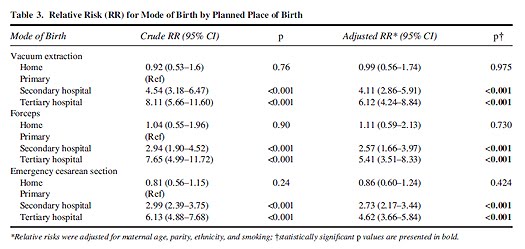
Women planning to give birth in secondary and tertiary hospitals had a higher risk of cesarean section, assisted modes of birth, and intrapartum interventions than similar women planning to give birth at home and in primary units. The risk of emergency cesarean section for women planning to give birth in a tertiary unit was 4.62 (95% CI: 3.66–5.84) times that of a woman planning to give birth in a primary unit. Newborns of women planning to give birth in secondary and tertiary hospitals also had a higher risk of admission to a neonatal intensive care unit (RR: 1.40, 95% CI: 1.05–1.87; RR: 1.78, 95% CI: 1.31–2.42) than women planning to give birth in a primary unit.

Here’s what the authors conclude:

Planned place of birth has a significant influence on mode of birth and rates of intrapartum intervention in childbirth.

Here’s what the authors deliberately tried to hide:

The neonatal death rate in the planned homebirth group was 1.1/1000. The neonatal death rate in the planned hospital birth group was 0.3/1000. In yet another example of a strikingly robust finding, planned homebirth in NZ had more than triple the neonatal death rate of planned hospital birth.

How was the study done?

Data were obtained from the [Midwifery Maternity Provider Organisation (MMPO) database] for a total of 39,677 births. Of these, 16,453 (41.47%) met the study’s low-risk criteria. Of this low-risk group, 11.3 percent were planning to give birth at home, 17.7 percent in a primary unit, 45.5 percent in a secondary level hospital, and 25.4 percent in a tertiary level hospital.

Where did the women ultimately give birth?

Most women gave birth in their planned place of birth; 82.7 percent of those planning a home birth, 90.2 percent planning to give birth in a birth center, 99.8 percent planning to give birth in a secondary hospital, and 99.8 percent planning to give birth in a tertiary hospital actually gave birth in their planned place of birth.

In other words, the transfer rate in the homebirth group was 17.3%; the transfer rate in the birth center group was 9.8%.

The authors are very excited about the difference in intervention rates among these groups, presented in the following table.

Not surprisingly, the risk of operative vaginal delivery and the risk of emergency cesarean section are much higher in the hospital. The authors do not define “emergency cesarean” but they apparently mean unplanned, not true emergency C-sections.

The authors also looked at secondary outcomes:

… Women planning to give birth in secondary or tertiary level hospitals were also at increased risk of artificial rupture of the membranes, augmentation of labor, pharmacological pain management, episiotomy, and neonatal admission to intensive care when compared with women planning to give birth in primary units. Those planning to give birth at home were at less risk of augmentation of labor, artificial rupture of membranes, pharmacological pain management, episiotomy, and perineal trauma than those planning to give birth in primary units…

So the homebirth group had lower rates of major interventions and the homebirth group had lower rates of minor interventions. How about deaths?

Well, funny you should mention that. There was a little bit of a problem there and the authors made a valiant attempt to hide it.

A total of six neonatal deaths (a death occurring up to 27 days after birth) occurred in the sample, two (0.11%) from women planning a home birth and four (0.15%) from women planning to give birth in the tertiary hospital. No intrapartum, intrauterine deaths were reported.

Hey, the death rates are exactly the same! Wait, what? The authors deliberately used the wrong denominator for calculating the hospital birth death rate?

Indeed they did. They compared the death rate at homebirth with the death rate in tertiary [high risk] facilities, but that’s not what we want to know. We want to know how the death rate at homebirth compares with the death rate at all hospital births, not the death rate at tertiary facilities.

What the authors should have told us was that there were two neonatal deaths (0.11%) among women planning a home birth and four (0.03%) from women planning to give birth in the hospital. In other words, the homebirth death rate was more than triple that of the hospital birth death rate. Oops!

The authors of this paper should be ashamed of themselves. They didn’t want anyone to know that homebirth had triple the neonatal death rate of hospital birth, so they deliberately obscured it by using the wrong denominator in their calculations.

The authors brazenly assert that no differences for planned place of birth were noted. That is simply a lie.

Homebirth in New Zealand has triple the neonatal death rate of hospital birth. The finding of lower intervention rates in the homebirth group is nothing to celebrate when more babies died as a result.

A failure from the moment of birth

Finally, a natural childbirth advocate willing to say what she desperately needs to believe really means. In a Facebook thread about women who have had C-sections, “Joni” pulls no punches:

Yes, they have failed at birth. They succeeded at making a baby and hopefully of caring for it, but they did fail the birth. And birth is so important for baby too. You can be scarred for life by it. There are women being persecuted so that all of us can have the birth that we want! There is a woman in Australia who is in trouble just because she wants every woman to have the choice to home birth! All of these people are anti choice for woman! Birth matters. It might matter most of all in life for woman!

Joni is pathetic brave. Joni doesn’t have any real achievements pander to those feeble excuses for women who couldn’t push a baby through their vagina.

But Joni doesn’t go far enough. When it comes to birth, it takes two to tango, and babies should accept their share of the blame. It isn’t just women who have failed by having a C-section; their babies have failed, too, and it’s time to be honest about it.

Babies who are premature? Failures.

Babies who have abruptions? Big failures.

Babies who suffocate and die during labor? The ultimate failures!

Now some of you might be thinking that we shouldn’t blame babies for things that they can’t control. Hello, babies are supposed to know how to be born. If you can’t get the timing right, if you can’t keep your placenta together, if you can’t get enough oxygen during uterine contractions, you obviously didn’t know how to be born.

How about the babies who don’t fit through the mother’s pelvis? Big babies, babies with asynclitic heads, transverse babies? Failures, failures, failures.

But is it really the baby’s fault if it grows bigger than a mother’s pelvis can accommodate? Duh! Everyone knows that a mother’s body won’t grow a baby too big for her to birth; therefore, it must be the baby’s fault.

And let’s be honest here. Some babies aren’t merely failures, they are evil failures. Evil because they gave their mothers pre-eclampsia, or gestational diabetes or even deadly peripartum cardiomyopathy.

It may sound harsh, but it’s true. Just like women are perfectly designed to give birth, babies are perfectly designed to be born through the vagina. If they can’t get with the program and have to come out by C-section, they are failures just like their mothers are failures.

Frankly, if they don’t know how to be born the right way, they don’t deserve to be born at all. We should just let them die and their failed mothers die with them. Because really — when it comes right down to it — the entire purpose of birth to push something through your vagina and if you can’t do that like Joni can, you don’t deserve to live.

If natural childbirth is so natural, why must it be taught?

If there’s one thing that all natural childbirth advocates agree upon, it is that natural childbirth requires preparation and education. Such education includes classes, books and websites. No natural childbirth advocate would ever propose doing what women have done for most of human existence, nothing. Here’s what I want to know: If natural childbirth is so natural, why must it be taught?

The answer, of course, is that the philosophy of natural childbirth has little if anything to do with childbirth in nature. It is an elaborate set-piece, designed to give participants the illusion that they have recreated nature. It bears about as much relationship to childbirth in nature as an infinity pool in your backyard bears to the local watering hole.

Indeed, in the paper The social nature of natural childbirth (Social Science and Medicine, December 2007), Professor Becky Mansfield, claims that rather than representing a return to nature, natural childbirth posits a specific set of social and cultural practices. Mansfield begins by asking the obvious:

… If childbirth is so natural, how can there be strategies to facilitate it? If it is instinctive, why does it need to be learned? …

The answer, of course, is that it is a conceit of privileged white women in first world countries in which a a specific set of cultural practices is imagined to represent “nature.”

Mansfield reviews natural childbirth books written for lay people, and identifies 3 types practices that appear to be required for natural childbirth to be natural. Although Mansfield concentrates on books, websites and childbirth classes exist to promote the same information.

1. Activities during birth

The first theme is the variety of activities during labor and delivery that the books represent as necessary for making a non-medicalized birth possible. This theme is “social” because the books represent natural childbirth as something women must do; according to these books they cannot do nothing or just anything.

Not only is doing nothing forbidden, but special equipment and preparations are necessary:

… Books promote having a range of props to help a woman be active (e.g., squat bars or birth balls) … The books place even greater emphasis on using the environment to help women be emotionally comfortable, on the premise that the wrong environment increases fear and anxiety (thereby inhibiting labor) while the right one reduces them…

2. Preparation

The second theme of these books – preparation – emerges from this emphasis on activities and learning. According to these books, women wanting birth without intervention must prepare themselves by doing a variety of things in advance…

Prescribed forms of preparation include physical preparation “as for an athletic event”, emotional preparation and elaborate “birth plans,” written documents meant to establish choices in advance.

3. Social support

The emphasis on choice of caregiver and place of birth is one indication that social support … is considered an integral part of natural childbirth… The books contend that social support makes natural childbirth possible by helping women build “trust” in themselves, their bodies, and the “natural” process of childbirth…

In other words, childbirth isn’t natural unless you pay money to someone to facilitate it.

The role of the caregiver as presented in these books is a complicated one… As a result (and despite their emphasis on instinct), books imply that women … rely on someone with knowledge, training, and experience to help figure out what is happening and what to do…

And let’s not forget all the “natural” interventions recommended by the caregiver, including

… a whole host of “non-pharmacological” practices meant to change the course of labor. Examples include herbal remedies, homeopathy, acupuncture, … massaging the perineum to prevent tearing, and transcutaneous electronic nerve stimulation (TENs machines) for pain relief. While books represent such interventions as “gentle” or “natural,” the message they send is that natural childbirth often does involve actively intervening in the birth process…

Evidently:

… “letting nature take its course” requires a complex sociocultural milieu that must be fostered through a range of social interactions.

Mansfield concludes:

… The books … represent natural childbirth as requiring social practice to make it successful… Thus, although the central theme first appears to be about letting nature take its course … [t]he central finding of this study is that proponents represent natural childbirth as a set of very specific social practices that are seen as facilitating nature, and in so doing, they also present a vision in which nature depends on social practice…

In other words, natural childbirth bears about as much relationship to childbirth in nature as an elaborately designed infinity pool in your backyard bears to the local watering hole. A quick look reveals a superficial resemblance, there’s a hole in the ground, water, rocks at the margins and plantings surrounding it all. But a more detailed analysis demonstrates elaborate planning, paid help, special tools to place the rocks, set in and care for the plantings and hidden technology like a water filter. There’s nothing natural about it.

Similarly, a quick look at natural childbirth reveals a superficial resemblance, but a detailed analysis demonstrates elaborate planning, paid help, special tools and hidden technology, such as fetal monitoring, blood pressure measurements, herbal supplements, chiropractic, and acupuncture.

Why must natural childbirth be taught? Because it is not natural; it is a simulacrum of natural designed to promote the conceit that privileged white women in first world cultures have returned to nature.

Adapted from a piece that first appeared on Homebirth Debate in January 2008.

There are none so blind as homebirth advocates who think they’ve “researched”

You knew it was coming. When Sarah Kerr was asked why she risked and lost the life of one of her children at a homebirth, she responded by insisting that she had “researched” the issue, and made her decision accordingly.

Kerr, like most homebirth advocates, was supremely confident about one thing. She was sure that she was more educated than the rest of us. She had done extensive “research” on the internet that had, in her view, qualified her to understand the risks and choose accordingly.

No doubt Kerr had done a great deal of reading. But what she, and other homebirth advocates, fail to understand is that their “research” has equipped them with nothing more than pseudo-knowledge.

Pseudo-knowledge has the appearance of real knowledge; it uses lots of big words, and it often includes a list of scientific citations. There’s just one serious problem; it’s not true and baby Tully is in a coffin in the ground because it isn’t true.

We are surrounded by pseudo-knowledge in everyday life and most of us understand that it isn’t true. Advertisements of all sorts of products are filled with pseudo-knowledge. Most of us are quite familiar with the language of pseudo-knowledge:

“Studies show …”
“Doctors recommend …”
“Krystal S. from Little Rock lost 30 pounds in 30 days …”

In the era of patent medicine, claims like these were usually enough to sell a product. But consumers have become more jaded and the language of pseudo-knowledge has become more sophisticated as a result. Contemporary pseudo-knowledge contains big, scientific words and sounds impressive. It also contains completely fabricated claims that have no basis in reality and which, not coincidentally trade on the gullibility of lay people. And it always contains citations to scientific papers that often don’t actually support the claims being made.

What do you really need to know to evaluate the safety of homebirth, particularly in the case of high risk like Kerr’s twins? Obviously, you need a thorough grounding in basic science and advanced knowledge of obstetrics. You need to have read and analyzed all the relevant textbooks and especially the relevant scientific papers (not simply the abstracts), and that, of course, requires an understanding of statistical analysis.

But wait! Science is hard and that’s unfair. Who has the time, the background or the ability to read and analyze all the relevant papers on homebirth? Not homebirth advocates. They lack knowledge of basic science and of obstetrics.Their math ability often trails off at arithmetic, leaving them no way to understand statistics, even if they bothered to read the relevant texts.

So if they’re not reading obstetric textbooks, and if they’re not reading the relevant scientific papers, and if they’re not analyzing statistics, what exactly are they doing when they are doing “research?” They are simply imbibing the views of other people who know just as little as they do.

Consider the lay bloggers. Who in her right mind could imagine that reading the nonsense spewed forth by simpletons like January of Birth Without Fear is “research”?

How about the self-described “experts”?

Barely a week passes on this blog without a lay person parachuting in to boast of all she has learned from her “research” encompassing the works of Henci Goer, Amy Romano, Barbara Harper or Ina May Gaskin. Don’t even get me started on Ricki Lake; she just makes it all up as she goes along. Their assertions mark them just as effectively as if they had tattooed “gullible” on their forehead.”

When it comes to homebirth and natural childbirth advocates their “research” is worse than worthless because they’ve acquired nothing more than pseudo-knowledge. Just about everything they think they “know” is factually false.

The truth about health education is both simple and stark. You cannot be educated about any aspect of health without reading and understanding scientific textbooks and the scientific literature. Period!

Don’t bother to claim that you are have done “research” on the internet or by reading the books and websites of other homebirth advocates. You haven’t acquired knowledge, you’ve acquired pseudo-knowledge, as well as the dangerous conceit that you know far more than you really do. Internet “research” marks you as a fool. That becomes a serious problem when you, like Sarah Kerr, decide to risk your baby’s life on no better foundation than your own “research.”

Adapted from a piece that first appeared in October 2010.

New study of delayed cord clamping shows no clinical benefit

Proponents of delayed cord clamping are really, really sure that it is better for babies, and they’re willing to look at ever more trivial outcomes to support their belief. Consider the paper published on Tuesday in the British Medical Journal, a major study of delayed cord clamping. Four hundred full term infants born after a low risk pregnancy were randomized to early or delayed cord clamping groups and after 4 months, the groups showed … no clinical difference.

No problem! The authors were apparently thrilled to discover some differences in lab values, despite the fact that both groups had normal lab results and are trumpeting this “benefit” far and wide in press releases.

Proponents of delayed cord clamping typically claim that it is beneficial primarily because it reduces anemia. This study, Effect of delayed versus early umbilical cord clamping on neonatal outcomes and iron status at 4 months: a randomised controlled trial, by Andersson et al., divided infants into two groups, early cord clamping (at ≤ 10 seconds after birth) and delayed cord clamping (≥ 180 seconds after birth). The main outcome measures were:

Haemoglobin and iron status at 4 months of age with the power estimate based on serum ferritin levels. Secondary outcomes included neonatal anaemia, early respiratory symptoms, polycythaemia, and need for phototherapy.

The results:

At 4 months of age, infants showed no significant differences in haemoglobin concentration between the groups …

… There were no significant differences between groups in postnatal respiratory symptoms, polycythaemia, or hyperbilirubinaemia requiring phototherapy.

Though there were no clinically relevant differences, the authors went looking for differences in laboratory values.

… infants subjected to delayed cord clamping had 45% (95% confidence interval 23% to 71%) higher mean ferritin concentration (117 μg/L v 81 μg/L, ≥0.001) and a lower prevalence of iron deficiency (1 (0.6%) v 10 (5.7%), P=0.01, relative risk reduction 0.90 [at 4 months of age] …

The authors trumpet these findings as supporting delayed cord clamping, but, in fact, they are basically meaningless. While it is of theoretical interest that infants in the delayed clamping group have higher normal iron stores, iron stores in and of themselves are not meaningful since they don’t affect health. The health parameters of interest are hemoglobin level and hematocrit (amount of red blood cells) and those are exactly the same.

The authors define iron deficiency as ≥2 indicators of iron status outside reference range (ferritin <20 μg/L mean cell volume <73 fL, transferrin saturation <10%, soluble transferrin receptor >7 mg/L). In both the early and delayed cord clamping groups, values for all parameters were well in the normal range. There is no reason to believe that that the having higher normal values (as in the delayed clamping group) offers any advantage over having mid-range normal values.

Of note, the authors chose to report on the two groups at 4 months of age. Other studies of delayed cord clamping have shown that differences in iron stores disappear by 6 months of age.

The authors make much of the difference in laboratory values, despite the fact that both groups were in the normal range:

We conclude that delayed cord clamping, in this randomised controlled trial, resulted in improved ferritin levels and reduced the prevalence of iron deficiency at 4 months of age… Two meta-analyses of clamping studies performed in low or middle income countries with a high general prevalence of anaemia found similar effects on ferritin as we did and concluded that this effect is clinically relevant and should lead to a change in practice. Iron deficiency even without anaemia has been associated with impaired development among infants. Our results suggest that delayed cord clamping also benefits infant health in regions with a relatively low prevalence of iron deficiency and should be considered as standard care for full term deliveries after uncomplicated pregnancies…

Let’s parse this carefully. Here’s what we can conclude:

  • Delayed cord clamping had NO effect on hemoglobin levels at 4 months of age.
  • Delayed cord clamping had NO effect on the health of the infants at any point.
  • Delayed cord clamping improved certain laboratory parameters, but both groups were normal.
  • In countries with a high prevalence of anemia (low and middle income countries), increased ferritin may be clinically relevant, but there is no evidence that increased ferritin is clinically relevant in high income countries.
  • Iron deficiency in the absence of anemia might be associated with impaired development, but there is no evidence that lower but normal iron stores are associated with impaired development.

What is really going on here? It is quite possible that although infants in the delayed cord clamping group received additional red blood cells, they did not need those red blood cells. Their bodies destroyed those cells and did not replace them, so that by 4 months of age, there was no difference in hemoglobin levels in the two groups. While this study indicates that the delayed group had higher iron stores at 4 months, this effect is known to disappear by 6 months and may simply represent the fact that the body has not yet been able to dispose of the excess iron left over from the extra red blood cells that it did not need.

In other words, this data could just as easily be interpreted to mean that, far from benefiting from delayed cord clamping, infants had to work to get rid of the excess (and unneeded) red blood cells and iron over a period of 6 months.

In any case, the key point is that the authors failed to show any demonstrable clinical benefit to delayed cord clamping in term infants.

Two questions for Australian midwife Hannah Dahlen

Yesterday I wrote about the callous and clumsy attempt of national media spokesperson for the Australian College of Midwives, Hannah Dahlen, to change the subject from the fact that homebirth increases the risk of perinatal death to … well to anything else.

In Home births: it’s time to broaden the focus of the debate, Dahlen makes the bizarre and morally indefensible claim that preventable perinatal mortality is an acceptable component of safe homebirth.

When health professionals, and in particular obstetricians, talk about safety in relation to homebirth, they usually are referring to perinatal mortality. While the birth of a live baby is of course a priority, perinatal mortality is in fact a very limited view of safety.

In light of her self-serving, obfuscatory piece, I have two questions for Hannah Dahlen.

1. Why don’t you say what you really mean?

Instead of struggling mightily with bizarre formulations attempting to justify broadening the definition of “safety” to include unsafe practices, Dahlen should just come out with the truth:

Australian midwives know that homebirth increases the risk of perinatal death, but we like homebirths and we are going to keep doing them.

Dahlen is not the first to struggle to make an intellectually and morally indefensible claim palatable by wrapping it in nonsensical language. Including the nonrational is sensible midwifery, by Jenny A. Parratt, and Kathleen M. Fahy, published in the Australian midwifery journal Women and Birth is a masterpiece of the genre.

The paper also argues for “broadening” the definition of the safety to include irrational beliefs and actions.

…What is deemed as safe is aligned with what is rational and what is unsafe is aligned with what is irrational. As irrationality is not acceptable this essentially forces the definition of safety to be thought of as ‘true’ even though it may not fit with personal experience and all situations…

Yes, that’s a real problem with rationality. It blasts apart the irrational claims of homebirth midwives. And homebirth midwives love the irrational:

… During birth, making room for the nonrational broadens both midwives’ and women’s knowledge about trust, courage and their own intuitive abilities …

This is just another (particularly pathetic) attempt to “broaden” the definition of safety to include unsafe practices that Australian midwives like. They know that many of their homebirth beliefs and practices are irrational and (by definition) not supported by scientific evidence of any kind, but they like them and they are going to keep doing them.

2. Aren’t you embarrassed to ask whose fault it is that women fear mainstream care when it’s your fault?

So when these women seek care outside our mainstream system, whose fault is it really? …

… When a woman chooses to have a homebirth with risk factors present, the question we need to ask is not ‘what is wrong with her’ but rather ‘what is wrong with a maternity care system that provides such limited options and inspires such fear that she would take on the added risk’?

These women do not love their babies less, they fear mainstream care more and this is a terrible indictment of our care.

This is what is known as “chutzpah,” a Yiddish word whose definition is best explained by example. When a man who has murdered both his parents begs the judge for mercy because he is an orphan, that’s chutzpah.

When a midwife who has made a career of demonizing mainstream care asks “who’s fault is it that women fear mainstream care?”, that’s chutzpah.

Dahlen is on record promoting fear of mainstream care, including claims that:

obstetricians want to restrict women’s choices

Hannah Dahlen, of the Australian College of Midwives, says [Dr. Pieter Mourik’s] comments represent the latest salvo in a ”scaremongering campaign” by obstetricians determined to stymie efforts to give women greater choice.

obstetricians perform unnecessary surgery because they are surgeons

Part of the reason we have such a high intervention rate is because normal, low-risk women are being cared for by highly specialised surgeons trained in surgery.

obstetricians care more about money that about women

We have a very powerful medical lobby in this country. They are desperate not to lose their sizeable market share of births…there’s huge money to be made.

and, my personal favorite, maternity hospitals mix up babies

University of Western Sydney professor and ACM (Australian College of Midwives) spokesperson Hannah Dahlan said that baby mix ups are one of the common errors that occur in maternity units.

Whose fault is it that Australian women fear mainstream care? It is, in large part, the fault of Hannah Dahlen and her colleagues, who never miss an opportunity to portray obstetricians as money grubbing surgeons who delight in forcing unnecessary interventions on women in facilities that routinely mix up babies.

Let’s be honest, Ms. Dahlen. Homebirth midwives like homebirths because they are in charge and they are not constrained by any petty concerns like rationality or whether the baby lives or dies. Your piece about “broadening the home birth debate” is nothing more than a justification for midwives continuing to do what they like regardless of whether it comports with the scientific evidence and regardless of whether it kills babies.

At least have the intellectual honesty and moral fortitude to tell the truth, instead of hiding it in obfuscatory language: homebirth midwives will continue to encourage, promote and attend homebirths, and the dead babies be damned.

Mortality a limited view of homebirth safety?

The ever growing list of homebirth deaths has become so long that even Australian midwives have recognized that it is foolish to claim that homebirth is safe. The new tack? Proclaim that “mortality is in fact a very limited view of safety.”

That’s what Hannah Dahlen, national media spokesperson for the Australian College of Midwives, has to say in a piece in the Australian press that is a masterpiece of callousness and obfuscation, Home births: it’s time to broaden the focus of the debate.

First, Dahlen acknowledges what everyone but homebirth advocates have always recognized:

… studies have shown that when women with high-risk pregnancies give birth at home the perinatal mortality is increased. In fact, the evidence is now substantial enough that we can identify where the greatest risk lies; for example, women giving birth to twins (especially the second twin) and breech babies.

In other words, one of the prime motivations for homebirth, to ignore medical advice on twins, breech, postdates and VBAC on the theory that avoiding a C-section is “safer” than hospital birth, is completely contradicted by “substantial” scientific evidence.

But wait! Whether the baby lives or dies is a “kindergarten” view of birth!

When health professionals, and in particular obstetricians, talk about safety in relation to homebirth, they usually are referring to perinatal mortality. While the birth of a live baby is of course a priority, perinatal mortality is in fact a very limited view of safety.

Really? On what planet would that be?

Can you imagine an obstetrician saying to patient that we ought to take a broader view of obstetrics than whether her baby lives or die? Can you imagine hospitals declaring to expectant parents that there is more to consider in choosing a place to give birth than whether the baby lives or die?

There may be factors in addition to perinatal mortality that contribute to safety, but there is no possible view of safety that does not place mortality (perinatal and maternal) at the center of obstetric care. I’d be the first to agree that there is more to safety than merely ensuring the baby lives, but there is no possible justification for a definition of “safety” that includes letting the baby die.

Dahlen’s claim is not simply an exercise in extreme callousness, it is a particularly clumsy effort at “re-framing the conversation.” Just like MANA (Midwives Alliance of North America), Australian midwives are taking a page out of the tobacco company playbook (What do homebirth midwives and tobacco executives have in common?).

As the Tobacco Institute explained to its members:

Our judgement, confirmed by research, was that the battle could not be waged successfully over the health issue. It was imperative, in our judgement, to shift the battleground from health to a field more distant and less volatile…

Now Australian midwives have recognized that the homebirth debate cannot not be waged successfully over the issue of safety, since hospital birth is clearly safer. Therefore, it’s time to change the battle field.

Let’s compare:

Tobacco industry:

… [W]e try to change the focus on the issues. Cigarette tax become[s] an issue of fairness and effective tax policy. Cigarette marketing is an issue of freedom of commercial speech. Environmental tobacco smoke becomes an issue of accommodation. Cigarette-related fires become an issue of prudent fire safety programs. And so on.

Dahlen:

Freedom? Check.

Women’s right to control what happens to their bodies during pregnancy and birth may be enshrined in law but this right is frequently violated in practice. I find it ironic that the same professionals who fight for the right for a woman to terminate her pregnancy will fight against her right to give birth at home. The law in this country is on the side of women and self-determination.

Accommodation? Check.

It is time to stop talking about the statistics and start working together to make home birth and hospital birth as safe (physical, cultural, emotional, social, psychological and spiritual) as it can be.

Prudent safety programs? Check.

Home birth will not go away, it is here to stay, so let us all share the responsibility for making it safe and satisfying, as should be our goal with all maternity care options.

And, above all else, changing the focus? Check

The debate around home birth is about more than place of birth or associated perinatal mortality, it raises deeper and more complex issues: the right of women to have control over their bodies during childbirth, the rejection of the prevailing medical model and risk paradigm of pregnancy and childbirth, societies’ belief that they have an investment in the product of childbirth and therefore should determine what is considered safe, the culture of childbirth in a country and the position and status of women within a society.

Nice try, Ms. Dahlen, but the rest of us are not fooled.

Dahlen has essentially conceded the homebirth debate. She acknowledges that the scientific evidence shows that hospital birth is safer. Now she’s merely making callous and clumsy attempts to change the subject.

Dahlen should be ashamed of herself. The birth of a live baby is not a priority, it is the priority. Any midwife who believes otherwise demeans the profession.

How many babies died at the hands of Oregon homebirth midwives?

No wonder Melissa Cheyney refuses to release the death rate of Oregon homebirths.

In August, I wrote:

The minutes of the August 5, 2010 Board meeting reports that the state of Oregon asked for the ability to retrieve information on Oregon midwives from the database:

“Cheyney stated that the MANA board’s official policy is to give state-level accounts to professional organizations as a tool to evaluate areas where more training might be needed for the purpose of self regulation, and to not provide the data to regulatory entities.”

In other words, the database is only to be used by MANA itself, and not shared with anyone who could potentially identify unqualified midwives and discipline them.

It doesn’t take a rocket scientist to speculate that there have been an extraordinary number of deaths. Now comes information from a new source that confirms that suspicion.

A new website, Oregon Homebirth Midwife Info, has compiled a Midwife Directory that makes for stomach-churning reading. The directory lists midwives by name and includes reports of deaths as well as other major morbidity and actions taken against the midwives.

It is an incomplete list; not all Oregon midwives are included and there may have been additional deaths that are not recorded. Nonetheless, the statistics are no less than horrifying.

In the past decade, no less than 19 babies have died at the hands of Oregon homebirth midwives.

To put that in perspective, consider that there are approximately 1000 homebirths per year in Oregon and that the neonatal death rate for low risk women in a hospital setting is 4/10,000 (0.4/1000). That means that you would expect approximately 4 homebirth deaths per decade. Instead there were at least 19 deaths, for a rate more than 4X higher (375%) than expected.

No less than 16 midwives have presided over at least one death. Interestingly, only 2 were unlicensed midwives. The rest were licensed at the time of the death(s) and almost all had complaints filed against them with the Board of Direct Entry Midwifery. In other words, this information is available to Melissa Cheyney in her role as a member of the Board.

Homebirth kills babies. No one knows that better than Melissa Cheyney, who has, until now, successfully hidden the number of homebirth deaths at the hands of Oregon homebirth midwives, and who continues, in her role as Director of Research at MANA (Midwives Alliance of North America), to hide the number of babies who died at the hands of homebirth midwives across the country.

Midwife : UK deaths result of failing to meet the needs of … midwives ?

Two weeks ago I reported on 15 deaths at two hospitals in the United Kingdon (Promoting normal birth is killing babies and mothers). The 15 tragedies were united by the fact that midwives were so busy promoting “normal” birth that they failed to recognize complications or refused to refer patients to specialists in the face of complications.

The mounting death toll of midwife attended preventable neonatal deaths and preventable maternal deaths demonstrates that efforts to promote normal birth kill babies and mothers. That’s not surprising when you consider that promoting normal birth is fundamentally unethical.

An ethical medical professional recommends whatever is safest for the patient, not whatever is most beneficial for the provider.

Last week I posted the story of Joshua Titcombe, whose needless, senseless, entirely preventable death occurred at the hands of midwives who refused to acknowledge that he was ill and never alerted a pediatrician.

Today I came across the response of a midwifery professor published in The Guardian. According to midwife Sarah Davies, we need a new model for maternity care, not blame for individuals, a piece which could more aptly be titled “mistakes were made … but not by us.”

It’s a masterpiece of the genre employed by errant politicians and corporate malfeasors, the non-apology apology.

Ms. Davies acknowledges that mistakes were made, specifically mentioning:

… two maternal deaths at Queen’s hospital in Romford that should never have happened, and the abusive and neglectful behaviour by midwives …

… individual midwives treated women with disrespect – one midwife was heard to say: “Hurry up, or I’ll cut you.” …

Concluding:

But blaming individuals for failing to care is no solution when the whole system is wrong.

Actually, blaming individuals for their unacceptable, unprofessional behavior is an excellent solution. We even have a special word for that solution. The word is “accountability.” Health professionals who commit malpractice (for that is precisely what happened in these instances) should be held personally accountable for their failings.

According to Ms. Davies, though, the midwives are not responsible for those deaths, “the system” is responsible. In a remarkable bit of rhetorical jujitsu, Ms. Davies insists that the failure of the midwives to obtain help from other clinicians (obstetricians and neonatologists) is the result of a shortage of … midwives!

… the circumstances described reflect the continuing neglect of pregnant women’s core needs. The government has chosen not to recruit the 5,000 additional midwives the Royal College of Midwives has repeatedly stated are required.

Those two sentence sum up what is wrong with the UK maternity system, though not in the way that Ms. Davies had in mind.

First, Ms. Davies deliberately conflates the needs of pregnant women with the needs of the midwives who care for them. The core need of pregnant women is for safe, professional, compassionate maternity care. The core need of UK midwives is apparently full employment for UK midwives.

Second, is there a shortage of midwives in the UK? Perhaps, but this is not an example of it. These were not overworked midwives who did not have the time to attend to their responsibilities. These were midwives who had more than enough time to “care” for patients who should have been cared for by specialists.

These tragedies occurred because midwives deliberately took on work that properly belonged to others in an apparent effort to protect their turf. The preventable deaths at both hospitals include cases in which obstetricians were told that their help was not needed and parents were told that the expertise of pediatricians was unnecessary.

Thirteen babies and mothers are dead at the hands of midwives, but Ms. Davies apparently thinks that this is the perfect opportunity to praise midwives:

All the research indicates that continuity of midwifery care gives the best physical and psychological outcomes for women and babies …

Apparently not, since thirteen babies and mothers are dead specifically because their midwives did not provide the best care.

Student midwives … are dedicated, caring individuals who make many sacrifices as they learn how to help women have a safe, satisfying birth experience …

How nice, but what does that have to do with the disasters that occurred? Nothing.

Because of the lack of recruitment, many newly qualified midwives struggle to find posts.

How sad, but what does that have to do with the disasters that occurred? Nothing.

For the long-term health of mothers, we desperately need a different model for maternity care – one that is community based; gives midwifery continuity; and where birth takes place at, or close to home for most healthy women.

Really? Would community based care, homebirth and midwifery continuity have prevented any of the thirteen deaths? Of course not, but it would lead to greater employment opportunities for midwives and that’s more important.

What led to the deaths of these babies and mothers? Midwives putting their needs ahead of the needs of patients. Ms. Davies is doing the exact same thing in this piece: putting the needs of midwives ahead of the needs of mothers.

Dr. Amy