Fear of flaccidity

Asian guy pulling warm pant. with copy space

On Sunday, Secretary of State Rex Tillerson, speaking about his genitalia, declared: “I checked. I’m fully intact.”

Tillerson was responding to Senator Bob. Corker’s criticizing President Trump’s public undercutting of his Tillerson on the issue of North Korea: “You cannot publicly castrate your own Secretary of State …”

[pullquote align=”right” cite=”” link=”” color=”” class=”” size=””]For a man who feels emasculated by competition from women, what better way could there be to marginalize them than natural parenting?[/pullquote]

It’s not an accident that the state of men’s genitalia has become a political issue. Trump’s favorite epithet, “little,” was first used in conjunction with Marco Rubio and most recently in regard to North Korea’s dictator. It’s also behind the derogatory claim that Trump has little hands. The charge of emasculation is Trump’s most vicious insult because it is his deepest fear. And it’s also the fear of his most ardent supporters.

In some ways, the events of the past two years seem inexplicable. Voters (though not a majority) ignored the successes of President Obama and elected his polar opposite. Where Obama is devoted to diversity and overcoming prejudice, Trump is a racist; where Obama is notably uxorious and supportive of equality for women; Trump is a thrice married sexual predator; where Obama is brilliant, Trump is a moron (as Tillerson noted); where Obama is urbane, Trump is a pig. Most importantly, where Obama was secure in his masculinity, Trump lives in desperate fear of flaccidity.

That fear lead to the irrational hatred of Hilary Clinton and the dread of a female president animating both Trump and his most ardent supporters. Instead they turned to toxic masculinity.

What is toxic masculinity?

According to Wikipedia:

Toxic masculinity is a cultural perspective held by individuals which emphasizes the ideology and importance of men maintaining a dominant, aggressive, unemotional and sexually aggressive attitude, both collectively and as individuals …

Men in the grip of toxic masculinity feel emasculated by women, by black people, by gay people and by the fanciful threat of immigrants stealing their jobs. Such fearful men preserve their sense of masculinity by flaunting misogyny, racism and homophobia. It is critical to their self esteem to put women, black people and gay people back “in their place.”

What does this have to do with natural childbirth, breastfeeding, attachment parenting and the other topics that I typically write about? Quite a bit, as it turns out. Misogyny and “pussy grabbing” are overt reflections of men’s fear of being emasculated by women’s increasing power; a far more subtle manifestation is the phenomenon of natural parenting.

In a society where women can no longer be forced to stay immured and unthreatening in the home, natural parenting is the perfect stealth method for manipulating women into believing they must stay home, in retreat from the public arena. While ostensibly promoting the wellbeing of infants and small children, natural parenting is really about weighing down mothering with so much work and so much moralizing that a “good mother” can’t possibly do anything but mother.

Grantly Dick-Read was painfully honest that he created the philosophy of natural childbirth as a way to keep women at home; only there could they find true happiness by fulfilling their biologic destiny, and then they would stop agitating for political, legal and economic equality, thereby assuaging men’s fears of impotence and emasculation

La Leche League and the lactivist movement were founded for similar reasons. Their message that breastfeeding is obligatory because Nature intended for women to breastfeed is a reflection of their belief that staying home is obligatory because God intended for women to stay home and assuage men’s fears of impotence and emasculation.

Attachment parenting purports to reflect the science of attachment, but is the exact opposite of what we know about infant attachment. The reality is that attachment parenting reflects the Bill and Martha Sears fundamentalist Christian beliefs about traditional gender roles where women are subservient to men, thereby assuaging their fears of impotence and emasculation.

Natural parenting is predicated on the notion of the man as breadwinner and the woman as nurturer. It both assumes and requires that women ought to be judged by the function of their reproductive organs instead of their intelligence, talents and character.

Natural parenting strips women of political and economic power and insists that they can be “empowered” by refusing pain relief in childbirth or breastfeeding their babies. If you were a misogynist who felt emasculated by competition from women in business, science and politics, what better way could there be to marginalize women once again than to divert them into competing over who has the better vagina and breasts?

White men are accustomed to privilege. When you’re accustomed to privilege, equality feels like oppression … or worse, it feels like impotence and emasculation. Fear of flaccidity leads inevitably to misogyny, but that misogyny does not have to be overt. Convincing women to retire from the arena to obsess about their reproductive organs and their children’s well being looks different from whining about diversity in tech or bewailing a “witch hunt” over sexual predation, but it’s just as effective in reducing men’s fears.

Surprise! Mothers don’t need to suffer to raise happy, healthy children

IMG_3518

Our deepest assumptions often go unexamined. That’s especially true if we live in a culture that takes those same assumptions for granted. One of the central assumptions of modern, Western culture is that raising happy, healthy children requires that mothers suffer.

I suspect that this bedrock assumption goes back at least to the Book of Genesis, which sought to make sense of the agony of labor by declaring that God wanted women to suffer as punishment for Eve’s indiscretion; as a result, she and Adam were driven from the Garden of Eden. It’s analogous to the ancient Greek idea that thunder is the result of gods fighting; it’s a poor effort to explain natural phenomenona that could not be understood in the absence of science. The big difference is that no one now believes that thunder is caused by the gods, while many people still believe that suffering is integral to motherhood.

[pullquote align=”right” cite=”” link=”” color=”” class=”” size=””]A central assumptions of modern, Western culture is that raising happy, healthy children requires maternal suffering. [/pullquote]

What is natural childbirth, really, beyond the assumption that suffering unmedicated agony in an attempt to have a vaginal birth is “better” for babies?

Sure, you can dress it up with fancy scientific sounding rationalizations like the claims that epidurals interfere with labor and harm babies (both shown to be false) or fabricated nonsense that labor pain is necessary for mother-infant bonding (for which there is no evidence whatsoever). If you’re going to lie, why not go all the way and try to convince women that their agony is good for them? They can be “empowered” by it.

Pro-tip: If it doesn’t empower an Afghan teenager to give birth without pain relief or medical assistance, it isn’t going to empower a privileged white woman who fetishizes refusing those same things.

There’s really no limit to the trade offs that natural childbirth advocates encourage women to make. Sure, vaginal birth might lead to tears from the clitoris to the anus, might result in urinary and fecal incontinence and sexual dysfunction but, but, but the microbiome!!! But, but, but epigenetics!!! There is no ostensible benefit to a baby too theoretical or unproven that it can’t be used to convince women that they deserve to suffer.

Lactivism is exactly the same. Breastfeeding advocates are forever fabricating new “benefits” of breastfeeding from poorly designed, weak studies that offer conflicting data, riddled with confounders. No matter that all their predictions about the lives and money saved by increasing breastfeeding rates have failed to materialize despite massive increases in breastfeeding rates over the past 40 years.

In agony because it feels like someone is macerating your nipples every two hours? Exhausted because you have to pump between feeding sessions to boost your supply? Unable to treat your postpartum depression for fear that the medication will contaminate your breastmilk? So what? Mothers must suffer because formula has “risks.” Let’s ignore the fact that two entire generations of Westerners were raised on formula and during those years every possible parameter of infant health continued to improve at the same rate as before formula became popular.

You want to give your baby formula because it is more convenient for you? How dare you imagine that you have the right to work, to rest, to control your own body? Only amoral, self absorbed harridans consider their own wants and needs.

Attachment parenting is the ultimate manifestation of the belief babies need their mothers to suffer in order to be happy. Attachment parenting postulates that mothers must serve as bedraggled chew toys for babies. Mothers are counseled that they can never leave their babies’ sides even to sleep or those babies will grow up to be neurotic failures. Curiously, the rise of attachment parenting has been accompanied by a rise in psychiatric disorders among children and teens, not to mention an increase in anxiety, depression, hospitalization and suicide among young people. There’s no evidence that attachment parenting caused this rise in mental health problems, but there’s certainly no evidence that it prevented it.

Don’t get me wrong, parenting (not just mothering) requires sacrifice. Parents sacrifice money, time, convenience and indulgences in order to raise children. But it does NOT require maternal suffering. There is precisely zero evidence that women who suffer in labor have children who are happier or more successful. There’s no evidence that women who suffer to breastfeed have provided anything beyond trivial health benefits for their children. And there’s never been evidence that attachment parenting is based on anything beyond the religious prejudice and misogyny of Bill and Martha Sears, who believe that God wants women subservient to men and immured in the home.

So if suffering is not integral to raising happy, healthy children, why are natural parenting advocates exhorting women to suffer? Because one of the central unexamined assumptions of our culture is that women deserve to suffer.

We have a word for that assumption: misogyny.

It’s time to reject suffering and misogyny in parenting … and in every other sphere of life.

Mother dies from breastfeeding

Tombstone Mother

Sugh a tragic, senseless waste of life!

From The Sun:

Rhianne Statom-Barnett, 30, was worried the prescription-only medication might affect her three-month-old son George through the transfer of baby milk.

Her mother explains what happened when Rhianne developed a severe ear infection:

[pullquote align=”right” cite=”” link=”” color=”” class=”” size=””]Cause of death: the culture of maternal self-neglect that is at the heart of breastfeeding promotion.[/pullquote]

Her mother Beverly, 55, told the hearing her daughter booked a GP appointment where she compared the pain to giving birth.

Beverly, a nurse, said: “We looked at her ear and it had blood and fluid coming out of it.

“She said she had a severe headache and her ear was hurting a lot. She said it was worse than labour pains.”

Three days later she found her daughter unconscious in her bed after George started at crying at 5am.

Beverly said: “She had vomited and when I called out her name she didn’t respond we called an ambulance.

“At hospital the senior doctor came out and told us that Rhianne was effectively brain dead. It was heartbreaking.”

Breastfeeding — and the culture that surrounds it — killed this mother as surely as if a lactivist had taken a gun and shot her through the head.

Here’s what I’d like to know:

Where did this young mother get the idea that antibiotics would be harmful to a breastfeeding child?

Why wasn’t her doctor able to reassure her that most antibiotics are safe during breastfeeding and prescribe an antibiotic that was known to be safe?

How did Rhianne come to believe that suffering in agony (describing the pain as worse than labor) was necessary to protect her baby?

Who encouraged Rhianne to risk her hearing, health and life as less important than breastfeeding her baby? Did she reach out to a Facebook group that supported her decision to refuse antibiotics? Did she consult a lactation professional who told her that she must avoid medication of any kind regardless of the risk to her?

Of course determining the answers to these questions doesn’t change the bottom line: a young mother is dead because of breastfeeding.

No doubt, the lactivists will be parachuting in to tell me that I mustn’t blame breastfeeding. They will insist that it wasn’t breastfeeding that killed this mother, it was the bacteria in her ear.

Yes, the bacteria were the proximate cause, spreading from her ear to the bones of her skull and then to her brain, but the real cause was the veneration of maternal self-neglect that is at the heart of breastfeeding promotion and, indeed, all natural mothering.

The three ideologies that sail under the natural parenting flag — natural childbirth, breastfeeding and attachment parenting — are promoted as both recapitulating mothering in nature and better for babies. Neither is true. All were created explicitly as anti-feminist projects designed to force women back into the home.

For example, La Leche League, the prime mover within the breastfeeding industry, was founded by a group of devout Catholic women who were deeply concerned that women with small children were working outside the home. They reasoned that Mary, mother of Jesus, would never have worked and that promoting breastfeeding would lead women to emulate Mary and to give up their jobs.

All three philosophies share another thing in common: the belief that the women’s needs are irrelevant, rendered invisible by the purported needs of babies. The breastfeeding industry treats women like cows: milk dispensers and nothing more.

A mother’s pain is irrelevant. For lactivists, just because a mother has cracked and bleeding nipples is no excuse for her to avoid breastfeeding.

Breastfeeding difficulties are irrelevant. Regardless of the difficulty (poor latch, flat nipples, poor suck, insufficient breastmilk) and regardless of the severity of the difficulty the lactivist prescription is always the same: “Breastfeed harder.”

A mother’s need for sleep is irrelevant. She is supposed to dispense breastmilk 24/7/365.

A mother’s need to control her own body is irrelevant. If breastfeeding makes her psychologically uncomfortable, she’s supposed to get over it.

A mother’s mental health is irrelevant. Lactivists are much more concerned with whether treatments for postpartum depression are compatible with breastfeeding than with whether they are the best possible treatment for the mother’s psychological condition. The mother must continue dispensing breastmilk even if she is inexorably approaching psychological collapse.

Maternal self-neglect is the order of the day. It’s hardly surprising then that a breastfeeding mother risked her own life, refusing antibiotics and enduring excruciating pain, in order to ensure that her breastmilk was pristine.

There is something very, very wrong when breastfeeding is promoted so aggressively (despite trivial benefits) that women are encouraged to neglect themselves to the extent that they end up dead.

A mother’s health and sanity is infinitely more important to her child than any amount of breastmilk.

Michel Odent, another old white male mansplainin’ childbirth to us womenfolk

IMG_3514

Heeeee’s baaaaack!

Michel Odent is back with another of his wacky, entirely fabricated theories about childbirth.

Michel Odent has moved from being the benign natural-birth pioneer to a doomsayer predicting that caesarean sections will increase autism spectrum disorders and change humanity on an evolutionary level.

And the doom he foretells?

The Birth of Homo, The Marine Chimpanzee theorises that the way babies are delivered could be one cause of increased numbers of developmental disorders, psychological problems and addictive behaviours. He has interpreted epidemiological studies that show that a high number of children born by caesarean section or induction go on to be diagnosed with an autism spectrum disorder in support of his theories.

I beg to differ, Odent hasn’t “moved.” Natural childbirth has always been about preaching doom for those who give birth using technology.

[pullquote align=”right” cite=”” link=”” color=”” class=”” size=””]Natural childbirth has always been about old white men insisting that women must suffer agonizing pain or “bad things” will happen.[/pullquote]

It’s always been about old white men, mansplainin’ childbirth to us poor, benighted womenfolk, insisting that we must suffer agonizing pain or “bad things” will happen.

And it’s always about controlling women and their bodies.

It started with opposition to the use of chloroform in childbirth. Both religious leaders and doctors opposed the use of pain relief as a violation of God’s wishes that women suffer in childbirth to atone for Eve’s original sin. The only thing that has changed more than 150 years later is the nature of the “bad things.”

The father of childbirth mansplainin’ was Grantly Dick-Read, a eugenicist, who freely admitted that his claims were intended to get white women of the “better” classes back into the kitchen and pregnant, instead of agitating for political and economic rights.

Odent is also a eugenicist. He claims:

One effect of modern obstetrics is to neutralise the laws of natural selection – the laws that foiled us all [in the past]. We have neutralised those laws. It means that at the beginning of the 20th century, a woman who could not give birth naturally would die, whereas the one in the village who could give birth easily would have 12 children. Today, the number of children one has depends on other factors than the physical capacity to give birth.

Like most eugenicists, Odent betrays a fundamental misunderstanding about evolution. Natural selection does not lead to survival of the perfect, but rather survival of the fittest. Fitness changes when the environment changes. Those who are best able to exploit the environment in which they live are the fittest. In a highly technological society like ours, the ability to exploit technology is a key to fitness.

The graph below vividly illustrates the truth of this:

IMG_3508

The acquisition of technology fueled explosive population growth, the ultimate measure of evolutionary success. The use of technology does not “weaken” the human race, it strengthens it.

This is not Odent’s made up nonsense. That includes his famous lie that childbirth pain is necessary for maternal-infant bonding and his fear of attending the births of his own children:

As it happens, at the exact moment our son arrived in the world, the midwife was on her way down the street and I, having made my excuses realising he was about to be born, was fiddling with the thermostat on the central heating boiler downstairs.

My partner did not know it, but I had given her the exceptionally rare, but ideal situation in which to give birth: she felt secure, she knew the midwife was minutes away and I was downstairs, yet she had complete privacy and no one was watching her.

It is easy for to understand that Odent’s “theory” of fathers at birth is nothing more than a projection of his own anxieties. His other theories are no different. They reflect the standard misogyny of old white mansplainers: women are meant to suffer, men must tell them how to give birth, and prejudice can be dressed up as the “science” of eugenics, masquerading as concern for the future of the human race.

According to Odent:

…So if we say that everyone can have a baby, from a short-term perspective, that is positive. But I am not talking about the short term, I am thinking of the future of mankind. There have been human beings on this planet for millions of years and how long can humanity survive now? It’s probably a negligible number of years in comparison with the past.”

The truth is exactly the opposite of Odent’s eugenics. When technology allows everyone to have a baby, and technology protects every baby’s health and brain function, the result is not an epidemic of feeblemindness and genetic weakness, but vitality, longetivity and accomplishment such as we have never known.

A new paper on breastfeeding and guilt

HELP!

A new paper, Resisting Guilt: Mothers’ Breastfeeding Intentions and Formula Use by Holcomb, explores what happens when breastfeeding is represented as a “choice” that is an unalloyed good for all babies and all mothers.

Although lactivists insist that such a claim is the inevitable result of scientific research, in truth the claim is a cultural construct. The reality is that breastfeeding is often not a matter of choice, and is not an unalloyed good for either mothers or babies. Many mothers live in that intersection between reality and cultural imperative, an intersection that is saturated with guilt. Holcomb seeks to understand how women manage that guilt.

[pullquote align=”right” cite=”” link=”” color=”” class=”” size=””]Breastfeeding is often not a matter of choice, and is not an unalloyed good for either mothers or babies. [/pullquote]

The paper offers an excellent exposition of the scientific evidence and the cultural dominance of a narrative that was created by and for privileged, mostly white women to suit themselves.

Lactivists encapsulated their views in the phrase “Breast is Best,” but:

It is important to note, however, that the research upon which this perception of “breast is best” is based has been critiqued… Some researchers argue that the positive benefits are often overstated; that research studies indicating a lack of significance are downplayed; and that broader family characteristics, such as socioeconomic status, have more of an impact on health outcomes than does breastfeeding… [M]any of the benefits of breastfeeding become statistically insignificant in within-family models that look at differences between siblings where one child was breastfed and the other was not… Despite these critiques, the discourse of “breast is best” maintains a powerful status.

Moreover, breastfeeding rates are closely correlated with socioeconomic factors:

…[P]rior research on breastfeeding indicates that age, level of education, income, race, and ethnicity are correlated with breastfeeding behaviors… Some scholars point to structural barriers, such as maternity leave policies, inflexible work, inadequate healthcare, and complex historical factors as some of the reasons behind these differences.

In other words:

Hegemonic understandings of good mothering include breastfeeding, but it is critical to keep in mind the raced and classed nature of those understandings.

How do women deal with the resulting guilt? They do this by resisting the fundamental claims of lactivism.

Breastfeeding is often NOT a choice.

..[W]omen in this study often found things beyond their control. Even though they knew the benefits of breastfeeding and tried to find medical staff supportive of breastfeeding, they experienced aspects of the process that were outside of their control—they had their own medical emergencies, formula was used without their consent, and those with medical authority recommended using formula. These mothers did not discuss their use of formula in terms of regret, guilt, or failure but rather as something that happened, at the advice of medical staff, despite their best laid plans.

In addition, breastfeeding is not a choice when women up to 15% of first time mothers are unable to produce enough breastmilk to fully nourish an infant. Moreover, some infants have difficulty obtaining milk from the breast because of poor sucking ability or structural issues (tongue-tie).

It isn’t merely physical factors that make breastfeeding difficult or impossible; socioeconomic factors also contribute.

…[B]reastfeeding occurs within a complex social context that can include working or going to school. When social context is included in discussions of breastfeeding, breastfeeding success becomes more than an individual decision and individual knowledge, incorporating factors such as work, school, racial and ethnic traditions, and historical factors.

Breastfeeding is not good for every baby.

Infant health is put at risk if mothers are not able to produce enough breastmilk. Babies suffer terribly from hunger, screaming for hours on end. Without formula supplementation some babies will develop dehydration, hypoglycemia, severe jaundice, failure to thrive, brain damage; some babies will even die. Contrary to the claims of lactivists, these harmful results are, unfortunately, not rare.

Breastfeeding is not good for every mother.

In the cosmology of lactivism, mothers are reduced to milk dispensers. But mothers are people and they matter. There is nothing beneficial to mothers from pain, frustration, exhaustion and postpartum depression.

…[M]others found the use of formula to be acceptable in that it allowed them to alleviate stress associated with continued breastfeeding or provided them the opportunity to focus on other aspects of well-being. Using formula allowed mothers to focus on other things, such as making homemade baby food, being present at work, and nurturing relationships with partners. Their children seemed to transition to formula smoothly, without upset intestinal tracts or lengthy episodes of crying. Given the stress and anxiety that they experienced during breastfeeding, and the ease of using formula, the mothers decided that using formula enhanced the greater good and that the method of nutritional delivery was not the only factor contributing to family well-being.

Combination feeding or exclusive formula feeding are often best for individual babies, individual mothers and individual families.

The ultimate irony, of course, is that strenuous efforts to increase breastfeeding rates have been ineffective. That’s just what you would expect when breastfeeding is not simply a choice, and is often experienced by babies are mothers as harmful, not healthful.

As Holcomb notes:

The women in this project—who were mostly white, highly educated, with higher earnings and who wanted to breastfeed—should have been “successful” breast feeders. It is particularly telling that even with this sample demographic, nine mothers (40%) used formula within the first week. Only six mothers (27%) breastfed for an entire year without using formula. Eight mothers (36%) had completely stopped breastfeeding by six months. The challenges they experienced are worth exploring in more detail, as they were mothers who wanted to breastfeed and who, demographically speaking, were expected to breastfeed for longer periods.

This is a small study and ought to be repeated on a larger scale before we can draw firm conclusions. But it does highlight an important fact:

…Breastfeeding is a process that unfolds over time (often in response to unexpected challenges along the way) and occurs within a context in which many other factors are significant. Future discussions of breastfeeding need to move beyond a focus on individual mothers and toward a recognition of how various aspects of social context impact breastfeeding experiences.

In other words, it is inaccurate to frame breastfeeding as a choice or best for either babies or mothers. The incontrovertible truth is that Fed Is Best. And the privileged, white women (such as myself) who have breastfed successfully are just lucky, not superior.

Children of pregnant vegetarians more likely to abuse drugs and alcohol

Woman Slumped On Sofa With Drug Paraphernalia In Foreground

I am not making this up.

STAT News reports:

Children of women who ate little or no meat while pregnant are more likely to abuse alcohol, tobacco, and marijuana at age 15 than are children of mothers who did eat meat.

That’s the conclusion from a new study Meat Consumption During Pregnancy and Substance Misuse Among Adolescent Offspring: Stratification of TCN2 Genetic Variants published in Alcoholism Clinical and Experimental Research.

[pullquote align=”right” cite=”” link=”” color=”” class=”” size=””]Until a result is reproduced, it ought to be viewed as interesting, but speculative and unproven.[/pullquote]

How was the study performed? According to STAT News:

Researchers analyzed data from 5,109 women and their children in a long-running study in England called ALSPAC (the Avon Longitudinal Study of Parents and Children), which has gathered years of data on what women did while pregnant and their children’s health. The less meat the women ate while pregnant, the more their children’s risk of drinking, smoking, or using marijuana as 15-year olds, Dr. Joseph Hibbeln of the National Institute on Alcohol Abuse and Alcoholism of the National Institutes of Health and his colleagues reported on Wednesday in Alcoholism: Clinical and Experimental Research. (They were funded by the U.S. and U.K. governments and a charity, not meat producers.)

Roughly 10 percent of the 15-year-olds smoked at least weekly, drank enough to have behavioral problems, or used marijuana “moderately.” But teens of meatless moms were 75 percent more likely to have alcohol-related problems, 85 percent more likely to smoke, and 2.7 times as likely to use marijuana compared to teens of mothers who’d eaten meat while pregnant.

Children of pregnant vegetarians are more likely to abuse drugs and alcohol.

Ironic, isn’t it, that a diet thought by its practitioners to be healthier is actually harmful to developing babies?

Ironic … and almost certainly untrue.

This research represents a cautionary tale, not about the risks of vegetarianism, but about the risks of p-hacking, a practice beloved of some scientists, particularly those in the field of breastfeeding research.

P-hacking often occurs in the analysis of large data sets. It refers to the value “p” used to determine statistical significance. A difference between two groups is only meaningful if it is statistically significant, expressed as the chance that the findings are due to chance. For example, a p value less than 0.001 means that there is a less than a 0.1% chance that an observed finding is due to chance and a greater than 99% chance that it represents a real difference.

Researchers look for statistically significant differences between two groups. Then they announce them as “findings” without acknowledging that any large dataset looking at multiple outcomes is bound to have random statistically significant differences that are coincidental and don’t represent real outcomes. Indeed, by definition using a p value of less than 0.001 means that almost 0.1% of the differences that appears to be statistically significant are actually due to chance and don’t represent a real finding at all.

When looking at studies of a few variables, a p value of 0.001 means that a statistically significant results is almost certainly a real result. However, mining of large datasets may involve thousands of variables. For example, in mining a dataset of 10,000 possible variables, we would expect that 0.1% — 10 statistically significant results — are, by definition, actually due to chance, and therefore, not real.

How can we guard against p-hacking? The most important way is to recognize that it is always a possibility when analyzing large datasets; in other words, it is wrong to conclude that every statistically significant result in such an analysis is a real result.

In addition, there are a number of additional statistical tests that can give greater insight into whether a result is real or just a statistical artifact.

The ultimate insurance that a result is real and not an effect of p-hacking is a basic principle of all research: reproducibility. Do other data sets produce the same results? Unless and until the finding is reproduced, there is no reason to believe that the results are real.

Therefore, we should not be rushing to counsel pregnant women that vegetarianism leads to substance abuse among offspring. It almost certainly does not. The finding is most likely spurious, just an artifact of the statistical analysis.

This cautionary tale has implications far beyond this study, most especially in breastfeeding research. Many of the purported claims about the benefits of breastfeeding are also based on mining of large datasets. Such studies by definition will produce spurious statistically significant relationships. When such a “benefit” is discovered in breastfeeding research, it should be greeted with the exact same skepticism that ought to greet this study.

A good rule of thumb is this: Until a result is reproduced, it ought to be viewed as interesting, but speculative and  unproven.

More wailing and gnashing of teeth over the C-section rate

IMG_3502

The sky is falling! The sky is falling!

That’s the impression you might get from an article in today’s Guardian, ‘A third of people get major surgery to be born’: why are C-sections routine in the US?

Caesareans have transformed from life-saving intervention into risky procedure performed for one in three births – and often geography is the deciding factor.

Yet the scientific evidence shows that the demonization of C-sections is based on ideology and contradicted by data.

Ideology oozes from nearly every quote in the piece.

“We are quite worried when the C-section rate goes above 30%, as it is in the United States,” said Dr Flavia Bustreo, the assistant director general for family, women’s and children’s health at the World Health Organization…

A C-section rate of 10% to 15% is “natural”, she said. “Above 15%, you don’t have additional benefits, and you have the risks, and you have the unnecessary health costs.”

There is no such thing as a natural C-section rate. Perhaps Dr. Bustreo means that a C-section rate of 10-15% is “optimal,” but that’s not what the scientific evidence shows.

In fact, some experts believe this rise in caesareans is one of the many intertwining factors contributing to crisis rates of maternal mortality, or death, and morbidity – defined as significant injury related to a pregnancy – which are increasing in the US even as they fall in other first-world countries.

“It’s certainly one of the downstream consequences” of performing avoidable C-sections, said Jill Arnold, who runs a website, The Unnecesarean, that tracks individual hospitals’ C-section rates …

Jill Arnold is not an expert. She’s a lay person and an ideologue. And she has no data that shows that C-section increase maternal mortality because there isn’t any.

“A third of people get major surgery to be born,” said Dr Neel Shah, a research physician at Beth Israel Deaconess Medical Center who works on ways to reduce avoidable C-sections.

As someone who had a 16% C-section rate when I practiced, I find myself mystified by a C-section rate of over 30%, but that, in itself, is not a reason to demonize C-sections. A third of the people in the US need glasses for nearsightedness yet we don’t conclude that glasses are over prescribed.

“It is very, very clear to me the connection between the number of C-sections and mortality and morbidity,” said Dr Shah.

I don’t know how it could be clear to him that C-sections increase maternal mortality since his OWN data show precisely the opposite.

Relationship Between Cesarean Delivery Rate and Maternal and Neonatal Mortality was published in JAMA in 2015. The authors, including Dr. Shah, concluded:

The optimal cesarean delivery rate in relation to maternal and neonatal mortality was approximately 19 cesarean deliveries per 100 live births.

They graphed their data:

IMG_3497

IMG_3498

These graphs show that C-section rate below 19% lead to preventable maternal and neonatal deaths. In other words, they show that the WHO “optimal” rate, far from being optimal, is actually deadly.

They also show that C-section rates above 19% are NOT harmful. There appears to be NO increased risk of either maternal or neonatal mortality for rates as high as 55%.

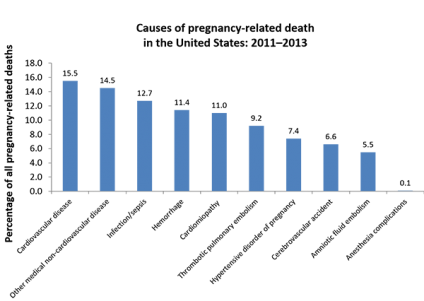
US maternal mortality statistics show that most of the leading causes of maternal death have nothing to do with C-sections.

IMG_2388

The most important message in this graph is that fully 41% of US maternal deaths are caused by cardiovascular (including cardiomyopathy) and non cardiovascular diseases. And that reflects the fact that pregnant women are now older, more obese and suffering from more chronic diseases than ever before. There’s no evidence that a high C-section rate contributes to maternal mortality.

Indeed, Gene DeClercq, a professor at the BU School of Health echoes my view:

… Declercq, who notes he is “no fan of unnecessary C-sections”, says the bigger drivers of maternal mortality probably include factors like the opioid crisis and the fact that many new mothers are dropped from Medicaid, the government-run health program, shortly after they give birth.

Just addressing the C-section rate alone won’t reduce the maternal mortality rate. Other developed countries have C-section rates that are as high as the United States’. A 2012 international comparison found that the C-section rate was 21.8% in Norway and 24.4% in the UK but 31.7% in Germany and 38.8% in Canada.

Despite the claims of C-section alarmists, the sky is not falling.

But even if it were, wailing and gnashing of teeth, the preferred response of those who demonize C-sections, would not accomplish anything. That’s because the driver of C-section rates is uncertainty. We know that lack of oxygen during labor, either from placental insufficiency, trapped head during a breech birth or severe shoulder dystocia can lead to permanent brain damage and death of babies. Unfortunately, we don’t have an accurate way of determining IN ADVANCE which babies will be injured during birth.

We are forced to resort to crude methods like measuring the baby’s heart rate to determine if it is at risk, and therefore are forced to perform C-sections that turn out to be unnecessary in retrospect. We know that some babies will die during breech birth because their heads will get trapped but we have no way of predicting in advance which babies will get stuck and therefore we recommend routine C-section for breech even though we know that nearly all of those C-sections are unnecessary. We know that some babies, particularly large babies, will suffer serious complications from shoulder dystocia, up to and including death, but we don’t know how to determine which babies will suffer shoulder dystocia so we are forced to recommend C-section in many cases where it is unnecessary.

Natural childbirth advocates like to pretend that the solution to imperfect technology is no technology. Since electronic fetal heart rate monitoring has a high false positive rate, we should just stop using it. Since most breech babies will fit, we should just stop doing C-sections for breech. Since most big babies won’t be harmed by shoulder dystocia, we should simply stop worrying about it.

But the solution to imperfect technology is not forgoing technology; it is improving technology. We need to spend tens of millions of dollars (or more) perfecting a way to determine fetal oxygen levels during labor. We need to spend tens of millions of dollars (or more) perfecting a way to determine whether a specific baby in a specific position will fit through a specific pelvis. When we create such technologies, the C-section rate will drop precipitously because we learn in advance which C-sections are unnecessary and stop doing them.

Wailing about the C-section rate accomplishes absolutely nothing. Crying “the sky is falling” does not prevent the sky from falling; it’s even more irresponsible when the sky is not falling at all.

The “choose life” crowd is Making Hypocrisy Great Again

Hypocrisy Concept

Irony is dead.

In the wake of the most deadly mass shooting in American history, Republicans in Congress are preparing to introduce the Pain-Capable Unborn Child Protection Act, a ban on abortions after 20 weeks of pregnancy.

CNN reports:

[pullquote align=”right” cite=”” link=”” color=”” class=”” size=””]Choose life — support health insurance & gun restrictions and oppose capital punishment & police brutality.[/pullquote]

The House of Representatives will vote Tuesday on legislation that would criminalize abortions after 20 weeks of pregnancy, with exceptions for instances where the life of the mother is at risk and in cases involving rape or incest.

The Pain-Capable Unborn Child Protection Act, which is similar to legislation that failed in 2013 and 2015, has support from the White House this time around.

The divisive issue of abortion has once again been brought to the forefront of national conversations since President Donald Trump assumed office. Trump issued support for the bill even before he won the election.

The same group of people who can’t be bothered to restrict guns, which kill more than 30,000 people per year, are rabid to restrict late term abortions, of which there are less than 10,000 per year. It’s hard to imagine how they could be bigger hypocrites.

Perusing their favorite slogans merely highlights their hypocrisy.

Choose life.

That’s an argument for universal healthcare, not an argument for banning abortions. Curiously, many of those who staunchly oppose pregnancy termination have no problem denying life saving healthcare for others, including children.

The same Congressmen who are enthusiastically promoting anti-abortion legislation had no trouble opposing Obamacare and had no trouble letting CHIP expire last week. CHIP is the program that provides low cost health insurance to 9 million children across the US.

The program, created under a 1997 law passed with bipartisan support during the administration of President Bill Clinton, provided coverage for children in families with low and moderate incomes as well as to pregnant women. It was instrumental in lowering the percentage of children who were uninsured from nearly 14 percent when it started to 4.5 percent in 2015. It was last reauthorized in 2015 and was due to be renewed by Sept. 30, 2017.

Amid unsuccessful efforts to repeal and replace the Affordable Care Act, the Republican-led Congress allowed the CHIP deadline to pass without action.

Providing health insurance for poor children is choosing life, but apparently for the anti-choice crowd all life is not equal. They are keen to protect life from conception up to, but not including, birth. Once you’re born, your life is worthless if you are poor.

Abortion stops a beating heart.

You know what else stops a beating heart? Capital punishment. Despite that incontrovertible fact, many of those who profess “pro-life” beliefs have no problem letting government stop the beating hearts of those convicted of crimes. If your reason for opposing late term abortion is to preserve life, it is hypocritical to promote mandated death at the hands of government.

They feel pain.

We could argue about whether or not science supports the claim that a 20 week fetus feels pain, but there is absolutely no doubt that everyone born, regardless of age, race or economic class feels pain. So why do the same Republicans who feel they must protect the unborn from pain have no problem letting the people of Puerto Rico suffer in pain, literally and figuratively, in the wake of widespread destruction of Hurricane Maria?

Pro-life means every life has value.

If every life has value, why isn’t everyone supporting Colin Kapernick’s campaign to kneel when the national anthem is played in order to draw attention to the black lives lost to police violence? Those opposing Kapernick justify it by claiming he is disrespecting the flag. That’s a lie, but even if it were true, are we supposed to believe that a piece of cloth has greater value than the life of a young black man?

Abortion is murder.

We could argue whether abortion is murder, but there’s no argument that murder is murder. Guns facilitate murder. Indeed, hand guns and semi-automatic and automatic weapons have no purpose other than to murder or threaten to murder others. If we actually cared about murder, we would ban murder weapons, but you won’t see anyone in Congress stand up to the gun lobby.

These five slogans of the anti-choice movement put its hypocrisy into high relief. The so called “pro life” crowd has no problem being anti-life whenever it suits them. So if ending late term abortion isn’t about saving lives, what is it about?

It’s about punishing women — but never men — for sex.

Providing medical care for children is more pro-life than preventing late term abortion, yet many “pro-lifers” don’t want to do it.

Banning capital punishment is more pro-life than preventing late term abortion, yet many pro-lifers are pro government spondered death.

Relieving the suffering of Puerto Ricans is more pro-life than preventing late term abortion, yet many pro-lifers seem curiously unconcerned about it.

Stopping the wanton police violence toward black men is more pro-life than preventing late term abortion, yet many “pro-lifers” are more concerned about a piece of cloth than actual human lives.

Regulating guns is more pro-life than preventing late term abortions, but when the choice is between right to life and right to guns, guns win every time.

Anyone who wants to choose life should be campaigning aggressively for health insurance for all and gun restrictions and against capital punishment and police brutality.

Otherwise, they’re merely Making Hypocrisy Great Again.

IMG_3495

Gun violence denialism is just another form of science denialism

IMG_1265

Another day, another US gun massacre, the biggest yet:

In the deadliest mass shooting in modern U.S. history, a hail of gunfire rained down from the Mandalay Bay Resort and Casino on Sunday evening, police said. The gunman, identified as Stephen Paddock, 64, is believed to be a “lone wolf” and was found dead in his hotel room, police said. More than 400 people were taken to area hospitals after the shooting, police said.

The details are horrific:

[pullquote align=”right” cite=”” link=”” color=”” class=”” size=””]Gun rights advocates are denialists just like anti-vaxxers are denialists, and they are every bit as dangerous to public health.[/pullquote]

Under the neon glow and glitz of the Vegas Strip, thousands of concertgoers who had gathered for a three-day music festival dove for cover or raced toward shelter when the gunfire began at about 10 p.m. Sunday. Police said more than 22,000 people were at the concert when Paddock, who had checked into the Mandalay Bay on Thursday, began firing round after round.

Police believe the 64-year-old Paddock, a local resident, was a “lone wolf” attacker. Lombardo did not give further details, however, on Paddock’s background or possible motivation. “We have no idea what his belief system was,” Lombardo said during a briefing. “Right now, we believe he was the sole aggressor, and the scene is static.”

Recordings of the attack suggested that Paddock used an automatic weapon. He was found with more than 10 rifles, Lombardo said.

The proximate cause is obvious to everyone in the world but gun aficionados; the proximate cause is the easy access to guns brought to us by a corrupt legislative process orchestrated by the National Rifle Association and its mounds of cash.

Gun restriction is associated with decreased gun violence. Yet, the NRA opposes gun control and their cash contributions to legislators trump all including the victims of American gun violence, and common sense itself. The truth is that the NRA is a group of gun violence denialists who have an amazing amount in common with science denialists of all stripes from creationists, to climate change denialists, to anti-vaxxers, to purveyors of “alternative” remedies.

Don’t believe me? Consider this definition of denialism offered by Andrew Dart in an chapter from Building your Skeptical Toolkit:

Denialism … is driven by ideology rather than evidence. Now denialists may claim they care about the evidence and will happily display any that supports their point of view, but in most cases they reject far more evidence than they accept. Furthermore, denialists will cling to evidence no matter how many times they have been shown that it is flawed, incorrect or that it does not support their conclusions; the same old arguments just come up again and again. Denialism also tends to focus on trying to generate a controversy surrounding the subject at hand, often in the public rather than scientific arena, and does so more often than not by denying that a scientific consensus on the matter even exists.

Pretty much nails gun violence denialism, right?

1. Denialists start with a conclusion and work backwards.

It doesn’t matter how much evidence you show to climate change deniers, creationists or anti-vaxxers. They’ve embraced a conclusion and they’re sticking to it, regardless of what the evidence actually shows. Similarly, there’s no evidence that you could show gun violence denialists that would cause them to even question their beloved conclusions about guns, let alone change those conclusions.

2. Denialists love denial.

Who you gonna believe, the NRA or your lying eyes?

Like the climate change deniers who will still be in denial as the water rises above their heads, and the evolution deniers who insist that dinosaur bones were planted by God to test our faith, or the anti-vaxxers who can still claim with a straight face that vaccines don’t prevent disease, gun violence denialists are still denying the dangers of easy access to guns as the pile of dead bodies mounts beside them.

3. Denialists love conspiracy theories.

As Dart explains:

So the vast majority of the scientific community and an overwhelming mountain of evidence is aligned against you, what are you going to do? Well you could always claim that there is a conspiracy to suppress the truth …

The favorite conspiracy theory of gun violence denialists is that the government wants to take away people’s guns in order to stage a fascist takeover.

Conspiracy theories, whether blunt or subtle, are nothing more than evasions of the actual evidence that easy access to guns leads to massive numbers of gun deaths, as well as the absence of any evidence of any kind that gun control is the first step to a fascist take over the of the US.

4. Denialists love cherry-picking.

Cherry picking is the act of selecting papers and evidence that seem to support your point of view, whilst at the same time ignoring the far greater body of evidence that goes against your position.

Gun violence denialists claim that research shows that easy access to guns makes us “safer,” when the evidence is all around us that in countries with easy access to guns life is more dangerous for everyone, particularly innocent people.

5. Denialists love echo chambers.

They seek support and validation for their views at NRA conventions and on Fox News and refuse to directly address the concerns of victims of gun violence and public safety experts.

6. They vigorously defend their “rights” while ignoring the rights of those around them.

They extol the “right” to bear assault weapons with large capacity magazines and “cop-killer” bullets, but ignore the rights of citizens to be free from random death. Like anti-vaxxers, they refuse to recognize that as members of society, they have responsibilities to the rest of us.

The inevitable conclusion is one that anyone who cares about scientific integrity and intellectual honesty should keep in mind:

It is not the topic that makes someone a denialist, it is how they the handle evidence that contradicts their cherished, immutable beliefs, in this case, the rising tide of the blood of innocent people injured and killed in gun rampages. Do they deny the evidence that is right in front of their eyes. Do they invoke outlandish conspiracy theories? Do they cherry pick the data and only present those findings that agree with them? And do they congregate in echo chambers that always validate and never question their beliefs?

Gun rights advocates are denialists just like anti-vaxxers are denialists, and they are every bit as dangerous to public health.


Adapted from a piece that first appeared in July 2015.

Punishing teen mothers by denying them epidurals

Sad and stressed pregnant woman

NPR reports on a bizarre and unethical practice:

An epidural is a common type of regional anesthesia that eases the pain of labor. As she had done many times before, Sweeney followed hospital protocol and called the anesthesia department. But to her shock, they told her they could not help her young patient.

“They said that without parental consent, … she would not be able to sign for her own epidural,” Sweeney says.

In Ohio, people under 18 who are in labor cannot consent to their own health care. They can receive emergency services, but nothing considered to be elective. For the many Ohio minors who become pregnant, it’s a painful gap in coverage.

Who would deny pain relief to a teenager in excruciating pain?

[pullquote align=”right” cite=”” link=”” color=”” class=”” size=””]An epidural for childbirth is a human right and no one, least of all state officials, should be allowed to pretend otherwise.[/pullquote]

Dr. Michael Cackovic, an obstetrician at The Ohio State University Wexner Medical Center, says every couple of months he sees a teenage mom who, under Ohio law, is unable to receive elective treatment, like an epidural. He says it’s frustrating to see patients in unnecessary pain.

… Cackovic … report[s] that, just as frequently, [he’s] had cases where the mothers intentionally denied their teenage daughters an epidural – as a sort of punishment for getting pregnant.

This is both cruel and bizarre. The same teen who is unable to consent to pain relief for herself, is able to consent to pain relief for the baby after its birth. It ought to be illegal for a very simple reason: pain relief is not considered elective for any other person in pain.

Were the same teen to be brought to the emergency room suffering abdominal injuries and requiring emergency surgery after a car accident, no one would deny her anesthesia claiming is it “elective.” Were a teen male brought to the emergency room with a fracture of his leg, no one would deny him pain relief while setting it.

In the paper Pain Management: A Fundamental Human Right, Brennan et al review the ethics of pain relief:

The importance of pain relief as the core of the medical ethic is clear. The relief of pain is a classic example of the bioethical principle of beneficence. Central to the good actions of doctors is the relief of pain and suffering. As Post et al. state, “the ethical duty of beneficence is sufficient justification for providers to relieve the pain of those in their care …” The principle of nonmaleficence prohibits the infliction of harm. Clearly, failing to reasonably treat a patient in pain causes harm; persistent inadequately treated pain has both physical and psychologic effects on the patient. Failing to act is a form of abandonment…

Childbirth is the only setting in which pain relief is wrongly viewed as elective and the reasons are religious, not medical.

In the case of analgesia for childbirth, there was bitter resistance on religious grounds. Fundamentalists cited the Bible as ordaining that childbirth was a necessarily painful process. Opposing both the church and powerful obstetricians, Queen Victoria requested that James Simpson administer chloroform analgesia for the delivery of her son, thus overcoming powerful negative attitudes that discouraged relief of the pain associated with childbirth…

In other words, many religious leaders believed, and some continue to believe, that women should be punished for having sex, and sex outside of marriage should be punished all the more. Abrogating that “punishment” with pain relief is therefore “elective.”

Lest you think that the idea that women deserve pain in childbirth is merely a relic of stodgy religious views, the belief has been secularized by the natural childbirth movement that deems epidurals in labor an “intervention,” but wouldn’t dream of labeling any other form of pain relief elective. Midwives and doulas are the only providers I am aware of that refuse to consult with anesthesiologists and condemn pain relief for ideological reasons.

What about the fact that epidurals have side effects? ALL methods of pain relief have side effects. Opioids administered into vein, muscle or by mouth have far more side effects — respiratory depression, addiction, death — than epidurals, yet no one claims that opioids for relief of severe pain are elective.

The relief of pain is NEVER elective, it is always emergent and ethically mandated. The only time that pain relief can be ethically withheld is if the patient refuses it.

What about the right of parents to determine appropriate medical care for children? If a parent brought a child to the emergency room with a severe burn from playing with matches, absolutely no one would honor that parent’s request to deny the child pain relief to “teach him a lesson.” They’d ignore the parent altogether and possibly petition the court on the grounds of child abuse. There is nothing elective about treating a painful burn regardless of whether the child brought it on himself.

There is also nothing elective about treating the pain of labor no matter how much or how brutally a parent or society wishes to punish women who have sex out of wedlock.

An epidural for childbirth is a human right and no one, least of all state officials, should be allowed to pretend otherwise.

Dr. Amy