Breastfeeding and marijuana

Smiling baby girl lying on a bed

Would you let your baby smoke pot?

This mother does:
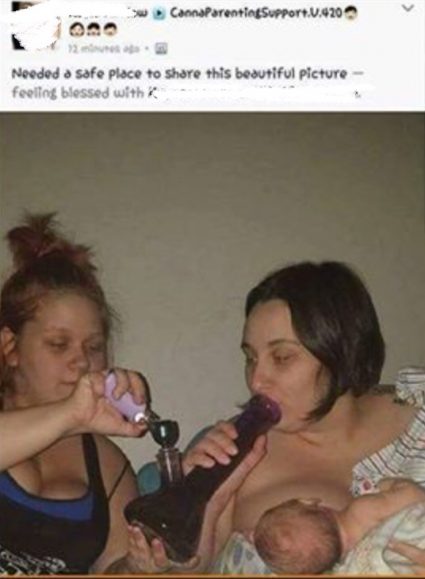
Enlight44

That’s what she is doing when she smokes pot while breastfeeding. Indeed, the baby gets a GREATER concentration of active ingredients than the mother does.

The mother wrote:

Need a safe place to share this beautiful picture …

Perhaps the fact that she was high is responsible for her delusion that the internet — even a private group — is a safe space.

[pullquote align=”right” cite=”” link=”” color=”” class=”” size=””]Is she unaware that she is potentially poisoning the baby’s brain or is she just too high to give a damn?[/pullquote]

Not surprisingly, the image has gone viral. According to the Irish Sun, Shocking photo appearing to show a US woman breastfeeding while taking hits from a BONG sparks outrage:

A shocking photo which appears to show an American woman breastfeeding while taking hits from a bong has caused outrage online.

The image shows breastfeeding mum Kayla Marlow holding a purple pipe – used to inhale drugs – to her mouth while her friend holds a lighter over the other end.

The post was shared by Ms Marlow, thought to be from Portland, Oregon, a state which has legalised the use of marijuana in most circumstances…

The picture was shared in a cannabis parenting support group on Facebook, but screenshots of the original post have gathered almost 9,700 likes and over 2,000 shares.

A cannabis parenting group? They are (or have become) a secret group so I can’t see what supporting canabis parenting means, but perhaps someone familiar with the group will let me know.

Many readers were outraged and no doubt Child Protective Services has been notified. That’s entirely appropriate since marijuana may cause serious neurodevelopmental problems in a breastfeeding infant.

According to the Academy of Breastfeeding Medicine’s Guidelines for Breastfeeding and Substance Use or Substance Use Disorder:

…D9-Tetrahydrocannabinol (THC), the main compound in marijuana, is present in human milk up to eight times that of maternal plasma levels, and metabolites are found in infant feces, indicating that THC is absorbed and metabolized by the infant. It is rapidly distributed to the brain and adipose tissue and stored in fat tissues for weeks to months. It has a long half-life (25–57 hours) and stays positive in the urine for 2–3 weeks …

There are few studies of marijuana use and breastfeeding and the results are conflicting. But animal studies raise the possibility of serious neurological impairment.

…[C]annabinoid exposure during critical periods of brain development can induce subtle and long-lasting neurofunctional alterations. Several preclinical studies highlight how even low to moderate doses during particular periods of brain development can have profound consequences for brain maturation, potentially leading to long-lasting alterations in cognitive functions and emotional behaviors.

Therefore, the ABM recommends:

Breastfeeding mothers should be counseled to reduce or eliminate their use of marijuana to avoid exposing their infants to this substance and advised of the possible long-term neurobehavioral effects from continued use.

I’d love to know the mother’s “reasoning” behind breastfeeding while high. Does she not understand that she is essentially making the baby high, too? Is she unaware that she is potentially poisoning the baby’s brain? Or is she just too high to give a damn?

Dr. Jack Newman, professional breastfeeding scold, strikes out

Portion of a red baseball scoreboard that says "Strike Out"

Adam Conover of “Adam Ruins Everything” recently released a video debunking claims about the supposed superiority of breastmilk compared to formula. It hilarious! My favorite line is “Formula has autism in it.”

In the video, Courtney Jung, author of the book Lactivism, pops out of a can of formula to point out that there is clinically no difference between breastfeeding and formula feeding (for term babies). The video has aroused the ire of Dr. Jack Newman, lactation professional and breastfeeding scold. He blasted his outrage on his Facebook page.

[pullquote align=”right” cite=”” link=”” color=”” class=”” size=””]There is no clinically meaningful different between terms babies who are breastfed and those who are bottlefed.[/pullquote]

When a political scientist pops out of a can of formula announcing that formula is just like breastmilk, not surprisingly, many people watching the video are left just as confused as the political scientist, wondering whether it all really makes any difference…

Videos like these are not only full of unscientific and just plain wrong information but they also bring the whole system many steps away from making a real effort to provide efficient help to breastfeeding mothers with breastfeeding problems. Because they confirm what so many in the health care system prefer to believe – that breastfeeding just is not all that important and really not worth the time or effort.

Dr. Newman can’t resist throwing in his sexist views:

and “what about all the hours mothers spend breastfeeding which they could be working outside of home instead?” (forgetting that someone still has to take care of the baby and why would that someone be a better candidate than the baby’s own mother?)

It’s almost as if he thinks fathers and grandparents are substandard caregivers, or that all mothers have the luxury of opting out of the workforce.

Worst of all, in my view, is the gratuitous viciousness in the accompanying blog post:

The act of breastfeeding is different from bottle feeding. Breastfeeding is a close intimate, physical and emotional relationship between two people in love.

Here, let me fix that for you, Dr. Newman: MOTHERING is a close intimate physical and emotional relationship between two people who love each other profoundly. Breasts have nothing to do with it.

Despite Dr. Newman’s vigorous protestations, the truth is that — as Adam Conover set out to show — for term babies there is no clinically meaningful difference between breastfeeding and formula feeding. That’s why I left this comment on his Facebook post.

Dr. Newman, if breastmilk is appreciably different from formula for term infants in industrialized countries, surely you could show us population data that demonstrates a correlation between breastfeeding rates and infant mortality rates. Where is the evidence that breastfeeding has more than trivial benefits in real world populations of term infants (as opposed to extrapolations of small studies riddled by confounders)? I’ve asked other lactation professionals and they can’t find such data, but perhaps you can.

In attempting to address it, Dr. Newman struck out:

Maybe you should read the blog, Dr Tuteur. I didn’t write anything about breastfed babies being healthier. The blog says only that there are ingredients in breastmilk that are not in formula and stuff in formula that shouldn’t be there. It is a response to the outrageous claim of Dr Jung that there is no difference between formula and breastmilk.

I responded:

So you are agreeing with me that there is clinically no significant difference between breastfeeding and formula feeding? That’s important for women to know!

Within the past few hours he wrote back:

No, I am not agreeing with you. I am saying that what I wrote provides clear and scientifically based information that formula is nothing like breastmilk.

Nothing like? Actually, it’s remarkably similar, but that’s not the point. The issue is whether breastmilk provides any clinically meaningful benefits for term babies (it does provide benefits for preterm babies).

My reply:

Since you are unable to provide evidence that breastfeeding rates are correlated with infant mortality, you ARE acknowledging that NO such data exists. There is NO population data that shows that increased breastfeeding rates leads to healthier term babies, let alone data that would be sufficient to prove causation…

I don’t doubt that Dr. Newman, like many professional lactivists, believes fervently that breastfeeding is better for babies. I don’t doubt that he think those benefits justify his sexism (comments about women working outside the home) and his gratuitous viciousness implying that women who breastfeed love their babies in a way that women who bottlefed can’t. As someone who has breastfed four children (whereas he has breastfed none), I can say with certainty that mother love has NOTHING to do with breastfeeding!

When pressed in a public forum, Dr. Newman could provide NO EVIDENCE to support his insistence that breastfeeding is a public health issue. Vaccination is a public health issue and we can demonstrate that a vaccinated population is much less likely to suffer injuries and deaths from vaccine preventable diseases than one that is not. Smoking is a public health issue and we can demonstrate that as smoking rates fall, rates of lung cancer fall, too. Breastfeeding is NOT a public health issue because no one — including Dr. Newman —can demonstrate that breastfeeding rates have any impact on major health indices of term babies.

The truth articulated by Courtney Jung in her book and in the “Adam Ruins Everything” video is that there is NO CLINICALLY MEANINGFUL difference between term babies who are breastfed and those who are bottlefed.

In his frustration, Dr. Newman lashes out in the manner of most quacks at others who pressed him to provide scientific evidence for his assertions, though he is not a quack.

And one last thing. I see that it is useless to try to argue with people who post these hate filled comments. I will not try to argue further with anyone who just does not read and does not want to see another side to the story but wishes only to send hate.

Is that how you would argue with a critic at a scientific meeting, Dr. Newman? Do you really think asking you for proof is hate filled? Or are you simply embarrassed that you can’t provide it?

Dr. Newman can continue writing until the cows come home that breastmilk is different from formula. But that isn’t the issue. The issue is whether breastmilk is CLINICALLY different from formula and even he can’t provide evidence to support his insistence that it is.

I pitched him a softball question, he blustered and talked trash, but in the end he struck out.

Here’s a rule of thumb that Dr. Newman would do well to keep in mind:

HER baby, HER body, HER breasts, HER choice, none of his business!

Breastfeeding support should be easily accessible for anyone who desires it, but no one should deride women who can’t or simply don’t want to breastfeed. As Adam Conover and Courtney Jung made clear: the scientific evidence on breastfeeding can’t justify applying either pressure or shame.

Who believes in quackery?

alternative therapy with herbs and essential oils

We are arguably living in a golden age of medical science. The great infectious scourges of history — smallpox, diphtheria, polio — have been nearly vanquished by vaccines. Previously deadly infections like appendicitis can be cured with surgery. Cancer and heart disease are yielding their secrets and conditions once thought to be due to sorcery or divine will — from epilepsy to infertility — are now understood and treated. Yet a large swathe of the American population is gullible enough to believe in and spend their money on quackery.

Who believes in quackery and why?

[pullquote align=”right” cite=”” link=”” color=”” class=”” size=””]Believers in quackery are easy marks for unscrupulous marketing messages that are tailored to appeal to their egos for the purpose of draining their wallets.[/pullquote]

In The appeal of medical quackery: A rhetorical analysis, pharmacists Widder and Anderson seek to answer these questions.

Quackery is not new.

From patent medications and nostrums to super-foods and miracle supplements, medical fraud, often referred to as “quackery,” has historically been a pressing and emotionally charged issue for health care professionals. Much like today, historical analysis of 18th century English quackery shows that those making dubious medical claims excelled at 3 things: taking advantage of new market opportunities, building a brand name, and advertising their product.

Who is susceptible to being tricked by quackery?

Overall, the typical CAM [complementary and alternative medicine] user tends to be female, middle aged, and college-educated, with lower perceived health and a higher level of spirituality (seeking answers and understanding to ultimate questions regarding life and its meaning and relationship with the sacred)…

That’s an accurate description of aficionados of quacktress Gwyneth Paltrow, “holistic” psychiatrist Kelly Brogan, herb and supplement peddler Aviva Romm, MD and their ilk.

The authors explain that the typical quack marketing plan is based on four straw-man metaphors:

Profit-mongering “Big Pharma”
The doctor as a deity
Illness as war
The body as a machine

They offer one of the best explications of quack philosophy that I have read.

The metaphors used by alternative medicine amplify genuine critiques of the medical community to extremes, attacking the ethos of modern medicine and its practitioners while moralizing the healing process and dichotomizing medical treatment. In this dichotomy, modern medicine is a cold, disjointed, toxic, “evil” and unnatural force of technology in contrast to a more natural, holistic, pure, good, and balance-driven force for unity that seeks to create conditions of health instead of merely treating specific pathologies. Through all of these arguments, alternative medicine relies on the pathos of anecdotal evidence to prove its efficacy, reinforcing to patients that they know their body better than any medical professional and that they should be treated as an individual and as an equal in the healing process.

To a large extent, as I’ve written in the past, doubt is the primary product of all quacks, specifically doubt about modern medicine and doubt about physicians.

Doubt about modern medicine:

Anything not seen as natural, from vaccines to antibiotics, is Big Pharma’s attempt to accumulate wealth at the expense of the unsuspecting public. Thus, the alternative medicine movement undermines the ethos of Western medicine and establishes a distrust of “unnatural” treatments. Health care has been compared to a “medical market,” where all practitioners “bid” for the trust of their patients. This establishes an ethos attack that sets up modern medicine as a conniving profit center, with the friendlier, seemingly straightforward, natural approach of alternative medicine standing in stark contrast.

Doubt about physicians:

In the “doctor as god” metaphor, alternative medicine … create[s] a perception that Western medical professionals think they know more about their patient’s body and how to heal it than the patient does… This is especially designed to rub against the beliefs of an educated, spiritual audience accustomed to seeking the answers to their own questions, and making educated decisions based on those answers. Once this straw-man has been set up, alternative medicine is able to offer a more egalitarian relationship between a patient and practitioner, emphasizing that a patient knows their own body far better than any physician, and therefore is an integral part of the healing decision process…

The authors also address the other two strawman arguments.

Illness as war:

…[I]llness is the enemy, and practitioners are soldiers fighting for the victim. While this metaphor has been used by modern health care, CAM proponents amplify the metaphor, and then attack that amplification. Alternative medicine proponents … caution that medications, like weapons, can be dangerous and backfire on the user, causing harm or provoking more aggressive tactics from the “enemy.” Then, they offer an alternative by stating that pain is not something to fight, but a messenger and a gift offering a clue to what is wrong in the patient’s life, illuminating behaviors and lifestyle habits that produce negative effects for the patient. The patient subsequently works with their health care practitioner to address their entire life from that gift of pain…

Body as machine:

…[Proponents of] alternative medicine … argu[e] that modern medicine views the patient as a machine to be fixed, just as a mechanic may repair a car. They claim that medical treatment relies on technology to treat separate parts of the body that can be detected as broken. Modern medicine, in this straw-man metaphor, attempts to control or quantify every variable, leading to over medicalization and overtreatment… In response to what they view as a brushing aside of the role of mind, emotions, and the entire person in health, alternative medicine argues that the body and spirit must be viewed as a whole, as a part of a wider balance process…

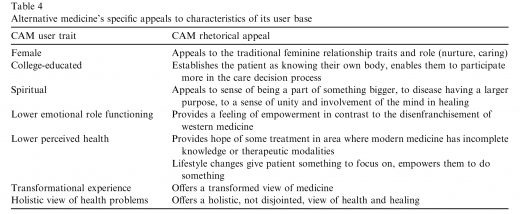
The authors offer a chart that lists the characteristics of typical believers in quackery and how the marketing messages are crafted to appeal specifically to those characteristics:

Enlight40

How can doctors, scientists and public health officials counteract the marketing talents of quacks?

Those who use alternative medicine may be more susceptible to its lure because the rhetoric of these movements appears to be targeted at them. Quackery especially relies heavily on pathos arguments for persuasion while undermining the ethos of modern medicine, appealing to the desire for independent thought process in the spiritually minded, more highly educated demographic. This sets up a moral dichotomy in medicine, where modern medicine is seen as cold, artificial, toxic, and disconnected in comparison to the more personable, natural, pure, and holistic approach of alternative medicine that empowers a patient to be a part of their own healing. Knowing this rhetoric, Western medical practitioners should adjust their interactions with patients to educate, inform, and empower their own patients to be able to make lifestyle changes as well as providing medication therapy.

As I have written in a wide variety of contexts in the past, quackery is a big business promoted by those with extraordinary marketing acumen. Believers in quackery who pride themselves on being resistant to the marketing messages of the business that is medicine should be alerted to the fact that they are easy marks for the unscrupulous marketing messages of the business that quackery, messages that are tailored to appeal to their egos for the purpose of draining their wallets.

Modern Alternative Mama and the ugliest parenting post I’ve ever read

Little Girl, Sadness, Solitude Concept

Kate Tietje, Modern Alternative Mama, continues to publicly plumb the depths of parenting insensitivity.

She recently posted this about her oldest child and only daughter:

Enlight37

Everyone has made SOME choice in parenting that they wouldn’t do again. My oldest is 9 (girl) and knows that she was born in a hospital and we ate junk food a lot… She was a little upset around 7 when she kind of figured it out, that things were different for her than her brothers. But now … she knows you know better and do better…

Apparently not.

[pullquote align=”right” cite=”” link=”” color=”” class=”” size=””]She wrote, for the entire world to see, that it wouldn’t be so bad if her daughter died so long as her son survived.[/pullquote]

Kate seems to have forgotten the most monumental parenting mistake she ever made. Six years ago, when her daughter was only 3, her son was todder and she was expecting her third child, she wrote the ugliest parenting post I have ever read. It put her on the map, garnering national attention.

It was a vicious attack on her little girl, titled Mom Confession: I Think I Love My Son a Little Bit More, published on the parenting website Babble. The title, while bad enough, does not convey the full repulsiveness of the piece.

There are moments – in my least sane and darkest thoughts – when I think it wouldn’t be so bad if I lost my daughter, as long as I never had to lose my son (assuming crazy, dire, insane circumstances that would never actually occur in real life). I know that sounds completely awful and truly crazy.

Indeed, Tietje understands precisely how awful it sounds and what it implies. But rather than seek psychological treatment, she seeks a “do over” with another daughter.

I know that if I don’t do something about this, and try to get over my weird hang ups and actually be the parent, that she will grow up to accuse me of these things: “Why were you so tough on me? Why were you so impatient? Why didn’t you hold me and love me like you did him?” And I could answer in a thousand ways …because he wanted me to hold him more, because he is more sensitive, because he is younger…because he needed me more…. It’s not good enough. Because she would be right, and I would have nothing that I could say. I completely accept that the worst of her behavior (which is thankfully not too often) is entirely my fault. It’s my fault for quietly preferring her brother, for ignoring her needs, for pushing her to the side and expecting too much of her. I secretly hope that this new baby is a girl. I want to start over with a little girl now that I’m healthy and an experienced parent. I want to love her and cherish her as she should be. And maybe…I can learn to love and parent a girl properly, and I can use this to change and parent my older daughter better, too. Maybe I can save us all before it’s too late.

In the outcry that followed, Tietje repeatedly pointed to the qualifiers with which she hemmed her statement, but no one was fooled. She had written, for the entire world to see, that it wouldn’t be so bad if her daughter died so long as her son survived. And in a subsequent post (after having edited the first paragraph above out of the original piece) she tried to minimize what she had done, claiming that many parents feel the same way. Perhaps they do, but they have enough self awareness to keep themselves from blaring it in public.

Although most commentors did not name it as such, they correctly interpreted Tietje’s feelings about her daughter (as well as her decision to air those feelings publicly) as a form of emotional abuse. Though Tietje then and now tried to blame her inappropriate feelings on her experience when her daughter was born, she provided ample evidence that the birth was an excuse, not the real reason for her enmity:

1. Her identification with her daughter and her distaste for specific characteristics that they share:

And she’s a very independent, challenging little girl. She wants things her way, all the time. And she acts out a lot by being extremely rude and defiant when she’s unhappy. Okay, so, she’s me. I know that. It doesn’t make it any easier. (my emphasis)

2. Tietje acknowledged that she treated her daughter the way her mother treated her.

… [A]s a few of you guessed, she did favor my brother (and my father favored me). My brother and I both knew it, talked about it. In my teen years, I even kind of understood it. I still didn’t find it fair. She was the adult, after all…shouldn’t she get past that?

3. Despite recognizing that her mother treated her poorly, Tietje seemed to be unable to make the connection that she is copying her mother’s behavior. Rather than recognizing that her feelings of dissatisfaction with her daughter originate within herself, Tietje blames those feelings on her daughter or on outside circumstances. It’s her daughter’s birth; it’s her daughter’s a “bad” personality; it’s because her daughter’s “bad” personality contrasts so sharply with her son’s “good” personality. It’s everything and everyone but Tietje herself.

4. Tietje almost connected the dots.

In speaking about her mother Tietje wrote: “I still didn’t find it fair. She was the adult, after all…shouldn’t she get past that?”

In speaking about the way that her daughter will view her in the future, Tieje used almost the exact same words: “But I know that if I don’t do something about this, … and actually be the parent, that she will grow up to accuse me …”

5. But Tieje could not make the final leap, and when others made it for her, by pointing out that her behavior was inappropriate and cruel, Tietje retreated into a myriad of defense mechanisms in a subsequent post, I’m Not a Perfect Mother.

Insults: “Instead of reading what you know to be a tiny, tiny snapshot into my life and condemning in nasty, insane voices — yes, INSANE — why don’t you understand that you, like everyone, have also had crazy thoughts. And then just walk away. Got it?”

Denial: “This in no way means that we love her less” even though the TITLE of her first piece was “I think I love my son a little bit more.”

Projection: “It probably struck a little too close to home for many of you…you’ve had those same thoughts … found it obscene to see your own worst thoughts out in the light of day …”

Minimization: “I’m not a perfect mother. There, I said it.”

Told repeatedly to seek psychological counseling, Tietje insisted that the doesn’t need to explore her feelings about herself and her own mother. Not surprisingly both Tietje’s ugly behavior and her denial are continuing.

Pro Publica learns maternal mortality is a fundamentally different problem than it thought

Funeral with casket carried by coffin bearer

In May Pro Publica, in conjunction with NPR, released a report on US maternal mortality that garnered a lot of attention. I criticized the piece for misrepresenting the problem. Pro Publica framed its story with the tragedy of a well off, healthy white woman who died of malpractice when the reality is that maternal mortality disproportionately affects black women and women with pre-existing medical conditions.

I was not the only one to criticize them, and to its credit, Pro Publica acknowledged the criticism and set out to do better. Today it published new findings, Lost Mothers, profiles of 16 women who died within a year of giving birth.

[pullquote align=”right” cite=”” link=”” color=”” class=”” size=””]The problem of US maternal mortality is far more political than medical.[/pullquote]

Although their picture, relying as it does on reader submissions, is still incomplete, it is a far better reflection of the actual problem.

I created a chart of the profiles. Even a cursory look shows that the problem is far different than Pro Publica initially presented.

Enlight35

This group of 16 profiles shows that maternal mortality is not really a problem of healthy white women dying of common complications. Fully half the women are not white. Very few were expecting a first baby. Nearly half had pre-existing obstetric or medical conditions. The causes of death ranged from hemorrhage (3 cases) and infection (2 cases), both of which are potentially preventable, to serious cardiac conditions (4 cases) like peripartum cardiomyopathy, heart attack and spontaneous coronary artery dissection, to mental health issues (2 cases), to stroke (1 case) to ectopic pregnancy (1 case), a complication of early pregnancy.

Most of the women who died did so because of LACK of timely access to medical technology, NOT overuse of technology. Contrary to the assertions of natural childbirth advocates like Henci Goer, these deaths could NOT be prevented by midwives, doulas and birth plans.

Goer, like most natural childbirth advocates, positively delights in misrepresenting maternal deaths to promote natural childbirth. Titling a recent piece Preventable Maternal Mortality: Disgrace of the US Maternity Care System, Gore asserts, with no evidence:

The overuse of cesarean surgery contributes (largely by increasing the numbers of women with placental attachment complications in subsequent pregnancies).

But most cases of maternal death profiled by Pro Publica have nothing to do with C-sections and it is not clear that any of the C-sections were unnecessary.

Indeed, contrary to the assertions of natural childbirth advocates that pregnancy is safe and interventions have made it dangerous, this list of maternal deaths makes it clear that pregnancy is dangerous (as it has always been, in every time, place and culture) and only MORE interventions are likely to make it safer. Moreover, pregnancy and childbirth put tremendous stress on many women, often too much for those with pre-existing or existing mental health issues to handle.

There are a number of things we could and should do if we really want to prevent maternal deaths instead of merely talking about them:

  • We must increase access to high tech medical and obstetrical care.
  • We must create a system of maternal critical care triage to parallel the highly effective system of neonatal critical care triage. Just as there are now Level I, II and III neonatal intensive care units, there should be Level I, II and III maternal intensive care units.
  • We must create algorithms and hold drills to prevent and treat common causes of maternal death.
  • We must devote significantly more research dollars to understanding cardiac complications of pregnancy.
  • We must provide more psychological support for women suffering mental health complications of pregnancy.
  • We must ensure that all women have easy access to contraception, abortion, and other gynecological services.

The maternal death rate is NOT a reflection of problems with our obstetric care system so much as it is an indictment of the general contempt in which we hold women’s health in the US.

Any country to seeks to restrict access to contraception and abortion is a country that doesn’t care whether women die.

Any country that restricts prenatal care to only those who can afford it is a country that doesn’t care whether women die.

Any country that predicates access to high tech obstetric and medical technology on whether women can pay for it is a country that doesn’t care whether women die.

The problem of US maternal mortality is far more political than medical. We have the ability to save more maternal lives; we just don’t have the will.

Infant mortality, what’s breastfeeding got to do with it? Absolutely nothing!

Baby Tombstone at Rose Hill Cemetery in Macon, Georgia.

Sometimes a picture is worth a thousand words, or in this case, two pictures.

To hear lactivists tell it, breastfeeding is lifesaving for infants and therefore, formula is deadly. Indeed, there are a variety of scientific publications that purport to show how many lives and how much money could be saved if more women breastfed exclusively.

[pullquote align=”right” cite=”” link=”” color=”” class=”” size=””]Breastfeeding saves lives in theory, but not in reality.[/pullquote]

Tellingly these papers rely on mathematical modeling NOT actual population data. Why? Because breastfeeding saves lives in theory, but NOT in reality.

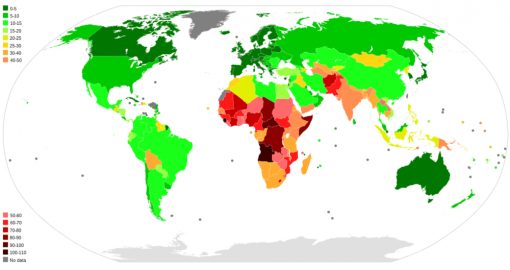
Don’t believe me? Below are two pictures of reality and they demonstrate quite impressively that breastfeeding rates have absolutely nothing to do with infant mortality.

This a map of the world colored to reflect exclusive breastfeeding rates at 6 months of age. The data come from the World Health Organization.

IMG_2887

Yellow reflects low breastfeeding rates; progressively redder colors reflect higher exclusive breastfeeding rates at 6 months. You can see the the US, Canada and Eastern Europe have among the WORST exclusive breastfeeding rates in the world.

Now let’s take a look at infant mortality rates. These data come from the the United Nations World Population Prospects report and the CIA World Factbook.

IMG_2884

The color legend shows that the greener the country, the LOWER the infant mortality rates.

The key point is glaringly obvious. The countries with the lowest infant mortality rates have very low rates of exclusive breastfeeding at 6 months. Of course there are countries that have high exclusive breastfeeding rates, such as in South America, that also have low mortality rates, but most of the countries with high exclusive breastfeeding rates have hideous rates of infant mortality.

In other words, breastfeeding has NOTHING to do with infant mortality. Indeed, a visitor from another planet looking at these images might conclude that formula is lifesaving, NOT breastfeeding.

That’s not surprising. Breastmilk is food, not magic. It doesn’t protect children from vaccine preventable diseases, for example, since the antibodies that attack most pathogens are IgG antibodies and these are too large to pass through breastmilk. And although breastfeeding does offer protection from colds and diarrheal illnesses, they aren’t the only important causes of infant death.

Why is there such a tremendous disconnect between theory and reality? Because most research purporting to show benefits of breastfeeding is weak, conflicting, and, critically, riddled with confounding variables. In high income countries especially, breastfeeding is associated with maternal education and socio-economic status. Most of the purported benefits of breastfeeding are actually benefits of wealth and easy access to healthcare.

Breastfeeding is definitely a good thing and we should be providing vigorous lactation support for women who choose to breastfeed, BUT we should not lie about the real benefits and true limitations of breastfeeding. Breastfeeding is NOT lifesaving, not merely in high income countries like the US, but in most countries around the world. The only exception is in the case of premature babies at risk of necrotizing enterocolitis. Breastmilk can lower (but not eliminate) the risk of NEC.

The idea that breastfeeding saves lives in industrialized countries is essentially a lactivist lie, based on theoretical models while utterly ignoring real world population data. It is designed to create demand for lactation goods and services. That does not mean that lactivists don’t believe it; they believe it fervently, but as these images demonstrate, it is obviously not true.

If your goal is a healthy baby, formula is just as good, if not better than breastfeeding, in ensuring infant health.

Gwyneth and her medi-shills strike back

IMG_2875

Quacktress Gwyneth Paltrow has take PT Barnum’s advice to heart.

Barnum famously said that you can’t go broke underestimating the intelligence of the American public. Paltrow is channeling Barnum with her website goop and is laughing all the way to the bank.

[pullquote align=”right” cite=”” link=”” color=”” class=”” size=””]When quacktresses like Paltrow trade on their celebrity to sell useless, nonsensical and potentially dangerous products, they aren’t empowering women; they’re taking advantage of them.[/pullquote]

But not everyone is laughing with Paltrow. Some are laughing at her. Indeed OB-GYN Jen Gunter has made a specialty of skewering Paltrow and she never lacks for material. Highlights include:

Gwyneth Paltrow says steam your vagina, an OB/GYN says don’t

Dear Gwyneth Paltrow, I’m a GYN and your vaginal jade eggs are a bad idea

Gwyneth Paltrow doesn’t have adrenal fatigue because it doesn’t exist

The bad publicity is apparently having an effect, because goop is addressing the criticism head on with a new post, Uncensored: A Word from Our Doctors:

Last January, we published a Q&A with Shiva Rose about her jade egg practice, which has helped her (and legions of other women who wrote to us in response) feel more in touch with her sexuality, and more empowered. A San Francisco-based OB-GYN/blogger posted a mocking response on her site …

There was a tremendous amount of press pick-up on the doctor’s post, which was partially based on her own strangely confident assertion that putting a crystal in your vagina for pelvic-floor strengthening exercises would put you in danger of getting Toxic Shock Syndrome …

Some of the coverage that goop receives suggests that women are lemmings, ready to jump off a cliff whenever one of our doctors discusses checking for EBV, or Candida, or low levels of vitamin D—or, heaven forbid, take a walk barefoot. As women, we chafe at the idea that we are not intelligent enough to read something and take what serves us, and leave what does not. We simply want information; we want autonomy over our health…

I’ve been reading Jen Gunter for years, and I’m quite sure that she wants women to have accurate information and believes passionately in women’s autonomy. But the ugly truth is that when quacktresses like Paltrow trade on their celebrity to sell useless, nonsensical and potentially dangerous products, they aren’t empowering women; they’re taking advantage of them. It isn’t Gunter who thinks women are not intelligent enough to understand medical information; it is Paltrow who bets on her belief that women are not intelligent enough to tell the difference between real medical information and quackery.

Paltrow is now defending herself using a page from the Tobacco Industry playbook.

The tobacco industry recognized as far back as the 1970’s that it was impossible to use science to justify the existence and marketing of their products. Going forward, the tobacco industry changed its focus from insisting that cigarettes did not cause lung cancer (a strategy made untenable by the weight of scientific evidence) to reframing the issue as one of personal freedom.

…[W]e try to change the focus on the issues. Cigarette tax become[s] an issue of fairness and effective tax policy. Cigarette marketing is an issue of freedom of commercial speech. Environmental tobacco smoke becomes an issue of accommodation. Cigarette-related fires become an issue of prudent fire safety programs. And so on.

Make no mistake, the advice to steam your vagina, to use jade eggs or to suspect that you are afflicted with adrenal fatigue are pure, unadulterated nonsense. It has no basis in science; these are marketing scams.

Paltrow has enlisted her medi-shills, Drs. Steven Gundry and Aviva Romm to strike back at Gunter. Who are medi-shills? They are physicians who use their medical knowledge to sell self-branded products, often through their own websites. There’s no surer sign of a quack than a doctor who has his or her own online store.

Dr. Gundry peddles supplements and skincare. The Skeptical Cardiologist notes:

I found on Dr. Gundry’s website an immediate and aggressive attempt to sell lots of supplements …

Dr. Gundry’s bio states “I left my former position at California’s Loma Linda University Medical Center, and founded The Center for Restorative Medicine. I have spent the last 14 years studying the human microbiome – and developing the principles of Holobiotics that have since changed the lives of countless men and women.”

Need I mention that “holobiotics” is (?are) not real.

Dr. Gundry doesn’t offer any science to support goop’s products; there isn’t any. Instead Gundry gives a master class in the use of the logical fallacy “appeal to authority”:

But, since you did not do even a simple Google search of me before opening your mouth, let me give you a brief history: I have published over 300 papers, chapters, and abstracts on my research in peer-reviewed journals and have presented over 500 papers at peer-reviewed academic meetings.

So what?

All those folks at Big Pharma have lots of citations to their names, too. Are we supposed to believe that people who publish scientific papers aren’t vulnerable to misleading people about their own products in order to make a profit?

Gundry appears to have a monstrous ego. Nearly all his 1290 word “response” is about himself and his credentials … as if we care.

I’ve written about Dr. Romm many times in the past. Romm is a former homebirth midwife and current herbalist who rhapsodizes about the purported safety of homebirth, but, curiously refuses to attend them now that she’s an actual doctor.

As I wrote in 2014:

I don’t know your reasoning. Perhaps you feel that you want an easier lifestyle? Perhaps you prefer to cash in by practicing “functional medicine” on the worried well who can pay out of pocket. I don’t blame you. You probably have massive amounts of debt and a high profile, high profit practice is the best way to clear that debt.

But don’t you think it’s rather hypocritical to promote homebirth while refusing to attend homebirths?

Romm also fails to offer any science to back the questionable goop products; she can’t because there isn’t any. Instead she offers typical alt-health gobbledygook:

In a time when women are desperately hungry for safe alternatives to mainstream practices that too often fall short of helpful for chronic symptoms, and in the setting of a medical system that is continually falling short of providing lasting solutions to the chronic disease problems we’re facing: I prefer, rather than ridiculing vehicles that are actually highly effective at reaching large numbers of women who want to be well, to seek to understand what women are looking for, what the maintstream isn’t providing; and how we can work together to support those vehicles in elevating their content so that women are receiving the meaningful, and evidence-based answers, they want and deserve, whenever possible.

Yes, women are desperately hungry for safe alternatives to mainstream practices that fall short of helpful for chronic symptoms. That’s precisely why goop’s peddling of vaginal steaming, jade eggs and adrenal fatigue are so strikingly unethical. These products AREN’T safe alternatives to medical practice helpful for chronic symptoms. They’re quackery.

This isn’t about health; it’s about profit. Big Placebo is no different from Big Pharma when it comes to putting money ahead of women’s wellbeing. Paltrow is a perfect example.

Long term neurodevelopmental outcome after neonatal dehydration

IMG_2868

Insufficient breastmilk is a relatively common condition affecting up to 15% of first time mothers attempting to initiate and maintain breastfeeding.

Lactation professionals are notoriously poorly informed about this risk of exclusive breastfeeding, many insisting that it is only the “rare” mother who has insufficient supply. Furthermore, breastfeeding professionals insist or imply that the benefits of breastfeeding outweigh the risks of infant weight loss and its complications. They are dead wrong.

[pullquote align=”right” cite=”” link=”” color=”” class=”” size=””]It is more important to preserve a baby’s brain function than a breastfeeding relationship.[/pullquote]

A new paper, Long-Term Neurodevelopmental Outcome of Neonates with Hypernatremic Dehydration, published in the journal Breastfeeding Medicine reveals the potentially devastating consequences of newborn dehydration.

The authors explain the nature and magnitude of the problem. Physiologic weight loss often occurs in the first few days but should be resolved by the end of the first week.

  • If weight loss continues beyond the first week or if weight loss is rapid (more than 2% of neonates weight in each day), insufficient breastmilk should be suspected.
  • Neonatal dehydration is almost entirely a phenomena of insufficient lactation and does not occur in the bottle fed child.
  • The incidence of NHD has been reported to be 1-3%.
  • Initially there are few symptoms, so it is often overlooked.
  • The hypernatremia [elevated salt level] and weight loss due to inadequate milk intake in breastfed infants may ultimately cause severe complications such as stroke and intracranial hemorrhage.
  • The incidence of NHD has increased in recent years.

The authors looked at 65 infants who had been admitted for neonatal hypernatremic dehydration and compared them to a control group of 65 breastfed infants. What did they find?

The most prevalent sign in infants of case group in our study was weight loss…

We found a significant positive relationship between the severity of weight loss and severity of hypernatremia. In studies by Moritz there was also a positive association be- tween severity of weight loss and severity of hypernatremia. So it seems that early detection of weight loss in neonates can prevent severe weight loss and severe hypernatremia. Uras et al. found that a weight loss of greater than 7% of birth weight was also associated with an increased risk of hypernatremia…

The importance of frequent neonatal weighing during their first week of life to prevent excessive weight loss and its complications is clearly evident.

Neonatal hypernatremic dehydration can be deadly:

In our study 7 out of 65 patients died as a result of complications of hypernatremia. There was a significant correlation between severity of hypernatremia and mortality (p = 0.001). All who died had serum sodium concentration >160 mmol/L.

But even when there were no obvious short term consequences to neonatal dehydration, the longterm consequences could be severe.

All infants in the control group were developmentally normal at ages 6 and 12 months, but in the case group 25% and 21% had developmental delay at 6 and 12 months, respectively. At 18 months the incidence of developmental delay was 3% for the control group and 19% for case group, and at 24 months 12% of case infants had developmental delay versus none for the case group. At the age of 6 months, the severity of developmental delay was directly related to the severity of hypernatremia ( p = 0.001)…

Long-term neurologic delay means that the child at the age of 2 years had developmental retardation of at least two from four Denver (gross motor, fine motor, speech, and Social). For example, baby at 2 years has a delay in speech, impaired walking, and seizures.

Looking back at initial brain CT scans, the authors found:

CT scan was performed in 39 of the cases. The results showed 5 cases with bleeding (12.8%), 29 healthy (74%), and 5 cases with cerebral edema. CT scans were performed in the second to fourth day of treatment.

They comment:

The higher prevalence of intracranial complications in our study may be due to the more severe hypernatremia and also late presentation of our patients. It has been reported previ- ously that a serum sodium concentration concentration ≥158mmol/L is associated with a high mortality rate. Acute brain injury is reported in 8% of patients with hypernatremia. Increased serum osmolality due to hypernatremia can cause brain in- jury with widespread hemorrhage, thrombosis, and subdural effusion, which lead to death or permanent neurologic sequelae…

The take home messages from this study:

  • neonatal hypernatremic dehydration is common
  • weight loss is a critical prognostic sign
  • frequent weights are crucial to diagnosing the problem early before severe complications can occur
  • Neonatal weight loss after the first few days is NOT normal and is a cause for significant concern and aggressive monitoring

Early supplementation is the key to reducing the risk of neonatal hypernatremic dehydration. Lactation professionals insist that supplementation can ruin the breastfeeding relationship; that’s not true but even if it were, dehydration can ruin the baby’s brain.

When it comes to the relative importance of the two, there is no contest.

Breastfeeding and “the science”

7515470 - medicine and health books with stethoscope isolated on white

That woman is not too bright, sorry to say. She has no credentials, her sources are limited and biased, and she is obviously just trying to reason away her own guilt for not breastfeeding …

No, that lactivist is not talking about me. She’s talking about Charlotte Faircloth, another professional who pointed out that the benefits of breastfeeding are far smaller than what advocates claim. Faircloth discusses this response in her paper ‘What Science Says is Best’: Parenting Practices, Scientific Authority and Maternal Identity.

[pullquote align=”right” cite=”” link=”” color=”” class=”” size=””]Lactivists don’t read scientific papers, don’t know what they show and don’t care anyway.[/pullquote]

Faircloth explains the meaning of “the science” to lactivists and the paradoxical invocation of scientific evidence by women who are just as likely to ignore science when they feel like it.

Simply put, lactivists don’t read scientific papers, don’t know what they show and don’t care anyway. “The science” is simply a convenient cudgel which lactivists use to metaphorically hammer away at women who do not follow their example:

The scientific benefits of breastfeeding and attachment parenting serve as a (seemingly) morally neutral cannon about which mothers can defend their mothering choices and ‘spread the word’ about appropriate parenting. I noticed that for some particular women, sharing ‘information’ with other mothers … was a source of great enjoyment – as Felicity in the quote above puts it, she is ‘super empowered’ with the knowledge that she has. Amelia, cited above, also said that she felt ‘like a genius on a planet of idiots.’ Any criticisms she has of other women are de-personalised, because science ‘has no emotional content…’

“A mother describes how she responds to those who criticise her decision to breastfeed her son until his seventh birthday, by saying: ‘I mean, do you want to see studies? Because I can show you studies!’ There are laughs and cheers from the rest of the group.”

But lactivists, who have basically no idea what the actual scientific evidence shows, use “the science” in another way:

Arguably, ‘science’ here is not about understanding, but belief. The use of ‘evidence’ has reached the level of the quasi-religious; not in the sense that the beliefs are other-worldly (quite the opposite) but that they are held to be beyond the possibility of doubt and revered as truth.

In other words, belief is described as “science” in order to trade on the reputation of science. As Faircloth notes:

In many ways, however, it is ironic that my informants refer to science, since many attachment parenting advocates are openly sceptical about scientific knowledge… What is interesting then, is the selective use (and mis-use) of scientific evidence to support certain (moral) discourses about parenting. (my emphasis)

Appeals to “the science” are a rhetorical strategy, and a rather cynical one at that. The very same people who ignore the scientific evidence on the dangers of homebirth, who openly spurn the World Health Organization recommendations on vaccination, and who dismiss the scientific evidence on circumcision by insisting it is only relevant in the developing world choose to misinterpret and misuse the scientific evidence on the limited benefits of breastfeeding.

This cynical misuse of science finds ultimate expression in public health campaigns to promote breastfeeding. That’s why these campaigns continue even though they have been failure on their own terms. The activists who create them, run them and promote them are far more interested in promoting their personal beliefs than in increasing breastfeeding rates.

In Faircloth’s words “sharing ‘information’ with other mothers … was a source of great enjoyment.” That’s because lactivists are not “sharing,” they are browbeating other women as a method of enhancing their own self esteem. As Faircloth notes:

When ‘science’ says something is healthiest for infants, it has the effect, for [lactivists], of shutting down debate; that is, it dictates what parents should do.

Critically, for lactivists, it allows them to “moralize” the choice of infant feeding. In the minds of lactivists, “the science” turns breastfeeding from a choice to an obligation, the classic is-ought confusion.

… [U]nder the assumption that science contains ‘no emotional content’, a wealth of agencies with an interest in parenting – from policy makers and ‘experts’ to groups of parents themselves – now have a language by which to make what might better be termed moral judgements about appropriate childcare practices. [But] ‘Science’ is not a straightforward rationale in the regulation of behaviour, rather, it is one that requires rigorous sociological questioning and debate in delimiting the parameters of this ‘is’ and the ‘ought’.

Hence the example with which the piece began, the vituperation directed at Faircloth for pointing out that the scientific evidence on breastfeeding is rather weak, and, at best, shows only a small, limited benefit. Lactivists responded with anger because their own self conception and their ability to feel superior to other women rests on presenting “the science” as firm, strong, unequivocal and dispositive. In the case of breastfeeding, it is none of the above.


The only thing that has changed since this piece first appeared in March 2011 is that more purported benefits of breastfeeding have been debunked while other soon to be debunked benefits have been proposed.

UK lactivists officially lose their minds

39601903 - explosion nuclear bomb in ocean

Imagine a natural disaster: flood, fire, hurricane, blizzard. Or, if you prefer, imagine a manmade disaster: a terrorist attack, a power grid failure, a nuclear explosion deliberate or accidental. Imagine the death, injury, destruction, fear and misery.

What would be your first priority if you were caring for those people? It wouldn’t be promoting breastfeeding, unless you were mad as a March hare — or a UK lactivist.

[pullquote align=”right” cite=”” link=”” color=”” class=”” size=””]Disaster planning for lactivists: prevent formula donations.[/pullquote]

Breastfeeding Trends UK just released a position paper entitled Protecting Babies in Emergencies. The ugly truth, however, is it is NOT about protecting babies; it’s about protecting breastfeeding.

UK lactivists are forever bemoaning the “dismal” state of breastfeeding in the UK, as if that has anything to do with infant health. As they never tire of telling us, less than 0.5% of UK babies are breastfed to a year of age. Nonetheless, the UK infant mortality rate is 3.6/1000, the lowest ever for the UK and among the lowest in the world.

Since — as they never stop lamenting — the UK breastfeeding rate is very low, you might think that a document that focused on protecting babies in the event of a disaster would focus on making sure that there is an adequate supply of formula and clean water with which to prepare it. You would be wrong. In a 1250 word document, only two sentences are devoted the vast majority of babies who might be affected:

Babies who are fully or partially formula fed are at risk if their caregivers lose access to clean water, are unable to sterilise feeding equipment or suffer disruption or contamination of their formula milk supplies. A suitable environment for preparation and storage of feeds, sterilising equipment, boiling water and safe storage such as a refrigerator, are all needed to prevent bacterial contamination.

The bulk of the position paper — I’m not making this up — is devoted to preventing worldwide donations of formula!

In the absence of guidance, agencies responsible for co-ordinating emergency response and volunteers working on the front line are often not aware that donations of formula milk can put babies at risk. Risks from donated formula milk include inadvertently distributing products that are unsuitable for babies under six months or for babies with special nutritional needs, as well as distributing milk that is contaminated or out-of-date.

Because in the wake of a nuclear holocaust when babies are dying in droves the last thing we should countenance is using formula after the sell by date.

What do these lactivists fools imagine will happen if there are no formula donations? Potentially tens of thousands of babies might die but apparently they’re expendable because they’re formula fed.

Lactivists, as always, are only concerned with promoting breastfeeding, not saving lives. They’re honest about their real anxiety:

There is also a risk that donations will be inappropriately provided to parents of breastfed babies, which can undermine the protective effect of breastfeeding and cause parents to become dependent on a continued supply of formula milk.

Sure, when formula fed babies are dying from lack of formula, and their mothers are rioting for lack of formula, aid workers will be spending their time searching for the tiny minority of breastfeeding women so they can tempt them away from breastfeeding with free formula. UK lactivists have officially lost their minds.

And what do these geniuses propose to do for breastfed babies whose mothers die during the natural disaster. Evidently it never occurs to them that a lactating mother can be injured or killed, cutting off her infant’s supply of food. Maybe they think “magical” benefits extend to preventing deaths of breastfeeding mothers. Or maybe they think once a breastfed baby is no longer breastfeeding, they’re expendable, too.

Their “guidance” in the event of a disaster is not focused on saving babies; it’s focused on saving breastfeeding … and employing lactation consultants:

…If breastfeeding helpers are not pre-authorised as part of planned disaster response the immediate help that families need can be delayed.

It gets worse:

  • …Local emergency planning should have identified appropriate infant feeding support from local health and voluntary services. There are telephone helplines which support caregivers with all aspects of infant feeding:NCT helpline (0300 330 0700)
    The Breastfeeding Helpline (0300 100 0212).
  • DO encourage donations of money to recognised agencies so that parents, caregivers and agencies can buy any formula or supplies needed, rather than donations of formula products…
  • DO ensure that formula milk is purchased and distributed only for babies who need formula milk, following basic screening of families …
  • DO NOT distribute formula milk in an untargeted way.

Do these women even hear themselves?

Basic human ethics demands that we try to save the majority of babies LIVES. In a country where very few women breastfeed that means maintaining a large and ongoing supply of formula and clean water to prepare it. Whatever way that can be accomplished most effectively in the wake of a disaster — and formula donations may be an effective way of accomplishing it — should be undertaken.

Anyone who stands in the way of making sure that as many babies as possible are fed, regardless of how they are fed, is deluded at best and monstrously self absorbed at worst.

Because the incontrovertible truth, especially during a disaster, is Fed Is Best!

Dr. Amy