There is no moral duty to breastfeed

Got ethics? Are you ethical question handwritten with white chalk on blackboard with eraser smudges

In a fascinating paper in the Journal of Medical Ethics, philosophers Fiona Woollard and Lindsey Porter conclude that mothers do not have a moral duty to breastfeed.

The paper is Breastfeeding and defeasible duties to benefit. The authors begin by quoting colleagues Lee and Furedi who deftly summarize the current moral milieu.

A process of cultural transmission seems to have turned provision of health information about the benefits of breastfeeding into hostility about formula use. This has a detrimental effect on relationships that are very important for new mothers, namely with health professionals and with other mothers.

[pullquote align=”right” cite=”” link=”” color=”” class=”” size=””]The moral duty to feed a baby does NOT imply a moral obligation to breastfeed just as the moral duty to educate a child does not imply a moral obligation to pay for private school.[/pullquote]

Or, as Woollard and Lindsey explain:

For many women experiencing motherhood for the first time, the message they receive is clear: mothers who do not breastfeed ought to have a darned good reason not to; bottle feeding by choice is a failure of maternal duty.

That’s certainly what professional lactivists believe, but they’re wrong.

We argue that this pressure arises in part from two misconceptions about maternal duty. First, confusion about the scope of the maternal duty to benefit and second, conflation between moral reasons and duties.

Indeed:

While mothers clearly have a general duty to benefit their offspring, we argue that this does not imply a duty … to carry out each particular beneficent act. Mothers do not have a moral duty to carry out each and every act that would benefit their baby. Mothers do have moral reason to perform each beneficial action. However, not complying with a moral reason, unlike failure to comply with a duty, is not an accountable matter. Therefore, the act of holding mothers to account for individual beneficent act omissions, and the demand that individual omissions be justified, is unwarranted. The expectation that mothers who bottle feed should have a ‘darned good reason’ is morally unwarranted, in addition to being demonstrably harmful.

We generally take this for granted in the day to day business of parenting. Mothers (and fathers) have a duty to protect children. Skiing is a potentially dangerous leisure activity. If mothers had a moral duty to carry out each and every act that might possibly protect their children, they would be morally required to forbid their children from skiing. But though everyone recognizes a mother’s duty to protect her child, very few people think that duty encompasses forbidding any activity that raises the possibility of injury.

Similarly, in many areas of the country private schools offer better education than public schools. If we believed that mothers have a moral duty to provide what is “best” for children, we would be forced to conclude that those mothers have a moral duty to provide the private school education regardless of the cost, but we don’t.

Though mothers have a general moral duty to provide “the best” for their children, they does not imply specific moral duties to provide every possible advantage in education or any other sphere. No one expects mothers to provide a ‘darn good reason’ for sending their children to free public schools.

Many lactivists are also natural childbirth advocates. Curiously they have no difficulty recognizing that the general moral imperative for mothers to protect babies does not imply a specific moral duty to give birth in exactly the way that doctors recommend. They argue — correctly in my view — that mothers have a right to autonomy over their own bodies and that, therefore, the moral duty to protect babies must be balanced against the moral right of women to give birth in the way that they choose.

For example, homebirth in Oregon has a perinatal mortality rate 9X higher than comparable risk hospital birth, yet very few believe that any Oregon mother who chooses homebirth must justify her desire to have a homebirth to other healthcare providers, other mothers or society at large.

The benefits of breastfeeding are far smaller than the benefits of hospital birth, yet lactivists routinely invoke a maternal moral duty to breastfeed. Diane Weissinger, in her seminal paper on the language that should be used to counsel new mothers, recognized this problem:

When we … say that breastfeeding is the best possible way to feed babies because it provides their ideal food, perfectly balanced for optimal infant nutrition, the logical response is, “So what?” Our own experience tells us that optimal is not necessary. Normal is fine, and implied in this language is the absolute normalcy and thus safety and adequacy-of artificial feeding …

In other words, Weissinger acknowledges that there is no moral duty to breastfeed … but then goes on to ponder how women can be browbeaten into believing that such a duty exists regardless.

The mother having difficulty with breastfeeding may not seek help just to achieve a “special bonus”; but she may clamor for help if she knows how much she and her baby stand to lose. She is less likely to use artificial baby milk just “to get him used to a bottle” if she knows that the contents of that bottle cause harm.

The mantra of the lactivist movement, “Breast Is Best,” is understood as invoking a moral duty to breastfeed. That’s why lactivists generally feel superior to mothers who formula feed, and feel justified in shaming those other mothers.

And that’s why they vehemently hate the phrase “Fed Is Best.” “Fed Is Best” embodies the very real maternal moral duty of making sure that babies are adequately fed while implying correctly that there is no moral duty to breastfeed.


The birth rights movement betrays both women and babies

17804813 - illustration depicting cutout printed letters arranged to form the word betrayed

It is both sad and ironic that the natural childbirth movement, which is supposed to empower women, has ended up disempowering them. Organizations like Human Rights in Childbirth and the Orgasmic Birth movement imagine that they are liberating women to experience the fullness of natural birth. In truth, they are imprisoning women in a view of birth that is in its own way every bit as constraining and unnatural as the medical model of birth.

Psychologist Helena Vissing addresses this irony in the chapter A perfect birth; The Birth Rights Movement and the idealization of birth in the new book A Womb of Her Own; Women’s Struggle for Sexual and Reproductive Autonomy. The chapter is dense with the language of psychoanalysis, but is worthwhile reading in full nonetheless.

[pullquote align=”right” cite=”” link=”” color=”” class=”” size=””]The birth rights movement has replaced one oppressive model of birth with another equally oppressive model: the idealization of birth. [/pullquote]

Vissing starts with an analysis of what she terms the “birth rights movement.”

… In the Birth Rights Movement, birth is seen as a decisive moment in a woman’s life and is viewed as having crucial impact on the baby and the attachment process. Mainstream obstetrics and hospital birth practices are fiercely criticized and understood as oppressive, profit-oriented, and inhumane.

Sadly, while the birth rights movement has empowered some women, it has disempowered many more. How?

I assert that the idealization of birth is an illusory solution …. On the individual level, it serves to protect against anxieties about the body. On a cultural level, this defense fuels the ideological fight. When the rightness of birth choices is debated in a heated atmosphere, it happens at the expense of maternal subjectivity and emotional integration. Mothers’ subjective experiences of their reproductive rights are used as testimonies in current discourses on birth rights and thereby become underpinnings in an ideological debate…

Simply put, in its insistence on idealizing childbirth, the birth rights movement ignores the experiences of a substantial proportion, perhaps the majority, of women. And it doesn’t merely ignore them, it actively derides them.

Indeed:

… [T]he Birth Rights Movement may be reproducing the oppressing tendencies it sets out to fight.

The primary problem is that the birth rights movement replaces what it views as the faulty model of “industrialized” labor with the equally faulty model of idealized labor.

I suggest that the idealization is fueled mainly by two elements of the Birth Rights Movement’s philosophy: bio-essentialism … and the use of (maternal) subjective accounts…

Vissing articulates the fundamental principles of natural childbirth:

The term “natural” is widely used in the Birth Rights Movement, coined in the term “natural childbirth” by Grantly Dick-Read. In the idea of “normal” or “natural” birth, the birth process is seen as an inherently natural biological, psychological, and potentially also spiritual process, that, if left undisturbed, will unfold itself. Natural childbirth proponents have argued that the unnecessary or questionable interventions, like excessive fetal monitoring and induction that can lead to a cascade of interventions, are disturbing to the natural process of birth.

This idealized view of birth has nothing to do with the reality of birth:

What is understood as the “natural” and “normal” here is quite far from the realities of general childbirth practices. Using the terms “normal” and “natural” create an implicit judgment of women who need or chose to use medical technology and interventions in birth.

Birth stories are used to reinforce this unnatural view of childbirth.

The challenge of asserting maternal subjectivity becomes further problematic when there is idealization at play, as it is namely the idealization of the maternal that makes it hard to connect with the reality of the mother subject (Benjamin, 1988; Parker, 1995). I therefore find it concerning to see mothers’ subjective experiences widely used in literature of an ideological nature. Mothers’ subjective experiences risk getting lost in the ideological discourse because they are fitted into a specific narrative and used as underpinnings. With that we lose the voice of the individual mother’s intrapsychic and complex experience.

How does this hurt women?

In the idealization of birth, the negative aspects are split off and understood explicitly as the result of an unhealthy and/or abusive obstetric system and implicitly as a woman’s failure to assert and empower herself. In the Orgasmic Birth narrative, we are offered the fantasy that childbirth and motherhood without any boundary pressure is possible. From feminist psychoanalytic perspectives, this has dire consequences for maternal subjectivity. A woman will have a hard time expressing ambivalence and anxieties in a philosophy that understands negative feelings as symptoms of an oppressing system that should be resisted. A childbirth philosophy that places responsibility on the mother, whether directly or indirectly, as in the exaggerated focus on a woman’s potential control over the birth, is concerning.

In promoting an idealization of birth, in rejecting the real experiences of the majority of women, in pretending that those who don’t experience an idealized birth have themselves to blame, and in refusing to acknowledge that different women have different views and values, the birth rights movement has become everything is claimed to despise in the medical system. They have merely replaced the patriarchy with the matriarchy and used their power to oppress rather than to liberate.

The insistence on idealizing breastfeeding makes lactivists appear heartless

IMG_2082

I recently wrote about the way that lactivists, including lactation professionals, invoke “lack of support” as a rationale for ignoring women who can’t or don’t want to breastfeed.

Tell lactivists that you don’t want to breastfeed and they’ll insist that you would want to breastfeed if only you received support.

Tell lactivists that breastfeeding is painful and they’ll insist that it wouldn’t be painful if you had received support.

Tell lactivists that you don’t produce enough breastmilk and they’ll tell you that is a misperception due to lack of support or, alternatively, that you would be producing enough if only you had the correct support.

That explains why lactation professionals feel perfectly justified in ignoring both women who have breastfeeding difficulties and the infant disabilities and death that result in ignoring those difficulties.

[pullquote align=”right” cite=”” link=”” color=”” class=”” size=””]In the best case scenario they are deluded; in the worst case scenario, they are lying.[/pullquote]

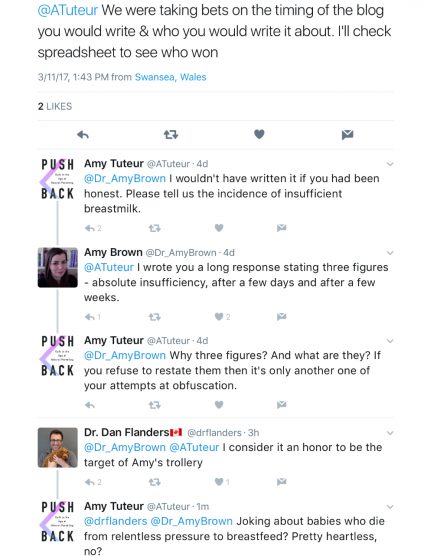
But that doesn’t explain why lactation professionals feel justified in ignoring and vilifying me. Consider this recent Twitter exchange.

IMG_2080

I had been taking Prof. Amy Brown to task in the wake of baby Landon’s death from dehydration due to insufficient breastmilk. Although Brown was willing to acknowledge that breastfeeding can be deadly, she refused to acknowledge just how often insufficient breastmilk occurs. The incidence is not rare; it is common. Brown didn’t give a small number; she knew I would ask for proof and she wouldn’t be able to provide any. She refused to give any number at all.

Pediatrician Dan Flanders parachuted in to offer what he presumably thought was a witty response:

I consider it an honor to be the target of Amy’s trollery.

Trollery?

Not to put to fine a point on it, but my academic credentials are likely superior to either those of Dr. Flanders or Prof. Brown. Moreover, since I breastfed my own four children I probably have as much or more experience breastfeeding as Prof. Brown and infinitely more than Dr. Flanders. Neither knows more about breastfeeding than I know, yet they feel free to dismiss my writing and my warnings.

Why? Because like most lactivists they are ideologues and the fundamental tenet of their ideology is that breastfeeding is perfect. How dare I point out that not only is breastfeeding imperfect like any other bodily function, but that it has real risks of injury and even death?

In many ways professional lactivists like Prof. Brown and Dr. Flanders undermine their own cause. Pretending that there are no risks to breastfeeding is like pretending there are no risks to pregnancy. No matter how much they want to believe in the Tinkerbell theory of childbirth and breastfeeding — you can only be successfully if you believe — no amount of believing prevents miscarriage. Similarly, no amount of believing increases milk supply.

In the best case scenario they are deluded; in the worst case scenario, they are lying. In either case, they demonstrate themselves to be untrustworthy, not to mention heartlessly cruel. Baby Landon is dead because lactation professionals insisted that everything was going well when Landon’s mother told them she thought he was starving. Rather than address that issue, both Brown and Flanders prefer to whine about me.

Sadly, they are recapitulating the behavior of an earlier generation of physicians whom they presumably despise. Those physicians believed that formula was the perfect food because it was “scientific.” They discouraged women from breastfeeding as a result. They were wrong, but they had the best of intentions. They truly believed what they said and that their paternalism was thereby justified.

Similarly, professional lactivists like Prof. Brown and Dr. Flanders sincerely believe that breastmilk is the perfect food because it is natural. They discourage formula feeding as a result and feel it necessary to demean anyone, no matter how personally and professional qualified, who dares to disagree with them. They are wrong, even though they appear to have the best of intentions. They truly believe what they say, but their paternalism is just as ugly as that of the generation of providers who promoted formula.

Let me speak directly to Prof. Brown and Dr. Flanders:

Breastfeeding is NOT perfect!

Believing breastfeeding is perfect is NOT the key to successful breastfeeding.

Informing women of the risks of breastfeeding does not undermine breastfeeding.

Idealization of breastfeeding harms, indeed kills, babies and mothers.

To the extent that you ridicule anyone who disagrees with you, you aren’t merely acting like heartless fools. You are harming both babies and mothers.

And that’s not funny.

The lactivist cry “lack of support” disempowers women

Woman plugging ears with fingers doesn't want to listen

Contemporary breastfeeding promotion is based on two lies. The first lie is that breastfeeding is critical to infant health when it isn’t and, in fact, can actually be harmful or deadly. The Fed Is Best Foundation has been doing tremendous work in exposing the lack of scientific evidence for this lie and the injuries to infant health and maternal mental health caused as a result.

The second lie beloved of lactivists is even more pernicious. It is the lie that women who can’t or don’t breastfeed are suffering from lack of support. As I wrote a few days ago, Prof. Amy Brown routinely deploys this lie. Brown’s own research showed that 80% of women stop breastfeeding because of pain and difficulty. She routinely ignores her own findings and substitutes the lactivists’ preferred explanation for any and every breastfeeding problem, “lack of support.”

[pullquote align=”right” cite=”” link=”” color=”” class=”” size=””]Simply disagreeing with lactivist orthodoxy marks you as disabled by false consciousness. Lactivists will ignore everything you say.[/pullquote]

The substitution is ludicrous on its face. There has never been more institutional and professional support for breastfeeding. Indeed there is an entire cadre of women, lactation consultants, who are paid for no other reason than to support breastfeeding. In other words, the idea that women are suffering a lack of support is a bald-faced lie.

The most pernicious aspect of the lie is not the fact that it is patently false, but that it is in effect an accusation of false consciousness. Therefore, it serves as an all purpose reason for ignoring anyone who claims to have difficulty with breastfeeding and anyone who criticizes lactivism and its dangerous excesses. Lactivists cry “lack of support” in an effort to disempower any woman who dares disagree.

False consciousness typically refers to political beliefs. According to Dictionary.com, false consciousness is:

a Marxist theory that people are unable to see things, especially exploitation, oppression, and social relations, as they really are; the hypothesized inability of the human mind to develop a sophisticated awareness of how it is developed and shaped by circumstances.

For example, Marxists insisted that working people who opposed Communism suffered from false consciousness. That inevitably led to the conclusion that the opinions of anti-Communists could be ingnored and that Marxists’ opinions were more valuable than those of people who opposed them.

As political theorist Steve Cook explains in Why calling “False Consciousness” is dangerous and unreasonable:

The moment that someone believes that another agent suffers from false consciousness, then they risk denying the equality of citizens. If someone believes that another suffers from false consciousness, then they can discount any reasons the other gives. The agent believes that they have special access to the truth, which others do not. Once you have special access to the truth … then your reasons automatically count and another’s can automatically be discounted…

Tell lactivists that you don’t want to breastfeed and they’ll insist that you would want to breastfeed if only you received support.

Tell lactivists that breastfeeding is painful and they’ll insist that it wouldn’t be painful if you had received support.

Tell lactivists that you don’t produce enough breastmilk and they’ll tell you that is a misperception due to lack of support or, alternatively, that you would be producing enough if only you had the correct support.

Hence Dr. Amy Brown, in her polemic entitled Why Fed Will Never Be Best: The FIB Of Letting Our New Mothers Down, insists:

Of course we must ensure that babies are fed. However, although the message may sound comforting on the surface, ‘fed is best’ is simply putting a sticking plaster over the gaping wound that is our lack of support for breastfeeding …

Brown’s claim perfectly illustrates the danger of accusing those who disagree with false consciousness. Brown and her colleagues feel completely justified in ignoring what women who can’t or don’t wish to breastfeed tell them. Their reasons for not breastfeeding (pain, insufficient breastmilk, inconvenience) don’t count. The only views that count are those of lactivists.

It does not matter how eloquently you explain that your baby died or nearly died of starvation. Your personal experiences are meaningless. Simply disagreeing with lactivist orthodoxy marks you as disabled by false consciousness. They will ignore everything you say.

As Cook notes:

The only way to prove that you don’t suffer from false consciousness is to wholeheartedly agree with the one who believes that you suffer from it. Effectively, you are regarded as fallible, and they as infallible. This kind of thinking can easily provide a justification for them to impose their will upon you…

In other words, it is deployed to disempower anyone who disagrees.

The bottom line is this: There has never been more institutional support for breastfeeding than there is today. To argue that current breastfeeding difficulties are due to lack of support is an empirical lie. But it’s also a tactic that lactivists use to disempower anyone who disagrees with them. That’s not merely wrong, but it can be deadly.

The shockingly unethical, paternalistic behavior of lactivists like Prof. Amy Brown

Woman liar with long nose

Lactation professionals are beside themselves with fear.

The story of a baby Landon who died from dehydration as a result of exclusive breastfeeding has become a tipping point. For years they have been exaggerating the benefits of breastfeeding, denying the risks and contributing to a wave of newborn deaths from both breastfeeding complications and deaths resulting from breastfeeding promotion efforts that have led to hundreds of smothering deaths and falls of maternal hospital beds each and every year.

[pullquote align=”right” cite=”” link=”” color=”” class=”” size=””]Lactation professionals believe that it is okay to withhold critical information in order to convince women to breastfeed.[/pullquote]

Baby Landon’s death has brought lactation professionals face to face with the biggest lie they espouse: the lie that insufficient breastmilk is rare when in truth it affects up to 15% of women or more.

Many lactation professionals are simply ignorant. They only know what their teachers — other lactation professionals have told them — which means they don’t know anything about the very real and very deadly risks of insufficient breastmilk. When you live and work inside an echo chamber, it’s hardly surprising that your knowledge is limited.

In contrast, there are quite a few prominent lactation professionals who do know the truth and are desperately trying to hide it. That is both unethical and profoundly paternalistic. They are literally afraid that if they tell women the truth about the risks of breastfeeding, as well as the benefits, women won’t make the choice they prefer.

Their goal is NOT to empower women with accurate information and hope they will choose to breastfeed. Their goal is to hide accurate information from women to ensure that they will breastfeed. They are no different from anti-choice activists who spread scientific falsehoods in an effort to dissuade women from choosing pregnancy termination. It’s unethical and it’s paternalistic.

Consider Prof. Amy Brown. I have engaged with her on the Facebook page of The New Scientist. She absolutely refuses to state a number for the incidence of insufficient breastmilk. Why? I’m going to guess that it’s because she knows that she has no scientific evidence for the typical lactivist lie that insufficient breastmilk is rare. I suspect that she knows as well as I do the the real incidence is 15% or more — and she doesn’t want to be caught telling women the truth. That’s shockingly unethical and disturbingly paternalistic.

I wrote about Brown last fall in connection with the naked misogyny of pressuring women to breastfeed. Brown’s research showed that 80% of women stop breastfeeding because of pain and difficulty. Brown then proceeded to ignore her own findings and substitute the lactivists’ preferred explanation of “lack of support.”

Brown is also the author of the charmingly titled Why Fed Will Never Be Best: The FIB Of Letting Our New Mothers Down. The title is in keeping with what appears to be the cardinal rule of lactivism — never miss an opportunity to shame women who can’t or don’t breastfeed.

Brown repeats the preferred lactivist fairytale that physiological problems are rare and “lack of support” accounts for low breastfeeding rates.

Of course we must ensure that babies are fed. However, although the message may sound comforting on the surface, ‘fed is best’ is simply putting a sticking plaster over the gaping wound that is our lack of support for breastfeeding and mothering in general. We cannot afford to say that how babies are fed does not matter…

Brown offers the standard lactivist lie.

Physiologically speaking only around 2% of women should be unable to breastfeed, but in reality less than half of mums in the UK breastfeed at all past six weeks.

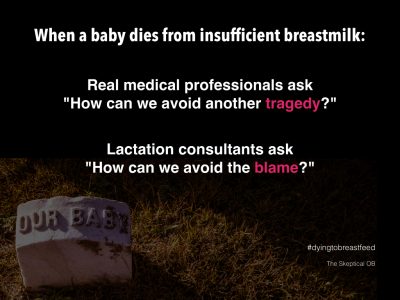
In our discussion on The New Scientist Facebook page, Brown simply refuses to answer the simple question about the real incidence of insufficient breastmilk. I noted that you can tell the the difference between real medical professionals and lactation consultants in the way they deal with this issue. When informed of a preventable death, real medical professionals ask, “How can we avoid this happening to another baby?” Lactation consultants ask, “How can we avoid blame?”

Brown then proceeds to prove my point by trying to deflect attention:

Babies can also die from dehydration if bottles are not properly made up eg too much powder provides too much sodium.

Now … is that the fault of the formula or a lack of awareness that it is an issue …

In both cases better support and education should be given!

I asked Brown a direct question:

What is the failure rate for breastfeeding? Please quote an actual number since this discussion is about the fact that lactation professionals lie about the rate of breastfeeding failure.

She didn’t bother repeating her previous lie of 2%.

Watch her try to wriggle out of giving an actual number.

IMG_2069

…[I]t’s Friday night in the UK and I’ve gone out for dinner.

You know it gets increased by what happens at birth and in early days. I recognise that. Better support would reduce that. Some will need formula. The data is different across countries which confirms this.

So … better recognition when things are not working. Formula if needed. I think we can agree on that?

I asked:

Would you agree with Alison Stuebe, MD of the Academy of Breastfeeding Medicine that as many as 15% of newborns can benefit from formula supplementation?

More comments from Brown, but no answer. I can only conclude that she doesn’t want women to know the truth because that might discourage them from breastfeeding. That’s just as paternalistic as the gynecologist who recommends hysterectomy but refuses to tell the patient the complication rate because that might discourage the her from choosing surgery.

It’s unethical when a gynecologist does it and it’s equally unethical when a lactation professional does it.

The goal of lactivism ought to be empowering women to breastfeed successfully if they can and if they want to do so. The goal should not be getting all women to breastfeed. That harms (and even kills) babies and the only people it empowers are lactation professionals.

One of the greatest ironies of contemporary lactivism is how lactation professionals have eagerly adopted the very traits that they so disparaged in doctors. They believe they know better than women themselves what is right for those women. They believe that it is okay to withhold information in order to convince women to do what they want them to do.

That’s why Amy Brown refuses to give a number for the incidence of insufficient breastmilk. The truth would reveal that breast is not best for a substantial proportion of mothers and babies.

Better to lie and let babies die.

Is US maternal mortality rising? Maybe not.

Tombstone Mother

I’ve been writing about the issue of US maternal mortality for years, and for years I’ve argued that most of the supposed increase is a result of improved reporting of maternal deaths, not more deaths.

That view was confirmed by the recent paper Is the United States Maternal Mortality Rate Increasing? Disentangling trends from measurement issues by MacDorman et al.

[pullquote align=”right” cite=”” link=”” color=”” class=”” size=””]”The overall picture is not consistent with any serious deterioration in maternal health or maternal health services in the United States.”[/pullquote]

Studies based on data from the 1980s and 1990s identified significant underreporting of maternal deaths… To improve ascertainment, a pregnancy question was added to the 2003 revision of the U.S. standard death certificate…

However, there were delays in states’ adoption of the revised death certificate … This created a situation where, in any given data year, some states were using the U.S. standard question, others were using questions incompatible with the U.S. standard, and still others had no pregnancy question on their death certificates.

Due in part to the difficulties in disentangling these effects, the United States has not published an official maternal mortality rate since 2007…

While raw data suggested that US maternal mortality had more than doubled since 2000, MacDorman and colleagues found that the real increase was only 26.4%, a much smaller increase, but an increase nonetheless.

Now a new paper, Factors Underlying the Temporal Increase in Maternal Mortality in the United States by Joseph et al., questions even the smaller increase.

The authors note:

Recent publications on global trends in maternal mortality have reported substantial increases in maternal deaths in the United States … The maternal mortality ratio in the United States in 2013 was higher than that in Azerbaijan, Iran, Kazakhstan, Libya, Saudi Arabia, and Uruguay (among others)… Such reports have led to considerable dismay in the United States and pleas for prompt clinical action to reduce maternal deaths.

It is difficult to reconcile the maternal mortality ratios in the United States with the lower estimates of these rates in less industrialized countries. Several explanations have been offered to explain the observed temporal increase in maternal mortality including an increase in chronic diseases among reproductive-aged women (especially obesity) and increasing rates of cesarean delivery. However, an alternative narrative, which views the rising rates of maternal mortality in the United States as an artifact of improved surveillance, implicates several different changes in maternal death surveillance …

The authors analyzed changes in both the overall rate of maternal mortality from 1999-2014 and cause specific mortality rates. They found that deaths from traditional causes actually DECLINED while deaths in new categories increased substantially.

Maternal mortality ratios (excluding late maternal deaths) increased from 9.88 in 1999 to 21.5 per 100,000 live births in 2014 (RR 2.17, 95% CI 1.93–2.45). However, maternal deaths resulting from complications of labor and delivery declined significantly over the same period (RR 0.43, 95% CI 0.27–0.68). There was no significant change in maternal deaths resulting from abortive outcomes (O00–O07), edema, proteinuria and hypertensive disorders, maternal care related to the fetus and amniotic cavity, and complications predominantly related to the puerperium. However, deaths resulting from other maternal disorders predominantly related to pregnancy and deaths resulting from other obstetric problems not elsewhere classified increased substantially between 1999 and 2014 (RR 10.0, 95% CI 6.85–14.7 and 5.88, 95% CI 4.38–7.89).

The difference was even more pronounced for late maternal deaths, many of which were not captured before the changes in reporting requirements;

Late maternal deaths, that is, obstetric deaths greater than 42 days and less than 1 year after delivery and deaths from sequelae of obstetric causes, increased from 0.38 in 1999 to 6.69 per 100,000 live births in 2014 (RR 17.7, 95% CI 10.5–29.7). Exclusion of codes O26.8 (other specified pregnancy-related conditions) and O99 (other maternal diseases classifiable elsewhere but complicating pregnancy, childbirth, and the puerperium) and late maternal deaths (O96 and O97) abolished the temporal increase in these maternal mortality ratios.

The authors explain:

Our study suggests that the reported substantial increase in maternal mortality in the United States between 1993 and 2014 was likely a consequence of improvements in maternal death surveillance and changes in the coding of maternal deaths. Regression adjustment for the separate pregnancy question on death certificates, ICD-10 codes, and the standard pregnancy checkbox on death certificates eliminated the increase in maternal mortality rates between 1993 and 2014. Exclusion of maternal deaths associated with the four new ICD-10 codes that identified late maternal deaths (O96, O97), other specified pregnancy-related conditions (O26.8), and other maternal diseases classifiable elsewhere (O99) also abolished the temporal increase in maternal mortality between 1999 and 2014.

Most other countries have not instituted new maternal mortality guidelines. Therefore it is hardly surprising that US maternal mortality ranking has dropped in relation to other countries that aren’t recording all maternal deaths.

The authors conclude:

Although there may have been some increase in maternal deaths resulting from chronic diseases (such as diseases of the circulatory system, diabetes, and liver disease) and definite reductions in maternal death resulting from obstetric causes (such as preeclampsia, eclampsia, and complications of labor and delivery), the overall picture is not consistent with any serious deterioration in maternal health or maternal health services in the United States.

Which is what I have been saying all along.

The morally grotesque Republican healthcare plan

28560596 - gray word on red wall

There is something morally grotesque about watching Republican legislators — all of whom get free Obamacare Plus on the public dime — compete with each other over designing the most unjust healthcare insurance system for others who may rely on the public dime.

I have a simple suggestion. Let’s mandate that Republican legislators get only the healthcare insurance that they give to the most vulnerable among us including the unemployed and those employed in blue collar work. If poor people get lousy Trumpcare, Republican legislators should get lousy Trumpcare too. That’s what justice requires.

[pullquote align=”right” cite=”” link=”” color=”” class=”” size=””]If poor people get lousy Trumpcare, Republican legislators should get lousy Trumpcare too.[/pullquote]

How can we determine what a morally just healthcare insurance plan might look like? It’s not as hard as you might imagine. John Rawls, the greatest political philosopher of modern times wrote that if we want to know what justice requires of us, we ought to imagine the world we would want if we didn’t know the position that we would occupy in that world. In other words, justice is what we would choose if we didn’t know if we were rich or poor, black or white, brilliant or plodding, talented or talentless. Or, expressed colloquially, what’s good for the goose is good for the gander.

Since it is unlikely that Republicans are going to create a Trumpcare that copies their high end insurance plans, the changes to Obamacare that Republican legislators propose must apply equally to them.

This is especially simple for Republican legislators who rely on the taxpayers to fund their health insurance. Justice means providing for others what legislators mandate that taxpayers provide for them. If they get government funded insurance — beef Wellington for every meal — it is immoral to force their poorest constituents to subsist on dry cereal without milk. Going forward, Republican legislators ought to get dry cereal without milk, too.

Since Trumpcare doesn’t mandate that employers provide insurance for their employees, the Federal government should not provide health insurance for Republican legislators. They should be forced to buy their health insurance on the open market. That will surely be very expensive, but it would save the a fortune for taxpayers. Of course if they think they are entitled to comprehensive health insurance, that’s what they should provide for the poorest among us.

Obviously Republican legislators wouldn’t qualify for any insurance subsidies since they make $174,000/yr, and they wouldn’t qualify for the new tax credits, either. Of course if they think that their comprehensive health insurance ought to be free from them, justice requires that it be free for everyone else.

Mandate that Republican legislators who are older be required to pay up to 5X more for insurance coverage than their younger colleagues. Not to worry, though; they could contribute up to $13,100 to pre-tax health savings accounts. That should be super helpful since self-insuring their families will cost about $6000 per year … before extras. If Republican legislators think that’s too onerous for them, it’s obviously too onerous for anyone else.

There would be no maternity benefit. That’s extra. If a Republican legislator wants to have children, he or she will have to pay for coverage with an expensive maternity rider or out of pocket, just like poor constituents. Babies might die as a result? Big deal. Republican “pro-life” legislators don’t give a damn if babies die, just so long as women are forced to give birth to them first.

Ironically, many Republicans are howling that the new plan is too generous! Surely if it’s too generous for poor people, their health insurance is far too generous for them.

If they want to exempt pre-existing conditions for others, their insurance shouldn’t cover pre-existing conditions. Child was an insulin dependent diabetic before Dad was elected to Congress? Now Dad will have to pay for insulin out of pocket.

If Republicans want to deny health insurance coverage to children between 22-26 that ought to apply to Republican legislators as well. And the same thing goes for lifetime caps. Legislator’s husband gets diagnosed with metastatic cancer? We’ll cover the first $1,000,000; after that they can pay the tab.

Don’t forget religious exemptions. No birth control on the public dime. Republican legislators and their spouses can just pay for it out of pocket.

Wait, what? Republican legislators think they’re entitled to better health insurance than their constituents who might be coal miners, factory workers, or stock boys at the local supermarket? Why? It can’t be because they are providing a more valuable service than those who work in mines, factories or supermarkets. Republican legislators just sit around and talk.

If a lousy Trumpcare plan is good enough for poor people and blue collar workers than it’s good enough for Republican legislators. Mandating that the government pay for Obamacare for legislators but not for constituents would be morally grotesque, wouldn’t it?

UK National Health Service paid more than $250 million to settle claims of brain damage from breastfeeding promotion

IMG_2020

The impact of baby Landon’s death from insufficient breastmilk continues to reverberate around the world and lactation consultants continue to whine that such deaths are not their fault.

The brutal truth is that lactivists lie and babies die.

A new paper from the UK provides more tragic examples.

[pullquote align=”right” cite=”” link=”” color=”” class=”” size=””]Both symptoms and maternal concerns were routinely ignored.[/pullquote]

The paper is Neonatal hypoglycaemia: learning from claims by Hawdon et al. It’s a risk management paper, published to alert clinicians and managers to potential causes of lawsuits.

The authors found:

…In this 10-year reporting period, there were 25 claims for which damages were paid, with a total financial cost of claims to the NHS of £162 166 677 [over $250,000,000 at the 2011 exchange rate].

Hypoglycemia is low blood sugar. Severe hypoglycemia can lead to severe brain injuries. Two examples were included:

The child is severely disabled and requires 24 hour care support. It has not been established whether the brain injury will have any impact upon life expectancy although limited mobility and cognitive deficits would contribute to a loss of life expectancy and her medical needs for the rest of her life are likely to be complex.

And:

She is mobile indoors but cannot walk properly on uneven ground or on even ground for more than 200 metres. She requires assistance with dressing, cleaning after toileting and has to have food cut up. She has no sense of danger to herself or others, acts in a dangerous and destructive way and requires constant close supervision.

Most cases involved well known risk factors for neonatal hypoglycemia including low birth weight, poor feeding behavior, maternal insulin dependent diabetes and hypothermia.

In most cases insufficient breastmilk intake was the cause and poor feeding behavior was the primary symptom although there were a few cases where other factors were involved (one case of neonatal hyperinsulinism and one case of neonatal sepsis).

For 21/28 (75%) babies, it was the abnormal feeding behaviour which caused clinical concern. Of these 21 babies, 2 were also described as hypotonic, 5 also as cold, 1 also as irritable and 1 also as sleepy.

Eight out of 28 (29%) babies were described as hypothermic, either in isolation or in combination with poor feeding or being sleepy.

One baby was described as being hypotonic in isolation, and one baby presented with cardiorespiratory collapse.

For two babies presenting clinical signs were not documented.

In fully 36% of cases, mothers felt there was something wrong with the baby but could not get the staff to take their concerns seriously.

The authors provide four examples:

‘By the third day he was sleepy and disinterested in feeding. His mother asked for assistance to latch him onto the breast and voiced concerns that he was not feeding. His mother continued to alert staff to her problems in getting the baby to feed and the fact that he was sleepy.’

‘The mother informed the midwifery staff on the ward on a number of occasions on this and subsequent days following the baby’s birth, that she was concerned the baby was not sucking when feeding was attempted and she was concerned he was not feeding properly. These concerns were not heeded, resulting in the baby not being fed adequately and ultimately causing his collapse due to hypoglycaemia.’

‘The mother felt she had expressed concerns on multiple occasions about baby’s feeding technique both on delivery unit and on the ward but she felt she had not received adequate support. These concerns were not listened to.’

‘The parents brought the baby to the accident & emergency department with feeding problems and episodes of rolling his eyes. Seen by the paediatric team. After giving advice on feeding to the parents, baby was discharged home. The parents continued to be concerned and brought baby back to accident & emergency 3 days later. Blood glucose levels were not measured and parents told they could take him home.’

The authors issue a number of recommendations including:

Babies presenting with abnormal clinical signs, including abnormal feeding behaviour and hypothermia, must undergo detailed and documented assessment including measurement of blood glucose levels …

Maternal concerns, especially with regards to feeding, should not be discounted and should be followed by a detailed and documented history and assessment of the baby’s condition.

In the presence of clinical signs, once a diagnosis of hypoglycaemia is suspected or made, this constitutes a clinical emergency.

Babies with risk factors for neonatal hypoglycaemia or abnormal feeding behaviour should not be discharged from postnatal ward to the community without assurance that the milk intake is sufficient to prevent hypoglycaemia…

There’s a theme that emerges here and it is quite ugly: both symptoms and maternal concerns were routinely ignored. Mothers were reassured that their babies were fine when no clinical investigation had been undertaken.

That’s what happened to baby Landon, too. His mother recognized that something was wrong and her concerns were dismissed out of hand.

Keep in mind that this paper involves only injuries from hypoglycemia in which successful lawsuits were filed; there were undoubtedly additional cases. Moreover, it does not include lawsuits for damage resulting from neonatal dehydration, smothering in the mother’s bed and falls from the mother’s bed, all known to be associated with the relentless contemporary promotion of breastfeeding.

The real problem here is quite obvious; it’s the magical thinking that surrounds breastfeeding. That includes the belief on the part of nurses, midwives and lactation consultants that serious breastfeeding problems are rare, when, in fact they are common and that believing you can breastfeed is the key to successful breastfeeding.

So lactation consultants and others falsely reassure mothers that everything is fine when in reality the baby’s brain cells are dying. In other words, lactivists lie and babies die.

If lactation consultants treated erectile dysfunction …

IMG_2002

Mr. Jones, so nice to meet you.

Allow me to introduce myself, Ima Frawde, IBCEC. What are the letters for? International Board Certified Ejaculation Consultant, of course. I support men who have ejaculation dysfunction at the low introductory price of $200 per hour. I’m here to help you with your erectile dysfunction.

Examine you? No, I’m not going to examine you. I know what’s wrong without examining you; I learned during my training that so called “erectile dysfunction” is always caused by the man who claims he is suffering from it. Different ejaculation consultants may have different opinions about a variety of issues, but on one thing we are all agreed: there is no such thing as “not enough” erectile function.

Just think about it. If erectile dysfunction were real, the population of the world would have died out long ago and we wouldn’t be here. We’re here, so that proves my point!

[pullquote align=”right” color=””]There is no such thing as “not enough” erectile function.[/pullquote]

What is causing your problem? Well, there are a number of possibilities.

1. You are not trying hard enough.

Some men simply don’t care about giving their wives the best sexual experience possible. Let’s face it, sexual intercourse can be a challenge and most husbands are just too lazy to meet the demands of regular activity. When the going gets tough, they give up and give in, opting for vibrators and other sex toys. Sure their wives may seem satisfied with vibrators, but over time those same wives will experience a decrease in IQ. If you really cared about your wife, Mr. Jones, you’d try harder. Lololol, get it? Try harder?

2. You are deformed, but that’s not an excuse.

Sigh, you have a circumcised penis, and we all know who’s to blame for that. Your ignorant parents never realized that circumcision causes erectile dysfunction. Sure you might not have noticed it for the first 65-70 years of life and it might not have started until after you had your first heart attack and began insulin for diabetes, but it is just as much the cause as if you were circumcised yesterday. Too bad for you.

3. Decreased blood flow? Don’t be silly.

You might have heard that erectile dysfunction can be caused by diseases that decrease blood flow to all organs, not just the penis, but it’s not true. That’s just a lie made up by Big Pharma in an effort to sell Viagra. There is no such thing as “not enough blood flow”! Your body is perfectly designed to have an erection and if you only gave it enough time, everything would be fine.

4. So what if your wife is crying because you can’t have intercourse; she’ll just have to wait.

Erectile dysfunction is a matter of supply and demand. If you don’t try to have sex often enough, you’ll never have enough blood flow. You have to keep trying to have sex over and over and over again each day and eventually there will be enough blood flow for erections on demand.

5. You’re doing it wrong.

Positioning is very, very important to prevent erectile dysfunction. If you held your wife the right way, she’d be able to “latch on” to your penis properly and you would then get an erection. So basically this is all your fault.

Oops, time’s up. You can pay with a check, although cash under the table is always appreciated. I’ll be back later in the week for another session. Just remember what I told you: you are not trying hard enough; you are deformed; there is no such thing as decreased blood flow; your wife is just going to have to deal with her disappointment; and, don’t forget, you are doing it wrong.

What? Of course it is your fault! Stop whining that there’s something wrong just so you have an excuse to stop having intercourse. We all know that is what is really going on.

You feel worse now?

No need to thank me; I’m just doing my job as an IBCEC, International Board Certified Ejaculation Consultant.


This piece first appeared in January 2013.

The Tinkerbell theory of breastfeeding and natural childbirth

Illustration of a fairy with butterfly wings

I just read a fantastic piece in The New Statesman. John Elledge writes about politicians’ preferred fall back strategy when their programs don’t work: blame the voters for not believing enough.

“The moment you doubt whether you can fly,” J M Barrie once wrote, “You cease for ever to be able to do it.” Elsewhere in the same book he was blunter, still: “Whenever a child says, ‘I don’t believe in fairies’, there’s a little fairy somewhere that falls right down dead.”

… [O]ver the last few years, what one might term the Tinkerbell Theory of Politics has played an increasingly prominent role in national debate. The doubters’ lack of faith, we are told, is one of the biggest barriers to flight for everything from Jeremy Corbyn’s poll ratings to Brexit. Because we don’t believe, they can’t achieve.

[pullquote align=”right” cite=”” link=”” color=”” class=”” size=””]Believing you can fly does not give you the ability to fly; believing that you can breastfeed exclusively or have an unmedicated vaginal birth does not give you the ability to do either one.[/pullquote]

I’m not sure about the applicability of the Tinkerbell theory to British politics, but it immediately struck me that the Tinkerbell theory is at the heart of contemporary breastfeeding and natural childbirth advocacy. Lactation consultants, midwives and doulas routinely blame their failures on mothers. Apparently if women don’t believe, LCs, midwives and doulas can’t achieve.

The recent spate of lactivist hysteria over Jillian Johnson’s heartbreaking story about the death of her son Landon from breastfeeding induced dehydration has demonstrated thatlactivists cannot tolerate criticism of breastfeeding. They insist serious breastfeeding problems are rare in the face of copious scientific evidence that they are common. Then when those problems occur, since they are after all common, they resort to the Tinkerbell theory.

Serious breastfeeding problems are routinely ascribed to mothers’ failure to believe that they can breastfeed. Evil formula corporations, ignorant doctors, and lack of support from others are invoked instead of the actual biological reasons for the problems. Apparently whenever a mother says, “breastfeeding is not working for my child and me,” a breastfeeding fairy dies.

Hence the relentless insistence that more women would breastfeed successfully if only they received more “support.” It isn’t the lactation consultant’s fault that breastfeeding is starving your child, or is searingly painful, or utterly impossible while working full time. It’s really your fault since you didn’t get the appropriate “support” that would have allowed you to believe. Your lack of belief, not their lack of scientific knowledge, that is the real problem.

Natural childbirth advocates like midwives and doulas are even more overt in their embrace of the Tinkerbell theory. What does their mantra “Trust Birth” mean if not “the moment you doubt you can have an unmedicated vaginal birth you cease to be able to have one”? What are birth affirmations except explicit invocations of the Tinkerbell theory? Each one is a variation on “I believe that my body was made to have an unmedicated vaginal birth”?

Hence if you got an epidural, acceded to an induction, wound up with a C-section it’s your fault for not believing instead of your midwife’s fault for making nonsensical claims in order to boost her business. If only you had had more “support,’ you would have believed. It is your lack of belief, not their lack of scientific knowledge, that is the real problem.

The Tinkerbell theory is a form of magical thinking. Magical thinking does not mean believing in magic. It means believing that thoughts and actions have the power to affect events. Knocking on wood, wearing lucky socks and fearing the number 13 are all examples of magical thinking. None of those behaviors has any impact on events but many people persist in believing that they do.

Magical thinking involves a rejection of the scientific concepts of chance, probability and randomness in favor of supposedly powerful thoughts. Magical thinking accounts for the extraordinary fatalism of homebirth advocates in the face of neonatal death. It can’t possibly be the midwife’s fault because “the baby would have died anyway” even in a hospital. It isn’t chance that kept a baby from being born vaginally, it was the mothers failure to believe her birth affirmations. It isn’t birth pathology that cause poor outcomes in childbirth, it is doctors’ insistence on pathologizing birth and their refusal to accept that women are “designed” for childbearing.

As Elledge notes in discussing politics:

It’s easy to see why the Tinkerbell strategy would be such an attractive line of argument for those who deploy it – one that places responsibility for their own f*ck-ups squarely on their critics, thus rendering them impervious to attack.

That’s the same reason why the Tinkerbell theory is so attractive to lactation consultants, midwives and doulas. It’s one that places responsibility for their own fuck-ups squarely on their patients, thus rendering them impervious to criticism. But just as believing you can fly does not give you the ability to fly, believing that you can breastfeed exclusively or have an unmedicated vaginal birth does not give women the ability to breastfeed exclusively or have an unmedicated vaginal birth.

Of course, it is not fairies who die when women are blamed for their lack of belief in breastfeeding or natural childbirth. It is babies who die — and the responsibility for their deaths lies with those who encouraged them to believe, not with mothers who didn’t believe enough.

Dr. Amy