A baby is dead and Hannah Dahlen thinks the problem is oppression of midwives

36247186 - creative on a theme of oppression, a pencil eraser and word oppression. vector illustration.

Homebirth midwives are nothing if not self-absorbed.

A baby is dead and Hannah Dahlen, a spokesperson for the Australian College of Midwives, has the unmitigated gall to use the preventable death as an opportunity to whine about the “oppression” of midwives.

[pullquote align=”right” cite=”” link=”” color=”” class=”” size=””]Hannah Dahlen has never met a dead baby she couldn’t exploit for her own purposes.[/pullquote]

According to ABC Australia:

The baby, referred to as “NA” by the New South Wales deputy coroner, died during a breech birth at a property near Nimbin in northern NSW in February last year.

The coroner found in September the parents of NA were clearly warned by their doctor of the dangers of a home birth because the baby was lying sideways…

There was no midwife or medically qualified person present during NA’s birth, in a practice often referred to as a “free birth”.

The parents were warned that the baby could die at homebirth and in an amazing coincidence — who could have seen that coming? — the baby died at an unassisted homebirth. Why was the birth unassisted? Because no doctor or midwife would attend a homebirth of such extraordinarily high risk.

This was a completely preventable death. For Hannah Dahlen, it was just another oppportunity to whine.

“I think there’s a few things driving this,” professor of midwifery at Western Sydney University, Helen [sic] Dahlen, said.

“One of them is the increasing over-regulation and oppression of midwives in this country …”

Say what?

Let me see if I get this straight. According to the Coroner’s Report, the parents were warned by doctors and midwives that the baby was transverse, that a transverse birth was far too dangerous to attempt at home and that no doctor or midwife would attend them if they chose to risk the baby’s life in that way.

… In my view both parents knew that they had been warned in general terms against proceeding with a home birth. Their pre-existing views made them wilfully blind to the level of risk involved. In my view it is established that they knew the foetus was lying sideways shortly before the due date. However they did not appear to properly understand or accept that they were heading into a potential catastrophe.

What does that have to do with the regulation of midwives? Not a damn thing.

But Dahlen has never met a dead baby she couldn’t exploit for her own purposes.

Dahlen made this horrifying claim in 2011 in the wake a multiple preventable homebirth deaths:

When health professionals, and in particular obstetricians, talk about safety in relation to homebirth, they usually are referring to perinatal mortality. While the birth of a live baby is of course a priority, perinatal mortality is in fact a very limited view of safety.

Really? On what planet would that be?

On Planet Midwifery where dead babies are a small price to pay for increased midwifery autonomy.

Dahlen’s claims in this case are even worse. This baby’s death had no more to do with midwifery regulation than it had to do with physician regulation. And regulation of midwifery is no more oppressive than regulation of physicians. The point of regulation is that safety standards matter more than the desires of individual practitioners. That’s a good thing, not a bad thing.

No matter. Dahlen exploited this baby as yet another opportunity for midwifery lobbying.

Dahlen’s claims are not simply an exercises in extreme callousness, they are a symptom of the ugly self-absorption that places the feelings and interests of midwives above everything else including the lives of babies.

The ultimate appeal of anti-vaccine advocacy: it flatters the ignorant

Superhero girl. Confident young woman

One of the most attractive aspects of anti-vaccine advocacy, indeed of all alternative health, is that no particular knowledge is necessary to declare yourself an expert.

It doesn’t matter that you don’t have even the most basic knowledge of science and statistics. It doesn’t matter that you don’t have any understanding at all of the complex fields of immunology or virology. Your personal experiences count for more than the collective wisdom of doctors, scientists and public health officials. Hence Jenny McCarthy, a B movie actress with no training of any kind in science is touted by herself and others as an “expert” on vaccines. Hence Modern Alternative Mother Kate Tietje and similarly undereducated mommy bloggers parade themselves as “experts” on vaccination.

[pullquote align=”right” cite=”” link=”” color=”” class=”” size=””]You don’t have to listen to experts; you are an expert.[/pullquote]

As the paper The Persuasive Appeal of Alternative Medicine explains:

The person-centered experience is the ultimate verification and reigns supreme in alternative science… Alternative medicine makes no rigid separation between objective phenomena and subjective experience. Truth is experiential and is ultimately accessible to human perceptions… [O]bjective diagnostic or laboratory tests that discern what cannot be felt never replace human awareness… [A]lternative medicine, unlike the science component of biomedicine, does not marginalize or deny human experience; rather, it affirms patients’ real-life worlds. When illness (and, sometimes, biomedicine) threatens a patient’s capacity for self-knowledge and interpretation, alternative medicine reaffirms the reliability of his or her experience.

On its face, such an appeal seems ludicrous, but it provides powerful validation for people who are frightened and confused:

  • You don’t have to listen to experts; you are an expert.
  • It doesn’t matter what studies show about whether vaccines cause autism; it only matters that it seems to you that vaccines cause autism.
  • Your personal experience isn’t irrelevant to determining whether vaccines cause autism; it is the central, perhaps the only, thing you need to know to make a determination.

Anti-vax advocacy reflects the conviction that no particular knowledge is necessary to pontificate on a topic. Merely having a child who is autistic and has been vaccinated (against anything, at any time) automatically qualifies them to pontificate on “vaccine injuries.” It’s the equivalent of claiming that their personal experience of gravity qualifies them as experts on Einstein’s theories.

Anti-vaxxers attempt to justify the lack of understanding of immunology and infectious diseases by making disparaging claims about the value of science itself. These types of claims are made by people who clearly feel threatened by knowledge (or their lack of it). It is not coincidence that these claims have been invoked by flat-earthers, creationists and climate science deniers as well.

These claims include:

  • Statistics cannot tell us everything about what happens.
  • Science tells us something different than experience tells us.
  • Science does not tell us the truth because it is manipulated by scientists for their own ends.
  • Science does not tell us the truth because it is manipulated by business people for their own ends.
  • There is no such thing as scientific truth.

These claims are not merely a justification of lack of knowledge; they are an affirmative celebration of ignorance.

Anti-vaccine advocacy is not simply based on factual errors and a pervasive failure to understand basic science and statistics, not to mention immunology and infectious diseases. It is also based on a denial of the need for specific knowledge and a disparagement of such knowledge. By elevating personal experience to the same or even higher level than knowledge of the relevant subject matter, anti-vax advocacy makes everyone an “expert.”

In other words, instead of imparting new knowledge, instead of protecting children, it merely flatters the ignorant.


Addendum: Anyone want to claim that vaccines are unsafe or ineffective?

Please post citation to at least 10 large scale meta-analyses from high impact journals that support your contention that vaccines are not safe.

If you cannot, or if you post links to old, obscure papers in low impact journals, I will consider that an admission of defeat.


Adapted from a piece that first appeared in May 2009.

BFHI, the Bullying Friendly Hospital Initiative

img_1408

Last week I wrote about the fact that so called Baby Friendly Hospital Initiative has been worse than a failure.

Not only does it fail to achieve its objective, it is actively harmful.

[pullquote align=”right” cite=”” link=”” color=”” class=”” size=””]The BFHI is not a medical program; it’s the institutionalization of lactivist bullying.[/pullquote]

  • The BFHI bans pacifiers despite the fact that the scientific evidence shows they don’t interfere with breastfeeding and that they prevent SIDS.
  • The BFHI bans judicious formula supplementation despite the fact that the scientific evidence shows it doesn’t interfere with breastfeeding and prevents dehydration, brain damage and death.
  • The BFHI enforces prolonged skin to skin contact despite the fact that the scientific evidence shows it leads to deaths from Sudden Unexpected Postneonatal Collapse (SUPC).
  • The BFHI enforces 24 hours rooming in and encourages closing well baby nurseries despite the fact that the scientific evidence shows it leads to infant injuries and deaths from falling out of or being smothered within the mother’s bed.

The BFHI is not friendly to babies, but deadly to babies. It’s friendly to lactivist bullying.

It’s been a depressing series of decades for those who find deep and abiding satisfaction in bullying others. You can no longer bully people for being divorced or for having a child without being married. You can’t bully people of different races, sexes or religions. You can’t bully people for being gay and at the rate things are going, it won’t be long before it will be frowned upon to bully people for being overweight. But, in this world of ever decreasing bullying opportunities, there are still some tried and true opportunities available: you can still bully another women for being a bad mother.

The practice of mother bullying is practically a competitive sport. All the traditional options are still available: “I can’t believe your 14 month old is not walking”; or “My Johnny is always picked first for sports teams”; not to mention the ever popular “I’m so sorry that your child is going to a state college and not the elite college my child is attending.” Breastfeeding has provided some deeply satisfying new options for lactivists bullies. These include bullying women if they did not meet an arbitrary standard of breastfeeding duration or exclusivity, or (heaven forfend!) never breastfed at all.

The BFHI is not a medical program; it’s the institutionalization of lactivist bullying. Even better, the BFHI allows its proponents to pretend that they are bullying another mother, not merely for her child’s benefit, not merely for her benefit, but for the benefit of public health. It’s a win-win: all the fun of bullying another mother plus a heaping helping of self-righteousness.

Baby Friendly Hospitals represent breast bullying on steroids. Locking up formula in hospitals is oh so painful for mothers and so satisfying for bullies. If only they could require prescriptions for formula, breast bullies’ lives would be complete. And best of all, they are doing the shaming for the public good!

To hear lactivists tell it breastfeeding prevents every disease known to man; it cures every disease known to man; there is no problem that exists that cannot be solved by squirting breast milk at it! A mother who can’t or (worse!) chooses not to breastfeed is purportedly harming her child, AND being a selfish slob who puts her convenience ahead of her child’s brain functioning.

Nothing could be further from the truth. In countries with easy access to clean water the benefits of breastfeeding are trivial.

Being a bully is fun. Being a breastfeeding bully is better than fun; it is a public service! The BFHI isn’t friendly to babies; it leads to their suffering and even death. The BFHI isn’t friendly to mothers; it torments them for failing to mirror lactivist beliefs back to the lactivists who created it. The BFHI is friendly only to bullies and should be dismantled and replaced as soon as possible.

We can and should support breastfeeding without supporting bullying and we should not allow lactivists to convince us otherwise.

Has childbirth pain outlived its evolutionary purpose?

img_1401

Why does childbirth hurt?

Natural childbirth advocates often claim that the pain of childbirth brings a variety of benefits. Some claim that the pain triggers a hormone cascade that is necessary for maternal infant bonding. Others insist that childbirth is not painful and is actually “ecstatic” and provides sexual pleasure. These varying theories hinge on the notion that the pain of childbirth adds something of value to the experience birth, and that the pain is good and beneficial.

[pullquote align=”right” cite=”” link=”” color=”” class=”” size=””]Far from being beneficial, labor pain may now have only harmful effects.[/pullquote]

However, evidence derived from the study of ancient childbirth suggests that natural childbirth advocates have it precisely backwards. The pain of childbirth is not needed to trigger good things, it is vital to prevent maternal and neonatal death, and is a vestigial response that is no longer needed.

Before we consider ancient childbirth, it makes sense to think about the role of pain in the human body. Pain is almost always a sign that something is wrong, perhaps seriously wrong. Indeed, pain is so important to human survival that it can stimulate reflexive reactions. Put your hand on a hot object and you will actually begin pulling it away before you consciously feel the pain. That’s because there are nerve circuits in the spinal cord that allow you to unconsciously perceive the pain and pull away, skipping the step of consciously noticing the pain so as to save time and limit damage.

When you think about it, there is no instance in which pain is not designed to protect against damage. At the level of the skin, pain tells us what is safe to touch and what is dangerous. At the level of bone, the pain of a broken bone is so great that it forces immobility, and that probably helps the bone to heal properly. The pain of disease makes people search for ways to diminish the pain, and perhaps improve survival from the specific problem. So, at the most basic level, there is no reason to believe that the pain of labor is beneficial in and of itself. Unless labor pain is different from all other types of pain of human existence, labor pain exists to warn.

Human childbirth has existed in its present form for millions of years. During that time, the death rate of both mothers and infants was extraordinarily high. Evolution would certainly have favored strategies that lowered the risk of death. Perhaps labor pain, like all other forms of human pain, existed to warn women to seek assistance.

Seeking assistance in childbirth may have lowered infant mortality by having help in situations like breech birth (which usually cannot be accomplished without some manipulation of the baby’s body) and may have lowered the death rate from postpartum hemorrhage, because the assistant could massage a woman’s uterus after birth. Assistance in childbirth must be very important from an evolutionary perspective because anthrologists report that all human societies have birth attendants.

According to Karen Rosenberg (a paleoanthropologist who studies human birth) and Wenda Trevathan (a biological anthropologist and trained midwife) writing in Scientific American special edition, New Look At Human Evolution, 2003:

… [W]e suggest that natural selection long ago favored the behavior of seeking assistance during birth because such help compensated for these difficulties. Mothers probably did not seek assistance solely because they predicted the risk that childbirth poses, however. Pain, fear and anxiety more likely drove their desire for companionship and security.

Psychiatrists have argued that natural selection might have favored such emotions—also common during illness and injury—because they led individuals who experienced them to seek the protection of companions, which would have given them a better chance of surviving. The offspring of the survivors would then also have an enhanced tendency to experience such emotions during times of pain or disease. Taking into consideration the evolutionary advantage that fear and anxiety impart, it is no surprise that women commonly experience these emotions during labor and delivery.

How ironic for natural childbirth advocates if the role of pain in labor is to alert women to the inherently dangerous nature of childbirth so they will seek assistance. It would also mean that labor pain has outlived its usefulness. Far from being beneficial, labor pain may now have only harmful effects.

The Baby Friendly Hospital Initiative is worse than a failure

Stop Doing What Doesn't Work

An extraordinary editorial in the latest issue of JAMA confirms what I have been writing about for years: the Baby Friendly Hospital Initiative is worse than a failure. It not only doesn’t work at promoting breastfeeding, but it actually harms infants and mothers in the process.

The editorial accompanies publication of the new USPSTF (United States Preventive Services Task Force) breastfeeding promotion guidelines. Interventions Intended to Support Breastfeeding Updated Assessment of Benefits and Harms by Flaherman and Von Kohorn is remarkable for its honesty.

[pullquote align=”right” cite=”” link=”” color=”” class=”” size=””]It’s the inevitable result of replacing scientific evidence with lactivist ideology.[/pullquote]

The BFHI doesn’t work.

…[O]nly individual-level interventions demonstrated effectiveness at improving breastfeeding, whereas system-level interventions, including the World Health Organization’s Baby-Friendly Hospital Initiative (BFHI), did not.

That’s a stunning admission. After millions of dollars in expenditure and countless tears of starving infants and guilt ridden mothers, the BFHI doesn’t even achieve its only objective: to increase breastfeeding rates.

If that weren’t bad enough, it has become clear that the BFHI is actually harming babies.

How?

The BFHI bans pacifiers in contradiction to the scientific evidence.

Counseling to avoid the use of pacifiers in the newborn period is an intervention commonly used to support breastfeeding. However, evidence has been building that infant use of a pacifier may be associated with a reduced risk of sudden infant death syndrome,7 the most common cause of postneonatal death in the United States. The evidence review showed that avoiding pacifiers was not associated with any breastfeeding outcomes assessed in the evidence review. A recent Cochrane systematic review reached the same conclusion. Thus, routine counseling to avoid pacifiers may very well be ethically problematic.

The BFHI bans formula supplementation in contradiction to the scientific evidence.

Counseling mothers to avoid giving infants any food or drink other than breast milk during the newborn period is step 6 of the BFHI and one of the primary care interventions most commonly used to support breastfeeding. Three randomized trials have specifically examined the effectiveness of counseling to avoid giving newborns any food or drink other than breast milk; none showed a beneficial effect of such counseling on breastfeeding duration.

And that’s harmful:

… For women who have scant colostrum and no copious milk production for 4 to 7 days, exclusive breastfeeding in the first few days after birth is associated with increased risk of hyperbilirubinemia, dehydration, and readmission.14- 16 Although these conditions are generally mild and often resolve rapidly, their frequency is high; 1% to 2% of all US newborns require readmission in the first week after birth, and the risk is approximately doubled for those exclusively breastfed.15,17 If counseling to avoid food and drink other than breast milk is not an effective method to support breastfeeding, the frequent low morbidity and rare high morbidity outcomes could potentially be avoided without reducing breastfeeding duration.

That’s in addition to previously described harms.

As noted in Unintended Consequences of Current Breastfeeding Initiatives:

Enforced prolonged skin to skin contact leads to deaths from Sudden Unexpected Postneonatal Collapse (SUPC).

Reports of SUPC include both severe apparent life-threatening events (recently referred to as brief resolved unexplained events) and sudden unexpected death in infancy occurring within the first postnatal week of life. A comprehensive review of this issue identified 400 case reports in the literature, mostly occurring during skin-to-skin care, with one-third of the events occurring in the first 2 hours after birth …

Infant injuries and deaths as a result of enforced 24 hours rooming in and closing well baby nurseries.

An overly rigid insistence on these steps in order to comply with Baby-Friendly Hospital Initiative criteria may inadvertently result in a potentially exhausted or sedated postpartum mother being persuaded to feed her infant while she is in bed overnight … This may result in prone positioning and co-sleeping on a soft warm surface in direct contradiction to the Safe Sleep Recommendations of the National Institutes of Health. In addition, co-sleeping also poses a risk for a newborn falling out of the mother’s bed in the hospital, which can have serious consequences.

How did a program designed to promote breastfeeding end up harming so many babies? It’s the inevitable result of relying on lactivist ideology instead of scientific evidence. Sadly, hospitals, doctors and nurses allowed the breastfeeding industry, including lactation consultants, to set policy.

Lactivists and lactation consultants appear to believe that only continuous, extended, exclusive breastfeeding has value, but that’s not what the scientific evidence shows. Instead of promoting science based support of breastfeeding, the BFHI promotes depriving infants of vital formula supplements, life saving pacifiers and safe sleeping arrangements. Instead of promoting science based support of women who want to breastfeeding, the BFHI focuses on shaming and blaming mothers who can’t or don’t wish to breastfeed.

The deadly results that I and others have been warning about for years were tragically inevitable.

Pediatricians have taken critical first steps in acknowledging that the tenets of the BFHI lead to preventable infant deaths, but it’s long past time to start dismantling the BFHI. How can we possibly justify maintaining a punitive program designed by lactivists designed to enforce an unscientific ideology in hospitals, facilities devoted to promoting infant and maternal health?

Does breastfeeding prevent SIDS?

Baby feeds on MOM's breasts

It is now widely accepted that breastfeeding prevents SIDS (Sudden Infant Death Syndrome), but is that what the scientific evidence really shows?

The short answer: yes, but it’s complicated.

[pullquote align=”right” cite=”” link=”” color=”” class=”” size=””]Yes, but it’s complicated.[/pullquote]

Yesterday I wrote about the claim that roomsharing prevents SIDS and concluded that the evidence is both extremely limited and very weak. In contrast, there have been a multitude of studies supporting the claim that breastfeeding prevents SIDS; the problem is confounding variables and exaggeration of the benefits.

The following graphs illustrate the difficulties.

This first set of graphs comes from the 2016 paper Overall Postneonatal Mortality and Rates of SIDS by Goldstein et al. The first graph shows the decline of SIDS and non SIDs infant and postneonatal deaths over the past 3 decades. The second graph breaks out trends in various causes of unexplained neonatal mortality of which SIDS is only one possible diagnosis.

img_1394

The authors explain:

It has been recognized that SIDS mortality has decreased since inclusion in the International Classification of Diseases in 1973, decades before the promotion of supine sleep positioning. Without diminishing the remarkable contributions of BTS, this 30-year analysis raises important considerations that changes in mortality were also associated with concurrent influences on postneonatal mortality and those affecting intrinsic risk… Additional support that SIDS and non-SIDS mortality share common influences is provided by the cluster analysis, where SIDS mortality trends most closely follow specific conditions with improvements attributable to advances in prenatal and neonatal care.

In other words, there are a myriad of confounding variables that plague all studies of SIDS. The recent decline in SIDS deaths takes place against the background of an overall decline in postneonatal mortality, an overall decline in prone infant sleeping, and an improvement in classifying deaths that are typically attributed to SIDS.

Most studies claiming that breastfeeding is protective against SIDS are case-control studies. Both cases and control should presumably reduce the effect of background changes in SIDS incidence. However, the ambiguity and changing classifications of previously unexplained infant deaths/SIDS deaths could have a disparate impact.

The authors note:

Although some changes in diagnostic preferences may reflect attitudes toward particular nomenclature, such as the use of “cause unknown” instead of “SIDS,” others imply significant differences in the decision-making process for the classification of sudden infant deaths. The increased use of “accidental suffocation and strangulation in bed” instead of “SIDS,” for example, reflects awareness of potentially lethal asphyxial conditions from improved scene investigations but also debatable judgments about their contribution to death in an assumed normal infant…

Breastfeeding rates are closely associated with socio-economic status. Are there differences in cause of death diagnosis between wealthy communities and poorer communities? We don’t know.

Keeping these issues in mind, let’s look at the actual studies that analyze the impact of breastfeeding on SIDS rates.

Breastfeeding and dummy use have a protective effect on sudden infant death syndrome by Alm et al. is a literature review on the protective effect against SIDS of both breastfeeding and pacifier use.

We conducted a literature review on the effect of breastfeeding and dummy (pacifier) use on sudden infant death syndrome (SIDS). From 4343 abstracts, we identified 35 relevant studies on breastfeeding and SIDS, 27 on dummy use and SIDS and 59 on dummy use versus breastfeeding.

What did they find?

We examined 17 observational studies and found that breastfeeding was reported to have provided a protective effect on SIDS in ten studies. No protective effects were found in the other seven.

All three of the meta-analyses that our search identified showed that breastfeeding had a protective effect on SIDS.

How about the impact of pacifiers?

We found 11 observational studies that consistently showed a risk reduction of about 50% if the infant used a dummy.

There were also two meta-analyses that gave approximately the same odds ratio of about 0.5.

What was the impact of pacifier use on breastfeeding rates?

[F]ive randomised controlled studies (RCTs) have been performed to date. Four of them did not find that a dummy reduced the duration of breastfeeding, while one found an increased risk of earlier weaning.

In 2011, Jaafar conducted a meta-analysis on the RCTs carried out by Jenik and Kramer, which concluded that using a dummy did not affect the chance of exclusive breastfeeding at three months.

This plot of pooled odds ratios shows the impact of breastfeeding and pacifiers on SIDS and well as the impact of pacifiers on breastfeeding. It demonstrates that pacifier use reduces the risk of SIDS as much or more than breastfeeding!

img_1396

More importantly, the protective effect of pacifiers or breastfeeding is dwarfed by the harmful effect of bed sharing. While pacifier use and breastfeeding appear to decrease the risk of SIDS by 50%, bedsharing increases the risk of SIDS by 400% or more.

So does breastfeeding prevents SIDS?

The evidence suggests that it does, but using a pacifier has an equal if not greater effect on reducing the risk of SIDS, and avoiding bedsharing has a far greater protective effect than either. Of course, placing an infant to sleep on her back has the greatest protective effect of all.

Sadly the lay literature does not accurately portray the risks. That’s because lactivists are so intent on promoting breastfeeding  that they have exaggerated its benefits, minimized the benefits of pacifiers and, to a large extent, ignored the risks of co-sleeping. Moreover, lactivists have failed to situate the benefit of breastfeeding in preventing SIDS within the larger context of the risks of insufficient breastmilk which can cause seizures, permanent brain damage and death.

Should you breastfeed if you can produce enough milk? Sure; it can reduce the risk of SIDs. But you can also give your baby a pacifier which reduces the risk of SIDS by the same amount. And the benefit of breastfeeding is dwarfed by the risk of co-sleeping.

If we truly want to save lives we should be aggressively promoting pacifier use and strongly discouraging co-sleeping. And breastfeeding can help, too.

Evidence that roomsharing prevents SIDS is extremely weak

Little newborn baby boy sleeping in round crib with canopy

The American Academy of Pediatrics is finally acknowledging that many principles of lactivism are contradicted by the scientific evidence. Sadly, they have replaced old unsupported recommendations with a new unsupported recommendation.

In August, the AAP finally acknowledged that The Baby Friendly Hospital Initiative, a hospital based effort to promote breastfeeding, leads to serious iatrogenic infant injuries and deaths. The relentless promotion of prolonged periods of skin to skin contact and forced rooming in (by closing well baby nurseries) has led to an epidemic of preventable infants deaths from smothering in the mother’s bed and skull fractures caused by falling out of it. Moreover, the lactivist insistence that co-sleeping improves breastfeeding rates has led to infant deaths from SIDS (Sudden Infant Death Syndrome) at home.

Sadly, the new recommendations, while an improvement, continue to promote the prejudices of lactivists that women should be as close to their babies as possible for as many hours of the day as possible in place of the actual scientific evidence. Specifically, the AAP strongly recommends roomsharing despite the fact that the scientific evidence for a protective effect is extraordinarily weak.

According to the new guidelines:

It is recommended that infants sleep in the parents’ room, close to the parents’ bed, but on a separate surface designed for infants, ideally for the first year of life, but at least for the first 6 months.

There is evidence that sleeping in the parents’ room but on a separate surface decreases the risk of SIDS by as much as 50%.

Actually, as far as I can determine, there is little evidence that sleeping in the parents’ room prevents SIDS. There are four case control studies, two from 2005 and 2004 and two from the 1990’s that show an association between infants sleeping in the parents’ room and decreased risk of SIDS. But as basic statistics teaches us, correlation is not causation.

1. The 2005 study is Bedsharing, roomsharing, and sudden infant death syndrome in Scotland: a case-control study that took place in Scotland involving 123 infants who died of SIDS between January 1, 1996 and May 31, 2000, and 263 controls.

The authors found:

Sharing a sleep surface was associated with SIDS (multivariate OR 2.89, 95% CI 1.40, 5.97). The largest risk was associated with couch sharing (OR 66.9, 95% CI 2.8, 1597). Of 46 SIDS infants who bedshared during their last sleep, 40 (87%) were found in the parents’ bed…

In other words, the association between roomsharing and prevention of SIDS was so minor that they didn’t even include it in the abstract.

What did they find when they looked at roomsharing?

Separate room not sharing was not associated with a risk of SIDS on univariate analysis (OR 1.32 95% CI 0.67, 2.60) but became a risk on multivariate analysis (OR 3.26 95% CI 1.03, 10.35)… Further stratified analysis showed that separate room was associated with a significant risk of SIDS only if a parent smoked (OR 12.2 95% CI 2.25, 66.4) and not if parents were nonsmokers (OR 1.25 95% CI 0.16, 10.06)

Roomsharing was protective ONLY when parents were smokers. That’s not evidence that roomsharing is protective against SIDS.

How about the other citations?

2. Sudden unexplained infant death in 20 regions in Europe: case control study was published in 2004.

…Highly significant risks were associated with prone sleeping (OR 13·1 [95% CI 8·51–20·2]) and with turning from the side to the prone position (45·4 [23·4–87·9])… If the mother smoked, significant risks were associated with bed-sharing, especially during the first weeks of life (at 2 weeks 27·0 [13·3–54·9]). This OR was partly attributable to mother’s consumption of alcohol. Mother’s alcohol consumption was significant only when baby bed- shared all night… About 16% of cases were attributable to bed-sharing and roughly 36% to the baby sleeping in a separate room.

Curiously the authors found that a history of roomsharing but not room sharing at the time of death was associated with relative risk of 0.48, while a history of roomsharing and roomsharing at the time of death was associated with a relative risk of 0.32. The authors acknowledge that they have no idea how roomsharing decreases the risk of SIDS death let alone how a history of previous roomsharing could decrease the risk of death. That suggests that confounding variables may lead to a spurious association.

3. Co-sleeping increases the risk of SIDS, but sleeping in the parents’ bedroom lowers it is part of a 1995 Norwegian monograph, Sudden Infant Death Syndrome: New Trends in the Nineties. I have been unable to access the monograph.

4. Babies sleeping with parents: case-control study of factors influencing the risk of the sudden infant death syndrome is a 1999 British case-control study.

The findings are shown in this chart:

img_1389

The authors acknowledge problems with interpreting their data:

… Certain factors characteristic of infants found in the parental bed were systematically different from those where the infant was found in a cot: bed sharing infants were much younger, few were put down in the prone position, and few were found with their heads covered. Conversely these factors were reversed among infants who slept separately from their parents.

That’s not a definitive result.

So we have 3 studies with widely disparate findings that indicate potential association, but not causation.

The potential protective effect of roomsharing on SIDS fails to meet the majority of the Hill’s Criteria typically used to determine causation.

  •  The strength of the association is unknown.
  • The dose-response relationship is unknown.
  • The potential protective is not consistent. It varies widely among the studies and in one study applies only to parents who are smokers.
  • No one has offered a remotely plausible mechanism by which roomsharing could prevent SIDS.
  •  The possibility of a chance finding orconfounding variables has not been ruled out.
  • There are no experiments or even prospective studies that look at this issue.

In other words, the claim that roomsharing is associated with protection against SIDS is based on data that is weak and conflicting. More importantly, there is no evidence that roomsharing is the cause of any protective association.

Roomsharing is not harmful. No babies will be hurt by following the recommendation.

What’s at risk is the credibility of the AAP and other physicians. When we make recommendations based on weak data, we face the likelihood that the recommendations will be overturned by better research. That has happened repeatedly with recommendations about breastfeeding.

In 2016 we are finally acknowledging that practices beloved of lactivists — exclusive breastfeeding, co-sleeping, pacifier bans and formula restriction — have risks. Thankfully, the AAP is revising its recommendations in response. The last thing they should be doing is making new recommendations that are no better supported by scientific evidence than the old ones.

Quackery and the conceit of the brilliant heretic

11259841 - galileo galilei - picture from meyers lexicon books written in german language. collection of 21 volumes published between 1905 and 1909.

A pervasive theme in quackery (aka “alternative” health) is the notion of the brilliant heretic. Believers argue that science is transformed by brilliant heretics whose fabulous theories are initially rejected, but ultimately accepted as the new orthodoxy.

Alternative health practitioners, with no embarrassment at their own presumption, routinely liken themselves to Galileo and Darwin. Today their brilliant theories of homeopathy, therapeutic touch and “vaccine injuries” are rejected but ultimately they will be acknowledged as truth. As usual, their claim is based on a lack of knowledge about science, and ignorance of history.

[pullquote align=”right” cite=”” link=”” color=”” class=”” size=””]Galileo and Darwin were considered heretics by religious leaders, not by other scientists.[/pullquote]

As explained in The Holistic Heresy: Strategies of Ideological Challenge in the Medical Profession by Paul Wolpe, alternative health practitioners believe:

[Alternative health] is the inevitable (or desirable) next step in the history of medicine, and like other heroes of medical history who were initially rejected by the orthodoxy of the day … the [alternative health practitioner] is simply ahead of his time. Innovation is always initially resisted … Holistic heretics portray themselves as mavericks, leaders, with every expectation that soon all of medicine will, by necessity, follow in their footsteps.

It is a breathtaking conceit, and it betrays a profound lack of understanding of the history of science.

1. The conceit rests on the notion that revolutionary ideas are dreamed up by mavericks, but nothing could be further from the truth. Revolutionary scientific ideas are not dreamed up; they are the inevitable result of massive data collection. Galileo did not dream up the idea of a sun-centered solar system. He collected data with his new telescope, data never before available, and the sun-centered solar system was the only theory consistent with the data he had collected.

Similarly, Darwin did not dream up evolution. He collected data during his years of exploration on the Beagle, much of it previously unavailable. A theory of evolution was the only theory consistent with the data that he had collected.

In contrast, belief in alternative health has no basis in scientific fact. It has been dreamed up by its various adherents and practitioners. Far from depending on scientific evidence, it eschews the need for scientific evidence.

2. The notion of the heretical maverick betrays a lack of historical knowledge. Galileo and Darwin were considered heretics by religious leaders, not by other scientists. Their ideas swept across the scientific world precisely because of their explanatory power and the data that they had to back them up.

In the world of science, it was already well established that the orthodoxy could not explain what everyone had observed. Long before Galileo, scientists understood that the Biblical theory of the earth-centered universe did not accord with astronomical evidence. Long before Darwin, fossil discoveries had called into question the Biblical creation story.

Mainstream medical science has been astoundingly successful in both theory and practice. The power of the germ theory of disease or the molecular structure of DNA rests on their ability to explain what we observe, are confirmed by experimental data, and result in highly effective treatments and cure.

In contrast, alternative medicine exists independent of scientific observation. Its theories have poor explanatory power and are directly contradicted by copious scientific evidence. The treatments of alternative health are notoriously ineffective. Although anecdotes abound, scientific studies of “alternative” health treatments have yet to identify a single one that works.

3. New theories may be resisted by older scientists because they upset the orthodoxy, but they are not resisted by the scientific world. That’s the point of peer reviewed scientific journals. Scientists present their evidence, and other scientists decide whether that evidence supports a new theory.

For example, early in my medical career a scientist claimed that ulcers were caused not by acid, but by the H. pylori bacteria. The initial reaction of the medical world was disbelief. However, when doctors saw the data, and when the original studies were quickly reproduced by other scientists, doctors accepted the theory, created treatments based on the discovery and moved on.

In medicine, as in all science, the data comes first, the theory follows. In “alternative” health, the theory exists independent of the evidence, and no one even bothers to collect evidence. The idea that alternative health will ultimately be accepted as true is ludicrous.

The idea that heroic geniuses dream up new scientific theories that are initially rejected but ultimately embraced by other scientists is a fairy tale. It betrays a lack of understanding about how science works, and a lack of knowledge about what actually happened to people like Galileo and Darwin.

Can you strengthen your immune system?

img_1379

Proponents of “alternative” medicine often disagree profoundly on treatment methods. Sick? In pain? Try this homeopathic remedy that contains no active ingredients. Stick needles into acupressure points. Wear magnetic foot pads to pull the toxins out of your body.

[pullquote align=”right” cite=”” link=”” color=”” class=”” size=””]Illness is not caused by a weak immune system.[/pullquote]

But on one point all proponents of alternative medicine agree. Since the source of all your troubles is a weak immune system, the key to treating and preventing all illness is “strengthening the immune system.” Indeed, this belief is so widespread, it appears that the only people who don’t subscribe to it are people who actually know something about the immune system, doctors, immunologists, microbiologists, etc. The idea that disease can be treated and prevented by “strengthening the immune system” depends on a profoundly flawed, almost cartoon like, view of the immune system itself.

The immune system is tremendously complicated, involving as it does innate cellular immunity and humoral (antibody) immunity. Multiple poorly understood organs make up the immune system. Anyone actually know what the spleen is for? And how about lymph nodes and bone marrow? Those are also quite complex. It is the interactions of these types of immunity, within the various organs of the immune system and throughout the body that determine whether and how we can fight off disease.

The alternative medicine view of the immune system is cartoon like in its simplicity. The individual components of the system, and their specific functions are never discussed or even mentioned. Too complicated. The cascade of events that occurs when the body’s outer defenses of skin or other tissues are penetrated by a foreign substance is completely ignored. Also, too complicated.

Instead, the immune system is conceptualized as a unitary entity that it either weak or strong. If you get sick, your immune system must be weak. In order to prevent illness, or to treat it once it occurs, you must “strengthen” your immune system. And how do you do that? The way you do everything in alternative medicine: you eat the right foods, and take vitamins and supplements.

But, of course, illness is not caused by a weak immune system. The specific mechanisms of illness depend on the specific causes. One possible cause is a failure of innate cellular immunity to find and destroy bacteria that penetrate the barrier of the skin. Another possible cause is the inability of the humoral (antibody) system to create antibody fast enough to overwhelm a viral invader. Instead, the invader gets a tremendous head start before the body can fight back and the virus overwhelms the host. Yet another factor is the presence or absence of various immune system organs. For example, it is well known that removal of the spleen leaves people particularly vulnerable to infection by the pneumococcus bacteria.

In every case, the disease results from a complex interaction between the disease causing agent and a specific component of the immune system. Moreover, there is no evidence that nutrition, vitamins or supplements can do anything to change the balance in these interactions, since the fundamental problem is not malnutrition, or vitamin or mineral deficiency.

It’s not as though we don’t know what a truly weakened immune system looks like. Chemotherapy (which preferentially kills fast growing cells) and certain disease like AIDS, knock out one or more components of the immune system, rendering people more susceptible to disease. If enough of the immune system is compromised or destroyed, the individual becomes vulnerable to infections that would otherwise be harmless or never occur in the first place.

In addition to ignoring what a weakened immune system looks like, and imagining that nutrition is the source of “strength” of the immune system, advocates of alternative medicine have another naïve belief about the immune system. They appear to think that the immune system can be overwhelmed by too much information. Ignoring the fact that each individual faces hundreds, thousands or more immune challenges each day, alternative medicine afficianados argue that vaccines, particularly those designed to immunize against more than one disease at a time, “overwhelm” the immune system, particularly what they imagine to be the “underdeveloped” immune system of small children.

Ironically, the truth is exactly the opposite. Vaccines are one of the few things, if not the only thing, that can strengthen the immune system by giving it a head start against a microscopic invader. Humoral (antibody) immunity takes time to ramp up if the body has never seen the invader before. It’s as if the body can’t start making weapons until it has already been invaded. Vaccines act like a picture of the enemy. Vaccines allow the body to “see” what the invader looks like before the invasion, and to stockpile weapons for the coming fight. When the assault ultimately occurs (when the person is exposed to the disease), the counterattack can begin without delay, and therefore it is much more likely to be successful.

As a general matter, a detailed understanding of system function is not necessary for lay people to understand what the system does. People do not need to know about all the different clotting factors to understand that blood should clot when you are cut and that something is wrong if it doesn’t clot. No one would invoke the idea of a “weak” clotting system to explain why a hemophiliac is bleeding to death, and no one would recommend eating the right foods, or taking vitamins or supplements to treat hemophilia.

Unfortunately, a detailed understanding of the immune system has been replaced with a cartoon like caricature of the immune system, leading lay people to believe that it is either weak or strong, and that it can be strengthened by eating right. It is this cartoon like view that makes lay people vulnerable to the claims of alternative medicine practitioners and, therefore, this cartoon like view must be changed.


This piece first appeared in December 2009.

Why do babies die at homebirth? You may be surprised.

Intensive care.

More babies die of infection at homebirth than at hospital birth.

Surprised?

Homebirth advocates often insist that homebirth is beneficial because it avoids exposing babies to infections. That claim always made little sense on its face since the major infectious causes of neonatal death, group B streptococcus and herpes, are found in the mother’s vagina. Now a new paper by Grunebaum et al. confirms that the high death rate at American homebirth includes an increased risk of death from infections that would have been easily prevented or treated at the hospital.

[pullquote align=”right” cite=”” link=”” color=”” class=”” size=””]Homebirth increases the risk of neonatal death from infection.[/pullquote]

The paper is Underlying causes of neonatal deaths in term singleton pregnancies: home births versus hospital births in the United States.

The authors note:

Midwife-attended home births in the United States (US) are associated with an increase in adverse neonatal out-comes such as a higher incidence of neonatal mortality (NNM), Apgar score of 0 at 5 min, and neonatal seizures or serious neurologic dysfunction, but the causes for the increase in NNM in home birth have not been reported previously. The objective of this study was to evaluate the underlying causes of NNM in midwife-attended home births and compare them to hospital births attended by a midwife or a physician in the US.

What did they find?

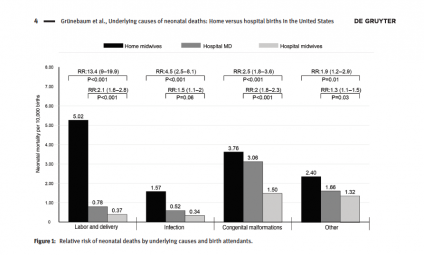
Overall, the midwife-attended home births had the highest rate of neonatal deaths (122/95,657 NNM 12.75/10,000; RR: 3.6 (95% CI 3–4.4), followed by hospital physician births (8,695/14,447,355 NNM 6.02/10,000; RR: 1.7 95% CI 1.6–1.9) and hospital midwife births (480/1,363,199 NNM 3.52/10,000 RR: 1)…

Among midwife-assisted home births, underlying causes attributed to labor and delivery caused 39.3% (48/122) of neonatal deaths (RR: 13.4; 95% CI 9–19.9) followed by 29.5% due to congenital anomalies (RR: 2.5; 95% CI 1.8–3.6), and 12.3% due to infections (RR: 4.5; 95% CI 2.5–8.1).

By and large, labor and delivery issues refer to oxygen deprivation from a variety of different sources: inability to perform a timely C-section through inability to perform an expert neonatal resuscitation. It’s only to be expected that most of the deaths at homebirth are attributed to not being at a hospital.

Congenital anomalies as a cause of death is also an expected finding since that is the major cause of death for term babies in hospitals.

But the fact that infection is the 3rd leading cause of death at homebirth thoroughly debunks the claim of many homebirth advocates that a key benefit of homebirth is avoiding infections. You don’t avoid neonatal infections by giving birth at home because the infectious agents are in the mother’s vagina, not the hospital environment. The difference in infectious deaths at home vs. the hospital is because hospitals prevent infections by prophylactic antibiotics for group B strep and elective C-sections for active herpes.

The results are represented by this graph:

img_1377

The authors conclude:

Our study shows that the significantly increased risks of neonatal deaths among midwife-attended home births are associated with three underlying causes: labor and delivery issues, infections, and fetal malformations. Each of these underlying causes was significantly increased when compared to midwife-attended hospital births.

The hospital NNM in our study is similar to the NNM reported for 2010 in the US by Matthews and Mac-
Dorman. This study’s significantly elevated term NNM of 12.75/10,000 births for home births confirms
the increased neonatal mortality risks reported among midwife-attended home births by other US home birth studies: Cheyney et al. reported a NNM of 12.3/10,000 from 2004 to 2009 and Grunebaum et  al. reported a term NNM for home births of 12.6/10,000 from 2006 to 2009.

They note that homebirth is much more dangerous in the US than in other industrialized countries:

Other studies on homebirth outcomes such as studies from the Netherlands, Ontario and British Columbia, where homebirths are well integrated in the health system, found no increased risk of adverse perinatal outcomes for planned home births among low-risk women …

American homebirth midwives (CPMs and LMs) lack the education and training of all other midwives in the industrialized world including US certified nurse midwives (CNMs) and midwives in the Netherlands, the UK, Canada, Australia, etc.

American homebirth kills babies. Avoiding the hospital doesn’t merely increase the risk of a baby dying from oxygen deprivation; it also increases the risk of a baby dying of infection.

Dr. Amy