Judith Rooks models ethical behavior for homebirth midwives

Got ethics ?

A birth activist once told me that she had heard Judith Rooks express regret for undertaking a study on VBACs in birth centers. Rooks had been confident that the study would show that it is safe to have a VBAC in a birth center, but it showed the opposite. Prior to the study, VBAC was considered a reasonable option for birth centers; after the study it was prohibited. Yet even though she was disappointed with the results, even though they showed the opposite of what she had wanted to show, she published them anyway, because that’s what ethics requires.

I don’t know if the story is true, but it was one of the first things I thought of when listening to Rooks testify before the Oregon legislature about the appalling rate of death at the hands of Oregon homebirth midwives (8X higher than the death rate in the hospital). She sounded deeply grieved to have to report that homebirth, which she supports, is unsafe as practiced by Oregon homebirth midwives, yet she reported it anyway, because that’s what ethics requires.

Her testimony highlights the profoundly unethical behavior of the Midwives Alliance of North America (MANA), Melissa Cheyney, and the midwifery hierarchy of Oregon. All three conspired to commit what amounts to fraud: for many years they have been deliberately hiding that homebirth with a homebirth midwife has an appalling neonatal death rate both in Oregon and in the country as a whole. It is the midwifery equivalent of the Vioxx debacle. Although the hierarchy at the Merck drug company was aware that the pain killer Vioxx increased the risk of death from heart attack and stroke, they marketed it anyway. They took the position that it was more important to make money from Vioxx than to protect consumers. It eventually caught up with them. To date, Merck has paid out billions to the thousands of families of those who died as a result of taking Vioxx.

MANA, Melissa Cheyney and other homebirth midwifery executives have knowingly and deliberately taken the position that it is more important to be able to work as homebirth midwives than to protect mothers and babies. In many ways, the case for hiding the appalling death rates at homebirth is more compelling economically than the case for bringing Vioxx to market. While Vioxx represented a significant share of Merck’s income, it was no where near 100% because they have many other products. In contrast, homebirth midwifery usually accounts for 100% of the income of homebirth midwives. Revealing the truth about homebirth deaths would have a major impact on the ability of homebirth midwives to attract clients and make money.

I suspect, though, that money was not the only or even the primary motivation behind the unethical behavior of Melissa Cheyney and MANA.

We are currently immersed in a virtual epidemic of unethical behavior among scientific researchers. It is so easy and so tempting to report fraudulent results that it happens all the time. Partly it is the tremendous pressure to publish scientific papers, but often it is the result of a researcher believing so profoundly that his theory is correct that he (or she) feels no guilt about “massaging” the data to support the theory. They don’t believe that they are committing fraud because they are sure that future data will ultimately prove them right, but they can’t wait for future data because people can benefit from the theory now. Couple that with the fact that scientific journals rarely demand that a finding be reproduced before publication and you have the perfect formula for the plethora of scientific papers routinely published even though they are junk.

I have no way of knowing, of course, but I suspect that something similar has been going on at MANA. It started in 2005 with the Johnson and Daviss BMJ paper that claimed to show that homebirth was safe even though the data showed that homebirth nearly tripled the risk of neonatal death. And it has continued ever since with Melissa Cheyney and MANA waiting desperately for the data that would show homebirth to be as safe as they know it is. That data never came because homebirth midwives are grossly undereducated, grossly undertrained, unsafe practitioners. The longer they waited for confirmation of what they believed, the more they were required to contort themselves to hide the data they had. One thing is sure: they demonstrated consciousness of guilt by deliberately hiding the information from American women.

Many of their tactics over the years demonstrated their consciousness of guilt, but none more so than the decision to share the data only with those who, after being appropriately vetted, would sign a non-disclosure agreement complete with legal punishments for those who shared the data with anyone else. In other words, they understood that the death rates were so hideous that they had to take the incredibly heavy handed and revealing step of announcing legal punishments with anyone daring to share the truth with American women, the one group that was most entitled to have the information.

It appears that MANA, Melissa Cheyney and the midwifery hierarchy never considered their ethical obligations, and not just their obligation to release the data. Almost any other professional organization, when confronted with the evidence that their practitioners were responsible for an appallingly high death rate, would have instituted plans for improving outcomes. It seems never to have crossed the minds of Cheyney and others in MANA. Babies dying preventable deaths? Sad, but apparently a small price to pay for the freedom to be a pretend “midwife” and charge women for services that are apparently literally worse than nothing. The folks at Merck having nothing on Melissa Cheyney and MANA when it comes to the cold blooded sacrifice of innocent people (babies, no less) on the alter of expediency.

Now, of course, their efforts to hide data have been eclipsed by states collecting their own data and they have no one but themselves to blame. As I have written in the past, the biggest mistake that homebirth midwives ever made was their campaign to obtain licensure. They didn’t want to do it, but they wanted insurance reimbursement so badly (and insurance companies will only reimburse licensed practitioners) that they took the risk and it has blown up in their faces. You can fool some of the state legislatures some of the time, but not all of them, and it is hard to fool insurance companies at all. It was inevitable that they were going to demand data, and collect it themselves if need be. Now that data is coming in and it is very, very ugly. What insurance company is going to be willing to reimburse providers that have appalling death rates and, almost certainly, appalling injury rates? And birth injuries are not cheap. They can cost hundreds of thousands of dollars in acute care (think head cooling to minimize neonatal brain damage) and millions in chronic care for those left permanently impaired.

Judith Rooks modeled ethical behavior for midwives and it would behoove them to follow her example and release the data they are hiding and take the steps necessary to improve safety. I have little hope that will happen. The way I see it, the disclosure of the appalling death rates is not the end for the CPM credential, although I suspect that is where it will lead us. Rather, like Winston Churchill once said in another context:

Now this is not the end. It is not even the beginning of the end. But it is, perhaps, the end of the beginning.

It is the end of period in which homebirth midwives were able to hide the dead babies, and, as such, marks an important turning point toward the inevitable abolition of the CPM credential. CPMs are not eligible for licensure in any other first world country. It is time to insist that they are not eligible for licensure in the US, either.

Oregon releases official homebirth death rates, and they are hideous

iStock_000014444104XSmall

Moments ago, the State of Oregon released the official homebirth death statistics for 2012 and they are worse than my worst prediction.

You may recall that back in August 2010, Melissa Cheyney, the Director of Research for the Midwives Alliance of North America (MANA) and also the head of the Board of Direct Entry Midwifery, rejected a call by the State of Oregon for access to the MANA homebirth death rates for Oregon. As a result, the State decided to collect the statistics themselves. They turned to Judith Rooks, a certified nurse midwife and midwifery researcher who is known to be a supporter of direct entry midwifery, to analyze the Oregon homebirth statistics for 2012.

Rooks testified this afternoon at a legislative hearing on HB 2997, a bill addressing the licensing requirements direct entry (homebirth) midwives.

She began by introducing herself:

I’m a certified nurse-midwife, a past-president of the American College of Nurse-Midwives, and a CDC-trained epidemiologist who has published three major studies of out-of-hospital births in this country.

In 2011 the Oregon House Health Care Committee amended the direct-entry midwifery—“DEM”—law to require collection of information on planned place of birth and planned birth attendant on fetal-death and live-birth certificates starting in 2012.

Oregon now has the most complete, accurate data of any US state on outcomes of births planned to occur in the mother’s home or an out-of-hospital birth center.

She then presented and explained the following table:

Oregon homebirth death rates 2012

The death rate is horrific, even AFTER Rooks inappropriately eliminated the death of a baby at homebirth who had congenital anomalies. Since the hospital group contains congenital anomalies, it is not appropriate to remove them the homebirth group.

The total mortality rate associated with those births [planned OOH births with direct-entry midwives as the planned birth attendants] – excluding the one involving congenital abnormalities – is 4.8 per 1000.

For comparison, data on births planned to occur in hospitals is provided in the bottom row of the table.

The real death rate for planned homebirth with a direct-entry midwife in 2012 was actually 5.6/1000.

As Rooks regretfully acknowledges:

Note that the total mortality rate for births planned to be attended by direct-entry midwives is 6-8 times higher than the rate for births planned to be attended in hospitals. The data for hospitals does not exclude deaths caused by congenital abnormalities.

Many women have been told that OOH births are as safe or safer than births in hospitals…

But out-of-hospital births are not as safe as births in hospitals in Oregon, where many of them are attended by birth attendants who have not completed an educational curriculum designed to provide all the knowledge, skills and judgment needed by midwives who practice in any setting.

After reaffirming her support of direct entry midwives, Rooks pleads for more stringent standards:

The legislature won’t have another opportunity to make the law stronger on behalf of safety until 2015. Please keep the six women who lost their babies last year in mind as you legislate this year.

We can only hope that the legislators heed Rooks’ plea. The first two basic steps that they should take are these:

1. Mandate that Oregon homebirth midwives advise women, as part of obtaining informed consent, that homebirth has a death rate 8x higher than hospital birth.

2. Refuse to expand homebirth midwives’ scope of practice and limit them to attending ONLY the lowest risk births.

It’s the least they can do for the women and babies of Oregon.

Guest post: Pregnancy, childbirth and parenting gave me an education in feminism

iStock_000004204535XSmall

One of the best things about running this blog is the delight of witnessing women and men discover that they are great writers while engaging with each other in the comments section. Here is a fabulous example, written by thepragmatist in response to my post Natural childbirth, attachment parenting, and policing women’s bodies.

I told my husband that he would be a feminist by the time I was done having our child. He didn’t believe me. I thought I would educate him on the politics of birth… You know, the evils of over-medicalized pregnancy and obstetric interference. Oh boy, it was not him who was going to get the education. No.

What I didn’t know was that I would not be prepared for the loss of agency over my body: that my body would become public property and that I would also feel such despair and horror at the loss. I never realized when I walked into a midwife’s office to plan a home birth (and went home with Birthing From Within that day in my bag to read) that I would end up choosing a MRCS months later, because I realized it was right for me and safe for my baby. That I would meet a female OB/GYN who had utmost respect– more than anyone else– for my agency as a woman, changed my mind about obstetrics forever, and would become a fundamental part of my healing from other trauma. So much for the sexist OB/GYN disabusing the woman of her right to empower herself! Indeed, it was the OB/GYN who was instrumental in helping me understand what it was I really wanted and then manifesting it with me… Certainly not the midwife who told me “not to think about tearing because we have ways to prevent it” or the other midwife, who when I was having strong, regular contractions right before my c-section, told me, smugly, “Well, you can’t always have the birth you want” and refused to attend me and told me to go back to bed. No, midwifery didn’t empower me, science did. Science and reason. Control over my body. A physician with the real power to make that happen.

I learned, on encountering the world of lactivism and attachment parenting that I had assumed would be a good fit for me, as I imagined both feminist, that I was not good enough, not mom enough, not enough, no matter what I did. And that my experience as a woman engaged in the act of mothering was irrelevant to the discussion. I learned that NCB and AP were not only prescriptive but also fundamentally ablest. The final breaking point was when I — disabled by a number of issues — fought my way through many challenges only to be ridiculed for my parenting choices, again and again, some very hard to make. I realized I did not matter as a human being anymore in that context. And that the worse enforcers of this dogma were women themselves. They continue to be. At times derided for such things as “long science-fueled posts” or “normalizing c-sections” and my posts deleted if I dared tried to publicly support a woman in learning to appropriately supplement with formula or enjoy the birth of a child through c-section, for example. Asked to leave our community board for continuing posting “facts” when others would post inflammatory articles like, “Just Say No to Pitocin” and I would go, “Uh, yeah, but wait…” At one point I had 40 grown women devote a thread to informing me that I had completely ruined their forum, when I refused to leave it out of principle, having broken no rules. Later, those women went on to make a different forum where they screen people very carefully for access with intrusive questions to make sure they are sufficiently NCB/AP and topics such as combo feeding or sleep training are off the table, at all times. Sounds feminist to me… Worse yet is knowing that because they pass themselves off as feminist and evidence-based they lure in unsuspecting mothers-to-be who they then fill with misinformation about birth and parenting. Then later, my OB/GYN gets to deal with these women when they show up from home birth a train wreck and be demonized in the process. Avoided interventions but come out of it with perhaps an unnecessary c-section or a needlessly traumatic birth. But who needs to make good sound decisions based on at least a basic understanding of your own physiology, birth, and the interventions involved, and their risks and benefits, when you could sit in an echo chamber all day and blame obstetric intervention and read the same five books to each other?

Indeed, it was MY feminism most altered in its trajectory as I made controversial or unaccepted choices with my body and my baby, meeting my own and my child’s needs, being shamed and derided through out, realizing more and more I had been lied to, that the data was skewed, and that the story was rife with inconsistent, contradictory values, unrealistic (at times, inhumane) expectations and glaring misogyny. Religion, not science. Not safer. Not best practice. Lies. Nefarious too, because the major enforcers of NCB/AP in our community know that they are lies, and have confessed to me in private they know they are lies. Then I fully appreciated the anti-intellectualism but also how corrupt and anti-woman it really was. It wasn’t that my facts were incorrect, but that they were not in line with NCB/AP dominant paradigm. My facts were indeed, not the issue, they were perfectly true: they just did not want them shared.

I was naive, to be honest. I had not ever experienced women en masse, of my own age, in such an environment. Member of many topical message boards over the years, where evidence and argument were critical to discussion, this was so foreign to me that I could not understand it. Why would you not want to know what was going on in your body or how to improve your own medical care? And how could these, the birth duolas and educators, shut me down so completely, when they knew I was correct? Cynically, my husband pointed out I was embarrassing them in front of their client base. “But it’s still a lie!” I would shout. He was right. Correcting the “birth educators” on their misinformation was embarrassing for them, so they demonized me.

My husband did, indeed, become a feminist. He is proud to call himself a feminist. he became a feminist not because I educated him about Spiritual Midwifery. He walked with me through making enormous strides as a woman. From my MRCS came the first time in my life I felt power over my own body, as a sexual abuse survivor, and from there, so much more power came. In the moment that I said no to a vaginal birth and someone actually said, OK! I took new control over my body, my sexuality, my needs as a woman. A pivotal moment in my life. And I am told that I was powerless there. Oh no, not at all. Far from powerless. From there the seeds grew to face ALL the misogyny in my life around me and I stopped accepting anti-feminism from other people. I began to see that other women are the real enforcers in a way I never realized. Or wanted to realize. From there-in everything shifted. When my son was just about a year old, I walked into a police station and filed a report against a charismatic and popular serial sexual predator, thereby stopping him from hurting anyone else again, but risking the same social shunning. Yet I am not good enough for these women, because I fed my baby formula sometimes? I am not powerful? I am ten times braver, indeed. Women who are empowered do not need to empower themselves through their reproductive function or prove their worth through mothering. I learned that bit here.

It has redefined me. But it also makes me feel like a lone wolf, because I have been ostracized for my choices: from decrying the current parenting paradigm; for actually wanting to talk about the needs of mothers as human beings and not objects; and of course, worse of all, to suggest that women have the right to do what they need to do with their own bodies and have access to accurate information so they know what choices may be right for them. It has resulted in the kind of shaming and shunning usually reserved for promiscuous women or victims of sexual assault. Having also been that woman more than once, it feels the same to me. But never have I been so shamed as when I stood up for mother’s rights! Something you think would be fairly non-controversial, given how much those in the NCB movement promise women such rights in childbirth (and do not deliver), but those rights apparently end there. Because once baby is born, mother has no needs. Huge realization there that I was not actually with feminists. I’m not talking about mothers who “need” to neglect their children, but rather, that it is okay to take into account your own feelings and needs: indeed, it is critical. And indeed, it is the very same kind of shaming, and policing of women’s bodies: through shame and shunning the NCB and AP movement actively silent dissent and enforce prescriptive and gendered parenting roles. At one point, my husband got angry at the continual characterization as men as hapless idiots, incapable of nurturing. He is more of a nurturer, in spirit, than me.

It is really interesting how oppression of women is a continuum and central, always, is reproduction and the reproductive years. So it’s not shocking, really, when a nearby crisis pregnancy center puts on a NCB movie night to raise money to fight abortion and the feminists in the room can’t seem to put it together. Do they say hurrah or get angry? No, they say nothing at all. Eye opening! All around me women call themselves feminist and embrace this movement and they do not know what it is they are subscribing to. This week a film on Ina May is being screened at our local college. Facebook is abuzz. And I want to post, “Did you know she let her premature baby die for lack of medical care? Do you know she doesn’t understand basic female anatomy? Do you know that she judges women’s ability to birth on their emotional state? Why is this feminist? Don’t call it feminist. Call it whatever else you like, but not that.”

I know it would just be deleted.

The disenfranchisement of women’s right to their own bodies is not what I envisioned. I totally bought it: that it was a movement to liberate women. And I think in my mother’s time, maybe it was. They fought for maternity leave, rights in the workplace for mothers, and legalized abortion. But our fight for reproductive freedom has been hijacked and, in a sense, truncated. Misinformation and out right deceit regarding pregnancy and birth is rampant. The real risks of birth rarely discussed. And although we have the right to decide to end a pregnancy, the right to effective pain relief in labour and maternally-requested c-section are tenuous in many Western countries where other feminist principles are often adopted and extolled. The cultural and ideological creep is no longer creeping here in Canada: it is a tsunami, and there is very little push back from my feminist peers. Piggy-backing on the work of a generation of feminists who fought for reproductive rights, inserting itself into discussion on autonomy when it is exactly the opposite, and so many following blindly and unaware of its greater implications.

NAPW: National Advocates for [Some] Pregnant Women

way

Yesterday I wrote about the efforts of natural childbirth advocates, lactivists, and attachment parenting advocates to police women’s bodies through pregnancy and the early childhood years.

Surely, I thought, there must be a women’s organization that defends against this attempt to control pregnant women’s bodies, and there is. There’s just one problem. They’re only interested in protecting women who make approved choices and — surprise! — the only approved choices are those championed by NCB advocates, lactivists, and attachment parents.

The organization is called National Advocates for Pregnant Women (NAPW), but they ought to include an asterisk in their name. They don’t advocate for all pregnant women, just a small subset.

NAPW describes themselves as follows:

National Advocates for Pregnant Women (NAPW) seeks to protect the rights and human dignity of all women, particularly pregnant and parenting women and those who are most vulnerable including low income women, women of color, and drug-using women. NAPW uses the lessons learned from the experiences of these women to find more effective ways of advancing reproductive and human rights for all women and families. Our work encompasses legal advocacy; local and national organizing; public policy development, and public education. NAPW is actively involved in ongoing court challenges to punitive reproductive health and drug policies and provides litigation support in cases across the country. NAPW engages in local and national organizing and public education efforts among the diverse communities that are stakeholders in these issues, including the women and families directly affected by punitive policies, as well as public health and policy leaders.

Consider their page devoted to birth issues: unhappy with your maternity care? unhappy with your C-section? committed to breastfeeding? They’ve got your back.

Denied a maternal request C-section? Forced to sign a waiver simply because you don’t want to breastfeed? Fuggedaboutit!

NAPW was front and center in the defense of the Florida woman who wanted to postponed by several days her medically indicated semi-emergent C-section for fetal distress.

NAPW has sent a letter to the hospital explaining that the threat of arrest lacks justification in both law and medical ethics. Farah Diaz-Tello, NAPW Staff Attorney explained, “Women do not lose their rights to medical decision making, bodily integrity and physical liberty upon becoming pregnant or at any stage of pregnancy, labor or delivery.”

Sounds to me like the right to medical decision making would include maternal request C-sections. But that’s not what you find when you search the site. The only reference to maternal request C-section (cavalierly referred to as C-section “on demand”) is this mention from 2006:

…organizations concerned about unnecessary and potentially risky c-sections, including NAPW, will be closely watching this week when the National Institutes of Health state-of-the-science holds its conference on ‘cesarean delivery by maternal request.’

So let’s see if I get this straight. An organization that supports a women’s rights to refuse C-section, citing the right to of women to control their own bodies, is staunchly opposed to women’s right to request a C-section, ignoring the right of women to control their own bodies. They have a word for that stance: hypocrisy.

If I understand NAPW correctly, they believe that women have the right to weigh the risks and benefits to themselves and their children of medically indicated C-sections, but somehow are incapable of weighing the risks and benefits to themselves and their children of maternal request C-section. And that, of course, makes no sense.

If NAPW is so concerned about the right of women to control their own bodies, why aren’t they front and center in opposition to new rules banning elective delivery before 39 weeks? Surely if a woman has a right to control her own body, she has a right to control how long she wishes to be pregnant. Surely if a women has a right to bring an abortion, which is the termination of a pregnancy before viability, she must have a right to terminate a pregnancy that will result in a healthy, live baby.

Surely if a woman has a right to control her own body, she should not be forced to sign waivers attesting to the superiority of breastfeeding when she chooses not to breastfeed. How is that any different from the many different hoops anti-choice forces want to impose on women seeking abortion?

The ultimate irony is that NAPW supports women in their choice to use recreational drugs during pregnancy:

Some of the starkest examples of the consequences of denying women full human rights involve the direct and severe punishment of pregnant, drug-using women. By combining claims of fetal rights with the war on drugs, new laws that punish pregnant women and families are being put into place… Like other applications of the war on drugs, the punishment of pregnant women is targeted at vulnerable, low-income, women of color; those with the least access to health care or legal defense.

In the last twenty years, over 200 pregnant women or new mothers have been arrested in a concerted effort to deny women liberty. At least nineteen states now address the issue of pregnant women’s drug use in their civil child neglect laws, and many of these states make it possible to remove a child from the mother based on nothing more than a single positive drug test. These cases and statutes are having a devastating effect on public health efforts, as well as women’s reproductive rights, drug policy reform efforts, and efforts for racial equality.

So if I understand NAPW correctly, they will fight for your right to use heroin while pregnant, but if you want to have a maternal request C-section to preserve your pelvic floor, you’re on your own.

Women do have a right to control their own bodies and that right extends not merely NAPW approved choices (having an abortion, refusing a C-section, or using heroin during pregnancy). It extends to ALL choices whether the women in NAPW would choose the same things for themselves or not.

NAPW is inappropriately named. They don’t advocate for pregnant women. They only advocate for pregnant women who make choices they approve, and that is hypocrisy of the worst kind.

Natural childbirth, attachment parenting, and policing women’s bodies

iStock_000016537922XSmall

It is a sad fact of history that men have spent a tremendous amount of time policing women’s bodies. And an even sadder fact is that women have often been the prime enforcers in this effort.

Consider female genital mutilation. It is a practice designed by men, for men, to preserve men’s privileges, but it is performed exclusively by older women on female children in order to make their bodies “respectable” for men.

You might think that the time of women as enforcers of policing other women’s bodies has passed. You’d be wrong. There are now entire movements devoted to policing women’s bodies: the natural childbirth movement, the lactivist movement, and the attachment parenting movement.

In fact, with the exception female genital mutilation itself, it is difficult to think of a historical movement that placed more emphasis on the insistence that women use their bodies in the “proper” way. These philosophies are the intellectual equivalent of the burqa. They function in large part to keep women trapped in the home, invisible, and incapable of pursuing the same goals as men.

I recently had something of an epiphany. I’ve been maintaining a version of this blog for more than 6 years. There have been literally hundreds of thousands of comments in that time. The epiphany is that most of them have been in response to, or in defense of what women should or should not be doing with their bodies. Should women experience pain in labor? Do they have a right to abolish that pain? Should women breastfeed? Should women persevere if they have pain or difficulty in breastfeeding? Should women feel free to supplement or replace breastfeeding with formula? Should women carry their infants around all day? Should women have their children sleep in the marital bed each and every night?

This blog is noted for its full throated condemnation of the myths and lies of the homebirth and natural childbirth movements, and emphasizes the fact that homebirth results in preventable neonatal deaths. But I’d like it to also be noted for something else: the firm conviction that NCB, lactivism and attachment parenting are anti-feminist. All three locate the center of women’s worth in her body (specifically her vagina and breasts) and generate elaborate prescriptions for women’s use of their own bodies that essentially control how they use their bodies every minute of every day. I firmly believe that women’s bodies should be controlled by women themselves, not by groups who prescribe the “correct” way to give birth, the “correct” way to nourish a baby, and the “correct” way to nurture a baby.

I’ve joked about the sanctimommy who has advice for everyone on every aspect of mothering. I’ve pointed out that a great deal of the appeal of being a part of the NCB, lactivism and AP movements is the opportunity to feel superior to other mothers, and to belong to a like minded community whose primary purpose seems to be praising themselves. Yet that is merely the incentive to joining these movements, not the purpose of them. The true purpose, sometimes conscious and sometimes unconscious, is to generate so many prescriptions around mothering that women cannot possibly leave the home and participate in the larger world.

It’s hardly a coincidence that the prime movers behind these philosophies are men, particularly men deeply disturbed by the idea of women rejecting the conventional roles to which men have relegated them. From Grantly Dick-Read, the father of natural childbirth, a sexist who decried women’s efforts at political and economic emancipation, to Dr. William Sears, the father of attachment parenting, who is a religious fundamentalist, these efforts at policing women’s bodies began with the ideas and efforts of men.

And I suspect that it is hardly a coincidence that the leading female enforcer of policing pregnant women’s bodies is Ina May Gaskin. She’s a woman in the shadow of a man who is not merely her husband,  but the leader of the cult (The Farm) to which she belongs. Based on her own admission, she was pressured into letting one of her own children die at homebirth because her husband did not want to use the medical system when that baby was born prematurely, on a bus on the freezing Great Plains, in the dead of winter. She was relegated by her cult to the “women’s work” of midwifery, and she has done a fabulous job of making that work important. But no one should ever forget that Ina May Gaskin was relegated to midwifery, and that the only control she was allowed to have was control over other women.

In an ironic twist, the current enforcers of these movements have turned to men to make the job of enforcement easier. New York Mayor Michael Bloomberg’s bizarre effort to promote breastfeeding by shaming women who want to use formula is a case in point. In first world countries, the public health benefits of breastfeeding, while real, are trivial. Yet lactivists have convinced Mayor Bloomberg and his staff that it is their right and their obligation to put obstacles in the path of women who don’t want to use their breasts to feed their babies.

Lactivists have created the Orwellian designation of “baby-friendly” hospitals to force women into signing waivers explicitly stating that those who refuse to use their breasts to feed their babies are knowingly choosing an inferior method of caring for them. Can you imagine the howling from the NCB movement if every woman who came to the hospital with a birth plan for avoiding interventions was forced to sign a statement acknowledging that childbirth without interventions was an inferior, and less safe, method of birth? Yet many of these same women seem to positively gloat at the idea of other women metaphorically branded as lesser mothers simply because they refuse to use their breasts in the approved manner.

I tend to focus on the validity of the claims of the NCB, lactivism and AP movements. It’s easy to do so since most of their empirical claims are factually false. However, we shouldn’t forget that these movements are, at their heart, retrograde, anti-feminist and ultimately concerned with policing women’s bodies.

Make no mistake: there is nothing wrong with unmedicated childbirth, breastfeeding or attachment parenting if those are the choices that work best for individual women and their families; I chose to do all of them with my own children. But there is something very wrong with philosophical movements devoted to forcing those choices on other women, essentially policing their bodies for every moment of the 9 months of pregnancy, the hours of labor and childbirth, and the years of parenting small children.

MANA prepares to acknowledge the hideous death rate at homebirth

Lies Concept

Let me take you on a trip down memory lane.

I started writing about the Midwives Alliance of North America and their campaign to hide their death rates more than 5 years ago, back in August of 2006. My first major post on the issue was Research and special interests/the BMJ 2005 study in which I began an exploration of the fact that Johnson and Daviss were not forthcoming about their connections to the homebirth industry. Over the following year, I proceeded to analyze the BMJ 2005 study and demonstrate that it actually shows that homebirth with a CPM in 2000 had a death rate nearly triple that of low risk hospital birth in the same year. It took nearly 2 years, but Johnson and Daviss ultimately acknowledged that I had been right all along.

I first wrote about the fact that the Midwives Alliance of North America (MANA), the organization that represents homebirth midwives, was hiding their own death rates back in January of 2007. MANA has fought me every step of the way, denying, lying and doing whatever it takes to hide the fact that not only does the evidence show that homebirth with a homebirth midwife has a hideous death rate, but MANA has known that for years and done everything it could to make sure that American women did not find out.

That hideous death rate has been confirmed by 5 years of CDC statistics on planned place of birth, and most spectacularly by the horrific perinatal death rate of licensed Colorado homebirth midwives.

The mountain of statistics confirming the increased risk of death at homebirth is continuing to grow, and, as a result, it appears that 5 years of lying and denying on the part of MANA and homebirth midwives and their supporters is about to end. That’s the message I take away from the proactive attempts of the homebirth industry to minimize the significance of those deaths. Consider today’s post on Science and Sensibility by by Wendy Gordon, CPM, LM, MPH, MANA Division of Research, Assistant Professor, Bastyr University Dept of Midwifery (and placenta encapsulation specialist!), a woman who has been arguing with me in print about the data for more than 5 years.

The post talks about last week’s Institute of Medicine conference on birth settings and specifically addresses data that shows that planned homebirth has an increased rate of death. Instead of denying it, as Wendy Gordon has done in a variety of venues for more than 5 years, she actually acknowledges it and then counsels everyone to ignore it.

Gordon references the presentation by Dr. Frank Chervenak on CDC data:

Chervenak used his 12 minutes (out of 10) that were to be devoted to the hospital provider perspective for, instead, a rapid-fire display of “back-of-the-envelope” bar graphs attempting to show home/hospital differences in 5-minute Apgar scores using raw data drawn from birth certificates.

Chervenak slide

Gordon helpfully telegraphs the response that I suspect will accompany MANA’s defense of its horrific death rates:

1. It hasn’t been published!

Since it appears that some doctors are having a hard time getting their “research” on this topic published in peer-reviewed journals, they are presenting their data in settings that do not require peer-review, such as last year’s annual conference of the Society of Maternal-Fetal Medicine (the study still hasn’t been published) and this IOM workshop.

Of course, CDC data is published. It’s published by the CDC. It is valid even before it is included in a peer reviewed scientific paper. When the CDC publishes the number of people who died of lung cancer last year, that number is accepted, regardless of whether it ever appears in a scientific paper.

2. So what if the death rate at homebirth is much higher? The absolute number of babies who have died is small.

Let’s say that a person’s odds of getting struck by lightning in a heavily populated city are one in a million, and those same odds in a rural area are five in a million. These odds are called your “absolute risk” of being struck by lightning. Another way to look at this is to say that a person’s odds of being struck by lightning are five times higher in a rural area than in a densely-populated area; this is the “relative risk” of a lightning strike in one area over another.

A common approach of anti-homebirth activists is to use the “relative risk” approach and ignore the absolute risk, because it’s much more dramatic and sensationalistic to suggest that the risk of something is “double!” or “triple!” that of something else …

So after years of lying about the increased risk of death at homebirth, the homebirth industry is finally acknowledging that what I’ve been writing about the death rates has been true all along.

I find it quite amusing that Gordon and other homebirth advocates have suddenly discovered the difference between absolute and relative risk. The same people who have been howling about the “dangers” of epidurals (the risk of death from an epidural is less than the risk of being killed by a lightening strike), are suddenly insisting that the risk of death at homebirth, which is anywhere from 100 to 1000 times higher, is actually so small that you should ignore it.

3. Birth certificate data is unreliable!

Epidemiologists in the room were quick to step to the microphone for the open discussion part of the panel, pointing out the many flaws in Chervenak’s presentation. Marian MacDorman, Ph.D., senior statistician and researcher for the CDC’s National Center for Health Statistics, reminded everyone that birth certificate data is notoriously unreliable for neonatal seizures and low Apgar scores; this has been shown time and again for decades and had indeed been discussed earlier in this very workshop. More importantly, McDorman stated that data from birth certificates cannot be used to make comparisons between settings or providers…

I find that absolutely hilarious. Marian MacDorman, an editor of the Lamaze sponsored “journal” Birth, has published a number of papers based on, you guessed it, birth certificates. Infant and Neonatal Mortality for Primary Cesarean and Vaginal Births to Women with “No Indicated Risk,” United States, 1998–2001 Birth Cohorts is widely quoted in the homebirth community as demonstrating a 3X higher neonatal death rate (triple!) for elective C-section as compared to vaginal delivery. MacDorman and colleagues publicly revised the relative risk after others pointed out serious methodological flaws, but they still ended up claiming that C-section without medical indication has a 1.5X higher risk of neonatal death (nearly double!) than vaginal delivery. But birth certificates are notoriously unreliable for reporting risk factors, as I pointed out at the time.

Apparently MacDorman is trying to set a new standard for hypocritical behavior. She published at least 2 studies relying on birth certificate data, and in both studies, although the relative risk of neonatal death at C-section was supposedly nearly double or triple, the absolute risk was very small. Those studies are supposed to be valid, but the homebirth death rates are not?

After years of lying and denying, homebirth advocates are being forced to acknowledge the dramatically increased risk of death at homebirth.

There are two important messages to take away from this:

Homebirth (particularly homebirth at the hands of grossly undereducated and undertrained CPMs) dramatically increases the risk of perinatal death.

More importantly, professional homebirth advocates have steadily and repeatedly lied about the increased risk of perinatal death. They should never have been trusted before, and cannot be trusted now.

This is yet another reason why the CPM should be abolished. In addition to being undereducated and undertrained, the entire CPM industry is unethical, putting their desire for income ahead of their obligation to obtain informed consent. Not only have they let babies die, they’ve lied about it, too.

A female obstetrician decries the insistence that breast is always best

Female headshot - facial expression

Imagine if an ophthalmology organization created a “eye friendly” policy that recommended, as a first step, shaming people who need glasses.

Imagine if said organization mandated that before opticians could grind the lenses, the patient was required to sign a release stating that although she knew that natural vision was best, she was insisting on artificial vision.

How about if the organization insisted that every pair of glasses was required to carry a warning label stamped on the ear piece declaring that glasses are a poor substitute for natural vision?

And imagine if that organization recommended weeks of stumbling about without glasses in an effort to improve vision “supply” to meet with vision demand.

We would consider that organization to be made up of fools whose primary impulse was to demean those who need vision correction.

Under no circumstances would we consider such policies to be “eye friendly” and we certainly wouldn’t consider them to be patient friendly.

So why do we allow lactivists to promote similar policies?

In a recently published opinion piece in Obstetrics and Gynecology, Is Breast Always Best?: A Personal Reflection on the Challenges of Breastfeeding, obstetrician Divya K. Shah argues for a less demeaning approach to discussing breastfeeding.

Dr. Shah describes her history of infertility and her commitment to breastfeed the child she ultimately conceived:

… [I] was looking forward to the immediate “skin-to skin” contact I had been taught would facilitate breastfeeding. The joy I had anticipated when my daughter latched on, however, was replaced by searing pain. It was normal, I was told, my breasts just needed to “toughen up.” Two days later, I was still shouting expletives through every feed, and the baby had lost more than 15% of her body weight. I was told she had a tight frenulum, or “tongue tie,” that was causing a painful, ineffective latch. The pediatric otolaryngology fellow performed a frenulectomy the next day— and although my pain improved, my milk production did not. The hospital pediatricians instructed me to supplement with formula. Before I could do so, our hospital asked me to sign a release stating that I knew that breast milk is the very best form of nutrition but that I had nonetheless chosen to deviate from the practice of exclusive breastfeeding. I cried as I signed the form, feeling like I had let my baby down before even taking her home from the hospital.

Apparently the hospital was “baby-friendly” and in the wisdom of the lactivists who control the baby-friendly appellation, shaming is an integral part of promoting breastfeeding.

Despite heroic attempts to continue breastfeeding, it became clear that Dr. Shah was not producing the amount of milk her baby needed.

Dr. Shah believes that she learned something important about the experience of patients:

It took my recent experience as a patient to make me realize that there is a group of women whom we as practitioners are inadvertently alienating—the mothers who, despite motivation, persistence, and utilization of all available resources, are still unable to breastfeed. Is continued reinforcement that “breast is best” helping this population? Many of these women are already
self-flagellating and facing judgment from family and friends—do they truly benefit from the additional scrutiny of their physician? Or, by promoting the idea of breastfeeding as an ideal of motherhood, are we as a community simply reinforcing the feelings of anxiety, guilt, and inadequacy that inevitably plague new mothers? …

As I’ve written many times before, there is no evidence that “baby friendly” hospital policies increase breastfeeding rates. The only thing they appear to do is increase the rate of women who claim, on hospital discharge, that they will be breastfeeding, but don’t follow through.

The sad reality is that we’ve allowed public health policy to be highjacked by a bunch of activists who exaggerate and misrepresent the scientific evidence about breastfeeding to promote the validation of their personal choices. “Baby-friendly” hospital initiatives are misnamed. It would be more appropriate to call them “lactivist-friendly” since the only thing they reliably do is make lactivists feel good about themselves and their own choices. No program can be “baby-friendly” if there is no evidence that it works, if it does not address the real issues, and if it shames and denigrates the mothers of those babies.

Dr. Shah ends with a plea to her colleagues:

I would like us as members of the American College of Obstetricians and Gynecologists to acknowledge proactively the challenges involved in breastfeeding as well as to normalize the difficulty that many women experience. By describing breastfeeding initiatives as “baby friendly,” the unfortunate implication is that mothers who do not breastfeed are, by default, “baby un-friendly.” Albeit a subtle change in language, I envision a more holistic “family friendly” approach to breastfeeding and postnatal care that takes into account the physical, mental,
and emotional health of both mother and baby, thereby better individualizing the care that we provide to our patients.

Simply put, obstetricians should stop promoting lactivist-approved mother-shaming, and get back to promoting the welfare of both babies and mothers.

Yet another C-section study that purports to show the risks but ends up showing they aren’t particularly risky

iStock_000019747710XSmall

The conventional wisdom in 2013 about obstetrics is that C-sections are “bad.” This conventional wisdom is not shared by most obstetricians, but it has spread to academia where conferences are held on how to decrease the C-section rate to some theoretical ideal. Earlier this week I wrote about a new study in the policy journal Health Affairs. That paper was deeply misleading and ignored important data. Now comes another C-section study that sets out to show that C-sections have unacceptable risks, but actually demonstrates the opposite. Moreover, the study suffers from a serious flaw, which if remedied would lower the purported risks even further still.

The study is Consequences of a Primary Elective Cesarean Delivery Across the Reproductive Life by Miller, Hahn and Grobman. The goal of the study is admirable and important:

There is a paucity of data regarding the reasons a woman may request a primary cesarean delivery. Fear of childbirth and its associated morbidity have been cited as prominent contributing factors toward such a request. These concerns have been supported by some experts, who have suggested that a planned cesarean delivery is less morbid than a trial of labor when weighing in the rates of an unplanned cesarean delivery…

One of the limitations of the available data is its focus on short-term outcomes related only to the initial pregnancy. However, the decision about route of delivery in one pregnancy has ramifications through subsequent pregnancies given the increased morbidity associated with multiple abdominal surgeries and uterine scars. Yet the comparative morbidity across multiple pregnancies related to the initial approach to delivery remains uncertain. A properly powered observational study that would provide such data would require many thousands of women given the relatively low frequency of adverse events that occur with either delivery approach. The logistic difficulty of this makes such an observational study unlikely to be performed. Thus, we designed a decision analysis to provide a framework for understanding the risks over the reproductive lifespan associated with either trial of labor or elective cesarean delivery for an initial delivery.

So far so good. The authors want to find out the risks of a maternal request C-section across the subsequent reproductive lifespan. It’s too hard to do an actual study of what the risks really are, so they plan to create a theoretical model to estimate them. Now comes the serious problem: there is no data on the risks of maternal request C-sections, so they plan to use elective C-sections as a proxy for maternal request C-section. But in the medical context, elective does NOT mean unindicated, it means non-emergent. So many “elective” C-sections are performed for medical reasons in no way represent unindicated C-sections. The authors show some awareness of this problem:

This model included women at term with a singleton gestation in the vertex presentation and no contraindication (eg, placenta previa) to a trial of labor.

In other words, the model took into account absolute contraindications to vaginal delivery, but not other indications for “elective” C-sections. Therefore, the results are likely to dramatically overstate the risks of a maternal request C-section.

Nonetheless, the findings are remarkable for just how safe C-sections have become. Moreover, the authors did not repeat the dreadful mistake of the Health Affairs piece and did include some neonatal outcomes making it possible to compare the risks of C-sections to the risks of vaginal delivery.

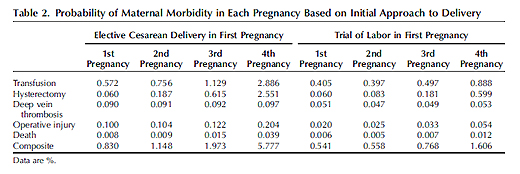
Let’s look at maternal morbidity first, which is summarized in the table below.

C-sections maternal morbidity

What jumps out at me is just how low the risks really are. The death rate for a non-emergent primary C-section is 8/100,000 as compared to a death rate for vaginal delivery of 6/100,000, for a difference of only 2/100,000. And that difference is likely to be a dramatic overestimate in the case of a truly elective (vs. non-emergent) C-section.

It is true that the risk rises with ever subsequent C-section. For the 4th C-section, the death rate is 39/100,000 as compared to 12/100,000 for a 4th vaginal delivery, for a difference of 27/100,000. Once again this is likely to be a vast overestimate. In addition, 85% of American women have fewer than 4 children, so this difference applies to a small subset of women.

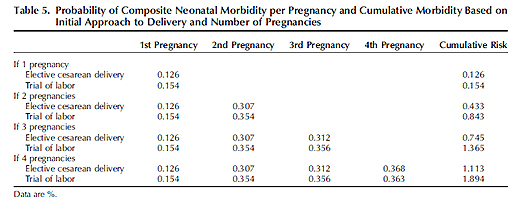
Now let’s look at the outcomes for babies, which can be found in the table below.

C-sections neonatal morbidity

In contrast to the results for mothers, the authors unfathomably chose to ignore the neonatal death rate, surely the single most important piece of data in evaluating neonatal outcomes. They chose to restrict neonatal outcomes to cerebral palsy and brachial plexus injuries. C-section results in a neurologic injury rate for a first C-sections is 12.6/1000 as compared to 15.4/1000 demonstrating that C-section has a protective effect for babies. Although the protective effect disappears by the 4th C-section, the difference is only 5/100,000.

The omission of neonatal death rates is inexcusable. It’s not as if that information is unavailable. Although, to my knowledge, no study has been done to specifically look at the differences in neonatal mortality as the number of C-sections rise, there are  studies that demonstrate that C-section is protective, such as Neonatal Morbidity and Mortality After Elective Cesarean Delivery by Signore and Klebanoff that showed that if 1 million women underwent C-section at 39 weeks instead of waiting for onset of labor and attempting vaginal delivery, 692 more babies would be saved, 517 cases of intracranial hemorrhage and 377 brachial plexus injuries would be prevented.

Even in the absence of mortality data, the authors acknowledge that C-sections are protective:

…this model demonstrates that elective first cesarean delivery may allow one to avoid the infrequent intrapartum neonatal events that occur during trials of labor and that may be associated with longterm neurodevelopmental impairment…

Neonatal outcomes chosen included those known to be affected by route of delivery. Insofar as elective cesarean delivery is often scheduled at 39 weeks of gestation, some have suggested that stillbirth rates could be reduced by using a strategy of elective cesarean delivery. Elective cesarean delivery at 39 weeks at gestation would, indeed, reduce the incremental increase in stillbirth associated with expectant management of pregnancy after this point…

The authors conclude:

… Our analysis cannot determine that one approach is “better” than another, particularly because some outcomes (eg, incontinence) remain poorly characterized and because such a determination would need to include preferences accorded to different routes of delivery by women. Nevertheless, this analysis can provide information that may be helpful in counseling and emphasizes that although an initial cesarean delivery may result in only a marginally increased risk of maternal morbidity and a marginally decreased neonatal risk compared with a trial of labor, the difference in maternal morbidity throughout reproductive life become increasingly larger, whereas the difference in perinatal outcomes becomes increasingly smaller.

The bottom line is that even multiple C-sections may have modest risks and for women planning only one or two children, the benefits of elective C-section may actually outweigh the risks.

20 years of presiding over homebirth deaths

Baby shoes

Last night a reader sent me a link to this story of an Indiana midwife arrested in the wake of two perinatal deaths in one week:

Barbara S. Parker, 55, faces three felony counts of practicing midwifery without a license. These charges stem from three August deliveries.

The first was on Aug. 2nd when Parker took a woman to an Auburn hospital when she was having trouble delivering her child. Then on Aug. 3rd Parker helped a woman deliver a baby that wasn’t breathing and had no pulse. That child later died at the hospital. Then a few days later, on Aug. 7th, Parker was helping a mother deliver twins and the second infant was only partially delivered and had to be taken through cesarean section. According to court papers, the second child did not survive.

Parker told police that she had been licensed in Colorado in the early 1990’s, but a little research revealed that didn’t go so well either. She lost her license and lost her court battle to retain it (THE PEOPLE OF THE STATE OF COLORADO, PLAINTIFF-APPELLEE, v. JEAN ROSBURG AND BARBARA PARKER, DEFENDANTS-APPELLANTS):

This case involves an appeal of a trial court’s order permanently enjoining appellants Jean Rosburg and Barbara Parker from practicing midwifery without a license as prohibited by sections 12-36-106(1)(f) and 12-36-106(2), 5 C.R.S. (1985).*fn1 The midwives argued to the trial court that section 12-36-106(1)(f) unconstitutionally infringed the right of privacy of pregnant women to choose their method of childbirth and that the section was unconstitutionally vague. The trial court ruled that the midwives did not have standing to assert the privacy right of pregnant women*fn2 and that section 12-36-106(1)(f) was not unconstitutionally vague. The midwives appealed to this court pursuant to section 13-4-102(1)(b), 6A C.R.S. (1987).

We agree with Rosburg and Parker that they have standing in this case to assert the privacy right of pregnant women. We disagree, however, that the prohibition against practicing midwifery without a license infringes a privacy right of pregnant women. We hold that section 12-36-106(1)(f) does not violate the midwives’ equal protection right because the prohibition of lay midwifery bears a rational relationship to the state’s legitimate interest in protecting the health of the pregnant woman and her child. We also hold that section 12-36-106(1)(f) is not unconstitutionally vague.

After reviewing the arguments, the Court concluded:

The term “practice of midwifery” also is not unconstitutionally vague as applied to Rosburg and Parker. They also were aware of what conduct was prohibited by the statute and their conduct fell within the prohibition. Rosburg testified at trial that her profession was that of a lay midwife and she defined the term in accordance with applicable dictionary and legal definitions.*fn10 The trial court also specifically found that Rosburg and Parker had engaged in the practice of midwifery.

Accordingly, we uphold the constitutionality of section 12-36-106(1)(f) and affirm the trial court’s order permanently enjoining Rosburg and Parker from practicing midwifery without a license.

Unfortunately, I cannot find the original case that led to Parker losing her Colorado license. Although it almost certainly resulted from at least one perinatal death, I cannot confirm that. In any case, Parker has continued to practice despite disciplinary measures and mothers and babies have allegedly continued to pay the price.

Introducing the automated birth story generator

apps multicolor symbol

Hi, folks, Ima Frawde, CPM here with my latest product for empowered mamas, the automated birth story generator app.

You can download it from the app store for the low, low price of 4 separate payments of $95 each. Once you download the app, you need to activate it by sending us a copy of the baby’s birth certificate signed by a CPM or a family member, with a sworn affidavit attesting to the fact that you fulfilled our requirements: a vaginal birth, no pain medication, a fecally contaminated birth pool, and eating at least one full meal during labor. Don’t worry, though, it doesn’t matter whether the baby lived or died.

Once we review your affidavit, we will instantly email you the code to unlock the app. If your birth doesn’t meet our guidelines, we won’t send you the code. Sorry, no refunds; you will still owe the 4 separate payments of the low, low price of $95 each.

The app is fantastic. Mama, now there’s no need to interrupt the tandem breastfeeding of your newborn, your toddler and your middle-schooler during your babymoon to labor over (get it? labor over?) the 15 page birth story that you can upload immediately to Mothering.com. Just fill in the blanks and we do the work for you.

Choose from several options including: the healing HBAC after 12 C-sections, the 45 week pregnancy, the homebirth of breech Siamese triplets and many other variations of normal.

Here are some excerpts of an actual birth story generated by the new app highlighting some of its most important features.

1. The opening paragraph immediately places the focus of the birth story right where you want it, on the baby yourself:

The birth story of my precious daughter Areola Anigav (that’s vagina spelled backwards) begins 3 years ago when I had a completely unnecessary C-section birth rape for my son Whatshisname. I don’t call it a birth because he was ripped from my body after 4 days of labor including 11 hours of pushing. I never gave him an actual name because if he didn’t have a real birth, he isn’t a real baby.

How did it happen that my hopes for a homebirth were torn to shreds and my spirit and body were mutilated? In a moment of weakness, I gave in to the pleas of my sniveling DH that we transfer to the hospital. Sure enough, as could have been predicted, the doctors birth rapists promptly recommended a C-section for no better reason than the fact that Whatshisname was lying sideways in my uterus, presenting shoulder first. They said he was in an undeliverable position, but having educated myself in the interim I now realize that it was the baby’s fault for not knowing how to be born.

2. A contraction by contraction description of your labor:

In contrast to my labor with Whatshisname, I had no pain at all during the birth of my precious Areola Anigav. Yes, I was screaming myself hoarse with every contraction rush, but those were blood curdling screams of joy.

3. A special section for recounting the 911 call, the NICU stay and the use of the latest technology including head cooling to reduce brain damage from lack of oxygen:

I birthed Areaola Anigav into a kiddie pool of bloody water strewn with flowers. How bloody was the water? When it was over the birth pool had a higher hematocrit than I did.

Areaola Anigav arrived earthside so peacefully. She never screamed. She never cried. She never even opened her eyes. My midwife was awesome. She didn’t panic just because Areola wasn’t breathing. She knew that if you don’t cut the cord, the baby continues to get oxygen from the placenta for up to 3 days. It was my DH who made the 911 call that filled the house with EMTs 15 minutes later. The EMTs bowled over my awesome midwife who was trying to stop them from cutting the cord. They resuscitated Areola and transferred her to the hospital.

4. A closing paragraph that allows you to summarize what your baby did for you.

I don’t consider my homebirth a failure just because Areola Anigav did not survive. Areola gave me the ultimate gift. Her birth taught me that my body is not broken and that trusting birth is all it takes to attain the highest human achievement of all, a baby passing through your vagina. My precious Areola Anigav knew how to be born. I do feel a little sad that she didn’t know how to breathe, but perhaps the next baby will be smarter. Newly empowered, I look forward to having another homebirth to provide a little brother or sister for Whatshishame, even though he doesn’t deserve any gifts from me.

The app has many more features, too numerous to list here.

The Ima Frawde, CPM Birth Story Generator is available in the app store. Download it today!

Dr. Amy