Lawsuit update

iStock_000006938226XSmall

As promised, I’m providing an update on my lawsuit against Gina Crosley-Corcoran.

The short version: After several delays, Gina’s lawyer filed a motion to dismiss based on jurisdiction, just as we expected. The issue is whether I can sue Gina in Massachusetts or must I sue her in Illinois. There is case law on both sides of the argument and, while the balance seems to be in favor of keeping the case in Massachusetts, there is no way to know what the judge will decide. This is a technical issue and has no relationship to the merits of the actual case.

The longer version: Despite the fact that the motion to dismiss is a technical issue, Gina’s lawyer felt compelled to file a document laced with ad hominem attacks. Here is the Motion to Dismiss, complete with exhibits: https://dl.dropbox.com/u/27713670/Tuteur-20130305_Memorandum_ISO_Mtn_to_Dismiss_w_EXHIBITS.pdf

The motion begins:

The Plaintiff in this action, Amy Tuteur, is a bully.

She is, to be sure, a modern-day bully; a “cyber bully,” who spews her venom over the Internet, rather than kicking sand on a playground, but she is a bully nonetheless. Ms. Tuteur, a former physician who is no longer licensed to practice medicine (and yet who identifies herself as an obstetrician gynecologist on her websites), runs a number of blogs, including one entitled “The Skeptical OB,” where she is something of a niche bully…

Curiously, the motion says nothing about the fact that the lawsuit was filed because Gina was abusing the Digital Millenium Copyright Act (DMCA) in a avowed effort to censor me by contriving to keep webhosts from hosting The Skeptical OB. Instead, the motion states:

This lawsuit represents another form of Ms. Tuteur’s bullying. The Defendant in this action, Gina Crosley-Corcoran, is a mother of three young children, a graduate student, a practicing doula, and (most importantly for the purposes of this motion) a resident of Illinois. A proponent of parents’ right to choose home birth, Ms. Crosley-Corcoran has often found herself the target of Ms. Tuteur’s ire…

In support of her ad hominem attacks, Gina’s lawyer included several of my posts in the exhibits, though curiously neglected to include the original post in question (Questions for The Feminist Breeder). He also fails to mention the multiple DMCA notice filings, the efforts to solicit others to send DMCA filings, etc. Therefore, it appears that Gina has no idea why she was sued, beyond my supposed effort to bully her.

I guess her lawyer has not seen what Gina has been writing lately on her own blog.

… It seems like every single time I’ve ever tried to stand up for myself in this blogging gig, It has backfired. TERRIBLY.

Example: After three years of being non-stopped harassed by that psycho ex-doctor Amy Tuteur, I finally stood up for myself, scraped together just enough cash to hire a lawyer for a few hours of work, and tried to get her to stop. She responded by using her millions to file a federal lawsuit against me that is FULL of outright lies and speculation, designed only to bankrupt my family and ruin my life. Even if/when I WIN against this insanity, the court costs will destroy my family finances forever. I will probably never be able to afford the kind of lawyer I need to actually defend myself In court, so she could simply win a “default” judgement (because I’m just too poor to fight this.) That’s how this shit works. She knows that. That’s why she’s doing it.

But it’s my fault – you know why? I should have kept my fucking mouth shut. I should have gone on ignoring the attacks like I’d done for THREE years prior. Any time I try to respond – try to defend myself – it comes right back to bite me in the ass…

… So, here I am, wrapped up in the aftermath of yet another highly publicized incident that people will use for years to come to paint me as the asshole.

I’m NOT an asshole. I AM a fucking idiot.

I can only agree.


Addendum: I’ve just filed a motion to strike. You can read it at https://dl.dropbox.com/u/27713670/Tuteur-20130305_Memorandum_of_Law_iso_Motion_to_Strike.pdf

The key points:

As discussed herein, Defendant Gina Crosley-Corcoran’s Memorandum Of Law In Support Of Her Motion To Dismiss contains numerous immaterial, impertinent, and scandalous allegations that are highly prejudicial and have nothing to do with this action or, more specifically, Defendant’s claim that this Court lacks jurisdiction over her. Dr. Tuteur seeks to have Defendant’s improper allegations stricken from Defendant’s Memorandum or, in the alternative, to have Defendant’s Memorandum stricken in its entirety pursuant to Fed. R. Civ. P. 12(f)…

Crosley-Corcoran’s repeated name-calling is a transparent attempt to cast Dr. Tuteur in a disparaging light. Crosley-Corcoran’s insulting language is not only an attempt to denigrate Dr. Tuteur’s character, it evinces complete disregard for the appropriate level of decorum expected of parties when appearing before a federal court.

Needless to say, none of the Improper Allegations bears any possible relation to Crosley- Corcoran’s arguments that she is not subject to the jurisdiction of this Court. For instance, it is unfathomable how Crosley-Corcoran’s personal feelings about Dr. Tuteur translate to any cognizable basis for her assertion that there is no statutory or Constitutional basis for the exercise of jurisdiction by this Court. Similarly, Crosley-Corcoran’s apparent view that Dr. Tuteur is a “bully” is not relevant to the claims asserted in the Complaint or any conceivable defenses thereto.

Latest update: Gina’s response, which is basically more of the same: https://dl.dropbox.com/u/27713670/Tuteur-20130306_Opposition_to_Motion_to_Strike_w_Exh_1.pdf

New paper on C-sections is misleading and leaves out important data

Male doctor giving thumbs down

A new paper in the journal Health Affairs is receiving a great deal of media attention. Although the paper provides valuable data, the authors dramatically overstate the conclusions and leave out critical information.

The paper is Cesarean Delivery Rates Vary Tenfold Among US Hospitals; Reducing Variation May Address Quality And Cost Issues by Kozhimannil et al. According to the authors:

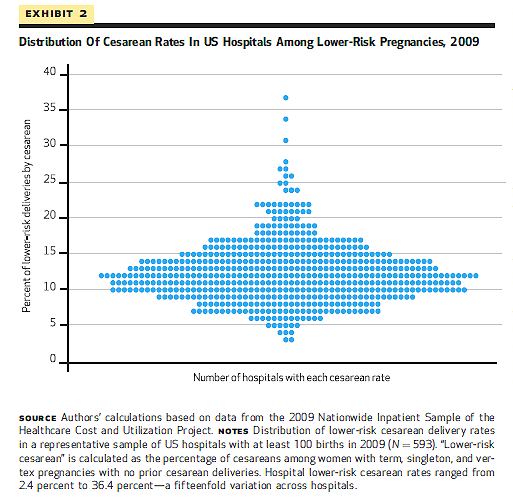
Working with 2009 data from 593 US hospitals nationwide, we found that cesarean rates varied tenfold across hospitals, from 7.1 percent to 69.9 percent. Even for women with lower-risk pregnancies, in which more limited variation might be expected, cesarean rates varied fifteenfold, from 2.4 percent to 36.5 percent. Thus, vast differences in practice patterns are likely to be driving the costly overuse of cesarean delivery in many US hospitals.

Not exactly. To see how the authors overstate their case, it helps to looks at charts that they created.

US C-sections 2009

Yes, it is true that the rate at the hospital that did the greatest proportion of C-section is 10 times higher than the rate at the hospital that did the lowest proportion of C-sections, but a glance shows that both hospitals are outliers. Therefore, that comparison is essentially useless. A far more valuable statistic is the interquartile range, the difference between the 25-75 percentiles. As the authors acknowledge in a subsequent table, the mean C-section rate in 2009 was 32.8 with an interquartile range of 9.4. So fully half of the hospitals had C-section rates in the range of 23.4%-42.2%. That’s still an appreciable difference (double), but very far from the 10 fold difference touted by the authors. In fact, more than 90% of hospitals had C-section rates between 21%-44%.

The same thing applies to the analysis of C-section rates in low risk women.

US low risk C-sections 2009

The authors report that the C-section rate for low risk women varies 15 fold among hospitals, but that is misleading. As the authors acknowledge in the subsequent table, the mean C-section rate for low risk women in 2009 was 12 with an interquartile range of 4.9. Fully half of the hospitals had low risk C-section rates ranging from 7.1%-16.9%. Again the difference is appreciable (slightly more than double), but a very far cry from a 15 fold difference. Nearly 90% of hospitals had C-section rates for low risk women between 6%-19%.

So the national variation in C-section rates is far less than the authors claim. Moreover, the authors commit the same error as do many natural childbirth advocates; they focus on process as opposed to outcome. We shouldn’t be looking for an ideal average C-section rate. We should be looking for the C-section rate that produces the best outcomes. How does the perinatal mortality rate compare between hospitals with low C-section rates and high C-section rates? The authors don’t know because they never looked. Indeed, the underlying (and totally unjustified) assumption that permeates the entire study is that there is no appreciable difference in mortality rates between various hospitals and that, therefore, we can focus in difference in C-section rates.

But perinatal mortality rates do vary appreciably among hospitals and it is critical to include this data. What if the mortality data showed that hospitals with C-section rates below 25% have higher perinatal mortality rates than hospitals with higher C-section rates. If that were the case, the hospitals with lower rates should be chastised, not held up as a model for an ideal, achievable C-section rate.

The authors conclude their paper with the following:

Although some variation would reasonably be expected given differences in patient populations, the scale of the variation in hospital cesarean delivery rates—most notably, a fifteenfold variation among the lower-risk subgroup— indicated a wide range in obstetric care practice patterns across hospitals and signaled potential quality concerns.

But as we have seen, the real variation among hospitals is much smaller making it much less likely that differences are due to practice patterns. Most importantly, the authors are not in a position to assess quality concerns unless and until they look at outcomes, and privilege them above process.

Lactivism and reefer madness

Plants 01

No, this is not a post about breastfeeding while stoned.

It’s a post about how hysterical exaggeration undermines campaigns like the War on Drugs and American lactivists’ efforts to promote breastfeeding.

According to Wikipedia:

Reefer Madness … is a 1936 American propaganda exploitation film revolving around the melodramatic events that ensue when high school students are lured by pushers to try marijuana — from a hit and run accident, to manslaughter, suicide, attempted rape, and descent into madness.

The film has become a byword for propaganda that backfires. This snippet of the plot makes it easy to see why the film ultimately accomplished the opposite of what the producers intended:

Mae Coleman and Jack Perry — a couple supposedly “living in sin,” yet sleeping in separate beds as all married couples depicted in films of the era — sell marijuana. Mae prefers to sell marijuana to customers her own age, whereas Jack sells the plant to young teenagers… Young students Bill Harper and Jimmy Lane are invited to Mae and Jack’s apartment … Jimmy takes Bill to the party. There, Jack runs out of reefer. Jimmy, who has a car, drives him to pick up some more. Arriving at Jack’s boss’ “headquarters,” he gets out and Jimmy asks him for a cigarette. Jack gives him a joint. Later, when Jack comes back down and gets into the car, Jimmy drives off dangerously, along the way running over a pedestrian with his car. A few days later, Jack tells Jimmy that the pedestrian died of his injuries. Jack agrees to keep Jimmy’s name out of the case, providing he agrees to “forget he was ever in Mae’s apartment”…

And the hit and run resulting in a pedestrian’s death is one of the least serious consequence of smoking a joint.

The film became a cult classic in the 1970’s when it was purchased and re-released by The National Organization for the Reform of Marijuana Laws (NORML). It was viewed as a comedy by people who used marijuana and recognized that the doleful consequences of marijuana use depicted in the film bore no relationship to the real, rather minimal consequences of marijuana use that viewers knew from personal experience. In other words, by grossly exaggerating the supposedly deleterious effects of marijuana use, the film sent the opposite message: those involved in the “War on Drugs” were lying about marijuana use and it wasn’t harmful at all.

American lactivists are currently running the breastfeeding equivalent of the Reefer Madness campaign. In addition to ignoring the difficulties of breastfeeding, lactivists grossly exaggerate the “risks” of formula feeding. Lactivists overstate the benefits of breastfeeding and fail to acknowledge that almost all the studies that purport to demonstrate those benefits suffer from serious methodological flaws. Lactivists demonize formula feeding using deliberately pejorative terms and suggesting that it should be available by prescription only. Unfortunately, they’ve communicated their hysteria to public officials like Mayor Michael Bloomberg of New York who has literally locked up formula as if it were a harmful substance.

But just like the Reefer Madness campaign, the contemporary lactivism campaign is a failure and for a similar reason; it bears no relationship to what we already know, through personal experience, about the purported “risks.” Most adults today WERE formula fed and are, nonetheless, healthy, intelligent and high functioning. No one knows, or has even heard about, a baby who has died as a direct result of formula feeding. Everyone recognizes that if you lined up a group of kindergarten students, no one could tell the difference between those who were formula fed and those who were exclusively breastfed. Moreover, if you lined up a group of the leaders in fields ranging from academia, to government, to entertainment to sports, no one could tell the difference between those who were formula fed and those who were exclusively breastfed.

In their desperation to promote their personal choices, lactivists have created histrionic campaigns that are foolish at best, and utter failures at worst. The claims of lactivists are completely out of line with reality. The “dangers” of not breastfeeding are exaggerated every bit as much as the dangers of marijuana use were exaggerated in Reefer Madness. Overstating the case just engenders distrust of lactivists, not an increase in breastfeeding rates.

Actually you did lose your uterus because you chose homebirth

iStock_000015892112XSmall

Homebirth advocacy is based on many myths and lies and one of the biggest lies is that homebirth advocates take responsibility for their decisions. They take responsibility for nothing. If anything goes wrong they blame everyone but themselves even when it is obvious they are the ones to blame.

Consider the following story, Elodie: Caesareans are NOT benign interventions from the blog Humanize Birth, replete with the typical ignorance, hubris, denial, and lack of gratitude that is the hallmark of homebirth advocacy.

The basic story is very simple and the fault is very clear. She had a history of previous C-section, went against medical advice in choosing homebirth, ruptured her uterus, had her baby’s life save and her life saved by a repeat C-section and lost her uterus and wound up in the ICU on a ventilator having received multiple transfusions.

Does she take responsibility for her decision to choose high risk homebirth? Are you kidding? It’s everyone’s fault but hers.

I did not lose my uterus because I chose to birth at home. I lost my uterus because I underwent a caesarean that could most probably have been avoided with my first birth. I lost my uterus because our medical system does not trust women to know best when it comes to having their babies. I lost my uterus because our medical system thinks women’s bodies can’t birth without interventions…

Actually, Elodie, you did lose your uterus because you chose homebirth. YOU chose it. YOU ignored medical advice. YOU pretended that the most feared complication of vaginal birth after Cesarean wouldn’t happen to you. YOU were spectacularly wrong and you paid a high price, although it could have been much higher still.

Why did you choose it? Because YOU chose to privilege the blather of other laypeople like those of ICAN and Hypnobabies instead of the advice of medical professionals. YOU were more interested in bragging rights to a vaginal birth than whether your baby would live through the experience. YOU, YOU, YOU!

YOU chose to believe that your virtue as a woman resides in whether or not a baby passes through your vagina. And YOU still think that your virtue as a woman is bound up with your experience of birth. YOU write:

I am a survivor. I am a fighter. I am strong. I birthed two babies through my belly.

You didn’t survive; you’re life was saved by others with far greater knowledge and skill than you possess.

You weren’t a fighter. You were unconscious and lacked any control over what happened.

You weren’t strong. You survived only because of surgeons, anesthesiologists, nurses, blood bank technicians, blood donors, a ventilator, respiratory therapists, ICU nurses, EMTs, and tens of thousands of dollars of other people’s money.

You did give birth to two children through your abdomen, but you could have done that far more easily, with far less trauma, far less risk to your baby’s life and far less risk to yours if you had chosen an elective repeat C-section.

But that would have required something that apparently you and other homebirth advocates don’t possess: accurate knowledge of childbirth and a willingness to place safety above bragging rights.

After YOU ignored medical advice, and YOU were saved by the evil medical system that you deplore, the least you could do now is take responsibility for YOUR decision.

The real appeal of homebirth advocacy is that it flatters the ignorant

I'm educated about childbirth

On it’s face, homebirth advocacy, makes no sense. Anyone with even a modicum of knowledge of science and statistics, let alone a basic knowledge of history, knows that childbirth is inherently dangerous, that life threatening emergencies can occur without warning, and that giving birth at home leads to preventable perinatal deaths.

Nearly every day there is another example in the media or on homebirth blogs and message boards.

Today’s iteration is the completely preventable death of Joseph Thurgood, who died because his mother chose to attempt a VBA2C at home, ending in the exact complication doctors warned her about: her uterus ruptured.

The Coroner’s Court was told that the midwife, Fiona Hallinan, is guilty of a gross breach of her duties. And, of course, the mother “educated” herself about homebirth:

A “high risk” pregnant woman who mistrusted doctors and did her own medical research was repeatedly warned of the dangers of a home birth, an inquest on her baby heard yesterday.

Kate Thurgood had delivered two children by caesarean section and was “determined” to have a child naturally and at home.

After doing her own research on the internet she dismissed concerns raised by doctors about the position of her baby and complications raised by her earlier caesareans.

“(She was told) she should not labour or deliver at home and she should have an elective caesarean section at hospital,” Dr Paul Halley, of Southern Health, told the Coroner’s Court.

Mrs Thurgood did her own web-based research on the risks, questioned several doctors’ advice, and sought out midwife Fiona Hallinan to help her deliver the child at home, the inquest heard.

So why do women like Kate Thurgood choose homebirth? I would argue that its real appeal is that homebirth advocacy, like all pseudoscience, flatters the ignorant.

In the real world, the majority of people recognize that science and statistics are difficult, specialized subjects and that medicine, including obstetrics, requires years of study and years of experience to master. In the world of pseudoscience, there is no need for hard work. All you need to do to be qualified to argue with your doctor, advise anonymous people on message boards, and set up your own website to “educate” others is to do “research” on the web.

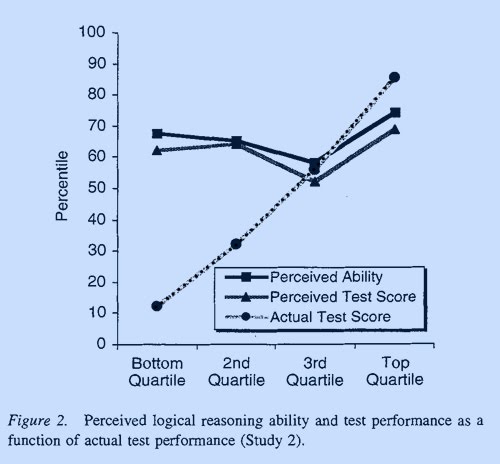
Don’t worry, “research” on the web is not nearly as difficult as it sounds. It’s not as if you are expected to actually READ any scientific papers. Merely cutting and pasting their titles and abstracts is enough. Then you cherry pick the statements that you like from relevant professional organizations, while simultaneously ignoring any statements that you don’t like. And finally, you rely heavily on the Dunning-Krueger effect.

What’s the Dunning-Krueger effect? The classic paper on this phenomenon is Unskilled and Unaware of It: How Difficulties in Recognizing One’s Own Incompetence Lead to Inflated Self-Assessments by Kruger and Dunning published in Journal of Personality and Social Psychology in 1999. The paper reports on a variety of experiments that were used to evaluate individuals’ actual performance compared to predicted performance.

As the chart below demonstrates, those that knew the least about the subjects under discussion thought that they knew the most. In other words, those who knew the least were also the least capable in understanding how little they knew.

Dunning Krueger graph

Dunning and Krueger explain:

… [I]ncompetent individuals may be unable to take full advantage of one particular kind of feedback: social comparison. One of the ways people gain insight into their own competence is by watching the behavior of others… However, [our study] showed that incompetent individuals are unable to take full advantage of such opportunities. Compared with their more expert peers, they were less able to spot competence when they saw it, and as a consequence, were less able to learn that their ability estimates were incorrect.

Homebirth advocacy leverages the Dunning-Krueger effect to flatter the ignorant into believing that they are educated, as if being educated were merely a matter of defying authority and reading websites and books written by other laypeople.

The Dunning-Krueger effect is pretty powerful. Hence the perverse persistence of those who parachute into this blog to “educate” me. They are impervious to reason. Point out to them that they have not read the scientific literature they are quoting and they are unabashed. Point out to them that they cherry pick the statements of professional organizations, brandishing those they like and ignoring everything else and they are unembarrassed. Point out to them that there are specialists with years of training and experience, people who actually DO the research on childbirth, who have reached conclusions the opposite of theirs and they are unmoved. Why? Because to acknowledge the relevance of actually reading the literature, and following the recommendations of professional organizations and clinicians undercuts their insistence that they are “educated.”

Homebirth advocates, like advocates of vaccine rejection and other forms of pseudoscience, cling desperately to their beliefs in the face of both evidence and logic, not merely because they need to believe the foolishness that they believe. At its heart, the promotion of pseudoscience gives the ignorant the delusion of being educated without any of the hard work that really being educated requires. And that flattering delusion of being knowledgeable, when in reality they are ignorant, is too precious to give up, even for something as important as the life of your own baby.

Marissa Meyer, Yahoo and competitive mothering in the executive suite

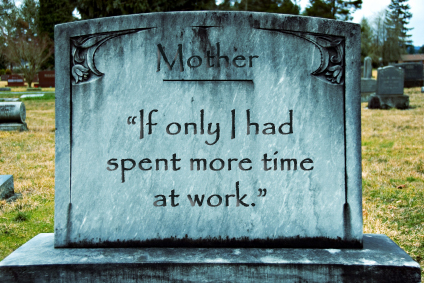
If only I had spent more time at work

For the last few days I’ve been writing about attachment parenting, a parenting philosophy which has little or nothing to do with the needs of children, and can best be understood as a competition among women looking for validation of their mothering. Simply put, women who pride themselves on making mothering a priority compete as to who sacrifices more for their children.

Lest you think that competitive mothering is restricted to those who place mothering front and center, Marissa Meyer has helpfully demonstrated that competitive mothering is alive and well in the executive suite, though there the rules are precisely the opposite. Instead of competing on who sacrifices more for their children, competitive mothers in the executive suite rig the game so that no other mother can sacrifice more than they do and make them feel bad.

Meyer is the CEO of Yahoo and in her very short tenure thus far she has managed to twice up the ante on mommy competition in the boardroom. First, Meyer made waves by announcing that she would take no more than 2 weeks maternity leave for the birth of her first child.

From the start, Mayer, who at 37 is one of Silicon Valley’s most notorious workaholics, was not the role model that some working moms were hoping for. The former Google Inc. executive stirred up controversy by taking the demanding top job at Yahoo when she was five months pregnant and then taking only two weeks of maternity leave. Mayer built a nursery next to her office at her own expense to be closer to her infant son and work even longer hours.

This week Meyer moved to abolish telecommuting, a practice common at many tech companies:

Now working moms are in an uproar because they believe that Mayer is setting them back by taking away their flexible working arrangements. Many view telecommuting as the only way time-crunched women can care for young children and advance their careers without the pay, privilege or perks that come with being the chief executive of a Fortune 500 company.

Meyer claims to have abolished telecommuting for purely business reasons:

“To become the absolute best place to work, communication and collaboration will be important, so we need to be working side-by-side. That is why it is critical that we are all present in our offices,” Jackie Reses, Yahoo’s human resources chief, wrote in the memo sent out Friday. “Speed and quality are often sacrificed when we work from home. We need to be one Yahoo, and that starts with physically being together.”

Really? Does Meyer have any evidence that the production and quality of work among those who telecommute is less than those who come to the office every day? If she has it, why hasn’t she presented it.

I, for one, doubt Meyer’s ostensible business motivation. I’m afraid that it is about about competitive mothering in the boardroom. Specifically, Meyer wants to ensure that other mothers can’t spend any more time with their children than Meyer spends with hers.

Back in the good old days of conventional sexism, all a professional woman had to do to succeed is to be better at her job than any other man. Now, with mothers in the executive suite, professional women have to better at their jobs than any man AND make sure not to make the boss feel bad that she spends less time with her children than you spend with yours. That’s because women in the executive suite appear to think that the mothering decisions of their female employees are within their purview and ought to be judged with one criterion in mind: “What do her choices mean about my children and me?”

The reality is that Meyer’s decision makes no sense from a business perspective:

UCLA management professor David Lewin said the telecommuting ban is a risky step that could further damage Yahoo employee morale and performance and undermine recruiting efforts in a hotly competitive job market.

A 2011 study by WorldatWork also found that companies that embraced flexibility had lower turnover and higher employee satisfaction, motivation and engagement.

But it makes perfect sense in the world of competitive mothering. In fact, it is the paradigmatic example of competitive mothering in the executive suite. Instead of judging her employees by the quality of their work, Meyer judges them by how they make her feel about herself and her relationship with her children.

Meyer’s action is anti-feminist, but not in the way that most critics imply. Feminists have no obligation to make the workplace more accommodating to other women; they are merely required to offer the same opportunities to women as they offer to men. Meyer’s action is anti-feminist for two reasons. First, because it is the boardroom version of competitive mothering and the terrible propensity women have for criticizing anyone who doesn’t parent in exactly the same way that they do. Second, because it requires extra obligations on the part of other women. Simply turning in a high quality work product is not enough; they must do so without making their boss feel guilty about the amount of time she spends (or doesn’t spend) with her children.

The sad fact is that there are precious few good ways to combine a high powered career and mothering, but some women do manage to do it, whether it is through telecommuting or some other innovative practice. In the world of competitive mothering in the executive suite, that is unacceptable. Those women must be punished for their success in combining work and family so the boss doesn’t have to feel bad that she couldn’t manage to do it, too.

Attachment parenting is about the need of parents for validation, not the needs of children

image

Imagine a cocktail party where everyone introduced him or herself with reference to a car.

Hi, I’m Debbie and I drive a Ford Explorer

Nice, to meet you Debbie. I’m Karen and I drive a Lexus RX350. Let me introduce Kathy; she drives a Subaru. And here’s Margie. She drives a Ford Explorer just like you.

Hi, Margie. I’m so glad to meet someone else who drives a Ford Explorer. It can be tough to be a Ford driver in this culture when no one else cares enough about their country to buy American cars.

What might we conclude from this brief exchange? First, it is clear that the people in this group have constructed their identity around car ownership, not simply differentiating between those who own cars and those who don’t, but tying identity directly to specific brands. Second, even in this short exchange, we can see that identity creation through brand choice leads to a form of security, through a sense of belonging to a self-chosen group. Third, although the car appears to be central, this is not about cars at all; it is really about self-definition.

Sounds ludicrous to create an identity around car brands, doesn’t it? Yet is strikingly similar to the current penchant for creating identity around specific parenting choices, also known as parental tribalism. According to Jan Macvarish:

The idea of ‘parental tribalism’ … [is] descriptive of a tendency among individuals to form their identities through the way they parent, or perhaps more precisely, through differentiating themselves from the way some parents parent and identifying with others …

Macvarish is a scholar in the relatively new field of “parenting culture.” She is a member of the Centre for Parenting Culture Studies. The Centre’s key areas of research are common topics for discussion on this blog, including (among others): risk consciousness and parenting culture; the management of emotion and the sacralisation of ‘bonding’; the policing of pregnancy (including diet, alcohol consumption, smoking); the moralization of infant feeding (including breast and formula feeding, weaning); and The experience of the culture of advice/’parenting support’. Each of these topics is also a basis for parental tribalism.

Parental tribalism involves constructing an identity around parental choices, or rather constructing an identity centered on differentiating themselves from parents who make different choices. It is perhaps not coincidental that Mothering.com, the leading publication in the “natural” parenting community, refers to its individual message boards, each denoting a different parenting choice, as “tribes”, thereby highlighting differences and encouraging the construction of maternal identity around these differences.

Strikingly, many of these choices, although they appear to concern the well being of children, are really about the self image of parents. As Macvarish explains:

…[T]the focus on identities reflects adult needs for security and belonging and, although the child appears to be symbolically central, in fact ‘the cultural politics of parents’ self-definition have eclipsed a concern with the needs of children.

I have often said that homebirth, for example, is not about babies, and it is not even about birth. Homebirth is about mothers, their experiences, their needs and their desires.

As with all forms of tribalism, parental tribalism leads to conflicts:

[T]there is a frailty and sometimes hostility in real or imagined encounters between parents, where the parenting behaviour of one can either reinforce or threaten the identity of another. What is noticeable in contemporary mothers’ descriptions of their parenting experiences is that many feel stigmatised or assume a defensive stance about their parenting choices, even those apparently making officially sanctioned choices. For example, some breastfeeding mothers express the view that society still sees breastfeeding as abnormal, despite the fact that they are very much swimming with the tide of official advice …

Websites and publications concerned with attachment parenting, natural childbirth, homebirth and lactivism emphasize and encourage this hostility. There is an almost paranoid certainty that other mothers are watching and criticizing. The resultant defensiveness is the true source of the hostility. By aggressively promoting their own choices, aggressively demeaning the choices of other mothers, and aggressively insisting that anyone who makes different choices is implicitly criticizing them, advocates of attachment parenting, homebirth, lactivism, etc. encourage the very conflicts that they claim to deplore.

These conflicts do not benefit children, anyone’s children, in any way. That’s not surprising since it’s not about children, but about parental self image. Indeed, constructing identity around parenting choices has the potential to harm children, by ignoring the actual needs of children in favor of promoting the mother’s sense of security and belonging.

This piece first appeared in November 2010.

Two new papers raise serious questions about banning elective deliveries before 39 weeks

image

I’m a mainstream obstetrician. Most of my views about obstetric practice are in line with that of other obstetricians, pediatricians and neonatologists. In one area in particular, though, I am bucking the conventional wisdom, and that is in my oppposition to the hard stop policy banning elective deliveries before 39 weeks gestation.

I realize that the March of Dimes believes strongly that this is an effective and necessary policy (and a lot easier to accomplish than trying to prevent the prematurity that actually kills babies), and I know that the American Congress of OB-GYNs (ACOG) and the American Academy of Pediatrics (AAP) have enthusiasticly climbed on the bandwagon. And almost every time I write about this issue I get emails of other obstetricians (including regular readers of this blog) disagreeing with me.

But I view this issue as a subset of a serious problem plaguing American medical practice: the implementation of “preventive” care guidelines (particularly those that promise to save money) in the absence of evidence to support those guidelines. As I’ve written in the past, I’m afraid of preventive medicine. From routine estrogen replacement therapy to routine use of prostate cancer screening, preventive measures have been implemented without appropriate, large scale, long term studies to determine unanticipated side effects. I’m afraid that the 39 weeks ban will also turn out to have serious side effects, and in this case, we can’t even claim that they were unanticipated.

Why should we anticipate the serious consequences of banning elective deliveries before 39 weeks? Because we know (as demonstrated by the chart below) that each additional week of pregnancy beyond 36 weeks raises the stillbirth rate.

image

I’m not the only obstetrician to point this out. Indeed two new papers address this issue specifically, one in a theoretical argument, the other using the results of a study.

The first paper is Theoretical and Empirical Justification for Current Rates of Iatrogenic Delivery at Late Preterm Gestation by Joseph and Dalton, published in the most recent issue of Pediatric and Perinatal Epidemiology.

The authors point out that the 39 week ban is based on 3 erroneous beliefs:

1. The erroneous belief that the difference in death rates between babies born at 34 weeks and babies born at 39 weeks is merely due to gestational age.

Numerous studies have quantified the excess morbidity and mortality among late preterm infants compared with term infants. Although such quantification accurately reflects differences between the two groups due to differences in pregnancy duration and pregnancy complications, it is disingenuous to suggest that a pregnancy with evident fetal compromise at 34 weeks gestation could be safely delivered at term.

2. The erroneous belief that “too many” babies are born before 39 weeks.

Expectant management given fetal compromise at late preterm gestation is associated with a potential risk of fetal demise, neonatal death or serious neonatal morbidity (due to progression of the fetal compromise). On the other hand, iatrogenic late preterm birth given fetal compromise is associated with a potential risk of neonatal death or serious neonatal morbidity (especially respiratory morbidity due to lung immaturity). Studies show that recent increases in iatrogenic preterm birth have been associated with declines in perinatal mortality. To our knowledge, no population-based study has demonstrated an increase in rates of neonatal mortality or respiratory morbidity due to the recent increases in iatrogenic late preterm birth.

It is also noteworthy that about one-third of iatrogenic late preterm birth is carried out for maternal indications.Yet no study to date has examined the effects of increases in iatrogenic late preterm birth on maternal health status…

3. The erroneous belief that multiple studies show that unindicated premature deliveries are rampant.

… These studies have been criticised because of their weak retrospective design; two studies were based on retrospective abstraction of medical charts and the third was based on a national database with information from birth certificates (known to overestimate non-indicated labour induction). The lack of detail regarding the clinical context makes judgement regarding the appropriateness of iatrogenic late preterm birth in these studies uncertain. The absence of an indication in the medical chart could imply an elective delivery or could represent a problem with the documentation of a legitimate indication.

So the purported theoretical basis for banning deliveries before 39 weeks is very weak.

What happens to the stillbirth rates if such bans are implemented? That’s the question addressed by the second paper, The risk of fetal death: current concepts of best gestational age for delivery by Mandujano et al., published in this month’s issue of the American Journal of Obstetrics and Gynecology.

According to the authors:

Linked birth and infant death data for the US from the National Center for Health Statistics analyzed nonanomalous singleton pregnancies between 2003 and 2005. Pregnancies were classified as high risk or low risk based on preexisting maternal complications. Out- comes of 8,785,132 live births and 12,777 FDs between 34 and 42 completed weeks’ gestation were examined…

What did they find?

Between 34 and 40 weeks’ gestation, the FD [fetal death] risk of those remaining undelivered for all pregnancies declined and then increased at term. For high risk pregnancies, the FD risk of those remaining undelivered is substantially higher than for low risk pregnancies. The number of FDs that can be avoided by delivery exceeds the neonatal death rate between 37 and 38 weeks’ gestation in low risk pregnancies and at 36 weeks’ gestation in high risk pregnancies.

The inevitable conclusion is:

These findings suggest that delivery at 39 weeks’ gestation in both high and low risk pregnancies would result in an increased number of perinatal deaths. Decisions regarding the “optimal time for delivery” should include the risk of remaining undelivered.

The authors note:

Much of the na- tional conversation and literature on this subject have surrounded the neonatal morbidities associated with a delivery before 39 weeks’ gestation. Although these analyses have demonstrated that delayed delivery reduces neonatal morbidities and the subsequent neonatal mortality from prematurity, they failed to include stillbirth in their analysis. We hope that by directly comparing fetal and neonatal mortality, we highlight what must be considered when determining optimal GA for delivery: both the risk of delivery and the risk of non-delivery. Recommendations that consider only one element should be considered incomplete.

That’s the very point I’ve been striving to make in multiple posts I have written on this issue. The underlying assumption of banning elective delivery before 39 weeks is that morbidity can be reduced without increasing mortality from stillbirths. As these two papers show, that is an assumption that is entirely unjustified. It is probably impossible to reduce morbidity without increasing mortality from stillbirths. As between the two, a short NICU admission is far preferable to a preventable perinatal death.

The Vaginal Mystique

image

This week is the 50th anniversary of the publication of Betty Friedan’s The Feminine Mystique, widely credited with being one of the most influential books of the 20th Century.

As The New York Times explains:

That phrase, of course, became famous when “The Feminine Mystique” was published, 50 years ago on Tuesday, to wide acclaim and huge sales, and it remains enduring shorthand for the suffocating vision of domestic goddess-hood Friedan is credited with helping demolish.

But that suffocating vision of domestic goddess-hood was a lot harder to kill than most of us ever imagined. In fact, it still exists, although it goes by a new name: attachment parenting.

Attachment parenting, the currently dominant parenting ideology, is just the feminine mystique writ large. In the 1950’s, the “good” mother was obsessed with various irrelevant measures of her value, like having the whitest wash or the cleanest floor. In the 2010’s, the “good” mother is obsessed with enduring the longest labor without pain relief, never putting her child down and never letting her children cry.

Wikipedia has an excellent synopsis of The Feminine Mystique and several chapters have particular relevance to this modern day incarnation of domestic goddess-hood.

Chapter 9: Friedan shows that advertisers tried to encourage housewives to think of themselves as professionals who needed many specialized products in order to do their jobs, while discouraging housewives from having actual careers, since that would mean they would not spend as much time and effort on housework and therefore would not buy as many household products, cutting into advertisers’ profits.

Chapter 10: Friedan interviews several full-time housewives, finding that although they are not fulfilled by their housework, they are all extremely busy with it. She postulates that these women unconsciously stretch their home duties to fill the time available, because the feminine mystique has taught women that this is their role, and if they ever complete their tasks they will become unneeded.

The attachment parenting industry, comprised of childbirth educators, doulas, midwives, lactation consultants, parenting advisors, sling manufacturers, etc. encourage mothers to think of themselves as needing many specialized services and products in order to be “good” mothers, while discouraging them from having actual careers, which would interfere with their ability to consume the services and goods offered by the attachment parenting industry.

Moreover, the attachment parenting industry insists on practices that fill 24 hours in each and every day, from extended breastfeeding, to constantly carrying young children, to letting them sleep in the parental bed on a regular basis. Attachment parenting has insisted that this is women’s role and if they ever complete these tasks, which used to be confined to infancy and toddlerhood, they will become unneeded.

Attachment parenting is obsessed with the mother’s body, emphasizing the vaginal mystique, the breast mystique and the mystique of the mother’s arms. As philosopher Rebecca Kukla has observed, attachment parenting fetishizes proximity, insisting that the mother’s body must always be in contact with the child’s body, making it impossible for her to accomplish anything in the larger world, effectively confining her to the home.

If anything, the philosophy of attachment parenting is even more restrictive than the 1950’s view of mothering. At least back then, women owned their own bodies. The 1950’s emphasis was on the perfect home and lifestyle; the contemporary emphasis is on the maternal body that performs perfectly (“It’s what women are designed to do.”), ignores even severe pain like labor pain (“It’s good pain.”) or insists that women brought their pain on themselves (“If only you didn’t fear birth …” “If only you were breastfeeding correctly …”).

The philosophy of attachment parenting requires more than goods; it requires services, expensive services. The feminine mystique required purchasing the best laundry detergent and floor wax. The vaginal mystique requires a small army of service providers — childbirth educators, doulas, midwives, and lactation consultants — who charge hundreds or even thousands of dollars for their services. The products of the feminine mystique were economically within reach of even the poorest women. The products of the vaginal mystique are so expensive that women are actually publicly soliciting money to finance things like homebirth.

Make no mistake: attachment parenting and the vaginal mystique are every bit as suffocating and retrograde as the feminine mystique. Whether or not a child is born vaginally is no more important than whether or not your laundry is the whitest in the neighborhood. Neither makes any difference to the well-being of children. They are artificial conceptions of motherhood that serve the needs of everyone but mothers and children.

Dr. Amy