All posts by Amy Tuteur, MD

Just because you’re a “shit mom” for not breastfeeding doesn’t mean she’s judging you!

image

There are few things more fascinating that watching a Sanctimommy struggle to justify her sanctimony.

Yesterday I created a meme to explain to lactivists why their comments to women who formula feed are so very hurtful and posted it on Facebook.

Lactivists,

Would you tell a woman struggling with infertility that it was easy for you to get pregnant?

Would you tell a woman who just had a miscarriage that she would have carried to term if she’d just tried harder?

The DON’T tell a woman who chooses formula that it is easy to breastfeed and she should have just tried harder,

image

The meme has been liked by hundreds and seen by tens of thousands. Clearly it resonated with women who feed their babies with formula.

Not surprisingly, the Sanctimommies are up in arms about pointing out their ugly sanctimony, and they’ve parachuted in to explain why they’re not judging formula feeders who they judge to be bad mothers.

The results are hilarious. There are apparently many, many ways to miss the point.

There’s whizzing right by the point:

You are comparing two things that are completely out of a woman’s control to something that she has almost complete control over. Stop comparing apples and oranges.

There’s walking right into the point, bouncing off it and failing to recognize it:

I really can’t believe someone would trivialize infertility or miscarriage to prove a false point.

There’s “my pain is worse than yours”:

…[T]o say that not having a child, or having a dead child, is the same as not being able to breastfeed is the worst possible summary.

There’s proving the point while missing it entirely. In response to #fedisbest:

#fedisthebareminimum

There’s “I’m so not judging you for being a shit mom”:

Oh please no one ever shame [sic] women who CAN’T breastfeed but it definitely makes you a shit mom if you don’t even attempt to breastfeed.

And variations like:

…Unless you have a legit medical reason, I will always believe not breastfeeding is selfish.

And:

Some women don’t even try to give their baby the nutrition that was designed for them! Yes, it’s hard and demanding, but with support you can push through. What did women do before formula? They wet nursed! Stop making everything about you and get over it. Women who are lactivists just want to help other moms because breastfeeding is freakin amazing. We want every woman to be able to experience the same joy. It’s not a personal attack on someone who chose not to or couldn’t.

Awww, she wants every shit mom to be able to experience the same joy. That’s why she and her sister Sanctimommies are rubbing their faces in their failures. It’s such an obvious motivation that I can’t believe I didn’t think of it before.

Listen up Sanctimommies:

1. In first world countries with clean water, the benefits of breastfeeding are trivial. All that stuff you’ve heard about breastfeeding preventing obesity and every disease known to man is based on evidence that is weak, conflicting and riddled with confounders. In other words, it’s not true.

2. There are many, many things that provide greater benefits to babies in the short and long term like the families’ socio-economic status and the mother’s level of education. A woman who has a graduate degree provides a greater benefit to her child than breastfeeding. So maybe if you don’t have an MD, JD or PhD, should we conclude that you don’t care enough about your children to give them the very best?

3. Why should anyone care what you think about how another loving mother chooses to raise her child? Your ugly and unmerited sense of superiority is merely a disguise for your desperate desire to believe that you are better than somebody, anybody. It’s pathetic.

Let me make things easy for you:

You aren’t a better mother because you breastfeed and you are a contemptible person because you judge.

What if Jamie Oliver had said pregnancy is easy and convenient?

image

Lactivists have rushed to Jamie Oliver’s defense.

As I wrote on Friday, in his efforts to promote it Oliver ignited a firestorm by claiming that breastfeeding is easy and convenient.

Charlotte Gill, writing in the Independent, is typical of Oliver’s defenders. The title of her piece Jamie Oliver was right to comment on breastfeeding – we can’t silence debate for the sake of oversensitive mums is dripping with judgmentalism. Apparently lactivists just can’t help being Sanctimommies.

Gill says:

[pullquote align=”right” cite=”” link=”” color=”#F61014″ class=”” size=””]Opposition to women’s bodily autonomy is sexism.[/pullquote]

Unfortunately for Oliver, women are feeling more sensitive than ever about any claim ‘breast is best’. Over the last decade, the non-breastfeeding community has developed a faux-sense that society is ganging up on them; judging them for choosing alternative methods of feeding their babies. On learning of Oliver’s interview, many told him promptly to get back in the kitchen.

Way to miss the point Ms. Gill!

Let me see if I can explain the issue in a way you might understand:

Imagine if Jamie Oliver had said pregnancy is easy and convenient and therefore women’s shouldn’t use birth control; they should simply give birth to as many children as nature intended.

Would you be surprised at the ensuing outcry? Would you claim that women objecting to a man telling them not to use contraception were “oversensitive”? I doubt it. I suspect that you would be outraged right along with the rest of us at the idea that a man should tell a woman how she should feel about pregnancy and whether she should control her own fertility. You’d probably insist that such a view is profoundly sexist.

I wouldn’t be surprised if your outrage stemmed from your belief that a claim that pregnancy is easy and convenient is absurd. You’d probably insist (just as I would) that no one has a right to control a woman’s ovaries and uterus except the woman who owns them. They are parts of her body and how she uses them is protected by the principle of bodily autonomy. Opposition to her bodily autonomy is sexism.

Guess what? Breasts are also body parts and how a woman uses them is up to her and no one else, protected by the very same principle of bodily autonomy.

Ms. Gill laments:

… But any sort of advocation of breastfeeding is now seen as oppressive to those who can’t do it. I understand that it’s difficult and painful for many women – but when it has some many positive health outcomes, it’s for the greater good that we promote it.

It is a myth to think that the non-breastfeeding community is the silenced one; for years they have made known their difficulties. And they are wrong to assume that most people judge them for this.

But we must not be so sensitive to them as to whitewash the benefits of breastfeeding. It’s important – and if it takes a man to remind everyone of that fact, than so be it.

Would she insist that opponents of contraception aren’t oppressive to women? Would she claim that opponents of contraception have been silenced? Would she bewail listening to women whitewash the benefits of pregnancy?

I doubt it.

She would (hopefully) recognize that the issue is not the purported benefits of pregnancy to babies or to society as a whole, the issue is a woman’s right to control her own body. Similarly she should recognized that the issue at stake with Oliver’s comments is not the purported benefits of breastfeeding to babies or society, the issue is a woman’s right to control her own body.

It is sexist to oppose women’s right to control their own breasts, and no amount of hiding behind the purported benefits of breastfeeding for babies mitigates that sexism.

Meanwhile, the outcry has led Oliver to walk back his statements.

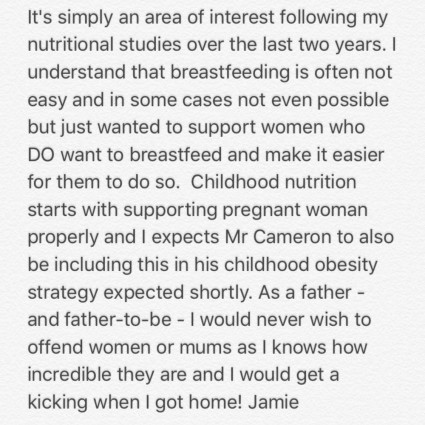
…I understand that breastfeeding is often not easy and in some cases not even possible but just wanted to support women who DO want to breastfeed and make it easier for them to do so… As a father … I would never wish to offend women or mums …

image

As a father of daughters, he should be deeply concerned about their right to bodily autonomy. His comments weren’t offensive merely because he ignored the very real difficulties of breastfeeding. They were offensive because he presumed to tell women how they should use their own breasts. That’s sexist and that’s why an apology was necessary.

Jamie Oliver and lactivists who lie

Man fingers crossed behind a backside

See what happens when you let men out of the kitchen where they belong? They start pontificating about subjects that they know nothing about and making fools of themselves in the process.

Take celebrity chef Jamie Oliver, for example. Oliver, whose US school lunch program designed to decrease obesity was a total failure because kids didn’t like the food, now turns his attention to breastfeeding.

[pullquote align=”right” cite=”” link=”” color=”” class=”” size=””]For many women, breastfeeding is NOT easy, and it is NOT convenient.[/pullquote]

Acting as a spokesperson for a British nutrition charity, he made a promotional video where he actually uttered the words:

It’s the next big thing. Breastfeeding is easy and convenient.

No, Jamie, it’s not the next big thing. It’s a very old, and very imperfect thing.

Women have been breastfeeding since the beginning of time and infant mortality rates have been hideous since the beginning of time (until the advent of modern medicine and, dare I say it, infant formula).

How could breastfeeding, “nature’s way” for feeding babies, be imperfect?

In the exact same way that pregnancy, nature’s way of making babies, is imperfect. We’ve all seen nature shows about turtles. Female turtles laboriously haul themselves out of the sand to lay and bury millions of eggs on a beach. Those eggs hatch at roughly the same time and the baby turtles have to scrabble to the water in order to survive. Only a fraction of them make it; the rest are eaten by predators waiting patiently for a feast.

Human reproduction, like turtle reproductions, like all animal reproduction is terribly wasteful. Consider that women produce millions of ova (eggs) that they never use and men produce billions of sperm that will never fertilize an ovum. Even when conception does occur, the carnage continues. Approximately 20% of established pregnancies will end in miscarriage. Death on a grand scale is inevitable in reproduction and breastfeeding is a part of reproduction.

At least 5% of women, perhaps more, cannot produce enough milk to fully nourish an infant. In the good old days when everyone was breastfed, those babies simply died. Just as miscarriage is the specter that haunts every newly pregnant woman, infant death from dehydration or failure to thrive used to be the specter that haunted new motherhood. Breastfeeding is so imperfect that the ONLY societies that have low infant mortality are societies where formula is readily available and readily used.

Oliver might be forgiven his ignorance of the entirely natural death toll of breastfeeding, but his claim that breastfeeding is “easy and convenient” is completely unforgivable. In facts, it’s the classic, self-serving lie of the lactivist movement.

Let me say this loud and clear so there’s no confusion on this issue:

For many women, breastfeeding is NOT easy, and it is NOT convenient.

Lactivists like to pretend that women stop breastfeeding because of lack of education, because hospitals give out formula, because of lack of professional support, because of lack of peer support, etc. etc. etc. All this pretending reflects the profound unwillingness of the breastfeeding industry to acknowledge  the real reasons that women stop breastfeeding or fail to start in the first place. The dirty little secret about breastfeeding is that starting is hard, painful, frustrating and inconvenient. And continuing breastfeeding is hard, sometimes painful, and incredibly inconvenient especially for women who work, which in 2016 is most women.

Why do lactivists lie about the reality of breastfeeding? Why do they sugarcoat it with little maxims like “breast milk is always available,” breast milk is always the perfect temperature,” and “breast feeding saves money.” Why does the breastfeeding industry (lactation consultants, manufacturers of breastfeeding supplies like pumps) ignore the very real challenges in initiating and maintaining breastfeeding?

They lie because they think they have a right to police women’s bodies. They fear that women will not attempt breastfeeding if they are informed honestly about the difficulties. Yet it seems that the opposite is true. By not acknowledging these difficulties up front, the breastfeeding industry sets women up for failure, guilt and possibly postpartum depression, when those women encounter the “normal” pain, frustration and inconvenience of breastfeeding.

Women are telling the breastfeeding industry that the way information on breastfeeding is presented has made them feel awful. It is the height of arrogance to tell a woman that what is hurting her is not really hurting her. When mothers tell lactivists that breastfeeding is often painful and often inconvenient, it is arrogant to tell them that breastfeeding is “easy and convenient.” When mothers tell lactivists that aggressive breastfeeding promotion leads fo crushing feelings of failure and inferiority, it is arrogant to tell them that it doesn’t.

This is the central paradox of contemporary lactivism. If breastfeeding is so easy and convenient, why do lactivists need to recruit Jamie Oliver to tell women that it is easy and convenient? Because it isn’t really easy and convenient; they know it and lie about it anyway.

Jamie Oliver should get back in the kitchen were he belongs and leave the hard work of nourishing infants to their mothers who love them, want what’s healthiest for them, and know beyond a shadow of a doubt that breast is NOT always best.

Why is Kristin Cavallari feeding her baby milk from an animal that eats garbage?

image

I’m currently reading a fascinating book, The Fever of 1721, about the first time that inoculation against smallpox was used in Colonial America. The man who proposed inoculation was the Reverand Cotton Mather, of Salem Witch Trial fame. He had read about it in the Proceedings of the Royal Society and one of his sons was among the first people inoculated.

One of the most striking things about Colonial society was the sheer amount of death. Mather himself buried 10 of his 15 children and two of his three wives. In the age when all children were breastfed, all food was organic, and everyone exercised, the average child lived until … death from infectious disease.

[pullquote align=”right” cite=”” link=”” color=”” class=”” size=””]When it comes to breastmilk substitutes, infant formula is the gold standard.[/pullquote]

Nothing screams “privilege” louder than our collective amnesia about the deadliness of the all natural lifestyle. Perhaps that’s why actress Kristin Cavallari is boasting about feeding her baby goat’s milk, which comes from an animal that routinely eats garbage.

Cavallari tells People Magazine:

I would rather feed my baby these real, organic ingredients than a heavily processed store-bought formula that contains ‘glucose syrup solids,’ which is another name for corn syrup solids, maltrodextrin, carrageenan, and palm oil …

Because her sons have “sensitivities to cow’s milk,” the former Laguna Beach star uses goat’s milk powder for her homemade formula. Other ingredients include organic maple syrup and cod-liver oil (see below for the full recipe).

Yeah, that’s certainly better than real organic Camphylobacter and Listeria bacteria found in goat’s milk. NOT.

When it comes to breastmilk substitutes, infant formula is the gold standard. Nothing else even comes close to a product that is pasteurized to remove bacteria, fortified to include every vitamin and mineral a human baby needs, and subject to rigorous purity standards. Anything else is not only inferior, but potentially deadly.

The American Academy of Pediatrics recommends infant formula as the ONLY acceptable alternative. Making your own formula is specifically noted to be dangerous. Pediatric gastroenterologist Mark Corkins asks:

Why would you want to use an alternative formula when there are well tested and tried formulas widely available?

There are two reasons women like Cavallari use homemade formula. The first is ignorance. Putting goat’s milk in your baby’s bottle is no better than putting Mountain Dew in your baby’s bottle, but these women are so bewitched by the word “natural” that they never stop to think that most of the children who ever existed ate “real organic” ingredients and died in droves. There is NO health benefit to organic ingredients, a fact that has been demonstrated over and over and over again. Just because something is natural doesn’t make it healthy to consume. Tobacco, cocaine and heroin are all natural and all of them kill.

The second reason is that wacky “natural” substitutes are status symbols among the privileged. Goat’s milk is to the all natural crowd what a Gucci handbag is to New York socialites. A designer handbook is not better than a standard handbag in any way, but it is far more expensive And therefore conveys social status.

People Magazine includes Cavallari’s recipe for goat’s milk formula. If I were their legal counsel, I’d recommend that they get rid of that ASAP before a baby dies as a result.

That leads to another question. Why would anyone with more than two functioning brain cells take medical advice from an actress instead of a pediatrician? If you wouldn’t let the average actress pilot your next flight, or draw up the architectural plans for your new home, why would you let her tell you what should be in your infant’s formula? It takes less education and training to be a pilot or an architect than it takes to be a pediatrician.

Unfortunately, our culture worships celebrities. We breathlessly consume news of their romances and breakups, marriages and divorces. We buy the products for which they shill and read the books and blog posts that they write on topics they don’t understand. (Gwyneth Paltrow, I’m talking about you and your vaginal steaming!) And we ape them slavishly, wearing what they wear, eating what they eat, and dosing ourselves with deadly nonsense that they promote.

But let’s leave our babies out of it since their lives depend on medical advances like formula and vaccinations, not nonsense dreamed up by people whose claim to fame is their personal attractiveness.

For most of human history, the average woman gave birth to 8 or more children and the population grew very, very slowly. Why? Because most of those children did not survive long enough to have children of their own; all natural childhood is deadly.

Only countries with easy access to infant formula have low rates of infant mortality. That’s because any breastmilk substitute besides formula is unsafe.

Massive rates of infant and child death are 100% natural. Don’t take infant feeding advice from anyone who is clueless about that fact.

Why didn’t my baby’s head fit?

image

Did you have a C-section for “failure to progress”? It may have happened because the baby’s head did not fit through your pelvis, a condition known as cephalo-pelvic dysproportion (CPD).

CPD is far more common in humans than any other primates, because there are competing evolutionary pressures that have acted on the two most important parameters, the size of the mother’s pelvis (a big pelvis is good for childbirth, but bad for upright mobility) and the baby’s head (a big head is good for survival, but bad for childbirth).

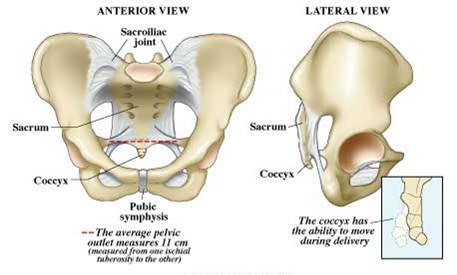
Most people imagine that the pelvis is like a hoop that the baby’s head must pass through, and indeed doctors often talk about it that way. However, the reality is far more complicated. The pelvis is a bony passage with an inlet and an outlet having different dimensions and a multiple bony protuberances jutting out at various places and at multiple angles. The baby’s head does not pass through like a ball going through a hoop. The baby’s head must negotiate the bony tube that is the pelvis, twisting this way and that to make it through.

image

You can see what I mean in the illustration above (from Shoulder Dystocia Info.com). There are bony protuberances that jut into the pelvis from either side (the ischial spines) and the bottom of the sacrum and the coccyx, located in the back of the pelvis, jut forward. How does the baby negotiate these obstacles? During labor, the dimension of the baby’s head occupies the largest dimension of the mother’s pelvis. But because of the multiple obstacles, the largest part of the mother’s pelvis is different from top to middle to bottom. Therefore, the baby is forced to twist and turn its head in order to fit.

This illustration (from the textbook Human Labor & Birth) shows what happens. We are looking up from below and the fetal skull is passing through the mother’s pelvis. The lines on top of the skull demarcate the different bones of the fetal skull.

image

You can see that at the beginning of labor, the baby’s head is facing sideways; in the middle of labor, the head in facing toward the mother’s back; and after the head is born, it switches back to sideways and the shoulders come through the pelvis.

What does it mean when the baby’s head gets stuck? It can mean a number of different things. The pelvic inlet could be too small so the baby’s head never even drops into the pelvis. The ischial spines could stick too far into the pelvis and stop the head. The sacrum and coccyx could be angled too far forward and that could stop the head.

Clearly there is a great deal of potential for a mismatch between the size of the pelvis and the size of the baby’s head. Over time, babies have evolved so that the bones of the skull are not fused and can slide over each other, reducing the diameter of the head. This is called “molding” and accounts for the typical conehead of the newborn. But there is a limit to the amount of molding that the head can undergo and ultimately, the baby may not fit through.

The illustration above shows the baby’s head entering the pelvis in the optimal position, but babies don’t always cooperate. If the head is in anything other than the ideal position the fit will be even tighter. That’s why babies in the OP position (facing frontwards) and babies with asynclitic heads (the head titled to one side) are much more difficult to deliver vaginally. Their heads no longer in the smallest possible diameter. It’s like trying to put on a turtleneck face first of over your ear instead of starting from the back of your head. It’s much more difficult.

Although this is a more detailed explanation than that typically offered, it is still a simplified explanation. It does demonstrate, though, that many different variables are involved in whether a baby’s head will fit: the diameter of the pelvic inlet, the length and angle of the ischial spines, the angle of the coccyx, the position in which the fetal head enters the pelvis, the ability of the fetal head to mold to accommodate itself to the available dimensions.

Considering how many variables are involved, it’s not surprising that many babies simply do not fit. The real miracle is that most babies do fit. That was good enough to get the population to this point, despite the deaths of many babies and mothers childbirth. It’s no longer good enough, though because we want to save every baby and every mother. That’s why C-sections exist.


This piece first appeared in June 2010.

The simple reason why breastfeeding is NEVER a substitute for vaccination

antibody

I’m going to lead this piece with the “money quote” so if you read nothing else you’ll read this:

Breastfeeding can NEVER be a substitute for vaccination for a very simple reason: maternal antibodies to vaccine preventable diseases CAN’T be passed via breastmilk.

Why?

[pullquote align=”right” cite=”” link=”” color=”” class=”” size=””]Maternal antibodies to vaccine preventable diseases are not and CANNOT be passed via breastmilk.[/pullquote]

The immune system makes different types of antibodies (immunoglobulins) labeled alphabetically. Immunoglobulin A (IgA) can be passed through breastmilk. IgA can protect against colds and diarrheal illnesses but NOT other illnesses.

The antibodies that fight vaccine preventable diseases are IgG. Vaccines stimulate the production of IgG. IgG can be passed across the placenta but CAN’T be passed in breastmilk. So babies can be born with some immunity to vaccine preventable diseases, but that immunity immediately begins to wane. It is not replaced by breastfeeding because there is no IgG in breastmilk.

Why do anti-vaccine parents think breastmilk is a substitute for vaccination?

According to Martucci and Barnhill, it is because we have over-emphasized the “naturalness” of breastfeeding.

InUnintended Consequences of Invoking the “Natural” in Breastfeeding Promotion in the journal Pediatrics they claim:

Medical and public health organizations recommend that mothers exclusively breastfeed for at least 6 months. This recommendation is based on evidence of health benefits for mothers and babies, as well as developmental benefits for babies. A spate of recent work challenges the extent of these benefits, and ethical criticism of breastfeeding promotion as stigmatizing is also growing… Promoting breastfeeding as “natural” may be ethically problematic, and, even more troublingly, it may bolster this belief that “natural” approaches are presumptively healthier. This may ultimately challenge public health’s aims in other contexts, particularly childhood vaccination.

Martucci and Barnhill have focused on an important issue. However, it seems to me that it isn’t merely the naturalness of breastfeeding that has emboldened anti-vax parents to insist that vaccination isn’t necessary for breastfed babies. They’ve been emboldened by irresponsible claims of specific immunological benefits of breastfeeding.

For example, the Baby Friendly Hospital Iniatitive claims:

Human milk provides the optimal mix of nutrients and antibodies necessary for each baby to thrive.

That’s utterly FALSE. Breastfeeding CAN’T provide antibodies for vaccine preventable diseases.

Claims about the immune benefits of breastfeeding are often utterly irresponsible.

Writer Angela Garbes claimed in In The More I Learn About Breast Milk, the More Amazed I Am:

According to Hinde, [Katie Hinde, a biologist and associate professor at the Center for Evolution and Medicine at the School of Human Evolution & Social Change at Arizona State University] … If the mammary gland receptors detect the presence of pathogens, they compel the mother’s body to produce antibodies to fight it, and those antibodies travel through breast milk back into the baby’s body, where they target the infection.

That’s pure speculation on Hinde’s part, as she later acknowledged in a public Twitter conversation with me.

I agree wholeheartedly with Martucci and Barnhill’s claim that touting breastfeeding as natural has serious unintended consequences (like maternal guilt for women who don’t breastfeed). Nonetheless, I suspect that it is the specific irresponsible false claims made by lactivists about the immunological benefits of breastfeeding that have led anti-vax parents to believe that breastfeeding is a substitute for vaccines.

We should think carefully before we tout breastfeeding as superior because it is natural, but it is even more important to hold lactivist organizations to account for all sorts of false claims, including immunological claims. In countries with reliable clean water supplies, the benefits of breastfeeding for term infants are limited to a few less colds and episodes of diarrheal illness across the entire population of infants (because of IgA in breastmilk). That’s it. Claims of other benefits are based on scientific evidence that is weak, conflicting and riddled with confounders. And in many cases, even that weak evidence was debunked long ago.

The key point, though, is that breastfeeding is NEVER a substitute for vaccination because IgG (the antibodies produced by vaccination) can’t be passed in breastmilk.

It’s just that simple.

Watch a mother nearly kill a baby at home waterbirth

image

Waterbirth is both unnatural and potentially deadly.

You can easily see why in this video where a baby remains underwater for nearly FOUR MINUTES and easily could have inhaled the water in the birth pool.

I have no idea why this baby was allowed to remain submerged for so long.

[youtube https://m.youtube.com/watch?feature=youtu.be&v=O3ysogVwU7g]


It is ironic that waterbirth is promoted as part of natural childbirth when it is anything but natural. There are no primates who give birth in water. With the possible (and possibly apocryphal) historical exception of one tribe of Indians on the California coast, there are no human societies that give birth in water.

Babies evolved to breathe immediately upon birth. As anyone who has delivered a substantial number of babies can tell you, they can gasp, snort and cry before their bodies are born.

Babies practice breathing in utero. The claim that babies won’t breathe until they feel air on their faces is flat out false.

Indeed, the American Academy of Pediatrics’ Committee on Fetus and Newborn in conjunction with the American College of Obstetricians and Gynecologists notes:

Although it has been claimed that neonates delivered into the water do not breathe, gasp, or swallow water because of the protective “diving reflex,” studies in experimental animals and a vast body of literature from meconium aspiration syndrome demonstrate that, in compromised fetuses and neonates, the diving reflex is overridden, whichleads potentially to gasping and aspiration of the surrounding fluid.

The water poses three specific threats to babies: inhalation of water interfere with oxygen exchange in the lungs; it increases the risk of lung infection from the bacteria in the birth pool water; and the baby can suffer life threatening hyponatremia (dilution of electrolytes) from ingesting the hypotonic water of the birth pool.

And AAP/ACOG report concludes:

…[T]he practice of immersion in the second stage of labor (underwater delivery) should be considered an experimental procedure that only should be performed within the context of an appropriately designed clinical trial with informed consent. Facilities that plan to offer immersion in the first stage of labor need to establish rigorous protocols for candidate selection, maintenance and cleaning of tubs and immersion pools, infection control procedures, monitoring of mothers and fetuses at appropriate intervals while immersed, and immediately and safely moving women out of the tubs if maternal or fetal concerns develop.

According to the text accompanying the video, the birth pool was barely filled in time, suggesting that there was no time to heat the water, a risk factor for neonatal compromise, further aggravated by delaying wrapping the baby after it was finally removed from the birth pool.

Fortunately, this baby did breathe eventually. We have no idea whether the baby suffered complications like infection or hyponatermia.

The parents posted the video to boast about what they had done. They shouldn’t be proud; they should be ashamed for risking the baby’s life in this way.

I find it excruciating to watch this video and I suspect nearly all obstetricians, pediatricians and neonatologists would agree.

Childbirth isn’t maternal performance art. There are enough inherent risks to a baby during childbirth. Why would any mother willingly add more?

Is neonatal tongue-tie surgery the new tonsillectomy?

image

A New Zealand pediatrician is questioning the growing popularity of neonatal surgery for tongue-tie.

Dr. Pamela Douglas believes Deep cuts under babies’ tongues are unlikely to solve breastfeeding problems:

[pullquote align=”right” cite=”” link=”” color=”” class=”” size=””]Babies are being cut on the theory that breastfeeding is always perfect and, therefore, it is babies who are “broken.”[/pullquote]

When I perform comprehensive breastfeeding assessments on babies with breastfeeding problems or fussiness, including those who’ve had oral surgery in the previous weeks or months, I find a range of underlying problems that have not been properly identified and addressed, though the women have usually seen multiple health professionals.

I regularly see babies who have become even fussier at the breast after they’ve had the deep laser or scissor cuts and the distressing wound-stretching exercises. We call this “oral aversion”.

Occasionally, I find other unexpected side-effects of frenectomies: an under-surface of a tongue partly separated into two, or stitches inserted under the baby’s tongue, or into the upper gum. Parents are told the stitches were because the tie was so bad. But stitches are only put in to control excessive bleeding.

The epidemic of tongue tie is surprising since the natural incidence of tongue-tie has been estimated as 1.7-4.8%

But releasing (snipping) the tongue tie is big business. The surgical fee for frenectomy/frenotomy is $850. I presume that $850 is what the doctor bills; what he or she is actually paid probably varies by insurance company.

How effective is surgery for tongue-tie in reducing breastfeeding problems?

Not very.

A recent review of the literature published in the journal Pediatrics, Treatment of Ankyloglossia and Breastfeeding Outcomes: A Systematic Review, found:

Twenty-nine studies reported breastfeeding effectiveness outcomes (5 randomized controlled trials [RCTs], 1 retrospective cohort, and 23 case series). Four RCTs reported improvements in breastfeeding efficacy by using either maternally reported or observer ratings, whereas 2 RCTs found no improvement with observer ratings. Although mothers consistently reported improved effectiveness after frenotomy, outcome measures were heterogeneous and short-term. Based on current literature, the strength of the evidence (confidence in the estimate of effect) for this issue is low. (my emphasis)

In Tongue-tie and frenotomy in infants with breastfeeding difficulties: achieving a balance the authors note:

There is wide variation in prevalence rates reported in different series, from 0.02 to 10.7%. The most comprehensive clinical assessment is the Hazelbaker Assessment Tool for lingual frenulum function. The most recently published systematic review of the effect of tongue-tie release on breastfeeding concludes that there were a limited number of studies with quality evidence. There have been 316 infants enrolled in frenotomy RCTs across five studies. No major complications from surgical division were reported. The complications of frenotomy may be minimised with a check list before embarking on the procedure.

Conclusions: Good assessment and selection are important because 50% of breastfeeding babies with ankyloglossia will not encounter any problems. We recommend 2 to 3 weeks as reasonable timing for intervention. Frenotomy appears to improve breastfeeding in infants with tongue-tie, but the placebo effect is difficult to quantify. Complications are rare, but it is important that it is carried out by a trained professional.

That raises the question: is tongue-tie surgery the new tonsillectomy, a surgery that is necessary for certain narrow indications that became extremely popular to treat conditions that didn’t need treatment? In 1959, there were 1.4 million tonsillectomies performed in the United States. By 1987, the number dropped to 260,000. What was the reason for the dramatic change?

Physicians recognized that although tonsillectomy is necessary for enlarged tonsils that obstruct a child’s airway, they aren’t helpful for the reasons they were commonly performed — to prevent minor illnesses that would resolve on their own. As the authors of Effectiveness of adenotonsillectomy in children with mild symptoms of throat infections or adenotonsillar hypertrophy: open, randomised controlled trial explain:

Results: During the median follow up period of 22 months, children in the adenotonsillectomy group had 2.97 episodes of fever per person year compared with 3.18 in the watchful waiting group (difference −0.21, 95% confidence interval −0.54 to 0.12), 0.56 throat infections per person year compared with 0.77 (−0.21, −0.36 to −0.06), and 5.47 upper respiratory tract infections per person year compared with 6.00 (−0.53, −0.97 to −0.08). No clinically relevant differences were found for health related quality of life. Adenotonsillectomy was more effective in children with a history of three to six throat infections than in those with none to two. 12 children had complications related to surgery.

Conclusion: Adenotonsillectomy has no major clinical benefits over watchful waiting in children with mild symptoms of throat infections or adenotonsillar hypertrophy.

Are we making the same mistake with tongue-tie surgery as we made with tonsillectomy? While surgery is appropriate for babies with severe tongue-tie, is it being recommended for painful breastfeeding when it is not the cause and will not effectively treat the pain?

I am not an expert in tongue-tie and I have not reviewed the entire breadth of the literature, so I may be wrong, but I’m extremely dubious about surgery on babies because mothers are having pain breastfeeding. Is it really the baby’s fault? Are the small benefits of breastfeeding really worth subjecting babies to painful surgical treatments? The existing data suggests that surgery for tongue-tie is being overused for a problem that it may not even treat.

I’m also extremely dubious about any surgery recommended by the lactation industry. Instead of acknowledging that pain in breastfeeding is distressingly common and that breastfeeding may not be right for every mother and every infant, babies are being cut on the theory that breastfeeding is always perfect and, therefore, it is babies who are “broken.”

Only further research will answer these questions definitively, but until then mothers should seek second opinions on tongue tie surgery from someone other than lactation consultants and the doctors who perform the surgery. Mothers should ask themselves if the benefits of breastfeeding outweigh the risks of surgery. Should you really cut your baby’s tongue when bottles of pumped breastmilk or formula may solve the problem?

Masturbation in childbirth?

image

VICE UK offers the Argument for Masturbating During Childbirth.

Doula Angela Gallo describes her experience:

As I neared transition, near the end of labor, I was feeling very vulnerable and stressed-out; I went into the shower to find some relief, and my husband asked if I would like to have sex. I said no, but it reminded me I could self-stimulate,” she told me. “The second I started using clitoral stimulation, the resting period between contractions was more pleasurable and I could use more force to meet the climax of the contractions.” Gallo described the sensation as “taking the edge off” the pain more than sexual gratification.

Childbirth educator Kate Dimpfl explains:

[pullquote align=”right” cite=”” link=”” color=”” class=”” size=””]How could masturbating to release MORE oxytocin ease labor pain?[/pullquote]

“The hormones in birth and sex are identical,” explained Dimpfl in her TEDx talk, “We Must Put the Sex Back into Birth,” pointing to the hormone oxytocin, which was literally named after the Greek term for “swift birth.” Oxytocin is released during sexual arousal and orgasm, but also during childbirth, skin-to-skin contact with a newborn, and breast-feeding. With oxytocin comes a rise of endorphins, which can naturally reduce pain.

Really? And yet the idea of masturbation during childbirth appears to be restricted to privileged Western, white women who have marinated in the natural childbirth literature. To my knowledge, it was unknown in any time, place or culture across the entirety of human experience until it was promoted by Ina May Gaskin. Gaskin is a privileged Western, white woman with no medical, nursing or midwifery training who is considered the grandmother of the American homebirth movement.

Gaskin* didn’t promote masturbation per se; she extolled the virtues of the provider sexually touching the laboring women:

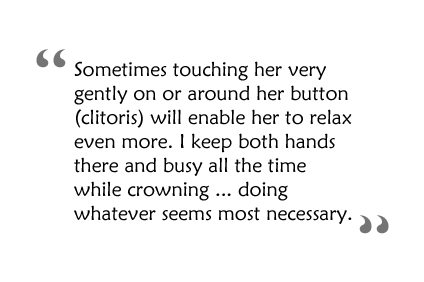
It helps the mother to relax around her puss if you massage her there using a liberal amount of baby oil to lubricate the skin. Sometimes touching her very gently on or around her button (clitoris) will enable her to relax even more. I keep both hands there and busy all the time while crowning … doing whatever seems most necessary.

And:

Sometimes I see that a husband is afraid to touch his wife’s tits because of the midwife’s presence, so I touch them, get in there and squeeze them, talk about how nice they are, and make him welcome.

Subsequently, Gaskin elaborated a theory to explain why sexually touching other women benefits them, the theory parroted by childbirth educator Dimpfl. Gaskin made it up; it is pseudoscience invoked to justify her sexual touching of other vulnerable women while they were in agony.

Another privileged, Western white women, Debra Pascali-Bonnaro, embellished the theory to fabricate “orgasmic birth,” another phenomenon never described by anyone else, anywhere else, at any other time throughout the millennia of human existence until it was “discovered” by privileged Western white women steeped in the natural childbirth literature.

There’s no harm to masturbating during labor, just like there’s no harm to imbibing homeopathic preparations that are nothing more than water. But just as the harm of homeopathy comes from expectations of efficacy, the harm of promoting masturbation in labor is also of raising expectations of efficacy. Moreover, the belief that childbirth is a form of performance art, whereby a woman demonstrates mastery of her own pain to such an extent that she engages in sexual play during labor, is also harmful.

Advocates of sexual touching during childbirth proclaim that the hormones of sex are also the hormones of childbirth … yet they neglect to mention that they are also the hormones of miscarriage. That fact seems to have escaped them.

Many, perhaps most, hormones have multiple functions within the body. Cortisone, for example, is known as a stress hormone, but it is also important in fighting inflammation. That doesn’t mean that the two are inevitably connected; when your body produces cortisone to fight an infection in your finger, it doesn’t lead to the fight or flight response at the same time.

Oxytocin also has multiple functions in the body. It is involved in both sexual arousal and in labor pain but it obviously doesn’t create the same effect. Indeed, the idea of sexual touching in childbirth to reduce pain is nonsensical. During labor circulating levels of oxytocin are highest and labor is usually agonizing. How could masturbating to release more oxytocin ease labor pain? That doesn’t make much sense, does it?

The sad fact is that, to my knowledge, sexual touching during childbirth was virtually unheard of until Ina May Gaskin started doing it to women under her care. She made up a theory to justify it and she is held in such high esteem by her acolytes that instead looking askance at her behavior, they emulated it, albeit modified to self-stimulation instead of provider stimulation. That’s unfortunate.

The history of and the historical justification for sexual touching in labor is deplorable. Women should be questioning it, not copying it.


*The quotes come from Spiritual Midwifery, 3rd and 4th Editions.

Academy of Breastfeeding Medicine publishes embarrassingly weak rebuttal to my plea to save well baby nurseries

image

The Academy of Breastfeeding Medicine (ABM) has just published a rebuttal to my recent piece in TIME, Closing Newborn Nurseries Isn’t Good for Babies or Moms in which I address one of the central tenets of the Baby Friendly Hospital Initiative (BFHI), rooming-in, which is ostensibly about increasing breastfeeding rates, a task that it doesn’t accomplish.

This is one of the main points of my piece:

[pullquote align=”right” cite=”” link=”” color=”” class=”” size=””]Are we going to trot out ugly medical paternalism to insist that women can’t be trusted to know what’s good for them and their babies?[/pullquote]

Keep in mind that no one is preventing rooming in. If women want to keep their own babies in their rooms 24/7, they are welcome to do so. But that’s not enough; they insist that all women keep their babies in their rooms with them, whether they want to or not.

Apparently the folks at ABM don’t think that mothers can be trusted to make the choice they want them to make. Their response, Rebuttal to Dr. Amy Tuteur regarding Time editorial by Dr. Renee Boynton-Jarrett and Dr. Lori Feldman-Winter is embarrassingly weak, muddled and afflicted by remarkably foolish errors.

1. False dichotomy.

The ABM piece starts with the same false choice that preoccupies many apologists for the BFHI:

Thirty years ago, every newborn infant born in a US hospital was separated from their parents at the time of birth. Rooming-in was not an available option. We know now that that this standard practice was not optimal for the mother or the infant.

But the opposite of forbidding rooming-in is not MANDATING rooming in; it is ALLOWING rooming-in.

2. Red herring. A red herring is something that misleads or detracts from the issue at hand. The ABM red herring is pathetic in the extreme:

The image used by Time Magazine depicts an “unsafe” practice: several newborns swaddled in basinets on their sides sleeping. This sleep position carries more the double the risk of SIDS compared to infants sleeping on their backs.

The picture? Seriously, ladies, the picture? The picture (which I did not choose) is meant to illustrate the piece, not to accurately reflect contemporary well baby nurseries. You must be really desperate to be reduced to criticizing the picture instead of making a reasoned argument.

3. A whopper:

Rooming-in does not mean mothers cannot rest. In fact, studies show that mother’s sleep quality improves when her newborn is nearby, and sleep quantity does not diminish.

Studies show? Which ones? Oops, the authors could not manage to cite any of the studies! But worse than the fact that the authors don’t bother to provide citations is the fact that claims like these illustrate the most maddening aspect of the breastfeeding industry: they don’t listen to mothers. Women are complaining bitterly that they can’t rest when they are responsible for infant care 24/7 and they need to rest to heal from the ordeal of birth and any lacerations, stitches or surgery. But the breastfeeding industry couldn’t care less what mothers want; they are only interested in what THEY want.

4. Casual callousness:

It is unfortunate that the author believes Baby-Friendly is “deeply wounding” for those who choose to formula feed.

No, what’s unfortunate is that the authors don’t believe the MOTHERS who say that the BFHI is deeply wounding. I breastfed my four children. I did not directly experience the shaming and guilt of the BFHI but I don’t doubt the many, many women who have written to me and commented on my blog telling me that they have experienced the BFHI as shaming. But, as noted above, the breastfeeding industry couldn’t care less how mothers feel; to my knowledge, no breastfeeding researcher has ever asked them.

5. Speculation presented as scientific fact:

The benefits of breastfeeding and risks of formula feeding are anything but trivial. The establishment of the infant’s immune system and properly functioning microbiome are reliant on an exclusively breastfed diet with profound and lifelong results.

The only words in that sentence that are true are “and” and “the.” The rest is wishful thinking on the part of the breastfeeding industry, which routinely substitutes opinion for scientific evidence.

6. A lie:

There is no “breastfeeding industry.”

Really? Then why does a major market research firm publish a 56 page market analysis of the breastfeeding supplies industry? And that doesn’t even count the millions spent on lactation consultants, breastfeeding classes and promoting and implementing the BFHI. It’s an industry that’s so lucrative that market research analysts charge $2500 for the report, reasoning the members of the industry will be willing to pay that much to find out how to sell more goods and services.

7. Heartless indifference to the deaths of babies who die as a result of mandatory rooming in.

Mothers should be expected to use call bells when sleepy or having trouble transferring the newborn to the bassinet.

If you accidentally fall asleep with the baby in your bed and the baby dies, it’s your fault you didn’t call the nurse before accidentally falling asleep. That attitude is reprehensible.

8. Refusal to address the actual issue: lack of respect for women’s autonomy.

The issue is CHOICE. Are we going to treat women as if they are smart enough and capable enough to decide when they want their babies in the room and when they want to rest? Or are we going to trot out ugly medical paternalism to insist that women can’t be trusted to know what’s good for them and their babies?

The authors of this rebuttal are really grasping at straws if they have to resort to false dichotomy, a red herring, a whopper, a lie, speculation, casual callousness in response to women’s feelings, heartless indifference to preventable infant deaths, and lack of respect for women’s autonomy.

The issue is simple; the issue is choice. The breastfeeding industry does not trust women to make the decisions they want them to make so they prefer to restrict their choice.

I’m thrilled that the authors couldn’t manage anything more impressive than this. And if they thought they didn’t like my TIME piece, they are going to have an absolute fit when they see my book, PUSH BACK: Guilt in the Age of Natural Parenting – 384 pages, 256 footnotes – an extended argument on the ways in which the natural childbirth, breastfeeding and attachment parenting industries promote guilt in order to monetize it.

I just can’t wait for the ABM review!