All posts by Amy Tuteur, MD

Obstetricians are lifeguards

image

Lifeguards are over used.

Think about it:

  • Swimming is a natural process.
  • Water is entirely natural.
  • Animals swim all the time without difficulty.
  • If death by drowning were common we wouldn’t be here.
  • Most rescues result in children and adults who are perfectly fine.

Yet despite these incontrovertible facts, people have been socialized to believe that public pools and public beaches need lifeguards.

[pullquote align=”right” color=”#F6BE00″]Some children are just meant to drown.[/pullquote]

We should simply trust swimmming.

Our ancestors trusted swimming. They swam in lakes, rivers and oceans and never used lifeguards. Children were free to jump into filled quarries and from small cliffs and frolicked at the seashore without anyone watching for sharks. Everyone understood that some people are just meant to drown.

The last 100 years have seen the rise of the lifeguard with all the technology that implies. Lifeguards sit on tall chairs above swimmers as though they knew more about swimming than the swimmers themselves. They carry whistles (unnatural), use binonculars (unnatural) and have rescue equipment like jet skis (highly technological) at their disposal.

Most of what they do is thoroughly unnecessary. Yes, some people really do need to be rescued from drowning. How do we know? Those are the people who sustain permanent brain damage or die despite rescue. But the truth is that most people “rescued” by lifeguards end up perfectly fine, demonstrating that they didn’t need to be rescued in the first place.

So why are there so many unnecessary rescues?

Isn’t it obvious? Lifeguards are worried that if we understood how uncommon drowning really is, their incomes would be threatened. Therefore they stage “rescues” of floundering men, women and children that were entirely unnecessary.

How accurate in lifeguard monitoring anyway? Judging by the fact that most of the people pulled from the water don’t even require professional medical care, lifeguard monitoring is basically useless.

Why is lifeguard monitoring such a failure? It’s because lifeguard monitoring has high sensitivity, but low specificity. Sure, if you are really drowning (as demonstrated by your subsequent death), lifeguards will recognize it nearly every time (high sensitivity). But many people who appear to be drowning (flailing, lying motionless, disappearing under the surface without reappearing) are perfectly fine when plucked from the water (low specificity). Even those who don’t appear to be fine initially do quite well if transported to the local hospital for treatment.

We are spending a fortune on lifeguards who are entirely unnecessary. How can we simultaneously save money and return swimming to the natural process that it has always been? Instead of hiring lifeguards, we should hire certified professional monitors (CPMs) to preside over swimming. The hallmark of certified professional monitors is that they are experts in normal swimming. CPMs trust swimmming because they recognize that it is a natural process to be savored, not a potential disaster to be feared.

CPMs don’t routinely employ technology like whistles and binoculars, although they do keep them in their cars in the parking lots so they can use them in the exact same way as real lifeguards; however, they use them ONLY when an emergency develops, not when everything is fine. They don’t sit on tall chairs looming above everyone else. Indeed they don’t even face the swimmers! Since monitoring swimmers is limited by low sensitivity, it is obviously useless to watch them. Watching swimmers merely leads to unnecessary “rescues” of people who might never have drowned if left on their own.

Certified professional monitors know that there is plenty of time to transfer care in the event of a real emergency. Once others have pulled the blue, pulseless child from the water CPMs can perform CPR, dial 911 and await the arrival of the ambulance crew. No doubt some of those pulled from the water won’t survive, but let’s face it some children are just meant to drown.

Think of all the money we could save by employing CPMs who are paid much less than real lifeguards!

But the real benefits of using CPMs (or no one at all) is that we can return swimming to the pristine state it occupied in nature. Instead of viewing swimmers as potential drownings waiting to happen, we would trust the natural process of swimming by returning to the traditional practices of our ancestors. Swimming ought to be a spiritual experience, unmarred by technology, not an employment opportunity for technocratic lifeguards who claim to be rescuing people who in reality would have been perfectly fine without them.

Trust swimming! Use monitors who are experts in normal swimming. Above all, restrict the use of lifeguards to true emergencies only. Prevention is entirely overrated. The experience of swimming is so much more important than the outcome!
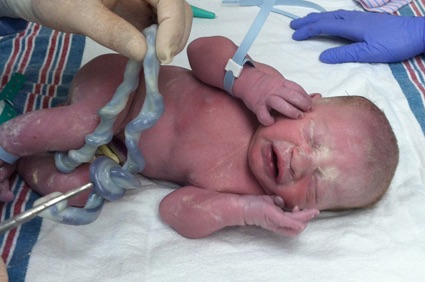
Let’s review: Trust umbilical cords?

image

Natural childbirth and homebirth advocates get very excited about umbilical cords, specifically nuchal (neck) cords, the medical term for an umbilical cord that gets wrapped around the baby’s neck. They get excited because they believe that obstetricians dramatize the risk of nuchal cords (“the baby could die”) when they aren’t dangerous at all. As usual, natural childbirth and homebirth advocates are wrong on this point and the reason is that they fundamentally misunderstand when and why a nuchal cord dangerous.

How does an umbilical cord get wrapped around the baby’s neck in the first place. The reason is that for most of pregnancy, the baby has a lot of room to move and the cord is relatively long. Moving around, up and down, and somersaulting, the baby can easily get the cord wrapped around itself. Most of these loops will slip off at some point, generally without causing a problem. There is the possibility, however, that even if the loops eventually slip off the baby, a true knot will have been formed but many true knots never cause a problem.

[pullquote align=”right” color=”#5A70C6″]To understand the danger of a nuchal cord it helps to think of the cord as similar to the air line of a deep sea diver. [/pullquote]

Even more likely, a loop may get stuck around the neck because it is more slender than the shoulders below it and the head above it. Contrary to popular belief, the danger of a nuchal cord has nothing to do with the fact that it is wrapped around the baby’s neck. Since the fetus does not breathe, compressing its neck has no impact on whether there is adequate oxygen in the blood. In other words, the effect of neck compression is fundamentally different than if the neck of a child or adult is compressed.

In order to understand the danger of a true knot in the cord or a nuchal cord it helps to think of the cord as similar to the air line of a deep sea diver. It’s easy to understand that if a diver moved around such that he created a true knot in an air line, it could pose a serious problem. If the knot isn’t pulled tight, there is no problem. The oxygen can pass easily through the loop. However if the knot gets pulled tight because the diver pulls on the air line by diving down deep or it gets pulled tight by being snagged on something else, the supply of oxygen can get cut off and the diver could die.

Similarly, a loose true knot in the umbilical cord is not a problem for the fetus because the oxygen continues flowing through the loop. However, if the knot gets pulled tight, either by the cord being pulled as the baby descends into the pelvis or the cord getting pulled by being snagged on an arm or leg, the baby will be deprived of oxygen and die

image

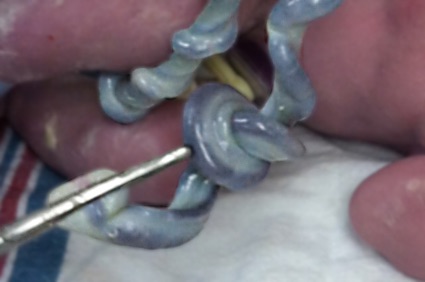
This picture of a true knot (a close up of the picture at the top) was sent to me by a reader. It was noted at her 3rd C-section. It is easy to understand that had the knot been pulled tighter, the baby might have died..

If an air line got wrapped loosely around a diver’s neck, the oxygen would keep flowing through it. However if the loop or loops were so tight as to cut off flow within the line, the diver will die. Of course a diver could actually be strangled by a loop or loops of cord, but a baby cannot. Therefore, the issue with a nuchal cord is NOT the fact that it is wrapped around the neck. The issue is whether the loop is pulled tight enough to cut off the flow of blood and therefore of oxygen.

The bottom line is that true knots of cord are not necessarily dangerous, but there is no way to no beforehand whether the knot will tighten during the course of labor and cut off oxygen to the baby. Similarly, a nuchal cord is not necessarily dangerous; in fact most nuchal cords are loose and therefore do not threaten the baby. Once again, though, there is no way to know beforehand how the loop or loops around the neck will be affected during labor. The higher the number of loops, the shorter the remaining cord, and the more likely that the cord will be fatally compressed during labor. However, even a single loop can be pulled tight during the descent of the baby and the baby will die for lack of oxygen.

Ultimately, when NCB and homebirth advocates “trust birth,” they are trusting that there are either no knots or loops in the cord, or that if they exist, they will not be pulled tight. But that makes no more sense than a deep sea diver trusting that he can assume that there are no knots in his air line and not worry if the air line gets wrapped around his neck. Obviously, in the case of the air line, trust has nothing to do with it, and, in direct contrast to what NCB and homebirth advocates proclaim, in the case of the umbilical cord, trust has nothing to do with the presence or absence of knots and loops.

The only way to know if a knot or nuchal cord is hindering the flow of the blood to the baby is to monitor the baby’s heart rate. Without monitoring, the supply of oxygen to the baby could completely stop during labor and no one would know until the baby was born dead.


This piece first appeared in February 2012.

Marginalizing women by diverting them into the vagina wars

image

When you think about it, it’s a stroke of genius.

If you were a misogynist who felt threatened by competition from women in business, science and politics, what better way is there to marginalize women once again than to divert them into competing over who has the better vagina and breasts?

That was the conscious plan of the founders of the natural childbirth, lactivism and attachment parenting movements. The movements were explicitly created to convince women to withdraw from competition with men and re-immure themselves in the home. Grantly Dick-Read, fabricated the racist lie that “primitive” (read black) women had painless childbirth and that white women of the “better classes” who wanted to have painless childbirth, too, simply had to withdraw from competing with men to compete with other women over who had the more “authentic” birth.

[pullquote align=”right” color=”#A5194C”]Convincing women to fight over who has the better vagina and breasts diverts them from taking their rightful place in wider world.[/pullquote]

That was the conscious plan of the founders of the La Leche League, 7 devout Catholic women, who saw the promotion of breastfeeding as a way to keep mothers of young children out of the workforce and send them back home where they belonged.

Dr. William Sears, the popularizer of attachment parenting, is a religious fundamentalist who promulgated a philosophy that fetishizes physical proximity of mother and child (“baby wearing”) effectively forcing women back into the home.

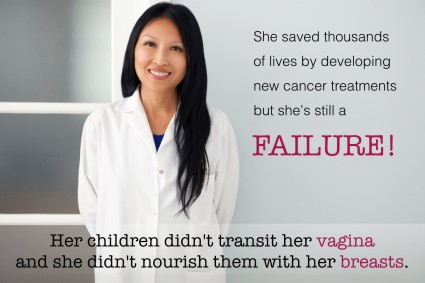
As a result we have women claiming to be “empowered” by unmedicated vaginal birth when the reality is that designating one form of birth as better than another is just a way to instigate a sophisticated version of a cat fight. We have women feeling that they have “failed” because their babies were born by C-section, when the only failure is the willingness of women to judge each other by whether a baby transited her vagina.

As a result we have a public health campaign grossly exaggerating the benefits of breastfeeding in order to moralize infant feeding, implying that some mothers are superior to other mothers because of the way they wield their breasts. The truth is that we have never detected any population wide benefits to breastfeeding term infants beside a few less colds and episodes or diarrheal illness over the first year. The aggressive promotion of breastfeeding is a masterstroke in marginalizing women, because the hours devoted to breastfeeding, or attempting to breastfeed or feeling guilty for not breastfeeding are hours that hamper the quest for equality in the workplace.

As a result we have a dominant parenting philosophy, attachment parenting, revealingly known as “intensive mothering,” that keeps women bound to their children 24/7/365 and therefore out of the workforce, the political arena and the wider world.

On the surface, it seems rather surprising that natural childbirth, lactivism and attachment parenting, explicitly created to force women back into the home, have gained traction among so many women, even women who call themselves feminists. It happened because the sexists who created these movements were aided and abetted by women who were able to monetize these movements. And the women who turned these movements into profit for themselves promoted the movements as feminist merely because all the workers are women.

Midwives have always existed, but had been overshadowed by modern obstetrics, which succeeded in saving so many lives where midwifery had failed conspicuously. The philosophy of natural childbirth came to the rescue of midwifery just when it was needed most. Natural childbirth allowed midwives to turn necessity into virtue. Their inability to use life saving and pain relieving technologies were transmuted from a rather obvious disadvantage to an asset by demonizing the technology itself.

Midwives, at least, are highly educated, but the natural childbirth industry has spawned a variety of childbirth paraprofessionals – doulas, childbirth educators, and lay birth attendants — who profit by promoting the virtues of unmedicated vaginal birth. Many of these paraprofessionals lack college degrees or even high school degrees. Their employment prospects are therefore rather bleak. Where else but in the natural childbirth industry can a woman who might not have the skills to work at Target become a private contractor charging hundreds of dollars per hour for her services?

Actually, there is one other place: the lactation industry. The lactation industry is the creation of La Leche League. In its early days, LLL leveraged the experience of mothers who had successfully breastfed to provide free advice for women who wanted to learn how to breastfeed. It didn’t take long for LLL to realize that there was no reason to give away knowledge for free when they could profit from it instead. LLL elevated the volunteer LLL leader to the lactation consultant who gave the exact same information but now charged for it. LLL leaders were not the only ones who profited. The organization itself, by charging for the certification and the courses designed to obtained it created a new profit center.

The race was on to increase profits by subverting science, claiming that unmedicated vaginal birth is superior (it’s not) and that breastfeeding provides immense health benefits (it does not). Curiously, though both unmedicated vaginal birth and exclusive breastfeeding are venerated as natural, both now require a legion of paraprofessionals, a stash of books and products, and large wads of cash in order to accomplish successfully. The central driver for both industries is vicious competition among women over who has better deployed her vagina and breasts.

And that explains in large part why my writing is deplored both by members of the natural childbirth and lactivism industries (I threaten their profits) and by natural childbirth and breastfeeding advocates (I threaten the sense of superiority that the industries have striven to promote). The result is the ultimate irony: philosophical movements created to marginalize women are aggressively promoted by women who profit from marginalizing other women.

The natural childbirth, lactivism and attachment parenting industries portray birth and infant feeding as feminist issues. It is a brilliant marketing tactic. By convincing women to fight with each other over who has the better vagina and breasts, they divert women from taking their rightful place in wider world.

Really, TNR? Is this hatchet job on electronic fetal monitoring what passes for journalism these days?

image

Apparently the author started with the conclusions, spoke only to those who would support that conclusion, and failed to consult even a single expert on the topic to produce a hatchet job on electronic fetal monitoring (EFM).

Noah Berlatsky wrote The Most Common Childbirth Practice in America Is Unnecessary and Dangerous for The New Republic (TNR).

…[W]hy despite decades of overwhelming evidence, do doctors and patient alike continue to insist on this largely useless and sometimes dangerous procedure?

The obvious answer is that the author doesn’t understand the issue. What’s more likely, that obstetricians are engaged in a world-wide plot to harm mothers and babies, or that Noah Berlatsky, a journalist with no medical training, doesn’t understand the state of the evidence?

[pullquote align=”right” color=””]An author writes a piece decrying obstetric technology without ever consulting an obstetrician and editors think that is acceptable?[/pullquote]

You might think, therefore, that the editors at TNR would have considered that Berlatsky didn’t understand what he was talking about, and insisted on consultation with and quotes from experts in the issue, obstetricians. You would be wrong. It was awesome click-bait, one sided and shocking. They published it, and when the deficiencies of the piece were pointed out to Berlatsky, he resorted to name calling, deleting and blocking.

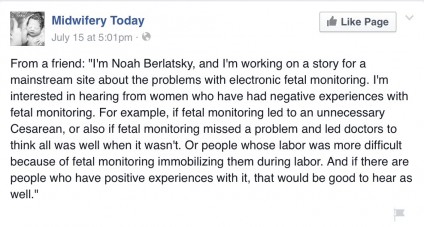
The piece reads as if Berlatsky consulted only the natural childbirth industry who profit by demonizing modern obstetrics. And, indeed, that is precisely what he did. He quoted midwives and an executive from the Childbirth Connection, the largest natural childbirth lobbying organization. Then he reached out to lay midwives searching for EFM bad outcomes with which to frame his piece.

image

…I’m interested in hearing from women who have had negative experiences with fetal monitoring. For example, if monitoring led to an unnecessary Cesarean, or also if fetal monitoring missed a problem and led doctors to think all was well when it wasn’t…

There is so much wrong with the piece that I can’t recount it all. The single biggest problem with it is that the issue of EFM is complicated, nuanced and poses difficult choices. To understand that issue, you need to understand what EFM is and why it was created.

Childbirth is inherently dangerous. The day of birth is the single most dangerous day of the 18 years of childhood. Every newborn death is a dreadful tragedy, but the cruelest form of newborn death may be stillbirth during childbirth. A woman labors in agony for hours, pushes with all her strength to expel the baby and finally the baby is born … dead. During labor, the baby was deprived of oxygen (fetal distress) and died. If the baby had been delivered by C-section, it almost certainly would have survived.

Before C-sections became very safe, the issue was moot. There was no point in monitoring the baby during labor if you couldn’t do anything to save the baby. The advent of safe C-sections gave impetus to efforts to diagnose fetal distress and deliver babies before they could be harmed or killed.

Unfortunately, unborn babies are inaccessible. You can’t measure their oxygen levels, or their blood pressure, or examine them. The only thing you can measure is their heart rate. Determining health from heart rate is exceedingly difficult and imprecise. You have to listen at the right times and for long enough to detect harmful changes; electronic fetal monitoring was designed to monitor the fetal heart rate for long periods and to create a written record.

Fetal monitoring, first using handheld listening devices and later using EFM, essentially eliminated stillbirth in labor. This success in nearly eliminating stillbirth in labor encouraged obsetricians to believe that they could eliminate cerebral palsy if they monitored more, longer and with more sophisticated techniques. It wasn’t until EFM was in widespread use that we came to understand that while oxygen deprivation causes cerebral palsy, oxygen deprivation is not the only thing that can cause cerebral palsy.

So where are we know?

1. Fetal monitoring, using listening devices or EFM, has been spectacularly successful in preventing stillbirth during labor.

2. EFM has very high sensitivity. If a baby is experiencing oxygen deprivation, EFM will alert providers.

3. We have come to understand the EFM has low specificity. That means that it can signal fetal distress when no distress is present, leading to unnecessary C-sections.

4. EFM provides proven benefits in high risk pregnancies. That’s not surprising since EFM is a screening test and all screening tests are more accurate in high risk populations than in low risk populations.

5. EFM can probably prevent some forms of cerebral palsy, but many probably occur before the onset of labor and EFM can’t prevent those cases.

6. In low risk populations, EFM probably provides no advantage above listening to the fetal heart rate following a strict pattern of frequent listening, which essentially requires one on one nursing in labor and delivery suites. This is a critical point: Even in low risk populations EFM is not useless, it’s just no better than listening to the heart rate according to a strict schedule. And in high risk populations, EFM has been repeately shown to improve outcomes.

7. There is no evidence that EFM is dangerous. To be dangerous, EFM would have to lead to poorer outcomes and it does NOT lead to poorer outcomes. Why then do natural childbirth advocates demonize EFM? The reason is not outcome, but process. Natural childbirth advocates are obsessed with process and take a good outcome for granted. Doctors are more concerned with outcome than process, and eons of human history have shown that a good outcome can never be taken for granted.

8. Oxygen deprivation in labor is still a serious problem requiring our best efforts to prevent it. Is EFM the best possible tool to prevent oxygen deprivation? It’s not the best, but at the moment, it’s one of the few things we have.

Berlatsky and his those he chose to quote are anxious to demonize EFM, but they don’t appear to be the least bit concerned about how to prevent brain damage and infant death. They don’t offer other better methods to protect babies; it appears to never enter their minds that there is anything that can or should be done to protect babies.

And that’s the critical difference between natural childbirth advocates like Berlatsky and the people he quotes and obstetricians. They’re willing to settle for things the way they are now; that’s good enough for them. Obstetricians are NOT willing to settle. They want every baby they deliver to be healthy; they want every mother they deliver to be healthy. They will continue working toward that end.

In the meantime, people like Berlatsky, who doesn’t understand the underlying issues, will continue writing crappy pieces that demonize technology; and continue to pretend that obstetrics ought to be like horse-shoes and hand grenades: close enough is good enough. Berlatsky is entitled to his uninformed opinion; but there was no reason for TNR to publish such a misleading, unbalanced, biased piece.

An author writes a piece decrying obstetric technology without ever consulting an obstetrician and editors think that is acceptable? If so, journalism has reached a sorry state.

How do breastfeeding stunts normalize breastfeeding? They don’t!

image

Imagine if former chief executive Carly Fiorina had addressed HP stockholders while wearing a filmy negligee. Would that normalize women chief executives? No.

How about if Serena Williams took the court at Wimbledon topless? Would that normalize women in sports? I doubt it.

What if Hillary Clinton chose to campaign in a bra and G-string? Would that normalize women Presidents? Of course not.

[pullquote align=”right” color=””]What if Hillary Clinton chose to campaign in a bra and G-string? Would that normalize women Presidents?[/pullquote]

Each of these stunts would do the opposite. Instead of promoting an image of strength and capability, they’d promote the sexist image of women as flighty and irresponsible.

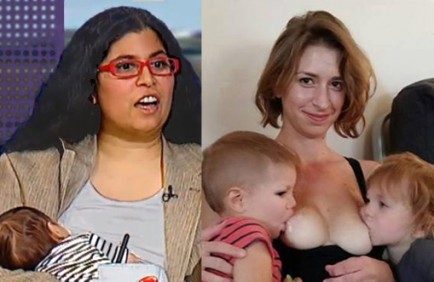
So how do breastfeeding stunts like Dil Wickremasinghe breastfeeding her son while being interviewed on live TV and Jessica Colletti breastfeeding her toddler and his friend normalize breastfeeding? They don’t. Instead of promoting an image of breastfeeding as an excellent way to nourish a child, perfectly compatible with running corporations, competing in elite athletic events, or becoming President, they promote an image of breastfeeding as a stunt designed to offend as many people as possible.

Don’t tell me that breastfeeding is beautiful and deserves to be visible in public. Sex is beautiful but that doesn’t mean that women (or men) should be having sex during business conferences. Don’t tell me that the female body is beautiful. That doesn’t mean that women should show up for athletic events with menstrual blood running down their legs. Don’t tell me that nature is beautiful. That doesn’t mean that we want to see our politicians urinate on TV.

The photos above have nothing to do with normalizing breastfeeding and everything to do with normalizing exhibitionism.

It’s harder than ever to get the public’s attention by shocking it. Homebirth advocates will tell you that tweeting your homebirth, live-blogging it or even live streaming video of the birth is so 2014. To get attention now you have to perform a birth stunt, like giving birth outdoors in a Alaska in a blizzard, or in an Amazonian stream filled with microscopic parasites.

So it stands to reason that if you want to get attention for breastfeeding, you have to do in someplace unusual or with children other than your own. Breastfeeding while ostensibly performing your job on live TV qualifies as unusual. Breastfeeding a child for whom you provide daycare is unusual. Unusual is what it’s all about when you are a narcissist promoting yourself and your baby (or someone else’s baby) is merely a prop for your exhibitionism.

Wickremasinghe claims to be normalizing breastfeeding for working women, but she’s doing exactly the opposite. Her smug exhibitionism in the face of her co-worker’s obvious discomfort is a betrayal of legions of women (including myself) who have fought for the space, time and right to pump while at high pressure, high profile jobs like medicine, law and business. We’ve spent decades showing that breastfeeding is completely compatible with a career and does not mean flaunting our breasts in the workplace or embarrassing our professional colleagues.

How does Wickremasinghe’s behavior, the behavior of a privileged media celebrity, help her less fortunate sisters who only wish to be able to combine breastfeeding with a blue collar, secretarial or service industry job? It doesn’t. Indeed it harms their chances of convincing employers that breastfeeding and working are fully compatible. It’s hard to imagine a gesture more contemptuous of the “little people” and their real world breastfeeding difficulties than a celebrity pretending to normalize breastfeeding by exploiting her celebrity status on air.

Colletti claims to be normalizing breastfeeding, but she’s doing exactly the opposite. Her smug exhibitionism in the face of at least one of the toddlers looking anything but happy at being used as a prop is a betrayal of the legions of women who have fought for the right for women to breastfeed discreetly anytime and anyplace where our babies are hungry. We’ve spent decades showing that breastfeeding is about nourishing our babies, not flaunting our breasts in public or using public breastfeeding to produce shock and distaste.

How does Colletti’s behavior help normalize breastfeeding, public or otherwise. It doesn’t. It makes breastfeeding look like the choice of crazy, breast-baring self-promoters, not loving mothers who merely want to nourish their babies in the way they think is best anytime or anyplace where those babies need to eat. It’s hard to imagine a gesture more contemptuous to women who struggle for the right to breastfeed discreetly in public than an exhibitionist pretending to normalize breastfeeding by posting pictures of herself breastfeeding another woman’s child.

Breastfeeding stunts don’t normalize breastfeeding; they normalize exhibitionism. But then that was the point all along.

How mothers became rivals and what we can do about it

Two girls looking each other angry

For the longest time, I was one of the few bloggers writing about the perverse and inappropriate pressures of natural parenting. But as the response to World Breastfeeding Week indicates, the tide is finally turning.

In the last few months, we’ve seen:

Of course there’s still plenty of trash like this from Elizabeth Grattan writing about opposition to World Breastfeeding Week:

[pullquote align=”right” color=””]”Big Mama” has created and promoted rivalry as their premier marketing technique, and it’s working![/pullquote]

And every single time you hijack this cause to remind the world that you made a different choice, you HURT so many families who are not out to get you.

Don’t you care about that? Because I do…

I care that someone wants to pit mom against mom.

So fuck them.

And since you are doing it too, fuck you…

I am DAMN PROUD that I breastfeed. I have every reason in the world to be…

So, yeah then, fuck you…

Fuck you for feeling the need to boast this week online that you didn’t breastfeed and your kids are just fine. Fuck you for saying you support nursing “except”, “unless”, or “if” one more time…

Fuck you.

Grattan is furious we won’t let her use breastfeeding to bolster her fragile self-esteem as a better mommy than you.

Then there’s this, We Are Not Rivals, by Claire Kirby:

There is no wrong way. There is just your way. Sometimes it’s a choice, sometimes it’s a circumstance. We all parent differently. But we are all the same in that we are doing our best.

We all agonise over the decisions we make. We all feel the guilt that comes with being a parent. We all occasionally wish we could leave the house with a smaller bag. We all love our children with a passion we didn’t know we were capable of. We all cry on their first day of school.

We are not rivals. We are mothers.

It’s an eloquent plea to stop tearing each other apart over our mothering decisions, but sadly it does not reflect reality.

We are rivals because some people WANT us to be rivals, and they are using every method at their disposal, hijacking hospitals, exaggerating public health messages and subverting science to MAKE us rivals.

Who are they? The childbirth and breastfeeding industries, of course. The mothering counterpart to Big Pharma: “Big Mama.”

Don’t think they’re industries? That’s because we associate industry with large corporations. The truth is that midwives are an industry, doulas are an industry, childbirth educators are an industry, lactation consultants are an industry and lactation credentialing organizations are an industry. Like all industries they have trade unions, public relations personnel and lobbyists. True, they don’t make billions of dollars, but as industries they make tens or even hundreds of millions of dollars, and for many, 100% of their income comes from convincing mothers that we ARE rivals … for the title of best mother.

They have labored to imbue every mothering decision with incredible importance. They’ve subverted science to pretend that unmedicated vaginal birth is “better” for babies and to pretend that “breast is best.” They’ve hijacked hospitals to promote the only form of birth they can profit from, natural childbirth. They’ve hijacked hospitals to promote the only form of infant feeding they can profit from, breastfeeding. Like Big Pharma, “Big Mama” grossly exaggerates the health benefits of the products they promote and grossly minimizes the dangers of those same products.

They’ve created a Mothering Mystique every bit as soul crushing as the Feminine Mystique so eloquently described by Betty Friedan.

Wikipedia has an excellent synopsis of The Feminine Mystique and several chapters have particular relevance to the creation of mothering rivalry:

Friedan shows that advertisers tried to encourage housewives to think of themselves as professionals who needed many specialized products in order to do their jobs, while discouraging housewives from having actual careers, since that would mean they would not spend as much time and effort on housework and therefore would not buy as many household products, cutting into advertisers’ profits.

Friedan interviews several full-time housewives, finding that although they are not fulfilled by their housework, they are all extremely busy with it. She postulates that these women unconsciously stretch their home duties to fill the time available, because the feminine mystique has taught women that this is their role, and if they ever complete their tasks they will become unneeded.

“Big Mama,” the childbirth and lactation industries, encourages mothers to think of themselves as needing many specialized services and products in order to be “good” mothers, while discouraging them from having actual careers, which would interfere with their ability to consume the services and goods offered by the industry. Hence the need for books, experts for hire, and continuous physical proximity to infants and small children.

The childbirth and lactation industries insist on practices that fill 24 hours in each and every day, from extended breastfeeding, to constantly carrying young children, to letting them sleep in the parental bed on a regular basis. “Big Mama” insists that this is women’s role and if they ever complete these tasks, which used to be confined to infancy, they will become unneeded.

The childbirth and lactation industries strengthen the perceived need for their services and products by proclaiming that mothers who use their services and products are better than other mothers. “Big Mama” has created and promoted rivalry as their premier marketing technique … and it’s working!

One of the central conceits of the childbirth and lactation industries is that its goods and services help women recapitulate mothering in nature, mimicking child rearing among indigenous peoples. Nothing could be further from the truth.

In indigenous societies, “it takes a village to raise a child.” Mothers are not meant to be rivals.

It takes a village of women of all ages, mothers, grandmothers, sisters and aunties, to raise a child. In contemporary parenting, it takes a single mother, battling for supremacy in the mommy wars, buying the products and services of the childbirth and lactation industries, to raise a child.

We can reject the trap that these industries have set for us.

We can reject the divisive tactics of “Big Mama.”

We can end the rivalry that the childbirth and lactation industries encourage.

It’s time for mothers to return to supporting each other.

That’s better for our babies and better for us!

The mothering quest and the construction of the maternal hero

Pregnant Woman Mother Character Super Hero Red Cape Chest Crest

You cannot understand the discourse around contemporary parenting in the US without understanding this central reality:

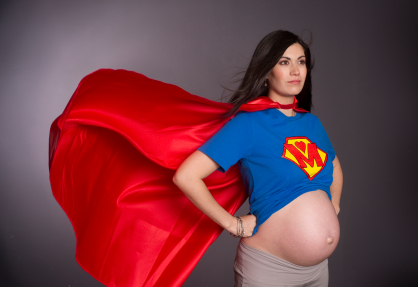
Every woman is the hero of her own mothering story.

That’s the essence of the mommy-wars. It has nothing to do with children, although children are ostensibly the focus; it has nothing to do with science, although science is often subverted for the purpose; it has everything to do with women and how they wish to see themselves, especially in comparison with other women.

The response to my piece in TIME about shaming of formula feeding mothers was notable for a total lack of regret that formula feeding mothers are feeling shamed by efforts to promote breastfeeding. Not a single person writing about the piece was moved to ask how lactivists might craft a message that promotes breastfeeding without shaming women who can’t or don’t wish to breastfeed. That’s hardly surprising, though, if you understand that one of the central motivations of lactivism in the US is to construct the breastfeeding mother as a hero flaunting her superiority in front of other, lesser mothers.

The mother as quest hero is at the heart of nearly all parenting movements based in part, or in whole, on pseudoscience.

[pullquote align=”right” color=”#005fb9″]The mommy wars are fights to the emotional death so that some mothers can claim heroic status while grinding other mothers into the dust.[/pullquote]

Consider this description of a heroic quest:

  • The call to adventure: The hero is “called” by [her]self or others to complete a task that will take [her] away from [her] regular “role” in [her] own society.
  • The entry into the unknown: As a result of the call, the hero must leave the safety of [her] own known community and venture into a world of unknown dangers.
  • Facing tests and trials: The hero faces a number of challenges on [her] journey… Heroes are often tempted to give up or give in.
  • Sages: All heroes have guides to receive unexpected help on their journey…
  • A supreme ordeal: This is the MOST difficult challenge or obstacle that the hero faces. Completing and overcoming this “trial” marks the end of the “testing” stage where the hero had to prove [her] worth…
  • The return: The hero [her]self receives a reward of honour, acknowledgement, respect and perhaps love for [her] efforts…

Compare that to the classic “birth story” so beloved of birth bloggers and other natural childbirth advocates.

  • The mother is “called” to have an unmedicated vaginal birth and prepares by doing “her research.”
  • She leaves the safety and comforts of medicated hospital birth.
  • She faces tests and trials: refusal of standard preventive tests and interventions, arguments with relatives and friends about the wisdom of her choices, and the attitudes of hospital personnel who are nearly always constructed as unsupportive. She is tempted with offers of pain relief and C-section.
  • Her midwife and her doula are her sages who guide her on her quest.
  • The supreme ordeal is navigating labor (the longer and more excruciating the better; the best is to ignore calls that your child is at risk) and “achieving” an unmedicated vaginal birth (preferably with minimal or no vaginal tearing).
  • The hero receives honor, acknowledgment and respect for her achievement. Most importantly, she emerges “empowered.”

In other words, the mother is always the hero of her children’s birth stories, and by her heroism, she conveys her superiority over other mothers. Her heroic status rests on rather tenuous scientific grounds. In order for a mother to be a hero for having unmedicated vaginal birth, unmedicated vaginal birth must be vastly superior to the way most women give birth. It isn’t superior at all, so birth activists and birth industries (midwifery, doula care) must subvert science to pretend that it is.

The heroic mother myth is at the heart of contemporary lactivism, where the lactating mother faces pain, inadequate milk supply, and inconvenience, braves the temptation of formula feeding, is guided by a lactation consultant and achieves the quest of not a single drop of formula ever crossing her child’s lips. In order for a mother to be a hero for breastfeeding her child exclusively for months or even a year, breastmilk must be portrayed as vastly superior to infant formula. It isn’t vastly superior; in industrialized countries, the benefits are trivial, but lactivists subvert the scientific evidence to pretend that breastfeeding provides tremendous, lifelong benefits.

Even anti-vaccination advocacy depends on the quest trope. The mother goes on a journey of discovery by reading anti-vax screeds and websites, faces the pressures of relatives, friends and medical professionals, triumphantly refuses to vaccinate, and receives honor and acknowledgement in the anti-vax community for her heroism.

If the heroic mother fantasy affected only those who sought to make themselves mothering heroes, there would be no problem. Unfortunately, portraying themselves as mothering heroes comes at the expense of two vulnerable groups. The first, and by far the most important, are the children themselves. Unfortunately, they serve as little more than props in the quest story. They exist to be acted upon and their actual well being is irrelevant. Hence a natural childbirth aficionado will risk her child’s health and sometimes even her child’s life to complete her heroic quest. Lactivists will let babies cry desperately in hunger and even let them starve, sometimes nearly to death, in order to complete her lactation quest. Anti-vax parents live in a dream world unmoored from reality where the scientifically illiterate are heroically “knowledgeable.”

The other group affected by the fantasy of the heroic mothering quest is the women who don’t view mothering as a quest. They can and should ignore the women who are desperate to cast mothering as a quest and themselves as heroes, but that’s harder than you might think. Why? Because the quest mothers, in an effort to demonstrate their own superiority, have hijacked public health messages, particularly in the area of breastfeeding. The heroic quest appears to require shaming women who refuse to consider motherhood a quest. That’s why no one promoting World Breastfeeding Week thought to ask how the message of support for breastfeeding might be modified to minimize shaming of other mothers. They WANT other mothers to be ashamed; they’re HAPPY they are ashamed; the last thing they want to do is to mitigate that shame. If mothers who formula feed aren’t failures at the quest, how can the mothers who breastfeed be heroes?

Don’t be fooled. The mommy wars over childbirth, breastfeeding and even vaccination have NOTHING to do with children. The portrayal of mothering as a quest has NOTHING to do with actually mothering children. The desperate desire to create mommy heroes and mommy losers has NOTHING to do with science. The mommy wars are fights to the emotional death so that some mothers can claim heroic status while grinding other mothers into the dust. It’s ugly; it’s wrong; and the rest of us should refuse to countenance it.

Have lactivists lost their minds?

iStock_000036642046_Small

I wasn’t planning to write about breastfeeding today. I thought I had temporarily exhausted the topic.

Then I saw this:

The Australian Breastfeeding Association is warning that new mums are giving up breastfeeding so they can drink alcohol … with disappointing outcomes for their bubs…

New mothers are being warned that feeding their ­babies formula is worse than breastfeeding after a few drinks.

Have these people lost their minds?

[pullquote align=”right” color=”#b700d9″]Formula is worse than alcohol in breastmilk? Really? Really??!![/pullquote]

The advice from the Australian Breastfeeding Association (ABA) comes as new research shows an increasing number of women turning to bottle feeding within weeks of giving birth, in some cases because they wish to recommence consuming alcohol.

The ABA’s website states two alcoholic drinks a day is safe while breastfeeding…

“I am not advocating for women to drink alcohol and certainly not in the first four weeks but they need to know they don’t need to give up on breastfeeding if they want to have a couple of drinks and are scared of the impact on the baby,” ABA Queensland spokeswoman Naomi Millgate said…

Gold Coast midwife Amanda Bude believes that while ­socialising is not the main reason women give up on breastfeeding, she sees women who simply get fed up “being good”, especially after abstaining from ­alcohol throughout pregnancy.

Lead author of the research, Jennifer Ayton, a PhD student and registered midwife, said she was shocked by the dropout rate.

“What is needed now is a re-education of new mothers and a rethink on how best to support the family so that exclusive breastfeeding can continue,” she said.

No, what is needed now is for lactivists to get a grip on reality.

Formula is worse than alcohol in breastmilk? Really? Really??!!

What research supports this astonishing claim? No research at all!

  • Has anyone ever compared the impact on the infant brain of alcohol vs. formula? NO.
  • Has anyone ever compared the impact on the infant microbiome of alcohol vs. formula? NO.
  • Has anyone ever compared the impact on the infant ANYTHING of alcohol vs. formula. NO.

They just made it up, because they will say and do anything to have their own feeding choices mirrored back to them.

I have been shocked by the lactivist response to my TIME piece that made what I consider a rather innocuous and obvious claim about formula feeding. Formula is nutritious and healthy and no one should feel guilty for using it. Two entire generations of Americans were raised nearly exclusively on infant formula and it made no difference in infant mortality, life expectancy or population IQ.

Breastfeeding advocates have gone ballistic. How dare I tell women the truth??

The benefits of breastfeeding in industrialized countries are trivial. That’s what population data shows. I challenge any breastfeeding advocate to present population data that shows otherwise.

I suspect that the ferocious response of lactivists is due in part to the fact that they can’t use their tried and true tactic of shaming on me. I breastfed four children until they weaned themselves.

Of course, that hasn’t stopped people from trying. “Nursaholic” (how apt) who offers advice for the “lactation lush” writes regarding my breastfeeding experience:

Keeping in mind that some people round up (a lot), we know that breastfeeding multiple children for a few months each is not the same level of experience as breastfeeding multiple children for, say, a few years each…

…[S]uch a claim needs honest clarification before it can be used as evidence of credible “expertise” in this area.

Regarding my commitment to supporting all mothers, she writes:

It’s also hard to ignore the fact that some medical practitioners receive monetary kickbacks for promoting formula…

What evidence does she provide for her insinuations? None, of course.

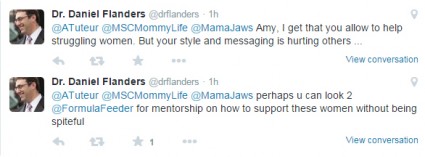
More disturbing to me is the ongoing Tweets between Canadian pediatrician Dr. Daniel Flanders and myself, who claims my writing is inflammatory and divisive.

Inflammatory about what Dr. Flanders? Divisive toward whom? I’ve asked him, but he won’t say.

And the inevitable culmination with the classic sexist exhortation to be “nice” like other women:

Flanders tweet3

No doubt the Fearless Formula Feeder is a MUCH nicer person than me.

But you know what Dr. Flanders? It’s 2015 and professional women don’t have to be “nice” to get their message across.

I wrote a piece about being nice to formula feeders and get accused of not being nice.

Oh, the irony!

Dr. Newman, what will it take for you to understand the suffering of mothers pressured to breastfeed?

Time To Listen

“Listen to your patient, [s]he is telling you the diagnosis.”

Those are the words of William Osler often called the Father of Modern Medicine for his contributions to the development of medical education. I first heard them from the chief of surgery at the beginning of my internship. It is almost always true, the patient is almost always telling you the diagnosis, but listening is harder than you might think. It is especially difficult to hear what patients have to say when those words are not complimentary. One of the failings of the medical professional is that some doctors peremptorily dismiss anything that makes them feel bad about themselves.

Prominent breastfeeding proponent Dr. Jack Newman illustrates that shortcoming in attempting to peremptorily dismiss the piece I wrote for TIME, Why I’m Not Celebrating World Breastfeeding Week. In the piece, I’m serving as a conduit for the anguish that floods my email inbox. So many women are tormenting themselves over “failure” to breastfeed when the benefits of breastfeeding in industrialized countries are trivial.

[pullquote align=”right” color=”#0166be”]When a patient tells you she has crushing feelings of failure and inferiority because of pressure to breastfeed, it is arrogant to tell her that she doesn’t and she would realize that if she had better information.[/pullquote]

Unfortunately, as his response makes clear, Dr. Newman is not listening.

Dr. Newman starts by being fundamentally disrespectful to a colleague … me. His refusal to follow netiquette and link to my piece, his refusal to acknowledge my name, my professional qualifications, and my goal of easing suffering when writing about breastfeeding all speak to fear. What is that fear? It’s the fear that women will find that there IS someone who recognizes the pernicious nature of breastfeeding advocacy; that there IS someone who understands that the “Baby Friendly” Hospital Initiative is a deliberate slap in the face to many devoted mothers; that there IS someone who cares about mothers’ feelings and mental health; that there IS someone who recognizes the cruelty of letting hungry babies cry it out in an effort to “promote” exclusive breastfeeding. Simply put, I have been listening to what women tell me, not ignoring them. If I were Dr. Newman, I’d be afraid of me, too.

But Dr. Newman’s response isn’t inadequate merely because he fails to listen to women.

Dr. Newman acknowledges that, as I wrote, the evidence for the ‘benefits of breastfeeding’ are not well documented and that the studies are flawed, but then insists:

Since when do we need to prove that the normal, physiological method of feeding infants and young children is better than the artificial method, the feeding used made in a factory?

Since always, Dr. Newman. That’s the essence of science. We start any investigation with the null hypothesis (the claim that there is no difference between the two things we are testing) and then we try to disprove it.

Dr. Newman’s statement is actually a two-fer. Not only does it violate a major principle of scientific investigation, but it is also an excellent example of a logical fallacy — the naturalistic fallacy. The naturalistic fallacy is the unwarranted and illogical belief that anything that is natural is better. Hurricanes, earthquakes, and asteroids hitting the earth are natural, but that doesn’t make them good. Heroin, cocaine and tobacco are natural, but that doesn’t make them healthy. Babies starving to death due to inadequate breastmilk is natural, but hardly desirable. Women suffering postpartum depression is natural, but that doesn’t mean we want to exacerbate it.

When presented with information that breastfeeding promotion is causing women (and babies) to suffer, Newman doubles down:

The author bemoans the fact that so many mothers contact her with horror stories about their breastfeeding experiences. I too am upset about all the mothers having terrible experiences. The author blames breastfeeding for these problems, but the truth is that it is not breastfeeding that is the problem. It’s the lack of information, the lack of support from society in general and from health professionals more specifically that is the problem.

You’re not listening, Dr. Newman!

Patients are saying that the flood of information and the way it is presented has made them feel awful. It is the height of medical arrogance to tell a patient that what is hurting her is not really hurting her. If a patient tells you that she has crushing chest pain, you don’t tell her that she doesn’t and she would realize that if she had better information. It is exactly the same with mental anguish, Dr. Newman. When a patient tells you she has crushing feelings of failure and inferiority because of pressure to breastfeed, it is arrogant to tell her that she doesn’t and she would realize that if she had better information.

Newman digs himself in deeper:

There is no question that, with many exceptions of course, most health professionals, including obstetricians and pediatricians, don’t know the first thing about “practical” breastfeeding.

Earth to Dr. Newman! In 2015 the majority of obstetricians and pediatrician are WOMEN, and they know a great deal about practical breastfeeding because WE HAVE DONE IT … unlike you, I might add.

Referring to problems with breastfeeding, Newman claims:

I will state emphatically, these problems could have been prevented had the mothers received good help at the beginning.

You’re not listening, Dr. Newman! Women ARE TELLING YOU that they don’t want your help, they don’t want your pressure, and they certainly don’t want you to tell them that more “help” and more pressure will make them feel better.

Dr. Newman concludes:

The author also suggests that we “push” breastfeeding on mothers. What world does she live in? Formula is being pushed on mothers from day 1 of their pregnancies by formula company marketing, free samples from doctors and in hospital and in the mail. Bottle feeding images everywhere. Breastfeeding should at least have equal time, but it doesn’t.

I’m living in the real world in 2015, Dr. Newman; you appear to be mired in the 1950’s. Breastfeeding initiation rates are above 75%. That’s the MAJORITY, Dr. Newman. Breastfeeding images are everywhere, in blogs, on Facebook, in mainstream media. Breastfeeding women are everywhere, in restaurants, in workplaces, any place where women congregate. Sure, some people don’t like the public visibility of breastfeeding, but that just proves the point that it’s everywhere. It’s difficult to take lactivists seriously when they make claims that are so obviously untrue.

It’s time to listen to mothers, Dr. Newman. Your arrogance is in believing that you, the doctor, know better than they what they are feeling and experiencing. That’s paternalism and it’s ugly.

This is what not enough breastmilk looks like

breastfeeding starving 3

The image is horrifying. The story behind it is possibly even more horrifying.

It is featured in a BabyCenter blog entitled Giving thanks for formula during World Breastfeeding Week. Midwife and photographer Marry Fermont took the photo during an internship in Cambodia.

Fermont explains:

One day I saw a woman with two little babies who were both really upset, but one baby was much larger than the other baby. I didn’t understand how this was possible, because there didn’t seem to be 9 months between them, but neither did they look like twins.

[pullquote align=”right” color=”#7adfda”]Because the mother did not have enough milk, she only fed the boy.[/pullquote]

Fermont’s interpreter spoke with the mother:

…[W]e learned that it indeed was a twin. A boy and a girl, but because the mother did not have enough milk, she only fed the boy.

The mother was able to support twins inside her body, but not outside. In truth, both babies were starving.

“I could not bear to see the children so upset and begged the woman to latch them,” Marry went on to say while sharing her recollection of the emotional meeting. “Soon I realized, even though I had no experience with breastfeeding or babies, that they were not calming down, there was just no milk. The mother gave me the little girl to hold and all I wanted in that moment was that my breasts could give milk, right here and right now…”

The photo demonstrates that the claim that every mother produces enough milk is a cruel lie.

Yes, these were twins, and yes, the mother might have been able to support one baby, but not necessarily. We know that 5% of women simply don’t make enough breastmilk to support the normal growth of a baby. The photo indicates that this mother probably did not suffer from insufficient glandular tissue of the breasts. And the classic canard that mothers who choose not to breastfeed are just lazy certainly does not apply. She simply couldn’t make enough milk to naturally nourish the children she had naturally conceived and naturally nurtured inside her body during pregnancy.

It probably did not take this mother long to realize that she did not have enough milk for two babies, so she made a hideous choice. She chose to feed the more “valuable” child, the boy, and was letting the girl starve to death. She could not bring herself to do what other mothers throughout time have done in that situation, leave one baby exposed outside to die or be eaten by predators. It might have been better for the boy, if the mother had killed the girl outright since he hadn’t been getting enough milk either. Both babies suffered terribly and Fermont was deeply affected:

We went back to the city and bought loads of powdered milk and a week later we went back to take it to the mother. We were too late…not only the girl, but also the boy had also passed away…

Fermont reflects on how this has influenced her thinking about World Breastfeeding Week:

We live in a country where everything is available; we can provide what is needed for our children. We have the luxury of switching to powdered milk when breastfeeding is not possible, we have the luxury to choose powdered milk if we do not want to breastfeed and our child will grow up and will have all the chances in the world.

Yet it seems that we just make it hard for each other; guilt if you choose to bottle feed instead of the breastfeeding, guilt if breastfeeding does not work, discussions about feeding your child in public. Why can’t we support each other? We only want one thing: to raise our children.

She concludes:

I think it is important that mothers know all the possibilities and the benefits of breastfeeding. Not to condemn you if you make a different choice, not to make you feel bad if breastfeeding did not work out for you. Whatever you choose or have chosen, your child grew up with it, and that’s something we should be grateful about.

As I wrote yesterday, nourishing=flourishing, and isn’t that what we want for all children?

That means encouraging breastfeeding when it is possible AND working for both mother and baby. But it also means celebrating formula feeding if needed or preferred. To that end, we should devote our efforts to bring clean water to places where it isn’t currently available. Formula made with contaminated water can be deadly, but it’s the water that makes it deadly, not the formula. Formula producers ignored that brutal reality for years, and countless babies died because their mothers were convinced to abandon breastfeeding for formula. That is a scandal of massive proportions. Yet, it seems remarkably cruel to promote breastfeeding to avoid contaminated water only to let breastfed children die as preschoolers from the very same contaminated water.

Motherhood is powered by love, not by breastmilk. Honoring the fierce love between mothers and babies means honoring any feeding method that leads to a flourishing baby. Often times that’s breastfeeding, but often times that is formula.

World Breastfeeding Week is marred by a literally fatal flaw; some babies die if exclusively breastfed. Therefore we should not be celebrating a method of feeding; we should be celebrating healthy outcomes. If that’s what World Breastfeeding Week were about, there would be a lot less guilt and a lot more thriving babies and mothers.

Motherhood powered by love