All posts by Amy Tuteur, MD

Childbirth and the invisibility of women’s needs

image

I have often commented that the philosophy of natural mothering (natural childbirth, lactivism, attachment parenting) rests on fundamental assumptions that are often unrecognized and therefore unexamined. I’ve written about the social construction of risk within our culture and the social imperative that everyone (mothers and doctors) do everything possible to minimize risks to babies without ever considering the trade-offs that reducing specific risks imply.

But risk is not the only thing that is socially constructed within the philosophy of natural mothering. Women’s needs are also socially constructed; specifically, in the philosophy of natural mothering, women’s needs are rendered invisible. Natural childbirth advocacy and its approach to the issue of pain in labor is perhaps the paradigmatic example of the way in which natural mothering erases the needs of women.

Natural childbirth advocacy uses several different strategies to render women’s needs invisible. To understand how these strategies work it makes sense to start with the empirical facts that most of us agree upon:

1. Childbirth is excruciatingly painful. Indeed the pain of childbirth is so impressive that ancient cultures imagined that the only possible explanation was divine punishment of women for their transgressions.

2. Severe pain should be treated. No one would ever suggests that cancer pain be ignored or that pain from a broken bone should go untreated.

3. Medical professionals have an obligation to treat pain. Every human being is entitled to the medical treatment of pain if that’s what he or she desires.

Natural childbirth advocates employ a variety of strategies to render invisible women’s need for pain relief. The first strategy is to insist that a mother’s need for pain relief is insignificant when compared to the “risks” of epidurals. This strategy is all the more remarkable when one considers that the “risks” of epidurals are not empirical, but purely speculative. Presumably, the baby has a need and a right, to avoid any potentially harmful effects from epidurals that might be discovered as some unspecified future time. And that need (even though theoretical) trumps the mother’s need for pain relief, despite the fact pain of this magnitude would always be treated if it were from any other source.

The intellectual sophistry of such a claim is all too apparent. The natural childbirth project involves invoking risks that may not even exist and inflating both the severity and the likelihood of such risks. And it rests on the assumption that no matter how theoretical or how small these risks may be, they automatically trump a woman’s need for pain relief. A woman’s need for pain relief is therefore of no consequence and not even worthy of consideration.

Even when natural childbirth advocates concede that women might feel a need for pain relief, they employ a variety of strategies to diminish the importance of that need. These strategies involve

Blaming the woman for her own pain – if she did it “right,” childbirth would not be painful.
Blaming the woman for not using “natural” methods of pain relief – regardless of their questionable value in providing adequate relief.
Blaming the woman for not embracing the pain as an “empowering” aspect of her biological destiny.

Simply put, according to natural childbirth dogma, a woman’s pain in labor is irrelevant, of no importance compared to the baby’s need to avoid theoretical risks, and her own fault.

It is important to note that in natural childbirth philosophy, it makes no difference how small the risk to the baby might be, and it makes no difference how large the mother’s need for pain relief might be. To put that in perspective, it helps to consider another, far more trivial, example of balancing risk and need that all mothers must address.

Consider the issue of driving with a baby in the car. There is no doubt that riding in a car exposes a baby to a real risk of injury and death in a car crash, a risk whose magnitude is far greater than the theoretical risk of an epidural. And consider that the mother’s “need” to go to the grocery store is trivial, and can easily be met at another time without putting the baby in danger of injury or death in a car accident. So why aren’t natural childbirth advocates berating women for driving with infants in their cars? They consider that larger risk socially acceptable. In that case, convenience trumps whatever needs the baby might have.

The reality is that every choice has risks and benefits, and those risks and benefits must weighed against each other. But when a woman’s need for pain relief is rendered invisible, natural childbirth advocates can act as if there is no benefit to pain relief in labor and can pretend that no weighing of risks and benefits is necessary.

It is difficult to imagine any other situation in which ignoring a woman’s severe pain would be socially and ethically acceptable. But for natural childbirth advocates, a woman’s needs are invisible, and therefore merit no consideration.

Adapted from a piece that first appeared in January 2011.

It’s morally repugnant to recommend saving money by forcing women to labor in agony at homebirth

image

I wrote last week about Dr. Neel Shah’s piece in The New England Journal of Medicine musing on the desirability of homebirth.

Dr. Shah piously presents his musing as a way to save women from overtreatment from C-sections, which he derides as like an airbag exploding in a woman’s face. Apparently, Dr. Shah views the promotion of homebirth as a way to save money. On Thursday I noted that Dr. Shah never mentioned (and seemed to be unaware) of the multiple studies and datasets that show that US homebirth has a death rate up to 800% higher than comparable risk hospital birth. He never mentioned (and seemed to be unaware) that in contrast to the UK, the US has a two tier midwifery system with the bulk of American homebirths attended by grossly uneducated, grossly undertrained second tier midwives.

On Friday I asked what message we send to women when we derided C-sections as unmitigated disasters and argued that we convey the message that women who undergo C-sections have failed, have been failed by their obstetricians, or both. That’s hardly a message of support.

Today I’d like to ask another question:

What message do we send to women when we advocate saving money on healthcare by undertreating their agonizing pain? Homebirth doesn’t just save money on over treatment; it saves money by undertreatment, preventing women from getting the most effective form of labor pain relief, an epidural.

We send the ugly, morally repugnant message that, whereas we would never contemplate saving healthcare dollars by undertreating men’s pain, we should not merely permit, but we should encourage saving money by refusing to treat women’s agony.

After all, they’re just women; presumably they’ll get over it. You know what they say: women forget the pain of labor once they see the baby. After all, women’s agony in childbirth is natural, so why should we waste our health dollars ameliorating it? After all, think of how much we could improve healthcare financing simply by forcing women to give birth at home and letting them scream their throats raw.

That’s the odious subtext of saving money by promoting homebirth; women’s excruciating pain is not “worth” treating.

How have we reached the point where women’s pain is not worth the cost of relieving it?

We’ve had lots of help along the way.

To being with, most of us have been raised within religions that view women’s pain in labor as appropriate “punishment” for having sex (even within marriage).

That view received a secular gloss with the advent of the philosophy of natural childbirth. Grantly Dick-Read was explicit in his view that primitive (read: black) women didn’t have pain in childbirth because they understood that their primary role in life was to bear and raise children. Those uppity white women of the wealthier classes, had been “over-civilized” by their educations and their desire for legal and economic emancipation. Their pain in labor reflected their refusal to accept their lot in life. The fear-tension-pain cycle that Dick-Read conjured from whole cloth reflects his view that pain in labor was punishment for women who didn’t wholeheartedly welcome the relegation of women to baby making factories.

Lamaze, the competing philosophy of unmedicated birth, had its genesis in the Soviet Union in the years after WWII. It was a response to the fact that the USSR could not afford pain relieving medications and, in an effort to compete with the West, created a free alternative: Pavlovian conditioning to convince women they weren’t in pain. This was presented as the socialist effort to make pain relief accessibly to the proletariat, when in reality, it was inaccessible for all.

Midwives, contemporary avatars of the natural childbirth philosophy, have demonized epidurals for a different reason; they can’t provide them and therefore cannot profit from them. They don’t oppose all forms of pharmaceutical pain relief; they’re happy to drug women with nitrous oxide since they can do that themselves, but epidurals are verboten. What’s the difference between inevitably agonizing labor described in the Bible and the “empowering” pain of midwifery approved natural childbirth? Salesmanship.

Is it any wonder then that Dr. Shah (just like the money counters at the British National Health Service) finds it perfectly reasonable to save money by depriving women of the chance for effective pain relief in labor? He’s come of age in a society where women’s pain in childbirth is merely acceptable punishment, and within a medical sysatem where it is being aggressively peddled by midwives as positivly desirable: spiritually fullfilling and personally empowering.

While it may be reasonable to Dr. Shah and other who promote homebirth as a cost saving measure, it is morally reprehensible.

Women’s pain matters.

Treating women’s pain is an ethical mandate.

Saving healthcare dollars by deliberately putting effective pain relief out of reach of women forced to labor at home is immoral.

That Dr. Shah (and others who promote homebirth for financial savings) never even considered this dimension of encouraging homebirth is testament to how far women still have to go in being taken seriously as human beings who have the same right to pain relief as men.

What message do we send to women when we deride their C-sections as “air bags that explode in your face”?

accident car three

Dr. Neel Shah owes a lot of women an apology.

I wrote yesterday about Dr. Shah’s endorsement of homebirth, both for Time.com and in this post.

My rebuttal of Dr. Shah’s claims was simple; he appeared to be entirely unaware of the published literature on the dramatically increased death rate at American homebirth, and equally unaware that homebirth in the US is typically attended by a second, inferior class of midwife, one who does not meet the basic education and training standards in any other industrialized country. Inexplicably, he was endorsing homebirth in the pages of the New England Journal of Medicine when he hadn’t read the basic literature.

Apparently stung, Dr. Shah sent me this unsolicited Tweet:

Shah tweet 6-4-15

[H]ospitals are not seatbelts; they are airbags that explode in your face 1 out of every 3 times you get in the car.

I find that to be a ridiculous analogy, issued in an attempt to undermine the measured argument that I made.

I wrote:

Hospital births are like seatbelts. Most of the time you won’t be in a car accident so you don’t need them; but when you need them, they save lives. Just like failing to buckle your child in on a drive to the store in unlikely to result in that child’s death, homebirth is unlikely to result in the death of a child. But over large populations riding in cars repeatedly, routinely buckling seatbelts saves thousands of lives. When it comes to homebirth, each mother must decide whether she is willing to tolerate the risk to her baby of dying at homebirth, a risk that is higher than the risk of the same baby dying in a car accident.

Apparently Dr. Shah is referring to the American C-section rate of 32%. Talk about hyperbole! He implies that 100% of C-sections are unnecessary, and are performed merely because the system is malfunctioning spectacularly. At a MINIMUM, fully half of those C-sections he derides are medically necessary and a substantial proportion are literally life saving. Yet Dr. Shah implies that obstetricians are performing C-sections for reasons that aren’t merely illegitimate, but are a travesty exploding in the face of unsuspecting mothers. Dr. Shah owes American obstetricians an apology for that insinuation.

But I’d like to address a different issue:

What message are we sending to women when we deride their C-sections as airbags that “explode in your face”?

We are sending the message that women who undergo C-sections for whatever reason (Dr. Shah didn’t exclude medically necessary C-sections) are damaged, defective, and have been hoodwinked by evil obstetricians. In other words, we imply that women who have had C-sections ought to be ashamed of them and of themselves.

That’s an ugly, unjustified and unjustifiable message. This endless demonization of C-sections has got to stop. It is incontrovertible that C-sections have saved more lives than nearly an other procedure in modern medicine.

Is the C-section rate too high?

As someone who had a 16% C-section rate when I practiced, I believe that it is. Not because there is anything wrong with C-sections, not because C-sections cost “too much” and certainly not because vaginal birth is somehow better, since it isn’t it. I believe that we can safely lower the C-section rate somewhat by promulgating clearer, stricter indications.

Nonetheless, I have the deepest admiration and respect for women who undergo C-sections. Consider C-sections for fetal distress. In 2015, the diagnosis of fetal distress is imperfect at best:

…We know that almost all babies who experience lack of oxygen during labor will give evidence of that on electronic fetal monitoring. In contrast, many babies who appear to be in distress may actually be fine. When a woman consents to a C-section for fetal distress, she is saying in essence: I don’t know whether my baby is truly experiencing oxygen deprivation, but I don’t want to take any chances. Cut me and help the baby; if I’m wrong, it’s a price I’m willing to pay to be sure that my baby is okay.

In other words, its a sign of devotion, not a sign of failure. And it is NEVER a sign that they are damaged, defective or have been hoodwinked.

Dr. Shah owes C-section mothers an apology. In an effort to express his displeasure with me, he callously insulted them.

Not to mention his analogy is weak, incorrect and yet another example of the unreflective demonization of C-sections so beloved of those who can’t perform them and those who don’t want to pay for them.

Are hospitals the safest place to have a baby? Without question.

iStock_000008339833_Small

This is an expanded version of a piece I wrote for Time.com.

Dr. Neel Shah, Assistant Professor of Obstetrics, Gynecology and Reproductive Biology at Harvard Medical School has written two pieces on the safety of homebirth. The first, A NICE Delivery — The Cross-Atlantic Divide over Treatment Intensity in Childbirth, appears in The New England Journal of Medicine; the second, Are hospitals the safest place for healthy women to have babies? An obstetrician thinks twice was published on The Conversation website.

Dr. Shah is also the Founder and Executive Director of nonprofit organization Costs of Care, Inc., which describes its mission as:

We believe that Americans can get their money back by trimming the fat out of medical bills – replacing or rejecting services that eat into our wallets without making us healthier.

The Problem: many medical bills are inflated with unnecessary care

So the real question being addressed in these pieces is not whether hospitals are the safest place to have a baby. There’s no question that they are. The real question that Dr. Shah appears to be asking is: Are homebirths safe enough that we can shunt pregnant women into lower cost homebirths in an effort to save money?

That’s a reasonable question to ask, but Dr. Shah’s answer is compromised by his failure to address two major issues, the existence of two different types of midwives in the US with wildly divergent perinatal deaths rates, and the growing body of literature that shows that homebirth in the US has a mortality rate anywhere from 3-9X higher than comparable risk hospital birth.

Here’s how Dr. Shah frames the issue in the NEJM piece:

For generations, both British and American mothers have assumed that the safest way to give birth is to spend many hours, if not days, in a hospital bed under the supervision of an obstetrician. Now, new guidelines are challenging these deeply held beliefs.

After completing an evidence-based review, the United Kingdom’s National Institute for Health and Care Excellence (NICE) concluded that healthy women with straightforward pregnancies are safer giving birth at home or in a midwife-led unit than in a hospital under the supervision of an obstetrician.1 Across the pond, eyebrows went up. The New York Times editorial board (and others) wondered, “Are midwives safer than doctors?”2 How can homes be safer than hospitals? And what implications will the British guidelines have for the United States?

Dr. Shah claims:

At its core, this debate is not about the superiority of midwives over doctors or hospitals over homes. It is about treatment intensity and when enough is enough.

However:

1. In contrast to the UK where there is only one type of midwife, highly educated and highly trained, in the US there are two types of midwives: certified nurse midwives (CNM), the best educated, best trained midwives in the world, and a second, inferior class of midwife, certified professional midwives (CPM), who lack the education and training of midwives in EVERY other industrialized country. Most US homebirths are attended by this second class of midwife, the bulk of whom have attained their credential by correspondence course (or no courses) and who have served an apprenticeship with another, equally poorly trained CPM. The mortality rates reflect this fact.

2. There is a large and growing body of research that demonstrates that homebirth with an American homebirth midwife has a death rate 3-9X higher than comparable risk hospital birth. Curiously Dr. Shah’s scant list of only 5 references, doesn’t include any of the many papers and datasets that demonstrate the wide gulf in outcomes between homebirth and hospital birth.

It’s not possible to review the entire scientific literature of homebirth death rates, but here are some highlights:

In March 2013, Oregon released an analysis of homebirth deaths prepared by Judith Rooks, CNM, MPH that showed that PLANNED homebirth with a LICENSED Oregon homebirth midwife had a death rate 800% higher than comparable risk hospital birth.

In June 2013, Grunebaum et al. demonstrated that homebirth increases the risk of a 5 minute Apgar score of zero by nearly 1000%.

In January of 2014, Wasden et al. demonstrated that the risk of anoxic brain injury is more than 18 times higher at homebirth than comparable risk hospital birth.

In January of 2014, the Midwives Alliance of North America published their landmark study (actually a non-representative survey of less than 30% of their members completed 5 years ago) claiming that homebirth is safe but ACTUALLY showing that homebirth increases the risk of perinatal death by 450%.

So Dr. Shah’s question, are hospitals the safest place to give birth, has been repeatedly asked and answered: In the US, hospital birth is incontrovertibly safer than homebirth.

The real question is whether homebirth is safe enough to contemplate encouraging it as a cost saving measure as they are doing in the UK.

The answer to that question is debatable, but we are lacking important information that would allow us to debate it.

Are out of hospital births really cheaper than hospital births? On the face of it, the fee for giving birth outside a hospital is much lower than the fee for giving birth inside a hospital. However, the cost of the actual birth is not the only cost. What is the cost of transport and how does that add up when more than 40% of first time mothers are transferred to the hospital and then incur hospital fees as well? The most critical component, and it is a massive component, of any cost analysis of homebirth is the cost of caring for a brain injured child who might have avoided the injury in the hospital. Each one of those children requires tens of thousands or hundreds of thousands of dollars of expenditure each year, and if the brain injury is permanent, he or she may incur millions of dollars of care over a lifetime. And don’t forget to factor in the millions of dollars that will be paid out in legal judgments for damaged or dead infants, as well as the increased cost of liability insurance to cover these claims. It is quite possible that over large populations hospital birth costs less than homebirth.

Is homebirth safe enough? That’s an individual decision that can only be made by individual mothers considering their own wants and needs. Hospital births are like seatbelts. Most of the time you won’t be in a car accident so you don’t need them; but when you need them, they save lives. Just like failing to buckle your child in on a drive to the store in unlikely to result in that child’s death, homebirth is unlikely to result in the death of a child. But over large populations riding in cars repeatedly, routinely buckling seatbelts saves thousands of lives. When it comes to homebirth, each mother must decide whether she is willing to tolerate the risk to her baby of dying at homebirth, a risk that is higher than the risk of the same baby dying in a car accident.

Dr. Shah concludes his NEJM piece:

As a U.S.-trained obstetrician, I have little doubt that the United States offers outstanding care for medically complicated pregnancies. But there are lessons to be learned from the British system. The majority of women with straightforward pregnancies may truly be better off in the United Kingdom.

That point is debatable, for a variety or reasons, but one thing is not debatable.

The majority of American women with straightforward pregnancies are far better off in hospitals and it is unfortunate that Dr. Shah did not share the scientific evidence that makes that clear.

Breastfeeding advocacy fits perfectly into our “blame the mother” culture

Teacher and Blackboard

On the face of it, there’s no reason why breastfeeding, which in industrialized countries has only trivial benefits, has become a public health cause celebre.

There are so many, many issues that have a much greater impact on child health that are being ignored, while breastfeeding advocacy benefits from millions of dollars of public and private funds, extensive public health campaigns, and redesign of hospital policies. We have public health campaigns against smoking because that costs millions of lives; we have public health campaigns to promote vaccination because vaccines save millions of lives; we have public health campaigns to promote breastfeeding … which has never been shown to save even a single term baby.

If you want to see how trivial the impact of breastfeeding is on public health you need only look at the impact of breastfeeding on infant mortality in the US during the 20th Century when breastfeeding rates fluctuated dramatically from a high of over 75% to a low of 25% and back up to 75%. Breastfeeding rates had ZERO impact on infant mortality.

While breastfeeding advocates breathlessly promote studies that show trivial benefits within tiny groups of carefully selected individuals, we’ve already done the largest public health experiment possible and it shows that breastfeeding is NOT a public health issue since it has no impact on public health.

How then can we explain a multimillion dollar effort to promote breastfeeding rates in the absence of public health benefits?

There are several reasons that I have detailed many times in the past.

1. The science of breastfeeding has been subverted. The truth is that the scientific literature on the benefits of breastfeeding is weak, conflicting and compromised by confounding variables.

2. Breastfeeding advocacy is a huge business. While individual professional breastfeeding advocates don’t make large sums of money, 100% of the income of lactation consultant derives from breastfeeding promotion, and 100% of the income of lactivist organizations like the Orwellian-named Baby Friendly Hospital Initiative comes from the more than $10,000 they charge each hospital for the privilege of being designated lactivist baby friendly.

3. Breastfeeding promotion, which has its modern incarnation in La Leche League as an effort to keep women in the home and out of the workforce, is a response to the profound social disclocation of women’s emancipation. The political right has retreated into religious fundamentalism and the political left has retreated into mindless worship of “nature.” Simply put, aggressive promotion of breastfeeding is deeply retrograde and anti-feminist.

There is a fourth reason:

Breastfeeding advocacy dovetails perfectly with our contemporary “blame the mother” culture.

Blaming the mother for how a child turns out is hardly new. For most of human history mothers were blamed if a child was not a desired son (even though it is actually the father who is responsible for a baby’s gender); congenital anomalies were blamed on a mother’s dreams and fears; and severe mental illness in a child was blamed on emotionally cold “refrigerator mothers,” while homosexuality was blamed on inappropriately close relationships between mothers and sons.

No matter what it is, if it is bad, it’s always the mother’s fault.

This fits in perfectly with a contemporary political culture that denies government any role in dealing with vast social inequality within the population. American society has shifted violently to the political right, which takes as axiomatic the belief that government cannot and should not have any role beyond national defense.

We could look at the deficiencies in health, educational level, and income of Americans at the lowest end of the socio-economic spectrum and seek to correct the structural inequities within our society. But that would require a strong, well funded central government, anathema to conservatives. How much easier, cheaper, and politically reassuring then to blame these differences on the mother and insist, without any evidence at all, that her children would be more successful if only she had breastfed.

As Phyllis Rippeyoung explained in a recent position paper, Governing Motherhood: Who Pays and Who Profits? published by the Canadian Centre for Policy Alternatives:

This individualizing of responsibility for child welfare has also been seen among breastfeeding proponents, as most explicitly illustrated in an editorial by Dr. Ruth Lawrence, a founder of the Academy of Breastfeeding Medicine. In her essay, “The Elimination of Poverty One Child at a Time,” she argues that breastfeeding is the panacea for health and cognitive inequalities between poor and non-poor children. She ends the piece by writing that breastfeeding may be the only gift that poor mothers have to offer their children.

… I have been unable to find any research assessing whether breastfeeding … will actually reduce either poverty or the consequences of growing up poor, one child at a time or otherwise. In research I have recently completed (Rippeyoung forthcoming), I assessed the relative impact of breastfeeding versus the family educational environment on reducing gaps in child verbal IQ between the poor, the near poor, and the non-poor … This research indicates that individual solutions to low test scores will not solve the problems of inequalities in school readiness.

It is hardly a coincidence that the women who are targets for shaming by breastfeeding advocates are more likely to be poor, non-white and under-educated. It’s so much easier (and cheaper, not to mention politically gratifying) to chastise these mothers for not breastfeeding than to address the terrible environments in which many are forced to raise their children.

The ugly truth is that money spent on breastfeeding advocacy benefits only the advocates and not mothers or children.

We should stop spending money on public health campaigns to promote breastfeeding, both inside and outside hospitals. Instead we should divert that wasted money to initiatives that we know will help ameliorate social inequities: better public school funding, easy access to doctors for all children, and debt forgiveness for student loans. But that presupposes a beneficial role for government.

It is ever so much easier (and delightfully satisfying) to simply blame the mother for not breastfeeding.

OMG! OMG! It’s a lactating breast!

Access is denied notice on a notebook

I know, I know; what was I thinking?

Here I am, a 56 year old woman, old enough to be a grandmother (hint to my married and engaged children!) and I violated the standards of Facebook by heading a post about lactation with a picture of …

[Stop reading now if you are easily offended. Cover your children’s eyes. Gather your strength]

… a lactating breast.

Oh, the horror! No wonder that I’ve been banned from Facebook for 24 hours. I should have realized that infants and children might have seen that picture and who can bear to think about the consequences of that.

The post in question was Babies are dying because breastfeeding advocates are lying written to highlight the small but rising death toll that has resulted from breastfeeding advocates lying about the benefits of breastmilk and demonizing formula, apparently a trivial problem in comparison with the serious problem of people being exposed (full frontal!) to lactating breasts.

You can view the picture here. Shocking, isn’t it?

I’ve changed the picture and I’ve appealed the ban, but I’m not particularly hopeful.

I realize that Facebook relies on algorithms to police it’s photos and I imagine that real nipples are verboten. Obviously we don’t want Facebook to become cluttered up with porn, but it does raise an interesting question: why is a female breast inevitably construed as pornography?

We have a real problem as a society if we say we want to encourage breastfeeding but then we turn around and ban all images of the female breast as inevitably pornographic. Which is it? Is breastfeeding a beautiful gift that a mother can give a child, or is it something so perverted that it must be hidden from children and everyone else?

Breasts are inherently sexual. I know that, but that’s not a bad thing. Sexual is not the same as pornographic and we should be mature enough as a society to realize that.

Babies are dying because breastfeeding advocates are lying

image

The original photo that got me banned from Facebook is here.

Breastfeeding has a death toll.

In itself that’s not surprising because breastfeeding is yet another aspect of reproduction and all animal reproduction, including human reproduction, has very high rates of wastage from miscarriage, death during childbirth and death in the early months of infancy. What’s surprising is that deaths from breastfeeding, which in industrialized countries had been reduced to zero with the advent of infant formula, have begun to rise again.

The scientific literature contains new and disturbing reports of infant deaths due to hypernatremic dehydration as a result of inadequate breast milk consumption, deaths from falling out of mothers’ hospital beds as a result of pressure to room-in to promote breastfeeding, and, most recently, reports of hyponatremia due to dilution of breastmilk with water. It’s only a matter of time before there are illnesses and deaths from contaminated breastmilk bought and traded on the internet.

Why are these babies dying? They’re dying because lactivists are lying, exaggerating the benefits of breastfeeding far, far beyond anything in the scientific literature. And they’re lying about non-existent “risks” of formula to the point that mothers are afraid to use it even when supplementing with formula is a matter of life and death.

The biggest lie and perhaps the one that has done the most damage is the claim that “breastmilk is the perfect food.” To understand why that claim is a lie we need to consider what characteristics a perfect food for infants would have.

Here are the 3 characteristics that a perfect infant food would have:

1. It should contains all the nutrients and other factors that an infant needs.

2. It must be available in sufficient quantity to promote vigorous growth of the infant.

3. The infant must be able to access it easily.

Any food that does not meet ALL THREE criteria cannot, under any circumstances, be a perfect food for that child. Breastmilk may be the perfect food for some infants, but it is highly imperfect for many others.

Lactivists routinely ignore critera 2 and 3, and babies die as a result. They get around the need for an adequate supply of milk with a claim that is manifestly a lie, the claim that all mothers produce enough milk. It’s pretty clear that up to 5% of mothers cannot produce enough breastmilk to fully meet a baby’s needs. That’s hardly surprising since no biological process is guaranteed to work perfectly. If established pregnancies can have a 20% miscarriage rate, and they do, it is hardly surprising that breastfeeding can have a failure rate of only a fraction of that amount.

Lactivists get around the third criterion with another lie, that every baby is capable of efficiently extracting milk from the breast. Some babies just can’t do it for anatomical reasons, because of weak muscle tone, or because they simply never get the hang of it. It is a serious problem that lactivists simply fail to address.

Those are the critical foundational lies that lead to deaths, but the are accompanied by a myriad of other, smaller lies about the benefits of breastfeeding. Breastfeeding does not prevent asthma, allergies, diabetes, obesity or anything beyond mild respiratory and mild gastrointestinal illnesses. Breastfeeding does NOT increase IQ.

The latest lie to enter the lactivist catalog of lies is the claim that breastfeeding is a public health issue. There has never been EVEN ONE STUDY that has demonstrated that breastfeeding benefits public health. The studies that make the claim of public health benefits or healthcare saving are all theoretical and are based on the ASSUMPTION that breastfeeding provides benefits that are in reality unproven.

Why are lactivists lying? Lactivism is a business and breastfeeding is their product. True, lactivism does not yield multimillion dollar profits, but for lactation consultants and lactivism advocacy groups it yield 100% of profits. Consider the Baby Friendly Hospital Initiative that credentials hospitals based on whether they meet specific breastfeeding promotion criteria (criteria that ironically have never even been shown to improve breastfeeding rates). The credentialing organization charged more than $10,000 per hospital for the privilege. Extolling and exaggerating the benefits of breastfeeding improve the bottom line.

Lactivists and their organizations are not lying knowingly, of course. Their belief in the benefits of breastfeeding is akin to religious devotion and like religious devotion is not affected by the actual scientific evidence. They believe, they want everyone else to believe, and they will say nearly anything to convince people to believe, that breastfeeding is critical whether it is true or whether they merely believe it is true.

That wouldn’t be a problem if it weren’t for the dead babies. The deaths make a vet big problem indeed. So let’s be very clear on some important facts.

Breastmilk is NOT the perfect food.

In first world countries, the benefits of breastfeeding are TRIVIAL.

And, most importantly, infant formula is LIFE SAVING for many babies.

The truth is that there has never been a single identified infant death from properly prepared infant formula. In contrast there are quite a few babies who have died as a result of exclusive breastfeeding.

Unfortunately, babies will continue dying until breastfeeding advocates stop lying, so they should temper their rhetoric immediately. Otherwise future deaths will rest on them and their irresponsible, damn the consequences, efforts to promote breastfeeding.


Addendum: I’ve gotten numerous request for citations to the breastfeeding related deaths so here are several:

Breastfeeding-Associated Hypernatremia: Are We Missing the Diagnosis?

The incidence of breastfeeding-associated hypernatremic dehydration among 3718 consecutive term and near-term hospitalized neonates was 1.9%, occurring for 70 infants…

Conclusion. Hypernatremic dehydration requiring hospitalization is common among breastfed neonates…

Neonatal hypernatremic dehydration associated with breast-feeding malnutrition: a retrospective survey

Hypernatraemic dehydration and breast feeding: a population study

Deaths and near deaths of healthy newborn infants while bed sharing on maternity wards

Although bed sharing with infants is well known to be hazardous, deaths and near deaths of newborn infants while bed sharing in hospitals in the United States have received little attention … These events occurred within the first 24 h of birth during ‘skin-to-skin’ contact between mother and infant, a practice promoted by the ‘Baby Friendly’ (BF) initiative … We report 15 deaths and 3 near deaths of healthy infants occurring during skin-to-skin contact or while bed sharing on maternity wards in the United States. Our findings suggest that such incidents are underreported in the United States and are preventable…

In eight cases, the mother fell asleep while breastfeeding. In four cases, the mother woke up from sleep but believed her infant to be sleeping when an attendant found the infant lifeless. One or more risk factors that are known or suspected (obesity and swaddling) to further increase the risk of bed sharing were present in all cases. These included … maternal sedating drugs in 7 cases; cases excessive of maternal fatigue, either stated or assumed if the event occurred within 24 h of birth in 12 cases; pillows and/or other soft bedding present in 9 cases; obesity in 2 cases; maternal smoking in 2 cases; and infant swaddled in 4 cases.

Increasingly desperate proponents of delayed cord clamping search for ever more arcane “benefits”

iStock_000023737318_Small

Why are proponents of delayed cord clamping so sure that it has benefits for term infants despite all the scientific evidence to the contrary?

In part it’s because they have extrapolated inappropriately from existing science. It has been known for some time that delayed cord clamping is beneficial for premature infants. How? Many premature infants develop anemia known, not surprisingly, as anemia of prematurity. As this article on Medscape explains:

All infants experience a decrease in hemoglobin concentration after birth… For the term infant, a physiologic and usually asymptomatic anemia is observed 8-12 weeks after birth.

Anemia of prematurity (AOP) is an exaggerated, pathologic response of the preterm infant to this transition…

AOP spontaneously resolves in many premature infants within 3-6 months of birth. In others, however, medical intervention is required.

Delayed cord clamping provides an auto transfusion in the moments after birth, thereby decreasing the chance that a premature infant will need a blood transfusion for severe anemia.

But term infants don’t suffer from anemia of prematurity, so there’s really no reason to believe that delayed cord clamping is beneficial for them.

However, the real reason for believing that there are purported benefits is that proponents of cord delayed cord clamping come from a midwifery tradition of reflexive defiance. Simply put, many midwives operate on the premise that whatever obstetricians do is “unnatural” and therefore doing the opposite must be better. Not surprisingly, then, the “benefits” of delayed cord clamping were fabricated from whole cloth by a midwife. According to CNN:

What started as a grass-roots movement by UK midwife Amanda Burleigh nearly a decade ago, has recently grabbed the attention of medical doctors around the world. “I wanted to find answers to why so many children, including mine, my friends’ and my colleagues’ appeared to have additional learning and health needs, especially the boys,” said Burleigh. So she started reflecting on her own practice as a midwife.

“I began to question why we were trained to cut the umbilical cord immediately after a baby was born,” said Burleigh. “I then started to explore my theory that there must be a link to a child’s health based on when the cord is cut.” Her curiosity grew into a movement.

In other words, with absolutely no evidence, Burleigh spun a fantasy that her children’s learning and health needs were due to the evil acts of obstetricians, specifically immediate cord clamping.

In the intervening decade there have been numerous studies that were supposed to show the benefits of delayed cord clamping in term infants, but ended up showing nothing much at all.

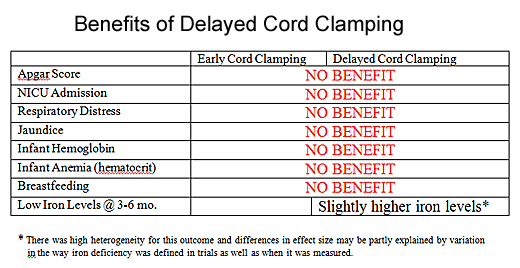
Two years ago I wrote about the last study to receive substantial media attention in Delayed cord clamping: much ado about nothing, and I included a handy chart:

Benefits of delayed cord clamping

So the only “benefit”was slightly higher iron stores (a laboratory value), one that has no clinical effect and probably has no clinical significance.

But that hasn’t stopped proponents of delayed cord clamping from continuing their desperate search for benefits.

The latest effort comes from Sweden, and the scientists who conducted the study promoted it breathlessly … as nearly all scientists promote their work whether it is high quality or useless.

From the CNN article:

“It’s incredible to see what a difference an extra three minutes and one-half cup of blood can have on the overall health of a child, especially four years later,” said Dr. Ola Andersson, lead author of the study and a pediatrician at the department of women and children’s health at Uppsala University in Sweden. “This is very promising, but larger studies are necessary,” said Andersson.”

Not exactly.

What was the study, Effect of Delayed Cord Clamping on Neurodevelopment at 4 Years of Age; A Randomized Clinical Trial, looking for?

The main outcome was full-scale IQ as assessed by the WPPSI-III.

What did the author find?

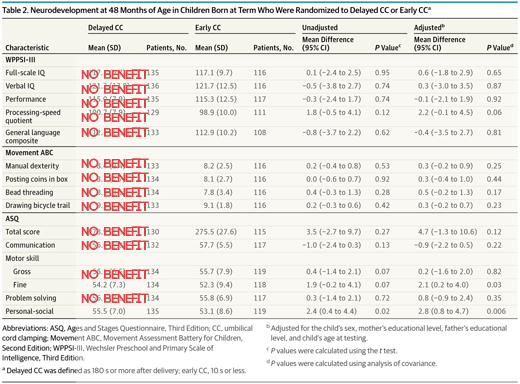
As the chart below demonstrates, they found that delayed cord clamping had no benefit on IQ. Specifically, there was no benefit on full scale IQ, no benefit on verbal IQ, no benefit on performance, no benefit on processing speed and no benefit on general language composition.

delayed cord clamping Sweden 5-14

But wait!

Fine-motor skills were assessed by the manual dexterity area from the Movement Assessment Battery for Children, Second Edition (Movement ABC), which includes 3 subtests: time for posting coins into a slot (both hands), time for bead threading, and drawing within a bicycle trail…

Delayed cord clamping had no benefit on any of these tests of manual dexterity.

So delayed cord clamping had no benefit on IQ and no benefit on manual dexterity.

But wait! All was not lost:

Parents reported their child’s development using the Ages and Stages Questionnaire, Third Edition (ASQ) 48-month questionnaire, which was translated into Swedish … The ASQ contains 5 subdomains: communication, gross motor, fine motor, problem solving, and personal-social …

On 2 of those 5 parent assessments of their child, fine motor and personal-social, the delayed cord clamping group had statistically significantly better scores.

What does that mean? Absolutely nothing!

In reality, this study demonstrates that delayed cord clamping in term infants has NO appreciable benefits.

The study was conducted to determine if delayed cord clamping has an effect on IQ and found that it doesn’t. The the authors looked at objective tests of manual dexterity and also found no difference. Then they looked at parental assessments of child performance and found a statistically significant difference between in two subsets, but at no point have the authors demonstrated that the small sample of 263 children (which represented only 2/3 of the children originally enrolled) has enough statistical power to be valid.

In other words, the authors failed to find any meaningful benefit in neurodevelopmental outcomes caused by delayed cord clamping.

Contrary to Dr. Andersson’s assertion, the only thing incredible about this study is how brazen the authors are in claiming that their findings are incredible when, in fact, they merely highlight the increasingly desperate efforts to find some benefit, no matter how arcane, from delayed cord clamping in term infants.

Encroaching on women’s rights by moralizing motherhood … without moralizing fatherhood

Female symbol located in restricted area

The past 20 years have witnessed an ever growing movement to moralize motherhood, from the endless restrictions on what pregnant women can consume (most of them, like the prohibition on alcohol, far outstripping any scientific evidence), the moralization of infant feeding and public pressure to breastfeed (once again far outstripping any scientific evidence), and the promotion of intensive mothering (attachment parenting) whereby the mother’s “real” work is to stay home and raise children. This moralization of motherhood has been justified as an attempt to recapture the supposedly superior lifestyle of our foremothers. But in truth it has nothing to do with science and everything to do with fear of women’s emancipation.

How can I be sure? Because there has been no comparable attempt to moralize fatherhood or return it to the supposedly superior lifestyle of our ancestors. There is nothing equivalent for fathers to the holy trinity of natural mothering (natural childbirth, breastfeeding and attachment parenting).

  • When was the last time you saw people claiming that “good” fathers demonstrate their love for their wives and children by killing game animals and dragging them home?
  • When was the last time you saw men escorted out of the delivery room because traditional societies do not allow fathers at childbirth?
  • Where are the restrictions on what men can consume, justified by the desire to keep their sperm safe for maximum fertility?
  • When was the last time you saw fathers harassing each other over who is the more natural father?

Never, right? And that’s not a coincidence.

Obviously any large social movement, like the movement to moralize motherhood within industrialized societies, is complex and multifactorial. Nonetheless, a significant impetus for the movement to moralize motherhood is to return to the olden days … for women, but not for men.

That’s why there are mommy wars, but no daddy wars.

As the pressure mounts on young women, it’s time for a wholesale reassessment of what is really driving the promotion of intensive mothering. Is it really about what’s best for children or is it about what returns women to the home and keeps them from achieving professional and economic success?

I hear the natural mothering crowd yelling that it’s about “the science.” But if the last 20 years have shown us anything it is that “the science” is weak, conflicting and riddled with confounding variables. We cannot pin down the answer to something as basic as whether it is good or bad for children if their mothers work and the reason we cannot pin it down is that there is no one answer. It depends; it depends on the individual mother, and individual child and the life circumstances of the family. It’s just like breastfeeding, where “the science” is also quite fuzzy no matter how much lactivists insist otherwise. That’s because the greatest danger of not breastfeeding comes from contaminated water used to prepare it and that’s not a problem in first world countries. Is breastfeeding better for babies than formula feeding? It depends; it depends on the individual mother, the individual baby and the life circumstances of the family.

The weak “science” of breastfeeding and the weak “science” on working mothers is stronger by far that any science on natural childbirth or attachment parenting. That’s because there is no science at all to support either of those two components of the holy trinity of natural mothering.

And what does the science show about fathering in nature? No one knows, because virtually no one is looking.

In part that reflects the importance of mothers during pregnancy and early infancy, but, I would argue, it also reflects the fact that we use mothering to control women while there is no comparable effort at all to control men through fathering.

As a society we need to step back and ask ourselves why we are placing such pressure on new mothers and why we are demanding that women accede to the imperatives of intensive mothering (and shame them for not doing so), while paying no attention to fathering.

Is this really about what’s best for children? Is this really about “the science”? Or is this yet another, albeit thoroughly modern, way to control women?