All posts by Amy Tuteur, MD

Afraid of homebirth? You should be!

Grieving family with an infant's coffin

Yesterday’s Washington Post contained a puff piece on homebirth. It’s entitled Afraid of a home birth? These two first-person accounts will give you a new perspective, and is followed by two anecdotes, one of a mother who had a homebirth in the US, and another of a mother who had a homebirth in the Netherlands. But neither story will give you new perspective for two important reasons.

First, although anecdotes may reassure you or frighten you, by their very nature they can’t give you perspective. If you’re afraid of homebirth, you want to know the risk to YOUR baby, not two women’s personal experiences. Imagine, for example, that you want to know whether you should buckle your infant into a carseat when driving to the store. The fact that a random mother drove to the store with her infant unbuckled and the baby survived tells you nothing about what is likely to happen to YOUR baby. The fact that another mother drove with her infant unbuckled in a different country with very different rules of the road and using a car with a plethora of safety features that we don’t have in the US tells you nothing about what might happen to YOUR baby. And the fact that both babies survived does not change the fact that not buckling your infant into a carseat is a very bad idea.

Second, the Post reporter leaves out two critical facts when relating the anecdotes:

Homebirth dramatically increases the risk of neonatal death.

Dutch midwives caring for low risk women (home or hospital) have a HIGHER perinatal mortality rate than Dutch obstetricians caring for HIGH risk patients in the hospital. That’s a scathing indictment of Dutch midwifery care.

Afraid of homebirth? You should be. It raises the odds that YOUR baby will die during childbirth.

The anecdotes themselves, while meant to be reassuring are anything but.

You know you have a problem when the title of your piece promoting homebirth is I had a home birth and I’m not stupid. Or brave. It’s an even bigger problem when the piece demonstrates that you are stupid and reckless.

When I began really looking into what evidence based birth meant, it seemed like the exact opposite of what I had received. It turns out laboring on your back is not conducive to letting your body open and your baby come down. While I knew it was best to stay out of bed, I hadn’t known how listening to the nursing staff like a good patient might alter the course of my birth. It seems like commonsense now, to make use of gravity, one of the most natural forces in the world. But at the time, I was trying, against my better judgment, to listen to my care providers. I should’ve been listening to my body.

I can’t comment on Sarah Bregel’s native intelligence, but I can tell you that it is monumentally stupid to believe that you can educate yourself by reading homebirth books, websites and message boards. Would you trust a money manager with your life savings if he told you that he is sure that he can increase the value of your portfolio because he read about it on the internet? Would you trust a pilot to fly you safely to your destination if she told you she had researched flying by reading a bunch of websites? No, and no. Why not? Because anyone who isn’t living under a rock is aware that the internet is packed with bogus “experts” peddling bogus products and taking your money in exchange. Reading homebirth websites to find out if homebirth is safe is like reading Big Oil websites to find out if solar power is a good way to heat your home. You’d be a fool to think you could find the truth by doing so.

While the most common reactions to having a home birth are either that it is very stupid or very brave, I’m here to tell you that for me (and many others) it’s neither. Home birth is a safe option for many women. While hospital transfers do happen, the midwifery model of care typically means being monitored very closely. So in the case of an emergency, it’s not often the dramatic, rush to the hospital, last minute C-section, tearing the baby out in the nick-of-time fiasco that you’d imagine…

And I’m here to tell you, Sarah, that if you believe that you are foolish and gullible.

Who am I? I’m an obstetrician and mother who has spent years cataloging the literally hundreds of babies who have died preventable deaths at homebirth, because their mother’s were hoodwinked and flattered into believing that they know more about childbirth safety than obstetricians who have spent years studying, training, practicing and routinely saving infant lives. Just last night I was informed of two more babies who died at homebirth this past weekend, and within the last month I learned of two MOTHERS who had died at homebirth in Texas within days of each other in December.

Homebirth is NOT a safe option, though I doubt any homebirth advocates would tell you that. In the most comprehensive collection of homebirth statistics ever analyzed, Judith Rooks, CNM MPH (and homebirth advocate) looked at PLANNED homebirths with a LICENSED homebirth midwife in Oregon in 2012. She found that the perinatal death rate at homebirth was 800% (that’s right, EIGHT HUNDRED PERCENT) higher than comparable risk hospital birth. That data was released in March 2013, and if you didn’t know that, Sarah Bregel, than you didn’t know anything about the safety of homebirth.

I happen to know the details of many of these deaths and I can tell you that these babies died in fiascoes DESPITE dramatic rushes to the hospital, last minute C-sections and tearing the baby out NOT in the nick of time, but after it was already dead or so profoundly brain damaged that it could not survive.

And they died in fiascoes where they were born not breathing or even dead because clueless midwives weren’t monitoring the babies’ heart rates appropriately or didn’t understand what they were hearing.

Homebirth is NOT a safe option, and the organization that represents homebirth midwives (the Midwives Alliance of North America) is well aware of that fact and DELIBERATELY, and UNETHICALLY lying about it. Their own paper (actually a voluntary survey completed by only 25% of members) shows that homebirth increases the risk of death by 450%! They know that; they lie about that: and they trick gullible women like Sarah Bregel so they can make money attending births despite being so unqualified that they would not be eligible to work as midwives in ANY other first world country, (not the Netherlands, not the UK, not Canada, not Australia, not any industrialized country).

The second anecdote, How pregnancy and birth overseas is so different than in the U.S., is hardly an endorsement of homebirth, and that’s despite the fact that the author is unaware of the terrible perinatal mortality rates of Dutch midwives.

Over the course of my pregnancy, however, I started to see the appeal of giving birth outside of a hospital setting. It was comforting (and, in retrospect, highly delusional) to think that I wouldn’t experience any pain my body couldn’t handle, that childbirth was fail-safe process engineered by Mother Nature for peak results…

I’ll spare you the details of my delivery. Suffice it to say, it was not quite the pool party I had hoped for. By the time I finally broke down and demanded to transferred [sic] to a hospital so that a real doctor could administer an epidural, it was too late.

But childbirth is hardly a fail-safe process engineered by Mother Nature for peak results (and both infertility and miscarriages are evidence of that). The insistence by Dutch midwives that it is fail-safe has led to the Netherlands having one of the worst perinatal mortality rates in Western Europe, and the appalling reality that high risk babies delivered by obstetricians are actually MORE likely to survive than low risk babies delivered by midwives.

Afraid of homebirth? You should be. It’s promoters and practitioners, both in the US and in other countries are not honest about the death toll at homebirth.

Hospital birth is like a carseat. Don’t use it and your baby will probably survive anyway … no thanks to you or your midwife.

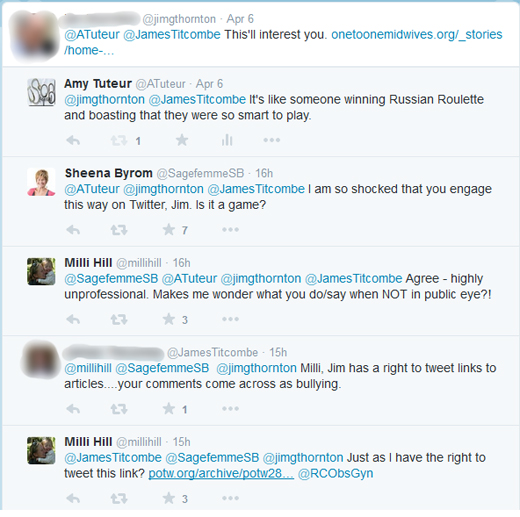
UK midwives foolishly continue their bullying on Twitter

iStock_000003866849Small

You might think these women would have more important things to worry about like the hideous death rates at their hands at Morecambe Bay (where 16 babies and 3 mothers died over a 9 year period) to the newly revealed horror at Royal Oldham/ North Manchester General Hospitals (where an appalling 7 babies and 3 mothers died in just 8 months!). But that would mean taking time from praising themselves and each other for the purportedly “evidence based” care.

Instead, they are making fools of themselves on Twitter (again!) by trying to bully anyone who dares question their clinical judgment.

It started innocently enough when a British obstetrician tweeted me a link to this “empowering” story of an HBA3C attended by a British midwife.

I responded:

It’s like someone winning Russian Roulette and boasting that they were so smart to play.

Tweet 4-6-14 1

That’s when the midwifery bullies swept in.

Remember the cruel behavior of those mean girls from middle school and high school who appointed themselves arbiters of the social universe? It was never enough for them to exclude the girls they didn’t like. Nope, they set out to punish anyone who wouldn’t fall under their sway. The classic mean girl line? “You can’t be friends with me if you’re friends with her.”

Their hypocrisy is mind blowing, exceeded only by their stupidity in conducting their bullying in a public forum. What is wrong with these women?

Sheena Byrom, who has publicly treated a loss parent viciously, and who was not being addressed by the obstetrician, is “so shocked that you engage this way on Twitter.”

Pot, meet kettle!

And Milli Hill*, who wouldn’t know an obstetric fact if she fell over it, whines that it is “highly unprofessional,” and, as is apparently routine for UK natural childbirth bullies, sends the tweet to The Royal College of Obstetricians and Gynecologists. She also inanely links to a quote from MacBeth about the three witches, explaining that the combination of the obstetrician, the patient advocate and myself in one Tweet is just like them.

Tweet 4-6-15 2

The thread twists and turns and branches off and I won’t bore you with the detaisl, but this is perhaps my favorite part:

Tweet 4-6-15 3

The obstetrician tries to discuss the wisdom of a homebirth after 3 C-sections, but Milli Hill insists:

YOU should explain why you are tweeting with Amy Tutuer [sic]

There follows an flurry of midwives and natural childbirth advocates retweeting and favoriting each other’s tweets as if that might make them true.

The sad reality is that an obstetrician wants to discuss patient safety; the midwives and natural childbirth advocates want to bully anyone who tries to discuss patient safety. It is indicative of the UK natural childbirth culture and midwives, doulas and celebrity natural childbirth advocates who are out of control, specifically:

1. Patient safety appears to be irrelevant
2. Clinical guidelines are irrelevant
3. An obsession with “normal” birth regardless of the dangers
4. An inability to behave professionally online
5. A culture of bullying that spends more time on threatening dissenters than investigating (or even acknowledging) the deaths at their hands
6. A sense of invulnerability, as if they can say what they want, threaten whom they want, ignore what they want, and get away with it that extends from the highest to the lowest and, indeed, the bullying tactics are sanctioned by the highest and copied by the lowest.

Keep it up ladies, you’re doing a fabulous job at discrediting yourselves, far better than I could discredit you on my own!


*Addendum: Hill is deeply concerned that people might get the impression from this piece that she is a UK midwife when she is merely a celebrity midwifery apologist. Hopefully, this clears up any confusion.

Jill Duggar Dillard risks her baby’s life at homebirth

Seaton Road Accident

Jill Duggar Dillard is giving us all a lesson in how planning a homebirth is like risking your baby’s life by not buckling him into a carseat.

The odds are in her favor that everything will turn out fine, but, of course, the odds would be in her favor that not buckling him into a carseat would turn out fine. That doesn’t make either one a good idea.

Dillard, one of the 19 and counting Duggar children, is a birth junkie.

Back a few years ago, I had the opportunity to attend 12 weeks of childbirth classes with my 14-year-old friend, who was a single mom. Through these classes, I learned how to coach her during the birth of her child. Although I had attended two of my siblings’ births, being able to work as an active part of my friend’s birth made me interested in learning more. I became friends with a doula/labor coach who worked in the area, and started going to home and hospital births with her. Soon, I became her assistant, and through that, I came into contact with other local midwives. Over the course of the next several years, these midwives would call on me periodically for help at home births.

Now Jill is studying to be a pretend “midwife” (CPM) and will be attended by an equally poorly educated, poorly trained pretend “midwife.”

What’s the difference between a CPM (certified professional midwife) and a real midwife? The CPM credential was made up by a bunch of women who wanted to be midwives but couldn’t be bothered to meet the internationally accepted requirements for midwifery. Real midwives, like those in the Netherlands, the UK, Canada, Australia and the US, must have a minimum of a university degree in midwifery. US certified nurse midwives (CNM) must have a nursing degree plus a masters in midwifery, making them the most highly educated midwives in the world. In contrast, CPMs are the least educated midwives in the industrialized world. They are required to have only a high school diploma, a course of unmonitored self-study that can be completed at home, and attend only 40 births (approximately the same number that I attended in my first week of residency training).

Jill could have trained to be a real midwife, but that involves college, and that, apparently was just too hard.

I had been considering attending nursing school for a while, but the timing of it all wasn’t working out … Eventually, through my work with the local midwives, the door opened for me to enter into a distance-learning midwifery training program in Texas. This program, after about 3 1/2 years of schooling, would give me the education I need to become a licensed, Certified Professional Midwife (CPM).

An “education” that is considered to be so poor that is unacceptable in the Netherlands, the UK, Canada and Australia. The training is as deficient as the education. All other midwives train within hospitals to learn to recognize, manage and prevent life threatening obstetrical complications. CPMs don’t bother with any of that because they are self-proclaimed “experts in normal birth,” which is about as useful a pretend meteorologist who is an expert in sunny weather and must call a real meteorologist to figure out if it might rain.

What do CPMs do when a life threatening complication occurs at homebirth?

They transfer the mother to the hospital where there are real medical professionals with the equipment and expertise to save lives. That, of course, is like transferring your baby to the hospital after the car crash that ejected the baby through the windshield because you couldn’t be bothered to buckle him into a carseat. We don’t think much of mothers who can’t be bothered to buckle their babies into carseats. That’s negligent or crazy or both. Now consider that the chance of a baby dying in childbirth is actually HIGHER than the chance of the same baby dying in a car accident.

Dillard is now nearly 2 weeks past her due date. We know that with every day that passes, the risk of stillbirth goes up. That’s because the placenta often has trouble meeting the oxygen and nutritional needs of a baby growing beyond full term. The baby could simply die spontaneously, or could die during labor, because contractions can stress a healthy baby, let alone one with a failing placenta. Insisting on homebirth at this point is like driving with a baby unbuckled, on an icy road, knowing that the road will get icier still with each passing day.

We all know mothers who have done that and everything has turned out fine. That’s why Jill Duggar Dillard’s son is likely to be fine, too, even though she is casually risking his life at homebirth.

A fine Cesarean whine

image

I guess this woman didn’t get the message that I have declared April to be Cesarean Appreciation Month.

image

This will ruffle feathers, it’s okay. I do not get celebrating c-sections. I’ve had two. They were awful. Neither of my children’s births were beautiful. They were horribly traumatic for them, and for me. I’m a full on attachment parenting, unschooling mom. You cannot be these things without celebrating your children everyday of their lives, and offering gratitude for them nearly every moment of everyday. Celebrating their assault while entering this world? Never.

Note: I am referring to the act of celebrating c-sections in general, not a particular one or ones.

She doesn’t appreciate her C-sections, does she?

I left a comment:

“Disappointed in your C-sections? Blame the industry that set you up for disappointment, the natural childbirth industry. That’s the industry that encourage women to value process over outcome.

In the chapter The Dialectics of Disruption: Paradoxes of Nature and Professionalism in Contemporary American Childbearing, anthropologists Caroline Bledsoe and Rachel Scherrer examine why meaning-making is so important within the culture of natural childbirth advocacy.

Their description of the current situation:

‘… Birthing is depicted culturally as an individual achievement, one in which a woman should be in control of her actions. For this, women attempt to present themselves as professionals, medical as well as legal: as close as they can come to being equals with their medical peer doctors, informed and trained to evaluate their qualifications.’

Bledsoe and Scherrer recognize that meanings and meaning-making are luxuries of a society in which childbirth is so safe that women have forgotten that in reality it is inherently dangerous:

‘… As childbearing became safer and more benign visions of nature arose, undesired outcomes of birth for women came to consist of a bad experience and psychological damage from missed bonding opportunities. Today, with safety taken for granted, the new goal has become in some sense the process itself: the experience of childbirth…’

Their critical insight:

‘… But with *control* being such a crucial issue in cultural ideals of childbearing, the greater the expectations that a scripted birth plan creates, the greater the surety that the woman will fall short of her ideal. Some elements will go wrong, and with them the hope of remaining the equal of the professionals who deals with her birth. This relegates obstetricians, who have the power to disrupt a naturalism but also to save lives if something goes wrong, to being the inevitable targets of opposition.’

Specifically:

‘If nature is defined as whatever obstetricians do not do, then the degree to which a birth can be called natural is inversely proportional to the degree to which an obstetrician appears to play a role. The answer to why obstetricians are described with such antipathy thus lies not in the substance of what obstetricians do that is unnatural – whether the use of sharp incision. forceps, and medications that blunt sensation. or anything else- but in the fact that obstetricians represent a woman’s loss of control over the birth event. Obstetricians are thus perceived as the chief source of disruption in the birth event, backed by the licensing power of medicine and the law. And yet it is not what obstetricians do that women find problematic but the fact that they are the people who step in when the woman is seen to have failed.’

If the goal of childbirth is seen as a healthy baby, there’s no reason to be disappointed with a C-section. But if the goal is a carefully scripted, NCB approved birth “experience,” it’s no wonder that you are disappointed. The problem is that you blame the C-sections when you should be blaming the natural childbirth industry.”

She immediately deleted the comment. It was not offensive in the least, but I guess she couldn’t stand the cognitive dissonance of acknowledging that she had been set up for disappointment by the natural childbirth movement.

Or maybe she was just enjoying feeling sorry for herself and didn’t want anything to detract from her fine Cesarean whine.

April is Cesarean Appreciation Month

image

The natural childbirth industry is second to none in its mastery of marketing. Several years ago, ICAN (International Cesarean Awareness Network) designated April as Cesarean Awareness month (CAM). That sounds ever so much better than Cesarean Defamation Month, which would be far more accurate.

As a result, we will be treated with a month of posts from the natural childbirth industry bemoaning the C-section rate, bewailing a “crisis” in maternity care, and aggressively decrying the rare complications of C-section while ignoring the major benefits. The natural childbirth industry promotes awareness of the risks of C-sections, and utterly ignores the benefits that dramatically outweigh those risks.

The truth is that C-sections have saved literally millions of lives and continue to save tens of thousands of mothers and babies in the US alone each and every year. Therefore, I am designating April Cesarean Appreciation Month in honor of the incredible benefits of C-sections.

In 2006 Dr. Atul Gawande wrote a piece for The New Yorker, The Score, that uses the Apgar score as a focus for a review of the history of contemporary obstetric care.

Gawande starts by acknowledging that for most of human existence, childbirth was the leading cause of death of young women and the leading cause of death of babies. The risks are legion, from hemorrhage, to infection to obstructed labor, when a baby is too big to fit through the maternal pelvis.

The natural childbirth industry would have you believe that these complications are rare, but in fact, they are so common that midwives and doctors invented tools to cope with them.

The first reliably life-saving invention for mothers was called a crochet, or, in another variation, a cranioclast: a sharp-pointed instrument, often with clawlike hooks, which birth attendants used in desperate situations to perforate and crush a fetus’s skull, extract the fetus, and save the mother’s life.

If only the baby could be removed healthy and whole from the mother’s uterus:

But Cesarean section on a living mother was considered criminal for much of history, because it almost always killed the mother—through hemorrhage and infection—and her life took precedence over that of the child… Only after the development of anesthesia and antisepsis, in the nineteenth century, and, in the early twentieth century, of a double-layer suturing technique that could stop an opened uterus from hemorrhaging, did Cesarean section become a tenable option.

The C-section was part of the transformation of modern obstetrics:

In the United States today, a full-term baby dies in just one out of five hundred childbirths, and a mother dies in one in ten thousand. If the statistics of 1940 had persisted, fifteen thousand mothers would have died last year (instead of fewer than five hundred)—and a hundred and twenty thousand newborns (instead of one-sixth that number).

And the statistics from the 1940’s were far better than those that occur in nature. If the statistics of pre-history had persisted, 40,000 mothers and 280,000 babies would have died last year.

As Gawande notes:

… [A]lmost nothing else in medicine has saved lives on the scale that obstetrics has.

In large part, that’s a result of the liberal use of C-sections.

A measure of how safe Cesareans have become is that there is ferocious but genuine debate about whether a mother in the thirty-ninth week of pregnancy with no special risks should be offered a Cesarean delivery as an alternative to waiting for labor…

…Many argue that the results for mothers are safe, too. Scheduled C-sections are certainly far less risky than emergency C-sections-procedures done quickly, in dire circumstances, for mothers and babies already in distress. One recent American study has raised concerns about the safety of scheduled C-sections, but two studies, one in Britain and one in Israel, actually found scheduled C-sections to have lower maternal mortality than vaginal delivery. Mothers who undergo planned C-sections may also (though this remains largely speculation) have fewer problems later in life with incontinence and uterine prolapse.

Of course, C-sections, like any surgical procedure, have complications. These include infection, bleeding, need for future C-sections, and risk of rare complications in future pregnancies like placenta accreta, where the placenta grows into the wall of the uterus at the location of the scar. Accreta is dangerous and can lead to hysterectomy and even death of the mother.

On balance, though, the benefits of C-sections dramatically outweigh the risks. That’s why April should be Cesarean Appreciation Month, in acknowledgement of the many millions of lives save by this simple surgery. It has transformed childbirth from an opportunity for women to make their wills and prepare for possible death into an opportunity to complain about having a C-section.

Midwives need to stop pledging allegiance to normal birth and start protecting babies

image

A British mother and child have won a record payment of £14.6 million in a case of midwifery incomptence. Coming hard of the heels of the release of the Morecambe Bay report, a stunning indictment of UK midwives’ lack of clinical skills and obsession with “normal” (unmedicated, vaginal) birth, it is yet another example of the failure of midwife led care.

According to The Mail Online:

A mother whose son suffered severe brain damage during birth is set to receive potentially the biggest medical negligence payout in history.

The High Court ruled today that United Lincolnshire Hospitals NHS Trust must pay in excess of £14.6 million for birth injuries, after failing to carry out a Caesarean section on Suzanne Adams and properly monitor her during labour.

The hospital’s negligence led to her son James Robshaw, now 12, being born with cerebral palsy.

The decision, believed to be one of the most significant in a case of medical negligence and the largest ever such court-ordered award for birth injury, reflects the lifetime care that James needs…

What happened?

Ms Adams was in labour when she was admitted to Lincoln County hospital in 2002.

Although her baby’s heart was monitored after her arrival, midwives either ignored or could not interpret the CTG trace – which detects foetal heart rate – correctly…

The confusion about CTG interpretation and the additional failure to carry out a timely Caesarean section meant there was a delay in delivering James.

Resuscitation procedures were then carried out in the delivery room before he was transferred to the Special Care Baby Unit.

Just as at Morecambe Bay, midwives either didn’t understand or ignored evidence that a baby was in distress.

More stomach churning allegations of midwifery incompetence at Morecambe Bay continue to emerge. The Nursing and Midwifery Council will hold hearings later this month about a midwife, alleging:

That you, whilst employed as a Band 7 Midwife at Furness General Hospital (“the Hospital”) by University Hospitals of Morecambe Bay NHS Foundation Trust (“the Trust”) between 15 February 2004 and 10 September 2013:

1) On 25 February 2004 an in relation to Patient A

1.1 Failed to and/or failed to ensure that the fetal heart rate was adequately monitored after 20:15 and up until the time that Patient A’s baby was delivered.

1.2 Failed to request assistance from a Doctor and/or any other suitably qualified medical professional when you had difficulty auscultating the fetal heart.

1.3 Caused distress to Patient A by inappropriately placing Patient A’s baby by her side

1.4 Your conduct contributed to the death of Patient A’s baby and/or caused Patient A’s baby to lose a significant chance of survival.

2) On 6 September 2008 in relation to Patient B

2.1 In relation to Patient B’s pain relief;

i) Advised Patient B that she could not have an epidural
ii) Failed to document your discussions with Patient B regarding pain

2.2 Failed to and/or failed to ensure that the fetal heart rate was monitored at 15-30 minute intervals during the first stage of labour …

i) Failed to and/or failed to ensure that continuous electronic fetal monitoring was in place and/or

ii) Failed to and/or failed to ensure that the fetal heart rate was auscultated every 5 minutes …

2.5 Failed to adequately escalate the delay in the second stage of labour to an obstetrician at approximately 20:45

2.6 Your conduct contributed to the death of Patient B’s baby and/or caused Patient B’s baby to lose a significant chance of survival

These are just the most egregious of 15 separate allegations against the midwife.

Both these case are part of a disturbing pattern of injuries to and deaths of babies, questionable midwifery competence, and failure to call for interventions.

UK midwives need to stop pledging allegiance to normal birth and start protecting babies.

Nature thinks babies are expendable

image

Two of the central conceits of the natural childbirth and homebirth industries is that women are “perfectly designed to give birth,” and “babies know how to be born.”

They are conceits not merely because they are untrue, but also because advocates imagine human beings as somehow immune to the forces and exigencies that rule birth among all other animals. The truth is that Nature thinks babies are expendable, and, to a lesser extent, mothers are expendable, too.

One of the main characteristics of reproduction in the animal kingdom (and the plant kingdom) is massive wastage. The chance of any individual organism surviving to adulthood is very small; therefore, massive amounts of offspring must be produced, because most of them are naturally going to die.

Think about how many seeds are produced by an individual plant. Think about how many larvae are produced by one insect. Think about how many eggs are produced by an individual fish. Then think about how many of those survive to become the adult form: only a vanishingly small proportion.

The classic example is the thousands of baby turtles who all hatch on a single night and immediately begin clambering across the beach to safety in the sea. Along the way they must travel a gaunlet of predators and most will not survive.

Of course plants, insects, fish and turtles don’t generally care for their offspring. Their investment in the next generation ends with birth, or even before.

How about those animals that invest time in brooding or gestating their young? For them, parental energy expenditure is much greater and the the proportion of offspring that are lost before adulthood is consequently much lower. It is still relatively high, which is why most animals reproduce every year or every other year.

Not surprisingly, there appears to be a correlation between the amount of parental time and energy invested in offsrpring and the proportion of those offspring that survive. Even when the parental contribution is enormous, however, such as in larger animals, death rates are extraordinarily high. For example, it is estimated that one out of two lion cubs will not survive its first year.

Human beings devote the most time and energy to raising the next generation. Pregnancy is 9 months long, infancy is nearly 2 years, and childhood lasts for up to 18 years. This intensive investment ensures that a high proportion of babies will survive to adulthood, but it is entirely compatible with losing 10%, 20% or even more children.

When you take the long view, the proportion of survivors is even smaller. Human females are born with millions of eggs, and human males produce billions of sperm. Most will never even be used in reproduction. Even when sperm meets egg, fertilization can fail; cell division can fail; uterine implantation can fail. For successfully established human pregnancies, the miscarriage rate is one in five (20%). These are all natural occurrences. How can anyone claim that women are perfectly designed (or evolved) to give birth when they can’t even sustain 20% of all pregnancies?

Obviously, they are not perfectly designed (or evolved). That’s not surprising since nature doesn’t “do” perfect; it only does good enough. In every generation, only the fittest survive. That means that the less fit will die.

This applies to childbirth as to any other aspect of human existence. Only the fittest babies will survive childbirth and only the fittest mothers. Fittest in this sense does not mean physically fit; it means having the characteristics that are most suitable in the specific setting. Hence very big babies are in danger of dying (and killing their mothers) during childbirth. They may be robust and strapping, but if their heads are too large to negotiate the maternal pelvis, they will die and their mothers will die, too. They weren’t fittest for the particular environment in which they existed.

Nature thinks that human babies and human mothers are expendable, subject to the exact same natural forces that kill babies of other species. The difference between humans and all other animals is NOT that humans are perfectly designed for nearly 100% survival in birth. The difference is that we can change our environment in ways that ensure that babies who would otherwise die will live instead.

Technology is our secret weapon.

Consider that human beings have come to inhabit nearly every climate on the globe. We have been successful in frigid climates NOT because the air got warmer, but because of our technology: clothes, houses, and heating. No one would suggest that we are “overusing” or should give up any of those technologies in order to return to our paleolithic past. Nor would anyone suggest that since were were “meant” to live in Africa, we should all return there so that clothes, houses and heating would no longer be necessary.

Technology also allows the same baby whose head is too big to fit through his mother’s pelvis to be delivered instead through a C-section incision. The baby will survive and the mother will survive, too. Neither will be compromised in the slightest by the surgery. Yet natural childbirth and homebirth advocates insist that we are overusing technology in childbirth and that we should give it up. The babies who die without access to that technology are dismissed as “meant” to die.

The facts of reproduction are no different for human beings than for any other animals. Women are NOT designed to give birth perfectly and babies are NOT designed to survive birth. The difference between human beings and all other animals is this: Our technology is perfectly designed to help women give birth safely. Our technology is perfectly designed to help every baby possible survive birth.

Natural childbirth and homebirth advocates who prattle that women are perfectly designed to give birth and babies are perfectly designed to be born suffer from the conceit that humans aren’t subject to the same natural forces as all other animals. They live in a fantasy world made possible by the liberal use of the technologies that they deplore. Childbirth isn’t safe; it only appears that way because technology is used.

That fantasy world shatters in the face of the reality of childbirth: it is dangerous and many mothers and babies aren’t perfectly designed to survive it. Fortunately, most women are smart enough and astute enough to avail themselves of the technology that allows them to survive despite imperfection.

Yet another mother dies at homebirth

image

At the end of December I wrote about 22 children left motherless when 7 different women died at homebirth. I wasn’t aware that an additional 2 mothers died in December leaving 11 more children motherless.

Two weeks ago, I wrote about one of the maternal deaths. A mother in Texas died after a postpartum transfer from homebirth. The baby was born lifeless but surived after cooling therapy to mitigate brain damage from lack of oxygen at birth. The mother died despite days of heroic efforts to save her life at the hospital.

Yesterday I learned about another mother, also from Texas, who died 9 days before the first death.

According to her husband:

Dec 11th 2014 my wife texted me and said that it was time for me to come home for the birth of our 8th child. This was our 7th homebirth, the other 6 an amazing success.

She had no reason to suspect that she would suffer a life threatening complication, amniotic fluid embolus, but she did. Her labor was proceeding normally, and then.

The midwife checked her and the baby and it was time to get her to push. As the pain got worse she looked at me and said it was so hard. I tried to comfort her as best I could. Then she passed out in the tub.

When seconds counted, they were many minutes away from help.

We called 911 and got her out of the tub onto the bed. We could see that she wasn’t breathing so we tried CPR. She kind of came to a little bit and was trying to push the baby out with all she had while not being able to breath. She then passed out again never to awaken.

On arrival at the hospital:

…[They] did an emergency C section in the ER. They then struggled to keep her alive as I sat outside the curtain more afraid than I had ever been in my entire life before. They took Lilly to the NICU to try to save her but to no avail.

The mother never recovered despite intensive treatment.

After 5 grueling weeks of watching her almost bite through her lip when she would have seizure like episodes and seeing her kept alive by machines, she died on my 6 year old’s birthday Jan 17th.

Would she have survived had she been in a hospital? That’s hard to say because amniotic fluid embolus has a 50% mortality rate. But we can be sure that she would have had a better chance at survival and the baby would have had a much better chance with an immediate C-section.

I’m not sure if things would have been different if we would have had a hospital birth, but there is a chance I would be holding a sweet little girl and perhaps snuggled next to my wife if we would have known more about AFE. This is why we are all posting our stories, donating our time, and money. Lord willing we might be able to save one baby or one momma and it will all be worth it.

Now 33 children have been left motherless by the deaths of 9 different mothers at homebirth.

Thinking about homebirth? Think again.

Think about leaving your children motherless and their father struggling to cope.

This father is warning you. Don’t ignore his plea.

Midwives are the guardians of normal birth; obstetricians are the guardians of mothers’ and babies’ lives.

image

Midwives love to claim they are the “guardians of normal birth.”

Type “guardians of normal birth” into Google and you get page after page of midwives declaring their commitment to a specific vision of birth.

I’m not sure why they’re boasting because it’s actually an unwitting indictment of the moral rot at the heart of contemporary midwifery theory. It highlights the difference in ethics between midwives and obstetricians. Midwives are the “guardians of normal birth,” while obstetrians are the guardians of the health and lives of mothers and babies.

It is fundamentally unethical for any health provider to pose as a guardian of a procedure. It would be wrong for a surgeon to pose as a guardian of appendectomy; it would call into question his or her ability to successfully and ethically treat abdominal pain when he had a clear bias toward removing appendices. It wouldn’t matter if the surgeon claimed to believe that appendectomy was the appropriate treatment for abdominal pain, and we would quite rightly suspect that the surgeon has his own self-interest (the surgical fee, the opportunity to hone skills, the enjoyment of performing surgery) at heart.

Similarly, if a dermatologist claimed that she was a guardian of Botox, it would call into question his her ability to recommend appropriate treatment for her patients. It wouldn’t matter if the dermatologist claimed to believe that every patient could benefit from an injection of Botox. We would quite rightly suspect that the dermatologist had her own self-interest (her fee, gifts from the drug company, opportunity to serve as a paid consultant for Botox)at heart.

When a midwife claims to be a guardian of normal birth, it calls into question her ability to successfully and ethically care for pregnant women. It doesn’t matter if the midwife claims to believe that normal birth is beneficial for nearly every women. We would quite rightly suspect that she had her own self-interest (her fee, professional autonomy, the enjoyment of assisting an unmedicated vaginal delivery) at heart.

Obstetricians, in contrast, are the guardians of the health and lives of mothers and babies. Their commitment is to the patients they treat, not to a particular method of treatment. Their commitment is to delivering healthy babies to healthy mothers, regardless of what it takes to make that happen. Their commitment is to people, not process.

Over the past few decades we have come to understand the pernicious influence that outside forces can exert on providers. Even something as simple and trivial as small gifts to doctors from pharmaceutical companies can affect a doctor’s choice of therapy (which is why pharmaceutical companies engage in the practice in the first place). Ideology is a far more powerful source of influence than pens and calendars. It, too, can sway a provider’s judgment to use decision making criteria other than the best interest of the patient. That’s why ideology has no place in medical care.

The central questions in caring for pregnant women should be: how can I help each individual women to remain healthy during pregnancy and childbirth and what can I do to ensure the health of her baby?

Midwives, as guardians of normal birth, view the central question as: what can I do to make this woman’s birth conform to my ideal of unmedicated vaginal delivery?

Not surprisingly the different approaches lead to different responses in the event of complications. Since the obstetrician is committed to health, complications are acknowledged, treatments instituted based on specific circumstances, with all options avaiable to achieve the desired outcome.

Midwives’ commitment to unmedicated vaginal birth means that complications are more likely to be ignored or denied (a “variation of normal). Treatment options are rated by whether or not they are compatible with normal birth, not based on their likelihood of ensuring the health of mothers and babies. A particularly distasteful consequence of privileging unmedicated vaginal birth is that failure to achieve a live baby is often unacknowledged, dismissed with the callous words “some babies are meant to die.” Instead of investigation, root cause analysis and questioning of the approach taken, midwives committed to normal birth may supress investigations and root cause analysis and to ban questioning of the approach taken since that would call the commitment to normal birth into question, which is intolerable.

Midwives need to take a long hard look at the moral rot of a philosophy that privileges birth process over healthy mothers and healthy babies. Rather than patting themselves on the back for being guardians of normal birth, they should be embarrassed to be caught out promoting a philosophy that places how a baby is born on an equal or greater footing than whether that baby lives or dies.

Dear daughter, here’s why I work (at ending the mommy wars)

Mommy wars

Dear Daughter,

Why do mothers pummel each other over whether or not they work for pay outside the home? Why do so many women eagerly enlist on one side or another in the Mommy Wars?

Why did Lydia Lovric write Dear Daughter, Here’s Why I Don’t Work? Or, more to the point, why did Lovric publish a letter that was ostensibly written to her daughter, including such gems as:

My “job” is to take the best care possible of you and your younger brothers…

Other people may dismiss babies as simply blobs. But we both know better.

And:

I stay home because although I did love my job very much, I love you more.

I stay home because although writing and radio did make me extremely happy, I knew that you seemed happier when I was around. And your happiness was more important to me than my own. And making you happy also made me happy.

I stay home because I want you to learn that family and love are more important than material possessions. A large home or fancy sneakers will not make up for an absent mother.

I stay home because I want you and your brothers to be proud of me because I gave up something I truly loved in order to put you first.

And especially:

The feminists may not like it, dear daughter, but even if I made it to the very top of my profession, even if I drove a fancy company car and went on a slew of business trips, I would feel like an utter failure if any of my kids felt the need to ask me if I loved work more than I loved them.

I ponder these questions because I’m a feminist. I was a feminist even as a child, before I had ever heard the word and before the feminist movement profoundly improved the world for all women.

I’m proud that you are a feminist, too.

I ponder these questions because I was a stay at home mother, too, and I am all too familiar with the way that women bash each other about their choices, as if their worth as mothers and as human beings depends on belittling those who make different choices.

I suspect that it was your feminism that led you to ask me years ago why I no longer worked outside the home, specifically, “Don’t you feel bad that you are not an important person?” We talked about it when you asked me, and I’ve thought a lot about over the years.

I understood that what you were asking about was not that mothers aren’t important; you were curious whether an ambitious person can be happy if she does not have professional success to point to, and if no one is paying her for the work that she does. The answer is yes.

I stayed home because I am a feminist and feminism is about women being free to make the choices that are right for them, without external limitations imposed by societal beliefs about women. Feminism is a remarkably simple belief: women are morally, intellectually, and politically equal to men. That’s it.

That’s why Lovric’s dig “The feminists may not like it, dear daughter, but … I would feel like an utter failure if any of my kids felt the need to ask me if I loved work more than I loved them.” is hard for me to fathom.

Dear daughter, as a feminist yourself, you know that feminists don’t care that Ms. Lovric chooses not to work. And you’ve probably figured out that the fact that she imagines they care tells us more about her and her misunderstanding of feminism than anything else.

As you know, and as we have discussed at length, feminism requires that women not be constrained by societal prejudices. It does NOT demand that women work or emulate men in their choices. While Ms. Lovric feels driven to flaunt her choice to prove her supposed maternal superiority, the rest of the world is going about its business.

Or they should be.

Sadly, there is no lack of enlistees in the mommy wars. They imagine that motherhood is a zero sum game with a limited amount of child happiness, parental success, and personal self-worth to be doled out among the mothers of the world. They envision an “I win; she loses” world. I hope you never view motherhood that way.

The truth is very different. As I’ve written in the past, two women making opposite choices can BOTH raise happy children … or not. Two women making opposite choices can both point to the same parenting success … or not. Two women making opposite choices can both be proud of what they have done … so long as they aren’t always judging themselves by what others are doing.

And that’s why I work, not at paid work, but at defying the invective, defusing the guilt and decrying viciousness of the mommy wars. I concentrate on childbirth, infant feeding and attachment parenting, which some women have turned into fights to the death about unmedicated childbirth vs. epidurals, breastfeeding vs. bottlefeeding, and baby-wearing vs. sleep training, but I’m well aware of other battles like “stay at home vs. working” mothers.

I stayed home with you and your brothers because I love you beyond reason, but I don’t think, even for a moment, that other women who made different choices love their children any less.

I’m so glad, dear daughter, that you’ve had the opportunity to know my friends, highly educated, talented, powerful women who have made a range of different choices and whose profound love for and devotion to their children has not been bounded in any way by those choices.

As a feminist, I want every choice to be open to you, including the choice to be child-free (though I am not so secretly desperate to be grandmother). But if you do have children, I fervently hope that what I’ve tried to teach you, and endeavored to model for you will lead you away from the mommy wars and toward making the choices that are right for you and your family, without any reference to what other women are choosing.

And no matter what, I will always love you and your brothers more than life itself.
Your Mom