All posts by Amy Tuteur, MD

The tragedy of the Baby Friendly Hospital Initiative can be explained by Goodhart’s Law

Performance target

I wrote a piece that appeared on Slate on Friday. Will the Tide Ever Turn on Breastfeeding? highlights the fact that most of the promised benefits of breastfeeding have never appeared. Worse, aggressive breastfeeding promotion is harmful.

There has been an increase in babies falling from their mothers’ hospital beds or suffocating [due to forced rooming in]. There has been a rise in serious harms to babies including dehydration, starvation, brain injuries, and even deaths. Indeed, exclusive breastfeeding on discharge is now the leading risk factor for hospital re-admission.

Nearly all the pain, suffering and death can be traced to the Ten Steps of the Baby Friendly Hospital Iniative. How could lactation professionals, good people with good intentions, turn out to be so wrong? As I explained in the Slate piece, health recommendations were issued on the basis of small studies without waiting for confirmation by larger studies. Most of these early studies have been debunked. Moreover, small studies, by their very nature, cannot reveal the risks that become serious problems in large population.

[pullquote align=”right” cite=”” link=”” color=”” class=”” size=””]When a measure becomes a target, it ceases to be a good measure.[/pullquote]

The tragedy of the Baby Friendly Hospital Initiative is that a program designed to improve babies’ health has harmed them instead; tens of thousands of newborns are readmitted to the hospital each year for dehydration and jaundice. Equally tragic, a program designed to support mothers has ended up undermining their psychological health.

Why? The answer can be found in data science: Goodhart’s Law.

When a measure becomes a target, it ceases to be a good measure.

Campbell’s Law, a corollary of Goodhart’s Law, is equally instructive:

The more any quantitative social indicator is used for social decision-making, the more subject it will be to corruption pressures and the more apt it will be to distort and corrupt the social processes it is intended to monitor.

What does that mean?

Incentive structures work,” as Steve Jobs put it. “So you have to be very careful of what you incent people to do, because various incentive structures create all sorts of consequences that you can’t anticipate.” Sam Altman, president of Y Combinator, echoes Jobs’s words of caution: “It really is true that the company will build whatever the CEO decides to measure.”

This sketch from the fantastic website Sketchplanations illustrates the problem:

B3A02E02-D413-46B1-B330-D763944AACD4

Imagine you are the CEO of a company that manufactures nails and you want to incentivize your workforce to increase profits by rewarding them for meeting production targets.

If you tell them you will offer a bonus to workers who meet a target number of nails produced each week, workers will start making tiny nails so they can produce more of them. If instead you offer a bonus to workers who meet a target for weight of nails produced each week, workers will switch to producing a few massive nails. When a measure becomes a target, it ceases to be a good measure because setting a target distorts and corrupts the process it is designed to monitor.

What should the CEO of the nail factory have chosen to measure?

Data scientist Roman Shraga offers this answer:

You need to ask questions that ensure the measure relate [sic] to the ultimate goal. Additionally, think about whether it would be possible to get a perfect score on the measure, and if it would be possible, to do so without adding any value. This line of reasoning will allow you dissect a measure until you understand whether or not it is doing a good job of indicating performance.

In other words, the CEO should have chosen a measure, or a combination of measures that increases productivity without compromising quality.

Now let’s look at the Baby Friendly Hospital Initiative. Its leaders chose to incentivize hospitals, nurses and lactation consultants on exclusive breastfeeding rates at discharge. That seemed like a good target to choose because the goal was to increase long term exclusive breastfeeding rates and the mothers who breastfeed exclusively for the long term are likely to be exclusively breastfeeding at discharge. In addition, it is much easier to measure exclusive breastfeeding rates at discharge than to track down mothers and babies to see if they are breastfeeding 3, 6 or 12 months later.

How has this target distorted and corrupted the provision of breastfeeding support to new mothers? Just look at the Ten Steps:

9FDF92F0-05A2-4943-8073-C1C2AB436A8C

Since hospitals, nurses and lactation consultants want to maximize the rate of exclusive breastfeeding at discharge, the Ten Steps make it nearly impossible to avoid breastfeeding. Mothers are hectored to breastfeed, forced to breastfeed within the first hour, denied formula, forced to endure the baby’s cries of hunger by rooming in, and denied pacifiers that might soothe the baby.

When lactation consultants are incentivized to maximize rates of exclusive breastfeeding at discharge, they ignore dehydration, hypoglycemia (low blood sugar) and jaundice because treating them would involve formula and that would reduce the rate of exclusive breastfeeding.

When lactation consultants are incentivized to maximize rates of exclusive breastfeeding at discharge, they make formula hard to get: they restrict access to it, lock it up and force women to sign odious, shaming “consent forms” to get it.

When lactation consultants are incentivized to maximize rates of exclusive breastfeeding at discharge they make sure that hospital personnel will not have to endure the anguished cries of starving infants by closing well baby nurses and leaving babies in mother’s rooms around the clock. And should nurses break down because of simple human compassion and offer formula, they are excoriated by official policy.

Is it any wonder then that exclusive breastfeeding has become the leading risk factor for hospital readmission? By setting the wrong target, the BFHI incentivizes poor, even deadly, care.

What should breastfeeding promotion incentivize?

Since our goal ought to be providing breastfeeding support for anyone who wishes to breastfeed:

1. Mothers’ desires must be accommodated, instead of ignored as they are now.

2. The quality, availability and accessibility of SUPPORT should be measured not the absolute number of infants breastfeeding exclusively.

3. Hospital readmissions must be measured since any effort to promote breastfeeding that leads to an increase in dehydration, hypoglycemia and jaundice is a failure regardless of how high the rate of exclusive breastfeeding at discharge might be.

4. Formula should be easily available; women should be taught how to use it; and judicious formula supplementation should be freely recommended in the early days when babies are most likely to suffer breastfeeding complications.

5. The only breastfeeding rates that are clinically relevant are rates beyond two months. That’s much harder to measure but that’s what actually matters. Measuring exclusive breastfeeding rates on discharge reflects the streetlight effect, also known as the drunkard’s search principle: searching for keys lost in a unlit park under a streetlight because that where it is easiest to look.

The tragedy of the Baby Friendly Hospital Initiative is that bad outcomes were nearly guaranteed by focusing on the wrong target … and failing to understand Goodhart’s Law: when a measure becomes a target, it ceases to be a good measure.

Who could have guessed that THIS reduces the risk of postpartum depression?

Health Visitor With New Mother Suffering With Depression

Why are natural childbirth and breastfeeding advocates relentlessly looking for a physical cause for a mental health problem?

As part of their ongoing effort to demonize both C-sections and formula feeding, they seem desperate to show that mode of birth or “failure” to breastfeed are risk factors for postpartum depression. But why would anyone think that a mental health problem had a physical cause? And wouldn’t the best place to look for risk factors for a serious mental health problem be psychological issues?

[pullquote align=”right” cite=”” link=”” color=”” class=”” size=””]Women who were psychologically flexible and able to be compassionate to themselves were at lower risk of postpartum depression.[/pullquote]

According to a 2016 review in the New England Journal of Medicine:

…Symptoms of postpartum depression often include sleep disturbance (beyond that associated with the care of the baby), anxiety, irritability, and a feeling of being overwhelmed, as well as an obsessional preoccupation with the baby’s health and feeding. Suicidal ideation and worries about causing harm to the baby have also been reported. The strongest risk factor for postpartum depression is a history of mood and anxiety problems and, in particular, untreated depression and anxiety during pregnancy.

We already know factors that impact mental health play an important role:

…including low social support, marital difficulties, violence involving the intimate partner, previous abuse, and negative life events.

“Wait,” I hear natural mothering advocates cry, “what about hormones?”

The rapid decline in the level of reproductive hormones after childbirth probably contributes to the development of depression in susceptible women, although the specific pathogenesis of postpartum depression is unknown.

The impact is serious:

Postpartum depression results in maternal suffering and diminished functioning and is asso- ciated with increased risks of marital conflict and impaired infant–caregiver attachment, as well as increased risks of impaired emotional, social, and cognitive development in the child, and in rare cases, suicide or infanticide.

Given the high incidence, serious nature and profound effects of postpartum depression, we should be doing everything we can to prevent it. A new paper to be published in the March issue of the Journal of Affective Disorders asks the critical question, What protects at-risk postpartum women from developing depressive and anxiety symptoms?

The authors describe the problem:

The adjustment to motherhood is marked by a range of different internal experiences, including negative thoughts and emotions. However, societal ideologies highlight that a normative response to motherhood is the presence of immediate and continuous feelings of happiness and joy. These expectations of motherhood may lead to women having more difficulties accepting their internal experiences, such as negative thoughts and emotions, when they do not reflect such ideals…

They found:

Women not presenting depressive and anxiety symptoms reported significantly higher levels of psychological flexibility, nonjudgmental appraisal of thought content and self-compassion than women presenting depressive and anxiety symptoms. Hierarchical logistic regression showed that women with higher levels of psychological flexibility (OR = 1.06, CI: 1.01–1.12) and nonjudgmental appraisal of thought content (OR = 1.33, CI: 1.15–1.53) had a significantly higher likelihood of not presenting depressive and anxiety symptoms.

They explain:

Consistent with previous studies, our results showed that women presenting no depressive and anxiety symptoms reported significantly higher levels of psychological flexibility, nonjudgmental appraisal of thought content and self-compassion when compared with women presenting depressive and anxiety symptoms. We also found a significant negative association between these variables and depressive and anxiety symptoms… Thus, these findings corroborate our hypothesis that a more accepting and self-compassionate attitude towards private events in the postpartum period for women presenting a risk for PPD is associated with lower levels of depressive and anxiety symptoms.

Women who were psychologically flexible and able to be compassionate to themselves were at lower risk of postpartum depression. Unfortunately we live in the milieu of natural mothering ideology that is psychologically rigid and so far from compassionate as to be cruel:

…[T]he social idealization of motherhood can hinder the acceptance of negative private thoughts and emotions during this period and lead to maladaptive avoidance strategies, which have a significant impact on the psychological adjustment of postpartum women…

The authors conclude:

Our results suggest that a tendency to be more accepting and nonjudgmental of internal experiences might be beneficial and that promoting this tendency could be an important feature of perinatal psychological prevention interventions…

That’s why, for example, the insistence of lactation professionals that breastfeeding reduces the risk of postpartum depression is such an egregious lie.

It is a lie because we know that the risk of postpartum depression depends on intention to breastfeed not on the process of breastfeeding itself.

New Evidence on Breastfeeding and Postpartum Depression: The Importance of Understanding Women’s Intentions found:

…[T]he effect of breastfeeding on maternal depression symptoms was found to be highly heterogeneous and, crucially, mediated by breastfeeding intentions during pregnancy. Our most important finding relates to the majority of mothers who were not depressed during pregnancy, and who planned to breastfeed their babies. For these mothers, breastfeeding as planned decreased the risks of PPD, while not being able to breastfeed as planned increased the risks.

Furthermore:

For the majority of mothers who did not show symptoms of depression before birth, breastfeeding … increased the risk of PPD among mothers who had not intended to breastfeed.

When women could not meet their own goal of breastfeeding, the risk of postpartum depression doubled. And the exact same thing happened when women who did not want to breastfeed were pressured to do so even when they were able to successfully breastfeed. If breastfeeding itself were protective, that would not have happened.

The claim that of lactation professionals that breastfeeding prevents postpartum depression is a particularly heartless lie for two reasons. First, they are the ones who have exaggerated the benefits of breastfeeding out of all proportion to reality. Because of their claims of (mostly debunked) benefits, women pressure themselves to breastfeed. Second, when these women have trouble, either because of insufficient breastmilk, pain or other cause, lactation professionals refuse to demonstrate psychological flexibility or compassion.

The bottom line is that while postpartum depression may have physical components, nearly all risk factors are psychological. If lactation professionals cared about women (as opposed to breastfeeding rates) they would stop lecturing, hectoring and shaming them. I’m not holding my breath that will happen anytime soon!

Whatever happened to the mother in the mother-baby dyad?

Happy African American mother and her daughter.

Every time I read the term ‘mother-baby dyad’ I cringe.

Inevitably what follows is an admonition to the mother or her providers to sacrifice her needs, desires and comfort for the “good” of the baby. The mother-baby dyad is used to justify forcing women to room in with their infants in hospitals, the closing of well baby nurseries, the practice of baby-wearing and the rest of the ritualized behaviors that are so beloved of attachment parenting aficionados.

[pullquote align=”right” cite=”” link=”” color=”” class=”” size=””]AP advocates have edited out Bowlby’s concern with the wellbeing of mothers to subvert Attachment Theory into attachment parenting.[/pullquote]

But providers — I’m looking at you midwives and lactation consultants — have subverted the meaning of the mother-baby dyad for their own ends. In truth, the relationship is bi-directional and the needs and comfort of both parties must be taken into consideration.

That’s what John Bowlby, the father of Attachment Theory, explained:

To grow up mentally healthy, “the infant and young child should experience a warm, intimate, and continuous relationship with his mother (or permanent mother SUBSTITUTE) in which BOTH find satisfaction and enjoyment (my emphasis)

As psychologist Inge Bretherton has noted:

Later summaries often overlook the reference to the substitute mother and to the partners’ mutual enjoyment.

That’s an understatment!

AP advocates have edited out those two phrases to subvert Attachment Theory into attachment parenting. The result is to mandate specific behaviors on the part of the mother and to ignore any concern for her wellbeing. The defining features of attachment parenting are constant physical proximity and constant maternal sacrifice. According to Bowlby, in contrast, neither is necessary or even good.

From the inception of Attachment Theory, Bowlby acknowledged that the mother herself was not required; a substitute is perfectly acceptable. To grow up mentally healthy, children need a long term caregiver they can depend upon. That person can be a father, a grandparent or a hired nanny. The child needs someone to be physically present on an ongoing basis, but that someone doesn’t have to be a female parent. Hence the notion of the mother-baby dyad is fundamentally flawed.

Since the caregiver doesn’t have to be the mother, or even a woman, all the admonitions around childbirth and breastfeeding have nothing to do with Attachment Theory. A baby doesn’t need his mother to suffer through labor without pain relief in order to bond with the caregiver; he doesn’t need skin-to-skin contact; he doesn’t need breastfeeding. Those things were added in by Dr. Sears to promote his religious philosophy that women are subservient to men and should stay home and care for children.

The key characteristics of the caregiver are emotional warmth and ongoing presence. What happens at birth and in the early hours after birth are irrelevant. Any adoptive parent could tell you that. It’s also what any mother who gave birth with an epidural, didn’t practice skin-to-skin, and didn’t breastfeed can tell you. The baby forms it first bond with whomever cares for it on an ongoing basis and the bond happens spontaneously without ritualized behaviors.

It’s hard to overemphasize the importance of this fact. Almost every admonition of attachment parenting rests on the belief that the mother is needed uniquely and the baby’s health psychological development must therefore depend on things — like vaginal birth and breastfeeding — that only a biological mother can do. Attachment Theory tells us otherwise.

Equally, it’s hard to overemphasize that fact that maternal sacrifice is not required to ensure a child’s healthy psychological development. Indeed, healthy development requires the satisfaction and enjoyment of the mother as well as the child.

So where did we get the idea that maternal sacrifice is integral to child development? We have been socialized to believe it because of the misogyny in historical and contemporary culture. As I noted recently, sociologist Pam Lowe explains in Reproductive Health and Maternal Sacrifice:

…At its heart, maternal sacrifice is the notion that ‘proper’ women put the welfare of children, whether born, in utero, or not yet conceived, over and above any choices and/or desires of their own. The idea of maternal sacrifice acts as a powerful signifier in judging women’s behaviour…

Babies don’t require maternal sacrifice; other adults do.

But sacrifice isn’t merely unnecessary, it can be actively harmful. Or as an unknown philosopher, almost certainly female, once said: “If mama ain’t happy, ain’t nobody happy!”

  • Babies don’t need and don’t benefit from mothers enduring agonizing childbirth pain.
  • Babies don’t need and don’t benefit from mothers being forced or forcing themselves to breastfeed.
  • Babies don’t need and don’t benefit from mothers being pressured to stay home full time.
  • Babies don’t need and don’t benefit from enforced physical proximity with their mothers if that’s not what their mothers enjoy.
  • Babies don’t need and don’t benefit from sharing the mother’s bed or room if that interferes with the mother’s sleep.

Attachment parenting advocates — lactivists in particular — have spent years attempting to normalize mothers’ pain, exhaustion and mental suffering by lying to them about what babies truly need. Attachment Theory teaches us the opposite. The mother is equally important as the baby in the mother-baby dyad and we must stop pretending maternal sacrifice is required.

Babies don’t require perfection from mothers; only other adults do

9B1C26EB-C6D6-476B-8409-C9EF8918E61A

NPR recently published a chilling piece.

She Wanted To Be The Perfect Mom, Then Landed In A Psychiatric Unit details the horrifying experience of a woman who suffered from postpartum psychosis.

Lisa wanted to be the perfect mom. She was ready to be the perfect mom. She and her husband lived in San Francisco, and Lisa had worked as a successful entrepreneur and as a marketing executive for a Silicon Valley tech company. When it came to starting her family, she was organized and ready to go. And that first week after her baby was born, everything was going according to plan. The world was nothing but love.

Then the baby started losing weight, and the pediatrician told Lisa to feed her every two hours.

Lisa started to feel like she couldn’t keep up.

“It weighed on me as, ‘I’ve failed as a mom. I can’t feed my child,’ ” she says. “I needed to feed her — that was the most important thing. And my well-being didn’t matter.”

She was barely sleeping. Even when she could get a release from what felt like breastfeeding purgatory, she couldn’t relax. As she got more and more exhausted, she started to get confused.

When she mentioned suicide her husband hospitalized her.

[pullquote align=”right” cite=”” link=”” color=”” class=”” size=””]Where does a woman get the idea she must be a perfect mother? From the same place that some women get the idea that they must be a perfect wife and deserve to be beaten if they are not: she is socialized to it.[/pullquote]

Lisa doesn’t remember any doctors or nurses telling her why she was there or what was going on. But she does remember, about a week into her hospitalization, her husband bringing a printout from online about postpartum psychosis.

The article said elevated hormones from childbirth — plus sleep deprivation — can trigger confusion and paranoia. Lisa didn’t believe it — she thought her husband was tricking her and had spent hours using Photoshop to piece together a fake article.

Suicide claims many women in the year after a baby’s birth:

In the U.S., mental health problems are one of main contributors to maternal mortality, according to a 2018 report from a Centers for Disease Control and Prevention initiative called Building U.S. Capacity to Review and Prevent Maternal Deaths. On the report’s list of causes of death among new moms, mental health problems (which include drug overdoses) rank seventh — nearly tied with the complications of high blood pressure. For white women, mental health problems are the fourth leading cause of death.

Where did Lisa get the idea that her baby needed perfection?

It certainly wasn’t from the baby. As attachment theorist D.W. Winnicott first articulated, a baby needs only a ‘good enough’ mother by which he meant “the ordinary good mother … the devoted mother.”

As a Wikipedia article notes:

…[T]he idea of the good enough [mother] was designed on the one hand to defend the ordinary mother … against what Winnicott saw as the growing threat of intrusion into the family from professional expertise; and on the other to offset the dangers of idealisation …

But we didn’t need an attachment theorist to explain this reality. We are well aware that children can and do bond desperately to parents who abuse them.

I doubt it was from her own experience. Most people love their own mothers dearly despite recognizing (and complaining about) the fact that she is not perfect.

So where did she get the idea that she needed to be a perfect mother? From the same place that some women get the idea that they need to be a perfect wife and merit punishment from their husbands if they are not: she was socialized to it.

For most of human history women have been socialized to the idea that they must be perfect wives; meek, subservient, devoted to meeting any and every need a husband could dream up, no matter how ugly or unreasonable. Women were taught that when they “failed,” they deserved to be punished. Until very recently nearly every culture considered a wife’s body the property of her husband and he had the legal right to beat her, rape her or lock her away forever. Many cultures still do.

Even within our own culture, where we deem wife beating a crime, many women are abused and believe they deserve to be abused if they fail to meet their husbands’ expectations. “It was my fault!” is often the first thing a battered woman will say to the medical provider who discovers her injuries.

Why do women stay with abusive partners? There are a host of reasons but nearly always one of them is that the woman believes she owes her partner perfection and he is entitled to discipline her if she falls short.

Our culture, touting “attachment mothering,” socializes women to believe they owe their babies perfection. And mothers do believe it, eagerly disciplining other women — family, friends, acquaintances on social media — if they “fall short.”

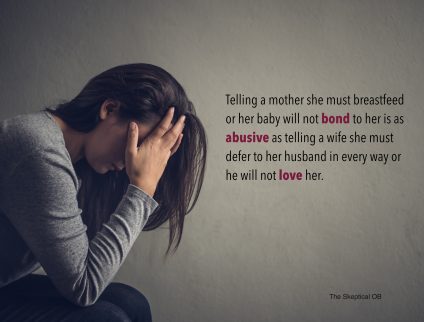
Mothers (and “experts”) verbally abuse women who don’t or won’t comply. Telling a mother she must breastfeed or her baby will not bond to her is as abusive as telling a wife she must defer to her husband in every way or he will not love her. Both are ugly lies that serve no other purpose than to force women’s acquiescence.

Sadly, the journalists at NPR are every bit as socialized to such misogynistic beliefs.

Although they correctly identify the pressure to breastfeed as a trigger for postpartum psychosis, their “solution” is bizarre in the extreme.

The writer of the NPR piece approvingly describes a psychiatric facility designed for postpartum treatment:

Every room has a hospital-grade breast pump, Kimmel says, and there’s a lactation consultant who helps women with breastfeeding. The unit has a designated refrigerator for moms to store pumped milk.

What message does that send? It’s the equivalent of treating a woman who was beaten for burning her husband’s dinner by providing her with a kitchen and a cooking instructor.

It reinforces the same misguided, misogynist beliefs that brought her to this deadly impasse in the first place.

Fortunately, Lisa understood the opposite.

She had a second child but did not suffer a recurrence:

The psychosis did not come back after Vivian’s birth, in part because of all the precautions Lisa took. She made sure she got enough sleep. She gave herself permission to give up breastfeeding if it became too much.

“We’ve got so many messages of just self-sacrifice,” Lisa says. ” ‘Do anything for your kids.’ ‘Drop everything. That’s what it means to be a good mom.’ And for me, that’s not what made me a good mom. That’s what made me fall apart.

Words that other mothers struggling to meet unreasonable goals ought to take to heart. Because babies don’t require perfection from mothers; only other adults do.

You have my permission to stop breastfeeding

approved square stamp

I’ve heard from quite a few women that they initially found my website when they were googling “am I a bad mother for not breastfeeding?” or something similar. They write with gratitude that I reassured them that breastfeeding has nothing to do with it, that the benefits of breastfeeding have been exaggerated, and that their pain, suffering and mental health are worthy of consideration, too. As a result, they realize that it is okay to supplement their breastfed babies with formula, or give up breastfeeding altogether.

So today I want to make it official: you have my permission to stop breastfeeding!

You have my permission to stop breastfeeding (or supplement) if your baby seems frantic with hunger even after nursing repeatedly for long periods of time. His comfort is more important than what any lactation consultant has to say.

[pullquote align=”right” cite=”” link=”” color=”” class=”” size=””]There is nothing in breastmilk that your baby needs more than your continued mental health.[/pullquote]

You have my permission to stop breastfeeding (or supplement) if your baby is not growing well, or worse, continues to lose weight after the first few days. The health of her brain is more important than your Facebook friends’ satisfaction that you are mirroring their own choices back to them.

You have my permission to stop breastfeeding (or supplement) if breastfeeding has become excruciating because of cracked, bleeding nipples, infections or no particular reason that you can identify. You are part of the much vaunted mother-baby dyad and your comfort matters, too.

You have my permission stop breastfeeding (or supplement) if you’ve been told you must subject your baby to the pain of tongue tie surgery if you want to breastfeed successfully and you can’t bear to do it.

You have my permission to stop breastfeeding (or supplement) if waking multiple times each night to nurse has left you incapacitated by exhaustion. Sleep deprivation is a risk factor for postpartum depression and you should to do everything you can to avoid that.

You have my permission to stop breastfeeding (or supplement) if you think you may be suffering from postpartum depression or postpartum anxiety. There is nothing in breastmilk that your baby needs more than your continued mental health … absolutely, positively NOTHING.

You have my permission to stop breastfeeding (or supplement) if you feel that breastfeeding is blighting your relationship with your infant. If you are beginning to resent your baby for being the source of your pain or if you simply can’t enjoy your baby because breastfeeding worries and attempts are occupying every spare moment, you can cut back or end breastfeeding altogether.

You have my permission to stop breastfeeding (or supplement) because in industrialized countries the benefits of breastfeeding term babies are so trivial as to be undetectable in the population. I would never give permission for anything that might harm your baby like refusing vaccines, but I know it makes no difference whether your baby gets breastmilk or formula.

You have my permission to stop breastfeeding (or supplement) because the risks of breastfeeding with insufficient breastmilk are not trivial: hypernatremic dehydration, hypoglycemia, kernicterus (severe jaundice), brain injuries and deaths. Indeed, exclusive breastfeeding at hospital discharge is probably the greatest risk factor for readmission.

You have my permission to stop breastfeeding (or supplement) because while breastfeeding may reduce the incidence of SIDS, pacifier use reduces it even more.

You have my permission to stop breastfeeding (or supplement) because NONE of the claims about breastfeeding and the microbiome have been substantiated.

You have my permission to stop breastfeeding (or supplement) because anger at formula manufacturers has led major professional societies to say and do nearly anything to discourage formula feeding even though it is an excellent option.

You have my permission to stop breastfeeding (or supplement) because the truth is that breastfeeding is a class signifier, not a health choice. Almost all the purported benefits of breastfeeding are actually benefits of the higher education level and socio-economic class of those who breastfeed, not breastfeeding itself. That’s why intending to breastfeed provides the same benefits as actually breastfeeding.

You have my permission to use or supplement with formula because buying someone else’s breastmilk is a waste of money better spent on saving for your child’s college education. It has NEVER been shown that donor breastmilk has any benefits for term babies.

You have my permission to never start breastfeeding in the first place. It’s your baby and your breasts. It should be your decision and no one else’s.

Who am I that my permission ought to matter? A medical professional recently complained that people only listen to me because of my Harvard education and training. If that’s the case, I won’t hesitate to take advantage of it. I am a Harvard educated, Harvard trained obstetrician-gynecologist who happily and successfully breastfed my own four children. That’s how I know it doesn’t make me a better mother than someone who formula feeds.

Of course you don’t need my permission at all. You could give yourself permission, but I recognize that some mothers, mired in the exhaustion of new motherhood and buffetted by the dire warnings of everyone from lactation consultants to Facebook friends, wouldn’t dare give themselves permission to ignore middle and upper middle class mothering norms. If you won’t give yourself permission, I hereby give you permission.

Just the fact that you’ve been consumed with worry about “am I a good mother?” means you already are!

Scientific American is DEAD wrong about midwives

4839E11D-C963-4AC5-A963-AFAB40E79C23

We can thank the Editors at Scientific American for illustrating the famous H.L Mencken quote:

…[T]here is always a well-known solution to every human problem — neat, plausible, and wrong.

The U.S. Needs More Midwives for Better Maternity Care is a truly execrable piece lacking common sense, scientific support and historical accuracy. It’s neat, plausible and dead wrong.

[pullquote align=”right” cite=”” link=”” color=”” class=”” size=””]If mortality and C-section rates ROSE as the proportion of midwife attended births rose, how will increasing the number midwives make them fall? [/pullquote]

The ignorance is on display with the very first sentence:

Despite the astronomical sums that the U.S. spends on maternity care, mortality rates for women and infants are significantly higher in America than in other wealthy countries.

The fact is regardless of what ANY country pays on maternity care, mortality rates for black women and infant are significantly higher than other ethnic groups. The difference in mortality rates of industrialized countries largely reflects the proportion of black women in the population. “Whiter” countries have lower mortality rates.

For example, the US maternal mortality rate is 3-4X higher for black women than white women. In the UK, the difference is actually larger; black maternal mortality rate is 4-5X higher that of white women. So why does the UK have a lower maternal mortality rate than the US? Because black women represent 12% of the US population and less than 4% of the UK population.

…[T]he rate of cesarean sections is exceedingly high at 32 percent—the World Health Organization considers the ideal rate to be around 10 percent—and 13 percent of women report feeling pressured by their providers to have the procedure.

The World Health Organization FABRICATED their “ideal” C-section rate and as they themeselves have publicly acknowledged, there is no evidence and there has never been any evidence to support it. The best existing research on the topic shows that a MINIMUM C-section rate of 19% is necessary for low maternal and neonatal mortality and that rates above 40% are also compatible with excellent outcomes.

Having utterly mischaracterized the problem, the Editors offer their “solution:

Widespread adoption of midwife-directed care could alleviate all these problems. In many other developed countries, such as the U.K., France and Australia, midwifery is at least as common as care by obstetricians.

There is precisely ZERO evidence to support that claim. What are the C-section rates in these countries? It’s 33% in Australia, 26.2% in the UK and 20.8%. That’s hardly a ringing endorsement for the role of midwives in lowering the C-section rate.

What about maternal mortality? Women in the US die for LACK of access to high tech maternity care, the very care that midwives don’t provide.

A recent paper in New England Journal of Medicine What We Can Do about Maternal Mortality — And How to Do It Quickly offers four separate recommendations for reducing maternal mortality and all of them involve MORE high tech care, not less.

And if that weren’t enough to convince you that the Editors at Scientific American have no idea what they are talking about, consider this: the US C-section rate and maternal mortality rates have risen steadily as the proportion of midwife attended deliveries increased. How will increasing the number of midwives further lower these rates in the future when they couldn’t do so in the past?

In the U.S., certified midwives and nurse-midwives must hold a graduate degree from an institution accredited by the American College of Nurse-Midwives, and certified professional midwives must undergo at least two years of intensive training. This is designed to make midwives experts in normal physiological pregnancy and birth.

But whereas certified nurse midwives get similar education and training to European, Australian and Canadian midwives and meet the ICM [International Confederation of Midwives] international standards, “certified professional midwives” do not. Indeed, CPMs aren’t really midwives; they are lay people who are not allowed to practice in any other country in the industrialized world.

Most practicing CPMs have no education beyond a correspondence course and an apprenticeship with another substandard CPM. To understand just how poorly educated and trained these women are: the requirements for the CPM were “strengthened” in 2012 to mandate a high school degree. Almost all CPMs work outside hospitals at home or in unaccredited birth centers. Their neonatal mortality rates are 3-9X higher than those of nurse midwives. The Editors at Scientific American appear to have no understanding of this.

Nor do they understand that a midwifery who is an “expert in normal birth” is about as useful as meteorologist who is an expert in sunny whether. When birth is uncomplicated, you don’t need an any attendant, let alone an expert. You only need an expert when complications occur, the very situation for which CPMs lack education and training.

There’s much more wrong with the piece, including its revisionist history of the decline of midwifery care, but it’s enough to know that its central claims are flat out false. There is NO EVIDENCE that midwifery care decreases the C-section rate and NO EVIDENCE that midwives decrease the maternal mortality rate. Moreover, for the past decade the UK, where midwives are gatekeepers of maternity care has been rocked by a growing series of scandals involving the preventable deaths of dozens, perhaps hundreds of babies and mothers. Why did these babies and mothers die and why did hundreds more sustain severe injuries? In nearly every case it was because midwives refused to call for the doctors who could have saved them for fear of losing control over the patients.

Highly educated, highly trained nurse midwives are an asset in any US maternity care setting. I’ve worked with many and have high praise for the care they can provide BUT there’s precisely ZERO evidence that increasing the proportion of midwife attended births has any impact on either C-section rates or mortality rates. The Editors of Scientific American should be embarrassed that they ignored the scientific evidence — indeed appear to be utterly unaware of its existence — and printed midwifery marketing propaganda instead.

Your baby doesn’t need you to suffer

happy mother's day! baby son gives flowersfor mother on holiday

Yesterday I wrote about Meg Nagle, the Milk Meg, and her strenuous efforts to normalize infant starvation and maternal exhaustion. She’s hardly alone; nearly all lactation professionals have been desperately working to normalize infant suffering. It’s integral to the ongoing effort to promote breastfeeding regardless of the increasing rate of neonatal dehydration, starvation, brain injuries, falls from mothers’ hospital beds and smothering deaths within them. Sadly, their efforts are bearing fruit for them and suffering for babies. Exclusive breastfeeding on discharge has become the single biggest risk factor for hospital readmission.

[pullquote align=”right” cite=”” link=”” color=”” class=”” size=””]Who benefits from normalizing maternal suffering? Natural childbirth advocates, lactivists and misogynists.[/pullquote]

When it comes to normalizing maternal suffering, Meg and her lactation colleagues have lots of company. What are natural childbirth advocates and midwives seeking to promote “normal birth” doing if not normalizing maternal agony? And what are advocates of attachment parenting doing if not normalizing women restricting themselves to “women’s work”?

No doubt you’ve heard their admonitions:

Labor pain is good pain!

Babies do not need to learn how to fall asleep on their own. Just breastfeed!

If you’re too tired to care for your baby in the hospital, what are you going to do when you get home?

You should stop taking your antidepressants or the medications that control your ulcerative colitis or your epilepsy so you can breastfeed!

So how can you stay comfortable, rested and healthy when there are so many “professionals” who think you should be suffering instead?

Just remember: your baby doesn’t need you to suffer.

There is NO benefit to your baby from enduring labor pain.

Sure the baby must exit your body somehow and a significant amount of pain is unavoidable either from labor pain or C-section pain but there’s no harm to your baby from minimizing either.

There is NO benefit to your baby from “normal birth.”

Yes, I realize that this is the bread and butter of midwives, doulas and childbirth educators, but their economic wellbeing pales in significance compared to the health of your baby and yourself.

C-sections are safer for babies. The liberal use of interventions is preventive medicine. And waiting for your due date to come and go actually increases the risk of complications for both you and your baby.

There is virtually NO benefit to your term baby from breastfeeding.

Indeed, the benefits are so small that they are literally undetectable in large populations. Breastfeeding is a good thing but it’s only one of two excellent ways to nourish a baby.

Therefore, there is no benefit to exclusive breastfeeding.

It’s great if it works for you and your baby, but it’s equally fine if it doesn’t. There’s no need to torture yourself pumping between feedings if you have insufficient breastmilk. There’s no need to get up in the middle of the night to breastfeed if someone else can give your baby a bottle of formula.

There is no benefit for you in waking up multiple times each night.

Yes, your baby must be fed when he or she is hungry and must be comforted when ill or in distress, but that doesn’t mean that you always have to be the one to do it. Your partner can help, your parents/in-laws can help, nannies and au pairs can help.

There is no benefit to having your baby strapped to you, sleeping in your own bed, or always within inches of wherever you are.

Some women find those things enjoyable and should of course do them (with the exception of bed-sharing, which increases the risk of SIDS). But other women need time and space to themselves, need to socialize with others without the baby, or need to work. There is nothing wrong with enjoying them.

Don’t get me wrong, you WILL suffer even if you take heed of the above precepts. You will suffer some pain and exhaustion because it is impossible to completely avoid either. But most of your suffering will have nothing to do with childbirth, infant feeding or attachment parenting.

You will suffer when your child is ill.

You will suffer when your child is in pain, physical or psychological.

You will suffer if your child gets injured.

You will suffer if your child has a disability, a learning issue, difficulty making friends at school.

You will suffer with worry over and over and over again. The only thing that will change as the years go by is the specifics of what you are worry about this time.

But none of that benefits your child, either.

If maternal suffering doesn’t benefit children, who does it benefit?

It benefits those who make money by convincing women to endure the suffering, and sell books, courses and service to support them through the suffering: midwives, doulas and lactation consultants in particular.

And it benefits misogynists who believe that women exist to suffer and sacrifice for others. As sociologist Pam Lowe explains in Reproductive Health and Maternal Sacrifice:

…At its heart, maternal sacrifice is the notion that ‘proper’ women put the welfare of children, whether born, in utero, or not yet conceived, over and above any choices and/or desires of their own. The idea of maternal sacrifice acts as a powerful signifier in judging women’s behaviour…

Sunna Simmonardottir notes:

…[M]others are instructed to direct all their physical and emotional capacities at their children and … the maternal body and mind is subject to disciplinary practises…

Susan Franzblau has written:

The idea that women are evolutionarily prepared to mother … is consistent with a long historical tradition of using essentialist discourse to predetermine and control women’s reproductive tasks and children’s rearing needs… If the treatment of women differs from the treatment of men, such treatment could be justified in terms of its biological and evolutionary purposes…

In other words, it benefits many people but not women themselves.

Natural childbirth advocates — midwives, doulas, purveyors of books and courses — should stop normalizing maternal suffering.

Lactation professionals and lactivists should stop normalizing maternal suffering.

Misogynists should stop normalizing maternal suffering.

I have no hope of convincing any of these people to do so. They have too much at stake financially or psychologically to give up what has been an enriching and enjoyable practice. But I am working diligently to convince women that they don’t have to listen to those who normalize their suffering.

Your baby doesn’t need you to suffer. Don’t let anyone else tell you otherwise.

Milk Meg and the normalization of infant starvation and maternal exhaustion

word dystopia printed on paper macro

I have an advantage over most of you, including most lactation professionals. I’m old enough to remember when neither infant starvation nor maternal exhaustion were touted as “normal.”

I did my medical training — and I breastfed my four children — before promoting breastfeeding was deformed by lactation professionals into dystopian efforts to force women to breastfeed regardless of their wishes and regardless of the consequences.

[pullquote align=”right” cite=”” link=”” color=”” class=”” size=””]As the harms of aggressive breastfeeding promotion have become more common, lactation professionals have devoted themselves to normalizing those harms.[/pullquote]

What do I mean by “dystopian”? A dystopian society is one in which oppressive social control is required to support the illusion of perfection. Sadly, contemporary lactivists imagine that oppressive social controls are required to support the illusion that breastfeeding is perfect for every mother and every baby.

The Baby Friendly Hospital Initiative (a truly dystopian name for an initiative that often harms both babies and mothers) is the paradigmatic example of contemporary lactivism. It involves mandatory education efforts, muzzling of providers, locking up infant formula and forcing women to sign consent forms detailing its “dangers.” Even worse, because lactivists cannot admit that breastfeeding is anything but perfect, it has led to a rise in serious iatrogenic complications including infant dehydration, starvation, brain injury and even death.

The BFHI is an institutional effort but the regime, like any dystopian regime, has many enforcers in the form of lactation professionals who make their money by promoting breastfeeding. Obviously, there is nothing wrong with the concept of lactation professionals. It is perfectly reasonable for some women to make money offering education and support that many women want.

The problem occurs when lactation professionals forget they exist to support women and babies and imagine they exist to support a regime of universal breastfeeding. Sadly, as the harms of aggressive breastfeeding promotion have become more common, lactation professionals have devoted themselves to normalizing those harms.

How do lactivists normalize infant starvation? They:

  • Lie about stomach size
  • Assert cluster feeding is normal
  • Insist poor weight gain is acceptable
  • Claim “one bottle” can destroy supply
  • Tell women to ignore pediatricians who are concerned

A hungry baby is one who cannot settle and wakes up repeatedly through the night to feed. Thus lactation professionals have been forced to normalize maternal exhaustion.

Meg Nagle has become a world leader in normalizing both infant starvation and maternal exhaustion. That effort is encapsulated in her motto, “Just Keep Boobin’.” It is meant to encourage women to keep breastfeeding no matter what happens, to never question whether a baby might be starving, and to always ignore her own needs in favor of breastfeeding.

Meg has a nearly endless supply of memes and I encourage you to look them over. Nearly all reflect her desperate effort to normalize infant starvation, maternal exhaustion or both.

Normalizing infant starvation

The frequency in which your baby feeds is not an indication of how much milk they are getting.

And:

A baby who is unsettled after a breastfeed or feeding constantly will not autonomatically need formula…

And:

Yes I’m eating but … You do know that I’ll still want to boob every five minutes right??

And:

A schedule of breastfeeds every three hours is often not looked at fondly by your baby. Why? Because babies breastfeeding for so many reasons than just hunger…

And:

The amount you pump is not an indication of how much you make or how much your baby receives.

And:

Don’t worry about your baby’s … feeding cues. The second they make a peep … just breastfeed them.

Normalizing maternal exhaustion

Feeding your baby back to sleep. Not a mistake, the biological norm! Most babies will need a mid-nap breastfeed and frequent feeds during the night. For months or years.

And:

I finally discovered the three easy steps to breastfeeding: Cancel everything else in your life. Lay down topless on the couch with your child. Stay there for 2 years.

And:

Babies do not need to learn how to fall asleep on their own. They need to fall asleep with … some boobie.

And:

Your baby is not “using you” as a pacifier. A pacifier takes the place of what normally happens at the breast.

And:

Mothering THROUGH breastfeeding at night is the biological norm.

And:

Instead of asking her, “Is your baby sleeping through the night?” try, “is your baby breastfeeding well through the night.

And:

Is it normal for my toddler to breastfeed all the time day and night? Yes. The end.

It goes on and on and on and on. And just in case you were unclear that Meg is trying to normalize infant starvation and maternal exhaustion, she helpfully includes the word “normal” and even the hashtag #normalizenightwaking.

In the dystopian novel 1984, George Orwell introduced the idea that vocabulary has the power to control thought. In 1984, the government, in an effort to control citizens and force them into submission, perverts the meaning of common words and phrases to promote approved views and stamp out unapproved views. The classic example of this effort is the following quote:

War is peace.
Freedom is slavery.
Ignorance is strength.

In the current lactivist dystopia:

Frequent, frantic efforts to take in enough nutrients is “bonding.”
Sleep constantly broken by hunger is “soothing.”

Orwell also said:

Orthodoxy means not thinking – not needing to think. Orthodoxy is unconsciousness.

Meg and other lactation professionals don’t need to think; they’ve been told what to think in order to maintain the oppressive social controls required to support the illusion that breastfeeding is perfect for every mother and every baby. Lactation professionals reflexively and unconsciously normalize the abnormal … and that includes normalizing infant starvation and maternal exhaustion

Natural childbirth and breastfeeding are class signifiers, not signs of maternal devotion

1544019E-DE8E-4790-9B02-C3CD2F272AB2

Natural childbirth advocates and lactivists like to claim that I hate vaginal births and breastfeeding. Never mind that I had four vaginal births and breastfed all four of my children. It seems beyond their powers of reasoning to imagine that someone could choose something for herself without insisting that everyone else ought to choose it too. They cannot fathom that a choice could be “best for me,” but that doesn’t make it “best.”

The claims made about natural childbirth and breastfeeding are not supported by the scientific evidence; benefits are exaggerated by professionals who earn their living from promoting them; and they are fundamentally misogynistic, inevitably requiring as they do re-immuring women into the home. So why has it become conventional wisdom that natural childbirth and breastfeeding are best? Because they denote privilege.

[pullquote align=”right” cite=”” link=”” color=”” class=”” size=””]The ugly truth is that breastfeeding has become “best” because only the “best” people can afford to do it.[/pullquote]

Privilege is a sine qua non of natural mothering and not merely the economic privilege that allows natural mothers to purchase expensive specialty products. One must have access to a highly technological lifestyle in order to give meaning to rejecting it.

I’m not the only one who has realized this. So has Elizabeth Carrid-Halkett, although in her book The Sum of Small Things: A Theory of the Aspirational Class she refers to it a bit differently: natural childbirth and breastfeeding are class signifiers.

Who are the aspirational class? It’s not merely a function of wealth.

…[T]hey reveal their class position through cultural signifiers that convey their acquisition of knowledge and value system—dinner party conversation around opinion pieces, bumper stickers that express political views and support for Greenpeace, and showing up at farmer’s markets. These behaviors and signifiers imply aspirational class values and also suggest the knowledge acquired to form them.

Thus:

Social norms and goods of the aspirational class reflect an implicit knowledge and procurement of knowledge that informs their consumption practices. Aspirational class leisure, whether reading the Economist, listening to NPR, or taking a yoga class, is imbued with knowledge and productivity in the same spirit as work.

And motherhood is a particular focus of the aspirational class, specifically because of the conspicuous leisure required to “perform” it. That’s why breastfeeding, for example, is so closely associated with maternal education and socio-economic class.

Mothering, writ large, has become a new channel for engaging in what Veblen termed conspicuous leisure. Breast-feeding and birthing practices are the most obvious examples of this, as playing sports or studying Greek were in Veblen’s time. Unlike a Louis Vuitton bag or a luxury car, these signifiers are not explicitly expensive but they do require significant investments of time, an even more precious commodity in modern society…

Wait! Aren’t these practices free for everyone?

While many aspects of motherhood seem costless — birthing choices, co-sleeping, carrying your baby, breastfeeding — women can only engage in these activities if they have the luxury of time and leisure and membership into cultural and social groups that encourage this form of motherhood. Certain maternal choices demonstrate the possession of both time and cultural capital that is truly impossible for many women to attain.

The author references French scholar Roland Barthes and his book Mythologies:

…Through the dominant values upheld by society we create “myths” around particular practices and consumer goods, which become “signifiers” of particular messages or dominant belief systems.

In our society, we have created a myth around motherhood, the myth of “attachment” mothering, which has become a critical signifier of membership in the aspirational class. Breastfeeding — because it can be “performed” before others — has become perhaps the most important signifier of all.

It is mainly prevalent in particular cultural and class groups — women with higher education levels who learn about the benefits of breast-feeding and women of higher income groups who can afford the insurance to deliver in baby-friendly hospitals with round-the-clock nurses and lactation consultants providing breastfeeding classes, expensive and efficient breast pumps, and help throughout the mother’s entire stay. One of the other significant predictors of breast-feeding success is duration of maternity leave: … In the United States, good maternity leave is a rare thing for all women, but those who receive it are primarily women in high-level professional jobs. …

What about everyone else?

…[A]s the sociologist Cynthia Colen summed it up, “In the United States, where only 12 percent of female workers and 5 percent of female low-wage workers have access to paid leave, most women are required to forgo income in order to breast-feed. This may be a less-than-ideal situation for middle-class women but an impossible situation for poor women who already are having trouble making ends meet.

That’s yet another reason why aggressive efforts to promote breastfeeding are cruel in the extreme:

Given that breast-feeding requires a whole host of resources and time that poor mothers may not have, low-income mothers are limited in their ability to breast-feed, even if it is not physiologically based. Breast-feeding might be the ideal choice, but these women often do not have the chance to do so.

The ugly truth is that breastfeeding has become “best” because only the “best” people can afford to do it.

Breastfeeding is the designer handbag of mothering. No woman should feel guilty about not owning a designer handbag and no mother should feel guilty about not breastfeeding. Just as a regular handbag is an excellent way to carry your wallet and car keys, formula feeding is an excellent way to nourish an infant. Contrary to claims of the aspirational class, breastfeeding is merely a class signifier, NOT a sign of maternal devotion.

It’s good if your baby doesn’t sleep through the night? That’s misogynistic mothering bullshit.

CB02F321-4AF2-4872-B2F1-B23BC8A4D6A6

This is public service announcement on how to protect yourself from misogynistic mothering bullshit (MMB). Sadly, too much of what passes for parenting advice in 2019 is MMB.

Consider the latest example. Why it’s actually a good thing if your baby doesn’t sleep through the night is misogynistic mothering bullshit of the highest order, involving as it does fabrication of benefits for babies to justify suffering of mothers.

Professor Peter Fleming who specialises in developmental psychology at the University of Bristol told Buzzfeed that babies are not designed to sleep for long periods, and it’s normal for them to wake.

“It’s not good for them, and there is absolutely no evidence whatsoever that there is any benefit to anybody from having a child that sleeps longer and consistently.

That is classic MMB, but like most misogynistic mothering lies it’s bullshit with a purpose. The purpose is to shame mothers who dare to consider their own needs.

[pullquote align=”right” cite=”” link=”” color=”” class=”” size=””]It’s bullshit with a purpose: to shame mothers who dare to consider their own needs.[/pullquote]

How can you recognize MMB like this. I hereby offer Tuteur’s Criteria to help you protect yourself.

1. Was it promulgated by an old white man?

Misogynistic mothering bullshit is almost always propagated by old white men. This is neither a necessary nor a sufficient criterion of MMB, but it is startlingly common. Don’t misunderstand me; old white men aren’t all bad and can occasionally offer scientifically valid insights about mothering. But Dr. Peter Fleming follows the path from Grantly Dick-Read in the 1930’s to William Sears in the 1990’s, a long tradition of old white men offering bullshit advice meant to keep women immured in the home.

2. Does it invokes the naturalistic fallacy and/or the Panglossian paradigm?

The naturalistic fallacy is the is/ought fallacy; if something is a certain way in nature, that’s the best way for it to be. The Panglossian paradigm is the belief that every human organ/function/behavior is a product of intense evolutionary selection, as opposed to the reality that evolution does not produce perfection, that traits beneficial in one evolutionary environment may not be beneficial in another and that there are genetic limits to evolution.

Invoking the “design” of babies, as Dr. Fleming does above, represents both the naturalistic fallacy and the Panglossian paradigm. Even if babies were “designed” to wake during the night that doesn’t mean it’s good for babies or good for mothers.

3. Does it rely on the noble savage trope, homogenizing tens of thousands of years of human existence and thousands of cultures into one set of “ancestors” who had one set of parenting practices?

There is no single way that human mothers have raised children across time and cultures. Moreover, existing indigenous people are not necessarily representative of ancient human cultures any more than existing animals are representative of animals that existed in the past.

There’s no clearer indicator of the noble savage trope that the racist invocation of black African mothers. Dr. Fleming once again comes through:

I’ve done quite a lot of work in Africa and in various other places and babies are carried around with their mother all the time. They’re asleep when they need to sleep and they’re awake when they need to be awake, but they’re constantly with their mother and that facilitates breastfeeding.

4. Does it fabricate benefits for babies that are not supported by or are directly contradicted by scientific evidence?

Dr. Fleming does not appear to be constrained by scientific evidence at all. He surrenders himself to fantasy. He claims that there are no benefits to babies from sleeping well when existing scientific evidence is either agnostic on that point or associates improved sleep with improved infant wellbeing. His claim that mothers don’t benefit from long stretches of uninterrupted sleep is MMB par excellence. There is a reason why sleep deprivation is considered torture … because it IS torture. Poor quality sleep is associated with postpartum depression and other harms to women.

Professor Fleming explains that there’s a very clever reason why babies wake through the night.

“Biologically that’s a big advantage because they will have more attention from their two primary caregivers at that time of day than at any other, because there are fewer distractions.

Is this guy on drugs? Does he imagine that parenting across time and culture involved fathers caring for their babies? What evidence does he have that by waking up during the night improved the father-infant relationship or the overall wellbeing of babies? None, of course. His prejudice in favor of traditional two parent nuclear families is showing here.

Professor Fleming makes the connection between very high levels of developmental and intellectual achievement and not sleeping throughout the night.

It’s hard to find a clearer example of MMB than that nonsensical claim.

5. Does it imply that human evolution stopped 20,000 years ago and that our current culture is incompatible with our evolution?

Professor Fleming says biological sleep patterns can’t suddenly be changed just because the modern world operates to a different schedule than humans did thousands of years ago.

Fleming said: “One needs to remember that society changes faster than biology. A biological pattern that’s taken half a million years to develop can’t just be suddenly ignored and turned around…

Really? Then how did humans develop lactose tolerance very quickly after the introduction of animal milk into the human diet? Because the mutation that allowed humans to benefit from the ability to digest animal milk was present in the human population and selection pressure quickly favored it and allowed for rapid spread.

6. Does it promote the modern nuclear family with mother relegated to the home as “best,” ignoring the traditional tribal band where everyone worked to improve the survival of the group.

Though nearly all MMB claims purport to be about restoring traditional mothering practices, the real goal is making recent mothering practices (those developed within the past 1-2 centuries) normative. It is very similar in that sense to efforts by homophobic activists to restore “traditional marriage” imagining that a man and a woman marrying for love is traditional when the truth is that “traditional marriage” was about families trading their sons and daughters for protective alliances and material gain.

To qualify as MMB, a claim doesn’t need to meet all of Tuteur’s Criteria for misogynistic mothering bullshit but Dr. Fleming’s claims do meet them all. What’s really going on here?

Dr. Fleming seeks to promote breastfeeding and the deadly practice of bedsharing.

[Babies are] asleep when they need to sleep and they’re awake when they need to be awake, but they’re constantly with their mother and that facilitates breastfeeding…

The idea that sharing a sleep surface with your baby is in anyway wrong, abnormal or peculiar is just nonsense,” he says. “Most people in the world would see that view as bizarre – 90pc of the human infants on this planet sleep that way every night and over the half a million years of human evolution that’s been the norm.

Over the half million years of human evolution, massive child mortality has also been the norm. Just because something is natural doesn’t make it safe, healthy or “best.”