All posts by Amy Tuteur, MD

We mothering vs. me mothering: neoliberalism, paranoia and vaccination

Medical vials and Syringe, Isolated on Blue background

Earlier this week I wrote about the closing of well baby nurseries as an expression of neoliberal philosophy:

Neoliberalism places a premium on individual responsibility and minimizes the value of collective action. We see this in contemporary political philosophies that venerate private industry and derogate goverment support. But we also see its impact in mothering philosophies that place a premium on individual maternal action and ignore the impact of the family and “the village.”

[pullquote align=”right” cite=”” link=”” color=”” class=”” size=””]There’s no better example of the triumph of ‘me mothering’ than the anti-vaccination movement.[/pullquote]

The closing of hospital well baby nurseries is a paradigmatic expression of neoliberal philosophy. In order to “promote breastfeeding,” new mothers are being forced to room in 24/7 with their newborns. It doesn’t matter that these women are exhausted, in pain and often taking sedating medications. Promoting breastfeeding is considered to be more important and neoliberal philosophy places responsibility squarely on the mother.

In other words, neoliberalism ignores our cultural history of ‘we mothering’ in favor of ‘me mothering.’ For example when lactivists offer breastfeeding “support” they aren’t offering to share women’s mothering burdens; they are hectoring women to assume individual responsibility.

Moreover neoliberalism doesn’t merely pressure women to take on the entire burden of children’s health, wellbeing, brain function and future economic prowess; it actively attempts to discredit the value and possibility of collective action to improve children’s health. Vaccination is the archetypical example of the triumph of ‘we mothering.’ And there’s no better example of the triumph of ‘me mothering’ than the anti-vaccination movement.

Vaccination works through collective action. We cannot vaccinate 100% of the population since some are allergic or immunocompromised and infants are too young for some vaccinations. Vaccination works through herd immunity. Vaccines dramatically reducing the chance that an infected person will encounter an unprotected person.

Imagine that little Ainsley comes in close contact with 10 children per day. Now imagine that Ainsley develops diphtheria. Who is likely to catch diphtheria from Ainsley? If 99% of children are vaccinated and the vaccine is 95% effective, the odds are low that any of the 10 children she comes in contract with could get diphtheria. Thus, the outbreak of diphtheria ends with Ainsley (though it may end poor Ainsley’s life).

Now imagine that only 50% of children are vaccinated against diphtheria. That means that half the children are likely to be susceptible, and therefore diphtheria is almost certain to be transmitted. And since the children who catch diphtheria from Ainsley are going to expose additional children who aren’t vaccinated, the disease begins to spread like wild fire.

The effectiveness of vaccines depends on collective action, precisely the kind of action that is devalued in neoliberal philosophy.

But vaccines have been a spectacular success. How could anyone doubt their efficacy and safety?

To privilege individual over collective action, neoliberalism takes advantage of the paranoid style in American thinking, the belief that bad things are caused by conspiracies. Rather than acknowledge the role of chance, misunderstanding and just plain stupidity in government or industry blunders, the paranoid style leads people to believe that there is no such thing as mistakes, only deliberate, nefarious plots.

An irreducible tiny fraction of children will be harmed by vaccines. Indeed, vaccine consent forms inform parents of the rare risk of brain injury or death. Those afflicted with the paranoid style imagine that pharmaceutical companies deliberately allow injuries that could easily be prevented and have hidden the scale of those injuries. In addition, there are children who suffer from conditions, like autism, whose cause is still unknown. Those afflicted with the paranoid style look for someone to blame and vaccines, because of their ubiquity, are easy to blame.

It is hardly surprising then that neoliberal thinking, which places all responsibility for children’s health and wellbeing on individual parents, has led to the vaccination movement, which venerates individual action, especially action in defiance of authority. From the anti-vaxxer’s viewpoint, ‘we mothering’ has given us vaccine “injuries” and only ‘me mothering’ can prevent them.

Ironically, the same people who are quick to see nefarious economic motives to ‘we mothering’ projects like vaccination, are willfully blind to the economic motives of those who promote ‘me mothering.” Anti-vax is nothing if not a money making enterprise; profits are high because unlike pharmaceutical companies that have to demonstate efficacy and safety, anti-vaxxers simply monetize nonsense — books, websites, supplements, immune “boosters” and detoxes.

Anti-vax flourishes not because children are being injured by vaccines; they aren’t. It flourishes because the neoliberal mothering project derides the possibility of collection action to promote health, lays complete responsibility for child health and wellbeing on individual parents, and promotes a paranoid style of thinking.

Anti-vax advocacy dismisses ‘we mothering’ in favor of ‘me mothering.’ As a result children die, parents arrogantly trumpet ignorance and ‘me mothering’ advocates laugh all the way to the bank.

No, new study does NOT show tiny amounts of alcohol in pregnancy affect baby’s face

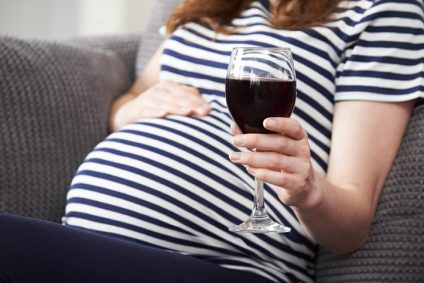
Close Up Of Pregnant Woman Drinking Red Wine

We have a terrible problem in contemporary scientific research. Or it would be more accurate to say we have two terrible problems.

First, a great deal of published research is junk, generally because of spurious statistical analysis.

Second, the media credulously publishes any press release, the more irresponsible the better.

[pullquote align=”right” cite=”” link=”” color=”” class=”” size=””]It doesn’t matter what the paper showed because the results are NOT statistically significant.[/pullquote]

Consider this story in STATNews, usually a reliable outlet for medical news. Entitled Babies’ face scans detect exposure to low amounts of alcohol in utero, it is remarkably injudicious. Why? Because by the authors’ own admission, their results AREN’T statistically significant.

Here’s a simple explanation of statistical significance:

When a statistic is significant, it simply means that you are very sure that the statistic is reliable.

So when results aren’t statistically significant, it means that the results are NOT reliable. In other words, the paper does NOT show what it claims to show.

STATNews reported:

…[C]an a small amount of drinking by an expectant mother show itself on her child’s face?

To answer that question, researchers in Australia analyzed three-dimensional images of over 400 children’s faces and heads around their first birthday. An algorithm … looked for any substantial deviations from a standardized template made from all of the children’s scans. The children’s mothers also answered surveys about their alcohol intake several times before giving birth — data that researchers used to separate them out into groups based on when and how much they drank…

So far, so good.

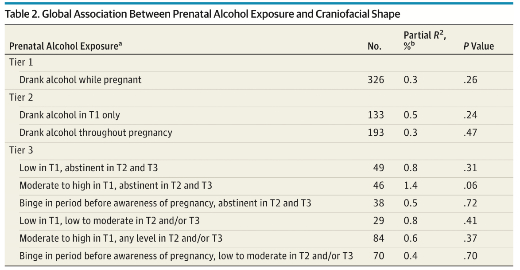
3-D facial scanning picked up some differences … It also picked up on one otherwise difficult-to-measure change called mid-facial hypoplasia, in which the center of the face develops more slowly than the eyes, forehead, and lower jaw. Perhaps most notably, there seemed to be slight differences in the mid-face and at the tip of nose even in the children of women who had only had a little to drink and only in the first trimester of their pregnancy. (However, almost no overall changes were statistically significant.)

The fact that the overall results weren’t statistically significant is not a minor issue that merits only a comment in parentheses. It is the most important thing about the study. In truth, the authors’ data shows that tiny amounts of alcohol do NOT affect a baby’s face. The people at STATNews should never have repeated the claim and certainly not titled their article based based on the erroneous claim.

No matter how they sliced and diced the data (by level of drinking or by trimester), the results are not statistically significant.

IMG_2534

It’s notoriously difficult to get negative results published. Perhaps this is why the authors kept slicing and dicing. They came up with this:

IMG_2536

The authors looked at whether the results sliced on the basis of how a mother FELT after drinking. Did she feel the effects of alcohol as usual or more quickly than usual? When the mother reported feeling the effects of alcohol as usual, there was still no difference in facial structure based on alcohol exposure. But when the mothers reported feeling the effects of alcohol more quickly than usual, two out of nine variables were statistically significant.

In what way is the mothers’ perception of alcohol effects relevant? I can’t think of any plausible reason to analyze the data that way besides p-hacking, aka data dredging.

What is p-hacking?

Data dredging (also data fishing, data snooping, and p-hacking) is the use of data mining to uncover patterns in data that can be presented as statistically significant, without first devising a specific hypothesis as to the underlying causality.

The process of data dredging involves automatically testing huge numbers of hypotheses about a single data set by exhaustively searching — perhaps for combinations of variables that might show a correlation, and perhaps for groups of cases or observations that show differences in their mean or in their breakdown by some other variable.

P-hacking occurs in a desperate effort to find something, anything, that is statistically significant in the data. If you engage in p-hacking you will almost always find something that is statistically significant because tests of statistical significance produce some false positives by definition.

When large numbers of tests are performed, some produce false results … hence 5% of randomly chosen hypotheses turn out to be significant at the 5% level, 1% turn out to be significant at the 1% significance level, and so on, by chance alone.

P-hacking leads to testing hypotheses suggested by the data and that is invalid:

If one looks long enough and in enough different places, eventually data can be found to support any hypothesis. Yet, these positive data do not by themselves constitute evidence that the hypothesis is correct. The negative test data that were thrown out are just as important, because they give one an idea of how common the positive results are compared to chance. Running an experiment, seeing a pattern in the data, proposing a hypothesis from that pattern, then using the same experimental data as evidence for the new hypothesis is extremely suspect, because data from all other experiments, completed or potential, has essentially been “thrown out” by choosing to look only at the experiments that suggested the new hypothesis in the first place.

When interviewing the mothers, the authors presumably asked a variety of questions. Then they apparently exhaustively searched for combinations of variables that might show statistical significance. When they found a few variables that were statistically significant if they sliced the data based on mothers’ perception of alcohol effect, they created a new hypothesis — even small amounts of alcohol affect the facial structure of children so long as the mothers feel the effects of alcohol sooner than they expected —- and use the data that generated the new hypothesis to “prove” the new hypothesis.

In other words, instead of acknowledging these few results, though statistically significant, are meaningless, the authors blithely ignore what they are required to take into account and brazenly conclude:

The results of this study suggest that even low levels of alcohol consumption can influence craniofacial development of the fetus and confirm that the first trimester is a critical period.

The truth is that their results confirm the EXACT OPPOSITE; there is no evidence that alcohol ingestion had any impact on facial structure no matter how desperately the authors wish to claim it.

The folks at STATNews should have understood that and should have debunked the paper, not compounded the problem of junk science by repeating the spurious claims.

Closing newborn nurseries: what if we’re doing postpartum breastfeeding support all wrong?

Dressing baby dolls

The central conceit of organized efforts at breastfeeding promotion such as the Baby Friendly Hospital Initiative (BFHI) is that we can best support breastfeeding by recapitulating the experience of our ancestors. The most obvious difference is technology. Hence lactivists have focused their efforts on depriving women of access to technological innovations like formula supplementation, pacifiers and well baby nurseries. Remove these “unnatural” additions, so the reasoning goes, and women will be inspired/pressured to make breastfeeding work.

But what if the obvious difference isn’t the most important one? What if we’re doing postpartum breastfeeding support all wrong because the critical difference is in our philosophy, not our technology?

[perfectpullquote align=”right” cite=”” link=”” color=”” class=”” size=””]A defining feature of postpartum care in nearly all other cultures is that mothers are NOT expected to exclusively care for their infants.[/perfectpullquote]

We live embedded in a neoliberal society. Neoliberalism is primarily an economic philosophy but it has important implications for the way that we think about families and individuals.

According to We Need to Talk about Family: Essays on Neoliberalism, the Family and Popular Culture:

Neoliberalism is usually defined as the expansion of economic thinking in all spheres of human activity, including the family, with emphasis on individualism and practices of extending and disseminating market policies to all institutions and forms of social action…

The individualistic conception of selfhood central to neoliberalism accepts that an individual is both an ideal locus of sovereignty and a site of governmental intervention. The individual is a rational, calculating unit, looking after her or his own needs. Moral responsibility is equated to rational action…

Neoliberalism places a premium on individual responsibility and minimizes the value of collective action. We see this in contemporary political philosophies that venerate private industry and derogate goverment support. But we also see its impact in mothering philosophies that place a premium on individual maternal action and ignore the impact of the family and “the village.”

In many ways, the philosophy of intensive parenting, aka attachment parenting, is an expression of neoliberal values.

Intensive parenting refers to a style of parenting defined by tremendous energy, time, money and financial resources being devoted to children and rationalised through the discourse of acting “in the best interest of the child.”

Although theoretically either parent can undertake intensive parenting, in practice it is nearly always the mother. Intensive mothering minimizes or ignores the value of grandparents, aunts, friends and neighbors. It is assumed that ONLY a mother working alone can meet a child’s needs. Because we live immersed in neoliberal culture, we forget that it is a relatively new philosophy that differs dramatically from the traditional philosophy that “it takes a village to raise a child.”

The closing of hospital well baby nurseries is a paradigmatic expression of neoliberal philosophy. In order to “promote breastfeeding,” new mothers are being forced to room in 24/7 with their newborns. It doesn’t matter that these women are exhausted, in pain and often taking sedating medications. Promoting breastfeeding is considered to be more important and neoliberal philosophy places responsibility squarely on the mother.

The results, not surprisingly, are deadly. Interventions Intended to Support Breastfeeding Updated Assessment of Benefits and Harms and in Unintended Consequences of Current Breastfeeding Initiatives, both published in JAMA in October 2016, attest to the growing number of preventable injuries and deaths that occur because babies, instead of being in the well baby nursery, are being smothered in and falling from their mothers hospital beds.

Moreover, the insistence of immediately placing full responsibility for childcare on postpartum mothers is in direct contradiction to everything we know about postpartum practices in other societies.

According to Traditional postpartum practices and rituals: a qualitative systematic review:

Organized support, usually in the form of family members caring for the new mother and her infant for a specified period of time, is almost universally provided in the early postpartum period by the mother, mother-in-law, other female relatives or husband. Respected elder female community members, traditional birth attendants or young women from the community may also be involved in providing care for the mother. The support often includes practical assistance (e.g., household chores or cooking), as well as information for the mother regarding how to care for herself and the infant…

Organized support typically corresponds to a prescribed period of rest, during which the mother is prohibited from performing her usual household chores. In most cultures, the rest period spans between 21 days and 5 weeks, and is considered a period of vulnerability for future illness.

In other words, a defining feature of postpartum care in nearly all other cultures is that mothers are NOT expected to exclusively care for their infants and are assumed to need assistance for WEEKS. New mothers can rest when and as often as they need to because others are there are always others available to care for the baby. In a very real sense, we’ve missed the critical difference between our ancient foremothers and contemporary mothers; the difference is not technology, it is support.

It’s very similar to the bizarre BFHI policy banning formula supplementation. As I’ve written previously, the practice of prelacteal feeding spans time and culture. Odds are high that it reflects the fact that 5-15% of women (or more) have insufficient or delayed production of breastmilk. Without supplements, those babies would have died of dehydration. With pre-lacteal feeds, babies lived who would otherwise have died. We’ve ignored those insights about supplementation, ascribing them to ignorance, in favor of our preferred belief that women in indigenous cultures breastfeed early and exclusively. Once again we’ve missed the critical difference between our indigenous foremothers and ourselves. Early supplementation of breastfeeding itself is not harmful; it only looks harmful when the only available prelacteal feeds are contaminated with bacteria.

In a very real sense, the BFHI is cargo cult science.

Physicist Richard Feynman coined the expression in his 1974 commencement address at CalTech.

…In the South Seas there is a cargo cult of people. During the war they saw airplanes land with lots of good materials, and they want the same thing to happen now. So they’ve arranged to imitate things like runways, to put fires along the sides of the runways, to make a wooden hut for a man to sit in, with two wooden pieces on his head like headphones and bars of bamboo sticking out like antennas –he’s the controller– and they wait for the airplanes to land… So I call these things cargo cult science, because they follow all the apparent precepts and forms of scientific investigation, but they’re missing something essential, because the planes don’t land.

Lactivists know that our ancient foremothers breastfed exclusively. They want the same thing to happen now. So they’ve arranged to imitate the lack of technology and they wait for women to breastfeeding exclusively. It’s cargo cult science because they follow what they think are the precepts and forms of ancient breastfeeding support, but they are missing the most essential insight since the BFHI doesn’t appear to increase breastfeeding rates.

The most essential insight is that supporting breastfeeding does not require banning technology; it requires providing care. In closing well baby nurseries, lactivists imagine they are copying nature but they’re doing the exact opposite!

Lactivists don’t understand this because they are prisoners of neoliberal philosophy that places all responsibility for outcomes on mothers and accuses them of moral laxity for failing to comply with breastfeeding injunctions.

If lactivists really want to increase breastfeeding rates they’d stop trying to recapitulate the absence of technology in nature and concentrate on recapitulating the different philosophy in nature: it takes a village offering a tremendous amount of support to raise a child. Instead of closing well baby nurseries, they’d be demanding that they stay open.

Make America Weak Again

IMG_2509

I’m not going to lie: I don’t have much respect for Trump voters. It amazes me that anyone with two functioning brain cells could vote for a brutal, stupid, narcissist whose previous career was notable only for his celebrity despite of a parade of bankruptcies, endless evidence of cheating and fraud, as well as personal viciousness. I recognized that many Trump supporters — with the aid of FoxNews, Breitbart and social media — recused themselves from reality, preferring to feast on an endless banquet of “alternative facts” because real facts don’t comport with right wing fantasies.

But even I’m surprised by the level of gullibility and stupidity to which Trumps supporters have sunk. Trump is behaving like a wholly owned subsidiary of Russia. and his supporters don’t seem to register that it appears that Trump is being led around by the nose by Vladimir Putin.

[pullquote align=”right” cite=”” link=”” color=”” class=”” size=””]FoxNews viewers, Breitbart readers, Republican congressmen/women and Trump supporters, are you really so insulated from reality that you can’t see it?[/pullquote]

I realize that we are just in the earliest stages of the investigation into Russia’s undeniable meddling in the US election and Trump’s staff meeting (and possibly Trump himself) with Russian bankers, spies and government officials. But really, people, do I have to spell it out for you?

By far the biggest obstacle for Putin’s plans to make Russia Great Again has been the United States. With our power, prestige, and ideological leadership, the US represents the biggest threat to Putin’s aspirations. In order to make Russia Great Again, he hoped — through the insertion of Donald Trump into American politics — to Make America Weak Again. He has succeeded beyond his wildest imaginings.

Think about it. If you wanted to make America weak again, what would you do? Here are some suggestions:

1. Meddle in US elections to facilitate the ascent of a brutal, stupid narcissist to the Presidency.

2. Encourage chaos, since internal chaos US automatically reduces the US ability to project power, leadership and ideological influence. Trump is nothing if not a source chaos.

3. Promote the election of a party that is incapable of governing. The Republicans now control all three branches of government but they still can’t manage to accomplish anything besides harassing the downtrodden.

4. Promote dissension between the US and its allies. It is not an exaggeration to say the the United States is the leader of the world, but its position is already faltering as Trump manages to offend even our closest allies. Putin must be ecstatic that it has taken Trump only 4 months to degrade US influence in the world. But I’ll bet he couldn’t have imagined Trump would publicly betray the most valuable espionage asset of our ally Israel. Who could possibly be that irresponsible? Donald Trump.

5. Destroy NATO. The US has intentionally been the bulwark of NATO, arguably the biggest barrier to Russian territorial aspirations in Europe. Trump has deliberately, with no obvious benefit to our country, sown dissension with NATO members and incomprehesibly, with no obvious benefit to our country, undermined the deterrent effect of NATO by musing aloud about refusing to stand with out allies.

6. Destroy US leadership in science and technology. By pulling out of the Paris climate accords we have made ourselves the laughingstock of the scientific world. By cutting funding for scientific and medical research we assure that we will soon be ranked second behind China as a leading innovator.

7. Destroy America’s reputation as a wellspring of democratic values. Trump has already expressed his admiration for brutal dictators like Duterte of the Phillipines and Erdogan of Turkey and been slapped down repeatedly by the US courts for his efforts to discriminate against Muslims. But I suspect that even Putin could not have dreamed of allowing Erdogan’s thugs free rein to attack protesters in the US itself. Trump has already managed it.

Despite all this, not a single US job or dollar has been saved.

How exactly does the ranting of a stupid, brutal narcissist on Twitter make America great again?

How does offending our allies make America great again?

How does ceding our leadership role in defense of democracy make America great again?

How does gutting our own science programs make America great again?

How does closing our eyes to the imminent reality of destruction of US business and property by climate change make America great again?

Inquiring minds want to know.

The truth is that it appears that at the behest and under the influence of Vladimir Putin, Donald Trump is Making America Weak Again. Tell me FoxNews viewers, Breitbart readers, Republican congressmen/women and Trump supporters, are you really so insulated from reality that you can’t see it?

Facebook kills babies

Halloween image of the death reaper on a black background

I love Facebook; I ought to know since I spend a large portion of every day engaging with it. That’s why it pains me to point out that Facebook kills babies.

[pullquote align=”right” cite=”” link=”” color=”” class=”” size=””]Facebook has turbo charged the ignorance of quacks, charlatans and ordinary people.[/pullquote]

How? By allowing users to create communities where access to accurate information is tightly controlled — through deleting, banning and vetting membership — it has empowered purveyors of pseudoscience; and pseudoscience kills babies and children. I’ve have written all too many times about brain injuries and deaths that occur in natural childbirth and homebirth Facebook groups. And don’t get me started about anti-vax groups.

Another potentially deadly situation is playing out right now.

IMG_2490

IMG_2491

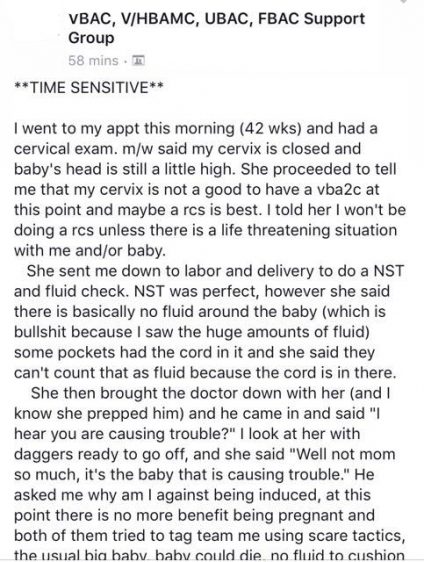
TIME SENSITIVE

I went to my appt this morning (42 weeks) and had a cervical exam. Midwife said my cervix is closed and baby’s head is still a little high. She proceeded to tell me that my cervix is not good to have a VBA2C at this point and maybe a repeat C-section is best. I told her I won’t be doing an RCS unless there is a life threatening situation with me and/or baby.

…NST was perfect, however she said that there is basically no fluid around the baby (which is bullshit because I saw the huge amounts of fluid) …

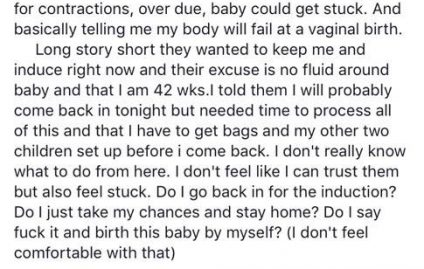
She then brought the doctor down with her (and I know she prepped him) … He asked me why am I against being induced, at this point there is no more benefit being pregnant and both of them tried to tag team me using scare tactics, the usual big baby, baby could die, no fluid to cushion for contractions, over due, baby could get stuck. And basically telling me that my body will fail at a vaginal birth…

…I don’t really know what to do from here. I don’t feel like I can trust them but also feel stuck. Do I go back in for the induction? Do I just take my chances and stay home? Do I say fuck it and birth this baby by myself? (I don’t feel comfortable with that)

Because who you gonna call when your midwife and doctor tell you your baby’s life is at risk? Your Facebook friends, of course. Not surprisingly, she was deluged with suggestions on how and why both her midwife and doctor are wrong and she should just wait it out. Only a few commentors recommended that she listen to her healthcare providers instead of her instincts.

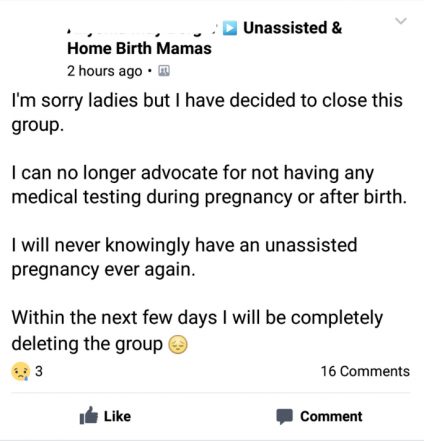
That makes for an interesting juxtaposition with this post from the administrator of a different unassisted pregnancy/unassisted childbirth group.

IMG_2502

IMG_2503

IMG_2504

I’m sorry ladies but I have decided to close this group. I can no longer advocate for not having any medical testing during pregnancy or after birth. I will never knowingly have an unassisted pregnancy again.

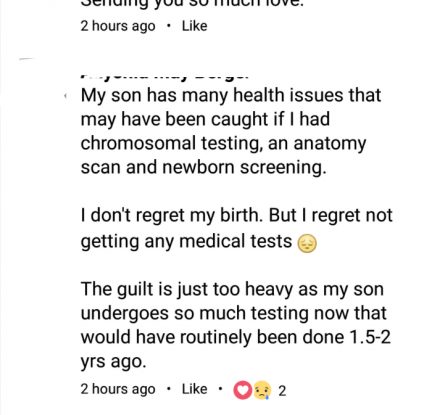
My son has many health issues that may have been caught if I had chromosomal testing, an anatomy scan and newborn screening… The guilt is just too heavy …

My instincts were very very wrong…

In other words, calling on her Facebook friends for support in ignoring medical advice end up grievously harming her son and family.

Don’t misunderstand me: each woman has the right to do exactly what she is doing (in the case of the first mother) or did (in the case of the second mother), but both looked to private Facebook groups — where pseudoscience reins supreme, other viewpoints are rare or deleted, and accurate information is in very short supply — to bolster them in believing both that they know far more than they do and that their instincts are more accurate than the knowledge of midwives and doctors.

Facebook, more than any other entity, allows people to recuse themselves from reality and create a carefully curated faux “reality” instead. I’m confident that this was never what Mark Zuckerbeg had in mind; indeed, given that his wife is a pediatrician I suspect that it pains both of them to consider how Facebook has turbo charged the ignorance of quacks, charlatans and ordinary people. But like him I am at a loss for what to do about it.

Free speech is more important than ever and the right to assemble (including in the cloud) with like minded individuals is a precious freedom. But by allowing people to shield themselves from other viewpoints and from accurate information, Facebook facilitates the dissemination of deadly nonsense. Facebook kills babies — but it seems that beyond calling attention to it, there’s not a damn thing anyone can do about it.

Who gets to decide what’s “best” for babies?

IMG_2485

Pregnancy and paternalism go together like peanut butter and jelly, like milk and cookies, like salt and pepper. Where you find one, you almost always find the other.

What is paternalism? It’s the practice of people in positions of authority determining the freedom and responsibilities of others in the others’ supposed best interest. It’s the belief that those in authority know better than mothers themselves what’s best for babies.

[pullquote align=”right” cite=”” link=”” color=”” class=”” size=””]Mothers — not doctors, not professional organizations, not activists — get to decide what’s best for their babies.[/pullquote]

Consider the ACOG policy toward alcohol that I wrote about yesterday. According to ACOG president Dr. Howard Brown, since we don’t know the safest upper level for alcohol consumption in pregnancy:

Why tempt harm when all risk can be avoided?

Dr. Brown is clearly incredulous than anyone could even think about accepting a risk in pregnancy, even a theoretical risk. He apparently subscribes to the contemporary view that constant sacrifice is the definitive feature of good mothering.

As sociologist Pam Lowe explains in Reproductive Health and Maternal Sacrifice:

…At its heart, maternal sacrifice is the notion that ‘proper’ women put the welfare of children, whether born, in utero, or not yet conceived, over and above any choices and/or desires of their own. The idea of maternal sacrifice acts as a powerful signifier in judging women’s behaviour. It is valorized in cases such as when women with cancer forgo treatment to save a risk to their developing foetus, and it is believed absent in female substance users whose ‘selfish’ desire for children means they are born in problematic circumstances…

I suspect that Dr. Brown might bristle at the notion that his paternalistic beliefs reflect an assumption that maternal sacrifice is the heart of motherhood. I imagine that he would claim, as he tried to do in his Letter to the Editor, that his admonition is not his personal opinion; it is merely what the science shows. Scientific consensus (therefore doctors) is purportedly the arbiter of what is best for babies. Mothers cannot be trusted to decide what’s best for their babies and themselves when it comes to the risks of alcohol in pregnancy. That’s paternalism.

That’s certainly the justification of The Baby Friendly Hospital Initiative and other lactivists organizations. Lactivists might not even balk at the idea that sacrifice is essential to good mothering. That’s why they turn a deaf ear to mothers’ claims of pain, frustration and inconvenience at breastfeeding.

As Michelle, a commentor on the Skeptical OB Facebook page, eloquently put it:

IMG_2484

I care enough to give my kid something that IS natural, than be a selfish heifer and give them something that is meant for a calf. Breastfeeding takes time and you have to sacrifice.

The BFHI and other lactivist organizations are more temperate in their language, but the sentiment behind their mantra “Breast Is Best” is exactly the same. The assumption is that every mother can and should sacrifice to give her child the “best” regardless of the trivial nature of the benefits and regardless of the personal cost to mothers. When confronted they respond, like Dr. Brown implied, that it isn’t personal opinion, it’s what the science shows. In other words, scientific consensus (therefore lactation consultants) is the arbiter of what is best for babies. Mothers can’t be trusted to decide what is best for their babies and themselves when it comes to infant feeding. That’s paternalism, too.

Curiously, natural childbirth, breastfeeding and attachment parenting advocates, who thrill to invoking science as the arbiter in the case of alcohol consumption in pregnancy and breastfeeding are thereafter, are generally horrified when anyone dares suggest that science (therefore doctors) ought to be the arbiter on what is best for babies when it comes to vaccination and homebirth.

The science on the benefits of vaccination is far stronger than the science on the risks of alcohol consumption in pregnancy and the theoretical risks of formula feeding. No matter. Vaccination has become an issue of personal freedom. Forget the scientific consensus! Every mother has to “educate” herself and do her own “research.” Indeed, for anti-vaxxers, explicitly rejecting the scientific consensus is viewed as empowering and a mark of intellectual independence. Only mothers can be trusted to decide what is best for their babies when it comes to vaccination. That’s a rejection of paternalism.

Similarly, homebirth in the US increases the risk of perinatal death. The best statistics we have thusfar, from the state of Oregon, show that homebirth with a non-nurse midwife increases the risk of death by 800%! Over the years, the Midwives Alliance of North America (MANA), the organization that represents homebirth midwives (CPMs, LMs), has been forced to ado it that their own statistic show that homebirth markedly increases the risk of perinatal death. Yet, they, too advocate rejecting the scientific consensus and focus instead on women’s autonomy and personal values.

Homebirth is an expression of a woman’s autonomy … A woman has the right and responsibility to choose the place and care provider for pregnancy, birth, and postpartum and to make decisions based on her knowledge, intuition, experiences, values, and beliefs.

Only mothers can be trusted to decide what’s best for their babies when it comes to place of birth. That, too, is a rejection of paternalism.

Ironically, most anti-vaxxers and homebirth advocates are hypocrites, invoking science when it suits them and ignoring it when it does not. Nevertheless, the issue they raise is crucial: who gets to decide what’s best for babies?

In my view, medical ethics with its emphasis on patient autonomy, requires that mothers — not doctors, not professional organizations, not activists — get to decide what’s best for their babies. Hopefully those mothers will have accurate medical information at hand, but we cannot and should not force people to make decisions that those with accurate medical information prefer. That’s paternalism. The only exception is vaccination since that affects the health of others. The government may therefore choose to make vaccination a prerequisite for attendance at schools and childcare facilities.

That means that women can and should be free to make bad decisions; it is their right. Why? First, science is not always correct in its conclusions. Second, individuals have different values from each other and it is those values that they call upon to determine which risks are acceptable and which are not. As a general matter, people deciding for themselves (autonomy) make better decisions than authorities deciding for them (paternalism).

Women may elect to drink alcohol during pregnancy or they may elect to have a homebirth. That doesn’t mean that either is a good idea; it might be a very bad idea but as long as they are apprised of the risks, it is their choice. Of course they are also responsible for the consequences. The right to make a bad choice doesn’t mean that the rest of us have to approve of it. Very few people are going to applaud a woman’s decision to handicap her child with fetal alcohol syndrome just because she has the right to drink during pregnancy. Similarly very few people are going to applaud a woman’s decision to have a homebirth if it kills her baby.

To the extent that authorities choose to insert themselves in the promotion of one health choice over another, it is entirely appropriate for government to mandate vaccination in order to protect everyone. It is not appropriate for health authorities to mandate breastfeeding through programs like the BFHI since a woman’s decision to breastfeed or formula feed her baby affects no one outside of her family.

Women are people — not incubators, not breastmilk dispensers, not individuals whose only purpose in life is to sacrifice their needs for the theoretical needs of their children. Although “why tempt harm when all risk can be avoided?” might be my personal philosophy when it comes to pregnancy and birth, we cannot and should not mandate that it be everyone’s philosophy. That would be paternalism and that would be wrong.

ACOG, alcohol and the infantilization of pregnant women

IMG_2479

Perhaps this will lay the accusation that I am a shill for ACOG to rest.

The president of the American College of Obstetrician Gynecologists (ACOG) wrote a letter in response to my recent piece in The Washington Post, Five myths about pregnancy, in which he vehemently disagreed with me. He seems to think we disagree on what the science shows; in truth, we disagree on what professional ethics demands of doctors.

I wrote:

[pullquote align=”right” cite=”” link=”” color=”” class=”” size=””]Women deserve to have the same information that doctors have and medical autonomy means that they can decide for themselves whether the risk is worth it to them. [/pullquote]

Studies on alcohol are … ambiguous. Although it is quite clear that large amounts of alcohol can cause fetal alcohol syndrome, the limit of safe consumption is unknown. There are some doctors who insist that if we don’t know the exact limit, women should avoid any alcohol. But most believe that an occasional glass of wine or beer will not cause any problems.

These sentences are undeniably true, yet in a Letter to the Editor, Tom Donaldson, president of the National Organization on Fetal Alcohol Syndrome and Haywood L. Brown, president of ACOG, vehemently disagree.

By writing that studies are “ambiguous” in “Five myths about pregnancy” [Outlook, May 14], Amy Tuteur framed the issue of a safe level of alcohol use during pregnancy as an ongoing debate between opposing sides, each with scientific validity. In fact, the science is settled: There is no amount of risk-free alcohol use during pregnancy. This is the position of every scientific and public-health institute and medical and behavioral health association in the United States …

They claim:

[No study] has found any level of prenatal alcohol consumption that is non-toxic to human development.

This is the logical fallacy known as the “argument from ignorance,” often colloquially expressed as “Absence of evidence is not evidence of absence.”

According to Wikipedia:

It asserts that a proposition is true because it has not yet been proven false (or vice versa). This represents a type of false dichotomy in that it excludes a third option, which is that there may have been an insufficient investigation, and therefore there is insufficient information to prove the proposition be either true or false.

Yes, it is true that no study has found a safe level of prenatal alcohol consumption in pregnancy, but that does NOT mean that there is no safe level of alcohol consumption, merely that we don’t know what it is.

Why don’t we know? Because the situation is far more nuanced than Mr. Donaldson or Dr. Brown acknowledge and by representing our knowledge as complete and definitive when it is incomplete and uncertain, they infantilize pregnant women.

How?

They write:

Why tempt harm when all risk can be avoided?

But it’s not their decision to make; the decision belongs to each individual pregnant woman.

What do we know about alcohol and FAS?

1. There is no reliable relationship between drinking in pregnancy and FAS. Sure, large amounts of alcohol can lead to FAS, but many women drink moderately without any apparent harm to the developing child. Researchers have noted the “American paradox.” Though alcohol consumption per capita (among women and men) is much higher in European countries than in the US, the incidence of FAS is much lower there. Drinking wine with meals is widespread in Europe, so many women are drinking before they know they are pregnant and when they are pregnant, yet the incidence of FAS is just a fraction of what it is here. Perhaps FAS is more common with some forms of alcohol than with others; we don’t know.

2. The likelihood of developing FAS depends on maternal genetics. Some ethnic groups (like Native Americans) have a much higher incidence of FAS than other ethnic groups even when comparable amounts of alcohol are consumed. In other words, some ethnic groups are “prone” to FAS while others are not.

3. The likelihood of developing FAS also depends on fetal genetics. A study of twin pregnancy in heavy drinkers revealed an extraordinary finding; while there was 100% concordance among identical twins (if one had FAS, the other did, too), there was less than 70% concordance for fraternal twins:

…Sixteen pairs of twins, 5 MZ [monzygotic] and 11 DZ [dizygotic], all heavily exposed to alcohol prenatally, were evaluated. They represented all available twins of alcohol-abusing mothers who were on the patient rolls of the authors. The rate of concordance for diagnosis was 5/5 for MZ and 7/11 for DZ twins. In two DZ pairs, one twin had fetal alcohol syndrome (FAS), while the other had fetal alcohol effects (FAE). In 2 other DZ pairs, one twin had no diagnosis while one had FAE. IQ scores were most similar within pairs of MZ twins and least similar within pairs of DZ twins discordant for diagnosis.

Clearly the issue of alcohol in pregnancy is not straightforward.

Unfortunately, Mr. Donaldson and Dr. Brown have transmuted uncertainty into certainty. Instead of acknowledging that the safe limit of alcohol consumption in pregnancy depends on factors that we don’t yet understand, they imply that NO amount of alcohol consumption is safe in pregnancy and that is almost certainly not true for every woman. To maintain such a stance in the absence of concrete scientific evidence is to treat women like children.

I suspect that if a newly pregnant patient worried aloud about her fears of fetal harm from a glass of Chardonnay she drank before she knew she was pregnant, even Dr. Brown would reassure her that it probably caused no harm at all —because that’s what the existing scientific evidence shows. If it is appropriate to reassure women who have already had that glass of Chardonnay, it is inappropriate to tell another women who hasn’t had the Chardonnay yet that a glass of wine could very easily cause harm.

Women deserve to have the same information that doctors have and medical autonomy means that they can decide for themselves whether the risk is worth it to them.

In my view doctors are ethically obligated to be honest with women — to tell them what is true and to acknowledge what we don’t know — and let them decide for themselves. It is infantilizing to make decision for them and counsel them to do what we might prefer.

Guest post: A daughter’s illness, a mother’s anguish

Prayer

A long time reader shared this with me and I found it deeply moving. She graciously gave her permission to let me share it with everyone else.

If I were a painter I would depict: a child huddled in a hospital bed, burritoed into an oversized raspberry-pink coat, topped by a spray of blonde hair, like ripened corn. A woman, the child’s mother, ugly-crying on the bench outside the hospital, gripping elastic cords and zipper pieces. Or maybe I would just show the cords and zippers in a neat pile, so that the painting whispered in a secret code to a world I wish I’d never known.

[pullquote align=”right” cite=”” link=”” color=”” class=”” size=””]“There’s no magic pill” they say. — Yes there is. It’s called “Lithium.” (Or “Ritalin” or “Prozac,” or whatever.)[/pullquote]

Bibi (not her real name) was six years old when the school nurse handed me my blue folder.

“Welcome to the world of special needs,” she told me. “I know it wasn’t what you had in mind, but it is going to be ok.”

Bibi could not read. She was late in many of her motor skills, struggled to work independently, resisted wearing socks, underwear, or sweaters, and reacted in terror to any mild aggression.
Bibi, I was told, had Sensory Processing Disorder.

I cried right there in the nurse’s office. Most of the mothers do.

Neuropsych testing. RTI and Orton-Gillingham. Sensory brushes. Sensory pillows, blankets, and cushions. Gizmos to fidget with, gadgets to rattle and tap. Noise canceling headphones. Years of epically-unbrushed hair.

Autism, no.
Aspergers, no.
Cognitive disabilities, perhaps.
Dyslexia, yes.
ADHD, maybe.
Bipolar.
Yes.

It wasn’t a shock. Well, how can that not be a shock? — But, I know bipolar. I spent my childhood at its mercy — dragged along by the fury, grandiosity and flights of notion of my mother, a woman who needed a screaming fight about something, anything for at least a few good hours every weekend.

Bibi — beautiful, sunny, cosmically smart Bibi — is nothing like my mother. Bibi’s giggles cascade out of her like pink champagne bubbles. Her allowance is gone as quickly as it comes in — spent on extravagant gifts for her siblings or some child who was crying on the playground and deserved a pick-me-up.

When Bibi was seven, her prize hen Rosie — the golden-laced wyandotte Bibi had raised from a hatchling — was snatched by a coyote. The sound was terrible — chicken agony, coyote growls, and Bibi — armed with a fallen tree branch– shrieking her fury at that coyote, who released the hen and bolted for the woods. Bibi gathered up the shredded pieces of poor Rosie and brought her to me, demanding first aid. Dubious, (and grossed-out) I poured warm water and then iodine over the raw, chewed-up chicken flesh. I feared we were prolonging the poor thing’s suffering, but at Bibi’s insistence, I filled a box with soft rags and placed it on our screened porch under a warming lamp and tucked Rosie in for the night, warning Bibi the chicken likely would be dead in the morning.

Bibi snuck out to the porch sometime well past midnight, dragging a heavy camping blanket behind her. She brought Rosie to her chest, stroking her soft feathers and willing the hen back to life with the sheer force of her love. They spent the night that way.

Rosie survived.

But there were other sides to Bibi, and they scared me. She was plagued by graphic nightmares, long periods of elevated mood followed by lethargy and detachment. When the therapy and the routines and the removal of her bedroom closet door stopped keeping the shadows at bay, we found a psychopharmacologist.

Two weeks later, she woke up normal. Yes. It really was that simple. At first.

She was ready for school on time. She ate what we put in front of her. She did her homework and brushed her teeth and skipped happily off to bed. I wanted to track down the inventor of this small beige button of a tablet, send her a fruit basket or maybe a Mercedes, or a villa in the south of France. It was the first time in my life I considered the difference between keeping a person from dying, and keeping a person from living a tortured lifetime.

“There’s no magic pill” they say. — Yes there is. It’s called “Lithium.” (Or “Ritalin” or “Prozac,” or whatever.)

If melatonin and St. John’s Wort work for you, that is just fantastic. You’ve got it good. So do we. Many children and families suffer far worse trying to find the right medication — the one that works, the one that’s available, the one insurance will pay for, the one whose side-effects don’t make life not worth living.

Over time, other drugs were added to Bibi’s regimen, as they inevitably are. We dosed and we tweaked, and Bibi got very good at succinctly answering questions about her sleep, her mood, her energy, her focus. And always — always and forever more — she went to weekly therapy.

She also went to overnight camp.

Here’s what you don’t know if you don’t have a sick child: those annoying HIPAA laws that mean filling out piles of forms and standing behind the line at the doctor’s office? Those laws have meant my daughter has access to life.

You do not go to the camp director and tell her your daughter is bipolar and taking a medication that could, maybe, perhaps, cause kidney failure if administered improperly. You do not tell your child’s counselor, “Hello, nice to meet you, please make sure she wears sunscreen and a hat and also it is not out of the realm of possibility that she might start to feel herself slipping into madness. You’ll want to keep an eye out for irrational sadness or fear, or a strangely elevated mood … are you writing this down?”

You do not tell them these things because then they will not like your daughter — much less head-on adore her, like she deserves. They’re not bad people. But the power they have over your child is horrifying. If Bibi were diabetic, the way people responded to her insulin pump would have absolutely no impact on the outcome of her illness.

How people interact with the mentally disordered has everything to do with whether they get worse or better. People with mental illness are often subject to shaming and rejection that reinforce their own worst terrors about themselves and the world. Enter HIPAA, and the right of patients to strict confidentiality from their care providers, even if those providers work for a private summer camp.

That hot July morning I waited in line for about twenty minutes, listening as a parade of anxious mothers gave the infirmary nurse detailed instructions on their daughters’ Claritin or Lactaid or Gummy vitamins or even — I am not making this up — her absolute need to 24 hour access to Tylenol. I can’t judge — I don’t know their stories — but when I entered the nurses’ office, I closed the door that had enabled me to overhear the prior conversations, and dropped two large Ziploc bags filled with orange prescription bottles on the desk.

How about some psychotropics, bitch?

She never flinched. She took detailed notes. She organized the dosages and had me check and recheck them. She reassured me repeatedly that she knew what lithium poisoning looked like and that she would do a proper psych triage on my daughter every day.

With careful management, love, luck and more than a few angels, Bibi has been imbued with self-worth, acceptance and an abiding faith that her life will be good. But she also understands that she will never be free of the burden of this disorder, and the suffering it brings her will always be part of her life.
All of her descents carry similar elements — elevated mood and creativity, followed by lethargy and disinterest. The nightmares return. She resists all sensory discomfort including showers and hair brushes.
This leads to more visits to the psychopharmacologist, consultation with the therapist, careful emails to the school nurse and her classroom teacher. Generally, the descent is followed in fairly good time by an ascent.

And then it wasn’t.

She was sleeping less and less, waking at all hours, wandering the house, writing stories, making elaborate presents for people she barely knew. I begged her to get on the school bus and she cried and asked if she could wear my coat — my new, luscious, raspberry colored down parka. “It smells like you, Mama,” she said softly. For weeks, she didn’t take that coat off. It gathered stains: toothpaste, dribbled hot chocolate, a faint hint of vomit.

Bibi was not getting better. And so we went to the Emergency Department of our local hospital, which is where mental health patients in crisis are triaged. Pediatric emergency cases can spend up to several days or even weeks in the Emergency Department. While there, they receive no treatment. They cannot leave their rooms, the doors to which are left wide open to the corridor at all times, a hospital security officer is stationed outside it. When mental health patients in the ED need to use the bathroom, they are escorted by their security officer and a nurse, and they must leave the door open.

Eleven year-olds are no different.

And so Bibi shuffled to the john, trailed by her mother and a nurse and a cop, peeing with the door open because she had committed the crime of being born with a chemical imbalance in her brain.

She was in the Emergency Department about five hours when a social worker led her dad and me to the “Quiet room.” Easy chairs. A box of tissues. A cheesy picture of a waterfall. Some day I will be a millionaire and I will donate to hospital quiet rooms boxes of soft kleenex because it just sucks to have a chapped nose on top of everything else.

The social worker walked us through the options. Bibi was in trouble. And they wanted to find a bed for her on the psych ward, if we would consent to it. We did.

Bibi was alone in her room, the door open to the hall, the security officer watching. I suppose to everyone else she was an unwashed, odd-smelling, confused little girl. To me, she was sweet Bibi-of-the-cascading giggles, and I climbed in beside her, pulling her close to my body, to the body we had shared, to her nose against my collerbone, and mine against her warm hair.

“I have to stay, don’t I?” she asked.

“No,” I said. “I will take you home right now if you want me to. But the thing is,” I stare at the styrofoam tile ceiling, willing the words to come. “I’m scared. I can bring you home, and I will if you ask me to. But I’m afraid I can’t take proper care of you. I am afraid you will get sicker and you will end up back here and it will be worse because we waited.”

“And you can’t stay with me?”

“No. I can’t. You’d have to do it alone.”

We clung to each other, my little girl and I, awash in the rawness of life.

We were lucky. A bed opened less than 24 hours later. The officer escorted us up to the psych ward, where he buzzed the security door for admittance. Bibi’s little chubby hand gripped the handle of the overnight duffle, her back straight, her chin set. So help me she walked herself in to the psych ward.

They searched her bag. She could not keep the ceramic mug, her scarf, or the knitting project. No sneakers or laced shoes of any kind. No belts, no nail clippers, nothing with an edge. They stuffed the banned items into a garbage bag which they handed to me to take home. And then they turned their attention to the coat, to its zippers and elastics and knobbies and all the pretty little things such coats have.

“Just cut it,” I said.

The nurse made quick work of it, ripping and slicing. Bibi put it back on and managed a slight giggle at how deflated it looked.

And then we were gripping each other and sobbing.

“These are not your people,” I tell her. “This is not your world. Your world is at home with me. So get it done and get out of here and come back to me.” We grip harder and sob more because we both know there is a lie there.

As of now, these are Bibi’s people, these hollow-eyed girls in flip flops and sweat pants, angry red divots along their arms where their fingernails have ripped at the flesh– their outward release of an inner pain no one has been able to soothe. They share Bibi’s disordered world, a world I have to abandon her to if I want to get her back.

And so there I am, on the bench outside the hospital, a garbage bag at my feet, elastics and zippers clenched in my fists and I think how maybe if I dug my nails into my arms it would distract me from all the unbearable bearing down on me. I can’t scratch my arms, but I want to wreck something, or damage myself or — no, not damage. Mark. Claim. Own this identity that will be part of me forever. So I send a text. I send it to anyone I think might be my friend.

“Bibi has been admitted to the psych ward. I need childcare coverage in the afternoons during visiting hours. I need a dog walker. Please text back if you have any availability.”

“I can do Tuesday and Wednesday after school to 8:00.”

“I’m going to send you my dog walker, she’s great.”

“What do your kids eat? I can drop a meal or two.”

Someone cleaned my kitchen, and someone brought food, and I claimed my place as the mother of a child who will need hospitalizations on and off throughout her life.

Thankfully, Bibi’s stay this time was short. Her medications kicked in, she was sleeping normally, and the bright gentleness I love so much was returning to her face. On the fourth night, they released her for home. Leaving, she was like Nixon boarding Marine One. She turned to her medical team and said, “SEE YOU NEXT TIME!”

In the car on the way home she asked me what we would tell everyone.

I said, “Why not tell them you were in the hospital?”

And she said, “Why not just go ahead and tell them I was in the loony bin and see how fast I make new friends?”

It was bitter and funny and awful and true.

“How about you just tell them the truth — you have a chronic condition. You need medication and sometimes hospitalization. Why don’t you let them give you the love and sympathy and support a hospitalized child deserves?”

We are silent. We know I am dreaming of a world we want to exist, that does not exist, that could only exist if we march forward believing in it. But what 11 year old wants to make that march?

“There are two kinds of people in the world, sweetheart,” I tell her. “Those who understand and feel compassion and sympathy for you and those you don’t need in your life. Why should you have to pretend to be something you’re not for people who aren’t nice to sick people?”

“Ok,” she said.

She wore her hospital bracelet for more than a month. A mark of her own, I think. A decision that she was done hiding a very vital — and sometimes very painful — part of herself. We are still navigating this world, Bibi and I, where we understand that the stigma is real and dangerous and that she must be kept safe. But we also know that the stigma thrives on people like us acting like we have something to hide.
I have this amazing daughter, with a wicked sense of humor and giggles like champagne bubbles. She likes to draw and cook and play softball.

She has a chemical imbalance of the brain called “bipolar.” Sometimes it blows through our life destroying everything it touches until we think the sun will never shine again. During those times, we rely on each other, and we ask for help, and we tell bad jokes, and we love the friends who send us dog walkers and clean our kitchen and repeatedly tell Bibi “You’re a bad ass, darling.”

Because she is.

Sheena Byrom and the moral bankruptcy of UK midwifery

36275662 - handprint with dripping paint

Once again I have written a blog post about my revulsion at the deadly behavior of UK midwives, and once again a prominent midwife has rushed to demonstrate the truth of my words to the entire world: professional autonomy is more important to midwives than whether babies live or die.

It was only 4 days ago that I wrote about the latest Stunning indictment of UK midwives. According to The Guardian:

[perfectpullquote align=”right” cite=”” link=”” color=”” class=”” size=””]Sheena Byrom is the poster child for moral depravity in the face of preventable infant deaths.[/perfectpullquote]

The number of claims for brain damage and cerebral palsy has tripled in a decade, amid widespread monitoring failures …

The cases – often linked with a failure to monitor babies’ heart rates, to detect risks of oxygen starvation – fuelled maternity negligence claims of more than £1.2bn in 2015/16 [$1.5 billion].

The proximate cause is that UK midwives are not adequately trained in fetal monitoring, but the real cause is that UK midwives place process (“normal birth”) above outcome (live, healthy babies and mothers).

Just in case you thought I was exaggerating the immorality of a group of medical providers who place their personal philosophy above the lives they are ethically mandated to protect, midwife Sheila Byrom rushes to prove me right.

Byrom is the poster child for moral depravity in the face of preventable infant deaths. She has the unmitigated gall to defend the unethical behavior of midwives in privileging process over outcome by arguing that it is more important to preserve “normal birth” than human life.

In my piece I asked: how many babies have to die and how many billions of pounds have to be paid out before the morally repugnant, incompetently trained, self-dealing, deadly UK midwives are held to account?

Sheena Byrom, writing in conjunction with another deadly midwifery enabler, Soo Downe, answered: as many as UK midwives damn well please.

In Normal birth – a moral and ethical imperative, Byrom and Downe are attempting to rebut a piece in The London Times, Midwives told to stop pushing own agenda for natural births, which notes:

Midwives will be told not to use language that could push women into “normal” birth amid fears that babies are at risk because of a reluctance to ask for medical help…

A review into the deaths of 11 babies and one mother at the Morecambe Bay trust warned that a desire for normal birth “at any cost” was a contributor.

Outgoing head of the Royal College of Midwives (RCM) Cathy Warwick has met every new midwifery scandal with weasel words but no action. Speaking of the most recent scandals, Warwick offered more weasel words:

[I]f there were midwives who were pushing normal birth then we must have good governance process in place which will pick up that and make sure it doesn’t continue to happen.

Byrom and Downe also use weasel words:

Promoting normal birth while also maximising the wellbeing of mother and baby is therefore not a cult, or a professional project, or a conspiracy. It is a moral and ethical imperative, that should be supported by all of those with any interest in the wellbeing of mothers, babies and families, in the short and longer term. This includes professionals, journalists, politicians, health service managers, childbirth activists, and lawyers.

But no one is talking about promoting normal birth while maximizing wellbeing of mother and baby; the issue is promoting normal birth above maximizing wellbeing of mothers and babies.

Byrom and Downe present a graph that demonstrates a slowly rising C-section rate and ask:

And if there is a widespread problem where midwives ‘pursue normal birth at any cost’, why are the statistics below so stark? Surely, the opposite would be the case?

Which words in “claims for brain damage and cerebral palsy has tripled in a decade” and “maternity negligence claims of more than £1.2bn in 2015/16 [$1.5 billion]” are they having trouble understanding?

Byrom and Downe insist that “normal birth” is a moral and ethical imperative.

Really?

Medical ethics rests on four principles:

Respect for autonomy – the patient has the right to refuse or choose their treatment.

Beneficence – a practitioner should act in the best interest of the patient.

Non-maleficence – to not be the cause of harm…

Justice – concerns the distribution of scarce health resources, and the decision of who gets what treatment …

Do you see normal birth — or any specific procedure — among these? I don’t either.

The key to understanding midwives’ insistence on a procedure instead of an outcome is to recognize that when midwives say “normal birth” what they really mean is “anything midwives can do and nothing they cannot.” Promoting normal birth is really about promoting midwife autonomy.

In their first paragraph Byrom and Downe make it clear that this is really about midwives and their desires:

Yes, there needs to be learning from incidents, and development where needed. But blaming one professional group, or a particular type of birth, does little to improve any situation.

Actually, insisting that a professional group take responsibility for their own deadly mistakes does A LOT  to improve any situation.

I regularly spend time with student midwives from around the UK and beyond. They tell me they are worried about practising as qualified midwives, as, during their training, they hardly ever see women who have had a normal, physiological, straightforward pregnancy, labour and birth.

Midwifery is NOT supposed to be about meeting midwives’ needs; there is a moral imperative to meet PATIENTS’ needs.

Recent press reports add to the fear already embedded in maternity services. This fear is real in high income countries, and influences the decisions of women, mothers and families alike.

But the ethical provider SHOULD feel fear at the thought of preventable deaths. It is only the morally bankrupt who would counsel otherwise.

Byrom, Downe and Warwick have blood on their hands and the reason is very simple: they continue to promote THEIR interests — the process of “normal birth” (or, more accurately, midwife autonomy) — above safe outcomes for mothers and babies.

As long as UK midwives are allowed to indulge their desire to serve their own interests, babies will continue to die and the NHS will continue to pay out billions of pounds to grieving parents. That is truly immoral and unethical.

Gwyneth Paltrow, queen of the quacktresses

Vector illustration - Queen gold text

Apparently, I wasted 8 years in medical training. Four years of medical school and four years of residency were over-kill (pardon the expression). It seems that in 2017 the most important requirement for a medical authority is to be a quacktress.

A quacktress is a actress who has monetized her celebrity by giving pseudoscientific medical “advice,” often selling books, supplements and other products to the credulous.

[pullquote align=”right” cite=”” link=”” color=”” class=”” size=””]Who is gullible enough to believe steaming your vagina and filling it with jade balls makes any sense at all?[/pullquote]

Quacktresses have been with us for years. Homebirth advocate Ricki Lake is a quacktress; anti-vax loon Jenny McCarthy is a quacktress; and, for many years, Suzanne Somers was the queen of quacktresses, peddling dubious cancer “cures.” But Suzanne Somers has been dethroned. Gwyneth Paltrow is the new queen of the quacktresses.

What has Paltrow done to deserve this honor? Perhaps it is because she is young and beautiful. Perhaps it is because she is a better actress than most quacktresses. But I suspect that Paltrow now represents the acme of quackery because so much of her nonsense centers on the vagina.

Through her lifestyle website Goop, Paltrow has proven that women are gullible enough to put anything in their vaginas.

Writing about a high end spa, Paltrow shared:

The real golden ticket here is the Mugworth V-Steam: You sit on what is essentially a mini-throne, and a combination of infrared and mugwort steam cleanses your uterus, et al…

It is an energetic release — not just a steam douche — that balances female hormone levels …

What does that gobbledygook even mean?

The spa’s site provides a history of the steam, explaining that it has been utilized in Korea “for hundreds of years” and helps to “maintain internal health” and keeps “skin looking young and healthy. The procedure involves the placement of boiled leaves and flower buds on a “specific area of the body” for “detoxication.”

So much stupid in so few words!

Claiming that you can clean your uterus by steaming your vagina is like claiming you can clean your colon by steaming your mouth. Why would your uterus need “detoxification,” even assuming such a thing were possible? And how does it balance your female hormones when nearly all of them are made in your ovaries and head (pituitary gland)? Obviously it doesn’t.

But it does boost traffic at her website. As Paltrow explained:

If I find benefit to it and it’s getting a lot of page views, it’s a win-win.

It’s not her fault that people are gullible, right?

Paltrow’s vagina fetish doesn’t end there. According to the Washington Post:

Most recently, Paltrow’s lifestyle website Goop, which promoted vaginal steaming, is at it again with another advice for women: putting a jade egg — yes, a solid object about the size of a golf ball — in your vagina, and keeping it there all day or while you’re sleeping.

For $66 a piece, the jade eggs, once “the strictly guarded secret” of Chinese queens and concubines to please their emperors, would help boost your orgasm and “increase vaginal muscle tone, hormonal balance, and feminine energy in general,” reads the beginning of an article titled “Better Sex: Jade Eggs for Your Yoni.”

But gynecologist Jen Gunter, had this to say:

My issue begins with the very start of your post on jade eggs specifically that “queens and concubines used them to stay in shape for emperors.” Nothing says female empowerment more than the only reason to do this is for your man! And then the claim that they can balance hormones is, quite simply, biologically impossible…

Gunter deftly and hilariously debunks Paltrow’s nonsense and there is a great deal of it.

Gwyneth Paltrow’s goat milk therapy for parasites is stupid and dangerous

Gwyneth Paltrow doesn’t have adrenal fatigue because it doesn’t exist

As well as this delightfully scathing takedown:

Dear Gwyneth Paltrow we’re not f**king with you we’re correcting you, XOXO Science

Why would anyone believe Paltrow’s quackery?

In part it’s because of our obsession with celebrity. We worship celebrities and even the idea of celebrity. People are desperate for the opportunity to be humiliated on reality TV shows just so they can become famous. We trust celebrities even when they give us no reason to do so or plenty of reasons not to.

In part it’s because of bizarre form of racism that imagines that “orientals” and indigenous (read: black) peoples are in possession of exotic knowledge that white people can use.

But mostly it’s because of the dismaying strain of anti-intellectualism that has longed plagued our country, including the idea that doctors know so little that quacktresses actually know more.

Why? How can anyone claim with a straight face to believe that Ricki Lake knows anything about childbirth? How could anyone possibly believe that Jenny McCarthy knows about immunology simply by dint of having a child who she thought was autistic. And Suzanne Somers? Does anyone seriously believe that the purveyor of the “Thigh-Master” just happened to discover the cure for cancer in her spare time?

And who is gullible enough to believe steaming your vagina and filling it with jade balls makes any sense at all?

A lot of people, apparently, and they’ve made Gwyneth Paltrow queen of the quacktresses.