All posts by Amy Tuteur, MD

UK National Health Service paid more than $250 million to settle claims of brain damage from breastfeeding promotion

IMG_2020

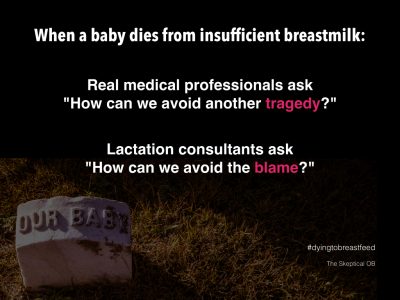
The impact of baby Landon’s death from insufficient breastmilk continues to reverberate around the world and lactation consultants continue to whine that such deaths are not their fault.

The brutal truth is that lactivists lie and babies die.

A new paper from the UK provides more tragic examples.

[pullquote align=”right” cite=”” link=”” color=”” class=”” size=””]Both symptoms and maternal concerns were routinely ignored.[/pullquote]

The paper is Neonatal hypoglycaemia: learning from claims by Hawdon et al. It’s a risk management paper, published to alert clinicians and managers to potential causes of lawsuits.

The authors found:

…In this 10-year reporting period, there were 25 claims for which damages were paid, with a total financial cost of claims to the NHS of £162 166 677 [over $250,000,000 at the 2011 exchange rate].

Hypoglycemia is low blood sugar. Severe hypoglycemia can lead to severe brain injuries. Two examples were included:

The child is severely disabled and requires 24 hour care support. It has not been established whether the brain injury will have any impact upon life expectancy although limited mobility and cognitive deficits would contribute to a loss of life expectancy and her medical needs for the rest of her life are likely to be complex.

And:

She is mobile indoors but cannot walk properly on uneven ground or on even ground for more than 200 metres. She requires assistance with dressing, cleaning after toileting and has to have food cut up. She has no sense of danger to herself or others, acts in a dangerous and destructive way and requires constant close supervision.

Most cases involved well known risk factors for neonatal hypoglycemia including low birth weight, poor feeding behavior, maternal insulin dependent diabetes and hypothermia.

In most cases insufficient breastmilk intake was the cause and poor feeding behavior was the primary symptom although there were a few cases where other factors were involved (one case of neonatal hyperinsulinism and one case of neonatal sepsis).

For 21/28 (75%) babies, it was the abnormal feeding behaviour which caused clinical concern. Of these 21 babies, 2 were also described as hypotonic, 5 also as cold, 1 also as irritable and 1 also as sleepy.

Eight out of 28 (29%) babies were described as hypothermic, either in isolation or in combination with poor feeding or being sleepy.

One baby was described as being hypotonic in isolation, and one baby presented with cardiorespiratory collapse.

For two babies presenting clinical signs were not documented.

In fully 36% of cases, mothers felt there was something wrong with the baby but could not get the staff to take their concerns seriously.

The authors provide four examples:

‘By the third day he was sleepy and disinterested in feeding. His mother asked for assistance to latch him onto the breast and voiced concerns that he was not feeding. His mother continued to alert staff to her problems in getting the baby to feed and the fact that he was sleepy.’

‘The mother informed the midwifery staff on the ward on a number of occasions on this and subsequent days following the baby’s birth, that she was concerned the baby was not sucking when feeding was attempted and she was concerned he was not feeding properly. These concerns were not heeded, resulting in the baby not being fed adequately and ultimately causing his collapse due to hypoglycaemia.’

‘The mother felt she had expressed concerns on multiple occasions about baby’s feeding technique both on delivery unit and on the ward but she felt she had not received adequate support. These concerns were not listened to.’

‘The parents brought the baby to the accident & emergency department with feeding problems and episodes of rolling his eyes. Seen by the paediatric team. After giving advice on feeding to the parents, baby was discharged home. The parents continued to be concerned and brought baby back to accident & emergency 3 days later. Blood glucose levels were not measured and parents told they could take him home.’

The authors issue a number of recommendations including:

Babies presenting with abnormal clinical signs, including abnormal feeding behaviour and hypothermia, must undergo detailed and documented assessment including measurement of blood glucose levels …

Maternal concerns, especially with regards to feeding, should not be discounted and should be followed by a detailed and documented history and assessment of the baby’s condition.

In the presence of clinical signs, once a diagnosis of hypoglycaemia is suspected or made, this constitutes a clinical emergency.

Babies with risk factors for neonatal hypoglycaemia or abnormal feeding behaviour should not be discharged from postnatal ward to the community without assurance that the milk intake is sufficient to prevent hypoglycaemia…

There’s a theme that emerges here and it is quite ugly: both symptoms and maternal concerns were routinely ignored. Mothers were reassured that their babies were fine when no clinical investigation had been undertaken.

That’s what happened to baby Landon, too. His mother recognized that something was wrong and her concerns were dismissed out of hand.

Keep in mind that this paper involves only injuries from hypoglycemia in which successful lawsuits were filed; there were undoubtedly additional cases. Moreover, it does not include lawsuits for damage resulting from neonatal dehydration, smothering in the mother’s bed and falls from the mother’s bed, all known to be associated with the relentless contemporary promotion of breastfeeding.

The real problem here is quite obvious; it’s the magical thinking that surrounds breastfeeding. That includes the belief on the part of nurses, midwives and lactation consultants that serious breastfeeding problems are rare, when, in fact they are common and that believing you can breastfeed is the key to successful breastfeeding.

So lactation consultants and others falsely reassure mothers that everything is fine when in reality the baby’s brain cells are dying. In other words, lactivists lie and babies die.
If lactation consultants treated erectile dysfunction …

IMG_2002

Mr. Jones, so nice to meet you.

Allow me to introduce myself, Ima Frawde, IBCEC. What are the letters for? International Board Certified Ejaculation Consultant, of course. I support men who have ejaculation dysfunction at the low introductory price of $200 per hour. I’m here to help you with your erectile dysfunction.

Examine you? No, I’m not going to examine you. I know what’s wrong without examining you; I learned during my training that so called “erectile dysfunction” is always caused by the man who claims he is suffering from it. Different ejaculation consultants may have different opinions about a variety of issues, but on one thing we are all agreed: there is no such thing as “not enough” erectile function.

Just think about it. If erectile dysfunction were real, the population of the world would have died out long ago and we wouldn’t be here. We’re here, so that proves my point!

[pullquote align=”right” color=””]There is no such thing as “not enough” erectile function.[/pullquote]

What is causing your problem? Well, there are a number of possibilities.

1. You are not trying hard enough.

Some men simply don’t care about giving their wives the best sexual experience possible. Let’s face it, sexual intercourse can be a challenge and most husbands are just too lazy to meet the demands of regular activity. When the going gets tough, they give up and give in, opting for vibrators and other sex toys. Sure their wives may seem satisfied with vibrators, but over time those same wives will experience a decrease in IQ. If you really cared about your wife, Mr. Jones, you’d try harder. Lololol, get it? Try harder?

2. You are deformed, but that’s not an excuse.

Sigh, you have a circumcised penis, and we all know who’s to blame for that. Your ignorant parents never realized that circumcision causes erectile dysfunction. Sure you might not have noticed it for the first 65-70 years of life and it might not have started until after you had your first heart attack and began insulin for diabetes, but it is just as much the cause as if you were circumcised yesterday. Too bad for you.

3. Decreased blood flow? Don’t be silly.

You might have heard that erectile dysfunction can be caused by diseases that decrease blood flow to all organs, not just the penis, but it’s not true. That’s just a lie made up by Big Pharma in an effort to sell Viagra. There is no such thing as “not enough blood flow”! Your body is perfectly designed to have an erection and if you only gave it enough time, everything would be fine.

4. So what if your wife is crying because you can’t have intercourse; she’ll just have to wait.

Erectile dysfunction is a matter of supply and demand. If you don’t try to have sex often enough, you’ll never have enough blood flow. You have to keep trying to have sex over and over and over again each day and eventually there will be enough blood flow for erections on demand.

5. You’re doing it wrong.

Positioning is very, very important to prevent erectile dysfunction. If you held your wife the right way, she’d be able to “latch on” to your penis properly and you would then get an erection. So basically this is all your fault.

Oops, time’s up. You can pay with a check, although cash under the table is always appreciated. I’ll be back later in the week for another session. Just remember what I told you: you are not trying hard enough; you are deformed; there is no such thing as decreased blood flow; your wife is just going to have to deal with her disappointment; and, don’t forget, you are doing it wrong.

What? Of course it is your fault! Stop whining that there’s something wrong just so you have an excuse to stop having intercourse. We all know that is what is really going on.

You feel worse now?

No need to thank me; I’m just doing my job as an IBCEC, International Board Certified Ejaculation Consultant.


This piece first appeared in January 2013.

The Tinkerbell theory of breastfeeding and natural childbirth

Illustration of a fairy with butterfly wings

I just read a fantastic piece in The New Statesman. John Elledge writes about politicians’ preferred fall back strategy when their programs don’t work: blame the voters for not believing enough.

“The moment you doubt whether you can fly,” J M Barrie once wrote, “You cease for ever to be able to do it.” Elsewhere in the same book he was blunter, still: “Whenever a child says, ‘I don’t believe in fairies’, there’s a little fairy somewhere that falls right down dead.”

… [O]ver the last few years, what one might term the Tinkerbell Theory of Politics has played an increasingly prominent role in national debate. The doubters’ lack of faith, we are told, is one of the biggest barriers to flight for everything from Jeremy Corbyn’s poll ratings to Brexit. Because we don’t believe, they can’t achieve.

[pullquote align=”right” cite=”” link=”” color=”” class=”” size=””]Believing you can fly does not give you the ability to fly; believing that you can breastfeed exclusively or have an unmedicated vaginal birth does not give you the ability to do either one.[/pullquote]

I’m not sure about the applicability of the Tinkerbell theory to British politics, but it immediately struck me that the Tinkerbell theory is at the heart of contemporary breastfeeding and natural childbirth advocacy. Lactation consultants, midwives and doulas routinely blame their failures on mothers. Apparently if women don’t believe, LCs, midwives and doulas can’t achieve.

The recent spate of lactivist hysteria over Jillian Johnson’s heartbreaking story about the death of her son Landon from breastfeeding induced dehydration has demonstrated thatlactivists cannot tolerate criticism of breastfeeding. They insist serious breastfeeding problems are rare in the face of copious scientific evidence that they are common. Then when those problems occur, since they are after all common, they resort to the Tinkerbell theory.

Serious breastfeeding problems are routinely ascribed to mothers’ failure to believe that they can breastfeed. Evil formula corporations, ignorant doctors, and lack of support from others are invoked instead of the actual biological reasons for the problems. Apparently whenever a mother says, “breastfeeding is not working for my child and me,” a breastfeeding fairy dies.

Hence the relentless insistence that more women would breastfeed successfully if only they received more “support.” It isn’t the lactation consultant’s fault that breastfeeding is starving your child, or is searingly painful, or utterly impossible while working full time. It’s really your fault since you didn’t get the appropriate “support” that would have allowed you to believe. Your lack of belief, not their lack of scientific knowledge, that is the real problem.

Natural childbirth advocates like midwives and doulas are even more overt in their embrace of the Tinkerbell theory. What does their mantra “Trust Birth” mean if not “the moment you doubt you can have an unmedicated vaginal birth you cease to be able to have one”? What are birth affirmations except explicit invocations of the Tinkerbell theory? Each one is a variation on “I believe that my body was made to have an unmedicated vaginal birth”?

Hence if you got an epidural, acceded to an induction, wound up with a C-section it’s your fault for not believing instead of your midwife’s fault for making nonsensical claims in order to boost her business. If only you had had more “support,’ you would have believed. It is your lack of belief, not their lack of scientific knowledge, that is the real problem.

The Tinkerbell theory is a form of magical thinking. Magical thinking does not mean believing in magic. It means believing that thoughts and actions have the power to affect events. Knocking on wood, wearing lucky socks and fearing the number 13 are all examples of magical thinking. None of those behaviors has any impact on events but many people persist in believing that they do.

Magical thinking involves a rejection of the scientific concepts of chance, probability and randomness in favor of supposedly powerful thoughts. Magical thinking accounts for the extraordinary fatalism of homebirth advocates in the face of neonatal death. It can’t possibly be the midwife’s fault because “the baby would have died anyway” even in a hospital. It isn’t chance that kept a baby from being born vaginally, it was the mothers failure to believe her birth affirmations. It isn’t birth pathology that cause poor outcomes in childbirth, it is doctors’ insistence on pathologizing birth and their refusal to accept that women are “designed” for childbearing.

As Elledge notes in discussing politics:

It’s easy to see why the Tinkerbell strategy would be such an attractive line of argument for those who deploy it – one that places responsibility for their own f*ck-ups squarely on their critics, thus rendering them impervious to attack.

That’s the same reason why the Tinkerbell theory is so attractive to lactation consultants, midwives and doulas. It’s one that places responsibility for their own fuck-ups squarely on their patients, thus rendering them impervious to criticism. But just as believing you can fly does not give you the ability to fly, believing that you can breastfeed exclusively or have an unmedicated vaginal birth does not give women the ability to breastfeed exclusively or have an unmedicated vaginal birth.

Of course, it is not fairies who die when women are blamed for their lack of belief in breastfeeding or natural childbirth. It is babies who die — and the responsibility for their deaths lies with those who encouraged them to believe, not with mothers who didn’t believe enough.

Hundreds of babies die each year as a result of the Baby Friendly Hospital Initiative

57080349 - beautiful marble statue of angel.

What if I told you that hundreds of babies die each year in industrialized countries from a problem that could be easily prevented by better patient and provider education?

You’d jump at the chance to fix the problem, wouldn’t you?

[pullquote align=”right” cite=”” link=”” color=”” class=”” size=””]In industrialized countries, aggressive breastfeeding promotion kills far more babies than it saves.[/pullquote]

What if I told you that a group of providers has a personal stake in perpetuating the problem and therefore won’t let it be treated?

You’d be horrified, right?

So let me tell you that hundreds of babies die preventable deaths each year as a result of the Baby Friendly Hospital Initiative (BFHI). And lactation consultants and lactivists are actively perpetuating the problem by ignoring these deaths.

The problem is so serious and widespread that it it has results in a new diagnosis: sudden unexpected post-neonatal collapse, the unexpected death of an otherwise healthy infant in the first hours or days of life.

Herlenius wrote about the problem in Europe in Sudden Unexpected Postnatal Collapse of Newborn Infants: A Review of Cases, Definitions, Risks, and Preventive Measures, reporting on 400 cases of collapse.

Such incidents are increasingly common in Europe in response to the adoption of so-called “baby friendly” policies:

Our summary of published reports indicates that even if still rare and with varying reported incidences, SUPC might occur more frequently than indicated in recent surveys. Even the lowest incidence numbers, if extrapolated on the 5 million annual births in the European Union, would result in some 500 SUPC cases and 150 newborn unexpected deaths yearly. Most of them are likely preventable.

How can we prevent these deaths? The first step is to acknowledge the role of the BFHI. That’s just what Flaherman and Von Kohorn in Interventions Intended to Support Breastfeeding Updated Assessment of Benefits and Harms and Bass et al. in Unintended Consequences of Current Breastfeeding Initiatives  published in JAMA in October 2016 recommended.

Not surprisingly, professional lactivists reacted to the editorials with a wall of denial embodied in a flurry of Letters to the Editor.

Melissa Bartick complained that studies that show the effectiveness of BFHI were excluded. Flaherman and Von Kohorn easily dismantle her complaint.

When considering the difference between studies included in the systematic review and those excluded, there are 2 important concepts to consider: confounding and generalizability. Confounding is an important
threat to internal validity for observational studies. In this case, confounding can occur when an increase in breastfeeding is attributed to the BFHI intervention when, in reality, it is caused by another factor…

Generalizability refers to the external validity of a study, an assessment of how applicable the results of the study are to patients and populations… Excluding a study such as PROBIT from the USPSTF review does not mean that the findings are not generalizable to some populations, only that they are not generalizable to the United States.

…[T]he good-quality evidence available that is applicable to the United States indicates that the BFHI is not beneficial for the general US population. This fact, along with the growing evidence for possible harm associated with some of the steps of the BFHI and the large number of effective individual-level interventions to promote breastfeeding, leads us to conclude that US institutions should focus on
implementation of the individual-level interventions identified by the USPSTF as effective.

Bass and colleagues address the denial expressed by other Letters in a compelling response.

Gardner et al comment that, under the BFHI Guidelines … mothers are fully informed of the benefits of breastfeeding and supportive practices… However they do not require that mothers also be informed of the important safety risk of late skin-toskin care identified by the AAP guidelines or the established benefit that a pacifier confers to prevent sudden infant death syndrome.

And:

Boyd et al state that they were unable to document any deaths … before 28 days of life in New York City between 2012 and 2014 when they implemented BFHI designation in several facilities. This is not surprising given … that there intervention took place in only 8 birthing facilities in a city that has 50 hospitals with maternity services.

And most devastating of all:

Ferrarello characterizes sudden infant death syndrome in newborns as “exceedingly rare,” a position that other respondents also implied… [N]ational data on sudden unexpected infant death for US infants for 2003-2013 reveal that … there were 1421 [deaths] in the first 6 days of which 666 occurred on the first day of life… These compelling data provide a perspective on the potential magnitude and significance of the problem, which … should encourage government … as well as concerned breastfeeding advocates to focus on alternative effective strategies to promote breastfeeding safely.

If the statistics from the US and Europe are correct, babies continue to die preventable deaths every week as a result of rigid adherence to the BFHI. If this were about science, BFHI proponents would be rushing to modify the tenets of the BFHI.

But it’s not about science; it’s about business. The BFHI is a money maker for its proponents including the organizations that support it and the individuals who are employed as a result. Paraphrasing Upton Sinclair: It is difficult to get a woman to understand something, when her salary depends on her not understanding it.

It’s not just about business; it’s also about magical thinking. Lactivists, suffering from a severe case of white hat bias, insist that breastfeeding must be perfect and that all efforts to promote it must be perfect, too. Neither is true.

Lactivists can’t identify any term infants whose lives are saved by breastfeeding yet pediatricians and neonatologists can point to hundreds of lives lost each year to efforts to promote breastfeeding. It hard to imagine a more scathing indictment of lactivists in general and the Baby Friendly Hospital Iniative in particular than that.

Is breastfeeding like sex?

Cuddling

Lactivists are in a frenzy over the success of the Fed Is Best Foundation. How dare anyone suggest that breastfeeding — unlike every other aspect of reproduction — is not always perfect? How dare anyone point out that the relentless focus on exclusive breastfeeding is harming babies and harming mothers? And how dare anyone deprive lactivists of the opportunity to bash women who don’t mirror their own feeding choices back to them?

[pullquote align=”right” cite=”” link=”” color=”” class=”” size=””]Uncomfortable, exhausted women do not owe their husbands sex and they do not owe their babies breastmilk.[/pullquote]

Breastfeeding researcher and lactation consultant Miranda Buck, PhD, writing on my Facebook page compares breastfeeding to sex:

A better analogy is sex. It’s perfectly reasonable to suggest that women have a right to a pain-free sex life. Nobody says to a woman that she’s just not good at sex. That she should have IVF instead. Nobody says ‘conceived is best’, to just forget about it and that sex is overrated. It is a natual and healthy normal activity that women should have the choice to do or not do. Same with breastfeeding…

There’s a lot to unpack here.

First, I’m not sure what a “right” to pain free sex means. As a gynecologist, I have seen that there are a variety of conditions — from vaginismus, to uterine fibroids, to lichen sclerosis — that make penetrative sex painful and while we do all we can to alleviate the pain of penetrative sex, we aren’t always successful. Claiming that women have right to breastfeed without difficulty is analagous to claiming that women have a right to painless penetrative sex. Invoking a right does nothing to make it reality.

Second, lactivists go much further than invoking a right; they insist that there is an obligation to breastfeed — even if it is painful, exhausting, inconvenient or distasteful — since it is “so much better” than formula feeding. That’s like insisting that every woman has an obligation to have penetrative sex regardless of whether it is painful or enjoyable; that’s cruel.

Third, to the extent that a “right” exists, it is a right to obtain sexual pleasure. But heterosexual penetrative sex is not the ultimate way or the only way to enjoy sexual activity. Some women are not heterosexual. Are we supposed to believe that they are abnormal because they find pleasure having sex with women instead of men? I hope not. Then why are we supposed to disdain women who don’t want to breastfeed?

Fourth, there are a myriad of pleasurable sexual activities that don’t involve penetration. Should those activities be considered deficient compared to penetrative sex? That’s up to the sexual partners to decide, not outside observers. Similarly, infant formula is another excellent way to nourish a baby besides breastfeeding. Why should women who choose it be made to feel like that they are lesser beings, deviant or selfish?

Buck, like many lactivists, cannot resist the humble brag:

… Personally I didn’t much enjoy it, it was a practical way to feed a baby and then a toddler that was convenient for a lazy woman who couldn’t be arsed to get out of bed to feed them. It reduced my risk (which was considerable as I have both PCOS and GDM) of heart disease, hypertension, type II diabetes and will reduce my BMI for the rest of my life. I’m all for having smaller thighs. Not all women weigh up the leaking, dependency, discomfort and intimacy of lactation against the benefits and make the same choice. But they should have a right to that choice.

Analogizing to sex as Buck has suggested would give us this:

Personally I didn’t much enjoy it; it was a practical way to satisfy my husband that was convenient for a lazy woman who couldn’t be arsed to get out of bed.

Why would a woman accept those terms as the basis of a sexual relationship? And if she wouldn’t — if she dared to believe that the relationship should be conducted on terms that were enjoyable for her — would we condemn her for not fulfilling an obligation? Uncomfortable, exhausted women do not owe their husbands sex. Similarly, they do not owe their babies breastmilk.

Sure, some women find giving into their husband’s sexual demands while contemplating the ceiling to be acceptable and make that choice, but most would not boast about that. Moreover, it’s hardly something to which other women ought to aspire.

Is breastfeeding like sex? I don’t think it’s a particularly good analogy except in one way. Women have the right to control their own bodies. They have the right to decide for themselves what is pleasurable, what is tolerable, what they owe their partners. Everyone else should mind their own business.

Similarly women have the right to decide for themselves whether they will use their breasts to feed their babies. It’s up to them to decide what is pleasurable, what is tolerable and what they owe their babies. And lactivists, including lactation professionals, should mind their own business.

Biomarker discovered for low breastmilk supply

Unrecognizable young mother with her crying son in sling

The discovery of a biomarker for low breastmilk supply demonstrates that low supply is real, is common and that mothers who complain of low supply are not mistaken.

Perhaps that will stop lactivists from lying about the incidence low supply and gaslighting women who have concerns about supply and fear that their infants are starving.

[pullquote align=”right” cite=”” link=”” color=”” class=”” size=””]Low breastmilk supply is NOT maternal misperception.[/pullquote]

Despite the fact that the scientific evidence shows that 15% of mothers or more can’t produce enough breastmilk to fully nourish and infant, lactation consultants, lactivist organizations and individual lactivists refuse to believe women who worry about low supply. They refuse to accept that babies are screaming from hunger. They refuse to acknowledge that infants are being injured and in some cases end up dying because of dehydration, seizures and malnutrition.

I wrote several days ago about the lactivist lie concerning infant stomach size. La Leche League UK has already modified its graphics. Did they say average newborn stomach size? Oops, they really meant average newborn intake per feeding; the newborn stomach is far larger and many infants need more than an average amount of milk per feeding.

Now comes word that low breastmilk supply may have a distinct chemical signature that should put to rest lactivists lies about supply.

Previous research found that low breastmilk production is accompanied by high breastmilk sodium, irrrespective of the mother’s diet.

High levels of sodium in breast milk are closely associated with lactation failure. One study showed that those who failed lactation had higher initial breast milk sodium concentrations, and the longer they stayed elevated, the lower the success rate. This association has subsequently been confirmed.Several possibilities have been suggested as to the cause of increased sodium levels in breast milk… It has been shown that sodium values are not affected by the mother’s diet by the method of milk expression…

A new prospective study confirms that relationship and refines it. The paper is The Relation between Breast Milk Sodium to Potassium Ratio and Maternal Report of a Milk Supply Concern by Murase et al. published this week in The Journal of Pediatrics.

The authors explain that the ratio of sodium to potassium changes as colostrum production gives way to milk production:

The ratio of breast milk sodium to potassium concentrations (breast milk Na:K) dramatically declines …  as lactation progresses through colostral, transitional, and mature milk production stages; thus, decreasing breast milk Na:K is an objective biomarker of mammary gland progress toward copious mature milk production over the first week postpartum.

The authors had two goals:

[O]ur primary objective was to determine if elevated breast milk Na:K at day 7, as an objective biomarker of lack of progress toward mature milk production, is significantly more prevalent in mothers reporting a milk supply concern, even in the context of current exclusive breastfeeding. Our secondary objective is to deter- mine whether elevated breast milk Na:K at day 7, in the context of exclusive breastfeeding, is predictive independently of stopping breastfeeding before day 60.

The authors found that high Na:K ratio in breastmilk at day 7 was associated with maternal perception of low supply and with decreased breastfeeding rates at day 60.

IMG_1961

As demonstrated in the chart above, mothers who expressed concerned about low supply were more than twice as likely to have high Na:K ratios on day 7:

…[E]levated day 7 breast milk Na:K occurred in 42% of mothers with a day 7 milk supply concern, compared with 21% of mothers without a day 7 milk supply concern (unadjusted relative risk, 2.0; P = .008) (Table II). The unadjusted odds of elevated Na:K were 2.7 greater (95% CI, 1.3-5.9) with maternal report of milk supply concern (refer- ence = no concern, P = .01) and further increased after ad- justment for maternal ethnicity (3.4; 95% CI, 1.5-7.9; P = .003).

The risk of stopping breastfeeding by day 60 was also increased in women with high Na:K ratio on day 7:

The unadjusted odds of stopping breastfeeding by day 60 postpartum were 2.9 (95% CI, 1.1-7.8) with elevated day 7 breast milk Na:K (reference=normal breast milk Na:K; P=.04) and further increased after full adjustment for significant sociodemographic variables (3.3; 95% CI, 1.1-9.7; P = .03)

In other words, it was not a matter of flawed maternal perception; those who thought they had low supply had high Na:K ratios consistent with low supply.

The authors consider and disregard the typical lactivist denial about low supply and claims of maternal misperception:

If concerns about milk supply among exclusively breastfeeding women were primarily owing to a lack of knowledge about the signs of abundant milk production, then the expected outcome would be no difference in breast milk Na:K as compared with exclusively breastfeeding women without milk supply concerns… Instead, the observed prevalence of elevated Na:K was 2-fold greater in the mothers with milk supply concerns (42% vs 21%)… This result challenges the belief that milk supply concern in the context of exclusive breastfeeding is primarily maternal misperception. (my emphasis)

These findings have important implications:

1. Low breastmilk supply is an objective reality.

2. Low milk supply is relatively common.

3. Low milk supply is NOT maternal misperception.

4. Low milk supply is associated with a measurable biomarker that may be both diagnostic and predictive of low supply.

5. If we know early on that a mother has low supply, close watch should be kept on her infant and the threshold for formula supplementation should be low.

The bottom line is that low breastmilk supply is real, is common, and mothers who complain of low supply are not mistaken. Lactivists should be embarrassed that they ever claimed otherwise.

This baby died because of lactivist “fake news”

Rolled newspaper with fake news headline for bad media journalism

The Fed Is Best Foundation recently published the tragic story of a baby who died because of the lactivist lie that insufficient breastmilk is rare. Bereaved mother Jillian Johnson generously shared the story of her son Landon in order to prevent anyone suffering the heartbreak that she has suffered.

[pullquote align=”right” cite=”” link=”” color=”” class=”” size=””]The claim that insufficient breastmilk is rare is fake news.[/pullquote]

In his second day of life, while still in the hospital, Landon became frantically hungry:

Landon cried. And cried. All the time. He cried unless he was on the breast and I began to nurse him continuously. The nurses would come in and swaddle him in warm blankets to help get him to sleep. And when I asked them why he was always on my breast, I was told it was because he was “cluster feeding.” I recalled learning all about that in the classes I had taken, and being a first time mom, I trusted my doctors and nurses to help me through this – even more so since I was pretty heavily medicated from my emergency c-section and this was my first baby…

So we took him home….not knowing that after less than 12 hours home with us, he would have gone into cardiac arrest caused by dehydration…

How could the many people who cared for Landon let him suffer and ultimately die? It’s because they believed the lactivist lie that insufficient breastmilk production is rare … when in fact it is quite common. The claim that it is rare is “fake news.”

In the wake of the recent election, we have come face to face with the concept of fake news. Fake news is complete falsehoods passed off as facts by hyperpartisans in order encourage solidarity.

Many purveyors of fake news don’t even realize that it’s fake. They belong to an alternate world of internal legitimacy that has it’s own news outlets, conferences and experts. They believe that they are sole possessors of the “truth,” that forcing their “truth” on everyone is beneficial and that those who oppose them are persecuting them. Indeed, a sense of persecution is endemic to purveyors of fake news.

Tragically, many lactivists and professional lactivist organizations are purveyors of fake news. Many lactivists don’t even realize that it’s fake. They belong to an alternative world of internal legitimacy where they communicate only with each other. They believe that they are sole possessors of the “truth,” that forcing their “truth” on everyone is beneficial and that those who oppose them are persecuting them. Indeed, a sense of persecution is endemic to contemporary lactivism.

The lactivist lie that insufficient breastmilk is rare is no different than the Trump lie that his inaugural had the largest audience ever. It’s not based on fact; it’s based on ideology and wishful thinking.

For reasons that I cannot fathom, lactivists desperately insists that breastfeeding — unlike any other bodily function — is always perfect. Regardless of the age, size and temperament of the baby, lactivists claim that his mothers breasts ALWAYS make enough milk to fully nourish him and that ANY supplementation of breastmilk with formula destroys the breastfeeding relationship. Why? Because women were “designed” to breastfeed.

It’s the equivalent of insisting that there is no such thing as infertility because women were “designed” to get pregnant.

As it happens, about 20% of couples may experience difficulty getting pregnant. But imagine if we lied to women and told them that infertility was rare and any effort to treat it would destroy their ability to get pregnant. It’s not hard to fathom the anguish that lie would cause: millions of infertile women would suffer believeing they were alone, would blame themselves and would not seek treatment in fear of destroying their fertility altogether.

The incidence of insufficient breastmilk, though not as high as the incidence of infertility, is high nonetheless. As many as 15% of women will have difficulty producing enough breastmilk to fully nourish a child. No less an authority than Alison Stuebe, MD of the Academy of Breastfeeding Medicine has acknowledged that as many as 1 in 7 first time mothers suffers delayed onset of breastmilk production leaving their newborns in need of supplementation with formula in order to survive the first few days without suffering severe hunger, possible dehydration and even death.

When I posted Landon’s story on my Facebook feed, some lactivists responded by insisting that his story was untrue. One commentor wrote:

I need more information. The story reads sensationalized. Red Flag.

Another demonstrating the lactivist penchant to view themselves as persecuted:

You’ve crossed the line into bullying and shaming breastfeeders. I’m out.

A nurse, wrote:

I’ve just re-read that post to make sure I have fully understood it. It is chock full of cherry picked and unsupported claims. However, this is what we are meant to take away from it. A baby is deemed well enough to go home, but within 24 hours he has lost enough fluid to send him into cardiac arrest. This simply does not add up. It simply is not true that a well functioning baby will “starve” in this fashion. There are millions of early struggles with feeding and early thriving that will involve the baby not getting enough down in the first week. For it to arrest I would be asking about a hundred other variables here.

But as an anesthesiologist responded:

A newborn’s blood volume is about 85 cc/kg, so this baby at about 3.5 kg (round numbers) had a blood volume of 300 cc. If he lost 10% of his total body weight from dehydration, I would think that would be more than enough to cause hypovolemic arrest. The neonatal heart and sympathetic nervous system can do an awful lot of compensation to keep vital organs perfused…until it fails…

Why don’t lactivists, lactation consultants and nurses know this? Because they have been bombarded with fake news about breastfeeding, the lie that insufficient breastmilk is rare when it is actually common, the lie that the newborn stomach is 80% smaller than it really is, the lie that supplementing destroys the breastfeeding relationship, among other lies.

I don’t understand why lactivist organizations feel the need to resort to fake news. Breastfeeding is an excellent form of infant nutrition for those babies whose mothers wish to breastfeed and can do so. But it is not perfect, formula is not harmful for term babies and supplementing does NOT destroy the breastfeeding relationship.

The anguish of Landon’s mother is palpable:

If I had given him just one bottle, he would still be alive.

Sadly, she’s right.

And as long as we continue to allow lactivist organizations to promote fake news about breastfeeding there will be more Landons, babies who die because lactivists lie.

Dutch homebirth rate continues to plummet; now only 13%

Percentage decrease concept

Homebirth advocates in the US, the UK, Canada and elsewhere have long considered the Netherlands to be a paradise of homebirth midwifery. They haven’t been paying attention; Dutch perinatal death rates were found to be among the highest in Western Europe and Dutch mothers have been abandoning homebirth in droves.

When I started Homebirth Debate, the predecessor to this blog, almost 11 years ago, the Dutch homebirth rate was 30%. By 2015 it had dropped to 13%. Why such a precipitous drop in a relatively short time?

[pullquote align=”right” cite=”” link=”” color=”” class=”” size=””]US midwives cite the Netherlands experience as proving the safety and desirability of homebirth at the same time that Dutch women are deciding the opposite.[/pullquote]

From Dutch News:

According to the Dutch association of gynaecologists NVOG the fall in home births is connected with an increase in the demand for pain relief which cannot be administered at home.

Dutch women are apparently deciding that the comfort of pain relief in labor is more important to them than the comforts of home.

In addition:

More ‘honest’ information also contributed to home births becoming less popular. ‘Time was when having your baby at home was the norm. But now women are told that this isn’t always the best option. Half of women who choose a home birth end up in hospital,’ NVOG chair Jan van Lith told the paper.

The honest information was obtained from a number of papers that showed that the perinatal mortality rate at low risk homebirth was higher than at high risk hospital birth. The findings led the authors to conclude:

We found that the perinatal death rate of normal term infants was higher in the low risk group than in the high risk group, so the Dutch system of risk selection in relation to perinatal death at term is not as effective as was once thought. This also implies that the high perinatal death rate in the Netherlands compared with other European countries may be caused by the obstetric care system itself, among other factors. A critical evaluation of the obstetric care system in the Netherlands is thus urgently needed.

An economic analysis published several years later demonstrated that falling homebirth rates were associated with improved perinatal outcomes:

Historical data show that 7-day (28-day) mortality declined from 4.25 (5.35) deaths per 1,000 births in 1980–1985 to 2.42 (3.18) deaths in 2005-2009, while the share of hospital births increased from 61.25 percent to 72.06 percent. In addition, using a decomposition … we find that most of the mortality decline between 2000–2008 comes from newborns over 2,500 grams, who are more likely to be low-risk and thus eligible for home births.

Indeed:

Back-of-the-envelope calculations suggest that the rise in hospital births explains roughly 46– 49 percent of the reduction in infant mortality in the Netherlands between 1980 and 2009.

Not surprisingly, that’s not how Dutch midwives, who highly value the opportunity to act autonomously at home, see it. They too were interviewed for the Dutch News article:

Midwife association KNOV chair Mieke Beentjes thinks the problem lies with women being given the wrong information. ‘In 2010 baby mortality in the Netherlands was the subject of much heated debate and at the time an unjustified link was made with home births. The effect of that is still noticeable,’ Beentjes told the paper.

The wrong information? Beentjes almost certainly believes that the right information comes from a series of papers by midwife Ank de Jonge, such as this one, that claim to show that homebirth with a midwife in the Netherlands is as safe as hospital birth with a midwife.

But as I have noted in the past, the combined intrapartum/neonatal death rates for both groups was higher than would be expected for a group of low risk women in midwifery care. Indeed, it is higher than the intpartum/neonatal death rate of 0.74/1000 (nullips) and 0.46 (multips) previously reported for high risk patients under the care of Dutch obstetricians.

De Jonge, of course, has been careful to leave out the death rates of Dutch obstetricians, though she has acknowledged that previous studies have shown midwifery mortality rates for babies of low risk women to be higher than those of obstetricians caring for high risk women.

So women who informed of the risks of homebirth are NOT being given the wrong information; they are being given all the relevant information and are choosing accordingly.

How ironic then that US, UK, Canadian and other midwives point to the Netherlands experience as proving the safety and desirability of homebirth at the same time that Dutch women are deciding the opposite.

Kellyanne Conway, I’m a feminist and you are too!

IMG_1942

Speaking at the Conservative Political Action Conference this morning, Kellyanne Conway declared that she is not a classic feminist:

[pullquote align=”right” cite=”” link=”” color=”” class=”” size=””]Did you marry the man of your choice or did your father trade you along with a goat and some land for family advantage?[/pullquote]

It’s difficult for me to call myself a feminist in a classic sense because it seems to be very anti-male, and it certainly is very pro-abortion, and I’m neither anti-male or pro-abortion,” Conway said during a conversation onstage with conservative commentator Mercedes Schlapp. “So, there’s an individual feminism, if you will, that you make your own choices. … I look at myself as a product of my choices, not a victim of my circumstances.

Well, Kellyanne, I’m a feminist in the classic sense and I know that you are too.

How do I know that you are a feminist? It’s pretty easy.

Feminism has nothing to do with hating men and everything to do with women being intellectually, economically and morally equivalent to men.

    • You vote. You are exercising one of the first rights brought to you by feminists.
    • You probably have your own bank account, credit card or mortgage. Those economic rights are brought to you by feminism.
    • Did you marry the man or your choice or did your father trade you along with a goat and some land in exchange for greater family prestige or advantage? If you chose, you are a feminist.
    • Do you use birth control? Choosing to control your own fertility makes you a feminist.
    • You have a professional job and political power. You can thank feminism.

I could go on and on, but I think you get the idea. Unless you are prepared to give up all those rights, you are a classic feminist whether you admit it to yourself or not.

Lots of men are feminists, too (yet another reason why classic feminism has nothing to do with hating men). For men who are wondering if they are classic feminists, ask yourself:

  • Do you own your wife? No, you’re a feminist.
  • Do you spend the money that your wife earns? You’re benefiting from feminism.
  • Did you marry the woman (or man) of your choice, or did you pay a bride price or receive a dowry for her? If you chose, you’re a feminist.
  • Have you committed any honor killings lately? No, that’s because feminists have successfully broken the link between women’s sexual purity and men’s honor.

Kellyanne Conway, you can protest all you want that you are a aren’t a classic feminist but unless you are immured in your home, unable to go out without the escort of a male relative, and swathed in a burqa when you do leave your home, you are a feminist.

A woman’s right to control her own body follows inevitably from classic feminism, but people can differ as to whether that encompasses abortion. Believing in the right to choose pregnancy termination is not a requirement of feminism.

Simply put, Kellyanne, if you believe that women are morally vested with the same legal, political and economic rights as men, and you clearly do, you are a classic feminist and most Republican women are classic feminists, too. I don’t care what call yourselves or how you try to fool yourselves and others with your demurrals. I’ve seen how you behave and you behave like classic feminists … just like me.

Scottish MP Alison Thewlis, the Marie Antoinette of lactivism

Marie Antoinette

No child in an industrialized country should suffer from hunger. Period.

It is a scandal that millions of children suffer hunger nonetheless. That’s what makes the self-aggrandizing hypocrisy of lactivists like Scottish Member of Parliament Alison Thewlis both ugly and deadly.

[pullquote align=”right” cite=”” link=”” color=”” class=”” size=””]Yet another privileged women wants to use her political power to promote breastfeeding, deriding women who choose formula as victims of the formula industry.[/pullquote]

Thewlis represents Scotland, a country with a high level of poverty, under- and un-employment and an “epidemic of hunger.”

According to Nourish Scotland:

“[W]e are still experiencing an epidemic of hunger in Scotland. Benefit delays and changes are still the primary reasons underpinning the increased number of referrals to foodbanks.

“What is more concerning, however, is that hunger is also clearly and consistently being driven by low income.

“A decrease in the cash in people’s pockets leads to an increase in the use of foodbanks.”

So there isn’t enough food for the children in Scotland but Thewlis thinks that a “cracking down” on infant formula is a good use of her time and political capital.

A Parliamentary lactivist group quotes Thewlis:

“The Bill I have published today is a major step forward in tackling the excessive and misleading marketing techniques deployed by formula milk companies.

“For too long, these enormously powerful multi-nationals have been pushing the boundaries and circumventing existing legislation to relentlessly promote their products to parents and families…

Thewlis insists that this is not about breastfeeding vs. bottlefeeding:

“I absolutely understand and respect that some families will choose to use formula milk; this is absolutely not about breastfeeding versus bottle feeding. I want to make sure parents are protected from misleading advertising and can access impartial, trusted information when making feeding decisions for their children.

Bullshit! That’s exactly what this is about. Yet another privileged women wants to use her political power to promote breastfeeding and she resorts to deriding women who choose formula as victims of the formula industry.

As sociologist Pam Lowe explains in Reproductive Health and Maternal Sacrifice:

The underlying assumption behind … breastfeeding campaigns, is that women who decline breastfeeding only do so through ignorance or as the dupes of formula marketing campaigns…

It seems not to have crossed Thewlis’ mind that women who are not of her socio-economic class are capable of independent thought. It also has not crossed her mind that a substantial number of women cannot successfully breastfeed, have work and family commitments that make it impossible to successfully breastfeed, or simply don’t want to use their breasts in the lactivist approved manner.

Implying that formula manufacturers are waging war against breastfeeding is like claiming birth control manufacturers are waging war against pregnancy. Women use formula for the same reason that women use birth control; it allows them to determine when and how they wish to use their reproductive organs. In other words, formula puts WOMEN in control of their own bodies. That’s a basic principle of feminism.

Thewlis seems to think that how an infant is fed is more important than IF it is fed. Her attitude evokes the apocryphal story of Marie Antoinette who saw crowds of people rioting for bread and declared “let them eat cake” as if cake were ever an option.

In a country like Scotland where children are going hungry and suffering from malnutrition, FEEDING children ought to be the highest priority. Unless and until all children are properly nourished, expending any effort trying to get poor women to emulate their “betters” by breastfeeding makes as much sense as proposing that rioters eat cake.

Thewlis’ efforts demonstrate an utter lack of understanding for the real circumstances of real women trying desperately to support and feed ALL their children, not just their infants.

Thewlis evinces an alarming lack of respect and compassion for struggling mothers, imagining that if they don’t emulate Thewlis and her privileged cohort they must be misled by formula marketing.

Thewlis betrays the feminist principle that ALL women, not just privileged women, have the right to control their own bodies.

“Cracking down” on formula advertising is a monumentally stupid waste of time and effort. Babies are not suffering by drinking formula; mothers are not suffering. The only ones suffering from the use of infant formula are lactivists who aren’t getting their self-esteem bolstered by having their own choices mirrored back to them.

Thewlis should concentrating on making sure that all children are fed, rather than worrying about whether other women’s infants are breastfed.