Category Archives: Uncategorized

The March of Dimes and dishonesty about prematurity

Schweig still / be silent

What does an organization do when it achieves it’s goal? You might think it would disband in triumph, but that’s not the case with The March of Dimes.

The organization was created by President Franklin Roosevelt to combat the scourge of polio and was spectacularly successful in its goal. Polio has been nearly wiped off the face of the earth because of the polio vaccine. Instead of disbanding, however, the organization has sought to perpetuate itself by finding another cause.

For a while, The March of Dimes concentrated on “birth defects”: congenital medical anomalies and illnesses. They have not been nearly as successful in addressing that problem because it is complex and multi-factorial. Now they’ve moved on to prematurity. It is also a complex multi-factorial problem that does not lend itself to easy answers. The March of Dimes has scored no successes in preventing prematurity, but they’re undaunted. Unfortunately, instead of greater efforts to address the major problem of extreme prematurity that is responsible for a large proportion of neonatal deaths, The March of Dimes has chosen to misrepresent the problem in order to be seen as doing something. The misrepresentations are disingenuous and, in some cases, border on outright dishonesty.

The March of Dimes has chosen to misrepresent prematurity as being caused by early elective delivery. While early elective delivery poses risks, it also has significant benefits (reducing the stillbirth rate) and, in any case, is only a tiny contributor to the problem of prematurity. I suppose one could argue that hyping the issue of early elective delivery is like looking for your keys under the streetlamp even though you dropped them elsewhere. The answer is not likely to be there, but at least that’s where the light is.

I can think of no good reason the be dishonest about prematurity and race, however, and The March of Dimes is thoroughly dishonest on that point. Black African ancestry is a major risk factor for prematurity, but the MOD has not simply ignored this reality, they started denying it, too.

The MOD has been publishing a yearly “report card” on prematurity. The report card is rather farcical since while claiming to grade states on prematurity rates, it is basically grading them by the proportion of African-Americans in each state.

According to NBC.com:

Vermont led the nation with just 8.7 percent of births coming before 37 weeks gestation. Alaska, California, Maine, New Hampshire and Oregon had rates of 9.6 percent or lower, the target recommended by the March of Dimes…

The states with the highest rates of preterm birth are Mississippi (17.1 percent), Louisiana (15.3 percent) and Alabama (14.6 percent). If they were countries, they would be among the 14 worst of the 184 for which data are available, according to the U.N. report. The global average is 11.1 percent…

The high U.S. rate for preterm births is often blamed on the nation’s racial, ethnic and economic diversity, said McCabe [medical director of the March of Dimes], “but the California example refutes that.”

California, with half a million births each year, “has an incredibly diverse population, but it set up policies and procedures to make reducing preterm births a priority,” he said.

Not exactly.

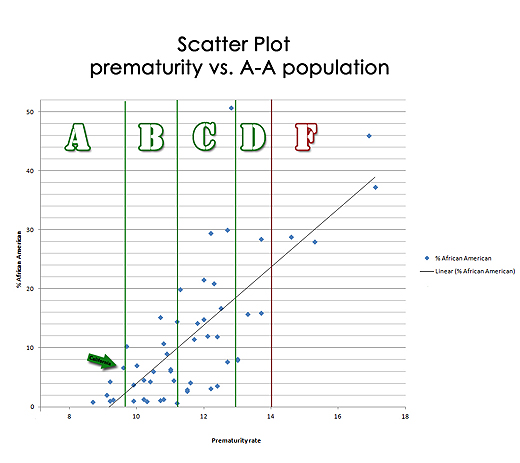
The scatter plot below compares prematurity rates to the proportion of African-American’s within each state.
Prematurity vs Race

As you can see, there is a strong correlation between prematurity rates and the proportion of African American in each state. I calculated a correlation coefficient (Pearson’s r) of 0.75. The whitest states have the lowest prematurity rates and the blackest states have the highest prematurity rates. In other words, the whitest states merit an A grade, while the blackest states are awarded F’s.

The arrow identifies the data point for California. Contrary to Dr. McCabe’s claim that California refutes the relationship between race and prematurity, California actually has a very low proportion of African Americans, corresponding to its low prematurity rate.

Why is any of this important?

We aren’t going to be able to solve the problem of prematurity if we aren’t honest about the reality of prematurity. Yes, there is an iatrogenic component to American prematurity rates, but this is a trivial aspect of the problem. Not to mention that reducing iatrogenic prematurity has risks of its own.

More importantly, the strong correlation between race and prematurity suggest a major genetic component. We should be aggressively searching for a genetic basis for prematurity instead of pretending that it doesn’t exist. But that, of course, it hard, and The March of Dimes would prefer the easy way out, grandstanding by “grading” states on prematurity rather than do the difficult work of solving the actual problem.


Addendum:

March of Dimes state by state prematurity statistics can be found here: http://www.multivu.com/players/English/59684-march-of-dimes-75th-anniversary/

African-American state by state population statistics can be found on Wikipedia: http://en.wikipedia.org/wiki/List_of_U.S._states_by_African-American_population

November 1, 2013: This week in homebirth idiocy

iStock_000018428541XSmall

You can’t make this stuff up!

1. Is anyone really so stupid that they could believe this?

From the festival of ignorance known as Mothering.com, comes this from Who the Heck First Thought Up the Cry it Out Approach?

Holt popularized Cry It Out in 1895, and it is my theory that the method caused both World Wars, twenty and forty years later, when these very pissed off babies became adults.

Because we all know that there were no wars before WWI.

2. The title says it all, The Freebirth of Apple Blossom Light Hawk Summer Willow Wind:

Before Peacy’s birth, Joey had told me of a Native American tradition where children’s names were constantly in motion – constantly changing based on their phase of life and their spirit. I tried this out with Peacy, but it didn’t feel right; I wanted her to have a name of her own. It felt like something she was entitled to, something sacred. I thought about it for a long time. I over-thought it. I came up with a name, Lynnea, and I shared it with Joey. He didn’t like it. He asked me why I had chosen it. I told him it reminded me of the forsythia – the first vibrant blossom of the spring.

“What about ‘Spring Blossom,’” he said.

I fell in love with this – I had never even considered a name so beautiful. Over the next few months, her name evolved. It became like a poem. It came to embody her soft, radiant beauty, her fiery spirit, and her deeply passionate soul. We gave her a nickname too, “Peacy,” because who can say “Apple Blossom Light Hawk Summer Willow Wind, come get your dinner!”?

Good point!

3. What’s up with the ridiculously long titles? Consider I Did Not Cut My Baby’s Umbilical Cord for Six Days So We Could Have a Natural “Lotus Birth” Just Like Chimpanzees.

Because, really, who doesn’t aspire to be just like a chimpanzee?

When we clamp and cut the cord too soon, we risk losing this precious fluid and gas exchange. Some wild animals such as our closest relatives, the chimpanzees must know this instinctively as most of them continue to carry around the placenta with the cord attached to their babies until it naturally drops off and is returned to the earth; what we otherwise refer to as a “lotus birth.” Other animals do chew the cord off shortly after birth, but as a vegan this option did not appeal to me.

4. Even though there is a whole lot of stupidity in the first three pieces, the winner this week, hands down, is this fourth effort, illustrating is what happens when your parents and their friends are narcissistic morons who think birth is a piece of performance art and the baby is a prop. No single quote could truly capture the narcissism of all the adult participants, so I urge you to read the whole post if you can stand it.

From the friend:

…[H]e was there, he was there, little floppy white boy was in her arms cradled close to her aching flesh, and he was out and real and so white and limp. For a brief instant we were flooded with relief so sharp it stung. Wendy announced, voice shaking, “It’s a boy!” and there was a flutter of excitement and happiness before Richelle seized the baby and sealed her mouth over his. “Come on baby, breathe,” she muttered between breaths. What? At first I thought Richelle was just taking precautions, just in case, but he’d cry any second now and we’d all laugh and say how freaky that was and how for a minute we were worried something was actually wrong. Right? I saw Dave Rush put his hand over his mouth and the smile slowly disappeared from Wendy’s face. He wasn’t breathing? …

“Turn the fan off!” Richelle snapped at the people behind her, laying Beckham on the floor, continuing filling his little chest with air. Turn pink turn pink, turn pink, this isn’t really happening is it? This is happening. Just cry just be okay, oh baby please please be okay!…

Richelle was still methodically giving the baby breaths. Dave was sobbing into his hands and Wendy was leaning over the edge of the tub staring fixedly at her baby, speaking clearly and forcefully. “I need you to breathe. I need you to breathe for your mommy. Breathe for your mommy. Breathe for your mommy!” … Dave kneeled on the floor above the little guy, begging him to breathe, holding the oxygen tube near that tiny nose, crying.

Fortunately the baby survived, though it is impossible to know the extent of the damage done by lack of oxygen both before and after the baby’s birth.

But wait! They didn’t nearly kill their own baby, they nearly killed the mother, too.:

Everyone in the room was focused on Beckham, and exploded into sobs of relief when he took that first breath. Nobody knew that I was still in peril. Upon Beckham’s birth, my placenta had abrupted and I was hemorrhaging badly into the tub. I felt large placenta-sized clots spilling out of me and the water in the tub was quickly filling with my blood. I began to see stars and felt like I was going to pass out.

The midwives turned their attention toward me and noticed the severity of my hemorrhage. They lifted me out of the tub, placed me on the couch, and administered pitocin in my leg and methergine in an IV. Katie held my uterus firmly between her hands and my doulas cut a piece of the placenta and put in under my tongue. I was pale and weak and I was struggling to stay conscious. I remember thinking that I had to stay awake, because if I closed my eyes, I wouldn’t wake up…

See, just like nature intended: a nearly asphyxiated baby and a mother nearly dying from hemorrhagic shock. But it was worth it because she could immediately snuggle with her baby in the comfort of her own home … No, couldn’t do that, either:

Once I was stable, Richelle began the work of repairing my labia and perenium that had been badly torn as Beckham was crowning. I endured 2 hours of careful stitching as my husband and mother drove Beckham to the hospital to be checked out.

The hospital confirmed that Beckham had some fluid in his lungs, and he was a bit anemic from some blood loss, but that he was really healthy besides that. They recommended that he be placed in the NICU for observation that night, but since that hospital did not have a proper NICU facility, they wrote orders to have him transferred to another hospital.

I did not want to be separated from Beckham, but my husband was worried and wanted to take him. My mom convinced my husband to bring Beckham home to me before they transferred Beckham over to the NICU. Dave explained that the baby was fine but needed to be in the hospital for observation. I told my husband that we would stay up with him all night in shifts and observe him ourselves. He very reluctantly agreed and dropped the conversation…

It took Beckham only a few days to recover. It took four weeks and a blood transfusion for me to fully recover.

Did the mother learn anything from this disaster? Are you kidding?

I am so grateful to my skilled midwife and the loving support of my birth team. Without them, the outcome of my birth would have been very different. I am so glad that I chose to have a homebirth, especially because I had complications. If I had been in the hospital, my baby would have been taken to the NICU and his entire introduction to life would have been different. Instead of being placed in a bright room hooked up to monitors, Beckham was in a dim room, in his mother’s arms, where he knew he was safe.

Yes, it would have been very different! The baby likely would not have risked loss of brain function from asphyxia, and the hemorrhage he experienced when the clueless midwife snapped his short umbilical cord, and the mother would not have nearly bled to death and needed a blood transfusion to function. Plus, she wouldn’t have experienced the two hours of suturing of her labia and perineum which had been torn to shreds.

Of course, had she given birth in the hospital, the mother would not be able to revel in her own narcissism, and what could possibly be more important than that?

Screen time

Screen time cropped copy

I’ve been following the discussion of screen time in the comments, and thought I’d weigh in.

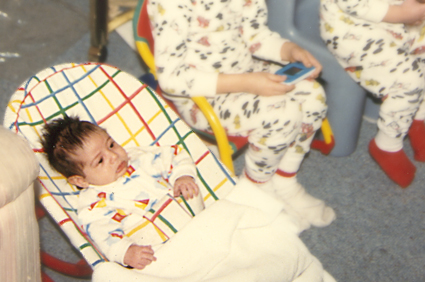
The picture above is my third son at 3 weeks of age watching TV with his brothers. His eldest brother (4 1/2 at the time) was simultaneously playing a hand held computer game.

I didn’t just allow screen time, I actively encouraged it. Bad mommy!

First world achievements

Hand holding a TV remote

You’ve probably heard of first world problems.

As the website First World Problems explains, “It isn’t easy being a privileged citizen of a developed nation.”

Consider:

The sun is too bright for me to read my iPhone screen.

Or:

I tried to unlock the wrong Prius today. Twice.

And my personal favorite:

I can’t find the remote.

There’s a corollary that you probably haven’t heard about: first world achievements.

That’s when a privileged denizen of the first world brags about dealing with her first world problems. For example:

I’m so proud of myself for reading my iPhone screen even thought it was sunny.

Or:

Even thought there were lots of Prius’ in the Whole Foods Parking Lot, I immediately unlocked my own Prius.

Or:

I was able to find my TV remote without help.

Or, my personal favorite:

I am so proud of myself for having an unmedicated childbirth.

As you can see, first world “achievements” aren’t achievements at all. They are what passes for an achievement among privileged women who don’t have real achievements and have to make some up to feel good about themselves. They are all variations on the same theme: Look at me! Here’s how I dealt with the “problem” of the luxuries in my life.

Unmedicated childbirth is the paradigmatic first world achievement. Any woman could do it. Most women who have ever lived have already done it, and most women who give birth around the world do it each and every minute of each and every day 24/7/365.

Do natural childbirth advocates consider unmedicated childbirth an achievement for an Afghan teenager? No. How about for a woman who accidentally gives birth on the side of the road because she didn’t make it to the hospital in time? Nope, not an achievement for her. How about our grandmothers, great grandmothers and other female ancestors who gave birth without pain medication? No, it wasn’t an achievement for them, either.

Clearly, it isn’t experiencing the pain that is the “achievement”? So what are these woman boasting about? They are boasting that they had access to effective pain relief but they refused it.

And not just any pain: It’s not an achievement to refuse Novocaine for a root canal, and it’s not an achievement to refuse general anesthesia for an appendectomy. That’s considered foolishness.

And not just any pain relief: It’s perfectly acceptable, indeed entirely compatible with natural childbirth, to reduce the pain of childbirth by lying in a kiddie pool filled with fecally contaminated water.

So if it’s not the ability to tolerate pain (since women who have unmedicated childbirth because they have no other choice haven’t achieved anything), and it’s not simply enduring pain (since NCB advocates wouldn’t consider unmedicated migraines or kidney stones to be an achievement) and it’s not the refusal of pain relief per se (since no NCB advocate thinks it is an achievement to refuse anesthesia for surgery), what is it?

It’s their own special, carefully defined, easy to accomplish “achievement”:

I was presented with a luxury option and chose to forgo it.

We’re supposed to be impressed by that?

Frankly, I’d consider it more of an achievement if you learned to program the remote.

Every vagina has superpowers?

Pregnant Woman Mother Character Super Hero Red Cape Chest Crest

In my efforts to expose American homebirth midwives as woefully ignorant fools I have no better allies than homebirth midwives and their supporters.

Case in point, this tweet from the annual conference of the Midwives Alliance of North America (MANA) that took place this weekend:

vagina superpowers

The woman behind this statement is Roanna Rosewood. According to her website:

Roanna is an the author of the Amazon Bestseller, Cut, Stapled, & Mended: When One Woman Reclaimed Her Body and Gave Birth on Her Own Terms After Cesarean, an award-winning international speaker, co-founder and host of Birth Plan Radio, and the executive action chair of Human Rights in Childbirth and most importantly, a mother. In her not-so-humble opinion, the latter makes her a true birth expert.

Bestseller? It’s #143,785, but Roanna is obviously into hyperbole.

Human Rights in Childbirth? You remember them, the folks who think human rights in childbirth means protecting baby slaughterers and other incompetents.

Being a mother makes her an expert in birth? I wonder if she thinks she’s an expert in cardiology because she has a beating heart.

There are only a few words in the tweet, but they convey so much about American homebirth midwives:

1. They are startlingly immature

Rosewood’s claim is a great example of the magical thinking that characterizes American homebirth midwifery. If you wish it, it is so. You can be a best selling author even when your book is ranked #143,785 because you said so. Defending women who commit manslaughter constitutes supporting human rights in childbirth because you said so. You’re an expert in birth because you said so. Your vagina has “superpowers” because you said so.

2. They lack basic education in childbirth

This is obviously going to come as a shock to the folks at MANA, but the vagina has no powers at all in childbirth. In is entirely passive. The uterus and the mother’s pushing efforts do all the work. Claiming that the vagina is powerful in childbirth is like claiming that the highway makes cars function.

3. They are biological essentialists

Women are constantly being reduced to their uteri, vagina and breasts. I’ve yet to see a homebirth advocate claim that her brain has superpowers. Why is that?

4. They are woefully lacking in self-esteem

You really have to have a pathetically low sense of self-esteem to be impressed with the notion that your vagina has superpowers.

5. They are fools

Not only did a nitwit make a ridiculous statement, but it was promptly and publicly relayed to the other fools following MANA13 as if it were wisdom.

Homebirth kills babies and it’s easy to see why. Anyone who believes that women’s vaginas have superpowers is not qualified to provide care in the inherently dangerous process of childbirth.

Why would any woman hire fools like these?

Autism and maternal self-blame

Autism

I’m currently reading a widely praised book on raising children who are very different from their parents. The book is Far From the Tree: Parents, Children and the Search for Identity by Andrew Solomon. It’s about one of the most challenging aspects of parenting, recognizing that your child is not you and that’s okay. The task is made far more difficult when the child differs from you in major ways: children who are deaf, autistic, transgender, etc.

One aspect common to parenting children with major differences is self-blame, at least in the early stages.

Solomon writes:

…The attribution of responsibility to parents is often a function of ignorance, but it also reflects our anxious belief that we control our own destinies. Unfortunately, it does not save anyone’s children; it only destroys some people’s parents, who either crumble under the strain of undue censure or rush to blame themselves before anyone else has time to accuse them… Many parents … organize their guilt around some fictitious misstep. I had lunch one afternoon with a highly educated activist whose son suffers from severe autism. “It’s because I went skiing while I was pregnant,” she said to me. “The altitude isn’t good for the developing child.” I felt so sad hearing this. The roots of autism are confusing, and there are questions as to what may dispose children toward the condition, but altitude is not on the list. This intelligent woman had so assimilated a narrative of self-blame that she didn’t know that it had come out of her imagination.

It is quite startlingly how desperately parents, particularly mothers, try to blame themselves for their child’s autism. How I Gave My Son Autism is a horrifying example of this narrative of maternal self blame.

I am admitting here for all the world to see: I gave my son Autism. I did it. Me. And no one can ever take that away.

So . . . how did I give my son autism? I wish I could say it was one thing – one thing that I could take back that would make things neat and easy, but it wasn’t. It was mistake after mistake, assault after assault. The following are the biggest mistakes I made to which I attribute my son’s descent into autism…

The list of the mother’s supposed transgressions is mind boggling:

  • Ultrasound
  • High fructose corn syrup
  • Tylenol
  • Pitocin
  • C-section
  • Antibiotics
  • Vaccines
  • Flouride

For example:

I had at least five while I was pregnant. I was assured that they were completely safe. Heck, you can get them in malls, so I assumed they were pretty benign. Wrong! While I didn’t get ultrasounds in malls, I didn’t research them either. Ultrasounds have, in fact, been implicated in autism among other neurological disorders…

No it hasn’t. There is no scientific evidence for ANY of the supposed transgressions on this list as a cause of autism, but then there is no evidence that altitude is a cause of autism, either, yet that didn’t stop the mother in Solomon’s example from invoking it.

The mother declares:

I am already anticipating three different responses to this post:

Response 1) There will be people who read this and think, “Good grief, woman. How stupid can you be? What you did borders on child abuse. OF COURSE your child has Autism.” And to that, I have no argument. You are absolutely right. And good for you for knowing better than I did.

Response 2) Some of you will read this and know exactly how I feel because your story is very similar. To all of you, you have my deepest, heartfelt sympathy. While we will always have our mistakes to live with, the best thing we can do now is to share our truth and our story to help others.

Response 3) There will be people who feel pity for me because I have not been able to make peace with myself for my role in my son’s health crisis. You will feel compelled to reach out to me with kind messages imploring me to forgive myself. Please . . . don’t. It won’t do any good. I am not fishing for forgiveness, and while I know you mean well, it won’t help me… No child should have to endure what mine has endured. No mother should ever have to experience the kind of torturous guilt I live with every day.

This is the flip side of magical thinking so integral to natural childbirth, attachment parenting and vaccine rejection. If what you think and do has the power to keep your child safe, it follows that if your child has an affliction, it must be your fault. Indeed it is easier for mothers to blame themselves than to acknowledge the frightening reality; autism is basically random, due to genetics and can’t be prevented.

Apparently it is better to be powerful and wrong than to be utterly powerless in controlling our children’s destinies.

Melissa Cheyney spews more BS to justify hiding MANA death rates

image

Kudos to the more than 400 people who have signed the online petition demanding that the Midwives Alliance of North America (MANA) release the death rates for the 27,000+ homebirths in their database. It has been swiftly and remarkably successful.

I created the petition on October 1.

On October 4 MANA began censoring comments on their blog after refusing to reveal the death rates.

Also on October 4th, after learning that both Melissa Cheyney CPM and Wendy Gordon CPM (and placenta encapsulation specialist!) were feeling pressured by my “attacks,” I offered this challenge:

Stop lying! Stop hiding! Stop trying to bury dead babies twice, once in the ground and the second time in our collective memories.

How dare you two lie to American women by omission or commission? I never had any doubt that you aren’t healthcare providers; I’ve always known you are lay people trying to get paid while you get your birth junkie fix, but really??!! Have you no decency at all?

Release the MANA death rates. Stop lying about existing research. Start acting like the healthcare providers you claim to be and not a bunch of selfish, self-absorbed women who casually step over the tiny bodies of babies who didn’t have to die on your way to picking up a check.

On October 24, ahead of the MANA13 national conference taking place this weekend, Cheyney felt compelled to spew more BS in an effort to justify the fact that MANA has been hiding their death rates for nearly 5 years.

They say that when you can’t dazzle them with brilliance you can always baffle them with bullshit and apparently that’s Cheyney’s motto, too. Cheyney employs a lot of words to tell us nothing. Well, not exactly nothing. She can’t resist yet another whopper.

Cheyney claims that the MANA statistics cannot be released without the approval of an IRB (institutional review board).

The code of federal regulations # 21 part 56 requires it, and researchers cannot submit findings for publication unless they have gone through appropriate procedures to access data. You must have IRB clearance before you analyze data for publication.

First, MANA itself has published almost all the data from the database EXCEPT the death rates.

Second, while IRB approval could be required for publications based on the data, IRB approval is not required to read and review the data.

Finally, Federal regulations #21 part 56 concerns studies leading to FDA approval of drugs or devices and has nothing to do with the MANA data.

Cheyney also has this revelation for us:

I’m excited to report that a group of researchers and I have two papers on the MANA Stats 2.0 dataset coming out in the Jan/Feb 2014 issue of the Journal of Midwifery and Women’s Health…

M: This article looks at the demographics of the MANA Stats data set 2004-2009, including the intended place of birth and the type of midwife in attendance …

It also looks at standard maternal-child health outcomes and home birth indicators, like transfer rates, i.e. intrapartum transfer, neonatal transfer, maternal postpartum transfer, and it looks at reasons for those transfers. It also examines cesarean section rates and spontaneous vaginal birth rates. It also examines intrapartum, early neonatal, and late neonatal mortality. Finally, it explores rates and type of tearing, hemorrhage, and NICU admissions.

That’s funny. As recently as September 29, Wendy Gordon claimed that there were no articles in press, and now there are suddenly two that will be published in less than two months?

So nearly 5 years after the data was analyzed, MANA has decided to publish it. Johnson and Daviss took 5 years to figure out how to spin the CPM death rate in the 2005 BMJ homebirth study. They finally decided to compare homebirth in 2000 to hospital birth in a bunch of out of date papers extending back to 1969. That’s how they concealed the fact that homebirth had a death rate nearly triple that of low risk hospital birth in the same year.

I expect a similar attempts from Cheyney at burying the deaths of homebirth babies. She should report how many homebirth babies died compared to how many homebirths were intended. What might she do instead?

Here are just a few possibilities:

Compare homebirth to high risk hospital birth including premature babies

Exclude breech, twins, VBAC and postdates from the homebirth deaths as “high risk” even though Cheyney has spent years trying to convince the state of Oregon that they’re not

Follow the lead of Colorado homebirth midwives are report the result in an incomprehensible way like deaths per midwife

Take a page from Oregon homebirth midwives and obfuscate the data by adding in all prenatal stillbirths thereby dramatically diminishing the impact of homebirth deaths.

I’m sure that Cheyney will do something to hide the hideous death rate at CPM attended homebirth. I’m so sure, in fact, that if I’m wrong, I will publicly apologize to Cheyney and donate $100 to the MANA stats project.

It’s a win-win for me. If I’m wrong, and Cheyney publishes the number of homebirth deaths compared to the total number of attempted homebirths, I’ll finally have access to the data. If I’m right, I’ll save $100 and I’ll be able to say that you heard it here first that MANA would try to hide the many homebirth deaths at the hands of their members.

No matter what, though, we’ve already shown the power of a public petition. In less than one month, MANA has already been forced to release data to counteract the charge that they’ve been hiding their death rates for nearly 5 years. It’s a small, but real victory.

If you haven’t signed the online petition yet, please do so. We can’t let up the pressure on MANA to release the data that will allow women to make an informed decision about homebirth.

No, “birth rape” is not for real

iStock_000009069522XSmall

I’ve been writing about this issue for years, but it has finally made it in to the mainstream. In a piece on Time.com, Bonnie Rochman asks Is “Birth Rape” for Real? The answer is a resounding NO!

What is “birth rape” supposed to mean? It doesn’t mean rape during birth, although that is indeed possible, and no doubt has actually occurred.

As Rochman tells us:

In a post on Salon.com by Tracy Clark-Flory, Reed explains the phenomenon: “Fingers, hands, suction cups, forceps, needles and scissors … these are the tools of birth rape and they are wielded with as much force and as little consent as if a stranger grabbed a passer-by off the street and tied her up before having his way with her.”

According to Amity Reed, the Al Sharpton of birth activists, birth rape is:

an instance during labor “when an instrument or hand is inserted into a woman’s vagina without permission, after which the woman feels violated.

Like Sharpton who cries “racism” regardless of the circumstances, Reed cries rape regardless of the circumstances. But the circumstances matter.

We have a word for medical care without permission and the word is “assault.” But childbirth activists abuse the word “rape,” and demean the experience of victims of actual rape, because they are desperate for attention. The promiscuous use of language, as when people abuse the term “lynching” or “racism” any other shocking term, is a sure-fire attention getter.

They’ve figured out that “I didn’t like the way the obstetrician treated me when he was trying to save my baby’s life” is not particularly compelling, since anyone who has ever suffered a serious medical problem knows that doctors give priority to saving lives in life threatening situations, rather than respecting emotional sensitivities. Let me be very clear about this point: I’m NOT saying that doctors are always right. Often more compassion could be shown without compromising life saving efforts in the least. But lack of compassion is not rape, either.

What is the actual definition of rape?

the unlawful compelling of a woman through physical force or duress to have sexual intercourse.

The legal definition has been expanded to include other forms of sexual touching that do not involve intercourse. And while it is true that we have come to understand that rape is often more about power than sex, we limit the meaning of rape to sexual contact. We have a different word for non-sexual harm; that word is assault. This is a critical point. We don’t discount any form of abuse or harm, but we do insist on precision in describing and punishing it.

And we do not determine whether a crime has occurred by referencing the feelings of the victim. The feelings of the victim matter not at all; what matters are the “feelings” of the perpetrator. We a name for the perpetrator’s feelings: intent.

All crimes require more than a physical act. They require intent, legally known as mens rea or the guilty mind. Consider the crime of murder. A person run down by a driver who was texting is every bit as dead as a person run down by a professional hit man intending to cause the death. But only the latter case is murder, while the former is manslaughter at most. Intent is absolutely critical to determining whether a crime has been committed and what type of crime has been committed.

It does not matter how the victim feels about the crime (or in the case of murder, how the victim theoretically would feel about the crime). It does not matter that the relatives of the victim run down by a texting driver “feel like” the victim has been murdered, and that’s not because we discount their feelings. We are actually quite sympathetic to the anger and sense of loss of the victim’s relatives.

Let’s look again at “birth rape.” Rape requires sexual touching. A man can punch a woman and it is not rape. It might be assault, but it is not rape. Why? Because it is not sexual touching.

And it’s not merely a matter of the identity of the body part that has been touched. A woman can kick a man in the crotch, but that is not rape either. It might be assault, but it is not rape. Why? Because intent matters.

The victim’s feelings about the matter are irrelevant. The woman who was punched can “feel” like she was being raped, but that doesn’t make it so. A man who was kicked in the crotch might “feel” like he was being raped, but that doesn’t make it so.

And, as I mentioned above, a woman in labor can actually be raped. Do childbirth activists actually expect us to believe that a vaginal exam without consent is the equivalent of forced sexual intercourse during labor? I can’t imagine they do. And if they can tell the difference between the two scenarios, then they are aware that they are misusing the term rape.

“Birth rape” does not exist. It is a promiscuous abuse of the term rape for the sole purpose of garnering attention. The term is legally meaningless and ethically suspect. It is morally wrong to insist that a rape has occurred when nothing of the kind happened. It is ethically unjustified to misuse the term rape regardless of how worthy the motivation. And it is insupportable to base the accusation of a crime on how the victim “feels” about it.

Why the autonomy of pregnant women really matters: the alternative could be incarceration

iStock_000027310206XSmall

In case you thought yesterday’s discussion of maternal autonomy vs. “the best interests of the child” was just an arcane academic discussion, today comes word of a pregnant woman forced into a drug treatment program (even though she was not taking drugs) because her doctor thought it would be in the best interests of the child.

The New York Times reports reports on the case of Alicia Beltran, a case that practically defies belief:

Alicia Beltran cried with fear and disbelief when county sheriffs surrounded her home on July 18 and took her in handcuffs to a holding cell.

She was 14 weeks pregnant and thought she had done the right thing when, at a prenatal checkup, she described a pill addiction the previous year and said she had ended it on her own — something later verified by a urine test. But now an apparently skeptical doctor and a social worker accused her of endangering her unborn child because she had refused to accept their order to start on an anti-addiction drug.

Ms. Beltran, 28, was taken in shackles before a family court commissioner who, she says, brushed aside her pleas for a lawyer. To her astonishment, the court had already appointed a legal guardian for the fetus.

Think about that for a minute: a grown woman was shackled and taken into custody because her doctor disapproved of what she (erroneously) thought she was doing. It could never have happened but for the fact that Beltran was pregnant. Apparently, she lost her autonomy the moment the egg met the sperm.

Why did this happen at all?

Under a Wisconsin law known as the “cocaine mom” act when it was adopted in 1998, child-welfare authorities can forcibly confine a pregnant woman who uses illegal drugs or alcohol “to a severe degree,” and who refuses to accept treatment.

Now, with Ms. Beltran’s detention as Exhibit A, that law is being challenged as unconstitutional in a federal suit filed this month, the first in federal court to challenge this kind of fetal protection law. Its opponents are hoping to set an important precedent in the continuing tug of war over the rights of pregnant women and legal status of the unborn.

Why does this law exist? It’s certainly not because it is effective in protecting children:

In 2011, the American College of Obstetricians and Gynecologists said that “incarceration and threat of incarceration have proved to be ineffective in reducing the incidence of alcohol or drug abuse” and that mandated testing and reporting lead women to avoid prenatal care that “greatly reduces the negative effects of substance abuse during pregnancy.”

Dr. Cresta W. Jones, an obstetrician and a fetal medicine specialist at the Medical College of Wisconsin who sees many women with histories of drug or alcohol abuse, said that even sporadic detentions had sowed fear.

“The women are scared to come in if they have dependency problems,” she said. “When you allow them to be honest you get better outcomes in their pregnancies.”

This law and laws like it are almost surely unconstitutional and violate the basic principles of medical ethics. They exist not because anyone wants to promote the best interests of an individual child, but as a shot across the bow in the effort restrict legal abortions; these laws substitute religious principles for both medical ethics and the law, and award personhood to embryos and fetuses. Indeed, this law went so far as to appoint a lawyer for the fetus, while not providing one for its mother.

Placing the purported best interests of the child above maternal autonomy, whether in the realm of drug use or the realm of homebirth poses more than a theoretical threat to the rights of pregnant women. Homebirth may be unsafe (as a variety of legal choices like smoking may be unsafe), but women, even pregnant women, have the right to make unsafe choices. The alternative is incarcerating women against their will when they make decisions with which their doctors disagree. This alternative is both ineffective and harmful, as well as unethical and unconstitutional.

The AAP responds to obstetrician criticism of its homebirth position

Autonomy

You may recall that last fall the American Journal of Obstetrics and Gynecology published a position paper opposing homebirth and I savaged it (You heard it here first: new paper opposing homebirth is poorly researched, relies on bad studies and is woefully paternalistic).

The paper in question is The paper is Planned home birth: the professional responsibility response by Chervenak et al.

Chervenak is presenting a personal, religious philosophy on maternal autonomy and fetal beneficence and it would have been appropriate for him and his colleagues to acknowledge that their views are not supported by the mainstream medical ethics community. Simply put, in light of American law, and non-religious moral ethics, Chervenak et al. are wrong about the extent of women’s autonomy and women’s ethical obligations toward their unborn children.

And:

Women’s well established right to medical autonomy is not “rights-based reductionism”; it is a foundation of medical ethics. Professional responsibility never involves forcing patients into doing what you recommend or harranging them for failing to follow your recommendations. Professional responsibility requires informed consent, nothing less and most certainly, nothing more.

Chervenak et al. have now taken their incorrect and misguided argument to the journal Pediatrics. In a paper entitled Planned Home Birth: A Violation of the Best Interests of the Child Standard?, Chervenak actually has the temerity to accuses the AAP of violating ethical standards in their position statement on homebirth, published earlier this year.

The AAP statement correctly states that hospital birth is the safest form of birth. However, the effect of this statement is to sanction, and unintentionally enable, planned home birth if certain circumstances are met. However, meeting these circumstances does not eliminate the preventable, increased perinatal risks of planned home birth. The AAP should consider withdrawing
this sanction and replacing it with the professional responsibility of pediatricians to be strongly directive in recommending against planned home birth and recommending in favor of planned hospital birth. The AAP should also emphasize the professional responsibility of pediatricians not to participate in planned home birth, except in the very limited circumstances described in this article. Pediatricians should support creating settings that resemble home birth in the hospital and in birthing centers that are in or adjacent to hospitals.

Once again, Chervenak et al. are spectacularly wrong are wrong about the extent of women’s autonomy and women’s ethical obligations toward their unborn children.

Not surprisingly, the American Academy of Pediatrics (AAP) has responded sharply to the accusation, Policy Statement on Planned Home Birth: Upholding the Best Interests of Children and Families written by Kristi Watterberg on behalf of the Committee on Fetus and Newborn.

The arguments made by Chervenak et al regarding the “best interests of the child” have several notable flaws. First, before delivery, the fetus is not an independent being (child), but a fetus, and the authors inexplicably ignore both the ethical principle of autonomy for the expectant mother and the difficult balance of maternal and fetal benefits and harms. Previous commentary by these authors advocates overriding both maternal and fetal rights, arguing instead for the “professional responsibility model of obstetric ethics … In other words, it appears that physician beneficence is the dominant ethical principle, and that when a pregnant woman becomes an obstetric patient she gives up her autonomy and her decision-making capability to the physician…

Watterberg concludes:

…[W]e firmly believe that the policy statement on planned home birth follows the AAP mandate to promote the best interests of children and their families, by acknowledging maternal and family autonomy and the complexity of their decision-making, by setting rigorous standards for care of infants born in any setting, and by promoting increased professional collaboration and communication.

Watterberg is correct.

Chervenak et. al, in addition to being wrong about the ethical principles that govern a woman’s right to choose homebirth,  appear to believe that they speak for most obstetricians when the reality is the opposite. Most obstetricians recognize that both medical ethics and the law requires that a woman’s decision to choose homebirth must be respected.

Chervenak and colleagues are certainly entitled to their personal opinions, but that’s all they are, merely their personal opinions. It is deeply unfortunate that they have chosen to mistake their personal beliefs for the ethical principles that govern contemporary medical practice.