Category Archives: Uncategorized

Filmaker: natural childbirth is anti-feminist propaganda

Macro image of dictionary definition of propaganda

I’m not the only one who has figured out that natural childbirth is profoundly anti-feminist.

The New Inquiry interviewed film professor Irene Lusztig on her new documentary The Motherhood Archives.

Here’s Lusztig on the philosophy of natural childbirth:

I’m a filmmaker; I’ve worked a lot with propaganda and archives—my background is in communist, post­communist stuff… So when I was pregnant it became immediately, abundantly obvious to me that almost everything I was reading or seeing or being exposed to was telling me how to give birth or how to be pregnant or how to mother or look after my child. It was clear to me immediately that all of this is an intense space of propaganda.

On the “right” way to give birth:

I just found it helpful and reassuring to think through the intense ideological space of “the right way to give birth,” “the right way to mother,” “the right way to do this or that with your child.” There’s a constant idea that you’re failing, you’re doing it wrong—so for me I just found it hugely reassuring to ­understand that these things are completely culturally bound, historically bound. There is no wrong way to give birth.

On the misogyny of Grantly Dick-Read:

Grantly Dick-Read is the British obstetrician who coined the term natural childbirth and wrote the first books about it. His writing is a very explicitly Christian appeal to the experience of being inside the pain as a form of spirituality. It’s a Christian thing to do. That history has also been erased. It’s kind of ironic that the space feminists occupy now is a redeployment of this incredibly Christian and misogynist argument about women’s bodies.

On the history of pain relief in childbirth and the fact that women demanded twilight sleep:

… [T]he pain of labor is an abject experience of very intense pain. The language that’s used in these books and articles that feminists wrote advocating twilight sleep is basically human-rights discourse: Society has the obligation to give us women this thing that will take away this devastating pain that we experience. It’s a human-rights discourse of equality for women in the form of pain relief. Which is incredibly interesting set next to ­today’s feminist conversation which is all about natural unmedicated childbirth being the correct, feminist way of giving birth…

On inherently high rates of perinatal and maternal mortality:

People have asked me about the word pathological. People think of that as a very bad word, but it comes directly out of earlier writings about childbirth… It comes out of doctors struggling with incredibly high maternal mortality rates and high infant-mortality rates, incredibly high rates of vaginal tearing and bad maternal side-effects from birth, prolapse and all these things that still happen, actually.

Lusztig has identified the central ironies about contemporary natural childbirth: it is profoundly anti-feminist; it was created by misogynists who wished to control women; it is both ahistorical anti-scientific, denying as it does both the need for pain relief and the inherent dangers of childbirth.

There is one more point about natural childbirth that Lusztig doesn’t mention, although she alludes to it:

Natural childbirth advocates, who claim to be “educated,” appear to be utterly clueless that they are being manipulated by propaganda.

Delayed cord clamping: much ado about nothing

iStock_000007632446XSmall

Ahhh, the power of the press release.

How else to explain the fanfare with with the latest Cochrane Review on delayed cord clamping was greeted despite the fact that it showed almost no benefit?

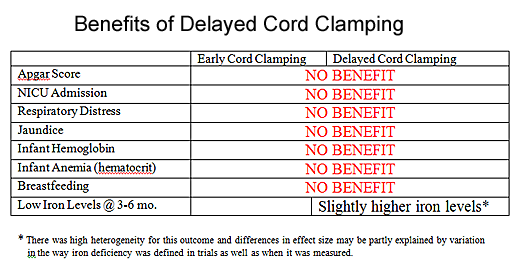
To see what I mean, I’ve created the following chart listing all the benefits of delayed cord clamping.

Benefits of delayed cord clamping

As you can see, the authors looked at a variety of possible benefits of delayed cord clamping and found almost nothing … except slightly higher iron stores (a laboratory value), one that has no clinical effect and probably has no clinical significance.

So why did mainstream media outlets like the New York Times wax rhapsodic on the front page?

But a new analysis has found that delaying clamping for at least a minute after birth, which allows more time for blood to move from the placenta, significantly improves iron stores and hemoglobin levels in newborns …

Um, not exactly. Obviously babies subject to delayed cord clamping had higher hemoglobin levels in the first few days after birth; they got more blood. But that doesn’t mean that higher hemoglobin levels are beneficial and, indeed, the higher hemoglobin levels did not translate to better Apgar scores, less respiratory distress, fewer NICU admissions, or greater breastfeeding success.

Moreover, it did not translate to lower levels of anemia at 3-6 months. Babies in both groups had the same hemoglobin level and hematocrit at that point, suggesting that the initial transfusion of blood from the cord was unnecessary and the baby had to destroy those blood cells to get to a normal hematocrit.

Not surprisingly, babies who had to destroy blood cells ended up with higher iron stores, but there is no evidence that they benefited from this in any way. Indeed, it would be helpful to look at longer term outcomes to determine if the higher iron eventually disappeared, suggesting no advantage to having higher measures of iron stores. The authors actually acknowledge that the apparent difference in iron stores may not be real, and may reflect disparities in the way that iron stores were measure in the individual studies that make up the meta-analysis.

To understand exactly why there are no real benefits to delayed cord clamping, lets do a thought experiment. Let’s pretend that we gave half of newborns a blood transfusion in the immediate aftermath of birth to test the hypothesis that an immediate blood transfusion benefits normal babies. If we measure the same things that the Cochrane investigators measured, we would get exactly the same results. The only “benefit” would be slightly higher iron levels, and even that isn’t guaranteed since the authors are not sure that result is real.

Would we conclude that routine newborn transfusions offered enough benefits to recommend them? Of course we wouldn’t, since it offers no clinical benefits at all.

The exact same thing can be said about delayed cord clamping.

So what’s this paper really about? This paper is about midwives and natural childbirth advocates dissing obstetricians. Indeed the paper was written by midwives who are desperate to find yet another reason to criticize obstetricians. Delayed cord clamping is just a reaction to the fact that obstetricians have traditionally clamped the cord early. As the chart clearly shows (no chart was included in the study since it would have graphically displayed the lack of benefit), there is no clinical benefit to delayed cord clamping and only a difference in laboratory values at 3-6 months that has no bearing on health and may not be really anyway.

Fortunately, delayed cord clamping appears to have no harms, so there’s no reason that we can see (at the moment) not to do it if parents request it. By that reasoning, we could give every newborn a blood transfusion if their parents request it.

So why is everyone jumping up and down about this study?

That’s the power of the press release … and a paper written to maximize clinically irrelevant effects and minimize the absence of clinical benefit.

Homebirth killed my baby; I’m still in favor of it

iStock_000005377638XSmall

I wish I were making this up:

From Mama’s Milkies Facebook page:

Fan Share: Hi ! Love your page! I actually did have a midwife at my homebirth and sadly my baby died. He was born still. We couldn’t find his heartbeat and then just didn’t get him out fast enough (had to transfer to hospital and have a csec) it was an attempted vbac. Even after that situation, I am still for home birth. (just not for me) If one of my daughters decided to have a HB I would be all for it…

Demonstrating yet again how common homebirth death is, Tyann chimes in:

I’m so sorry to hear of your loss. My first daughter,Paityn, was stillborn, at home, with a midwife at 40+3. I had my 2nd in a hospital due to preeclampsia but was planned at home and my 3rd at home.

Exactly how many of their own babies have to die before these nitwits figure out the obvious? Homebirth kills babies who didn’t have to die.

As I’ve written in the past (Homebirth and human sacrifice):

“Birth,” like any goddess demands worship. Her power must be acknowledged and her essential goodness must be constantly praised through birth “affirmations.” “Birth” also demands constant evidence of belief. What could possibly be more demonstrative of true faith than the willingness to sacrifice your newborn child?

Unlike the God of the Old Testament in the story of Abraham and Isaac, “Birth” apparently does want and need human sacrifice.

Babies die all the time at homebirth, and the biggest risk factors lead to the greatest number of deaths. As with any religion, believers must then deny that the deity had anything to do with it. Yes, they trusted “Birth” and the baby died, but that was just an incredible coincidence.

It’s easiest to figure out who are the truest believers. They are women who lost babies at homebirth but still trust “Birth.” To demonstrate their continued faith, they immediately being planning for the next homebirth.

It turns out that sacrificing your baby on the altar of “Birth” isn’t the highest form of devotion. That honor is reserved for deliberately placing your next child on the same altar and trusting that the goddess who killed your last baby won’t kill this one, too.

Allison Dixley’s feeling threatened; maybe she isn’t an alpha parent after all

alpha

Oooh, someone’s feeling threatened.

That would be Allison Dixley, the self-proclaimed “Alpha Parent.”

Those who denounce breastfeeding science are merely the exhaust fumes of the internet. They are an unfortunate and unavoidable result of our information age. Whilst emotionally satisfying for the denouncer, their pseudoskepticism has reckless consequences for the rest of society. Denouncers hold moral and political responsibility for selfishly promulgating misinformation to advance their own interests while knowingly damaging the work of organisations whose main focus is improving all our health. We need to reframe breastfeeding, not as some sort of ideology to be defended; but rather as a universal act of allegiance to our children and to ourselves.

Sorry, Allison, but no matter how much you wish to rub our faces in your “superiority,” you are out of luck. The science simply doesn’t support your self-serving claims.

You’re hardly the first to moralize breastfeeding by brandishing “the science.” Indeed, Charlotte Faircloth refuted your piece before you even wrote it in her paper ‘What Science Says is Best’: Parenting Practices, Scientific Authority and Maternal Identity.

She’s got you pegged:

Faircloth explains the meaning of “the science” to lactivists and the paradoxical invocation of scientific evidence by women who are just as likely to ignore science when they feel like it.

Simply put, lactivists don’t read scientific papers, don’t know what they show and don’t care anyway. “The science” is simply a convenient cudgel which lactivists use to metaphorically hammer away at women who do not follow their example:

The scientific benefits of breastfeeding and attachment parenting serve as a (seemingly) morally neutral cannon about which mothers can defend their mothering choices and ‘spread the word’ about appropriate parenting. I noticed that for some particular women, sharing ‘information’ with other mothers … was a source of great enjoyment – as Felicity in the quote above puts it, she is ‘super empowered’ with the knowledge that she has. Amelia, cited above, also said that she felt ‘like a genius on a planet of idiots.’ Any criticisms she has of other women are de-personalised, because science ‘has no emotional content…’

“A mother describes how she responds to those who criticise her decision to breastfeed her son until his seventh birthday, by saying: ‘I mean, do you want to see studies? Because I can show you studies!’ There are laughs and cheers from the rest of the group.”

But lactivists like Allison, who have basically no idea what the actual scientific evidence shows, use “the science” in another way:

Arguably, ‘science’ here is not about understanding, but belief. The use of ‘evidence’ has reached the level of the quasi-religious; not in the sense that the beliefs are other-worldly (quite the opposite) but that they are held to be beyond the possibility of doubt and revered as truth.

In other words, belief is described as “science” in order to trade on the reputation of science. As Faircloth notes:

In many ways, however, it is ironic that my informants refer to science, since many attachment parenting advocates are openly sceptical about scientific knowledge… What is interesting then, is the selective use (and mis-use) of scientific evidence to support certain (moral) discourses about parenting.

Appeals to “the science” are a rhetorical strategy, and a rather cynical one at that. The very same people who ignore the scientific evidence on the dangers of homebirth, who openly spurn the World Health Organization recommendations on vaccination, and who dismiss the scientific evidence on circumcision by insisting it is only relevant in the developing world choose to misinterpret and misuse the scientific evidence on the limited benefits of breastfeeding.

In Faircloth’s words “sharing ‘information’ with other mothers … was a source of great enjoyment.” That’s because lactivists are not “sharing,” they are browbeating other women as a method of enhancing their own self esteem. As Faircloth notes:

When ‘science’ says something is healthiest for infants, it has the effect, for [lactivists], of shutting down debate; that is, it dictates what parents should do.

Critically, for lactivists, it allows them to “moralize” the choice of infant feeding. In the minds of lactivists, “the science” turns breastfeeding from a choice to an obligation, the classic is-ought confusion.

… [U]nder the assumption that science contains ‘no emotional content’, a wealth of agencies with an interest in parenting – from policy makers and ‘experts’ to groups of parents themselves – now have a language by which to make what might better be termed moral judgements about appropriate childcare practices. [But] ‘Science’ is not a straightforward rationale in the regulation of behaviour, rather, it is one that requires rigorous sociological questioning and debate in delimiting the parameters of this ‘is’ and the ‘ought’.

Allison responds with anger whenever anyone points out that the benefits of breastfeeding, while real are small, because her own self conception and her ability to feel superior to other women (“alpha parent” just in case you don’t immediately understand that this is about boosting Allison’s fragile self-esteem) rests on presenting “the science” as firm, strong, unequivocal and dispositive. In the case of breastfeeding, it is none of the above.

Allison is a typical Sanctimommy, ignorant, immature, self-absorbed … and wrong when it comes to the benefits of breastfeeding.

Sorry, Allison. You’ll just have to find another way to boost your fragile self-esteem. Have you considered therapy?

Don’t know where to start? Just mention to a therapist that you refer to yourself as the “alpha parent.” He or she can probably take it from there.


Contains excerpts from a piece that first appeared in March 2011.

The fantasy of orgasmic birth harms women

iStock_000008735145XSmall

Orgasmic birth is a big lie.

A Western, white woman, well off woman made it up as part of the ongoing effort by Western, white, well off women to turn motherhood into a piece of performance art.

I’m not the only one who has recognized this. Danish psychologist Helena Vissing starts from the premise that the idea of orgasmic birth is nothing more than a fantasy and then proceeds to analyze why some women cling to this fantasy. Moreover, Vissing points out that the fantasy of orgasmic birth is harmful.

From her recently published paper Triumphing over the Body: Body Fantasies and Their Protective Functions:

I believe attempts to integrate sexuality and passion in childbirth care should be recognised. I acknowledge the motivation for encouraging confidence and embracing the possible pleasure and pride of childbirth in Orgasmic Birth. However, I believe the cultural narratives that arise from Orgasmic Birth may result in the opposite, because terror and ambivalence is denied…

…The idea that a completely wondrous, ecstatic, and fulfilling birth experience is not only possible, but the more “true” nature of the female body’s capacities is the epiphanic message. Less ideal birth experiences are acknowledged, but are largely attributed to the cold-hearted world of hospital obstetrics and lack of a caring and sensually attuning atmosphere for the mother. Birth in and of itself is orgasmic in nature, if only the true nature of birth is invited and accommodated for.

What is the purpose of the orgasmic birth fantasy?

The fantasy of the Orgasmic Birth is the creation an outcome not only free of problems or anxiety, but also victorious. Zeavin states that “[i]dealization helps us through nightmares – personal or societal.” The fantasies offer necessary protection as they help to create a sense of authority and cohesiveness through the control over the body.

There’s a second reason for the fantasy: competitive mothering. Referring to the work of colleagues, Vissing writes:

Balsam addresses competitiveness in relation to reproduction and particularly childbirth. She believes women‘s concerns and disappointments about their birthing capacities are about female-to-female rivalry about body power … Parker … in her examination of maternal ambivalence, suggested that the intensive comparisons, exchanges, and mirroring between mothers is not so much about victory and competitiveness as it is about longing for the deeply-needed reassurance mothers are longing for in their struggles with guilt, anxiety, and ambivalence. In my view, both competitive impulses and needs for reassurance seem equally important in this drama of the female body and its capacities.

Vissing captures what I have been writing about for years: orgasmic birth is entirely fabricated to serve two purposes. First, it is the logical endpoint of the ridiculous fantasy of “natural” childbirth. Second, it is yet another weapon in the war of some mothers against other mothers.

The fantasy of orgasmic birth is ridiculous on its face, but it offers insight into the ongoing war of Sanctimommies against everyone who doesn’t soothe their anxiety by mirroring their own choices back to them.

This has important implications for both women’s health and for public policy.

As I have written many times in the past, the philosophy of natural childbirth hurts women. It is both perverse and dysfunctional. It is also a big business, with an army of midwives, doulas and childbirth educators profiting from making women feel bad about themselves and their births. Second, it is deliberately cruel. Women are vicious and competitive when it comes to mothering. In fact, they are so desperate for validation that they have enlisted government in enforcing compliance with their agenda.

Anyone who thinks that the Baby Friendly Hospital Initiative and programs like Mayor Bloomberg’s Latch on NYC are about breastfeeding is mind bogglingly naive. The benefits of breastfeeding, while real, are quite small. The tremendous effort to force women to use their breasts to feed their babies can’t be justified by the benefits to babies. These programs exist because of the benefits to activists who promote them. In the vicious battle of some mothers against other mothers, these programs are nothing more than attempts to rub some women’s faces in their “failure” to mother in accordance with the principles enunciated by activists.

It’s pretty obvious to almost everyone that orgasmic birth is a self-serving fantasy among women with so little self-esteem that they will say anything to feel superior to other mothers. It is less obvious, but equally true, that lactivism is responsible for the self-serving fantasy that the benefits of breastfeeding are so great that the government must promote it.

It is easy to see the harm in the fantasy of orgasmic birth, which explicitly denies the reality of childbirth. It is less easy to see the harm in government promoted lactivism, which explicitly denies the reality of breastfeeding, preferring to pretend that women who don’t breastfeed are lazy and “uneducated” and that breastfeeding problems are vanishingly rare and should be blamed on the women who experience them.

Natural childbirth and lactivism have no basis in reality. They are both about policing women’s bodies in order to achieve specific specific social outcomes. Grantly Dick-Read created the philosophy of natural childbirth to convince white women of the better classes to have more children. Contemporary natural childbirth activists promote natural childbirth in order to feel better about themselves. The fantasy of orgasmic birth is a cautionary tale about the lengths to which activists will go in order to distinguish themselves as “better” than other mothers.

Anyone who cares about and for women should take the lesson of orgasmic birth to heart. We must ensure that the way we care for women is based on science and that public health initiatives are backed by solid evidence of massive benefits. We should stop allowing ourselves to be manipulated to enforce the agenda of activists who have no greater goal than to feel better about themselves by conjuring self-serving fantasies used to denigrate other mothers.

Reframing the language around childbirth; how about this?

image

From Motherwise:

As a birth doula, mother and a woman who has been on a long journey to find a stronger connection to my womb space* and in general, self-love — I feel deeply compelled to discuss the value of positive reframing. The beliefs we hold about ourselves and especially our bodies are very powerful. The words we choose, whether we are conscious of them or not, can shape our ideas and in turn foster strength or fear within us. This applies directly to childbirth outcomes.

Ok. How about this?

Let’s replace the words “birth interventions” with “preventive medicine.”

It’s easy to fear and refuse “birth interventions” but who refuses preventive medicine?


* What is a womb space and why would you want to have a connection to it?

Let’s review: Do obstetricians ignore scientific evidence?

image

Natural childbirth advocates love mantras. They spread through the community, are quoted over and over, and become received wisdom as though by saying something enough times it might make it true. Classic NCB mantras include “pain is caused by fear” and “animals need privacy to birth successfully; so do humans.” And let us not forget the infinitely inane “trust birth.”

Mantras change with time and in response to cultural values. In an age in which science is greatly respected, the most popular mantra is “obstetricians ignore the scientific evidence.” All the celebrity natural childbirth advocates insists that this is so, and some of them might even believe it. Many midwives consider it among the most important of their marketing techniques.

Professor Barry Beyerstein wrote about the technique of applying a veneer of scientific respectability as a way to improve the status of pseudoscientific beliefs. As Beyerstein explained:

The prestige and influence of science in this century is so great that very few fields outside of religion and the arts wish to be seen as overtly unscientific. As a result, many endeavors that lack the essential characteristics of a science have begun to masquerade as one in order to enhance their economic, social and political status. While these pseudosciences are at pains to resemble genuine sciences on the surface, closer examination of the contents, methods and attitudes reveals them to be mere parodies. The roots of most pseudosciences are traceable to ancient magical beliefs, but their devotees typically play this down as they adopt the outward appearance of scientific rigor. Analysis of the perspectives and practices of these scientific poseurs is likely to expose a mystical worldview that has merely been restated in scientific-sounding jargon.

And that almost perfectly captures the public relations ploy of choice among NCB advocates. What could sound more impressive that shouting from every rooftop that obstetricians ignore the scientific evidence, while NCB advocates are slaves to scientific rigor? The fact that the claim is a lie is beside the point. Many NCB advocates neither know the truth, nor care.

If you say “obstetricians ignore the scientific evidence” fast enough, people won’t stop to consider if it makes sense. But if we do stop to consider it, we might amplify it as follows:

We are supposed to believe that obstetricians (with 8 years of higher education, extensive study of science and statistics, and four additional years of hands on experience caring for pregnant women), the people who actually DO the research that represents the corpus of scientific evidence, are ignoring their own findings while NCB advocates and many midwives, the people who rarely, if ever, do quantitative scientific research, are assiduously scouring the scientific literature, reading the main obstetric journals each month, and changing their recommendations and practice based on the latest scientific evidence.

See what I mean? That makes no sense at all.

And what does the scientific evidence on childbirth really show? There is virtually no support for ANY of the central tenets of homebirth advocacy. Let’s start with a favorite NCB claim that “lots of scientific papers show that homebirth is safe.” When it comes to homebirth in the US, ZERO scientific papers show that homebirth is safe. Indeed EVERY paper written on the subject shows that homebirth increases the risk of neonatal or perinatal death, even the Johnson and Daviss BMJ paper that claims to show otherwise. National statistics on homebirth collected by the CDC from 2003-2008 show that homebirth with a non-CNM midwife triples the rate of neonatal death, and homebirth with a CNM doubles the rate of neonatal death.

Consider other, easily verifiable claims:

Proper position speeds labor? No, no evidence for that.

Eating in labor gives women “strength” and improves outcomes? No, no evidence for that.

Babies won’t breathe if delivered under water because of the diving reflex? The diving reflex works in cold water, not warm water.

Epidurals are dangerous? No, no evidence for that, either.

Indeed, I am hard pressed to come up with even a single NCB tenet that is based on scientific evidence. Oh, wait. I can think of one: breastfeeding is beneficial for your baby. But even that scientific evidence is misrepresented by NCB advocates, since the benefits are actually quite small.

The bottom line is that the NCB claim that “obstetricians ignore the scientific evidence” is a big lie. NCB advocates seems to think that if they say it loud enough and long enough everyone will believe. Unfortunately for them, even a cursory investigation demonstrate that obstetricians follow the scientific evidence and NCB advocates don’t even know what the evidence shows.

Adapted from a piece that first appeared in January 2011.

5 reasons why I chose hospital birth

hospital birth

Homebirth advocates often feel a burning need to explain their motivation for giving birth at home. It seems only fair that those who give birth in the hospital should offer an explanation.

5 reasons why I chose hospital birth:

1. I wanted a live baby
2. I had no desire to even take even the tiniest risk to my baby’s brain function
3. I had no need to impress other privileged Western white women with faux “achievements,”
4. I actually read the scientific literature, not some lay blogger’s “interpretation” of it
5. I don’t get my medical advice from washed up talk show hosts

PS: Did I mention I wanted a live baby?

That’s why I chose hospital birth. How about you?

Blogging is like marriage …

vanity

The Alpha Parent Arrogant is at it again.

The Alpha Parent Arrogant is a sanctimommy extraordinaire: obnoxious, self-congratulatory and anxious to make all the other mommies feel bad.

The best part about the Alpha Parent Arrogant is that she is always ready to share her wisdom with the rest of us. She doesn’t hesitate to point out the deficiencies of your parenting practices (in other words, how your parenting choices differ from hers). She doesn’t hesitate to make dire predictions about what the future holds for your children. She never hesitates to bemoan your lack of understanding of the key issues of childrearing, letting you know that you are not as “educated” as she is.

But let’s give credit where credit is due. The Alpha Parent Arrogant has surpassed herself this time.

Her new meme:

Breastfeeding is like Marriage. You can’t cheat on it and expect it to work.

That’s pretty much a work of art. It manages is to be simultaneously offensive, guilt inducing, inaccurate and self-aggrandizing. But I’ve gotten use to expecting nothing less from the Alpha Parent Arrogant.

Here’s a thought, Alpha Parent Arrogant:

Giving advice is like marriage. You can’t shame your partner and expect it to work.

And here’s another:

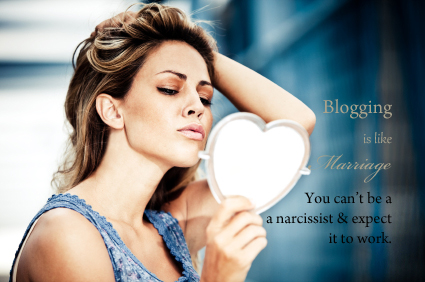
Blogging is like Marriage. You can’t be a narcissist and expect it to work.

Apparently the Alpha Parent Arrogant is shocked, shocked by the blistering contempt with which her little aphorism was greeted.

And in her typically offensive way, she tries to defend her obnoxiousness.

For anyone that still has their panties up their crack with regard to the “Breastfeeding is like Marriage” meme I posted yesterday, here is my defense posted on The Leaky Boob

Charming, no?

It motivates mothers to trust their bodies, to re-evaluate any urge to supplement.

Formula feeding≠infidelity. (DO I SERIOUSLY NEED TO SAY THAT?)

You’re missing the point. This meme has nothing whatsoever to do with formula feeders in the main. It’s about mothers who are trying to breastfeed. Cheating= harms marriage as supplementing= harms supply. The meme is a simple cause and effect comparison. It says nothing of shame or morality. It compares the stress of cheating on a relationship to the stress of supplementing on your supply.

Here’s the technical term for this “explanation.” It’s bullshit!

C’mon, Alpha Parent Arrogant. Surely you can do better than the classic defense of the passive-aggressive narcissist: “Who me? I didn’t intend to hurt you. You just took my obnoxious, self aggrandizing attempt to denigrate you the wrong way!!

I can understand why this picture enraged so many people. Most women supplement, so the majority of women looking at this will have been triggered in some way, great or small. In the MAJORITY of cases, supplementation leads to a complete switch to formula. These are FACTS and I hasten to add, their truth is what frustrates people most. But if you’re offended because you’ve supplemented, that’s your beef. The meme isn’t aimed at you. It is aimed at the pregnant mother or the new mother getting to grips with breastfeeding who can heed the warning.

In other words, if you’re insulted, it’s because you deserve to be insulted.

No, Alpha Parent Arrogant, no one is frustrated by the truth. They are simply appalled by your viciousness.

Here’s the way I see it, Alpha Parent Arrogant:

You are nothing but a garden variety jerk.