Category Archives: Uncategorized

Yet another C-section study that purports to show the risks but ends up showing they aren’t particularly risky

iStock_000019747710XSmall

The conventional wisdom in 2013 about obstetrics is that C-sections are “bad.” This conventional wisdom is not shared by most obstetricians, but it has spread to academia where conferences are held on how to decrease the C-section rate to some theoretical ideal. Earlier this week I wrote about a new study in the policy journal Health Affairs. That paper was deeply misleading and ignored important data. Now comes another C-section study that sets out to show that C-sections have unacceptable risks, but actually demonstrates the opposite. Moreover, the study suffers from a serious flaw, which if remedied would lower the purported risks even further still.

The study is Consequences of a Primary Elective Cesarean Delivery Across the Reproductive Life by Miller, Hahn and Grobman. The goal of the study is admirable and important:

There is a paucity of data regarding the reasons a woman may request a primary cesarean delivery. Fear of childbirth and its associated morbidity have been cited as prominent contributing factors toward such a request. These concerns have been supported by some experts, who have suggested that a planned cesarean delivery is less morbid than a trial of labor when weighing in the rates of an unplanned cesarean delivery…

One of the limitations of the available data is its focus on short-term outcomes related only to the initial pregnancy. However, the decision about route of delivery in one pregnancy has ramifications through subsequent pregnancies given the increased morbidity associated with multiple abdominal surgeries and uterine scars. Yet the comparative morbidity across multiple pregnancies related to the initial approach to delivery remains uncertain. A properly powered observational study that would provide such data would require many thousands of women given the relatively low frequency of adverse events that occur with either delivery approach. The logistic difficulty of this makes such an observational study unlikely to be performed. Thus, we designed a decision analysis to provide a framework for understanding the risks over the reproductive lifespan associated with either trial of labor or elective cesarean delivery for an initial delivery.

So far so good. The authors want to find out the risks of a maternal request C-section across the subsequent reproductive lifespan. It’s too hard to do an actual study of what the risks really are, so they plan to create a theoretical model to estimate them. Now comes the serious problem: there is no data on the risks of maternal request C-sections, so they plan to use elective C-sections as a proxy for maternal request C-section. But in the medical context, elective does NOT mean unindicated, it means non-emergent. So many “elective” C-sections are performed for medical reasons in no way represent unindicated C-sections. The authors show some awareness of this problem:

This model included women at term with a singleton gestation in the vertex presentation and no contraindication (eg, placenta previa) to a trial of labor.

In other words, the model took into account absolute contraindications to vaginal delivery, but not other indications for “elective” C-sections. Therefore, the results are likely to dramatically overstate the risks of a maternal request C-section.

Nonetheless, the findings are remarkable for just how safe C-sections have become. Moreover, the authors did not repeat the dreadful mistake of the Health Affairs piece and did include some neonatal outcomes making it possible to compare the risks of C-sections to the risks of vaginal delivery.

Let’s look at maternal morbidity first, which is summarized in the table below.
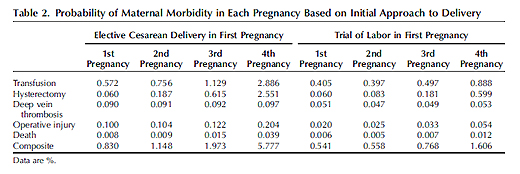
C-sections maternal morbidity

What jumps out at me is just how low the risks really are. The death rate for a non-emergent primary C-section is 8/100,000 as compared to a death rate for vaginal delivery of 6/100,000, for a difference of only 2/100,000. And that difference is likely to be a dramatic overestimate in the case of a truly elective (vs. non-emergent) C-section.

It is true that the risk rises with ever subsequent C-section. For the 4th C-section, the death rate is 39/100,000 as compared to 12/100,000 for a 4th vaginal delivery, for a difference of 27/100,000. Once again this is likely to be a vast overestimate. In addition, 85% of American women have fewer than 4 children, so this difference applies to a small subset of women.

Now let’s look at the outcomes for babies, which can be found in the table below.
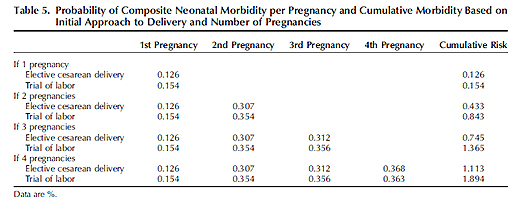
C-sections neonatal morbidity

In contrast to the results for mothers, the authors unfathomably chose to ignore the neonatal death rate, surely the single most important piece of data in evaluating neonatal outcomes. They chose to restrict neonatal outcomes to cerebral palsy and brachial plexus injuries. C-section results in a neurologic injury rate for a first C-sections is 12.6/1000 as compared to 15.4/1000 demonstrating that C-section has a protective effect for babies. Although the protective effect disappears by the 4th C-section, the difference is only 5/100,000.

The omission of neonatal death rates is inexcusable. It’s not as if that information is unavailable. Although, to my knowledge, no study has been done to specifically look at the differences in neonatal mortality as the number of C-sections rise, there are  studies that demonstrate that C-section is protective, such as Neonatal Morbidity and Mortality After Elective Cesarean Delivery by Signore and Klebanoff that showed that if 1 million women underwent C-section at 39 weeks instead of waiting for onset of labor and attempting vaginal delivery, 692 more babies would be saved, 517 cases of intracranial hemorrhage and 377 brachial plexus injuries would be prevented.

Even in the absence of mortality data, the authors acknowledge that C-sections are protective:

…this model demonstrates that elective first cesarean delivery may allow one to avoid the infrequent intrapartum neonatal events that occur during trials of labor and that may be associated with longterm neurodevelopmental impairment…

Neonatal outcomes chosen included those known to be affected by route of delivery. Insofar as elective cesarean delivery is often scheduled at 39 weeks of gestation, some have suggested that stillbirth rates could be reduced by using a strategy of elective cesarean delivery. Elective cesarean delivery at 39 weeks at gestation would, indeed, reduce the incremental increase in stillbirth associated with expectant management of pregnancy after this point…

The authors conclude:

… Our analysis cannot determine that one approach is “better” than another, particularly because some outcomes (eg, incontinence) remain poorly characterized and because such a determination would need to include preferences accorded to different routes of delivery by women. Nevertheless, this analysis can provide information that may be helpful in counseling and emphasizes that although an initial cesarean delivery may result in only a marginally increased risk of maternal morbidity and a marginally decreased neonatal risk compared with a trial of labor, the difference in maternal morbidity throughout reproductive life become increasingly larger, whereas the difference in perinatal outcomes becomes increasingly smaller.

The bottom line is that even multiple C-sections may have modest risks and for women planning only one or two children, the benefits of elective C-section may actually outweigh the risks.

20 years of presiding over homebirth deaths

Baby shoes

Last night a reader sent me a link to this story of an Indiana midwife arrested in the wake of two perinatal deaths in one week:

Barbara S. Parker, 55, faces three felony counts of practicing midwifery without a license. These charges stem from three August deliveries.

The first was on Aug. 2nd when Parker took a woman to an Auburn hospital when she was having trouble delivering her child. Then on Aug. 3rd Parker helped a woman deliver a baby that wasn’t breathing and had no pulse. That child later died at the hospital. Then a few days later, on Aug. 7th, Parker was helping a mother deliver twins and the second infant was only partially delivered and had to be taken through cesarean section. According to court papers, the second child did not survive.

Parker told police that she had been licensed in Colorado in the early 1990’s, but a little research revealed that didn’t go so well either. She lost her license and lost her court battle to retain it (THE PEOPLE OF THE STATE OF COLORADO, PLAINTIFF-APPELLEE, v. JEAN ROSBURG AND BARBARA PARKER, DEFENDANTS-APPELLANTS):

This case involves an appeal of a trial court’s order permanently enjoining appellants Jean Rosburg and Barbara Parker from practicing midwifery without a license as prohibited by sections 12-36-106(1)(f) and 12-36-106(2), 5 C.R.S. (1985).*fn1 The midwives argued to the trial court that section 12-36-106(1)(f) unconstitutionally infringed the right of privacy of pregnant women to choose their method of childbirth and that the section was unconstitutionally vague. The trial court ruled that the midwives did not have standing to assert the privacy right of pregnant women*fn2 and that section 12-36-106(1)(f) was not unconstitutionally vague. The midwives appealed to this court pursuant to section 13-4-102(1)(b), 6A C.R.S. (1987).

We agree with Rosburg and Parker that they have standing in this case to assert the privacy right of pregnant women. We disagree, however, that the prohibition against practicing midwifery without a license infringes a privacy right of pregnant women. We hold that section 12-36-106(1)(f) does not violate the midwives’ equal protection right because the prohibition of lay midwifery bears a rational relationship to the state’s legitimate interest in protecting the health of the pregnant woman and her child. We also hold that section 12-36-106(1)(f) is not unconstitutionally vague.

After reviewing the arguments, the Court concluded:

The term “practice of midwifery” also is not unconstitutionally vague as applied to Rosburg and Parker. They also were aware of what conduct was prohibited by the statute and their conduct fell within the prohibition. Rosburg testified at trial that her profession was that of a lay midwife and she defined the term in accordance with applicable dictionary and legal definitions.*fn10 The trial court also specifically found that Rosburg and Parker had engaged in the practice of midwifery.

Accordingly, we uphold the constitutionality of section 12-36-106(1)(f) and affirm the trial court’s order permanently enjoining Rosburg and Parker from practicing midwifery without a license.

Unfortunately, I cannot find the original case that led to Parker losing her Colorado license. Although it almost certainly resulted from at least one perinatal death, I cannot confirm that. In any case, Parker has continued to practice despite disciplinary measures and mothers and babies have allegedly continued to pay the price.

Introducing the automated birth story generator

apps multicolor symbol

Hi, folks, Ima Frawde, CPM here with my latest product for empowered mamas, the automated birth story generator app.

You can download it from the app store for the low, low price of 4 separate payments of $95 each. Once you download the app, you need to activate it by sending us a copy of the baby’s birth certificate signed by a CPM or a family member, with a sworn affidavit attesting to the fact that you fulfilled our requirements: a vaginal birth, no pain medication, a fecally contaminated birth pool, and eating at least one full meal during labor. Don’t worry, though, it doesn’t matter whether the baby lived or died.

Once we review your affidavit, we will instantly email you the code to unlock the app. If your birth doesn’t meet our guidelines, we won’t send you the code. Sorry, no refunds; you will still owe the 4 separate payments of the low, low price of $95 each.

The app is fantastic. Mama, now there’s no need to interrupt the tandem breastfeeding of your newborn, your toddler and your middle-schooler during your babymoon to labor over (get it? labor over?) the 15 page birth story that you can upload immediately to Mothering.com. Just fill in the blanks and we do the work for you.

Choose from several options including: the healing HBAC after 12 C-sections, the 45 week pregnancy, the homebirth of breech Siamese triplets and many other variations of normal.

Here are some excerpts of an actual birth story generated by the new app highlighting some of its most important features.

1. The opening paragraph immediately places the focus of the birth story right where you want it, on the baby yourself:

The birth story of my precious daughter Areola Anigav (that’s vagina spelled backwards) begins 3 years ago when I had a completely unnecessary C-section birth rape for my son Whatshisname. I don’t call it a birth because he was ripped from my body after 4 days of labor including 11 hours of pushing. I never gave him an actual name because if he didn’t have a real birth, he isn’t a real baby.

How did it happen that my hopes for a homebirth were torn to shreds and my spirit and body were mutilated? In a moment of weakness, I gave in to the pleas of my sniveling DH that we transfer to the hospital. Sure enough, as could have been predicted, the doctors birth rapists promptly recommended a C-section for no better reason than the fact that Whatshisname was lying sideways in my uterus, presenting shoulder first. They said he was in an undeliverable position, but having educated myself in the interim I now realize that it was the baby’s fault for not knowing how to be born.

2. A contraction by contraction description of your labor:

In contrast to my labor with Whatshisname, I had no pain at all during the birth of my precious Areola Anigav. Yes, I was screaming myself hoarse with every contraction rush, but those were blood curdling screams of joy.

3. A special section for recounting the 911 call, the NICU stay and the use of the latest technology including head cooling to reduce brain damage from lack of oxygen:

I birthed Areaola Anigav into a kiddie pool of bloody water strewn with flowers. How bloody was the water? When it was over the birth pool had a higher hematocrit than I did.

Areaola Anigav arrived earthside so peacefully. She never screamed. She never cried. She never even opened her eyes. My midwife was awesome. She didn’t panic just because Areola wasn’t breathing. She knew that if you don’t cut the cord, the baby continues to get oxygen from the placenta for up to 3 days. It was my DH who made the 911 call that filled the house with EMTs 15 minutes later. The EMTs bowled over my awesome midwife who was trying to stop them from cutting the cord. They resuscitated Areola and transferred her to the hospital.

4. A closing paragraph that allows you to summarize what your baby did for you.

I don’t consider my homebirth a failure just because Areola Anigav did not survive. Areola gave me the ultimate gift. Her birth taught me that my body is not broken and that trusting birth is all it takes to attain the highest human achievement of all, a baby passing through your vagina. My precious Areola Anigav knew how to be born. I do feel a little sad that she didn’t know how to breathe, but perhaps the next baby will be smarter. Newly empowered, I look forward to having another homebirth to provide a little brother or sister for Whatshishame, even though he doesn’t deserve any gifts from me.

The app has many more features, too numerous to list here.

The Ima Frawde, CPM Birth Story Generator is available in the app store. Download it today!

Lawsuit update

iStock_000006938226XSmall

As promised, I’m providing an update on my lawsuit against Gina Crosley-Corcoran.

The short version: After several delays, Gina’s lawyer filed a motion to dismiss based on jurisdiction, just as we expected. The issue is whether I can sue Gina in Massachusetts or must I sue her in Illinois. There is case law on both sides of the argument and, while the balance seems to be in favor of keeping the case in Massachusetts, there is no way to know what the judge will decide. This is a technical issue and has no relationship to the merits of the actual case.

The longer version: Despite the fact that the motion to dismiss is a technical issue, Gina’s lawyer felt compelled to file a document laced with ad hominem attacks. Here is the Motion to Dismiss, complete with exhibits: https://dl.dropbox.com/u/27713670/Tuteur-20130305_Memorandum_ISO_Mtn_to_Dismiss_w_EXHIBITS.pdf

The motion begins:

The Plaintiff in this action, Amy Tuteur, is a bully.

She is, to be sure, a modern-day bully; a “cyber bully,” who spews her venom over the Internet, rather than kicking sand on a playground, but she is a bully nonetheless. Ms. Tuteur, a former physician who is no longer licensed to practice medicine (and yet who identifies herself as an obstetrician gynecologist on her websites), runs a number of blogs, including one entitled “The Skeptical OB,” where she is something of a niche bully…

Curiously, the motion says nothing about the fact that the lawsuit was filed because Gina was abusing the Digital Millenium Copyright Act (DMCA) in a avowed effort to censor me by contriving to keep webhosts from hosting The Skeptical OB. Instead, the motion states:

This lawsuit represents another form of Ms. Tuteur’s bullying. The Defendant in this action, Gina Crosley-Corcoran, is a mother of three young children, a graduate student, a practicing doula, and (most importantly for the purposes of this motion) a resident of Illinois. A proponent of parents’ right to choose home birth, Ms. Crosley-Corcoran has often found herself the target of Ms. Tuteur’s ire…

In support of her ad hominem attacks, Gina’s lawyer included several of my posts in the exhibits, though curiously neglected to include the original post in question (Questions for The Feminist Breeder). He also fails to mention the multiple DMCA notice filings, the efforts to solicit others to send DMCA filings, etc. Therefore, it appears that Gina has no idea why she was sued, beyond my supposed effort to bully her.

I guess her lawyer has not seen what Gina has been writing lately on her own blog.

… It seems like every single time I’ve ever tried to stand up for myself in this blogging gig, It has backfired. TERRIBLY.

Example: After three years of being non-stopped harassed by that psycho ex-doctor Amy Tuteur, I finally stood up for myself, scraped together just enough cash to hire a lawyer for a few hours of work, and tried to get her to stop. She responded by using her millions to file a federal lawsuit against me that is FULL of outright lies and speculation, designed only to bankrupt my family and ruin my life. Even if/when I WIN against this insanity, the court costs will destroy my family finances forever. I will probably never be able to afford the kind of lawyer I need to actually defend myself In court, so she could simply win a “default” judgement (because I’m just too poor to fight this.) That’s how this shit works. She knows that. That’s why she’s doing it.

But it’s my fault – you know why? I should have kept my fucking mouth shut. I should have gone on ignoring the attacks like I’d done for THREE years prior. Any time I try to respond – try to defend myself – it comes right back to bite me in the ass…

… So, here I am, wrapped up in the aftermath of yet another highly publicized incident that people will use for years to come to paint me as the asshole.

I’m NOT an asshole. I AM a fucking idiot.

I can only agree.


Addendum: I’ve just filed a motion to strike. You can read it at https://dl.dropbox.com/u/27713670/Tuteur-20130305_Memorandum_of_Law_iso_Motion_to_Strike.pdf

The key points:

As discussed herein, Defendant Gina Crosley-Corcoran’s Memorandum Of Law In Support Of Her Motion To Dismiss contains numerous immaterial, impertinent, and scandalous allegations that are highly prejudicial and have nothing to do with this action or, more specifically, Defendant’s claim that this Court lacks jurisdiction over her. Dr. Tuteur seeks to have Defendant’s improper allegations stricken from Defendant’s Memorandum or, in the alternative, to have Defendant’s Memorandum stricken in its entirety pursuant to Fed. R. Civ. P. 12(f)…

Crosley-Corcoran’s repeated name-calling is a transparent attempt to cast Dr. Tuteur in a disparaging light. Crosley-Corcoran’s insulting language is not only an attempt to denigrate Dr. Tuteur’s character, it evinces complete disregard for the appropriate level of decorum expected of parties when appearing before a federal court.

Needless to say, none of the Improper Allegations bears any possible relation to Crosley- Corcoran’s arguments that she is not subject to the jurisdiction of this Court. For instance, it is unfathomable how Crosley-Corcoran’s personal feelings about Dr. Tuteur translate to any cognizable basis for her assertion that there is no statutory or Constitutional basis for the exercise of jurisdiction by this Court. Similarly, Crosley-Corcoran’s apparent view that Dr. Tuteur is a “bully” is not relevant to the claims asserted in the Complaint or any conceivable defenses thereto.

Latest update: Gina’s response, which is basically more of the same: https://dl.dropbox.com/u/27713670/Tuteur-20130306_Opposition_to_Motion_to_Strike_w_Exh_1.pdf

New paper on C-sections is misleading and leaves out important data

Male doctor giving thumbs down

A new paper in the journal Health Affairs is receiving a great deal of media attention. Although the paper provides valuable data, the authors dramatically overstate the conclusions and leave out critical information.

The paper is Cesarean Delivery Rates Vary Tenfold Among US Hospitals; Reducing Variation May Address Quality And Cost Issues by Kozhimannil et al. According to the authors:

Working with 2009 data from 593 US hospitals nationwide, we found that cesarean rates varied tenfold across hospitals, from 7.1 percent to 69.9 percent. Even for women with lower-risk pregnancies, in which more limited variation might be expected, cesarean rates varied fifteenfold, from 2.4 percent to 36.5 percent. Thus, vast differences in practice patterns are likely to be driving the costly overuse of cesarean delivery in many US hospitals.

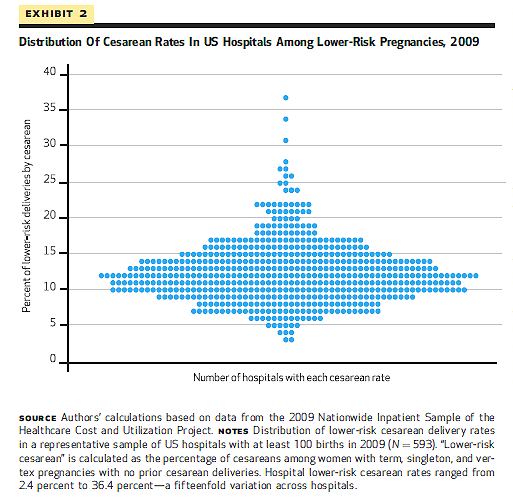
Not exactly. To see how the authors overstate their case, it helps to looks at charts that they created.

US C-sections 2009

Yes, it is true that the rate at the hospital that did the greatest proportion of C-section is 10 times higher than the rate at the hospital that did the lowest proportion of C-sections, but a glance shows that both hospitals are outliers. Therefore, that comparison is essentially useless. A far more valuable statistic is the interquartile range, the difference between the 25-75 percentiles. As the authors acknowledge in a subsequent table, the mean C-section rate in 2009 was 32.8 with an interquartile range of 9.4. So fully half of the hospitals had C-section rates in the range of 23.4%-42.2%. That’s still an appreciable difference (double), but very far from the 10 fold difference touted by the authors. In fact, more than 90% of hospitals had C-section rates between 21%-44%.

The same thing applies to the analysis of C-section rates in low risk women.

US low risk C-sections 2009

The authors report that the C-section rate for low risk women varies 15 fold among hospitals, but that is misleading. As the authors acknowledge in the subsequent table, the mean C-section rate for low risk women in 2009 was 12 with an interquartile range of 4.9. Fully half of the hospitals had low risk C-section rates ranging from 7.1%-16.9%. Again the difference is appreciable (slightly more than double), but a very far cry from a 15 fold difference. Nearly 90% of hospitals had C-section rates for low risk women between 6%-19%.

So the national variation in C-section rates is far less than the authors claim. Moreover, the authors commit the same error as do many natural childbirth advocates; they focus on process as opposed to outcome. We shouldn’t be looking for an ideal average C-section rate. We should be looking for the C-section rate that produces the best outcomes. How does the perinatal mortality rate compare between hospitals with low C-section rates and high C-section rates? The authors don’t know because they never looked. Indeed, the underlying (and totally unjustified) assumption that permeates the entire study is that there is no appreciable difference in mortality rates between various hospitals and that, therefore, we can focus in difference in C-section rates.

But perinatal mortality rates do vary appreciably among hospitals and it is critical to include this data. What if the mortality data showed that hospitals with C-section rates below 25% have higher perinatal mortality rates than hospitals with higher C-section rates. If that were the case, the hospitals with lower rates should be chastised, not held up as a model for an ideal, achievable C-section rate.

The authors conclude their paper with the following:

Although some variation would reasonably be expected given differences in patient populations, the scale of the variation in hospital cesarean delivery rates—most notably, a fifteenfold variation among the lower-risk subgroup— indicated a wide range in obstetric care practice patterns across hospitals and signaled potential quality concerns.

But as we have seen, the real variation among hospitals is much smaller making it much less likely that differences are due to practice patterns. Most importantly, the authors are not in a position to assess quality concerns unless and until they look at outcomes, and privilege them above process.

Lactivism and reefer madness

Plants 01

No, this is not a post about breastfeeding while stoned.

It’s a post about how hysterical exaggeration undermines campaigns like the War on Drugs and American lactivists’ efforts to promote breastfeeding.

According to Wikipedia:

Reefer Madness … is a 1936 American propaganda exploitation film revolving around the melodramatic events that ensue when high school students are lured by pushers to try marijuana — from a hit and run accident, to manslaughter, suicide, attempted rape, and descent into madness.

The film has become a byword for propaganda that backfires. This snippet of the plot makes it easy to see why the film ultimately accomplished the opposite of what the producers intended:

Mae Coleman and Jack Perry — a couple supposedly “living in sin,” yet sleeping in separate beds as all married couples depicted in films of the era — sell marijuana. Mae prefers to sell marijuana to customers her own age, whereas Jack sells the plant to young teenagers… Young students Bill Harper and Jimmy Lane are invited to Mae and Jack’s apartment … Jimmy takes Bill to the party. There, Jack runs out of reefer. Jimmy, who has a car, drives him to pick up some more. Arriving at Jack’s boss’ “headquarters,” he gets out and Jimmy asks him for a cigarette. Jack gives him a joint. Later, when Jack comes back down and gets into the car, Jimmy drives off dangerously, along the way running over a pedestrian with his car. A few days later, Jack tells Jimmy that the pedestrian died of his injuries. Jack agrees to keep Jimmy’s name out of the case, providing he agrees to “forget he was ever in Mae’s apartment”…

And the hit and run resulting in a pedestrian’s death is one of the least serious consequence of smoking a joint.

The film became a cult classic in the 1970’s when it was purchased and re-released by The National Organization for the Reform of Marijuana Laws (NORML). It was viewed as a comedy by people who used marijuana and recognized that the doleful consequences of marijuana use depicted in the film bore no relationship to the real, rather minimal consequences of marijuana use that viewers knew from personal experience. In other words, by grossly exaggerating the supposedly deleterious effects of marijuana use, the film sent the opposite message: those involved in the “War on Drugs” were lying about marijuana use and it wasn’t harmful at all.

American lactivists are currently running the breastfeeding equivalent of the Reefer Madness campaign. In addition to ignoring the difficulties of breastfeeding, lactivists grossly exaggerate the “risks” of formula feeding. Lactivists overstate the benefits of breastfeeding and fail to acknowledge that almost all the studies that purport to demonstrate those benefits suffer from serious methodological flaws. Lactivists demonize formula feeding using deliberately pejorative terms and suggesting that it should be available by prescription only. Unfortunately, they’ve communicated their hysteria to public officials like Mayor Michael Bloomberg of New York who has literally locked up formula as if it were a harmful substance.

But just like the Reefer Madness campaign, the contemporary lactivism campaign is a failure and for a similar reason; it bears no relationship to what we already know, through personal experience, about the purported “risks.” Most adults today WERE formula fed and are, nonetheless, healthy, intelligent and high functioning. No one knows, or has even heard about, a baby who has died as a direct result of formula feeding. Everyone recognizes that if you lined up a group of kindergarten students, no one could tell the difference between those who were formula fed and those who were exclusively breastfed. Moreover, if you lined up a group of the leaders in fields ranging from academia, to government, to entertainment to sports, no one could tell the difference between those who were formula fed and those who were exclusively breastfed.

In their desperation to promote their personal choices, lactivists have created histrionic campaigns that are foolish at best, and utter failures at worst. The claims of lactivists are completely out of line with reality. The “dangers” of not breastfeeding are exaggerated every bit as much as the dangers of marijuana use were exaggerated in Reefer Madness. Overstating the case just engenders distrust of lactivists, not an increase in breastfeeding rates.

Actually you did lose your uterus because you chose homebirth

iStock_000015892112XSmall

Homebirth advocacy is based on many myths and lies and one of the biggest lies is that homebirth advocates take responsibility for their decisions. They take responsibility for nothing. If anything goes wrong they blame everyone but themselves even when it is obvious they are the ones to blame.

Consider the following story, Elodie: Caesareans are NOT benign interventions from the blog Humanize Birth, replete with the typical ignorance, hubris, denial, and lack of gratitude that is the hallmark of homebirth advocacy.

The basic story is very simple and the fault is very clear. She had a history of previous C-section, went against medical advice in choosing homebirth, ruptured her uterus, had her baby’s life save and her life saved by a repeat C-section and lost her uterus and wound up in the ICU on a ventilator having received multiple transfusions.

Does she take responsibility for her decision to choose high risk homebirth? Are you kidding? It’s everyone’s fault but hers.

I did not lose my uterus because I chose to birth at home. I lost my uterus because I underwent a caesarean that could most probably have been avoided with my first birth. I lost my uterus because our medical system does not trust women to know best when it comes to having their babies. I lost my uterus because our medical system thinks women’s bodies can’t birth without interventions…

Actually, Elodie, you did lose your uterus because you chose homebirth. YOU chose it. YOU ignored medical advice. YOU pretended that the most feared complication of vaginal birth after Cesarean wouldn’t happen to you. YOU were spectacularly wrong and you paid a high price, although it could have been much higher still.

Why did you choose it? Because YOU chose to privilege the blather of other laypeople like those of ICAN and Hypnobabies instead of the advice of medical professionals. YOU were more interested in bragging rights to a vaginal birth than whether your baby would live through the experience. YOU, YOU, YOU!

YOU chose to believe that your virtue as a woman resides in whether or not a baby passes through your vagina. And YOU still think that your virtue as a woman is bound up with your experience of birth. YOU write:

I am a survivor. I am a fighter. I am strong. I birthed two babies through my belly.

You didn’t survive; you’re life was saved by others with far greater knowledge and skill than you possess.

You weren’t a fighter. You were unconscious and lacked any control over what happened.

You weren’t strong. You survived only because of surgeons, anesthesiologists, nurses, blood bank technicians, blood donors, a ventilator, respiratory therapists, ICU nurses, EMTs, and tens of thousands of dollars of other people’s money.

You did give birth to two children through your abdomen, but you could have done that far more easily, with far less trauma, far less risk to your baby’s life and far less risk to yours if you had chosen an elective repeat C-section.

But that would have required something that apparently you and other homebirth advocates don’t possess: accurate knowledge of childbirth and a willingness to place safety above bragging rights.

After YOU ignored medical advice, and YOU were saved by the evil medical system that you deplore, the least you could do now is take responsibility for YOUR decision.

The real appeal of homebirth advocacy is that it flatters the ignorant

I'm educated about childbirth

On it’s face, homebirth advocacy, makes no sense. Anyone with even a modicum of knowledge of science and statistics, let alone a basic knowledge of history, knows that childbirth is inherently dangerous, that life threatening emergencies can occur without warning, and that giving birth at home leads to preventable perinatal deaths.

Nearly every day there is another example in the media or on homebirth blogs and message boards.

Today’s iteration is the completely preventable death of Joseph Thurgood, who died because his mother chose to attempt a VBA2C at home, ending in the exact complication doctors warned her about: her uterus ruptured.

The Coroner’s Court was told that the midwife, Fiona Hallinan, is guilty of a gross breach of her duties. And, of course, the mother “educated” herself about homebirth:

A “high risk” pregnant woman who mistrusted doctors and did her own medical research was repeatedly warned of the dangers of a home birth, an inquest on her baby heard yesterday.

Kate Thurgood had delivered two children by caesarean section and was “determined” to have a child naturally and at home.

After doing her own research on the internet she dismissed concerns raised by doctors about the position of her baby and complications raised by her earlier caesareans.

“(She was told) she should not labour or deliver at home and she should have an elective caesarean section at hospital,” Dr Paul Halley, of Southern Health, told the Coroner’s Court.

Mrs Thurgood did her own web-based research on the risks, questioned several doctors’ advice, and sought out midwife Fiona Hallinan to help her deliver the child at home, the inquest heard.

So why do women like Kate Thurgood choose homebirth? I would argue that its real appeal is that homebirth advocacy, like all pseudoscience, flatters the ignorant.

In the real world, the majority of people recognize that science and statistics are difficult, specialized subjects and that medicine, including obstetrics, requires years of study and years of experience to master. In the world of pseudoscience, there is no need for hard work. All you need to do to be qualified to argue with your doctor, advise anonymous people on message boards, and set up your own website to “educate” others is to do “research” on the web.

Don’t worry, “research” on the web is not nearly as difficult as it sounds. It’s not as if you are expected to actually READ any scientific papers. Merely cutting and pasting their titles and abstracts is enough. Then you cherry pick the statements that you like from relevant professional organizations, while simultaneously ignoring any statements that you don’t like. And finally, you rely heavily on the Dunning-Krueger effect.

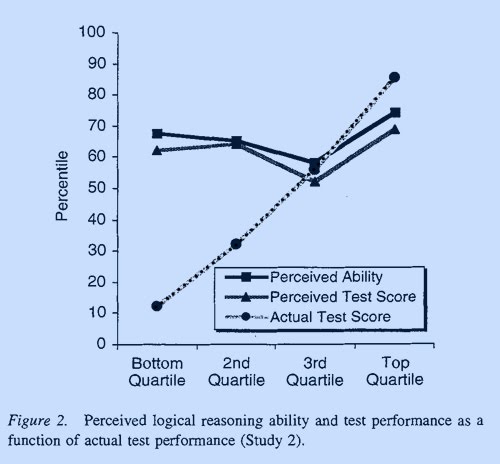
What’s the Dunning-Krueger effect? The classic paper on this phenomenon is Unskilled and Unaware of It: How Difficulties in Recognizing One’s Own Incompetence Lead to Inflated Self-Assessments by Kruger and Dunning published in Journal of Personality and Social Psychology in 1999. The paper reports on a variety of experiments that were used to evaluate individuals’ actual performance compared to predicted performance.

As the chart below demonstrates, those that knew the least about the subjects under discussion thought that they knew the most. In other words, those who knew the least were also the least capable in understanding how little they knew.

Dunning Krueger graph

Dunning and Krueger explain:

… [I]ncompetent individuals may be unable to take full advantage of one particular kind of feedback: social comparison. One of the ways people gain insight into their own competence is by watching the behavior of others… However, [our study] showed that incompetent individuals are unable to take full advantage of such opportunities. Compared with their more expert peers, they were less able to spot competence when they saw it, and as a consequence, were less able to learn that their ability estimates were incorrect.

Homebirth advocacy leverages the Dunning-Krueger effect to flatter the ignorant into believing that they are educated, as if being educated were merely a matter of defying authority and reading websites and books written by other laypeople.

The Dunning-Krueger effect is pretty powerful. Hence the perverse persistence of those who parachute into this blog to “educate” me. They are impervious to reason. Point out to them that they have not read the scientific literature they are quoting and they are unabashed. Point out to them that they cherry pick the statements of professional organizations, brandishing those they like and ignoring everything else and they are unembarrassed. Point out to them that there are specialists with years of training and experience, people who actually DO the research on childbirth, who have reached conclusions the opposite of theirs and they are unmoved. Why? Because to acknowledge the relevance of actually reading the literature, and following the recommendations of professional organizations and clinicians undercuts their insistence that they are “educated.”

Homebirth advocates, like advocates of vaccine rejection and other forms of pseudoscience, cling desperately to their beliefs in the face of both evidence and logic, not merely because they need to believe the foolishness that they believe. At its heart, the promotion of pseudoscience gives the ignorant the delusion of being educated without any of the hard work that really being educated requires. And that flattering delusion of being knowledgeable, when in reality they are ignorant, is too precious to give up, even for something as important as the life of your own baby.

Marissa Meyer, Yahoo and competitive mothering in the executive suite

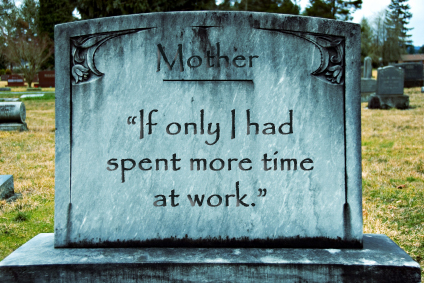
If only I had spent more time at work

For the last few days I’ve been writing about attachment parenting, a parenting philosophy which has little or nothing to do with the needs of children, and can best be understood as a competition among women looking for validation of their mothering. Simply put, women who pride themselves on making mothering a priority compete as to who sacrifices more for their children.

Lest you think that competitive mothering is restricted to those who place mothering front and center, Marissa Meyer has helpfully demonstrated that competitive mothering is alive and well in the executive suite, though there the rules are precisely the opposite. Instead of competing on who sacrifices more for their children, competitive mothers in the executive suite rig the game so that no other mother can sacrifice more than they do and make them feel bad.

Meyer is the CEO of Yahoo and in her very short tenure thus far she has managed to twice up the ante on mommy competition in the boardroom. First, Meyer made waves by announcing that she would take no more than 2 weeks maternity leave for the birth of her first child.

From the start, Mayer, who at 37 is one of Silicon Valley’s most notorious workaholics, was not the role model that some working moms were hoping for. The former Google Inc. executive stirred up controversy by taking the demanding top job at Yahoo when she was five months pregnant and then taking only two weeks of maternity leave. Mayer built a nursery next to her office at her own expense to be closer to her infant son and work even longer hours.

This week Meyer moved to abolish telecommuting, a practice common at many tech companies:

Now working moms are in an uproar because they believe that Mayer is setting them back by taking away their flexible working arrangements. Many view telecommuting as the only way time-crunched women can care for young children and advance their careers without the pay, privilege or perks that come with being the chief executive of a Fortune 500 company.

Meyer claims to have abolished telecommuting for purely business reasons:

“To become the absolute best place to work, communication and collaboration will be important, so we need to be working side-by-side. That is why it is critical that we are all present in our offices,” Jackie Reses, Yahoo’s human resources chief, wrote in the memo sent out Friday. “Speed and quality are often sacrificed when we work from home. We need to be one Yahoo, and that starts with physically being together.”

Really? Does Meyer have any evidence that the production and quality of work among those who telecommute is less than those who come to the office every day? If she has it, why hasn’t she presented it.

I, for one, doubt Meyer’s ostensible business motivation. I’m afraid that it is about about competitive mothering in the boardroom. Specifically, Meyer wants to ensure that other mothers can’t spend any more time with their children than Meyer spends with hers.

Back in the good old days of conventional sexism, all a professional woman had to do to succeed is to be better at her job than any other man. Now, with mothers in the executive suite, professional women have to better at their jobs than any man AND make sure not to make the boss feel bad that she spends less time with her children than you spend with yours. That’s because women in the executive suite appear to think that the mothering decisions of their female employees are within their purview and ought to be judged with one criterion in mind: “What do her choices mean about my children and me?”

The reality is that Meyer’s decision makes no sense from a business perspective:

UCLA management professor David Lewin said the telecommuting ban is a risky step that could further damage Yahoo employee morale and performance and undermine recruiting efforts in a hotly competitive job market.

A 2011 study by WorldatWork also found that companies that embraced flexibility had lower turnover and higher employee satisfaction, motivation and engagement.

But it makes perfect sense in the world of competitive mothering. In fact, it is the paradigmatic example of competitive mothering in the executive suite. Instead of judging her employees by the quality of their work, Meyer judges them by how they make her feel about herself and her relationship with her children.

Meyer’s action is anti-feminist, but not in the way that most critics imply. Feminists have no obligation to make the workplace more accommodating to other women; they are merely required to offer the same opportunities to women as they offer to men. Meyer’s action is anti-feminist for two reasons. First, because it is the boardroom version of competitive mothering and the terrible propensity women have for criticizing anyone who doesn’t parent in exactly the same way that they do. Second, because it requires extra obligations on the part of other women. Simply turning in a high quality work product is not enough; they must do so without making their boss feel guilty about the amount of time she spends (or doesn’t spend) with her children.

The sad fact is that there are precious few good ways to combine a high powered career and mothering, but some women do manage to do it, whether it is through telecommuting or some other innovative practice. In the world of competitive mothering in the executive suite, that is unacceptable. Those women must be punished for their success in combining work and family so the boss doesn’t have to feel bad that she couldn’t manage to do it, too.