Category Archives: Uncategorized

Vaginal birth, the faux “achievement”

Believing that vaginal birth is an achievement depends on a fundamental misunderstanding about why some babies fit and others do not. Women have NO control over whether a baby is going to fit, therefore they should not be taking any credit if the baby does fit and they should not be taking any blame if the baby does not fit.

In other words, the claim that vaginal birth is an “achievement” or “empowering” or worthy of praise makes as much sense as believing your eye color is an achievement or empowering or worthy of praise. You have to be pretty desperate for positive attention to take credit for bodily attributes that are beyond anyone’s control.

Let’s leave aside for the moment the issue of whether the baby can tolerate labor and look only at the factors that determine whether the skull of the baby will be able to pass through the bones of the mother’s pelvis. Four major factors are involved: pelvis, passenger, fetal position and power. Women can control NONE of them.

I’ve written about the pelvis and the passenger (fetus) before:

Most people imagine that the pelvis is like a hoop that the baby’s head must pass through, and indeed doctors often talk about it that way. However, the reality is far more complicated. The pelvis is a bony passage with an inlet and an outlet having different dimensions and a multiple bony protuberances jutting out at various places and at multiple angles. The baby’s head does not pass through like a ball going through a hoop. The baby’s head must negotiate the bony tube that is the pelvis, twisting this way and that to make it through…

There are bony protuberances that jut into the pelvis from either side (the ischial spines) and the bottom of the sacrum and the coccyx, located in the back of the pelvis, jut forward. How does the baby negotiate these obstacles? During labor, the dimension of the baby’s head occupies the largest dimension of the mother’s pelvis. But because of the multiple obstacles, the largest part of the mother’s pelvis is different from top to middle to bottom. Therefore, the baby is forced to twist and turn its head in order to fit.
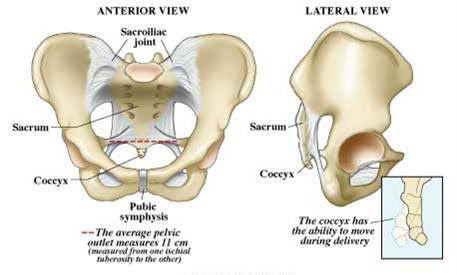
If the pelvic inlet is toot small the baby’s head may never even drop into the pelvis. If the ischial spines stick too far into the pelvis,the head the head will not be able to get past them. If the sacrum and coccyx are angled too far forward they may stop the head from going farther.

It isn’t a matter of the absolute dimensions of the pelvis, but the dimensions relative to the individual baby. Almost all women can vaginally deliver a small baby, but a big baby is another matter entirely. The claims of natural childbirth and homebirth advocates that “a mother cannot grow a baby too big for her pelvis” is simply made up. The size of the mother’s pelvis is determined by her genes and the size of the baby is determined by her partner’s genes as well. His genetic contribution may lead to a large baby and that isn’t going to change simply because the mother’s pelvis is small.

Over time, babies have evolved so that the bones of the skull are not fused and can slide over each other, reducing the diameter of the head. This is called “molding” and accounts for the typical conehead of the newborn. But there is a limit to the amount of molding that the head can undergo and ultimately, the baby may not fit.

That’s pelvis and passenger. What about position? The optimal position for a baby to enter the pelvis is head first, spine facing the mother’s front. This position is known as occiput anterior. Babies don’t always cooperate. If the head is in anything other than the ideal position the fit will be even tighter. That’s why babies in the OP position (facing frontwards) and babies with asynclitic heads (the head titled to one side) are much more difficult to deliver vaginally. Their heads no longer in the smallest possible diameter. It’s like trying to put on a turtleneck face first of over your ear instead of starting from the back of your head. It’s much more difficult.

The final factor is power. Even if the baby is small enough to fit through the pelvis, it won’t go through unless the uterus is pushing against the baby with a sufficient amount of force to counter the resistance of the soft tissue and pelvic bones. The power is the strength, duration and frequency of uterine contractions. Any or all of these can be insufficient to push the baby through the pelvis. That’s where pitocin comes in. Inadequate contractions can be strengthened by pitocin, and the frequency and duration of contractions can be increased. Many women and babies who would have died before the advent of pitocin for labor augmentation have smooth uncomplicated labors once pitocin is given to the mother.

What can the mother do about these factors? Absolutely nothing. She cannot increase the diameter of her pelvic inlet, change the shape of her ischial spines or decrease the angle of her sacrum. She can do nothing about the size of the baby. She can do nothing about the position of the baby. She can do nothing about the power of her uterus.

The only thing a woman can do is to continue with a protracted labor and hope that the baby will eventually fit through. This is where we have to return to the issue of whether the baby can tolerate labor.

Labor is stressful for the baby. Every contraction cuts off blood flow to the placenta. Therefore, the baby is essentially “holding its breath” with every contraction. The placenta is supposed to transfer enough oxygen between contractions so that the baby can tolerate being deprived of oxygen for a minute or more every two minutes. The oxygen transfer capacity of the placenta can be compromised by a variety of factors including high blood pressure, post dates, or an undiagnosed deficiency in the placenta itself. Even a healthy baby with a healthy placenta may be unable to withstand labor indefinitely. The longer the labor lasts, the greater the risk to the baby.

Strictly speaking, the baby is either going to fit or not going to fit and there’s nothing the mother can do about it. If the baby is not going to fit she will eventually have to consent to a C-section or she will ultimately die.

If the problem is poor uterine power, the baby may eventually come through after a very long labor, putting the baby at risk of distress and the mother at risk of postpartum hemorrhage. Treatment with pitocin when the labor is diagnosed as protracted will take hours off the labor, with benefits to both mother and baby. Refusing pitocin can paradoxically increase the need for a C-section by increasing the length of labor until the baby can no longer tolerate it, or until an infection develops or some other complication occurs.

Yes, it is true that a baby born vaginally after a multi-day labor was always capable of fitting and might have been delivered by C-section “unnecessarily” but the corollary is that the baby that ultimately fits may sustain damage from oxygen deprivation during the prolonged labor.

Either way, vaginal birth is not an achievement. If the four factors are not properly aligned, the baby is not coming out through the vagina no matter what. The only issue is how much stress the mother is willing to expose the baby to before she acknowledges reality.

Natural childbirth: with thought leaders like this …

I can understand why women who lack basic knowledge of science might believe the made-up “facts” advanced by the natural childbirth and homebirth movements. And I can understand how women who lack basic knowledge of history might be gulled into thinking that childbirth in nature is inherently safe.

But for the life of me, I cannot understand why any woman would believe the clap trap of a movement whose thought leaders are a self-proclaimed midwife with no midwifery training (Ina May Gaskin), a self-described “expert in obstetric research” with no training in either obstetrics or research (Henci Goer), and a washed up TV talk show host (Ricki Lake). Between the three of them they have NO training in obstetrics, NO training in midwifery, and NO degrees in the fields in which they claim expertise.

Notice a theme here? I do. All three are “self-proclaimed” experts, as if one could acquire expertise by simply declaring that you have it. It’s a classic tactic in pseudoscience. As Physics Professor Rory Coker has written in his article Distinguishing Science from Pseudoscience, pseudoscience appeals to false authority and distrust:

A high-school dropout is accepted as an expert on archaeology … A psychoanalyst is accepted as an expert on all of human history, not to mention physics, astronomy, and mythology, even though his claims are inconsistent with everything known in all four fields…”

In the case of natural childbirth and homebirth, three lay people with no expertise in anything are accepted by their followers as experts on obstetrics, midwifery and statistics. How can anyone believe anything they say?

They are, of course, only the current leading exponents. Perhaps women believe the absurd claims of natural childbirth and homebirth advocacy because of the stellar credentials of the founders of these movements and the respect they are accorded by colleagues. No, it can’t be that. Although they were both doctors, but it is widely accepted among science and health professionals that both Grantly Dick-Read and Fernand Lamaze made up their claims and had no scientific basis for those claims.

Grantly Dick-Read, the father of natural childbirth, was quite clear about his racist and sexist eugenics beliefs and how that influenced his philosophy. He never hid the fact that his theory of natural childbirth was a direct result of his belief that primitive (read black) women were hypersexualiized, knew their place and therefore had painless childbirth, while white women of the “better classes” had developed shriveled ovaries, and painful childbirth because they had acquired education and political rights. As he put it:

… [T]he mother is the factory, and by education and care she can be made more efficient in the art of motherhood.

And:

Woman fails when she ceases to desire the children for which she was primarily made. “Her true emancipation lies in freedom to fulfil her biological purposes …

Fernand Lamaze was hardly any better. According to Sheila Kitzinger:

… Lamaze consistently ranked the women’s performance in childbirth from “excellent” to “complete failure” on the basis of their “restlessness and screams.” Those who “failed” were, he thought, “themselves responsible because they harbored doubts or had not practiced sufficiently,” and, rather predictably, “intellectual” women who “asked too many questions” were considered by Lamaze to be the most “certain to fail.”

So natural childbirth and homebirth advocates are not drawn to the philosophy by the beliefs of its originators.

What’s the appeal then? The appeal is the ego boost that natural childbirth and homebirth advocates get by setting a goal that literally any woman could achieve and then receiving plaudits from the thought leaders and fellow believers for “achieving” it. People pay attention to Ina May Gaskin, Henci Goer and Ricki Lake, not because of what they know, since they know very little, but because they make their followers feel good.

Nonetheless, although I understand the appeal of praise, natural childbirth and homebirth advocacy sets a new standard of desperation. Believers are so desperate to feel good about themselves that they are willing to embrace a philosophy whose thought leaders know virtually nothing about the subject of their purported “expertise.”

Only the uneducated and gullible take medical advice from B movie starlets

I guess I wasted 8 years in medical training. Four years of medical school and four years of residency were over-kill (pardon the expression). It seems that in 2012 the most important requirement for a medical authority is to be a former B movie starlet.

That’s right. Ricki Lake is evidently an expert on childbirth, Jenny McCarthy is an expert on immunology, and Susan Somers is an expert on chemotherapy (in the immortal words of Orac of Respectful Insolence, she has been carpet bombing the media with “napalm-grade stupid about cancer”).

What, you might ask, are the qualifications of these experts beyond their tawdry celebrity? Well, Ricki Lake completed two (count ’em, 2) semesters at Ithaca College; Jenny McCarthy dropped out of Southern Illinois University in favor of a career at Playboy; and Suzanne Somers dropped out of Lone Mountain College after 6 months.

All three had advanced training as well. Ricki Lake has actually given birth to two children. Jenny McCarthy has a child she believed was afflicted with autism. And, Suzanne Somers actually had cancer. If that’s not enough to make you a medical authority, I don’t know what is.

It’s hardly surprising that celebrity has gone to the heads of these women and made them think they are medical experts (look at Kate Gosselin if you want to see what celebrity can do), but what is the matter with the millions of people who appear to believe the drivel fabricated and spouted by these women? What has happened to us, America?

How can anyone believe anything they have to say on any medical topic? Does anyone seriously think they are qualified to dispense medical advice? Aren’t homebirth advocates, vaccine rejectionists and cancer conspiracists embarrassed to be consulting actresses for information on sophisticated medical issues? No? they ought to be.

The sad fact is that instead of being embarrassed, homebirth advocates, vaccine rejectionists and other health conspiracists are actually proud of themselves. You have to be pathetically ignorant to be proud of your own ignorance.

Is this part of the dismaying strain of anti-intellectualism that has longed plagued our country? Do people honestly think that those smarty-pants doctors don’t have any knowledge that couldn’t be acquired on “Three’s Company”?

Or should we blame this farcical behavior on the American penchant for conspiracy theories, the more outlandish the better? Do people really have so little faith in organized medicine that they consider Suzanne Somer’s cancer advice more likely to cure them than medical treatment?

I am a cynical person, but really folks? The government is paying for and recommending the distribution of injectable poisons? Big Pharma wants to create of generation of autistic people? Chemotherapy is a plot to keep you from the real cure for cancer? That’s not cynicism; it is credulousness.

Inquiring minds want to know: How can anyone claim with a straight face to believe that Ricki Lake knows anything about childbirth? How could anyone possibly believe that Jenny McCarthy knows about immunology simply by dint of having a child who she thought was autistic. And Suzanne Somers? Does anyone seriously believe that the purveyor of the “Thigh-Master” just happened to discover the cure for cancer in her spare time?

Someone please explain it to me, because for the life of me I, like other doctors, cannot figure it out.

A version of this piece first appeared in October 2009.

The philosophy of natural childbirth hurts women

Here’s an interesting thought:

… women’s reports of “lower childbirth satisfaction” after cesarean should not be attributed to excessive and appropriative medical intervention. Rather, their negative evaluation of their birthing experience is produced by a cultural discourse of “natural” childbirth that encourages them to measure their labors against an inherently moralistic and ultimately pernicious ideal of birth.

In other words, the philosophy of natural childbirth, far from empowering women, is destructive to women’s self esteem.

This is the central insight of the feminist critique of natural childbirth known as the “critique of the idealized birth.” As Jane Clare Jones explains in Idealized and Industrialized Labor: Anatomy of a Feminist Controversy, published last fall in the feminist journal Hypatia:

… [T]he idealization critique is … concerned with the alternative birth movement’s role in prescribing coercive norms that generate inflated expectations about the degree of control women can and should exercise over the process. Indeed, as Lobel and DeLuca note, one possible way to reduce the adverse effects of cesareans on mothers’ reports of “childbirth satisfaction” would be to encourage them to “develop realistic expectations” about labor, rather than educating them to resist obstetric practice—as has been the main strategy of the natural childbirth movement.

The leading exponent of the critique of idealized labor is Georgetown University philosophy professor Rebecca Kukla:

For Kukla, the alternative birth movement’s encouragement of such strategies as childbirth classes and birth plans, while originally laudable in intent, is responsible for establishing “completely unrealistic expectations concerning how much control one can possibly have over the laboring process.” As a consequence, the movement is implicated in “setting women up for feelings of failure, lack of confidence, disappointment, and maternal inadequacy when things do not go according to plan, even when mother and baby end up healthy”. Thus, critics like Kukla suggest, while the natural childbirth movement styles itself as concerned with empowering laboring women, its establishment of a normative ideal of birth is, ultimately, disciplinary and punitive. (my emphasis)

As I have written repeatedly, there are two critical problems with natural childbirth. First, it is based on a purported past that never existed. In fact, the past to which the natural childbirth literature refers is nothing more than a cultural construct:

… [The] alternative birthing literature constantly appeals to “the authority of nature,” conceived on the basis of “an emphatically ahistorical and anticultural notion of time.” Such invocations of timeless female physiology function … to posit a body that exists prior to or outside culture and that, moreover, conceals the fact that the “rhetorical recourse to the natural body” is “itself cultural” (Michie and Cahn 1996, 49). Thus, the alternative birthing movement is guilty … of grounding its normative ideals on a notion of “nature” that is rhetorically and culturally constituted…

Second, it a form of biological essentialism:

… [T]he idealization of nature is implicated in propagating an essentialist notion of femininity, one that allies “the female” to a host of traditionally devalued cultural categories. While second-wave “matriarchal” or “cultural” feminists undertook a celebratory re-appropriation of the equation of woman to nature, many feminists of the third wave remain leery of the emancipatory potential of re-inscribing binary polarities that have long served to discipline women’s bodies and behaviors…

This is not surprising considering that the two founders of modern natural childbirth philosophy were both profoundly sexist.

I have written extensively about Grantly Dick-Read who fabricated the philosophy of natural childbirth to aid in the eugenics battle against “race suicide” and drew upon widely prevalent racist notions of hypersexualized black women who reproduced easily and “hysterical” white women whose ovaries supposed shriveled as they acquired education and political rights.

In this paper, though, I learned about the sexism of Fernand Lamaze. According to natural childbirth advocates Sheila Kitzinger:

… [T]he disciplinary nature of Lamaze’s approach to childbirth is evident from Sheila Kitzinger’s description of the methods he deployed while working in a Paris clinic during the 1950s. According to Kitzinger, Lamaze consistently ranked the women’s performance in childbirth from “excellent” to “complete failure” on the basis of their “restlessness and screams.” Those who “failed” were, he thought, “themselves responsible because they harbored doubts or had not practiced sufficiently,” and, rather predictably, “intellectual” women who “asked too many questions” were considered by Lamaze to be the most “certain to fail”

The bottom line is that natural childbirth philosophy does not empower women. It subjugates them by “supervaluing the denigrated categories with which women have long been associated.”

The idealization of “natural” birth functions ideologically to impose a prescriptive normativity on women’s childbearing in a manner that deprives them of agency, inflates their expectations, and opens them to social stigmatization and a profound sense of shame if they fail to enact the ideal.

In other words, the philosophy of natural childbirth is just another way to accuse women of being failures.

International comparisons of neonatal and infant mortality are invalid

Cheating

It is perhaps the most powerful claim in the NCB and homebirth advocacy armamentarium. It’s the claim that the US ranks poorly on infant mortality. It’s powerful, it’s shocking and it’s completely false.

I written about this repeatedly over the years. First, infant mortality (death from birth to one year of age) is a measure of pediatric care, not obstetric care. Neonatal mortality (death from birth to 28 days of age) is more accurate, and perinatal mortality (late stillbirths + neonatal deaths) is the most accurate measure of obstetric care. Second, many countries cheat in calculating both infant and neonatal deaths.

How do they cheat? According to the World Health Organization, the infant death rate is the number of infant deaths divided by the total number of live births in a year. Similarly, the WHO definition of neonatal mortality is the number of neonatal deaths divided by the total number of live births in a year. Not surprisingly ALL live born babies, regardless of weight or gestational age are supposed to be included in these calculations. The US adheres to these guidelines, as does Canada. Most other first world countries do not. They cheat by deliberately excluding very premature babies. In other words, they classify the babies who are most likely to die as born dead (and therefore not included) even when they are born alive.

So, for example, a 28 weeker who lives for several days is counted in the US or Canadian neonatal mortality statistics, but is treated in many other countries as if it never existed, thereby artificially lowering the neonatal mortality rate.

This has a huge impact on mortality rates. That’s why other countries cheat in the first place. A paper published last month in the British Medical Journal has quantified exactly how large the impact is. It turns out that the US (and Canada) don’t have poor rankings and never had poor rankings. They actually have among the best ranking for infant and neonatal mortality it the world!

The paper is Influence of definition based versus pragmatic birth registration on international comparisons of perinatal and infant mortality: population based retrospective study, written by multiple scientists at Fetal and Infant Health Study Group of the Canadian Perinatal Surveillance System.

The authors investigated the cheating by determining how many premature babies were included in the mortality rates. They found that most countries besides the US and Canada exclude live born babies less than 500 gm (1 pound, the typical weight at 22-23 weeks gestation and at the outer limit of viability). More surprising, many countries exclude live babies less than 1,000 gm (2 pounds, the typical weight at 28 weeks gestation, and known to have a very high survival rate).

Here is what they found:

Results: The proportion of live births under 500 g varied widely from less than 1 per 10 000 live births in Belgium and Ireland to 10.8 per 10 000 live births in Canada and 16.9 in the United States. Neonatal deaths under 500 g, as a proportion of all neonatal deaths, also ranged from less than 1% in countries such as Luxembourg and Malta to 29.6% in Canada and 31.1% in the United States. Rankings of countries based on crude fetal, neonatal, and infant mortality rates differed substantially from rankings based on rates calculated after exclusion of births with a birth weight of less than 1000 g or a gestational age of less than 28 weeks.

Conclusions: International differences in reported rates of extremely low birthweight and very early gestation births probably reflect variations in registration of births and compromise the validity of international rankings of perinatal and infant mortality.

The following table shows the crude mortality rate for each country (the rate that the country uses) and compares it to the corrected mortality rate. The corrected mortality rate is the neonatal mortality for live born babies of 1,000 gm or more (click on it for a larger view).

Crude and corrected international neonatal mortality rates

Crude neonatal mortality rates are on the left side of the table. As you can see, the US ranks 22nd, behind countries like Malta and Hungary. However, when the crude results are adjusted by removing all babies under 1000 gm (which weren’t included in the crude rates for most countries), the results are very different. Almost all the countries in the table have a neonatal mortality rate just about the same as the US, or even higher.

The graph below illustrates the results (click on it for a larger view).

Graph crude and corrected international neonatal mortality rates

The top line represents crude neonatal mortality rates ranked in rising order. The bottom line represents corrected rates. Now instead of the US having the highest rate of neonatal mortality, it has one of the lowest rates.

How do countries that exclude live born premature infants from mortality rates account for those babies? They categorize them as stillbirths. That’s why perinatal mortality (neonatal mortality + stillbirths) is the most accurate measure of obstetric care. Perinatal mortality does not allow countries to hide premature babies as if they never existed.

The conclusion is clear. International comparisons of crude infant or neonatal mortality rates are invalid. They are grossly inaccurate because many countries cheat in order to make their statistics look better.

The authors note:

The World Health Organization … has long defined a live birth as any product of conception that shows signs of life at birth, with no consideration for birthweight or gestational age criteria. Although this definition remains unchallenged, countries have widely varying regulations for registration of birth that range from definition based to pragmatic. For instance, birth registration is required for all live births that satisfy the WHO’s definition of live birth in Canada, England and Wales, and the United States, whereas countries such as the Czech Republic, France, and the Netherlands specify limits based on some combination of gestational age (for example, at least 22 weeks), birth weight (for example, at least 500 g), or survival (for example, any live birth irrespective of birth weight that survives the first 24 hours after birth). Procedural differences due to longstanding traditions, social attitudes, and local incentives (including financial remuneration of healthcare providers) also probably dictate whether an infant at the borderline of viability is registered…

In summary, we observed large international differences in the reported proportion of live births under 500 g and under 1000 g birth weight and in neonatal deaths in these birthweight categories. International comparisons based on crude fetal, neonatal, and infant mortality rates yielded results that differed from comparisons that excluded extremely low birthweight and early gestation births, especially those at the borderline of viability. Variations in the registration of births at the borderline of viability and related problems compromise the validity of international rankings of industrialised countries by perinatal and infant mortality.

The bottom line is that the US does not now and has not in the past ranked poorly on infant and neonatal mortality. The US has one of the lowest rates in the world and NCB and homebirth advocates should stop lying about it in their efforts to make homebirth look “safe.”

A history of hospital birth

On its website, Midwifery Today features a timeline entitle The History of Midwifery and Childbirth In America. The timeline extends from 1660 to the late 1990’s. It contains interesting tidbits of information about childbirth practices, interspersed with general historical events. It seems quite comprehensive with the exception of one curious omission. It barely mentions mortality statistcs.

To my mind, the history of childbirth is a continuing effort to master its inherent dangers. Childbirth is and has always been, in every time, place and culture, one of the leading causes of death of young women and the leading cause of death of newborns. Indeed, the primary purpose of a childbirth attendant is to increase the chance that the mother will live, at least, and hopefully the baby will live too.

The secondary purpose of a childbirth attendant is to comfort the mother as she endures the excruciating pain of labor. The history of childbirth has also been a continuing effort to master the pain of childbirth. That’s another curious omission from the Midwifery Timeline. It makes no mention of chloroform, general anesthesia or epidurals, arguably among the most important advances in the history of childbirth.

I suspect that the reason for these glaring omissions reflects the direct entry midwifery obsession with process. The outcome, whether or not the mother or baby lived, is virtually irrelevant.

Perhaps another reason why the timeline is silent on the issue of mortality statistics is that they illustrate the spectacular success of modern American obstetrics. For hundreds of years midwives presided over childbirth and had almost no impact on the appalling rates of maternal and neonatal mortality. It was only with the advent of modern obstetrics that the mortality rates began to fall.

I thought it might be interesting to look at the statistics that the Midwifery Today timeline left out. I took as the starting point the timeline itself. It faithfully chronicles the movement of birth from the home to the hospital starting in 1900. In every decade, it reports the ever increasing percentage of hospital births. Yet it is silent on massive declines in maternal and infant mortality that occurred simultaneously. For each point in the timeline where the percentage of hospital deliveries is mentioned, I looked up the corresponding maternal and neonatal mortality rates. This graph is the result.

As the percentage of births in the hospital rose, the maternal and neonatal mortality plunged. The graph is a powerful way of demonstrating that the association is dramatic. During the 1900’s, for the first time in history, using the tools of modern obstetrics, the terrible inherent dangers of childbirth were mastered. Could we do even better? No doubt, and the search continues to make birth even safer than it is today. As Dr. Atul Gawande wrote in his New Yorker article (The Score, How childbirth went industrial), “Nothing else in medicine has saved lives on the scale that obstetrics has.” The graph makes that very clear indeed.

Infant and maternal mortality rates abstracted from CDC on Infant and Maternal Mortality in the United States: 1900-1999. Although neonatal mortality is a much better measure of obstetric practice, neonatal mortality figures were not collected in the earlier part of the century. Therefore, infant mortality statistics are used as a proxy, albeit imperfect.

This piece first appeared in December 2009.

Homebirth and optimistic bias

Consider the following situations:

1. Homebirth advocate Rixa Freeze proudly relates the near death of her baby at an (oops!) unassisted homebirth:

Soon after the birth, Inga lost muscle tone and color. I quickly realized that I needed to perform mouth-to-mouth. Fortunately, I became certified in neonatal resuscitation several years ago, so I knew what to do. It was tricky getting the angle right, since the cord was short. I gave her five breaths. After each breath, she coughed and perked up a bit more.

Rixa herself was spinning the near disaster as though it was nothing serious and that she had educated herself to handle the situation calmly and with ease. Rixa seems to imply that what happened to Inga is the worst emergency that can happen at homebirth and all you have to do is take a neonatal resuscitation course and you will be adequately prepared to save your baby’s life.

2. The mother of baby Florence, discussed in yesterday’s post (What were they thinking?) whose baby is in the NICU due to the irresponsible actions of the patient and her midwives. The mother is obsessed with the issue of whether the baby is getting breast milk and has completely ignored the more pressing issues of the baby’s survival and brain function.

3. A pathetically ignorant homebirth blogger currently treating us to the series The safety of home birth and why I chose it twice :

I’m not going to pretend that my first birth was all roses. My first baby was born with a low Apgar score. She wasn’t breathing because the cord was wrapped around her neck (which happens in 25% of births), and it took my experienced midwife several minutes of CPR to get her breathing. But I wasn’t frantic. Do you know why? Because the cord hadn’t been cut, and I knew that she was still getting the oxygen she needed. She would be fine because she was getting oxygen the same way she had for the previous 9 months. Now in a hospital, it’s pretty likely that cord would have been cut right away and my baby rushed away . Then I would have had cause to worry. Then my beautiful baby girl may have suffered brain damage from lack of oxygen.

These three homebirth advocates ended up in desperate situations because they suffer from “optimistic bias.” Optimistic bias also leads them to minimize the significance of major complications, and give outsize attention to small risks while ignoring large one.

What is optimistic bias? In an editorial in the August 2011 issue of the Journal of Clinical Nursing entitled The implications of the optimistic bias for nursing and health, Aja Murray explains the phenomenon.

The tendency to believe that negative events are less likely and positive events more likely to happen to oneself than to others is known as the optimistic bias. In a health setting, this can manifest as a serious underestimation of health risk. Biases can be highly resistant to change and this can contribute to an unwillingness to take preventative or restorative action…

That describes homebirth advocates perfectly. They grossly underestimate the risk of pregnancy complications and therefore they reflexively refuse to take any preventive action (prenatal tests, antibiotics for group B strep, C-section for breech, etc.) and even when complications do occur, as they inevitably occur in exact same proportions as the rest of the population, they delay and even refuse lifesaving and neonatal brain sparing treatment. And when bad outcomes occur, they dismiss their significance as minor.

Homebirth advocates don’t merely fall prey to optimistic bias, they actively promote it among themselves and proselytize optimistic bias to everyone else. They justify this optimistic bias by claiming that they aren’t going to develop pregnancy complications because they practice “good nutrition,” they exercise and they employ bizarre alternative treatments like “cranio-sacral therapy,” even though there is precisely zero evidence that these have any impact on the development and severity of pregnancy complications.

But optimistic bias is not a virtue, it is a danger. As Murray explains:

Optimistically biased judgements can cause individuals to underestimate their vulnerability to a wide range of health conditions, including cancer, cardiac, substance abuse and HIV. It is also associated with greater risk of health-related factors such as high cholesterol.

… Overall, however, the evidence suggests that having an optimistic bias is more likely to have a net negative impact on health.

That is certainly the case for homebirth advocates. The only people who appear to be unaware of the fact that homebirth increases the risk of perinatal death are homebirth advocates.

Why do they engage in optimistic bias?

Evidence suggests that both motivational factors, which serve to preserve self-esteem and avoid anxiety, and non-motivational factors, such as errors in comparative judgements, interact to produce and maintain an optimistic bias . Thus, any intervention must target both. Most interventions to date have, however, focused on non-motivational aspects of optimistic biases. … [Attempts] to reduce participant reliance on inaccurate information by providing information about their relevant risk factors and highlighting aspects of the information that would be expected to produce unfavourable comparative judgements. These interventions, however, failed to produce a consistent reduction in bias…

… [O]ptimistic bias … encourages attitudes and behaviour which minimise awareness of undesirable and anxiety-provoking information which may threaten a positive self-image… [I]ndividuals who express an optimistic bias are less likely to be aware of risks to their health, less open to novel health-relevant information and more susceptible to believing health myths. Indeed a significant predictor of an individual’s health relevant behaviour is his/her feelings about health risk which can outweigh a rational evaluation of risk.

Does this apply to homebirth advocates?

✓ Preservation of self esteem
✓ Avoiding anxiety
✓ Errors in comparative judgment
✓ Resistance to scientific evidence
✓ Belief in health myths

It most certainly does!

Moreover:

If the [health risk] is perceived to be positive and controllable, then individuals are likely to be more biased in their comparative judgments than if the dimension is positive but uncontrollable. This implies that patients affected by health problems that are amenable to protective behaviour, such as taking regular exercise, are most likely to underestimate their health risk. Ironically, those for whom there is the most scope for health improvement are likely to be the least motivated to take steps to make these improvements.

Homebirth advocates insist that they can control their risk of pregnancy complications. Therefore, they dramatically underestimate those risks and refuse to take the steps most likely to reduce the risks, including conventional antepartum care, prenatal tests, and most importantly, delivery in a hospital.

Murray sees a role for health providers in reducing optimistic bias. Unfortunately, in homebirth advocacy, the providers (midwives) suffer as much or more from the same optimistic bias, and for the same reasons. Homebirth midwifery is basically a hobby designed to boost the self-esteem of poorly educated homebirth midwives. They are resistant to scientific evidence since they have little idea what the scientific evidence shows, they are incapable of making comparative judgments of risk and they believe in health myths.

Optimistic bias is notoriously resistant to evidence since it is not about evidence; it is about the self-esteem of those who ignore health risks. That is certainly the case in homebirth advocacy. Of course health care providers should continue to explain the health risks, but they might consider going a step further and addressing the underlying issue. A frank discussion of the way that all people, not just homebirth advocates, have a tendency to fool themselves about risk will shift the focus away from their purported “knowledge” to their motivations.

Just like smokers minimize the risk of lung cancer to themselves, and alcoholic minimize the impact of alcohol abuse on their health, homebirth advocates minimize the risk of pregnancy complications, both the risk that they will occur and the consequences of those complications. In all three cases it is not because the smokers, alcoholics or homebirth advocates are more “educated.” It’s just that they are better at kidding themselves.

What were they thinking?

I’ve written repeatedly about the scandalously poor care provided by many UK midwives in hospitals. Here’s an example of malpractice at home.

UK midwives apparently have no monopoly on stupidity. The mother, Julie received moronic advice on Facebook from a self-employed New Zealand midwife.

From a VBAC activist Facebook page (I have corrected the spelling errors for ease in reading):

12/24/2011

I had a C-section with my first fully asleep as he was breech and big, then 5 yrs later gave birth in hospital – but was cut and stitched with no pain relief – agony, then had another C-Section 7 yrs later due to baby in distress, then had another C-section 9 yrs later due to pre-eclampsia in 2008 and I am due again in 8 weeks and planning a home birth with community midwives who are supporting my decision . The doctor at my surgery informed social services of my decision for the home birth and not to immunise saying I was putting my baby at risk, they wrote to me and said i was within my rights to choose what I wanted! The doctor who did this got my blood pressure up to its highest point in this pregnancy!!

We have no hospital in our town now, so it would be a while until i got to a hospital should an emergency arise, but I have read on line of many women who had a healing and pleasant birth experience, even after many C-sections, by having their baby at home. I am trusting God and believe thinking positive instead of all the negatives will help things go well…

3/1/2012

I am 43 and 41 weeks pregnant & going for a VBA3C at home. I am 3 cm dilated after a membrane sweep to try to bring things on today. My waters broke on the 19th Feb, due date was 23rd Feb. I have agreed to a membrane sweep every 3 days if I don’t get into regular contractions. I have had irregular contractions and backache since the 19th.

They also found a swab showed i have something called GBS but my husband and have looked it up and it seems that most women carry this – there is apparently a 10% chance of it being passed onto baby, and could be fatal or brain damage if so!

The solution is to have a IVF drip with antibiotics, but only when in established labour, which i am not. A Caesarian doesn’t clear it either (phew) and i cannot be induced and don’t want to either. So there is no solution as far as we can see? Any advice please?

3/3/2012

I am still waiting!!!! I am slowly losing faith that i will homebirth this baby 🙁

I am two weeks since my SROM and 1 week over my due date, with no signs of contractions getting closer or more intense, just intense backache at times and the odd intense contraction!!!
The swab I had with the GBS strep B came back as having grown, whatever that means, we don’t really understand it – so we are so unsure of what we should do next apart from wait!!!

3/4/2012
Self-employed midwife Michelle Goodhew

Obviously you are keeping a close eye on baby with your midwives Julie… There is quite a bit of information of GBS and a good Cochrane review written on the subject. BTW you can give antibiotics at any stage, oral in pregnancy is fine too. Or some use garlic cloves for a more natural approach. It is a very transient bacteria but can be detrimental to babies as you mentioned. Take care Julie… have you seen a homeopath, tried acupuncture etc to get labour going?

3/4/2012

Hi Michelle, we came in hospital in the night as i had meconium on my pad, our midwives met us there and sorted everything out that we desired – i.e. no sheet up in theatre so we could see baby arrive when they did, and for me to hold my husband whilst i had the spinal, then we had a BABY GIRL named FLORENCE ROSE. She isn’t breathing alone, and is in special care – we are trusting God for her full health.

Thank you for all your support, it has been so helpful.

3/5/2012

Florence is critical as she has not been able to breathe alone since birth, she has been sedated so as not to knock out her tubes, the medical people just keep telling us she is very poorly. I hope God chooses to keep her here on earth.

3/6/2012

She remains stable, but good news today – i got to change her nappy. She had a lumbar puncture today to see if she has meningitis, as she has an infection. She is sedated at the moment. I will try to update you further.

The test came back clear from meningitis although they said they are observing the sample for growth over the next few days. She is still sedated and not taken any of my colostrum yet, it’s all in the fridge.

No update yet today.

Lotus birth: the wackiest childbirth practice ever

image

Pondering strange practices associated with childbirth, many people imagine that they are the product of third world cultures. While it is true that third world cultures have unusual and superstitious childbirth practices, the most bizarre and the most disgusting almost always come from first world countries. No one in the third world devised the spectacular lie that childbirth is “orgasmic;” and women in the third world did not make up the practice of waterbirth and pretend that delivering a baby into fecally contaminated water provides a good start in life. For the winner of wackiest (and most disgusting) childbirth practice ever, though, I’d nominate another stunt made up by first world women: lotus birth.

Lotus birth is the decision to leave the placenta attached to the baby for several days until it rots off. It is a bizarre practice with no medical benefit and considerable risk, particularly the risk of massive infection. I’m not making this up. According to Lotus Fertility.com (“Serving your Inner Midwife”):

The baby is born and remains attached to its cord while the placenta is birthed. The baby’s placenta-cord is kept in-situ with the baby, gently wrapped in cloth or kept in an uncovered bowl near the mother, and the cord is sometimes wrapped in silk ribbon up to the baby’s belly. The cord quickly dries and shrinks in diameter, similar to sinew, and detaches often by the 3rd Postpartum day (but up to a week in certain humid indoor air conditions) leaving a perfect navel.

How is this accomplished?

…[T]he placenta is placed in a special bowl or wrapped in a ceremonial cloth (it is helpful to rinse it first, and remove clots)… Sea salt is also applied generously on both sides to aid drying and minimize scent. This small pillow and its cord are easily kept with the baby, and some women even use the Lotus pillow as an elbow prop during nursing…

In other words, in order to minimize the smell of rotting, the placenta is salted like a piece of dried meat. And as a bonus, you can use the rotting placenta as an elbow prop!

Why would anyone engage in such a bizarre and potential dangerous practice? Here’s the ostensible reason:

The practice … [is] called “Lotus Birth”, connecting the esteem held in the east for the Lotus to the esteem held for the intact baby as a holy child … Ahimsa, (non-violence in action and thought within one’s self and towards others) … is from the writings and leadership by Gandhi … and Martin Luther King, Jr.’s civil rights inspired marches followed soon after. Approaching birth options with Ahimsa in mind is something that can create a tremendous liberation of creative energies, freeing the potential of birth & early parenting to be a peaceful experience for the human family at large…

What’s the real reason behind lotus birth? Homebirth and other fringe birth advocates are engaged in a battle of oneupsmanship, and the woman with the most bizarre (and often the most dangerous) birth practices wins.

So, for example:

A says, “I had natural childbirth”
and B says, “Oh, yeah, well I had PAINLESS childbirth”
and C says, “Well, ladies, I can top that. I had an ORGASM during childbirth!”

and:

A says, “I had my baby in a birth center”
and B says, “Oh, yeah, well I had my baby at HOME”
and C says, “Well, ladies, I can top that. I had my baby at home BY MYSELF!”

now:

A says, “My partner cut the cord”
and B says, “Oh, yeah, well we waited until the cord stopped pulsating and then cut the cord”
and C says, “Well, ladies, I can top that. We didn’t cut the cord AT ALL and just waited for it to rot off!”

On this point I agree with homebirth and other fringe birth advocates. If the goal is to claim the wackiest childbirth practice, lotus birth wins: treat your baby like a “flower” and let the dead parts rot off.

This piece first appeared in May 2009.