Category Archives: Uncategorized

Melissa Cheyney is not the only anthropologist of birth

Yesterday I wrote about Melissa Cheyney’s disquisition on the anthropology of birth. Cheyney does provide insight into the “meaning making” of natural childbirth and homebirth advocates, but she does so from a position of complete credulousness. Since she (herself a homebirth midwife as well as an anthropologist) is part of the subculture she is investigating, she does not question the meanings, the meaning-making or the relationship of such meaning-making to reality. It as if an anthropologist writing on human sacrifice ascribed to the belief that the gods could be propitiated by throwing virgin girls into volcanoes, and having accepted that assumption, proceeded to describe the meaning and meaning-making of the ceremonies surrounding the sacrifices.

Cheyney, however, is not the only anthropologist of birth. There are others whose work is not colored by the need to justify the beliefs of the natural childbirth/homebirth subcultures. Consider the chapter The Dialectics of Disruption: Paradoxes of Nature and Professionalism in Contemporary American Childbearing by Caroline Bledsoe and Rachel Scherrer. It appears in the book Reproductive Disruptions: Gender, Technology, and Biopolitics in the New Millennium.

The chapter covers many areas of the anthropology of childbirth in contemporary first world countries. The one that is relevant for our current discussion is the issue of meaning-making explained by Cheyney. However, they go far beyond Cheyney in that they explore why and how NCB/homebirth advocates have come to believe what they do. Unlike Cheyney, who so eagerly accepts the meanings and meaning-making of contemporary NCB/homebirth advocates, Bledsoe and Scherrer examine why meaning-making is so important within the subculture.

Their description of the current situation is spot on:

Birthing is depicted culturally as an individual achievement, one in which a woman should be in control of her actions. For this, women attempt to present themselves as professionals, medical as well as legal: as close as they can come to being equals with their medical peer doctors, informed and trained to evaluate their qualifications (my emphasis).

Bledsoe and Scherrer recognize that meanings and meaning-making are luxuries of a society in which childbirth is so safe that women have forgotten that in reality it is inherently dangerous:

… As childbearing became safer and more benign visions of nature arose, undesired outcomes of birth for women came to consist of a bad experience and psychological damage from missed bonding opportunities. Today, with safety taken for granted, the new goal has become in some sense the process itself: the experience of childbirth… (my emphasis)

In other words, as I have written repeatedly since for NCB/homebirth advocates outcome is taken for granted, the focus has shifted entirely to process. And the most critical element in the process, the one to which the most significance is imputed, is control.

Their critical insight:

… But with *control* being such a crucial issue in cultural ideals of childbearing, the greater the expectations that a scripted birth plan creates, the greater the surety that the woman will fall short of her ideal. Some elements will go wrong, and with them the hope of remaining the equal of the professionals who deals with her birth. This relegates obstetricians, who have the power to disrupt a naturalism but also to save lives if something goes wrong, to being the inevitable targets of opposition. (my emphasis)

Specifically:

If nature is defined as whatever obstetricians do not do, then the degree to which a birth can be called natural is inversely proportional to the degree to which an obstetrician appears to play a role. The answer to why obstetricians are described with such antipathy thus lies not in the substance of what obstetricians do that is unnatural – whether the use of sharp incision. forceps, and medications that blunt sensation. or anything else- but in the fact that obstetricians represent a woman’s loss of control over the birth event. Obstetricians are thus perceived as the chief source of disruption in the birth event, backed by the licensing power of medicine and the law. And yet it is not what obstetricians do that women find problematic but the fact that they are the people who step in when the woman is seen to have failed. (my emphasis)

In other words, as I have written repeatedly, the “natural” in natural childbirth has nothing to do with nature. Natural is defined as anything a midwife can do. In contrast, if only an obstetrician knows how to do it, it is “unnatural” by definition in the NCB subculture.

The authors summarize:

… Today, because of medical and technological advances that have brought so many of the life-threatening complications of childbirth under control, the naturalism in childbirth that women now envision is not only benign but desirable. But to the extent that childbearing remains less about nature than control, animosity will likely continue to be directed at doctors because they represent failure to attain nature, and animosity will continue to be directed at obstetricians, regardless of what they actually do or what their gender is. (my emphasis)

Ultimately, there is nothing wrong with Cheyney’s attempt to describe the meanings and meaning-making of contemporary NCB/homebirth advocates. The problem is that she fails to question the fundamental assumptions that undergird these meanings. Just as human sacrifice only makes sense to those who believe that the gods are pleased by throwing virgins into volcanoes, natural childbirth only makes sense to those who believe that childbirth is inherently safe. And while we have no idea whether there are “gods” and whether they are pleased by human sacrifice, we do know that childbirth is not inherently safe.

Bledsoe and Scherrer understand:

… As we turn to the disruptions that preoccupy US middle-class women as they contemplate the birth of a child. it is vital to keep in mind both the dangers that reproduction can entail and the science that has allowed us to imagine as common sense a safe, uninterrupted, reproductive life trajectory.

It is precisely these points, the inherent dangers of childbirth, and the science that has allowed us to treat and prevent them, that Cheyney fails to take into account. Therefore, her analysis is flawed to the point that it is nearly nonsensical.


More garbage from Melissa Cheyney

First I have to catch my breath from laughing so hard. I try not to spend large amounts of time wading through complete bullshit, but as a service to my readers, I bought and read Melissa Cheyney’s latest attempt at academic relevance. I ought to try it more often; it’s really funny.

And I did learn something important. Anyone who believes the oft repeated claims that homebirth midwifery is about scientific evidence is at best naive, and at worst a fool.

Melissa Cheyney makes clear, in her new paper published yesterday in the Medical Anthropology Quarterly, Reinscribing the Birthing Body: Homebirth as Ritual Performance, that homebirth is about anything but the scientific evidence.

Cheyney’s paper is a celebration of the crap that passes for “research” among homebirth advocates:

… As a socially performed act of differentiation, homebirths are constructed in opposition to dominant ways of giving birth, although just where the lines between consent and resistance lie are not always clear, shifting with each provider and each mother, over time and in the retellings.

Now don’t you feel silly; homebirth is not about birth or babies. Melissa Cheyney confirms what I have been saying for years. Homebirth is about defiance of authority. Of course that begs the question of what Melissa Cheyney is doing as Head of the Oregon Board of Direct Entry Midwifery. How trustworthy is a regulator whose stated aim is to create ritual performances in opposition to standard practice?

You might have thought that prenatal and intrapartum care was about delivering healthy babies to healthy mothers. How tragically naive; it’s all about peeling away fictions:

Midwives describe the desire to peel away these fictions of medicalized prenatal care, exposing strong and capable women who “grow” and birth babies outside the regulatory and self-regulatory processes naturalized by modern, technocratic obstetrics…

In other words, homebirth midwifery is not about what is actually happening, it’s all about pretending that women are strong and capable even when they are ill or their babies are dying.

Indeed:

The midwives who participated in this study openly reject the messages of danger, uncertainty, fear, “tentative pregnancy,” doctor-as-ultimate-authority, strangemaking, and even, to some extent, the separation they believe are communicated by the rituals of medicalized prenatal care…

But if homebirth midwifery is all about banishing messages of danger, uncertainty or fear (even when they are justified), why do homebirth midwives ape the practices of real medical professionals? Cheyney attempt to dazzle us with BS:

The use of prenatal artifacts—equipment for taking blood pressure or for urinalysis, for example—are thus, embedded in the larger power/knowledge matrices of midwifery–obstetric practices. The context, artifacts, and symbolic actions associated with prenatal care function to stack or layer meanings for participants by providing a text and subtext that are simultaneously both literal and metaphorical.

Uh-huh. Evidently that means that homebirth midwives monitor pregnant women NOT because such monitoring provides valuable information to be acted upon as necessary, but simply because it is a ritual that women expect. For homebirth midwives, pretending is far more important than reality.

… Repeated restylizations of the strong, capable, healthy pregnant body in the home communicate connection, safety, and well-being. These reconstructed “natural facts,” while equally socially embedded relative to more medicalized perspectives, are seen by midwives as essential components of the foundation needed for “trusting birth outside the hospital” once labor begins.

In case anyone is confused about what’s really important, Cheyney approvingly quotes a homebirth midwife:

I hope no doctors or midwives are running around thinking all we want is a live baby and mother…

Believe me, I’m not confused on that point!

There’s so much nonsense in this paper that, in the interest of brevity, I’ll offer a few more representative quotes.

On active labor:

… The physiological processes of labor transport women into an inherently liminal space—called “laborland” by mothers and midwives in this study—that carries its own affectivity. During labor, midwives can capitalize on this affectivity to transmit transgressive values about pregnant and birthing bodies, socializing participants into accepting the powerful and life-giving properties of the female body and the unity of mother and baby.

On upright pushing:

… It co-opts and restructures what Babcock has called “symbolic inversion,” where the gradual psychological opening to new messages characteristic of the liminal or transitional period of ritual is intensified by metaphorically turning elements of the normal belief system upside-down or inside-out.

On delayed cord clamping:

Midwives tend to feel very strongly about how the immediate postpartum period should unfold and argue that it is cruel to sever the cord too early.

On neonatal resuscitation:

… [M]idwives advocate for some practices that differ from mainstream hospital resuscitation rituals. For example, midwife participants argued that resuscitation is not simply the physiological process of assisting ventilation. Infants are seen as active participants in the process and, like adults who can be called back to consciousness after fainting by stimulation and speaking of their names, respond quickly to maternal touch and voice. Midwives, thus, encourage mothers to “call their babies back,” to caress and to speak to them as they are resuscitated.

Homebirth advocates routinely complain about the centrality of the doctor in “technocratic” births. Curiously, in homebirth midwifery the mother is not the central actor, the homebirth midwife is. A woman can’t simply be pregnant, labor, give birth or welcome her new baby. Every aspect of the process must be mediated by midwives whose primary purpose appears to be to transmit transgressional messages.

One aspect of birth — safety — is almost entirely absent from Cheyney’s discussion. Homebirth is not about birth and it is not about babies, so safety is irrelevant. It’s all about counter hegemonic empowering values!

… the rituals of homebirth midwifery care are not simply about assuring personal transformation via the transmission of counter hegemonic–empowering value —although many women certainly described their experiences this way. Midwifery rituals, as I have argued, are also self-consciously political in their intent. As the popular bumper sticker “Midwives: Changing the World One Birth at a Time” suggests, homebirth is a performative medium for the promotion of social change.

Actually, what it is really about is self-proclaimed midwives making themselves stars of the ritual “performance”:

… Capitalizing on the semiotic potential, heightened emotion, and the liminality of the birth itself, midwives seek to overturn mechanistic views of the faulty female body in need of medical management, replacing them with the language of connection, celebration, power, transformation, and mothers and babies as inseparable units. Homebirth practices, thus, are not simply evidence based care strategies. They are intentionally manipulated rituals of technocratic subversion designed to reinscribe pregnant bodies and to reterritorialize childbirth spaces and authorities. For many, choosing to deliver at home is a ritualized act of “thick” resistance where participants actively appropriate, modify, and cocreate new meanings in childbirth.

This paper is Exhibit A in why Melissa Cheyney is grossly unqualified to head the Oregon Board of Direct Entry Midwifery. For her, homebirth is all about three things: the midwife, the midwife’s beliefs and the midwife’s “performance.” Birth, babies and safety have little or nothing to with homebirth.

Nurse midwife suspended over homebirths

Evelyn Muhlhan, CNM was suspended by the Maryland Board of Nursing on October 7. According to the story in the Catonsville Patch:

The Maryland Board of Nursing has suspended the license of Catonsville-based midwife Evelyn D. Muhlhan, citing multiple complaints in recent years alleging she performed home births without a physician backup or an approved medical plan.

It seems that Muhlhan was too busy trusting birth to pay attention to the standards of practice. The suspension order is chilling reading, recounting as it does the various complaints made against Mulhan:

Case #1 (baby requiring expert resucitation):

On or about July 16, 2008, the Board received a complaint regarding Respondent from MD l, a neonatologist at Hospital-A.

According to the complaint, on June 7, 2008, Respondent performed a vaginal home delivery and the patient (“Patient A”) was reported to have experienced a pregnancy with contraindications for a home vaginal delivery, including, a previous c-section, Factor V Leiden deficiency and maternal obesity…

On arrival at Hospital A, the baby was described as cyanotic and apneic with no respiratory effort and was intubated and admitted to the NICU. with diagnoses of respiratory distress and perinatal depression. The baby was discharged home on June 27, 2008.

When interviewed by the Board’s investigator regarding the complaint, Respondent indicated that Collaborating MD-2 was her collaborating physician for home births.

During his interview with the Board’s investigator, Collaborating MD-2 was adamant that he does not cover Respondent for home births and that he “never has covered and never will” and has made this clear to Respondent on several occasions.

Patient #2 (baby with hypoxic ischemic encephalopathy and seizure disorder):

On or about April 14,2010, the Board received a complaint from … Director of Labor and Delivery and … Director of Gynecology and Obstetrics, at Hospital B. According to the complaint, between March 25th and 26th, 2010, Respondent failed to follow the standard of care in her management of an attempted home birth by:

I. Utilizing Intramuscular Oxytocin to stimulate labor in a term pregnancy;
II. Using fundal pressure in the second stage of labor to attempt to cause descent of
the fetus;
III. Using vaginal chlorhexadrine, rather than intravenous penicillin, in labor to treata known group B beta hemolytic strep vaginal carrier to prevent early onset GBS neonatal sepsis;
IV. Misdiagnosing fetal station resulting in an unnecessary episiotomy. The physical exam on admission to Hospital B was a fetus impacted in the vagina at + 1 station which was incompatible with the report that the fetus had been crowning when the episiotomy was performed…

… Patient B delivered a male infant (“Baby B”) by LSTCS, with a vertex fetal presentation and occiput posterior (“OP”) position at birth. The APGAR scores were 1 at 1 minute and 5 at 5 minutes and cord/Initial blood gas was ph 7.1; pC02 63; p02 10; BE -13. Baby B was limp and cyanotic on delivery with nuchal cord x 1, required PPV for 3 minutes before being transitioned to CPAP. Baby B was transported to the NICU on CPAP with diagnoses of Hypoxic Ischemic Encephalopathy and Seizure disorder.

Baby B was transferred to a pediatric rehabilitation hospital on April 21, 2010.

Patient #3 (attempted homebirth of 11 pound baby):

On May 31, 2011, the Board received a complaint from … Hospital C. The complaint alleged that on January 5,2011, Patient C presented to Hospital C after a failed home delivery by Respondent…

The complaint expressed concerns regarding: an attempted home birth when an estimated fetal weight of 11 lbs. was identified two weeks prior to labor; an attempted home birth with a mother with gestational hypertension; continued assistance of a patient at home with a protracted labor pattern.

…[O]n admission, Patient C was in active labor, dilated at 5 cm, 100% effaced and the fetal vertex was at – 4 station. The fetal heart rate was reassuring and the mother’s vital signs were stable. A plan of care was discussed with the patient and a decision was made to proceed with a cesarean section due to arrest of labor and a ultrasound estimated fetal weight of greater than eleven pounds.

On January 6, 2011 at 0147, a live male infant was delivered by primary c-section. APGAR scores were 1 and 8 at 1 and 5 minutes respectively, and the infant weighed 10 lbs and 9.6 ounces.

Patient #4 (attempted VBAC, uterine rupture, intrapartum death):

On or about July 14, 2011, the Board received another complaint from … Hospital C. The complaint alleged that on July 12, 2011, Patient D presented at Hospital C, after an aborted home birth, with uterine rupture, intra-partum fetal death and a history of a previous c-section…

On arrival at Hospital C, the patient was evaluated in the ER and taken immediately to the OR. Several unsuccessful attempts were made to obtain a fetal heart rate.

On July 12, 2011 , Patient D underwent a low transverse c-section. Operative Findings include: … male infant in vertex presentation, occiput posterior with a tight nuchal cord. Mother had an area of uterine rupture from the scar from the midline to the right side going down toward the cervix and uterine vessels on the right side. Abundant thick meconium was noted in the patient’s abdomen and pelvis with massive bowel edema and erythema, with meconium already stuck onto bowel walls.

Patient #5 (postpartum hemorrhage, attempted manual removal of placenta at home):

On September 8, 2011, the Board received a complaint from the Risk Manager at Hospital C regarding Patient E. According to the complaint, Patient E was admitted to Hospital C on September 7, 2011 after a home delivery and suspected manual extraction of the placenta.

EMS reported that on September 7, 2011 at 22:21 hours he responded to a call of “maternity with complications.” Upon arrival, he reported one crew attending to the mother and another attending to the baby. The mother was observed to be lethargic, pale and bleeding from the vaginal area with a blood pressure of 90/50 and heart rate of 158…

… Respondent’s assistant (name unknown) stated that that the baby had been born at 9:15pm, the placenta had failed to deliver, Respondent “pulled out the placenta” and at least “some of it had been removed.”

The attending physician at Hospital C, documented that Patient E presented with PPH and Retained Placenta and an estimated blood loss at home of 1 liter.

… Patient E underwent a Dilatation and Curettage and Repair of deep 2nd degree perineal laceration with an estimated blood loss of 1500 ml…

The Maryland Board of Nursing suspended Muhlhan’s license for, among other things:

  • Practicing without required physician backup
  • Attempting high risk deliveries at home.
  • Use of intramuscular oxytocin to induce labor at home.
  • Attempted unsuccessful manual removal of placenta at home
  • Hypoxic ishcemic encephalopathy and seizure in one newborn
  • Death of the baby during an attempted home VBAC

Mulhan’s conduct is completely indefensible, but, you guessed it, homebirth advocates are nonetheless supporting her. According to the website Save Homebirth with Evelyn in Maryland:

There are several problems with the way the Board of Nursing has treated Evelyn. The first, and most severe, is the fact that they suspended her license before proof has been established. One of our rights as an American is that we are deemed innocent until proven guilty. This drastic act does not allow that right to Evelyn. The Board of Nursing has stripped Evelyn of her ability to serve women in any capacity. They did not just suspend her CNM license, they also suspended her Registered Nurse (RN) license, thus completely taking away her ability to work or make a living.

Secondly, none of these complaints came from one of Evelyn’s clients or a client’s family. The complaints were filed by hospital physicians after a client was transported to the hospital. In fact, three of the five complaints came from the same hospital…

Three of the five complaints came from one hospital? Well if that’s not a conspiracy, I don’t know what is? Just because Muhlhan sent them transports including a woman with a dead baby and ruptured uterus, and another woman with a postpartum hemorrhage during which Muhlhan attempted unsuccessfully to manually remove the placenta at home, they decided to victimize poor Evelyn.

Things are not going so well with the fund raising, however:

Our Goal Is To Raise $20,000. As of 12/01/11 we have raised $1355.00

The Maryland Board of Nursing reprimanded Muhlhan in the strongest possible terms:

… The complaints regarding her practice involve her incompetent, negligent practice during home deliveries resulting in serious complications for the mother and/or death or a poor prognosis for the infant. Her practice shows a blatant disregard for the laws and regulations governing her practice as a CRNM and a reckless disregard for the health, safety and welfare of her pregnant patients. Respondent’s practice is a danger to the public health, safety and welfare.

Homebirth leaves babies dead or brain damaged. It is indeed a danger to public health.

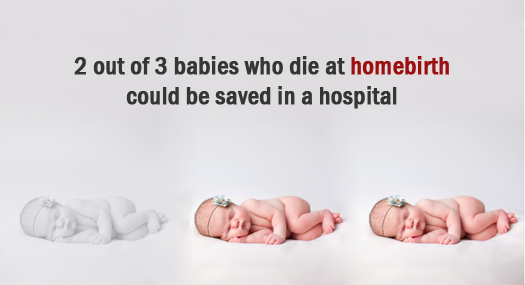
2 out of 3 babies who die at homebirth could have been saved in a hospital

As homebirth advocates have been forced to reconcile themselves to what everyone else has known all along — homebirth increases the risk of perinatal and neonatal death — they’ve been experimenting with rhetorical strategies to diminish the significance of these deaths.

On Wednesday I wrote about Henci Goer’s effort to make homebirth deaths more palatable by comparing homebirth to amniocentesis. Other homebirth advocates emphasize that the absolute risk of death is low (true) or that only women having first babies are at risk for homebirth death (false). The argument goes something like this: Yes, 3 times (200%) as many babies die at homebirth as in comparable risk birth the hospital, but 3 times a small number is still a small number.

Leaving aside for the moment that this is the same group who crowed over a 20% increase in homebirths from from 0.56% to 0.67% of US births, does dismissing the absolute number of death as low fully convey what is at stake in the decision to attempt homebirth? It seems to me that it does not.

Since the way we formulate risk changes the way we view risk, I am offering another formulation of the exact same data:

2 out of 3 babies who die at homebirth could have been saved in the hospital. 0 babies who die in the hospital could have been saved at homebirth.

And that is a best case scenario. That’s what happens in a system where the midwives are highly educated, homebirth care is integrated into the larger obstetrical system, and the list of exclusion criteria long and detailed. None of those criteria apply to homebirth in the US, so the proportion of preventable homebirth deaths in the US is undoubtedly much higher.

In other words, most of the babies who die at homebirth in the US could have been saved in the hospital, whereas none of the babies who died at the hospital could have been saved at home. This formulation makes a mockery of the claims that advocates make for homebirth.

  • Obviously, if 2 out of 3 babies who die at homebirth could have been saved in the hospital, homebirth is not as safe as comparable risk hospital birth.
  • Since 2 out of 3 babies who die at homebirth could have been saved in a hospital, homebirth is not “as safe as life gets.”
  • Since 2 out of 3 babies who die at homebirth could have been saved in the hospital, trusting birth is a bizarre and deadly strategy.
  • As 2 out of 3 babies who die at homebirth could have been saved in a hospital, living close to the hospital is not close enough.
  • Since 2 out of 3 babies who die at homebirth could have been saved in the hospital, hiring an attendant who is trained in “normal birth” is not going to save those babies.

Homebirth advocates like to claim that choosing homebirth birth means “taking responsibility” for the outcome. If that’s so, in 2 out of 3 cases of a homebirth death, the mother is responsible for the fact that her baby died.

Unless and until homebirth advocates understand this reality, they are not making an informed choice of homebirth.

Saraswathi Vedam’s deeply disingenuous guide to the homebirth literature

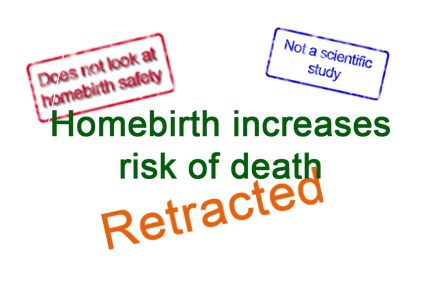
Homebirth stamps

I never cease to be amazed at the pervasive contempt in which professional homebirth advocates hold their own followers.

  • Contempt for the intelligence of their followers: they are confident that followers can be easily tricked with long lists of citations;
  • Contempt for their unfamiliarity with forms of scientific literature: they are confident that their followers will believe something is a scientific paper if they just make it look like a scientific paper; but most of all,
  • Contempt for the obligations they owe their followers: they have no compunction about tricking them into risking the lives of their babies by using mendacious means to convince them of homebirth safety.

Saraswathi Vedam’s Homebirth: An Annotated Guide to the Literature © is a case in point. Vedam has helpfully provided a list of 66 separate citations. But if you read each and every citation, as I have done, you will find that only 3 of the 66 “citations” support the claim that homebirth is as safe as hospital birth.

Vedam was one of the organizers of the recent Homebirth Consensus Summit, a public relations ploy to elevate the status of homebirth midwives, giving the impression that they were “invited to the table” by the expedient of creating the table and issuing all the invitations.

Vedam describes her Guide:

This annotated bibliography provides citations and critical appraisal of original studies on home birth.

It’s all very official and “scientific” looking, complete with elaborate subcategories and a table of contents. It’s true purpose is betrayed by a statement on the first page:

Please distribute widely.

In other words, it’s a document designed for advocacy of homebirth, not truth about homebirth safety. And homebirth advocacy organizations, including Citizens for Midwifery (CfM), the Center for the Childbearing Year, and the Coalition for Improving Maternity Services (CIMS) are duly offering copies of the Guide on their websites.

What does the Guide offer?

Let’s start with the title. Reading it, you might think that the guide provides an overview of scientific citations and original scientific research on home birth. You’d be wrong.

Sure, there are some scientific studies in there, but out of 66 total “citations,” fully 25, more than 1/3, are not scientific studies at all, 1 was never published and 1 was published in a non-peer reviewed publication.

Well, that’s not too bad, is it? Vedam has compiled and annotated a list of 39 studies that “support” homebirth and its safety.

Not exactly.

Of the 39 actual scientific citations:
1 was publicly retracted
17 do not address the issue of homebirth safety.

Okay, so in an effort to support homebirth, Vedam has compiled and annotated 21 contemporary scientific studies that address the issue of homebirth safety. And they show that homebirth is safe, right?

Not exactly.

Of the 21 scientific studies:
2 are underpowered
4 compared homebirth to a hospital group containing high risk women

That leaves 15 studies of which:
12 showed that homebirth had an INCREASED risk of perinatal or neonatal death
3 showed homebirth may be as safe as hospital birth under very strict conditions

That’s right. Out of 66 separate citations in Vedam’s Guide, only 3 show that homebirth is as safe as hospital birth, 2 from Canada and 1 from the Netherlands. The results from the Dutch study are called into question by the fact that it compared homebirth with a midwife to hospital birth with a midwife. A more recent study showed that low risk birth (home or hospital) with a Dutch midwife has a HIGHER perinatal mortality rate than high risk delivery with a Dutch obstetrician.

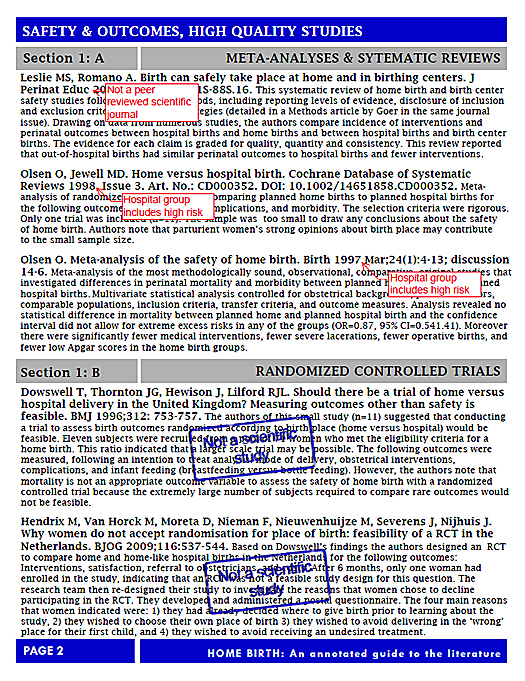
Of course, nothing brings the point home like an illustration, such as the view of a typical page of the Guide posted below.

Vedam guide page 1

You can view the complete document, with my annotations, here:

Dr. Amy’s Annotated Guide to the Annotated Guide

Vedam’s deeply disingenous Guide shows how professional homebirth advocates use the forms and language of science to mislead their readers and the contempt that they have both for their readers and for the truth.

Is homebirth like amniocentesis?

Henci Goer has finally moved the homebirth debate where it ought to be (Is Home Birth a Reasonable Option). It’s not about whether homebirth is as safe as hospital birth; even she acknowledges that hospital birth is safer. The issue is whether homebirth is safe enough.

That, as Goer recognizes is a value judgment. It is up to the individual woman to decided if it is worth it to her to expose her baby to an increased risk of death simply to have the birth “experience” that she desires. In an effort to make the deliberate decision to risk a baby’s life more palatable, Goer attempts to equate homebirth with amniocentesis, and with that, her argument goes off the rails.

… To put this into perspective, the excess risk of losing the pregnancy as a result of having an amniocentesis is 60 per 10,000. No one is advising women against amniocentesis on grounds of its danger, so we may conclude that an excess risk considerably more than 8 per 10,000 is deemed tolerable by the obstetric community.

At a superficial level, Goer is correct in her comparison. Both amniocentesis and homebirth involve exposing a baby to an increased risk of death in exchange for a benefit that accrues to the mother. In the case of amnio, the benefit is knowledge of genetic defects and the opportunity to abort a genetically abnormal fetus. In the case of homebirth, the benefit is the mother’s experience. But the similarities end at that superficial level.

What are the differences?

  1. The gestational age of the baby: Amniocentesis is done in the mid second trimester, before viability. Homebirth occurs long after viability has been reached.
  2. The decision to continue the pregnancy: Amnio is usually chosen to decide whether to continue a pregnancy. Homebirth is chosen for a pregnancy that the mother has already decided to continue.
  3. The relative risks: In both cases, the absolute risks are small. However, while amnio increases the rate of pregnancy loss by 6%, homebirth increases the risk of perinatal death by 200% or more.

Moreover, Goer’s claim about physician counseling is flat out false.

Goer insists that “no one is advising women against amniocentesis on grounds of its danger.” Actually every doctor is ethically and legally required to counsel women about the risks of amniocentesis. Such counseling typically includes the recommendation against amniocentesis if the woman is not going to act on the information (would not abort the pregnancy).

Amniocentesis, like all medical procedures, has risks and benefits. The primary benefit is the ability to terminate a pregnancy. If that option is not on the table, doctors routinely counsel women that the risks outweigh the benefits.

Goer’s follow up claim is also flat out false. She asserts that “an excess risk considerably more than 8 per 10,000 is deemed tolerable by the obstetric community.”

The excess risk is not determined to be “tolerable” by the obstetric community. It is determined to be of the same magnitude as the risk of having a baby with a serious chromosomal abnormality. Amnio is only offered when the risk of pregnancy loss from amniocentesis is exceeded by the risk of a genetic abnormality in the baby. That risk is determined by age and by screening tests such as alpha-fetoprotein.

Furthermore, the decision to have an amnio is determined by whether the risk is tolerable to the mother, not to the obstetric community. Even when the risk of a chromosomal abnormality far exceeds the risk of loss from amniocentesis, the mother won’t have an amnio unless she feels that the risk of loss is acceptable to her.

I understand what Goer is trying to do here. Having finally acknowledged that homebirth increases the risk of perinatal death, she is trying to put an acceptable face on deliberately choosing that risk. But no one has ever claimed that an amniocentesis is as safe or safer than foregoing an amnio. Moreover, the two choices differ in gestational age, decision about continuing a pregnancy and relative risk.

It is one thing to say that amnio is safe enough for women at increased risk of having a baby with a genetic abnormality, when done long before viability, in a pregnancy that will be terminated if the baby has a genetic defect. It is another thing entirely to risk the life of a baby at term, in a wanted pregnancy, for no other reason that the desire for a particular experience.

Melissa Cheyney: mandatory licensing for homebirth midwives … with a few exceptions

You can’t make this stuff up.

Melissa Cheyney has seen the light. Voluntary licensure of homebirth midwives has been recognized for the self-serving ploy that it is, so now Cheyney is in favor of mandatory licensing.

Yes, she is; she said so in this article:

Melissa Cheyney, a licensed midwife and chair of the Oregon Board of Direct Entry Midwifery, argues that mandatory licensure is not a matter of making the practice safer but a matter of holding midwives accountable and making sure every midwife has a minimal entry level of training.

Yes, she’s absolutely in favor of mandatory licensing, except …

… Cheyney is wary about establishing a law so soon without data proving licensed midwives produce better birth outcomes than those without a license. Though a project to obtain this data is under way, it will take at least three years to compile the information and determine the results.

Of course that data already exists and shows that both licensed and unlicensed Oregon homebirth midwives have appalling levels of perinatal death. (How many babies died at the hands of Oregon homebirth midwives?)

No matter, Cheyney is completely in favor of mandatory licensing for Oregon homebirth midwives. There just need to be a few teeny, tiny exceptions in light of the fact that a license costs money:

Cheyney is concerned for many midwives, including those with fewer client bases such as student midwives who are just starting out, midwives who work in rural towns, and midwives who work with under-served populations. If those midwives can’t afford a license under a new law, they would be forced to give up their practice.

Because what’s really important is the ability of homebirth midwives to make money.

It’s not like women in rural areas and in under-served populations deserve accountable, minimally trained midwives, right? And, really, is it fair to hold brand new homebirth midwives accountable? Let’s wait until they made some money before we ask them to prove that they’ve been minimally trained.

So let’s see. Melissa Cheyney is completely in favor of mandatory licensing for all homebirth midwives who aren’t new, who aren’t practicing in rural areas and who aren’t working with under-served populations.

Yes, indeed, every single one those midwives must be licensed. Well, actually not every single one.

Cheyney wants to maintain protection for traditional midwives regardless of licensing laws. She suggests allowing midwives to apply for exemption from mandatory licensure to preserve those traditions. “I think it’s a travesty around the world that Western-style obstetrics have come in and annihilated long traditions of traditional midwives,” Cheyney says.

She’s got a point. But why stop at homebirth midwives? Shouldn’t we also exempt traditional neurosurgeons from the requirement for a medical license. Isn’t it a travesty around the world that Western-style neurosurgery have come in and annihilated long traditions of trephining skulls and exorcisms?

Be that as it may, the important thing is that Melissa Cheyney has changed her mind and recognized the importance of licensure for Oregon homebirth midwives. Every single homebirth midwife should be licensed except for the new midwives, those who work in rural areas, those who work with the under-served and those who practice traditional midwifery.

I, for one, am giving thanks for this change of heart.

As someone who is working diligently to abolish the CPM credential, I must give thanks to Melissa Cheyney directly. It’s difficult to imagine a more incompetent and downright destructive defender of the grossly undereducated, grossly under-trained certified professional midwife than Cheyney.

How has she hurt the cause of CPMs? Let me count the ways:

promoting voluntary licensure;
creating laws that allow anyone to call herself a midwife, even if she has no training;
refusing to release the death rates of the 24,000 homebirths in the MANA database;
refusing to share the Oregon MANA statistics with the state of Oregon;
publicly acknowledging that she won’t share those statistics because they could be used to discipline midwives;
and now, promoting mandatory licensure with indefensible exceptions.

I could tell you that CPMs are nothing more than birth junkies who wish to call themselves midwives without doing the hard work of earning a midwifery degree. I could tell you that CPMs care only about themselves, eschewing the need for training, licensure and accountability. I could tell you that CPMs have appalling death rates and couldn’t care less. But no one brings the point home like the Melissa Cheyney.

Keep up the good work, Missy!

Why don’t homebirth advocates learn from a near miss?

She argued with me in another forum about the safety of homebirth:

I truly recommend the book, “Born in the USA: How a Broken Maternity System Must be Fixed to put Women and Babies First” by Dr. Marsden Wagner. He is a Doctor with extensive experience and would enlighten many a doctors on the subject and safety of Homebirth…

Lets start there Doctors. Lets actually enable a women to birth rather then telling her in many ways that she does not know her body, cant possibly push a 10 pound baby out of her vagina (for example), must birth on her back with a cathetar and epidural because she could never handle the pain. Lets educate women and truly give all sides of the birthing procedures…

She became an ICAN co-leader because of her belief that her first child was delivered by an “unnecessary” C-section:

My oldest son was a c/s bc the ob thought he was too big. I was young, ignorant and swayed quite easily. He was scheduled to be cut out of me one day after his due date. I never felt labor, and I barely remember his birth. He was 9lb 6oz 21 in and a 13.5in head.

She vowed that her second birth would be different. Despite the risk factors of a previous C-section and previous macrosomic baby, she chose to have a home VBAC with a certified professional midwife (CPM). The baby nearly died and she suffered a significant postpartum hemorrhage:

[The midwife] checked [his] heart tones, she couldn’t find them.

My heart stopped.

[The midwife] had me get on all fours with my chest on the bed to relieve the pressure from his head in the birth canal. [She] told [my husband] to call the ambulance. [Her] assistant called the hospital to prepare for a homebirth transport…

She had a partially prolapsed cord. Fortunately the ambulance arrived quickly and the hospital was only a few minutes away. The baby was born alive.

Delivering the placenta was interesting, and seemingly boring. Then I began to lose a lot of blood, it poured out of me. Pieces of [the baby’s] amniotic sac were still adhered to the wall of my uterus and required [the doctor] to manually scrape the walls to remove the excess.

She was extremely proud of her vaginal birth. Earlier this year she wrote:

…Having [him] has set me on the path to becoming a homebirth midwife. I believe in women and their innate ability to birth.

Someone asked me recently how I could want to be a homebirth midwife since I had such a difficult delivery and it is obviously not safe. My response was, “Yes it was incredibly difficult however, will you not birth your child at the hospital under induction because women and babies have died?” I needed the hospital and it was there. I will birth my next child at home as well, no second thoughts.

She planned a homebirth with the same CPM despite her history of a previous C-section, a macrosomic baby, an occult cord prolapse and a postpartum hemorrhage.

At 41 weeks, her daughter died in utero on Thanksgiving day. She was delivered later that evening in the hospital. The baby weighed 5 lbs. 15 oz, suggesting that she had been suffering from intrauterine growth retardation likely due to placental insufficiency.

This mother dodged a bullet at the first homebirth, but didn’t learn anything. She wasn’t as lucky the second time around and her daughter is dead.

More mendacity from MANA

Is there anyone left out there who thinks MANA isn’t hiding its death rates?

If so, it’s not for lack of bone-headed moves on MANA’s part. While vigorously denying they are hiding the number of deaths out of the 24,000 planned homebirths in their database, MANA has made it clear that that is precisely what they are doing.

The obvious thing to do, if they are hiding their death rates and have absolutely no intention of revealing them, would be to keep silent when someone points out that they are hiding the data. Any claim that they are not hiding how many of those 24,000 babies died that does not include disclosure of the number merely serves to call attention to the fact that they are indeed hiding this data and that the death rate is likely to be nothing short of an appalling indictment of homebirth with a certified professional midwife (CPM).

Their disingenuous, mendacious and down right inept responses to my piece on Time.com and the subsequent comments are inadvertently providing loads of entertainment. On Wednesday I wrote about the unsigned letter by MANA executives that was published on their website and on Time.com.

In particular, I pointed out that MANA executives changed their Handbook for Researchers just this month, removing specific requirements I highlighted in my Time piece, while implying in their letter that those requirements had never existed. When this was pointed out in the comments, a MANA executive claimed that it is just an amazing coincidence. Wendy Gordon, CPM, LDM/LM, MPH, (and placenta encapsulation specialist!) Midwives Alliance Division of Research explains:

I have to smile at the suggestion that the Midwives Alliance or any organization could move so swiftly as to make policy changes in response to something someone says in a blog somewhere. These were decisions that were carefully weighed and discussed over several months, culminating in Board member approval. If only decisions could always be made that quickly!

Wow, MANA executives began planning to remove the inappropriate requirements for data access months ago, and it is just an incredible coincidence that release of the new guidelines occurred in the very month that my piece appeared. If only they had coincidentally released the death rates, too!

And if that claim isn’t foolish enough, Ms. Gordon can’t seem to help making another, even more foolish claim:

There has never been a requirement that researchers must swear to use the data for the advancement of midwifery — even the Wayback Machine can confirm that.

Are you sure, Ms. Gordon? I don’t know if the document is in the Wayback Machine, but it is certainly on my hard drive. The MANA bulletin of Summer 2006, explaining how the data will be used, asserts (page 11) that midwives were told prior to submitting data to the study that the data could only be used for the “advancement of midwifery” and that the Director of Research would close the account of any researcher who did not conform and used the data “inappropriately.”

Oops!

When Gabe Paparella, writing as SomeoneIsWrongOnTheIntenet asked Ms. Gordon point blank for the mortality data, she suddenly remembered, that:

We are preparing this information for publication and look forward to sharing it widely.

Oh, they are preparing it for publication. Really? Then why did the executives of MANA fail to mention that salient point? Why didn’t former President of MANA Geradine Simkins mention that? Why didn’t Ms. Gordon herself mention it at any time before she was asked point blank to reveal how many of those 24,000 babies died. How curious that no one thought to mention this before.

But my favorite comment made by Ms. Gordon is this:

There are no significant differences from previously published data (see Johnson & Daviss, BMJ, 2005).

Now that’s funny! The Johnson and Daviss BMJ 2005 study ACTUALLY shows that homebirth with a CPM in 2000 had nearly triple the death rate of comparable risk hospital birth in 2000. Of course, Johnson and Daviss left that out of the original paper, but have since publicly acknowledged that they never compared homebirth in 2000 with low risk hospital birth in 2000.

Let’s leave all those disingenuous and mendacious comments aside for the moment. The issue under discussion is exquisitely simple:

Is MANA hiding how many babies died at the 24,000 planned homebirths in their database?

According to the MANA executives, they’re not hiding how many babies died, … they just refuse to say.

And that’s not the same as hiding, especially since they just remembered, just yesterday, that they are planning to publish how many babied died … some day … at some point in the future … and they look forward, yes they do, to sharing the number of dead babies with us then, but for now they just can’t reveal how many babies died because … because … well, they can’t think of a reason.

But they know there is a reason, even if they can’t think of it, because if there were no reason then they would be hiding the number of babies who died and they aren’t hiding the number of babies who died…

So how many of those 24,000 babies died at the hands of homebirth midwives?

They’re not hiding the answer; they just won’t tell us.

How homebirth advocates do research on the internet

A little more than a year ago I wrote a piece entitled Attachment parenting causes autism. The purpose was to demonstrate the faulty reasoning skills of vaccine rejectionists and explain how the same reasons offered to “prove” that vaccines cause autism could also prove that attachment parenting causes autism.

The piece has been extremely popular and a lot of people understood the point, but I’ve been surprised by a completely unforeseen response: some people actually came away from it believing that attachment parenting could cause autism!

I’ve seen a variety of discussions on a number of different parenting message boards; in fact there is one going on at the moment. It usually takes only 10 back and forth posts on a thread for someone to come along and put everyone out of their misery by pointing out that it is a satire on the faulty reasoning of vaccine rejectionists. After which, predictably, the usual arguments are trotted out about how they “know” that vaccines cause autism.

What’s most interesting to me is the insight these discussions offer into the way that homebirth advocates (and vaccine rejectionists) “educate” themselves about health issues.

1. They are unbelievably gullible.

When I wrote the original piece I thought long and hard about an example that was so incredibly outrageous that readers would immediately understand that the piece is a satire. Who could possibly take seriously the claim that attachment parenting causes autism? Evidently, the same people who think homebirth is safe or vaccines cause autism.

2. They don’t actual read an article; they simply accept the title.

I am hopeful that the main reason that some readers don’t understand the piece is satire is because they don’t actually read or even effectively skim the article which clearly states:

Those who have read this far have probably figured out that this is a satire.

3. They don’t understand what they read, and make no effort to understand it.

The alternative, of course, is that there are people who read the beginning of the article, don’t finish it and are left with the impression that attachment parenting does cause autism. What’s remarkable is that it never occurs to them that they may have misunderstood and that they should read the rest of the article to find out.

4. They completely and utterly miss the point.

When it is eventually pointed out to them that the piece is a satire on what passes for “reasoning” among homebirth advocates and vaccine rejectionists, it never occurs to them that they have been duped precisely because they don’t understand logic. They fail to draw the obvious conclusion that if they can be tricked into believing that attachment parenting causes autism, they can be tricked into believing that vaccines cause autism.

These factors go a long way toward explaining how people are so easily fooled by the websites and publications of professional homebirth advocates and vaccine rejectionists. Those who think they can “educate” themselves on the internet are gullible; don’t actually read the books and websites, merely skim the titles; if they read the books and websites, they don’t make an effort to understand what is written; and, of course, they have no idea about even the most basic elements of logical thought.

I never meant to trick people into believing that attachment parenting causes autism. The fact that I could do so inadvertently tells us a great deal about how homebirth midwives, childbirth educators, professional homebirth advocates and professional vaccine rejectionists can convince their gullible readers of just about anything, no matter how ridiculous.