Category Archives: Uncategorized

Lies, damn lies and the Midwives Alliance of North America

Stung by my piece on Time.com What Ricki Lake Doesn’t Tell You About Homebirth, MANA has responded.

The response is the typical disingenuous attempt of MANA executives to justify withholding their death rates … with a twist.

The latest tactic? Changing their Handbook for Researchers just this month removing specific requirements and implying that they never existed at all.

The executives at MANA wrote:

“Our dataset is currently available to researchers, and we welcome applications. There is no stipulation that data must be used for the advancement of midwifery nor is there an agreement promising not to release death rates; this statement is completely false.”

Let’s analyze.

First, the executives of MANA would like to leave the impression that statistics can only be released in the context of research. That is completely untrue. Every state and the US government releases annual statistics on the number of births and the number of neonatal deaths (not to mention a myriad of other health issues). This information is publicly available to anyone for free through the CDC. MANA can and ethically should release its data to the public for free in the same form as the CDC data. There is nothing preventing them from doing this beside their unwillingness to reveal the numbers.

Second, MANA has removed key sections of the Handbook just this month to comport with their current claims.

As it happens, I originally submitted the piece to Time.com in late September. The following quotes are taken directly from the edition of the Handbook prior to this month’s changes. (Through the miracle of the “Way Back Machine,” you can access the edition of the Handbook as it appeared on July 2011 here.) Strike-throughs indicate the relevant text that was removed just this month.

1. A pledge to use the data to benefit the midwifery community:

“The MANA DOR [Director of Research] is responsible for representing the midwifery community in its relationship with investigators… Therefore the MANA DOR expects all investigators interested in collaboration with this community to consider how they can cooperate with these principles, and to describe how they intend to do so in their request for data access.

The Handbook does still mention that MANA endorses (a very indiosyncratice view of ) the principles of Community-Based Participatory Research. They apparently believe that it is designed to protect homebirth midwives, even though it is really designed to protect research subjects.

2. An elaborate vetting procedure, including, among other things:

“…
a. Investigator affiliations
b. The nature and purpose of the proposed research, including:
i. Basic description of the study design and methods of analysis
ii. Time frame
iii. Specifics of data requested (year, intended site of birth, provider)

3) Signed statement of familiarity with Community Based Participatory Research (descriptive material contained in this Handbook) – form available at
http://www.mana.org

4) Signed statement of familiarity with the Midwifery Model of Care, scope of
practice and out-of-hospital birth protocols or practice guidelines (descriptive
material contained in this Handbook) – form available at http://www.mana.org

5) Copy of Research Protocol, to include the following:
a. Description of Project and Research Questions
b. Project Background, Review of the relevant literature, and Significance
c. Methods and Procedures
d. Variables Requested for Analysis, including any time or geographic limits
e. Risks/Benefits Assessment
…”

3. A non disclosure agreement promising not to reveal any data (including death rates) to anyone:

access will be predicated on the signing of … a Confidentiality and Non-Disclosure Agreement

replaced with: “A standard confidentiality/ non-disclosure agreement will be provided.”

4. The substantial fee for access remains unchanged:

“Fee for individual researchers is $250 and for institutions $1000.”

So what are we to make of this?

MANA is still struggling mightily to avoid releasing their own death rates. Nonetheless, they have been deeply stung by my accusations, so much so that they went to the effort to remove various offending passages. But they went a bit too far by implying that those passages never existed instead of acknowledging that they removed them.

It’s one thing to call for a retraction of false claims. It’s another thing entirely to amend a document to make it look like the original claims are false.

MANA took a golden opportunity to do the right thing and turned it into another example of mendacity. Instead of announcing that the inappropriate requirements for access to the data were removed, MANA executives have tried to make it look like they never existed. In my judgment, this is grossly unethical conduct and raises questions about whether we can ever believe MANA claims and statements.

And the original issue still remains:

MANA needs to tell us: how many of those 24,000 babies delivered by MANA members died?

There is no plausible reason why this information should be withheld from American women.
Advocates hail news that driving without a seatbelt is safe

Advocates of seatbelt free driving are hailing the results of the largest study ever done of driving without a seatbelt.

Investigators compared 16,000 women who drove without a seatbelt to the grocery store to 16,000 women who were wearing a seatbelt on the drive to the grocery store and found that the number of deaths was very similar. In fact, for experienced drivers driving to the grocery store, fatalities were the same.

The authors investigated only those who were at low risk for a fatal crash by applying a long list of exclusion criteria. Drivers could only be included in the study if their drive to the grocery store took place

  • during daylight
  • in the absence of rain
  • on roads that had no potholes
  • only if there were no other cars on the road during the entire route.

Overall, the number of fatal outcomes was similar in both groups, but in depth analysis revealed that most of the fatal outcomes occurred in the subgroup of first time drivers. In contrast, for women who had driven before AND

  • never had an accident or speeding ticket
  • never drove drunk in the past, texted or even talked on a cellphone during driving
  • were driving cars with front and side airbags

the results were very similar.

Of note, the authors found a surprisingly high rate of drivers changing their minds. Between 36-45% of first time drivers actually ended up wearing a seatbelt even though they had planned not to do so. A far smaller number, 10-15% of experienced drivers also wore seatbelts even though they had not intended to do so.

The study was conducted by Seatbelt-Free America, a consortium of auto manufacturers who have long argued that the requirement to put seatbelts in all cars adds needless expense and results in only minimal benefit.

In a press conference, Ima Frawde CPG (certified professional gadfly), leader of the study explained the results:

This, the largest study of its kind, demonstrates that all women should be offered the choice of buying a car without seatbelts. Of course, women should receive adequate counseling from their auto salesman, about the slightly increased risk of fatal outcomes among first time drivers, but it they elect to buy a car without seatbelts, that it their decision.

Ms. Frawde continued:

The risk of a fatal accident was very low in both groups, suggesting that driving to the grocery store with or without a seatbelt is extremely safe. The additional protection afforded by wearing a seatbelt was relatively trivial, just a few deaths avoided per thousand drivers.

During the press conference, a reporter asked if this study of seatbelt use restricted to driving to the grocery store during daylight, in the absence of rain, on roads that had no potholes, and only if there were no other cars on the road during the entire route was generalizable to the population at large, given that many drives are far longer, it is often raining, many roads have potholes and there are usually other cars on the road.

Ms. Frawde expressed surprise:

Why wouldn’t it be?


This piece is a satire on the response of homebirth advocates to the recently published Birthplace Study.

Real message of Birthplace Study? Don’t trust birth!

iStock_000015695134XSmall

It is interesting to see how different media outlets and different stakeholders are trying to spin the results of the Birthplace Study. Is the glass half full or half empty? Did the study show that homebirth increases the risk of perinatal death and brain damage or did it show that homebirth is safe for rigorously screened women who have had uncomplicated births in the past?

I reviewed the findings of the study this morning (It’s official: homebirth increases the risk of death), but there’s more to the study than just the numbers. It is valuable to look at the bedrock principles that the researchers used, because there is not much doubt about those.

Specifically, the investigators rejected the bulk of midwifery theory. The underlying assumption of the study is that birth is inherently dangerous, that there are a myriad possible complications with serious consequences and that carefully culling out anyone with even minor risk factors is critical to good outcomes at homebirth.

The real message of the Birthplace Study is this: don’t trust birth.

Moreover, the various homebirth midwifery aphorisms that flow from trusting birth are treated as the nonsense they are:

Breech is a variation of normal? Nonsense.
VBACs are safe at home? Nonsense.
Twins are safe at home? Nonsense.
Elevated blood pressure not a cause for concern? Nonsense.
Gestational diabetes not a cause for concern? Nonsense.
Preterm deliveries before 37 weeks safe at home? Nonsense.
History of previous shoulder dystocia safe at home? Nonsense.
Low or high amniotic fluid safe at home? Nonsense.

The investigators have no use for other midwifery theories, either.

Trust your intuition? Nonsense.
Babies know how to be born? Nonsense.
You won’t grow a baby too big to birth? Nonsense.
And my personal favorite, including the nonrational is sensible midwifery? Complete and utter nonsense.

The Birthplace Study is predicated upon the fact that complications in birth are common and that various risk factors increase the risk of complications to the point where it is unsafe to give birth at home. Therefore, the only way to assure that there are a minimal number of preventable neonatal deaths is to exclude anyone that had a problem in the past as well as anyone with the merest hint that a problem might develop.

To the extent that the Birthplace Study identifies a subgroup in which homebirth may be as safe as hospital birth, that subgroup is “women who can be relied upon not to experience any complication of any kind.” In other words, homebirth is safe if nothing goes wrong. If there is any chance of anything going wrong, homebirth is not safe.

What does this mean for American homebirth midwifery (CPMs, certified professional midwives)? It basically blasts it out of the water.

Given what the Birthplace Study shows, we can conclude that the underlying philosophy of American homebirth midwifery is garbage, the principles that flow from that philosophy are nonsense, the rejection of risk factors is deadly, and the education and training of CPMs is completely inadequate.

Homebirth in the UK for women who have had a previous completely uncomplicated pregnancy, whose current pregnancy has no risk factors of any kind, and who are being cared for by highly educated and highly trained midwives may be safe, so long as those midwives adhere to the very strict criteria in the study. Homebirth in the UK for women who have never had a baby but whose current pregnancy has no risk factors of any kind and who are being cared for by highly educated and highly trained midwives increases the risk of perinatal death and brain damage. Everyone else isn’t even a candidate for homebirth.

In other words, this study is a huge blow to Ina May Gaskin and her followers. This study does NOT support the safety of homebirth with an American homebirth midwife (CPM). In fact, it indicates that homebirth with an American homebirth midwife (CPM) cannot possibly be safe.

It’s official: homebirth increases the risk of death

IMG_2474
The largest, most comprehensive study ever done of homebirth has released its results and there’s nothing left to argue about: homebirth increases the risk of perinatal death.

The Birthplace Study, a large multi-year study, was designed to address the safety of place of birth by controlling for the many factors that had not been handled properly in other studies. The study looked at intended place of birth to rule out improperly assigning transferred patients to the hospital group, and included only the lowest possible risk women. The study was conducted by The National Perinatal Epidemiology Unit in the United Kingdom.

The authors found that homebirth increases the risk of death, brain damage and serious neonatal injury.

The authors chose to evaluate the results by creating an index of primary events comprising intrapartum stillbirths, early neonatal deaths, neonatal encephalopathy [brain damage] meconium aspiration syndrome, brachial plexus injury, and fractured humerus or clavicle. Using this measurement:

… [T]here was a significant excess of the primary outcome in births planned at home compared with those planned in obstetric units in the restricted group of women without complicating conditions at the start of care in labour. In the subgroup analysis stratified by parity, there was an increased incidence of the primary outcome for nulliparous women in the planned home birth group (weighted incidence 9.3 per 1000 births, 95% confidence interval 6.5 to 13.1) compared with the obstetric unit group (weighted incidence 5.3, 3.9 to 7.3).

In other words, the risk of death and serious injury was approximately double in the homebirth group and that increase was seen mainly among first time mothers.

The authors did not include the number and distribution of specific primary events within the paper itself, but did publish a 78 page supplementary file including this information. The following tables are adapted from that file. (OU stands for Obstetric unit [hospital], AMU stands for along side maternity unit [in hospital birth center], and FMU for free-standing maternity unit [independent birth center].)

Stillbirths

IMG_2471

Early neonatal deaths (to 7 days)

IMG_2472

Encephalopathy [brain damage]

IMG_2471

The authors put the best possible face on the outcome:

… Adverse perinatal outcomes are uncommon in all settings, while interventions during labour and birth are much less common for births planned in non-obstetric unit settings. For nulliparous women, there is some evidence that planning birth at home is associated with a higher risk of an adverse perinatal outcome…

What can we conclude?

Homebirth increases the risk of perinatal death and brain damage in the lowest risk women receiving care from highly trained midwives (often two) and liberal access to transfer.

Homebirth increases the risk of perinatal death and brain damage even when, at the start of labor, breech, twins, VBAC. positive GBS status, gestational diabetes and obesity were excluded. All routinely occur at homebirths in the US, the UK and Australia.

And how about the purported “risks” of interventions that homebirth advocates are always taking about?

Homebirth increases the risk of perinatal death and brain damage even though the incidence of epidural use was 5 times higher in the hospital group.

Homebirth increases the risk of perinatal death and brain damage even though the incidence of pitocin augmentation was 5 times higher in the hospital group.

Homebirth increases the risk of perinatal death and brain damage even though the incidence of operative vaginal delivery was 3-4 times higher in the hospital group.

Homebirth increases the risk of perinatal death and brain damage even though the C-section rate was 4 times higher in the hospital group.

In other words, any way you choose to look at it, no matter how carefully you slice and dice the data, there is simply no getting around the fact that homebirth increases the risk of perinatal death and brain damage.

NZ study tries to bury increased homebirth death rate

How do homebirth midwives handle mistakes? They bury them, of course, and a recent study from New Zealand is yet another case in point.

From the title,Planned Place of Birth in New Zealand: Does it Affect Mode of Birth and Intervention Rates Among Low-Risk Women?, to the conclusion, the authors refuse to address the increased neonatal death rate. In fact, the authors go so far as to deliberately obfuscate the increased neonatal death rate at homebirth.

Here’s how the authors represent the findings of their study:

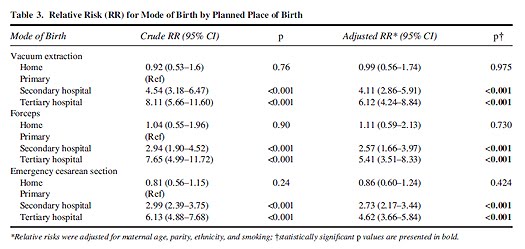
Women planning to give birth in secondary and tertiary hospitals had a higher risk of cesarean section, assisted modes of birth, and intrapartum interventions than similar women planning to give birth at home and in primary units. The risk of emergency cesarean section for women planning to give birth in a tertiary unit was 4.62 (95% CI: 3.66–5.84) times that of a woman planning to give birth in a primary unit. Newborns of women planning to give birth in secondary and tertiary hospitals also had a higher risk of admission to a neonatal intensive care unit (RR: 1.40, 95% CI: 1.05–1.87; RR: 1.78, 95% CI: 1.31–2.42) than women planning to give birth in a primary unit.

Here’s what the authors conclude:

Planned place of birth has a significant influence on mode of birth and rates of intrapartum intervention in childbirth.

Here’s what the authors deliberately tried to hide:

The neonatal death rate in the planned homebirth group was 1.1/1000. The neonatal death rate in the planned hospital birth group was 0.3/1000. In yet another example of a strikingly robust finding, planned homebirth in NZ had more than triple the neonatal death rate of planned hospital birth.

How was the study done?

Data were obtained from the [Midwifery Maternity Provider Organisation (MMPO) database] for a total of 39,677 births. Of these, 16,453 (41.47%) met the study’s low-risk criteria. Of this low-risk group, 11.3 percent were planning to give birth at home, 17.7 percent in a primary unit, 45.5 percent in a secondary level hospital, and 25.4 percent in a tertiary level hospital.

Where did the women ultimately give birth?

Most women gave birth in their planned place of birth; 82.7 percent of those planning a home birth, 90.2 percent planning to give birth in a birth center, 99.8 percent planning to give birth in a secondary hospital, and 99.8 percent planning to give birth in a tertiary hospital actually gave birth in their planned place of birth.

In other words, the transfer rate in the homebirth group was 17.3%; the transfer rate in the birth center group was 9.8%.

The authors are very excited about the difference in intervention rates among these groups, presented in the following table.

Not surprisingly, the risk of operative vaginal delivery and the risk of emergency cesarean section are much higher in the hospital. The authors do not define “emergency cesarean” but they apparently mean unplanned, not true emergency C-sections.

The authors also looked at secondary outcomes:

… Women planning to give birth in secondary or tertiary level hospitals were also at increased risk of artificial rupture of the membranes, augmentation of labor, pharmacological pain management, episiotomy, and neonatal admission to intensive care when compared with women planning to give birth in primary units. Those planning to give birth at home were at less risk of augmentation of labor, artificial rupture of membranes, pharmacological pain management, episiotomy, and perineal trauma than those planning to give birth in primary units…

So the homebirth group had lower rates of major interventions and the homebirth group had lower rates of minor interventions. How about deaths?

Well, funny you should mention that. There was a little bit of a problem there and the authors made a valiant attempt to hide it.

A total of six neonatal deaths (a death occurring up to 27 days after birth) occurred in the sample, two (0.11%) from women planning a home birth and four (0.15%) from women planning to give birth in the tertiary hospital. No intrapartum, intrauterine deaths were reported.

Hey, the death rates are exactly the same! Wait, what? The authors deliberately used the wrong denominator for calculating the hospital birth death rate?

Indeed they did. They compared the death rate at homebirth with the death rate in tertiary [high risk] facilities, but that’s not what we want to know. We want to know how the death rate at homebirth compares with the death rate at all hospital births, not the death rate at tertiary facilities.

What the authors should have told us was that there were two neonatal deaths (0.11%) among women planning a home birth and four (0.03%) from women planning to give birth in the hospital. In other words, the homebirth death rate was more than triple that of the hospital birth death rate. Oops!

The authors of this paper should be ashamed of themselves. They didn’t want anyone to know that homebirth had triple the neonatal death rate of hospital birth, so they deliberately obscured it by using the wrong denominator in their calculations.

The authors brazenly assert that no differences for planned place of birth were noted. That is simply a lie.

Homebirth in New Zealand has triple the neonatal death rate of hospital birth. The finding of lower intervention rates in the homebirth group is nothing to celebrate when more babies died as a result.

A failure from the moment of birth

Finally, a natural childbirth advocate willing to say what she desperately needs to believe really means. In a Facebook thread about women who have had C-sections, “Joni” pulls no punches:

Yes, they have failed at birth. They succeeded at making a baby and hopefully of caring for it, but they did fail the birth. And birth is so important for baby too. You can be scarred for life by it. There are women being persecuted so that all of us can have the birth that we want! There is a woman in Australia who is in trouble just because she wants every woman to have the choice to home birth! All of these people are anti choice for woman! Birth matters. It might matter most of all in life for woman!

Joni is pathetic brave. Joni doesn’t have any real achievements pander to those feeble excuses for women who couldn’t push a baby through their vagina.

But Joni doesn’t go far enough. When it comes to birth, it takes two to tango, and babies should accept their share of the blame. It isn’t just women who have failed by having a C-section; their babies have failed, too, and it’s time to be honest about it.

Babies who are premature? Failures.

Babies who have abruptions? Big failures.

Babies who suffocate and die during labor? The ultimate failures!

Now some of you might be thinking that we shouldn’t blame babies for things that they can’t control. Hello, babies are supposed to know how to be born. If you can’t get the timing right, if you can’t keep your placenta together, if you can’t get enough oxygen during uterine contractions, you obviously didn’t know how to be born.

How about the babies who don’t fit through the mother’s pelvis? Big babies, babies with asynclitic heads, transverse babies? Failures, failures, failures.

But is it really the baby’s fault if it grows bigger than a mother’s pelvis can accommodate? Duh! Everyone knows that a mother’s body won’t grow a baby too big for her to birth; therefore, it must be the baby’s fault.

And let’s be honest here. Some babies aren’t merely failures, they are evil failures. Evil because they gave their mothers pre-eclampsia, or gestational diabetes or even deadly peripartum cardiomyopathy.

It may sound harsh, but it’s true. Just like women are perfectly designed to give birth, babies are perfectly designed to be born through the vagina. If they can’t get with the program and have to come out by C-section, they are failures just like their mothers are failures.

Frankly, if they don’t know how to be born the right way, they don’t deserve to be born at all. We should just let them die and their failed mothers die with them. Because really — when it comes right down to it — the entire purpose of birth to push something through your vagina and if you can’t do that like Joni can, you don’t deserve to live.

If natural childbirth is so natural, why must it be taught?

If there’s one thing that all natural childbirth advocates agree upon, it is that natural childbirth requires preparation and education. Such education includes classes, books and websites. No natural childbirth advocate would ever propose doing what women have done for most of human existence, nothing. Here’s what I want to know: If natural childbirth is so natural, why must it be taught?

The answer, of course, is that the philosophy of natural childbirth has little if anything to do with childbirth in nature. It is an elaborate set-piece, designed to give participants the illusion that they have recreated nature. It bears about as much relationship to childbirth in nature as an infinity pool in your backyard bears to the local watering hole.

Indeed, in the paper The social nature of natural childbirth (Social Science and Medicine, December 2007), Professor Becky Mansfield, claims that rather than representing a return to nature, natural childbirth posits a specific set of social and cultural practices. Mansfield begins by asking the obvious:

… If childbirth is so natural, how can there be strategies to facilitate it? If it is instinctive, why does it need to be learned? …

The answer, of course, is that it is a conceit of privileged white women in first world countries in which a a specific set of cultural practices is imagined to represent “nature.”

Mansfield reviews natural childbirth books written for lay people, and identifies 3 types practices that appear to be required for natural childbirth to be natural. Although Mansfield concentrates on books, websites and childbirth classes exist to promote the same information.

1. Activities during birth

The first theme is the variety of activities during labor and delivery that the books represent as necessary for making a non-medicalized birth possible. This theme is “social” because the books represent natural childbirth as something women must do; according to these books they cannot do nothing or just anything.

Not only is doing nothing forbidden, but special equipment and preparations are necessary:

… Books promote having a range of props to help a woman be active (e.g., squat bars or birth balls) … The books place even greater emphasis on using the environment to help women be emotionally comfortable, on the premise that the wrong environment increases fear and anxiety (thereby inhibiting labor) while the right one reduces them…

2. Preparation

The second theme of these books – preparation – emerges from this emphasis on activities and learning. According to these books, women wanting birth without intervention must prepare themselves by doing a variety of things in advance…

Prescribed forms of preparation include physical preparation “as for an athletic event”, emotional preparation and elaborate “birth plans,” written documents meant to establish choices in advance.

3. Social support

The emphasis on choice of caregiver and place of birth is one indication that social support … is considered an integral part of natural childbirth… The books contend that social support makes natural childbirth possible by helping women build “trust” in themselves, their bodies, and the “natural” process of childbirth…

In other words, childbirth isn’t natural unless you pay money to someone to facilitate it.

The role of the caregiver as presented in these books is a complicated one… As a result (and despite their emphasis on instinct), books imply that women … rely on someone with knowledge, training, and experience to help figure out what is happening and what to do…

And let’s not forget all the “natural” interventions recommended by the caregiver, including

… a whole host of “non-pharmacological” practices meant to change the course of labor. Examples include herbal remedies, homeopathy, acupuncture, … massaging the perineum to prevent tearing, and transcutaneous electronic nerve stimulation (TENs machines) for pain relief. While books represent such interventions as “gentle” or “natural,” the message they send is that natural childbirth often does involve actively intervening in the birth process…

Evidently:

… “letting nature take its course” requires a complex sociocultural milieu that must be fostered through a range of social interactions.

Mansfield concludes:

… The books … represent natural childbirth as requiring social practice to make it successful… Thus, although the central theme first appears to be about letting nature take its course … [t]he central finding of this study is that proponents represent natural childbirth as a set of very specific social practices that are seen as facilitating nature, and in so doing, they also present a vision in which nature depends on social practice…

In other words, natural childbirth bears about as much relationship to childbirth in nature as an elaborately designed infinity pool in your backyard bears to the local watering hole. A quick look reveals a superficial resemblance, there’s a hole in the ground, water, rocks at the margins and plantings surrounding it all. But a more detailed analysis demonstrates elaborate planning, paid help, special tools to place the rocks, set in and care for the plantings and hidden technology like a water filter. There’s nothing natural about it.

Similarly, a quick look at natural childbirth reveals a superficial resemblance, but a detailed analysis demonstrates elaborate planning, paid help, special tools and hidden technology, such as fetal monitoring, blood pressure measurements, herbal supplements, chiropractic, and acupuncture.

Why must natural childbirth be taught? Because it is not natural; it is a simulacrum of natural designed to promote the conceit that privileged white women in first world cultures have returned to nature.

Adapted from a piece that first appeared on Homebirth Debate in January 2008.

There are none so blind as homebirth advocates who think they’ve “researched”

You knew it was coming. When Sarah Kerr was asked why she risked and lost the life of one of her children at a homebirth, she responded by insisting that she had “researched” the issue, and made her decision accordingly.

Kerr, like most homebirth advocates, was supremely confident about one thing. She was sure that she was more educated than the rest of us. She had done extensive “research” on the internet that had, in her view, qualified her to understand the risks and choose accordingly.

No doubt Kerr had done a great deal of reading. But what she, and other homebirth advocates, fail to understand is that their “research” has equipped them with nothing more than pseudo-knowledge.

Pseudo-knowledge has the appearance of real knowledge; it uses lots of big words, and it often includes a list of scientific citations. There’s just one serious problem; it’s not true and baby Tully is in a coffin in the ground because it isn’t true.

We are surrounded by pseudo-knowledge in everyday life and most of us understand that it isn’t true. Advertisements of all sorts of products are filled with pseudo-knowledge. Most of us are quite familiar with the language of pseudo-knowledge:

“Studies show …”
“Doctors recommend …”
“Krystal S. from Little Rock lost 30 pounds in 30 days …”

In the era of patent medicine, claims like these were usually enough to sell a product. But consumers have become more jaded and the language of pseudo-knowledge has become more sophisticated as a result. Contemporary pseudo-knowledge contains big, scientific words and sounds impressive. It also contains completely fabricated claims that have no basis in reality and which, not coincidentally trade on the gullibility of lay people. And it always contains citations to scientific papers that often don’t actually support the claims being made.

What do you really need to know to evaluate the safety of homebirth, particularly in the case of high risk like Kerr’s twins? Obviously, you need a thorough grounding in basic science and advanced knowledge of obstetrics. You need to have read and analyzed all the relevant textbooks and especially the relevant scientific papers (not simply the abstracts), and that, of course, requires an understanding of statistical analysis.

But wait! Science is hard and that’s unfair. Who has the time, the background or the ability to read and analyze all the relevant papers on homebirth? Not homebirth advocates. They lack knowledge of basic science and of obstetrics.Their math ability often trails off at arithmetic, leaving them no way to understand statistics, even if they bothered to read the relevant texts.

So if they’re not reading obstetric textbooks, and if they’re not reading the relevant scientific papers, and if they’re not analyzing statistics, what exactly are they doing when they are doing “research?” They are simply imbibing the views of other people who know just as little as they do.

Consider the lay bloggers. Who in her right mind could imagine that reading the nonsense spewed forth by simpletons like January of Birth Without Fear is “research”?

How about the self-described “experts”?

Barely a week passes on this blog without a lay person parachuting in to boast of all she has learned from her “research” encompassing the works of Henci Goer, Amy Romano, Barbara Harper or Ina May Gaskin. Don’t even get me started on Ricki Lake; she just makes it all up as she goes along. Their assertions mark them just as effectively as if they had tattooed “gullible” on their forehead.”

When it comes to homebirth and natural childbirth advocates their “research” is worse than worthless because they’ve acquired nothing more than pseudo-knowledge. Just about everything they think they “know” is factually false.

The truth about health education is both simple and stark. You cannot be educated about any aspect of health without reading and understanding scientific textbooks and the scientific literature. Period!

Don’t bother to claim that you are have done “research” on the internet or by reading the books and websites of other homebirth advocates. You haven’t acquired knowledge, you’ve acquired pseudo-knowledge, as well as the dangerous conceit that you know far more than you really do. Internet “research” marks you as a fool. That becomes a serious problem when you, like Sarah Kerr, decide to risk your baby’s life on no better foundation than your own “research.”

Adapted from a piece that first appeared in October 2010.

New study of delayed cord clamping shows no clinical benefit

Proponents of delayed cord clamping are really, really sure that it is better for babies, and they’re willing to look at ever more trivial outcomes to support their belief. Consider the paper published on Tuesday in the British Medical Journal, a major study of delayed cord clamping. Four hundred full term infants born after a low risk pregnancy were randomized to early or delayed cord clamping groups and after 4 months, the groups showed … no clinical difference.

No problem! The authors were apparently thrilled to discover some differences in lab values, despite the fact that both groups had normal lab results and are trumpeting this “benefit” far and wide in press releases.

Proponents of delayed cord clamping typically claim that it is beneficial primarily because it reduces anemia. This study, Effect of delayed versus early umbilical cord clamping on neonatal outcomes and iron status at 4 months: a randomised controlled trial, by Andersson et al., divided infants into two groups, early cord clamping (at ≤ 10 seconds after birth) and delayed cord clamping (≥ 180 seconds after birth). The main outcome measures were:

Haemoglobin and iron status at 4 months of age with the power estimate based on serum ferritin levels. Secondary outcomes included neonatal anaemia, early respiratory symptoms, polycythaemia, and need for phototherapy.

The results:

At 4 months of age, infants showed no significant differences in haemoglobin concentration between the groups …

… There were no significant differences between groups in postnatal respiratory symptoms, polycythaemia, or hyperbilirubinaemia requiring phototherapy.

Though there were no clinically relevant differences, the authors went looking for differences in laboratory values.

… infants subjected to delayed cord clamping had 45% (95% confidence interval 23% to 71%) higher mean ferritin concentration (117 μg/L v 81 μg/L, ≥0.001) and a lower prevalence of iron deficiency (1 (0.6%) v 10 (5.7%), P=0.01, relative risk reduction 0.90 [at 4 months of age] …

The authors trumpet these findings as supporting delayed cord clamping, but, in fact, they are basically meaningless. While it is of theoretical interest that infants in the delayed clamping group have higher normal iron stores, iron stores in and of themselves are not meaningful since they don’t affect health. The health parameters of interest are hemoglobin level and hematocrit (amount of red blood cells) and those are exactly the same.

The authors define iron deficiency as ≥2 indicators of iron status outside reference range (ferritin <20 μg/L mean cell volume <73 fL, transferrin saturation <10%, soluble transferrin receptor >7 mg/L). In both the early and delayed cord clamping groups, values for all parameters were well in the normal range. There is no reason to believe that that the having higher normal values (as in the delayed clamping group) offers any advantage over having mid-range normal values.

Of note, the authors chose to report on the two groups at 4 months of age. Other studies of delayed cord clamping have shown that differences in iron stores disappear by 6 months of age.

The authors make much of the difference in laboratory values, despite the fact that both groups were in the normal range:

We conclude that delayed cord clamping, in this randomised controlled trial, resulted in improved ferritin levels and reduced the prevalence of iron deficiency at 4 months of age… Two meta-analyses of clamping studies performed in low or middle income countries with a high general prevalence of anaemia found similar effects on ferritin as we did and concluded that this effect is clinically relevant and should lead to a change in practice. Iron deficiency even without anaemia has been associated with impaired development among infants. Our results suggest that delayed cord clamping also benefits infant health in regions with a relatively low prevalence of iron deficiency and should be considered as standard care for full term deliveries after uncomplicated pregnancies…

Let’s parse this carefully. Here’s what we can conclude:

  • Delayed cord clamping had NO effect on hemoglobin levels at 4 months of age.
  • Delayed cord clamping had NO effect on the health of the infants at any point.
  • Delayed cord clamping improved certain laboratory parameters, but both groups were normal.
  • In countries with a high prevalence of anemia (low and middle income countries), increased ferritin may be clinically relevant, but there is no evidence that increased ferritin is clinically relevant in high income countries.
  • Iron deficiency in the absence of anemia might be associated with impaired development, but there is no evidence that lower but normal iron stores are associated with impaired development.

What is really going on here? It is quite possible that although infants in the delayed cord clamping group received additional red blood cells, they did not need those red blood cells. Their bodies destroyed those cells and did not replace them, so that by 4 months of age, there was no difference in hemoglobin levels in the two groups. While this study indicates that the delayed group had higher iron stores at 4 months, this effect is known to disappear by 6 months and may simply represent the fact that the body has not yet been able to dispose of the excess iron left over from the extra red blood cells that it did not need.

In other words, this data could just as easily be interpreted to mean that, far from benefiting from delayed cord clamping, infants had to work to get rid of the excess (and unneeded) red blood cells and iron over a period of 6 months.

In any case, the key point is that the authors failed to show any demonstrable clinical benefit to delayed cord clamping in term infants.

Two questions for Australian midwife Hannah Dahlen

Yesterday I wrote about the callous and clumsy attempt of national media spokesperson for the Australian College of Midwives, Hannah Dahlen, to change the subject from the fact that homebirth increases the risk of perinatal death to … well to anything else.

In Home births: it’s time to broaden the focus of the debate, Dahlen makes the bizarre and morally indefensible claim that preventable perinatal mortality is an acceptable component of safe homebirth.

When health professionals, and in particular obstetricians, talk about safety in relation to homebirth, they usually are referring to perinatal mortality. While the birth of a live baby is of course a priority, perinatal mortality is in fact a very limited view of safety.

In light of her self-serving, obfuscatory piece, I have two questions for Hannah Dahlen.

1. Why don’t you say what you really mean?

Instead of struggling mightily with bizarre formulations attempting to justify broadening the definition of “safety” to include unsafe practices, Dahlen should just come out with the truth:

Australian midwives know that homebirth increases the risk of perinatal death, but we like homebirths and we are going to keep doing them.

Dahlen is not the first to struggle to make an intellectually and morally indefensible claim palatable by wrapping it in nonsensical language. Including the nonrational is sensible midwifery, by Jenny A. Parratt, and Kathleen M. Fahy, published in the Australian midwifery journal Women and Birth is a masterpiece of the genre.

The paper also argues for “broadening” the definition of the safety to include irrational beliefs and actions.

…What is deemed as safe is aligned with what is rational and what is unsafe is aligned with what is irrational. As irrationality is not acceptable this essentially forces the definition of safety to be thought of as ‘true’ even though it may not fit with personal experience and all situations…

Yes, that’s a real problem with rationality. It blasts apart the irrational claims of homebirth midwives. And homebirth midwives love the irrational:

… During birth, making room for the nonrational broadens both midwives’ and women’s knowledge about trust, courage and their own intuitive abilities …

This is just another (particularly pathetic) attempt to “broaden” the definition of safety to include unsafe practices that Australian midwives like. They know that many of their homebirth beliefs and practices are irrational and (by definition) not supported by scientific evidence of any kind, but they like them and they are going to keep doing them.

2. Aren’t you embarrassed to ask whose fault it is that women fear mainstream care when it’s your fault?

So when these women seek care outside our mainstream system, whose fault is it really? …

… When a woman chooses to have a homebirth with risk factors present, the question we need to ask is not ‘what is wrong with her’ but rather ‘what is wrong with a maternity care system that provides such limited options and inspires such fear that she would take on the added risk’?

These women do not love their babies less, they fear mainstream care more and this is a terrible indictment of our care.

This is what is known as “chutzpah,” a Yiddish word whose definition is best explained by example. When a man who has murdered both his parents begs the judge for mercy because he is an orphan, that’s chutzpah.

When a midwife who has made a career of demonizing mainstream care asks “who’s fault is it that women fear mainstream care?”, that’s chutzpah.

Dahlen is on record promoting fear of mainstream care, including claims that:

obstetricians want to restrict women’s choices

Hannah Dahlen, of the Australian College of Midwives, says [Dr. Pieter Mourik’s] comments represent the latest salvo in a ”scaremongering campaign” by obstetricians determined to stymie efforts to give women greater choice.

obstetricians perform unnecessary surgery because they are surgeons

Part of the reason we have such a high intervention rate is because normal, low-risk women are being cared for by highly specialised surgeons trained in surgery.

obstetricians care more about money that about women

We have a very powerful medical lobby in this country. They are desperate not to lose their sizeable market share of births…there’s huge money to be made.

and, my personal favorite, maternity hospitals mix up babies

University of Western Sydney professor and ACM (Australian College of Midwives) spokesperson Hannah Dahlan said that baby mix ups are one of the common errors that occur in maternity units.

Whose fault is it that Australian women fear mainstream care? It is, in large part, the fault of Hannah Dahlen and her colleagues, who never miss an opportunity to portray obstetricians as money grubbing surgeons who delight in forcing unnecessary interventions on women in facilities that routinely mix up babies.

Let’s be honest, Ms. Dahlen. Homebirth midwives like homebirths because they are in charge and they are not constrained by any petty concerns like rationality or whether the baby lives or dies. Your piece about “broadening the home birth debate” is nothing more than a justification for midwives continuing to do what they like regardless of whether it comports with the scientific evidence and regardless of whether it kills babies.

At least have the intellectual honesty and moral fortitude to tell the truth, instead of hiding it in obfuscatory language: homebirth midwives will continue to encourage, promote and attend homebirths, and the dead babies be damned.