Category Archives: Uncategorized

How science denialists know their team will win the Super Bowl

Football on the Field

Hi, folks, Ima Frawde here. I spend every working day denying the safety and effectiveness of vaccines, denying the reality of climate change and denying the deadliness of the COVID pandemic.

How do I relax?

I’m a football fan! I spend all my free time watching football, following my team on social media and reading about my team on fan websites.

My team is going to win the Super Bowl!

How do I know? Because football is just like science denial.

1. Our quarterback, the captain of our team, says we’re going to win the Super Bowl.

Just like with science denial, I always trust the claims of our leader.

2. Our fans say we’re going to win.

Just like with science denial, it always helps to associate exclusively with others who already agree with you.

3. I’ve watched extensive film of our team winning and compared it to extensive film of other teams losing.

As in science denial, you must cherry pick the data.

4. I’ve seen our team play mini-golf against other teams and they always win.

If you only watched the YouTube videos of our team winning at mini-golf you’d be equally impressed, too.

5. We won every game in the first half of the season.

Sure sportscasters often declared that our opponents won, but as I tell my fellow science denialists you can’t believe the mainstream media.

6. We also won every game in the second half of the season.

Yes the refs declared that we lost those games, but just as everyone knows scientists are paid to say whatever government or industry wants them to say, everyone knows refs are paid by the NFL to say which team won regardless of what really happened.

7. We had an undefeated season!

Like science denialists, true fans never change their minds based on actual evidence.

Wait, what? The only way you can tell which team is best is by having them play other teams and accepting the outcome of the contests?

Surely you’re joking.

As a professional science denialist I can assure you that would never work!

How can we know what is true?

True or False

Science denialists believe the opposite of scientists.

Science shows that vaccines are safe and effective; anti-vaxxers believe they’re neither.
Science shows that the earth’s climate is changing as a result of human activity; climate denialists either claim it isn’t changing or the change is not the result of humans.
Science shows COVID-19 is a coronavirus that causes serious illness; denialists either deny its existence or its severity.

[perfectpullquote align=”right” bordertop=”false” cite=”” link=”” color=”” class=”” size=””]Determining scientific truth requires being willing to change conclusions based on new evidence.[/perfectpullquote]

How we do we know what is true?

It’s NOT, as many denialists think, by deciding WHO to believe. You can’t determine scientific truth merely by deciding that Donald Trump knows more science than Dr. Tony Fauci.

It’s NOT even, as other denialist think, by deciding WHAT to believe. You can’t determine scientific truth by deciding that YouTube videos present a more compelling case for a particular belief than scientific papers.

Rather, scientific truth is determined by HOW to believe.

Science is a process.

As the authors explain in Enquiry and Normative Deviance; The Role of Fake News in Science Denialism:

Science denialism doesn’t merely involve a rejection of a scientific theory — otherwise scientists themselves would count as science deniers given that they would reject theories on the basis of their explanatorily inadequacy. Rather, science denialism deeply challenges the practice [of] impartially testing research methods, theories, and evidential sources with the aim of improving the accuracy of scientific theories.

That’s because science isn’t about specific beliefs; it’s about evidence and how we use it. Simply put, science requires two things:

First, determining scientific truth requires following all available evidence to logical conclusions.

That’s why science denialists hold beliefs that are inevitably false:

Instead of attempting to find ALL available evidence, denialists use only evidence that is offered to them by other denialists.

Instead of assessing ALL evidence, denialists assess only some, carefully cherry-picked pieces of data.

Instead of incorporating the MOST sophisticated scientific evidence (by reading and understanding scientific papers) denialists rely overwhelmingly on the LEAST sophisticated forms of data that can be easily transmitted in bite sized amounts by web pages and YouTube videos.

Second, and even more importantly, determining scientific truth requires changing conclusions based on new evidence.

What does that mean in practice?

It means acknowledging the LIMITATIONS of the existing data.

Scientific papers usually contain a section near the end that explicitly acknowledges that the existing data might have led to erroneous conclusions perhaps because not enough data was collected or because the data was inadvertently collected from a non-representative sample.

It means interrogating your own conclusions for ALTERNATIVE explanations.

In the same section of the scientific paper acknowledging the limitations of the existing data, there is usually a few sentences or a paragraph entertaining alternative explanations for the existing data and making a case for why those alternative explanations are not supported by the data.

It means acknowledging that the conclusion may change and SHOULD change if future data contradicts it.

Lay people often point to changes in scientific belief as if they reflect a weakness of science. But the willingness to follow additional evidence to a new (even an opposite conclusion) is the great STRENGTH of science.

It means testing to see if you are wrong by considering, reading and attending scientific meetings with those who disagree.

Scientific truth can only be found in contentious communities that deeply engage those with whom they disagree. Denialism, in contrast, takes place in supportive communities (information silos) that drastically limit the data available, misrepresent those who disagree and never, ever directly engage with them publicly.

In other words, the ONLY way you can tell whether a scientific claim is true is by having it compete with other claims on a level playing field and being willing to accept the outcome if it loses.

Science encourages that kind of competition. Denialism fears it.

Science denialism and the evidence double standard

10953771-A193-48B4-9A85-2B99D593E32E

Science denialists have a deeply fraught relationship with scientific evidence. On the one hand, even the most outlandish forms of denialism attempt to invoke the imprimatur of science. Claims range from the simple (“studies show …”) to the elaborate (lists of scientific citations of papers that appear to support the claims being advanced, but actually do not). On the other hand, when scientific evidence undermines their claims, denialists suddenly discover that scientific evidence is not “applicable” to their claims or is “not enough” or produced by scientists with ostensible financial conflicts of interest.

[perfectpullquote align=”right” bordertop=”false” cite=”” link=”” color=”” class=”” size=””]Denialists use science only when it supports their pre-determined conclusions. [/perfectpullquote]

As Professor Rory Coker explains:

Pseudoscience appeals to the truth-criteria of scientific methodology while simultaneously denying their validity. Thus, a procedurally invalid experiment which seems to show that astrology works is advanced as “proof” that astrology is correct, while thousands of procedurally sound experiments that show it does not work are ignored…

Something similar plays out in every type of science denialism. Consider anti-vaccine advocacy. On the one hand, antivaxxers brandish scientific papers that show deleterious effects of various vaccine components like thimerosol or aluminum. Leaving aside for the moment that the papers are typically not directly relevant (involving related but different chemicals, involving massive amounts as compared to the minuscule amounts present in vaccines), these are real scientific papers containing valid scientific evidence.

But, unfortunately for anti-vaxxers, there are tens of thousands of scientific papers that demonstrate the safety and efficacy of vaccines. In contrast to the scientific papers that they like, this mass of scientific research, is not accepted on its face. When trying to persuade the unsophisticated, scientific evidence is explicitly rejected (“vaccine preventable diseases were decreasing BEFORE vaccines were invented”). If the audience is more sophisticated, a more subtle approach is required. In that case, specific poorly done papers are critiqued, never mind that they aren’t particularly representative of the literature as a whole.

This double standard is deftly summarized by Edzard Ernst MD, PhD, FMedSci, FSB, FRCP, FRCPEd in a brief editorial in the journal he edits, Focus on Alternative and Complementary Therapies (FACT). Prof. Ernst is the bete noire of “alternative” health. His credentials are impeccable. He was the first Professor of Complementary Medicine in the UK. Born and trained in Germany, he began his career at a homeopathic hospital. His belief in “alternative” health was so complete, he set out to show that its various remedies are both safe and effective.

But what he found apparently shook him to the core. His 700 published papers represent a lifetime of research that led him to conclude that only 5% of “alternative” medicine is backed by scientific evidence. The other 95% has either not been studied or has been definitely shown to be ineffective, unsafe, or both. Not surprisingly, Dr. Ernst is now viewed as “the scourge of alternative health.”

Dr. Ernst begins by reviewing the relationship between “alternative” health and evidence based medicine:

I have said it so often that I hesitate to say it again: the concepts of EBM are not a threat but an unprecedented opportunity for CAM [Complementary and Alternative Medicine]. EBM does not focus on mechanisms of action or basic sciences … It merely asks, ‘does it work?’ This open-minded approach is therefore uniquely suited for testing the value of CAM …

Alas:

What I have seen happening recently is almost the opposite. If the results do not fit the preconceived ideas of CAM proponents, the findings tend to be dismissed. In such instances CAM enthusiasts tend to declare the studies in question to be fatally flawed. If trial after trial is negative, the old argument re-emerges … Scientific rationality, they argue, is for testing washing machines and guns but ‘for understanding what passes between humans… [it] is not adequate’…

In other words, there is a double standard:

Rigorous proof, it seems, is the standard for conventional health care, and study designs that cannot possibly generate a negative result are being promoted as the standard that CAM enthusiasts would like to see applied to CAM. Observational data might then masquerade as proof of effectiveness, while unbiased studies are deemed to be not applicable to CAM.

… Scientific testing of CAM is acceptable, perhaps even desirable … but the results have to be positive. If they are not, then the level of scientific rigor is swiftly lowered until finally – BINGO – a (false)-positive result is being generated. Science has thus become a tool not for testing (its true purpose) but for proving that one’s preconceived ideas were correct.

That double standard is integral to science denialism.

Rigorous proof is the benchmark in science. It is not the benchmark in denialism. Scientific research is desirable, but the results have to confirm denialism. If they don’t, the level of scientific rigor is swiftly lowered until finally the desired (but false) result is achieved. Denialists use science only when it supports their pre-determined conclusions.

That’s a double standard.

Science denial, Dunning Kruger and the Tuteur Corollary

00A1BF6C-2246-46A4-B444-D109C816FFAB

I spend my days wrangling with science denialists on the Skeptical OB Facebook page. I don’t really argue with them since a doctor can no more argue science with a denialist than a mathematician can argue calculus with a four year old. Neither denialists nor four year olds know enough to come to grips with the actual subject.

Most four year olds would be quick to agree that they don’t understand calculus, but most denialists aren’t nearly so self aware. As victims of the Dunning Kruger effect, they actually think they know what they are talking about.

[perfectpullquote align=”right” bordertop=”false” cite=”” link=”” color=”” class=”” size=””]The Tuteur Corollary: If they don’t understand it, it must be a plot to harm them.[/perfectpullquote]

The Dunning Kruger effect explains why those who know the least about a particular topic — science, for example — actually believe they know the most. They simply don’t know what they don’t know. According to Dr. Dunning:

What’s curious is that, in many cases, incompetence does not leave people disoriented, perplexed, or cautious. Instead, the incompetent are often blessed with an inappropriate confidence, buoyed by something that feels to them like knowledge.

It seems to me that there is a corollary to Dunning Kruger — I’m going to call it the Tuteur Corollary — that applies to science denialists:

Those who lack relevant knowledge look at what they don’t understand and imagine it must be a plot to harm them.

I’ve noticed that when bad things happen to people, they can be roughly sorted into two groups: those who look at the untoward event they don’t understand and ask, “How did this happen?” and those who look at the exact same event and ask, “Who did this to me?” In other words, those with a modicum of knowledge want to understand — and assume they will be able to understand — what happened; in contrast, those who lack basic relevant knowledge (and often basic logic as well) assume that if they don’t understand something bad, it must be because someone, generally a corporation or government entity, is trying to harm them.

Anti-vaxxers are the perfect example.

Those who don’t understand basic immunology obviously don’t understand how vaccines work. Dunning Kruger leads them to conclude that vaccines don’t work; the Tuteur Corollary impels them to explain the world-wide consensus of immunologists, pediatricians and epidemiologists on the efficacy of vaccines as a world-wide plot to boost the fortunes of Big Pharma.

Those who don’t understand basic statistics obviously don’t understand that the recent apparent increase in the incidence of autism can be attributed to better diagnosis and expanded classification. Dunning Kruger leads them to insist that autism is an epidemic; the Tuteur Corollary leads them to conclude that corporations, with the blessing of government, are deliberately causing autism.

Those who don’t understand basic chemistry obviously don’t understand that a chemical that is dangerous in its elemental form, like mercury, is not dangerous when a component of a chemical compound, thimerosal. Never mind that there are many examples in every day life: elemental sodium is exposive; sodium chloride (table salt) is beloved as a seasoning for food. That’s Dunning Kruger. The Tuteur Corollary is responsible for the nonsensical belief that Big Pharma once added an expensive chemical to its vaccine preparations for no therapeutic reason and intended to poison children.

Those who don’t understand the scientific method obviously don’t understand that a single scientific citation (or even a dozen) that they’ve never read is not an argument against vaccination, especially when compared with the literally tens of thousands of papers that demonstrate the safety and efficacy of vaccines. Dunning Kruger leads them to assume that they are more educated about vaccines that those with PhDs in immunology. The Tuteur Corollary forces them to conclude that the entire scientific, medical and public health communities are deliberately ignoring all the fascinating data on whale.to and NaturalNews that seems so compelling to them.

Dunning Kruger explains why those who know the least are most likely to fall prey to anti-vax charlatans. The Tuteur Corollary explains why they abandon common sense to conclude that a random quack is more dedicated to curing their cancer than their own oncologists, that people peddling worthless miracle cures are less interested in profit than doctors, and that the vaccine conspiracy is so massive and so dastardly that doctors, pharma execs and public health officials are willing to inject their own children with vaccines in order to maintain the deception.

Dunning Kruger also explains why those who know the least are most likely to fall prey to COVID denialist politicians. The Tuteur Corollary explains why they abandon common sense to conclude that a politician like Donald Trump is more dedicated to preventing COVID than a scientist like Tony Fauci. It explains why denialists imagine simple public health measures like mask wearing to be a nefarious plot to deprive them of their “freedom.” It explains why denialists twist themselves into pretzels trying to argue that the hundreds of thousands of EXCESS American deaths in 2020 were all people who died of other causes.

The bottom line when it comes to science denial is that large groups of Americans now rest their self worth on the twin delusions that their own ignorance is “knowledge” and that whatever they don’t understand must be a plot to harm them.

Who’s responsible when an anti-masker gets COVID?

Word Responsibility Handwritten With Black Marker

Imagine this scenario: A woman, after reviewing the evidence from both sides, after carefully considering the increased risks, and after deciding that she is willing to accept the responsibility for the outcome, decides to … smoke cigarettes.

This situation happens all the time. Indeed, a substantial portion of the population smokes cigarettes. In 2021, everyone knows that cigarette smoking increases the risk of lung cancer, emphysema and other diseases. However, most smokers will accurately point out that not everyone who smokes gets a smoking related illness, that smoking provides both pleasure and concrete benefits such as relaxation and increased concentration, and that adults are entitled to make their own healthcare choices. In addition, there are scientists who assert, and who have testified under oath, that the harms from smoking have been dramatically exaggerated.

[perfectpullquote align=”right” bordertop=”false” cite=”” link=”” color=”” class=”” size=””]Anti-maskers intend to take exactly the same responsibility for their health that smokers intend: none.[/perfectpullquote]

So if a woman claims to have made a knowledgeable decision to smoke cigarettes, and is aware of the potential consequences, does that mean that she is “taking responsibility” for her health?

In one very real sense, it does, since she is the one who will suffer if any harmful effects ultimately occur. She is the one who will gasp for breath with emphysema, she is the one who will endure treatment for cancer and who may die a painful death from it. However, it most other ways, she has no intention of “taking responsibility” for her health.

First, most women who elect to smoke cigarettes have some measure of denial about what is can happen. They tend to grossly underestimate the risks of getting a serious illness; they tend to be unaware of a variety of less common illnesses caused by smoking (bladder cancer, peripheral vascular disease); and they tend to drmatically underestimate the impact that emphysema, lung cancer and other diseases will have on their life as a whole. So while they may be technically “educated” about the risks, they are not acting with a clear eyed assessment of those risks.

Second, smokers have no intention of managing any complications alone. If they get emphysema or cancer, they will expect and demand state of the art treatment for those diseases. They caused their own disease, but they will expect and demand that others do everything possible to cure or at least ameliorate it. Moreover, they have absolutely no intention of paying for their decision. They bought insurance for just this eventuality. As far as they are concerned, other, healthier people can pay for their illness with higher premiums overall.

In a very real sense, they don’t plan on taking ANY responsibility for their health. They plan on other people doing all the work, and paying most of the money to rescue them if their choices were wrong. The bottom line is that women who “take responsibility” for smoking are generally in denial, grossly underestimate the risks of serious harm, have no intention of fixing their own medical problems, and have no intention of paying the bulk of the cost from those problems.

COVID denial is very similar. Most anti-maskers have no clue as to the real risks of COVID. Second, most anti-maskers are in denial about the fact that serious complications and even death can occur among low risk people, including young people and those without pre-existing health conditions. Third, anti-maskers expect and demand state of the art medical care to rescue them from their decision to forgo a mask. Fourth, anti-maskers have absolutely no intention of paying the bulk of the costs that may result from their choice, ranging from a long stay in the ICU to months of rehabilitation thereafter.

In other words, all the talk about anti-maskers taking responsibility for their own health is just talk. In the ways that count, anti-maskers expect everyone else to do all the work, take all the responsibility and shoulder the bulk of the expense for their choice. Anti-maskers intend to take exactly the same responsibility for their health that smokers intend: no responsibility at all.

Forcing pregnant people who request a C-section to see a psychiatrist is obstetric violence

57EB52B0-FC9A-4C9E-AE74-8BD456BFAE07

It’s one of the oldest tricks in the misogynist playbook: declare that any woman who tells inconvenient truths is mentally ill. Physicians of the 19th and early 20th Century even had a name for the purported mental illness: hysteria.

That’s why it is the bitterest irony that Australian midwives have declared that women who request C-sections should be seen by psychiatrists.

[perfectpullquote align=”right” bordertop=”false” cite=”” link=”” color=”” class=”” size=””]The only thing more disrespectful than telling pregnant people how to give birth is declaring them mentally ill because of their choices.[/perfectpullquote]

Aussie docs slam mental health screening of C-section women:

Australian obstetricians have vowed to fight any move to send pregnant women booked for a C-section to a psychiatrist, as the extreme move to slash caesarean rates …

However, the Australian College of Midwives supports efforts to reduce unnecessary C-sections and believes women should have access to a psychiatrist to discuss their de-cision …

Apparently, Australian midwives believe that women who request C-sections are “hysterical” and require mental health evaluation.

In the paper The Race of Hysteria: “Overcivilization” and the “Savage” Woman in Late Nineteenth-Century Obstetrics and Gynecology, Laura Briggs explains how the mental health diagnoses were weaponized to control women:

Hysteria, we learned from feminist historical scholarship in the 1970s, was never just a disease. It was also the way nineteenth century U.S. and European cultures made sense of women’s changing roles. Industrialization and urbanization wrought one set of changes, while the women’s rights movement brought another. Together, these included higher education for women, their increasing participation in a (rapidly changing) public sphere, paid employment, and declining fertility. These cultural changes were accompanied by a virtual epidemic of “nervous weakness” largely among women, causing feminist historians to begin asking whether the diagnostic category of hysteria was simply a way of keeping women in the home…

To punish women who refused to be enslaved by their biology, misogynist physicians declared these women’s choices to be symptoms of mental illness.

Similarly, to punish pregnant people who refused to be enslaved by their biology, misogynist midwives declare these people’s choice of C-section to be symptoms of mental illness, requiring evaluation by mental health professionals. This how radical midwifery ideology makes sense of women’s effort for greater bodily autonomy in choosing how they will give birth. As in the case of hysteria, it tells us more about the prejudices of those making the diagnosis than the health of the pregnant people being diagnosed.

Moreover, requiring women who choose C-section to see a psychiatrist isn’t merely misogynistic; it is obstetric violence.

Obstetric violence is defined as:

…[T]he appropriation of women’s body and reproductive processes by health personnel, which is expressed by a dehumanizing treatment, an abuse of medicalization and pathologization of natural processes, resulting in a loss of autonomy and ability to decide freely about their bodies and sexuality, negatively impacting their quality of life.

It is supremely disrespectful to tell pregnant people how they ought to give birth and ignoring what they might want (pain relief, interventions, maternal request C-section) in labor. Telling a woman she must undergo a vaginal birth simply because it is natural is no different from telling a woman she must continue an unwanted pregnancy because that is natural. It results in a loss of autonomy, ability to decide freely about their bodies and sexuality, negatively impacting their quality of life.

The only thing more disrespectful is to label them as mentally ill and force them to be evaluated by a psychiatrist. Not only does that compound the loss of a pregnant person’s autonomy, it is an abuse of the mental health system. As in a totalitarian state, it turns the mental health system into an expression of state power. Second, it reduces access for people who actually have mental illness to the mental health services they need by diverting those services to ideological ends.

It is fundamentally unethical — and probably also illegal — to force pregnant people into psychiatric evaluation that they do not want and do not need in an effort to deprive them of autonomy to choose a C-section.

And it is a particularly egregious form of obstetric violence.

Why do denialists delude themselves?

BD9DAD92-69C7-43AD-BB21-4AAFD9BA57EF

Why do people believe things that even the most cursory exploration would reveal to be untrue?

Why do people fervently embrace vaccine denialism, climate denialism and even election denialism?

It’s only partly because they find these delusional beliefs comforting. The real reason is because belief in fantastical delusions has become a form of identity signaling, advertising membership in a particular social group.

[perfectpullquote align=”right” bordertop=”false” cite=”” link=”” color=”” class=”” size=””]Denialism is a form of social identity signaling.[/perfectpullquote]

That’s the theory outlined by John S. Wilkins in the 2016 paper Why do believers believe silly things? Costly signaling and the function of denialism.

He starts with the example of a member of the “Exclusive Brethren”:

… I would try to talk to him about his beliefs, but he simply refused to engage. The Exclusive Brethren have withdrawn from all conversation with the secular world (which, in their view, includes all other Christians) except for business. I wondered at how a clearly intelligent person could believe what he believed, and then it hit me: he couldn’t speak to outsiders, because they just looked at him with their jaw open and shaking their head. His beliefs isolated him from those outside his community, and therefore, by implication, strengthened his involvement within the community…

The more delusional the belief, the more aggressively believers hold it:

Think of this as a kind of investment: one spends a long period developing one’s beliefs and social connections. If you are challenged in your beliefs, you put at risk your social networks with those who use the silly beliefs you hold as a test of inclusion, and therefore risk your social connections…

The key point is this:

… [I]t is not the content or topic of the beliefs that matters, but the fact that in order to hold them and assert them, you have isolated yourself from the external community as a show of faith. To abandon them simply because they are false would cost too much. And so you face up to the cognitive dissonance and rationalize your beliefs and the facts that challenge them.

It’s impossible to reason denialists out of their bizarre beliefs because they didn’t reason themselves into them. They swallowed them whole from the arbiters of the social group to which they want desperately to belong.

That explains why group members constantly signal their allegiance to shared delusions. But why believe something delusional — like claiming vaccines don’t work, climate change isn’t real, or the recent Presidential election was stolen — in the first place?

Because the more delusional the lie, the more powerful the resulting in-group identity. That’s especially true if it is personally harmful to maintain belief in the delusion. For example, COVID denialism literally sickens and kills believers by convincing them to forgo protective public health measures.

COVID denialism is the ultimate social signal because it is a “power lie.”

In her book Surviving Autocracy, journalist Masha Gessen explains the “power lie”:

The purpose of the power lie isn’t to get you to believe something that’s untrue, as is the case with ordinary lies. The goal of a power lie is to demonstrate extraordinary power over others by insisting that denying what you know to be true is proof of political fealty.

COVID denialism is a power lie because it forces people to deny the danger of sickness and death as proof of political fealty to Donald Trump.

That’s how South Dakota came to be the epicenter of a massive, deadly COVID outbreak. A motorcycle rally in Sturgis became not merely a motorcycle rally, but an opportunity for identity signaling. Hundreds of thousands showed up, demonstrating the tremendous power of the lie.

The result was exactly what public health authorities predicted.

Albert Aguirre was amped as he and a buddy skimmed across the South Dakota plains, heading to join 460,000 bikers for a motorcycle rally shaping up to be a Woodstock of unmasked, uninhibited coronavirus defiance.

“Sit tight Sturgis,” Mr. Aguirre, 40, posted on Facebook on Aug. 7 as he snapped a photo of the sun sifting through the clouds. “We’re almost there!”

Less than a month later, Aguirre was struggling to breathe and a few days after that he was dead.

The lie is so powerful that there have been reports of COVID deniers desperately trying to maintain their denial even as they are DYING of the disease. They recognize they are very sick; they seek help at hospitals; but they insist literally to their dying breath that they must have some other disease. Even unto death they feared both cognitive dissonance and exclusion from their chosen social group more than they feared death.

That’s why head on efforts to educate denialists out of their denial are doomed to failure. Since denialism has nothing to do with facts it will not be changed by facts. Maintaining delusional beliefs is a form of identity signaling, not a form of intellectual independence. Denialists aren’t cognitively brave; they’re socially weak, dependent on their group for approval and desperate to signal continuing membership.

Scientists create first vaccines against stupidity

Syringe and vials filled with vaccine. Isolated on pure white.

It’s been a dream for so long, but scientists have finally created the first vaccines against human stupidity. Early tests show that they are more than 90% effective at selectively extending the life and promoting the health of intellectual elites. They have the added advantage of also protecting those who are smart enough to follow the scientific advice of those elites.

We call the new injections COVID vaccines.

[perfectpullquote align=”right” bordertop=”false” cite=”” link=”” color=”” class=”” size=””]Though scientists set out to create a vaccine against COVID, they also created an indirect vaccine against stupidity.[/perfectpullquote]

They are an entirely new form of vaccine in that they work indirectly against stupidity. A conventional vaccine against stupidity would protect people from being infected by stupid conspiracy theories. They could watch as much Fox News and join as many anti-vax websites without gullibly believing the crap that they spew. In contrast, these new vaccines work by protecting only those who are already scientifically literate, extending their lives and promoting their health by dramatically reducing the incidence of COVID in vaccinated populations.

How does it work?

Here’s an example:

Yesterday Fox News spokesclown Tucker Carlson had this to say about the new vaccines:

Carlson, who has regularly mocked public health experts and questioned the consensus of the scientific and health communities on measures that can be taken to reduce the spread of the coronavirus, highlighted an Alaska health care worker who had an adverse reaction to the vaccine on Tuesday but who responded quickly to standard treatment…

Carlson [opened] his show with the story of the Alaska worker as an on-screen graphic read, “BAD VACCINE REACTIONS.” The text in Carlson’s banner that appeared in the lower-half of the screen snarked, “THERE WILL BE NO QUESTIONING THE CORONA VACCINE.”

Carlson warned his viewers that they should be skeptical of what he described as a “glitzy” effort to get people vaccinated.

Carlson’s comments make it much less likely that those stupid enough to believe his conspiracy mongering will accept the lifesaving vaccine. In large populations, therefore, the educated are far more likely to get the vaccine and get it early, reducing their chance of death or long term impairment. Over time, the elites (and those who follow them) will get healthier and the stupid will sicken and die in greater proportions.

It’s incredibly ironic when you think about it. Right wing conspira-nuts are hyperventilating about ever more moronic and exorbitantly priced treachery (“vaccines contain microchips!”), but if the government wanted to harm Americans, it wouldn’t have to spend billions of dollars on vaccines. It could simply and cheaply dump poison into the water, the air or food.

Or for even less money it could do what it has already done: refuse to acknowledge the value of public health measures. Hundreds of thousands have died as a result, many dying preventable deaths.

A government that really wanted to harm Americans wouldn’t have to sink billions of dollars into a vaccine or trillions of dollars into injecting everyone with microchips. But apparently when you’re stupid, you ignore the obvious in favor of ever more ridiculous conspiracy theories.

So though scientists set out to create a vaccine against COVID, they also created an indirect vaccine against stupidity … which is fine by me. I want to get the vaccine for myself and my family as soon as we possibly can so we can return to normal life without fear of preventable death from the virus.

At the moment about 300 million Americans are ahead of me in line. If the stupid want to give up their places, I can get vaccinated that much sooner. Thanks for your help, Tucker Carlson!

Antivaxxers will be begging for the new COVID vaccines!

BE38C1AE-5EC6-4734-8FE7-7EBA1885A991

As the new COVID vaccines begin to come to market, there is concern among public health officials that a substantial proportion of the population will refuse the vaccine. I doubt it. In fact, I suspect that it’s just a matter of time before antivaxxers will be begging to get it.

Why? Because they’ll witness it working in a way they are currently unable to see other vaccines work.

[perfectpullquote align=”right” bordertop=”false” cite=”” link=”” color=”” class=”” size=””]It’s just a matter of time.[/perfectpullquote]

Nearly all vaccines work in two different ways.

1. Vaccines stimulate the production of antibodies. Antibodies are proteins that recognize specific bacteria or viruses and bind to them, thereby signaling to immune cells that they are targets for swift destruction. Each antibody binds to a specific site on a specific bacteria or virus.

That’s how vaccines lead to antibodies, but that’s NOT how they protect the whole population. Even the best vaccines are not 100% effective, and we can’t vaccinate 100% of the population. For example, babies can’t be vaccinated for specific diseases until they can mount the appropriate antibody response. Immuno-compromised people may not be able to mount an immune response at all.

In a vaccine-naive population, this is the primary way that vaccines provide protection.

2. Widespread vaccination leads to herd immunity, dramatically reducing the chance that an infected person will encounter an unprotected person who is susceptible to the disease.

Consider diphtheria vaccine:

Imagine that little Ainsley comes in close contact with 10 children per day. Now imagine that Ainsley develops diphtheria. Who is likely to catch diphtheria from Ainsley? If 99% of children are vaccinated and the vaccine is 95% effective, the odds are low that any of the 10 children she comes in contract with could get diphtheria. Thus, the outbreak of diphtheria ends with Ainsley (though it may end poor Ainsley’s life).

Now imagine that only 50% of children are vaccinated against diphtheria. That means that half the children are likely to be susceptible, and therefore diphtheria is almost certain to be transmitted. And since the children who catch diphtheria from Ainsley are going to expose additional children who aren’t vaccinated, the disease begins to spread like wild fire.

In other words, in 2020 if Ainsley’s mother doesn’t vaccinate her against diphtheria and she never gets diphtheria, it’s NOT because she was breastfed, eats organic food and has a strong immune system. It’s because herd immunity ensures that she’s never exposed to diphtheria.

This is the primary way that vaccines work in a population that is largely vaccinated.

Why does that matter?

It’s impossible to “see” herd immunity at work. In a population that is largely vaccinated against diphtheria (or any other childhood illness), the incidence of the disease is so low that most people will never see a case in their lifetime. It’s easy for parents to pretend that diphtheria poses no threat to their children and that vaccines are unnecessary. How could their children get diphtheria if it appears that no one has diphtheria?

In contrast, it’s easy to “see” the impact of antibody production in vaccine-naive populations.

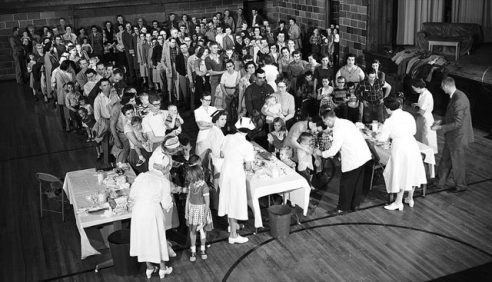
Consider polio in the 1950’s. Summer outbreaks led to tens of thousands of cases (most in children) leaving hundreds paralyzed or dead. By some accounts, second only to the atomic bomb it was what most Americans feared most.

Frantic parents were eager to enroll their children in the vaccine trial.

The first large-scale clinical trial of Salk’s vaccine began in 1954 and enrolled more than 1 million participants. It was the first vaccine trial to implement a double-blind, placebo-controlled design …

The scientist leading the vaccine trial, Dr. Thomas Francis, Jr. from the University of Michigan, announced the positive results at a press conference on April 12, 1955. Later that same day, the U.S. government declared Salk’s vaccine safe and effective for use …

The rate of polio among vaccinated children was reduced by nearly 90% compared to those children who had received the placebo. Parents rushed to get their children vaccinated because the benefits of the vaccine were glaringly obvious. It’s very easy to see the impact of an effective vaccine in a vaccine naive-population.

If the new COVID vaccines are similarly effective (and early results suggest that they are), their impact will be even more obvious. In contrast to polio, which at its height sickened tens of thousands of Americans each year, COVID has sickened millions and killed hundreds of thousands in less than a year. The incidence of COVID and COVID deaths will immediately begin to drop dramatically as soon as vaccination starts and it will be obvious that those who received the vaccine are protected and can return to a normal existence.

In other words, it will be clear to even the most obstinate antivaxxer that the COVID vaccines really work. Will there be unanticipated risks to the vaccine? That’s always a possibility, but in a vaccine-naive population like ours the benefits will outweigh all but the most serious risks.

That’s the one silver lining to the vaccine shortage that is going to persist for many months. There isn’t enough to give to everyone so only those who really want it will be able to get it. The benefits of the vaccines will become apparent and antivaxxers will want those benefits, too. It’s just a matter of time.

Breastfeeding ableism

6AFBF4A8-6FD0-4D81-AD55-D7C7C9745043

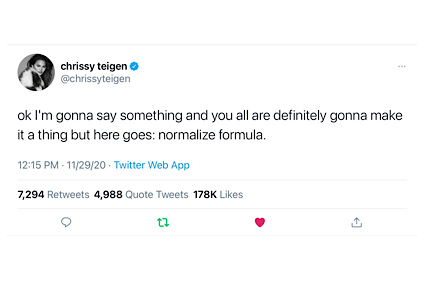
Recently Chrissy Teigen issued a full throated defense of infant formula.

ok I’m gonna say something and you all are definitely gonna make it a thing but here goes: normalize formula.

[N]ormalize breastfeeding is such a huge, wonderful thing. but I absolutely felt way more shame having to use formula because of lack of milk from depression and whatnot…

As for efforts to increase her supply:

[perfectpullquote align=”right” bordertop=”false” cite=”” link=”” color=”” class=”” size=””]Insufficient breastmilk is a disability; refusing to believe it is ableism.[/perfectpullquote]

[T]he stress of it, combined with the guilt that you cannot do nature’s most natural thing for your own baby is too much. I dunno why this is my crusade now. I just remember the sadness I felt and want you to know you are doing it right if your baby is fed, mama.

The lactivist response has been predictable and predictably ableist — including the belief that breastfeeding is perfect and the assumption that insufficient breastmilk could have and should have been “fixed.”

What do I mean by ableist? Let’s do a little thought experiment. I’m going to share with you a typical lactivist response and as you read it, try substituting a different disability like deafness or paraplegia or autism.

The following quotes come from Lucy Ruddle IBCLC.

Breastfeeding ableism assumes that disability is the result of lack of effort on someone’s part, either the person with the disability or those responsible for his or her care.

We know that around 80% of women wanted to breastfeed but weren’t able to meet their goals. And when we look at why it boils down to lack of proper help… and being offered formula instead.

Are people deaf because of a lack of proper help and being offered lip reading or hearing aids instead?

No, and insufficient breastmilk is not the result of a lack of proper help or the availability of formula.

Breastfeeding ableism like many other forms of ableism is remarkably condescending:

I need to say this very clearly, Chrissy. You did not fail to breastfeed. Lack of good, skilled, early and consistent help, alongside a societal belief that breastmilk is only valid if it’s exclusively fed is to blame. Not you. Not your body. Not breastfeeding.”

Is paraplegia the result of lack of skilled help? No, and neither is insufficient breastmilk.

Is it appropriate to infantilize people with paraplegia by declaring that your body is not to blame, nor is the ability to walk? Of course not.

Breastfeeding ableism like many forms of ableism reeks of pity:

My heart aches for you, and so many like you who are failed every single day. If you ever want to talk through your experiences in what we call a debrief, I would be very happy to hold a safe space for you, judgement free. Sometimes just unpicking all of those swirling angry and painful feelings can help us to find peace with how things turned out.

Is it possible to be more presumptuous than to imagine that a person who is not neurotypical appreciates your heartache or wants to debrief with someone who insists that they could have been “fixed”?

Lucy Ruddle is hardly alone in her ableist beliefs that insufficient breastmilk isn’t a real disability and is the result of lack of support. She’s not alone in her striking condescension nor her assumption that those who are disabled welcome her pity.

She’s parroting the currently popular lactivist philosophy known as “beyond choice.”

As explained by social scientist Suzana Ignjatović in her paper Breastfeeding Divisions in Ethics and Politics of Feminism:

The “beyond formula vs breastfeeding debate” position focuses on constraints to successful breastfeeding, addressing breastfeeding and women’s economic, social, and political status. It is assumed that women are constrained by structural factors and that these factors should be addressed instead. According to Hausman, the constraints include lack of paid maternity leave, lack of support, the sexualization of women’s body …

But “beyond choice” is NOT beyond choice. It presumes that the only correct choice is to breastfeed.

…[This] approach is usually implicitly pro-breastfeeding. Shifting focus to obstacles and support means that women would choose to breastfeed (“all woman will ‘naturally’ adore breastfeeding”), if they get proper support.

It’s just like forms of ableism that assume that people who are deaf or autistic want to be “fixed.” They don’t.

Insufficient breastmilk is a disability, like many other disabilities. It is not the result of lack of effort or lack of support. Those affected do not merit condescension and they certainly don’t benefit from pity. They want — and they deserve — to be accepted on their own terms not the terms of lactation professionals who flatter themselves by imagining they know better.