Natural childbirth is an industry

image

Why do even sophisticated people fail to recognize that natural childbirth is an industry?

It’s probably because they equate “industry” with large amounts of money. True, individual natural childbirth professionals don’t make a lot of money, but for most, it represents 100% of their income. That’s why they have a tremendous financial incentive to convince you to buy their products and services.

[pullquote align=”right” cite=”” color=””]Midwives fought to wrest control of patients back by deriding what obstetricians offered and offering the exact opposite.[/pullquote]

The advent of modern obstetrics, and the dramatic drop in maternal and perinatal mortality that it brought, set the stage for the development of the natural childbirth industry. This created both a problem and an opportunity for midwives. The problem was that obstetricians could promise safer outcomes.

Midwifery succumbed to the success of obstetricians who were only too happy to supplant midwives. While midwives themselves make much of this economic competition, blaming deliberate action by obstetricians in an attempt to stifle competition, the fact is that women came to prefer hospital birth because of its safety and increased comfort. Previously doctors were called to childbirth in only the most dire circumstances. With the switch to routine hospitalization for birth and the routine presence of obstetricians, and, in particular the easy access to pain relief, midwifery went into decline.

The increased safety of childbirth also created an opportunity for midwives: the chance to emphasize the quality of the birth experience. Modern obstetrics made childbirth seem safe. Since safety was now a given, midwives fought to wrest control of patients back by deriding what obstetricians offered and offering the exact opposite.

  • If obstetricians medicalized childbirth to make it safer, then midwives would de-medicalize it to make it more enjoyable, and, for added impact, would declare that childbirth was safe before obstetricians got involved.
  • If obstetricians offered screening tests and measures to prevent complications then midwives would insist that “trusting birth” was all that was needed.
  • If obstetricians offered pain relief, midwives would proclaim that feeling the pain improved the experience, tested one’s mettle and made childbirth safer.
  • If obstetricians whisked babies off to pediatricians to make sure that they were healthy, midwives would claim that skin to skin contact between mother and infant in the first moments after birth was crucial to creating a lifelong bond.
  • If obstetricians insisted that modern obstetrics was based on science, midwives would accuse them of ignoring science, and if that didn’t stick, they’d insist that scientific evidence was not the only form of knowledge.
  • If obstetricians placed the highest value on a healthy mother and a healthy baby, midwives would place the highest value on a fulfilling birth experience.

In other words, no matter what obstetricians offered, midwives would insist that it was unnecessary, disempowering, harmful and contradicted by the scientific evidence. Midwives would wrest childbirth back from paternalistic doctors and give it to those to whom they believed it rightly belonged  …  the midwives themselves. And the entire project would be promoted as being in the best interests of women and babies.

The natural childbirth industry in general, and midwifery in particular, became unreflective (and completely reflexive) defiance of modern obstetrics.

That’s doesn’t mean that those who promote natural childbirth don’t believe in it. Its advocates believe fiercely in what they promote, and sell — normal birth as the holy grail of childbirth, midwives as the guardians of normal birth and distrust of obstetricians (whom they correctly identify as their chief competition) as the people who medicalized birth … and thereby made it safe.

Maura and her no good, very bad, nearly deadly Bali homebirth

Denial

Who could have seen that coming?

Remember Maura? She’s the woman whose in utero single footling breech daughter “told her” to go to Bali for her homebirth? Despite being counselled by everyone and their midwives that homebirth was not a safe option in her situation, Maura “knew” that it was the right choice. Of course it was the wrong choice and Maura nearly killed her daughter in the attempt. Ultimately she had an emergency C-section and Lila survived.

Cognitive dissonance is hard. That’s what happens when reality does not comport with your most cherished beliefs. You have two choices in that situation: you could change your beliefs or you could changed reality. Maura is currently attempting to change reality in a truly remarkable blog post, 42 Days and 42 Nights: The Joy and Grief of a Cesarean Birth. I urge you to read it in full. Nothing I write could truly capture the pretzel like contortions of logic that allow Maura to conclude that despite being wrong about every single thing she predicted for this birth, she was actually right.

But the internet never forgets even if Maura does.

Back in August, Maura wrote this:

[pullquote align=”right” color=”#67a7f1″]Her in utero single footling breech daughter “told her” to go to Bali for her homebirth.[/pullquote]

… Lila, our divine little one, things have taken a “turn”. As many of you know, we have long planned a water birth at home (actually outside) and we came to Asia to birth her because she literally asked us to. We sold our homes and cars and furniture and embarked on this journey for her sake. Doing so required an impossible amount of trust and openheartedness. Offering her a chance at natural birth at home here in Bali is something we feel incredibly strongly about … Lila, however, has decided she prefers to meditate sitting up, rather than relaxing on her head like most babies. This means she is breech. Now, I am all about having a breech home birth and have no qualms whatsoever about having her come through me butt first. I even created a new dance called the breech booty boogie to celebrate her choice on how she wants to enter the world 🙂

But others did have qualms including the Balinese midwives and doctors; every single one recommended an elective C-section at 38 weeks. No matter. Maura paid for a New Zealand midwife to spend a month in Bali and attend her in labor. Labor didn’t start until 43 weeks.

What happened?

It was just as Maura had envisioned … at first.

We had a beautiful 16 hour long outdoor labor under the palm trees and it was truly an ecstatic journey. Andrew was an epic labor partner! Our journey began at 4 am walking through the rice fields together under Lila’s birth stars and watching the sun rise over the ricefields as the first rushes came on. I labored in a warm pool sprinkled with rose petals under a sacred palm tree and sparkling blue skies and under a thatched roof looking out over the rice fields. I dilated to four centimeters quite quickly and baby was doing awesome throughout our wild day of laboring in the water and sun.

But then:

Sometime late in the day, Lila inserted one of her feet into my pelvis and my dilation reversed back to 1 cm. At that point after her waters had been broken for 18 hours, and she had switched from frank breech to footling breech, our midwife recommended that we go to the hospital for an emergency cesarean…

You might think that Maura would conclude that her vaunted intuition had failed her. You would be wrong. Maura believes her intuition saved Lila’s life:

She was still doing fine when we arrived at the hospital and no one was in a hurry to do anything. They took the monitor off. An hour after we arrived I had a bad feeling and asked the nurses to check her heart rate. It had plummeted! She was in severe distress and no one would have caught it if I had not asked them to check her… As they brought me into the operating room I was really worried that we were going to lose her. And Andrew didn’t even know where I was or what was happening. I was alone in a frantic operating room of people speaking foreign languages. Within 7 minutes of noticing the distress, I was cut open and Lila was born… There were no sounds, no cries for five minutes after I felt them pull her out. I did not know for the first five minutes after her birth whether she had survived. It was the longest five minutes of my life…

They determined that the cause of all of the abnormalities was a very short cord that didn’t allow her to turn and suspended her high in the uterus and eventually stretched to where it distressed her oxygen supply… Lila could never have been born by way of the birth canal and any further efforts to turn her or birth her would have killed her.

So did Maura make a mistake when she chose to believe that Lila could be born vaginally? Surely you jest!

If I had known Lila had a short cord and could not be born vaginally, I still would have chosen to wait until I went into labor and endure a trial of labor before having a c-section. There are so many benefits to going through some labor before a cesarean. For one, it indicates that the baby is ready to be born. Even at a bona fide 43 weeks, our baby was still quite small and she needed the extra time in the womb. Babies absolutely know when it is the right time to come out. Secondly, a trial of labor allows the baby to experience uterine contractions, which help their lungs and circulation prepare for entry into the world. If we had followed medical advice, Lila would have born five weeks earlier, would have weighed about 4 pounds. Not only would her lungs have been underdeveloped, but they would not have been primed by our labor together and she would have been very likely to have breathing problems.

Ummm, Maura, didn’t you tell us that “Lila is a very small baby estimated at only 4.8 pounds at 36 weeks.” Babies gain about a 1/2 pound per week at this point in pregnancy, so she would have been about 5 1/2 pounds, but what’s a little exaggeration when you are trying to make yourself the hero of your daughter’s birth story.

The truth is that Maura was wrong about nearly everything and Lila almost died as a result, but that’s not how Maura is spinning it:

When I first showed resistance to having a 38-week scheduled c-section just because our baby was breech, I got the line “how you birth doesn’t really matter, having a healthy baby in the end is all that really matters”. Something about that statement made me feel ill. After my experience, I say that yes, the most important thing is having a healthy baby at the end… But that doesn’t mean that that statement is true or that it isn’t dangerous. Statements like this are used to push cesarean on mothers with very insidious bits of guilt, shame, and an illusion of control. They imply that having a cesarean guarantees something. But scheduling a cesarean birth guarantees nothing. It does not guarantee that your baby will live.

Actually, Maura, it does guarantee that your baby will live; that’s the reason it’s done.

Despite having been wrong about nearly everything, Maura has learned nothing:

The other thing that I wish for you is a deep trust in your own intuition. Your perfect body and deep subconscious created your baby, and you and the baby can be trusted to finish the journey. It was my intuition that told me to insist on an internal exam when I did. It was my intuition that told me to go to the hospital when my midwife gave me the choice of hospital or trying to sleep for a few hours at home. And finally, it was my intuition that demanded that I insist for the baby’s heart rate to be checked when she went into distress. Each of these conspired to save Lila’s life. Our bodies know, and we can trust ourselves.

Maura’s intuition told her to go to Bali, told her that she should have a vaginal birth, told her not to alter her plans despite the baby’s breech position and told her to let Lila nearly die. Not to put too fine a point on it, but her intuition sucked! But not in Maura’s mind.

Maura isn’t the least bit chastened by her experience. She’s rewritten reality so that she can preen about being right all along.

If I would have listened to hospital staff over my own internal voice, my baby would be dead. It was not the hospital that made the choice that got her out alive. It was me. It was my body’s knowing. It was the same principle that could be trusted to keep a floating microscopic ball of cells safe for two weeks in my womb. It was the same principle that could be trusted to make 33 perfect vertebrae. My final words to you are that you can afford to trust yourself. You, yourself, are a miracle and a miracle maker and you can be trusted.

Trust birth like Maura? I hope not.

Forceps and incontinence

image

Jill Raleigh Fischer, a nurse, wrote about her experience with forceps and incontinence on The Skeptical OB Facebook page in response to my piece Incontinence: the traumatic result of vaginal birth that dare not speak its name. Jill gave me permission to share it on the blog. She was motivated to share her experience after reading a DONA international article “ACOG to OBs: Consider Operative Vaginal Delivery to Reduce Cesareans,” and notes that operative vaginal delivery has the highest risk of pelvic floor damage and subsequent incontinence.

I am a sample of one and my forceps baby is almost 41 years old… born in the heyday of forceps deliveries. Do I want any and all measures to be used to save the life of a mother and her baby ~ absolutely. Do I think “operative vaginal delivery” should be used to reduce cesareans ~ hell no!

That said, my son’s mid-forceps delivery was performed by a perfectly competent obstetrician in a perfectly fine hospital. No one has been sued.

[pullquote align=”right” cite=”” link=”” color=”” class=”” size=””]Try asking some women how forceps delivery worked out for them.[/pullquote]

I went into labor at 40 weeks gestation with a SROM (spontaneous rupture of membranes) and progressed normally for a first labor. That is until the second stage of labor (pushing). After three hours of trying very hard to push an occiput posterior baby out, a forceps delivery was recommended. A spinal anesthetic was administered and forceps applied.

My entire body moved down the table with the pulling and tugging applied to my son’s tiny head and body. With gratitude from all that is within me, he arrived healthy and whole and suffered no more than a bruise to his beautiful face. He had no lingering problems from his traumatic entry into the world.

However, forceps delivery is an incredibly invasive procedure and can and does result in trauma to babies and to their mothers’ bodies. This consequence appears to be grossly under reported or even recognized. The above New Yorker article cites the historical lack of use of evidence based practices in obstetrics. Perhaps that has changed, but no one has asked how I have fared since my forceps encounter.

My first experience was intense perineal pain. Sitting for a month plus was very difficult. On the plus side, I was able to have 3 more children with natural, vaginal deliveries. Would I have traded being able to have fewer children had I undergone a cesarean section the first time and having 4 with the pelvic difficulties I have had? That is a loaded question I can’t answer since I adore all of my children.

I had complete urinary incontinence immediately following my son’s forceps delivery. I was horribly embarrassed. This improved but persisted as a problem. By the time my youngest child was 4 (and the first one was 10) I was experiencing pelvic prolapse. I underwent a hysterectomy and bladder suspension. 4 years after that I underwent an A & P repair. The damaged tissues between the vagina and the urinary tract and between the vagina and the end of the digestive system needed to be repaired to improve function of both systems and decrease urinary incontinence.

With the passage of time, aging and gravity, inherited quality of tissue, and the emerging thought that these procedures are not what should be done, I found myself needing a pelvic reconstruction at age 55. Seems old ~ so what? It’s not old when it is you this is happening to. Again, I was fortunate to work with an exceptional surgeon and had insurance to assist me in obtaining good care. But, there is no putting it back the way it was no matter what kind of deliveries you had. With my history, I had even less chance than that.

Still, the evidence seems to suggest that the kind of damage I have suffered is less common following cesarean section deliveries. Did anyone ask how it went for me? Did they ask anyone? Any real studies done that support using operative vaginal deliveries in lieu of cesarean section deliveries?

I am not writing about a few tugs on a vacuum, though this should be done with the utmost thought, skill, and care. I am writing about a violent procedure and to say that there is no reason any woman should again endure a forceps delivery merely done to avoid a c-section. It may look cost effective and that it reduces pain and suffering. I am telling you that from my experience, it costs plenty of money, plenty of suffering and it costs women world wide their dignity.

So, try asking some women how forceps delivery worked out for them. And, women… fight to retain control of your bodies, your healthcare and your birth process!

La Leche League’s response to claims of overselling breastfeeding is both pathetic and bullying

Bullying

Way to go La Leche League! Thanks for proving Courtney Jung’s points for her.

In advance of the publication of her new book Lactivism, Jung wrote an op-ed in the NYTimes, Overselling Breast-Feeding.

The benefits associated with breast-feeding just don’t seem to warrant the scrutiny and interventions surrounding American infant feeding practices.

What are those benefits? In countries with clean water supplies, the benefits of breastfeeding for term infants amount to nothing more than a few less colds and episodes of diarrheal illnesses across the population in the first year of life.

[pullquote align=”right” color=”#cf4b93″]Total fail when it comes to refuting Jung, but, fear not. It is a masterpiece of bullying.[/pullquote]

Not surprisingly, La Leche League, the organization that has led the charge in overselling the benefits of breastfeeding and encouraging the moralization of infant feeding was angered by the piece and issued a press release in response.

They insist that the benefits of breastfeeding aren’t oversold.

Before we look at what they said, let’s think about what they’d need to show.

The claims on their website are remarkably expansive:

Breastfeeding has been shown to be protective against many illnesses, including painful ear infections, upper and lower respiratory ailments, allergies, intestinal disorders, colds, viruses, staph, strep and e coli infections, diabetes, juvenile rheumatoid arthritis, many childhood cancers, meningitis, pneumonia, urinary tract infections, salmonella, Sudden Infant Death Syndrome(SIDS) as well as lifetime protection from Crohn’s Disease, ulcerative colitis, some lymphomas, insulin dependent diabetes …

So the first thing LLL ought to show is the dramatic increase in breastfeeding initiation in the past 30 years has led to a commensurate decrease in all the illnesses that breastfeeding is supposed to prevent.

But LLL can’t show that, because with the exception of colds and mild diarrheal illness, breastfeeding has had no measurable effect on any of these ailments.

Furthermore, the increase in breastfeeding rates has had no impact on infant mortality, no impact on life expectancy and no impact on population IQ. And, contrary to the claims of lactivists that breastfeeding could save billions of dollars in healthcare costs, breastfeeding has had no discernible impact on healthcare costs.

What evidence did LLL offer for the benefits of breastfeeding? Their response can be summed up simply: because we said so.

[B]reastfeeding has been shown to have definite health risks and consequences…

This deepening understanding of the importance and value of human milk for human babies from an immunological, physiological, and psychological standpoint is a result of an ever-increasing, vast, and incontrovertible body of research.

What are those definite health risks? LLL doesn’t dare say.

What is this incontrovertible evidence? LLL doesn’t say.

Where is the proof that breastfeeding has any impact on infant mortality, life expectancy and healthcare savings? LLL doesn’t offer it because it doesn’t exist.

So the press release is a total fail when it comes to refuting Jung, but, fear not. It is a masterpiece of bullying and shaming:

Likening breastfeeding to tobacco smoking:

When our organization began nearly sixty years ago, most babies were not breastfed and a significant portion of the population smoked. Just as research has shown that smoking has a serious negative effect on health … not breastfeeding has been shown to have definite health risks and consequences …

Classy, huh?

Slamming women who bottle feed as abnormal:

…[B]reastfeeding is now clearly understood to be the normal way to feed a human baby.

Implying that women who don’t breastfeed are ignorant:

There isn’t any pressure in our society that could force intelligent women to do something that doesn’t make sense.

But no one is claiming that breastfeeding doesn’t make sense or that women are being forced to breastfeed. What Jung has claimed is that women have been tricked into breastfeeding by organizations like LLL that have dramatically oversold the benefits.

LLL ends with a flourish of nonsense:

We’re also hormonally driven and biologically hard-wired to breastfeed and be breastfed.

We’re also hormonally driven and biologically hard-wired to begin reproducing at age 16 or so, but we don’t, do we? We’re hormonally driven and biologically hard-wired to have no control over the number of children we have, but we ignore that, don’t we? We are not animals; we are people and our lives are much safer, healthier and more comfortable because we can and do exercise control over them.

And just in case they hadn’t shamed formula feeders enough:

We’re mammals. Lactation and breastfeeding is the normal behavior and food for human mothers and babies.

Eating raw meat on the hoof is also normal behavior and food for mammals. Should we do that, too?

The bottom line is that the La Leche League response to the claims that the benefits of breastfeeding have been oversold is pathetic, reflecting the complete dearth of evidence that breastfeeding term babies in first world countries has any major impact on health.

In the absence of evidence, LLL falls back on their favorite tactic: bullying mothers who don’t follow their prescription for motherhood.

That’s just nasty.

The sexist origins of attachment parenting

image

There has been considerable debate about whether attachment parenting is anti-feminist, placing as it does a tremendous burden on mothers to have an unmedicated childbirth, breastfeed exclusively for a year or years, carry a baby constantly, and let the baby sleep in the marital bed. So where did attachment parenting come from?

Bill and Martha Sears are widely credited as the originators of attachment parenting. They are generally reticent about its sexist, religious origins. They and others have promoted the idea that attachment parenting is the way children were raised in prehistoric times and that attachment parenting is supported by science. Neither claim is true.

The Sears deeply believe that attachment parenting is God’s plan for child rearing. As Martha Sears explains in her 1997 book, The Complete Book of Christian Parenting and Childcare:

[perfectpullquote align=”right” color=”#E10025″]”We have a deep personal conviction that this is the way God wants His children parented.”[/perfectpullquote]

The type of parenting we believe is God’s design for the father-mother-child relationship is a style we call “attachment parenting.” Our intent in recommending this style of parenting to you is so strong that we have spent more hours in prayerful thought on this topic than on any other topic in this book… We have a deep personal conviction that this is the way God wants His children parented.

What else does God purportedly expect from parents?

From husbands:

God has given the husband the prime responsibility for making the marriage relationship work, which is as it should be since he has been made the head…

From wives:

“Now as the church submits to Christ, so also wives should submit to their husbands in everything… and the wife must respect her husband.” The Greek word translated “submit” is derived from the same word meaning “to yield” in the sense of yielding to another’s authority…

What is attachment according to the Sears’?

Mother-infant attachment is a special bond of closeness between mother and baby. Mother’s care enables the young of each species to thrive and, for human babies, to reach their fullest potential. Babies come equipped with behaviors that help mothers deliver the right kind of care. God has placed within mothers both the chemistry and the sensitivity to respond to their babies appropriately. This maternal equipping is what is meant by the phrase “mother’s intuition.” It helps her get attached to her baby.

Elsewhere the Sears’ refer to the “science” behind attachment parenting, but the reality is that attachment parenting reflects the Sears’ fundamentalist Christian beliefs that traditional gender roles are part of God’s plan.

The similarity with the origins of both natural childbirth and lactivism is striking. In all cases, these represents the beliefs of traditionalists on the appropriate role of women in a modern society. Grantly Dick-Read believed that a woman’s natural role is as a mother; the women who started La Leche League believed that promoting breastfeeding was a way to keep mothers of small children out of the workforce and tied to the home; the Sears’ believe in hierarchical marriage and traditional gender roles as mandated by God.

Attachment parenting serves an important role in this cosmology. By tying women to the home and (literally through baby-wearing) to their children, attachment parenting emphasizes the subservient role of women, bars them from financial independence, and restricts them to their reproductive functions.

Attachment parenting has no basis in science and never did. It reflects a fundamentalist world view on the appropriate role of women, and as such, is deeply anti-feminist and retrograde. It’s religion smuggled into the mainstream in the guise of “science” and it has been remarkably sucessful at hiding its sexist, religious roots.

Without modern obstetrics, both Jessa and Jill Dugger would probably be dead

image

Trust birth?

You must be joking!

Jessa Duggar Seewald and Jill Duggar Dillard are two, young healthy women who planned homebirths. They were about as low risk as low risk can be, yet, in an object lesson for homebirth advocates, both had to be rescued by obstetricians.

Jill, in direct contrast to the prattling of homebirth advocates that “your body won’t grow a baby too big to birth” grew a baby too big to birth.

[pullquote align=”right” color=”#86273F”]They trusted birth and birth nearly killed them.[/pullquote]

Jessa apparently had an uncomplicated spontaneous vaginal delivery … and then began to bleed heavily, so heavily that she had to be transferred to the hospital.

What would have happened to the Duggar sisters had they lived 200 years ago instead of today?

Jill would have been one of the hundreds, perhaps thousands, of American women who died of obstructed labor each and every year.

What is obstructed labor? It’s the technical term for a baby too big or too poorly positioned to fit through the pelvis. Prior to the advent of safe cesareans Jill would have labored in agony for days, struggling to push the baby through her pelvis with no chance of success. The baby’s head would have molded and elongated, the plates of the his skull sliding over each other in a desperate effort to decrease the diameter of the his head so it could be forced through.

A uterine infection might have developed to which baby and mother would have succumbed. Alternatively, Jill’s uterus might have ruptured and they could have bled to death. If the situation became desperate, her providers might have attempted to save her life by passing instruments through the cervix and dismembering the baby.

Jessa, in contrast, might have bled to death after the successful birth of a healthy boy. Why did she bleed so much? There are a number of possible reasons:

  • Uterine atony: the uterus was simply exhausted after pushing a very large baby and simply refused to contract. Since the only way uterine bleeding can be stopped is by the uterine muscles contracting around the blood vessels and closing them off, massive bleeding will occur if the uterus fails to contract.
  • A retained remnant of placenta: The uterus can only contract completely if it is completely empty. Even a small piece that has torn away from the placenta can keep the uterus from contracting and heavy bleeding may be the result.
  • A cervical laceration: These tears in the cervix can bleed profusely and can only be stopped by clamping and stitching them. Cervical lacerations are not common but they are more likely if the mother begins to push before she is fully dilated.
  • Major vaginal lacerations: These tears can extend through the back of the vagina right through to the rectum. Although they need to be carefully repaired by an obstetrician they usually don’t bleed a great deal.
  • Jessa could have developed pre-eclampsia with HELLP syndrome. HELLP stands for hemolysis, elevated liver enzymes and low platelets. It is a life threatening condition that, in the absence of treatment, can easily result in death.

What would have happened if Jessa had give birth at the hospital? That’s hard to say since we don’t know exactly what had happened. Uterine atony could be treated with a variety of medications. A piece of retained placenta could have been removed immediately. A cervical laceration or vaginal lacerations could have been repaired immediately. All of these things would have reduced or prevented heavy blood loss.

Instead, Jessa lost so much blood that she had to be admitted to the hospital, probably for blood transfusions at the least. The fact that she remains in the hospital suggests that there was a bigger problem than blood loss or lacerations alone.

Ironically, Jessa gave birth at home almost certainly so she could spend the first hour skin to skin and breastfeeding her newborn. Instead, she probably wasn’t even in the same zip code.

It’s hard not to feel sorry for Jessa. She was probably contractually bound to news outlets to provide pictures of the baby, but she wasn’t there to be in them. She was probably contractually bound to provide a family photo as soon as possible so her husband brought the baby to the hospital and it appears that they hung a sheet behind her hospital bed; she was probably sitting in the bed (too weak to stand?) and husband was standing beside her.

She’s given birth, she’s suffered a serious complication and she’s required to be on display in order to earn money. So much for the intimacy of homebirth.

So both Jill and Jessa trusted birth and birth nearly killed them. Obstetricians, in contrast, saved them. They’ve given us an object lesson in why homebirth can be dangerous and even deadly.

Thinking about homebirth? Think about Jessa and Jill and think again.

The riddle at the heart of attachment parenting

image

If there’s one thing that natural childbirth advocates are sure of, it’s that unhindered birth is best. Women and babies are “designed” for birth, and if they only trust birth, it will turn out fine. That’s why some natural childbirth advocates choose homebirth and a smaller group choose unassisted homebirth. They want to give birth “their way” and whatever way feels safest to them is safe. In other words, babies and mothers know how to handle birth; complications happen when we try to interfere with the process.

[pullquote align=”right” cite=”” link=”” color=””]Aren’t women and babies designed to bond spontaneously after birth?[/pullquote]

So why aren’t women and babies designed to bond spontaneously after birth?

Nearly all attachment parenting advocates are natural childbirth advocates, too. That makes the riddle at the heart of attachment parenting even more surprising. The same people who insist that birth happens naturally then turn around and claim that bonding does NOT happen naturally. It must be prodded and controlled in a series of ritualized behaviors (skin to skin at birth, breastfeeding only, baby wearing) otherwise children will presumably end up “detached.”

Why can childbirth be trusted to happen spontaneously, but bonding be considered an imminent disaster aveted only if you do exactly what the attachment parenting experts tell you to do?

Ironically, given that attachment parenting is promoted as “natural,” the idea that maternal-infant attachment occurs naturally, that mother and child might love each other simply because they belong to each other, is rejected out of hand, Instead, specific practices must be employed and mothers must be taught these practices by an army of experts including parenting gurus, midwives, doulas and lactation consultants, among others.

As Charlotte Faircloth notes in the essay The Problem of ‘Attachment’: the ‘Detached’ Parent in the book Parenting Culture Studies:

It hardly seems controversial to say that, today, we have a cultural concern with how ‘attached’ parents are to their children. Midwives encourage mothers to try ‘skin-to-skin’ contact with their babies to improve ‘bonding’ after childbirth, a wealth of experts advocate ‘natural’ parenting styles which encourage ‘attachment’ with infants…

Previously a mother’s love for her child had been romanticized and ascribed to inherent characteristics of women, mother love has now been medicalized, requiring participation in rituals prescribed by experts.

As I’ve noted before, attachment parenting is not based on attachment theory, which tells us that the “good enough” mother is all that any child needs. So where did it come from? It certainly did not come from an epidemic of “detached” children. Until recently it was accepted as obvious that children remained unattached only in the most severe cases of abuse and neglect.

It came not from the study of humans, but of non-primate animals. Animals like ducklings had been shown to “imprint” on whatever caretaker they saw first during an “attachment window.” Attachment parenting theorists simply extrapolated, theorizing that infants “bonded” to their mothers during an attachment window around birth.

Faircloth explains:

Initially, the focus was on the critical period immediately after birth, though this later expanded to the period around birth as a whole. The argument was that a child’s first hours, weeks, and months of life had a lasting impact on the entire course of the child’s development. Birth, in particular, was singled out as one of the ‘critical moments’ for bonding to take place. After birth, new mothers were told to look into the eyes of their infant, hold their naked child, preferably with skin-to-skin contact, and breastfeed for optimal bonding…

From the outset, successful bonding thus required both a set of behaviours that maintained proximity with one’s child and an emotional bond …

This belief is the result of the medicalizing and the pathologizing of bonding.

…[C]oncern with detachment as part of a broader trend in the twentieth century towards the medicalization of parenthood: in particular, the medicalization of maternal emotion and mother love itself. Where, for example, mothers’ love was promoted and idealized in the late eighteenth and nineteenth centuries as an extension of women’s inherent virtue, during the late nineteenth and early twentieth centuries, maternal emotion came under much greater scrutiny … Mothers’ own ‘instincts’ were increasingly considered inferior to the findings of experts, who based their guidance to mothers on a more rational account as to what promoted the emotional well-being of children.

It’s rather surprising considering that natural childbirth advocates rail again the medicalizing and pathologizing of birth.

But then natural parenting is, in large part, about looking at the medical evidence and then rejecting it. This defiance of authority is lauded as transgressive and empowering. So if obstetricians point out that childbirth is inherently dangerous, natural childbirth advocates insist that it is safe. If psychologists point out that maternal child bonding happens spontaneously as long as the mother is not abusive or neglectful, attachment parenting advocates insist that it is contingent. It will not occur unless women follow a formalized set of behaviors prescribed by attachment parenting advocates.

The truth is that bonding is not contingent and does happen spontaneously (as any father or adoptive parent could tell you). It does not depend on a formalized set of behaviors; indeed, it has NOTHING to do with those behaviors at all (as anyone who has adopted a child beyond infancy can tell you).

There’s nothing wrong or harmful about the behaviors prescribed by attachment parenting gurus if (and it’s a big “if’) that’s what works best for you, your child and your family. But they are not in any way required for bonding. As a general matter, bonding happens spontaneously when you put a mother and her child together. It does not depend on specific rituals; it arises from mutual love and need.

Vitually all children will bond to their mothers in the absence of abuse or neglect. Unfortunately, attachment parenting gurus have medicalized and pathologized bonding. They promote a fear based view of bonding, hinting at dire consequences if you don’t follow their advice. And that leads to a lot of unnecessary guilt on the part of mothers who did not or could not follow attachment parenting prescriptions.

Considering the close association between attachment parenting and natural childbirth, it’s ironic, isn’t it?

Assume the position: the importance of enemas in alternative health

iStock_000010744011_Small

Both purveyors and consumers of alternative health believe in a lot of wacky things.

Homeopaths believe that repeatedly diluting a substance in water makes it stronger because water retains “memory” of the substance. Chiropractors believe disease results from disruption of the flow of a life force from the brain through the spinal nerves caused by misalignments of the vertebrae. These beliefs are both scientifically false, and absurd on their face. But they aren’t the wackiest thing I’ve ever heard. That distinction goes to this gem written by Heather Dexter, the mother who let her children suffer 6 months of horror from pertussis, coughing and gasping for breath, in order to stroke her own ego as a naturopath.

[pullquote align=”right” color=”#c6490e”]”Turns out the best way to clear out the lungs is through the rectum … enemas.”[/pullquote]

Heather informed us:

Turns out the best way to clear out the lungs is through the rectum … enemas.

That got me thinking about the centrality of enemas in alternative health. It turns out that I’m not the only one who has pondered this. Dr. Edzard Ernst, who has spent his career debunking pseudoscience, has written on this topic in Colonic Irrigation and the Theory of Autointoxication: A Triumph of Ignorance over Science

Colonic irrigation is an enema on steroids. Whereas an enema involves a one time administration of fluid by rectum to clean the last third of the colon, colonic irrigation involves literally irrigating (or attempting to irrigate) the entire colon. In both cases, the theory is based on the belief in auto-intoxication:

The theory of autointoxication claims that by-products of incomplete digestion may poison the body and, therefore, cause disease. It can be traced back to most ancient cultures of medicine. In the Western world, humoral medicine was based on the idea that all diseases were caused by the imbalance of the four body humors. Conversely, health constituted a balanced mix of these humors. Waste products formed in the intestinal tract were thought to be a major potential contributor to such imbalance. Both Hippocrates and later Galen viewed “autointoxication” as a major etiologic factor of disease.

The cure for disease followed directly from this belief: physically removing the waste products from the colon would treat any and all diseases.

The theory found particular favor in the 19th Century:

Charles A. Tyrell was particularly aggressive in promoting … his therapeutic device, the “Cascade”. This was a rubberized water bottle that held 5 quarts of liquid. The patient would insert its nozzle into his or her rectum and sit on the instrument. The patient’s body weight would then create the pressure to drive the fluid into the patient’s colon. Tyrell led huge advertising campaigns promoting his “Cascade” as a cure for anything from cholera to rheumatism. Like most quacks, he emphasized that his treatment was natural and hence harmless… Like most quacks, he promoted his treatment as a veritable panacea without ever providing convincing evidence.

Sound familiar?

It should because the contemporary revival of the enema owes much to the same beliefs and marketing practices:

Today colon therapy is almost as popular as it was in its heyday. It forms an integral part of the therapeutic armamentarium of most (nonmedically qualified) alternative practitioners around the world who have, during the past three decades, experienced an unprecedented resurgence in this popularity…

Many of the outlandish claims of yesterday are echoed today … [T]he therapy cleans the colon in its full length, detoxifies it, reconstitutes intestinal flora, and even rids the body of parasites and prevents bacteria from entering the blood stream. Today’s list of indications for colon therapy is impressive: alcoholism, allergies, arthritis, asthma, backache, bad breath, bloating, coated tongue, colitis, constipation, damage caused by nicotine or other environmental factors, fatigue, gas, headache, hypercholesterolemia, hypertension, indigestion, insomnia, joint problems, liver insufficiency, loss of concentration, mental disorders, parasite infestation, proneness to infections, rheumatoid arthritis, sinus congestion, skin problems, and ulcerative colitis.

And apparently pertussis, too.

It’s rather remarkable considering the fact that in the intervening years we discovered the germ theory of disease, antibiotics and surgical treatment for or excision of diseased organs. But alternative health is still living in the age of evil humors and treatments that require no special knowledge to recommend or perform.

Ernst concludes:

False claims, a lack of evidence, big money, aggressive advertising, disregard of risk – little seems to have changed.

The importance of enemas in  contemporary alternative health shows that he’s absolutely right.

Heather Dexter, whooping cough, and the clinical course of quackery

Quack Doctor

On Monday I wrote about Heather Dexter, the naturopathic quack who proudly (proudly??!!) boasted about the severe medical neglect that nearly killed her children.

Heather refused to vaccinate her three small children against pertussis (whooping cough), in her quest to provide them with “natural” immunity.[pullquote align=”right” color=”#555555″]Children who survive pertussis DON’T develop permanent immunity.[/pullquote]

Her children suffered bitterly for months:

At this point, Madilyn’s cough was beginning to scare me. She would wake in the middle of the night, multiple times a night, coughing so hard that she would puke over the side of her loft bed, followed by turning purple and then finally gasping for air.

What was Heather doing during this time? She was consulting with other naturopathic quacks on how to “treat” her children. Their stupidity defies belief.

Turns out the best way to clear out the lungs is through the rectum … enemas.

After it was over Heather celebrated … herself:

It took a good 120-150 days from the start of the coughing for each of them to eliminate the bronchial damage and lung weakness caused by the bacterial infection, Pertussis. We spent hundreds of dollars on natural health products and consultations with various Naturopathic Professionals. It was a living HELL. Every day. It had an intense effect on my marriage and relationship with my husband. It caused me to question everything I knew about Natural Health.

Apparently, she didn’t learn a damn thing:

We made it through using only natural remedies. Seeking no medical attention. We did it. My children developed REAL and TRUE immunity from being exposed to this bacteria and fighting it off naturally. It has been my biggest challenge to date as a mother. This mother conquered. (my emphasis)

There is a bitter irony to this story. Actually two bitter ironies. Heather thinks she “treated” her children with her quackery, but the fact is that their clinical course was dramatically prolonged compared to the typical clinical course for pertussis. Second, and perhaps more important, Heather accomplished absolutely nothing! Children who survive pertussis do NOT develop permanent immunity, and each of her three children are no more protected from pertussis now than they would have been had they gotten the vaccine and avoided the 6 months of torture altogether.

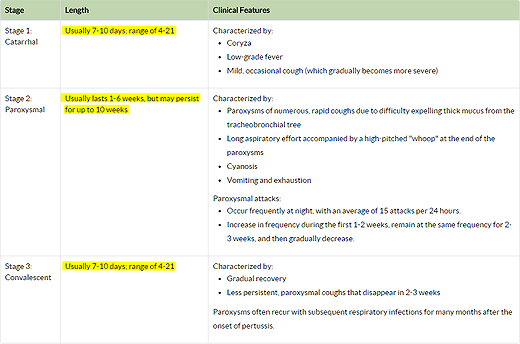
What is the typical clinical course of whooping cough?

The CDC explains:

The clinical course of the illness is divided into three stages:

Catarrhal
Paroxysmal
Convalescent

Pertussis has an insidious onset with catarrhal symptoms that are indistinguishable from those of minor respiratory tract infections. The cough, which is initially intermittent, becomes paroxysmal. In typical cases paroxysms terminate with inspiratory whoop and can be followed by posttussive vomiting.

Paroxysms of cough, which may occur more at night, usually increase in frequency and severity as the illness progresses and typically persist for 2 to 6 weeks or more… After paroxysms subside, a nonparoxysmal cough can continue for 2 to 6 weeks or longer.

Unvaccinated or incompletely vaccinated infants younger than 12 months of age have the highest risk for severe and life-threatening complications and death. In infants, the cough may be minimal or absent, and apnea may be the only symptom.

Apnea means the baby stops breathing for a period of time.

They also offer the following chart; I’ve highlighted the length of each stage.

Pertussis chart

The typical clinical course lasts 12 weeks (84 days). According to Heather, each of her children was sick almost twice as long. So much for natural “treatments.” Turns out that enemas are NOT best way to clear out the lungs.

And how about the children’s “real and true immunity”? That doesn’t exist.

According to the CDC’s frequently asked question about pertussis:

Getting sick with pertussis … doesn’t provide lifelong protection, which means you can still get pertussis and pass it onto others …

The bottom line is that Heather’s children endured 6 bitter months of medical neglect and the only thing that was “treated” was Heather’s ego. In her arrogant ignorance, she let her children suffer the horror of coughing until they vomited and being unable to catch their breath over and over and over and over again for no benefit at all.

During the course of the children’s illness, Heather’s father begged her to get treatment for the children:

Heather, there is a time and place for every thing and the time to go get an antibiotic is now. It may be that your pride has got you confused …

No doubt Heather loves her children very much. Nonetheless, her pride and her need to believe the naturopathy nonsense on which she has staked her self-esteem were more important to her than her children’s intense suffering. What she did was monstrous, but some good could come of it.

This story should serve as a wake up call to anti-vaxxers. This is the suffering that awaits your children if you refuse to protect them.

Are brelfies transgressive, traditional or sexist?

Taking selfie portrait photo on smart phone concept

Breastfeeding selfies are now so ubiquitous that they have their own nickname, “brelfies.” Women offer them for public consumption on social media sites, often positioning them as transgressive and often with the stated objective of “normalizing breastfeeding.” But the reality of brelfies may be somewhat different. Their true purpose may be as personal branding and to re-inscribe traditional motherhood as a woman’s highest calling.

According to Boon and Pentney, writing in the paper Selfies| Virtual Lactivism: Breastfeeding Selfies and the Performance of Motherhood:

[pullquote align=”right” color=”#ffbc01″]Brelfies are a form of personal branding.[/pullquote]

Situated between lactivism and narcissism, the breastfeeding selfie must … be understood as both a personal gesture and a political act. The two tangle into one another in complex and sometimes contradictory ways. However productive the breastfeeding selfie might be as a space for self-realization and lactivist engagement, it is an inherently ambiguous space. The corpus of images we surveyed … while intriguing, nevertheless appears to reinforce—rather than undermine—the status quo.

There’s no question that brelfies are situated between lactivism and narcissism:

Like other selfies, breastfeeding selfies offer individuals the possibility of microcelebrity, the opportunity to present carefully manufactured and managed online selves across a range of social media platforms, with the “audience” imagined as fans. Furthermore, their socially mediated presence enables the possibility of virality, offering a wide audience for those who might otherwise not have access to a public in an unmediated space.

Brelfies are a form of personal branding:

If … participation in social media is modeled on corporate branding strategies, particularly active self-promotion and status-seeking behavior, then the selfie may be the most obvious example of the self as brand commodity. Certainly breastfeeding selfies can be read as instances of self-branding… [W]hile breastfeeding selfies may be decidedly—and often determinedly—unprofessional self-portraits, they are still highly constructed sites of self-making; that is, their informality belies their staged nature.

The authors analyzed a collection of brelfies found on BabyCenter.com.

As a whole, this collection of selfies and their commentary reflect the concerns and attitudes of normatively privileged social groups, demonstrative of the larger flavor of BabyCenter … For instance, the majority of BabyCenter’s fixed and advertising images portray white, heterosexual couples and white babies. Additionally, the site’s “2014 Best Overall Baby and Toddler Products” guide (2014)—amassed by “real moms”—features high-end products priced at or above $300…

But, as is the case with nearly all aspects of natural parenting:

Perhaps not surprisingly, then, the vast majority of breastfeeding selfies posted … feature white mothers and children and reference cisgender, heterosexual family structures. While most images do not include the full body, the bodies that are shown appear to align with standard body ideals; for example, there are no visibly fat bodies included.

Are brelfies really transgressive? Or are they the opposite, re-inscribing traditional views of thin, white, well-off women whose proper place is attached, literally to her children.

Is public breastfeeding a feminist act, in opposition to the typical sexualized view of breasts? Or is public breastfeeding just the contemporary iteration of “a woman’s place is in the home,” and visible expression of the belief that women should be judged by the performance of their reproductive organs, not the power of their minds or the breadth of their talents?

Dr. Amy