Suffer the unvaccinated little children!

iStock_000038322306_Small

There is so much suffering in the world, and sadly, so much of it falls on small children … victims of earthquakes, famines, genocide and war.

But the suffering that angers me the most is that visited on small children by the selfishness of their parents. Such suffering comes in many different forms but can ultimately be traced back to the narcissism of mothers and fathers who think that fulfilling their own needs — whether that is a need to vent their anger, exercise their fists or bolster their fragile self esteem — is more important than meeting the needs of the children who depend on them for everything.
[pullquote align=”right” color=”#555555″] He was genuinely terrified each and every time he woke from sleep without breath.[/pullquote]

Case in point:

Heather Dexter proudly boasts about the medical neglect of her children on Like Minded Mamas. Not only is she unrepentant about the horror that she visited on them, she proud of it!

Like Minded Mamas

What happened?

It’s been a year. Mid-October 2014 was a game changer for three tiny immune systems.

My oldest, Madilyn at this time was 6.5 years old…

Lucien, my second, … is the best hugger and sweetest cuddler that I know…

Emilia, my youngest, at this time was 9 months old. Millie, as we affectionately call her, was just beginning to gain her personality and figure out who she is as a little person…

How did Heather “change the game” for her children’s immune systems? Not by gently creating immunity to pertussis (whooping cough) with a vaccine. No, no vaccines for Heather’s kids. She wanted only natural immunity for them, so she let them get deathly ill with whooping cough.

The totally avoidable horror and suffering went on for more than 6 months!!

You can read the details in the link webcache of the post. I’ll just hit the highlights:

During the night, Lucien would cough until he barfed up mucus, proceeded by crying and screaming fits. He was genuinely terrified each and every time he woke from sleep without breath. At this point in time my husband, and I were now waking every 30-90 minutes through the night to clean up after or console one of two coughing, puking, screaming children…

And:

Madilyn had been coughing for 60+ days. We hadn’t slept longer than 2 hours in months. UGGGGGH. Sleep, it’s for the select few parents who probably drug their kids or lock them in their rooms. How I just wanted to sleep for six hours straight for just one night, it would have been miraculous. The term “walking dead” described the new me.

Her husband feared the children were going to die:

It was during this time, the first week in December that my husband, Scott, sat me down, looked me in the eyes and said, “I trust you, but I am scared that one of our kids is going to die. You know it is just a matter of time before Millie develops whatever it is that Madilyn and Lucien have. She’s only 9 months old. It’s going to be bad, Heather. (my emphasis)

Heather could have alleviated her children’s suffering AT ANY TIME during these 6 months. All she had to do was to take them to a real doctor and get antibiotics. But, no, Heather’s self-image was on the line and it was all about Heather all the time.

Part of me felt blind-sided and hurt, unsupported and ready to blow…that was the exhausted me… However, I have learned that my truth does not belong to all of humanity. Each person is entitled to their beliefs and logic or training.

… I do believe their immune systems were built to handle this… They just haven’t been a whole lotta sick in their lives, babe! This is their time to gain immune stimulation.”

Heather relied on her “degree” from Google University:

Was I doing this to prove a point? What do my kids gain from true immunity? Why was I sooooooo opposed to putting them on antibiotics? This in itself is an entire new blog, but let me just give you some links to why antibiotics should be limited and not passed out like candy …

Ok…so hopefully if you found yourself saying, “What is she thinking?” … You’ve taken the time to watch or read some of the above listed links.

Heather’s father tried to reason with her and he hit the nail on the head:

During this time, however, I received a very stern “talking to” from my father. He’s a veterinarian and has been for just shy of 40 years. While holding Emilia, he said to me, “Heather, there is a time and place for every thing and the time to go get an antibiotic is now. It may be that your pride has got you confused… I would hate to see you make a poor choice with your children at the[ir] expense.”

But Heather’s pride was more important than her children’s suffering.

HOLY SHIT… What? Did he honestly believe I was sitting there doing nothing? Couldn’t he see I was taking all the care in the world trying to make this work and heal them naturally? My heart broke. Tears streamed down my face…

I called my mentor and the founder of my Naturopathy school to gain yet another naturopathic perspective. She had nothing but good things to say. She once again boosted my morale. It was all I needed to hold strong over the holiday season.

Now the baby got sick:

By mid-January, Madilyn was doing great. Lucien was turning the corner, for the better. He was now only coughing moderately throughout the day and waking only a couple times a night. But Emilia’s breathing had now reached the scary point. She was now coughing until she puked, often times turning purple in the process. This was followed by crying, which would cause the process to repeat itself until often times she would just fall asleep due to pure exhaustion.

Ultimately, everyone recovered so Heather could return to patting herself on the back fulltime.

Look at how she had suffered to “protect” her children:

It took a good 120-150 days from the start of the coughing for each of them to eliminate the bronchial damage and lung weakness caused by the bacterial infection, Pertussis. We spent hundreds of dollars on natural health products and consultations with various Naturopathic Professionals. It was a living HELL. Every day. It had an intense effect on my marriage and relationship with my husband. It caused me to question everything I knew about Natural Health.

Heather was indeed the hero of her own story:

We made it through using only natural remedies. Seeking no medical attention. We did it. My children developed REAL and TRUE immunity from being exposed to this bacteria and fighting it off naturally. It has been my biggest challenge to date as a mother. This mother conquered. (my emphasis)

And just in case you hadn’t already reached the obvious conclusion that Heather is an idiot, she offered this to make it crystal clear:

I just want you to ask yourself… How did people make it through for thousands of years? How did they get through the Spanish Influenza, the Black Plague, fevers and other ailments?

Made it through?

More people died of the Spanish flu than died in WWI. Two-thirds of the population did NOT make it through the Black Death. Both were holocausts that took the lives of tens of millions.

Heather was so proud of herself, but then it turned out that the rest of the world was not nearly so impressed. They considered what she had done to be child abuse, and it was a form of child abuse known as medical neglect.

Heather and colleagues shut down their blog and Facebook page and sent out this message to their supporters.

Just in case you thought anti-vax was about anything other than mothers’ ego, they set us straight:

Recently, we shared a heart-felt story with you on Heather’s journey to healing her kiddos whooping cough naturally. We know and trust that all of our experiences are lessons. And the whole premise of this blog is to share these hard lessons, these times in stormy weather, with you dear reader. It wasn’t easy for Heather to write that post, but she did grounded in hope that it would empower you in times of similar situations.

Immediately, we received an outpour of support and love. Readers thanked us for being so transparent and honoring a mother’s intuition and our beautiful immune systems. This story without a doubt touched the hearts of many…

Then last week, the story found itself in the hands of those who are out to destruct. Threat after threat has made its way into this window of our lives. While we are aware that this is all part of the territory of speaking our truths, our system wasn’t ready to withstand the ambush of attacks.

Heather and her buddies have learned nothing!

One thing is for sure. We know that our voice is needed now more than ever. In fact, this experience has shown us that we need to be even louder.

The sad truth is that Heather could have spared her children MONTHS OF AGONY. If she had immunized her children against whooping cough the odds are very high that they wouldn’t have got whooping cough in the first place. Heather could have shortened the MONTHS OF AGONY. She could have let real medical professionals treat them with antibiotics. But no, Heather forced them to cough until they vomited and screamed, forced them to endure lung damage that may be permanent, and for what? For “natural immunity.” And how does this benefit Madilyn, Lucien and Millie. Heather never tells us.

But it did bolster Heather’s self-esteem and what’s 6 months of 3 small children coughing, vomiting, and screaming compared to that?


The moralization of breastfeeding parallels the monetization of breastfeeding

newborn

Courtney Jung is getting great publicity for her forthcoming book Lactivism.

First there was the NYTimes op-ed Overselling Breast-feeding.

Now there’s a piece in the Atlantic The Big, Bad Breastfeeding Industry. As you might guess from the title, the author, Ester Bloom, is dubious of Jung.

Bloom explains Jung’s claims:

[pullquote align=”right” color=”#874338″]The moralization of breastfeeding parallels the monetization of breastfeeding.[/pullquote]

People tend to associate the formula faction with corporate profits: It generates, by some accounts, “two million dollars a day.” But, Jung asserts, “some of the research that corroborates the benefits of human milk for infants is funded by companies like Medela, which makes breast pumps, and Prolacta Bioscience, a company that makes infant nutrition supplements from human breast milk.” The breast-pump and nursing-accessory industries, she writes, have market share to gain from an increase in the number of breastfeeding parents.

In other words, self-interest is inescapable, and unbiased information is hard to come by. This echoes an argument put forward in The Federalist by Rebekah Curtis, which came with the subtitle, “Breastfeeding wasn’t just revived by La Leche League but by those who figured out how to profit off it.”

Unfortunately, Bloom gets side tracked condemning the formula industry (which certainly deserves condemnation for past actions):

The commercial history of infant formula is a long and colorful one. In the ‘70s, Nestle was “accused of getting Third World mothers hooked on formula” via misleading promotional campaigns. The results were disastrous: Since many mothers could not afford the stuff they were told they needed, they over-diluted it, often using contaminated water. An in-depth New York Times Magazine investigation from 1981 reported that “the health consequences of the shift to bottle-feeding in the third world have been severe.” A worldwide consumer boycott of Nestle products ensued and lasted seven years.

This view can best be summed up as “who cares what the breastfeeding industry does when the formula industry has done such bad things in the past?”. No doubt Jung is going to hear this a lot but it’s a faulty argument. But the overselling of formula feeding in the developing world is not a justification for the overselling of breastfeeding in industrialized countries.

Bloom also falls for another facile argument in defense of the breastfeeding industry:

It helps no one to draw false equivalences between both sides of this debate when they’re as different, in terms of resources, as PBS and Comcast, or to imply that, when health organizations recommend nursing when possible, as they have done for centuries, they are doing the bidding of profit-hungry corporations.

She’s wrong about that. It helps the millions of women who have been harmed by the moralization of infant feeding. The benefits of breastfeeding have been grossly exaggerated by the organizations that profit from promoting breastfeeding. Being dishonest in counseling women (even for supposedly “good” motivations) deprives them of agency in making the best decisions for themselves and their families.

Moreover, Ms. Bloom’s draws the wrong conclusion from the relative sizes of the formula and breastfeeding industries. Consider: an individual who works for minimum wage is likely to be more aggressive in pursuing an opportunity to an earn an additional $50/week than someone who makes $1,000,000. Furthermore, formula is only one product of many for the large corporations that sell it whereas breastfeeding is the only product of the breastfeeding industry. The breastfeeding industry may not make as much money as the formula industry, but it is every bit as motivated by profit.

La Leche League was founded by women who believed that promoting breastfeeding was a way to keep mothers at home and out of the workplace. It was a volunteer organization providing peer to peer breastfeeding counseling. Then in the 1980’s the folks at LLL began to wonder why they were giving away information for free when they could make money from the same information. They spun off an organization that created the lactation consultant credential; women who previously earned nothing for giving breastfeeding advice at LLL meetings, now were earning $100/hr or more giving the same advice for profit. LLL and lactation consultants themselves began aggressively promoting and lobbying at all levels of government for lactation consultants in hospitals and doctors’ offices. They’ve grossly exaggerated the benefits of breastfeeding and minimized the difficulties for women. Regrettably, they hit upon the best marketing technique of all: they moralized infant feeding and convinced doctors (who should have known better) to moralize it, too.

Breastfeeding in 2015 has no greater or lesser benefits than breastfeeding in 1975, but the urgency around breastfeeding has grown phenomenally, far out of proportion to it’s actual benefits. That has harmed mothers and it hasn’t helped babies. The fact is that approximately 5% of women can’t make enough breastmilk to fully support a growing infant. Those babies are starving and their frantic mothers are admonished to “breastfeed harder,” get more help from lactation consultants, buy pumps and otherwise enrich the breastfeeding industry … and blame themselves for not giving their babies “the best.”

The history of lactivism shows that the moralization of breastfeeding parallels the monetization of breastfeeding. That’s not a coincidence and it needs to stop.

What if your baby can’t get enough oxygen during childbirth?

suffocate

One of the great ironies of natural childbirth is that the same folks who get hysterical about the possibility that a baby’s umbilical cord is cut early, potentially depriving him or her of oxygen, blithely ignore of what happens to a baby who isn’t getting enough oxygen during labor.

What will happen to your baby if he or she is chronically deprived of oxygen during the hours of labor — because the placenta isn’t transmitting it fast enough (placental insufficiency, postdates pregnancies) or your baby is deprived of oxygen acutely (a tight nuchal cord, severe shoulder dystocia, breech with a trapped head, placental abruption, ruptured uterus during attempted VBAC).

The new paper Pathophysiology of foetal oxygenation and cell damage during labour is highly technical, but in its own way quite chilling.

The authors set the stage:

[pullquote align=”right” color=”#b27d27″]Your baby must have a steady supply of oxygen for cells to work properly.[/pullquote]

All human cells require oxygen and glucose to maintain aerobic metabolism and for energy production. The foetal oxygen requirement is determined by foetal size, activity and essential metabolic processes. During foetal life, the oxygen supply is dependent entirely on maternal respiration and circulation, placental perfusion, gas exchange across the placenta and the umbilical and foetal circulations. If the supply and requirement are in balance, the foetus has adequate oxygen to metabolise glucose aerobically to produce the energy required for organ function…

During the human birth process, the foetus is squeezed through the birth canal over a period of up to several hours, during which the head sustains considerable pressure and the foetus is intermittently deprived of oxygen. A reduced oxygen supply is often categorised into three types: (1) hypoxaemia, involving a reduced oxygen in the arterial blood, but where cell and organ function are not usually affected; (2) hypoxia, with reduced oxygen and subsequent anaerobic metabolism, mainly in the peripheral tissues; and (3) asphyxia, where the hypoxia extends to the central organs e the heart, brain and adrenal glands e and potentially leads to metabolic acidosis.

… Asphyxia is one of the main causes of neonatal and childhood mortality and morbidity, and it has been associated with neonatal death, hypoxic-ischaemic encephalopathy (HIE), seizures, intraventricular haemorrhage, cerebral palsy (CP) and delayed development.

In other words, your baby must have a steady supply of oxygen for cells to work properly. A baby can tolerate the reduced oxygen supply during contractions, but only if the placenta is transferring enough between contractions. What happens when that steady supply is compromised by a poorly functioning placenta?

First:

…[F]oetal metabolism switches to anaerobic. This leads to a decrease in pH, accumulation of lactate and an increase in the base deficit (BD)…

According to the international consensus, metabolic acidosis in the umbilical cord arterial blood at birth is defined as umbilical cord pH

When there isn’t enough oxygen available, fetal cells switch to an alternate method of metabolism that produces lactate, which accumulates and makes the blood acidic. This is similar to the process that might happen to you during vigorous exercise. In adults it causes cramps, nausea and weakness. It’s unlikely to be pleasant for your baby.

If the process continues, your baby will begin to asphyxiate (suffocate).

The authors note:

Foetal asphyxia almost always occurs as a result of a gradual insufficiency in the umbilical blood flow or insufficient uterine blood flow, and in most cases, it is attributable to a reduction in gas exchange for variable time periods. However, a sudden complete cessation of oxygen delivery to the foetus as a cause of asphyxia is clinically rare, but often catastrophic.

Your baby will attempt to protect him/herself.

This includes changes in FHR, reduction of oxygen consumption secondary to the cessation of non-essential functions such as body and eye movements, reduction of body temperature
and centralisation (redistribution of cardiac output to preferentially perfuse vital organs such as the heart, brain and adrenal glands (Fig. 3); and a switch to anaerobic cellular metabolism first in the peripheral organs and subsequently in the central organs). The degree to which these mechanisms are effective in preventing asphyxia depends upon the overall health of the foetus and the placenta, as well as the duration, frequency and intensity of the hypoxaemic event(s).

To conserve oxygen, your baby will stop moving in, lower his or her body temperature, and shunt blood away from most organs to send oxygenated blood preferentially to the heart and brain in a desperate attempt to stay alive.

But:

As asphyxia progresses, the foetus loses the ability to protect its vital organs, and there are subsequent further decreases in the blood flow to the heart and the brain. Decomposition with severe metabolic acidosis is associated with a reduction of the arterial pressure due to a decrease in the cardiac output, and ultimately a decrease in the cerebral blood
flow. Thus, the combination of asphyxia and ischaemia due to hypotension and hypoperfusion results in decreased cerebral oxygen consumption and, if sustained, hypoxic brain damage, organ system failure and, ultimately, foetal death.

The brain and the heart and ultimately your baby him/herself begins to die.

The damage does not end if your baby is born alive. Many natural childbirth and homebirth “success” stories imply that if a baby is successfully resuscitated at birth, the problem has been solved. Nothing could be further from the truth.

When the tissue is reoxygenated and reperfused, energy-rich phosphates are rapidly replenished. However, reoxygenation entails the initiation of complex chains of events that result in secondary energy failure and neurotoxicity. The neurotoxicity in the second phase starts by the generation of oxygen derived free radicals and an excess of excitatory amino acids This takes place at 2-6 h after the primary insult, as the restoration of the cerebral blood flowincreases the pO2 in the tissues …

Another significant component affecting the progression of foetal brain injury is the cerebral inflammatory response following hypoxiceischaemic insults. This inflammation is generated by both the activation of local inflammatory cells in the affected brain tissue and the recruitment of circulating immune cells.

The damage to your baby’s brain continues to get worse even though he or she is now getting enough oxygen and looks fine. There is evidence that the bulk of the permanent damage to your baby’s brain will happen in the hours after birth, not during the actual oxygen deprivation. That’s why high tech resuscitation often involves brain cooling. The idea is to decrease the metabolic rate during those critical hours when your baby’s injured brain is producing toxic substances that harm brain cells, and thereby minimize the inevitable additional damage.

The damage may have a long term impact on your baby:

… [H]ypoxic damage typically afflicts the grey matter … The resulting clinical syndrome may take several forms, but two major syndromes can be schematically described. First, when the lack of oxygen develops gradually, the resulting clinical picture in surviving neonates after severe hypoxia-ischaemia is an acute and transient failure of kidney and liver functions together with chronic brain injuries… The neonate shows the typical signs of severe brain injury, and the head does not grow during the following months (microcephaly), and a typical CP syndrome develops with severe spastic paralysis of all four extremities. In the second major syndrome after acute severe hypoxia, the typical brain injury is severe damage to the basal ganglia with sparing of the cerebral cortex… The clinical picture in typical cases is of a child with a normal head circumference and often well-preserved developmental functions, but with gross impairment of motor coordination and balance, and consequently of their total motor performance…

So if your baby experienced ongoing oxygen deprivation during labor the result may be severe brain injury affecting all aspects of function. Your baby will be severely handicapped both physically and intellectually. If your baby was temporarily deprived of oxygen because of an acute event like severe shoulder dystocia, he or she may have normal intellectual function but impaired motor function, typically known as cerebral palsy.

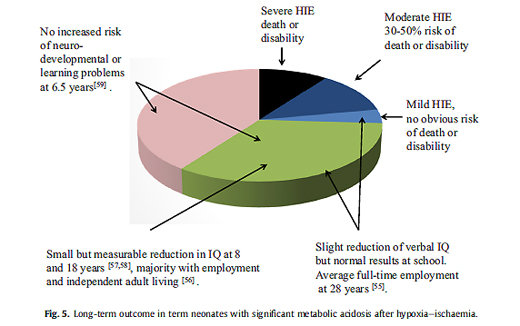
The authors provide a pie chart of outcomes:

Outcomes metabolic acidosis

How can you protect your baby? The best way is fetal monitoring during labor, either electronic fetal monitoring or intermittent listening (auscultation) following a rigorous protocol. Fetal monitoring, particularly electronic monitoring, has a high false positive rate. That means that it may indicate distress when your baby is not actually oxygen deprived. It does, however, have a low false negative rate, meaning that if your baby’s heart rate monitoring is normal, your baby is very likely to be safe.

A high false positive rate means that a lot of babies are rescued (by emergency C-section, forceps or vacuum) who were never in any trouble. On the other hands, it means that if there is even the slightest indication that your baby’s brain is at risk, everything will be done to prevent injury.

Of course, you could always opt not to monitor at all and “trust” that your baby will survive birth unscathed. Ironically, natural childbirth advocates, the folks who are most concerned with maximizing a child’s intellectual potential and health by breastfeeding, making their own organic baby food, and avoiding any toxins, are most likely to put their babies at risk of the biggest toxin of them all: oxygen deprivation during labor.

If we treated erectile dysfunction like we treat breastfeeding difficulties …

iStock_000005186242XSmall copy

Mr. Jones, so nice to meet you.

Allow me to introduce myself, Ima Frawde, IBCEC. What are the letters for? International Board Certified Ejaculation Consultant, of course. I support men who have ejaculation dysfunction at the low introductory price of $200 per hour. I’m here to help you with your erectile dysfunction.

Examine you? No, I’m not going to examine you. I know what’s wrong without examining you; I learned during my training that so called “erectile dysfunction” is always caused by the man who claims he is suffering from it. Different ejaculation consultants may have different opinions about a variety of issues, but on one thing we are all agreed: there is no such thing as “not enough” erectile function.

Just think about it. If erectile dysfunction were real, the population of the world would have died out long ago and we wouldn’t be here. We’re here, so that proves my point!

[pullquote align=”right” color=””]There is no such thing as “not enough” erectile function.[/pullquote]

What is causing your problem? Well, there are a number of possibilities.

1. You are not trying hard enough.

Some men simply don’t care about giving their wives the best sexual experience possible. Let’s face it, sexual intercourse can be a challenge and most husbands are just too lazy to meet the demands of regular activity. When the going gets tough, they give up and give in, opting for vibrators and other sex toys. Sure their wives may seem satisfied with vibrators, but over time those same wives will experience a decrease in IQ. If you really cared about your wife, Mr. Jones, you’d try harder. Lololol, get it? Try harder?

2. You are deformed, but that’s not an excuse.

Sigh, you have a circumcised penis, and we all know who’s to blame for that. Your ignorant parents never realized that circumcision causes erectile dysfunction. Sure you might not have noticed it for the first 65-70 years of life and it might not have started until after you had your first heart attack and began insulin for diabetes, but it is just as much the cause as if you were circumcised yesterday. Too bad for you.

3. Decreased blood flow? Don’t be silly.

You might have heard that erectile dysfunction can be caused by diseases that decrease blood flow to all organs, not just the penis, but it’s not true. That’s just a lie made up by Big Pharma in an effort to sell Viagra. There is no such thing as “not enough blood flow”! Your body is perfectly designed to have an erection and if you only gave it enough time, everything would be fine.

4. So what if your wife is crying because you can’t have intercourse; she’ll just have to wait.

Erectile dysfunction is a matter of supply and demand. If you don’t try to have sex often enough, you’ll never have enough blood flow. You have to keep trying to have sex over and over and over again each day and eventually there will be enough blood flow for erections on demand.

5. You’re doing it wrong.

Positioning is very, very important to prevent erectile dysfunction. If you held your wife the right way, she’d be able to “latch on” to your penis properly and you would then get an erection. So basically this is all your fault.

Oops, time’s up. You can pay with a check, although cash under the table is always appreciated. I’ll be back later in the week for another session. Just remember what I told you: you are not trying hard enough; you are deformed; there is no such thing as decreased blood flow; your wife is just going to have to deal with her disappointment; and, don’t forget, you are doing it wrong.

What? Of course it is your fault! Stop whining that there’s something wrong just so you have an excuse to stop having intercourse. We all know that is what is really going on.

You feel worse now?

No need to thank me; I’m just doing my job as an IBCEC, International Board Certified Ejaculation Consultant.


This piece is satire. It first appeared in January 2013.

Abby Reichardt of The Florida School of Traditional Midwifery demonstrates the arrogant ignorance of homebirth midwives

expression -  Ignorance is bliss - written on a school blackboar

The most deadly thing about homebirth midwives isn’t their ignorance; the most deadly thing is that they are arrogant in their ignorance.

Over the last two days, regular readers have been treated to a festival of blazing stupidity courtesy of Abby Reichardt, posting as Sweet Baby Jesus. I’ve known all along who she is, but she just outed herself to the rest of the group this morning.

Who is Abby?

[pullquote align=”right” color=”#0f100f”]At the end of the argument, Abby is no more knowledgeable than at the beginning (even about arithmetic).[/pullquote]

Abby Reichardt, B.S., is a … graduate of the University of Florida in Family, Youth & Community Sciences. She first became involved with FSTM as a student midwife and completed one year, taking time off to work so that her husband, John, could pursue his degree at UF also. She has been working with FSTM’s Academic Department since spring 2012. In September 2013 she gave birth at home to her first child, John Earley. Abby is passionate about midwifery education and practice and intends to complete her midwifery schooling and become an LM/CPM.

What is FSTM?

The Florida School of Traditional Midwifery offers excellence in direct entry midwifery education in an environment that encourages students to reach their full potential.

What’s Abby’s role at FTSM? Having dropped out of the school temporarily, she worked at the school as … wait for it … Academic Director!

But as I said above, the most amazing thing about Abby is not that she is so ignorant that, as she demonstrated, she cannot do 4th grade math. The most amazing thing is that no matter how many times she was corrected on matters both large and smaller, she continued to aggressively insist that she has something to teach the many doctors and CNMs who were correcting her.

Abby parachuted in like so many homebirth advocates do, determine to share her special brand of “knowledge” with the rest of us.

With your impressing curricula vitae, Dr. Amy, it would appear from this post that the facts and examples you obtained came from sitting in the break-room with other colleagues from your exact background sharing anecdotal banter about “lay midwives” from a painfully narrow and biased perspective. Where are any real facts and figures in your post? What research have you conducted on midwifery training and accredited schools in the US, or for that matter the national infant and maternal mortality/morbidity rates in this country?

Abby then graced us with the typical talking points of the homebirth movement and concluded with a flourish:

My final charge to you, Dr. Amy, is this: I challenge you to re-post your very same argument in response to my comments using REAL statistics and CURRENT information regarding obstetrical practice in the United States. I want to see facts that include the actual state of CPM education in our country and a comparison of those overseas…

Written by a student midwife seeking CPM/LM licensure in the State of Florida, previous Academic Director of a MEAC-accredited midwifery school and mother of one beautiful and safely home-born boy.

Abby promptly demonstrated her astounding inability to do arithmetic:

Neonatal death—all newborns
Homebirth: 2.0/1,000
Hospital Birth: 0.9/1,000
(increased risk with Homebirth is 0.1%)

Let’s leave aside for the moment that the death rate for low risk white women at term is actually 0.4/1000 which means that the risk of death at homebirth is 5X higher (400%); any 4th grader should be able to divide 2.0 by 0.9 and get 2.22. I can’t even begin to fathom how Abby came up with 0.1%. What’s even more remarkable than that is that she couldn’t see, just by eyeballing that she was spectacularly wrong in her “calculations.”

When it was pointed out to Abby that the increase risk of death at homebirth (using her numbers) is 1.22/1000, she dismissed such deaths as so rare as to be unworthy of consideration.

That is a blip on my radar. That is also a trade-off for some of the things that can happen when only-hospital birth is enforced.

Who wants to be cared from by a provider who thinks your baby’s death is a blip on her radar?

After expounding on the risks of C-sections, someone asked Abby if she knew the risks of vaginal birth. Her response:

I think that is a great question and vital to a true informed consent. I will get back to you on that because I think that it will take time to gather info…

She then favored us with this gem:

The number one maternal killer in the US is suicide.

Abby does not realize that when we speak about maternal death we are referring to deaths cause directly or indirectly by the pregnancy or other medical conditions. Suicide is not even on that list. The number one cause of maternal death in the US is maternal cardiac disease.

After being corrected repeatedly on her assertions, Abby had this to say:

I’m going on anecdotal evidence at best. There is not a whole lot of research on out of hospital birth as a whole that isn’t horribly slanted toward the hospital-birth bias. I would love to see more. Would you listen? When I posted evidencebasedbirthblog above everyone laughed, so apparently attempts to research it are made fun of. Preeeeetty discouraging.

No, Abby, what’s pretty discouraging is that you think a website run for profit by a cardiac nurse is a research source.

Abby believes herself to be an expert on obstetric training. First she told us that during 4 years of internship and residency, OBs see only 75 spontaneously vaginal births. When informed that the average OB resident sees that many in two months, Abby retorted:

Does every OB see every complication during training before they start managing birth? It’s not like #81 is guaranteed to be a cord prolapse. You train hard and you learn how to manage it and you practice in clinic and you continue education. Just like every single medical provider out there. Your standards are out of reach even for OBs and it makes for faulty logic.

Actually, we see all but the rarest complications (and even some of those) because we train in teaching hospitals. So not only did I myself perform hundreds of deliveries and care for thousands of women during the years of my internship and residency, but I went to Morbidity and Mortality rounds every week where all complicated cases were discussed. Since more than 6,000 babies were born at the hospital every year and since I was there for 4 years, I heard about complications from over 24,000 deliveries and how best to manage each and every one of those complications.

Abby wailed repeatedly about the hardship of becoming a real midwife (CNM):

Did you know that there are only a handful of CNM programs even available in this country? One has closed recently in my hometown and leaves very few options left in our region of the country.

So what? Providing safe healthcare for women isn’t about what is convenient for Abby and her friends; it’s about the education and training needed to be a safe provider. Just because it isn’t as easy for them to obtain the necessary training is not a reason to dumb down the training to make it convenient for them.

Abby flounced repeatedly, but could not stick the flounce. She kept returning to provide more evidence that CPMs are utterly incompetent.

At the end of the argument, Abby is no more knowledgeable than at the beginning (even about arithmetic), despite being corrected repeatedly:

I will end with this: The perinatal risk of having a homebirth over a hospital is 0.1% greater.

Abby has taught us a lot … no nothing about math, medicine or obstetrics … Abby has demonstrated why homebirth midwives are responsible for so many dead babies. Many homebirth midwives, like Abby, are blithering idiots who mistake their own ignorance for knowledge.


Addendum: Abby deleted all her comments, but I had already saved them. Here they are (in reverse order).

[gview file=”http://www.skepticalob.com/wp-content/uploads/2015/10/Abby-Reichardt-compressed.pdf”]

Eating in labor and the deadly practice of believing press releases

A tablet computer on a desk - Press Release

Would you ever buy a car because the press release from Ford said it was a pleasure to drive, has incredible gas mileage and never needs repairs?

Then you shouldn’t accept the claim of a scientific researcher based on a press release that said it was awesome, ground breaking and relevant to current medical practice.

Mainstream media and natural childbirth advocates are trumpeting a press release from a poster presented by two medical students at the American Society of Anesthesiologists (ASA) 2015 annual conference.

[pullquote align=”right” color=”#d24623″]Since a policy of fasting in labor was instituted, deaths from aspiration have dropped dramatically.[/pullquote]

Most healthy women can skip the fasting and, in fact, would benefit from eating a light meal during labor, suggests research being presented at the ANESTHESIOLOGY® 2015 annual meeting. Improvements in anesthesia care have made pain control during labor safer, reducing risks related to eating, researchers note.

Women traditionally have been told to avoid eating or drinking during labor due to concerns they may aspirate, or inhale liquid or food into their lungs, which can cause pneumonia. But advances in anesthesia care means most healthy women are highly unlikely to have this problem today and when researchers reviewed the literature of hundreds of studies on the topic, they determined that withholding food and liquids may be unnecessary for many women in labor.

Really? How did two medical students reach that determination? It’s not easy to tell since there is virtually nothing available for other physicians to read and analyze.

Here’s what they said in their poster presentation:

Declining rates of parturient aspiration mortality have been indicated in the UK with no reported cases from 2000-2005 when compared with rates of 1.499 per 1000 parturients during the 1940s

Wait, let me get this straight: Since a policy of fasting in labor was instituted, deaths from aspiration have dropped dramatically?

And that’s supposed to mean that aspiration is no longer a risk.

But a dramatic drop in the incidence of maternal aspiration doesn’t mean that the risk has disappeared. There’s also been very few cases of polio in the UK since 1990 (because of vaccination). That doesn’t mean that polio has disappeared.

Here’s what the authors of the the poster say it means:

This review suggests that in low-risk patients with no risk factors, fasting does not appear warranted.

Here’s what it is more likely to mean:

Fasting in labor prevents aspiration deaths.

Why did the ASA issue a press release on the findings of two medical students? For the same reason any scientific organization issues a press release, to garner media attention.

What is the impact of such press releases?

According to a 2014 BMJ paper, The association between exaggeration in health related science news and academic press releases: retrospective observational study:

The framing of health related information in the national and international media, and the way in which audiences decode it, has complex and potentially powerful impacts on healthcare utilisation and other health related behaviour in many countries. The media also demonstrably influences the behaviour of scientists and doctors.3 4 Such impacts may often be beneficial, but misleading messages can have adverse effects (even if these effects may be difficult to predict and prove because the responses of audiences are complex and multiply determined).6 This problem is not restricted to rare dramatic cases such as vaccination scares7 8; the cumulative effect of everyday misreporting can confuse and erode public trust in science and medicine, with detrimental consequences.

How accurate are such press releases?

For our analysis of advice we found that 40% of the press releases contained more direct or explicit advice than did the journal article (bootstrapped 95% confidence interval 33% to 46%). For our analysis of statements based on correlational results (cross sectional or longitudinal) we found that 33% of primary claims in press releases were more strongly deterministic than those present in the associated journal article (bootstrapped 95% confidence interval 26% to 40%).

That’s precisely what has happened here. The medical students noted a finding, maternal aspiration now occurs rarely compared to more frequent incidents of aspiration in the 1940’s. This correlated with the development of anesthesia techniques designed to minimize aspiration. They concluded (with no evidence to support that conclusion) that the new anesthesia techniques prevent nearly all cases of aspiration.

But there was one anesthesia “technique” that seems to have escaped their notice, the strict enforcement of fasting during labor.

It is very likely that the fasting in labor is a major factor in the decrease in aspiration deaths. Certainly the authors presented no data to indicate otherwise.

Anesthesia colleagues, help me out here:

Have UK hospitals been allowing women to eat in labor since the 1940’s or did they have a strict fasting policy?

Is there something that I am missing that allowed the researchers to isolate the impact of new anesthesia techniques from the impact of fasting itself?

If not, then the authors drew a conclusion from the data that is not supported by existing scientific evidence.

If not, then the authors are advocating stopping the fasting policy that was responsible for the decrease in deaths.

If not, then the ASA has issued a thoroughly irresponsible press release that contains advice that isn’t merely unsupported by the evidence, but advice that could be deadly.

Breastfeeding and the glorification of victimhood

Victim Rubber Stamp

Is support a zero sum game?

If I offer support to the victims of an earthquake in South America does that mean I can’t offer support the victims of a typhoon in South East Asia, too?

If I express support for those who lost their homes in a hurricane does that mean I can’t express support for those who lost their homes in a wildfire, too?

If I support women who have breast cancer, does that mean I can’t support women who have ovarian cancer, too?

[pullquote align=”right” color=”#1212b2″]Why can’t I support formula feeding mothers AND support breastfeeding mothers?[/pullquote]

Sounds ridiculous, right?

So why can’t I support formula feeding mothers AND support breastfeeding mothers?

Because lactivism embraces victimhood as central to its understanding of breastfeeding and the women who choose it.

In the world of lactivism, support is a zero sum game and any support offered to women who choose formula feeding is viewed as support that is deliberately stolen from breastfeeding mothers.

At their heart, the “breastfeeding wars” aren’t about breastfeeding. They’re about whether lactivists are entitled to the moral superiority of victimhood. That’s how lactivists justify the fact that their claims of minority status are unmoored from reality, their claims of the benefits of breastfeeding are unmoored from the scientific evidence, and their viciousness expressed in efforts to lock up formula, force new mothers to sign releases proclaiming that breastfeeding is superior, and programs to promote breastfeeding designated as “baby friendly,” (as if those who breastfeed care more about their babies than those who don’t) is unwarranted.

The celebration of their victimization serves several important roles in the lactivist cosmology. First, and foremost, it guarantees moral superiority. As Sommer and Baumeister explained in the book The human quest for meaning:

…[C]laiming the victim status provides a sort of moral immunity. The victim role carries with it the advantage of receiving sympathy from others and thereby prevents [one’s own behavior] from impugning one’s character…

Never mind that women who try breastfeeding represent the overwhelming majority of women, lactivists insist breastfeeders are a tiny minority, oppressed by the formula industry, and ceaselessly harassed by formula feeders. They’re victims dammit and that means that nothing they do to promote breastfeeding is ever wrong.

Second, the insistence on victimization serves to simplify the world by creating a false dichotomy. For lactivists, the world is divided into diametrically opposed camps of breastfeeders and formula feeders. It seems never to have occurred to them that combining breastfeeding and formula feeding is not merely possible, but common. Since the world is divided into diametrically opposed camps, in the lactivist cosmology everyone is either with them or against them. Or, paraphrasing one of my blog commentors, lactivists make it clear to new mothers that “you’re either with us or we’re against you.”

When you are a breastfeeding victim, the fact anyone others don’t agree with you, or at least validate your feelings of victimization, is viewed as a form of re-victimization.

Other women choose formula? They are victimizing you by refusing to validate your decision to breastfeed by mirroring it back to you.

Formula feeders want to be able to choose formula without being harassed by hospital lactation consultants, vilified by breastfeeders, or told that they aren’t “baby friendly”? They’re victimizing you.

Dr. Amy (or anyone else) point out that the benefits of breastfeeding in first world have been massively exaggerated and are, in reality, limited to a few less infant colds and episodes of diarrheal illness in the first year? She is most definitely victimizing you; she hates breastfeeding, bathes daily in Similac and dries off using hundred dollar bills sent to her by Nestle as payment for services rendered.

Third, their status as self-proclaimed victims has been instrumental in allowing lactivists (particularly professional lactivists like La Leche League) to take control of public health messages and discussion in the public sphere. Breastfeeding rates were low purportedly because of the victimization of breastfeeders. That was the justification behind massive public and private initiatives to support breastfeeders and thereby promote breastfeeding. How has it worked out?

As a society, we have spent tens of millions of dollars promoting breastfeeding in order to improve child health and save on medical costs. Where’s our return on investment? Where is the evidence that overall infant health has improved as a result of breastfeeding rates tripling in the past 50 years? There isn’t any. Where are the billions of dollars in healthcare savings we were promised as a result of increasing breastfeeding rates? No one seems to be able to find them.

Yet lactivists continue promoting these programs and initiatives on the grounds that breastfeeding mothers are being victimized.

Interestingly, the goalposts of lactivist victimization are always moving. Fifty years ago the evidence of breastfeeders’ victimization was that hospitals did not support their efforts. In 2015, when hospitals do everything humanly (and inhumanely) possible to increase breastfeeding rates and when even cans of formula proclaim “breast is best,” failure to wholeheartedly embrace and praise public breastfeeding is viewed as … you guessed it … evidence of victimization.

Indeed, the goalposts have moved so far, basic civility to women who choose formula feeding as best for their babies is routinely criticized as victimization of women who breastfeed.

It’s time for lactivists to grow up and stop bleating endlessly about their victimization. Breastfeeding is just one of two excellent ways to nourish an infant, nothing more and nothing less. Breastfeeders aren’t morally superior, aren’t better mothers, and certainly aren’t being victimized. They’re no different from formula feeding mothers, both trying to do what is best for their babies, their families and themselves.

Support is not a zero sum game.

I can offer support to the victims of an earthquake in South America AND offer support to the victims of a typhoon in South East Asia.

I can express support for those who lost their homes in hurricanes AND express support for those who lost their homes in a wildfires.

I can support women who have breast cancer AND support women who have ovarian cancer.

In exactly same way, I can support women who breastfeed AND women who formula feed. I don’t have to choose between them and society does not have to choose … no matter how much lactivists insist otherwise.

Want to end the breastfeeding wars? Here’s the first step.

35171140_s

Lactivists are shocked, shocked that anyone might think that there is a war going on over infant feeding.

Casey Rosen-Carole, MD of the Academy of Breastfeeding Medicine (ABM) insists:

I am therefore saddened that media discourse on breastfeeding continues to undermine women by putting forth articles supporting the notion that a battleground exists between mothers…

How could formula feeding mothers have gotten the idea there is a breastfeeding war going on?

[pullquote align=”right” color=”#b44800″]Imagine if a hospital that treated gay people designated itself “traditional marriage friendly.”[/pullquote]

  • Maybe it’s because lactivists ignore what women tell them about breastfeeding difficulties and insist that they must be doing it wrong.
  • Maybe it’s because lactivists ignore what women tell them about breastfeeding difficulties and insist that they aren’t getting enough support.
  • Maybe it’s because lactivists ignore what women tell them about breastfeeding difficulties and insist that formula companies are undermining breastfeeding.
  • Maybe it’s because lactivists ignore what women tell them about feeling shamed and blamed and lactivists deny it.
  • Maybe it’s because lactivists ignore what women tell them about feeling shamed and blamed and lactivists insist the media has made it up.

But there’s something very simple that they could do to dispel the belief that they are shaming and cruel, clinging desperately to the notion that breastfeeding makes them better mothers than women who don’t breastfeeding:

They could change the name of the “Baby Friendly Hospital Initiative” to the “Breastfeeding Friendly Hospital Initiative”.

What is the Baby Friendly Hospital Initiative (BFHI)?

The Baby-Friendly Hospital Initiative (BFHI) is a global program … to encourage and recognize hospitals and birthing centers that offer an optimal level of care for infant feeding and mother/baby bonding. It recognizes and awards birthing facilities who successfully implement the Ten Steps to Successful Breastfeeding and the International Code of Marketing of Breast-milk Substitutes.

In other words, it is an organization designed to promote breastfeeding.

If it’s supposed to promote breastfeeding, why is it called “baby friendly”? It’s called “baby friendly” as a deliberate slap in the face to women who choose formula.

Imagine if a rehabilitation facility that treated people in wheelchairs designated itself “walking friendly.”
Imagine if a hospital that treated gay people designated itself “traditional marriage friendly.”
Or how about a weight loss camp that called itself “thin friendly”?

I suspect most people would have no trouble recognizing the designations as deliberate attempts at shaming.

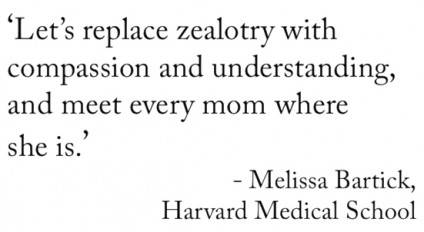
The ABM tweeted this quote from Dr. Melissa Bartick:

Bartick tweet

Let’s replace zeaolotry with compassion and understanding, and meet every mom where she it.

Compassion?

How compassionate is it to label a breastfeeding initiative “baby-friendly”? It’s not compassionate. It’s humiliating and that’s no accident.

Lactivists need to change the BFHI to the “breastfeeding friendly hospital initiative.” It’s easy; it’s a sign of a commitment to end the breastfeeding wars; and they won’t even have to change the initials of the program.

The next step?

End all punitive hospital practices: no more locking up formula, no more making women sign releases attesting to the superiority of breastmilk in order to obtain formula, no more banning of formula gifts (a ban that hurts the poor and women of color more than anyone else).

I’m not holding my breath. Lactivism represents a last bastion of socially sanctioned bullying. Lactivists are enjoying every delicious opportunity to proclaim their superiority over women who choose (or are forced by medical circumstances to choose) infant formula.

But as long as the BFHI is designated “baby friendly,” all pious attempts to deny or decry the breastfeeding wars will be nothing more than hypocrisy.

Lactivists fight back

Blank book cover isolated on white

Breastfeeding has become an industry, an industry predicated on gross exaggeration of the benefits of breastfeeding in first world countries.

Now that the misrepresentations of the scientific evidence have been pointed out in a national forum (Overselling Breast-feeding by Courtney Jung) lactivists are doing what any industry would do: they’re fighting back to retain market share.

The science is pretty clear that the benefits of breastfeeding in first world countries are trivial; lactivists are not attempting to prove otherwise, because they can’t. Instead, they’re fighting back with weak arguments and logical fallacies. In fact, the arguments are so predictable that they could write a playbook:

[pullquote align=”right” color=”#bf7341″]“When a person tells you that you hurt them, you don’t get to decide that you didn’t.”[/pullquote]
Step 1. Reframe the issue

The issue under discussion is whether lactivists have oversold the benefits of breastfeeding. They have, but they don’t want to address that point. Instead they reframe the issue as opposition to breastfeeding itself.

Melissa Bartick, MD:

It’s become routine: a big anti-breastfeeding piece comes out in a major publication …

The Boob Geek:

How to write an anti-breastfeeding article

Step 2: Appeal to authority

“Because they said so” is a logical fallacy, not an argument. Yes, consensus involving major medical organizations can be an important issue when defending empirical claims like “vaccines are safe and effective.” But when the claim under discussion is “medical authorities have overstated the benefits of breastfeeding,” trumpeting the fact that major medical organizations agree with each other is not a defense.

Julie Taylor, President Academy of Breastfeeding Medicine:

For strong evidence that breast-feeding is by far the optimal nutrition choice to support maternal-child health, consult the Academy of Breastfeeding Medicine, the American Academy of Pediatrics and the World Health Organization.

Step 3: Imply guilt by association

Is there any industry more despised than the infant formula industry? Therefore, insist that those who question the overselling of breastfeeding are influenced by or in league with the infant formula industry.

Casey Rosen-Carole, MD:

… Courtney Jung’s op-ed… posits a false dichotomy, supported by formula advertising, that the true battleground for breastfeeding exists between “lactivists” and mothers who choose to, or must, formula feed their infants…

It is unclear why discourse on the “minimal” or “moderate” effects of breastfeeding continues; it is likely related to influence from both personal experiences of writers and influence from formula marketing.

The Boob Geek:

Remember, though, that no formula company has ever undermined breastfeeding by providing free samples of their products. There is no proof that advertising affects us in any way.

Elizabeth Grattan:

Jung feeds this fallacy to a tee when she neglects to address the tactics of the Infant Formula Council specifically targeting breastfeeding families.

Step 4: Denial

Lactivists are making women who choose infant formula feel bad by exaggerating the benefits of breastfeeding? No, they’re not.

Dr. Rosen-Carole:

This argument posits … that the true battleground for breastfeeding exists between “lactivists” and mothers who choose to, or must, formula feed their infants. Rather, breastfeeding advocacy today focuses on the social conditions that prevent women around the world from being able to make choices that support their health and empowerment, and the futures of their babies.

Dr. Bartick:

It only takes one “lactivist” to piss off a journalist. You never know who might turn around and write that next full page op-ed for the New York Times.

Grattan:

Jung positions those who don’t breastfeed as the victims in society… This lets her pander to the masses by convincing them that they are the ones more deserving of the attention. Again, this approach isn’t new, it’s quite common. This martyr complex is a well known deflect as a way for people to completely avoid social justice.

These writers would do well to keep in mind the immortal words of comedian Louis CK:

“When a person tells you that you hurt them, you don’t get to decide that you didn’t.”

Step 5: Never address the actual issue

Dr. Rosen-Carole:

It is unclear why discourse on the “minimal” or “moderate” effects of breastfeeding continues … I will not engage this discourse here, as it is clear from every medical expert panel in every country in the world that the benefits of breastfeeding for health of mother and baby

English to English translation: I can’t rebut the claim.

I’m not surprised that lactivists are running scared. Jung has pointed out two of the dirty secrets of lactivism: the real benefits of breastfeeding are trivial and breastfeeding is being promoted by an industry that profits from it. There is no way to disprove these claims because they are true. But that doesn’t stop lactivists from trying.

What’s the take away message for the rest of us?

Be aware of the lactivist playbook — reframing, appealing to authority, guilt by association, denial and refusal to address the scientific claims. The tide is turning, and inevitably the truth about the overselling of breastfeeding will out.

Billions saved by breastfeeding? Show me the money!

iStock_000001656690_Small

Lactivists claim that if more women breastfed, we could save billions of dollars in medical costs due to decreased illness and hospitalizations.

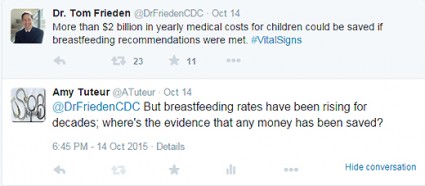
Dr. Tom Frieden from the CDC repeated this cherished maxim in a recent tweet:

Frieden breastfeeding billions

More than $2 billion in yearly medical costs for children could be saved if breastfeeding recommendations were met.

Really Dr. Frieden? Show me the money.[pullquote align=”right” color=””]Surely we should have seen some savings by now, but we haven’t.[/pullquote]

Breastfeeding initiation rates have risen from a nadir of 24% in the 1970’s to the current rate of over 76%. Surely we should have seen some savings by now, but we haven’t.

The truth is that there was never any reason to believe that we would save billions. That figure was conjured by professional lactivist Dr. Melissa Bartick.

In the 2010 paper The Burden of Suboptimal Breastfeeding in the United States: A Pediatric Cost Analysis Bartick “estimated” that the US could save 900 infant lives and $13 billion if 90% of US women breastfed. These numbers were grossly misleading since not even a single US term infant death (let alone 900 per year) had ever been attributed to not breastfeeding and since, to my knowledge, not a single dollar of savings had yet to be recorded. Moreover, Dr. Bartick invoked many benefits to breastfeeding that have never been proven, including childhood asthma, childhood leukemia, type 1 diabetes, and childhood obesity. Presumably Dr. Frieden’s claim about $2 billion dollars in savings is an extrapolation from Dr. Bartick’s “estimate.” She postulated a 90% breastfeeding rate; his claim is predicated on a lower rate. (The case may be different for preterm infants at risk for developing necrotizing enterocolitis (NEC), but, as yet, that has not been demonstrated, either.)

Though Dr. Bartick’s claim has been quoted repeatedly, a review of the scientific literature fails to show any of the predicted cost savings. As far as I know, and I’m happy to be corrected, there is no evidence that there has been any healthcare savings. That’s hardly surprising when you consider that for term infants in first world countries, the benefits of breastfeeding are trivial: a slightly reduced incidence of colds and diarrheal illnesses in the first year of an infant’s life. Even if there were savings, they’d need to be balanced against the millions of dollars spent on breastfeeding each year (pumps, lactation consultants, etc.) as well as the tens of millions spent on to promoting breastfeeding

Perhaps that’s why Dr. Frieden failed to respond to my request for scientific evidence to support his claim.

The claim that billions of dollars in medical costs could be saved by increasing breastfeeding rates is yet another one of the many examples of overselling breastfeeding. Breastfeeding is one of two excellent ways to feed an infant, the other being formula. Those who claim increasing breastfeeding rates save billions need to show us the money.

The breastfeeding initiation rate has tripled in the past 50 years. Where are the cost savings?

Dr. Amy