Women can’t reclaim their agency from doctors by giving it to midwives and lactation consultants

26161664_s copy

Where did the natural childbirth and lactivism industries go so wrong?

Why do I receive emails and Facebook messages from desperate women nearly every day detailing their guilt, self-abnegation and torment over “failing” to give birth vaginally or to breastfeed?

Why, when I talk about my forthcoming book with friends and acquaintances, do women years removed from childbearing burst into tears about their struggles?

Yes, it’s true that the philosophies of both natural childbirth and lactivism were created as ways to convince women to remain in the home instead of seeking legal and economic emancipation, and we should never forget that when considering their harmful effects on women. However, their retrograde beginnings were shed (and hidden) when natural childbirth and lactivism reached the mainstream, and the original impetus from both advocates and adherents was strong and resonated deeply. The original goal of the philosophies of natural childbirth and lactivism was to reclaim women’s agency from doctors. Instead of doctors deciding that women should be asleep during birth, deprived of emotional support from partners and subject to unnecessary procedures like shaving and enemas, women insisted that it was their right to decide to be conscious, to be accompanied by partners and to accept or reject procedures based on informed consent. Instead of being convinced to forgo breastfeeding and forced to forgo it due to lack of breastfeeding support, women insisted that it was their right to receive encouragement and support in nourishing their infants in the way they thought best.

In other words, from the 1950’s to the 1970’s, the philosophies of natural childbirth and lactivism were about reclaiming women’s agency from doctors. [pullquote align=”right” color=”#cc33cc”]The name “Baby Friendly Hospital Initiative” is a deliberate slap in the face to women.[/pullquote]

Where did the natural childbirth and lactivism industries go wrong?

Both natural childbirth and lactivism went off the rails when they insisted that the only way women could reclaim their agency from doctors was to hand over that agency to midwives and lactation consultants.

Here’s what childbirth and lactivism would look like if women were in charge of the decision making:

All possible choices would be represented because women have a broad spectrum of needs and desires.
Birth plans would just as readily include maternal request C-sections as unmedicated vaginal births.
Pain relief would have a prominent place in birth plans since most women find they need pain relief.
Women would choose how to feed their infants based on what worked for them, and they would NEVER be shamed for bottlefeeding.
Free formula gifts would be available to those who want them.

In other words, every safe childbirth or feeding decision made by mothers would be respected by professionals and by other mothers, just in the same way that we owe respect to women for whatever decisions they make about who or if to marry, whether or not to have children, and whether or not to work outside the home if they have children.

Decision making would be bottom up: women would make the decisions and inform providers of their choices.

Instead, in the process of women reclaiming their agency from doctors, midwives and lactation consultants swooped in to steal if from them. Within natural childbirth and lactivism, decision making is top down. Midwives, doulas and childbirth educators decide what a “good” or “normal” birth should look like and they force that decision down women’s throats, complete with hectoring and shaming dressed up with the twin lies of being “better for baby” and “evidence based.” Lactation consultants decide how babies should be fed and force that decision down women’s throats, complete with hectoring and shaming dressed up with the twin lies of being “better for baby” and evidence based.”

The Baby Friendly Hospital Initiative (BFHI) is the paradigmatic example of how natural childbirth and lactivism reflect top down decision making and deprive women of their own agency.

The name “Baby Friendly Hospital Initiative” is a deliberate slap in the face to women.

It reflects the professional lactivists’ beliefs that they know better than women what is best for them and their babies, and, it is the apogee of mother shaming.

I am appalled that any hospital allows such an organization anywhere near emotionally fragile new mothers. Political consultants say that when you frame an issue, you own it. The medical community has regrettably allowed an organization of zealots to frame the issue of breastfeeding as “baby friendly” when it may be anything but baby friendly, to explicitly ignore the needs of mothers, and to ratify shaming as an acceptable tactic for manipulating women. Any women who does not breastfeed is branded as not “friendly to” her baby. The medical community has empowered a group of zealots with top down decision making authority over infant feeding. These zealots explicitly deprive women of agency. The assumptions behind the BFHI are that women cannot be trusted to make decisions for their infants, they must be hectored into breastfeeding, any alternative must be made as inconvenient as possible, and that bottlefeeding or combo feeding mothers can and should be deprived of valuable infant formula gifts.

Lactivists rationalize their abysmal and disrespectful treatment of new mothers as “better” for babies … just as midwives justify their insistence on unmedicated birth as a standard by claiming that is is “better” for babies and mothers … just as doctors justified shaving and enemas as “better.”

In every case, women are deprived of agency, purportedly for their own benefit.

Women should understand that standards for birth or infant feeding are efforts at top down decision making that ignore the individual wants and needs of women and babies. Unmedicated vaginal birth is no more “better for babies and mothers” than shaves or enemas. Both reflect the preferences of providers, not the needs of mothers or babies. And the Baby Friendly Hospital Initiative is the most egregious example of depriving women of agency. Its name should be changed immediately to expunge the stench of mother shaming and it’s goals should be modified to reflect the critical role of mothers in determining what is best for them and their babies.

Women can’t reclaim their agency from doctors by ceding it to midwives and lactation consultants. The guilt, self-abnegation and torment of so many mothers reflects that fundamental reality.
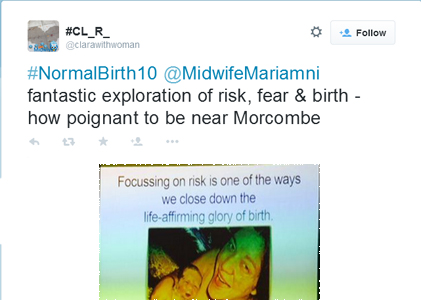
Everything wrong with contemporary midwifery encapsulated in a single slide

Life affirming glory of birth

Here we have everything wrong with contemporary midwifery in a single slide:

Focussing on risk is one of the ways we close down the life-affirming glory of birth

The slide was presented today at the Normal Labour & Birth: 10th Research Conference.

You might think that the recent revelations about dozens of preventable deaths at the hands of midwives would have prompted them to reassess their mindless veneration of unmedicated vaginal (“normal”) birth. You would be wrong. Indeed, the heartless woman who tweeted the image called it “poignant” in the wake of the 12 preventable deaths detailed in the Morecambe Bay report. Poignant is not the word that occurs to me; disrespectful, unfeeling, and heartless leap to my mind.

Here’s my question, midwives: how life affirming is the birth if the baby is dead?

Apparently, it’s still life affirming … because it affirms the lives of MIDWIVES. What? You thought contemporary midwifery was about babies and women? Aren’t you naive.

Midwives have become everything they claimed to despise in doctors: they are arrogant, dictatorial and contemptuous of scientific evidence. Most importantly, they appear to believe that the profession exists for their benefit and women should shut up and do what they say.

The ugly, deadly truth is that “normal birth” is not healthier, safer or better in any way for mothers or babies than childbirth with the entire panoply of obstetric interventions. But “normal birth” is a nail, and midwives are hammers and they just keep on pounding.

As anthropologist Margaret MacDonald explained in the Lancet, The cultural evolution of natural birth:

Natural birth has long held iconic status within midwifery and alternative birth movements around the world that have sought to challenge the dominance of biomedicine and the medicalisation of childbirth… The recent transition of midwifery in several Canadian provinces from a social movement—for which “reclaiming” natural birth was a critical goal — to a regulated profession within the formal health-care system is a unique opportunity to track changes in how natural birth is understood and experienced. Midwifery in Canada has much in common ideologically with independent or direct-entry midwifery in the USA and with radical and independent midwifery in the UK and so insights about changes in Canada have implications for maternity caregivers in a range of health systems.

But normal birth actually involves lots of technology. There is nothing natural about checking blood pressure, listening the fetal heart with a Doppler or recommending chiropractic. Other technological interventions have also become a part of normal birth. In fact:

[If an intervention] can bring back the clinical normalcy of the labour pattern and keep it within the midwifery scope of practice, it is generally regarded as a good thing by midwives and clients alike …

That is the key point. Anything is acceptable as long as it can keep the birth within the scope of midwifery practice. Normal birth is about midwives keeping patients under their control.

Consider a handyman, Bob, who only knew how to use a hammer. Whenever he was called to a job, he brought his trusty hammer and banged in the nails. Imagine that a new handyman, Steve, comes to town and he knows how to use a hammer AND a screwdriver. He can do twice as much as the original handyman and as time goes by, more and more people call Steve, since many of their projects involve nails and screws.

Bob, the original handyman, now faces a difficult choice. What should he do about jobs that involve screws? There are several tacks that he could take:

He could always learn to use a screwdriver, but that might be difficult for Bob. What else might he do?

  • He could insist that screws can be pounded in.
  • He could insist that screws are an unnecessary use of technology; anything that can be made with screws could also be made with hammers.
  • He could insist that Steve invented screws just to take business away from him.
  • He could insist that Steve recommends screws for a project when nails would have been just fine.

Or:

He could insist that only things assembled with nails are normal.

All of these strategies share one thing in common. They imply that using a hammer is always best.

Just like Bob the handyman, a midwife faces a difficult choice when confronted with a patient who needs advanced technology like a C-section. She also has several choices, remarkably like the choices from which Bob can choose.

  • She could insist that the patient can give birth safely without a C-section.
  • She could insist that C-sections are an unnecessary use of technology.
  • She could insist that obstetricians recommend C-sections just to take business away from midwives.
  • She could insist that obstetricians routinely recommend C-sections when vaginal birth would have been just fine.

Or:

She could insist that only vaginal birth is normal.

Midwives use all these strategies. What women need to understand is that midwives define normal birth by what is good for THEM, not what is good for women or safe for babies, and certainly not by what is actually normal. When they hold conferences to promote “normal birth,” they are holding conference to promote themselves. And in their efforts to promote themselves, they have become arrogant, dictatorial and contemptuous of scientific evidence that does not support their biases.

They’ve actually gone one step beyond what they despised in doctors; they appear to be incapable of learning from their mistakes. It makes no difference to them how many babies or mothers die preventable deaths; it makes no difference how many reports are written about their egregious negligence; it makes no difference to them how many midwives are struck off for deadly practices. They have staked their professional lives on the altar of “normal birth” and they don’t care how many babies and women must be sacrificed to continue worshiping at that altar.

But breastfeeding has to be superior … otherwise I’m not superior

image

Professor Charlotte Faircloth has written a simple, tightly argued piece cautioning us not to moralize infant feeding, and lactivists have become unhinged.

Faircloth merely states the obvious in Breastfeeding doesn’t determine a child’s future, so we should stop pretending like it does:

…[T]he assumption that how a woman feeds her baby in the early months will have life-long physical (and psychological) implications – a message echoed by the host of “experts” that now colonize early parenting – means that many women feel a huge sense of obligation to breastfeed (and therefore creating the two rather unappealing options of being “smug” or “guilty.”) …

[H]ow a mother feeds her baby is just one small part of the parenting jigsaw, and not one that will determine her child’s future outcomes. Women need infant feeding support that starts from them and their family’s needs, not more governmental hectoring, or sensationalist spats in the media, which just continue to fuel this already over-heated, destructive debate.

Faircloth is no stranger to decying efforts to moralize infant feeding. In her paper ‘What Science Says is Best’: Parenting Practices, Scientific Authority and Maternal Identity Faircloth explains the meaning of “the science” of breastfeeding to lactivists. “The science” is simply a convenient cudgel which lactivists use to metaphorically hammer away at women who do not follow their example:

The scientific benefits of breastfeeding and attachment parenting serve as a (seemingly) morally neutral cannon about which mothers can defend their mothering choices and ‘spread the word’ about appropriate parenting.

In the minds of lactivists, “the science” turns breastfeeding from a choice to an obligation.

When ‘science’ says something is healthiest for infants, it has the effect, for [lactivists], of shutting down debate; that is, it dictates what parents should do.

… [U]nder the assumption that science contains ‘no emotional content’, a wealth of agencies with an interest in parenting – from policy makers and ‘experts’ to groups of parents themselves – now have a language by which to make what might better be termed moral judgements about appropriate childcare practices. [But] ‘Science’ is not a straightforward rationale in the regulation of behaviour, rather, it is one that requires rigorous sociological questioning and debate in delimiting the parameters of this ‘is’ and the ‘ought’.

In Contextualising risk, constructing choice: Breastfeeding and good mothering in risk society. Stephanie Knaak, a sociologist, explains that breastfeeding promotion in first world countries is not about what an infant eats.

… this discourse is not a benign communique about the relative benefits of breastfeeding, but an ideologically infused, moral discourse about what it means to be a ‘good mother’ in an advanced capitalist society.

Lactivists have gone far beyond simple attempts to educated women about the benefits of breastfeeding. They have explicitly framed one feeding choice as “good” and another as “bad.” And they imply that only those women who make “good” choices can be good mothers.

… [T]his association of breastfeeding with ‘good mothering’ and formula feeding with ‘not so good mothering’ has been argued to be a key characteristic of today’s dominant infant feeding discourse. In large part, this can be attributed to the fact that pro-breastfeeding discourse is organised and mediated by: (a) a moralising public health ideology; and (b) the ‘ideology of intensive mothering’, today’s dominant parenting ideology.

In other words, breastfeeding promotion is not about nourishment and it’s not even about babies. It’s about mothers and how they wish to see themselves. Simply put, if breastfeeding is not vastly superior to infant formula, lactivists are not vastly superior to other mothers. Hence the vicious responses to Faircloth’s piece.

One commentor in particular regurgitates the greatest hits of lactivist propaganda:

Bottle fed infants are far more likely to have speech impediments, especially in boys.No one thrives on bottle milk, they survive it. Try measuring their tooth and bone density and checking how overcrowded their lower jaws are if you think they are thriving. And a woman dying every 20 minutes in the UK from breastcancer, a disease that doesn’t exist in fully breastfeeding cultures, well they’re hardly thriving are they?

And:

You are wrong to say their bodies fail them. Hospitals are overheated overlit and staffed by strangers so overuse is made of anaesthetic. All these make breastfeeding an uphill struggle. On release from hospital they are advised to feed with very restricted access to the breast, the last feed at night is advised and unnaturally long gaps between feeds.Without frequent enough feeds no woman’s body can produce enough milk. It is the health service that fails women, not their bodies.As for your mother in law, you may be confusing confidence and independence with not being close.

And my favorite:

The hormones of breastfeeding promote a sense of goodwill which is designed to be directed towards the baby. They are called the love hormones and they are released during breastfeeding. A bottle feeding mother can be caring, but she doesn’t have nature working in her favour, always a disadvantage when you are exhausted and in constant demand by another person.

Personally, the love I had for my babies was so overwhelming that nothing could dimish it, and I hardly had to rely on hormones to support that love.

The truth about breastfeeding in industrialized countries is that it is the designer handbag of parenting. Is it better than formula feeding? Marginally, as designer handbags are marginally better than run of the mill handbags. But the differences are trivial, and just as a regular handbag is an excellent way to carry your wallet and car keys, formula feeding is an excellent way to nourish an infant. Designer handbags convey status in a world where some women are desperate to feel superior to others, and breastfeeding conveys status in a world where some mothers are desperate to feel superior to other mothers.

These women moralize infant feeding because it makes them feel better about themselves. For them, breastfeeding has to be superior, otherwise they’re not superior … and that is simply intolerable.

British midwifery has degenerated into a cult

image

With the publication of the recent report of obstetric liability payouts, the transformation has been completed. British midwifery has become a cult.

How many babies have to die before British midwives recognize that their veneration of “normal birth” is a mistake? Apparently there is no number of dead babies high enough to force a change. That’s because British midwifery is a cult devoted to “normal birth,” and as in any cult, it is impossible for the leaders to admit that they are wrong.

The Kirkup Report published in the wake of the Morecambe Bay scandal where 11 babies and one mother died preventable deaths makes for chilling reading:

[M]idwifery care in the unit became strongly influenced by a small number of dominant individuals whose over-zealous pursuit of the natural childbirth approach led at times to inappropriate and unsafe care. One interviewee told us that “there were a group of midwives who thought that normal childbirth was the… be all and end all… at any cost…”

James Titcombe, a loss parent who has become a patient safety advocate, details the contemptuous response of the Royal College of Midwives in the recent issue of their magazine:

The scene is set straight away by the RCM CEO Cathy Warwick on page 5. Cathy refers to the issue of the ‘normality agenda’ and asks ‘are we pushing this too far?’, Cathy’s response is ‘no’.

This response really does amaze me, not least because Cathy doesn’t refer to any study or evidence to support her answer. In this piece, the RCM President Lesley Page even questions the Kirkup report’s clear conclusion that the over zealous pursuit of normal childbirth was a significant factor in what happened at Furness General.

“I searched carefully to find out what was the basis of this emphasis but couldn’t find much.”

Really?

When the Kirkup report was published, some midwifery supporters claimed that this was a one time failure on the part of rogue midwives. Kirkup himself publicly disabused them of this excuse and the Recent publication of last year’s liability payments illustrate the extraordinary dimensions to the problem.

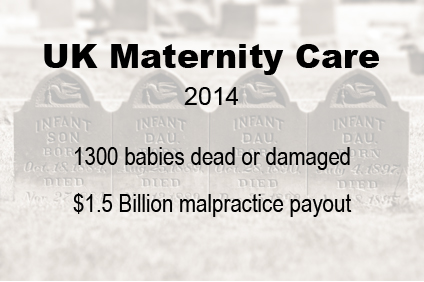
From The Times of London, NHS errors leave 1,300 babies dead or maimed:

The NHS paid or set aside just under £1 billion [$1.5 billion] last year to settle 1,316 claims of negligence in maternity units, up from £488 million a decade ago, data from the NHS Litigation Authority show. The most costly claims involve babies brain-damaged during labour, who will require constant care for the rest of their lives.

One basic error accounts for a quarter of payouts, with campaigners saying it was a “scandal” that the health service was failing to learn from its mistakes. They blamed divisions between midwives and doctors, saying that the desire for “natural” births — without interventions — sometimes went too far…

How have midwives and their supporters responded to this scathing indictment?

Midwifery apologist Elizabeth Prochaska of Birthrights UK simply ignores the findings:

The latest incarnation of this trend towards midwife-blaming came in yesterday’s Times editorial (paywall). Commenting on a Leicester University study into stillbirth rates in the UK, it claimed that ‘the roots of the problem are inadequate monitoring before birth, inadequate Times editorial investigation after it and a faddish bias in favour of midwife-led “natural” maternity care.’

Ms. Prochaska simply ignores the more than 1300 dead babies because to do anything else would call the primary belief of the cult into question.

In a fascinating article in Mother Jones (The Science of Why We Don’t Believe in Science), the author offers the classic tale of psychologist Leon Festinger’s research on a doomsday cult after its prediction for the end of the world proved false:

… [T]he aliens had given the precise date of an Earth-rending cataclysm: December 21, 1954. Some of Martin’s followers quit their jobs and sold their property, expecting to be rescued by a flying saucer when the continent split asunder and a new sea swallowed much of the United States…

Festinger and his team were with the cult when the prophecy failed…December 21 arrived without incident. It was the moment Festinger had been waiting for: How would people so emotionally invested in a belief system react, now that it had been soundly refuted?

… [R]ationalization set in. A new message arrived, announcing that they’d all been spared at the last minute… Their willingness to believe in the prophecy had saved Earth from the prophecy!

… They lost their jobs, the press mocked them, and there were efforts to keep them away from impressionable young minds. But while Martin’s space cult might lie at on the far end of the spectrum of human self-delusion, there’s plenty to go around…

British midwives and their apologists exhibit the same behavior in order to preserve the cult of “normal birth.” It makes no difference to them whether 10 babies die or 1,000 babies die. They are incapable of acknowledging their deadly mistakes because British midwives are less healthcare providers than members of the cult of “normal birth” with all self-delusion that entails.

Dr. Neel Shah wants us to emulate this system of obstetric care??!!

UK maternity care 2014

Dr. Neel Shah wrote a foolish, poorly researched article on homebirth, A NICE Delivery — The Cross-Atlantic Divide over Treatment Intensity in Childbirth, and The New England Journal of Medicine published it, apparently without having it reviewed by anyone who knows anything about American homebirth. Then he penned a piece for The Conversation, Are hospitals the safest place for healthy women to have babies? An obstetrician thinks twice, that expanded and amplified his themes. That piece was syndicated in multiple outlets including Time, Newsweek and The Washington Post among others.

Dr. Shah’s NEJM commentary listed only 5 references, one of which was a piece in The New York Times. He simply ignored the existing literature on the outcomes of homebirth in the US; it appears that he didn’t even know that it existed. Dr. Shah did not appear to be aware that there is a two tier midwifery system in the US and therefore, the British study that he touted has no applicability to homebirth in the US.

Dr. Shah claimed that we should emulate the UK in promoting a greater role for out of hospital birth. He waxed rhapsodic over the Birthplace Study that purported to show that homebirth in the UK is safe for a subset of women and the purportedly superior delivery of obstetric care in the UK.

Is this the obstetric system that we ought to emulate?

From The Times of London, NHS errors leave 1,300 babies dead or maimed:

The NHS paid or set aside just under £1 billion [$1.5 billion] last year to settle 1,316 claims of negligence in maternity units, up from £488 million a decade ago, data from the NHS Litigation Authority show. The most costly claims involve babies brain-damaged during labour, who will require constant care for the rest of their lives.

One basic error accounts for a quarter of payouts, with campaigners saying it was a “scandal” that the health service was failing to learn from its mistakes. They blamed divisions between midwives and doctors, saying that the desire for “natural” births — without interventions — sometimes went too far…

To put that in perspective, last year in the US obstetric malpractice claims came to $428 million, one third the amount of the UK payout, though the US has more than 4X as many births per year and a far more litigious culture.

So on a per birth basis, the UK payout on obstetric malpractice is 1100% HIGHER than the US.

Sara Burns, a specialist in negligence at the law firm Irwin Mitchell, said that some of the rise was down to a more litigious culture, but repetition of the same type of cases pointed to fundamental problems. “There is an inherent issue with the training of midwives,” she said.

And that issue is treatment intensity. UK midwives favor low intensity treatment and that is killing babies (and mothers).

Why did Dr. Shah write a piece extolling homebirth and the UK obstetric system when the evidence shows that homebirth in the US leads to as much as an 800% increase in the perinatal death rate and the UK system is being bankrupted by payouts for dead or brain injured babies that reflect the low treatment intensity that Dr. Shah favors? Why did NEJM publish such a foolish, poorly researched piece?

In April of this year, Richard Horton, editor of the prestigious scientific journal The Lancet, issued a blistering critique of contemporary scientific journals:

The case against science is straightforward: much of the scientific literature, perhaps half, may simply be untrue. Afflicted by studies with small sample sizes, tiny effects, invalid exploratory analyses, and flagrant conflicts of interest, together with an obsession for pursuing fashionable trends of dubious importance, science has taken a turn towards darkness…

Specifically:

In their quest for telling a compelling story, scientists too often sculpt data to fit their preferred theory of the world. Or they retrofit hypotheses to fit their data. Journal editors deserve their fair share of criticism too. We aid and abet the worst behaviours. Our acquiescence to the impact factor fuels an unhealthy competition to win a place in a select few journals. Our love of “significance” pollutes the literature with many a statistical fairy-tale.

Let’s leave aside for the moment the fact that Horton, in his capacity as editor of the The Lancet, has the power to keep bad science out of his journal, but has not employed it. His critique is spot on, as Dr.Neel Shah’s recent piece on homebirth in The New England Journal of Medicine demonstrates.

Fashionable trends of dubious importance? Check!

Dr. Shah’s piece capitalized on two fashionable trends, the demonization of C-sections and an infatuation with homebirth.

Sculpting the data to fit a preferred theory of the world? Check!

Dr. Shah is looking for ways to save money on healthcare and he thinks obstetrics is the place. He started with the conclusion and didn’t even bother to check the literature to see if it supported that conclusion.

Untrue? Check!

Ignoring the existing scientific literature on US homebirth, relying on a British study that is inapplicable to the US, and apparently unaware of the deadly and extraordinarily expensive result of midwifery led low treatment intensity care, Dr. Shah crafted a fairytale … and then disseminated that fairytale far and wide. How? By relying on the fact that both scientific journals and mainstream publications are obsessed with fashionable trends of dubious importance.

Scientific efforts to demonize C-sections bear an ugly resemblance to scientific efforts to demonize abortion

embryo in woman hand

What’s the difference between:

We argue that a detailed assessment of these risks should be taken into account in guidelines …

And this:

… [W]e are committed to educate … patients, the general public … and our medical colleagues regarding the medical and psychological complications …

Sounds pretty similar, right? But the first comes from a new paper on the “risks” of C-sections and the second comes from the mission statement of Prolife OBGYNs. We know for a fact that anti-choice advocates start with the conclusion that abortion is “bad” and look for evidence to support it. Unfortunately, many people now writing about C-sections approach the topic in a similar way. They start from the premise that C-sections are “bad,” and then search for evidence to support the predetermined conclusions.

Why do I bring this up?

Apparently it’s Hate on C-sections Week in the scientific journals.

First we had the doctor who described C-sections as airbags that explode in women’s faces , stung when it was pointed out that he had written a journal article encouraging homebirth in the US without having read the existing scientific literature on the death rate at US homoebirth.

Now we have this piece in the BMJ, Time to consider the risks of caesarean delivery for long term child health, by Blustein and Liu. There are a lot of problems with this piece, starting with the title.

To understand my objection, try this thought experiment: what would be your first reaction to a journal article entitled “It’s time to consider the risks of abortion on long term women’s health”? I suspect it would be immediate recognition that the piece was agenda driven with the conclusion determined long before the data was analyzed. This piece bears an uncomfortable resemblance although in this case the predetermined conclusion is not that abortions are “bad” but that C-sections are “bad.”

Our knowledge of the human microbiome is in the earliest stages of infancy. We have literally no idea what constitutes the normal human microbiome. We have no idea whether differences between individuals in the microbiome reflect genetics, environment or simple chance. We have literally no idea of the relationship (if any) between the microbiome and chronic disease.

Our knowledge of epigentics is also in its infancy. We know precious little beyond the fact that information encoded outside the genes can affect the expression of those genes.

No matter. Everyone “knows” that C-sections are “bad” even though existing scientific evidence does not support that view. The microbiome and epigenetics represent new opportunities to find “risks” to support predetermined conclusions.

What about long term beneficial effects of C-sections? Be serious; what journal is going to publish a paper about the benefits of C-sections? In an age where journals send out press releases to garner favorable public attention, it is imperative to publish headline generating papers that capture the contemporary zeitgeist. And the contemporary zeitgeist is that C-sections are “bad.”

Blustein and Liu demonstrate their bias at the outset:

…[I]n cooler moments, such as repeat or maternal choice of caesarean, it makes sense to consider the risks and benefits of caesarean versus vaginal delivery, just as we would for other medical treatments. Both modes of delivery are associated with well known acute risks. For the neonate, for example, a caesarean is associated with increased risk of admission to a neonatal intensive care unit and vaginal delivery with a greater likelihood of cephalohaematoma. To date, concerns around long term child health have largely focused on neurological impairment. But recent research points to latent risks for chronic disease: children delivered by caesarean have a higher incidence of type 1 diabetes, obesity, and asthma. We argue that a detailed assessment of these risks should be taken into account in guidelines for caesarean delivery.

What are the benefits? The authors can’t be bothered to mention those.

The scientific evidence on risks is so weak as to be practically non-existent.

Much of the evidence linking caesarean delivery to chronic disease is observational…

The absolute rates derived from these relative increases depend on many assumptions, including local rates of caesarean and disease prevalence. For example, using the US caesarean rate of 32.7% and an overall childhood obesity rate of 17%, the estimated rate of obesity is 15.8% among children delivered vaginally and 19.4% among children delivered by caesarean. With an overall childhood asthma rate of 8.4%, the rate of asthma among children delivered vaginally is estimated at 7.9% compared with 9.5% in those delivered by caesarean. And an overall childhood type 1 diabetes rate of 1.9/1000 translates to rates of 1.79/1000 children delivered vaginally and 2.13/1000 children delivered by caesarean.

In other words, risks (if they exist at all) are trivial.

What does this have to do with the microbiome or epigenetics? Funny you should ask. There’s no evidence it has anything to do with either. They are merely speculative mechanisms to explain speculative risks. We may not know why or how, but we “know” that C-sections are bad.

The truth is that we know nothing about the association between C-sections and chronic disease. The authors themselves acknowledge this repeatedly using the word may:

… When a caesarean is done after labour has started it may be preceded by rupture of membranes, with exposure to maternal microflora. The risks to long term child health might then vary between caesareans done before and after labour has started. Similarly, intrapartum stress may be higher in emergency caesarean and instrumental vaginal delivery than in unassisted vaginal delivery. Comparing outcomes in various settings allows a test of the relative importance of stress versus caesarean delivery itself. These (and other) more nuanced approaches may lead to better understanding of the dynamics underlying risk. This in turn may lead to clinical approaches to mitigating risk.

Of course may implies may not, but agenda driven research does not allow for that possibility.

If someone claimed that abortions had a long term risk of chronic disease, we would rightly be suspicious of an agenda. We’d want to see proof, solid proof, of causation not merely correlation. We’d demand large population based studies, definitive data and a detailed causal mechanism. In the absence of that information, we’d have little choice but to conclude that the authors were driven by the agenda of preventing abortions and we would be angry at the attempted manipulation.

Is the C-section rate too high? Possibly.

Do C-sections lead to chronic disease? We have no idea.

Are papers speculating on long term risks of C-sections in the absence of solid data manipulative and irresponsible? Undoubtedly!

It’s official: men are too emotional for a career in science

scientist. in various poses

I know it’s not politically correct to say it, but it has become unavoidable:

Men are too emotional for a career in science.

Nobel Prize winner Tim Hunt has made it official with his blithering about “trouble with girls” in science labs:

A Nobel Prize-winning British scientist apologized Wednesday for saying the ‘trouble with girls’ working in laboratories is that it leads to romantic entanglements and harms science.

But Tim Hunt stood by his assertion that mixed-gender labs are ‘disruptive.’

Hunt, 72, made the comments at the World Conference of Science Journalists in South Korea, according to audience members.

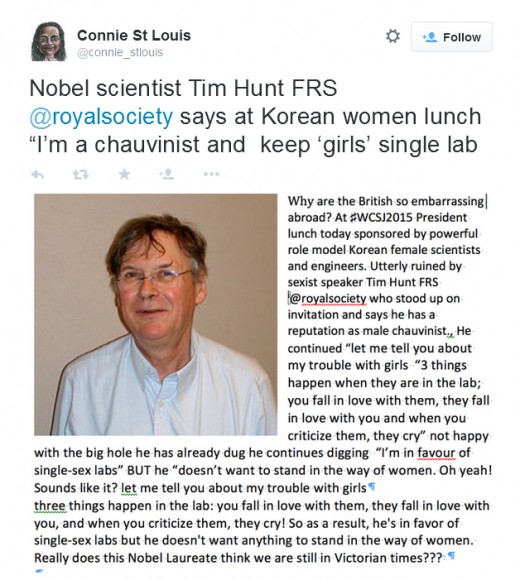
Connie St Louis of London’s City University tweeted that Hunt said when women work alongside men in labs, “you fall in love with them, they fall in love with you, and when you criticize them, they cry.”

From Ms. St. Louis’ Twitter feed:

Tim Hunt tweet

… At … lunch today sponsored by powerful role model Korean female scientists and engineers. Utterly ruing by sexist speaker Tim Hunt FRS [Fellow of the Royal Society] who … says he has a reputation as a male chauvinist. He continued “let me tell you about my trouble with girls.” 3 things happen when they are in the lab; you fall in love with them, they fall in love with you and when you criticize them, they cry” … “I’m in favour of single-sex labs” BUT he “doesn’t want to stand in the way of women.” Oh yeah?

See what I mean about men being too emotional? First he acknowledges that he cannot maintain professional relationships in the lab (“you fall in love with them), then he displays complete irrationality and delusion (“they fall in love with you”), and finally, he demonstrates his inability to handle anyone’s emotions, let alone his own.

Riiiiight! Who wouldn’t immediately fall in love with this stunning example of male beauty?

Tim Hunt

We all know that men are surprisingly irrational creatures. Consider Rosetta scientist Matt Taylor in #shirtgate. Instead of dressing soberly for an interview as a woman scientist would, he could not help dressing provocatively and inappropriately in a Hawaiian shirt adorned with scantily clad busty women.

shirtgate

Sure, he ultimately issued a tearful apology (demonstrating that when you criticize male scientists, they cry), but it’s difficult to imagine a woman scientist committing such an egregious faux pas in the first place.

Hunt is already apologizing, too, if by “apologizing” you mean digging himself in deeper:

Hunt, a biochemist who was joint recipient of the 2001 Nobel for physiology or medicine, said he was just trying to be humorous. He told BBC radio on Wednesday that he was “really, really sorry I caused any offense.”

Then he added: “I did mean the part about having trouble with girls. … I have fallen in love with people in the lab and people in the lab have fallen in love with me and it’s very disruptive to the science.”

Riiiight! He didn’t mean to cause any offense with his blatant sexism. Can’t anybody take a joke anymore?

I do agree with Professor Hunt on one point though, single sex labs. I don’t think we need to go as far as to ban men from science labs, but as Hunt himself has demonstrated, we should not allow them to have leadership roles since they are too emotional to handle leadership. Going forward we should put women in charge of research labs. It won’t be forever, of course, just until men can demonstrate that they have enough control over their emotions to handle working with women in a professional way, not as objects for their romantic attentions.

We need a Twitter hashtag for these types of incidents. When Matt Taylor wore his provocative shirt, they called it #shirtgate.

I suggest that we call this #shitgate since many male scientists, utterly incapable of controlling their emotions, can’t help spewing shit when confronted with women in science.

Childbirth and the invisibility of women’s needs

image

I have often commented that the philosophy of natural mothering (natural childbirth, lactivism, attachment parenting) rests on fundamental assumptions that are often unrecognized and therefore unexamined. I’ve written about the social construction of risk within our culture and the social imperative that everyone (mothers and doctors) do everything possible to minimize risks to babies without ever considering the trade-offs that reducing specific risks imply.

But risk is not the only thing that is socially constructed within the philosophy of natural mothering. Women’s needs are also socially constructed; specifically, in the philosophy of natural mothering, women’s needs are rendered invisible. Natural childbirth advocacy and its approach to the issue of pain in labor is perhaps the paradigmatic example of the way in which natural mothering erases the needs of women.

Natural childbirth advocacy uses several different strategies to render women’s needs invisible. To understand how these strategies work it makes sense to start with the empirical facts that most of us agree upon:

1. Childbirth is excruciatingly painful. Indeed the pain of childbirth is so impressive that ancient cultures imagined that the only possible explanation was divine punishment of women for their transgressions.

2. Severe pain should be treated. No one would ever suggests that cancer pain be ignored or that pain from a broken bone should go untreated.

3. Medical professionals have an obligation to treat pain. Every human being is entitled to the medical treatment of pain if that’s what he or she desires.

Natural childbirth advocates employ a variety of strategies to render invisible women’s need for pain relief. The first strategy is to insist that a mother’s need for pain relief is insignificant when compared to the “risks” of epidurals. This strategy is all the more remarkable when one considers that the “risks” of epidurals are not empirical, but purely speculative. Presumably, the baby has a need and a right, to avoid any potentially harmful effects from epidurals that might be discovered as some unspecified future time. And that need (even though theoretical) trumps the mother’s need for pain relief, despite the fact pain of this magnitude would always be treated if it were from any other source.

The intellectual sophistry of such a claim is all too apparent. The natural childbirth project involves invoking risks that may not even exist and inflating both the severity and the likelihood of such risks. And it rests on the assumption that no matter how theoretical or how small these risks may be, they automatically trump a woman’s need for pain relief. A woman’s need for pain relief is therefore of no consequence and not even worthy of consideration.

Even when natural childbirth advocates concede that women might feel a need for pain relief, they employ a variety of strategies to diminish the importance of that need. These strategies involve

Blaming the woman for her own pain – if she did it “right,” childbirth would not be painful.
Blaming the woman for not using “natural” methods of pain relief – regardless of their questionable value in providing adequate relief.
Blaming the woman for not embracing the pain as an “empowering” aspect of her biological destiny.

Simply put, according to natural childbirth dogma, a woman’s pain in labor is irrelevant, of no importance compared to the baby’s need to avoid theoretical risks, and her own fault.

It is important to note that in natural childbirth philosophy, it makes no difference how small the risk to the baby might be, and it makes no difference how large the mother’s need for pain relief might be. To put that in perspective, it helps to consider another, far more trivial, example of balancing risk and need that all mothers must address.

Consider the issue of driving with a baby in the car. There is no doubt that riding in a car exposes a baby to a real risk of injury and death in a car crash, a risk whose magnitude is far greater than the theoretical risk of an epidural. And consider that the mother’s “need” to go to the grocery store is trivial, and can easily be met at another time without putting the baby in danger of injury or death in a car accident. So why aren’t natural childbirth advocates berating women for driving with infants in their cars? They consider that larger risk socially acceptable. In that case, convenience trumps whatever needs the baby might have.

The reality is that every choice has risks and benefits, and those risks and benefits must weighed against each other. But when a woman’s need for pain relief is rendered invisible, natural childbirth advocates can act as if there is no benefit to pain relief in labor and can pretend that no weighing of risks and benefits is necessary.

It is difficult to imagine any other situation in which ignoring a woman’s severe pain would be socially and ethically acceptable. But for natural childbirth advocates, a woman’s needs are invisible, and therefore merit no consideration.

Adapted from a piece that first appeared in January 2011.

It’s morally repugnant to recommend saving money by forcing women to labor in agony at homebirth

image

I wrote last week about Dr. Neel Shah’s piece in The New England Journal of Medicine musing on the desirability of homebirth.

Dr. Shah piously presents his musing as a way to save women from overtreatment from C-sections, which he derides as like an airbag exploding in a woman’s face. Apparently, Dr. Shah views the promotion of homebirth as a way to save money. On Thursday I noted that Dr. Shah never mentioned (and seemed to be unaware) of the multiple studies and datasets that show that US homebirth has a death rate up to 800% higher than comparable risk hospital birth. He never mentioned (and seemed to be unaware) that in contrast to the UK, the US has a two tier midwifery system with the bulk of American homebirths attended by grossly uneducated, grossly undertrained second tier midwives.

On Friday I asked what message we send to women when we derided C-sections as unmitigated disasters and argued that we convey the message that women who undergo C-sections have failed, have been failed by their obstetricians, or both. That’s hardly a message of support.

Today I’d like to ask another question:

What message do we send to women when we advocate saving money on healthcare by undertreating their agonizing pain? Homebirth doesn’t just save money on over treatment; it saves money by undertreatment, preventing women from getting the most effective form of labor pain relief, an epidural.

We send the ugly, morally repugnant message that, whereas we would never contemplate saving healthcare dollars by undertreating men’s pain, we should not merely permit, but we should encourage saving money by refusing to treat women’s agony.

After all, they’re just women; presumably they’ll get over it. You know what they say: women forget the pain of labor once they see the baby. After all, women’s agony in childbirth is natural, so why should we waste our health dollars ameliorating it? After all, think of how much we could improve healthcare financing simply by forcing women to give birth at home and letting them scream their throats raw.

That’s the odious subtext of saving money by promoting homebirth; women’s excruciating pain is not “worth” treating.

How have we reached the point where women’s pain is not worth the cost of relieving it?

We’ve had lots of help along the way.

To being with, most of us have been raised within religions that view women’s pain in labor as appropriate “punishment” for having sex (even within marriage).

That view received a secular gloss with the advent of the philosophy of natural childbirth. Grantly Dick-Read was explicit in his view that primitive (read: black) women didn’t have pain in childbirth because they understood that their primary role in life was to bear and raise children. Those uppity white women of the wealthier classes, had been “over-civilized” by their educations and their desire for legal and economic emancipation. Their pain in labor reflected their refusal to accept their lot in life. The fear-tension-pain cycle that Dick-Read conjured from whole cloth reflects his view that pain in labor was punishment for women who didn’t wholeheartedly welcome the relegation of women to baby making factories.

Lamaze, the competing philosophy of unmedicated birth, had its genesis in the Soviet Union in the years after WWII. It was a response to the fact that the USSR could not afford pain relieving medications and, in an effort to compete with the West, created a free alternative: Pavlovian conditioning to convince women they weren’t in pain. This was presented as the socialist effort to make pain relief accessibly to the proletariat, when in reality, it was inaccessible for all.

Midwives, contemporary avatars of the natural childbirth philosophy, have demonized epidurals for a different reason; they can’t provide them and therefore cannot profit from them. They don’t oppose all forms of pharmaceutical pain relief; they’re happy to drug women with nitrous oxide since they can do that themselves, but epidurals are verboten. What’s the difference between inevitably agonizing labor described in the Bible and the “empowering” pain of midwifery approved natural childbirth? Salesmanship.

Is it any wonder then that Dr. Shah (just like the money counters at the British National Health Service) finds it perfectly reasonable to save money by depriving women of the chance for effective pain relief in labor? He’s come of age in a society where women’s pain in childbirth is merely acceptable punishment, and within a medical sysatem where it is being aggressively peddled by midwives as positivly desirable: spiritually fullfilling and personally empowering.

While it may be reasonable to Dr. Shah and other who promote homebirth as a cost saving measure, it is morally reprehensible.

Women’s pain matters.

Treating women’s pain is an ethical mandate.

Saving healthcare dollars by deliberately putting effective pain relief out of reach of women forced to labor at home is immoral.

That Dr. Shah (and others who promote homebirth for financial savings) never even considered this dimension of encouraging homebirth is testament to how far women still have to go in being taken seriously as human beings who have the same right to pain relief as men.

Dr. Amy