Guest post: When breast isn’t best

image

Freda McFadden is the co-author of Baby City, a book detailing the life of a resident working on Labor and Delivery in a busy hospital. Dr. Amy provided her advice on a difficult homebirth scene in this novel, and in her honor, 25% of profits will go to the Fistula Foundation.

That’s right, I said it. Breastmilk isn’t always best.

I always considered myself to have a very healthy attitude about breastfeeding. I set a goal for myself to do it for a year, but was willing to occasionally supplement with formula. And when women tell me they want to breastfeed, I try to offer practical tips, including telling them not to stress if it doesn’t work out.

But when I was breast-feeding my younger daughter, I realized that my attitude about breastfeeding was far from healthy.

Ways you know you have an unhealthy breastmilk obsession:

–You have passed up a chance to do something actually enjoyable in order to pump

–Your baby is 6+ months and you are still pumping

–Even though it means you leave work later and see your baby less

–Your freezer contains more milk than food

–You have fed your baby breastmilk that might have been going stale so it wouldn’t get “wasted”

–You make breastmilk bottles for day care with less milk than you think your baby will drink so none of it will get “wasted”

–You feel sad/angry when the baby doesn’t drink all the milk in a bottle because it is “wasted”

–You have given up sleep to pump

–You have given up sleep to keep your baby from getting a single bottle of formula

–You think formula smells bad

–When your baby does get formula, you feel guilty

–Even though you pretend not to, you secretly judge other women who don’t breastfeed for at least a full year

–You find mold on your pumping equipment, but instead of throwing away your frozen stored breastmilk, you continue to feed your baby potentially moldy milk, even though your infant is 10 months old and you still have plenty of fresh breast milk for her. Just hypothetically speaking…

Women are taught to chant “breast is best” in our sleep. (What sleep, right?) But I’d like to think that we women have brains and are not automatons who must breastfeed no matter what, even if it’s not in our best interest.

That’s why my favorite mantra is not “Breast is best,” but rather, “Happy mama, happy baby.”

A version of this article was originally posted in Mothers in Medicine.

Why Modern Alternative Mama Katie Tietje is dangerous

Beware Dog Sign

Katie Tietje, Modern Alternative Mama, is whining again in a post entitled Why The “Science” Critics are Dangerous.

You might be confused into thinking that Tietje is lamenting critics of science, but her helpful use of scare quotes around “Science” signals that she is whining about people who use science to criticize her.

She places herself in lofty company:

Just a few weeks ago, a group of doctors called for Dr. Oz to be fired from a staff position at a university because of his TV show — they didn’t like that he makes strong claims for supplements and alternative health products, and felt that this interfered with his ability to be employed as a serious doctor…

It may or may not surprise you that as a popular blogger in the alternative world, I’ve faced the same types of criticism — obviously on a smaller scale. There are entire groups dedicated to “stopping” me. These groups leave comments on my Facebook page almost daily, telling me how “dangerous” I am and linking to some article that’s pro-vaccine, pro-GMO, etc. They regularly — at least a couple times a month — write articles about me and all the “woo” I peddle.

I ignore them, generally, as do many of my colleagues. (Food Babe is another huge target for these people.) But it seems that despite ignoring them they’re only speaking out more and more. They’re doing so more publicly. They’re writing for major media and calling people out. (emphasis in the original)

Heaven forfend! How dare they speak out! How dare they do so publicly! How dare they write for major media and call people out! Only Katie is allowed to do stuff like that.

And you know what? It’s not okay. Which is why I’m taking a stand today. I think these so-called “science” critics are dangerous people. And it’s time everyone knew.

Why are bloggers like me dangerous?

The real point is, it’s my goal to provide people with another view point. Alternative information. The mainstream isn’t exactly kind to people who choose home birth (or to reject some/all vaccines, or eat only organic, or…). It’s not exactly accurate or remotely unbiased.

There are people looking for that information. People who want to know what “the other side” really thinks about these topics. And they deserve a safe place to go to access that information.(emphasis in the original)

Safe from what, precisely? Is anyone threatening them? No. When Tietje says “safe” she means “safe from demands for proof.”

For Tietje a safe place is one where she can be validated and she can’t be validated if she’s asked to provide proof for her claims because there is no proof. And that’s dangerous.

It is ironic that one of our greatest technological advances has provided an incomparable boon to scientific illiteracy. I’m referring, of course, to the internet. Prior to the advent of the internet, wacky pseudo-scientific “theories” were relegated to the fringes and had to be deliberately sought out. Now pseudo-scientific mumbo jumbo can be widely disseminated.

But perhaps more important than the actual dissemination of misinformation is that feeling of validation that internet communities provide. Pseudoscience can thrive when believers congregate on message boards that validate bizarre beliefs and ban information that undermines those beliefs. They don’t call it validation, though; that’s too clinical. They call it “support.”

Hart et al. explore this phenomenon in their paper Feeling Validated Versus Being Correct: A Meta-Analysis of Selective Exposure to Information. The authors explain:

… Receiving information that supports one’s position on an issue allows people to conclude that their views are correct but may often obscure reality. In contrast, receiving information that contradicts one’s view on an issue can cause people to feel misled or ignorant but may allow access to a valid representation of reality. Therefore, understanding how people strive to feel validated versus to be correct is critical to explicating how they select information about an issue when several alternatives are present. (my emphasis)

Avoiding cognitive dissonance is central to the search for validation:

… According to dissonance theory, after people commit to an attitude, belief, or decision, they gather supportive information and neglect unsupportive information to avoid or eliminate the unpleasant state of postdecisional conflict known as cognitive dissonance.

Minimizing cognitive dissonance requires selective exposure, seeking out information sources that confirm existing beliefs and avoiding sources that undermine those beliefs.

Tietje is correct that her critics are dangerous; they are dangerous to her self-esteem. Asking Tietje for proof or offering scientific evidence that she is wrong creates cognitive dissonance and Tietje and other believers in quackery cannot abide cognitive dissonance. Tietje finds cognitive dissonance unbearable, not merely because it causes leads to questioning her core beliefs, but because her self esteem rests on those beliefs.

Tietje’s claims about the dangers of critics of quackery would be hilarious except for the fact that she actually believes them.

They think that the mainstream view is clearly “right” and they’ll do anything to prove it.

Earth to Katie! Earth to Katie! That’s what science, real science, is all about. It looks for the right answer and the answer can only be right if there is proof.

These are people who will go to any length to say that there is ONE correct view.

That’s because there often is only ONE correct view. You can pretend that there is no gravity, but that doesn’t eliminate gravity. You can believe that the earth is flat, but that doesn’t make it flat. You can insist that vaccines are dangerous, but that doesn’t mean they’re actually dangerous.

And yet, they take no responsibility for the results of these actions.

Because Katie always takes responsibility for her recommendations. Oh, wait! She never takes responsibility.

I provide information; it’s up to you to read more, ask questions, and make a decision to use or ignore it.

Just so long as you don’t ask Katie any questions or request proof.

It’s time to stand up and say NO to these people.

… They do NOT have the right to harass people with an alternative view point.

Harass? Asking questions is not harassment. Insisting on proof is not harassment. Criticizing someone who publicly posts her beliefs for the entire world to see is not harassment!

Her conclusion (Irony thy name is Katie!):

Stand up for what you believe in and choose. Share information even when people don’t like it. Don’t let them make you stop.

Let me assure you Katie, that I’m taking your advice. I’m standing up for science. I’m sharing information whether you like it or not. And there’s nothing you can do (even whining about me) to make me stop calling you out for your dangerous quackery and your equally dangerous belief that you should be “safe” from any need to provide proof.

Our unwitting surrender to sexism enshrined in a single word: Mama

Super Mom - illustration of multitasking mother

More than two decades ago, when my children were small and I was a working mother, I read an article on how would we know that true gender equality had arrived.

You would know when you received a call at your workplace from your husband who said this:

“Honey, I just wanted to let you know that I’m taking next Tuesday afternoon off to take the baby for his MMR vaccine.

And I noticed that Jake, our three year old, is outgrowing his shoes so I’ll take him to Stride Rite on the way back.

Oh, you may not have seen it, but yesterday in the bottom of Sophia’s back pack there was a note from school; the first grade is making fruit salad tomorrow and Sophia’s been assigned to bring the papaya. I’ll pick it up on my way home from work.”

Nearly 25 years later, that day has not yet arrived.

I thought about that after reading two pieces by writers I admire published on Mother’s Day.

The first was Judith Shulevitz’ Mom: The Designated Worrier, which lays out the problem.

I wish I could say that fathers and mothers worry in equal measure. But they don’t. Disregard what your two-career couple friends say about going 50-50. Sociological studies of heterosexual couples from all strata of society confirm that, by and large, mothers draft the to-do lists while fathers pick and choose among the items. And whether a woman loves or hates worry work, it can scatter her focus on what she does for pay and knock her partway or clean off a career path. This distracting grind of apprehension and organization may be one of the least movable obstacles to women’s equality in the workplace.

The second, The Rise of ‘Mama,’ by Elissa Strauss offers an explanation for why nothing has changed.

This use of mama can be traced back to women like Ariel Gore, who began publishing her alternative parenting magazine “Hip Mama” in 1993. Inspired by her experience as an urban single mom, the magazine became the source of parenting advice for riot grrrl types, tattooed and pierced women who wanted to find a way to embrace parenthood while simultaneously rejecting much of the bourgeois accouterment that comes along with it.

This fringe quality of “mama” stuck, leading to websites like the “Wellness Mama,” the home of a popular alternative lifestyle guru named Katie who is into stuff like, “cloth diapering, natural birthing, GAPS dieting, homeschooling, not eating grains, making my own toothpaste, drinking the fat and more.” For her, being a mama isn’t just about parenting one’s kids, but seeing parenting as a medium through which one can change the world.

But “cloth diapering, natural birthing, … homeschooling, … [etc.]” is not about changing the world. It’s about keeping women in the home, too busy with mothering to do anything else. It embodies the fact that, as I wrote last week, both natural parenting and religious fundamentalism reflect fear of women’s emancipation:

…[A]ll three major components of natural parenting (natural childbirth, lactivism and attachment parenting) were created in direct response to women’s emancipation and their refusal to remain at home content with the traditional role of a mother.

It is not a coincidence, therefore, that natural parenting requires tremendous sacrifice on the part of the mother and only the mother. Indeed every element of natural parenting, extending to vaccine rejection and organic food, makes more work for mothers. Moreover, it is hardly a coincidence that the home is the heart of natural parenting. From homebirth to homeschooling, the natural mother never has to leave the house and certainly should never be employed outside the house when her children are small.

Sadly, the rise of the word ‘Mama’ reflects this generation’s eager, unwitting surrender to sexism.

Don’t get me wrong, I adored being called Mama by my children. I remember musing when my youngest was small that I had three different appellations from four children: Mama, Mommy, and Mom, reflecting their ages.

But Mama is reserved for children. Anyone else who uses the term to describe another woman is reducing that women to domestic work and relegating her to the home. Using it to describe oneself is capitulating to the backlash against women’s emancipation. Instead of rejecting relegation to the home, “Mama” celebrates it.

As a woman who struggled mightily to be accepted into a traditionally male career, I am dumbfounded by women’s willingess to call themselves by an infantilising, pejorative term. ‘Mama’ should have gone out with ‘girl,’ ‘honey’ and ‘Mrs.’ all traditionally used to keep women in their place.

Labeling yourself ‘Mama’ is glorifying gender inequality. Worse, it is a sign of utterly giving up on the possibility of gender equality. It is not merely “mothers draft the to-do lists while fathers pick and choose among the items” as described by Shulevitz, it is making mother’s to-do lists endless, grafting everything from growing your own food, washing diapers and homeschooling onto the already very long list.

This past weekend I was at the Smithsonian Museum of Natural History that includes several exhibits on the rise of technology including domestic technology. You don’t need to be a cultural anthropologist to recognize that women’s liberation from domestic slavery was achieved because of domestic technology including ovens, washing machines, and dishwashers, and medical technology including the birth control pill and infant formula. By deliberately rejecting that technology, ‘Mamas’ are unwittingly re-enslaving themselves, kowtowing to the pressure to retreat from the wider world back into domestic confinement.

According to Strauss:

The cool factor of mama is why women are also using it to address one another as well.

“When I hang out with others moms we usually refer to one another as ‘mama.’” said Raquel Miller, a writer and graphic designer and mom of one in Los Angeles. She said it’s the go-to term among her hipper friends, the “Hollywood moms.”

This edgy sweetness has made “mama” a hit in the mothering blogosphere as well. Mama’s become the go-to term for talking about the sentimentality of the experience without sounding too old-fashioned, and one that mothers can be expected to rally around.

But there is nothing cool or edgy or sweet about viewing yourself as a domestic slave no matter how much you love mothering.

If you give an anti-vaxxer an admonition

HiRes copy

With apologies to Laura Joffe Numeroff.


If you give an anti-vaxxer an admonition (to vaccinate)
She’s going to ask for a reason.

When you tell her it will prevent disease
She’ll insist that disease was disappearing before the advent of the vaccine.

When you show her how many deaths have been prevented
She’ll declare it’s a result of good of nutrition.

Then she’ll point out that her children haven’t been vaccinated and they haven’t gotten sick.


If you tell her that her children haven’t gotten sick because other children are vaccinated
She’ll tell you she couldn’t care less about other people’s children.

When you explain that she should care because herd immunity protects babies and children with cancer
She’ll proclaim that herd immunity doesn’t exist.

When you tell her relying on others to vaccinate makes her unethical
She’ll ask you why you think vaccinated children are vulnerable if the vaccine really works.

Then she’ll post to her friends on her anti-vax message board that she really showed you.


If you make vaccination mandatory for public school education
She’s going to insist her rights are being violated.

When you explain that there is no right to hurt other children
She’ll declare that you are in the pocket of Big Pharma.

When you point out that Big Pharma does not pay you anything
She’ll insist that you’re just a sheeple who believes whatever you are told.

Then she’ll loudly declare that the Nuremberg Code prohibits human experimentation.


Once she’s compared you to the Nazis, she’s lost control completely
And she’ll bombard you with links to Whale.to, LewRockwell.com and Joe Mercola.

You’ll have to point out repeatedly that these are not scientific citations.

Then she’ll declare that she’s spent too much time trying to educate a dolt like you and she’ll flounce from your website.

But she won’t stick the flounce.


When she inevitably returns
It will be to rail against antibiotic resistant microbes.

When you point out that resistance can be overcome with new, more powerful antibiotics
She’ll insist that pathogens will become resistant to the new agents, too.

Then you’ll proudly tout the fact that we can avoid antibiotic resistance altogether
A prospect she will welcome, until …

You tell her we have developed a vaccine against the antibiotic resistant organisms.

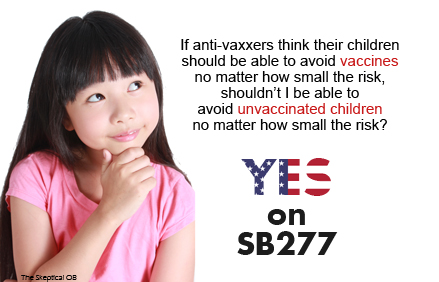
Vote YES on SB277: if anti-vaxxers are allowed to avoid vaccines, the rest of us should be allowed to avoid anti-vaxxers

Yes SB277

Anti-vaxxers, help me out here. There’s something I don’t understand.

You have been aggressively campaigning against California Senate Bill 277 introduced in the wake of the Disneyland measles outbreak. SB277 would do away with personal vaccine exemptions, meaning that all children would be required to be fully vaccinated in order to go to public or private schools. The only exemptions allowed would be medical exemptions for allergy to vaccine ingredients or history of a serious adverse reaction to vaccines.

According to the website No on SB277:

Those children who are not completely up-to-date on every state mandated vaccine will be denied a public education ” SB 277 impacts children in private or public elementary or secondary school, child care center, day nursery, nursery school, family day care home, or development center.” SB 277, would eliminate a parent’s right to exempt their children from one, some, or all vaccines, a risk-laden medical procedure…

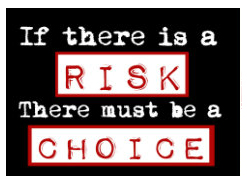
There’s even a handy little image to put the point across:

Risk choice

Or as the website insists:

Where there is a risk of injury or death, no matter how small the perceived risk may be, there must be a choice.

That’s pretty straightforward and easy to understand, but here’s the part I don’t understand (stick with me here, because this is intellectually tricky):

If you believe that you should be able to avoid vaccinating your children because you consider vaccines dangerous, shouldn’t everyone else in California be able avoid your unvaccinated children because they consider them dangerous?

Children who haven’t been vaccinated pose a risk because they can carry and spread vaccine preventable diseases. How big a risk? That doesn’t matter, right? It doesn’t matter how small the perceived risk may be, there must be a choice.

Shouldn’t you be voting FOR SB277?

When it passes, you will be able to exercise your right to protect your children from vaccines no matter how small the perceived risk may be and everyone else will be able to exercise their right to ban your children from schools no matter how small the perceived risk may be. Everyone will be happy!

Wait, what? You disagree??

Since education is compulsory, opting for no schooling will not be an option.

Duh! That’s the whole point of SB277. Since education is compulsory, despite the fact that your children pose a health threat to the majority of children, their parents are forced to expose them to the threat.

According to you and your anti-vax compatriots:

Risk choice

If there’s a risk, there must be a choice!

Your children pose a risk, and the rest of us have made our choice: you can’t send them to school unless they are fully vaccinated!

That’s why we (and you!) should be encouraging a YES vote on SB277.

Anything else would be astounding hypocrisy on your part, right?

Right??!!

For Mother’s Day: let’s be more MOM-passionate, less MOM-petitive

image

On this Mother’s Day, I have a wish for mothers:

I wish for a society that is more MOM-passionate and less MOM-petitive.

Mothering is a difficult job involving just about every physical and emotional resource a woman can call upon. From the physical pain of childbirth to the emotional pain of leaving a child at college, from the physical exhaustion from staying up all night with a sick child to the emotional exhaustion of staying up all night waiting for a teen who has broken curfew, from the exasperation of negotiating with a toddler to the even greater exasperation of negotiating with a teenager.

We know what it is like; we all go through it. That makes it all the more surprising that we live in a society where the dominant mothering ideology, natural parenting (natural childbirth, lactivism and attachment parenting), is so utterly lacking in support for each other. Natural parenting —high intensity/high stakes parenting — sacrifices MOM-passion on the altar of MOM-petition.

There appears to be no recognition that different children have different needs and that different mothers also have different needs. There is a tremendous emphasis on a woman’s reproductive organs and very little emphasis on her emotional identity. There seems to be precious little acknowledgement that children are people, not products to be primped and primed for adult economic competition.

Our society has missed the most critical insight: there are many different, equally excellent ways to raise a child. Instead, we have reduced mothering from a complex alchemy to a simple recipe … the better to keep score with other mothers.

But we have the power to change things, from this Mother’s Day forward we can replace the senseless MOM-petition with compassion for our fellow mothers, struggling, just as we are, to do the right things for our children.

I am not a particularly religious person, but when my four children were small, and I went from room to room each night gazing upon them before I went to bed (so angelic compared to their devilish selves during the day!), I often said a little prayer:

“Please grant me the wisdom and the patience to be the mother they need me to be.”

My wish on this Mother’s Day is that we can be the mothers our children need us to be in order to thrive, not the mothers our friends need us to be in order to approve.

Everything wrong with the American enchantment with “natural” in one simple image

image

A picture is worth a thousand words.

People (myself included) have devoted tens of thousands of words to debunking the American love affair with the naturalistic fallacy, but none of us has come close to the unwitting brilliance Briana Santoro* of The Naked Label. Using a quote from Diane Sanfilippo, Santoro created an image that encapsulates what’s wrong with everything from “natural” food to natural childbirth.

What is the naturalistic fallacy, sometimes known as the is-ought problem? It is the fallacy that if something is a certain way in nature, that’s the way it ought to be. It is widely beloved of anti-vaxxers, organic food advocates, and natural childbirth advocates among others.

Why does Santoro’s image perfectly capture what’s wrong with our obsession with “natural”?

Because it is a picture of amanita muscaria, a poisonous mushroom!

How does this illustrate the many deficiencies of the naturalistic fallacy? Let me count the ways:

1. First and most obvious, just because it is natural, doesn’t mean that something is good or even safe. Rattlesnakes are natural, earthquakes are natural and untimely death from eating poison mushrooms is entirely natural.

2. Being pretty is entirely compatible with being deadly. Santoro had thousands of pictures of mushrooms available to her to illustrate her meme, but she chose amanita because it is attractive and conveys the impression of purity. Advocates of the natural are often fooled by appearances. Natural childbirth advocates are dazzled by images of natural birth but it never crosses their mind that something that looks so beautiful can easily and routinely be deadly. Antivaxxers are distressed by images of injections and it never crosses their mind that something that looks so unpleasant could easily and routinely be lifesaving.

3. Advocates of the “natural” routinely privilege intuitive thinking over analytical thinking without realizing that intuitive thinking is very often wrong. Intuitively, amanita muscaria looks like it’s good for you. Analytically, it’s deadly.

4. Advocates of the “natural,” particularly those who shill for it like celebrity food activists, celebrity antivaxxers and celebrity natural childbirth advocates are startlingly stupid. The depth and breadth of their ignorance is exceeded only by their unmerited self-regard. They are walking, talking, illustrations of the Dunning Kruger effect whereby the least competent are entirely unable to recognize their own incompetence.

Santoro’s meme mishap has important implications for those enchanted by the natural. I’ve created an acronym to remind you if you are tempted to fall for the naturalistic fallacy: S.P.I.N.

S = Safety. Just because it is natural does not mean it is safe.

P = Pretty. Just because it is pretty does not mean it is safe.

I = Intuition. Intuition cannot distinguish between safe and deadly.

N = Nitwits. Purveyors of the natural are often nitwits, utterly ignorant and dangerous.

The next time someone tries to convince you that something is good for you because it is natural, think about S.P.I.N. If you don’t, you might just end up eating a poison mushroom because a clown like Briana Santoro told you it was not merely safe, but better for you because it’s natural.

*N. B.: Attribution corrected. Although the quote comes from Diane Sanfilippo, the meme was created by Briana Santoro of The Naked Label.

Both natural parenting and religious fundamentalism reflect fear of women’s emancipation

image

Arguably the greatest civil rights achievement of the 20th Century was the emancipation of women. For all of human existence, women had been relegated to secondary, nearly subservient, status. For the first time ever, some women in some societies were able to take their place alongside men, finally achieving political, intellectual and legal equality.

I lived through the culmination of the emancipation wrought by the “women’s liberation” movement. Even though it was the tail end of more nearly 100 years of advances, it is difficult to exaggerate the profound changes that took place between the 1960’s, when as a child I was told that women could not be doctors, through the 1970’s when as a high school athlete I was told that women did not merit uniforms or equipment, to the 1980’s when I entered medical school. Don’t get me wrong, gender discrimination did not disappear, but it became widely acknowledged as a bad thing, not an inevitability.

Profound social change does not occur without opposition or fear. In my view, both the rise of natural parenting and the rise of religious fundamentalism are due in part to backlash against the emancipation of women. And both function, explicitly or implicitly, to keep women in the home.

The natural childbirth movement was created explicitly in response to women’s emancipation. As I have detailed many times, most recently a few days ago, Grantly Dick-Read was painfully honest that he created the philosophy of natural childbirth as a way to keep women at home; only there could they find true happiness by fulfilling their biologic destiny, and then they would stop agitating for political, legal and economic equality.

While doing research for my forthcoming book I learned, to my surprise, that La Leche League and the lactivist movement were founded for similar reasons. In the book La Leche League:At the Crossroads of Medicine, Feminism, and Religion, Jule DeJager Ward explains that the La Leche League was:

…founded in 1956 by a group of Catholic mothers who sought to mediate in a comprehensive way between the family and the world of modern technological medicine…

[A] central characteristic of La Leche League’s ideology is that it was born of Catholic moral discourse on family life … The League has very strong convictions about the needs of families. These convictions are the normative heart of its narrative… The League’s presentations and literature carry a strong suggestion that breast feeding is obligatory. Their message is simple: Nature intended mothers to nurse their babies; therefore, mothers ought to nurse…

The idealization of motherhood reflects the place of Mary in Catholic popular devotion…

The League’s answer to the question “What should mothers do” is grounded in … the original faith community of its founders.

For those women, the contents of their Catholic faith and the existential question of motherhood are interdependent…

Just as Grantly Dick-Read created natural childbirth in opposition to women’s demands for emancipation, LLL channeled the Catholic Church’s opposition to women’s emancipation, in particular women’s desire to work for their own economic freedom. Breastfeeding, therefore, came to be viewed as part of the Catholic mother’s obligation to remain at home with her children.

Indeed, the founders of LLL were aware of the complementarity of their views and those of natural childbirth. In one of their first major meetings, in 1957, Grantly Dick-Read himself was the featured speaker.

Attachment parenting is a product of similar beliefs about women and families. Dr. William Sears, a religious fundamentalist and father of eight, is widely credited with creating attachment parenting. He certainly popularized it, but attachment parenting had its inception with The La Leche League.

But according to Peggy O’Mara, Editor of the defunct Mothering Magazine (now a website and message board):

Sears published his book, The Fussy Baby, with La Leche League in 1985, at a time when he was the most well known of LLL’s physician supporters. He is widely credited with coining the term attachment parenting and wrote a book on the subject in 2001. But, Dr. Sears did not invent attachment parenting.

Two young La Leche Leaders, Barbara Nicholson and Lysa Parker, were influenced by Dr. Sears and fascinated with attachment theory…

As Nicholson and Parker became increasingly steeped in research on the critical attachment period, they wanted to educate others, and, in 1995 they formed Attachment Parenting International.

So all three major components of natural parenting (natural childbirth, lactivism and attachment parenting) were created in direct response to women’s emancipation and their refusal to remain at home content with the traditional role of a mother.

It is not a coincidence, therefore, that natural parenting requires tremendous sacrifice on the part of the mother and only the mother. Indeed every element of natural parenting, extending to vaccine rejection and organic food, makes more work for mothers. Moreover, it is hardly a coincidence that the home is the heart of natural parenting. From homebirth to homeschooling, the natural mother never has to leave the house and certainly should never be employed outside the house when her children are small.

In my judgment, it is also not a coincidence that religious fundamentalism experienced a renaissance in the US in the wake of the “women’s liberation movement.” Religious fundamentalists root their opposition to women’s emancipation in their reading of the Bible. Many embrace the tenets of natural parenting. They cite religion as the reason why women must be subservient to their husbands and occupied entirely with their children, but the end result is that same: more work for mothers and no opportunity for women in the larger world.

That’s not to say that every woman who embraces the tenets of natural parenting is committed to perpetuating a patriarchal society, the type of society embraced by the founders of natural childbirth, lactivism and attachment parenting. Individual women make individual choices based on the needs of their families and their own desires. A woman can be a natural parenting advocate and a feminist, but it is important to understand that natural parenting was created, and is often promoted in direct opposition to feminism.

It’s not an accident that much of natural parenting, from home birth to home schooling, is centered on the home. Natural parenting, like religious fundamentalism, has at its heart the imperative to keep women at home and to promote the patriarchal status quo.

It’s time for a new paradigm: the materna-centered model of care

image

The 20th Century was a golden age for maternity care. With the advent of modern obstetrics, childbirth went from a routinely deadly event to a rarely deadly advent. A myriad of interventions, from antibiotics to blood banking, from safer anethestia to safer C-sections, from neonatal ventilators to surfactant led to a 99% drop in maternal mortality and a 90% drop in neonatal mortality. The medico-technocratic model of maternity care has been a stunning success.

But the medico-technocratic model of care placed the the convenience of physicians ahead of maternal autonomy, and the midwifery model of care was advanced as a corrective. The midwife model of care put the focus back on women’s experience. Once childbirth was routinely safe, it made sense to focus on more than whether the mother and baby survived the experience. The midwife model of care acknowledged that many practices existed merely for physician convenience and offered no benefit for women and perhaps harmed them, or at the very least was cold and impersonal. Making sure that mothers are awake and aware for the birth of their children, inviting partners and other family members in for the birth, and rigorous investigation of routine maternity practice dramatically improved women’s experience.

Although the midwife model of care has brought improvements, it suffers from a similar problem as the medico-technocratic model of care. It still puts the provider at the center of care. The midwife model takes the core beliefs of midwives as incontrovertible fact, specifically the idea that there is a “best” way to give birth and that best way involves as little technology as can possibly be used. Midwives start with the bedrock assumption that unmedicated vaginal birth is the ideal and anything else represents a deviation from ideal. It uses midwives beliefs as its starting point, and that’s the wrong place to start.

I propose a new model of childbirth care for the 21st Century: a materna-centric model of care. A materna-centric model would take the best features of the two previous models, the dramatic improvement in safety wrought by the medico-technocratic model, and the focus on experience provided by the midwife model, but it would locate mothers at the heart of maternity care, their views, their values, their desires. The materna-centric model of care would have as its fundamental premise the idea that birth experiences are contingent on maternal culture, values and personal experiences. When you place the mothers values at the center, it is obvious that there is no best way to give birth; there is only what the mother prefers.

There is no need to glorify vaginal birth, and no reason to valorize refusing pain relief. The model is both culturally sensitive and personally sensitive. What constitutes a good birth is going to be different for a woman from Southeast Asia than for a woman from the US Southeast. What constitutes a good birth for a woman from a fundamentalist religious sect is going to be different from a good birth for a woman who works in the tech industry. Nobody is wrong. And, most importantly, no one’s birth choices make her superior to anyone else.

It may be helpful (albeit imperfect) to draw an analogy between maternity providers and interior decorators. Obstetricians can be understood as decorators who limit their designs to spare and functional choices. They decorate houses with every piece of furniture you need, but much of it is drab, and some of it is not comfortable. Midwives go beyond obstetricians in that their designs are colorful and comfortable. There’s just one problem; they only decorate in their preferred style, shabby chic. The equivalent of the new maternity provider (doctor or midwife) would be a decorator who decorates in the style that the client prefers, not the style that is most convenient for the decorator or most pleasing to the decorator.

The midwife model of care is outdated because it places the midwife at the heart of maternity care. As a result, it serves the needs of midwives, but leads to unnecessary suffering and tremendous guilt on the part of mothers. We need a model of maternity care that places mothers squarely at the center of care, and uses their values as the touchstone for decisions, not the provider’s values.

In other words, we need a materna-centered model of care.

Natural childbirth has always been about keeping women in their place

iStock_000015897241_Small

Yesterday I wrote about Sheila Kitzinger’s acknowledgment that many feminists consider natural childbirth to be deeply anti-feminist because of its baseline assumption that agonizing pain is good for women, and its glorification of women’s reproductive organs ahead of their minds, talents and characters.

It’s hardly surprising that natural childbirth is deeply retrograde and anti-feminist. The philosophy of natural childbirth is and has always been about keeping women in “their place,” pregnant, at home and restricted to the domestic sphere.

Grantly Dick-Read, the creator of the philosophy was explicit about his sexism.

According to Dick-Read:

Woman fails when she ceases to desire the children for which she was primarily made. Her true emancipation lies in freedom to fulfil her biological purposes…

And:

…[T]he mother is the factory, and by education and care she can be made more efficient in the art of motherhood.

Grantly Dick-Read’s theory of natural childbirth grew out of his belief in eugenics. He was concerned that “inferior” people were having more children than their “betters” portending “race suicide” of the white middle and upper classes. Dick-Read believed that women’s emancipation led them away from the natural profession of motherhood toward totally unsuitable activities. Since their fear of pain in childbirth might also be discouraging them, they must be taught that the pain was due to their false cultural beliefs. In this way, women could be educated to have more children.

Pain in childbirth served a very important function in this sexist discourse: it was the punishment that befell women who became too educated, too independent and left the home. The idea that “primitive” women had painless childbirth was fabricated to contrast with the painful childbirth of “overcivilized” women.

In other words, the philosophy of natural childbirth was created in reaction to early feminist victories in acquiring political, legal and economic rights.

As I wrote yesterday, women like Kitzinger decided to make a virtue of necessity. If they were going to be judged by the function of their reproductive organs, then they would glorify those organs and concomitantly demonize technology which was, in their minds, a product of men. No longer would the purpose of childbirth be to produce children; its purpose was expanded to produce birth “experiences” that validated women for placing the function of their reproductive organs at the heart of their self-image.

The philosophy of natural childbirth locates a woman’s virtue in her vagina, and exults in her agony.

Hence Kitzinger wrote:

Birth isn’t something we suffer, but something we actively do, and exalt in!

And:

In achieving the depersonalization of childbirth and at the same time solving the problem of pain, our society may have lost more than it has gained. We are left with the physical husk; the transcending significance has been drained away. In doing so, we have reached the goal which perhaps is implicit in all highly developed technological cultures, mechanized control of the human body and the complete obliteration of all disturbing sensation.

And:

In most societies birth has been an experience in which women draw together to help each other and reinforce bonds in the community. Now that eradication of pain with effective anesthesia is often the only issue in any discussion of birth the sacramental and social elements which used to be central to women’s experience of birth seem, for an increasing proportion of women, to be completely irrelevant.

Feminist philosopher Katherine Beckett, in Choosing Cesarean: Feminism and the politics of childbirth in the United States explains the feminist critique of natural childbirth:

The idea that women do (or should) savour, enjoy, or feel empowered by the experience of labour and delivery … romanticizes women’s roles as lifebearers and mothers, and assumes an emotional and physical reality (or posits an emotional and physical norm) that does not exist for many…

In short, some feminists perceive the alternative birth movement as rigid and moralistic, insistent that giving birth ‘naturally’ is superior and, indeed, is a measure of a ‘good mother’…

In other words, Kitzinger’s view of natural childbirth functioned to keep women in their place acknowledging that women are restricted to a certain role, romanticizing that role, and utterly ignoring the suffering that women endured because they were restricted to that role.

Pain in childbirth has always been about who holds power.

Men had the power to insist, through religion, that women’s pain in childbirth was a form of divine punishment for their sins. They could and did withhold anesthesia from laboring women.

Then came a woman who was more powerful than all the clerics and doctors, Queen Victoria.

In her role as Head of the Anglican Church, she had the power to declare that childbirth anesthesia did not violate a divine plan for female punishment. She used anesthesia in childbirth and she liked it.

Queen Victoria was not a feminist, but the early feminists who followed in her wake a few decades later considered that easy access to childbirth pain relief was a political issue. Increasing access to pain relief in labor reflected women’s growing political power. That is precisely what Grantly Dick-Read feared.

But it was not just pain relief that liberated women from “their place.” Technology of all kinds, from antibiotics to blood banking to safer C-sections liberated women from the fear of death in childbirth. And the benefits of technology were not limited to childbirth itself, but extended to infant formula that liberated women from breastfeeding if they wished it, and the oral contraceptive pill that liberated women from endless unwanted pregnancies that sapped their health and prevented them from taking their place in the larger world along side men.

The philosophy of natural childbirth makes women slaves to their biology and therefore renders them merely handmaidens to men, unable to take the reins of political, legal and economic power. Natural childbirth keeps women in their place, pregnant, at home and restricted to the domestic sphere. True, it glorifies their slavery, but it remains slavery nonetheless.

Dr. Amy