Buzzfeed, why are you glamorizing risking a baby’s life at homebirth?

Michael Jackson dangling baby

Buzzfeed, would you glamorize a parent who held his or her baby out over a balcony railing ten stories up as Michael Jackson is doing in this photo?

It’s really no different glamorizing a footling breech homebirth.

single footling breech

Actually it is a bit different. A breech homebirth is far more dangerous than dangling your baby off a balcony.

Why? The risks of labor differ substantially for breech babies.

How?

Fetal head entrapment may result from an incompletely dilated cervix and a head that lacks time to mold to the maternal pelvis. This occurs in 0-8.5% of vaginal breech deliveries… The Zavanelli maneuver has been described, which involves replacement of the fetus into the abdominal cavity followed by cesarean delivery. While success has been reported with this maneuver, fetal injury and even fetal death have occurred.

Nuchal arms, in which one or both arms are wrapped around the back of the neck, are present in 0-5% of vaginal breech deliveries and in 9% of breech extractions.[4] Nuchal arms may result in neonatal trauma (including brachial plexus injuries) in 25% of cases…

Cord prolapse may occur in 7.4% of all breech labors. This incidence varies with the type of breech: 0-2% with frank breech, 5-10% with complete breech, and 10-25% with footling breech…

In other words:

At term, the baby’s head is usually the largest part of the baby. That means that if the head fits, the rest of the baby should follow without difficult (shoulder dystocia is an exception). Moreover, the bones of the fetal skull are not fused and can slide past each other, allowing “molding” of the fetal head letting it squeeze through the pelvis. In the breech presentation, the head is still the biggest part of the baby, but now it is coming last and there is no chance for it to mold to squeeze through the pelvis. There is a high risk that the head will be trapped, often resulting in the death of the baby.

In addition, in contrast to vaginal delivery where the baby’s arms are pressed to its sides, the arms of a breech baby may end up over its head. One or both can end up behind the head crossing the neck. This is known as nuchal arms. A baby with nuchal arms cannot be delivered because the diameter of the head plus the arm(s) is too big to fit through the pelvis. Unless the provider can move the arm(s) from behind the head, the baby will die.

Typically, the head fills the cervix as it is dilating, making it impossible for the cord to prolapse (fall out), a condition that routinely ends in death. In contrast, the breech, being smaller, does not fill the cervix, making cord prolapse far more likely.

Without immediate access to C-section, cord prolapse has a mortality rate from 32-47%.

The risk of death at a footling breech homebirth can be as high as 12%, which means that as many as 1 in 8 babies will die during a footling breech homebirth. That’s only slightly better than the odds of playing Russian Roulette by pointing a gun at your baby’s head. Would you glamorize that?

Buzzfeed, if you want to show what homebirth is REALLY like, show some photos of complications and death. Without those, your piece in nothing more than an advertizement for taking terrible risks with babies’ lives.

I will not stay silent so that you can stay comfortable

Silent comfortable

Just about everyone involved in the episode of midwife bullying that I detailed last week has weighed in.

In an open letter to the chair of the forthcoming maternity review, I wrote:

I observed a group of midwives that has become a sisterhood of deadly enablers, ignoring deaths of their patients, incapable of tolerating criticism or even listening to it, patrolling social media to keep obstetricians and loss parents in line, and cheering each other on by encouraging outright dismissal of any criticism.

And:

In the 100+ tweets that passed back and forth over the course of the day yesterday, I did not see even a single one from a midwife acknowledging the appalling litany of maternal and perinatal deaths at the hands of UK midwives. The same dangerous midwifery culture that leads to praise of homebirth after 3 C-section also leads to shirking any responsibility in maternity deaths, and the privileging of process over outcome that the obstetrics professor, the loss father, and I are working hard to confront.

The obstetrician shared his thoughts on Sunday:

I’m afraid I kept my head down – accusations of unprofessionalism, especially when copied to the RCOG make me nervous; I’m still in clinical practice and have had run-ins with them before – and when something goes viral it is difficult to avoid digging a bigger hole…

The loss father weighed in yesterday:

What has really surprised me though, is observing that even the mere act of copying Tuteur into a tweet led to a respected professor of obstetrics being accused of being ‘very unprofessional’ and the veiled threat of copying in the RCOG. For me, this crosses a line. As users of social media we have an absolute right to choose who we engage with and to block/ignore or mute those we wish. However, I don’t think it’s right that any person or group of people should decide that someone is so unacceptable to them, that they monitor who else engages with them and make very serious and public accusations about the professional conduct of anyone who does.

I do think that this is a form of bullying…

In contrast, Sheena Byrom held a pity party for herself and invited others to pity and support her (The dark side of social media):

But for those who continue to intimidate, harass and bully individuals and professional groups, and to undermine evidenced based models of maternity care, I have one message.

I have wobbled, but your actions have made me stronger.

Wait, what? Sheena Byrom barged into a twitter conversation that had NOTHING to do with her, bullied and threatened an obstetrics professor AND a loss father, and when called out for it, whines that SHE was bullied.

She received many tweets and emails from other midwives in support of her position. In support of her position? The one where she attempted to police whom others could communicate with on social media? I kid you not.

That typifies so much of what is wrong with UK midwifery culture: the inability of midwifery leaders and prominent midwives to acknowledge mistakes, the refusal to take responsibility for their own actions, the rush to blame everyone else, and most especially, a culture of relentless bullying that is not merely accepted as normal, but treated as a right with which no one should interfere.

My intention in writing about this incident so extensively was to shine a bright light on a pattern of action by a prominent group of UK midwives: bullying, contemptuous dismissal of infant loss, shirking of responsibility, refusal to acknowledge that obsession with normal birth leads to preventable deaths, and a relentless culture of closing ranks to ignore, dismiss and hide midwifery negligence.

A group of prominent midwives and midwifery leaders helped me achieve far more than I could have hoped, and I have a message for them:

I will not stay silent so that you can stay comfortable. The stakes — the lives and health of mothers and babies — are too high for me to walk away.

Hannah Dahlen bemoaning birth disappointment is like the fashion industry bemoaning negative body image

Young anorexic

Midwifery Professor Hannah Dahlen is back, bemoaning “a toxic postnatal experience.”

Women have told us there is something worse than death – there is being alive but dead inside. There is being so traumatised by pressurised interventions in their birth plan that they can’t care for their newborn or have a relationship with their partner, and their own mental health is affected. Ms Tait’s comment that “whether a baby first glimpses the light of day via the stomach, in a pair of forceps, or via the vagina, what matters is that the baby arrives alive and the mother stays alive” is clearly naïve. We need women and babies to be more than simply alive; we need them to be well physically, emotionally and culturally.

That’s like the fashion industry bemoaning negative body image. Pious concern for women’s feelings is difficult to take seriously when it comes from the very people who make women feel bad about themselves. In the case of the fashion industry, idealized representations of the female body lead to self hatred when women’s bodies don’t meet the fashion industry norm. In the case of the natural childbirth industry, idealized representations of birth lead to self hatred when women’s birth experiences don’t meet the natural childbirth industry norm.

Dahlen may believe that she is speaking against pernicious obstetric practices, but the sad truth about the natural childbirth industry is while it promotes itself as empowering women, its insistence on a rigid, idealized view of childbirth promotes self-hatred.

As Jane Clare Jones explains in Idealized and Industrialized Labor: Anatomy of a Feminist Controversy, feminist critics of natural childbirth asserts that:

… women’s reports of “lower childbirth satisfaction” after cesarean should not be attributed to excessive and appropriative medical intervention. Rather, their negative evaluation of their birthing experience is produced by a cultural discourse of “natural” childbirth that encourages them to measure their labors against an inherently moralistic and ultimately pernicious ideal of birth.

This critique is:

… concerned with the alternative birth movement’s role in prescribing coercive norms that generate inflated expectations about the degree of control women can and should exercise over the process. Indeed, as Lobel and DeLuca note, one possible way to reduce the adverse effects of cesareans on mothers’ reports of “childbirth satisfaction” would be to encourage them to “develop realistic expectations” about labor, rather than educating them to resist obstetric practice—as has been the main strategy of the natural childbirth movement.

The leading exponent of the critique of idealized labor is Georgetown University philosophy professor Rebecca Kukla:

For Kukla, the alternative birth movement’s encouragement of such strategies as childbirth classes and birth plans, while originally laudable in intent, is responsible for establishing “completely unrealistic expectations concerning how much control one can possibly have over the laboring process.” As a consequence, the movement is implicated in “setting women up for feelings of failure, lack of confidence, disappointment, and maternal inadequacy when things do not go according to plan, even when mother and baby end up healthy”. Thus, critics like Kukla suggest, while the natural childbirth movement styles itself as concerned with empowering laboring women, its establishment of a normative ideal of birth is, ultimately, disciplinary and punitive. (my emphasis)

The normative ideal of birth includes claims like these:

Women who have pharmacologic pain relief in labor have “given in” and put their own needs above the “risk of exposing their babies to drugs.”
Women who have C-sections have “failed” at birth.
Women who follow their obstetrician’s advice and have inductions are personally responsible for the “cascade of interventions” that led to their ultimate failure.
Women who have pain relief can’t bond to their babies.
Women who have C-sections have ruined their baby’s gut microbiome AND changed the baby’s DNA in harmful ways.

Dahlen herself has repeatedly promoted many of these spurious claims.

Leave aside for the moment that none of these claims is supported by scientific evidence and most of them are lies. Such idealized representations (even if they are lies) have the power to harm fragile new mothers. Who would be so cruel as to promote these accusations to a new mother? Not anyone who cared about women’s mental health. Yet new mothers are bombarded by these accusations, either directly or as insinuations, before, during and after giving birth.

Dahlen and her colleagues CREATE the very anguish that they decry.

The solution to maternal anguish caused by anything other than an idealized, midwife-approved birth is NOT to promote ideals that lead mothers to prefer death to anything other than an unmedicated vaginal birth. The solution is to confront these arbitrary and corrosive ideals for what they are: shameless attempts by the natural childbirth industry to promote maternal guilt and then monetize it into greater employment opportunities for midwives and other members of the natural childbirth industry.

World Health Organization’s warning on C-sections is ideology masquerading as science

Group of People Brainstorming about Ideology Concept

Once again, the World Health Organization has dressed up ideology to mimic science and is hoping no one notices the difference.

This is not the first such misleading effort on the part of the WHO. In 1985, Marsden Wagner, then head of Maternal and Child health in the European Regional Office of the WHO, convened a conference that declared that the optimal C-section rate was 10-15%. Wagner and colleagues simply made that up, thereby elevated their strongly held ideological conviction, unmoored from science of any kind, into policy.

In 2009, the WHO was forced to acknowledge that there is no optimal C-section rate and that there had never been any scientific evidence of any kind to support an optimal rate.

Although the WHO has recommended since 1985 that the rate not exceed 10-15 per cent, there is no empirical evidence for an optimum percentage … the optimum rate is unknown …

For 24 years the World Health Organization touted a C-section target that was an utter fabrication, created to suit the prejudices of its creators, without any evidence to support it.

Pretty embarrassing, no?

Apparently not, since the WHO has just done it again.

According to the Daily Science Journal:

The global health guidelines suggest that the ideal rate for Caesarean births is between 10% and 15% and unnecessary surgery could be “putting women and their babies at risk of short and long-term health problems.”

In order to make that claim, you’d need to show two things: first that in industrialized countries, C-section rates above 15% did not lower perinatal mortality; second that C-sections rates above 15% increase maternal and neonatal morbidity and mortality.

The WHO has shown NEITHER. And there are two critical caveats to what they did show:

They looked at middle income and poor countries where C-section is far more dangerous than in industrialized countries.

They did not include stillbirth rates. Since C-sections are used in large part to prevent stillbirth, it means the findings are woefully incomplete.

Consider the WHO Statement on Caesarean Section Rates itself:

1. The first sign that this is ideology, and not science, is that there are no scientific references. That’s a curious omission for a warning that purports to be based on scientific evidence.

2. The second sign is that this is ideology and not science is that it based on two studies that aren’t identified:

In 2014, WHO conducted a systematic review of the ecologic studies available in the scientific literature, with the objective of identifying, critically appraising, and synthesizing the findings of these studies, which analyse the association between caesarean section rates and maternal, perinatal and infant outcomes. At the same time, WHO undertook a worldwide ecologicstudy to assess the association between caesarean section and maternal and neonatal mortality, using the most recent data available. These results were discussed by a panel of international experts at a consultation convened by WHO in Geneva, Switzerland, on 8–9 October 2014.

What studies might those be?

The second half of the pronouncement discusses the Robson classification of C-sections. I was able to find this paper published on Friday in The Lancet, Use of the Robson classification to assess caesarean section trends in 21 countries: a secondary analysis of two WHO multicountry surveys. According to this paper, the two studies that were analyzed were:

The WHO Global Survey of Maternal and Perinatal Health (WHOGS) was undertaken in 2004–05 (in Latin America and African countries) and in 2007–08 (in Asian countries).17–19 The primary aim of WHOGS was to explore the association between the use of caesarean section and maternal and perinatal outcomes.20–22 A stratified, multistage, cluster-sampling approach was used to obtain a sample of deliveries in 24 countries from Africa, Asia, and Latin America.

Both studies looked primarily, and possibly exclusively, at middle and low income countries, which means that their conclusions are INAPPLICABLE to industrialized countries.

Why? Because the risk of performing a C-section in resource limited and resource poor countries (with decreased or no access to state of the art anesthesia, antibiotics, blood banking, etc.) is dramatically higher than in industrialized countries. Because the risks of C-section are much higher, the point at which the risk of dying of a C-section outweighs the risk of surviving because of a C-section (the “optimal” rate) is going to be MUCH LOWER than the industrialized countries where the risk of the C-section itself is relatively trivial.

The WHO statement is based on conference of a panel of international experts convened by WHO in Geneva, Switzerland, on 8–9 October 2014. Who were those experts? The World Health Organization doesn’t say.

3. Third sign that this is ideology, and deliberately misleading at that, is that the data comes from middle and low income countries, but the conclusions are inappropriately extrapolated to industrialized countries.

The conclusions:

Based on the WHO systematic review, increases in caesarean section rates up to 10-15% at the population level are associated with decreases in maternal, neonatal and infant mortality. Above this level, increasing the rate of caesarean section is no longer associated with reduced mortality…

Current data does not enable us to assess the link between maternal and newborn mortality and rates of caesarean section above 30%.

Quality of care, particularly in terms of safety, is an important consideration in the analysis of caesarean section rates and mortality. The risk of infection and complications from surgery are
potentially dangerous, particularly in settings that lack the facilities and/or capacity to properly conduct safe surgery.

The association between stillbirth or morbidity outcomes and caesarean section rates could not be determined due to the lack of data at the population level…

Since mortality is a rare outcome, especially in developed countries, future studies must assess the association of caesarean section rates with short and long-term maternal and perinatal morbidity outcomes (e.g. obstetric fistula, birth asphyxia)…

4. The fourth sign that this is ideology and not science is that the WHO publicized the study as a warning to women in industrialized countries when it knows the data has nothing to do with industrialized countries.

In the wake of exposure of 1985 optimal C-section rate as a fabrication, the WHO has done it again, albeit this time with greater sophistication. In 1985, Wagner and colleagues merely conjured the “optimal” rate out of thin air; this time they’ve disingenuously, and without any scientific justification, applied the optimal rate for low and middle income countries to high income countries.

The bottom line is that thirty years on, the WHO is still placing ideology above science, and still lying about the optimal C-sections rate.

Saddened, frightened by the power of the sisterhood of deadly enablers among UK midwives

I Can't Speak

One of the great privileges of being a blogger is the ability to speak on behalf of the voiceless. If there is any group whose voice has been ignored and silenced it is the babies and mothers who have died at the hands of UK midwives.

As I wrote yesterday in my open letter to Baroness Cumberlege, Chair of the forthcoming maternity review:

I observed a group of midwives that has become a sisterhood of deadly enablers, ignoring deaths of their patients, incapable of tolerating criticism or even listening to it, patrolling social media to keep obstetricians and loss parents in line, and cheering each other on by encouraging outright dismissal of any criticism…

In the 100+ tweets that passed back and forth over the course of the day yesterday, I did not see even a single one from a midwife acknowledging the appalling litany of maternal and perinatal deaths at the hands of UK midwives. The same dangerous midwifery culture that leads to praise of homebirth after 3 C-section also leads to shirking any responsibility in maternity deaths, and the privileging of process over outcome that the obstetrics professor, the loss father, and I are working hard to confront.

Sadly, Sheena Byrom, her midwifery colleagues, and midwifery apologist Milli Hill are bullies.

Dr. Thornton, the professor of obstetrics who tweeted to me about the HBA3C has weighed in:

Byrom had crossed swords with Tuteur before – she regards her as an internet troll who enjoys picking fights with supporters of natural childbirth – and felt it inappropriate to copy a mother’s personal, albeit public, blog about her happy and successful birth to such a person. James Titcombe defended me, and soon found himself embroiled in the row. Others accused me of being unprofessional, and likened Titcombe, Tuteur and Thornton to Macbeth’s three witches

He explains:

I’m afraid I kept my head down – accusations of unprofessionalism, especially when copied to the RCOG make me nervous; I’m still in clinical practice and have had run-ins with them before – and when something goes viral it is difficult to avoid digging a bigger hole…

And, not surprisingly:

So let me be plain. Amy Tuteur is wrong. Sheena Byrom and her colleagues are also trying to make birth safer. I am sorry my tweet led to their motives being impugned yet again.

But …

When one of the retweeters wrote about the HVBA3C blog “What an amazing story thanks for sharing let’s hope it empowers more women”, I did have sympathy with Amy Tuteur’s response:

“Let’s hope it doesn’t kill anyone”.

I understand Professor Thornton’s predicament. Bullying works.

But it can only work if you have the power to harm someone who speaks out against you; they don’t have power over me.

I also understand how a medical system is supposed to protect patients. I briefly worked in a hospital that had 2 maternal deaths within one week. JCAHO (Joint Committe on Accreditation of Healthcare Organizations) immediately investigated and down graded the hospital’s safety rating so low that it nearly put the hospital out of business. The State of Massachusetts conducted full investigations into the deaths, and the media followed the cases carefully.

As a result, the hospital made numerous changes to improve safety and eventually regained a high safety rating. There was no cover up. There were no professionals protecting each other. The system worked as it was supposed to do. It could not bring those mothers back to their lives and families, but everyone involved made sure those deaths were not in vain.

In contrast in Morecambe Bay, and more recently in Royal Oldham/Greater Manchester Hospitals, deaths had to rise into the double digits over months or even years before anyone even took notice. UK midwives, who played a central role in many of these deaths because of their obsession with “normal birth,” are still ignoring those deaths, still incapable of tolerating criticism, still bullying their critics and still getting away with it.

Fortunately, UK midwives like Sheila Byrom and her colleagues, as well as midwifery apologists like Milli Hill can’t bully me. I will continue speaking out on behalf of babies and mothers who die preventable deaths in the US, the UK or anywhere else, and continue pointing out and publicizing midwifery bullying on social media.

The sisterhood of deadly enablers within UK midwifery must be held to account. I predict that more babies and mothers will die on the altar of midwives’ obsession with normal birth until that day of reckoning is here.

Dear Baroness Cumberlege: UK midwifery has become a sisterhood of deadly enablers

33403342_s

Dear Baroness Cumberlege,

Congratulations on your appointment as Chair of the maternity review mandated in the wake of publication of the Morecambe Bay Report. It is a weighty responsibility to have the task of protecting the UK’s mothers and babies from poor clinical care, refusal to address devastatingly poor outcomes, and a tendency for officials at every level to champion each other rather than the babies, mothers and families they are obligated to serve.

I cannot say that I am surprised by the findings of the Morecambe Bay Report. From my blog across the pond I’ve been following midwifery in the US and other countries for nearly a decade. I’ve detailed the progressive radicalization of British midwifery in theory and in practice. The hideous outcomes at Morecambe Bay (where 16 babies and 3 mothers died over a 9 year period) to the newly revealed horror at Royal Oldham/ North Manchester General Hospitals (where an appalling 7 babies and 3 mothers died in just 8 months!) are the inevitable result of a policy where UK midwives consider themselves “guardians of normal birth” instead of guardians of the lives and health of mothers and babies.

I understand how a group of providers can become more concerned about their own self-interest than patient well being as UK midwives have done. What I do not understand is how the NHS has allowed UK midwifery to become a sisterhood of deadly enablers who feel free (on social media no less!) to harass loss parents, make light of their suffering, ignore dead babies and dead mothers, and complain that not enough attention is being paid to their feelings.

I suspect that observing this type of behavior, which will probably not be addressed in the maternity review, might give you some insight into what those who desperate to secure quality midwifery care for their themselves and their loved ones are up against.

I’d like to share with you what happened on just one day, on just one social media platform, as a group of midwives attacked an obstetrician and a loss father.

How did this come to my attention? I was the cause of the attack.

A Professor of Obstetrics alerted a loss father (in his role as patient safety advocate) and myself to a midwifery practice boasting about a successful homebirth after 3 C-sections.

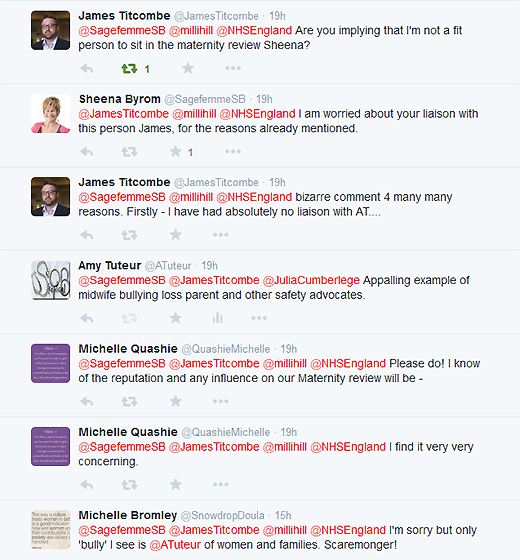
Can you spot the problem? According to the midwives (and journalist/professional natural childbirth advocate Milli Hill) who parachuted in for the attack, the problem was not the terribly risky homebirth. The problem was that a Professor of Obstetrics had dared to correspond with me and they didn’t approve … they didn’t approve at all. You can find the beginning of the Twitter conversation here (UK midwives foolishly continue their bullying on Twitter).

Hill captures their criticism succinctly:

Tweet 4-6-15 3

YOU should explain why you are tweeting with Amy Tutuer [sic]

That’s how I came to be part of the Twitter conversation, and what I observed may interest you in your forthcoming task.

I observed a group of midwives that has become a sisterhood of deadly enablers, ignoring deaths of their patients, incapable of tolerating criticism or even listening to it, patrolling social media to keep obstetricians and loss parents in line, and cheering each other on by encouraging outright dismissal of any criticism.

For example, midwife Sheena Byrom, as is her wont, started tweeting the conversation to NHS accompanied by (yet another!) thinly veiled threat to report the loss father’s failure to toe the midwifery line to your maternity review.

Tweet 4-9-15 1

That’s when I copied you in so you could see the bullying in action.

In the 100+ tweets that passed back and forth over the course of the day yesterday, I did not see even a single one from a midwife acknowledging the appalling litany of maternal and perinatal deaths at the hands of UK midwives. The same dangerous midwifery culture that leads to praise of homebirth after 3 C-section also leads to shirking any responsibility in maternity deaths, and the privileging of process over outcome that the obstetrics professor, the loss father, and I are working hard to confront.

Instead I saw this:

Tweet 4-9-15 3

And this:

Tweet 4-9-15 2

And this:

Tweet 4-9-15 4

I do not understand how midwives can be so brazen as to behave this way in a public forum, and I fear that the same vicious response to criticism is what mothers and fathers face in attempting to hold midwives to account. It is almost as if they believe themselves to be untouchable; they act as if it does not matter what they do, whom they harm, and what tragedies they cause, because as long as they ignore criticism and stick together they can avoid being held to account.

Baroness Cumberlege, in addition to being an obstetrician, I am a mother of four children, now grown. There is nothing more precious to me than these children (and their father) and I cannot imagine the horror of losing a child because of a midwife’s fealty to normal birth above all else, and THEN have to endure contemptuous dismissal of my loss by midwives who promote the philosophy that led to the death of my child.

The task ahead of you is enormous, and I beg your indulgence in intruding on your time, but it is important that you are aware of the vicious behavior of UK midwives on social media, which, I fear, is symptomatic of the behavior that has led to so many preventable deaths.

Sincerely,
Amy B. Tuteur, MD

Breast milk, the latest product to be commercialized in the orgy of conspicuous consumption that is natural parenting

compact electric breast pump to increase milk

I’m a bit late to the party of those writing about the ethics of commercializing breast milk, but I’d like to offer a different view of the issue.

I submit that the commercialization of breast milk is the inevitable result of the natural parenting industry’s relentless commercialization and promotion of products and services that no one needs, primarily to enrich itself. It’s yet another example of how “natural parenting” costs a fortune and the benefits accrue most to the members of the industry.

The philosophy that sails under the flag of “natural parenting” ought to be free, right? It was certainly free in nature. But instead it is remarkably expensive and, therefore, an indubitable sign of middle and upper class privilege.

Consider:

If childbirth is natural, why do you need to hire an army of consultants from childbirth educator, to midwife, to doula? In nature, women were assisted by friends and companions for free.

If childbirth is natural, why do you need to buy an array of herbs and supplements? Animals don’t use them; they don’t work, and they cost money.

If childbirth is natural, why do you need any books, relaxation tapes, birth pools or birthing balls? None of those exist in nature and all cost money.

If breastfeeding is natural, why do we need lactation consultants? In nature, women were assisted by friends and family members for free. Prior to the 1980’s any woman could be assisted in breastfeeding by La Leche League, a volunteer organization. But then La Leche League realized the money to be made by professionalizing breastfeeding advice, and created the lactation consultant credential. It started an organization to administer (and charge for) the credential and women suddenly had to pay for assistance they previously got for free.

If breastfeeding is natural, why do we need breast pumps and supplements to stimulate milk production?

If attachment parenting is natural, why do women have to buy slings to hold their babies? Animal mothers don’t use slings.

I could go on, but I think you get the idea. You don’t need any of these things in order to give birth, nourish and raise a baby, but the natural parenting industry insists that you do because that’s how they make their money.

It was only a matter of time before a black market in breast milk arose, so that women who couldn’t make breastfeeding work by buying the services of lactation consultants could fork over a fortune buying the breast milk itself. The black market in breast milk is unregulated; there is no screening; there is no pasteurization and it is nearly impossible to know if you are getting the substance you paid for.

The problems with a black market in breast milk are legion. Studies have show that the milk is often contaminated. Microbial Contamination of Human Milk Purchased Via the Internet, was published in Pediatrics in 2013. The authors found:

Most (74%) Internet milk samples were colonized with Gram-negative bacteria or had >104 colony-forming units/mL total aerobic count. They exhibited higher mean total aerobic, total Gram-negative, coliform, and Staphylococcus sp counts than milk bank samples. Growth of most species was positively associated with days in transit, and negatively associated with number of months since the milk was expressed, per simple linear regression. No samples were HIV type 1 RNA-positive; 21% of Internet samples were cytomegalovirus DNA-positive.

CONCLUSIONS: Human milk purchased via the Internet exhibited high overall bacterial growth and frequent contamination with pathogenic bacteria, reflecting poor collection, storage, or shipping practices…

Just this week Pediatrics published a new study shows that commercialized breast milk is often adulterated with formula or cows milk in order to increase profit margins. According to Cow’s Milk Contamination of Human Milk Purchased via the Internet:

Ten Internet samples [10%] had bovine DNA concentrations high enough to rule out minor contamination, suggesting a cow’s milk product was added. Cow’s milk can be problematic for infants with allergy or intolerance. Because buyers cannot verify the composition of milk they purchase, all should be aware that it might be adulterated with cow’s milk. Pediatricians should be aware of the online market for human milk and the potential risks.

Why on earth would a mother feed her baby someone else’s breast milk that might be filled with bacteria or corrupted with cow’s milk, the very substance that these mothers were specifically trying to avoid?

Why? Because they’ve been indoctrinated to believe that breast milk (even someone else’s breast milk) is “liquid gold” when it is nothing of the kind. To my knowledge, there has not been even a single study showing that there is any benefit to feeding someone else’ breast milk to a baby.

But that doesn’t matter because parents have also been indoctrinated to believe that raising a superior child “naturally” is a project to be managed with lots of money. The commercialization of breast milk is merely the latest form of conspicuous consumption, easily available to the privileged and utterly out of reach of those lower on the economic scale.

In fact the only thing surprising about black market breast milk is that it took so long for the natural parenting conspicuous consumption brigade to think of it.

Afraid of homebirth? You should be!

Grieving family with an infant's coffin

Yesterday’s Washington Post contained a puff piece on homebirth. It’s entitled Afraid of a home birth? These two first-person accounts will give you a new perspective, and is followed by two anecdotes, one of a mother who had a homebirth in the US, and another of a mother who had a homebirth in the Netherlands. But neither story will give you new perspective for two important reasons.

First, although anecdotes may reassure you or frighten you, by their very nature they can’t give you perspective. If you’re afraid of homebirth, you want to know the risk to YOUR baby, not two women’s personal experiences. Imagine, for example, that you want to know whether you should buckle your infant into a carseat when driving to the store. The fact that a random mother drove to the store with her infant unbuckled and the baby survived tells you nothing about what is likely to happen to YOUR baby. The fact that another mother drove with her infant unbuckled in a different country with very different rules of the road and using a car with a plethora of safety features that we don’t have in the US tells you nothing about what might happen to YOUR baby. And the fact that both babies survived does not change the fact that not buckling your infant into a carseat is a very bad idea.

Second, the Post reporter leaves out two critical facts when relating the anecdotes:

Homebirth dramatically increases the risk of neonatal death.

Dutch midwives caring for low risk women (home or hospital) have a HIGHER perinatal mortality rate than Dutch obstetricians caring for HIGH risk patients in the hospital. That’s a scathing indictment of Dutch midwifery care.

Afraid of homebirth? You should be. It raises the odds that YOUR baby will die during childbirth.

The anecdotes themselves, while meant to be reassuring are anything but.

You know you have a problem when the title of your piece promoting homebirth is I had a home birth and I’m not stupid. Or brave. It’s an even bigger problem when the piece demonstrates that you are stupid and reckless.

When I began really looking into what evidence based birth meant, it seemed like the exact opposite of what I had received. It turns out laboring on your back is not conducive to letting your body open and your baby come down. While I knew it was best to stay out of bed, I hadn’t known how listening to the nursing staff like a good patient might alter the course of my birth. It seems like commonsense now, to make use of gravity, one of the most natural forces in the world. But at the time, I was trying, against my better judgment, to listen to my care providers. I should’ve been listening to my body.

I can’t comment on Sarah Bregel’s native intelligence, but I can tell you that it is monumentally stupid to believe that you can educate yourself by reading homebirth books, websites and message boards. Would you trust a money manager with your life savings if he told you that he is sure that he can increase the value of your portfolio because he read about it on the internet? Would you trust a pilot to fly you safely to your destination if she told you she had researched flying by reading a bunch of websites? No, and no. Why not? Because anyone who isn’t living under a rock is aware that the internet is packed with bogus “experts” peddling bogus products and taking your money in exchange. Reading homebirth websites to find out if homebirth is safe is like reading Big Oil websites to find out if solar power is a good way to heat your home. You’d be a fool to think you could find the truth by doing so.

While the most common reactions to having a home birth are either that it is very stupid or very brave, I’m here to tell you that for me (and many others) it’s neither. Home birth is a safe option for many women. While hospital transfers do happen, the midwifery model of care typically means being monitored very closely. So in the case of an emergency, it’s not often the dramatic, rush to the hospital, last minute C-section, tearing the baby out in the nick-of-time fiasco that you’d imagine…

And I’m here to tell you, Sarah, that if you believe that you are foolish and gullible.

Who am I? I’m an obstetrician and mother who has spent years cataloging the literally hundreds of babies who have died preventable deaths at homebirth, because their mother’s were hoodwinked and flattered into believing that they know more about childbirth safety than obstetricians who have spent years studying, training, practicing and routinely saving infant lives. Just last night I was informed of two more babies who died at homebirth this past weekend, and within the last month I learned of two MOTHERS who had died at homebirth in Texas within days of each other in December.

Homebirth is NOT a safe option, though I doubt any homebirth advocates would tell you that. In the most comprehensive collection of homebirth statistics ever analyzed, Judith Rooks, CNM MPH (and homebirth advocate) looked at PLANNED homebirths with a LICENSED homebirth midwife in Oregon in 2012. She found that the perinatal death rate at homebirth was 800% (that’s right, EIGHT HUNDRED PERCENT) higher than comparable risk hospital birth. That data was released in March 2013, and if you didn’t know that, Sarah Bregel, than you didn’t know anything about the safety of homebirth.

I happen to know the details of many of these deaths and I can tell you that these babies died in fiascoes DESPITE dramatic rushes to the hospital, last minute C-sections and tearing the baby out NOT in the nick of time, but after it was already dead or so profoundly brain damaged that it could not survive.

And they died in fiascoes where they were born not breathing or even dead because clueless midwives weren’t monitoring the babies’ heart rates appropriately or didn’t understand what they were hearing.

Homebirth is NOT a safe option, and the organization that represents homebirth midwives (the Midwives Alliance of North America) is well aware of that fact and DELIBERATELY, and UNETHICALLY lying about it. Their own paper (actually a voluntary survey completed by only 25% of members) shows that homebirth increases the risk of death by 450%! They know that; they lie about that: and they trick gullible women like Sarah Bregel so they can make money attending births despite being so unqualified that they would not be eligible to work as midwives in ANY other first world country, (not the Netherlands, not the UK, not Canada, not Australia, not any industrialized country).

The second anecdote, How pregnancy and birth overseas is so different than in the U.S., is hardly an endorsement of homebirth, and that’s despite the fact that the author is unaware of the terrible perinatal mortality rates of Dutch midwives.

Over the course of my pregnancy, however, I started to see the appeal of giving birth outside of a hospital setting. It was comforting (and, in retrospect, highly delusional) to think that I wouldn’t experience any pain my body couldn’t handle, that childbirth was fail-safe process engineered by Mother Nature for peak results…

I’ll spare you the details of my delivery. Suffice it to say, it was not quite the pool party I had hoped for. By the time I finally broke down and demanded to transferred [sic] to a hospital so that a real doctor could administer an epidural, it was too late.

But childbirth is hardly a fail-safe process engineered by Mother Nature for peak results (and both infertility and miscarriages are evidence of that). The insistence by Dutch midwives that it is fail-safe has led to the Netherlands having one of the worst perinatal mortality rates in Western Europe, and the appalling reality that high risk babies delivered by obstetricians are actually MORE likely to survive than low risk babies delivered by midwives.

Afraid of homebirth? You should be. It’s promoters and practitioners, both in the US and in other countries are not honest about the death toll at homebirth.

Hospital birth is like a carseat. Don’t use it and your baby will probably survive anyway … no thanks to you or your midwife.

UK midwives foolishly continue their bullying on Twitter

iStock_000003866849Small

You might think these women would have more important things to worry about like the hideous death rates at their hands at Morecambe Bay (where 16 babies and 3 mothers died over a 9 year period) to the newly revealed horror at Royal Oldham/ North Manchester General Hospitals (where an appalling 7 babies and 3 mothers died in just 8 months!). But that would mean taking time from praising themselves and each other for the purportedly “evidence based” care.

Instead, they are making fools of themselves on Twitter (again!) by trying to bully anyone who dares question their clinical judgment.

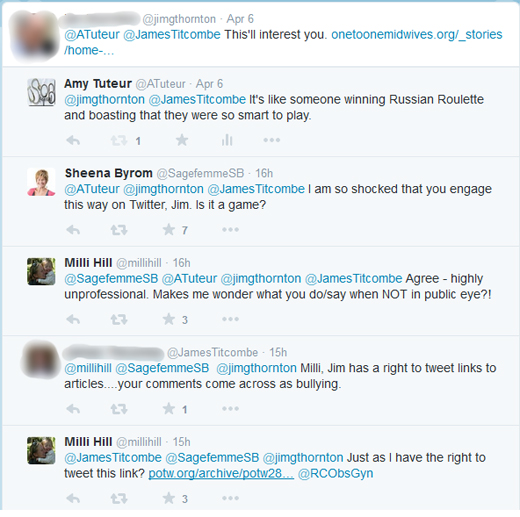
It started innocently enough when a British obstetrician tweeted me a link to this “empowering” story of an HBA3C attended by a British midwife.

I responded:

It’s like someone winning Russian Roulette and boasting that they were so smart to play.

Tweet 4-6-14 1

That’s when the midwifery bullies swept in.

Remember the cruel behavior of those mean girls from middle school and high school who appointed themselves arbiters of the social universe? It was never enough for them to exclude the girls they didn’t like. Nope, they set out to punish anyone who wouldn’t fall under their sway. The classic mean girl line? “You can’t be friends with me if you’re friends with her.”

Their hypocrisy is mind blowing, exceeded only by their stupidity in conducting their bullying in a public forum. What is wrong with these women?

Sheena Byrom, who has publicly treated a loss parent viciously, and who was not being addressed by the obstetrician, is “so shocked that you engage this way on Twitter.”

Pot, meet kettle!

And Milli Hill*, who wouldn’t know an obstetric fact if she fell over it, whines that it is “highly unprofessional,” and, as is apparently routine for UK natural childbirth bullies, sends the tweet to The Royal College of Obstetricians and Gynecologists. She also inanely links to a quote from MacBeth about the three witches, explaining that the combination of the obstetrician, the patient advocate and myself in one Tweet is just like them.

Tweet 4-6-15 2

The thread twists and turns and branches off and I won’t bore you with the detaisl, but this is perhaps my favorite part:

Tweet 4-6-15 3

The obstetrician tries to discuss the wisdom of a homebirth after 3 C-sections, but Milli Hill insists:

YOU should explain why you are tweeting with Amy Tutuer [sic]

There follows an flurry of midwives and natural childbirth advocates retweeting and favoriting each other’s tweets as if that might make them true.

The sad reality is that an obstetrician wants to discuss patient safety; the midwives and natural childbirth advocates want to bully anyone who tries to discuss patient safety. It is indicative of the UK natural childbirth culture and midwives, doulas and celebrity natural childbirth advocates who are out of control, specifically:

1. Patient safety appears to be irrelevant
2. Clinical guidelines are irrelevant
3. An obsession with “normal” birth regardless of the dangers
4. An inability to behave professionally online
5. A culture of bullying that spends more time on threatening dissenters than investigating (or even acknowledging) the deaths at their hands
6. A sense of invulnerability, as if they can say what they want, threaten whom they want, ignore what they want, and get away with it that extends from the highest to the lowest and, indeed, the bullying tactics are sanctioned by the highest and copied by the lowest.

Keep it up ladies, you’re doing a fabulous job at discrediting yourselves, far better than I could discredit you on my own!


*Addendum: Hill is deeply concerned that people might get the impression from this piece that she is a UK midwife when she is merely a celebrity midwifery apologist. Hopefully, this clears up any confusion.

Jill Duggar Dillard risks her baby’s life at homebirth

Seaton Road Accident

Jill Duggar Dillard is giving us all a lesson in how planning a homebirth is like risking your baby’s life by not buckling him into a carseat.

The odds are in her favor that everything will turn out fine, but, of course, the odds would be in her favor that not buckling him into a carseat would turn out fine. That doesn’t make either one a good idea.

Dillard, one of the 19 and counting Duggar children, is a birth junkie.

Back a few years ago, I had the opportunity to attend 12 weeks of childbirth classes with my 14-year-old friend, who was a single mom. Through these classes, I learned how to coach her during the birth of her child. Although I had attended two of my siblings’ births, being able to work as an active part of my friend’s birth made me interested in learning more. I became friends with a doula/labor coach who worked in the area, and started going to home and hospital births with her. Soon, I became her assistant, and through that, I came into contact with other local midwives. Over the course of the next several years, these midwives would call on me periodically for help at home births.

Now Jill is studying to be a pretend “midwife” (CPM) and will be attended by an equally poorly educated, poorly trained pretend “midwife.”

What’s the difference between a CPM (certified professional midwife) and a real midwife? The CPM credential was made up by a bunch of women who wanted to be midwives but couldn’t be bothered to meet the internationally accepted requirements for midwifery. Real midwives, like those in the Netherlands, the UK, Canada, Australia and the US, must have a minimum of a university degree in midwifery. US certified nurse midwives (CNM) must have a nursing degree plus a masters in midwifery, making them the most highly educated midwives in the world. In contrast, CPMs are the least educated midwives in the industrialized world. They are required to have only a high school diploma, a course of unmonitored self-study that can be completed at home, and attend only 40 births (approximately the same number that I attended in my first week of residency training).

Jill could have trained to be a real midwife, but that involves college, and that, apparently was just too hard.

I had been considering attending nursing school for a while, but the timing of it all wasn’t working out … Eventually, through my work with the local midwives, the door opened for me to enter into a distance-learning midwifery training program in Texas. This program, after about 3 1/2 years of schooling, would give me the education I need to become a licensed, Certified Professional Midwife (CPM).

An “education” that is considered to be so poor that is unacceptable in the Netherlands, the UK, Canada and Australia. The training is as deficient as the education. All other midwives train within hospitals to learn to recognize, manage and prevent life threatening obstetrical complications. CPMs don’t bother with any of that because they are self-proclaimed “experts in normal birth,” which is about as useful a pretend meteorologist who is an expert in sunny weather and must call a real meteorologist to figure out if it might rain.

What do CPMs do when a life threatening complication occurs at homebirth?

They transfer the mother to the hospital where there are real medical professionals with the equipment and expertise to save lives. That, of course, is like transferring your baby to the hospital after the car crash that ejected the baby through the windshield because you couldn’t be bothered to buckle him into a carseat. We don’t think much of mothers who can’t be bothered to buckle their babies into carseats. That’s negligent or crazy or both. Now consider that the chance of a baby dying in childbirth is actually HIGHER than the chance of the same baby dying in a car accident.

Dillard is now nearly 2 weeks past her due date. We know that with every day that passes, the risk of stillbirth goes up. That’s because the placenta often has trouble meeting the oxygen and nutritional needs of a baby growing beyond full term. The baby could simply die spontaneously, or could die during labor, because contractions can stress a healthy baby, let alone one with a failing placenta. Insisting on homebirth at this point is like driving with a baby unbuckled, on an icy road, knowing that the road will get icier still with each passing day.

We all know mothers who have done that and everything has turned out fine. That’s why Jill Duggar Dillard’s son is likely to be fine, too, even though she is casually risking his life at homebirth.

Dr. Amy