Getting your information on birth from The Childbirth Connection is like getting your information on solar power from Big Oil

iStock_000007637100Small copy

Can you say “conflict of interest”?

That’s the heart of the latest public relations effort by The Childbirth Connection, the leading lobbying organization of the natural childbirth industry.

The New York Times’ Motherlode blog notes, New Report Urges Less Intervention in Births.

But getting your information on birth from The Childbirth Connection is like getting your information on solar power from Big Oil.

Just like Big Oil has a financial interest in whether or not you choose solar power, the constituency of The Childbirth Connection (midwives, doulas and childbirth educators, aka “birth workers”) have a financial interest in whether or not you choose obstetric interventions.

The Childbirth Connection is well known for ignoring data, even its own data, in favor of promoting full employment for birth workers. The Childbirth Connection has published three “Listening to Mothers” surveys on the state of childbirth in the US, and each time they refuse to listen to what mothers tell them: approximately 90% of women in the US are happy with maternity care; the majority of women who use epidurals are extremely pleased with them; the majority of women who use alternative methods of pain relief find them to be ineffective, etc.

Despite what women have told them, despite the spectacular success of modern obstetrics, despite that fact that the only places in the world with low perinatal and maternal mortality are places with easy access to and liberal use of childbirth interventions, The Childbirth Connection insists there is a crisis.

“If overtreatment is defined as instances in which an individual may have fared as well or better with less or perhaps no intervention,” the report states in its forward, “then modern obstetric care has landed in a deep quagmire. Navigating out of that territory will be challenging.”

Dr. Sarah Buckley, who collected and interpreted the research and wrote the report, suggests within it a number of ways of escaping that quagmire, all based on the premise that the hormonal physiology of childbirth nearly always works best when it is left to work at its own speed. The benefits of the natural process, her synthesis of the research suggests, go far beyond what we had previously understood; preparing mother and baby for birth through hormonal changes up to and during the labor and birth process.

Dr. Buckley takes a page out of the playbook for challenging modern medicine. Paul Wolpe explains the steps in The Holistic Heresy: Strategies of Ideological Challenge in the Medical Profession.

1. Alternative health advocates must:

must portray the discourse as in crisis, must provide an alternative ideology to rescue the discourse, must legitimize their ideology through appeal to a reframed historical myth, and must portray the orthodoxy as a betrayer of the discourse.

Hence Buckley’s claim that modern obstetric care has landed in a deep quagmire. Really? In the past 100 years modern obstetrics has dropped the neonatal mortality rate by 90% and the maternal mortality rate by 99%! That doesn’t sound like a quagmire to me. The real quagmire is where “birth workers,” midwives, doulas and childbirth educators find themselves. They feel marginalized by lifesaving technology, so they demonize it.

2. Then offer the new philosophy, positioning it as the replacement for the old:

[The critic] draws from the marginalized or folk knowledge of the tradition and elevates the constructs found there to primary importance…

… [G]reat pains are usually taken … to show that the alien ideas are not in fact alien at all, but have existed in the discourse in a different form. [Critics] often import foreign, folk, and traditional forms of healing into their practices, [carefully describing] them as wholly compatible with Western medicine, scientifically valid, or historically present in other forms.

Hence, Buckley’s claim that “the hormonal physiology of childbirth nearly always works best when it is left to work at its own speed. The benefits of the natural process … go far beyond what we had previously understood.”

3. Blur the distinction between health and disease:

The goal of holistic health is more than the absence of disease; it is a state of optimal functioning, often referred to as ‘wellness’… [which] greatly expands the role of the [alternative provider] in medical intervention …

Hence the goal of The Childbirth Connection is more than healthy babies and healthy mothers, it is “normal birth,” a recapitulation of birth as practiced with the ancient wisdom of our foremothers.

4. Portray yourself as the savior:

The [critic] is the true keeper of the flame, the savior of the discourse, and should ascend to the position of power in place of the orthodoxy.

Hence Carol Sakala’s (director of Childbirth Connection Programs at the National Partnership for Women & Families) claim, “Our current high rates of intervention are not serving women well… But the community is really moving in the right direction. Professional societies are … talking publicly about the overuse of cesarean sections, the need to avoid constant fetal monitoring, and not permitting elective inductions or cesareans. “We are hopeful that the timing of this report will support that change.”

In the minds of natural childbirth advocates, demonizing modern obstetrics is the solution to the employment issues of birth workers.

Why? As anthropologists Caroline Bledsoe and Rachel Scherrer explain in The Dialectics of Disruption: Paradoxes of Nature and Professionalism in Contemporary American Childbearing:

If nature is defined as whatever obstetricians do not do, then the degree to which a birth can be called natural is inversely proportional to the degree to which an obstetrician appears to play a role. The answer to why obstetricians are described with such antipathy thus lies not in the substance of what obstetricians do … Obstetricians are … perceived as the chief source of disruption in the birth event …

And, not coincidentally, they represent the chief economic competition to midwives, doulas and childbirth educators.

For birth workers, fewer interventions = more employment opportunities.

To a hammer, everything looks like a nail. To a birth worker, every women looks like she needs a birth without interventions.

That doesn’t make it so.

What The Feminist Breeder and the Quiverfull movement have in common

iStock_000039310624Small

Yesterday I joked about Gina Crosly-Corcoran, The Feminist Breeder, and her sancti-question (The Feminist Breeder is so not judging you for failing to breastfeed).

What’s a sancti-question? It’s sanctimoniousness disguised as puzzlement, e.g. I simply can’t understand why other women can’t be bothered to be as awesome as me.

Gina offered a classic of the genre:

I … don’t really “get” it when a woman chooses, without any medical or social barrier, not to breastfeed. To me it’s sorta like deciding not to take prenatal vitamins because you just don’t wanna, without recognizing that they do help build a healthier baby. I will NOT be all sanctimonious about it, I’m just saying I’m human and that one’s a head scratcher for me. We have lactating boobs for a reason: to feed the babies we make.

(Here’s a pro tip, Gina: Announcing you are not sanctimonious does not inoculate you from accusations of sanctimony.)

Today, though, I’m utterly serious. The Feminist Breeder’s comments are abhorrent, not merely because they are sanctimonious, but because they are deeply and profoundly sexist. Gina’s comment echoes the Quiverfull movement of fundamentalist Christianity that she probably deplores. How? She, like the Quiverfull, invoke biological essentialism, as justification for her beliefs. The idea that women should use their reproductive organs “as Nature intended” is a bedrock principle of sexist fundamentalist movements everywhere.

Here’s how it works:

Quiverfull claim that women should be subservient to their husbands because that’s what Nature intended.

They don’t use artificial birth control because women have monthly ovulation for a reason: to get pregnant as often as possible.

They don’t countenance abortion because women have a uterus for a reason: to reproduce constantly.

Many use lay midwives for childbirth because women have a vagina for a reason: to birth the babies they grow.

Women shouldn’t work outside the home because women have bodies that grow babies and produce milk: so they can stay home and take care of them.

See the problem?

Invoking women’s reproductive organs is a way to justify restricting women’s choices. Instead of giving women the opportunity to control their fertility, end unwanted pregnancies, and raise children in the way that each individual woman thinks is best, invoking women’s reproductive organs is a way to keep them in the kitchen, barefoot, pregnant and subservient. Invoking women’s reproductive organs in a discussion of women’s choices is sexism pure and simple. It’s meant to short-circuit any discussion of women’s rights, intellectual achievements, and character by implying that those things ought to be subservient to women’s biology.

No doubt it’s a head scratcher for fundamentalists that Gina’s husband had a vasectomy to make sure that she couldn’t get pregnant after only 3 children and even though she still has ovaries and a uterus for a reason.

It is deeply misogynist for Gina to justify her sanctimoniousness with appeals to women’s reproductive organs. This is not a public health issue, it’s a reproductive rights issue.

Let’s be very clear:

A women’s decision on whether or not to breastfeed is a reproductive rights issue, no different than the right to control fertility or to terminate a pregnancy.

It is profoundly anti-feminist to tell a woman how she should use her ovaries and how she should use her uterus. It is equally sexist and retrograde to tell a woman how she should use her breasts, or criticize women, implicitly or explicitly, for not using their breasts “as nature intended.”

The Feminist Breeder is so not judging you for failing to breastfeed

Full of fools

Gina Crosly-Corcoran is confused:

I am brave (foolish) enough to admit that while I totally and completely support any woman’s right and choice to feed her babies however she needs to, I still, deep down in a place I don’t like to admit, don’t really “get” it when a woman chooses, without any medical or social barrier, not to breastfeed. To me it’s sorta like deciding not to take prenatal vitamins because you just don’t wanna, without recognizing that they do help build a healthier baby. I will NOT be all sanctimonious about it, I’m just saying I’m human and that one’s a head scratcher for me. We have lactating boobs for a reason: to feed the babies we make.

Kind of like:

I am brave (foolish) enough to admit that while I totally and completely support transgender people, I still, deep down in a place I don’t like to admit, don’t really “get” when a man or a woman chooses to be the opposite sex. To me it’s sorta like deciding not to get married because you just don’t wanna, without recognizing that heterosexual families are what nature intended. I will NOT be all sanctimonious about it, I’m just saying I’m human and that one’s a head scratcher for me. A man has a penis for a reason, and a woman has a vagina for a reason: to be the gender that they were born to be.

See! Not sanctimonious or judgmental at all!

Just because she crashed and died while drunk doesn’t mean that drunk driving killed her

iStock_000000416052Small

Hi, folks! Jack Daniels here, spokesperson for CPRDD, the Committee to Promote Responsible Drunk Driving.

I’m sure you’ve seen newspaper accounts of horrific crashes that happened after someone drove drunk, but I’m here to tell you that just because a person died or killed someone else while driving drunk, does NOT mean that drunk driving led to those deaths.

Surprised? I’ll bet you are. But that’s because you’ve been subjected to the blandishments of Big Medicine working tirelessly to marginalize the role of alcohol in treating medical ailments. For hundreds of years surgery, from amputations to tumor removals, was performed with alcohol as the only anesthetic. Then along came doctors  who could not tolerate the economic competition and marginalized medicinal use of alcohol just to protect their own incomes.

How do we know that drunk driving is a safe and responsible choice? There are many reasons, but before I list them, I want to give thanks to my colleague Ima Frawde, CPM (certified professional midwife), the grandmother of American homebirth. Ima and her colleagues have come up with these fabulous arguments and I’ve simply adapted them for drunk driving.

1. Sober drivers die, too.

If you listen to those shills from Big Medicine, you’d think that no one sober ever dies in a car accident. Sure some drunk drivers are killed or kill others, but that hardly means that driving sober can guarantee that you will live. Ice is a major cause of car accidents; fog is another, but no one tries to demonize ice or fog the way that they demonize drunk driving.

2. Over 99% of drunk drivers will make it home without killing themselves or others.

Sure, you see reports of spectacular drunk driving accidents blaring from newspapers and TV, but those are the rare cases. As the many, many people who have successfully driven drunk can tell you, most drunk drivers will arrive home safely.

3. You are safest when you feel safest!

Just like homebirth is safe if you feel that it is safe, drunk driving is safe if you feel that it is safe. In fact, there’s an argument to be made that drunk drivers who do die or kill others simply weren’t trusting drunk driving enough.

4. Drunk drivers bring exactly the same skills and equipment to driving drunk as they do to driving sober.

Drunk drivers have access to the SAME brakes, gas pedal and wheel that sober drivers do. While drunk, they can perform EXACTLY the same maneuvers that they perform while driving sober.

5. Drunk drivers are responsible for their own health.

Who is the government or Big Medicine to tell me that I can’t care for myself in the way that I think is best? Making drunk driving illegal is the first step toward world domination by jack booted thugs who will implant us all with data chips to control our minds.

6. Drunk driving is empowering.

Those who have done it will tell you that driving drunk only increases the pleasure that you get from driving.

7. God is my co-pilot

Nothing happens that God does not intend should happen. If He wants a drunk driver to arrive home safely, it will happen. If the drunk driver dies or killed someone that surely means that God intended those deaths.

8. Some drivers aren’t meant to live.

Obviously!

There you have it, folks. These are just 8 of many reasons why drunk driving is safe. The next time you’re thinking about drinking and driving, remember, if those arguments are good enough to promote homebirth, they’re good enough to promote anything.

Sorry, but anti-vax advocates are idiots and crazies

Fool Rubber Stamp

Rachel Hills has written a thought provoking piece for The New Republic, The Best Way to Combat Anti-Vaxxers Is to Understand Them.

Referencing the work of Jennifer Reich, a sociologist at the University of Colorado Denver, Hills claims:

It is not just anti-vaxxers, after all, who take pride in their ability to critically evaluate information, who do background research instead of trusting their doctor’s advice on faith, or who are skeptical of the motivations of government, pharmaceutical companies, or big business. Nor is it only anti-vaxxers who believe that every individual is unique, and that policies should be adapted to fit those idiosyncrasies, rather than applied one-size-fits-all. (As one mother Reich interview explained it in relation to vaccines: “Everyone has a different immune system. For some people, it may take three shots. [Others get] immunity that first time.”)

In an era of high individualism, ideas like these aren’t outliers or aberrations. They are hallmarks of the liberal middle-classes—the kind of people, say, who might read The New Republic online. And I’ll be honest: they sound an awful lot like me.

In other words:

At its heart, the anti-vaccination movement isn’t a product of ignorance, selfishness, or even fear … although each of these play their part. It is the logical fallout of a society in which knowledge is relative, institutions are fallible, and the individual reigns supreme. In such an environment, the real surprise isn’t that there are people who doubt vaccines. It is that most of us don’t doubt them, even when every social force around us is urging us to do otherwise.

According to Hills, if that’s the case:

All of which begs the question of how we might better respond to anti-vaxxers. One solution might be to rebuild the trust between individuals and medical institutions. It is well established that parents who choose not to vaccinate their children are a privileged group, but the deep suspicion that lies at the heart of vaccine refusal reflects their distance from power, not just their proximity to it. It stems from the same impulse that leads people to believe that the U.S. government creates fake ISIS videos as propaganda tools, or that media barons dictate stories to their journalists over the phone…

She concludes:

Whatever approach we choose, one thing is for certain: Dismissing vaccine skeptics as crazies or idiots won’t solve the growing public health problem their choices present. To do that we need to go deeper; to examine not only the ways in which they are plainly wrong, but the beliefs they hold that are more equivocal—and the unwitting role we might all be playing in allowing those ideologies to thrive.

As much as I admire Hills’ writing and clear exposition of her claims, I disagree profoundly.

Hills is right to focus on parents’ attitudes, rather than their knowledge of science. That’s because anti-vax advocacy is not about vaccine and not about children. It’s about parents wanting to see themselves as educated, empowered and not submissive to authority … with an important caveat. They want to burnish their self-image without doing the hard work of learning immunology.

Yes, neo-liberals (and old fashioned liberals like myself) want to take pride in their ability to critically evaluate information, do background research instead of trusting their doctor’s advice on faith, and are skeptical of the motivations of government, pharmaceutical companies, or big business.” But it is IMPOSSIBLE to critically evaluate information about vaccines if you don’t have a firm grounding in basic immunology. It is IMPOSSIBLE to do research by reading websites written by laypeople for other laypeople. It is IMPOSSIBLE to be educated about vaccines without being thoroughly educated about immunology.

Hills claims that anti-vax isn’t a product of ignorance, selfishness, or even fear, Unfortunately, it is PRECISELY a product of ignorance, selfishness and fear; ignorance of basic immunology, microbiology and statistical analysis, selfishness in eliding the dangers vaccine rejection poses to others, and an absurd, overblown, unreasoning fear of autism.

Hills insists that anti-vaxxers aren’t idiots or crazies and likens them to people who believe the U.S. government creates fake ISIS videos as propaganda tools. But those people are also idiots and crazies. They have literally no idea what they are talking about and have an abiding fascination for conspiracy theories based on absolutely no evidence at all. If Hills was trying to make anti-vaxxers look reasonable, she used a strikingly poor analogy.

Hills concludes that dismissing vaccine skeptics as idiots or crazies won’t solve the growing public health problem their choices present.

I beg to differ.

Anti-vax activism is about parents and how they want to view themselves. It would be very hard for them to present themselves as educated and empowered if everyone else believed them to be ignorant and gullible. Indeed, the tide is turning at this very moment, as anti-vax advocacy is devolving in the public view from being simply one of many reasonable approaches to vaccination to the growing public belief that anti-vaxxers are crazy conspiracy theorists who have been 100% wrong about every claim they’ve ever made. The resurgence of pertussis, measles (and even the furor over Ebola), along with a continuing rise in autism prevalence have combined to make anti-vaxxers look like fools.

Hills is correct that anti-vax advocacy is not about science and is not going to be improved by improving science education, but she’s wrong to claim it is a manifestation of neo-liberalism. Neo-liberalism places great stock in real education, not pretending to be educated by surfing the internet. That’s just lazy boastfulness.

Neo-liberalism values skepticism, which actually means “requiring proof” and not “refusing to believe what experts say.” That’s just foolish.

Neo-liberalism questions government, pharmaceutical companies and big business, but it does not allege that government, pharmaceutical companies, and big business are engaged in conspiracies so massive that they involve all the doctors and public health officials in every country of the world, who are giving their own children vaccines that they supposedly know are toxic. That’s just totally crazy!

Obviously any attempt to increase vaccination rates will need to be multi-pronged, but I suspect that humiliating anti-vaxxers is going to be by far the most effective strategy. I would draw a parallel to racist and homophobic jokes. When they were acceptable, comedians told them and thought those jokes made them seem witty. When racist and homophobic jokes were finally acknowledged to be hateful, and comedians were humiliated for telling those jokes, most stopped telling them. They recognized that those jokes made them look bigoted, not witty.

When declaring yourself to be an anti-vaxxers brings only eye-rolls, condemnation and pity, neo-liberals will start vaccinating their children once again.

Dr. Keirns, help us understand your childbirth experience by letting your doctors tell THEIR side

Silence

Yesterday’s post, OMG! OMG! OMG! I was pressured to have a C-section just because I was a 40 year old insulin dependent diabetic with pre-eclampsia and bloody urine, was about Dr. Carla Keirns and her attempts in the professional and lay press to shoehorn her high risk birth into the natural childbirth narrative of the “unnecesarean.”

As I explained:

Dr. Keirns and her pregnancy were extremely high risk. She was 40 years old, which put her at risk right from the get go, but in addition she had a very serious pre-existing medical condition. Although Dr. Keirns implies that her diabetes was related to pregnancy, her need for insulin in the first trimester suggests that she may have type II diabetes unrelated to pregnancy. Furthermore, although she doesn’t explain the diagnosis, the fact that she was on magnesium sulfate to prevent the seizures of pre-eclampsia, and was spontaneously bleeding from her bladder, suggests that she was developing HELLP syndrome, a particularly dangerous variant that also affects blood clotting and liver function.

Nonetheless, Dr. Keirns wants us to believe that she was being pressured into a C-section that she didn’t need. How does she know that she didn’t need it?

… My son came out blue and not breathing. I listened for crying but didn’t hear any. I barely heard the doctors say it was a boy. Meanwhile, as the NICU unit was summoned to attend to my son, I began to hemorrhage …

After we were both stabilized, they handed the baby to my husband; I was too exhausted to safely hold him.

As I said yesterday, if nearly killing your baby and yourself qualifies as a “successful” vaginal delivery, I’d hate to see what failure looked like.

The people I really feel sorry for in this story are Dr. Keirns’ providers, not because I’m sure that they did everything right, but because they are being publicly humiliated without any chance to defend themselves.

Therefore, in one of several Twitter exchanges, I suggested to Dr. Keirns what is shown in the tweet below:

Keirns tweet 1-8-15

Dr. Keirns should absolve her providers of their obligation of confidentiality and let them tell what they think happened and why they repeatedly recommended a C-section. If the story that Dr. Keirns blared to the medical and lay press is true, they will be able to confirm it. If not, they’ll be able to defend themselves. Seems only fair, right? Otherwise, Dr. Keirns is just a very high risk patient trying to shoehorn her experience into the approved natural childbirth narrative.

I find it incredibly ironic that Dr. Keirns, a specialist in preventive medicine, utterly failed to understand that C-section in HER case was recommended as a form of prevention. I’d love to know whether her providers saw it that way, too.

I also find it deeply unfair that Dr. Keirns has publicly humiliated them without giving them an opportunity to explain what they thought was happening and why they made the recommendations that they did. As a physician, she knows that doctors are often subjected to second guessing by patients, and, when given a chance to explain their reasoning, can often help the patient understand why they did what they did, and said what they said. Since she publicly second guessed the doctors and nurses who cared for her, she should give them an opportunity to provide a public explanation.

How about it Dr. Keirns? Are you willing to allow your providers to speak publicly about your case? Think of it as a public version of Morbidity and Mortality Rounds. M & M’s are incredible learning opportunities. Everyone could learn something from your story: the public, your providers, and, I dare say, YOU.

All it takes is your consent, and we can hear both sides. Will you give that consent?

Another day, another effort by ImprovingBirth.org to demonize C-sections

Print

Extra! Extra! Get the latest from ImprovingBirth.org! Are C-sections Damaging Our Children?

I can save you the trouble of reading the piece by giving you the answer:

No, they’re not, but that doesn’t stop the folks at ImprovingBirth.org from trying to convince you that they are.

The release of the largest study of its kind [Cesarean Section and Chronic Immune Disorders] confirms yet again that the Cesarean epidemic in the U.S. deserves more attention, and women deserve better information and options. Evidence continues to emerge that birth by surgery, while sometimes necessary and wanted, is not benign.

Increasingly, researchers are finding relationships between Cesarean birth and babies’ future health. The latest findings come from a mammoth study including two-million full-term births over 35 years in Denmark—showing that children born by Cesarean had “significantly increased risk” of developing certain chronic disorders.

Does ImprovingBirth.org despise C-sections?

Is the Pope Catholic?

And just like anyone committed to free thought needs to take the Pope’s pronouncements on God’s wishes with a grain of salt, anyone committed to scientific evidence needs to take ImprovingBirth.org and Cristen Pascucci’s efforts to demonize C-sections with a whole salt shaker.

Why?

1. Bias

Getting your information about C-section from natural childbirth advocates is like getting your information about solar power from Big Oil. If you think they are going to tell you the truth, and the whole truth, then you are very naive.

2. Motivated reasoning

No doubt the folks at ImprovingBirth.org believe that C-sections are “bad.” And because that is non-negotiable, their reasoning is motivated to support their belief. They promoted papers that support their pre-existing convictions, and ignore everything else that doesn’t.

3. Training

Cristen Pascucci is a public relations executive and board member at ImprovingBirth.org whose claim to understanding the obstetric literature appears to be the fact that a baby transited her vagina.

4. A fundamental misunderstanding of the scientific literature

Just because a scientific paper is published doesn’t make it true. Reading a scientific paper is similar to reading a newspaper article. A Democratic leaning newspaper may have an article with the headline that Obama was born in Hawaii. A radical Republican newspaper may have an article with the headline that Obama was born in Africa. One article is true, the other is not. In science, publication of a paper means that it is worthy of discussion, NOT that the reviewers agreed with its conclusions.

5. A profound belief in the naturalistic fallacy

Pascucci and her natural childbirth cohorts are absolutely sure that if it’s natural, it must be good. That’s why tobacco, heroin and tsunamis are good. Oh … wait. But it is why getting the message to your followers by shouting it is better than using the Internet. Oh … wait I’ve got it! That’s why vaginal births are better than C-sections.

6. A serious misunderstanding of evolution

In a perverse way, natural childbirth advocates are eugenicists. They appear to be convinced that some peoples genes are “better” than other people’s genes. Hence the fatalism when babies die at homebirth that “some babies are meant to die.” Hence the unstated assumption that modern obstetrics must be weakening us in important ways.

7. A serious misunderstanding of chronic diseases of wealth.

Alternative health advocates in general and natural childbirth advocates in particular are desperate to pretend that chronic diseases of wealthy countries are “caused” by failing to follow the ancient wisdom of our ancestors. That’s absurd. Our ancestors died in droves from easily prevented and easily treated diseases. When you prevent those deaths, as modern medicine does, what’s left is chronic diseases of wealth. That doesn’t mean that medical care causes those diseases; it means that you can’t get those diseases unless modern medicine allows you to live long enough to get them.

Moreover, we have no idea of the prevalence in indigenous populations of diseases like Crohn’s or juvenile rheumatoid arthritis or defects of the immune system. We have no way to compare contemporary prevalence of these diseases with their prevalence in societies that lack modern medicine. Therefore, we are reduced to drawing conclusions from studies that trace prevalence over time or between groups within wealthy societies, limiting our ability to determine what modern medicine does or does not cause.

Let’s get back to the original study and see what it actually showed.

Pascucci acknowledges the difference between correlation and causation:

That is, they show a strong association between the presence of these immune diseases and the occurrence of Cesarean birth, but more research is needed to determine whether Cesarean birth is the cause of these problems, or merely an associated event.

Denmark saw an increase in the rate of C-sections from 5% in the 1970s to 20% in 2010. The U.S. saw a similar but even more dramatic rise to over 32% in 2012, according to Centers for Disease Control figures here. This is the same time frame during which we have seen an increase in immune-related disorders in westernized countries. The Danish study suggested this correlation was important, and their data supports that assertion.

Unfortunately, however, she never deconstructs the actual study and, therefore, fails to note it’s most serious flaw. Immune diseases like Crohn’s and juvenile rheumatoid arthritis have a large heritable component. Though the authors of the study took the mother’s history of immune disease into account, they failed to take the FATHER’S history of immune disease into account. Without that, they can’t draw any valid conclusions since it is entirely possible that the difference in the two groups of children is the results of differences in the fathers’ medical history, and NOT the difference in mode of birth.

Pascucci is careful to resist firm conclusions and instead settle for good old fashioned insinuation:

Emerging research points to the microbiome of babies as being a determinant in long-term health and even epigenetic changes [Actually, such research is in its infancy and offers no firm conclusions about anything] …

But this part is my absolute favorite:

At the same time, withholding information from women because we don’t want to cause hurt or guilt is a misplaced effort. It’s a perpetuation of what is truly hurting women and babies today: known but undisclosed risks of procedures like Cesarean section, biased information from care providers …

Excuse me while I pick myself up off the floor where I fell because I was laughing so hard.

Why was I laughing?

In the world of natural childbirth advocacy, informing women of the risks of death in childbirth is known as “fear mongering” and “playing the dead baby card” despite the fact that the statistics quoted are firm, reproducible and based on decades of data.

Obstetricians are bitterly chastised for “playing the dead baby card,” but now ImprovingBirth.org and Pascucci are advising us to play the “immune injured baby card” in the interests of full disclosure.

But they can’t have it both ways. And when we compare the known risks that a particular baby will die in childbirth without a C-section to the highly theoretical, unreproduced and unproven claims of future immunological diseases, C-sections win every time.

The folks at ImprovingBirth.org need to understand that what’s good for the goose is good for the gander. If you are going to condemn “fear mongering” over dead babies, you have no business fear mongering over theoretical risks of C-sections.

OMG! OMG! OMG! I was pressured to have a C-section just because I was a 40 year old insulin dependent diabetic with pre-eclampsia and bloody urine

iStock_000008432308Small copy

Yesterday, the Washington Post published I didn’t realize the pressure to have a C-section until I was about to deliver, excerpted from Narrative Matters section of the journal Health Affairs, Watching The Clock: A Mother’s Hope For A Natural Birth In A Cesarean Culture.

I’ll paraphrase it for you:

Look at me! Look at me! Look at me!

I embody everything that is wrong about contemporary obstetrics. Those meanie doctors were pushing me to have a C-section just because I was a 40 year old insulin dependent diabetic with pre-eclampsia, bleeding from my bladder suggesting that my blood was no longer coagulating properly, hooked up to a magnesium sulfate drip to prevent seizures and labored for several days.

I am a cautionary tale about the way that doctors push low risk women into having C-sections they don’t need.

How dare they! I’m a doctor and I know best.

That pity party is Dr. Keirns’ effort to shoehorn herself into the natural childbirth advocacy narrative of choice: I was low risk and they wanted me to have a C-section, but I showed them!

Who is Dr. Keirns? She is Assistant Professor of Preventive Medicine, Assistant Professor of Medicine and Clinical Ethicist at Stony Brook University. In other words, she should know better.

Before I get any further into lampooning Dr. Keirns’ absurd nattering, I want to make one point very clear:

Dr. Keirns is telling two stories at once. The first, which would be laughable if it weren’t a matter or life and death, is the classic natural childbirth advocate’s tale of woe. That deserves to be ripped apart. The second, simultaneous, story is one of poor bedside manner and poor preparedness for an emergency. That is a real story, too, and there is nothing that justifies that. Had Dr. Keirns chosen to wrie about her provider’s poor bedside manner and poor preparedness, she would have told a tale that is woefully familiar to anyone who has ever been hospitalized. She would have been raising an important issue that must be addressed: how to we treat patients with respect and dignity even as we struggle to save their lives? Unfortunately, that’s not the story that Dr. Keirns chose to tell.

For reasons beyond my comprehension, Dr. Keirns told a tale that was supposed to demonstrate what is wrong with contemporary obstetric practice, but, instead, demonstrates what is wrong with contemporary natural childbirth advocacy. Unintentionally, Dr. Keirns illustrates how natural childbirth advocacy privileges process over outcome, encourages women to make birth plans that are absurdly unrealistic, and considers vaginal birth both a success and a rebuke to obstetricians even if the baby is nearly dead.

Let’s start with the basics.

Perhaps somewhere there is an alternate universe where Dr. Keirns might have been considered low risk, but it isn’t this one.

Dr. Keirns and her pregnancy were extremely high risk. She was 40 years old, which put her at risk right from the get go, but in addition she had a very serious pre-existing medical condition. Although Dr. Keirns implies that her diabetes was related to pregnancy, her need for insulin in the first trimester suggests that she may have type II diabetes unrelated to pregnancy. Furthermore, although she doesn’t explain the diagnosis, the fact that she was on magnesium sulfate to prevent the seizures of pre-eclampsia, and was spontaneously bleeding from her bladder, suggests that she was developing HELLP syndrome, a particularly dangerous variant that also affects blood clotting and liver function.

In other words, Dr. Keirns is precisely the kind of woman who dies during pregnancy.

She seems to have utterly no awareness of the risk to herself (that, of course, is not part of the typical natural childbirth narrative) and instead chooses to focus on two factors that do make up the typical narrative: the health and brain function of the baby, and the “pressure” to make sure labor doesn’t go on too long.

Dr. Keirns goes off the rails immediately. She apparently started from the natural childbirth premise that birth is safe and that vaginal birth is best. But childbirth is not safe and at every point in her labor she faced a high risk of dying, and her baby faced an even higher risk of death or permanent injury. And it only go worse from there!

At nearly every point, C-section was the safest option for her and for her baby, but she wanted to try for a vaginal delivery; that was reasonable. But once her induction (presumably for diabetes and incipient pre-eclampsia) had dragged on, C-section was ever more clearly the safer option. Regardless of what natural childbirth advocates like to tell themselves, a longer labor means a greater risk of death or permanent injury of the baby.

If Dr. Keirns had agreed to a C-section at that point, she would have almost certainly had a vigorous healthy baby, and she would have been free to moan forever after about her “unnecessarean.” She would have avoided the risks of prolonged inductions, avoided the serious compromise of her baby, avoid the postpartum hemorrhage, possibly avoided the magnesium sulfate to prevent seizures, and possibly avoided the bleeding in her bladder.

Instead, she insisted on a vaginal delivery and she was “successful”:

… My son came out blue and not breathing. I listened for crying but didn’t hear any. I barely heard the doctors say it was a boy. Meanwhile, as the NICU unit was summoned to attend to my son, I began to hemorrhage …

After we were both stabilized, they handed the baby to my husband; I was too exhausted to safely hold him.

If nearly killing your baby and yourself qualifies as a “successful” vaginal delivery, I’d hate to see what failure looked like.

Dr. Keirns then regurgitates the standard misinformation offered by natural childbirth advocates. She repeats the childbirth lie that will not die, apparently unaware that in 2009 the World Health Organization withdrew its recommended C-section rate, acknowledging that there had never been any scientific evidence to support it.

Kearns claims:

As a doctor, I don’t discount any of the problems my doctors were worried about. I know that our obstetric colleagues are working in territory that is fraught with risk, uncertainty and liability.

She babbles on about failure to progress, completely discounting the problems in her doctors were worried about, and pretending the issue in her case was the slow progress of her labor, when it was really the ever growing risk from her serious chronic disease (insulin dependent diabetes) and her serious pregnancy complication (pre-eclampsia with possible HELLP syndrome).

Dr. Keirns was the obstetric patient from hell, doing everything in her power to kill her baby or herself, blissfully clueless to this very day about the dangers she aggressively ignored.

… I barely escaped a Caesarean I didn’t need. In the end, my son is healthy, I’m fine and we had the vaginal delivery that epidemiological data suggests was safest for both of us…

No, Dr. Keirns, the fact that you had a vaginal delivery of a nearly dead baby, a postpartum hemorrhage, intrapartum insulin and magnesium sulfate indicates that you DID need a C-section. Moreover, there is NO DATA that suggest that a vaginal birth was safest for YOU with diabetes, pre-eclampsia and possible HELLP syndrome, or YOUR BABY, who barely survived the labor.

In the end, Dr. Keirns’ tale is not a cautionary story about the rush to perform C-sections, but instead a cautionary story about the absolute nonsense peddled by natural childbirth advocates that threatens the lives of babies and mothers and is believed even by Dr. Keirns who should have known better.

Physician, heal thyself!

Does breastfeeding cause autism?

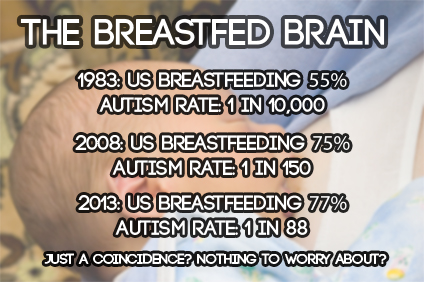
breastfed brain

Over the past 4 decades, there has been a shocking rise in the prevalence of autism. Antivax activists point out that there has been an dramatic increase in the number of vaccines that infants receive and conclude that vaccines cause autism. But here has also been a dramatic increases in breastfeeding rates. It is time for us to ask: Does breastfeeding cause autism?

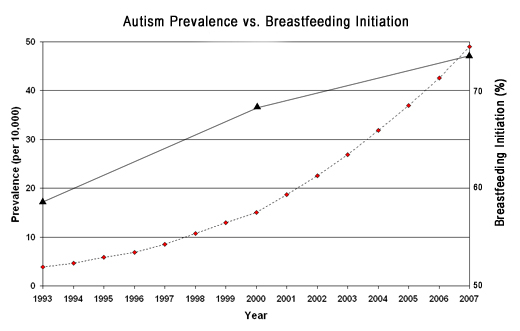
The above image relates the statistics and the graph below illustrates the trend.

autism prevalence vs breastfeeding initiation

It’s pretty dramatic, isn’t it? So we should be rushing to investigate whether breastfeeding causes autism, right? We should direct our attention to the CDC recommendations designed to encourage breastfeeding and ask if the CDC is ignoring the harmful effects of breastfeeding, right? We should view lactation consultants with suspicion and we should demand that they inform new mothers of the very clear association between breastfeeding and autism, right?

Wrong!

Why not? Because correlation is not causation. Just because two phenomena rise is parallel does NOT mean that one caused the other.

If correlation is not causation, what is?

To determine if Event A caused Disease B, we need to investigate whether it satisfies Hill’s Criteria. These are 9 criteria, most of which much be satisfied before we can conclude that Event A is not merely correlated with Disease B, but Event A actually causes Disease B.

Who was Hill and why should we care about his criteria?

…These criteria were originally presented by Austin Bradford Hill (1897-1991), a British medical statistician as a way of determining the causal link between a specific factor (e.g., cigarette smoking) and a disease (such as emphysema or lung cancer)… [T]he principles set forth by Hill form the basis of evaluation used in all modern scientific research… Hill’s Criteria simply provides an additional valuable measure by which to evaluate the many theories and explanations proposed within the social sciences.

What are the criteria?

1. Temporal relationship: It may sound obvious, but if Event A causes Disease B, Event A must occur before Disease B. The is the only absolutely essential criterion, but it is NOT sufficient. Lay people often erroneously assume that because it’s the only essential criterion, it is the only criterion that counts. For example, vaccine rejectionists often point to the fact that childhood vaccinations usually occur before the onset of autism, but that does not mean that vaccination causes autism. Similarly, breastfeeding occurs before the onset of autism. Consider that learning to walk usually precedes autism, but obviously learning to walk does not cause autism.

2. Strength: This is measured by statistical tests, but can be thought of as similar to the closeness of the relationship. Is Disease B always preceded by Event A? Sometimes? Only rarely? Does Event A always cause Disease B? Sometimes? Only rarely? Lung cancer is not always preceded by cigarette smoking, but it usually is. Cigarette smoking does not always lead to lung cancer, but it does often lead to lung cancer. In other words, the relationship is fairly strong.

In the case of breastfeeding (or vaccines) and autism, breastfeeding (or vaccines) usually precede the diagnosis. However, most children who receive vaccines don’t develop autism. Thus the relationship is weaker.

3. Dose-response relationship: If cigarette smoking causes lung cancer, we would expect that smoking more cigarettes would increase the risk of lung cancer, which it does. In contrast, there appears to be no dose-response relationship between the length of breastfeeding (or the number of vaccinations) and the risk of developing autism.

4. Consistency: Have the findings that purported to show a relationship been replicated by other scientists, in other populations and at other times? If studies fail to consistently show the relationship, causation is very unlikely.

This is a critical point. One experiment or even a few experiments is NOT enough to determine causation. A large number of experiments that consistently show the same result is required. This is particularly important for vaccine rejectionists to note. The fact that a few studies claim to have shown that vaccination causes autism is meaningless when a very high proportion of studies show that there is not even a correlation between vaccination and autism.

5. Plausibility: In order to claim causation, you MUST offer a plausible mechanism. In the case of cigarette smoking, certain components of the smoke are known to cause damage to the cells inside the lungs, and cellular damage has been shown to lead to cancer. In contrast, no one has yet offered a plausible explanation for how breastfeeding (or vaccines) “cause” autism. In fact, no one can even agree on the specific component that is supposedly responsible.

6. Consideration of alternative explanations: This is self explanatory. In the case of breastfeeding (or vaccines) and autism, there is a very simple alternative explanation. Autism cannot be diagnosed before the age of 2 and breastfeeding (and most vaccines) are given before the age of 2.

7. Experiment: If you alter Event A do you still get Disease B. In the case of smoking, if you quite smoking, the risk of lung cancer goes down. In the case of breastfeeding (or vaccines) and autism, if you forgo vaccination, the risk of autism remains unchanged.

8. Specificity: Is Event A the only thing that leads to Disease B? This is the least important of the criteria. If it is present, it is a very powerful indicator of causation. For example, among young women who developed a rare form of vaginal cancer, all of them were found to have been exposed to DES (diethylstilbestrol) while in utero. That is a highly specific effect.

However, even if the relationship is not highly specific, that does not preclude causation. Though there are non-smokers who get lung cancer, it does not change the fact that the other criteria show that smoking causes lung cancer.

9. Coherence: The explanation of action must comport with the known laws of science. If the purported mechanism of causation violates the law of gravity, for example, then it isn’t acceptable. That’s why religious arguments against evolution are wrong. They are “incoherent” since they invoke forces outside science.

What do Hill’s criteria look like in action?

In the case of cigarette smoking and lung cancer, 8 out of 9 Hill’s Criteria are satisfied. In contrast, in the case of breastfeeding (or vaccines) and autism, only 3, possibly 4 criteria are satisfied. This is why we can say that the scientific evidence shows that breastfeeding (or vaccines) do not cause autism.

While it is true that breastfeeding (or vaccines) usually precede the diagnosis of autism, that is an essential criterion, but not enough. The fact that is there is no dose-response relationship, that the few studies that showed a purported relationship cannot be replicated and that there are no studies in which people who were not breastfed had a lower incidence of autism.

That’s how we know that breastfeeding does not cause autism.

That’s also how we know that vaccines don’t cause autism, either!


Adapted from a piece that first appeared in February 2011.

Natural childbirth and white privilege

Marie Antoinette midwifery

Avital Norman Nathman, writing in The Frisky, succumbs to what is apparently an irresistible urge among natural childbirth advocates to exploit the tragedies of women of color to advance the agenda of privileged white women. In doing so, she reveals the white privilege at the heart of natural childbirth advocacy.

In Mommie Dearest: Mom Issues That Deserve Media Coverage In 2015, Norman Nachman asserts that mothers:

More stories on our broken birthing industry. I wrote a little bit about why I champion midwifery care here before. And I’ve gone even further, looking at the larger issues surrounding midwifery care in the US. I would love to see more stories in the mainstream delving into these issues and challenging the current status quo when it comes to maternal health in the US. There is something substantially wrong when we have the costliest maternal health care in the world, and yet we rank 60th out of 180 when it comes to maternal mortality (and are one of the few countries where these rates are increasing). So, yeah. More focus/air time on this, please.

But our “birth industry” is not broken and her focus on maternal mortality is not an example of the failure of modern obstetrics, but a glaring example of white privilege.

What is white privilege? According to The Southern Poverty Law Center:

White skin privilege is not something that white people necessarily do, create or enjoy on purpose. Unlike the more overt individual and institutional manifestations of racism described above, white skin privilege is a transparent preference for whiteness that saturates our society. White skin privilege serves several functions. First, it provides white people with “perks” that we do not earn and that people of color do not enjoy. Second, it creates real advantages for us. White people are immune to a lot of challenges. Finally, white privilege shapes the world in which we live — the way that we navigate and interact with one another and with the world.

It is white privilege (in this case the belief that everyone is white, middle class and has easy access to healthcare) that allows Norman Nathman to expropriate the tragedy of maternal mortality (which disproportionately affects African-American women) to advance the agenda of natural childbirth advocates, a group that is almost exclusively Western, white and relatively well off.

White privilege means that Norman Nathman neither knows nor cares about the reality of maternal mortality in childbirth. If she bothered to learn about it, she would be quite surprised.

1. Race, unfortunately, is a risk factor for maternal mortality. Women of African descent have disproprotionately high rates of maternal mortality, even when socio-economic status is taken into account. Black women are more than 3X as likely to die in childbirth as white women and women of other races. We don’t understand why this is so, and its exploration merits intensive research efforts and research dollars.

2. Women of lower socio-economic status are more likely to die in childbirth.

3. Women with pre-existing chronic medical problems or serious medical complications of pregnancy make up a large share of women who die in childbirth.

4. The US has a higher proportion of women of African descent (and, therefore, a higher risk population) than most of the countries that have better maternal mortality rates.

5. Too many American women die in childbirth because we don’t have enough high risk obstetric specialists and high risk obstetric ICUs (intensive care units).

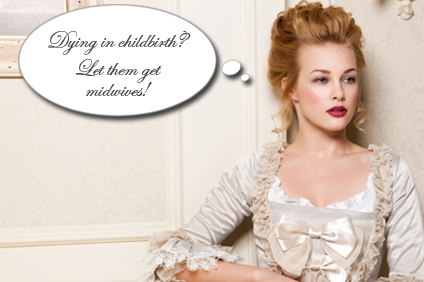
White privilege allows Norman Nathman to ignore the fact that the US maternal mortality rate reflects a population that is blacker, poorer and lacks access to high tech lifesaving care. White privilege allows Norman Nathman to imagine instead that the problem is that we aren’t spending more resources to spread the birth “experience” preferences of wealthy, white childbirth activists. Norman Nathman is the white privilege version of Marie Antoinette who, according to the apocryphal story, responded to learning that the poor were rioting because there was no bread, with the utterly clueless, “Let them eat cake.” Norman Nathman responds to learning that too many American women die in childbirth with the utterly clueless, “Let them get midwives.”

It is morally grotesque and reeks of privilege to suggest that midwifery is the answer to the problem of women dying in pregnancy of heart disease, kidney disease, eclampsia, and other serious complications. Natural childbirth advocates need to check their white privilege, stop imagining that everyone is white, middle class and has easy access to high tech healthcare, and, most importantly, stop expropriating the tragedies of black women to serve the agenda of privileged group of white women.

Dr. Amy