Dr. Amy’ 5 reasons NOT to have a homebirth

5 reasons not to choose homebirth

Wow, it happened again!

No sooner did I write a post about confident idiots than one of them stepped forward to offer a perfect example of why, despite their certainty, they cannot be trusted. Thank you Jennifer Margulis for your new post 45 Reasons NOT to Have a Home Birth. It is a delightful amalgamation of the mistruths, half truths and outright lies tossed back and forth between clueless homebirth advocates, who actually think it is knowledge.

As Dr. Dunning of the Dunning-Kruger effect has noted:

What’s curious is that, in many cases, incompetence does not leave people disoriented, perplexed, or cautious. Instead, the incompetent are often blessed with an inappropriate confidence, buoyed by something that feels to them like knowledge.

Jennifer Margulis has ZERO qualifications to offer medical information on homebirth. She’s not an obstetrician, not a midwife, not a medical professional of any kind. She hasn’t delivered any babies, cared for any pregnant women, or managed any pregnancy complications. Her degrees are in English Literature, so she lacks the fundamental knowledge of science and statistics needed to read and analyze scientific papers. She appears to have no idea what the scientific literature says about anything, and swallows every lie that the Midwives Alliance of North America chooses to spoon-feed her.

What’s curious is that her utter incompetence when it comes to the field of obstetrics does not leave her disoriented, perplexed, or cautious. Instead, she is blessed with entirely inappropriate confidence in her conclusions, buoyed by something that feels to her like knowledge, but is actually unbounded ignorance, with a heaping helping of arrogance. She, a travel journalist with a PhD in English literature, actually fantasizes that she has more knowledge about the risks of homebirth than the tens of thousands of obstetricians, pediatricians, and neonatalogists who have done the research that shows that homebirth dramatically increases the risk of perinatal death.

Of course, you can’t expect much from someone who offered what has to be the single stupidest excuse ever when presented with evidence that homebirth leads to preventable perinatal deaths. When I asked her about Judith Rooks, CNM MPH analysis of 2012 Oregon homebirth statistics that showed that planned homebirth with a licensed Oregon homebirth midwife has a death rate 800% HIGHER than comparable risk birth, Margulis responded:

Amy, Oregon has some of the safest best homebirth stats in the country IF YOU DON’T COUNT PORTLAND…

Yes, she really wrote that.

I’m not going to bore you with the latest nonsense that Margulis recycles in her post; you are free to read it if you can stomach it. However, I will offer MY 5 reasons not to have a homebirth. It’s a much shorter list because it gets to the point immediately.

Dr. Amy’s 5 reasons NOT to choose homebirth:

1. A healthy live baby is your first priority.
2. You don’t want to take even the tiniest risk to your baby’s brain function.
3. You don’t need to impress other privileged Western white women with faux achievements.
4. You actually read the scientific literature.
5. You take medical advice from medical professionals, not confident idiots.

My 5 reasons are not particularly startling. They reflect the findings of ALL the scientific literature on homebirth, as well as state, national and international statistics. They reflect the mainstream views of ACOG and the AAP, as well as the overwhelming majority of obstetricians, pediatricians and neonatologists.

But, of course, Jennifer Margulis is confident, oh so very confident, that she knows better than tens of thousands of medical professionals. The only question for women contemplating homebirth is this:

Who are you going to trust for medical advice on childbirth, medical professionals or a travel writer who is inexplicably confident in her utter ignorance?

Natural childbirth and confident idiots

Nerd laughing

The trouble with ignorance is that it feels so much like expertise.

So says psychology professor Dr. David Dunning. He ought to know.

In 1999, in the Journal of Personality and Social Psychology, my then graduate student Justin Kruger and I published a paper that documented how, in many areas of life, incompetent people do not recognize — scratch that, cannot recognize — just how incompetent they are, a phenomenon that has come to be known as the Dunning-Kruger effect. Logic itself almost demands this lack of self-insight: For poor performers to recognize their ineptitude would require them to possess the very expertise they lack. To know how skilled or unskilled you are at using the rules of grammar, for instance, you must have a good working knowledge of those rules, an impossibility among the incompetent…

Or, for instance, to know how knowledgeable or ignorant you are about childbirth, you have to have a good working knowledge of modern obstetrics including both normal and abnormal childbirth. Paradoxically:

What’s curious is that, in many cases, incompetence does not leave people disoriented, perplexed, or cautious. Instead, the incompetent are often blessed with an inappropriate confidence, buoyed by something that feels to them like knowledge.

When it comes to childbirth, we call these people midwives, doulas and childbirth educators. Not all, fortunately, have an inappropriate level of confidence in their own incompetence, but a significant proportion of midwives (including 100% of homebirth midwives) and an astoundingly large proportion of doulas and childbirth educators suffer from the of delusion believing themselves “knowledgeable” after having done “their research.” The world of celebrity natural childbirth and homebirth advocates is filled with what Dunning calls “confident idiots.” These include, but are in no way limited to, Ina May Gaskin, Ricki Lake, Barbara Harper of Waterbirth International, Jan Tritten of Midwifery Today, Jennifer Margulis, Jen Kamel of VBACFacts, Milli Hill of Positive Birth, and doula Teri Shilling, former president of Lamaze International, of My OB Said What??!!

How do people become confident idiots?

Very young children … carry misbeliefs that they will harbor, to some degree, for the rest of their lives. Their thinking, for example, is marked by a strong tendency to falsely ascribe intentions, functions, and purposes to organisms. In a child’s mind, the most important biological aspect of a living thing is the role it plays in the realm of all life. Asked why tigers exist, children will emphasize that they were “made for being in a zoo.” Asked why trees produce oxygen, children say they do so to allow animals to breathe… This purpose-driven misconception wreaks particular havoc on attempts to teach one of the most important concepts in modern science: evolutionary theory. Even laypeople who endorse the theory often believe a false version of it. They ascribe a level of agency and organization to evolution that is just not there…

Hence natural childbirth and natural parenting advocates claim that women are “perfectly evolved” for childbirth or that women who are breastfeeding “always” have enough breastmilk.

This idea of evolution misses the essential role played by individual differences and competition between members of a species in response to environmental pressures: Individual cheetahs who can run faster catch more prey, live longer, and reproduce more successfully; slower cheetahs lose out, and die out—leaving the species to drift toward becoming faster overall. Evolution is the result of random differences and natural selection, not agency or choice.

Similarly, childbirth and breastfeeding have always been, and are still governed by random differences and natural selection. Some pregnancies are too short and the baby dies; some pregnancies are too long and the baby dies. The idea that “the baby knows when to be born” is paradigmatic example of the purpose driven misbelief; it’s just as foolish as imagining that a cheetah knows that if it runs faster it will catch more prey. These purpose driven misbeliefs are behind many of the most egregious claims of natural childbirth advocates, from “breech is just a variation of normal” to “you can’t grow a baby too big to birth vaginally.”

The confident idiots of the natural childbirth world also suffer from motivated reasoning.

Some of our most stubborn misbeliefs arise not from primitive childlike intuitions or careless category errors, but from the very values and philosophies that define who we are as individuals. Each of us possesses certain foundational beliefs — narratives about the self, ideas about the social order—that essentially cannot be violated: To contradict them would call into question our very self-worth. As such, these views demand fealty from other opinions. And any information that we glean from the world is amended, distorted, diminished, or forgotten in order to make sure that these sacrosanct beliefs remain whole and unharmed.

The foundational belief of natural childbirth, lactivism and natural parenting is: “My birth, feeding and parenting choices make me a better mother than everyone else.” Many natural childbirth advocates literally cannot tolerate any evidence that threatens this foundational belief. Hence the epidemic of deleting and banning that afflicts natural childbirth websites and message boards.

How can we combat the epidemic of misbeliefs promoted by natural childbirth advocates? Dunning advocates a general strategy that can be applied to natural childbirth advocacy:

For individuals, the trick is to be your own devil’s advocate: to think through how your favored conclusions might be misguided; to ask yourself how you might be wrong, or how things might turn out differently from what you expect. It helps to try practicing what the psychologist Charles Lord calls “considering the opposite.” To do this, I often imagine myself in a future in which I have turned out to be wrong in a decision, and then consider what the likeliest path was that led to my failure. And lastly: Seek advice. Other people may have their own misbeliefs, but a discussion can often be sufficient to rid a serious person of his or her most egregious misconceptions.

Of course natural childbirth advocates have already cleverly “immunized” their followers against such a strategy. According to them, you should never ask yourself how you might be wrong because questioning birth inevitably leads to poor outcomes. “Trust birth!” sounds better than “Don’t think!” but it means exactly the same thing.

How can you protect yourself against the confident idiots in the world of natural childbirth?

1. The first step is to recognize that those who know the least often think they know the most. That’s why professional qualifications are so important. The people who know the most about childbirth are obstetricians. That doesn’t mean that they know everything, or that they are always right, but it does mean that they have a strong foundation from which to assess claims about childbirth.

2. Be wary of anyone who claims that formal education is unnecessary, or that obstetricians don’t follow the scientific evidence. Be wary of anyone who tells you what birth is like in the hospital when they have never worked in a hospital.

3. Be wary of anyone who makes claims about what is or is not normal in pregnancy without having extensive experience in caring for women who have pregnancy complications.

4. Don’t “trust” any natural process.

5. Ignore anyone who cannot tolerate dissent and deletes comments that call their claims into question.

6. Resist the temptation to succumb to flattery. Choices about birth and breastfeeding do not have much, if any, impact on whether children will become healthy, happy and competent adults. Anyone who tells you that the “right” choices make you a better mother is a confident idiot. Don’t let the desire to feel superior to other mothers make you a confident idiot, too.

Announcing …

3d Heart in a trap

My new book!

For the last few months I’ve been working on a book proposal. I’m happy to say that it garnered a lot of interest among editors and publishing houses, and ultimately went to auction.

Guilt Trap: New Motherhood and the Natural Parenting Industry will be published next year by Dey Street Books, an imprint of Harper Collins.

From the proposal:

[I hope that] Guilt Trap will bring desperately needed comfort to millions of women and will stimulate discussions in the mainstream media and our society about the corrosive impact of the natural childbirth and breastfeeding industries on women’s wellbeing. … I will show readers who benefits from making women feel guilty about their choices, and why contemporary childbirth, breastfeeding, and attachment parenting movements are retrograde, sexist, and even dangerous – and in doing so, free women from guilt they have unnecessarily shouldered for far too long.

I’m thrilled that I’ll be working with an amazing editorial team and I can’t wait to get started.

For my daughter on her birthday

Pink birthday cupcake

All my life I dreamed of you … and then you came.

From the time that I was a small child I had imagined what it would be like to have a daughter. I envisioned a girly girl with a powerful sense of self, and you have wildly exceeded my every expectation.

Your personality was apparent from the day that you were born: you have your own ideas and you won’t settle for substitutions or diversions. I remember trying to give you a pacifier when you were fussy, just like I had given your 3 brothers. They took it happily; you, on the other hand, immediately spit it out and gave me a look like “you cannot possibly be serious; this is plastic and I don’t do plastic.”

You talked clearly and imperiously before you turned one (your first word was “ring” because you wanted to wear my engagement diamond) and you picked out your own outfits from the time you were 18 months old. I learned early on that disagreement was pointless, but that reasoning with you was highly successful. When you wanted to wear plaid with stripes I didn’t say no; I merely told you that most people felt that they clashed, but you were free to make your own choice. After careful consideration, you put the plaid back and picked something that matched better. Your fashion sense has been unerring since those early years.

Second birthday small

As a preschooler you had 8 Barbies and two Magic Attic dolls, wore dresses every day and princess costumes for Halloween. I sewed for you and your dolls so you could have matching outfits for special occasions like your 2nd birthday above. Others cautioned me that dolls and frilly clothes would give you the wrong idea about about girls and ambition, but I’ve always felt that femininity and ambition are not incompatible. At six years old you asked me what you should do after you won the Nobel Prize.

When you were 11, you told me that your goal was to be a published author before you turned 16. I didn’t want to discourage you, but I thought that it was a goal much more difficult to achieve than you understood. Indeed, I pointed out for years I had written professionally (as a freelance medical writer) and for every 10 articles I sent out, 9 got rejected. “Well, yes, that’s you,” you replied, “but this is me.”

So we went to the bookstore and bought The Writer’s Guide to Children’s Literature, which listed all the magazines that accepted submissions of writing for children. That was on Saturday. When I came down on Monday morning, there was a neat stack of large, white envelopes on the kitchen table. Each contained a story and a cover letter, and each was addressed to a different publication. On top of the stack was a note asking me to mail them. Within several weeks you had an answer. You were going to be published. Your story, was published in Stone Soup, a national magazine for children. You had achieved your stated ambition, and you had achieved it ahead of schedule.

When you were 12, you asked me, “Why don’t you work?,” and more specifically, “Don’t you feel bad that you are not an important person?” We talked about it when you asked me, and I’ve thought a lot about over the years.

The third question you asked at the time was much easier to answer. “Don’t you feel bad that Daddy makes all the money, and you don’t have any?” No, I don’t, because, as I told you, Daddy may make all the money, but all of it is mine! “How does that work?”, you said. Marry the right guy, and it’ll work for you, too.

I understood that what you were asking about was not that mothers aren’t important; you were curious whether an ambitious person can be happy if she does not have professional success to point to, and if no one is paying her for the work that she does. The answer is yes. Because when it comes right down to it, it is the ordinary joys of life, the ones that are available to everyone and require no fancy skills that are the warp and weft of a happy life. Therefore, I recommend to you some ordinary joys:

Marry a good man. There is nothing better than being married to your best friend.

Pick interesting friends. Your friendships will be the backbone of your life. (Oh, be sure to have some friends who are doctors. That really comes in handy).

Do what you love, even if it’s hard. A satisfying career usually takes a lot of work to get started. Don’t let that stop you. Do the work, and you will be glad that you did.

Have professional colleagues whom you admire and respect. It’s even better if you can have professional colleagues who you admire, respect AND can call your friends.

Have children. There’s an upside and a downside to this. Children are extraordinary, but they are also a lot of work. They can bring joy and meaning to your life, and they can also point out that you are the dumbest person on earth, and the most embarrassing.

Read books. I cannot recommend that highly enough. I know that you love books as much as I do (we share a Kindle account and we are Amazon’s best customers) and they will always be a source of joy and comfort to you.

Have a hobby. I highly recommend sewing. Not only is it practical, but it is a way to shower attention on your children without actually being with them.

Finally, if you can manage it, have a daughter. It is every bit as fun, exciting, challenging and meaningful as I imagined it would be; you are the daughter of my dreams.

Wait, let me amend that, you are the daughter who has exceeded my fondest dreams!

Happy, Happy Birthday!

Quackery means never having to say you’re sorry

iStock_000046945224Small

There are a lot of tips for differentiating peddlers of pseudoscience from real scientists. I’ve written about some of them myself (Six red flags you need to recognize to quack proof yourself).

But there’s a simple question you can ask that serves as a highly reliable shortcut. Does the website (or Facebook page) airbrush the owner’s mistruths and mistakes?

You can determine the answer to that question not by what you see, but by what you don’t see. Just like pictures of fashion models are airbrushed to remove any flaws and project an image of perfection, the websites of quacks are airbrushed to removed the author’s mistakes and to remove (and ban) anyone who questions the author’s claims.

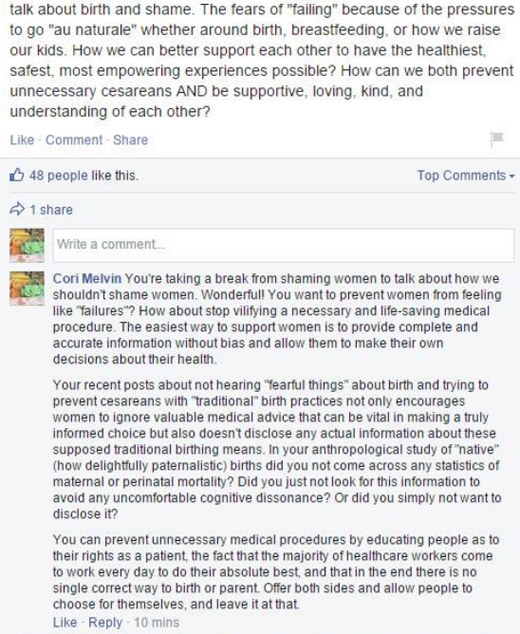
Consider the recent incident with Aviva Romm, MD. In an episode of monumental hypocrisy, Romm issued a caution against shaming women who have C-sections in the midst of a 30 day Facebook rant on preventing unnecessary C-sections that only the day before had advised women to avoid associating with anyone who thought her C-section was acceptable. Romm piously declared:

Today I am making a departure from cesarean prevention to talk about SHAME prevention… Let’s talk about birth and shame. The fears of “failing” because of the pressures to go “au naturale” whether around birth, breastfeeding, or how we raise our kids. How we can better support each other to have the healthiest, safest, most empowering experiences possible?

She promptly got her head handed to her on a platter with a scathingly brilliant comment.

Romm comment 10-26-14

You’re taking a break from shaming women to talk about how we shouldn’t shame women. Wonderful! You want to prevent women from feeling like “failures”? How about stop vilifying a necessary and life-saving medical procedure. The easiest way to support women is to provide complete and accurate information without bias and allow them to make their own decisions about their health.

Your recent posts about not hearing “fearful things” about birth and trying to prevent cesareans with “traditional” birth practices not only encourages women to ignore valuable medical advice that can be vital in making a truly informed choice but also doesn’t disclose any actual information about these supposed traditional birthing means. In your anthropological study of “native” (how delightfully paternalistic) births did you not come across any statistics of maternal or perinatal mortality? Did you just not look for this information to avoid any uncomfortable cognitive dissonance? Or did you simply not want to disclose it?

You can prevent unnecessary medical procedures by education people at to their rights as a patient, the fact that the majority of healthcare workers come to work every day to do their absolute best, and that in the end there is no single correct way to birth or parent. Offer both sides and allow people to choose for themselves and leave it at that.

Romm should have offered an apology for her hypocrisy and henceforth vowed to scrutinize her own writing for subtle and not so subtle shaming strategies. Instead of acknowledging her mistake (and her insensitivity), however, Romm simply airbrushed it out of existence, erasing not merely the hypocritical post that counseled against shaming, but the entire 7 posts of the series thus far, and erasing any evidence that the series ever existed.

Just like Jan Tritten erased evidence of her involvement in the death of Gavin Michael.

Just like Jen Kamel erased the fact that she had boasted about the VBAC outcomes of her followers without realizing they were hideous.

Just like Hermine Hayes-Klein of Human Rights in Childbirth erased evidence questioning the organization’s response to their “forced episiotomy” video.

Quacks can never tolerate being shown to be wrong. That’s entirely different from tolerating being wrong. No sooner did she delete her post on shaming women who have C-sections, then Aviva Romm created a post suggesting that C-sections may raise autism risk, without bothering to include the authors’ caveat that their paper did NOT show that C-sections cause autism. I cannot believe that she is so innumerate that she did not recognize that the paper proved nothing, yet she posted it anyway. She is so not shaming you for having a C-section even if it did cause your child’s autism. Despicable!

Real scientists and doctors make mistakes and should acknowledge them and correct them when it is pointed out to them. Real scientists and doctors can and must tolerate public dissent, must allow their claims to be questioned and must respond to those questions. Natural childbirth and homebirth advocates, like quacks of all kinds, cannot tolerate dissent and create airbrushed websites and Facebook pages that make them seem omniscient and infallible. Quackery means never having to say your sorry.

When you encounter a natural childbirth or homebirth website gleaming with airbrushed perfection, all signs of dissent removed and anyone who could challenge the author banned, you can be certain that you are in the presence of quackery … and you should protect yourself accordingly.

Lethal breasts?

Baby breastfeeding

Last month I wrote about a spate of infant deaths in so-called “Baby Friendly” hospitals and asked whether the Baby Friendly Hospital Initiative ought to be renamed the Baby Deadly Hospital Initiative.

The Initiative virtually mandates keeping babies in bed with exhausted new mothers even when multiple modifiable risk factors for infant suffocation are present, including maternal impairment due to sedating drugs or exhaustion and soft bedding. Why? To encourage breastfeeding, of course. The paper Deaths and near deaths of healthy newborn infants while bed sharing on maternity wards (2014) reported on the results: 15 neonatal deaths and 2 near deaths.

Over the weekend, a reader alerted me that this phenomenon is far more common than I had realized. In fact, it is so common that it has a name, sudden unexpected postnatal collapse (SUPC), and multiple papers exist describing the phenomenon.

In Unexpected collapse of healthy newborn infants: risk factors, supervision and hypothermia treatment (2013), Pejovic and Herlenius describe the findings in just one city, Stockholm:

Twenty-six cases of SUPC were found among 68 364 live-born infants, an incidence of 38/100 000 live births. Sixteen of these cases of SUPC required resuscitation with ventilation >1 min, and 14 of these remained unexplained (21/100 000). Fifteen of the 26 children were found in a prone position, during skin-to-skin contact, 18 were primipara, and 13 occurred during unsupervised breastfeeding at

Conclusion

SUPC in apparent healthy babies is associated with initial, unsupervised breastfeeding, prone position, primiparity and distractions. Guidelines outlining the appropriate monitoring of newborns and safe early skin-to-skin contact should be implemented.

Unexpected collapse in apparently healthy newborns – a prospective national study of a missing cohort of neonatal deaths and near-death events (2012) describes the British experience:

45 cases were reported, an incidence of 0.05/1000 live births of whom 12 infants died. In 15/45 infants, an underlying disease/abnormality was determined. In 30/45 cases (0.035/1000 live births), no such cause was found, but in 24, the clinical/pathological diagnosis was airway obstruction during breast feeding or in prone position. Mothers were commonly primiparous and unattended by clinical staff before collapse was recognised.

Not surprisingly, most cases occurred at times of low supervision and many cases involved known risk factors for sudden infant death syndrome (SIDS):

Collapse occurred between 21:00 and 08:59 h in 25 (56%) cases. Thirteen (29%) infants were presumed to be feeding at the time of collapse. Thirty (67%) women had received analgesia in the form of opiates or had had a regional or general (one case) anaesthetic in the 8 h preceding the collapse.

In 23 cases, the mother or both parents were unattended with their new baby at the time of collapse. When mothers were left alone with their baby, they recognised signs of collapse in around a third of instances. When another parent was present, they recognised the signs of collapse more often (75%)…

The long term outcomes were terrible:

Nineteen of the 24 infants with presumed accidental suffocation survived to discharge. At 1 year, five were noted to have neurological abnormalities (26%). Three have cerebral palsy, one has probable cerebral palsy with significant motor delay and the other has mild global delay and hypotonia…

Poets et al. reported in Sudden Deaths and Severe Apparent Life-Threatening Events in Term Infants Within 24 Hours of Birth (2011) on 17 cases of SUPC, defined as unexpected sudden infant deaths (SID) and severe apparent life-threatening events (S-ALTE) that occurred within 24 hours of birth.

There were 7 deaths (ie, 1.1/100 000); 6 of the 10 S-ALTE infants were neurologically abnormal at discharge. Twelve infants were found lying on their mother’s chest or abdomen, or very close to and facing her. Nine events occurred in the first 2 hours after birth; 7, were only noticed by a health professional despite the mother being present and awake.

CONCLUSIONS: SID or S-ALTE may occur in the first 24 hours after birth, particularly within the first 2 hours. Events seem often related to a potentially asphyxiating position. Parents may be too fatigued or otherwise not able to assess their infant’s condition correctly. Closer observation during these earliest hours seems warranted.

An editorial in Archives of Diseases of the Child Fetal Neonatal Edition Unexpected collapse of apparently healthy newborn infants: the benefits and potential risks of skin-to-skin contact (2012) advises:

… it seems appropriate … to recommend that midwives check on the infant’s condition frequently during the first 2–3 h after birth, with particular emphasis on ensuring that when in skin-to-skin contact the infant’s position is safe and the nose and mouth are not occluded.

The ultimate irony, of course, is that there is no evidence that early breastfeeding or skin to skin contact has any impact on breastfeeding success. Correlation has been noted, but that is easily explained by the fact that women who entered labor committed to exclusive breastfeeding are more likely to initiate early breastfeeding and to value extended skin to skin contact than those who plan to bottlefeed. In other words, not only is one of the central tenets of the Baby Friendly Hospital Initiative unproven, but may actually lead to brain injury and death.

In a recent issue of The Journal of Perinatal and Neonatal Nursing, M. Terese Verklan, PhD, CCNS, RNC, FAAN points out that The Breast Can Be Lethal:

… I have recently heard of 2 incidences of newborns being suffocated when breast-feeding. One case involved a mother who was exhausted after feeding her newborn every 11/2 to 2 hours for the past 60 hours or so. It is believed that she fell asleep while the newborn was feeding and did not wake up until the morning. It was obvious that the baby did not survive the night. In the second case, the neonate was approximately 4 hours old when the parents excitedly summoned the postpartum nurse to check him because “he didn’t look right.” The nurse remembers seeing his legs looking mottled and dusky and that she had to lift the breast off his head and chest. He was in cardiopulmonary arrest and survived extensive resuscitation with major neurologic sequelae. Both mothers had had a lactation consultant spend some time instructing them on how to breastfeed, describing several positions to enhance latching for the baby and comfort for the mother. I believe both were being held in the football hold, but I am not 100% sure. I do know that both mothers were primiparas wanting to provide the best nutrition for these babies.

Verklan concludes:

… Given that we are using evidence-based practice interventions today as much as possible, perinatal researchers need to closely scrutinize the different practices taught to mothers and develop the science behind these “routine” interventions…

Mandated rooming in policies, encouragement of prolonged skin to skin contact, and pressure to breastfeed repeatedly and exclusively during the first postpartum days are interventions promoted by the Baby Friendly Hospital Initiative. Like all interventions, we need to examine whether there is scientific evidence to support them, and describe the harms that result from them.

Otherwise, the Baby Friendly Hospital Initiative will truly become the Baby Deadly Hospital Initiative.

Aviva Romm, heal thyself!

Aviva Romm Day 7

You can’t make this stuff up.

Aviva Romm, MD has thoughtfully taken a break from her 30 day series on “Preventing Unnecessary Cesareans,” to inform us that she is shocked, shocked that some women are being shamed for their C-sections:

Day 7: Take Back Birth: Preventing Unnecessary Cesareans

Today I am making a departure from cesarean prevention to talk about SHAME prevention… Let’s talk about birth and shame. The fears of “failing” because of the pressures to go “au naturale” whether around birth, breastfeeding, or how we raise our kids. How we can better support each other to have the healthiest, safest, most empowering experiences possible?

How? Come closer, Aviva and I will whisper just one teensy, weensy little way that you might take the first step toward better support other women:

END YOUR NONSENSICAL, ANTI-SCIENTIFIC SERIES ON PREVENTING “UNNECESSARY” CESAREANS!

Romm’s series in a object lesson in the subtle cruelty of natural childbirth shaming.

Day 1: Start with self-serving hypocrisy:

My goal is not to make anyone who had a cesarean feel badly about it. We all do what we have to do in complex situations.

English to English translation: If only you had been smarter, you wouldn’t have had a C-section.

Day 2: Justify your own refusal to take responsibility by practicing obstetrics deciding which C-sections are necessary.

When applying to medical residencies, I considered becoming an OB-GYN, thinking this would be an extraordinarily subversive and effective way that I, as a midwife, could influence change in hospital birthing practices. Then I visited residency programs where I was confidently informed that I would get PLENTY of surgical training because there would be no shortage of cesareans!…

See, Aviva can’t take any personal responsibility for preventing unnecessary C-sections, because she might have had to perform a lot of C-sections in order to gain the qualifications to determine which C-sections are unnecessary, and she didn’t want to do that. Get it? Me, neither.

Day 3: Tell a whopper!

Your body should be your business not big business for someone else.

Thus saith Aviva Romm, whose entire career is a giant business, from midwifery, to books, to newsletters, to seminars, to bamboozling people by practicing “functional” medicine. 100% of Romm’s income depends on your body being a big business for her.

Day 4: Lie about the scientific evidence

Here’s a tip you might not have realized is ok and even beneficial: Eat during labor.

No, there is NO scientific evidence that eating in labor is beneficial. It’s not like the issue hasn’t been studied; it has been studied repeatedly. Each study has utterly failed to show any benefit to eating in labor, only risk. That risk being the risk of aspirating the food that you have eaten into your lungs.

But claiming that it is beneficial is delightfully subversive so Aviva indulges herself.

Day 5: Bash technology:

… [T]echnology and natural birth aren’t a great mix. So when I was pregnant I asked myself: How can I birth naturally? I studied how women birthed traditionally. I studied native birthing practices around the world through anthropology. Here’s what I learned and did: Walking, laboring with women friends and relatives there for support, eating when I was hungry, drinking when thirsty, staying upright for labor, pushing when the instinct overtook my body, squatting for birth. While you don’t have to do all of these, taking birth lying down and assuming technology knows our bodies better than we do are some of the ways we’ve gotten into this 34% cesarean rate!…

Me, me, me! Look at me! Follow me! Copy me! I’m awesome and if you try hard enough you can be like me, me, me!

Day 6: Today’s tip is tough but important. Be careful whose opinions and beliefs you “let in” to your personal emotional space while you are pregnant and in labor. Science shows us that who we surround ourself with affects our health. For example, if our friends are overweight, just by the social connections we have a 50% chance …

WE INTERRUPT THIS POST FOR AN IMPORTANT BULLETIN! AVIVA ROMM JUST RETRACTED HER 30 DAY SERIES ON PREVENTING UNNECESSARY C-SECTIONS! She removed each and every post from the series.

But I didn’t even get a chance to copy Aviva’s words on not socializing women who are overweight or women who have had C-sections, lest we become “infected” with obesity or Cesareans by them, before she deleted them.

As usual in the world of NCB, deletion is a sign of guilt. No sooner did Aviva notice that we were discussing her hypocrisy on the Fed Up Facebook page then she realized that we were right and moved quickly to erase the evidence … of course, without bothering to offer an apology for her smarmy tactics.

Looks like she took my advice even before I gave it, since I was going to say:

Aviva Romm, when it comes to preventing shame over C-sections, physician heal thyself!

Birth represents woman at her LEAST powerful

image


One of the most depressing things about the philosophy of natural childbirth is that it treats women like children who can be chivvied into believing sugar coated nonsense. Perhaps the premier example of this tendency toward infantilizing grown women is the bizarre claim that birth represents woman at her most powerful. Milli Hill purveys this ridiculous drivel in her recent piece in The Guardian while whining that Facebook removed images that violate their policies:

You could argue that this is simply about nudity, but I think there’s more to it. Social media reflects our wider culture’s issue, not with naked women, but with naked women who look real and active as opposed to air-brushed and passive. It also reflects millennia of attempts to suppress women’s power, of which childbirth is perhaps the ultimate expression.

Oh, please, Milli; grow up! Women have been giving birth vaginally without pain medication (or dying in the attempt) since the beginning of human existence, and until relatively recently, women have had ZERO power. Indeed, in countries that lack access to modern obstetrics, where every woman is forced to endure natural childbirth, women still have ZERO power. In such societies women are viewed as the property of their husbands, have no political or economic rights, are married off while still children, die in droves due to hideous maternal mortality rates, have their genitals mutilated, and are raped with impunity in war and often in peace as well. Does that sound like power to you, Milli?

The idea that childbirth reflects women’s power would be ludicrous if it weren’t so offensive. Obviously Hill isn’t talking about poor women, women of color, women living a subsistence existence in developing countries. She’s not talking about THOSE women, who are the majority of women in the world. Hill is apparently talking about privileged, Western, white women like herself who are apparently the only ones who count.

But, you know what, Milli, you’re wrong about those women, too. In industrialized countries that accord women legal and economic rights, birth does NOT represent women at their most powerful. It represents women at their LEAST powerful.

There is no power in being in agonizing pain, incapable of doing anything other than screaming or moaning, barely rational, and totally bereft of the capacity to control anything. A woman in labor surrenders all her power to others. A woman in labor is extraordinarily vulnerable and is at the mercy of anyone who walks by. She can’t defend herself, she can’t assert herself, she can’t express herself, she can’t care for others and she can’t care for herself if the need arises.

Yes, the process of labor is powerful. Once it has a woman in its grip, it does not let go until the baby is born or the woman is dead. It’s powerful in the same way that a tornado or an earthquake is powerful. Claiming that labor represents woman at her most powerful, is like claiming that a woman sucked out of her tornado ravaged house is powerful. In both cases she is subjected to powerful natural forces, but she herself is completely powerless.

Birth doesn’t merely render women physically powerless, the storm of hormones that surround and follow birth can also render them emotionally powerless. Many women have trouble controlling their emotions, may experience unexpected sadness, depression and in severe cases, major mental illness. In addition, many women are uniquely vulnerable to psychological manipulation in the days and weeks following birth because they are overwhelmed with love for the new baby and desperate to do their best in caring for him or her. They can be helpless to defend themselves against the depredations of natural childbirth advocates and lactivists who gleefully shame them with false accusations that a baby won’t bond to a mother who had medication during labor or who chooses not to breastfeed.

No, Milli, birth does not represent woman at her most powerful, it represents woman at her most vulnerable, and anyone who claims to care for pregnant women and new mothers should recognize and acknowledge that. To the extent that some women are powerful, their power resides in their intellect, their talents, their money, their political power (if they wield any), their military power (if they wield any), their degrees, their qualifications, and their work experience. Powerful women do not derive their power from having a baby transit their vagina, and it is pure nonsense to pretend that they do.

Natural childbirth advocates need to stop treating women like preschoolers. It is fine to tell a toddler that using the potty means she is a “big girl,” but it is demeaning to tell a grown woman that pushing a baby out through her vagina means that she is “powerful.” Expecting women to accept sugar coated lies in place of real power simply emphasizes their powerlessness.

Milli Hill demonstrates that natural childbirth is an issue of privileged, Western white women

image

Oh, the horror!

Milli Hill of The Positive Birth Movement is outraged.

Over the weekend, Facebook removed two images from our page and subjected myself and my organisation to a 24-hour ban. This was because, in its words, the images “violated community standards”. Neither image fits the stereotypical picture that most of us have of birth. In the first, a woman kneels: she looks composed, vital and beautiful. The second shows a baby emerging underwater into her mother’s own hands.

You could argue that this is simply about nudity, but I think there’s more to it. Social media reflects our wider culture’s issue, not with naked women, but with naked women who look real and active as opposed to air-brushed and passive. It also reflects millennia of attempts to suppress women’s power, of which childbirth is perhaps the ultimate expression.

Hill needs to get a grip. Are we supposed to imagine that Mark Zuckerberg, Sheryl Sandberg, and their minions at Facebook spent even a microsecond imagining that images of naked natural childbirth advocates reflect “women’s power,” let alone plotted to suppress them? Hill’s presumption is breathtaking in its narcissism. We all know that the photos were likely flagged by an algorithm (or by disgruntled readers) and removed because they violate the policy of a private corporation. No one at Facebook cares about Milli Hill, about natural childbirth, or whether or not images of naked natural childbirth advocates are reflections of their power.

Hill demonstrates, yet again, that natural childbirth, far from being a feminist issue is an issue of privileged, Western, white, relatively well off women who think that the worst thing that can happen to them is that Facebook is interfering with their freedom of expression.

Make no mistake, childbirth is, indeed, a feminist issue, and we should all be working to end maternal mortality, prematurity, neonatal death, obstetric fistula, lack of access to birth control, and the shackling of women prisoners in labor, among other issues that violate the rights of women and limit their ability to pursue their own happiness. But those are issues that disproportionally affect poor women, women of color and women of underdeveloped countries. Who cares about them? Certainly not natural childbirth advocates.

Indeed, natural childbirth advocacy has a long and sordid history of exploiting poor women of color. It started with Grantly Dick-Read, the father of natural childbirth, who based its philosophy on the racist claim that “primitive women” (read “women of color”) are fundamentally different from white women, simultaneously simple (longing only to reproduce) and unafraid of dying in childbirth, rendering them immune to the pain and dangers of birth.

That racist trope is alive and well among contemporary natural childbirth advocates who pretend to themselves that they are re-enacting childbirth among indigenous peoples. Their fantasy bears as much resemblance to childbirth in nature as a 3rd grade Thanksgiving play bears to the real relationship between the Pilgrims and the “uncivilized” Native Americans they came to displace.

But the racism extends even further. Natural childbirth advocates are positively eager to use the misfortunes of women of color to advance their own privileged agenda. They delight in pointing to relatively high rates of perinatal and maternal mortality in the US (as compared to other, “whiter” countries), yet ignore that they are the result of appalling death rates among African American women and their babies.Natural childbirth advocates and organizations have the unmitigated gall to imply that these women are dying of “too much” medical intervention when the reality is that they are dying of too little intervention for the serious complications they face.

The philosophy of natural childbirth is a rejection of privilege that simultaneously confirms it. Simply put, you have to be privileged enough to have easy access to safe pain relief in labor in order to give meaning to refusing it. You have to be privileged enough to have immediate access to high quality emergency obstetric services in order to give meaning and assure safety to refusing the testing and procedures (“interventions”) designed to prevent those emergencies in the first place.

Milli Hill has helpfully demonstrated, yet again, the incredible privilege of the Western, white, relatively well off women who imagine that by refusing pain medication they are demonstrating their “power” and who in their egotism pretend that when Facebook applies the same standards to them as to everyone else, they are somehow singling them out for special treatment.

Sorry to disappoint you, Milli Hill; while childbirth is a feminist issue, natural childbirth is not. Feminists everywhere should be working to put an end to the scourges of maternal mortality, prematurity, neonatal death, obstetric fistula, lack of access to birth control, and the shackling of women prisoners in labor, among other issues. In a list of the top 10 feminist childbirth issues, however, the removal from Facebook of photos depicting naked natural childbirth advocates giving birth ranks approximately 29th.

The last bastion of acceptable bullying? New motherhood.

image

We are all anti-bullying now.

We recognize that bullying based on race is wrong; bullying based on religion is wrong; bullying based on gender is wrong; bullying based on sexual orientation is wrong. In fact, there’s only one group that it is still acceptable to bully: new mothers.

And who are the bullies? Lactivists, natural childbirth activists, and the natural parenting industry.

How do these activists and industries bully new mothers? Let me count the ways.

1. Through the perversion of science

From individual lactivists to the so-called Baby Friendly Hospital Initiative, from individual birth bloggers to large organizations like Lamaze International and the Childbirth Connection, natural parenting advocates pervert the scientific evidence on breastfeeding and childbirth.

Yes, breastfeeding has real benefits, but those benefits are trivial in industrialized countries. That’s not surprising when you consider that the benefits of breastfeeding evolved in nature, where unsafe water supplies, scarce sources of food, and a myriad of untreatable pathogens pose a constant and massive threat to babies’ lives. In that setting, a safe source of water and nutrients, always available, generally present in adequate amounts, usually pathogen free and tailored to the specific needs of infants is the difference between life and death.

In first world countries, however, where we have safe water supplies, adequate sources of food and treatments for most pathogens, those threats to babies have largely disappeared. Infant formula is an excellent source of infant nutrition, safe, plentiful and convenient. Lactivists have chosen to ignore those changes and instead grossly exaggerate the benefits of breastfeeding, grossly exaggerate the “risks” of formula feeding, and use weak, poorly controlled and conflicting studies to do so. When all else fails, lying about breastfeeding and bonding is employed.

The perversion of science is, if anything, even worse in natural childbirth advocacy. Childbirth with modern obstetrics is actually dramatically safer than natural childbirth. That hasn’t stopped activists from lying about it. There is no lie that is too ridiculous for natural childbirth advocates to swallow: Michel Odent says pain is necessary for bonding; midwives promote “normal” birth as if the process is more important than the outcome; and there is no limit to the nonsense that issues forth from the mouths and pens of natural childbirth advocates (C-sections change DNA??!! C-sections destroy the infant microbiome??!!)

Lactivists and natural childbirth advocates repeatedly pervert science in order to use it as a cudgel with which to beat women who don’t conform to their values.

2. Emotional abuse

Among middle school girls there is probably no insult more devastating than “no one likes you.” That’s why it is wielded so promiscuously among middle school bullies. Among new mothers there is probably no insult more devastating than “your baby hasn’t bonded to you.” That’s why lactivist and natural childbirth bullies wield it so promiscuously among new mothers. There is NO EVIDENCE that bottle fed babies are less bonded to their mothers than breastfed babies; there is NO EVIDENCE that C-section babies are less bonded to their mothers than babies born by vaginal delivery. That hasn’t stopped activists from repeately invoking bonding to force new mothers into compliance with the ethos of the group.

3. Petty humiliations

“You only think you didn’t produce enough milk for your baby.”

“Your C-section was unnecessary.”

“Bottle feeding is so much easier; not suprising that you gave up breastfeeding and used formula instead.”

Or the humble brag version: “I breastfeed because I’m lazy. Who wants to sterilize all those bottles?”

“What a shame that your baby was born drugged because you gave in and got an epidural.”

4. Veneration of the biggest bullies

Many breastfeeding and birth bloggers are queen bees. They have arranged their little kingdoms to seek adulation from the minions. They practice shunning and silencing of those who disagree (through deleting and banning). They constantly emphasize their specialness and the specialness of their followers. They routinely shame those who will not go along.

Don’t believe me? I have two words for you: Alpha Parent.

5. Institutional humiliations

The Baby Friendly Hospital Initiative has to be the biggest oxymoron in contemporary maternity care. This credentialing initiative isn’t baby friendly and it certainly isn’t mother friendly. It’s bully friendly. It is based on the premise that any woman who doesn’t wholeheartedly embrace breastfeeding must be forced to do so by constant hectoring, shaming, inconvenience (locking up formula), sleep deprivation (mandatory rooming in) and punishment (banning formula gifts).

To my knowledge, neither the component “steps” nor the program itself have ever been shown to increase long term breastfeeding rates. Their only “success” is increasing the number of women who claim they will be breastfeeding when they leave the hospital, not the number who actually do.

I could go on, but I think you get the idea. Most of what passes for lactivism and natural childbirth advocacy is poorly disguised bullying.

Although we have gone a long way toward reducing bullying based on race, religion, gender and sexual orientation, we have a long, long way to go. The tendency to bully appears to be innate to human beings; therefore, we must always be on guard against it.

Unfortunately, new motherhood appears to be the last bastion of acceptable bullying, where shaming, blaming and humiliating new mothers has been sugar coated as “science” and “education” when it is neither. It’s just old fashioned bullying, and the sooner we acknowledge that, the better.

Dr. Amy