Vaginal tears

There seems to be a great deal of confusion among natural childbirth and homebirth advocates about the nature and treatment of vaginal tears.

All vaginal tears are not alike. The decision on whether they should be repaired, how they should be repaired and the consequences of not repairing them depend completely on the type of tear. Unfortunately, the need for repair is negatively correlated with the ability of a midwife to repair it. In other words, homebirth midwives know how to repair only minimal tears that would probably heal without repair. Most midwives, including certified nurse midwives, do not know how the to repair the tears that are most critical to repair. These are the tears that lead to bowel incontinence.

Most tears occur downward into the area between the vagina and rectum known as the perineum. It is more accurate, therefore, to refer to them as perineal tears. The Mayo Clinic website has an excellent series of slides detailing the normal anatomy of the perineum and the 4 degrees of perineal tears.

The illustration below portrays the normal perineal anatomy.
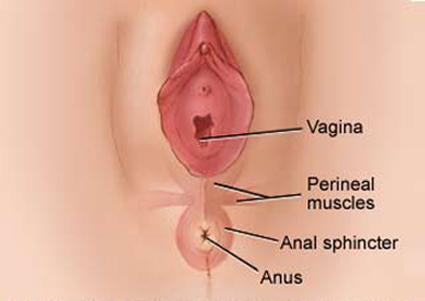
The perineal muscles identified in the illustration are the superficial perineal muscles; there is another deeper set that is more important for holding the pelvic organs in place. The anal sphincter is the ring of muscle that holds the anus closed. It is directly responsible for preventing bowel incontinence. If it will is torn completely apart and not properly repaired, the woman will be incontinent. Of note, this form of incontinence is different from a fistula, which is a hole inside the upper vagina that connects it directly to the bladder in front, the bowel behind or both.

Perineal tears are graded in severity from first degree to fourth degree, with first degree being minor and fourth degree most severe.

You can see a first degree tear below.
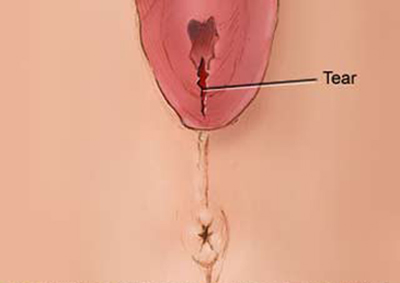
The tear is superficial and therefore minor. It’s the equivalent of a paper cut, and like a paper cut, will heal without stitches. Some people even think they heal better without stitches. First degree tears are very common.

Second degree tears are also common, but they heal better when stitched back together.
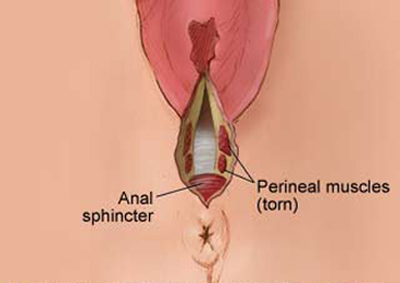
As you can see, this tear extends into the muscles that surround the vagina. The tear can be short in length or it can extend the entire distance between the bottom of the vagina and the top of the anal sphincter. A median episiotomy produces a second degree tear like this.

Putting the muscles back together makes sense if you want to preserve the natural shape and anatomy of the vagina. If it is not repaired, the opening to the vagina will gape, but there are usually no serious consequences of failing to repair it. Theoretically it is possible that the muscles will be able to heal back together on their own, but it is extremely unlikely. With the exception of very tiny tears, there are no circumstances under which a second degree heals “better” if it is not stitched.

A third degree tear MUST be repaired, and you can understand why when you look at the illustration.

The anal sphincter has been torn apart. If it is not repaired, bowel contents will be allowed to flow freely out of the rectum and there is nothing a woman can do to prevent it. Moreover, if the anal sphincter is not repaired at the time of delivery, the repair itself becomes much more complicated.

Unfortunately, though the illustrations make the difference between a second degree and third degree tear obvious, it is usually not so clear in real life. That’s because the muscle fibers of the anal sphincter tend to retract back into the surrounding tissue. If that happens, a third degree tear looks exactly like a second degree tear. If a tear extends the entire length of the perineum, the only way to tell the difference between a second degree and third degree tear is to put a finger in the anus and feel if the sphincter is still present.

A torn sphincter will not heal itself because the torn ends are usually far apart from each other after the muscle fibers retract. The superficial layers of the tear will heal and it may look like everything is normal, but the woman will not be able to control her bowel function and will definitely need an involved surgical repair under anesthesia.

Most midwives do not know how to repair a third degree tear and most homebirth midwives don’t even know how to tell the difference between a second degree tear and a third degree tear. Therefore, they often fall back on the tried and true tactic that homebirth midwives use when confronted with something they cannot do; they insist that it is unnecessary. In the case of perineal tears, this has the paradoxical effect that the more serious the tear, the more likely the homebirth midwife is to insist that it doesn’t need to be repaired.

The repair itself is not rocket science. You simply have to bring the torn ends of the sphincter out from the surrounding tissue and stitch them together. But you can only do that if you have the experience to diagnose the problem and carry the specialized clamps that will allow you to find and grasp the torn ends. Since homebirth midwives don’t have either, they often fail to repair third degree tears and the patient ends up with a surgical procedure under general anesthesia within months after the birth.

A fourth degree tear is the most serious. A fourth degree tear extends into the rectum. The result is that the vaginal and rectum form one continuous space.
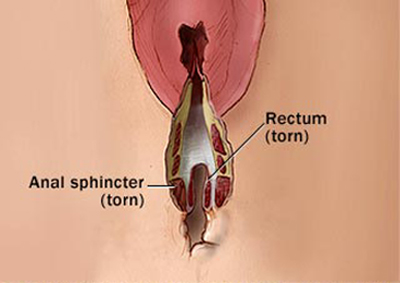
The repair of a fourth degree tear starts with the repair of the rectum itself. Depending on the how far the tear extends up into the rectum, the repair can be technically challenging and can take an hour or more. Once the rectum is repaired, the rest of the tear is repaired like any other third degree tear. However, because the rectum itself has been torn, the possibility exists that the tear may heal improperly and leave a hole (fistula) between the vagina and rectum with consent leaking of feces from the vagina. Obviously, a fourth degree tear MUST be repaired in the immediate aftermath of birth.

Let’s review:

  • Perineal tears are classified by severity.
  • First degree tears do not need to be stitched.
  • Second degree tears ought to be stitched but the results are not catastrophic if they are not stitched.
  • Third and fourth degree tears MUST be stitched or the woman will be left with bowel incontinence.
  • Third and fourth degree tears can only be diagnosed by someone with experience.
  • Third and fourth degree tears will NOT heal by themselves.
  • Third and fourth degree tears must be repaired by someone with extensive experience in repairing them.

Bedrest does NOT heal tears and the only thing it does is increase the risk of a woman developing a deep vein thrombosis or pulmonary embolus. If a homebirth midwives tells you that your tear will heal if you just stay on bedrest, it is a signal to get to the hospital as soon as possible for an expert diagnosis and repair. Otherwise, the results are likely to be embarrassing, painful, and require further more extensive surgery in the future.


The lactofascists strike again

Oh, the horror!

New Zealand professional athlete Piri Weepu was shown on television giving a 6 month old baby a ….bottle of formula.

Never mind that Weepu is the baby’s father. Never mind that the “incident” took place during a television commercial designed to discourage smoking around infants and small children. Never mind that the scene was designed to convey a father’s love for his child. The lactofascists were outraged:

La Leche League, a pro-breastfeeding organisation, has taken offence from a few seconds of film showing the All Black tenderly feeding a bottle of milk to daughter Taylor. The brief scene has been cut from an anti-smoking ad, due to complaints from the league.

One email said: “The damage that this shot of a celebrity All Black will do to breastfeeding in New Zealand Aotearoa will be significant.”

Weepu became a national hero during the All Blacks’ World Cup-winning campaign.

The Health Sponsorship Council’s TV ad is part of its “Smoking, Not Our Future” drive and features Weepu at home with his two daughters: 6-month-old Taylor and toddler Keira. In it Weepu speaks about the positives of having a smoke-free home and car.

… [T]he camera followed Weepu around for a day, including for an hour at his home while he played with his daughters.

“He happened to feed the 6-month-old briefly while they were there,” [Health Sponsorship Council chief executive Ian] Potter said.

People associated with the La Leche League initiated an email campaign against the ad, resulting in a “significant amount of feedback” to the council.

Why did La Leche League oppose an image of a father lovingly feeding his baby daughter?

La Leche League director Alison Stanton said the trouble wasn’t with Weepu bottle feeding but with the overall message.

The overall message? And what exactly does La Leche League think is the “overall message” of a father bottle feeding a baby?”

Asked what was wrong with Weepu cuddling and feeding a baby, she said: “You’ve got the healthy eating message, exercise, breastfeeding, smoke-free environment, wearing safety belts and this is about making sure that we give consistent health messages.”

Right, we all know that bottle feeding kills thousands of babies in first world countries each year. Wait, what? It doesn’t kill any babies at all? Surely for La Leche League to vociferously oppose bottle feeding during an anti-smoking ad it must have double or triple the risks of smoking around infants and small children. Wait, what? There is no evidence that is harmful to first world children at all?

Not to be outdone, the midwives piled on as well:

Karen Guilliland, chief executive officer of the College of Midwives, said her organisation opposed the ad too. “We just figured that Piri Weepu was so loved that whatever he did would carry a huge weight.”

Have these people lost their minds? What the hell do they think they are doing?

What they are doing is behaving like lactofascists. They are not content with promoting breastfeeding. They want to moralize infant feeding and demonize bottle feeding. Most importantly, they want to show that good mothers (mothers like themselves) would never bottlefeed, would never even consider letting their husbands give the baby a relief bottle.

Columnist Bob Trott had this to say in response:

The saddest thing is that the real breastfeeding issue of the day is whether moms should be able to pump and feed in public or at work. Bans on public breastfeeding are ridiculous – the idea that a woman feeding her child is offensive or indecent or inappropriate is, I think, offensive, indecent and inappropriate. And new mothers should have spots in their workplaces where they can pump or feed in privacy.

Apparently Bob does not understand that the real issue for lactofascists is to demonstrate their own superiority as mothers and to shame anyone who doesn’t do exactly what they do.

The ultimate irony of course is that many lactofascists support homebirth, although it demonstrably increases the risk of neonatal death. They insist that a woman’s right to control her own body means that she should be allowed to make any choice in birth, no matter how risky.

Evidently, a woman’s right to control her own body applies only from the waist down, however. She has no right to control her own breasts. When it comes to feeding an infant, woman’s autonomy be damned. There is only one right choice and the lactofascists want there to be no mistake about it.

Bob Trott sums it up best:

When Piri Weepu or any other guy is trying to be a good dad, let him be a good dad. Good dads feed their kids.

Good moms feed their kids, too, and it doesn’t matter whether they do it by breast or bottle.

Homebirth advocates discover smoking is safe in pregnancy

Hi, folks! Ima Frawde here, everybody’s favorite homebirth advocate, with some surprising news. Homebirth advocates have learned, through a process of deduction and logic, that smoking in pregnancy is both empowering and safe.

How do we know? Let me count the ways.

1. Smoking is natural.

Smoking involves three things: tobacco, fire and breathing. All three are 100% natural. Here’s what Wikipedia says about the research on tobacco:

Tobacco is an agricultural product processed from the leaves of plants in the genus Nicotiana. It can be consumed, … used in some medicines. It is … a valuable cash crop for countries such as Cuba, China and the United States. Tobacco, name for any plant of the genus Nicotiana of the Solanaceae family (nightshade family) and for the product manufactured from the leaf and used in cigars and cigarettes, snuff, and pipe and chewing tobacco.

See, it’s a crop. No different from wheat or rice. Of course you do have to be careful about toxins. That’s why homebirth advocates know that you should only smoke 100% organic tobacco.

Need more scientific data? Try:

Organic Growth Factor Requirements of Tobacco Tissue Cultures
, Physiologia Plantarum, Volume 18, Issue 1, pages 100–127, January 1965

A Revised Medium for Rapid Growth and Bio Assays with Tobacco Tissue Cultures
, Physiologia Plantarum, Volume 15, Issue 3, pages 473–497, July 1962

The complete nucleotide sequence of the tobacco chloroplast genome: its gene organization and expression, EMBO J. 1986 September; 5(9): 2043–2049

That’s three real scientific papers. There are plenty more and when I have time I’ll cut and paste the rest of them for you.

2. Smoking does not harm babies.

All ten of my friends who smoked while pregnant had healthy babies. And, I have read stories on line of fifty other women who smoked and no harm came to any of their babies. Plus, they were empowered by their decision to ignore what their doctor said and do what feels right to them.

3. If smoking were harmful, we wouldn’t be here.

Before that fear mongering Surgeon General’s report on the “dangers” of tobacco published back in the early 1960’s, half of US women smoked while pregnant. Not only are we still here, but the US population has GROWN since that time. According to the CIA World Factbook, the US population has been growing at a rate of 0.883%.

4. If smoking were harmful to an individual baby, his mother would know it.

Strong, fierce mamas have super powerful mama-intuition. If they thought for one minute that their babies were being deprived of oxygen when they smoked, they wouldn’t do it. They don’t take risks with their babies lives. They KNOW that smoking while pregnant is a safe, empowering choice.

5. Guess what my OB said??!! “Smoking leads to abruption, prematurity, low birth weight, and stillbirth.” Yup, like all other obstetricians, he played the dead baby card. Why? Isn’t the answer obvious?

It’s all about the money. Smoking leads to smaller babies who are more likely to be delivered vaginally, thereby depriving obstetricians of the opportunity to do a C-section and ruin a woman’s birth experience. And we all know that obstetricians make only $5 dollars for a vaginal birth and $50,000 for each and every C-section birth extraction.

Doctors have been engaged in a witch hunt against tobacco farmers for the past 50 years. Does that seem fair to you? All those rich doctors ganging up on those dirt poor tobacco farmers all because they resent the economic competition.

6. What about those stories of people who die of lung cancer? First of all, how do we know that they got lung cancer from smoking? Maybe they would have gotten lung cancer anyway even if they had followed their doctor’s advice. Second, plenty of people smoke and don’t get lung cancer. Third, some people never smoke and get lung cancer anyway. See, for example, CYP1A1 and GSTM1 genetic polymorphisms and lung cancer risk in Caucasian non-smokers: a pooled analysis, Carcinogenesis, Volume 24, Issue 5, Pp. 875-882.

So there you have it. Smoking in pregnancy is a safe empowering choice. All you have to do is “trust tobacco.”

Wait. What? Yes, it’s true the the thought process in determining that smoking in pregnancy is safe bears a striking resemblance to my arguments for the safety of homebirth. But we all know that homebirth is safe, so that’s just another reason why we should believe that smoking in pregnancy is safe, too.

There’s no need to thank me for these incredible insights of logic and reasoning. Just show your appreciation by buying a copy of the latest edition of my book, The Spiritual Tobacconist.

The Narcisarean

I suspect we are all breathing a collective sigh of relief that the new champion of homebirth narcissism, Emily Dickey, did not manage to kill her baby or herself in her marathon VBAC lasting nearly three days and presided over by a midwife who ought to be arrested for malpractice.

Emily is now crowing over her empowering narcisarean. What’s a narcisarean? That’s when a homebirth advocates refuses or delays a necessary C-section in favor of gratifying the immature narcissistic impulse to brag to her friends about her “achievement” of pushing a baby out of her vagina.

Emily is not merely a narcissist, she is a lucky narcissist. Many narcisareans end in the death or permanent brain injury of the baby. For example, Emily’s co-leader at the anti C-section organization ICAN of the Rock River Valley, Christine Woodard, attempted her own narcisarean last fall. Christine did ultimately have a C-section after multiple hours of pushing with no progress.

Emily joyfully announced the results:

Our other co-leader, Christine, and her family just welcomed a new baby BOY, Alexander John! Diagnosed with HIE [hypoxic ischemic encephalopathy, which is brain damage due to oxygen deprivation during labor] Alexander is in the NICU–send your prayers and hugs!! To stay up to date on Alexander’s progress, you can follow the journal that Christine set up here: Alexander’s Journal. Congrats Christine on your new little bundle of joy! Can’t wait to see pictures and meet him in person.

What’s a little brain damage among activists, right?

Christine wrote about the aftermath of her all too necessary C-section:

…[W]e were told that Alexander had swallowed a great deal of meconium and [was transported to another hospital] NICU for a hypothermic treatment to slow damage from the asphyxia…

Seeing him with all the tubes and wires in the transport incubator was horrible. I could not see his whole face. I could not hold him. I had to say goodbye to him not knowing what the future held…

… Off to Lutheran General I went 42 hours after delivery.

There it was harder. I could not touch him. I could not hold him. All the tubes, IV’s, monitors, wires–it was too much. And then I was told that he had apgars of 2, 5, & 6. He had a brain insult. There could be permanent damage.

Had I done this??? Did my selfishness cause this? Would he be okay??? All I knew is that I would keep vigil as much as I could until he could come home.

The number of narcisareans has been growing as homebirth becomes more popular. Australian midwife Lisa Barrett is an expert in narciseareans. She has presided over at least FIVE unnecessary neonatal deaths that occurred when women put their narcissistic desire for a vaginal birth over their babies’ lives.

This month alone I have written about three narcisareans: a postdates pregnancy that ended in a C-section that should have been done sooner (You risked your baby’s brain function for this?), a UC horror story, and a couple who refused to believe that their baby was in danger (A medical student learns about homebirth).

Frankly, I find it hard to think of anything more contemptible than a mother who risks her baby’s life and brain function to satisfy her own narcissistic impulses. But most of all I feel profoundly sorry for the littlest victims like Rebecca Dickey whose life was put at risk and Alexander John Woodard whose brain was damaged for no better reason than their mothers thought their “experience” was more important than their babies’ lives.

Dr. Amy’s dead baby card

34B48234-CCA8-4397-8464-46EE082A8EA0

Just like the medical student I quoted in yesterdays’ post, I too had an encounter early in my career with a natural childbirth advocate who refused to acknowledge that her baby was experiencing severe distress.

It happened within the first weeks of my obstetrics residency and involved a woman who had been attempting a VBA2C. The mother had received her obstetric care at a large HMO and had been cleared to attempt the VBA2C at the hospital. However, in an effort to give herself the “best chance” to have the longed for vaginal delivery, the mother hired a lay midwife and labored at home until she thought she was close to delivery.

She was only 6 cm and the baby was experiencing deep, prolonged episodes of bradycardia with heart rates down to the 50’s (the normal fetal heart rate is 120-160). The patient refused oxygen, she refused an IV and she refused to reposition herself to see if the baby might recover.

It was about 2 AM and I was alone with a nurse who was equally inexperienced. The patient’s doctor was in the OR along with the senior resident. We begged the mother in every way we knew how, but the mother was adamant. I distinctly remember her announcing that she would no longer speak to us and that henceforth everything must be negotiated with her lay midwife who kept counseling the patient that we were lying in an effort to ruin her “birth experience.”

The young nurse began to cry and that frightened the husband. He started to cry, too and begged his wife to put on the oxygen. Shortly thereafter, her membranes ruptured and thick, pea soup meconium oozed out.

I had called into the OR to alert her doctor to the situation and he finally appeared. He strode into the room, tore the paper strip from the monitor and waved it at the patient and her husband. “You don’t have to have a medical degree,” he shouted, “to know that a baby’s heart rate shouldn’t go down to 50 and stay there. Your baby is dying and if you don’t consent to a C-section right this minute, your baby will die.”

The husband became frantic and the wife acquiesced. The baby was born within 10 minutes with initial Apgars of 1 and 1 due to a massive, nearly complete abruption. The father was appalled and just like the story in yesterday’s post insisted that this was OUR fault and that they were going to sue.

They never sued, but I learned a great deal from the episode. I made sure that nothing like that ever happened again and it wasn’t really that hard. I simply played my version of the dead baby card. In the rare instances in which patients were so indoctrinated by the NCB and homebirth literature that they would not believe a detailed explanation of the danger of severe fetal distress, I didn’t argue. Arguing was what they expected and what they were prepared to defend against.

I drew up a hand written informed consent addendum:

Dr. Tuteur has explained to me that she believes my baby is in imminent danger of dying and needs to be delivered by C-section immediately. I understand that my baby might die without an immediate C-section, but I refuse and I take full responsibility for my baby’s death.

No one ever signed. When faced with taking responsibility for the death of her baby, every woman consented to the C-section.

I didn’t use that option very often, because frankly there are very few women who are so indoctrinated with NCB and homebirth misinformation that they cannot be reached. But for those who were, this seemed to cut right through the nonsense. When forced to acknowledge in writing that her baby might die, no woman could bring herself to do it.

A medical student learns about homebirth

In a post entitled The saddest thing, a third year medical student completing her obstetrics rotation shares her incredulousness that women refuse appropriate obstetric care because they are more worried about the “cascade of interventions” than they are about the health of their own baby. Or perhaps, having read and believed the crap that is offered as “knowledge” within the homebirth community, the mother simply didn’t realize that she was allowing her baby to slowly asphyxiate.

A couple came into the triage area (kind of the ER of the maternity ward) while I was on call on Sunday night. They were relatively normal, educated, middle-class people who had come into the hospital at the insistence of the midwife who had been supervising the woman’s labor. The couple arrived and said something about her having “a lot of meconium (baby poop),” and it was clear they didn’t want to be there to the extreme.

The mother refused to be touched by the doctors, refused a check of her cervix, refused IV access, and refused a fetal heart monitor. The reason for the refusal was simple to her: she wanted a natural birth. She thought if she allowed one medical intervention, it would lead to another, and another, and another (which, given her condition, was accurate). She had another child and she and her husband felt so robbed of the natural birth experience that they wanted to do everything in their power to have that experience. Everything.

Because of multiple risk factors, the mother had found a non-nurse midwife to attend her at home.

… The couple in the story here wanted a midwife, so they tried to get cleared for the birthing center attached to the hospital (they’d have a nurse midwife). Unfortunately for them, the mom was turned down, deemed too complicated, and rightfully so. She had conditions can still have a normal birth with no epidural, but their deliveries should be in the maternity ward with monitoring. She and her husband were ticked that they were turned down, so they said, “Forget this, we want to do this our way.” And so they went against all medical advice, hired a lay midwife, and prepared for a home birth.

The couple eventually acquiesced to an assessment of the baby.

When the couple in triage finally allowed a fetal heart monitor to be strapped to the woman’s belly, everyone freaked out. The heart rate was in the 90s. Normal fetal heart rate should always be over 120, under 110 is cause for alarm. The nurses told the couple that the heart rate was too low and the baby wasn’t getting oxygen, and they tried help. But she would not let them touch her. Then the heart rate fell again. The senior resident was called in a panic.

This heart rate is bad, bad, bad; the baby isn’t getting enough oxygen and it is dying inside of the mother’s womb. Let the baby sit with that oxygen level, and the best case scenario is that it winds up with cerebral palsy if not brain dead or actually dead. This was explained to the parents, multiple times, by every single person who tried to care for them. Yet, still insistent on that natural birth, they kept resisting care.

The parents continued to refuse medical care.

Because the baby’s heart rate kept dropping—and nobody knew how long the heart rate had been down to begin with—she went straight to the OR to get the baby out. And yet, both of them continued to refuse. As the heart rate dipped into the 70s, the mother refused to get onto the OR table. Eventually, after much forcing the fact that this baby’s life was in danger and it was almost 100% surely brain damaged already, they consented.

The baby came out blue (or so I am told, I was not in the OR for the delivery). It’s first APGARs were close to zero (normal babies come out at 8 or 9 out of a possible 10). The poor thing required chest compressions to try to get it breathing, and later had a seizure.

In the aftermath, the medical student is shocked to discover that homebirth advocates often refuse to take responsibility for their own actions. Indeed, they often try to blame the very people who saved the baby from parental ignorance and stupidity.

A few hours later, the nurses reported that the mother was starting to get emotional and upset that she wouldn’t be able to take her baby home in a couple of days.

Then she and her husband both started to insist that nobody had told them the gravity of their baby’s condition. Yeah. I know. That’s why the documentation. And even though what was happening and the seriousness of the situation were explained over and over, these people are going to continue to insist that the outcome isn’t their fault. Even if they know that it is entirely their fault, they are never going to tell their family or friends that. I wouldn’t want too, either. It’s a really daunting thing to carry that weight around—to know that you personally killed or disabled your child because you refused care that people smarter than you said was necessary—for the rest of your own life, much less face coming clean to the friends and family who have watched you carry a healthy baby for 9 months.

The baby is not doing well:

… Their baby has made it one day longer than the NICU pediatricians were expecting, but my understanding is, the baby’s not really improving. The most daunting part of this is that if she goes home with her parents, it will be months, if not years, before anybody knows the true extent of the damage done.

The medical student is horrified.

After this first happened, I was so angry at these parents that I was almost physically sick, and I actually did shed a few tears (I am not a super emotional person). I cannot even begin to fathom how any parents can choose to sacrifice the health—and very possibly the life—of their own child just to have a natural birth experience. Is the desire to have that one temporary experience really worth knowingly allowing your baby to suffocate to the point Death’s doorstep and even beyond? …

Birth junkies

road to recovery
What is a birth junkie and why is she obsessed with other women’s births?

Many if not most homebirth midwives, doulas and, sanctimommies are quick to tell everyone that they are “birth junkies.” They consider it a boast, but in reality, it is evidence of serious shortcomings.

Kathy at Woman to Woman Childbirth Education explained proudly that a birth junkie has “an infatuation bordering on addiction (if not actually there) for birth and all things related to it.” She continues:

You might be a Birth Junkie …

  • if when you’re discussing something related to birth, you receive those polite but puzzled looks… right before your conversation partner moves away …
  • if you have birth-related artwork somewhere in your house (includes placenta pictures and belly casts, etc.)
  • if you currently have or ever did have a placenta in your freezer
  • if you have ever consumed placenta …
  • if you’ve ever gone to the bookstore and hidden “What to Expect When You’re Expecting” (or some other similar non birth-junkie book) and replaced it with some pro natural-birth book …
  • if someone tells you she “had to have” a particular intervention and you can come up with several alternatives that were never mentioned to her …
  • if someone tells you her baby is breech and you give her names (bonus points if you know phone numbers) of chiropractors skilled in the Webster technique or people who can perform moxibustion
  • if you encourage your children, especially young children, to watch birth videos …

That’s not even the complete list. It’s less than half, but it highlights the serious problems with the concept.

1. Being a birth junkie (like being a Sanctimommy) involves butting into other women’s lives inappropriately. Birth junkies relish demeaning other women; she insists (without any evidence, of course) that any interventions another woman had were unnecessary, and any that she might be contemplating, such as C-section for breech, are unnecessary, too. As a special touch, they cheerfully recommend idiocy. Moxibustion for breech (I am not making this up) involves burning a small bundle of leaves at the tip of the 5th toe; this is supposed to cause the baby to turn to the head down position.

2. Birth junkies fetishize certain aspects of the birth process, and the weirder the fetish, the better. As Kathy makes clear, birth junkies fetishize the placenta. That includes making ink prints of it, keeping it indefinitely, and, or course, eating it.

3. Birth junkies insist on foisting their obsession inappropriately on others. They bore and offend other adults, and they insist that their children “especially young children” be exposed to the object of their obsession.

Others have noticed the pathological nature of the obsession. Barbara Katz Rothman, and sociologist and supporter of homebirth, spoke at last year’s conference of the Midwives Alliance of North America (MANA). The presentation was “Birth Junkies: Working Through Our Relationship to Birth: Who owns the birth experience? Strategies for maintaining a non-addictive relationship with midwifery, responding to clients concerns about their own birth addiction, and ways of responding to the “birth junkie” term in the birth/midwifery community.”

Being obsessed with birth, one’s own births and the births of others, is pathological. And being a birth junkie has nothing to do with birth, with babies and certainly has nothing to do with helping other mothers. The women who are birth junkies suffer from a crippling lack of self-esteem. Their only “achievement” is the faux achievement of having an unmedicated, and preferably an outlandish, birth. Like the adult still talking about his SAT scores 20 years after the fact, birth junkies need to continually remind themselves of their “achievement” by obsessing about it, demeaning other women, and controlling other women’s births.

Homebirth midwives are just birth junkies who took it a step further. They are birth junkies who couldn’t manage to get into or through a college level midwifery program, so they decided to simply pretend that they were midwives. They made up their own certification, heavy on the inanity, and entirely lacking the education and experience that are necessary to be a competent midwife.

Most have no interest in a real midwifery program because being a birth junkie is not about birth and has nothing to do with preventing and managing complications. It’s all about them and their constant need for validation. Rather than being proud of their obsession, homebirth midwives who are birth junkies should be questioning it. If they truly care about women and babies, they owe it to them to get real midwifery training (the kind that would be recognized in other first world countries) instead of simply pretending that they are midwives. And if all they care about is boosting their own self-esteem, they should still get real midwifery training. That is a real accomplishment to be proud of.

This piece first appeared in July 2009

Religious zealots try to impose their beliefs on women

science vs. religion

Since when is bald faced lying an acceptable religious practice?

In an amazing coincidence two groups of religious zealots have waded into the public fray. Both have done so ostensibly to promote American values. Both are attempting to control women’s bodies. And both groups are lying.

Catholic bishops claim that they are fighting for that quintessential American value, freedom of religion, in opposing a goverment mandate to include contraception in health insurance plans. Protestant zealots (joined in some cases by Catholic zealots) are blustering that proposed laws to mandate ultrasounds before abortion are nothing more than efforts to provide women with information needed to make the medical decision to terminate a pregnancy.

Both groups are lying. Both groups are attempting to violate that quintessential American value, freedom of religion. Indeed they are attempting to impose THEIR religion on people of other religions or no religion at all. And they are doing it in exactly the same way. They are committed to “rationing by inconvenience.”

Make no mistake; this is about Catholic zealots imposing their belief that birth control is immoral and this is about Protestant zealots imposing their belief that abortion is immoral. There has been no attempt to restrict their religious freedom. No one is attempting to force the Catholic bishops to use birth control and no one is attempting to force the Protestant zealots to have abortions. No one in either group is belng forced to violate his or her religious convictions by engaging in a practice that he or she deems immoral.

So why are the Catholic bishops and Protestant zealots upset? Because they don’t want OTHER PEOPLE to use birth control and they don’t want OTHER PEOPLE to have abortions. Oops, let me amend that. They don’t want WOMEN to use birth control and they don’t want WOMEN to have access to abortion. What a coincidence. Both are trying to impose their religious convinctions on WOMEN’S bodies.

Both the Catholic bishops and the Protestant zealots are trying to use the same method to accomplish their religious objectives: rationing by inconvenience.

Rationing by inconvenience is used by health insurance companies to deprive members of covered services. By making it difficult to access those services (mandating pre-approvals, denying payments, forcing members into complaint resolution and abitration) insurance companies attempt to reduce use of expensive services or force members to pay out of pocket for those services in order to access them in a timely fashion. Rationing by incovenience is used by religious zealots in precisely the same way. By refusing to pay for the health service of contraception, the Catholic bishops hope to discourage women, particularly poor women, from using birth control. Protestant and Catholic zealots hope to prevent women from accessing legal abortion by interposing inconvenience, whether it is waiting periods or mandate ultrasound exams that are both medically unnecessary and physically invasive. For example, religious zealots in the Virginia legislature are hoping that by mandating an invasive vaginal ultrasound, they can discourage women from having abortions.

That’s bad enough. What’s worse is that they are lying about it. Catholic bishops are trying to discourage the USE of birth control. Refusing to pay for it is just a tactic in preventing the use of contraception. It has nothing to do with the bishops’ religious freedom. Mandating medically unnecessary, inconvenient and uncomfortable procedures as requirement before accessing abortion has nothing to do with providing women with information.

These religious zealots should not be allowed to control women’s bodies by limiting their access to safe, legal medical TREATMENTS. They are attempting to impose THEIR religious values on women who don’t share them. These tactics should be rejected as fundamentally un-American attempts at religious coercion.

First rally for homebirth safety

Oregon homebirth midwives got an incredible surprise when they showed up to lobby legislators at the state capitol building. They wanted to “draw attention to midwifery care as the gold standard.” The surprise was that they were not alone. They encountered a group of homebirth safety advocates in what I believe is the first event of its kind, a rally to hold homebirth midwives accountable.

Many of these women speak from sad personal experience. Their babies have been injured or died at the hands of CPM whom they trusted to be highly educated, extensively trained and strictly regulated. In the wake of their personal tragedies, they found to their horror that anyone can call herself a midwife in Oregon. Moreover, even those who are certified professional midwives (CPMs) have so little education and training that they are not eligible for licensing in any country in the first world.

I am proud to be able to share pictures of the event with you:

These women and men deserve our deep appreciation for bringing this serious issue to the attention of the people of Oregon.

Homebirth, narcissism and risk

Mamabirth is offended that most people think homebirth advocates are “reckless, selfish, or uneducated.” She wants you to know that they love their children. Unfortunately, most homebirth advocates ARE reckless, selfish and uneducated. That’s because love has nothing to do with it. Their ability to assess the risks of homebirth is impaired by narcissism.

How does narcissism impair the ability of homebirth advocates to assess risk?

According to Narcissism, Confidence and Risk Attitude by Campbell et al. in the Journal of Behavioral Decisionmaking, 2004:

In the simplest terms, one can think of narcissists as individuals for whom enhancing the positivity of the self (specifically, to achieve status and esteem) is overwhelmingly important… [W]e suspected that narcissists’ decisions may be undermined by their short-term interest in maintaining an inflated self-image. Narcissists’ grandiose self-views may preclude the realistic appraisal of one’s likelihood of success needed for successful decisions, resulting in overconfidence and risk-taking.

Exhibit A of the grandiosity of homebirth advocates: their claim to be “educated.” Sure, they may have done reading of homebirth books and websites written by other lay homebirth advocates. Yet, the claims of “education” are absurd on their face when compared to the amount of relevant education of an obstetrician, neonatologist, scientist or statistician.

So Mamabirth is ignorant of childbirth theory, now about her knowledge of practice? That’s pretty pathetic, too. Consider this load of nonsense from the same post:

For the record- babies with wrapped umbilical cords can be delivered safely at home, home birth midwives often carry lifesaving anti-hemorrhage drugs (but they don’t need them as often as they are needed in the hospital, because mom isn’t pumped full of Pitocin through her labor, nor is heavy traction applied to a still attached placenta immediately postpartum) and YES THEY CAN MONITOR THE BABY! For goodness sake, they don’t show up with a stick for you to bite on and some beads to wave over your head in case something goes wrong.

Ignorance of the risks of nuchal cords, check. Ignorance of the risk of postpartum hemorrhage, check. Inane nonsense about pitocin imbibed from other homebirth advocates, check.

The claim of being “educated” is only the beginning of Mamabirth’s over confidence and willingness to risks her babies’ lives. As Campbell explains, narcissists express overconfidence through “an inflated subjective probability of a particular outcome occurring.” Homebirth advocates routinely proclaim that they “know” that homebirth is best for their baby, in other words, that fact that the baby will be born healthy, without complications, without needing a C-section or an expert neonatal resuscitation is, in their minds, a sure thing

How can they be sure? Exhibit B of the narcissism of homebirth advocates is their belief that they are so special that their own thoughts have to power to determine events. That’s what it means to “trust” birth, even though childbirth is one of the leading killers of young women and children in every time, place and culture. That’s why birth “affirmations” are so important in homebirth advocacy. Believe that you are safe and you are safe. Insist that complications won’t occur and they won’t. Assert that your baby cannot die at homebirth and it wouldn’t dare defy the injunction.

Regarding risk taking:

The second pitfall in narcissists’ decision making may be their willingness to take risks. … [W]hen coupled with overconfidence … risk-taking systematically leads to losses … Research has also demonstrated a link between threatened self-esteem and risk-taking… To the extent that high self-esteem is reflected in narcissism, this result is consistent with the prediction that narcissists will display more risk-taking on tasks involving their own knowledge.

Homebirth advocates are willing to take risks that would horrify any other mother because they are sure they know everything worth knowing about birth. And, Exhibit C in the grandiosity and narcissism of homebirth advocates, they are sure that they have some special insight (intuition) into what will happen during their own labor and delivery. They can tell what is going to happen in the future even though the rest of us mere mortals cannot.

What is truly striking, however, is the extent to which the self esteem of homebirth advocates is involved in the decision to choose homebirth. It isn’t about the baby, and it isn’t even about birth. It’s about them, not simply their experience, but their special talents, like being “educated” and having intuition about the future. And if that’s not enough, they insist they can control the future with their own thoughts.

Sorry, Mambirth, you are not “educated.” You are actually pathetically ignorant about the reality of childbirth, the standards of practice and the scientific literature.

You are reckless. You are willing to stake your baby’s very life on your grandiose assessment of your own knowledge and super-special ability (intuition) to predict the future, not to mention your inane conviction that believing homebirth is safe makes it safe.

And most of all, you are selfish. It’s all about you, what you think about yourself, how smart you think you are, and the way that you can brag to other women about your “achievements.”

I don’t doubt that homebirth advocates love their children. That’s a pretty low standard. After all, women who don’t buckle their children into seatbelts love them, too. That doesn’t change the fact that they are also reckless, selfish and uneducated about the risks.

Dr. Amy