Would we tolerate a hospital that treated women based on Sharia Law?

Abandoned Muslim tomb stone

Imagine that a woman in the midst of a miscarriage, bleeding heavily, arrived at her local emergency room for treatment. The pregnancy could not be saved. Indeed, while waiting for medical attention the mother passed the products of conception in their entirety and the bleeding stopped. The tissue would ordinarily be treated as medical waste, incinerated and sent to a sanitary landfill. Of course, if she chose, the mother could arrange for a private burial.

However, this local hospital is an Islamic hospital, and operates on the principles of Sharia Law. The mother is informed that the tissue will be buried in an Islamic cemetery with a burial service conducted by an imam. If she did not want an Islamic burial, she could pay for a private burial at her expense.

[pullquote align=”right” cite=”” link=”” color=”” class=”” size=””]Why is it acceptable to allow Catholic hospitals to impose Catholic doctrine on non-Catholics?[/pullquote]

The outrage of political conservatives would know no bounds. Despite zero evidence, many already fear that Muslim Americans wish to impose Sharia Law on non-Muslims. A hospital operating under Sharia Law would confirm their fears. It hasn’t happened yet simply because there are no Muslim hospitals in the US. But conservatives would be absolutely correct in opposing a hospital’s imposition of Muslim Law on non-Muslims as a violation of religious freedom.

So why do they find it completely acceptable to allow Catholic hospitals to impose Catholic doctrine on non-Catholics?

According to Sophie Novack of The Texas Observer:

A Catholic hospital in Austin forces patients who miscarry to consent to fetal burials. For one woman, that made a painful loss even worse …

Quietly, for more than 10 years, Seton has required the burial of all fetal remains after miscarriages. It’s widely known that Seton, which follows the ethical and religious directives of the Catholic Church, doesn’t perform abortions or offer contraceptives. But its policy on miscarriages is a secret even to some nurses and doctors who work at the hospital. Seton declined to give the Observer a copy of the policy, but a doctor who practices at the hospital provided one. “As a catholic institution, the Seton Healthcare Family policy is for all loss of life to be given a proper burial,” it reads.

Novack tells the story of Blake Norton who was scheduled to have a “missed miscarriage” (a pregnancy that has died) removed at Seton Hospital.

She calls what followed a “hazy nightmare.” Overwhelmed with grief, Norton waited in the lobby for hours and filled out paperwork. Finally, a nurse guided her into an exam room to change, and put an IV in her arm. She was about to be wheeled into surgery when she was handed one last form to sign. Confused, Norton scanned the document, quickly realizing that she was being asked to consent to the burial of the fetal remains. She could choose between two options: Seton would bury the remains in a shared grave, or Norton could arrange for a “private burial” at her own expense.

But she didn’t want the tissue to be buried in a Catholic religious ceremony.

Could she opt out of having a burial? Norton asked. The nurse shook her head, and sent a social worker to speak with her. “I don’t understand, why do I not have a choice?” Norton asked, increasingly upset. What had been a medical procedure suddenly felt like a religious rite, compounding the grief she was only beginning to process. The social worker reiterated that she could choose between the two burial options. Norton elected to leave it to Seton and opted not to be notified when the burial occurred. Where the form required her to specify her relationship to the remains, Norton said she had no choice but to write “mother.”

What does that burial look like? The reporter sought to find out:

A man, an employee of the cemetery, guides me on a golf cart to a row of flat headstones and points to one marking the group grave where the remains of Norton’s pregnancy are buried. “You are our sunshine, our only sunshine,” the headstone reads, below a date — August 12, 2015, nearly two months after Norton’s miscarriage. An image of the Virgin Mary is etched into the stone.

Surely this should be a violation of Texas law since it infringes on Blake Norton’s religious freedom, but it’s not.

In 2017, Republican state lawmakers passed a controversial law mandating the burial or cremation of all fetal remains of less than 20 weeks gestation after abortions and miscarriages that occur at medical facilities. (The state already required burial or cremation of fetal remains over 20 weeks.)

The Texas legislators almost certainly assume that the hospital will conduct the burials under Judeo-Christian principles. Would they be so eager to mandate burials if they were being done according to Sharia Law? I doubt it. They would almost certainly consider being subjected to Sharia Law as a violation of their religious freedom and they would be right.

And that suggests that laws mandating burial of tissue from miscarriages have nothing to do with freedom of religion of hospitals and everything to do with imposing approved religion on non-believers. That may be consistent with Christian doctrine of proselytization but it’s incompatible with the American principle of religious freedom.

Mothering monster: the narcissism and cruelty of letting your child get whooping cough

Woman kissing the mirror

Who lets her toddler get whooping cough and then boasts about how she breastfed him though it? A self-absorbed, self aggrandizing narcissistic parent. Someone like Shayla Cherry.

It’s difficult for me to describe the cruelty, stupidity and lack of self-awareness of a mother like Cherry so I’ll let her describe it herself.

[pullquote align=”right” cite=”” link=”” color=”” class=”” size=””]The true sign of Shayla Cherry’s narcissism is that she is boasting about the horror that she caused.[/pullquote]

From How Breastfeeding Saw Us Through the 100-Day Cough:

Rye was 18 months old when he contracted pertussis. I can’t begin to imagine how terrifying that would have been if, like nine out of ten babies, he was weaned already…

How terrifying it would have been? It wouldn’t have been terrifying at all if her child had been fully vaccinated because he wouldn’t have gotten whooping cough. But Shayla had “done her research” and is proud of herself for depriving him of that protection.

From The Risks of Routine Vaccination: Why I Don’t Vaccinate My Son:

I discovered that the diseases are less likely to harm my son than the vaccines themselves. Adverse reactions and chronic illnesses are far more common than serious complications from the diseases we vaccinate against.

There is nearly zero risk of an American child catching diphtheria or polio.

Despite all of the fear-mongering around polio, it’s generally asymptomatic. When symptoms do appear, they are usually flu like. Fewer than one percent of people who contract polio experience paralysis.

Whooping cough can be treated with Vitamin C…

Cherry is sublimely confident in her ignorance.

As it was, our bout with whooping cough was brutal, but never dangerous…

The truth is dramatically different.

As the CDC notes:

Before pertussis vaccines became widely available in the 1940s, about 200,000 children got sick with it each year in the United States and about 9,000 died as a result of the infection. Now we see about 10,000 to 40,000 cases reported each year and unfortunately up to 20 deaths.

Whooping cough is not merely dangerous; it’s deadly.

Fortunately, Cherry’s son did not die but he suffered tremendously and unnecessarily.

One week in and my son’s cough was only getting worse. We were up all night as he began coughing every hour, on the hour. He developed a sharp, desperate inhale; a characteristic whoop every mother hopes to never hear. I began researching pertussis with a sinking heart. Little did I know, we were in for a long and exhausting winter.

The next month was spent indoors as whooping cough tore through our home. Our days were filled with movies, cuddled together in our cozy haze. Sometimes when the coughing woke him at night, he was so exhausted that he’d fall back to sleep without nursing…

On our bed propped on an incline, we slept in fifty-minute bursts. We welcomed play at 2am in the dim hallway light when a coughing fit left him wide awake.

The child was desperately and needlessly sick for months and his mother is still focused on herself and the “benefits” she provided him by breastfeeding:

He would have lost every ounce of baby fat. We may have needed to go to urgent care for an IV, and who knows where that would have led — secondary infection, pneumonia, antibiotics…

There’s no reason to believe that breastfeeding did any of that. The baby could have just as easily bottle fed for comfort and nutrition. Breastfeeding didn’t prevent whooping cough in the first place; why should it be counted on in preventing secondary infection?

Cherry’s narcissism hasn’t merely blinded her to the fact that she subjected her toddler to a potentially deadly illness because her ego led her to imagine that she knew more about vaccines than nearly every single medical professional in the entire world.

Her narcissism hasn’t merely made her oblivious to the fact she is the one responsible for son’s suffering, not the one who prevented it.

The true sign of her overweening sense of self regard is that she is boasting about the horror that she caused.

Though I was more tired than I’ve ever been and my own health hasn’t quite recovered, I am immeasurably grateful for the gift of breastmilk. I was able to nourish and protect my son, even in the depths of my exhaustion. So, if you’re nursing a toddler and want to continue, I hope sharing my story helps you to trust your instincts. Do what is right for you and your child, as mothers have done for aeons.

Cherry learned nothing … but then narcissists never do.

Why are black mothers and babies dying? It’s unlikely to be weathering.

Racism, discrimination, prejudice and social exclusion message

A piece that will appear in The New York Times Sunday Magazine attempts to answer the question Why America’s Black Mothers and Babies Are in a Life-or-Death Crisis. Unfortunately, the answer it gives — that black women’s health is uniquely “weathered” by racism — while intuitively appealing, is probably wrong.

The tl;dr answer can be summarized as follows:

While racism is hardly limited to African Americans (think Native Americans nearly wiped out in a de facto genocide) the high rates of maternal and neonatal mortality are nearly exclusive to those of African descent.

And though the attention to the tremendous discrepancy in black vs white mortality rates has focused on the US, the problem is the same or worse for women of African descent in other countries.

Let’s look closer at the NYTimes piece and the existing research.

Linda Villarosa clearly lays out the problem:

Black infants in America are now more than twice as likely to die as white infants — 11.3 per 1,000 black babies, compared with 4.9 per 1,000 white babies, according to the most recent government data — a racial disparity that is actually wider than in 1850, 15 years before the end of slavery, when most black women were considered chattel. In one year, that racial gap adds up to more than 4,000 lost black babies. Education and income offer little protection. In fact, a black woman with an advanced degree is more likely to lose her baby than a white woman with less than an eighth-grade education.

This tragedy of black infant mortality is intimately intertwined with another tragedy: a crisis of death and near death in black mothers themselves. The United States is one of only 13 countries in the world where the rate of maternal mortality — the death of a woman related to pregnancy or childbirth up to a year after the end of pregnancy — is now worse than it was 25 years ago. Each year, an estimated 700 to 900 maternal deaths occur in the United States. In addition, the C.D.C. reports more than 50,000 potentially preventable near-deaths, like Landrum’s, per year — a number that rose nearly 200 percent from 1993 to 2014, the last year for which statistics are available. Black women are three to four times as likely to die from pregnancy-related causes than their white counterparts, according to the C.D.C. — a disproportionate rate that is higher than that of Mexico, where nearly half the population lives in poverty — and as with infants, the high numbers for black women drive the national numbers.

What explains the disparity? The causes could be genetic, environmental or both. Villarosa favors an environmental explanation.

Dr. Arline Geronimus, a professor in the department of health behavior and health education at the University of Michigan School of Public Health, first linked stress and black infant mortality with her theory of “weathering.” She believed that a kind of toxic stress triggered the premature deterioration of the bodies of African-American women as a consequence of repeated exposure to a climate of discrimination and insults. The weathering of the mother’s body, she theorized, could lead to poor pregnancy outcomes, including the death of her infant.

That’s an extraordinary claim and it falls apart fairly quickly when extended beyond black women.

If “weathering” were an accurate explanation of the black/white disparity in mortality, we would expect to find evidence of it in other populations exposed to racism. But that’s not what we find at all.

This graph comes from the 2017 paper Pregnancy-Related Mortality in the United States, 2011–2013.

04EF1F8B-D671-4495-9368-4E9BCB20B860

As you can see, black maternal mortality dramatically exceeds white maternal mortality. But if the weathering theory were true, we would expect that other ethnic groups would also experience weathering and that’s not what happens. One might argue that discrimination against African Americans is worse than discrimination against other ethnic groups but it’s simply not possible to argue that there is no discrimination against Hispanics. Nevertheless, maternal mortality statistics for Hispanic women are better than those of anyone else including white women.

The mortality discrepancy extends to other countries, too. The UK Confidential Enquiries into Maternal Deaths and Morbidity 2013–15 shows that maternal deaths of black women is 4X higher in the UK; that’s a greater discrepancy than the US.

5CF672EA-3757-4E22-AE5C-73EFC98A8B98

The situation is similar for perinatal mortality:

D14DC678-0BA1-4E64-A9F8-FEEA840FF21E

One of the strongest pieces of evidence in favor of the weathering theory is that black pregnancy outcomes get far worse as women get older. According to the theory, the effect of discrimination and insults is cumulative. Therefore, the disparity gets greater as women get older. If that were the case, though, we should see widening disparities in deaths rates as women get older and that’s not what we find. The disparity actually decreases as women get older.

3DD67E47-990D-45B7-B3C8-2D896B047A96

White women born in 2015 are expected to live for 81.1 years, Hispanic women for 3.2 years more and black women for 3 years less. In contrast, among women who turned 65 in 2015, white women had a further life expectancy of 20.5 years, Hispanic women an additional 2.2 years more and black women only 0.9 years less. Similarly, for women who turned 75 in 2015, white women had an additional life expectancy of 12.9 years, Hispanic women an additional 1.8 years more and black women only 0.2 years less.

Obviously the best way to test the weathering hypothesis would be to look at maternal and neonatal mortality rates in countries where black people make up the majority of the population and are governed by other black people. Such countries are in sub-Saharan Africa and they have the worst maternal and perinatal mortality rates in the world as illustrated by this map of maternal mortality from the WHO.

CBC717FB-AA6F-4F7B-B95D-45428500390E

There are a myriad of factors that result in high maternal and perinatal mortality in Africa so it’s impossible to blame race. Nonetheless, it means that if race is a specific risk factor for genetic reasons, it is hidden behind the socio-economic problems of the continent.

Racial discrimination undoubtedly plays a role in high rates of maternal and infant mortality but there are other groups that face considerable racial discrimination and they don’t have comparably poor mortality rates. Moreover, women of African descent have higher mortality rates regardless of where they live; indeed, the driver of maternal and perinatal mortality rates in industrialized countries is the percentage of women of African descent in the population.

Although Villarosa, the author of the NYTimes piece, implies that genetic factors have been ruled out, that’s hardly the case. Scientists and physicians are loath to invoke genetics when it comes to racial differences and there are good reasons to be wary. Nonethess, we know that there are certain genetic mutations that conferred benefit on African populations (like the mutation for sickle cell anemia that was protective against endemic malaria) that now, in the absence of malaria, only confer harm. It would be a tragedy if we failed to look for such explanations for high black maternal and perinatal mortality and fell back on environmental explanations that are more intuitively appealing but could very well be wrong.

Heterosexuality is best!

Good - Better - Best. Black bacground

Lactivists are confused.

864EA4FC-F27D-4CBA-AB28-4A6A6583E54F

We need to learn what nerve fed is best has touched and work out what that is.

I’m not sure why they’re scratching their heads over three simple words that mean what they say: breastfeeding may be (slightly) better than formula, but fully fed is best.

[pullquote align=”right” cite=”” link=”” color=”” class=”” size=””]In every article, meme and Facebook comment insisting that breast is best, replace the word “breast” with “heterosexuality.” See how ugly it sounds?[/pullquote]

But since they’re still confused I think a thought experiment might help. In every article, meme and Facebook comment insisting that breast is best, replace the word “breast” with “heterosexuality.”

I found the perfect example for this thought experiment in a comment on The Milk Meg’s post supporting the vile Stefania Giraldi piece I wrote about earlier this week.

A80F9BAA-D13A-490F-84ED-D53B007BACBA

Brittney has this to say:

The current attitude of the “fed is best” crowd has made me hostile towards them.

It’s not that I think formula is actually the devil, or that there are no moms who couldn’t, or that there’s actually something wrong with simply not wanting to.

The issues I’ve seen are clear:

1. They do not want mothers to celebrate their breastfeeding journey.

2. They sabotage mothers who clearly state they want to breastfeed.

3. They are anti science and argue with facts that do not fit their agenda. (Like WHO recommendations.)

4. Some “Fed Is Best” ladies are not just pro formula. They’re anti breastfeeding. They exploit old stories for their agenda.

5. Formula feeding is not a personal accomplishment like breastfeeding is.

Formula feeding is simply buying a product from a dominant industry. There’s very little trial & error. There’s no skill to learn.

It’s like buying a store bought cake vs a made from scratch cake then telling the person who put in the effort to make the cake that the store bought one is just as good or better. It’s rude. One is a truly personal accomplishment, the other is just normal. Both cakes are usually good though.

You dont need a support group for formula feeding. We don’t need formula feeding advocacy. Women are not kicked out of establishments for formula feeding. They dont need employee protection to work and formula feed.

These advocates for formula are not making an accurate comparison. They’re just retaliating because they want to feel that their choice is superior when its not.

Let’s try the thought experiment.

They do not want women to celebrate their heterosexuality.

See how ugly that sounds?

It’s because we understand that when someone purports to celebrate their heterosexuality, it is meant to at the expense of people who are gay.

Why would you need to celebrate your heterosexuality anyway? It’s a biological function, not an achievement. The fact that you choose to act on the way that you are born is hardly remarkable.

And why would celebration be seen as integral to heterosexuality? Is someone trying to take it away from you or are gay people merely fighting for the respect every human being deserves?

Similarly is anyone trying to end celebration of breastfeeding or are women who can’t or don’t wish to breastfeed merely trying to stop celebration at their expense?

They sabotage women who clearly state they want to be heterosexual.

When you make the substitution this claim also sounds very ugly and rather nonsensical.

Is that even possible? Can you sabotage another woman’s sexuality merely by mentioning the possibility that she might be gay?

The central claim of lactivists — that every woman would breastfeed if she had enough support — is starkly reminiscent of the ugly claims of those who promote so called “gay conversion therapy.” No amount of “support” will turn someone who is gay into a heterosexual and no amount of “support” will turn a woman who can’t or doesn’t want to breastfeed into someone who can or wishes to do so.

Moreover, just as gay conversion therapy is a euphemism for hectoring, berating and bullying gay people into denying reality, breastfeeding “support” is a euphemism for hectoring, berating and bullying women into breastfeeding whether they want to or not.

They are anti science and argue with facts that do not fit their agenda.

Let’s leave aside for the moment that it is lactivists who are ignoring the large and growing body of literature on the risks and costs of promoting breastfeeding and consider another aspect of this claim:

There’s no question that heterosexuality is the biological norm, and there is no question that gay people face discrimination and even violence for openly acknowledging their sexuality. Arguably, gay people face an existence far riskier than straight people. Those are facts, yet those facts don’t justify treating gay people as second class citizens, do they? Indeed, it is no one else’s business who a gay person loves just like it is no one else’s business whether or not a woman chooses to breastfeed.

Some women are not just pro homosexuality. They’re anti heterosexuality. They exploit old stories of gay women harmed by intolerance of their families and communities for their agenda.

How idiotic does that sound? Gay people aren’t opposed to straight people; indeed straight people have nothing to do with the fact that a person is gay. Gay people don’t need to affirm their sexuality by insisting that you have the same sexuality; apparently only heterosexuals need to do that. Gay people who tell stories about the pain of intolerance do so because they don’t want anyone to endure the suffering they have endured, not to scare straight people into becoming gay.

Similarly, Fed Is Best advocates aren’t opposed to breastfeeding; many like me found that breastfeeding was the best choice for ourselves and our babies. We tell stories (and quote scientific evidence) about the harms babies suffer as the result of aggressive breastfeeding promotion into order to ensure that no other babies have to endure similar suffering.

Homosexuality is not a personal accomplishment like heterosexuality is.

The truth is that neither is a personal accomplishment any more than digesting food or breathing air is an accomplishment.

Similarly, breastfeeding is not a personal accomplishment. Up until 150 years ago every mother who ever lived did it and many of their babies died in the attempt. How can doing something that literally every other women in the world could do — give their babies nothing besides the breast — possibly be an accomplishment of any kind? It can’t.

Sure, you are free to pretend that breastfeeding is some sort of accomplishment, but don’t expect the rest of the world to share your self-serving value system.

Brittney says:

[Formula feeding is] like buying a store bought cake vs a made from scratch cake then telling the person who put in the effort to make the cake that the store bought one is just as good or better.

And insisting that breast is best is like telling a woman without an oven that the raw ingredients of a cake made from scratch cake are better for her children than a store bought cake. It’s like insisting that unless she is forcing those raw eggs, uncooked flour and 70-proof vanilla down her screaming children’s throats, she is depriving them of the “benefits” of cake made from scratch. It’s false; it’s cruel; and it’s dangerous!

Another commentor disagrees with her, but Brittney is ready with her retort:

Breastmilk a personal accomplishment. Formula feeding is a consumer choice for the privileged.

Anyone who cant follow the instructions on the can is incompetent.

People like me dont coddle grown women who are begging for validation at the expense of breastfeeding advocacy.

You’re bringing other arguments into the equation because without including medical necessity or mixed feeding you’d have no base.

Fuck Fed Is Best.

No, Brittney, fuck you and the lactivists who think like you.

When it comes to patronizing language, midwives have merely replaced the patriarchy with the matriarchy

Doctor is checking a patient

Justine van der Leun’s recent piece in The Guardian has received a fair amount of attention in the childbirth community. It’s  ‘I felt I was being punished for pushing back’: pregnancy and #MeToo and subtitled ‘Pregnant women are still being patronised, blamed for our bodies’ failings, and made to feel guilty about our choices.’

Van der Leun experienced a very complicated pregnancy a few years ago:

[pullquote align=”right” cite=”” link=”” color=”” class=”” size=””]Why have midwives replaced the factual ‘vaginal birth’ with “normal birth’ and replaced the factual ‘pain relief’ with ‘intervention’? [/pullquote]

I spent one third of 2015 – about 120 days – on bed rest. I moved only to visit a hospital or doctor’s office, where I was scrutinised and presented with a list of concrete and potential deficiencies. There was certainly something wrong with my cervix, likely something wrong with my hormone levels, probably something wrong with my placenta, and possibly something wrong with my baby’s heart. Every time I was examined – which was constantly – a new potential problem surfaced. Having already lost two pregnancies, I was overcome by the looming possibility of catastrophe. I refused to prepare for anything more than a week in advance, as if hope were interchangeable with hubris and therefore deserving of punishment.

The outcome was a healthy baby girl:

That panic ended two years ago, replaced by the more welcome panic of how to care for a baby. After so much dread, not a single could-go-wrong went wrong. I will never know if the precautions helped, or if everything was fine all along. My daughter, born healthy at full term …

Now Van der Leun is pregnant again and this is also a high risk pregnancy. But this time she is whining:

At my 20-week check, the ultrasound technician informed me that, while my baby was in perfect condition, my cervix – the portion of the uterus that stands between the baby and the world – was shortening prematurely, the condition that had caused me much grief two years earlier. The official diagnosis is “incompetent cervix”. In a “competent” female body, the cervix stays long and closed until full term, and then dilates. But in an “incompetent” female body, the buffoonish cervix can shorten and open early, allowing a baby to tumble out. The “incompetent cervix” joins a number of curious obstetric diagnoses: the “inhospitable uterus”, “hostile uterus”, “hostile cervical mucus”, “blighted ovum”. Meanwhile, men experience “premature ejaculation” and not “inadequate testicles”; “erectile dysfunction”, but never a “futile penis”. They exhibit problems, but their anatomy is not defined as lacking. Pregnant women over 35 are of “advanced maternal age”, just a slight improvement over the previous term, only recently defunct: “elderly”. Those who have suffered more than two miscarriages are known as “habitual aborters”. We experience “spontaneous abortions”. A bad habit, that impetuous self-aborting: if only we had the self‑control to stop.

Oh, grow up! It’s hard to imagine anything more immature than facing a life and death situation and whining about the language that doctors used to describe it. Van der Leun seems to believe that this both patronizing and misogynistic:

The expectations placed upon women by the obstetric establishment – especially if our pregnancies don’t follow a perfect course, and often even when they do – are presented as normal. The field of obstetrics requires women to enter into an absurd realm, or perhaps to simply remain within the absurd realm in which we already exist. We’re subjected to methods that verge on Victorian: to remain prone, and in extreme cases tilted on a hospital bed at an angle for months at a time; to forgo work, pleasure, money; to allow painful interventions and invasive procedures; to agree to major abdominal surgery. We’re told it’s for baby’s sake; anything other than blind acceptance is selfish at best, murderous at worst.

I take that back, it’s even more immature to be so self-absorbed with pregnancy as to forget about the many non-pregnant people who struggle with kidney failure, heart failure, liver failure, and other failures of vital organs such as the pancreas in diabetes. No doubt they’d trade a lifetime of death defying struggles — dialysis, insulin, transplant surgery or heart surgery — for a few months of lying in a hospital bed forgoing work, pleasure and money and ending up cured. Sadly for them, their struggles are often permanent, lasting until an early death.

Where did Van der Leun get the idea that pregnant women are uniquely patronized by medical language? From midwives, of course:

Decades ago, a group of midwives, frustrated that pregnancy was treated as a condition and women as incapable children, created an empowering birth ideology, encouraging women to be confident about their bodies’ life-giving abilities…

Van der Leun doesn’t stop to ask herself why it was providers of care who insisted that the existing language was patronizing, and why it was these same providers whose concern for patronizing language did not extend to non pregnant women; they weren’t equally upset about devastating language like premature ovarian failure. If she had, she might have concluded that complaints about language were midwifery marketing tools, crafted to claw back patients from obstetricians, not to improve patient care.

Had Van der Leun really thought about it, she might have wondered why those same midwives proceeded to exchange purportedly patrionizing obstetric language for equally patronizing midwifery language like replacing the factual ‘vaginal birth’ with “normal birth’, or replacing the factual ‘pain relief’ with ‘intervention’. She might have realized that while obstetricians used what she considered objectionable language to promote the best possible outcome for mother and baby, midwives deploy patronizing language to leverage guilt and shame in an effort to increase their employment prospects.

In the ultimate irony, Van der Leun resorted to patronizing, misogynistic claims about female obstetricians, dismissing them with:

Women now make up more than half of obstetrician-gynaecologists, but the field was designed and dominated by men for centuries.

Architecture was designed and dominated by men for centuries but no one accuses female architects of knuckling under to men when they employ the exact same principles of structural engineering. The ministry was designed and dominated by men for centuries but no one implies female ministers are knuckling under to men when they preach about the exact same God. So why should female obstetricians be cavalierly dismissed as incapable of making their own decisions? Because there is no equivalent in those professionals to midwives who want their clientele for themselves.

Is the language of medicine patronizing?

I suppose it is if you think your self-worth resides in your organs. Fortunately, no one thinks their self-worth should be based on the function of their kidneys, liver or even their heart, yet women like Van der Leun think it ought to reside in their uterus and vagina.

That’s misogyny not on the part of doctors, but on the part of midwives and others like Van der Leun who reduce women to the function of their reproductive organs.

Are lactivists addicted to self-righteousness?

Woman has no Idea

According to scientist and author David Brin:

[S]elf-righteousness can also be heady, seductive, and even … well … addictive. Any truly honest person will admit that the state feels good. The pleasure of knowing, with subjective certainty, that you are right and your opponents are deeply, despicably wrong. Or, that your method of helping others is so purely motivated and correct that all criticism can be dismissed with a shrug, along with any contradicting evidence.

Sanctimony, or a sense of righteous outrage, can feel so intense and delicious that many people actively seek to return to it, again and again. (emphasis in original)

Lactivists are indignant. But then when are they not indignant?

[pullquote align=”right” cite=”” link=”” color=”” class=”” size=””]”Righteous outrage can feel so intense and delicious that many people actively seek to return to it”[/pullquote]

They’re indignant about breastfeeding rates.

A Swansea University academic has said that breastfeeding levels in the UK are the lowest in the world. She is placing much of the blame on the social pressures and attitudes that many women face and is calling for greater support for new mothers to start and continue breastfeeding.

Dr Amy Brown of the Department of Public Health, Policy and Social Sciences discusses this in her forthcoming book, Breastfeeding Uncovered. She says that breastfeeding has a whole host of benefits, including protecting the health of mothers and babies. Increasing breastfeeding rates would therefore save the UK millions of pounds each year.

It’s hard to see how breastfeeding will save any money since there is NO correlation between breastfeeding rates and healthcare costs. Indeed the UK — where lactivists are indignant about the breastfeeding rate — has one of the lowest rates of infant mortality in the world.

They’re indignant about formula. Oops! I mean artificial baby milk.

They’re indignant when anyone dares suggest that breastfeeding has risks as well benefits.

Melissa Bartick is an assistant professor of medicine at Cambridge Health Alliance and Harvard Medical School who volunteers to help hospitals become designated as baby-friendly. She called it “ridiculous” to draw the conclusion that there’s a link between newborn deaths and skin-to-skin care.

She noted that since 40% of the deaths in the first six days of life were in premature babies, there could have been other health complications. She also said there could have been other factors the study didn’t examine, like smoking or drug use by the mothers.

But most of all, they’re indignant that anyone dares criticize their self-righteousness.

In a piece surely destined to become a classic of the genre, Dear formula-feeding mothers – why are you so angry?, pathologically clueless Stefania Giraldi writes:

Those who give artificial milk feel equally attacked by those who constantly tell them how important and amazing breast milk is.’

Stefania goes on to say that, as a breastfeeding mother herself, she has been wondering why mums ‘who have not nursed their babies feel offended when they hear or read about breastfeeding’.

‘I am aware that this post of mine will unleash a tussle of no small amount but I truly want to understand what happens in the mothers who experience such negative feelings,’ she writes.

You can’t make this stuff up!

Giraldi has no interest in understanding anything. She just wants to bathe in those delicious feeling of self-righteousness.

So I ask myself: What happens to mothers who have not nursed their babies? Why do you feel so guilty? Why do you always feel like your feeding choices are called in question? Why are you offended? And why are you so angry against nursing mothers? Against us.

‘My intent is not, I repeat, to offend or hurt the mothers who have not nursed.

‘Whether you believe it or not, I despise judgment in any shape of form, I believe in support rather than war. What is this battle really about?

Stefania is indignant because she’s so misunderstood.

Perhaps I can help her understand with these gentle words:

Hey, stupid cow! Is your life so pathetic and your self esteem so low that you actually imagine you are “special” because you shove your saggy boob into your 3 year olds’ mouth every day?

Wait, what? Why are you so offended? You can be sure I don’t intend to hurt you because I despise judgment in any shape or form.

Stefania blathers on:

And I wonder why if I, or any one else writes that artificial milk is deficient compared to the maternal one (FACT), we are being crucified by those who accuse us of offending and insulting formula feeding mothers?

‘Basically, as soon as anyone talks about breastfeeding, here comes the army of those who wrongly translate every word you say into a threat, an offense towards those who did not breastfeed.

Here’s a thought, Stefania: maybe no one is offended that you breastfeed; they’re offended by your self-righteousness.

Ask yourself, Stefania, is it pleasureable to know with certainty, that you are right and your those lazy morons who formula feed are deeply, despicably wrong? Do you feel proud that that your method of helping others is so purely motivated and correct that all criticism can be dismissed with a shrug?

Because the truth is that this has nothing to do with breastfeeding and everything to do with the lactivist addiction to self-righteousness. It doesn’t matter to lactivists that the benefits of breastfeeding are trivial. It doesn’t matter to them that insufficient breastmilk is common. And it certainly doesn’t matter that aggressive breastfeeding promotion harms literately tens of thousands of infants each year. The only thing that matters to them it that delightful hit of dopamine that occurs every time they declare their inherent superiority — not, heaven forefend because they are bragging — but because they are selflessly educating formula feeding mothers by pointing out their faults.

Lactivists are addicted to self-righteousness. The question they must ask themselves is whether they are capable of kicking the habit.

What happened to Birthpedia?

Red Question mark on grey background, three-dimensional rendering, 3D illustration

Two days ago I posted this on Facebook:

“Really, Dr. Shah?

I’m shocked that Neel Shah is a part of a for profit birth website that features advocates of pseudoscience and poor practice, including Ina May Gaskin, Michel Odent, Brad Bootstaylor, Barbara Harper and a chiropractor, among others…

[pullquote align=”right” cite=”” link=”” color=”” class=”” size=””]Who suddenly got skittish?[/pullquote]

https://birthpedia.net/meet-the-contributors/

http://startupcompete.co/startup-…/internet/birthpedia/67399

Today’s Featured Questions include: “How could chiropractic care help you get pregnant?” I’ll answer it for free: It can’t!”

0D41E531-41C7-4255-98D5-ABEEBB2318C5

The image comes from their beta site that was up and running.

Dr. Shah wasn’t merely one of the contributors; he featured prominently in their promotional materials:

“Imagine having a Harvard OBGYN answer your specific question/concern for only $8 a month. We are changing how providers and patients intake information about birth where any pregnant woman can get answers by qualified professionals” – Co-Founder Justine Tullier

Expectant Parents want quick answers from a trusted source. Our qualified birth professionals are experts in their field and have insight that is backed up by research, evidence and experience. These experts are: PhDs, OBGYNs, Midwives, Lactation Consultants, Doulas, Lawyers, Chiropractors, Fitness Instructors and much more. Their 1 to 2 minutes answers per specific question reflects the trend in decreased attention span of upcoming generations as opposed to long form DVDs.

I also learned that Justine and Gabe Tullier, the founders of Birthpedia, have just taken over Midwifery Today from Jan Tritten. On a now deleted page, the Tulliers boasted:

Midwifery Today will become a vital catalyst for market penetration and thus an extension of Birthpedia.

Midwifery Today has been for years the leading purveyor of homebirth quackery. You may remember Jan, who helped a homebirth midwife canvass a life or death decision on Facebook that resulted in a the death of baby Gavin Michael.

This morning I find that Birthpedia has almost entirely disappeared from the internet. The homepage is still there but has been scrubbed of its experts or indeed any information beyond the fact that it is purportedly launching soon.

The page of contributors is now a 404:

9370C38B-C39A-4270-9317-E368E32A472F

Its business plan on StartupCompete.co was even hidden from the public:

25A3C596-824D-488F-B46B-B3BB07F48DDA

The Facebook page still exists as of this morning and includes such gems about chiropractic as this:

B51500A4-D1D7-46BC-9B67-7D0FEF9D91F5

Dr Gena Bofshever has an infectous personality to go along with her thorough chiropractic skills to help women who want to get pregnant by making the organs in their body easier to talk with their brain.

WTF??!!

So what happened to Birthpedia? Are they no longer planning to promote quackery? Who suddenly got skittish?

I’ll be searching for answers.

What does breastfeeding have in common with vitamins? It’s not what you think.

Female medicine doctor hand give prescription to patient

The NYTimes article Older Americans Are ‘Hooked’ on Vitamins starts with an anecdote:

When she was a young physician, Dr. Martha Gulati noticed that many of her mentors were prescribing vitamin E and folic acid to patients. Preliminary studies in the early 1990s had linked both supplements to a lower risk of heart disease.

She urged her father to pop the pills as well …

But just a few years later, she found herself reversing course, after rigorous clinical trials found neither vitamin E nor folic acid supplements did anything to protect the heart. Even worse, studies linked high-dose vitamin E to a higher risk of heart failure, prostate cancer and death from any cause.

Why were cardiologists prescribing vitamins that ultimately turned out to be not merely ineffective, but potentially harmful?

[pullquote align=”right” cite=”” link=”” color=”” class=”” size=””]You can be sincere and be wrong at the same time.[/pullquote]

Often, preliminary studies fuel irrational exuberance about a promising dietary supplement, leading millions of people to buy in to the trend. Many never stop. They continue even though more rigorous studies — which can take many years to complete — almost never find that vitamins prevent disease, and in some cases cause harm.

You could say almost exactly the same thing about breastfeeding. Indeed, a prominent breastfeeding researcher has. Dr. Michael Kramer, known for the PROBIT studies of breastfeeding gave a fascinating interview to Canadian radio in early 2016.

Dr. Kramer is a lactivist, but the interview is remarkably nuanced. There’s no transcript, but I’ve linked to the audio file.

When asked why lactivist organizations continue to insist on benefits that have been shown not to exist, he explained that these organizations rely upon preliminary data and simply refuse to accept anything that contradicts it. He was quite blunt about the fact that lactivist organizations won’t accept scientific evidence that doesn’t comport with what they believe.

Kramer was speaking before publication of a spate of papers that show that the benefits aren’t merely exaggerated, the risks and dangers have been completely ignored.

Such papers include:

Taken together they show that insufficient breastmilk is common (up to 15% of first time mothers), formula supplementation makes successful breastfeeding more likely, pacifiers prevent SIDS and extended skin to skin contact lead to babies falling from their mothers’ hospital beds or suffocating while in them. The leading cause of jaundice induced brain damage (kernicterus) is breastfeeding and breastfeeding doubles the risk of neonatal hospital admission leading to literally tens of thousands of hospital admissions per year.

When it comes to vitamins:

There’s no conclusive evidence that dietary supplements prevent chronic disease in the average American, Dr. Manson said. And while a handful of vitamin and mineral studies have had positive results, those findings haven’t been strong enough to recommend supplements to the general American public, she said.

The National Institutes of Health has spent more than $2.4 billion since 1999 studying vitamins and minerals. Yet for “all the research we’ve done, we don’t have much to show for it,” said Dr. Barnett Kramer, director of cancer prevention at the National Cancer Institute.

But, but, but vitamins are natural! And it seems like every week some researcher publishes a paper and a press release claiming this or that vitamin prevents cancer or heart disease.

Similarly, breastfeeding is also natural and it seems like every week some researcher publishes a paper and a press release claiming breastfeeding prevents cancer or heart disease or obesity or asthma or allergy or … the list goes on and on.

Why is the lure of vitamin supplements so attractive?

A big part of the problem, Dr. Kramer said, could be that much nutrition research has been based on faulty assumptions, including the notion that people need more vitamins and minerals than a typical diet…

But:

..[M]ost Americans get plenty of the essentials, anyway…

Also, American food tends to be highly fortified — with vitamin D in milk, iodine in salt, B vitamins in flour, even calcium in some brands of orange juice.

Without even realizing it, someone who eats a typical lunch or breakfast “is essentially eating a multivitamin,” said Catherine Price a journalist …

A big part of the problem with breastfeeding research is the faulty assumption that babies need whatever breastfeeding has that formula lacks. But formula provides everything a baby needs for health and growth. There’s no magic to breastmilk, just like there’s no magic to vitamins.

There’s another thing that breastfeeding has in common with vitamins: confounding variables.

People who take vitamins tend to be healthier, wealthier and better educated than those who don’t, Dr. Kramer said. They are probably less likely to succumb to heart disease or cancer, whether they take supplements or not. That can skew research results, making vitamin pills seem more effective than they really are.

We know that women who breastfeed are also healthier, wealthier and better educated than those who don’t. That inevitably skews research results. The purported benefits of breastfeeding are really benefits of better education, more money and easy access to health insurance.

Dr. Gulati’s experience is instructive. When she recommended vitamin D and folic acid to her dad, she believed that they would be beneficial. She was entirely sincere in her recommendation. Unfortunately, she was wrong but she was willing to change her mind and her recommendations in response to more complete data.

Dr. Gulati, the physician in Phoenix, said her early experience with recommending supplements to her father taught her to be more cautious. She said she’s waiting for the results of large studies — such as the trial of fish oil and vitamin D — to guide her advice on vitamins and supplements.

“We should be responsible physicians,” she said, “and wait for the data.”

It’s time for breastfeeding researchers to be responsible physicians and scientists, too. They need to wait for the results of large studies — and wait further until they are reproduced — before recommending breastfeeding for every mother and every baby.

It’s not enough to sincerely believe in the benefits of breastfeeding. You can be sincere and be wrong at the same time. Breastfeeding researchers must change their minds and their recommendations in response to more complete data like that in the papers linked above. Otherwise, babies will continue to suffer and die because lactation professionals’ irrational exuberance about the benefits of breastfeeding.

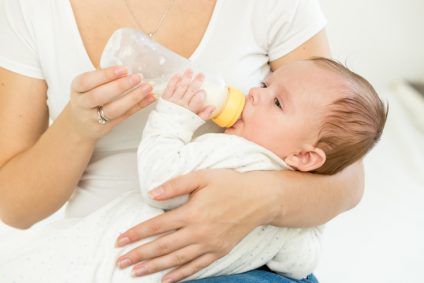
Amy Brown condemns bottle propping but ignores the more deadly practice of co-sleeping

Mother giving milk from bottle to baby sleeping on hands

The hypocrisy of professional lactivists is truly mind blowing!

Take Amy Brown’s latest piece on The Conversation, Baby bottle propping isn’t just dangerous – it’s a sign of a broken society, a polemic against products that prop bottles:

How on earth have we got to the point where bottle propping is the solution? Why are we ignoring the needs of our new mothers? Why are new mothers literally the ones left holding the baby, day in, day out? Having a new baby is always going to be a huge change. But it doesn’t need to be like this.

[pullquote align=”right” cite=”” link=”” color=”” class=”” size=””]If Brown truly cared about babies, she’d oppose co-sleeping.[/pullquote]

You bet it doesn’t need to be like this! The contemporary philosophy of natural mothering (aka attachment parenting) has made it like this. It starts with the Baby Friendly Hospital Initiative — which Brown vigorously supports — that forces women to be left caring for a baby in the hours and days immediately after birth, despite pain and exhaustion, in an effort to promote breastfeeding.

Many cultures and religions specify a period of “confinement” after birth, weeks in which new mothers are relieved of their daily duties and allowed to concentrate on caring for a newborn. They don’t even have to take care of themselves; mothers, mothers-in-law and other women take care of them. In our culture, “broken” by lactivism, women have to start caring for the baby the moment the placenta detaches.

Of course, the real problem with bottle propping is that it is dangerous. As Brown notes:

Young babies may not have the head control or strength to move away from the flow of the milk that is being aided by gravity. Quite simply they can choke to death as they cannot escape from the milk, or inhale it as the bottle becomes displaced.

And that’s why bottle propping should never, ever be done! Brown is correct that maternal exhaustion is not an excuse.

But once again Brown’s hypocrisy rises to the fore. Bottle propping, as dangerous as it is, has only accounted for rare infant deaths. In contrast, co-sleeping — another practice vigorously supported by Brown — is killing many more each year because, according to the American Academy of Pediatrics, it nearly triples the risk of infant death from SIDS.

Yet Brown, apprised of this risk is on the record in her support:

Brown told Reuters Health by email that “feeding a baby this much can be really tiring, especially if new mothers are expected to go back to work or need to care for other children in the day.”

Sleeping in the same bed can be helpful, Brown said. “Anything that helps mothers to get more sleep, and helps to make sure that the baby feeds frequently is really important.”

Wait, what? Co-sleeping, which triples the risk of SIDS is okay because it help mothers get more sleep and ensures that the baby feeds as needed, but bottle propping, which kills only rarely, is completely unacceptable as a method of easing a mother’s exhaustion and ensuring that the baby feeds as needed? In our culture, “broken” by lactivism, exhaustion is the perfect excuse for engaging in a deadly practice if you’re breastfeeding, but anathema if you aren’t.

But there’s a larger issue at stake, the romantizing of a past that literally never existed. Brown writes:

We now have so many parents who are pretty much doing this on their own. Yes, they might have a partner, but they’re often at work all day. Yes, they might have visitors, but how many are there just to coo over the baby rather than do anything useful such as cook a meal, do the washing up, or anything else that might actually help a new mother feel more relaxed? …

No mother should be doing this alone. We should track down where the “village” – that extended network of family and friends which share responsibility for raising a child – went to and recreate it. There must be a recognition of how isolating and exhausting caring for a baby can be – and a system in place to catch mothers before they fall.

In nature women had no work to do and were free to spend all their time tending their infant? There was never a time like that.

Women have always been integral to the survival of small hunter-gatherer bands. They spent hours each day as the gatherers. They spent additional hours in laborious domestic tasks like grinding grain. In a very real sense, mothering in nature was an interstitial task, taking place in the gaps while performing other tasks that required attention and energy.

The dominant contemporary paradigm of natural mothering, in contrast, imagines mothering performed instead of other tasks. It is not something that you do while doing everything else; it’s something you do to the exclusion of everything else. That’s not natural; it has nothing to do with the way our foremothers raised children.

No doubt Brown is going to be flabbergasted to learn that while our society may prop bottles, indigenous societies propped the entire baby. That’s part of the function of cradleboards.

Cradleboards were used during periods when the infant’s mother had to travel or otherwise be mobile for work … The cradleboard could be carried on the mother’s back … The cradleboard can also be stood up against a large tree or rock if the infant is small, or hung from a pole (as inside an Iroquois longhouse), or even hung from a sturdy tree branch…

Mothers prop bottles today for the same reason indigenous mothers propped babies. They have older children. They have elderly relatives that need care. They have jobs, whether in the home or outside it. It’s not a sign of a broken society. It’s a sign of a real society, not the fictitious one that Brown longs for.

If Brown truly cared about babies, she’d oppose co-sleeping. If she truly cared about mothers, she’d opposed mandatory rooming in policies. Instead she merely opposes bottle propping. That’s hypocrisy.

What if formula harmed as many babies as breastfeeding does?

Risk

For years I’ve been pointing out that the promised benefits of breastfeeding have failed to materialize.

Although lactation professionals like Melissa Bartick, MD have continued to write papers modeling the purported savings of both lives and healthcare dollars, with the exception of extremely premature babies neither she nor anyone else can point to any lives or healthcare dollars that have actually been saved. Moreover, the countries with the lowest rates of breastfeeding like the UK have among the lowest rates of infant mortality in the world, while multiple countries with the highest breastfeeding rates in Africa have the highest rates of infant mortality in the world.

[perfectpullquote align=”right” cite=”” link=”” color=”” class=”” size=””]The promised benefits of increased breastfeeding have failed to materialize because the risks were never taken into account.[/perfectpullquote]

Why is there such a discrepancy between what breastfeeding professionals promise and what actually happens?

There’s a simple reason: exclusive breastfeeding also has risks.

Although those factors are never taken into account in Dr. Bartick’s modeling, they appear to negate the saving of lives and obliterate the saving of healthcare dollars that lactation professionals promise.

What if formula harmed as many babies as breastfeeding does? There would be a national outcry!

Consider the furor surrounding revelations that French formula manufacturer Lactalis sold products contaminated with salmonella over a period of a decade.

In the 2005 outbreak, 146 children fell ill. In last year’s outbreak, at least 38 cases in France and Spain were traced to Lactalis milk.

On Thursday, researchers from the Pasteur Institute in Paris said the salmonella bacteria had remained at the Craon factory until it was closed.

As a result, they said, a total of 25 babies had been affected between 2005 and 2016.

Parents were horrified, governments swung into action, and the formula company will ultimately pay hundreds of millions of Euros in fines and to damage claims … all because 209 babies became sick.

Now consider that literally TENS OF THOUSANDS of American newborns are readmitted to the hospital each year, costing HUNDREDS OF MILLIONS of healthcare dollars because breastfeeding doubles the risk of newborn hospital readmission.

Why? Because insufficient breastmilk is common (up to 15% of first time mothers in the days immediately after birth) and severe dehydration, jaundice, failure to thrive and death are the inevitable results of pressuring women to exclusively breastfeed regardless of whether the baby is getting enough.

It’s a scandal that dwarfs the Lactalis scandal yet no one seems in the least upset. Researchers merely ponder how they can reduce the harm while continuing to promote exclusive breastfeeding for its “benefits.”

Consider, too, that breastfeeding is now the leading cause of kernicterus (jaundice induced brain damage) responsible for 90% of the cases of this serious complication that often results in long term disability or even death.

It’s scandalous but researchers merely ponder how they can reduce the harm while continuing to promote exclusive breastfeeding for its “benefits.”

Consider that emphasis on skin to skin contact and 24 hour rooming in has led to a dramatic increase in sudden post neonatal infant collapse (SUPC). SUPC can result in severe brain damage and many affected infants die.

It’s scandalous but researchers merely ponder how they can reduce the harm while continuing to promote exclusive breastfeeding for its “benefits.”

Consider that the Joint Commission has just issue new guidelines to combat an epidemic of infant falls — and the resulting injuries and deaths — that also result from the promotion of extended skin to skin contact and 24 hour rooming in.

It’s scandalous but researchers merely ponder how they can reduce the harm while continuing to promote exclusive breastfeeding for its “benefits.”

So why hasn’t there been an outcry about the dangers of breastfeeding? The answer has more to due with psychology than scientific evidence.

Psychology leads people to imagine that the risks of technology are always greater than the risks of nature.

Professor David Ropeik discusses this in The Consequences of Fear. He notes:

… [M]any people fail to protect themselves adequately from the sun, in part because the sun is natural and because, for some of us, the benefit of a healthy glowing tan outweighs the risks of solar exposure. However, solar radiation is widely believed to be the leading cause of melanoma, which will kill an estimated 7,910 Americans this year.

Psychology is also responsible for out marked aversion to betrayal:

…[S]afety products rarely provide perfect protection and sometimes “betray” consumers by causing the very harm they are intended to prevent. Examples include vaccines that may cause disease and air bags that may explode with such force that they cause death…

The mere possibility of betrayal threatens the social order that enables us to trust the safety infrastructure of our society, causing intense visceral reactions and negative emotions toward the betrayer. Unfortunately, these strong negative emotions toward a potential betrayer may also lead people to take unwise risks…

So we react with outrage when we learn that a manufacturer sold contaminated formula and insist that breastfeeding, because it is natural, will never betray us.

There’s a final reason why we’ve acquiesced to the rising tide in injuries and deaths from exclusive breastfeeding promotion: lactation professionals have lied about them. They create endless lists of the “risks” of formula feeding and refuse to mention the risks of breastfeeding like insufficient breastmilk, SUPC and falls from bed.

Even worse, they demonize the people and organizations who try to alert mothers to the risks and prevent the injuries and deaths. The founders of the Fed Is Best Foundation have taken an incredible amount of abuse from lactation professionals who appear psychologically incapable of accepting the scientific evidence on breastfeeding harms.

I myself am often accused by lactivists of “hating” breastfeeding even though I happily and successfully breastfed four children; no doubt this piece will reinforce their views. But I don’t hate breastfeeding. I hate iatrogenic injuries and deaths that are the result of refusing to acknowledge that breastfeeding has risks as well as benefits.

Sure breastfeeding has benefits, but they can easily be dwarfed by unacknowledged risks. That’s why the predictions of lactation professionals like Melissa Bartick, MD haven’t come true and never will.

Dr. Amy