If you support a woman who lets her baby die, you bear responsibility

Me?

This post is for the apologists parachuting in to my blog and Facebook page attempting to excuse their role in a baby’s death.

Yesterday I wrote about the Facebook group Ten Month Mamas who cheered a woman as she refused to seek care for an extremely postdates pregnancy, 44 weeks by her reckoning. As complication piled on complication — prolonged ruptured membranes, meconium, transverse lie — they kept cheering, right up until the moment that they learned the baby was dead.

Had the mother successfully delivered a live baby, they would have patted themselves and each other on the back for offering the support that got her to her goal. Yet when the mother delivered a dead baby, they immediately began absolving themselves of responsibility and expressing their anger toward me for exposing them.

Here are a few choice examples of their prose:

Enlight52

Sadie Canning Dossor: How dare you post this! This is someone’s life you’re pontificating on and she chose to share it with a specific group and not you’re pathetic negative and Ill informed group. You are the worst kind of person for posting such confidential and sensitive information to point score. I’m not even gonna argue the issue of pregnancy time frames because each case is different, though I will say I went to 43 weeks with both mine, had lovely home and hospital births and almost no intervention.

You and your idiotic followers are full of judgement hate and ignorance and you clearly feel the need to spread this tripe. Well good luck to you, you utter bint.

And this:

Enlight53

Aliki Doula Livanis: This is so stupid… the whole way you go about doing things… If you didn’t bully admins in groups nor the moms who have just lost life, I would actually have some respect for you. Hell, 44 weeks plus is a far stretch for me too. I was born at 43 weeks after a medical induction, without an epidural. Maybe that’s why my mom just had me? But it was safe after having constant NST’s, or so she said. If you ended up bullying her if she had lost me, would it have changed anything? My point is, you’re not really winning… if you did what you do with dignity and grace some of us “hippies” might even hear what you’re saying. But with all this screaming and shaming, all we see is a lonely old hag who lost her medical licence for who knows what reason… who also had traumatic hospital births and doesn’t talk about it… and is bitter now shames others who choose a more graceful birth. Just a thought.

And this, which I confess I don’t really understand:

Enlight54

Michelle Bromley: Ms T, please go and get some help. It’s quite obvious that so need to do some serious debriefing.
You are dangerous.
These groups help and support so many. People do not advocate harm to mothers and babies. I’ve seen many of your posts advocate serious harm and trauma.
Please stop the harassment!

Debriefing?

And this:

Enlight55

Cygnus Lindsey: Amy you’re a nasty ass bitch. Like a damn dog salivating waiting for a crumb to drop. Fuck you old wench!

Where did I go wrong? How did they get the impression that I care about their opinions?

Be that as it may, I feel confident that they know what they did is wrong and now they are they engaging in a variety of cognitive distortions in an attempt to shed guilt, including:

It was unpreventable. In this case, they insist that if I knew the facts about what happened, I wouldn’t blame anyone. Yet no one seems to be able to come up with any facts that I got wrong.

Women have the right to do this. Yes, they have the legal right to risk their unborn children’s lives, but that doesn’t make it ethical or justifiable.

Unassisted birth is actually good for babies. Yes, this time the baby died, but had the baby lived an unassisted birth would have provided benefits for the baby.

The baby wanted it. No one invoked that here, but in previous cases mothers have claimed that the baby communicated to them where and how the he or she wished to be born.

The mother and her defenders did not pioneer these excuses. They’ve been used by child abusers since time immemorial.

Yes, I violently shook the baby for crying, but how was I supposed to know it would die?

It’s my right as a parent to beat my children bloody if I think it is for their own good.

Spare the rod, spoil the child.

If they didn’t want to be punished, they wouldn’t have misbehaved.

Those who harm children have a million excuses about why they aren’t responsible for the resulting injuries and deaths.

But the truth is that no one beats a child to death out of love; they do it to satisfy their own impulses and needs.

And the truth is that no one plans an unassisted pregnancy and birth out of love; they do it to satisfy their own impulses and needs.

The truth is that while parents have a right to discipline their children; they have responsibilities as well.

And the truth is that while mothers have a legal right to let their unborn babies die in service to their cognitive delusions, they have the ethical responsibility to provide appropriate medical care.

The truth is that children don’t benefit from being beaten; the parents benefit.

And the truth is that babies don’t benefit from unassisted pregnancy and birth; the mother benefits from bragging rights and the toxic “support” of other members of the Facebook group.

Unassisted pregnancy and birth are child abuse, albeit entirely legal. And if YOU support an abuser, YOU bear responsibility for tragedies like this one.

Ten Month Mamas cheers a woman to her baby’s death

Sad mother missing her daughter

Homebirth, like most of alternative health, is about two things. Not mother and baby; don’t be silly! It’s about defiance and denial.

Homebirth especially is about defiance. Women routinely risk their baby’s lives — the greater the risk, the better — while flaunting their transgressiveness before their peers. That’s why there are so many Facebook groups built around the specific complication they are defying. Groups like Ten Month Mamas and its secret section.

Enlight46

Hi everyone! This group was recommended to me because I am currently 44+2. I’m excited to look through the posts and see if I can find some like minded support.

If she was looking for like minded, self-absorbed idiots, she came to the right place!

[pullquote align=”right” cite=”” link=”” color=”” class=”” size=””]The mother piled risk factor on risk factor until they eventually crushed the life out of her baby.[/pullquote]

The group is headlined with a typically moronic quote from killer pretend midwife Gloria Lemay, who has more deaths to her name than anyone even knows.

Attending births is like growing roses. You have to marvel at the ones that just open up and bloom at the first kiss of the sun but you wouldn’t dream of pulling open the petals of the tightly closed buds and forcing them to blossom to your time line.

Awesome advice for gardening. Idiotic for childbirth. That’s because for every week beyond 40 weeks that babies stay inside the womb, the risk of stillbirth rises … and rises … and rises. The risk of stillbirth doubles at 42 weeks, triples at 43 weeks, and continues to rise beyond.

If you wanted to use a gardening analogy, you might analogize to plants that get root-bound. Both the root-bound plant and the postdates baby grow beyond the size of their sustenance. It both cases they sicken and eventually die.

In the world of homebirth, more complications and greater idiocy are worth more atta-girls. One week after her initial post, Mom informs the group that in addition to extreme postdates, she’s added on prolonged rupture of membranes. Why not? She’s already had an unassisted pregnancy (no medical care by anyone) and plans an unassisted birth (no medical care by anyone). Mom gets her atta-girls.

Enlight47

But wait! There’s more. There is meconium in the fluid and Mom thinks the baby is transverse! More atta-girls.

Enlight48

Finally, three days later, the mother consents to induction!

Enlight49

But as she knew, the baby was already dead.

Enlight50

On July 28th [my partner] and I brought Earthside our sweet Angel baby. We discovered her heart had stopped beating before birthing. Unfortunately we had to say Goodbye in the same breath as Hello and were able to bring her home in our hearts, but not our arms…

Who could have seen that coming?

Anyone with a shred of common sense.

Unassisted pregnancy and birth have appalling rates of perinatal mortality. Postdates increases the risk of death, Prolonged rupture of membranes increases the risk of death. Meconium increases the risk of death. Transverse lie increases the risk of death. Put them all together and what do you get? A dead baby!

But as this mother piled risk factor on risk factor until they eventually crushed the life out of her baby, she was cheered on by women who are so privileged that they have forgetten that childbirth is dangerous and so immature that they think defiance marks them as authentic.

This baby did not have to die. She was killed by her mother’s choices and the group of like minded fools who supported her.

World Breastfeeding Week 2017, another ridiculous lactivist campaign

Concept of lies. Lie detector with text.

I’ve been writing about mothering issues for over a decade and that gives me an interesting perspective on lactivist marketing campaigns: they’re constantly changing because they never work to lactivists’ satisfaction.

The latest campaign has been trotted out for World Breastfeeding Week 2017: ending poverty, protecting the planet and ensuring prosperity. This campaign is going to fail for the obvious reason that breastfeeding is incapable of doing any of those things and anyone with a modicum of sense would know that.

[pullquote align=”right” cite=”” link=”” color=”” class=”” size=””]Breastfeeding as a way to end poverty, protect the planet and ensure prosperity? That’s bullshit.[/pullquote]

But lactivism isn’t about common sense and it isn’t even about babies. It’s about marketing the products and services of the breastfeeding industry while pretending that all women need these products and services and all babies benefit from these products and services. That’s why the moralization of breastfeeding has paralleled the monetization of breastfeeding.

The primary lactivist goal is unreasonable: to ensure nearly 100% exclusive, extended breastfeeding. It’s simply not biologically possible since the incidence of insufficient breastmilk supply is common, not rare (a lactivist lie). The goal is also anti-feminist. One of the cornerstones of feminism is the right of women to control their own bodies including their breasts. The lactivist goal is also absurd. For most of human existence there was nearly 100% exclusive, extended breastfeeding, and infant mortality rates were astronomical.

Before addressing why the World Breastfeeding Week 2017 campaign is the most ridiculous yet, it’s worth reviewing the previous campaigns.

The heart and soul of contemporary lactivism is lying about the benefits and risks. Breastmilk is literally presented as the “perfect food” for babies. But for a food to be perfect for babies, it needs to meet three criteria:

  • It must be nutritionally complete.
  • It must be available in the perfect amount.
  • A baby must be able to access as much as he or she needs.

Breastmilk is not nutritionally complete; it lacks vitamin D. Many women don’t make enough breastmilk to fully nourish an infant. And many infants have impediments (low muscle tone, poor suck) that make it impossible for them to access as much milk from the breast as they need.

But claiming breastmilk as perfect for all babies is only the beginning of the lactivist lies. Lactivist organizations — and sadly the WHO and UNICEF under the relentless lobbying of lactivist organizations — has insisted that the scientific evidence shows that breastfeeding has a host of health benefits. Most of the scientific evidence about breastfeeding is weak, conflicting and riddled with confounders. Since breastfeeding in industrialized nations is associated with maternal socio-economic status, most of the benefits claimed for breastfeeding are actually benefits of being well off with easy access to healthcare. No matter, lactivism has positioned fear of depriving babies of benefits as critical to their efforts.

Even lying about breastfeeding hasn’t been able to achieve lactivist goals, so they’ve extended their campaign in a variety of ways.

For years, “normalizing” breastfeeding has been a centerpiece of lactivist efforts. Ignoring what women told them about why they stopped or didn’t start breastfeeding — it can be painful, frustrating, exhausting and inconvenient — lactivists insisted that breastfeeding rates are low because of social pressure to formula feed. They embarked upon a relentless, multimillion dollar campaign to normalize breastfeeding, in other words to apply social pressure to breastfeed. Although many more women leave the hospital claiming they will breastfeed, and many more women feel guilty about not breastfeeding, the lactivist goal of 100% breastfeeding is nowhere in sight.

Critics of lactivism pointed out that it takes a village to raise a child, not a breast and therefore pressuring individual women to breastfeed is a classic neoliberal response to a health issue: putting the blame on individuals and discounting the role of government. Lactivists have responded with a new iteration in which government is condemned for not supporting breastfeeding enough — although it is supporting breastfeeding with more money and greater effort than any time in the past.

Moreover, it has become obvious that breastfeeding has risks as well as benefits. Critics have drawn attention to serious complications and deaths from insufficient breastmilk. The Fed Is Best Foundation has led the way in this area and its spectacular success in changing the dialogue is testament to the widespread nature of breastfeeding problems. How have lactivists responded? They’ve responded with unadulterated chutzpah. After literally decades of promoting breastfeeding by making women fear formula as substandard and a sign of personal weakness, lactivists have had the unmitigated gall to decry the fear generated by informing women about the fact that insufficient breastmilk is common, not rare.

World Breastfeeding Week 2017 represents a new acme in lies about breastfeeding: it’s not just a feeding method; it’s a way to end poverty, protect the planet and ensure prosperity. That’s bullshit.

According to WBW2017:

Breastfeeding is a vital part of sustainable development and a non-negotiable component of global action to end malnutrition…

Really? For most of human existence, when all babies were breastfed, there was never any hunger or malnutrition? Actually, as everyone knows, hunger and malnutrition were ubiquitous. Breastfeeding never prevented hunger and malnutrition in the past and it isn’t about to start now. Breastmilk does not come from thin air; it is produced from food eaten by mothers. No food for mothers = no breastmilk for babies. Unless and until breastmilk causes food to grow, it will never prevent hunger and malnutrition.

The health of our planet is affected by the way babies are fed. Breastmilk is a natural, renewable food that is produced and delivered without pollution, packaging or waste. The breastmilk substitute industry, on the other hand, carries a negative environmental impact that is not commonly recognised…

That’s hilarious! How green is the extra food (including meat from cows) needed to create breastmilk? Is there any evidence that the production of breastmilk takes less farming, fertilizers and transportation of food than the production of cow’s milk? How green is the plastic used in breast pumps? How green is the electricity used to run the pump and store the refrigerated or frozen breastmilk? How green are breast pads, nursing bras and lactation consultants (fuel needed to get to and from patients)? Oops! Maybe breastfeeding isn’t that green after all!

How about the claim that breastfeeding increases prosperity? The folks at WBW2017 don’t even bother to provide evidence of that, presumably because there is no such evidence.

The truth — an inconvenient truth that lactivists refuse to acknowledge — is that breastmilk is just milk, not magic. It doesn’t have magical health benefits. It doesn’t magically make women better mothers than those who formula feed. It doesn’t magically prevent hunger and malnutrition. It isn’t particularly environmentally friendly compared to formula feeding and it has no impact whatsoever on prosperity.

Therefore this campaign, like all the lactivist campaigns before it, is doomed to failure.

Not a single country in the world meets WHO standards for breastfeeding? So what?

23461995 - so what

Lactivists are bemoaning the latest breastfeeding report from the World Health Organization.

As USA Today reports:

No country in the world supports breastfeeding moms like they should, according to a new report released Tuesday by the World Health Organization (WHO) and the United Nations Children’s Fund (UNICEF)…

By comparing breastfeeding rates around the world, the groups found rates nowhere near 100% in its Global Breastfeeding Scorecard, released at the start of World Breastfeeding Week.

So what?

No matter how long and hard professional lactivists bleat about the purported life saving benefits of breastfeeding, very few parents actually believe them, nor should they. The truth, which lactation professionals refuse to acknowledge, is that breastfeeding rates have virtually nothing to do with infant health.

[perfectpullquote align=”right” cite=”” link=”” color=”” class=”” size=””]There is literally zero real world evidence that promoting breastfeeding improves infant health.[/perfectpullquote]

Don’t believe me? Consider which countries did best and worst on the WHO breastfeeding report card.

Only 23 countries report exclusive breastfeeding rates at 6-months above 60%: Bolivia, Burundi, Cabo Verde, Cambodia, Democratic People’s Republic of Korea, Eritrea, Kenya, Kiribati, Lesotho, Malawi, Micronesia, Federated States of Nauru, Nepal, Peru, Rwanda, São Tome and Principe, Solomon Islands, Sri Lanka, Swaziland, Timor-Leste, Uganda, Vanuatu and Zambia.

By and large, these countries have terrible rates of infant mortality (expressed per 1000 live births):

Bolivia 31
Burundi 54
Cabo Verde 21
Cambodia 25
Democratic People’s Republic of Korea 20
Eritrea 34
Kenya 36
Kiribati 44
Lesotho 69
Malawi 43
Micronesia 29
Federated States of Nauru 29
Nepal 29
Peru 13
Rwanda 31
São Tome and Principe 35
Solomon Islands 24
Sri Lanka 8
Swaziland 45
Timor-Leste 45
Uganda 38
Vanuatu 23
Zambia 43

In contrast:

Laurence Grummer-Strawn, technical officer with the World Health Organization, said the U.S. received “several red lights” or “failing grades” in the report. Rates in the United States were considerably lower than the average. Fewer than 25% of American moms report exclusively breastfeeding for the first six months. The United States has no paid maternity leave, and data showed only 18% of hospitals support recommended breastfeeding practices. Grummer-Strawn also pointed out there’s no regulation on how baby formula is advertised in the U.S., a reason moms could think formula is a substitute for breastmilk.

But the infant mortality rate in the US is 6/1000, a fraction of the rate in any of the countries given the best grades by the WHO.

The United Kingdom, by all accounts, does even worse with a breastfeeding rate at 12 months of 0.5%, reportedly the lowest in the world … and yet the infant mortality rate in the UK is even lower than the US, 4/1000, one of the best rates in the world!

These figures make is nearly impossible to take UNICEF and the World Health Organization seriously when it asks for ever more money to promote breastfeeding:

The groups are asking for lower and middle-income countries to invest $4.70 per newborn ($5.7 billion) in initiatives, such as access to breastfeeding counseling and improving breastfeeding practices in hospitals, to increase the global rate of 6-month exclusive breastfeeding to 50% by 2025. The Global Breastfeeding Collective suggests such an investment could save the lives more than 520,000 children under age five who die of preventable illnesses, annually, and could generate up to $300 billion in economic gains.

All the existing real world evidence suggest that that can’t possibly be true and isn’t even close to reality. So where do such claims come from? They come from mathematical models that assume that when breastfeeding rates are correlated with low infant mortality, they cause low infant mortality. But as anyone with even a passing acquaintance with statistics can tell you, correlation does not equal causation. The figures quoted above demonstrate that definitively.

Nonetheless, the UNICEF and WHO claims, which have no basis in fact, have been widely disseminated and accepted as conventional wisdom.

A piece published yesterday on the Fast Company website is typical:

We really need to act now to fully realize the benefits of breast feeding,” says France Begin, a senior advisor with UNICEF’s infant and young child nutrition division. “Prioritizing breast feeding will save lives, save money, and will lead to better health and economic outcomes for generations to come.

Yet there is literally ZERO real world evidence that prioritizing breastfeeding will do any of those things. In the real world, there is NO correlation between breastfeeding rates and infant mortality rates. Countries with the highest breastfeeding rates have HIGH infant mortality and countries with the lowest breastfeeding rates have LOW infant mortality.

There is NO real world, population based data to indicate increasing breastfeeding promotion or improving breastfeeding rates would have ANY impact on any infant health of term babies.

Indeed, I posted a challenge on Facebook and Twitter yesterday:

IMG_3020

Take the Dr. Amy World Breastfeeding Week Challenge: Please find any example of industrialized countries where promoting breastfeeding reduced infant mortality.

Thousands of people have viewed the challenge but not a single person has offered a single example. That’s not surprising. There are no examples.

Not a single country in the world meets WHO standards for breastfeeding? So what?

It’s World Breastfeeding Week and it’s time to stop the lactivist madness

Child saying no

It’s an amazing fluid with amazing properties. It is critical to health and well being. It is adaptive: it’s amount and constituents can change as circumstances change. Human beings could never have survived and thrived to this point without it.

No, it’s not breastmilk. It’s sweat … and it’s arguably just as important to human survival as breastmilk.

[pullquote align=”right” cite=”” link=”” color=”” class=”” size=””]Why is there World Breastfeeding Week and no World Sweating Week?[/pullquote]

So why is there a World Breastfeeding Week and no World Sweating Week?

Because there are special interest breastfeeding groups that have lobbied government to support them in promoting their product. World Breastfeeding Week is ostensibly about promoting infant health, saving money and increasing sustainability, but the truth is that the benefits of breastfeeding have been grossly exaggerated, the “dangers” of formula feeding mostly fabricated, and the risks of exlusive breastfeeding hidden or denied. Indeed, at this point, the harms of breastfeeding promotion — infants injured, infant deaths, maternal mental health compromised — arguably outweigh the benefits.

It’s time to stop the madness!

Let’s start with a fundamental premise:

Promoting process over outcome is wrong.

We’ve all heard the expression, “The operation was a success, but the patient died.” It’s an aphorism that memorably expresses the folly of valuing process over outcome.

Breastfeeding is a process. Infant health is the outcome and it is infant health that should matter, not breastfeeding rates. Lactivists have managed to elide this critical issue by starting with the dubious conclusion — that breastfeeding must be healthier because it is natural — and promoting scientific data that is weak, conflicting and riddled with confounders to support it.

The scientific literature on breastfeeding affirms over and over again that breastfeeding is theoretically healthier for babies. But we don’t have to resort to theory when we have reams of actual data. Over the past 100 years we performed a major “experiment” in industrialized countries. Breastfeeding rates, which in the US were in the range of 90%, dropped precipitously to 24% by 1973 and have since rebounded to initiation rates of nearly 80%. What impact have actual breastfeeding rates had on real life populations in industrialized countries? They’ve had no discernible impact at all. The infant mortality rate dropped steadily regardless of whether breastfeeding rates were rising or falling.

But what about middle and lower income countries where access to clean water to prepare infant formula is uncertain? Surely breastfeeding rates must have a significant impact on infant mortality rates.

Here’s a scatter chart of breastfeeding rates vs. infant mortality created from data on 121 low and moderate income countries.

IMG_1679

As you can see, as the breastfeeding rate rises, the infant mortality rate not only doesn’t fall, it actually rises, too. In other words, there is no correlation between breastfeeding rates and infant mortality rates. But, as demonstrated below, there is a strong correlation between economic activity and infant mortality.

IMG_3014

There’s no evidence here that increasing breastfeeding rates improved infant health.

But breastfeeding is natural!

So is sweat. Indeed breastmilk is actually modified sweat and the breast glands are modified sweat glands.

Sweat is critical to human survival because it is a primary method of thermoregulation, regulation of the body’s internal temperature. People who cannot sweat face the very real threat of death from drastically elevated body temperature. Given the lifesaving nature of sweating, you might think it would be accorded the same treatment as breastfeeding, but you would be wrong.

Consider:

It is widely recognized that temperature outstripping the ability to sweat is common. That’s why we recommend additional cooling methods like cold drinks and immersion in cool water. In contrast, lactivists refuse to accept that a mother’s ability to produce breastmilk can be outstripped by a baby’s needs for nourishment. Both are natural but only one is presumed to be nearly perfect.

It is widely accepted that using technology for cooling, like fans and air conditioning, is often superior to sweating. In contrast, lactivists insist that using technology, in this case infant formula, can’t possibly be as good as breastfeeding.

No one thinks that people who use technology to cool themselves are lazy or selfish, yet lactivists often assert that women who refuse to breastfeed are lazy and selfish. Many mothers are left with shame and guilt when they cannot meet the arbitrary lactivist imperative to breastfeed.

Cooling technology saves lives and improves quality of life. Sure, sweating is great and quite effective, but fans and air conditioners are far more pleasant and allow people to be productive in hot climates or during heat waves. In truth, infant formula also saves lives and improves quality of life for both mothers and babies, but lactivists vehemently deny what it right in front of their eyes and what mothers tell them.

Hence we have World Breastfeeding Week, when activists insist that babies’ health is threated by low breastfeeding rates, though there is no evidence of this; that infant health will be improved if more women breastfeed exclusively, though there is no evidence of this; that women stop breastfeeding because of lack of support, though women report that they stop because of low supply, pain and inconvenience; and that society doesn’t promote breastfeeding, even though tens of millions of dollars are spent each year doing just that.

It’s time to stop the madness!

Yes, breastfeeding is a good thing, but it produces milk, not magic, no matter how much lactivists pretend otherwise. And like any bodily process (think fertility or pregnancy), it has a significant failure rate, not a low rate. The decision to breastfeed instead of use formula is like the decision to sweat instead of using air conditioning. It doesn’t make people superior; those who choose not to do it aren’t lazy or selfish; and, most importantly, it’s a personal choice, not the appropriate purview of activists or governments.

Forget crunchy mothering; our goal should be supple mothering

Young ballerina in a black suit is dancing in dark

Many women proudly identify themselves as “crunchy” mothers. It is meant to invoke granola — natural and healthy. But there’s no evidence that crunchy mothering is more natural or healthier, just like there’s no evidence that granola existed in nature.

Yet the appellation is more accurate than crunchy mothers realize. Granola is hard, unyielding, but it is easily smashed and becomes soggy and falls apart with the application of milk. And though crunchy mothers like to pretend that they are child centered and self-sacrificing, the truth is that crunchy mothering is rigid and performance obsessed, the audience being other mothers.

[pullquote align=”right” cite=”” link=”” color=”” class=”” size=””]Supple mothering — adaptable, resilient, respectful of children’s differences and kind to mothers.[/pullquote]

Good mothering has nothing to do with being crunchy and everything to do with being both supple and resilient, qualities that can’t be found granola. What do I mean?

Supple mothering is adaptable; crunchy mothering is not.

The greatest defect of crunchy mothering is that it rests on the belief that one size fits all. Unmedicated vaginal birth is supposedly right for every baby and every mother; breastfeeding is supposedly best for every child and every mother; baby wearing is supposedly comfortable for every child and every mother; the family bed supposedly meets the needs of all.

If I’ve learned anything at all from mothering four children, it is that one size NEVER fits all. Every child is a unique person with individual needs that can differ subtly or dramatically from other children. Supple mothering means being able to conform to the individual child’s needs and desires whether that child needs a C-section in order to survive, formula feeding in order to thrive, or anything else that may not be part of a mother’s image of how she planned to mother or what she imagined her child might become.

Supple mothering is resilient; crunchy mothering is not.

Mothering is an extremely stressful and demanding job. My children are grown and though the physical work has receded into the past, the emotional imperatives have not. They know that I still worry about them (and are probably annoyed about it); they are sure that I will glory with them in their successes, and they can be confident that I will take their disappointments as hard or even harder than they do. I am always in their corner and have been since the day each was born.

In order to be there for them, I have had to be resilient and part of resilience is being realistic in my expectations of them and of myself. Supple mothering allows for that. It predicts that mothering will not be easy; it anticipates that children will not always adhere to the goals you have in mind for them or for yourself and it counsels adaptation not rigid adherence to a pre-existing plan.

Supple mothering also teaches women to be good to themselves. A woman who chooses an epidural in labor is not “giving in”; she is meeting her own need for pain relief. A mother who chooses not to breastfeed (even when she could have done so) is not selfish; she’s appropriately caring for herself. A mother who needs to sleep without a baby her in her bed is not depriving her child; she is shoring up her own reserves to improve her ability to parent that child.

Moreover, supple mothering allows women to adapt to their children. I have a friend who insisted that she would never let any daughter of hers play with Barbie dolls. Then she had a daughter who loved Barbies. Despite the fact my friend abhorred Barbie, she ultimately gave in to her daughter’s entreaties and bought her several. That took guts and humility, recognizing that perhaps she did not necessarily know what was best for this particular girl. Barbie turned out to be a passing fancy and her daughter never fell prey to the belief that she was expected to look like Barbie or behave in docile way. Supple mothering views adaptation as a strength, not a weakness.

Supple mothering supports; crunchy mothering blames.

One of the best books about parenting I ever read is Far From The Tree by psychiatrist Andrew Solomon. It’s about one of the most challenging aspects of parenting, recognizing that your child is not you and that’s okay. The task is made far more difficult when the child differs from you in major ways: children who are deaf, autistic, transgender, etc.

Solomon notes:

… The attribution of responsibility to parents is often a function of ignorance, but it also reflects our anxious belief that we control our own destinies. Unfortunately, it does not save anyone’s children; it only destroys some people’s parents, who either crumble under the strain of undue censure or rush to blame themselves before anyone else has time to accuse them …

Though Solomon writes of extreme parenting challenges, the urge to blame is  integral to crunchy mothering. That’s why crunchy mothering groups are filled with women who deride other mothers who had epidurals or C-sections, and who feel entirely comfortable insisting that women who don’t breastfeed are lazy. It’s both a function of ignorance about childbirth and breastfeeding, as well as the desperate belief that mothering is a matter of imposing your will. In fact the crunchy mothering ethos has become so ingrained in middle class white women that they don’t wait for others to blame them; they blame themselves and feel guilty about epidurals, C-sections, formula feeding, or something as basic and banal as needing sleep in order to function.

That’s why lactivist groups are hell bent on attacking The Fed Is Best Foundation for supporting ALL women REGARDLESS of the ways they feed their babies. Crunchy mothering is incapable of supporting women who make different choices; it can only blame. Lactivists think the ability of Fed Is Best to offer support regardless of circumstances is a weakness and betrayal of breastfeeding when, in truth, it is an evocation of supple mothering. It counsels women to be adapatable when it comes to infant feeding and to reject guilt for refusing to adhere to rigid rules about breastfeeding. And it saves lives, too. Crunchy mothering is so rigid and demanding that letting babies die from hypernatremic dehydration is waved off as “rare” when the reality is that it is common.

Supple parenting lets mothers save their strength for real parenting challenges; crunchy mothering pretends that trivial decisions are parenting challenges.

Childbirth, infant feeding, and issues like the family bed AREN’T the hard parts of parenting and they aren’t the important parts, either. They pale into insignificance behind the real challenges of parenting: dealing with differences, disabilities, bullying, poor school performance, lack of friends, major disappointments, risky behavior, drug use, depression and drunk driving. And that’s hardly an exhaustive list.

It takes strength to deal with these challenges, strength that should be husbanded, not wasted on meaningless issues like childbirth and infant feeding. There’s absolutely no need to feel guilty about safe mothering choices like C-sections and formula feeding. What should you feel guilty about? I guarantee that once they are old enough to talk your children will tell you … and tell you … and tell you.

The bottom line is that crunchy mothering isn’t good for children and it isn’t good for mothers. We should reject it. Our goal should be supple mothering — adaptable, resilient, respectful of children’s differences and kind to mothers.

Sorry, lactivists, but infant feeding method DOESN’T matter

IMG_3001

It’s hard to believe that a three word phrase could provoke such angst, but that’s what has happened with Fed Is Best.

Milky Mommas is the latest organization to spill ink and anger over Fed Is Best:

[pullquote align=”right” cite=”” link=”” color=”” class=”” size=””]Fully fed with formula is just fine.[/pullquote]

It’s because saying “fed is best” is saying that all options are equal, that infant feeding methods don’t matter. That no matter what you choose, it’s all the same, it’s all “best” for baby. And that is scientifically inaccurate.

I’ve got some bad news for the folks at Milky Mommas:

The choice between breastfeeding and formula feeding DOESN’T matter. No matter which you choose, it IS all the same; in industrialized countries formula is as good if not better than breastfeeding.

I’m sorry that this is hurtful for those who have wrapped their self-esteem around the function of their breasts, but frankly, it is no different — and no less inappropriate — to derive self esteem from lactating breasts than from large breasts. Women should not be judging themselves and each other by body parts. That’s the kind of objectification that harms all women.

The beauty of the phrase Fed Is Best, coined by Christie del Castillo-Hegyi, MD and lactation consultant Jody Seagrave-Daly, RN, is that it punches through all the rhetoric to get to the heart of the matter:

Fully fed with formula beats underfed with breastmilk every time.

Like the most successful mantras, Fed Is Best truly resonates. The first time most people hear it, the response is “Of course! I should have realized that.”

Fed Is Best has the ultimate advantage: it’s actually true. That’s what makes it so dangerous for lactivists. Insisting that “breast is best” for all babies, for all mothers, at all times — the hardest of hard lines — throws the fundamental error of lactivism into sharp relief: a process can NEVER be more important than a healthy outcome.

Diane Weissinger, one of the architects of contemporary lactivism realized that:

When we … say that breastfeeding is the best possible way to feed babies because it provides their ideal food, perfectly balanced for optimal infant nutrition, the logical response is, “So what?” Our own experience tells us that optimal is not necessary. Normal is fine, and implied in this language is the absolute normalcy and thus safety and adequacy-of artificial feeding …

Weissinger understood that when you tell women the truth about formula feeding — that it is safe, adequate and normal — they won’t feel compelled to breastfeed. Therefore, breastfeeding must be reframed with lies.

The mother having difficulty with breastfeeding may not seek help just to achieve a “special bonus”; but she may clamor for help if she knows how much she and her baby stand to lose. She is less likely to use artificial baby milk just “to get him used to a bottle” if she knows that the contents of that bottle cause harm.

In other words, contemporary lactivism rests on a deliberate lie; there is no evidence, and there has never been any evidence, that formula is harmful. Yet Milky Mommas blithely repeats the lie without having any idea of its origin:

What we are saying is that there are certain risks associated with formula (well documented in many, many studies) and that it is not a NUTRITIONALLY equal choice to breastfeeding.

There are no risks associated with formula and there never were. Claiming that formula feeding has risks is and has always been nothing more than a marketing tactic designed to promote the employment prospects of lactation consultants. Now Milky Mommas is concerned about the blow to their self-esteem that would come from acknowledging that “breast is best” was never anything more marketing bombast.

What we are saying, is that while we support our members who must use formula, pretending that what our babies are fed doesn’t matter contradicts everything we stand for.

I am sorry — and truth be told, a bit sickened — that organizations like Milky Mommas stand for the proposition that breastfeeding makes them better mothers and women. But the fact that they have chosen to stake their self-esteem on lactating doesn’t strengthen their case; it weakens it.

It’s no different than creationists who feel that evolution contradicts everything they stand for. They reject evolution because it calls their beliefs about themselves and the world into question, but that doesn’t change the fact that evolution is the only scientifically coherent explanation for the world as it exists. Milk Mommas reject the incontrovertible claim that fully fed with formula beats underfed with breastmilk every time because it calls their beliefs about themselves and the purported importance of breastfeeding into question. But that doesn’t change the fact there is simply no population based data that shows that breastfeeding rates have anything to do with infant mortality rates for term babies.

Lactivists constantly invoke mathematical models based on extrapolation from small studies in order to insist that breast is best, but there’s no need to create mathematical models when we have real world data. During the past century, breastfeeding rates have fluctuated dramatically from nearly 90% down to 24% and back up to about 76%. During that entire time, and involving literally tens of millions of babies, there has never been any evidence that breastfeeding rates impact major health indices for infant and children in any way.

Therefore, Milk Mommas is fundamentally wrong in their view of the science and themselves. They claim:

We are here to educate and advocate for the use of human breast milk. We understand the value and importance of human breast milk. That’s the science of health, not a judgement on mothers.

I’ve challenged a wide variety of lactation professionals to provide real world, population based evidence that breastfeeding makes a difference to infant health and they can’t because such evidence does not exist.

So what are Milky Mommas advocating for if there’s no evidence that breastfeeding has a meaningful impact on infant health? They’re advocating for themselves and their desperate desire to believe that they are better than mothers who make different choices.

That’s not science, just an unattractive facet of human nature.

Aviva Romm, Big Farma shill

pills and multivitamins

Why is it that in the world of “alternative” medicine (aka quackery), shilling for Big Pharma is viewed as the ultimate disqualification by aficionados, but those same people simultaneously turn a blind eye to shilling for Big Farma (herbs and supplements)?

Indeed, as Aviva Romm, MD demonstrates, one of the most effective tactics in shilling for Big Farma is criticizing Big Pharma. Romm, former homebirth midwife, and current herbalist and functional “medicine” physician, is a walking, talking financial conflict of interest. She monetizes fear of Big Pharma to shill for Big Farma.

[pullquote align=”right” cite=”” link=”” color=”” class=”” size=””]Romm monetizes fear of Big Pharma to shill for Big Farma.[/pullquote]

Consider her recent piece on The Pill. It is a blatant attempt to criticize a competitor with a superior product in order to profit from less effective (or even ineffective) products in which Romm has a financial stake. It’s also absolute nonsense.

Romm writes on her Facebook page:

But the risks of The Pill, in my opinion as a midwife and medical doctor, have since been sugar coated by medicine and pharma.

Sugar coated? Really, Aviva?

I left this comment on her Facebook post:

This is the package insert.

Please tell us which risks have been sugar coated?

Romm did what quacks always do. She deleted the post. Why? Because the insert shows quite clearly that Romm is lying and she can’t let the truth get in the way of shilling for her products.

Let’s look at what Big Pharma has to say on the package insert about the risks of The Pill:

CONTRAINDICATIONS
Oral contraceptives should not be used in women who currently have the following conditions:
Thrombophlebitis or thromboembolic disorders
A past history of deep vein thrombophlebitis or thromboembolic disorders
Known thrombophilic conditions
Cerebral vascular or coronary artery disease (current or history)
Valvular heart disease with complications
Persistent blood pressure values of ≥ 160 mm Hg systolic or ≥ 100 mg Hg diastolic96
Diabetes with vascular involvement
Headaches with focal neurological symptoms
Major surgery with prolonged immobilization
Known or suspected carcinoma of the breast
Carcinoma of the endometrium or other known or suspected estrogen-dependent neoplasia
Undiagnosed abnormal genital bleeding
Cholestatic jaundice of pregnancy or jaundice with prior pill use
Acute or chronic hepatocellular disease with abnormal liver function
Hepatic adenomas or carcinomas
Known or suspected pregnancy
Hypersensitivity to any component of this product

WARNINGS
Cigarette smoking increases the risk of serious cardiovascular events from combination oral contraceptive use. This risk increases with age, particularly in women over 35 years of age, and with the number of cigarettes smoked. For this reason, combination oral contraceptives …  should not be used by women who are over 35 years of age and smoke.

Does that sound to you like a company hiding the risks of their product? Me, neither.

But wait! There’s more. The package insert provides detailed information on specific risks and side effects including:

  • Depression
  • Weigh gain and metabolic syndrome
  • Blood clots and related risk of death
  • Post pill side effects
  • Cancer
  • Cardiovascular risks

Romm claims:

In medicine there’s a concept called informed consent, meaning that your health-care provider is supposed to give you information on the benefits and the risks of the option that he/she is recommending, as well as all the other existing options. You can’t truly have informed consent if you don’t have the whole picture. When it comes to oral contraception (aka the birth control pill or the Pill), the truth is that we have not gotten the whole story.

Which risks are they supposedly hiding:

  • Depression
  • Weigh gain and metabolic syndrome
  • Blood clots and related risk of death
  • Post pill side effects
  • Cancer
  • Cardiovascular risks

Wait! Are these the exact same risks included on the package insert? Yes, they are. So Romm is flat out lying when she says that doctors and Big Pharma don’t warn women of risks and side effects. Indeed the package insert has many more risks than Romm’s critique, including liver tumors, eye effects, gall bladder disease and ectopic pregnancy.

And when it comes to side effects, Big Pharma has disclosed far more than Romm, including:

The following adverse reactions have been reported in patients receiving oral contraceptives and are believed to be drug-related:
Nausea
Vomiting
Gastrointestinal symptoms (such as abdominal cramps and bloating)
Breakthrough bleeding
Spotting
Change in menstrual flow
Amenorrhea
Temporary infertility after discontinuation of treatment
Edema
Melasma which may persist
Breast changes: tenderness, enlargement, secretion
Change in weight (increase or decrease)
Change in cervical erosion and secretion
Diminution in lactation when given immediately postpartum
Cholestatic jaundice
Migraine
Allergic reaction, including rash, urticaria, angioedema
Mental depression
Reduced tolerance to carbohydrates
Vaginal candidiasis
Change in corneal curvature (steepening)
Intolerance to contact lenses

Why did Romm lie and then remove my comment in an attempt to prevent readers from finding out that she lied? Because she’s shilling for Big Farma and the products from which she profits.

Changing to a low inflammatory diet, getting the nutrients your body needs, healing your microbiome, and supporting your body’s detox pathways can all be helpful with the gynecologic, inflammatory, and blood-sugar-imbalance conditions that I have discussed here. Stress can also have a tremendous impact on your cycle, via its effects on the HPA axis and the rest of your stress response system. My latest book is about the adrenals and thyroid, but what many women don’t realize is that these are intricately linked to your reproductive health – as well as your mood, your blood sugar, and how you manage inflammation. Read more in The Adrenal Thyroid Revolution.

For pain associated with endometriosis, read this article for info on how to take a natural approach. For a natural approach to PCOS, you’ll find help here. Herbs and nutritional supplements can also be highly effective in the treatment of heavy and painful menstrual periods. Download a free infographic with my top remedies by clicking here.

In other words, she provides you with the FREE list of  products from which SHE profits. How generous … NOT!

Medicine has been dealing for years with the insidious efforts of Big Pharma attempting to create financial incentives for physicians to prescribe their products. Over 30 years ago, Boston’s Beth Israel Hospital, where I did my internship and residency, led the way in banning any and all Pharma gifts to physicians. Residents weren’t even allowed to accept pens or free pizza (a traditional Big Pharma gift to doctors in training).

In the intervening years many other hospitals and medical schools followed suit. Medical journals began to require disclosure of financial conflicts of interest. Financial conflicts of interest don’t necessarily invalidate scientific research, but they can still have subtle effects on researchers’ judgments and readers of their scientific papers deserve to know about these conflicts.

Sadly, in alternative medicine, financial conflicts of interest aren’t merely allowed; they are positively celebrated. Indeed, in my view, there is no better sign of quackery than an eponymous webstore for herbs, supplements and other products and a purveyor who drums up fear of Big Pharma products in order to sell Big Farma products … like Aviva Romm.

Autism, bleach and pre-rational beliefs about illness

IMG_2982

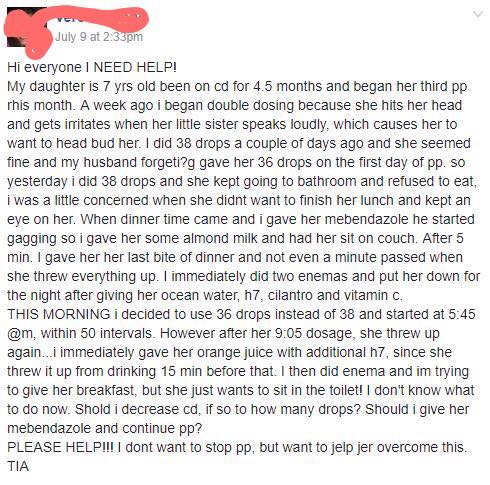
Yesterday I came across one of the most appalling examples of medical child abuse that I have ever read.

[pullquote align=”right” cite=”” link=”” color=”” class=”” size=””]Dosing an autistic child with bleach is the modern day equivalent of beating the demons out of her.[/pullquote]

Hi everyone I NEED HELP!

My daughter is 7 years old been on cd [chlorine dioxide: bleach] for 4.5 months and began her third pp [parasite protocol] this month. A week ago I began double dosing because she hits her head and gets irritated when her little sister speaks loudly, which causes her to want to head butt her.

I did 38 drops a couple of days ago and she seemed fine and my husband, forgetting, gave her 36 drops on the first day of pp. So yesterday I did 38 drops and she kept going to bathroom and refused to eat. I was a little concerned when she didn’t want to finish her lunch and kept and eye on her.

When dinner time came, I have her mebendazole [anti-parasite medication] she started gagging so I gave her some almond milk and had her sit on the couch. After 5 minutes I gave her her late bite of dinner and not eneve a minute passed when she threw everything up…

IMG_2975

Yes, this woman is dosing her autistic daughter with BLEACH. Why? Because a quack declared that autism is caused by parasites and that ingesting bleach and bleach enemas can kill those parasites. This was posted in a Facebook group that has thousands of members dedicated to treating autism with bleach.

You don’t need to be a physician to know that bleach is toxic and these parents are literally poisoning her daughter. This is the worst kind of medical child abuse imaginable and sadly her ignorant parents are abusing her not because they don’t care about her but because they do. They, like many people who lived before the existence of science, are laboring under pre-rational beliefs about health and illness. They are following in a long tradition of ascribing psychiatric and neurological illness to demons and seeking to drive the demons out. They’ve just dressed it up with the thinnest veneer of science, calling the demons parasites and poisoning the child to drive them out instead of beating her or burning her.

Human beings love stories. They tell stories to remember, stories to teach and stories to explain. Prior to the advent of science, there was often no way to explain illness — particularly neurological and psychiatric illnesses — and stories of demonic possession were often invoked. It seemed the perfect explanation for otherwise health individuals behaving in strange ways. Not surprisingly, since suffers were perceived to be invaded by demons, the “cure” involved driving demons out.

Such immature cognitive errors — ascribing disease to paranormal phenomena — are understandable in the absence of science, but, tragically, many people revert to these immature cognitive errors when confronting diseases for which the scientific explanation is still incomplete. Autism is such a disease and many parents are still in the grip of pre-rational beliefs about it.

Poisoning autistic children with bleach to drive out the parasites is only the worst of these pre-rational beliefs. Though vaccine-refusing and vaccine-hesitant parents boast that their “research” shows that vaccines cause autism, this is just another thin scientific veneer over the pre-rational belief that autistic children have been possessed by demons; in this case the demons are vaccines. And for some parents, driving out the demons involves spending vast amounts of money on useless “detoxing” treatments. Vaccine refusal and hesitancy aren’t the result of being educated; they’re the result of being superstitious.

Psychiatric and neurological illnesses like autism aren’t caused by demons — whether those demons are paranormal beings, parasites or vaccines — and therefore they can’t be treated by beating demons out of children or killing parasites and they can’t be prevented by refusing vaccines. Those practices are nothing more than medical abuse and neglect.

A feminist critique of breastfeeding promotion

Slut Walk Toronto 2012

I have been arguing for years that breastfeeding promotion in general, and the Baby Friendly Hospital Initiative (BFHI) in particular, are both paternalistic and deeply anti-feminist. A paper published last year in the journal Midwifery provides a similar feminist critique.

The paper is Infant feeding and maternal guilt: The application of a feminist phenomenological framework to guide clinician practices in breast feeding promotion. Unfortunately, it is jam packed with academic jargon, but if you can get past that it provides a compelling commentary on the biggest problems with contemporary breastfeeding promotion.

[pullquote align=”right” cite=”” link=”” color=”” class=”” size=””]Fed isn’t merely best; fed is feminist![/pullquote]

The authors are strong proponents of breastfeeding, but they are equally strong proponents of women’s rights. They provide a succinct explication of the problem:

Feminist scholars … propose that utilizing only medical evidence to promote ‘breast is best’ fails to recognize the experience of the mother and the social constraints that breast feeding imposes on personal and professional facets of a woman’s life. Thus, it is an example of the power used by health care pro- viders to reinforce ‘normative’ maternal behaviour.

For example, the Baby Friendly Hospital Iniative substitutes medical paternalism for maternal choice.

While the benefits of breast feeding are well recognized, examination of the way in which such breast feeding promotion programs are organized highlights the patriarchal nature of current health care practices. Although choosing to feed their infant artificial milk is a viable choice for mothers in developed nations, care providers do not communicate this message during the perinatal period. Therefore, it is evident that while mothers have a choice, there is a ‘best’ choice that is medically and socially defined by the health care system.

Indeed the BFHI is explicitly paternalistic. There is no effort to even pretend that mothers could or should have any say in how their infants are fed. Moreover providers are both muzzled and constrained in their actions by the BFHI’s Ten Steps. This is a clear ethical violation of medical autonomy.

Would it be ethical for a brain surgeon to avoid telling patients about the efficacy of radiation for the treatment of brain tumors just because he was convinced that surgery was “best”? No. Would it be ethical for an obstetrician to neglect to tell women about the risks of Cesarean section when recommending a C-section for a breech baby? Of course not. So how can it possibly be ethical to refuse to discuss the risks of breastfeeding and the benefits of formula feeding for some mothers in some situations? It can’t.

But the BFHI isn’t merely unethically paternalistic, it is deeply anti-feminist, treating women as breastmilk dispensers instead of persons.

While ‘breast is best’ is the language frequently used in broader health promotional initiatives and by care providers in recognizing the benefit of breast feeding, feminist scholars have identified that such a discourse disembodies the provision of milk from the maternal body experience of breast feeding… Such disembodiment acts to prevent a woman from experiencing her breasts as her own, but rather as a possession of her baby. By placing breast feeding focus on the biomedical and nutritional benefits of breast milk, as opposed to maternal experience associated with nursing her infant, health care providers are perpetuating the patriarchal conceptualization of the ‘good mother’ as one who is defined as selflessly giving by nursing her child while asking for nothing in return.

The BFHI doesn’t even try to hide this objectification of women, dubbing itself as “baby friendly” while ignoring mothers entirely.

The tendency of lactivists to objectify women as nothing more than a pair of breasts is reinforced by the absurd efforts of lactivists to divorce breasts from sexuality. The assumption is that breasts are sexualized by men and that women cannot and should not derive sexual pleasure from their breasts.

The division of breast feeding and sexuality further represents the social regulation of the female body, in that a woman can embrace her sexuality or the mothering role in breast feeding, but not both… ‘Good’ mothers are largely viewed as asexual, and the dissociation of providing breast milk and the embodied experience of breast feeding hinders women’s rights to experience pleasure in both breast feeding and her sexuality.

When apprised of the paternalism and sexism of breastfeeding promotion, lactivists offer a rejoinder that they think should shut down all discussion: But, but, but … ‘The Science.”

The science, of course, is hardly definitive. Most of the evidence is weak, conflicting and riddled with confounding variables like maternal education and socioeconomic status. As a fantastic piece in Quartz, The class dynamics of breastfeeding in the United States of America, notes:

“Breast is best” has not always been the mantra of the upper classes in the US. While the cultural definition of the “best” food for babies has fluctuated over the last century between infant formula and breast milk, one thing has remained constant: the most socially desirable form of infant nutrition has been whichever is harder for poor parents to access.

Breastfeeding has become normative NOT because science shows that it is far better than bottle feeding, but because it has become the preferred choice of the upper classes. Breastfeeding promotion has become an exercise in race based and class based paternalism with lactivists (almost always Western, white, well off women) ritually bemoaning the “irresponsible” behavior of their brown and/or poor sisters.

What might a non-paternalistic, feminist approach to breastfeeding support look like?

In caring for families in maternal child settings, clinicians must provide care that balances optimal infant nutritional needs with the psychological needs of the mother. Breast feeding promotion as it is currently practiced oppresses maternal choice and voice in infant feeding decisions … In light of this, it is critical that the traditional hierarchical relationship that is employed by nurses and other health care providers when providing breast feeding education and support is shifted to a collaborative partnership between the woman and care provider…

Imagine that, an approach to breastfeeding support that respects the autonomy, agency and worth of women!

…[A] philosophy of care in which maternal embodied experiences of breasts and breast feeding are prioritized would serve to reduce guilt by recognizing and attending to women’s needs and lived experiences in establishing the breast feeding relationship. Validation of such practices with women and gender diverse peoples in the perinatal period would serve to further advance understanding of ways by which to promote breast feeding without instilling maternal guilt.

That’s because fed isn’t merely best for babies; fed is feminist.

Dr. Amy