Kate Tietje and the 7 signs of an anti-vax quack

Measles word cloud

Kate Tietje, who writes under the nom de quack Modern Alternative Mama, professes herself shocked by the outcry to the execrable piece Five Reason Measles Is Better Than Autism, her “most controversial post of all time.”

Yesterday I wrote about the factual errors and neuro-bigotry in the piece (WTF, Kate Tietje?). Today I’d like to show how Kate’s response illustrates the 7 cardinal signs of an anti-vax quack.

[pullquote align=”right” cite=”” link=”” color=”” class=”” size=””]”If you agree, join me. If you don’t…leave quietly.”[/pullquote]

1. Striking contempt for basic knowledge

Since Tietje believes herself qualified to opine on vaccine safety, you might imagine that she would have formal education in immunology, science and statistics. You would be wrong.

Kate, like most anti-vaxxers is a walking, talking illustration of the Dunning-Kruger effect. That’s the paradox that those who know the least actually believe they know the most. She is so lacking in basic knowledge that she is literally incapable of realizing just how ignorant she is about the topic.

2. Fact resistance

Kate isn’t merely evidence resistant; she is fact resistant. It doesn’t matter what the World Health Organization, Centers for Disease Control or anyone else tells her about the fact that the association between autism and the MMR (measles, mumps and rubella) vaccine has been thoroughly debunked by a plethora of studies, nor that the seminal study “proving” the association was fabricated by Andrew Wakefield in an effort to promote the profitability of own version of the vaccine that was in development at the time. [Correction: Edited to remove an erroneous claim that I made about measles death rates].

3. Embrace of blatant lying

In regard to the piece, Kate claims:

It was written because of all of the people who have said, “I’d rather my children have autism than die of the measles.” That’s an unfair and wrong comparison, that blow measles way out of proportion. Death rates from measles are quite low in developed countries.

Since the measles vaccine DOESN’T cause autism, no one is claiming that they’d rather have their children get autism than measles.

4. Privileging intuition over facts

Kate believes that vaccines cause autism because that’s what her intuition tells her, facts be damned.

5. Outsourcing blame

As the population has fallen prey more and more to autoimmune disorders, chronic illness, and disability, they’ve been told, “It’s just a new variation of normal! It’s genetic! There’s nothing you can do! Accept it and love it!”

There’s no denying this is happening. There’s no denying that rates of allergies, autism, autoimmune disorders, learning disabilities, obesity, and more are rising exponentially. But if the powers-that-be redefine all of these things as “normal,” then no one has to answer for it or do anything about it.

For every untoward occurrence, Tietje never thinks to ask, “What went wrong?” Instead she demands to know: “Who did this to us?”

The fault always lies with a conspiracy, in the case of vaccines a conspiracy so large as to encompasses nearly every scientist, doctor, and public health official in the entire world.

The truth is, that post hit people hard, in their core belief systems. These people believe the lies that the doctors and pharmaceutical companies have sold them. It isn’t their fault. Basically, they’ve been “gas-lighted.”

That’s not what gas-lighting means. According to Wikipedia:

Gaslighting … is a form of psychological abuse in which a victim is manipulated into doubting their own memory, perception, and sanity.

Gaslighting involves empirical facts, NOT feelings. Gaslighting means insisting that the lights are bright when they are actually dim. Giving greater weight to scientific evidence than the perceptions of the scientifically illiterate is not gaslighting; it’s SCIENCE.

6. Desperation for adulation and self esteem

For Tietje, like most anti-vaxxers, it has precious little to do with vaccines or with children.  She view the combination of self-education and defiance of authority as an empowering form of rugged individualism, marking out her own superiority from the pathetic “sheeple” who aren’t self-educated and who do follow authority.

I feel sorry for all of these people. These children deserve *better.* I want them, and all children, to be the best versions of themselves…

I know that there are possibilities to achieve health, to really HELP people, that exist outside of what the mainstream says is possible. They deny it angrily, they call it magical thinking. Yet I’ve seen it work…over and over.

7. Isolation is critical to self-regard

If you agree, join me. If you don’t…leave quietly.

Kate can’t be bothered to convince anyone who disagrees because she cannot tolerate anyone who does not praise her. She spent yesterday banning and deleting anyone who dared to present scientific evidence because she cannot abide proof that she isn’t knowledgeable, uniquely insightful and special.

Kate Tietje is merely ignorant and deluded; she’s hoping against hope that by wiping away real scientific evidence she can prevent her gullible followers from realizing it.

WTF, Kate Tietje? Five reasons measles is better than autism?

http://dl.dropbox.com/s/411sgflctjdsm6b/Mob_s.jpg

I learned a new word today: neuro-bigotry.

Neuro-bigotry is prejudice against people on the autism spectrum based on the idea that they are less worthy of moral regard than everyone else.

Who taught me the new term? None other than neuro-bigot Kate Tieje whose nom de quack is Modern Alternative Mama.

[pullquote align=”right” cite=”” link=”” color=”” class=”” size=””]Suggesting that the risk of brain damage or death from measles is preferable to having a child on the spectrum is neuro-bigotry.[/pullquote]

Kate posted the mind boggling piece Five Reasons Measles is Better than Autism. There’s been such a firestorm of protest that Kate cannot ban and delete people fast enough from her Facebook page. But she is desperately trying to defend the post despite the fact that it is scientifically illiterate and startlingly prejudiced against those on the spectrum.

Here’s the Facebook version of the post:

image

**New Post** Enough with the fear-mongering, let’s be honest: measles is better than autism. We have five reasons why the disease is preferred over the vaccine…

The actual post is a festival of stupidity. Just about every scientific “fact” is at best cherry picking and at worst a bald faced lie. And that’s not even the worst part of the post.

The worst part is this:

When a child gets autism? There’s no easy bouncing back. A bowl of chicken soup ain’t gonna solve this problem (though soup can help to heal autism).

Autism results in long-term neurological damage with can affect a child for lifetime, though there are children who recover through the hard work of their warrior mamas! Indeed, many studies … have found that gut health has a profound impact on the behaviors of those on the autism spectrum, and interventions such as diet and probiotic supplementation may be helpful.

I have an adult child on the spectrum. He is not neurologically damaged. He’s a highly successful, productive member of society with a degree from an Ivy League college, a wife and a high paying job.

Wait! They’re not talking about people like my son?

And before you cry for acceptance of neurodiversity, keep in mind, I’m referring to children with severe, regressive cases of autism, not those that are high-functioning and more self-sufficient.

But the majority (up to 75%) of people on the spectrum DON’T have severe, regressive autism.

What about measles?

You know what’s not a big deal? Measles. Did you know that according to this CDC document (page 85), between 1950 and 1960, there was less than 1 death per 100,000 in the US, which is 0.00001%, or about 1 in 100,000.

But that’s about 1 death per 1,000 reported cases, not a trivial number. [Correction: Edited to make clear the difference between death rate per population and death rate per reported cases.]

According to Measles Elimination in the United States published the Journal of Infectious Diseases in 2004:

From 1956 to 1960, an average of 450 measles-related deaths were reported each year (∼1 death/ 1000 reported cases), compared with an average of 5300 measles-related deaths during 1912–1916 (26 deaths/ 1000 reported cases). Nevertheless, in the late 1950s, serious complications due to measles remained frequent and costly. As a result of measles virus infections, an average of 150,000 patients had respiratory complications and 4000 patients had encephalitis each year; the latter was associated with a high risk of neurological sequelae and death. These complications and others resulted in an estimated 48,000 persons with measles being hospitalized every year.

Measles was a very big deal indeed.

The blog post postulates that the autism is so debilitating that risking the very real chance of hospitalization, neurological damage and death from measles is better.

Many parents of autistic children posted on Facebook profoundly disagreeing with Tietje; she has deleted most of their comments and banned them.

She tries to defend herself.

image

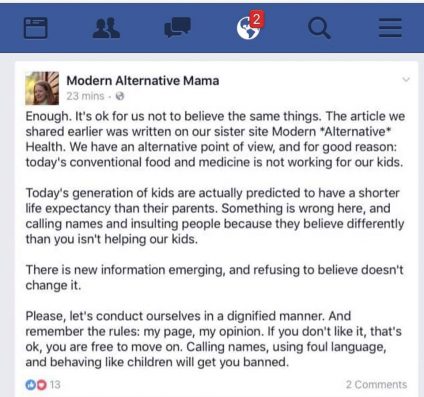
Enough. It’s ok for us not to believe the same things. The article we shared earlier was written on our sister site Modern *Alternative* Health. We have an alternative point of view, and for good reason: today’s conventional food and medicine is not working for our kids.

Today’s generation of kids are actually predicted to have a shorter life expectancy than their parents. Something is wrong here, and calling names and insulting people because they believe differently than you isn’t helping our kids.

There is new information emerging, and refusing to believe doesn’t change it.

Please, let’s conduct ourselves in a dignified manner. And remember the rules: my page, my opinion. If you don’t like it, that’s ok, you are free to move on. Calling names, using foul language, and behaving like children will get you banned.

And:

image

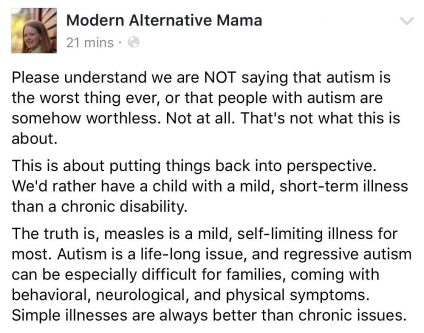
Please understand we are NOT saying that autism is the worst thing ever, or that people with autism are somehow worthless. Not at all. That’s not what this is about.

This is about putting things back into perspective. We’d rather have a child with a mild, short-term illness than a chronic disability.

The truth is, measles is a mild, self-limiting illness for most. Autism is a life-long issue, and regressive autism can be especially difficult for families, coming with behavioral, neurological, and physical symptoms. Simple illnesses are always better than chronic issues.

Of course that misses critical points:

Vaccines DON’T cause autism
Most people on the spectrum DON’T have severe regressive autism
Neurological injury or death from measles is WORSE than being on the spectrum

The most fundamental point is this:

Mothers don’t get to choose between measles and autism. They can choose to protect their children from measles but they CAN’T prevent autism, no matter how much they wish they could. Autism is almost certainly genetic. That means it’s no one’s fault so leaving your child exposed to death from measles in an effort to prevent autism is deadly nonsense.

And suggesting that the risk of brain damage or death from measles is preferable to having a child on the spectrum is neuro-bigotry.

What’s the difference between skeptics and denialists?

Crumpled colorful paper notes with words "Wrong", "Right" and question marks.

Why are those who battle pseudoscience called skeptics?

It’s not because they are skeptical in the colloquial sense. Rather, the term refers to the philosophy of skepticism. It’s an approach to knowledge that requires that claims be well supported by evidence.

According to Wikipedia:

[pullquote align=”right” cite=”” link=”” color=”” class=”” size=””]Skeptics won’t believe without evidence; denialists won’t believe evidence.[/pullquote]

In philosophy, skepticism refers more specifically to any one of several propositions. These include propositions about:

(a) an inquiry,
(b) a method of obtaining knowledge through systematic doubt and continual testing,
(c) the arbitrariness, relativity, or subjectivity of moral values,
(d) the limitations of knowledge,
(e) a method of intellectual caution and suspended judgment.

Are people who are skeptical of scientific consensus on issues like vaccines and evolution entitled to be called skeptics? No, they’re denialists as Andrew Dart explains in an chapter from Building your Skeptical Toolkit:

… [T]here are a lot of people who like to call themselves skeptics but who it can be strongly argued are anything but. There’s HIV/AIDS skeptics, global warming skeptics, moon landing skeptics, evolution skeptics, holocaust skeptics, 9/11 skeptics and vaccination skeptics, to name but a few. But while there may be some people who would use these labels who could legitimately be described as skeptics the vast majority of them are not practicing skepticism at all, but rather skepticism’s evil twin, denialism.

What’s the difference between skeptics and denialists?

Denialism … is driven by ideology rather than evidence. Now denialists may claim they care about the evidence and will happily display any that supports their point of view, but in most cases they reject far more evidence than they accept. Furthermore, denialists will cling to evidence no matter how many times they have been shown that it is flawed, incorrect or that it does not support their conclusions; the same old arguments just come up again and again. Denialism also tends to focus on trying to generate a controversy surrounding the subject at hand, often in the public rather than scientific arena, and does so more often than not by denying that a scientific consensus on the matter even exists.

It’s easy to see how anti-vaccine parents and creationists are denialists. Though it isn’t as obvious, natural childbirth and homebirth advocates are denialists, too. They deny the scientific consensus of modern obstetrics. And natural childbirth and homebirth advocates share key attitudes with anti-vaxxers, creationists and other denialists.

1. Denialists love of conspiracy theories.

As Dart explains:

So the vast majority of the scientific community and an overwhelming mountain of evidence is aligned against you, what are you going to do? Well you could always claim that there is a conspiracy to supress the truth and that the scientists working in the field are engaged in a complex cover up for some bizarre and often undefined reason…

Anti-vaxxers are blunt about their favorite conspiracy: Big Pharma is in cahoots with Big Medicine to make money from useless and/or harmful vaccines.

Natural childbirth and homebirth advocates do include some blunt conspiracy theories like the idea that C-sections occur because obstetricians want to get to their golf games, but professional natural childbirth and homebirth advocates are more subtle. They assert an acculturation conspiracy, whereby doctors are “socialized” to participate in the conspiracy to foist harmful/scientifically unsubstantiated practices on women.

Most scientists are viewed as simply towing the party line and it is assumed that none of them ever comes to their own conclusions based upon the evidence; they just believe what they are told to believe. As for the peer review process, well that is just a tool of the conspiracy to make sure that only those papers that agree with the conspirator’s message get published.

Conspiracy theories, whether blunt or subtle are nothing more than evasions.

These conspiracy theories never attempt to actually address the evidence; rather they seek to dismiss it entirely as a fabrication of unseen forces. Furthermore no explanation as to how a conspiracy so vast that it encompasses every scientist in a given field, as well as every student studying to become a scientist in that field, can maintain itself without someone blowing the whistle is ever given, and reasons why the conspiracies exist in the first place are equally rare and incoherent.

2. Denialists love fake experts.

Fake experts are defined as people who claim to be experts in a given field but whose opinions differ greatly from the consensus of scientists working in that field and from established knowledge…

Only in the world of anti-vax and alternative health can actresses and other public figures without medical training be considered experts.

3. Denialists love cherry-picking.

Cherry picking is the act of selecting papers and evidence that seem to support your point of view, whilst at the same time ignoring the far greater body of evidence that goes against
your position.

Anti-vaxxers, like most advocates of alternative health, make cherry-picking even easier than usual since they don’t even bother to read the articles they cite.

4. Denialists love impossible expectations

Hence the insistence by anti-vaxxers that we don’t know if vaccines are effective if we don’t have a randomized controlled trial of vaccines vs. placebo, an experiment that would be unethical.

5. Denialists love logical fallacies.

I’ve written extensively about the logical fallacies favored by natural childbirth and homebirth advocates including the argument from ignorance, and the fallacy of the lonely fact.

Dart’s conclusion is one that anyone who cares about scientific integrity should keep in mind:

It is not the topic that makes someone a skeptic or a denier, it is how they handle evidence that contradicts their pre-existing beliefs. Do they resort to claiming there is a conspiracy to suppress the truth in order to explain why the evidence is against them? Are the people presenting the argument actually experts in the topic at hand? Do they cherry pick the data and only present those findings that agree with them? And do they constantly move the goalposts and make use of logical fallacies in defense of their claims? If you keep a look out for these five things then you should have a good idea whether you are dealing with a genuine skeptic or a closed minded denier.

How can lay people tell the difference between skeptics and denialists? The best way is to master the scientific literature of the topic under discussion. Then you will understand what the preponderance of the scientific evidence shows and you will recognize cherry picking. You can also read up about logical fallacies since those are often employed in defense of pseudoscience.

But there’s an easier way. As Dart notes, denialists can’t handle evidence that contradicts their pre-existing beliefs. That’s why denialist websites, message board and Facebook pages delete scientific evidence that does not support their claims and ban anyone who posts such evidence. They create echo chambers where they will never be forced to address dissent. They resort to elaborate and nonsensical conspiracy theories to promote claims that have been repeatedly disproven. If you find yourself on such a website, message board or Facebook page, you can be sure they are peddling pseudoscience.

Simply put:

Skeptics won’t believe without evidence; denialists won’t believe evidence.

What Donald Trump and anti-vaxxers have in common

image

I’ve seen the speculation that Donald Trump is purposely trying to lose the presidential election.

The thinking seems to be that no one would purposely be so contemptuous of the truth, so offensive and so outrageous if they wanted to win. Surely Trump can see that he has reached the ceiling of his support and he has to broaden his message to sway those who are undecided.

[pullquote align=”right” cite=”” link=”” color=”” class=”” size=””]For Donald Trump, as for anti-vaxxers, facts take a back seat to ego.[/pullquote]

But Trump wants to win. How do I know? His quixotic approach to the election seems remarkably familiar to me. I’ve been battling such tactics for years; they are the same tactics as the anti-vaxxers and for the same reasons. In both cases the fundamental issue is adulation and self-esteem.

Consider:

1. Both have a striking contempt for basic knowledge

You might imagine that Trump would find it needful to educate himself about American history, American government, the Constitution, foreign relations and a myriad of other important topics to make it clear that he is qualified to become president. You would be wrong.

Similarly, you might imagine that anti-vaxxers would find it needful to educate themselves about immunology, virology and statistics to make it clear that they are qualified to opine about vaccines. You would also be wrong.

Why? Because both Trump and anti-vaxxers are walking, talking illustrations of the Dunning-Kruger effect. That’s the paradox that those who know the least actually believe they know the most. They are so lacking in basic knowledge that they are incapable of realizing that they are lacking in basic knowledge.

2. Both are fact resistant

Both Trump and anti-vaxxers aren’t merely evidence resistant; they are fact resistant. However, a good portion of what appears to be blatant lying by Trump or anti-vaxxers is more properly described as “bullshitting.” To lie, one must be aware of the truth; bullshitting, in contrast, is a form of arrogant ignorance. Trump and anti-vaxxers often have no knowledge of a particular issue. Rather than acknowledge that (or correct it), they issue streams of blather meant to dazzle equally ignorant listeners.

3. Both embrace blatant lying when is suits them

They do lie, or course, in addition to bullshitting. Trump is a pathological liar. He proclaims what he wishes were true, even when he knows it isn’t (e.g. the invocation of a non-existent aide with a brand new Twitter account) to blame for Melania’s plagiarism of Michelle Obama’s speech. Anti-vaxxers, particularly professional anti-vaxxers, lie when convenient (e.g. pretending polio was disappearing long before the advent of the polio vaccine).

4. Both give primacy to feelings (gut, intuition) over facts

Though neither Trump nor anti-vaxxers are cognizant of the fact, they are the ultimate post-modernists, believing that reality is radically subjective. For them, reality is what they feel, and has nothing to do with an objective evaluation. It literally does not matter to them what the facts are; they believe that “listening to their gut (or intuition if you prefer) provides better “facts” than any expert or textbook.

5. Both outsource blame

Both Trump and anti-vaxxers are always sure that it is somebody else’s fault. If it’s bad, it’s not their responsibility. It’s always the responsibility of the elites or the despised (sometimes both). For every untoward occurrence (whether that is stagnation of blue collar wages or a child’s autism), neither Trump nor anti-vaxxers ever ask, “What went wrong?” Instead they faithfully resort to a different formulation: “Who did this to us?”

6. Both are desperate for adulation and self-esteem

Trump entered the presidential race for the same reason he does anything; as a narcissist he has a hunger for adulation that can never be assuaged. It is enough for him that he can bask in the glow of carefully vetted crowds of supporters. That is far more immediate and real to him than the majority of people who view him with contempt.

Anti-vax advocacy has precious little to do with vaccines or with children. The combination of self-education and defiance of authority is viewed by anti-vax parents as an empowering form of rugged individualism, marking out their own superiority from the pathetic “sheeple” who aren’t self-educated and who do follow authority. Anti-vaxxers congregate on websites and in Facebook groups that validate this distorted view of themselves.

7. Their isolation is the key to their self-regard

Trump is obsessed with his supporters because they temporarily fill the maw of his narcissistic hunger. He can’t bother to convince anyone who disagrees because he cannot tolerate anyone who does not praise him. Anti-vaxxers carefully curate their online spaces, banning and deleting anyone who dares to present science that does not support them because they can’t tolerate the idea that they aren’t knowledgeable, uniquely insightful and special; they’re simply ignorant and deluded.

Anti-vaxxers want to convince everyone that they are correct but since they cannot abide anything or anyone that does not satisfy their desperate need for self-regard, they make little headway with the majority of people who disagree with them because they can’t tolerate engaging with them.

Similarly, Donald Trump wants to be president. But since he cannot suffer anything or anyone who does not satisfy his desperate need for adulation, he can’t make any headway with the majority of people who disagree with him. At this point, he isn’t even trying; he just doubles down on the prevarication, bigotry and outrageousness that so delights his core supporters.

Donald Trump is not trying to lose this election. He would like to be president, but that desire is utterly dwarfed by his desperate need to be praised.

Balance your evil humors the Food Babe Way!

image

For hundreds of years medical practitioners were obsessed with “evil humors.”

What are evil humors?

Humoral theory, also known as humorism or the theory of the four humours, was a model for the workings of the human body. It was systemised in Ancient Greece, although its origins may go back further still. The theory was central to the teachings of Hippocrates and Galen and it became the dominant theory in Europe for many centuries. It remained a major influence on medical practice and teaching until well into the 1800s.

[pullquote align=”right” cite=”” link=”” color=”” class=”” size=””]Detoxing is the new bloodletting.[/pullquote]

Evil humors were believed to be invisible. They constantly threatened people, and those people had no way of fending off the threat. Indeed, they were often completely unaware of the threat that was actively harming them. Practioners hypothesized that illness was the physical manifestation of evil humors that were out of balance.

Therefore:

The treatments for disease within humoral theory were concerned with restoring balance. These could be relatively benign and focused on changes in dietary habits, exercise and herbal medicines. But other treatments could involve more aggressive attempts to re-establish balance. As well as having the body purged with laxatives and emetics, or the skin blistered with hot iron, individuals already weakened by disease might be subjected to bloodletting because practitioners mistakenly believed that their bodies contained an excess of blood.

The theory of evil humors was thoroughly discredited centuries ago, but health quacks like Vani Hari, The Food Babe, continued to use them as the basis of their health advice. Vani doesn’t call them “evil humors” thought she calls them “toxins,” but the resemblance is unmistakable. They are invisible, constantly threatening people and supposedly, most people are unaware of the threat.

Since toxins are evil humors, Vani offers the modern day equivalent of treatments designed to restore balance. Chief among them are “de-toxifying” foods, drinks, enemas and cleanses.

Apparently someone pointed out to Vani that the body has two organ systems designed specifically to handle toxins, the liver and the kidneys. There is no need to anyone to use de-toxifying treatments because blood flowing through the liver and kidneys ARE de-toxifying treatments.

When the evil humors theory of disease was discredited, it’s purveyors were recognized as laughingstocks and were forced out of business. If the toxins theory of disease is discredited, Vani will be recognized as the laughingstock that she is and forced out of business.

She’s not taking it lying down.

Hence Vani’s latest post Does Your Body Cleanse Itself? Is Detoxing Really A Myth?

The scientific answers are yes and yes. Your body cleanses itself and detoxing is a myth.

But not according to Vani:

But what if I didn’t do anything to change my diet? What if I just believed the “experts” who said your body “detoxes naturally” – and there’s nothing you can do to make it detox any faster or better. What if I just listened to their advice and trusted that my body was going to be able to continue to detox itself just fine from all the soda, fast food and candy I was eating filled with a slew of controversial synthetic additives, pesticides and plasticizer chemicals from the packaging material – not to mention the daily exposure of suspect chemicals in water, air and the environment I was being exposed to … ?

Toxins are invisible … just like evil humors!

One thing is clear, we might not be able to see toxins, but they are there!

They’re everywhere … just like evil humors!

Many of them come from pesticide-sprayed food, farmed fish, and food packaging materials. Besides the food we eat, everyday items like shampoo, household cleaners, plastic bottles, clothing, furniture, water, and even the air we breathe are all possible sources of toxin exposure. It has been estimated that the average person could be harboring about 500 synthetic chemicals in their bodies, and one study found that unborn babies had over 200 toxins in their umbilical cord blood – this amount of toxins is no joke!

Your body can’t handle them … just like evil humors!

The problem is that your body can’t easily eliminate many of these toxins or break them down. They get stored in places like fat tissue and eventually make their way through your bloodstream and invade your brain, lungs, heart, eyes, stomach, liver, and sexual organs.

But don’t worry. You can treat them with special foods, laxatives and cleanses … just like evil humors!

For people who didn’t understand physiology, biochemistry and pathology, evil humors as a cause of illness made a lot of sense. They thought that people got sick because they couldn’t properly handle their humors. For people like Vani who don’t understand physiology, biochemistry and pathology, toxins as a cause of illness makes a lot of sense. She thinks people get sick because they can’t handle toxins.

Medical practitioners who worked prior to the advent of modern medicine were ignorant, but they were doing the best they could with the information they had available. Vani Hari is ignorant, but she has no excuse. The truth about human physiology is available to anyone who chooses to learn it.

Detoxing is the new bloodletting. Only a fool would think it prevents or treats illness.


If anti-vaxxers are allowed to avoid vaccines, shouldn’t the rest of us be allowed to avoid anti-vaxxers?

image

California anti-vax parents are having a tough week. Senate Bill 277 went into effect on July 1, barring unvaccinated children from public schools unless they have a medical exemption. Personal belief exemptions will no longer be allowed.

According to The Sacramento Bee, Scores of students without vaccine proof sent home on first day of school:

[pullquote align=”right” cite=”” link=”” color=”” class=”” size=””]Surely, if liberty is good for thee, it is equally good for me.[/pullquote]

In the Folsom Cordova Unified School District, 145 students out of about 3,200 starting kindergarten and seventh grade were sent home Tuesday on the first day of school for lack of immunization records …

A new state law that took effect July 1 eliminated personal- and religious-belief exemptions for families that opted to avoid vaccinations for their children. Under the new law, students entering the two checkpoint years of kindergarten and seventh grade are now required to show proof of vaccination…

Anti-vaxxers are appalled. It’s an issue of freedom! According to the Foundation for Economic Freedom, Mandatory Vaccinations Are Incompatible with Liberty.

Mandatory vaccinations involve a supreme violation of liberty, where agents of the state inject substances into someone’s body against his or her will. On the other side of the ledger, even in principle, mandatory vaccinations do not offer much benefit in enhanced public welfare, relative to a free society. When we throw in the realistic worries of government incompetence and malfeasance, the case against mandatory vaccinations is overwhelming.

And according to No on SB277, which opposed passage of the bill:

SB 277 eliminates a parent’s right to exempt their children from one, some, or all vaccines, a risk-laden medical procedure including death. In 2016, California parents will be forced to give their children more than 40 doses of 10 federally recommended vaccines. This open-ended vaccine mandate allows the State of California to add any additional vaccines they deem necessary at anytime. The only exemption available is a medical exemption that doctors deny to 99.99 percent of children under federal guidelines.

During their campaign opposing passage of the bill, they articulated a fundamental principle:

Where there is a risk of injury or death, no matter how small the perceived risk may be, there must be a choice.

I, too, am big believer in liberty. So anti-vaxxers, help me out. There’s something I don’t understand.

If you believe that you should be able to avoid vaccinating your children because you consider vaccines dangerous, shouldn’t everyone else in California be able avoid your unvaccinated children because they consider them dangerous?

Children who haven’t been vaccinated pose a risk because they can carry and spread vaccine preventable diseases.

How big a risk? That doesn’t matter, right? If it doesn’t matter how small the perceived risk of vaccines must be in order for you to refuse then, it shouldn’t matter how small the risk your unvaccinated children pose to their classmates, right. You insist there must be a choice.

The beauty of SB277 is that it allows you to exercise your right to protect your children from vaccines no matter how small the perceived risk may be and it allows the rest of us to exercise our right to ban your children from schools no matter how small the perceived risk may be.

Wait, what? You disagree??

Families that do not comply with the one-size-fits-all vaccine mandate, will lose their State Constitutional right for a free and appropriate education in public and private K-12 schools. The use of licensed daycare facilities, in-home daycare, public or private preschools and even after school care programs are also included in SB 277.

Duh! That’s the whole point of SB277. Since education is compulsory, without SB277 parents are forced to expose their children to the health threat of your unvaccinated children.

Any attempt by anti-vaxxers to force our children to be exposed to unvaccinated children is a violation of our liberty, right?

And surely, if liberty is good for thee, it is equally good for me.

Vitamin K: Do we have an ethical obligation to babies whose parents suffer healthcare delusions?

distraught looking conspiracy believer in suit with aluminum foil head isolated on white background

Vitamin K refusal is in the news again.

According to WBUR:

The baby was born full-term and healthy, but now, just a few weeks later, lay limp and unresponsive, barely breathing…

“The baby was diagnosed with bleeding in the brain,” said Dr. Ivana Culic, a neonatologist …

… The parents of the baby had refused the standard shot of Vitamin K that would almost certainly have prevented that bleed.

Tragedies like these raise a thorny ethical issue: how do we protect children whose parents suffer from healthcare delusions?

[pullquote align=”right” cite=”” link=”” color=”” class=”” size=””]You can’t take your baby home without a car seat; you shouldn’t be allowed to take your baby home without a vitamin K shot.[/pullquote]

Why is Vitamin K important?

Infants are vulnerable to a condition known as hemorrhagic disease of the newborn. The cause is deficiency of Vitamin K, an important component of the cascade of reactions needed for proper blood clotting.

As explained in this Medscape article:

Classic vitamin K deficiency bleeding usually occurs after 24 hours and as late as the first week of life. Classic vitamin K deficiency bleeding is observed in infants who have not received prophylactic vitamin K at birth.

The incidence of classic vitamin K deficiency bleeding ranges from 0.25-1.7 cases per 100 births…

Infants who have classic vitamin K deficiency bleeding are often ill, have delayed feeding, or both. Bleeding commonly occurs in the umbilicus, GI tract (ie, melena), skin, nose, surgical sites (ie, circumcision), and, uncommonly, in the brain.

There are approximately 4 million infants born in the US each year. In the absence of prophylactic Vitamin K shots routinely given to newborns, we would expect anywhere from 10,000 – 65,000+ cases per year. Routine vitamin K shots are literally life saving.

Sadly, some US parents embrace the fashionable delusion that vitamin K injections are harmful. It is their babies who suffer major GI and brain bleeds and the permanent injuries and deaths that go along with them.

Consider Baby Olive. Olive had been normal at birth and for the first few days afterward. Then her mother noted that she was lethargic. She immediately took Olive to the emergency room.

The next thing I knew I was sitting in a room with Eric and our Bishop from church, and seeing the doctor wheel in a computer with pictures on the screen… Just by looking, you could tell it wasn’t good. Where the left side of her brain was supposed to be, there was a huge (16 mm, to be exact) mass of blood, pushing her entire brain off center.

Dr. M. explain that a clot had developed which was placing immense pressure on Olive’s brain. Not only that, but there was bleeding on the back of the right side of her brain as well. The water pockets that are within the brain were completely destroyed, and the tissue on the left side of the brain looked mostly damaged. He said that the lack of Vitamin K in Olive’s system resulted in her body’s inability to clot. Anything as small as putting her down in her bed could have caused this bleed. Since she couldn’t clot, the bleeding didn’t stop. There had been one other case of this that the doctor had seen – I asked what had happened then, and was told that the baby hadn’t lived.

Olive was treated with vitamin K to restore the ability of her blood to clot and underwent brain surgery to evacuate the blood in her head; she made an excellent recovery. The entire disaster could have been avoided had Olive simply received vitamin K at birth.

As a general matter, we give parents wide latitude in determining the care and best interests of their children; we should! The freedom to raise your children as you wish is a critical freedom. But I would argue that we also have ethical obligations to babies like Olive whose parents embrace fashionable healthcare delusions.

Parents are free to risk their own lives by informed refusal of recommended medical care, but they don’t have the right to risk their children’s lives. Parents who refuse to seek medical treatment for deadly conditions like diabetes are (appropriately) charged with medical neglect. It doesn’t matter whether the parental delusion is that diabetes can be cured by prayer, or alternative health, or simply watchful waiting. Parents are both ethically and legally obligated to make sure the child receives medical treatment.

How about prophylactic care?

We have no problem mandating car seats when babies travel in automobiles regardless of whether parents think that car seats are helpful or harmful. You can’t take your baby home from the hospital in a car unless you have an approved car seat.

Similarly, we should mandate prophylactic vitamin K shots regardless of what parents believe about them. The facts are clear. Hemorrhagic disease of the newborn is a real threat to babies’ health and vitamin K prevents it; the benefits of vitamin K outstrip any possible risks. You shouldn’t be allowed to take your baby home from the hospital unless that baby has received a prophylactic vitamin K shot.

Parents are free to hold whatever healthcare delusions they choose, but they ought not to be free to risk their babies’ lives in service of their delusions.

What’s our ethical responsibility if a stranger’s baby might be dying?

Decision at a crossroad - Right or Wrong

Someone just asked me the following question on Facebook.

If you had an interview where you stated you don’t even care about your own births, they have “no bearing on your life”… then why do you have to be up someones vagina the minute a fucking baby pops out of THEIR crotch?

image

What prompted that expostulation?

[pullquote align=”right” cite=”” link=”” color=”” class=”” size=””]The issue is medical neglect.[/pullquote]

Yesterday I was sent this photo:

image

The caption reads:

Baby born unassisted tonight. Slow recovery but I’m curious about the cord. My others didn’t look like this, they just turned white. This was candy cane striped for more than an hour after her birth. We cut it and she seemed fine.

It was an apt description. A “candy cane” cord can be associated with severe infection.

As I wrote on my Facebook page:

This baby needs to be seen in the emergency room immediately. A baby can have a life threatening infection without showing any symptoms until it collapses and dies.

If anyone is a member of this group, could they please pass along this information. The mother is planning to take her baby to the pediatrician tomorrow. The baby could be dead long before that.

Obviously, it’s impossible for me (or anyone) to make a diagnosis from a picture, but the picture is sufficiently unusual and the consequences so dire that someone needs to tell the mother.

As I had hoped, the mother learned what I had written. What did she do?

She took herself to the hospital because she had fainted repeatedly, apparently due to excessive blood loss, but, by her own admission:

I did not tell them we had concerns about the baby.

In an effort to justify hiding the truth about the baby, she noted:

Her temperature, color and breathing have remained good (although she is quite grunty and seems to have a lot of birth gook in her nose and throat, congestion sounds)… [W]e’re going to watch her closely for signs of infection and take her to see a doctor on Monday…

But signs of infection in a newborn can be extremely subtle. Newborns with serious infections do not have the same symptoms as toddlers and older children. They may have no fever or even a lower than normal body temperature. Grunting can be a subtle sign of infection. A baby grunts because she is having trouble keeping her airway open. Grunting may be the only sign of a life threatening infection. Everything else might seem fine until the baby has a cardio-respiratory arrest and dies.

The mother appeared on my Facebook page in order to defend herself (she has since deleted her comments), and, of course, her friends swooped in to tell me to mind my own business. As usual, I was accused of being mean to the mother. The issue, according to the mothers defenders, is that I had publicly shamed her. Curiously no one seemed to be the least bit concerned about the health of the baby.

Why did I make a public plea? For two reasons: 1. It was the only I way I could be sure that she would see it; 2. The mother publicly solicited advice about the umbilical cord and I wanted to inform as many people as possible about what it could mean.

The mother is embarrassed? I should hope so. She’s committing medical neglect. Sure, the baby might be perfectly fine, but this is like the case of the Canadian couple who let their toddler die of meningitis. They were told the baby might have meningitis, but instead of getting it checked out by a medical professional, they waited until he was in extremis and then it was too late.

The issue here is medical neglect. The mother has no fear of hospitals; she took herself to the hospital because she doesn’t feel well. She was warned that the baby could be very sick DESPITE the fact that she looks fine. I can imagine many reasons why the mother does not want to have any contact with the hospital (all having to do with protecting herself), but I’m struggling to imagine any reason why getting the baby checked by a pediatrician could have any downside for the baby.

So what, if any, are the ethical obligations of bystanders? If we see a child who may be seriously ill or even dying, and a parent who doesn’t seem to understand the seriousness of the situation, do we have an ethical obligation to let her know? And what if we let her know about the risks and she chooses to ignore them? Do we have an ethical obligation to attempt to change her mind? Do we have an ethical obligation to inform child protection authorities?

I think I do, not because I’m a doctor, but because I’m a human being. It is entirely possible that the baby is fine; I recognize that. In fact, as time goes by and the baby does well, it becomes more likely that she is fine. But then it is entirely possible that any child subject to medical neglect will end up fine, but that doesn’t mean it isn’t medical neglect.

The mother understood that something was wrong. That’s why she sought reassurance on Facebook; but when she couldn’t be reassured she decided to ignore the issue. Should the rest of us ignore it along with her? I don’t think so.

To do so seems to me to be fundamentally unethical.

The Childbirth Olympics

golden podium of top 3 winner isolated on white background

Hi, folks, we at the Extreme Sports Network are proud to be reporting from this year’s Childbirth Olympics. We’re especially fortunate to have world renowned childbirth expert Ima Frawde, CPM here with us as a commentator.

Ima, tell us about competitive childbirth.

Ima Frawde, CPM here. I want to start by thanking the Extreme Sports Network for inviting me to comment on this very important event. Many people may not know about competitive childbirth, but it’s an obvious outgrowth of our understanding about birth. We used to think that childbirth was about having a healthy baby and a healthy mother, but we now realize that birth as a piece of performance art whose goal is to perfectly replicate birth in prehistoric times.

[pullquote align=”right” cite=”” link=”” color=”” class=”” size=””]In addition to her medal, the winner receives a golden pessary and a lifetime supply of Depends.[/pullquote]

I like to think of the sport as akin to rhythmic gymnastics. In rhythmic gymnastics participants are judged on how closely they execute a variety of stylized moves and how closely they mimic each other. In competitive childbirth, the judges evaluate each mother for how closely she executes the pre-approved moves of competitive childbirth and how closely she mimics childbirth in prehistory as imagined by a bunch of high school graduates thoroughly ignorant of both obstetrics and history.

The competition involves 3 phases. Competitors are awarded marks in each area: each competitor receives risk points, the object being to enter the arena with as many pre-existing childbirth risks as possible. Basic individual risks —breech, twins, postdates, VBAC —- receive small numbers of points. The key in this phase of the competition is to combine risks for bonus points. Bonus points are also awarded for women who willingly expose their babies and themselves to above average risks —- like a history of a previous stillbirth, intrauterine growth restriction, or a history of postpartum hemorrhage. pushing for more than 6 hours, ignoring thick meconium, or failing to monitor the fetal heart rate for hours at a time.

The strategy in this phase is come as close as possible to killing your baby and yourself without actually dying. No, there’s no point penalty if your baby or you actually die, but you can’t brag about the award if you don’t live to see it.

The second phase, which we’ll be watching today, awards style points for how closely the competitor mimics childbirth in nature as a imagined by a bunch of ignorant clowns. Style points are awarded for prolonged latent phase (regular contractions for two or more days BEFORE labor really starts), arrest of labor lasting 6 hours of more (extra style points for going over 8 hours), and pushing for more than 6 hours (extra style points for pushing more than 12 hours). Style points are also awarded for how much food a woman consumes during labor (it doesn’t matter if she vomits it up later), how much time she spends in the fecally contaminated birth pool, and how many herb preparations she consumes. Bonus points are awarded for pushing for more than 6 hours, ignoring thick meconium, or failing to monitor the fetal heart rate for hours at a time. Giving birth in creative place, such as in the Amazon rainforest or on top of Mount Everest also merits bonus points. Additional bonus points are awarded for being accompanied by animals like dolphins or sharks.

The final phase awards points for defiance of authority, but don’t thinks it’s merely about refusing postpartum interventions meant to protect the health of your child. Competitors are judged both on the seriousness of withholding those interventions; as you might expect, refusing the vitamin K shot, which could result in the baby bleeding into its brain and sustaining permanent damage, gets more points than refusing the eye ointment, which might only lead to blindness. Points are also awarded for bizarre childbirth practices attributed to indigenous peoples but actually made up by white women like lotus birth or eating the placenta. Additional bonus points are awarded for tricky maneuvers like attempting to breastfeed a non-responsive baby, or breastfeeding while in hypovolemic shock due to hemorrhage.

The winner of the competition is determined by adding together risk points, style points and defiance points. The winner has the satisfaction of knowing that she met the highest standards fabricated by a bunch of ignorant clowns.

Wait, what? The baby? Oh, yes, a live baby can be an unexpected bonus of the Childbirth Olympics, but that’s hardly a requirement, especially because many women enter because they want to experience a “healing” birth after a previous loss (of the competition, silly, not the previous baby), as opposed to wanting another child. There’s so much more to childbirth than whether the baby lives or dies!

The prize? Thanks for reminding me. In addition to her medal, the winner receives a golden pessary and a lifetime supply of Depends, which is going to come in very handy when she develops urinary incontinence after the inevitable uterine prolapse.

What do the runners-up receive? They receive a consolation prize for failing to meet the high standards of the competition: a lifetime supply of guilt!


Adapted from a piece that first appeared in September 2013.

What we can learn about obstetric violence from the $16 million Malatesta verdict: nothing!

18957911 - zero sign created from text - illustration

The birth community is buzzing with news of a $16 million dollar judgement in an Alabama obstetric case.

According to the Yahoo article Mom Who Sued Hospital for Traumatic Birth Wins $16 Million by Beth Greenfield:

[pullquote align=”right” cite=”” link=”” color=”” class=”” size=””]The jury did not find anyone guilty of obstetric violence.[/pullquote]

Malatesta was 32 years old and halfway through her fourth pregnancy when she switched hospitals, lured from one that had taken a typically medicalized approach to her three previous births … to Brookwood Medical Center in Birmingham, which used a new marketing campaign that offered women “autonomy,” birthing tubs, and cushy suites, and promised to honor their birth plan.

But what Malatesta experienced on the night she gave birth to her son at Brookwood in 2012 could not have been further from the picture the hospital had laid out. Instead … she was met with a staggering series of aggressive medical interventions — including being forced onto her back by nurses who held her son’s crowning head inside her for six minutes as they waited for a doctor to arrive. It left the mother of four (ages 10, 9, 6, and 4) with a rare and debilitating nerve injury, pudendal neuralgia, which causes her severe and chronic pain to this day — not to mention lingering psychological trauma for both Malatesta and her husband, J.T., an attorney.

Cristen Pascucci of ImprovingBirth.org has spun this as a victory against obstetric violence, going so far as to provide the jury verdict form on the organization’s Facebook page.

image

Other websites, Facebook pages and Tweets have echoed Pascucci’s spin.

There’s just one problem: As you can see from the verdict form, the jury did not find anyone guilty of obstetric violence. The jury found for Malatesta on two counts: the hospital nurses violated the standard of care and the hospital was guilty of false advertising.

According medical anthropologist Lola Ruiz-Berdun, the definition of obstetric violence is:

… the appropriation of the body and reproductive processes of women by health personnel, which is expressed as dehumanized treatment, an abuse of medication, and to convert the natural processes into pathological ones, bringing with it loss of autonomy and the ability to decide freely about their bodies and sexuality, negatively impacting the quality of life of women.

In other words, it is positioned as distinct from harming the patient or her baby (malpractice) defying the patient’s expressed refusal of treatment (medical battery) or failing to inform the patient of risks and benefits (informed consent).

As Law Journal Newsletters explains:

Reports of the types of acts that fall under the larger umbrella of obstetric violence include:

physical violence during labor and delivery, including slapping, pushing on the abdomen to force the baby out, and excessive force on the fetus;
lack of informed consent;
misinformation about delivery options and methods;
disrespect for non-medical delivery methods such as water births, use of a doula, and home delivery;
lack of confidentiality; or
forced sterilization.

The initial reaction is that tort claims based on problems such as these are unlikely to be as prevalent in the United States as in countries with a less robust health care system. Likewise, it is easy to fit many of these issues into traditional tort categories — assault and battery, violation of informed consent statutes, invasion of privacy or administrative claims for violation of the HIPAA Privacy Rule or state confidentiality regulations, or traditional medical malpractice cases. But, as we explore below, the concept of “obstetric violence” may ripen into new claims under American tort law.

Obstetric violence does not exist as a tort in American law.

…[W]e searched the “All States and All Federal” database on Westlaw for the term “obstetric /2 violence.” There were no reported cases in the results and no secondary sources that specifically discussed “obstetric violence” as a concept. A broader Internet search yielded three state trial level cases: 1) Caroline Malatesta’s case against Brookwood Medical Center in Alabama; 2) Kimberly Turbin v. Alex Abbassi, M.D., Superior Court of California, County of Los Angeles (http://bit.ly/1O5zvSt); and 3) Michelle Mitchell v. Mark Brooks, M.D., Augusta County, VA (http://bit.ly/1ObsRYS).

In Mitchell v. Brooks, the plaintiff lost.

According to the news articles, Ms. Mitchell alleged that Dr. Brooks forced her to have a C-section based on concerns of gestational diabetes and fetal macrosomia (larger than normal-sized) (http://bit.ly/1ObsRYS). Although Mitchell consented to the C-section, she claimed she signed the consent form under duress because Dr. Brooks threatened to call child protective services. The issue appeared to be the unwanted surgery because, according to the article, both mother and baby were “fine.” Ms. Mitchell initially sought $2.5 million in damages, but reduced her claim to $200,000. An Augusta County, VA, jury returned a defense verdict for Dr. Brooks.

Turbin v. Abbassi is the case of the forced episiotomy discussed several times on this blog. The plaintiff has been featured repeatedly on ImprovingBirth.org., which produced a press release at the time the lawsuit was filed.

The incident involved the outdated use of episiotomy—vaginal cutting that has been discredited for decades as harmful to women and not beneficial to babies when performed routinely (link). Despite the weight of medical evidence, episiotomy is still sometimes imposed on women without medical need and often without consent (link), apparently for provider convenience. Such treatment is characterized as obstetric violence, which has now been criminalized in a handful of other countries.

But Turbin filed a case of battery an established cause in law, not obstetric violence. The claim is that the doctor performed a medical procedure against the patient’s expressed wishes. That procedure could have been ANY procedure. The issue is not the episiotomy but the lack of consent.

The Malatesta case is not a case of obstetric violence, either. It’s just a straightfoward malpractice case alleging a violation of medical standards by nurses applying pressure to the baby’s head in an attempt to prevent delivery and the nerve injury to the mother that resulted. It was malpractice; and malpractice should never be tolerated and ought to be punished.

It was also a case of false advertising. The hospital advertised the availability of waterbirth more than a year after they had banned it. That, too, is unacceptable and should be punished.

Cristen Pascucci is insisting that Malatesta’s victory strikes a great blow against obstetric violence and for women everywhere; she’s wrong on both counts. It yet another one of a myriad of victories against nursing malpractice and has nothing to do with obstetric violence. It’s a victory for Malatesta personally, but does nothing for any other woman.

Dr. Amy