Disease is like terrorism and anti-vaccine parents are committing treason

image

Everyone is afraid of terrorism.

Terrorists strike without warning, often in the very places where we feel safest: cafes, concerts, and shopping malls. Terrorists kill and maim, leaving survivors with life long physical and psychological scars. The impact of terrorism is outsized. It only takes a few terrorist attacks for an entire population to feel vulnerable.

[pullquote align=”right” cite=”” link=”” color=”” class=”” size=””]Refusing to vaccinate is the equivalent of insisting our police and soldiers should throw rocks at Islamic terrorists because that’s how we fought our foes in nature.[/pullquote]

Not surprisingly, we view with horror anyone who aids and abets terrorism. We abhor American citizens who swear allegiance to Islamic terror organizations. We are horrified when they share information with terrorists about suitable targets or if they buy and supply weapons and explosives. Not surprisingly, we consider them traitors.

Vaccine preventable disease has a lot in common with terrorism. It strikes without warning in the places where we feel safest: home, school and work. It kills and maims, leaving survivors with life long physical and psychological scars. The impact of disease is outsized. Bacteria and viruses, too small for the eye to see, can take down and kill a grown man in a matter of hours. As you might imagine such attacks are even more devastating for children.

We ought to view with horror anyone who aids and abets vaccine preventable disease. We should fear anti-vaccine parents who pledge allegiance to Nature, which creates and maintains these tiny terrorists, as if Nature cares whether we live or die. We should be horrified by anti-vaxxers who offer their own children as fodder for vaccine preventable illnesses and then let those children expose other innocents. In truth, they are traitors to the rest of us.

Anti-vaxxers like to consider themselves hard-nose realists, ever wary of the possibility of government abetted corporate terrorism. It is axiomatic to them that they have more to fear from corporations than from bacteria and viruses. But they aren’t hard-nosed realists; they are startlingly child-like. They have been so softened by their easy access to technology, that they actually believe that life without technology (“Nature”) is benign. It’s the intellectual equivalent of stubbornly insisting that ISIS and other Islamic terrorists truly have our best interests at heart. And they are committing Nature’s equivalent of treason.

Vaccines protect everyone, but they offer the most protection to the most vulnerable. Just like the guns and bullet proof vests that we give our police officers and soldiers allow them to stand in a defensive formation and protect us from terrorist, vaccines serves as guns and bullet proof vests we give our immune systems. Refusing to vaccinate and relying on “natural” immunity is the intellectual equivalent of stripping our police and soldiers of their weapons and protective equipment, and telling them to throw rocks at ISIS and Al Quaeda because that’s how we fought our foes in nature.

Each child who is unvaccinated is the equivalent of a soldier in the defensive formation stripped of his weapons and protective gear. Not only is that soldier extremely vulnerable, but everyone else is vulnerable, too. No doubt a large group of soldiers could still defend those behind them if only one or two were deprived of weapons, but if more than a very few soldiers are unarmed, the line would break and the vulnerable civilians would be killed. That’s precisely what happens when parents refuse to vaccinate their children; everyone is put at risk.

Anti-vaxxers attempt to excuse their actions by claiming that their ultimate responsibility is to their own children whom they believe might be harmed by vaccines. But traitors always put the welfare of themselves and their families before the greater good; that’s generally why they commit treason. Claiming that you have the right to refuse to vaccinate your children because your only responsibility is to your child is the equivalent of enabling your child to be a terrorist if that’s what makes him happy since his welfare is your only concern.

Disease is like terrorism. Parents who enable either are committing treason.

Mommy Wars: Brexit edition

Arm wrestling

Why are women so vicious to each other when it comes to parenting?

Why do some mothers feel invalidated when they find someone who raised her children differently?

Why do some mothers imagine that because they give birth they are now experts on anything having to do with children no matter how tenuous the connection?

[pullquote align=”right” cite=”” link=”” color=”” class=”” size=””]Politics is a contact sport, but there’s no match for the viciousness of the Mommy Wars.[/pullquote]

These are the Mommy Wars.

I grapple with these questions every day as I write about the ways in which women — generally Western, white women of privileged status — torment each other over childbirth, breastfeeding and parenting small children.

Most mothers grapple with these questions every day on websites and message boards, at playgrounds, and at work. It’s hardly a secret within the professions that women often find that those who are least supportive of their efforts to combine mothering and work are other women.

It’s hardly surprising then that no sooner do we have the historic occurrence of two women vying with each other to become Prime Minister than the ugly specter of the Mommy Wars takes center stage.

Witness the Mommy Wars, Brexit edition:

In the wake of the successful vote for Britain’s exit from the European Union, Prime Minister David Cameron resigned to be replaced by the leader of the Conservative Party. Two women were vying for the leadership, Theresa May and Andrea Leadsom.

They say that politics is a contact sport, but there’s no match for the viciousness of the Mommy Wars. In a breathtaking display of pure cruelty, Leadsom was quoted in The Times of London as claiming that rival Theresa May’s infertility disqualified her from leading the UK.

As explained by Business Insider:

The Times newspaper ran a piece on Saturday where it quoted Leadsom saying May must be “really sad” about not being able to have children.

“I feel that being a mum means you have a very real stake in the future of our country, a tangible stake,” she said in the article, which was published as a front-page lead and headlined “Being a mother gives me edge on May — Leadsom.”

That’s why British government officials with children relentlessly opposed sending their sons to the slaughter on the Somme in World War I. And that’s why American government officials with children relentlessly opposed sending their sons to fight and die in the jungles of Vietnam. And that’s why Islamic jihadists never send their sons to blow themselves up as suicide bombers. It’s because, like Andrea Leadsom, they have a stake in their children’s future.

Wait, what? British officials with children sent them to their deaths? American officials with children sent them to their deaths? Islamic jihadists send their children to their deaths.

Obviously, having children does not make someone a better ruler or government official than not having them. So what did Andrea Leadsom think she was accomplishing with her faux “sadness” over May’s infertility and her loathsome insistence that it rendered May less competent?

She was competing with her opponent the way that many women compete with other women — on mothering itself.

When the story was published, Leadsom denied it, claiming it was “the exact opposite of what she said,” insisting:

I want to be crystal clear that everyone has an equal stake in our society, and in the future of our country. That is what I believe and it is what I have always believed.

It is the political equivalent of the gaslighting that so many women experience when they call out those who vilify their mothering choices. It’s shockingly similar to the standard natural childbirth claim of “Just because you had a C-section and didn’t really give birth doesn’t mean I’m judging you” and “Just because you didn’t love your child enough to persevere with exclusive breastfeeding doesn’t mean I think I’m a better mother than you are.”

But Sylvester had taped the interview.

It included this quote on how being a mother makes her more qualified than her opponent:

“So it really keeps you focused on ‘what are you really saying?’. Because what it means is you don’t want a downturn but ‘never mind, let’s look ahead to the ten years’, hence it will all be fine. My children will be starting their lives in that next ten years so I have a real stake in the next year, the next two.”

Fortunately, Leadsom has paid the price for trying to instigate the mother of all Mommy Wars. She has withdrawn from the political race and apologized to Theresa May.

When asked if she had apologised to the home secretary for the comments, Leadsom said she had, but declined to say if it was in person. “I’ve already said to Theresa how very sorry I am for any hurt I have caused and how that article said completely the opposite of what I said and believe,” she said.

And in typical Mommy Wars fashion, she believes that she is the victim, though she brought this on herself:

Leadsom, who told the Telegraph she was pressed into making the comparison, said after the story was made public she had felt “under attack, under enormous pressure … It has been shattering.”

Imagine that! Viciously using May’s infertility to imply she was unqualified to be Prime Minister has been “shattering” for Leadsom.

Let’s be honest here. Leadsom was not shattered by being accurately portrayed as using May’s infertility against her. She’s shattered because she’s been held to account for it.

If only we could similarly hold to account the many other women enthusiastically engaging in the Mommy Wars — those who condemn others for mothering choices that are none of their business and have no bearing on whether women are good mothers or good employees.

Guest post: No family should have to suffer to conform to breastfeeding ideology

Mother and her crying little son

Blogger Emilie Bishop generously shares her story of breastfeeding pressure and how it harmed her son and herself. She hopes it will bring comfort to the many other women who find themselves in similar situations.

I am the stay at home mother of a seventeen-month-old son, Jonathan, and I wish I’d found your blog when I was expecting him. It would have saved me so much anguish in his first few months. I know you hear some version of this story from countless women, but I feel compelled to add mine.

[pullquote align=”right” cite=”” link=”” color=”” class=”” size=””]I felt like my baby I’d longed for would die of starvation and dehydration because my milk was only a fraction of the volume it should have been.[/pullquote]

My husband and I were married just after college in 2006 and delayed having children until 2010 in order to finish grad school, buy a house, and enjoy some time together. I got pregnant the first month we timed sex (after being more lax about birth control for a few months before that), but I miscarried early on. We were sad, but I was 26 and healthy, so we figured it was just bad luck. Six months later, I had pelvic pain mid-cycle for the first time. Long story short, I was soon diagnosed with endometriosis and began a crazy roller coaster of hormonal, surgical, and crackpot naturopath treatments to control my pain. We tried to adopt a newborn through a private agency for two years, figuring my body was never going to cooperate in that way, but we were never chosen by a birth family. All this time, I heard from my obgyn and many other doctors that if I could just get pregnant and then exclusively breastfeed, I’d be period-free for over a year and my body would heal. So not only did I not have the family I longed for, the only sure-fire cure for my crazy disease was also being withheld from me. It felt like a cosmic joke.

Two days after Mother’s Day 2014, I got the shock of my life: I was pregnant. No fertility treatments of any kind, just what I believe to be a miraculous gift from God. Every test and ultrasound showed a healthy, growing boy, though of course I was worried the whole time. I had a lot of pelvic pain as he stretched out my body, but I figured that was from things like scar tissue that wouldn’t be hormonally-dependent anyway. I had no desire for a “natural” childbirth and I knew all the “trust your body” rhetoric was crap. My body was a mess—I knew better than to trust it! Knowing myself, I planned on an epidural as soon as I could. Being the breech child responsible for my mom’s first c-section, I knew that was a possibility and one I would make use of if needed. But I fell for the lactivism. I fell hard. I live in greater Seattle, where breastfeeding and obsessing over perfect nutrition are practically competitive sports. Plus, remember my doctor telling me breastfeeding would delay my period, so more healing time. In fact, we wanted to start trying for another baby as soon as my period came back, to spread out this miraculous healing I was promised (even though I knew by the end of pregnancy that near-constant nausea and fatigue are their own brand of illness, even if for a good cause).

My son was born January 20, 2015, weighing 6lbs 12oz, so smallish but full-term and healthy. We were in a “baby-friendly” hospital with mandatory rooming-in and mandatory visits from lactation consultants. But I was okay with that. I knew from friends that breastfeeding would be difficult at first, but if I just kept at it, we’d get the hang of it. Jonathan was placed on my chest and nursed quickly after a drama-free vaginal delivery (lots of back labor and an epidural, but no complications for him or me).

Poor guy got his nose covered and forgot to breathe, though, so my husband alerted our L&D nurse that he was turning blue. She dropped her charts and rushed to us, pulled him off my chest and held him under a warmer while smacking his back until he breathed again. I don’t blame our nurse for this (she was amazing and sings in our church choir with my husband), but my nipple bruised when she took him. He then promptly scratched the other nipple with his fingernail. So I had bruised nipple on the left and bleeding nipple on the right, plus a baby with a latch like a vice-clamp.

Our lovely L&D nurse was soon off her shift and replaced by first one and then a second nurse who got annoyed when I needed help latching him, but he just wouldn’t open his mouth wide enough, especially once I had a shield (see injuries). Lactation consultants thought he latched like a baby with a severe tongue-tie, but couldn’t find one. Our overnight nurse had me stay awake from 1-3 am with him skin-to-skin because he seemed cold, which left me even more exhausted and out of it. And every nursing session was painful and hard.

The next afternoon, we were sent home, 25 hours almost to the minute after Jonathan was born. We had yet to have a successful breastfeeding session without a nurse helping him latch, and he’d already lost 7% of his body weight. But I was told once we were home, we would relax and get the hang of it. I was exhausted and wanted to get away from the woman my husband dubbed “tiger nurse,” so I swallowed the Kool-Aid and we went home.

We spent the next night on the phone with his pediatrician on-call because he only had one wet diaper but several meconium poopy ones. The pediatrician couldn’t believe we were sent home with known feeding issues. I sobbed at feeding time, knowing it would hurt and wanting desperately to let my husband give him a bottle so I could finally rest, but I “knew” that would ruin it all, so we kept at it. He wasn’t a fussy baby—quite the opposite. We now know that wasn’t contentment, but lethargy.

On his third day of life, as my mom and stepdad were flying across the country to see us, we had a regularly scheduled appointment at the hospital’s breastfeeding center. We told our lactation consultant about the lack of wet diapers and painful feeds. Jonathan was down to 5lbs 9oz, having lost 11% of his body weight. He’d gone nearly 24 hours between each wet diaper, not adding one more for each day of life like he “should have.”

The lactation consultant weighed him after feeding and found he was only getting an ounce after twenty minutes and was probably burning more calories than he was taking in by nursing. To her credit, she got out a bottle of ready-to-feed formula, but he choked on the fast flow from the nipple. Alarmed, she had us readmitted to the hospital overnight.

My heart was breaking. Even after the nurses determined he didn’t need a feeding tube or IV, just supplementation, I felt like my baby I’d longed for would die of starvation and dehydration, or at the very least be compromised because my milk was only a fraction of the volume it should have been. We started a nurse/bottle/pump regimen that night (he finally took formula from a preemie bottle, the last step before resorting to an eye-dropper) that took nearly an hour each time. One nurse took him out to the nurse’s station with her between feedings so we could sleep, but I spent half that time crying. I had failed my son. I failed to recognize a serious problem, and I failed to make it better without formula.

Another long story short, by 2 months, I couldn’t take the nurse/bottle/pump regimen. My milk supply never increased, we never latched consistently well, and nursing took so much time and space and emotional and physical effort that I couldn’t just pull out my cute shower-gift cover and nurse him in public. We didn’t go to the mommy-baby group at the hospital or a lactation support group, though both were recommended many times. We rarely left the house around feeding time because I felt so ashamed and overwhelmed.

By 2.5 months, he was weaned and only taking the bottle. He went from a 5th percentile baby to a 50th – 75th percentile baby in just a couple months (height and weight). He was happy, I stressed less, but I still felt like a failure. What if I’d been more diligent about pumping after every single feeding (sometimes I just wanted to go back to sleep at 2am, so I did)? What if I’d taken the medications the lactation consultants recommended, despite being concerned about the possible emotional side effects in my already-fragile state? What if… He was probably nine months before I accepted that this was our story, that he was thriving and the method mattered far less than the outcome.

Oh, and my period came back, along with painful spotting in various places throughout my cycle. Interventions cause more problems than they solve. Nothing has been “healed” by pregnancy, birth, or breastfeeding except the presence of my son healing the hole in our family. And he has brought us immeasurable joy. But could our joy have been undiluted if our hospital stay had been more focused on our health than on breastfeeding? Hell yes. He deserved a better start to life and we deserved a better start to parenthood. I’ve signed petitions aimed at changing the literature given to new moms, but it feels so small when I think that other new moms go through similar ordeals. My son has shown no sign of delay or abnormality, but that now feels like luck, not the care we initially received.

Thank you for advocating for a return to sanity in hospital standards and infant feeding protocols. No family should have to suffer like this just to conform to an ideology.

There was a time when all babies were breastfed; how did that work out?

image

Lactivists are fond of logical fallacies and their favorite is the naturalistic fallacy.

According to Logically Fallacious:

When the conclusion expresses what ought to be, based only on actually what is more natural. This is very common, and most people never see the problem with these kinds of assertions due to accepted social and moral norms. This bypasses reason and we fail to ask why something that is, ought to be that way.

Jennifer Grayson, writing in HuffPo, adores the naturalistic fallacy:

[pullquote align=”right” cite=”” link=”” color=”” class=”” size=””]If our goal is to ensure maximum survival of children, it is both foolish and ahistorical to pretend that breastfeeding holds the key.[/pullquote]

Breast is best? Prove it! the media shouts with every study, unraveling a stream of headlines like “Should I Breastfeed My Baby to Make Him or Her Smarter?” Such headlines, unfortunately, trivialize the depth or greater context of the real science, or else misrepresent it altogether. The unthinking substitution of formula for breast milk is virtually as if, during the past century, we had decided to swap out the blood supply in our bodies, to replace it with an artificial blood substitute — and then demanded that the people who support real blood prove that it really worked better than the manufactured alternate.

In Grayson’s version of the naturalistic fallacy, breast must be best because it’s natural.

But the naturalistic fallacy isn’t a logical argument; it’s the absence of a logical argument and if you think about breastfeeding for anything more than 30 seconds you will recognize that.

There was a time when all babies were breastfed and in that time gone by child mortality rates were hideous. It is estimated that under 5 mortality in ancient times ranged from 1:3 to 1:2. Nearly HALF of all children did not survive beyond age 5.

But how can that be if we’re still here?

Easily, as this paper on population dynamics explains:

Over the long haul of pre-recorded history,the human population survived,but grew very slowly, with an average annual growth rate of less than one per thousand… Over the long haul, births and deaths have to have been in very close balance, and the net reproduction rate (the number of females surviving in the next generation to replace the mothers of this generation) must have averaged very slightly over 1.0… Thus the requirements of population dynamics indicate that, over the long haul of prehistory, the probability of dying by age five for females was probably no lower than 440 per thousand live births.

This pattern has persisted until the past century:

Since the beginning of the age of the Enlightenment and over the course of modernization, the mortality of children below 5 years of age has declined rapidly. Child mortality in rich countries today is much lower than 1%. This is a very recent development and was only reached after a hundredfold decline in child mortality in these countries. In early-modern times, child mortality was very high; in 18th century Sweden every third child died, and in 19th century Germany every second child died. With declining poverty and increasing knowledge and service in the health sector, child mortality around the world is declining very rapidly: Global child mortality fell from 18.2% in 1960 to 4.3% in 2015 …

Big countries like Brazil and China reduced their child mortality rates 10-fold over the last 4 decades. Other countries – especially in Africa – still have high child mortality rates, but it’s not true that these countries are not making progress. In Sub-Saharan Africa, child mortality has been continuously falling for the last 50 years (1 in 4 children died in the early 60s – today it is less than 1 in 10). Over the last decade this improvement has been happening faster than ever before. Rising prosperity, rising education and the spread of health care around the globe are the major drivers of this progress.

Indeed, in 2016, the countries around the world with the highest breastfeeding rates have the HIGHEST rates of childhood mortality.

For most of human history, breast wasn’t particularly good or healthy at all. It may have been better than the contemporaneous alternatives, but it was far, far worse than what we have today with easy access to infant formula, clean water and healthcare.

Fallacious assertions like Grayson’s are based on profound ignorance of prehistory. Life in nature was not a paradise; it was hellacious. Therefore, if our goal is to ensure maximum survival of children, it is foolish to pretend that breastfeeding holds the key, or even has any particular benefits.

Grayson is nothing if not ignorant about the scientific evidence:

Four generations of human beings have now been reared on infant formula, and millions upon millions of people would attest that they’re fine. But maybe we should stop talking about the benefits of breastfeeding and instead start considering the risks of not breastfeeding, since I’m certainly not fine. Are you fine? Are we — an overweight nation of chronically ill, medicine-dependent formula feeders — fine?

In prehistory, human life expectancy was 35 years. After the technological discoveries of clean water and sanitation systems, (but prior to the advent of infant formula) human life expectancy reached 48 years. In the US today life expectancy is approximately 80 years. What accounts for the difference? The very lifestyle and medications that Grayson unthinkingly derides.

Grayson commits another logical fallacy beloved of lactivists, confusing correlation for causation.

The reason was are a “nation of chronically ill, medicine-dependent” individuals is because so many of us live to be far older than we ever would in nature. Indeed, the prevalence of chronic illness is a sign of SUCCESS, not failure, but Grayson doesn’t have a clue.

Grayson’s “argument” is the intellectual equivalent of claiming that life before sewer systems was “best” because 1. that’s what nature intended and 2. sewer systems are responsible for the current rate of chronic illness and medication dependence.

Grayson concludes with a flourish of stupidity:

In the epidemic of our nation’s ill health, what if we are overlooking an utterly simple piece of the puzzle — that what and the way we feed our young, radically altered for the first time in human history, has played a role?

We AREN’T experiencing an epidemic of ill health; we are enjoying the BEST health of the entirety of human history! The rise in formula feeding has been accompanied by a dramatic INCREASE in health, not a decrease.

There was a time when all babies were breastfed … and they died in droves. Too bad Grayson seems utterly clueless about that reality.

How the quest for wellness is making us sick

Wellness sign with wooden cubes

There’s no such thing as wellness.

Surprised? Unless you’ve been living under a rock these past few decades, you have been bombarded about the mythical state of “wellness” and what you must do (and buy!) to achieve it.

Wellness is different from health. Health is freedom from disease or control of disease. It is a state of “good enough.”

[pullquote align=”right” cite=”” link=”” color=”” class=”” size=””]At best those seeking wellness end up poorer; at worst they end up dead.[/pullquote]

  • High blood pressure? We can control it with medication and you will be healthy.
  • Appendicitis? We can remove your appendix and you will be healthy.
  • Nearsighted? We can give you glasses or contacts and you will be healthy.
  • Diphtheria? We can immunize you against it and you will never even get sick.

In contrast, according to Dictionary.com, wellness is:

An approach to healthcare that emphasizes preventing illness and prolonging life, as opposed to emphasizing treating diseases.

In other words, it is a state of perfection.

There’s just one problem; absence of disease and long life are NOT the natural state of human beings.

That’s because human beings, like all living things on our planet, have evolved and evolution isn’t about perfection; it’s about survival of the fittest.

Think about that for a moment. Survival of the fittest means that for a given environment, some animals (or plants or bacteria or viruses) will be fitter than others. Critically, “fittest” is not a fixed set of characteristics. If the environment changes (either naturally or technologically), those who were once fittest might easily be out-competed by animals within or outside the species that, in a reversal of fortune, are now fitter.

The engine of natural selection is genetic mutation. That means that in each new generation there will be individuals who have heretofore unseen errors in their DNA. Some errors are devastating and the animal (or plant, bacteria, virus) dies; most DNA errors result in no functional difference. Every now and then a DNA error leads to an individual that is fitter for its environment than its compatriots. Since the holder of the error is fitter, it is more likely to survive to have many children who will also have the error and over time, the error will spread through the population.

When it comes to survival, there are many competing demands. For example, a woman with a narrow pelvis (like a man’s pelvis) is faster and better able to outrun predators. But that same woman with a narrow pelvis has less room to deliver a baby and therefore is more likely to die in childbirth.

Each individual animal, plant, bacteria or virus is the sum of its compromises and all are competing with other members of its species as well as other species. Some compromises leave us less vulnerable; some compromises leave us more vulnerable; and some do both. For example, humans who were under siege from malaria evolved a genetic mutation that made them better able to resist malaria. Yet the very same mutation, in the right circumstances, causes sickle cell anemia. Who is “well” then, the individual with or without the genetic mutation? The answer is: neither.

Indeed the term “wellness” did not even exist until the latter half of the 20th Century. We understood that our natural state was not wellness. Our natural state involves copious death and disease. Fully 20% of pregnancies end in miscarriage. The natural infant mortality rate is 7% or higher. The average lifespan in nature was 35 years.

That changed with the advent of modern medicine. We developed a myriad of ways to address the traditional scourges of human existence. We discovered the germ theory of disease and that led to clean water, proper disposal of bodily wastes, and anti-sepsis (all technological discoveries). We also developed antibiotics to cure disease and vaccines to prevent disease. Indeed we were so successful in applying technology to the vulnerabilities of human beings that some of us actually began to pretend that being well is our natural state.

Since then wellness has developed into a trillion dollar business, the bulk of it devoted to unproven fads that merely deprive people of their hard-earned money for no benefit.

What’s the harm of pursuing the mythical state of wellness?

1. It has led to a pervasive health moralism. Disease and dysfunction, which used to be viewed as God’s will or the result of bad luck, have been transmuted into a Calvinist view of health. Calvinism is a form of Christianity noted for its belief in predestination. God had predestined some people for entrance to heaven and the mark of that predestination was wealth. The meek might inherit the earth, but heaven would be the province of the wealthy.

Because of our belief in the mythical state of wellness, we have come to view disease not as a matter of luck, but as a sign of moral fitness. Got cancer? Then you must have done something to deserve it. Instead of supporting those who are ill (generally through no fault of their own), we torment them with our smugness that we are not sick and therefore we are more deserving. We force those who are sick in body to suffer in spirit as well by blaming them for their own misfortunes while patting ourselves on the back for being superior though we are nothing more than lucky.

2. It has led to a plethora of poor screening tests, many of which do more harm than good. If you believe that the natural state of human beings is wellness, then you assume that disease is a failure of prevention or detection. That leads to screening tests which are meant to preserve wellness by identifying those at risk for disease and treating them.

But the natural state of human beings is not wellness and therefore lots of healthy individuals are identified with early cancers that might never have become life threatening. From mammograms to PSA testing for prostate cancer, we have created screening tests that lead to unnecessary biopsies, unnecessary surgeries and, in rare cases, unnecessary deaths. In an effort to attain the mythical state of wellness, we are willing to turn health into disease.

3. It has led to a never ending stream of erroneous and conflicting recommendations about what we should and should not eat. While it may be true that you can overeat your way to obesity and associated diseases, the idea that you can eat your way to wellness is a pernicious fiction.

Our Paleolithic ancestors did not spend their days cavorting around food pyramids ensuring their good health. Our Paleolithic ancestors were NOT healthy. No group with a life expectancy of 35 is healthy.

They lived a subsistence existence where starvation was always a risk and vitamin deficiency was common. The fittest survived and being fit meant being able to get a sufficient amount of food and nutrients. You ate what you could and hoped for the best. Moreover, diet varied substantially depending on location and climate. There was NEVER an ideal diet that guaranteed wellness then and there isn’t an ideal diet that guarantees wellness now. That’s why the never ending stream of dietary recommendations is constantly changing. There is literally no such thing as an ideal diet.

4. The search for the mythical state of wellness has given rise to the trillion dollar industry of quackery. All forms of quackery — from homeopathy to chiropractic, from herbal supplements to nutritional cures, from fad diets to nonsensical detoxes — are based on returning people to the mythical state of wellness, a state that never existed in the past and does not exist today.

Quackery is nothing more than socially sanctioned robbery. Purveyors of quack treatments get rich, while buyers not only don’t get well, they get fleeced. At best, those seeking wellness end up poorer; at worst, those seeking wellness end up dead, either poisoned by the supplements that were supposed to make them healthy, or diverted from treatments like chemotherapy, which though arduous, can actually cure cancer while quackery cannot.

Wellness is a myth. It is incompatible with everything we know about evolution and prehistoric existence. In pursuit of the myth of wellness, we moralize health, we create screening tests that do more harm than good, we propose dietary guidelines that are useless, and we spend trillions of dollars on nonsense designed to return us to a state of perfect health that not only never existed, but could never exist.

The ultimate irony? The quest for wellness isn’t making us well; it’s making us sick.

Medicalization of childbirth is the best thing that ever happened to women!

image

There have been many great moments in women’s history. The invention of the Pill is near the top of the list, simultaneously allowing women to control their own bodies and saving millions of lives. Acquiring the right to vote and laws against gender discrimination are near the top, too.

Yet almost nothing else in medicine has saved lives on the scale that obstetrics has.

[pullquote align=”right” cite=”” link=”” color=”” class=”” size=””]Childbirth in nature killed as many women as breast cancer kills today.[/pullquote]

Those aren’t my words. They were written by Dr. Atul Gawande describing the history of the Apgar score in a famous piece in The New Yorker.

In certain circles it has become fashionable to denounce the medicalization of childbirth, but the truth is that the medicalization of childbirth is the best thing that ever happened to women.

The maternal mortality rate prior to the advent of modern obstetrics was approximately 1%. If that were still true, 40,000 women would die each year in childbirth (instead of less than 1000). That’s almost exactly the same number of women who die of breast cancer each year.

Think about that: Childbirth is nature killed as many women as breast cancer does today. And it’s far more dangerous for babies!

For most of human existence, midwives cared for women in childbirth, and for most of human existence, the grim death toll did not budge.

Obstetricians took a different approach.

As Gawande explained:

In obstetrics, meanwhile, if a strategy seemed worth trying doctors did not wait for research trials to tell them if it was all right. They just went ahead and tried it, then looked to see if results improved… But the package as a whole has made child delivery demonstrably safer and safer, and it has done so despite the increasing age, obesity, and consequent health problems of pregnant mothers.

Given that it saves so many lives, who would argue against the medicalization of childbirth?

The answer: midwives, who have been out competed by the life-saving advances of obstetrics. They have demonized those advances because they can’t provide them; it’s simple economics.

But it’s hardly persuasive for midwives to frame the issue as “Pay us even though we can’t prevent you from dying.” So in keeping with Marketing 101, they reframed the problem. Just as advertisers routinely promote their products by implying that they will improve your life experiences, midwives promote unmedicated vaginal birth as “Pay us because we will provide you with a better experience.” Over the years they’ve embroidered their marketing philosophy with claims that unmedicated vaginal birth is healthier, safer and superior to medicalized childbirth, though there’s no evidence for these claims.

That’s not to say that modern obstetrics is perfect. Far from it! But the central defect in obstetrics is NOT medicalization but paternalism. It isn’t the life-saving technologies; it’s the conceit that doctors should make choices for women instead of women themselves.

It’s not a coincidence that the heyday of medical paternalism, the 1950’s and 1960’s, was a time of increasing popularity for the philosophy of natural childbirth. Doctors had decided every detail of childbirth instead of leaving those decisions to women themselves. The original goals of the natural childbirth movement were quite laudable: being awake for birth, having a support person present, ending useless procedures like routine perineal shaving and enemas. That’s what midwives and natural childbirth advocates offered and women wanted it.

Those goals were achieved decades ago. Epidural anesthesia allows women to be awake and aware for childbirth AND pain-free. You can bring whomever you want to support you in labor. Routine perineal shaving and enemas went out with giant shoulder pads. Today, if you are looking for the safest, most comfortable, easiest childbirth, modern obstetrics is the obvious choice.

To compete, therefore, midwives have to convince you that you don’t want that; you are supposed to want to experience pain, want to dispense with technology that improves safety, and want to empower yourself through suffering. That’s why they decry medicalization, one of the two greatest achievements of women’s health of all time (along with the Pill).

But the dirty little secret of contemporary natural childbirth advocacy is this: women can’t reclaim their agency from doctors by giving it to midwives. That’s just a different form of paternalism.

Here’s what childbirth would look like if midwives and natural childbirth advocates were not so paternalistic:

  • All possible choices would be represented because women have a broad spectrum of needs and desires.
  • Medicalization would not be demonized; it would be lauded as life-saving.
  • Birth plans would just as readily include maternal request C-sections as unmedicated vaginal births.
  • Pain relief would have a prominent place in birth plans since most women want pain relief.
  • No form of childbirth would be represented as better or more empowering than any other.

But that’s not what contemporary midwifery and natural childbirth advocacy look like. Why not? Because both are shaped by the economic needs of midwives and other birth workers and NOT by the needs of women.

Medicalization of childbirth is the best thing that ever happened to women. We ought to be very wary of those who demonize medicalization in order to improve their bottom line at the expense of women’s health and safety.

Routine induction at 39 weeks? Natural childbirth advocates are spluttering!

A white background with myth and reality words

Natural childbirth advocates are in danger of losing their minds.

Obstetricians have been discussing the data that shows that routine induction at 39 weeks may be safer than waiting for labor to begin on its own. The possibility of consensus on this issue was discussed at the recent annual meeting of the American College of Obstetricians and Gynecologists. As the Washington Post explained:

[pullquote align=”right” cite=”” link=”” color=”” class=”” size=””]Nature is a terrible midwife.[/pullquote]

Norwitz argued against simply letting nature take its course.

“Nature is a terrible obstetrician,” he said, referring to the “continuum” of pregnancy and birth: the large number of zygotes that never implant, the 75 percent lost before 20 weeks, and stillbirth.

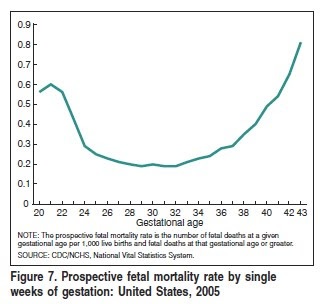
And, he said, the risk of stillbirth and neurological injuries rises after 39 weeks. “Stillbirth is a hugely underappreciated problem,” he said. “There are anywhere between 25,000 to 30,000 stillbirths a year in the United States.”

Indeed, the argument can be summarized in a simple graph:

image

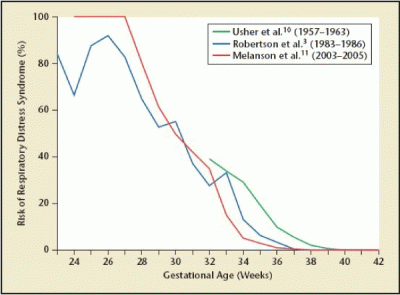
This is a graph of stillbirths vs. gestational age. As you can see, the stillbirth rate begins to rise precipitously at 36 weeks. But babies born at 36 weeks have a small but significant risk of immature lungs leading to breathing problems requiring intensive care. The graph below summarized the data of 3 studies on the risk of lung immaturity.

image

The lines on the two graphs cross at approximately 39 weeks when the risk of lung immaturity is 0% and the stillbirth rate continues to rise.

In other words, the optimal time for birth is at 39 weeks gestation.

Not surprisingly, natural childbirth advocates are horrified.

Cristen Pascucci, an advocate for giving women more control over childbirth decisions, thinks the doctors’ remarks suggest that all babies need to be “rescued by birth,” creating an anti-woman mentality. “It’s as if women and their babies are fundamentally in opposition to each other and the female body is dangerous by design,” said Pascucci, a vice president of the advocacy group Improving Birth.

It calls into question the fundamental conceit of the natural childbirth movement that childbirth is inherently perfect. But nature is a terrible midwife; the day of birth is the single most dangerous day in the 18 years of childhood. The risk of a baby dying on the day of birth is not exceeded until that baby is 92 years old.

Childbirth, like any aspect of body function, is subject to the multiple competing demands of natural selection.

Natural childbirth advocates don’t seem to understand that natural selection leads to the survival of the FITTEST, not survival of everyone. Those that aren’t fit often simply die.

For example, the distinguishing feature of human beings is their large brains. Overall, large brains confer a tremendous evolutionary advantage at birth and throughout life. The larger the brain at birth, the more neurologically mature the newborn and the better the chances of its survival.

But large brains are an evolutionary disadvantage. That’s because the size of the maternal pelvis has an upper limit. As the maternal pelvis gets bigger, the mother’s ability to walk and run decreases.

Every single birth involves an evolutionary compromise between the neurological advantages of a larger neonatal brain and the potentially deadly consequences of a larger neonatal brain leading to obstructed labor. Prior to the advent of modern obstetrics, babies whose heads were too big to fit simply died and their mothers died with them.

The brain continues to grow throughout pregnancy. Babies born at later gestational ages have bigger heads and are more neurologically mature but also more likely to die in labor. Babies born at earlier gestational ages have small heads which gives them a tremendous advantage in childbirth.

The same thing applies to the size of babies relative to the function of the placenta. Some placentas last longer than others. The longer a baby remains inside the mother, the more neurologically mature and fitter it will be. However the longer a baby remains inside the mother, the greater the chance that its growth will outstrip the placenta’s ability to supply oxygen. If the baby stays inside longer than the placenta can function, the baby is stillborn. The timing of birth represents a compromise between these competing imperatives.

Natural childbirth advocates are fond of pointing out that the a due date is just an estimate; a baby can be born any time between 38 weeks and 42 weeks or beyond. But they draw the wrong conclusion from this. They ascribe the variation in length of pregnancy to necessity (“a baby knows when to be born”) when it is merely due to evolutionary chance.

The idea that a baby knows when to be born and therefore is always born at the perfect time makes as much sense as the idea that a nose “knows” how big to grow and therefore everyone’s nose is the perfect size for her face. It makes as much sense as claiming that everyone’s blood pressure “knows” the ideal level to prevent heart attack or stroke, or that everyone grows to a perfect height. In other words, it makes no sense at all.

If babies truly knew when to be born, the first graph above would be a straight line; there would be the same number of stillbirths at every gestational age. That clearly is not the case. Babies DON’T know what to be born.

No wonder natural childbirth advocates are spluttering.

But their spluttering also illustrates another fundamental problem with natural childbirth. It’s not a matter of science, but of belief.

The Washington Post article reports that the ACOG debate changed the minds of many obstetricians in the audience. When presented with new scientific information, they reached new conclusions. In contrast, natural childbirth advocates would not give up cherished beliefs (“natural is better”), regardless of the evidence they were shown.

It reminds me of the debate on evolution between Bill Nye and creationist Ken Hamm. When Nye was asked was asked what would convince him that creationism was true, he responded, “Evidence.” When Hamm was asked what would convince him that evolution was true, he answered in effect, “Nothing.”

Natural childbirth advocates are like Ken Hamm. They start with the conclusion and work backward trying to cherry pick evidence to support it. They’re spluttering because no amount of evidence will ever change their minds.

No more pelvic exams? Not exactly.

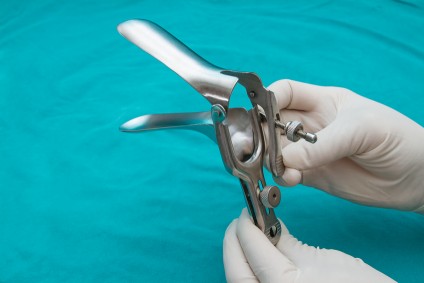
doctor holds a disposable speculum in his hand.

The mainstream media is filled with reports that pelvic exams are no longer necessary in the wake of a draft recommendation by the United States Preventive Services Task Force (USPSTF).

Here’s How StatNews reported the findings:

Millions of healthy women undergo routine pelvic exams every year, but on Tuesday a panel of physicians and other medical experts cast doubt on this longstanding pillar of women’s preventive health care.

But that’s NOT what the task force actually advised. The USPSTF advised discontinuing SCREENING BIMANUAL EXAMS, not pelvic exams.

[pullquote align=”right” cite=”” link=”” color=”” class=”” size=””]The mainstream media has reported the story inaccurately and women may die as a result.[/pullquote]

In order to understand the recommendations, you need to understand what a pelvic exam is.

A pelvic exam contains TWO parts, the speculum exam and the bimanual exam.

The speculum exam involves inserting a metal or plastic speculum in the vagina to push back the vaginal walls and allow the cervix (which is at the end of the vagina) to be seen. The provider can then perform a Pap smear, scraping off cells for examination under the microscope in order to detect cancer and precancerous lesions.

The bimanual (two hands) exam is performed after the speculum exam. Two fingers of the provider’s dominant hand are inserted into the vagina and the other hand is placed on the lower abdomen. The fingers and hand are brought together to feel the uterus, cervix and ovaries between them.

Routine speculum exams are STILL recommended.

Bimanual exams are STILL recommended for any woman with a complaint of pain, vaginal discharge and a variety of other symptoms.

The ONLY thing that the USPSTF recommends discontinuing is SCREENING bimanual exams (when a woman has no GYN symptoms of any kind) to detect POTENTIAL problems. The bimanual exam is a poor screening test because it has a high false positive rate leading to unnecessary ultrasounds and other tests.

No one should think that this means women should avoid the gynecologists or forego speculum exams and Pap smears. The HPV vaccine may ultimately render them unnecessary by preventing cervical cancer and precancerous lesions, but that hasn’t happened yet.

Women STILL need routine gynecological exams including speculum exams!

Women with GYN symptoms STILL need complete pelvic exams including bimanual exams!

As the StatNews piece notes:

Its conclusion applies only to women who are not pregnant and who do not have pelvic symptoms, such as pain or unusual bleeding. It gave the pelvic exam a grade of “I,” for “indeterminate,” meaning “we don’t have enough evidence to determine the benefits and harms,” said task force member Dr. Maureen Phipps, professor of obstetrics and gynecology at the Warren Alpert Medical School of Brown University and chief of OB-GYN at Women & Infants Hospital of Rhode Island…

The recommendation is unrelated to screening for cervical cancer, which the task force highly recommends. But that can be done without a pelvic exam, an internal and external inspection by sight and touch.

But even then it doesn’t get the terminology correct.

The last line particularly egregious:

ACOG said its current position is not dictated by financial considerations. But if women opt out of pelvic exams, many might visit a gynecologist less often. And if gynecologists do not bill for a pelvic exam and the follow-up it often triggers, their incomes would decline.

But the genesis of the routine pelvic exam is not in obstetrics but in public health. Many routine screening tests (like mammograms) were recommended by public health officials because cancer was imagined to be like infectious disease: early diagnosis would be much more likely to lead to a cure. But cancer is not like infectious disease in that it can spread and become incurable long before the patient has any symptoms. Everyone who has metastatic cancer at one point had a tiny early cancer, BUT not everyone who has an early small cancer will ultimately develop metastatic cancer. The cancer may grow so slowly that the patient dies of another cause first or the body’s immune defenses recognize the tiny cancer and remove it.

Routine bimanual exams were never a plot to make money. They were thought to be the only way to detect early ovarian cancer. Early ovarian cancer is potentially curable and advanced ovarian cancer is almost never curable. Moreover, early ovarian cancer almost never causes symptoms and symptomatic ovarian cancer is almost always deadly. It seemed to make sense to perform routine bimanual exams. Experience has shown us that sadly it doesn’t work. In other words, since bimanual exams can’t diagnose early ovarian cancer, there’s no reason to perform them as a screening test.

But cervical cancer is a preventable disease. Screening PAP smears (and therefore speculum exams) are highly effective in diagnosing cervical cancer and precancer. Screening PAP smears save lives.

Tragically, the mainstream media has reported the story inaccurately and women may die as a result.

Guest post: My baby died before labor began but my homebirth midwife had no idea

image

Naomi Desir endured an excruciating labor at home only to learn that her homebirth midwife had no idea that baby Boaz had died days before labor began. Naomi wrote to me: “I want to tell you my story so I can hopefully help other people understand the dangers of home birth and direct entry midwives. “

I was once naive and foolish to think that home birth was safe and that it had better outcomes for mom and baby than hospital births. I bought into all of the lies, brainwashing, and bullshit you talk about so often on skepticalob. I trusted the wrong people and I have to live with the consequences of my mistake for the rest of my life. The trauma and the loss has changed me forever. At the very least I hope my story will help change the mind of some mom to be out there who is considering having a home birth with a midwife.

[pullquote align=”right” cite=”” link=”” color=”” class=”” size=””]Sweet baby Boaz is gone forever. And I am changed forever.[/pullquote]

Moreover, I need to be heard. I need to tell my story. I have had very little voice since this tragedy. I feel that the people who matter to me the most don’t believe me, they don’t think there is any legitimacy or reality to my story, nor are they able to see the reckless incompetence of midwives and the dangers of home birth. I hope someone will listen.

In 2014 I had a home birth attended by a DEM, I was 41 weeks and 4 days pregnant. My midwife did no fetal monitoring or vaginal exams prior to me going into labor. Like so many oblivious midwives, she never saw my babies demise coming.

I went into labor very early in the morning. My contractions started out strong and came one right after the other; I could barely catch my breath. It didn’t take long for the fatigue and pain to become unbearable.

As the hours passed my contractions and fatigue only got worse. So there I was in a tub full of luke warm water pushing in agony; I was so exhausted I fell asleep in between contractions and pushing. My midwife ignored my exhaustion and instructed me to get out of the tub; she then had me move in various positions in hope of helping the baby reposition, it was torture and completely useless.

At some point during me moving this way and that way the midwife no longer was able to find babies heartbeat so she frantically called 911. Somehow I was able to get out of bed to prepare to go to the hospital, as I did this I felt something wet trickle down my legs, so I looked down and saw blood dripping down my legs and on to the carpet. I knew it was way too late for him; my son was dead.

In her wisdom, the midwife speculated that I had a prolapsed cord that was causing the loss of the heartbeat; this too was an incorrect assumption. However, she attempted to mitigate the problem by sticking her fingers into my vagina while I was on all fours with my head faced down. I rode all the way to the hospital this way. I screamed in pain and agony the entire ride to the hospital.

When we arrived at the hospital I exited the ambulance the same way I entered it. The nurses scrambled to get me into the hospital room. I was immediately taken back for an ultrasound and the doctor confirmed what I already knew, there was no heartbeat, our son was dead.

I continued to contract and push, (with my midwife standing at the end of the bed telling me how I don’t want a c-section because they are really difficult to recover from). I ended up having the unavoidable c-section. After hours of painful and non-productive pushing, all due to me being convinced and persuaded that vaginal birth was best, I finally caved. My body could no longer take it. I was practically begging for a c section at that point; I Was convulsing In pain and I just wanted to stop.

After somewhere between 20-24hrs baby Boaz was delivered via c-section. He was 9lbs 3oz, and 22.5in long; he was perfect, and he was gone forever. We found out later that our son was believed to have died days before I went into labor. There was never a heartbeat to monitor or lose; baby Boaz was already dead and the midwife never realized it; she was dumb founded.

The doctors said I had massive infection and was going septic. My recovery was long, I was in the hospital for a week and recovering at home for weeks after. My husband held our lifeless son, he bathed and kissed him, and wept, he said goodbye. I, however, was not able to hold Boaz for more than a couple of minutes and I barely looked at him; I was afraid to. I didn’t say goodbye. I couldn’t say goodbye. Sweet baby Boaz is gone forever. And I am changed forever.

I would hope that you will share my story on your website, and I hope someone listens.

Science based medicine vs. defiance based medicine

Boy with No sign

Why, in the absence of any scientific evidence to support it, has anti-vaccine advocacy become so popular?

Why, in the absence of any scientific evidence to support it, have homeopathic products that are nothing more than water become big sellers?

Why, in the absence of any scientific evidence to support it, does anyone pay hard-earned money for cranio-sacral therapy?

[pullquote align=”right” cite=”” link=”” color=”” class=”” size=””]Doing the exact opposite of what authority figures recommend is a sign of immaturity, not deliberation.[/pullquote]

These are questions that can be asked of any of the myriad forms of quackery that travel under the banner of “alternative health,” a multi-billion dollar industry that is burgeoning despite the fact that it is based on nonsense.

Doctors, scientists and public health officials often imagine that the problem reflects a lack of understanding of basic science. But opposition to science based medicine has nothing to do with science at all. It’s really defiance based medicine, predicated on the bizarre belief that defying authority is a form of empowering anti-elitism, distinguishing independent thinkers from the pathetic “sheeple” who are nothing more than followers.

In contrast to science, which is defined by the principles that causes and consequences are knowable but unpredictable, alternative health is entirely predictable. It’s just the mirror image of science based medicine.

Consider:

If it works claim it doesn’t. Vaccine rejection is the paradigmatic form of alternative health. Vaccines are one of the greatest public health advances of all time. That’s why the heart of anti-vax advocacy is the assertion that vaccine preventable illnesses were disappearing before the advent of vaccines.

If it doesn’t work, claim it does. Eating right, exercising, and taking herbs and supplements can’t prevent vaccine preventable diseases. There’s no evidence that it can and no evidence that it does so. That hasn’t stopped anti-vax advocates from insisting that the key to health is diet.

If it’s safe, claim it’s dangerous. Whether it’s vaccines, medications or GMOs (genetically modified plants), it is an article of faith among alternative health advocates that side effects are scary conditions — autism, autoimmune diseases — whose causes are not yet understood.

If it’s dangerous, claim it’s safe. Whether it’s colloidal silver, bleach enemas for autistic children, and even turpentine (I kid you not), alternative health is full of “remedies” that are deadly.

If it’s natural, claim it’s perfect. Because everyone knows that natural = safe, even though there is nothing in nature that is perfect and plenty (hurricanes, rattlesnakes, earthquakes) that is naturally deadly.

If it’s technological, claim that it’s harmful. Alternative health advocates labor under the delusion that technology has led to disease when the opposite is patently obvious. There was a time when all food was organic, everyone exercised and the only remedies were herbs, and the average life expectancy was — 35 years. In 21st century industrialized countries, massive portions of foods filled with artificial ingredients are plentiful, exercise may be limited to operating the TV remote control, and everyone seems to be on medication of some kind, yet the average life expectancy now approaches 80.

If it’s true, claim it’s false. AIDS isn’t caused by HIV; it’s a government lie. Microcephaly isn’t caused by Zika virus; it’s caused by pesticides. Medications don’t save lives; they kill people.

If it’s false, claim it’s true. A list of easily available, relatively inexpensive a substances claimed to cure cancer is longer than my arm, yet none of them — not a single one — works as advertised.

If it’s nonsense, claim it’s science. Homeopathy is nonsense. Cranio-sacral therapy is nonsense. Eating placentas. Meanwhile people are spending their money on treatments that don’t merely fail to work; they could never work.

If it’s science, claim it’s nonsense. Chemotherapy supposedly doesn’t work. Antibiotics supposedly do nothing more than create resistant organisms. Medicine supposedly doesn’t save lives; it kills people.

If someone is an expert, claim his education is worthless. Don’t listen to immunologists about vaccines, oncologists about cancer, or obstetricians about childbirth. They’ve been indoctrinated in a technocratic model of illness and disease. What do they know?

If someone is an amateur, insist she is an expert. Jenny McCarthy is a prophet of immunology knowledge; Suzanne Sommers is an oncologist, and no one knows more about childbirth than washed up talk show host Ricki Lake.

It’s not merely defiance that is the engine of alternative health, but knee-jerk defiance. That’s how alternative health advocates can oppose a Zika vaccine that doesn’t yet exist or a genetic cause of autism or cancer that hasn’t been elucidated.

Yes, there are many societal ills that stem from the fact that previous generations were raised to unreflective acceptance of authority. It’s not hard to argue that unreflective acceptance of authority, whether that authority is the government or industry, is a bad thing. BUT that doesn’t make the converse true. Unreflective defiance is really no different from unreflective acceptance.

Unreflective defiance is just the flip side of unreflective acceptance. There’s nothing praiseworthy about it. Only teenagers think that refusing to do what authority figures recommend marks them as independent. Adults know that doing the exact opposite of what authority figures recommend is a sign of immaturity, not deliberation.

Alternative health exists in opposition to science based medicine not because advocates don’t understand science (although they don’t); it is exists because some people confuse unreflective defiance of authority with independent thinking. But belief in alternative health isn’t independent thinking; it’s not thinking at all.

Dr. Amy