Do epidurals change labor?

Have epidurals changed labor?

Of course they have. They’ve made labor much less painful and much less feared than ever before. But Science and Sensibility guest blogger Dr. Michael Klein doesn’t care about that. He’s concerned that epidurals have changed the course of labor. Why is this important? Dr. Klein would like women to believe that epidurals increase the likelihood of C-section.

Dr. Klein has returned with part 2 of his post “Epidural Analgesia—a delicate dance between its positive role and unwanted side effects.” After the appearance of part 1, I wrote about Dr. Klein’s effort to delegitimize women’s need for pain relief in labor and how that fits with the tendency of natural childbirth advocates to treat women’s needs as invisible.

In a 1200 word post, Dr. Klein utterly fails to mention the excruciating pain of childbirth. There is not a single word about how women feel about pain and pain relief in labor.

True to form, Dr. Klein writes yet another screed on “the positive role and unwanted side effects” without bothering to mention the positive role or how women feel about relief of their labor pain.

In typical NCB fashion, Dr. Klein wants to talk only about the risks, whether real or imagined. Dr. Klein tells us what he personally found in his research on epidurals and why he believes that and not the Cochrane Review that showed epidurals have no impact on the C-section rate.

It is because of these studies that we had trouble accepting the results of the 2004 Cochrane meta-analysis that concluded that epidural analgesia did not raise the cesarean section rate. This conclusion was the same in the most recent Cochrane meta-analysis …

Here’s what Dr. Klein and his colleagues found:

We found that physicians with mean epidural rates under 40% for women having their first baby, had cesarean section rates of about 10%. In contrast, those family doctors with mean epidural rates of 71-100% had cesarean section rates of 23.4%, the others having rates between the two extremes. The women cared for by the three groups were similar. Thus it appeared that only physician practice difference could have accounted for such large differences in outcome…

In other words, Dr. Klein FAILED to show that epidurals increased the rate of C-section, but wait! The same doctors who had lots of patients who opted for epidurals had high C-section rates. And that means …. nothing!

To understand why Dr. Klein’s findings are meaningless, we can apply one of Hill’s criteria: consideration of alternative explanations. Is there an alternative explanation for Dr. Klein’s findings? Of course there is, possibly more than one.

Remember, Dr. Klein failed to show that women who had epidurals were more likely to have C-sections, which is, of course, is what he MUST show in order to impute causation. He only showed that certain doctors were more likely to a. have patients who requested epidurals and b. have a high C-section rate. The alternative explanations are rather obvious. Either the patients differed in important ways from doctor to doctor, or the doctors differed in important ways from each other.

We can use a related example to illustrate. Suppose I claimed that epidurals caused higher rates of admission to Harvard. First I looked to see if women who had epidurals were more likely to have children subsequently admitted to Harvard and found that they were not. Then I discovered that the patients in Dr. A’s practice had both a high epidural rate and a high rate of subsequent admission to Harvard, and the patients in Dr. B’s practice had a low epidural rate and a low rate of subsequent admission to Harvard. Would I have proven that epidurals cause Harvard admission? Of course not. Why not? Because an alternative explanation (for example, the fact that Dr. A practiced in a wealthy suburb whereas Dr. B practiced in the inner city) is far more likely to account for the difference.

In other words, Dr. Klein’s research most certainly does not show that epidurals increase the C-section rate, … but it does make a compelling case for Dr. Klein’s desperation to dramatically inflate the purported risks of epidurals and render the benefits invisible.

Homebirth advocates ignore baby, rally for midwife

Another day, another homebirth tragedy:

… [A] newborn was born in an east Charlotte home and rushed to the hospital.

Family members of the 24-year-old mother said the baby was still in the hospital Wednesday night and was not doing well.

The birth was attended by a homebirth midwife, also known as a certified professional midwife (CPM). Certified Professional Midwives are grossly undereducated, grossly undertrained and are not eligible for licensure in ANY other first world country. They lack a college education, and sport only a post high school certificate awarded by other CPMs.

You might think that this would be an opportunity for soul searching in the North Carolina homebirth community, but you’d be wrong. The North Carolina Friends of Midwives and the Charlotte chapter of the International Cesarean Awareness Network (ICAN) view this as an oppportunity to promote the interests of CPMs. No one knows whether the baby will live or die, but homebirth advocates have already “moved on” to the really important issue, the fate of the midwife.

Amy Medwin, the CPM in question, was arrested after the baby was transported to the hospital. CPMs are illegal in North Carolina. Certified nurse midwives (CNMs, the equivalent of midwives in every other industrialized country) are the only legally recognized midwives in North Carolina. Medwin was arrested for practicing illegally and for failure to provide appropriate medical care to the infant, resulting in serious injury.

This isn’t the first time Medwin was arrested. According to the Charlotte News and Observer, she was arrested in the wake of another poor homebirth outcome in 1998.

The baby was big, 10 pounds, 15 ounces. But then, midwife Amy Medwin hadn’t been expecting a peanut. The mother … had had two other babies that weighed more than 9 pounds. Still, attending the woman’s home birth in Davie County last September, Medwin watched cautiously as this baby’s head emerged; it was coming a bit too slowly.

Then it stopped.

The infant’s shoulder had caught on the mother’s pelvic bone and wouldn’t budge. Medwin, who has attended more than 750 births over the past 19 years, ordered the mother into different positions. They tried seven until finally the baby dislodged. He wasn’t breathing, and his body was blue.

So began the case that ultimately led to Medwin’s unprecedented arrest March 5: … she became the first woman in North Carolina charged with practicing midwifery without a license.

That’s a misdemeanor under state law and, without a prior record, Medwin could easily pay a fine and walk away. But Medwin says she cannot in good conscience tell a judge she will give up her practice. She believes she is called by God to help women deliver their babies in the comfort of their own homes.

The baby was transferred to the hospital and survived after a 6 day hospital stay. The case was ultimately dropped because the mother, who had filed the original complaint, refused to testify.

Now, once again, Medwin has presided over a serious complication at homebirth, and once again, a baby fights for its life in the local hospital. But who cares about that? Certainly not homebirth advocates.

The North Carolina Friends of Midwives has issued a 450 word press release and NOT A SINGLE WORD is devoted to the baby. The Charlotte chapter of ICAN has also issued a press release with NOT A SINGLE WORD about the baby’s condition. Instead, the press releases have usual suspects talking the usual talking points. Katie Prown (Look at the death rate in Katie Prown’s state) expresses pious concern for the taxpayers money that will be “wasted” in prosecuting Ms. Medwin. Russ Fawcett bemoans the “bullies and special interests” who dare to place the health and well being of babies above the economic interests of homebirth midwives. They are planning a rally in support of Ms. Medwin.

That is what is known as “reframing the conversation.” North Carolina homebirth advocates aren’t going to persuade anyone of anything by discussing the babies injured under the care of CPMs. They don’t even bother to try to justify the conduct of the CPM, her medical judgment (or lack thereof), or the appropriateness of a homebirth in either case. That argument is a total loser, so effort is expended to divert attention from the homebirth disasters.

Only homebirth advocates could consider the life threatening damage sustained by infants at homebirth as an opportunity to rally support. According to them, the problem is not that babies are injured and die at homebirth. And the problem is not that CPMs have less education and training that midwives in ANY other first world country. The real problem, according to homebirth advocates, is that these underqualified, dangerous practitioners who have already hurt babies don’t have legal sanction.

Hopefully the people and the legislature of North Carolina will recognize these tactics for what they are, a desperate attempt to change the subject from the risks of homebirth to the economic and social welfare of homebirth midwives.

Addendum: The latest news reports indicate that Medwin’s current arrest was prompted by TWO bad outcomes in one month. The first case was an intrapartum death in which Medwin attended the labor but claims she left before the birth of the dead baby. The second is the case discussed above in which the baby is still hospitalized and fighting for its life.

Ten lies my natural childbirth educator told me

Several people have expressed reluctance to join a Facebook group entitled Fed up with natural childbirth on the grounds that they have no objection to choosing unmedicated birth, or more generally, no objection to women making whatever choices they prefer. But natural childbirth is not simply a specific set of choices; it’s a philosophy that idealizes a specific set of choices and makes value judgments about women who choose differently. Moreover, it is a philosophy that rests on specific empirical claims; claims that are disingenuous, untrue, or occasionally outright lies.

Below is a list of the most popular NCB falsehoods and lies, the ones that are promulgated by natural childbirth celebrities and organizations, and faithfully transmitted even by purportedly neutral childbirth educators:

#1. Childbirth is inherently safe.

This is an outright lie. Childbirth is inherently dangerous. Childbirth is and has always been, in every time, place and culture, a leading cause of death of young women. For babies, the day of birth is the single most dangerous day of the entire 18 years of childhood.

This lie is a bedrock assumption of natural childbirth philosophy. On this false belief that childbirth in nature is inherently safe rests the claim anything that modifies childbirth must be dangerous or not as good as childbirth in nature.

#2. Fear causes the pain of childbirth.

This stems from a spectacularly racist lie. Grantly Dick-Read, the father of the NCB movement, was a eugenicist whose primary goal was to prevent “race suicide” by encouraging white women of the better classes to have more children. He claimed that primitive (i.e. Black) did not have pain in labor, in keeping with the pervasive racist beliefs of the age that Black women were hypersexualized, and gave birth without pain because they did not fear their natural role. Grantly Dick-Read based his entire philosophy on this lie, hence the title of his book, Childbirth Without Fear.

Contemporary natural childbirth advocates no longer make the absurd racist claims, but they are stuck on the notion that the pain of childbirth is inherently controllable by the mind, and that the mind can therefore be trained to minimize and manage the pain.

#3. Labor is not inherently painful.

This bizarre claim rests on a false assumption that labor pain is qualitatively different than other forms of pain. It’s not. It is exactly like any other form of pain, is initially received by the same types of neurons, passes exactly the same way up the spinal cord to the brain, and is perceived by the brain in exactly the same way as any other form of pain.

#4. Epidurals are dangerous and unnecessary

NCB advocates insist that epidurals are unnecessary because the pain of labor should be managed in other ways, or better yet, should be endured. The claim is both philosophical and empirical. The philosophical claim rests on the naturalistic fallacy and belief in essentialism. The naturalistic fallacy is the claim that because something is a certain way in nature, it ought to be that way all the time. Essentialism is the belief that women share an essential nature and are “empowered” by expressing that nature.

NCB also insist that epidurals are “dangerous” to both baby and mother. That’s nothing more than a lie, created by grossly inflating the purported risks of epidurals.

#5. Interventions are “bad.”

Obviously, if you operate under the mistaken belief that childbirth is inherently safe, it is impossible to recognize the benefits of interventions. However, if you recognize reality, that childbirth is inherently dangerous, interventions represent nothing more than preventive medicine. Knowing that complications are common and often preventable, it follows quite logically that pregnant women should be monitored for a variety of complications so they can be prevented, or treated early when there is the greatest chance of successful treatment.

Since NCB advocates insist that interventions are generally worthless, they are forced into the bizarre position of arguing that medical professionals deliberately offer worthless practices and technology because they are benefiting financially.

#6. Inductions are dangerous and unnecessary.

This lie was adopted by NCB advocates only recently. It flows inevitably from two other mistaken beliefs, the belief that childbirth is inherently safe and the belief that since there are no inductions in nature, there must be no need for inductions.

NCB advocates bemoan the rising induction rate while conveniently ignoring the fact that the stillbirth rate has dropped as a result.

#7 Cesareans are almost always unnecessary.

Again, this is nothing more than an empirical lie. It is well known that in countries where the C-section rate is under 5%, mortality rates are appalling. Indeed, in countries that have C-section rates less than 10%, mortality rates are still extraordinarily high. At a minimum, then 1 in 10 women derive major benefit from a C-section. That is hardly a procedure that is unnecessary.

#9. Vaginal birth is inherently superior

This is a philosophical claim that rests on the naturalistic fallacy. Since everything that is natural is “better” and vaginal birth is natural, it must be “better.” Most women consider that a birth that results in a live baby and live mother is inherently superior, and for a significant proportion of women, that birth is a C-section.

#10. Women who love their babies choose NCB

This is the most hateful claim, but a claim that flows inevitably from all the other lies. When you erroneously believe that natural is inherently safe and that everything else is inherently dangerous, interventions wrongly take on the specter of unnecessary risks. When you wrongly believe that epidurals are dangerous, opting to treat your own pain implies that you value your feelings over the risks to your baby.

***

Natural childbirth advocates will be the first to tell you that NCB is not merely a vaginal birth without pain medication. It is a belief system that necessitates choosing vaginal birth without pain medication and without interventions of any kind. As we have seen, it is based on a variety of philosophical and empirical claims that range from false to outright lies. Natural childbirth explicitly idealizes certain childbirth choices and derides others. More importantly, it asserts that women who make those idealized choices are better women and better mothers than everyone else. And that’s why I’m fed up with natural childbirth.

Fed up with natural childbirth

Birth “activists” dominate the conversation about childbirth in the US, giving the erroneous impression that they speak authoritatively and for a large proportion of women. Nothing could be further than the truth.

They dominate the conversation for several reasons. First, birth has a profound hold on their imagination. While most women view birth as a way for the baby growing inside to get outside, there is a small group of women for whom birth has an outsize importance. These “birth junkies” will cheerfully admit to being obsessed with birth, and get a great deal of their apparently limited self-confidence from their belief that giving birth vaginally without pain medication counts as an “achievement.”

Second, the internet and social media have magnified their voices. As in the case of vaccine rejectionism, natural childbirth advocates have created an alternate world where facts are fabricated, scientific evidence is ignored, and there is no context for understanding the information presented because the advocates lack basic knowledge of childbirth, science and statistics.

Third, it is a money making industry. Natural childbirth advocates love to accuse obstetricians of making money from the care of pregnant women. Those accusations generally ignore the current realities of reimbursement for medical care, and grossly exaggerate the purported “economic benefits” to health professionals of childbirth interventions. Meanwhile they carefully neglect to mention that natural childbirth represents 100% of the income of natural childbirth educators, homebirth midwives, and doulas, not to mention natural childbirth authors.

Fourth, they feel compelled to proselytize. It is not enough for a “birth junkie” to have the birth that she desires. YOU must also have the birth that she desires in order for her to feel validated in her choices. And, as is often the case with proselytism, natural childbirth advocates aren’t content with selling the virtues of their beliefs; they feel compelled to criticize everyone else’s beliefs in the strongest possible terms. Birth choices are not simply choices; they represent an epic battle between the forces of the purportedly “educated” and uneducated. They symbolize a conflict between “good” mothers and bad mothers. Perhaps most offensive of all, they are portrayed as a Manichean struggle between those who love their children and those who don’t love them enough.

I, for one, am fed up with the posturings of natural childbirth advocates, and there’s no question that I’m not alone. The vast majority of American women do not subscribe to the central beliefs of the natural childbirth philosophy: that vaginal birth is superior, that epidurals symbolize weakness, and that all women can and should breastfeed their infants for a year or more.

I am fed up with the assertion that vaginal delivery is the only way “real” women give birth.
I am fed up the the claim that C-sections are the avoidable result of not trying hard enough to have a vaginal delivery.
I am fed up with the canard that C-sections are “unnecessareans.”
I am fed up with the belief that pain relief in labor is dangerous and that forgoing pain relief is an achievement.
I am fed up with the claims that labor pain is “good” pain, “pain with purpose” and the remarkably hateful claim that “less pain equals less joy.”
I am fed up the idea that childbirth educators are qualified in any way to give medical advice on any topic.
I am fed up with self-proclaimed natural childbirth “experts” who lack basic understanding of science and statistics.
I am especially fed up with anyone who dares to assert that childbirth choices separate those who love their babies from those who don’t love them enough.

I’ve created the Facebook group Fed up with natural childbirth for “women who don’t need labor pain to feel authentic, don’t need a vaginal delivery to feel like a woman, and don’t need sanctimommies telling them how to feed their babies.”

Join me if you feel the same.

Celebrity blasts natural childbirth zealots on Twitter

Twitter is the latest venue for the battle against the sanctimommies of natural childbirth advocacy.

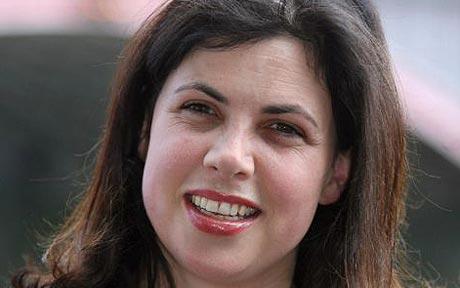
British TV host Kirstie Allsopp is angry:

[She] has launched a scathing attack on natural childbirth experts, accusing them of ‘stigmatising’ women who have Caesareans.

The TV presenter – whose two sons were delivered by C-section – claimed that she and thousands of other mothers were being made to feel a ‘failure’. She criticised the National Childbirth Trust for being ‘reckless’ in not providing enough information about the procedure in their antenatal classes, which are attended by 100,000 couples every year.

Ms. Allsopp appealed to her Twitter followers:

[She] then asked her 95,000 Twitter followers: ‘Anyone been on an NCT course recently? Was there any info/discussion on what happens in the event of you needing a C-section?’

Hundreds responded, many of them agreeing that they had been given minimal information. One new mother had apparently been banned from the class held after the birth because she had needed a Caesarean.

Her husband wrote: ‘After C-section my wife and I were the only couple not invited back to NCT group to tell expecting couples about it.’

Allsopp is fed up with the obnoxious attitude of professional natural childbirth advocates:

They seem to be saying if they had been in our position they would have managed somehow, despite all the medical advice, to give birth naturally,’ she said.

‘There are very few organisations that get away with suggesting you should ignore medical advice, but the NCT does.’

Brenda Phipps, president of the National Childbirth Trust (who has only 536 followers), rushed to inadvertently confirm Allsopps claims.

First, she offered the feeble excuse that the NCT did not cover C-sections in their childbirth classes, because it’s difficult ‘fitting everything in.’ But if Ms. Phipps and the NCT have chosen to ignore C-sections, they should have own their decision and not make absurd excuses.

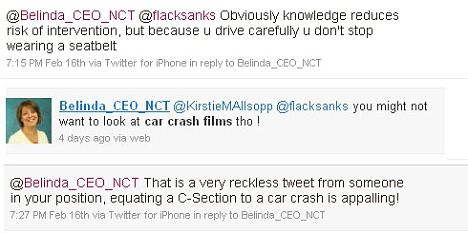
Then Phipps, like all professional NCB advocates, could not resist being obnoxious. She claimed that NCT ignores C-sections in their classes in order to help women avoid them. When Allsopp pointed out that knowledge is more helpful than ignorance, Phipps joked that watching a car crash might constitute knowledge for avoiding a car crash but no one would want to do that.

Thereafter Phipps slips into the truly ridiculous:

imagining what you don’t want makes it more likely

followed by:

say to a child don’t spill that and it will

Make up your mind Ms. Phipps. Does the NCT fail to provide information about C-section because there isn’t enough time? Or does it deliberately refuse to provide information about C-section on the astoundingly inane theory that thinking about a C-section will cause a woman to have one?

One thing is crystal clear, though. The NCT stigmatizes C-sections just as Allsopp claims. Phipps presumes that vaginal delivery is always superior to C-section, that C-section is an “accident” to be avoided at all costs, and that merely mentioning it could cause the dread event to come to pass.

Allsopp has had enough:

… [I]t makes me want to cry that some women don’t have the information they need at such an important time. It has to stop.

Janet Fraser: dead baby not as traumatic as birth rape

image

You might think that freebirth advocate Janet Fraser would be chastened by the death of her baby at homebirth. You’d be wrong. In fact, according to Fraser, it wasn’t even traumatic.

My birthrape with my first child is traumatic. My stillbirth was not.

Fraser is the premier Australian advocate of unassisted childbirth (UC) also known as freebirth. That’s right, a birth unattended by any medical professional of any kind, no matter how poorly educated. And Fraser added an extra fillip, no prenatal care of any kind. As she went into the labor that eventually resulted in a dead baby, she actually gave an interview to an Australian newspaper on March 22,2009 in which she boasted of her choices:

Janet Fraser is in labour… Has she called the hospital to let them know what’s happening? “When you go on a skiing trip, do you call the hospital to say, ‘I’m coming down the mountain, can you set aside a spot for me in the emergency room?’ I don’t think so,” says Fraser, whose breathing sounds strained…

… She hasn’t seen a doctor or any health professional since becoming pregnant this time. No ultrasound, no genetic testing, no internal examinations, no stethoscope. Does she have any feeling for how long the labour will go? “I could do this for days. My daughter’s birth was 50-something hours. You just do it — it’s just birth, a normal physiological process.”

The baby was not born for another five days. The death was described in another newspaper report:

… [T]he natural water birth of her third child, a girl, at her home went horribly wrong in the early hours of March 27.

Ambulances were sent to the address following a triple-0 call made at 1.13am.

An ambulance service spokesman said paramedics were called to a Croydon Park address for a newborn baby who had suffered cardiac arrest and was not breathing.

Paramedics failed to revive the baby throughout the journey to the Royal Prince Alfred Hospital at Camperdown.

“They were basically working on the baby all the way to the hospital,” the spokesman said.

It boggles the mind that Fraser could describe the death of her daughter as less traumatic than the live birth of her son, but evidently “having it your way” is much more important than having a live baby.

Fraser may not have been traumatized by her daughter’s death, perhaps a coroner’s inquest will change that. Fraser, like Australian homebirth midwife Lisa Barrett, has tried to argue that her irresponsibility led to a stillbirth, not a live birth, and therefore it should not be investigated. The New South Wales police investigators disagree:

A Coronial inquest will be held into the controversial death of a baby girl during a home birth where doctors or midwives were banned from assisting a delivery – a practice known as “free-birthing”.

The inquest comes two years after initial confusion as to whether the baby took a breath after delivery or died in utero. The latter instance would have prevented a coronial inquiry.

The Sunday Age understands New South Wales police have conducted an extensive investigation to present a brief of evidence to the coroner.

The matter is listed as a mention in the Glebe Coroner’s Court on March 18, almost two years to the day the controversy broke.

Presumably, Fraser is going to claim that her daughter was dead at the moment of birth. No one thought so at the time. Someone at Fraser’s house requested an ambulance and EMTs performed CPR all the way to the hospital.

Fraser may not have been personally traumatized birth the death of her daughter, but she certainly recognized that the death could have a traumatizing effect on others. Therefore, she deleted the story from her freebirth message board, Joyous Birth. Deaths are so very, very inconvenient when you are trying to pretend that irresponsible choices are safe. Better to obliterate all mention of it.

It’s hard to imagine anything more selfish and self absorbed than choosing freebirth, but Janet Fraser has topped that with something even more reprehensible. There’s nothing uglier than trying to erase all mention of your dead child and declaring that the death wasn’t that traumatic at all. Fortunately, the coroner is not going to let her get away with it.

Why safe choices are viewed as dangerous

How extraordinary! The richest, longest-lived, best-protected, most resourceful civilization, with the highest degree of insight into its own technology, is on its way to becoming one of the most frightened. – Aaron Wildavsky

There’s a big difference between assessment of risk and the perception of risk. As Wildavsky points out above, Americans are frightened of risks. He and other scholars of risk have located that fear in the large gulf between assessment and perception.

What’s the difference between risk assessment and risk perception?

Risk assessment is the mathematical determination of a specific risk, and is usually carried out by professionals in statistics or related disciplines. Risk perception is the belief about a specific risk and is typically the province of lay people. As scholars of risk have noted, there is often a wide gulf between actual risk and lay belief about risk. When it comes to advances in health and science, the American public often perceives far more risk than the risk assessment demonstrates. The actions taken in response to that fear, can often be more dangerous than the particular risk that is feared.

Alternative health practices like vaccine rejectionism and homebirth, arise in that wide gulf between assessment and perception. Risk perception is modified by factors that have nothing to do with actual risk. According to David Kane in Science and Risk: How Safe is Safe Enough, these factors include “newness” of the risk, control, and benefits.

What does he mean by “newness of the risk”?

Generally, a risk that has always existed is regarded as an acceptable risk, while newer risks that are brought to the public eye receive greater scrutiny. This intense examination makes the new risk appear to be more dangerous.

That is especially true when the magnitude of the risk is unknown to many (the risk of death during childbirth) or has not been directly witnessed (the risk of death from vaccine preventable diseases). It is also affected by the naturalistic fallacy, the claim that the way that things were is the way that they ought to be. Natural childbirth advocates routinely believe that the risks of technology are far higher than the risks of “natural” birth.

The second factor is control.

An individual is more willing to accept the risk of an activity of which he or she is in direct control… This underlying factor explains why … indirectly controlled activities have a high perceived risk.

A key type of control is the decision to be exposed to a risk. Voluntary risks involve this kind of choice, while involuntary risks lack this element of control. Because voluntary risks involve a choice based on an individual’s own set of values, [research has shown that] the acceptance levels are a thousand times greater than those of involuntary risks.

For example, even when homebirth advocates are apprised of the increased risk of neonatal death, many will still choose homebirth. It seems to them that the risk they choose (to have a homebirth) must be smaller than risk of hospital birth.

The third factor is benefits.

The public is only willing to tolerate a minute level of risk for activities which it considers to be of little value, such as constructing nuclear power plants. Conversely, for those events which the public perceives great benefit, the acceptance level is quite high.

Kane includes a graph that dramatically illustrates this phenomenon. Here’s a modified version of the graph.

As the graph demonstrates, large risks are considered acceptable if the benefits are valued highly.

For these reasons, vaccine rejectionists’ perceived risk of vaccination is much higher than the actual risk. Vaccine rejectionists perceive the risks of “new” vaccinations are far higher than “old diseases.” They are more frightened of risks posed by mandated vaccination than the far higher dangers of voluntarily rejecting vaccines. And since they don’t understand the magnitude of the benefit, they erroneous conclude that risk of vaccination is not acceptable.

Similarly, for homebirth advocates the risk of hospital technology are perceived as far higher than the risk of birth in the traditional venue of the home. They are far more frightened by the risks of undesired hospital policies than the far higher dangers of freely chosen homebirth. And for those who understand that the risk of neonatal death is higher at homebirth, it is judged acceptable because the perceived benefits are valued so highly.

Both vaccine rejectionists and homebirth advocates need to understand that their perceptions of risk are totally out of line with actual risk. Until they do, they will continue to erroneously believe that dangerous choices are safe, and safe choices are dangerous.

If correlation is not causation, what is?

321CC9B6-62D2-4107-98E3-9C3A58DE7FFF

Even those who can’t tell the difference between a t-test and a chi-square are familiar with a basic principle of epidemiology: correlation does not equal causation. In other words, even if Event A happened before Disease B, it does not mean that A caused B.

For example, in last 100 years deaths from infectious diseases has declined precipitously. During the same time span, the recreational use of marijuana has also increased. Yet no one would suggest that the decline in infectious disease deaths was caused by smoking marijuana.

So if correlation does not equal causation, what does?

To determine if Event A caused Disease B, we need to investigate whether it satisfies Hill’s Criteria. These are 9 criteria, most of which much be satisfied before we can conclude that Event A is not merely correlated with Disease B, but Event A actually causes Disease B.

Who was Hill and why should we care about his criteria?

… These criteria were originally presented by Austin Bradford Hill (1897-1991), a British medical statistician as a way of determining the causal link between a specific factor (e.g., cigarette smoking) and a disease (such as emphysema or lung cancer)… [T]he principles set forth by Hill form the basis of evaluation used in all modern scientific research… Hill’s Criteria simply provides an additional valuable measure by which to evaluate the many theories and explanations proposed within the social sciences.

What are the criteria?

1. Temporal relationship: It may sound obvious, but if Event A causes Disease B, Event A must occur before Disease B. The is the only absolutely essential criterion, but it is NOT sufficient. Lay people often erroneously assume that because it’s the only essential criterion, it is the only criterion that counts. For example, vaccine rejectionists often point to the fact that childhood vaccinations usually occur before the onset of autism, but that does not mean that vaccination causes autism. Consider that learning to walk usually precedes autism, but obviously learning to walk does not cause autism.

2. Strength: This is measured by statistical tests, but can be thought of as similar to the closeness of the relationship. Is Disease B always preceded by Event A? Sometimes? Only rarely? Does Event A always cause Disease B? Sometimes? Only rarely? Lung cancer is not always preceded by cigarette smoking, but it usually is. Cigarette smoking does not always lead to lung cancer, but it does often lead to lung cancer. In other words, the relationship is fairly strong.

In the case of vaccines and autism, vaccines usually precede the diagnosis. However, most children who receive vaccines don’t develop autism. Thus the relationship is weaker.

3. Dose-response relationship: If cigarette smoking causes lung cancer, we would expect that smoking more cigarettes would increase the risk of lung cancer, which it does. In contrast, there appears to be no dose-response relationship between the number of vaccinations and the risk of developing autism.

4. Consistency: Have the findings that purported to show a relationship been replicated by other scientists, in other populations and at other times? If studies fail to consistently show the relationship, causation is very unlikely.

This is a critical point. One experiment or even a few experiments is NOT enough to determine causation. A large number of experiments that consistently show the same result is required. This is particularly important for vaccine rejectionists to note. The fact that a few studies claim to have shown that vaccination causes autism is meaningless when a very high proportion of studies show that there is not even a correlation between vaccination and autism.

5. Plausibility: In order to claim causation, you MUST offer a plausible mechanism. In the case of cigarette smoking, certain components of the smoke are known to cause damage to the cells inside the lungs, and cellular damage has been shown to lead to cancer. In contrast, no one has yet offered a plausible explanation for how vaccines “cause” autism. In fact, no one can even agree on the specific component that is supposedly responsible.

6. Consideration of alternative explanations: This is self explanatory. In the case of vaccination and autism, there is a very simple alternative explanation. Autism cannot be diagnosed before the age of 2 and most vaccines are given before the age of 2.

7. Experiment: If you alter Event A do you still get Disease B. In the case of smoking, if you quite smoking, the risk of lung cancer goes down. In the case of vaccines and autism, if you forgo vaccination, the risk of autism remains unchanged.

8. Specificity: Is Event A the only thing that leads to Disease B? This is the least important of the criterion. If it is present, it is a very powerful indicator of causation. For example, among young women who developed a rare form of vaginal cancer, all of them were found to have been exposed to DES (diethylstilbestrol) while in utero. That is a highly specific effect.

However, even if the relationship is not highly specific, that does not preclude causation. Though there are non-smokers who get lung cancer, it does not change the fact that the other criteria show that smoking causes lung cancer.

9. Coherence: The explanation of action must comport with the known laws of science. If the purported mechanism of causation violates the law of gravity, for example, then it isn’t acceptable. That’s why religious arguments against evolution are wrong. They are “incoherent” since they invoke forces outside science.

What do Hill’s criteria look like in action?

D4DE2D97-AE05-40B3-89B3-FCD048FD61DA

In the case of cigarette smoking and lung cancer, 8 out of 9 Hill’s Criteria are satisfied. In contrast, in the case of vaccines and autism, only 3, possibly 4 criteria are satisfied. This is why we can say that the scientific evidence shows that vaccines do not cause autism.

While it is true that vaccinations usually precede the diagnosis of autism, that is an essential criterion, but not enough. The fact that there is no dose-response relationship, that the few studies that showed a purported relationship cannot be replicated and that studies in which people who were not vaccinated did not have a lower incidence of autism, demonstrates that vaccines do not cause autism.

Are vaccine rejectionists killers?

The folks at Age of Autism are shocked, shocked that Bill Gates blames vaccine rejectionists for the preventable deaths of innocent children.

In an interview with CNN’s Sajay Gupta, Gates expressed tremendous frustration with vaccine rejectionists.

“Well, Dr. Wakefield has been shown to have used absolutely fraudulent data. He had a financial interest in some lawsuits, he created a fake paper, the journal allowed it to run. All the other studies were done, showed no connection whatsoever again and again and again. So it’s an absolute lie that has killed thousands of kids. Because the mothers who heard that lie, many of them didn’t have their kids take either pertussis or measles vaccine, and their children are dead today. And so the people who go and engage in those anti-vaccine efforts — you know, they, they kill children. It’s a very sad thing, because these vaccines are important.”

According to AoA:

We think this type of extreme language is both insulting, and is a calculated way to cut-off questioning and debate on issues that Gates doesn’t want the public looking at very closely.

Here’s a news flash: it was meant to be insulting. Vaccine rejectionists are ignorant, lack basic education in science, statistics and immunology and take medical advice from ex-Playboy Playmates. That part about cutting off debate? Here’s another newsflash: there is no debate; there’s only pathetically ill informed people vilifying the greatest public health advance of all time. And what possible motivation does Bill Gates have for stifling the free flow of information about vaccination? AoA can’t thing of any reason at all.

Let’s parse what Gates said:

Wakefield used fraudulent data. True.
He had a financial interest in the law suits. True.
Multiple additional studies demonstrated that there is no connection between vaccination and autism. True.
The claim that vaccines cause autism is a lie. True.
Children have died preventable deaths because they were not vaccinated. That’s true, too.

If Gates can be accused of anything, it is getting his terms wrong. Vaccine rejectionists aren’t killers; strictly speaking they are manslaughterers. That’s because there have no intent to kill children; the vaccine rejectionists don’t understand immunology, virology or statistics, so they can’t be expected to comprehend the immense, detailed and highly technical scientific evidence supporting the safety and efficacy of vaccination.

Instead of bleating that they are being insulted, vaccine rejectionists should consider why they are being insulted. Bill Gates is spending billions of dollars of his personal fortune to vaccinate as many children for as many illnesses as possible. It’s difficult to argue that he’s less “educated” than people who get their education from websites like AoA. And he certainly has no financial interest in increasing the sales of vaccines.

So why is he speaking out in this way? Because the time is long overdue for the American public to get a rude awakening. Vaccines save lives. Vaccine rejectionism leads to preventable deaths of innocent children. It may not be killing, but you could make a good case that it’s manslaughter.

Penny Simkin: ignore labor pain

I ought to sent a thank you letter to the folks at the Lamaze blog Science and Sensibility. No sooner do I make a claim, then they rush to confirm it.

Barely a month ago, I wrote about the natural childbirth project of ignoring women’s need for pain relief in labor.

It is difficult to imagine any other situation in which ignoring a woman’s severe pain would be socially and ethically acceptable. But for natural childbirth advocates, a woman’s needs are invisible, and therefore merit no consideration.

Less than 2 weeks later, Science and Sensibility showed us just how it’s done. They published a guest piece by a family practice physician, and darling of the NCB movement, that purported to discuss the risks and benefits of epidurals without mentioning the most important benefit, the ability to relieve the agonizing pain of childbirth.

Now Penny Simkin explains why it’s okay to render women’s need for pain relief in labor utterly invisible. Ms. Simkin is the doyenne of the doula movement. Indeed, Ms. Simkin is so famous within the NCB movement that there is a Simkin Center at the Seattle School of Midwifery:

The Simkin Center for Allied Birth Vocations at Bastyr University trains social, practical and clinical care providers for pregnant and new families, including: Birth doulas [and] Postpartum doulas …

In other words, Ms. Simkin is a stalwart in the industry that has the most to lose from recognizing and abolishing labor pain. That’s why it’s more than a bit ironic that Ms. Simkin decries the epidural “industry.”

An enormous industry exists in North America to manufacture and safely deliver pain relieving medications for labor.

Who faces the real economic threat, Ms. Simkin? There’s no greater economic threat to doulas than an epidural; when women have effective pain relief, there’s no reason to pay someone whose entire purpose is to keep them from getting effective pain relief.

How clever, then, of Ms. Simkin to explain precisely why it’s okay to ignore women’s pain: pain should be ignored because “suffering” is more important. In a completely unexpected, who would have imagined, can’t make this stuff up coincidence, pain cannot be treated by doulas but suffering can.

Whom does Simkin reference for her astounding insight that women’s labor pain is irrelevant. Another natural childbirth advocate, of course:

Lowe also points out that “suffering,” can be distinguished from pain, in that by definition, it describes negative emotional reactions, and includes any of these: perceived threat to body and/or psyche; helplessness & loss of control; distress; inability to cope with the distressing situation; fear of death of mother or baby. If we think about it, one can have pain without suffering and suffering without pain.

Those silly medical people! They think that agonizing pain equals suffering. No, no, no. Those silly women in labor, they think that agonizing pain equals suffering. No, no, no. They’re too stupid to know what’s good for them. They “grasp” at the opportunity for relief of pain even when Penny Simkin knows that they are not suffering.

When staff believe that labor pain equals suffering, they convey that belief to the woman and her partner, and, instead of offering support and guidance for comfort, they offer pain medication. If that’s the only option, women will grasp for it.

The unmitigated gall of the woman! Who, exactly, is Penny Simkin to tell women they are not “suffering” when they are experiencing pain?

And what is suffering? I know you are going to be super duper shocked to find out that while agonizing pain is meaningless, “birth trauma” is the legitimate cause of suffering.

… the definition of trauma comes very close to the definition of suffering. “Trauma” involves experiencing or witnessing an event in which there is actual or perceived death or serious injury, or threat to the physical integrity of self or others, and/or the person’s response included fear, helplessness, or horror. (3) Neither suffering nor trauma necessarily includes actual physical damage, although it may do so.

One’s perception of the event is what defines it as traumatic or not. As it pertains to childbirth, “Birth trauma is in the eye of the beholder”(4), and whether others would agree is irrelevant to the diagnosis.

Evidently women are smart enough to define trauma for themselves; it’s in the eye of the beholder. Women are evidently too stupid to define suffering for themselves; that’s in the eye of Penny Simkin.

But not all women are too stupid to define suffering for themselves. Only women in labor are too stupid to define suffering for themselves and need Penny Simkin to define it for them. A woman who has pain in ANY other situation, in ANY other area of the body, for ANY other reason can figure it out for herself. It’s just women in labor who can’t be trusted.

This “reasoning” is simply obnoxious, not to mention patently self-serving, and entirely unscientific. Pain is a neurological phenomenon. Pain is what the WOMAN says it is. Pain can and usually does cause suffering. Pain SHOULD be treated if a woman wants it treated; no other reason is necessary, and no possible excuse mitigates the ethical obligation to treat it.

We do owe Penny Simkin thanks for one thing, though. By offering this inane, convoluted and incredibly self serving justification for ignoring labor pain, she has made it crystal clear that to NCB advocates women’s pain in labor is meaningless.

Dr. Amy