All posts by Amy Tuteur, MD

Contemporary lactivism: ugly, ugly, ugly

Woman Screaming at Anoher Female on White Background

When it comes to discrediting lactivism I get lots of help from an unlikely source, lactivists themselves.

For sheer viciousness, it’s hard to top Kathy Dettwyler, Associate Professor, Supplemental Faculty, Dept. of Anthropology, University of Delaware, Newark, who is known for her cultural work on extended breastfeeding and weaning. You may remember the nasty comment she left on a positive Amazon review of the book Lactivism:

[pullquote align=”right” cite=”” link=”” color=”” class=”” size=””]Lactivists can’t identify even a single term baby who suffered brain damage from properly prepared infant formula, yet they’re willing to risk brain damage from insufficient breastmilk.[/pullquote]

… Formula fed children definitely WILL BE INFERIOR to how those same individuals would have turned out if they had been breastfed.

Now she’s spewing drivel that is, if possible, even more offensive.
image

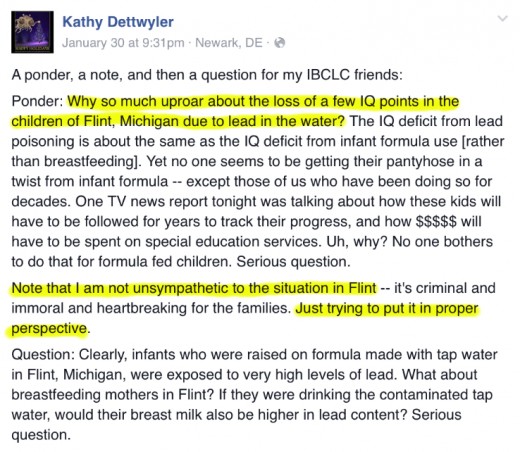
Ponder: Why so much uproar about the loss of a few IQ points in the children of Flint, Michigan due to lead in the water? The IQ deficit from lead poisoning is about the same as the IQ deficit from infant formula use [rather than breastfeeding]. Yet no one seems to be getting their pantyhose in a twist from infant formula — except those of us who have been doing so for decades. One TV news report tonight was talking about how these kids will have to be followed for years to track their progress, and how $$$$$ will have to be spent on special education services. Uh, why? No one bothers to do that for formula fed children. Serious question.

Note that I am not unsympathetic to the situation in Flint — it’s criminal and immoral and heartbreaking for the families. Just trying to put it in proper perspective…

It’s proper perspective? Yes, let’s put it is its proper perspective.

The effects of lead poisoning on the brain are manifold and include delayed or reversed development, permanent learning disabilities, seizures, coma, and even death.

See? Formula is exactly the same… Oops, guess not. But that doesn’t stop Dettwlyer from exploiting the tiny victims of lead poisoning to further her personal agenda.

Lest you think that the ugliness of lactivism is restricted to clowns like Kathy Dettwyler, consider the actions of Alison Stuebe, MD, a well known professional lactivist.

In a recent piece for the Academy of Breastfeeding Medicine blog, Of Goldilocks and neonatal hyponatremia, Dr. Stuebe felt compelled to address a petition that is circulating highlighting the dangers to babies of inadequate breastmilk.

A heart wrenching story has been circulating on social media about an exclusively breastfed baby who suffered brain damage after 4 days of ineffective feeding. The mother shares how she was reassured that all mothers can make milk, and did not realize until she engaged a lactation consultant at 96 hours postpartum that her child was profoundly dehydrated.

…That warning would directly challenge efforts across the US, and around the world, to emphasize the value of exclusive breastfeeding and the risks of unnecessary supplemental feeding.

Yes, just another random mother complaining about a random event…

Not exactly.

I commented on the post:

Dr. Steube, I notice that you display your own credentials prominently, but you disrespectfully ignored Dr. Christie del Castillo-Heygi’s credentials, referring to her as “the mother.” Dr. Castillo-Heygi is a practicing emergency room physician with degrees from Brown and UCSF medical school.

To her credit, after multiple complaints over 24 hours, including my suggestion to edit the piece, Dr. Stuebe did ultimately identify “the mother” and link to her story, but I wonder why Dr. Stuebe neglected to do so in the first place.

It’s not because Dr. Stuebe denies the deadly reality of neonatal hyponatremia; she doesn’t. It appears she didn’t want to give credence to Dr. del Castillo-Heygi’s experience and the lasting impact on her son.

Dr. Stuebe didn’t want to give attention to the risk of PERMANENT BRAIN DAMAGE and DEATH because she’s more concerned about the “risks” of unnecessary supplemental feeding. And what risks would those be? Not brain damage, not death, but the disruption of the breastfeeding relationship.

I suspect that Dr. Stuebe would be hard pressed to identify even a SINGLE term baby who suffered brain damage from properly prepared infant formula, yet she’s willing to risk brain damage from insufficient breastmilk. I suspect that Dr. Stuebe would be hard pressed to identify even a SINGLE term baby who died from properly prepared infant formula, yet she’s willing to risk infant deaths from insufficient breastmilk.

Dr. Stuebe offers a straw man fallacy to defend her point of view:

What, then, of the tragic stories of brain-damaged babies? Wouldn’t it be easier to supplement all babies, rather than redesign our systems of care to identify dyads at risk and ensure early follow-up for every baby?

No one, least of all Dr. del Castillo-Heygi, has ever suggested supplementing all babies.

Amidst the attempts at obfuscation, Dr. Stuebe admits:

We might start by acknowledging, once and for all, that not all mother-baby dyads are able to breastfeed exclusively. Reproductive physiology is not infallible. 10.9% of women have difficulty getting pregnant or carrying a baby to term. 15 to 20% of pregnancies end in miscarriage, 10% of infants are born preterm, and 1 in 100 infants are stillborn. Similarly, less than 100% of women can exclusively breastfeed.

Which, of course, has been Dr. del Castillo-Heygi’s point all along. Kudos to her for forcing the lactivist establishment to admit it.

Lactivists, both professionals and lay people, seem to have lost their minds over breastfeeding. The truth is that it’s just not that big of a deal. Breastfeeding has benefits, but in first world countries they are trivial, but the moralization of breastfeeding has paralleled the monetization of breastfeeding and an entire industry now believes that it depends on grossly exaggerating the benefits and misrepresenting the risks.

But it’s not all deadly seriousness. Here’s a tweet I received from a lactivist offended that I criticized the recent Lancet breastfeeding studies:

image

Hard to beat that for eloquence!
Saving babies’ lives. What’s breastfeeding got to do with it? Not much.

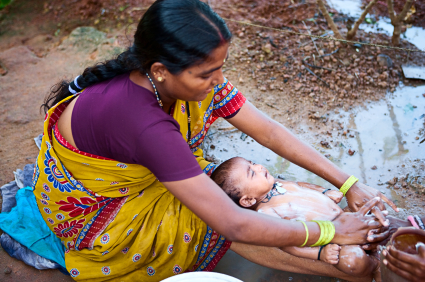
Indian woman washing her baby

On Friday I wrote about the Lancet series on breastfeeding. The authors claim that exclusive breastfeeding around the world could save 800,000 babies each year. I pointed out a paradox that undermines the authors’ contention: the countries with the highest infant mortality rates already have the highest breastfeeding rates.

We shouldn’t be surprised. There once was a time that breastfeeding rates were 100% everywhere and the infant mortality rate was … hideous! If breastfeeding didn’t protect babies for most of human existence, why would it suddenly start protecting infants now?

[pullquote align=”right” cite=”” link=”” color=”#521C4E” class=”” size=””]Increased breastfeeding rates might theoretically decrease infant mortality, but I can’t find any real world evidence that it does.[/pullquote]

In other words, there’s no real world evidence for the purportedly lifesaving benefits of breastmilk. So what are the authors’ basing their claim upon? They base their claims on projections from data gleaned in small studies. Indeed, as far as I know, every assertion that increasing breastfeeding rates will save lives or money is based on projections, never on actual experience. Indeed, as far as I can determine, there is no real world evidence that breastfeeding saves lives or money on the scale estimated by certain researchers.

That’s an important point because there is considerable evidence that other parameters and public health measures do do result in decreased infant mortality.

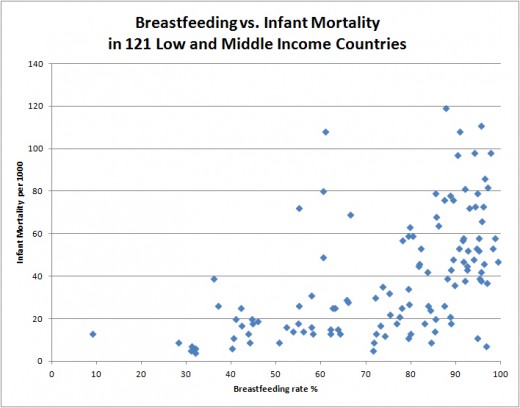
Here’s the scatter chart of breastfeeding rates vs. infant mortality that I presented on Friday. It is based on data from 121 low and moderate income countries.

image

As you can see, as the breastfeeding rate rises, the infant mortality rate not only doesn’t fall, it actually rises, too.

Now let’s look at the impact of per capita GDP (gross domestic product), a measure of income, on infant mortality in these same low and middle income countries.

image

The scatter chart looks very different. It is easy to see that as income rises, infant mortality rates fall. It’s the exact opposite of what we see with breastfeeding rates.

How about the impact of relatively clean water (including public taps, protected wells, and rainwater)? Here’s a scatter chart of access to clean water vs. infant mortality. As access to clean water approaches 100%, infant mortality drops precipitously. That’s also in direct contrast to what we see with breastfeeding.

image

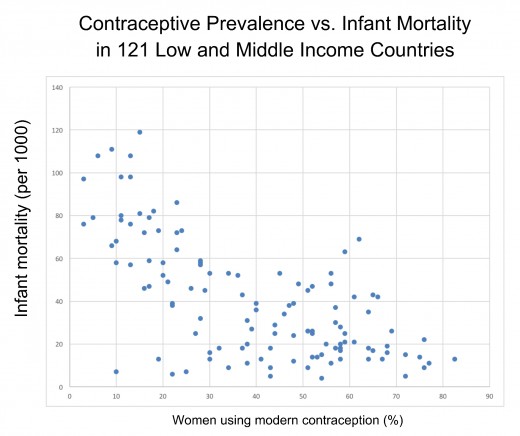
Finally, let’s look at access to modern contraceptive methods. The scatter chart below plots the proportions of sexually active women using modern contraception vs. infant mortality. Yet again we see that as access to contraception rises, infant mortality falls.

image

No doubt access to clean water and access to modern contraception are, in part, a function of per capita income, but they are certainly more firmly tied to reducing infant mortality than breastfeeding.

There’s nothing wrong with breastfeeding, of course. But it’s not a magic lifesaving elixir, no matter how much lactivists insist that it is. While increasing breastfeeding might theoretically decrease infant mortality, I can find no real world evidence that it actually does.

That’s not what I thought prior to reading the Lancet papers, but that’s actually what the data shows. Increasing breastfeeding rates are actually associated with INCREASED infant mortality.

It’s not because breastfeeding causes infant deaths; it doesn’t. It’s because babies die due to malnutrition (of themselves or their mothers), vaccine preventable illnesses, lack of medical care and war. Breastfeeding can’t fix those things and it is foolish (or worse) to pretend that for women living in abject poverty, their babies’ survival depends on breastfeeding.

If breastfeeding saves lives why do countries with the highest infant mortality rates have the highest breastfeeding rates?

image

It sounds spectacular. The headlines in The Guardian are typical, Breastfeeding could prevent 800,000 child deaths, Lancet says:

If almost every mother breastfed her children it could prevent more than 800,000 child deaths a year, yet governments are failing to promote and support breastfeeding, with rates remaining far below international targets, new research has found.

Poor government policies, lack of community support and an aggressive formula milk industry mean breastfeeding is not as widespread as it could be, according to a two-part Lancet breastfeeding series published on Thursday.

[pullquote align=”right” cite=”” link=”” color=”#F90207″ class=”” size=””]Countries with the highest infant mortality rates have the highest breastfeeding rates.[/pullquote]

It certainly seems plausible since breastfeeding is known to prevent diarrheal illnesses and colds and since formula prepared with contaminated water can be deadly. I had no reason to doubt the claim when I started reading the main paper Breastfeeding in the 21st century: epidemiology, mechanisms, and lifelong effect.

According to the authors:

Our meta-analyses indicate protection against child infections and malocclusion, increases in intelligence, and probable reductions in overweight and diabetes. We did not find associations with allergic disorders such as asthma or with blood pressure or cholesterol, and we noted an increase in tooth decay with longer periods of breastfeeding. For nursing women, breastfeeding gave protection against breast cancer and it improved birth spacing, and it might also protect against ovarian cancer and type 2 diabetes. The scaling up of breastfeeding to a near universal level could prevent 823 000 annual deaths in children younger than 5 years …

But the more I read, the less convinced I became.

Why?

Countries with the highest infant mortality rates have the highest breastfeeding rates.

image

I created this scatter plot of 121 low and middle income countries by comparing breastfeeding rates at one year (found in the supplementary material) and infant mortality rates (deaths from birth to 1 year, UN data).

As you can see, there’s no relationship between breastfeeding rates and infant mortality rates. Indeed, the countries with the highest rates of infant mortality often have the highest breastfeeding rates.

Why doesn’t breastfeeding have an impact on observed infant mortality?

Part of the reason is that the benefits of breastfeeding are quite small. Over 800,000 deaths prevented is a great thing, but when you consider that over 135,000,000 babies are born around the world each year, the deaths prevented present 6 babies per 1000. That’s too small to be reflected in country wide infant mortality.

So if infant mortality rates don’t change with breastfeeding rates, how did the authors reach the conclusion that 800,000 lives could be saved if all mothers breastfed? They extropolated from small studies and made a myriad of assumptions in doing so. It seems to me that many of these assumptions are simply wrong, rendering the authors’ conclusions unlikely to be true.

I’m no statistician and I haven’t read all the studies that the authors rely upon, so if I’m making mistakes with my analysis please let me know, but here are my concerns.

1. The authors assumed that findings of small studies could be extrapolated to entire nations. But each study had its own parameters and confounding variables and therefore might not be generalizable.

2. The authors assumed that substantial numbers of babies are dying from formula or contaminated formula itself. But the scatter plot suggests that there are other factors responsible for the bulk of infant deaths. These could be malnutrition (of mother and/or baby), infectious diseases that cannot be prevented by breastfeeding, civil unrest, etc. For example, promoting breastfeeding is not going to save a baby whose mother dies of malnutrition leaving him without any source of food.

3. The authors assumed that the lifesaving benefits of increasing the breastfeeding rate would be evenly distributed over populations, but that can’t possibly be true. When a country has a high infant mortality rate and also has a breastfeeding rate of 97% of 1 year olds, there’s no room to raise the breastfeeding rate.

4. The authors ignore history. There was a time when 100% of infants were breastfed … and the infant mortality rate was astronomical because the benefits of breastfeeding are really limited.

There’s nothing wrong with promoting breastfeeding. But there is something wrong with making spectacular statements about breastfeeding saving hundreds of thousands of lives in the absence of population data to support it. Small scale studies can provide valuable insights, but they can’t replace real world experience. In the real world, breastfeeding rates don’t seem to have much impact on infant mortality rates at all.

It would be interesting to model how many lives could be saved by other measures such as water filtration and food donations; those have the added benefit of being able to save lives of older children and adults, not just infants. I suspect that something like water filtration could save far more lives than promoting breastfeeding. It’s much cheaper to promote breastfeeding though than to provide, run and maintain water filtration technology.

Where does that leave us? It leaves us telling poor women that they could solve their own problems by breastfeeding, and patting ourselves on the back for our insights. Meanwhile babies continue to die in droves from causes that have nothing to do with breastfeeding at all.

Meditate on this Marianne Williamson: it’s irresponsible to put your financial health ahead of women’s mental health

image

One of themes of this blog is that natural parenting renders women’s needs invisible. Whether it’s childbirth, breastfeeding, or attachment parenting, women’s pain, distress and mental health are ignored.

Why? Follow the money. Natural childbirth advocates ignore women’s pain in labor because they can’t treat it effectively; lactivists ignore women’s pain, frustration and inconvenience with exclusive breastfeeding because to accept it might mean a loss of market share; attachment parenting advocates ignore women’s mental health because that might cut into profits for the books and products that they sell.

[pullquote align=”right” cite=”” link=”” color=”” class=”” size=””]Postpartum depression is a disease not a mood change.[/pullquote]

But as Marianne Williamson demonstrates, natural parenting advocates are hardly alone in rendering women’s need invisible while clawing for market share.

Yesterday on her Facebook page, Williamson, a self described “acclaimed author and spiritual teacher” offer this bit of ugliness:

U.S. Preventive Services Task Force says women should be “screened for depression” during and after pregnancy. Their answer, of course, is to “find the right medication.” And how many on the “Task Force” are on big pharma’s payroll? Follow the money on this one. Hormonal changes during and after pregnancy are NORMAL. Mood changes are NORMAL. Meditation helps. Prayer helps. Nutritional support helps. Love helps.

Wialliamson’s ignorant, self serving justification for minimizing the seriousness of postpartum depression has not gone unnoticed. Suffers of postpartum depression and those who care about them have created a social media campaign on Twitter with the hashtag #MeditateOnThis, seeking to educate Williamson. Thus far it appears to be having little effect on Williamson herself.

Why did the USPSTF recommend screening for postpartum depression?

… Depression is … common in postpartum and pregnant women and affects not only the woman but her child as well.

What’s the advantage of early detection by screening?

… [P]rograms combining depression screening with adequate support systems in place improve clinical outcomes (ie, reduction or remission of depression symptoms) in adults, including pregnant and postpartum women.

… [T]reatment of with antidepressants, psychotherapy, or both decreases clinical morbidity.

… [T]reatment with cognitive behavioral therapy (CBT) improves clinical outcomes in pregnant and postpartum women with depression.

Williamson derides the USPSTF screening program as an effort to increase Big Pharma profits. Curiously, she fails to note the the Task Force recommended talk therapy and cognitive behavioral therapy as often as medication. And she fails to note that the Task Force highlighted the risks of medication for depression.

… [S]econd-generation antidepressants (mostly selective serotonin reuptake inhibitors [SSRIs]) are associated with some harms, such as an increase in suicidal behaviors in adults … The USPSTF found evidence of potential serious fetal harms from pharmacologic treatment of depression in pregnant women, but the likelihood of these serious harms is low…

Why does Williamson oppose the recommendations to screen women for postpartum depression? Follow the money. Women who are depressed are more likely to buy her books and attend her seminars. Screening women for depression and treating them with effective therapy undercuts her market share.

Williamson no different from natural childbirth advocates who insist that childbirth pain is “normal,” that treatment with ineffective methods that they profit from (waterbirth, hypnotherapy) is best, and that effectively treating it with epidurals is “giving in.” Williamson insists that the pain of postpartum depression is also “normal,” that treating it with meditation and prayer (her products) is best, and that effectively treating it with medication is “giving in” to Big Pharma.

Williams is a New Age “faith healer,” putting her needs ahead of effective treatment. She’s the updated version of those who advised prayer for diabetes or insisted that epilepsy was a sign of possession by the Devil. Her profit is more important to her than women’s need to live free of psychological pain.

I suggest that she meditate on this:

Postpartum depression is NOT a normal hormonal change.

Postpartum depression is NOT a normal mood change.

Postpartum depression is a disease, no different from diabetes or epilepsy.

While prayer and meditation may help manage the symptoms, they are not a treatment for postpartum depression any more than they are a treatment for diabetes or epilepsy.

Women’s needs MATTER. Women have every bit as much right to live without psychological pain as to live without physical pain.

Most importantly, women’s mental health is more important than your financial health.

I took your advice to follow the money, Marianne Williamson, and it led me right to your bank account. You’re like the natural parenting industry: your profits rest on demonizing what you can’t offer and promoting what you can, women’s needs be damned.

Zika virus tragedy offers a history lesson for anti-vaxxers

image

Brazil is experiencing a massive increase in a rare, devastating birth defect.

The journal Science notes:

Brazil is facing a disturbing spike in a severe birth defect called microcephaly. Babies are born with heads that are far too small, a sign that the brain failed to fully develop. Doctors there have reported nearly 3000 cases since July 2015—more than 20 times the usual rate. Scientists are scrambling to understand what is going on. The leading theory so far is that the condition is caused by a little known mosquito-borne virus called Zika that surfaced in Brazil in March and is quickly spreading through Latin America…

What is microcephaly? The CDC updated its page on microcephaly only last week:

[pullquote align=”right” cite=”” link=”” color=”” class=”” size=””]The developing Zika crisis gives us a window into what the crises of smallpox, diphtheria, polio, rubella and other diseases were all about.[/pullquote]

Babies with microcephaly can have a range of other problems, depending on how severe their microcephaly is. Microcephaly has been linked with the following problems:

Seizures
Developmental delay, such as problems with speech or other developmental milestones (like sitting, standing, and walking)
Intellectual disability (decreased ability to learn and function in daily life)
Problems with movement and balance
Feeding problems, such as difficulty swallowing
Hearing loss
Vision problems

Zika virus is a flavivirus related to the viruses that cause yellow fever and dengue. It was identified 70 years ago in the Zika jungle of Uganda, and is spread by mosquitos. Until recently, it caused few outbreaks among humans. It hasn’t been definitively established as the cause of the epidemic of microcephaly in Brazil, but there is considerable evidence pointing in that direction; the working hypothesis is that infection of pregnant women in the first trimester can lead to microcephaly. At the moment there is no treatment for it and no vaccine.

It is devastating, it is spreading, and it is cause for alarm for pregnant women and anyone who cares about and for them … and it offers a history lesson for anti-vaxxers.

The anti-vax movement rests on several fundamental premises:

Vaccine preventable illnesses were prevalent because of poor sanitation.
They weren’t that bad.
Natural immunity to disease is preferable to vaccine induced immunity.
Vaccines cause more health problems than they prevent.
Vaccines exist just to enrich pharmaceutical companies.

The developing Zika crisis gives us a window into what the crises of smallpox, diphtheria, polio, rubella and other diseases were all about: devastating diseases, easily transmissible, with no effective treatment and no way to prevent them.

Are you afraid of Zika virus as it heads to the US? That’s how parents felt about smallpox, diphtheria, polio and other diseases a century ago. They could strike any child, at any time, and permanently maim or kill the child. Those diseases were bad, very bad, just like Zika induced microcephaly.

Do you think sanitation is going to protect you from Zika virus? You shouldn’t unless you think sanitation is going to protect you from mosquito bites. Parents in the early 1900’s knew that sanitation was not going to protect their children from smallpox, diphtheria or polio, either.

Do you think we should just let everyone get infected because natural immunity is better than anything a vaccine could produce? Are you willing to risk the health of your unborn babies rather than try to create a vaccine to protect them? Parents in the early 1900’s weren’t willing to gamble, either.

If a safe vaccine could be developed, would you refuse it and take your chances with Zika virus? Probably not, right?

Do you think that Zika virus induced microcephaly is a minor problem being hyped solely for the benefits of the pharmaceutical companies that will ultimately produce a vaccine? No? Then perhaps you can understand why a century ago parents didn’t feel that way about smallpox, diphtheria or polio.

We are watching a viral scourge unfold in real time. I have no doubt that we will eventually develop a vaccine for Zika. We’ve done it many times before; there’s no reason we can’t do it again. And I have no doubt that if vaccination for Zika virus becomes routine in order to protect the health of future generations, there will eventually be anti-vaxxers wailing that the vaccine is unnecessary, that the disease is caused by poor sanitation, that “natural” immunity is better than vaccine induced immunity and that microcephaly isn’t really that bad at all.

In the meantime anti-vaxxers might want to consider that their fundamental premises, which don’t apply to Zika virus, don’t apply to other vaccine preventable diseases, either.

Progress ending lactimidation, but there’s still a long way to go

image

Kudos to the American College of Obstetricians and Gynecologists (ACOG) for taking a small step toward ending lactimidation, the ongoing lactivist campaign to “encourage” women to breastfeed by shaming and browbeating them into making the choice that the intimidators approve.

In a Practice Bulletin entitled Optimizing Support for Breastfeeding as Part of Obstetric Practice, ACOG states:

Obstetrician–gynecologists and other obstetric care providers should support each woman’s informed decision about whether to initiate or continue breastfeeding, recognizing that she is uniquely qualified to decide whether exclusive breastfeeding, mixed feeding, or formula feeding is optimal for her and her infant.

[pullquote align=”right” cite=”” link=”” color=”#D21A24″ class=”” size=””]Deciding how to use their own breasts is integral to women’s bodily autonomy.[/pullquote]

Why are mothers uniquely qualified to make that decision? Because deciding how to use their own breasts is integral to their bodily autonomy.

As Tara Haelle notes in a piece for Forbes:

Such a seemingly simple change — let each individual woman decide the best way to feed her infant — would seem obvious, but it hasn’t been the norm in the medical community for more than a decade. The constant refrain of “breast is best,” whether explicitly stated or only implied, has often ended up a bludgeon to women’s self-confidence and competence as mothers. However well-intentioned, the message that all women should breastfeed or at least want to breastfeed their babies has become a source of shaming and blaming those who don’t.

It’s first step and only a tiny one. Within the same Practice Bulletin that appears to caution against shaming formula feeders, there’s a whole lot of shaming going on:

Breastfeeding is optimal and appropriate for most women.

No, didn’t we just acknowledge that the woman HERSELF decides what is optimal?

The American College of Obstetricians and Gynecologists (the College) strongly encourages women to breastfeed …

Why is ACOG strongly encouraging women to do something that has only minimal benefits? They don’t “strongly encourage” women to avoid homebirth even though that might kill their babies; why are they strongly encouraging breastfeeding?

Because they are still responding to pressure from the breastfeeding industry.

For example:

The World Health Organization’s “Ten Steps to Successful Breastfeeding” should be integrated into maternity care to increase the likelihood that a woman achieves her personal breastfeeding goals.

But those steps, integral to the deliberately named-to-shame “Baby Friendly” Hospital Initiative embrace shaming tactics.

Enabling women to breastfeed is also a public health priority because, on a population level, interruption of lactation is associated with adverse health outcomes for the woman and her child, including higher maternal risks of breast cancer, ovarian cancer, diabetes, hypertension, and heart disease, and greater infant risks of infectious disease, sudden infant death syndrome, and metabolic disease.

It shouldn’t be a public health priority because those “benefits” are very small and far from proven.

Clearly, ACOG still has a long, long way to go before rejects the shaming tactics so beloved of lactivists, their organizations, and their allies . For example:

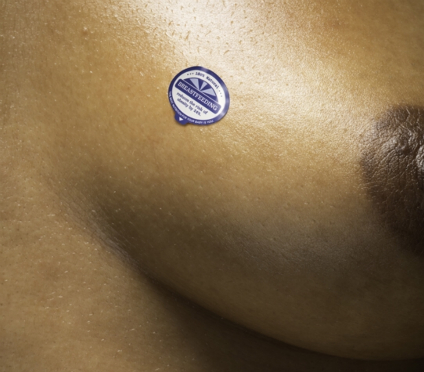
Consider this label, created in what was undoubtedly viewed an act of public service, Pro-Breastfeeding Ads Come With Produce-Style Freshness Stickers for Your Boobs:

Breasts and supermarket produce go well together in advertising lately.

A few month ago, we saw melons in a grocery store made up to look like breasts for a breast cancer awareness campaign. Now, we’ve got the opposite—produce-style freshness stickers that new moms can attach to their boobs as part of a pro-breastfeeding campaign.

BooneOakley in Charlotte, N.C., agency created the campaign, and is handing out the stickers—as well as related wall posters—free of charge to all “baby-friendly” hospitals. (Women and Babies Hospital in Lancaster, Pa., is the first to accept them.) Along with giving info about the health benefits of breastfeeding, the stickers also have a practical purpose—nursing moms can place them on one breast at a time to remind them which breast to feed their baby from next.

The stickers carry a “100% natural” claim, along with the line, “The best nutrition for your baby is you.” They come in three colors, with three different health messages—claiming that breastfeeding reduces a baby’s risk of obesity by 24 percent, of SIDS by 36 percent, and of asthma by 26 percent.

Except that breastfeeding does NOT decrease a baby’s risk of obesity or asthma.

image

Another not-so-subtle effort at lactimidation. What’s next? “Good Mother” stickers for their foreheads?

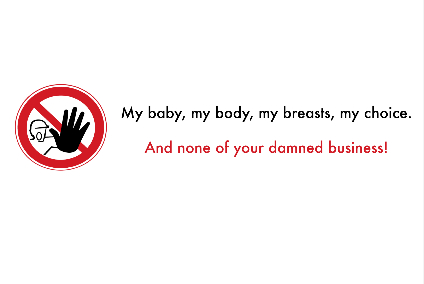
It has given me an idea, though. I’m thinking about making stickers to be affixed by mothers to the doors of their hospital rooms (see above):

My baby, my body, my breasts, my choice … and none of your damn business!

Homebirth is a business

business red word and dollar on magnifying glass

In today’s NYTimes, pediatrician Aaron Carroll wonders How to Make Home birth a Safer Option.

Noting that a recent study in the New England Journal of Medicine showed out of hospital birth in Oregon doubles the risk of perinatal death, Dr. Carroll makes it clear that he and his wife did not think that homebirth was safe enough for their babies:

I and my wife, feared the deaths of our babies during delivery so much that we chose in-hospital births. Our zeal to minimize that specific risk outweighed any other considerations. If faced with the decision again, I don’t doubt we’d choose the same…

The overwhelming majority of American women (nearly 99%) feel exactly the same way. Homebirth is a fringe practice. The pressure to support homebirth is not being driven by women. It is being driven by midwives and the rest of the natural childbirth industry (doulas, childbirth educators, natural childbirth lobbying organizations). Why? Because homebirth is a business.

[pullquote align=”right” cite=”” link=”” color=”F40000″ class=”” size=””]The push for homebirth is not being driven by women. It is being driven by midwives.[/pullquote]

Homebirth represents 100% of the income of American homebirth midwives, and it represents professional autonomy and a lack of professional scrutiny for others.

Dr. Carroll cites the UK experience with midwifery and efforts to lower treatment intensity. But the UK experience has hardly been encouraging. There, too, midwives have been aggressively clawing for market share both in and out of hospitals and the results have been ugly.

1. At Morecambe Bay:

Frontline staff were responsible for “inappropriate and unsafe care” and the response to potentially fatal incidents by the trust hierarchy was “grossly deficient, with repeated failure to investigate properly and learn lessons”.

Kirkup [the author of the report] said this “lethal mix” of factors had led to 20 instances of significant or major failures of care at Furness general hospital, associated with three maternal deaths and the deaths of 16 babies at or shortly after birth.

2. At Royal Oldham/Greater Manchester:

Seven babies and three mums have died in two Greater Manchester maternity units in the space of just eight months – sparking an independent investigation.

3. At Milton Keynes:

History is repeating itself with the deaths of FIVE more newborn babies following staff failures at the hospital maternity unit…

Milton Keynes has now seen at least eight such deaths in two separate periods over the last eight years.
The latest five deaths happened over eight months between 2013 and 2014…

Most of the deaths involved staff failing to recognise or act upon warning signs of foetal distress.
All the babies were full term and previously healthy, and in each case parents claim speedier medical intervention could have saved their lives.

This is not an isolated problem. Liability payments for dead and injured babies now represent fully 20% of the NHS maternity budget.

That’s what happens when health systems employ midwives to lower treatment intensity.

The question we ought to be asking is not how to make homebirth safer (although that is a worthy goal); the question we should be addressing is: why do midwives promote homebirth as safe when it manifestly increases the risk of death?

Midwives are infatuated with homebirth for a number of reasons:

1. It is the natural end point of their love affair with promoting what they can do and demonizing what they cannot. They’ve gone from favoring the employment of midwives in maternity units, to midwife led units and birth centers. Homebirth is the logical next step, freeing them from any scrutiny by other health professionals.

2. It reflects the intellectually and morally suspect philosophy that the “best” birth is NOT the safest birth, but the birth with the least interventions.

3. It ensures that women cannot get effective pain relief.

4. It is a midwife full-employment plan. In contrast to a hospital based unit where one midwife can care for multiple women at a time, homebirth (in many countries) requires two midwives to care for one woman.

Women (and their physicians) have very different priorities. Homebirth is not popular and will never be popular among pregnant women. Most women have no interest in anything that raises the risk of perinatal death. Homebirth is deeply unpopular among obstetricians; most of us abhor anything that increases the risk of perinatal death. Homebirth is anathema among neonatologists for the same reason.

Follow the money! Homebirth is a business. It isn’t about women or babies or birth; it’s about midwives … and women contemplating homebirth (and the doctors who care for them) need to understand both the risks of homebirth and the self-serving motivations of those who promote it.

Natural parenting is a risk factor for tyranny

image

Homebirth, and natural childbirth advocates insist that “Peace on Earth Begins With Birth.”

That’s not what my research shows. I’ve discovered an astounding fact about natural childbirth, breastfeeding and attachment parenting: all are risk factors for tyranny, mass murder and a variety of other ills.

Consider:

[pullquote align=”right” cite=”” link=”” color=”#00A8BD” class=”” size=””]Almost all of history’s greatest tyrants were breastfed … exclusively.[/pullquote]

Of history’s greatest tyrants, men such as Hitler, Torquemada, Henry VIII, Attila the Hun, etc., nearly all were born vaginally. The only potential exception is Julius Caesar, reputedly born by way of the eponymous Caesarean section.

Almost all of history’s greatest tyrants were breastfed … exclusively.

The long term effect of giving birth without pain medication is dreadful. 100% of the children born to women who gave birth before the advent of anesthesia in the mid-nineteenth century are now dead.

Vaginal birth is a risk factor for Communism: Marx, Engels, Lenin, and Stalin were all born vaginally.

Breastfeeding is a risk factor for plague. Nearly 100% of people who died of the Black Death were breastfed.

Attachment parenting played a major role in imperialist expansion in the US. Fully 100% of the invaders who displaced the Native American population of this continent were born vaginally. Moreover, fully 100% of the Native Americans who were unable to resist the advent of the invaders were breastfed.

Breastfeeding is a risk factor for violent behavior. Almost all Viking marauders were breastfed.

Nearly all slave-holding Americans, plantation owners and the entire Confederate army were born vaginally.

Not a single Crusader was born to a woman who had an epidural in labor.

Vaginal birth is a risk factor for anti-social behavior. Roman emperors Caligula and Nero, as well as Jack the Ripper and Lizzie Borden (who committed patricide AND matricide) were born vaginally.

Breastfeeding leads to transmission of disease. Typhoid Mary was breastfed.

Hospital birth promotes technological progress. Desk top computers, iPhones, Skype and Twitter did not exist until the proportion of US births occurring in hospitals rose above 90%.

What is the cause behind these incontrovertible facts?

First, we’ve known for centuries that deep seated prejudice is “imbibed with mother’s milk.” I’ve never heard of anyone imbibing hatred with Similac, so the obvious solution is to promote formula feeding.

Second, as Dr. Michel Odent has insisted, oxytocin is the love hormone and some women clearly don’t have enough love. The solution is oxytocin supplements. Fortunately, pitocin has the exact same chemical composition of oxytocin, so it seems clear that, to be on the safe side, all labors should be induced or augmented with pitocin.

Finally, epidurals ought to be mandatory in labor. The mothers of the greatest tyrants in history gave birth without pain relief and look what happened as a result.

It’s time to acknowledge that “Peace on Earth begins with Interventions in Birth!”


This piece first appeared in August 2012 and is (obviously) satire.

Earth to lactivists: breasts ARE sexual!


The Mother-Whore dichotomy ought to be dead.

It was proposed by Sigmund Freud to explain a tendency for men to characterize women as either asexual, nurturing and worthy of respect or sexually attractive. Unfortunately, the Mother-Whore dichotomy is alive and well and being aggressively promoted by the lactivism community.

If you spend any time reading lactivist books, blogs and webpages, you will be struck by the fact that the issue that appears to generate the most angst is public breastfeeding.

[pullquote align=”right” cite=”” link=”” color=”#999999″ class=”” size=””]The woman who views her breasts as primarily for feeding is a Mother, and a woman who views them as a source of sexual pleasure is a Whore.[/pullquote]

The latest example is the confrontation between actress Alyssa Milano (Mother) and talk show host Wendy Williams (Whore).

This characterization of the face-off appears to be represent the lactivist view:

Alyssa Milano shut down Wendy Williams on the subject of breastfeeding when she appeared on her talk show. Alyssa has been advocate of nursing babies since she began posting photos of herself on Instagram breastfeeding her 1-year-old daughter, Elizabella.

Williams told Milano that breasts are meant to feed babies for a certain amount of time, but other times they’re considered a sexual part of the body. Alyssa Milano shut down Wendy Williams by saying it’s society’s fault for creating that stigma.

Williams called breasts “fun bags” and that she did breastfeed, but did it for a very short amount of time and in private. The talk show host told Milano that she doesn’t want to see breastfeeding in public. 43-year-old Alyssa insisted that it’s that type of attitude that makes this such a hot button issue.

As quoted by People.com, Milano uttered these immortal “Mother” words:

Biologically they’re not made for sexual things, that’s what we’ve done to them.

And Williams responded with what lactivists imply are “Whore” words:

Breastfeeding is only a particular amount of time. The rest of your life, your breasts are sexual things.

The truth, as most people will recognize, is that Milano’s claim is absurd and that Williams is far more accurate in acknowledging that breasts ARE sexual, have always been sexual and will continue to be sexual.

Milano not only knows this, but as this photo from the Starpulse piece makes clear, she wields it to her own advantage:

image

So why did Milano make such a ridiculous statement? I would argue that it reflects that natural parenting desire to neuter women, to see them as either mothers or whores and to flat out refuse to acknowledge that women who are mothers still have sexual needs.

Women who request C-sections to preserve vaginal integrity and reduce the chances of incontinence are derided as giving into pressure to protect a male sexual pleasure. Women who find breastfeeding uncomfortable because they consider their breasts to be exclusively sexual are derided as brain washed. Women who don’t want to share the marital bed with infants as well as husbands/partners are derided as bad mothers obsessed with sexuality.

Apparently the woman who welcomes a vaginal tear is a Mother, and a woman who wants to avoid the tear, the stitches, the pain, the potential loss of sexual pleasure is a Whore.

The woman who views her breasts as primarily for feeding is a Mother, and a woman who views them as a source of sexual pleasure is a Whore.

The woman who kicks her husband/partner out of the marital bed to promote “bonding” is a Mother, and a woman who values sexual intimacy with her partner is a Whore.

The Mother-Whore dichotomy itself is deeply sexist and reflects lactivist discomfort with female sexuality. Mothers must be sexually neutered or else they are whores.

But that’s not the only ugly stereotype at play in this confrontation. Casting Milano, the white woman, as the Mother and Williams, the black woman, as the Whore is a grotesque racist trope. Eugenicists have long portrayed black (“primitive”) women as hypersexual and white women as civilized and demure. Lactivists consciously or unconsciously reinforce those stereotypes in publicizing the confrontation.

Why are natural parenting advocates in general and lactivists in particular so discomfited by and so dismissive of the sexuality of mothers?

I’m afraid it reflects deeply entrenched sexism, rather ironic for a movement that claims to be about what is best for women.

Imagine …

image

With apologies to John Lennon.

Imagine there’s no new mom guilt
It’s easy if you try
No C-section judgment on us
Or epidurals midwives deny
Imagine all the mothers
Trusting their OBs…

Imagine there’s no pressure
If breastfeeding’s hard to do
No reason to shame yourself or others
And no natural childbirth too
Imagine all the mothers
Living without pain…

You may say I’m a dreamer
But I’m not the only one
I hope someday LCs join us
And the world will be as one

Imagine no misuse of science
I wonder if you can
No need to demonize formula
Or make a birth plan
Imagine all the moms and babies
Living life in peace…

You may say I’m a dreamer
But I’m not the only one
I hope someday midwives and doulas join us
And the world will live as one