All posts by Amy Tuteur, MD

Marriage advice on Valentine’s Day

image

I’ve been privileged to be married for nearly 35 years to the most wonderful man in the world. On this Valentine’s Day, I’ve been reflecting on what makes a happy marriage. This is what I’ve learned.

Marry someone who is kind: There is no way to know what life will bring, but I always knew, no matter what happened that my husband would be good to me.

Marry someone who is smart … but don’t let him know exactly how smart you think he is: I like to say that I taught my husband everything he knows, but that’s not true. He’s one of the smartest, most engaged, most interesting people I have ever met. I improved him, of course, but that’s what a wife does.

Marry someone who will be a good parent: Parenting is a big part of marriage for most people and it helps to share it with someone who is a fabulous parent; my husband is an outstanding father. Whatever kind of parent I have been, I have been far better because of his advice, wisdom and patience, both with our children … and with me.

Marry your best friend: Ann Landers, an advice columnist who didn’t live to see the digital age, and is therefore someone you may have never heard of, used to say: “Love is friendship that has caught fire.” My husband was my friend long before we dated and he has remained by best friend ever since.

Don’t get married unless you can’t live without him. Our friends and family know the story of when I first declared that I could marry my husband … before I ever dated him. That shows you how sure I was that I could live with him, but I was equally sure that I could not live without him.

All the best things in my life come from my husband — our marriage, our children, our home, amazing experiences like family reunions and vacations to wonderful places … not to mention some really nice jewelry. He has made my life better in every possible way and I love him and need him more than mere words can say.

Happy Valentine’s Day! I hope everyone is spending the day with those you love.

Is there anyone who has less insight into her own actions than Modern Alternative Mama?

image

Hilarious! You cannot make this stuff up!

If it’s possible for a person to have so little insight into her own actions that it can be measured in negative increments, Katie Tietje, Modern Alternative Mama, shows how it’s done.

[pullquote align=”right” cite=”” link=”” color=”” class=”” size=””]I can’t parody Modern Alternative Mama; she is a parody.[/pullquote]

I can’t parody Tietje; she is a parody.

I’ll let her flay herself with her own words from today’s post, laughably titled Being “Semi-Crunchy” Doesn’t Make You Special:

I’ll admit, this post is born of frustration. But, with good reason, I think.

…[T]his is about a certain group of moms, moms who would probably describe themselves as “semi-crunchy,” who actually go around bragging about how smart they are because they’re crunchy…ish. That is, they embrace some aspects of crunchy, but they’re also “smart enough” to trust the mainstream, or scientists, on certain topics. They’re condescending about how this makes them better than all those too-crunchy, natural-or-bust moms (which is how they perceive us).

That. That condescending, “I know better than you stupid natural mamas” is what drives me insane.

So says Tietje, whose entire blog is a momument to unjustified condescension!

Being “Semi-Crunchy” Doesn’t Make You Special

As I said, whatever works for them. Cool

But, semi-crunchy mamas? You’re not special.

Pro tip for Katie. Prefacing withering remarks with “whatever works for you is cool” does not change their ugly intent.

What is Katie really irked about?

…[T]he woman doesn’t actually come right out and say, you’re a bad parent and your choice was stupid. But it’s pretty clearly implied.

Pot meet kettle!

…[I]t’s pretty crappy to brag about how great you are because you did something “normal” or “typical.”

Don’t you understand: only Katie and her buddies are allowed to brag about how great they are!

But wait!

Support other mamas. They don’t have to think like you, or make the same choices you do. That’s okay. Stop thinking they are uninformed, uneducated, ignorant, or bad people. Stop saying that they are, either directly or indirectly. Just trust that all mamas love their babies, many choices are okay, and everyone is doing the best they can.

English to English translation:

Don’t criticize ME. I don’t have to think like you, or make the same choices you do. Stop saying I’m uninformed, uneducated, ignorant, or bad. Stop criticizing ME, either directly or indirectly. I love my babies, my choices are okay, and I’m doing the best I can.

No, Katie, you’re not doing the best you can for your children. You’re doing the best you can for enriching YOURSELF. Your website, YOUR BUSINESS, doesn’t miss a monetization trick. You spew misinformation for PROFIT. You hide behind pious bleating when it suits you, but you are about as condescending as any human being could be with the added drawback that you are utterly, blissfully ignorant in regard to nearly every issue you tackle, whether it is vaccines, homebirth or diet.

Being crunchy doesn’t make you special, Katie Tietje; it marks you as gullible.

Running a crunchy website doesn’t make you special, either. It just marks you as a parasite, profiting by disseminating potentially deadly nonsense.

Muzzling healthcare providers

image

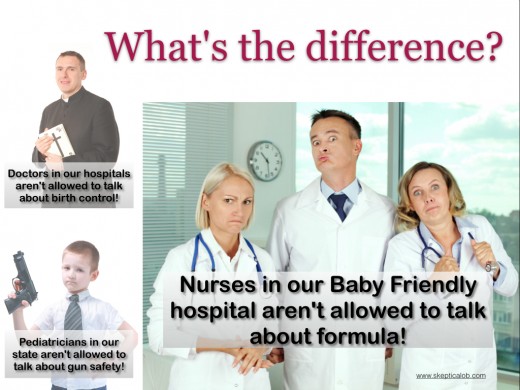
Special interest groups are often tempted to muzzle healthcare providers and many do. What’s the difference between Catholic hospitals muzzling healthcare providers who want to talk about birth control, the gun lobby muzzling healthcare providers who want to talk about gun safety, and the Baby Friendly Hospital Initiative muzzling healthcare providers who want to talk about formula feeding?

What’s the difference between a hospital that won’t inform women about formula feeding and a hospital that won’t inform women about contraception?

image

Lactivists believe women don’t understand the risks of formula feeding or the benefits of breastfeeding. New mothers aren’t making informed choices about infant feeding because they aren’t fully informed. If women only knew of the myriad risks of formula, they’d never choose it.

Lactivists are certain that offering information about formula feeding is tantamount to promoting it. That’s why they have been working assiduously to make sure, through the Baby Friendly Hospital Initiative, that hospital personnel aren’t merely prohibited from counseling women in favor of formula feeding, they are forbidden from mentioning it. Offering formula to new mothers is beyond the pale and under no circumstances should woman receive any gifts from formula companies that might be interpreted to condone the use of formula, even as a supplement to breastfeeding.

Inevitably there has been a backlash against the BFHI but the opponents claim the high ground with the retort: “We are just trying to support breastfeeding!” Lactivists believe they are providing a valuable service limiting information about formula feeding, limiting support for formula feeding and limiting access to formula.

I have a question for the folks at the BFHI:

What’s the difference between the Baby Friendly Hospital Initiative and a Catholic hospital that bans counseling about contraception?

Both insult women by presuming to decide what is the best way for them to use their bodies.
Both interfere with informed consent by withholding information.
Both violate women’s autonomy by mandating how they must use their body parts.
Both interfere with the free speech rights of healthcare providers.
Both appeal to shoddy science, exaggerating risks and inflating benefits.
Both justify their tactics by reference to what is “natural.”
Both insist that the ends (benefits for women’s infants/benefits for women’s immortal souls) justify the means.

So will someone please explain to me why many women who would be appalled by any effort to deprive women of access to contraception think it’s okay to deprive women of access to infant formula?

I don’t see the difference.

The big problem with the CDC’s alcohol recommendations — besides the sexism

Pregnant woman with red wine

Many are rightfully upset with the CDC’s heavy handed alcohol recommendations for women of childbearing age. But as big a problem as the obvious sexism in the recommendations is — women (but not men) must not drink alcohol in order to avoid unintended pregnancy, women (but not men) must be using contraception before they take a drink, and, most egregiously, women (but not men) must abstain in order to avoid domestic violence — there’s an even bigger problem. It is a problem that afflicts many preventive recommendations issued by medical organizations: the recommendations are far out in front of the actual scientific evidence.

The biggest problem with the CDC’s alcohol recommendations for women of childbearing age is that they aren’t science; they’re supposition. The CDC doesn’t “do nuance” and if there was ever a need for nuance it is in regard to the issue of alcohol in pregnancy.

[pullquote align=”right” cite=”” link=”” color=”#FE7295″ class=”” size=””]What’s the relationship between alcohol consumption in pregnancy and FAS? We don’t know.[/pullquote]

According to the CDC:

Alcohol use during pregnancy, even within the first few weeks and before a woman knows she is pregnant, can cause lasting physical, behavioral, and intellectual disabilities that can last for a child’s lifetime. These disabilities are known as fetal alcohol spectrum disorders (FASDs). There is no known safe amount of alcohol – even beer or wine – that is safe for a woman to drink at any stage of pregnancy.

The CDC’s recommendation is based on a scientific fact:

No one knows how low alcohol consumption in pregnancy must be in order to limit problems like fetal alcohol syndrome (FAS).

But instead of explaining why no one knows, the CDC decided to portray any amount of alcohol at any point in pregnancy as having a high potential to cause harm. Instead of explaining the nuances of research in this area, the CDC chose to portray the science as settled when it is anything but.

Why can’t we determine if there is a low level of alcohol consumption that is safe in pregnancy?

Nuance #1: There is no reliable relationship between drinking in pregnancy and FAS. Sure, large amounts of alcohol can lead to FAS, but many women drink moderately without any apparent harm to the developing child. Researchers have noted the “American paradox.” Though alcohol consumption per capita (among women and men) is much higher in European countries than in the US, the incidence of FAS is much lower there. Drinking wine with meals is widespread in Europe, so many women are drinking before they know they are pregnant and when they are pregnant, yet the incidence of FAS is just a fraction of what it is here. Perhaps FAS is more common with some forms of alcohol than with others; we don’t know.

Nuance #2: The likelihood of developing FAS depends on maternal genetics. Some ethnic groups (like Native Americans) have a much higher incidence of FAS than other ethnic groups even when comparable amounts of alcohol are consumed. In other words, some ethnic groups are “prone” to FAS while others are not.

Nuance #3: The likelihood of developing FAS also depends on fetal genetics. A study of twin pregnancy in heavy drinkers revealed an extraordinary finding; while there was 100% concordance among identical twins (if one had FAS, the other did, too), there was less than 70% concordance for fraternal twins:

… Sixteen pairs of twins, 5 MZ [monzygotic] and 11 DZ [dizygotic], all heavily exposed to alcohol prenatally, were evaluated. They represented all available twins of alcohol-abusing mothers who were on the patient rolls of the authors. The rate of concordance for diagnosis was 5/5 for MZ and 7/11 for DZ twins. In two DZ pairs, one twin had fetal alcohol syndrome (FAS), while the other had fetal alcohol effects (FAE). In 2 other DZ pairs, one twin had no diagnosis while one had FAE. IQ scores were most similar within pairs of MZ twins and least similar within pairs of DZ twins discordant for diagnosis.

So what’s the relationship between alcohol consumption in pregnancy and FAS? We don’t know.

The CDC transmuted uncertainty into certainty. Instead of acknowledging that we don’t know the safe limit of alcohol consumption in pregnancy because it depends on factors that we don’t yet understand, the CDC chose to state with certainty that NO amount of alcohol consumption is safe in pregnancy and that is almost certainly not true.

Instead of speaking to women as adults —we’re not sure of the relationship between alcohol and FAS, so we can’t tell you whether there is a safe level of alcohol — the CDC chose to speak to women as if they were children — don’t drink unless you’re using birth control, because we said so.

The CDC’s sexism in its recommendations is inexcusable, but the lack of nuance in the recommendations is hardly much better. When a public health organization doesn’t know the answer, they should acknowledge that they don’t know instead of getting out in front of the science and issuing definitive recommendations that may actually be wrong.

Closing newborn nurseries is unethical

image

I’m deeply disappointed to learn that the hospitals in my state, Massachusetts, are closing their newborn nurseries. It reflects short sighted capitulation to lactivists, and doesn’t accomplish its stated aim. Most importantly, it’s unethical.

As the Boston Globe explained:

The shift is part of a national movement designed to promote breastfeeding, bonding, and parenting skills by having mothers and healthy newborns room together around-the-clock, attended by nurses who look after their needs. Many postpartum specialists now believe that nurseries, long a life raft for recovering mothers, is not the best, or most natural, way to provide care…

Women seeking a few hours of rest after hours of labor or a caesarean section often are surprised to learn that Massachusetts hospitals are increasingly restricting nursery access or, in some states, have closed the nurseries altogether. In Boston, Boston Medical Center began widespread “rooming-in’’ years ago, Mass. General followed suit more recently, and Beth Israel Deaconess Medical Center is taking similar steps. They collectively deliver more than 11,000 babies a year. Brigham and Women’s Hospital also expects to move in this direction.

[pullquote align=”right” cite=”” link=”” color=”” class=”” size=””]There no evidence that rooming in leads to increased breastfeeding rates and there’s no plausible mechanism by which it would do so.[/pullquote]

The national movement is the Baby Friendly Hospital Initiative. The initiative is the crowning glory of the breastfeeding industry’s effort to shame women into breastfeeding. The appellation “baby friendly” is a deliberate slap in the face to women who can’t or don’t want to breastfeed. It offers a hospital credential (for $11,000) provided the hospital can demonstrate that it has done everything possible to harass women who don’t want to breastfeed by lecturing them about its purported benefits, making formula inconvenient and humiliating to obtain within the hospital, and depriving women of gifts of free formula to use when they go home.

What’s wrong with the Baby Friendly Hospital Initiative?

1. In first world countries with easy access to clean water, the benefits of breastfeeding are trivial: a few less colds and episodes of diarrheal illness across the entire population of infants. That’s it. What about all the other amazing claims about breastfeeding? They’re based on research that is weak, conflicting and riddled with confounders.

2. The breastfeeding industry’s understanding of the relationship between rooming in and breastfeeding is precisely backward. Rooming in (baby in the room at all times) doesn’t promote breastfeeding; breastfeeding promotes rooming in, because the women most ideologically committed to exclusive breastfeeding are also ideologically committed to keeping their babies with them at all times. Not only is there no evidence that rooming in leads to increased breastfeeding rates; there’s no plausible mechanism for it to do so. The implication of forced rooming in policies is that women make serious infant feeding decisions based on trivial factors like whether or not they can get some sleep when exhausted by sending the baby to the nursery.

3. Forced rooming in is UNSAFE. Rooming in safely requires a the presence of someone to watch the baby while the mother sleeps. Why is a second person needed? Because many mothers have trouble lifting babies out of hospital bassinets and therefore keep babies in bed with them. It is potentially DEADLY for babies to sleep in hospital beds with their mothers. We know that both soft bedding (such as that in hospital beds) and maternal impairment from narcotics (given for pain relief after C-section or vaginal tears) are associated with sudden infant death.

And that is exactly what has been happening in hospitals. Healthy babies have been dying, either dropped out of bed or accidentally suffocated by their mothers’ bodies. According to the  paper Deaths and near deaths of healthy newborn infants while bed sharing on maternity wards in the Journal of Perinatology:

We report 15 deaths and 3 near deaths of healthy infants occurring during skin-to-skin contact or while bed sharing on maternity wards in the United States. Our findings suggest that such incidents are underreported in the United States and are preventable.

What factors contributed to these 15 deaths and 3 near deaths?

In eight cases, the mother fell asleep while breastfeeding. In four cases, the mother woke up from sleep but believed her infant to be sleeping when an attendant found the infant lifeless. One or more risk factors that are known or suspected (obesity and swaddling) to further increase the risk of bed sharing were present in all cases. These included … maternal sedating drugs in 7 cases; cases excessive of maternal fatigue, either stated or assumed if the event occurred within 24 h of birth in 12 cases; pillows and/or other soft bedding present in 9 cases; obesity in 2 cases; maternal smoking in 2 cases; and infant swaddled in 4 cases.

Lactivists, being privileged women themselves, envision that everyone else is like them: privileged to have a partner who will participate in in-hospital baby care, who can take time off from work to be there, and who has enough money to pay a babysitter to stay home with any older children. It doesn’t make any difference to lactivists if they can’t send their babies to the nursery while they sleep; someone else is there to watch the baby. But that’s not the case for most women; they are solely responsible for the care of their newborn even if they are exhausted by a long labor, in pain from surgery or vaginal tears, and impaired by pain relieving narcotics. Closing well baby nurseries doesn’t merely deprive these less privileged women of time to recover; it literally puts their babies at risk for death at their own hands. That is unethical.

Keep in mind that no one is preventing rooming in. If lactivists want to keep their own babies in their rooms 24/7, they are welcome to do so. But that’s not enough for them; they want to FORCE other women to keep THEIR babies in their rooms with them whether they want to or not. And the kicker is that there’s no evidence that rooming in promotes breastfeeding and no plausible mechanism by which it would.

Any initiative that results in the preventable deaths of babies can’t possibly be baby friendly and it isn’t mother friendly, either. So whose needs are being served by closing well baby nurseries? The Baby Friendly Hospital Initiative should really be called the Lactivist Friendly Hospital Initiative, because it is only the needs of lactivists that are being served. But that’s enough to give hospitals cover to save money by cutting out the nursing staff needed to maintain well baby nurseries. So privileged women have given hospitals the convenient excuse to save money at the expense of poor women and their babies.

How convenient!

How unsafe!

How immoral!

Soliciting nominations for the Golden Boob Awards

image

The shaming of mothers who don’t breastfeed has got to stop. Maybe, it’s time to shame the shamers.

I hereby solicit nominations for a new set of awards, the Golden Boob Awards!

I’m envisioning awards in several categories:

Most outrageous breastfeeding “fact” (amateur)
Most outrageous breastfeeding “fact” (professional)
Most vicious attempt at shaming (amateur)
Most vicious attempt at shaming (professional)
Grand Prize for most despicable claim (both amateurs and professionals are eligible)

The winner of the Grand Prize will receive the tasteful statuette shown above, (available from Amazon UK as a party decoration for bachelor and bachelorette parties).

Please share your suggestions for nominees along with the statement or statements that you think qualify them for this prestigious award. Screen caps would be deeply appreciated.

In my view, the shamers, both amateur and professionals, truly are boobs and their contributions to breastfeeding discourse ought to be honored appropriately!

Trust your intuition, Mama — unless it tells you your breastfed baby is starving

image

“Trust your intuition, Mama!” It’s the all purpose battle cry of the natural parenting industries.

Want to have a homebirth even though ACOG says it increases the risk of perinatal death? Trust your intuition, Mama! You’re safest where you feel safest!

Want to give birth underwater even though the American Academy of Pediatrics says it’s dangerous? Trust your intuition, Mama! Everyone knows, according to the geniuses at the Midwives Alliance of North America (MANA), babies don’t breathe “until they experience gravity!”

[pullquote align=”right” cite=”” link=”” color=”#999999″ class=”” size=””]We have a word for those who think they know more about what patients are experiencing than patients themselves: paternalism.[/pullquote]

Want to skip vaccinations for your children even though every health organization IN THE WORLD says vaccines don’t cause autism? Trust your intuition, Mama! You know that your child’s difficulties were caused by a “vaccine injury.”

Want to supplement your exclusively breastfed baby with formula because he’s losing weight and screaming constantly from hunger? Trus… Wait!! You can’t possibly trust your intuition about something so important!!

You might think that your baby is starving, but, Mama, you’re just an unqualified layperson who should never trust her intuition on such an important matter. ONLY a professional lactivist is entitled to determine whether your baby needs supplementation. No one cares what you think; only someone like lactivist Maureen Minchin is qualified to decided whether your baby is starving — and Maureen already knows, before hearing your story and without ever examining your baby — that he isn’t.

The utter disrespect and dismissiveness with which lactivists treat mothers is one of the ugliest of the ugly, ugly, ugly tactics of contemporary lactivism.

In response to Dr. Alison Stuebe’s Academy of Breastfeeding Medicine post about exclusively breastfed babies suffering brain damaging, life threatening hypernatremia, Minchin offer this charming comment:

… I have my doubts that it was just four days of ineffective feeding that resulted in Meagan’s boy’s neurodevelopment problems… And the clues to what else happened to this child are there in Meagan’s post. He struggled to tolerate any formula and in the end would take ONLY ready-to-feed Alimentum, which as a liquid end-sterilised concentrate was most likely to contain high levels of AGEs and could have had many other problems …

Maureen has her doubts! And why should anyone care what Maureen thinks? She wrote a self-published book and everyone knows that a self-published book is the ultimate mark of expertise!

Maureen is a font of scientific sounding stupidity:

… My book argues that a milk hypothesis makes a lot more sense and has a more substantial scientific basis than the commonly accepted hygiene hypothesis or the biodiversity hypothesis, both of which are discussed. And 2. allergy studies to date have not looked for the intergenerational impacts of artificial feeding, which become very evident when you deal with these families as I have for decades, and can be explained by epigenetics. We are what our grandmothers ate: many first generation formula feeders gestated in bodies that were breastfed probably did better than second and third generation formula-exposed babies gestated in the bodies of women formula-fed as children (even if those women EBF). I have lived through both the 1960-1970s formula invasion (when every child in many hospitals was formula-exposed and most women breastfed for very short periods) and the allergy epidemic in Australia, which has grown with every generation for reasons both genetic and epigenetic.

Won’t someone think of the great grandchildren????????!!!!!!!!!

What’s Maureen’s problem (besides ignorance and grandiosity)? Maureen, like many lactivists, is suffering from cognitive dissonance. In Maureen’s fantasy world where breastmilk is ALWAYS the perfect food for every baby, regardless of circumstances, some babies have the temerity to sustain brain damage and even die because their mothers couldn’t produce enough breastmilk for them. How could that possibly be true? As far as Minchin is concerned, it couldn’t.

As Prof. David Dunning (of the eponymous Dunning-Kruger Effect) explains in regard to “confident idiots” afflicted by the Effect:

Some of our most stubborn misbeliefs arise not from primitive childlike intuitions or careless category errors, but from the very values and philosophies that define who we are as individuals. Each of us possesses certain foundational beliefs — narratives about the self, ideas about the social order—that essentially cannot be violated: To contradict them would call into question our very self-worth. As such, these views demand fealty from other opinions. And any information that we glean from the world is amended, distorted, diminished, or forgotten in order to make sure that these sacrosanct beliefs remain whole and unharmed.

To contradict the superlativeness of exclusive breastfeeding would call into question Minchin’s self-worth. Information about babies who sustain brain damage or die from insufficient breastmilk must be amended, distorted, diminished or ignored in order to make sure that Minchin’s sacrosanct belief in the perfection of breastmilk remains whole and unharmed.

When it comes to weighing brain damaged and dead babies against Minchin’s self-worth, it’s no contest, Minchin’s need for personal validation is far more important to her than what is actually happening to babies and mothers. Minchin is not alone. Other lactation professionals are equally adept at dismissing or outright ignoring what mothers tell them about their babies’ suffering.

So trust your intuition, Mama — unless it conflicts with the intuition of birth workers and breastfeeding professionals.

We have a word for healthcare professionals who think they know more about what patients are experiencing than patients themselves; that word is paternalism. Unfortunately, midwives and lactation professionals, who spend tremendous time and effort bewailing the paternalism of obstetricians and pediatricians have adopted the very attitudes they claim to despise.

Like Minchin, lactation professionals are not listening — and mothers and babies are suffering deeply as a result.

Zika virus causes anti-vaxxers to lose their minds

image

Well, that didn’t take long, did it?

The potential association between a Zika virus outbreak in Brazil and a startling increase in the serious birth defect microcephaly had barely reached public consciousness and anti-vaxxers were spinning a startling new conspiracy theory: the rising incidence of microcephaly in Brazil is caused, not by Zika virus infection, but by … you guessed it … vaccines!

It’s been a tough decade for anti-vaxxers. Their insistence on a link between vaccines and autism has been thoroughly discredited; their insistence that disease like measles disappeared before the introduction of the vaccine has been thoroughly discredited; their insistence that vaccine preventable diseases like pertussis don’t kill babies has been thoroughly discredited. They desperately need a new conspiracy theory.

[pullquote align=”right” cite=”” link=”” color=”#91D6F1″ class=”” size=””]The anti-vax movement has a perfect record; it has never been right about anything.[/pullquote]

Before going further, I must give credit where credit is due: The anti-vax movement has a perfect record!

That’s right. In the 200+ years since the anti-vaccination movement started, it has never been right about anything!

Apparently, anti-vaxxers are determined to continue their uninterrupted losing streak with the Zika virus conspiracy. The essence of the conspiracy is this: It might look like Zika virus infection of pregnant women causes microcephaly, a severe brain deformity, but it’s really caused by Tdap, the vaccine that prevents tetanus and pertussis. Anti-vaxxers point darkly to the fact that, following in 2015 Brazil began routinely offering pregnant women Tdap in the 3rd trimester to protect newborn babies from getting pertussis.

The Zika/Tdap conspiracy follows the usual anti-vax tropes. In “All manner of ills”: The features of serious diseases attributed to vaccination, authors Leask, Chapman and Robbins explain that diseases attributed to vaccines share a variety of common features:

  • Unknown cause
  • Apparent risk in incidence
  • Face value biological plausibility
  • Dreaded outcomes
  • Close proximity to vaccination

All the elements are present in the Zika tragedy. Although the working hypothesis is that the increase in cases of microcephaly are cause by infection with Zika virus, that has not yet been definitely established. There has been a rise in incidence of microcephaly in Brazil. It is biologically plausible. The outcome of microcephaly is usually severe intellectual and physical disability. And the birth of babies with microcephaly may have followed third trimester vaccination with Tdap.

But there’s no evidence that Tdap vaccination in pregnancy leads to microcephaly and considerable evidence that it does not.

Third trimester Tdap vaccination has been instituted around the world. Why is the increased incidence of microcephaly restricted to areas where Zika virus is endemic?

Microcephaly is a defect that originates in the early weeks of pregnancy when the brain is forming. How could an event in the third trimester have any impact on a process that was complete months before?

In contrast, there is considerable evidence that Zika virus infection of pregnant women is the likely cause:

There are a variety of viral illnesses that can cause serious brain defects in the embryo if contracted by pregnant women during the first trimester.

The incidence of Zika virus infection has been rising in Brazil. This is not the first Zika outbreak in the world, but it is the largest. Moreover, there is evidence that the Zika virus has mutated as it traveled around the globe since its discovery in Africa in 1947. The viral mutations appear to allow it to infect humans with greater ease.

Zika virus has been isolated from babies born with microcephaly and from pregnant women who gave birth to microcephalic babies.

Moreover, the conspiracy theory makes no sense in light of the actions of world health authorities:

If microcephaly were caused by Tdap, wouldn’t health authorities be trying to hide the issue not publicize it?

Why would health authorities issue travel advisories to countries where Zika is circulating if they knew that the cause was not Zika?

Why would the US spend money on the development of a vaccine for Zika virus is it’s not the cause of microcephaly?

In summary, there’s considerable evidence that Zika virus infection in the first trimester leads to microcephaly, that the incidence of microcephaly has been rising in parallel with the incidence of Zika infection, and that Zika virus is presented in affected babies and their mothers. There’s absolutely no evidence that Tdap leads to microcephaly and no logical mechanism by which a third trimester vaccination could cause a first trimester defect. Finally, a massive public relations campaign to highlight microcephaly in Brazil makes no sense if health authorities are trying to hide a causal association with Tdap.

But logic has never been the strong suit of anti-vaxxers and I don’t anticipate that there will be an outbreak of logical thinking now. Anti-vaxxers never learn; not matter how many times you destroy their arguments, they keep coming back for more.

Breastfeeding in Parliament is defeat for women, not a victory.

Businesswoman with baby and PC

Australia’s Parliament recently voted to allow female representatives to breastfeed in the chamber. Lactivists are hailing it as a victory. It’s not; it is, paradoxically, a defeat.

Why? It undercuts the professionalism of women and it is a poor exchange for what they really need: generous maternity leave.

Women have struggled for decades to be taken seriously as professionals; breastfeeding at work, while actually working, is unprofessional.

[pullquote align=”right” cite=”” link=”” color=”#f27591″ class=”” size=””]Allowing women to breastfeed at work and therefore skip maternity leave is like allowing workers to eat at their desks and therefore skip a lunch break.[/pullquote]

When my children were babies, my husband occasionally brought them to the hospital to eat when I was available. I nursed them in the privacy of the on call room. I loved seeing them and nursing a baby is so much more enjoyable than pumping.

BUT … I never took my babies into patient rooms; I never brought them to the emergency room and nursed them while performing a D&C for miscarriage; I never had a baby nursing under my surgical gown when performing a hysterectomy or a C-section. It wouldn’t have been not merely unprofessional (although it would indeed have been unprofessional), it would have been disrespectful to patients. They deserved my full, undivided attention whether I was operating on them, examining them or merely talking to them.

I would be appalled if engaged a lawyer and she nursed her baby during a consultation, during a deposition, while arguing with opposing counsel or in court in the middle of a case.

I would be appalled if got on an airplane and the pilot were nursing her baby during my plane flight or even (perhaps especially) if the pilot were nursing while going through pre-flight safety checks.

I can’t think of a single professional whose performance would be enhanced by breastfeeding a child while working.

When Australian representatives are in the Parliament chamber, they are working. They are considering legislation, arguing with colleagues, engaged in procedural maneuvers, supposedly giving their full attention to the people’s business. Bringing a baby into the chamber to feed it is unprofessional. It deprives the people of a legislator who is fully engaged with the matter at hand and it deprives babies of mothers who are fully engaged with them.

Don’t tell me that babies need to eat. Adults need to eat, too, but not in the operating room, while court is in session, or in the cockpit in the midst of actively flying the plane. And while it might not be dangerous to eat while examining a patient, or in a client consultation, or during a job interview, it would be disrespectful.

Moreover, breastfeeding at work isn’t a matter of business accommodating mothers, which would be a victory; it’s all about mothers (and babies) accommodating business.

In the past two decades, the line between work and home has been blurred. Sure, in 1996 someone from work could call you at home to consult on a problem, but when you were out of the workplace, you were generally considered unavailable. Computers, smart phones, and email have changed all that. Work has invaded every moment of life. Unless you are out of the range of a satellite phone, you can always be contacted; your coworkers can always send you documents to peruse; your boss can always expect you to finish that report ASAP and send it immediately even if it’s 2 AM. Work has invaded the home and since there are only a limited number of hours each day, it has cut into family interactions. When my father came home from work, I only had to share him with my mother and sports on TV. When today’s parents of young children come home from work, their children often have to continue to share them with work even when they are physically present.

Allowing breastfeeding in the workplace is a cheap substitute for what women and babies really need: generous maternity leave.

In my view, the feminist ideal would be recognition that women are valuable as mothers and valuable as professionals and workers. The feminist ideal is NOT forcing women to bring mothering into the workplace where it will compromise both job performance and mothering.

Allowing women to breastfeed at work and therefore skip maternity leave is like allowing workers to eat at their desks and therefore skip a lunch break. It’s not a victory; it’s a defeat.