All posts by Amy Tuteur, MD

Want to end the breastfeeding wars? Here’s the first step.

35171140_s

Lactivists are shocked, shocked that anyone might think that there is a war going on over infant feeding.

Casey Rosen-Carole, MD of the Academy of Breastfeeding Medicine (ABM) insists:

I am therefore saddened that media discourse on breastfeeding continues to undermine women by putting forth articles supporting the notion that a battleground exists between mothers…

How could formula feeding mothers have gotten the idea there is a breastfeeding war going on?

[pullquote align=”right” color=”#b44800″]Imagine if a hospital that treated gay people designated itself “traditional marriage friendly.”[/pullquote]

  • Maybe it’s because lactivists ignore what women tell them about breastfeeding difficulties and insist that they must be doing it wrong.
  • Maybe it’s because lactivists ignore what women tell them about breastfeeding difficulties and insist that they aren’t getting enough support.
  • Maybe it’s because lactivists ignore what women tell them about breastfeeding difficulties and insist that formula companies are undermining breastfeeding.
  • Maybe it’s because lactivists ignore what women tell them about feeling shamed and blamed and lactivists deny it.
  • Maybe it’s because lactivists ignore what women tell them about feeling shamed and blamed and lactivists insist the media has made it up.

But there’s something very simple that they could do to dispel the belief that they are shaming and cruel, clinging desperately to the notion that breastfeeding makes them better mothers than women who don’t breastfeeding:

They could change the name of the “Baby Friendly Hospital Initiative” to the “Breastfeeding Friendly Hospital Initiative”.

What is the Baby Friendly Hospital Initiative (BFHI)?

The Baby-Friendly Hospital Initiative (BFHI) is a global program … to encourage and recognize hospitals and birthing centers that offer an optimal level of care for infant feeding and mother/baby bonding. It recognizes and awards birthing facilities who successfully implement the Ten Steps to Successful Breastfeeding and the International Code of Marketing of Breast-milk Substitutes.

In other words, it is an organization designed to promote breastfeeding.

If it’s supposed to promote breastfeeding, why is it called “baby friendly”? It’s called “baby friendly” as a deliberate slap in the face to women who choose formula.

Imagine if a rehabilitation facility that treated people in wheelchairs designated itself “walking friendly.”
Imagine if a hospital that treated gay people designated itself “traditional marriage friendly.”
Or how about a weight loss camp that called itself “thin friendly”?

I suspect most people would have no trouble recognizing the designations as deliberate attempts at shaming.

The ABM tweeted this quote from Dr. Melissa Bartick:
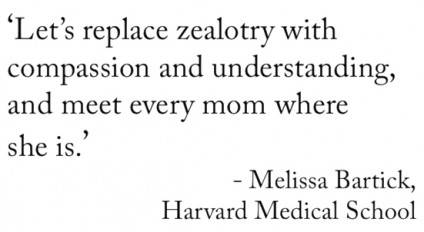
Bartick tweet

Let’s replace zeaolotry with compassion and understanding, and meet every mom where she it.

Compassion?

How compassionate is it to label a breastfeeding initiative “baby-friendly”? It’s not compassionate. It’s humiliating and that’s no accident.

Lactivists need to change the BFHI to the “breastfeeding friendly hospital initiative.” It’s easy; it’s a sign of a commitment to end the breastfeeding wars; and they won’t even have to change the initials of the program.

The next step?

End all punitive hospital practices: no more locking up formula, no more making women sign releases attesting to the superiority of breastmilk in order to obtain formula, no more banning of formula gifts (a ban that hurts the poor and women of color more than anyone else).

I’m not holding my breath. Lactivism represents a last bastion of socially sanctioned bullying. Lactivists are enjoying every delicious opportunity to proclaim their superiority over women who choose (or are forced by medical circumstances to choose) infant formula.

But as long as the BFHI is designated “baby friendly,” all pious attempts to deny or decry the breastfeeding wars will be nothing more than hypocrisy.

Lactivists fight back

Blank book cover isolated on white

Breastfeeding has become an industry, an industry predicated on gross exaggeration of the benefits of breastfeeding in first world countries.

Now that the misrepresentations of the scientific evidence have been pointed out in a national forum (Overselling Breast-feeding by Courtney Jung) lactivists are doing what any industry would do: they’re fighting back to retain market share.

The science is pretty clear that the benefits of breastfeeding in first world countries are trivial; lactivists are not attempting to prove otherwise, because they can’t. Instead, they’re fighting back with weak arguments and logical fallacies. In fact, the arguments are so predictable that they could write a playbook:

[pullquote align=”right” color=”#bf7341″]“When a person tells you that you hurt them, you don’t get to decide that you didn’t.”[/pullquote]
Step 1. Reframe the issue

The issue under discussion is whether lactivists have oversold the benefits of breastfeeding. They have, but they don’t want to address that point. Instead they reframe the issue as opposition to breastfeeding itself.

Melissa Bartick, MD:

It’s become routine: a big anti-breastfeeding piece comes out in a major publication …

The Boob Geek:

How to write an anti-breastfeeding article

Step 2: Appeal to authority

“Because they said so” is a logical fallacy, not an argument. Yes, consensus involving major medical organizations can be an important issue when defending empirical claims like “vaccines are safe and effective.” But when the claim under discussion is “medical authorities have overstated the benefits of breastfeeding,” trumpeting the fact that major medical organizations agree with each other is not a defense.

Julie Taylor, President Academy of Breastfeeding Medicine:

For strong evidence that breast-feeding is by far the optimal nutrition choice to support maternal-child health, consult the Academy of Breastfeeding Medicine, the American Academy of Pediatrics and the World Health Organization.

Step 3: Imply guilt by association

Is there any industry more despised than the infant formula industry? Therefore, insist that those who question the overselling of breastfeeding are influenced by or in league with the infant formula industry.

Casey Rosen-Carole, MD:

… Courtney Jung’s op-ed… posits a false dichotomy, supported by formula advertising, that the true battleground for breastfeeding exists between “lactivists” and mothers who choose to, or must, formula feed their infants…

It is unclear why discourse on the “minimal” or “moderate” effects of breastfeeding continues; it is likely related to influence from both personal experiences of writers and influence from formula marketing.

The Boob Geek:

Remember, though, that no formula company has ever undermined breastfeeding by providing free samples of their products. There is no proof that advertising affects us in any way.

Elizabeth Grattan:

Jung feeds this fallacy to a tee when she neglects to address the tactics of the Infant Formula Council specifically targeting breastfeeding families.

Step 4: Denial

Lactivists are making women who choose infant formula feel bad by exaggerating the benefits of breastfeeding? No, they’re not.

Dr. Rosen-Carole:

This argument posits … that the true battleground for breastfeeding exists between “lactivists” and mothers who choose to, or must, formula feed their infants. Rather, breastfeeding advocacy today focuses on the social conditions that prevent women around the world from being able to make choices that support their health and empowerment, and the futures of their babies.

Dr. Bartick:

It only takes one “lactivist” to piss off a journalist. You never know who might turn around and write that next full page op-ed for the New York Times.

Grattan:

Jung positions those who don’t breastfeed as the victims in society… This lets her pander to the masses by convincing them that they are the ones more deserving of the attention. Again, this approach isn’t new, it’s quite common. This martyr complex is a well known deflect as a way for people to completely avoid social justice.

These writers would do well to keep in mind the immortal words of comedian Louis CK:

“When a person tells you that you hurt them, you don’t get to decide that you didn’t.”

Step 5: Never address the actual issue

Dr. Rosen-Carole:

It is unclear why discourse on the “minimal” or “moderate” effects of breastfeeding continues … I will not engage this discourse here, as it is clear from every medical expert panel in every country in the world that the benefits of breastfeeding for health of mother and baby

English to English translation: I can’t rebut the claim.

I’m not surprised that lactivists are running scared. Jung has pointed out two of the dirty secrets of lactivism: the real benefits of breastfeeding are trivial and breastfeeding is being promoted by an industry that profits from it. There is no way to disprove these claims because they are true. But that doesn’t stop lactivists from trying.

What’s the take away message for the rest of us?

Be aware of the lactivist playbook — reframing, appealing to authority, guilt by association, denial and refusal to address the scientific claims. The tide is turning, and inevitably the truth about the overselling of breastfeeding will out.

Billions saved by breastfeeding? Show me the money!

iStock_000001656690_Small

Lactivists claim that if more women breastfed, we could save billions of dollars in medical costs due to decreased illness and hospitalizations.

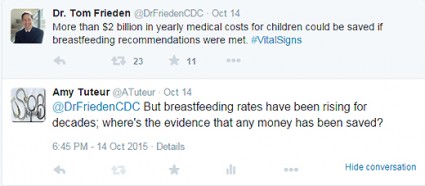
Dr. Tom Frieden from the CDC repeated this cherished maxim in a recent tweet:

Frieden breastfeeding billions

More than $2 billion in yearly medical costs for children could be saved if breastfeeding recommendations were met.

Really Dr. Frieden? Show me the money.[pullquote align=”right” color=””]Surely we should have seen some savings by now, but we haven’t.[/pullquote]

Breastfeeding initiation rates have risen from a nadir of 24% in the 1970’s to the current rate of over 76%. Surely we should have seen some savings by now, but we haven’t.

The truth is that there was never any reason to believe that we would save billions. That figure was conjured by professional lactivist Dr. Melissa Bartick.

In the 2010 paper The Burden of Suboptimal Breastfeeding in the United States: A Pediatric Cost Analysis Bartick “estimated” that the US could save 900 infant lives and $13 billion if 90% of US women breastfed. These numbers were grossly misleading since not even a single US term infant death (let alone 900 per year) had ever been attributed to not breastfeeding and since, to my knowledge, not a single dollar of savings had yet to be recorded. Moreover, Dr. Bartick invoked many benefits to breastfeeding that have never been proven, including childhood asthma, childhood leukemia, type 1 diabetes, and childhood obesity. Presumably Dr. Frieden’s claim about $2 billion dollars in savings is an extrapolation from Dr. Bartick’s “estimate.” She postulated a 90% breastfeeding rate; his claim is predicated on a lower rate. (The case may be different for preterm infants at risk for developing necrotizing enterocolitis (NEC), but, as yet, that has not been demonstrated, either.)

Though Dr. Bartick’s claim has been quoted repeatedly, a review of the scientific literature fails to show any of the predicted cost savings. As far as I know, and I’m happy to be corrected, there is no evidence that there has been any healthcare savings. That’s hardly surprising when you consider that for term infants in first world countries, the benefits of breastfeeding are trivial: a slightly reduced incidence of colds and diarrheal illnesses in the first year of an infant’s life. Even if there were savings, they’d need to be balanced against the millions of dollars spent on breastfeeding each year (pumps, lactation consultants, etc.) as well as the tens of millions spent on to promoting breastfeeding

Perhaps that’s why Dr. Frieden failed to respond to my request for scientific evidence to support his claim.

The claim that billions of dollars in medical costs could be saved by increasing breastfeeding rates is yet another one of the many examples of overselling breastfeeding. Breastfeeding is one of two excellent ways to feed an infant, the other being formula. Those who claim increasing breastfeeding rates save billions need to show us the money.

The breastfeeding initiation rate has tripled in the past 50 years. Where are the cost savings?

The weak, paternalistic Academy of Breastfeeding Medicine response to Overselling Breast-feeding

Time to listen

Yesterday I wrote about Courtney Jung’s NYTimes op-ed Overselling Breastfeeding.

It’s a fabulous piece and has been shared widely on social media. It’s a frontal assault on the industry of lactivism, which profits by moralizing breastfeeding, grossly exaggerating its benefits, boosting the fragile self-esteem of some mothers at the expense of other mothers, and re-inscribing the privilege of white, relatively well off women by enshrining their parenting choices as normative.

Lactivists are very angry about it, which makes their feeble attempts to respond all the more remarkable.

[pullquote align=”right” color=”#f3ce01″]Stop denying that women feel shamed when you shame them![/pullquote]

It’s almost as if they are not listening to what is being said.

Consider the response from The Academy of Breastfeeding Medicine (ABM), the mouthpiece for professional lactivists. It’s entitled Promotion without Support: A Reply to Editorials that Attack Breastfeeding Advocacy by Casey Rosen-Carole, MD, MPH.

I like the title. It’s an explicit acknowledgement that is NOT breastfeeding that is being attacked but the zealous, industry backed efforts to promote breastfeeding. The title is the high point; it’s all downhill from there.

Rather, breastfeeding advocacy today focuses on the social conditions that prevent women around the world from being able to make choices that support their health and empowerment, and the futures of their babies.

That’s shockingly hypocritical. Breastfeeding advocacy focuses on forcing women to choose breastfeeding. There is some attention paid to issues like maternity leave, but the social conditions that are the focus of lactivist efforts are the creation of programs, public health messages and hospital policies that seek to shame women who choose not to breastfeed and to place as many impediments as possible in their way, such as locking up infant formula and forcing women to sign releases acknowledging the superiority of breastmilk before they can obtain formula.

The Orwellian named “Baby Friendly Hospital Initiative” is not friendly to babies and is nakedly cruel to mothers. It is not based on science; there’s no evidence for most of the tenets of the initiative, and the marginal impact is completely oversold.

I will not engage this discourse here, as it is clear from every medical expert panel in every country in the world that the benefits of breastfeeding for health of mother and baby, decreasing economic and health inequities, and supporting a healthy environment, are well established.

Expert medical panels can be and are often wrong, particularly when it comes to dietary recommendations. It is telling that Dr. Rosen-Carole flat out refuses to discuss the actual research (which shows the benefits of breastfeeding in first world countries to be trivial), replacing any evaluation of the scientific evidence with the incredibly paternalistic “just do what we tell you because we know better than you.” I’m not the least bit surprised that Dr. Rosen-Carole refused to discuss the evidence for the purported benefits of breastfeeding. It’s weak, conflicting, riddled with confounders and fails to support nearly every contention of the breastfeeding industry.

I am therefore saddened that media discourse on breastfeeding continues to undermine women by putting forth articles supporting the notion that a battleground exists between mothers…

The conflation of negative social experiences of mothers and breastfeeding advocacy is overstated.

That’s a classic example of “gaslighting,” named after the horror movie Gaslight.

According to Wikipedia:

Gaslighting … is a form of mental abuse in which information is twisted or spun, selectively omitted to favor the abuser, or false information is presented with the intent of making victims doubt their own memory, perception, and sanity. Instances [include] the denial by an abuser that previous abusive incidents ever occurred …

Are you a mother who feels like infant feeding has become a battleground where lactivists abuse other women? It’s all in your head.

When this cruelly dismissive attitude was pointed out to Rosen-Carole, she responded with a disingenuous addendum that continued with gaslighting tactic:

Let me be clear: No one is saying this isn’t happening to moms.

Actually, Dr. Rosen-Carole, YOU are saying it isn’t happening to moms. The language you use, referring to the battleground as a “notion,” leave little room for misinterpretation. Moreover, it implicitly calls the reliability and truthfulness of formula feeding mothers into question. They feel it is a battleground where they are being attacked. Who are you to tell them that they are wrong about their own feelings?

And don’t blame the media.

[The media] are too busy with articles that radicalize breastfeeding advocates and dispute the value of breastfeeding.

That’s a tactic that is beloved of political extremists and shouldn’t be used by medical societies. But lactivists are extremists, too, clinging to cherished beliefs in the face of a growing mountain of scientific evidence that undermines those beliefs. When questioned about their claims, lactivists point fingers at everyone else instead of addressing the criticism.

Rosen-Carole concludes with a flourish of shaming:

…[W]e are saving our justified anger for the development of much-needed policies, medical practices and community movements that support women to have the real possibility of making choices that support the health and well-being of their families. The social and media conversation needs to move on as well. Editorials like Jung’s in the ‘Times’ only serve to continue the false conflation of advocacy and social blaming, and the false battleground between mothers.

Making “choices that support the health and well-being of their families.” So formula feeding moms don’t support the health and well-being of families?

Choices? What choice besides breastfeeding is considered acceptable to professional lactivists.

The “false conflation of advocacy and social blaming”?

Let me make this as clear as I can for the folks at The Academy of Breastfeeding Medicine. It’s time for them to listen:

Stop denying that women feel attacked when you attack them!

Stop denying that women feel shamed when you shame them!

Stop pretending that their feelings don’t reflect the reality that you have created with your endless hectoring, exaggeration and moralizing!

Jung made some strong empirical claims. Address those claims. Examine your cherished beliefs and adjust them based on the scientific evidence. That’s what physicians and scientists are supposed to do; not retreat into denial and defensiveness.

Breastfeeding is not the only thing being oversold; natural childbirth is too.

Overselling natural childbirth

Kudos to Courtney Jung for a fabulous NYTimes op-ed piece, Overselling Breastfeeding.

It’s not surprising that I love the piece. I’ve been saying exactly the same things for years.

According to Jung:

Oddly, the fervor of breast-feeding advocacy has ramped up even as medical research — published in The Journal of the American Medical Association, BMJ in Britain and The American Journal of Clinical Nutrition — has begun to report that the effects of breast-feeding are probably “modest.”…

Why so much pressure to moralize and promote breastfeeding? Because breastfeeding is an industry.

[pullquote align=”right” color=”” ]What could possibly be more lucrative for an industry than marketing its products as a moral imperative?[/pullquote]

…[T]he contemporary obsession with breast milk is also driven in part by big business — including the companies that manufacture breast pumps, the companies that make breast-milk-based nutritional supplements, and the companies that sell breast-feeding accessories. The A.C.A. regulation requiring insurance to cover the cost of breast pumps hands breast-pump manufacturers a substantial subsidy. Market analysts predicted that this regulation alone would expand the breast-pump market by more than 50 percent, to almost $1 billion a year in the United States alone, by 2020.

And that doesn’t even count the lactation consultant industry.

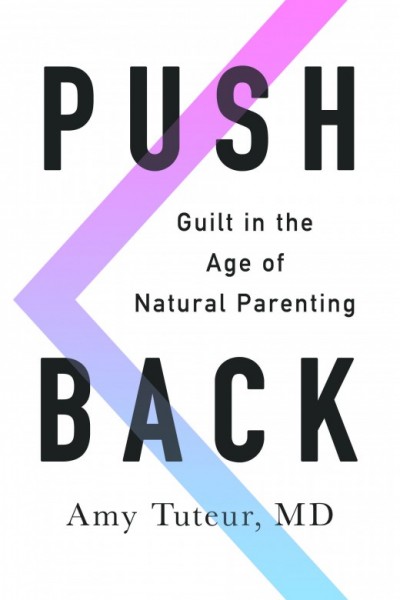
But breastfeeding is not the only thing being oversold for the benefit of the industry that profits from it. The philosophy of natural childbirth (vaginal birth without pain relief) is also being oversold and that industry is much larger and more lucrative. My book, Push Back: Guilt in the Age of Natural Parenting, available in early April 2016, encompasses not just the breastfeeding industry, but also the natural childbirth industry (and the attachment parenting industry).

Push Back cover

The natural childbirth industry embraces midwives, doulas and childbirth educators. It includes books, movies and Hypnobirthing tapes. It is aggressively marketed by everything from blogs that sell ads to large lobbying organizations like The Childbirth Connection. And it represents billions of dollars in profits.

As Jung notes in regard to the breastfeeding industry, people often confuse “industry” for “corporations.” The same thing happens regarding the natural childbirth industry. True, midwives, doulas and childbirth educators don’t make millions of dollars each, but for many of them, natural childbirth represents 100% of their income. That’s in dramatic contrast to obstetrician-gynecologists who may derive the bulk of their income from gynecologic surgery and the majority of whose patients have no interest in the philosophy of natural childbirth. It’s hardly surprising then that the purveyors of natural childbirth services, books and products are very motivated to promote the philosophy.

Though natural childbirth is marketed as safer, healthier and superior to birth with technology, there’s no scientific evidence and there has never been any scientific evidence to support those claims. But when it comes to marketing brilliance, the natural childbirth industry is second to none. Indeed, their marketing tactics are so seductive that many people who would have no trouble recognizing conventional marketing are chastened and distressed when they realize they’ve fallen for the marketing tropes deployed by natural childbirth organizations, celebrity natural childbirth advocates and by the legions of lay women who have been taught to proselytize the beliefs of the faithful.

Jung doesn’t merely echo what I have been writing about the industry of breastfeeding, but she also advances the same claims that I have made about the roles of privilege and race in both the breastfeeding and natural childbirth industries (Breastfeeding: how privileged women make privileged choices normative and Managing the birthing body: how privileged women have made childbirth a project).

The effect of the moral fervor surrounding breast-feeding goes beyond mere shaming. It also reflects, and reinforces, the divisions of race and class that have long characterized American social life. Although 91 percent of women in the top income quintile breast-feed, 71 percent of those below the poverty line initiate breast-feeding. Whereas 81 percent of white women breast-feed, 62 percent of black women do. Breast-feeding is a lifestyle choice the majority now make, but it is more common among white middle- and upper-middle-class parents.

In other words, the breast-feeding imperative has elevated the parenting habits of that relatively privileged minority to a universal standard of good parenting…

The philosophy of natural childbirth rests even more firmly on privilege. Nothing denotes privilege more emphatically than ostentatiously refusing something that those less privileged wish to have. In a world where millions of women, past and present, desperately beg(ged) for pain relief in labor, there’s no better way to communicate the unbelievable wealth, ease and self absorption of modern American life than elevating the refusal of easily available pain relief in labor to an “achievement.”

Follow the money. Both breastfeeding and natural childbirth are industries. What could possibly be better, or more lucrative for an industry than (falsely) marketing its products and services as moral imperatives?

Incontinence: the traumatic result of vaginal birth that dare not speak its name

image

To hear natural childbirth advocates tell it, vaginal birth is an unalloyed good.

The truth is rather different. Normal vaginal birth can lead to a lifetime of serious, embarrassing and life altering problems. Incontinence, among other issues, is an entirely natural consequence of an entirely natural vaginal birth.

As a newspaper piece from New Zealand notes, We need to speak more honestly about traumatic births:

[pullquote align=”right” color=””]Incontinence is an entirely natural consequence of an entirely natural vaginal birth.[/pullquote]

It ruins sex lives and destroys marriages, stops women from engaging in physical activities and even prevents some types of paid work. Although common, many women are so embarrassed by it that even their partners and closest friends are unaware of the problem.

It’s the injury that can result from a vaginal birth.

New research presented last week at the International Continence Society in Montreal about the psychological consequences of traumatic vaginal birth suggests that between 20 and 30 per cent of first-time mothers having a vaginal birth will suffer severe and often permanent damage to their pelvic floor and anal sphincter muscles. There can also be major psychological consequences of traumatic vaginal birth.

Conditions range from life-long urinary and faecal incontinence, painful sex, genital prolapse, body image problems and emotional trauma.

To understand why these problems develop we need to understand how the pelvic organs are held in place.

Ever wonder why the uterus doesn’t fall down through the vagina? It’s partly because of ligaments that hold it in place in the pelvis, but it’s mostly because of the muscles of the pelvic floor that form a sling to hold the organs up.

Here’s a classic view of the of the female pelvic floor seen in many anatomy textbooks:

image

The view is from the top down with the spine at the back (bottom) of the image, the pubic bone in the front (top) and all the organs have been removed.

You can see how the multiple muscles of the pelvic floor form a sling and that sling perforated by three tubes, at the top is the urethra, which carries urine from the bladder to the outside, the middle tube is the vagina, and the tube underneath is the rectum.

Now imagine a baby’s head, 10 centimeters in diameter, passing through this sling. It’s obvious that the fetal head is going to dramatically stretch, distort and possibly tear the muscles that surround the vagina. They will literally never be the same again. Where once the space between the muscles of the pelvic floor was only large enough to accommodate three relatively small tubes, now that space has been stretched tremendously.

Keep in mind that we are talking about internal muscles, not the tears in the vagina that occur externally (1st, 2nd, 3rd and 4th degree tears). External tears produce visible external damage. It’s not difficult to understand that a 3rd degree tear (a tear through the sphincter muscle surrounding the anus, which is locate below the level of the pelvic floor) makes continence of flatus (gas) and stool impossible. The anal sphincter is under voluntary control, but if it is torn, the anus cannot be closed to the prevent the release of the contents of the rectum. Stitch the sphincter muscle back together again and continence will be restored.

Injuries to the muscles of the pelvic floor take place at a deeper level, not visible externally, and not accessible to repair. The most common injury to these muscles is stretching and kegel exercises are designed to strengthen the muscles and thereby tighten them. But the injuries can be more severe than stretching. The muscles themselves can be torn away from the pelvic bones.

Midwife and co-author of the new research into psychological consequences of traumatic vaginal birth Elizabeth Skinner spent two years gathering and analysing the experiences of women who have suffered traumatic vaginal births.

“Women who have sustained vaginal birth trauma often have avulsion of the levator ani muscle. This is a disconnection of that muscle from the pelvic bone resulting in prolapsed organs. Women just put up with this “hidden injury” as they are too embarrassed to discuss symptoms with clinicians who frequently do not believe them,” Skinner says.

No amount of kegel exercises can repair pelvic muscles that are torn. When these muscles are torn, the pelvic organs can slip through the middle of the pelvic floor. This is known as prolapse. When a pelvic organ like the bladder prolapses, it distorts the relationship between the sphincter that controls release of urine from the bladder into the urethra. Although the sphincter itself has not been damaged, it nonetheless prevents the woman from “holding” urine. It works well enough that urine doesn’t constantly dribble out of the urethra, but when the intra-abdominal pressure is dramatically increased as occurs during coughing and sneezing, urine squirts out (stress urinary incontinence).

The damage may not be immediately apparent. It may not appear until menopause when ligaments are weakened by the lack of estrogen and the pelvic organs begin to drop between the muscles. A woman who has had no problem for 20+ years after the births of her children may gradually develop uterine prolapse and/or incontinence as she enters menopause.

How often does damage to the pelvic floor occur?

Professor of Obstetrics & Gynaecology, at the University of Sydney’s Medical School Hans Peter Dietz says that damage from vaginal birth is much more widespread than generally assumed.

“Only about 25 per cent of women get a non-traumatic normal vaginal delivery that did not do serious damage to their pelvic floor or their anal sphincter’, says Professor Dietz. ‘And this is on first time mothers. If we did this kind of analysis on women who try for a VBAC (vaginal birth after Caesarean) it would probably be as few as 10 to 15 per cent.”

In other words, up to 75% of women who have a vaginal birth will end up with some permanent damage to the muscles. The likelihood of damage rises dramatically with the use of forceps for obvious reasons. Putting forceps into the vagina and around the baby’s head creates a larger diameter than the baby’s head alone.

In our efforts to reduce the C-section rate, we’ve made the problem worse.

The policy to reduce caesarean births has lead to an increase in the use of forceps during vaginal deliveries and a tolerance for longer periods of pushing during the second stage of labour, both of which increase the risks to the mother and baby.

“The forceps rate has doubled in NSW over the last 10 years. At some hospitals quadrupled,” says the University of Sydney’s Professor Dietz. ‘That means much, much more damage is done than ten years ago — in some instances twice as much. This is largely a result of the attempt to reduce the caesarean births rate.”

One way to completely prevent damage to the pelvic floor is to have a C-section on maternal request.

Elizabeth Skinner and Professor Dietz are not against vaginal births; in some cases a vaginal birth is the best option. They also note that a caesarean section is major abdominal surgery and carries its own risks.

However women who have big babies, are short in stature, have Asian heritage, and have a family history of difficult births should be informed of their greater risk of trauma if they have a vaginal birth. And all women should be given the choice to make an informed decision for themselves.

Urinary and fecal incontinence, uterine prolapse and painful sex are not trivial problems. They can be life altering and the are the entirely normal consequences of completely normal vaginal birth. It’s hardly surprising that many women want to avoid them and it’s deeply unfortunate that in a society where vaginal birth is valued more than C-sections, no one warns women that they can occur.

The toilet bowl baby

Woman unclogs a stinky toilet with plunger

What could be more deeply spiritual, personally empowering and beautiful than being born head first into a fecally contaminated toilet?

toilet bowl baby

According to the mother’s Facebook post:

Ooommmmggggg!!

I dropped him in the toilet lol id like idk what to dooooo!!!!!!

I love him so much!! Still hasnt hit me yet!!

He’s the chillest baby every BTW!!

Ha, ha, ha, ha. She had a deliberately unassisted homebirth and dropped the baby on its head into the toilet. So funny! NOT.

[pullquote align=”right” color=””]Ha, ha, ha, ha. She had a deliberately unassisted homebirth and dropped the baby on its head into the toilet. So funny! NOT.[/pullquote]

What could be better than that? Apparently having your partner video it instead of catching the baby (always thinking of bragging rights!) and then immediately posting it on Facebook to get kudos from the other narcissists for your stupid, immature stunt.

“I love him so much!!”

Just not so much that she would actually protect his health and life by giving birth in the hospital. Her birth experience is ever so much more important than a baby with a mouth full of feces.

Amazingly, 310 other selfish idiots thought that the post was so beautiful that they liked it.

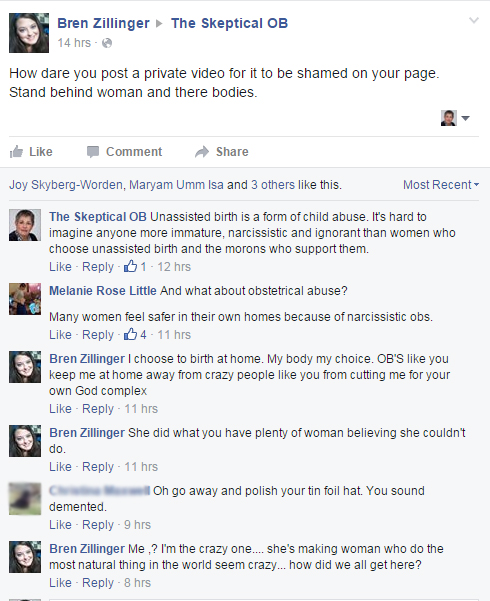
But now these buffoons from the unassisted birth Facebook group are angry.

No, not that the baby was treated literally like shit. Be serious! They don’t care about that.

They’re angry that I posted it on The Skeptical OB Facebook page.

The comments are priceless!

Bren

Melissa

Madison

It was an accident?

No, it wasn’t. She chose to give birth on the toilet and her partner chose to record it instead of catching the baby.

I’m “judgemental”? Damn straight!

It’s beautiful? Only if you think the important part of birth is bragging to your friends regardless of what happens to the baby.

The parachuters proceeded to embarrass themselves by bleating the usual homebirth garbage …

Hannah Lee

… but were unable to back it up with any scientific evidence of any kind.

No problem!

Dietra

As Dietra explains, whether homebirth is safe or not “has nothing to do with facts.”

Sorry Dietra, but it has everything to do with facts.

It’s a FACT that homebirth increases the risk of perinatal death up to 800%.

It’s a FACT that there is no evidence that homebirth in the US is safe.

It’s a FACT that there is no evidence that unassisted birth is ever safe.

But, hey, what are facts compared to a mother’s right to risk her baby’s death for kudos from her Facebook friends? What are facts when compared to a mother’s right to drop her baby head first into a fecally contaminated toilet? What are facts compared to a mother’s desperate need to boost her fragile self esteem with a selfish, immature narcissistic stunt like homebirth?

It’s hardly surprisingly that in a world where dropping your baby onto its head in the toilet is considered “beautiful” facts make no difference at all.

New natural childbirth motto: Safety Third!

Safety first on blackboard

The natural childbirth movement has unveiled a new motto:

Safety Third!

No, not really, but they might as well have made it their motto.

Yesterday I wrote about midwife Hannah Dahlen and her various cold blooded statements about perinatal death, especially:

[pullquote align=”right” color=”#c89f1e”]To hear many midwives and natural childbirth advocates tell it, the first and most important priority is the mother’s birth experience.[/pullquote]

When health professionals, and in particular obstetricians, talk about safety in relation to homebirth, they usually are referring to perinatal mortality. While the birth of a live baby is of course a priority, perinatal mortality is in fact a very limited view of safety.

A reader, Houston Mom, jokingly described Dahlen’s approach as “Safety Third!” and the more I thought about it, the more apt it seemed as a motto for the entire natural childbirth movement.

Experience First!

To hear many midwives and natural childbirth advocates tell it, the first and most important priority is the mother’s birth experience.

As Caroline Bledsoe and Rachel Scherrer note in The Dialectics of Disruption: Paradoxes of Nature and Professionalism in Contemporary American Childbearing:

… As childbearing became safer and more benign visions of nature arose, undesired outcomes of birth for women came to consist of a bad experience and psychological damage from missed bonding opportunities. Today, with safety taken for granted, the new goal has become in some sense the process itself: the experience of childbirth… (my emphasis)

Specifically:

If nature is defined as whatever obstetricians do not do, then the degree to which a birth can be called natural is inversely proportional to the degree to which an obstetrician appears to play a role. The answer to why obstetricians are described with such antipathy thus lies not in the substance of what obstetricians do that is unnatural … but in the fact that obstetricians represent a woman’s loss of control over the birth event…

Many midwives and natural childbirth advocates certainly believe this to be so. Dahlen is shockingly explicit about this belief:

Women have told us there is something worse than death – there is being alive but dead inside. There is being so traumatised by pressurised interventions in their birth plan that … their own mental health is affected.

Worse than death??!!

Ask any woman whose baby has actually died and you will find that there are vanishingly few women who believe that there is something worse than the death of their babies. Dahlen’s claim doesn’t reflect reality, merely the central conceit of those in the natural childbirth industry.

Providers’ Experience Second!

The providers’ experience is dramatically more important in the midwifery/natural childbirth paradigm than in obstetrics. Even a brief look at the midwifery literature confirms the central role of the midwife’s experience. Several years ago I did an informal analysis of the papers in various midwifery and obstetric journals. I found that anywhere from 20%-50% of papers in midwifery journals are concerned specifically with the midwife’s experience, whereas only 0%-8% of papers in obstetric journals mention the obstetrician’s experience.

For many midwives, process is deemed more important than outcome and the ideal process is one that affords the midwife maximum scope for practice and profit. Natural childbirth has come to be defined as “anything a midwife can do” regardless of whether it happens in nature or not.

A rather bizarre confirmation of the centrality of the provider experience among natural childbirth advocates is the existence of counterfeit midwives who have awarded themselves the designation “certified professional midwife” or CPM. These women are laypeople whose only education requirement is a high school diploma, and they fail to meet the minimum international standards for midwives. Not only are these counterfeit midwives allowed to practice in nearly half of all US states, the organizations that certify and represent them have NO safety standards of any kind. Safety is simply not a priority for CPMs.

The other confirmation of the centrality of the “provider” experience is the importance of the payor experience. The British National Health Service is desperately promoting homebirth despite the fact that it is not safe for a substantial proportion of women and despite the fact that 95+% of women have absolutely no interest in delivering far from medical expertise or pain relief. No matter. The ability of the payor to save money (even if those savings are subsequently dwarfed by massive monetary payouts for injured and dead babies) is considered more important than what women actually want or what is safest for babies.

Safety Third!

These factors relegate safety to third position in the hierarchy of natural childbirth values.

Partly it’s because natural childbirth advocates are profoundly ignorant of the medical and historical realities of childbirth. Childbirth is and has always been, in every time place and culture, a leading cause of death of young women and THE leading cause of death of babies. Childbirth in industrialized countries in 2015 appears safe, but only because of the liberal use of obstetric interventions. Without them, childbirth is inherently dangerous.

Mostly, though, it is because many midwives and natural childbirth advocates actually believe that both the maternal experience and the provider experience is more important than whether a baby lives or dies. Not surprisingly, in cultures like UK midwifery where this ugly philosophy is allowed free rein, there are a never ending series of scandals involving preventable perinatal and maternal deaths followed by midwives’ attempts to cover them up.

Modern obstetrics is not perfect. No one knows that better than an obstetrician like me. But at least obstetricians have their priorities in order. Safety of mother and baby comes first. Period. That’s why female obstetricians choose liberal use of obstetric interventions for themselves and their babies. That’s what is safest.

The truth is that safety ought to come first. That doesn’t mean that the mother’s experience is irrelevant; just that it is not as important as her safety and the safety of her baby unless she explicitly claims that her experience is more important to her than whether the baby lives or dies. The providers’ experience ought to be irrelevant. The preferences of midwives ought to be no more important in the provision of childbirth care than the preferences of neurosurgeons in the provision of brain surgery. Making midwives’ experiences equal to or more important than safety is, in my view, grossly unethical.

Ultimately, it is up to individual women to decide what is important to them. If you prioritize safety (and the vast majority of women do), then safety takes precedence. Before choosing providers, you should understand for many midwives though it’s “Safety Third.”

Hannah Dahlen, perhaps you can explain how a mother bonds with a dead baby

iStock_000063248435_Small

She’s back!

Midwife Hannah Dahlen is once again trying to set straight those of us who prefer to deliver live babies instead of dead ones.

You may remember Dr. Dahlen as the author of the heartless claim:

When health professionals, and in particular obstetricians, talk about safety in relation to homebirth, they usually are referring to perinatal mortality. While the birth of a live baby is of course a priority, perinatal mortality is in fact a very limited view of safety.

[pullquote align=”right” color=”#497a1a”]Why do natural childbirth advocates require specific conditions to bond with their babies, while the rest of us love them unconditionally merely because they are ours?[/pullquote]

It’s not simply a priority. Protecting the life of both baby and mother is the sine qua non of competent childbirth care.

Dahlen is also a hypocrite, publicly wailing about toxic postnatal experiences while she and her colleagues promote the conditions that lead to toxic postnatal experiences.

Women have told us there is something worse than death – there is being alive but dead inside. There is being so traumatised by pressurised interventions in their birth plan that they can’t care for their newborn or have a relationship with their partner, and their own mental health is affected.

That’s like the fashion industry bemoaning negative body image. Pious concern for women’s feelings is difficult to take seriously when it comes from the very people who make women feel bad about themselves. In the case of the fashion industry, idealized representations of the female body lead to self hatred when women’s bodies don’t meet the fashion industry norm. In the case of the natural childbirth industry, idealized representations of birth lead to self hatred when women’s birth experiences don’t meet the natural childbirth industry norm.

For example, in a recent piece for The Conversation on vaginal birth after Cesarean (VBAC), Dahlen made a claim that is both cruel and outrageous.

The advantages of a VBAC include … enhanced mother-infant bonding.

There is no scientific evidence for that claim; it is precisely the kind of gratuitously cruel remark that leads women to hate themselves when their birth experiences don’t meet the natural childbirth industry norm, something that Dahlen supposedly deplores.

Perhaps Dr. Dahlen can explain to us how a dead baby affects the mother-infant bond.

The primary reason for repeat C-section is to avoid the risk of uterine rupture and perinatal death. Women who choose repeat C-section often do so because they’d rather carry the risk of surgery rather than foisting the risk of uterine rupture and death on the baby. Yes, the absolute risk that the baby will die from an attempted VBAC is small, but it is real and it WILL happen to some babies. Faced with the small, but real risk of the baby’s death, many mothers will opt for abdominal surgery with the pain, potentially harder recovery and increased risk of infection or bleeding. In other words, women who choose repeat C-section want to protect their babies from any risk, no matter how small, at the cost of pain and potential suffering to themselves.

It seems to me that mothers who choose repeat C-section for that reason have already bonded with their baby in utero.

Midwives like Dr. Dahlen fail to grasp one of the most important things that any pregnant woman could tell her: women bond to their babies before birth and don’t need a specific birth experience to create that bond.

I’ve always loved this quote from Maureen Hawkins:

Before you were conceived, I wanted you. Before you were born, I loved you. Before you were an hour, I would die for you. This is the miracle of love.

It beautifully describes how fiercely I bonded to each of my four children, even before they were born. I had no control over it. It happened without my doing a single thing.

The idea that a vaginal birth is required for a mother to bond to her baby, or enhances the bonding process, is an utter lie.

That’s not to say that every woman bonds to every baby immediately. It can take days or weeks or more, but nearly every woman manages to bond fiercely to her child and nearly every child bonds fiercly to his or her mother.

Perhaps Dr. Dahlen can explain this to us as well:

Why do natural childbirth advocates like Dr. Dahlen seem to require specific conditions in order to bond with their babies, while the rest of us love them unconditionally merely because they are ours?

NHS plans to take pressure off hospitals by encouraging home brain surgery

image

For thousands of years it occurred in the comfort of one’s own home, surrounded by cherished family members and employing principles of ancient wisdom. I’m talking, of course, about ancient brain surgery, known as trephination.

Primitive cranial trephining, the surgical opening of the skull performed with primitive tools and techniques, is one of the most fascinating surgical practices in human history. It probably started in the Neolithic at least 7000 years ago.

Remarkably, it is performed yet today in parts of Africa, South America, and Melanesia.

That’s why it makes perfect sense for the NHS to take pressure off hospitals by encouraging home brain surgery.

[pullquote align=”right” color=”#333333″]There’s an unholy alliance between the NHS, desperate to save money regardless of who dies as a result, and the Royal College of Midwives, desperate to increase autonomy regardless of who dies as a result.[/pullquote]

Wait, what? The NHS is not encouraging home brain surgery? It’s not encouraging it because too many lives, including men’s lives, would be put at risk by brain surgery at home even though that’s how brain surgery was done for most of human history?

Oh, right, the NHS plans to “take pressure off hospitals” by encouraging home birth! That way the only people who will die are women and babies. That makes much more sense and is in keeping with the long time practice of the NHS to save money on the backs and through the agony of women.

According to The Daily Mail:

Officials want to encourage expectant mothers to have their babies outside hospital, either in small, midwife-led units or their own homes.

One proposal under consideration would see women offered vouchers to pay for their own private midwife for a home birth, if it could not be arranged on the NHS.

It has been put forward as part of a major review of maternity services being overseen by NHS England which is expected to report back next year.

Officials want to drive up safety and improve the overall birthing experience amid concerns that some labour wards are very understaffed.

Apparently officials of the NHS feel that it is too expensive to let UK midwives kills babies in hospitals when they could kill them cheaply at home.

1. At Morecambe Bay:

Frontline staff were responsible for “inappropriate and unsafe care” and the response to potentially fatal incidents by the trust hierarchy was “grossly deficient, with repeated failure to investigate properly and learn lessons”.

Kirkup [the author of the report] said this “lethal mix” of factors had led to 20 instances of significant or major failures of care at Furness general hospital, associated with three maternal deaths and the deaths of 16 babies at or shortly after birth.

“Different clinical care in these cases would have been expected to prevent the outcome in one maternal death and the deaths of 11 babies.

Indeed:

The midwives at Furness general were so cavalier they became known as “the musketeers”.

Of note, officials at Morecambe Bay attempted to short circuit investigations of the deaths and only relentless pressure by parents of babies who died ultimately led to an investigation.

2. At Royal Oldham/Greater Manchester, 7 babies and 3 mothers died in the space of 8 months:

Seven babies and three mums have died in two Greater Manchester maternity units in the space of just eight months – sparking an independent investigation.

Bosses at Royal Oldham and North Manchester General Hospitals called in outside experts to review the departments in light of the 10 tragedies …

It is understood the deaths took place between December 2013 and July last year – with four babies and two mums dying at Oldham, and three babies and one mother dying at North Manchester.

Once again, the hospitals themselves failed to investigate the deaths until a midwife anonymously reported them to the newspaper:

One Royal Oldham Hospital midwife, who contacted us anonymously … said: “It’s worse here than Morecambe Bay. It’s really bad, there have been lots of problems. Babies have died unnecessarily.”

3. At Milton Keynes:

History is repeating itself with the deaths of FIVE more newborn babies following staff failures at the hospital maternity unit…

Milton Keynes has now seen at least eight such deaths in two separate periods over the last eight years.

The latest five deaths happened over eight months between 2013 and 2014…

Most of the deaths involved staff failing to recognise or act upon warning signs of foetal distress.

All the babies were full term and previously healthy, and in each case parents claim speedier medical intervention could have saved their lives.

This is the second spate of preventable perinatal deaths:

Between 2007 and 2010 three babies had died due to midwife and doctor failures – a situation slammed as “scandalous” by coroner Tom Osborne .

As a result a CQC task force was put into the unit for a year. But in July 2013 problems recurred when staff failed to act after an unborn baby girl developed an abnormal heartbeat during labour.

The child was born with asphyxia and died two days later.

In November the same year two baby boys died shortly after they were born 24 days apart. Once again, vital clues from their deteriorating heartbeats during labour had been ignored for too long.

In all three cases the hospital admitted liability and offered a settlement – of around £20,000. The parents all refused and are now launching legal action.

Two more babies died between November 2013 and March 2014. In each case the hospital has admitted the care was “not good enough.”.

Meanwhile there is a sixth case, involving a baby boy born in January this year. An inquest will shortly decide whether failures by the hospital contributed to his death.

That’s dozens of preventable perinatal and maternal deaths in just 3 hospital systems. It may be only the tip of the iceberg.

Why has this happened?

I suspect it is because of an unholy alliance between the NHS, which is desperate to save money regardless of who dies as a result, and the Royal College of Midwives, which is desperate to increase its autonomy regardless of who dies as a result.

And I am sad to say, it reeks of gender discrimination. The NHS is trying to save money on the backs of women. They are willing to deprive them of state of the art obstetric care by replacing obstetricians with midwives, by allowing midwives to practice without appropriate oversight, and, in promoting homebirth, by letting them practice with no oversight at all.

I haven’t seen the NHS propose outsourcing to the home of any aspect of male medical care. How about home prostatectomies, or home vasectomies? Each of those procedures is far less dangerous, and far less painful than childbirth … but those procedures involve men, and apparently, the NHS believes that they shouldn’t save money by letting men suffer.

You have to credit the NHS with one achievement, though. In a masterpiece of marketing the NHS plans to take life saving services away from women and babies and pretend that allowing preventable deaths is improving “choice.” The fact is that more than 95% of women DON’T want to give birth at home. They’ve had the option for many years and they’ve rejected it.

But women, their needs, their desires, their very lives, pale when weighed against the NHS desire to save money and the RCM desire to increase autonomy.

The only issue going forward is how many babies and women are going to die as a result.