Category Archives: Uncategorized

The New York Times falls down the natural childbirth rabbit hole

canstockphoto6139465 copy

In a masterpiece of shoddy journalism, New York Times writer Tina Rosenberg published a ridiculous piece in yesterday’s edition: In Delivery Rooms, Reducing Births of Convenience. It is a sad illustration of what happens when a writer falls down the natural childbirth rabbit hole and utterly ignores scientific evidence and even common sense.

The piece begins with a bang:

San Francisco General is largely a hospital for the poor. It’s the city’s safety net hospital, known for providing free care for all who can’t afford it, and for its display — while you wait and wait — of the parade of humanity in all its glory.

It might be surprising, then, that according to data compiled by the state (pdf) it is probably the safest place in California to have a baby. Not the most luxurious, certainly — the labor and delivery ward in the famously dilapidated complex of buildings is strictly industrial. Since the hospital doesn’t accept money from formula companies — the usual providers of baby swag — mothers go home with blankets and baby caps made by volunteers from the Baby Love Ministry at Grace Episcopal Church in Napa, and diaper bags filled with breast pads the hospital purchased using money from a grant.

Really? San Francisco General Hospital has the lowest perinatal and maternal mortality rates in the state of California? No, silly, Ms. Rosenberg didn’t assess safety by how many babies and mothers lived and died. She measured it by the preferred metric of the natural childbirth community, by C-section rate.

While San Francisco General’s maternity ward does not provide luxury, it does something else very well: evidence-based medicine.

The evidence says doctors should do far fewer cesarean sections — the American College of Obstetricians and Gynecologists sets a target rate of 15.5 percent for first-birth low-risk C-sections.

Sometimes C-sections are necessary. Most are probably not. They are done (very rarely) for the convenience of the mother, or, far more commonly, for the convenience of the doctor

Who says that the C-section rate should be 15.5%? According to Ms. Rosenberg, that information comes from ICAN (International Cesarean Awareness Network) a group of lay people with no training in obstetrics or epidemiology, which quoted a press release from the American College of Obstetricians and Gynecologists that DID NOT recommend any optimal C-section rate, let alone one of 15.5%.

And how do we know that most C-sections are done for convenience? Because the Childbirth Connection, the premier lobbying group for the natural childbirth community insists, without even the tiniest shred of evidence, that they are.

In other words, Rosenberg’s piece is predicated on two claims made special interest groups, neither of which is true. What’s next, Ms. Rosenberg, a piece on evolution predicated on the claims of creationists?

Rosenberg should have known better than to rely on special interest groups for her factual claims, but even if she didn’t, basic logic should have alerted her to the fact that safety can ONLY be measured by outcomes, not by procedures. Would Rosenberg judge a cancer center by how much chemotherapy is “necessary” or “unnecessary” or would she judge it by how many cancer patients survived? I doubt it. Would she judge the treatment of heart disease by how many people got angioplasty vs. how many had surgery, or would she judge it by how many people survived and thrived after hospitalization. Almost certainly not.

The goal in obstetrics is NOT to maximize vaginal deliveries. The goal is to maximize babies’ lives and brain function and mothers lives. Apparently Ms. Rosenberg falls into the same trap the natural childbirth crowd does: assuming that a live, healthy baby and a healthy mother are guaranteed. Nothing could be further from the truth.

What are the perinatal and maternal mortality rates at San Francisco General Hospital? I don’t know and I can’t find out. The mortality rates for all California hospitals used to be available on line, but now are available only by request to individual hospitals.

How did Rosenberg come to write such a foolish piece and how did The New York Times come to publish it. Apparently they fell down the rabbit hole of natural childbirth where process matters more than outcome, where a healthy baby is assumed to be guaranteed, and where scientific “evidence” is fabricated to serve the whims of an interest group with absolutely no reference to actual scientific evidence.

Rosenberg  and The Times should be embarrassed by this. A reporter allowed herself to be manipulated by a special interest group and wrote an entire piece about childbirth safety without ever mentioning any safety parameters.

Rosenberg should correct her errors, source her medical facts from medical providers, not lobbyists, and find out the mortality rates at San Francisco General Hospital.

Does San Francisco General have the lowest perinatal and maternal mortality rates in the state? If not, it is not the safest hospital.

A “medwife” reflects on 3rd world birth and American homebirth

iStock_000016207634Small copy

A new guest post from the “Medwife“:

I’m a Medwife and I take call, about 72-96 hours a week to be exact. My phone rings at all hours of the day and through the night. The inevitable page comes through at family reunions and playoff games. Everything from the usual Friday afternoon 30 minutes after office closes “I think I have a UTI” to the Saturday morning 5:00am “I think I have a yeast infection”, spaced between “My pessary fell out” or “I can’t find my IUD strings” and the “Can I take Robitussin while breastfeeding” or “I think my water broke”. Top it off with a few late night calls from the ED and few more from Labor & Delivery and it’s a full time effort to be sure. Add in a few less common favorites “my nipple ring got stuck in the shower curtain” and you just never know what concern is waiting at the other end of the receiver.

But there’s that one call that makes time stop, a stomach churn and the thud of one’s own pulse resonate as whooshing sound through a medwife’s ears: “The baby’s not moving.” Silence. Now I’m not a fan of discussing Monistat-7 at 5:00am on Saturday morning, but “the baby’s not moving” is why it’s impossible to become complacent in the usual barrage of ringing during call hours. It’s the call that makes you hold your breath, the call that makes you wish warp-speed time travel existed and the call you never dismiss. When you’ve done this long enough, you know the last words you always hear before you diagnose a stillbirth are: “The baby’s not moving”. The dreaded call came in last night, despite 8 weeks of discussions on kick counts and a full 24 hours after the last perceived movement. In anticipation of her arrival to Labor and Delivery, commence the breath holding, conduct a review and mental checklist of risk factors (Primigravida, IVF and Gestational Diabetes) and recall last evaluation in office (48 hours ago, Glucose well controlled, Reactive NST, BPP 8/8, AFI 14).

Upon arrival to L&D, the mother was placed on the fetal monitor and a reactive NST was obtained. (Exhale). An ultrasound was ordered and returned a BPP 6/8 with AFI 10. It took a long discussion to convince her it was in her baby’s best interest for continuous monitoring over night with a repeat BPP in the morning. In the morning, the BPP had decreased to 2/8 and new onset of oligohydramios with an AFI of 4, which prompted the move towards a 36 week induction. Her labor progressed with an epidural in place and she proceeded to spontaneously deliver a growth restricted infant. The baby was handed to the Neonatologist for evaluation with Apgars 9-9. A placenta with a velamentous insertion and a hypocoiled cord was delivered. Mom and baby remained stable postpartum and Hepatitis B vaccine was given.

The decision-making was quite straight forward and outcome excellent, not something case studies are made of. However, sitting with this well-educated recently emigrated family awaiting their baby’s safe arrival was a good reminder of how fortunate we are to have the model of care we do in the US:

Health Care Providers: Although providers are available in her country, many women seek care with traditional healers and the extent of physician care is often limited to emergencies. The mother received care in an office and hospital setting with a CNM, Obstetrician, Perinatologist and Endocrinologist according to established standards of care. An Anesthesiologist placed an epidural and a Neonatologist was present to provide resuscitation care at birth.

Gestational Diabetes: When we discussed Gestational Diabetes, the father informed me it is rare for such a diagnosis in his country and that Diabetes is usually only diagnosed in older adults. When I asked him how many women in his family may have been screened in his country, he replied that they simply don’t test for it. No test, no diagnosis. He seemed a bit taken aback when I further discussed the actual rate of in his country is in fact 11 times as prevalent as US Caucasian rates.

Ultrasounds: The father commented on the number of ultrasounds performed during the course of pregnancy. In his country, it was rare to have even one. He questioned the utility or overuse of imaging. She had multiple early IVF ultrasounds for location, number and viability, as well as a third trimester growth ultrasound with weekly BPP/AFI after 34 weeks. Final ultrasound identified a baby with a significant perinatal morbidity risk.

Epidurals: The mother was unable to explain the concept of epidural pain management to her family in her country of origin. They couldn’t understand the concept of controlling pain in labor or the safety of doing so. She eventually gave up. Although she had planned epidural placement from the onset of pregnancy, yet was still quite delighted in how it removed an element of fear of the process of labor.

Hepatitis B Vaccine: The parents consented to Hepatitis B vaccine administration to the baby at birth. In fact, the father had a smile when we asked “You can do that right here? He can get vaccinated?” His response perplexed me until I realized the magnitude of Hepatitis B infection in his country and the relatively new program of pediatric immunization schedules with a history for very low compliance.

As I head home at the end of the day, I am reminded of how grateful I am to be a part of the US healthcare system, its technology and the safety it provides. How differently that phone call could have turned out if the system wasn’t there? How different it would have been if this family was in their country of origin with a perinatal mortality rate 8x’s higher than the US? How different this outcome could have been?

But then again, if we replace the country of origin with US Homebirth… would it really have been any different at all?

It’s so touching when the ignorant band together to defend each other’s ignorance

expression -  Ignorance is bliss - written on a school blackboar

I have often pointed out that no sooner do I write a post on the buffoonery of various homebirth and anti-vax activists then they rush to double down on their buffoonery.

For example, no sooner did I write a post that the surest sign of ignorance is when someone claims to be “educated” then the nitwits at The Thinking Mom’s Revolution rushed to demonstrate that my claims are true. Not surprisingly, the “Thinking Moms” are the one’s who have trouble with thinking.

Consider this gem of stupidity published only this morning, Featured Guest Blog: Oh, for Shame! But Shame on Who?. It is a truly touching example of how the ignorant ban together to defend each other’s ignorance.

The piece is about me and my attempts to hold Jennifer Margulis accountable for her nonsense, ranging from her claims that ultrasound might cause autism to her masterfully idiotic defense of the hideous homebirth death rates in Oregon (“Amy, Oregon has some of the safest best homebirth stats in the country IF YOU DON’T COUNT PORTLAND…”).

The author of the TMR piece is Jody McGillivray. What are McGilligray’s qualifications for assessing any disputes between Jennifer Margulies and myself?

She is a former K-12 foreign language educator and a volunteer autism legislative insurance reform advocate.

Well if that doesn’t qualify her to adjudicate a dispute about scientific evidence, I don’t know what does!!

Not surprisingly, her “defense” of Margulis is as damning as her lack of qualifications to defend Margulis.

The piece reads like it was written for The Onion. Here she lists Margulis’ qualifications for opining on medical issues.

Dr. Margulis is a magna cum laude Phi Beta Kappa graduate of Cornell University. She was accepted for graduate school at Harvard University and the University of California at Berkeley (she turned down Harvard to go to Berkeley). After earning a Master’s there, she spent three years doing development work in West Africa and worked in corporate philanthropy in the United States. As the small-project coordinator for Africare/Niger, Margulis built a hanger for handicapped artisans, directed an off-season gardening project with hundreds of rural women, spent two weeks in the bush interviewing very poor women about their health and the health of their families for a needs assessment, and worked on a child survival campaign. She was invited to speak live on prime-time TV in France to talk about the problem of child slavery. Her writing has appeared in so many magazines and newspapers that I couldn’t list them all, including the New York Times, the Washington Post, and on the cover of Smithsonian magazine.

Exactly! Margulis has NO qualifications of any kind to assess or comment on medical research.

It gets worse:

Oh, and did I mention Jennifer Margulis has a Ph.D.? From Emory University in Atlanta. And four children? And is part of an astonishingly intellectual family that includes at least one Nobel Prize winner (her uncle), a microbiologist who changed our understanding of evolution and whose name is in every Biology text book in the world (her mother), and the former head of the Math department at MIT, who solved several unsolvable problems?

She has a PhD in English! She has smart relatives!

So why does Amy Tuteur think Jennifer Margulis should be included in the “natural childbirth hall of shame?” Her biggest indictment of Dr. Margulis is that Dr. M has no credentials (see above). Her second reason for freaking out? The Business of Baby received two bad reviews.

Earth to Jody! Earth to Jody! My biggest indictment of Jennifer Margulis is that she is WRONG! I didn’t need a scathing review from The New York Times to tell me that Margulis’ book (currently ranked #297,043 on Amazon) is garbage, although I did enjoy Annie Murphy Paul’s takedown:

Inaccurate or inflammatory statements are repeatedly reproduced without adequate substantiation or comment from the other side… Margulis’s treatment of scientific evidence is similarly unbalanced… [U]ltrasound exams of pregnant women may be responsible for rising rates of autism among their children, according to “a commentator in an online article.” This anonymous individual has “used ultrasonic cleaners to clean surgical instruments (and jewelry),” which apparently qualifies him or her to offer an opinion on how the vibration of ultrasound waves may be causing the developmental disorder: “Perhaps this vibration could knock little weak spots in myelin sheeting of nerves or such, I don’t know.”

Jody keeps digging herself in deeper and deeper:

Dr. Margulis was recently in New York City. Why? Because the very same book that Dr. Amy Tuteur (retired)’s followers want you to shred for your hamster cage was nominated as one of five finalists for the prestigious Books For A Better Life Award.

Prestigious? It’s awarded by The New York City-Southern New York Chapter of the National Multiple Sclerosis Society. No doubt they do great work supporting people with MS in NYC and Southern New York, but they are hardly the Pulitzer Prize Committee.

Jody thinks this is her coup-de-grace:

Dr. Margulis really seems to have gotten Dr. Amy Tuteur’s (retired) goat. AT concludes her nasty blog with: “Jennifer Margulis has gone from journalist to joke, because of her endless stream of nonsense. Perhaps if she spent more time learning science, and less time worrying about me, she wouldn’t be one of the leading candidates for a spot in my Natural Childbirth Hall of Shame.”

I snorted my herbal ice tea out my nose when I read that. In fact, it is Dr. Tuteur (retired) who needs to spend more time in the actual field of science and less time personally attacking accomplished women who are working hard to make positive changes, to promote safe childbirth, and to champion safer childhood vaccines.

And who would know better than Jody, than a K-12 teacher of foreign languages?

McGillivray concludes:

Luckily, Thinking Moms are not so easily duped. We research, we study, we read extensively, and we educate ourselves beyond our degrees to become the best moms we can be. We live in the real world, not on the Internet. We make informed choices, beginning with choosing where to give birth, and we recognize that the decisions we make for our children determine how healthy they will be, and what type of people they will become. Nice try, Amy. But we will not be subjugated, intimidated, or made to feel disempowered by a schoolyard bully.

In other words, the “Thinking Moms” have no idea what they are talking about.

Oh, and Jody, no one is trying to subjugate, intimidate or disempower you. I’m simply trying to make you and Margulis look like the fools that you are. Thanks so much making my job even easier than it already was.

I’m not racist but …

I'm not a racist but

Have you ever noticed that there are certain statements that automatically mean the opposite of what the speaker intends?

The classic example is “I’m not racist but …” You just know that whatever follows those words is going to be racist.

According to Rational Wiki:

Any sentence that starts with the words “I’m not prejudiced, but…,” or similar formations (“I’m not racist, but…” or “I’m not homophobic,” “not sexist,” etc.) is likely to contradict itself very rapidly… Saying a sentence that starts with “I’m not X, but…” likely means that you are X.

The exact same principle applies to the favorite phrase of natural parenting advocates. That phrase is “I’m educated and …”

Popular formulations include:

I’ve educated myself about natural childbirth or homebirth or vaccination and …

I’ve done my research on natural childbirth or homebirth or vaccination and …

It is virtually guaranteed that whatever follows is going to be absolute nonsense.

Why?

When a natural parenting advocate claims to be “educated” about medical topics, she certainly doesn’t mean that she went to medical school, has hands on training caring for pregnant women and babies, or is familiar with the obstetric, neonatology or immunology literature. What does she mean? She means that she has adopted a cultural construction of “education” that has little if anything to do with actual knowledge of the topic. She means that she has used Google to access information that may or may not be true. She has ignored those who have actual education and training and crowd sourced her decisions by reading books, blogs, websites and message boards written by other lay people who are often equally ignorant.

A lay person’s claims to be “educated” about a health topic is really a claim of defiance. The person is proudly defying the recommendations of health experts with years of education and years of training in order to credulously accept the bizarre conspiracy theories and absolute nonsense of people who have little or no education and training in the relevant discipline. When a homebirth advocate or vaccine rejectionist claims to be “educated,” she means that she has thoroughly read and blindly accepted the propaganda of other people who are equally uneducated.

What’s doubly ironic about the claim of being “educated” is that people who really are educated on a topic never proclaim themselves to be “educated.” They might tell you about their training, their years of schooling, their professional titles or the papers they have published on the topic, but they will rarely if ever claim to be “educated.”

When someone tells me he is not racist but …, he has helpfully alerted me that the statement that follows is likely to be racist.

And hen someone tells me she is “educated” about childbirth, homebirth or vaccination, she has helpfully alerted me that she is thoroughly ignorant about that topic and about what being educated really means.

Here’s why I want to debate you, Jennifer Margulis

iStock_000008493076Small copy

On Friday I wrote about Jennifer Margulis’ pride in being singled out as one of the birth blogger buffoons.

Margulis wrote on her Facebook page:

A midwife who just requested my friendship on Facebook pointed out that I made the hit list of a notorious internet troll yet again! I am in good company with Ricki Lake and Jen Vbacfacts Kamel…

In response, I publicly offered to debate Margulis:

… I’ll debate you in print on natural childbirth, homebirth, vaccines, whatever you prefer. We can publish the debate on both your blog and mine so there will be no chance of altering our words. Then everyone can vote in the comments sections about who was more persuasive.

I’ll be waiting for your response, but I’m not holding my breath because I could turn awfully blue (just like those hypoxic homebirth babies). You’ll never agree and like Jennifer Block, Henci Goer, Ricki Lake, et al. you’ll run in the opposite direction as fast as you can.

You know as well as I do that you would be eviscerated and publicly humiliated in no time at all, so you won’t dare agree.

Margulis took 24 hours to think about it and respond thus:

Jennifer Margulis 5-3-14

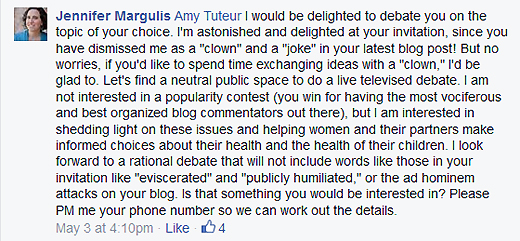
Amy Tuteur I would be delighted to debate you on the topic of your choice. I’m astonished and delighted at your invitation, since you have dismissed me as a “clown” and a “joke” in your latest blog post! But no worries, if you’d like to spend time exchanging ideas with a “clown,” I’d be glad to. Let’s find a neutral public space to do a live televised debate. I am not interested in a popularity contest (you win for having the most vociferous and best organized blog commentators out there), but I am interested in shedding light on these issues and helping women and their partners make informed choices about their health and the health of their children. I look forward to a rational debate that will not include words like those in your invitation like “eviscerated” and “publicly humiliated,” or the ad hominem attacks on your blog. Is that something you would be interested in? Please PM me your phone number so we can work out the details.

Margulis appears confused as to why I would want to debate someone I have dismissed as a clown and a joke, so I will explain:

Jennifer Margulis, I want to debate you because I think you are DANGEROUS.

I hold you personally responsible for putting children and babies at risk by your support of quackery. I would not be surprised if you are personally responsible for serious childhood illnesses in those who follow your advice about vaccination, and personally responsible for the deaths of babies whose mothers embraced homebirth midwifery after you needlessly scared them about the “dangers” of hospital birth.

Perhaps you think that your words are not particularly meaningful, just a way to sell articles and books, and draw internet traffic. Perhaps you consider them a proud defense of your own mothering choices. After all, you never face the inevitable result; you never have to sit with deathly ill children in ICUs; you never have to attend the funerals where they put the tiny white coffins of the babies who die at homebirth into the ground. But when you put words out into the public space, you bear moral responsibility for the consequences.

I realize that your understanding of science is poor at best. You have no understanding of immunology, virology and statistics. You are shockingly ignorant about everything from the dangers of childbirth to the causes of autism. Hence your “warnings” are sincere. But sincerity doesn’t prevent life threatening illness, and it certainly won’t bring babies and children back from the dead.

You potentially HURT and KILL children, Jennifer Margulis, and that’s why I want to debate you.

My desire is to protect babies and children, and therefore, I consider it an unpleasant, but morally necessary task to eviscerate your arguments and publicly show you up for the foolish, dangerous woman that you are. The fact that I personally have no respect for you is irrelevant. Other people do, and, as a result, they risk the lives and health of their children. I want to put a stop to it and I think that I can.

Obviously, you are never going to agree to a debate. You recognize that your arguments WOULD be eviscerated, and you WOULD be held up for public ridicule if you participated in a debate. Therefore, after no doubt carefully mulling how to publicly appear to agree to a debate that you can never let happen, you suggested debating live on television, which, as you know, is about as likely to happen as debating live on Mars. I doubt many people are fooled by your sophistry.

You are no different than Henci Goer, Jennifer Block and every other homebirth advocate I have offered to debate. You may not know much, but your survival instincts are keen. Even you (and they) know that your arguments would not stand up to scientific scrutiny. That’s why the natural habitat of a homebirth blogger is her own website and Facebook page, where she can control any debate by deleting inconvenient facts and keep her followers thoroughly in the dark, while simultaneously congratulating them on being “educated.”

The real question for you, Ms. Margulis, is whether you are willing to publicly own the nonsense that you promote as truth. Although I would prefer to eviscerate your claims, I will probably have to settle for the consolation prize of pointing out that you aren’t willing to face someone with actual knowledge of science in an open debate.

For now, I guess that will have to do.

Dr. Amy’s Natural Childbirth Hall of Shame

Carve it in Stone

I love my job. I really do!

In what other job do you find people stepping forward to make fools of themselves so you can write about it?

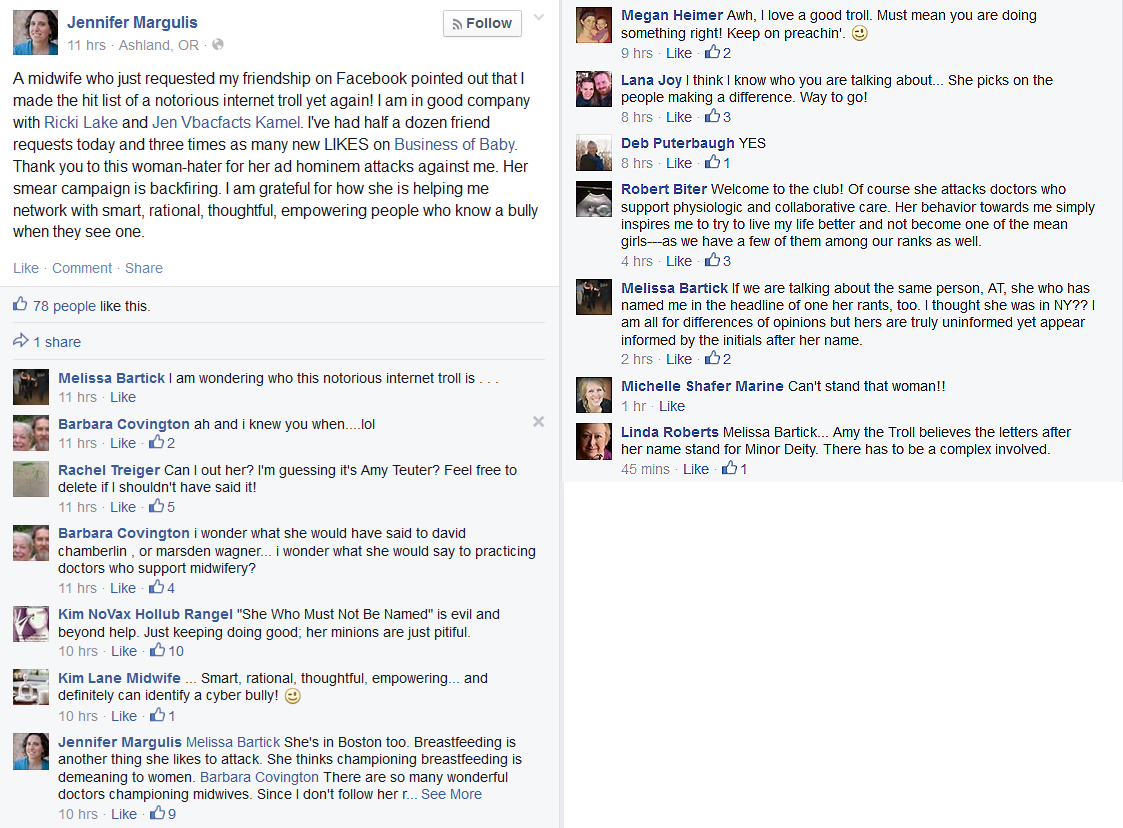
Consider this from anti-vax clown Jennifer Margulis (you can click on the image to see it full size):

Jennifer Margulis 5-2-14

Margulis writes on her Facebook page:

A midwife who just requested my friendship on Facebook pointed out that I made the hit list of a notorious internet troll yet again! I am in good company with Ricki Lake and Jen Vbacfacts Kamel. I’ve had half a dozen friend requests today and three times as many new LIKES on Business of Baby. Thank you to this woman-hater for her ad hominem attacks against me. Her smear campaign is backfiring…

I guess there are blog “affirmations” just like there are birth affirmations and in both cases, saying it over and over again does not make it true.

My campaign against the mistruths, half truths and outright lies of the natural childbirth movement has never been more successful. I’ve never had more traffic. I’ve never had more requests for background help on mainstream media articles. I’ve never had more requests for interviews. I’ve never had so many private emails of thanks.

Margulis, who purports to be a professional journalist, is apparently thrilled to be included with Ricki Lake, a washed up talk show host, and Jen Kamel, a layperson who has the same amount of obstetric/midwifery training as both Margulis and Lake: NONE!

Hey, Jennifer, what are you going to do with all your Facebook likes for your book, currently ranked #297,043 on Amazon, and eviscerated by Annie Murphy Paul The New York Times Book Review? Oh, right, those likes are worthless.

From the NYTimes review of Margulis’ book:

Inaccurate or inflammatory statements are repeatedly reproduced without adequate substantiation or comment from the other side… Margulis’s treatment of scientific evidence is similarly unbalanced… [U]ltrasound exams of pregnant women may be responsible for rising rates of autism among their children, according to “a commentator in an online article.” This anonymous individual has “used ultrasonic cleaners to clean surgical instruments (and jewelry),” which apparently qualifies him or her to offer an opinion on how the vibration of ultrasound waves may be causing the developmental disorder: “Perhaps this vibration could knock little weak spots in myelin sheeting of nerves or such, I don’t know.”

Amy Wong of the Oregonian offered an equally cutting review:

Margulis builds her argument mostly on individual parents’ anecdotes, without providing context for whether they represent common experiences. Many of the anecdotes seem to have been selected purely for their shock value. And she frequently describes in detail how mothers suffered at the hands of doctors or nurses apparently without having sought out the doctors or nurses for verification, comment or context. This is not journalism.

But what’s especially notable about Margulis’ wishful thinking is the rogues’ gallery of “birth workers” who rushed to join her. They condemn themselves by the company they keep, including Robert Biter, who had his medical license revoked after 7 separate findings of malpractice, including the death of a baby at homebirth.

That got me thinking that there should be a Natural Childbirth Hall of Shame. It will take a while to compile the names of the many people who should be in it, but it’s never too early to think about the design.

There should be one wing for the lay people who present themselves as “experts” on childbirth, like Margulis, Lake, Kamel, and Henci Goer, among others. There should be another wing for those “birth workers” who have been persecuted for no better reason than because they presided over the births of a bunch of dead babies, including Biter, Ina May Gaskin (she deserves her own private alcove), Rowan Bailey, Christie Collins, Gloria Lemay, and all the “Sisters in Chains.” There should be a special section for organizations that profit from disseminating misinformation like Lamaze International, and other childbirth lobbying organizations.

And the courtyard should be set aside for the Midwives Alliance of North America, highlighted with a plaque in honor of MANA Liar-in-Chief Melissa Cheyney.

Jennifer Margulis has gone from journalist to joke, because of her endless stream of nonsense. Perhaps if she spent more time learning science, and less time worrying about me, she wouldn’t be one of the leading candidates for a spot in my Natural Childbirth Hall of Shame.

Homebirth midwives and rampant Apgar inflation

Best grade

We’ve all suspected it. We’ve all seen the homebirth photos of hideously blue babies given high Apgar scores by homebirth midwives. Now comes confirmation that Apgar inflation is rampant among homebirth midwives.

In a new paper, Justified skepticism about Apgar scoring in out-of-hospital birth settings published in The Journal of Perinatal Medicine, Grunebaum et al. looked at 13,830,531 singleton term deliveries delivered from 2007 to 2010 in a hospital, a birthing center, or at home by either a physician, a CNM, or another midwife, and who had a 5 min Apgar score documented.

They found:

Newborns delivered by other midwives or certified nurse midwives (CNMs) in a birthing center or at home had a significantly higher likelihood of a 5 min maximum Apgar score of 10 than those delivered in a hospital [52.63% in birthing centers, odds ratio (OR) 29.19, 95% confidence interval (CI): 28.29 – 30.06, and 52.44% at home, OR 28.95, 95% CI: 28.40 – 29.50; CNMs: 16.43% in birthing centers, OR 5.16, 95% CI: 4.99 – 5.34, and 36.9% at home births, OR 15.29, 95% CI: 14.85 – 15.73].

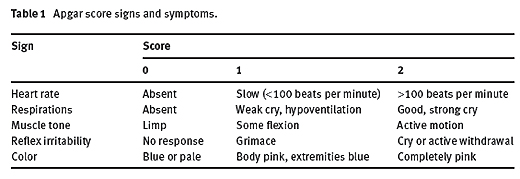
This is both surprising and important since the Apgar score is not discretionary. There are strict criteria for assigning Apgar scores, as the chart below demonstrates, and we would expect only a very few Apgar scores of 10 regardless of setting because normal neonatal physiology means that most babies will have blue extremities for a significant amount of time after birth.

Apgar scores

As the authors explain:

Our study shows an inexplicable bias of high 5 min Apgar scores of 10 in home or birthing center deliveries. Midwives delivering at home or in birthing centers assigned a significantly higher proportion of Apgar scores of 10 when compared to midwives or physicians delivering in the hospital. Studies that have claimed the safety of out-of-hospital deliveries by using higher mean or high cut-off 5 min Apgar scores and reviews based on these studies should be treated with skepticism by obstetricians and midwives, by pregnant women, and by policy makers.
The continued use of studies using higher mean or high cut-off 5 min Apgar scores, and a bias of high Apgar score, to advocate the safety of home births is inappropriate.

That’s a nice way of saying that homebirth midwives are either incapable of accurately assigning Apgars scores or deliberately inflating them.

Interestingly, a homebirth midwifery executive has also noted this inexplicable bias and ascribed a similar cause.

Melissa Cheyney, Liar-in-Chief of the Midwives Alliance of North America (MANA) in her role as Director of Research has invoked the incompetence of homebirth midwives in an effort to dismiss previous studies that have demonstrated an increased death rate at homebirth over comparable risk hospital birth. In Cheyney’s recent bizarre opinion piece in the Lamaze journal Birth: Issues in Perinatal Care alleging a “crusade” against homebirth, she writes:

There appear to be real differences between how physicians and home and birth center midwives perceive and report Apgar scores at the edges of the Apgar spectrum. Physicians are more likely to report fine gradations of either very low or very high Apgar scores, whereas home and birth center midwives are more likely to report Apgar scores of 0 or 10 more absolutely.”

In other words, Cheyney is insisting that homebirth midwives aren’t presiding over more deaths, they’re just stupid. Homebirth midwives deliver babies that are either better or deader than those delivered in hospitals because they are can’t accurately assign Apgar scores. But the reality is that there are no “fine gradations” of Apgar scores; there is no discretion in assigning Apgar scores of 0 or 10; and there are no differences in “perception” of neonatal death or a vigorous, completely pink newborn.

As poorly educated and poorly trained as I believe homebirth midwives to be, even I cannot imagine that they are mistakenly diagnosing babies as dead when they are not dead. And the only remotely plausible reason for more Apgar scores of 10 among a population that has a greater number of deaths than expected is rampant inflation of Apgar scores by homebirth midwives.

The bias of tendency of homebirth midwives to assign higher Apgar scores than warranted was anticipated by Virginia Apgar herself in recommending that the Apgar scores be determined by someone other than the person who delivers the baby:

Dr. Apgar herself anticipated the potential for bias in scoring when she stated: “ it is strongly advised that an observer, other than the person who delivers the infant, be the one to assign the score ” and “ … experience has demonstrated that the person delivering the infant should not be the one to assign the score. He or she is invariably emotionally involved with the outcome of the delivery and with the family, and cannot or unconsciously does not make an accurate decision as to the total score ” .

And indeed, the key difference between the assignment of Apgar scores at home and in the hospital is that at homebirth the midwives assign the Apgar score whereas the hospital nurse assigns the score in the hospital, eliminating the tendency to artificially inflate the score.

The authors conclude by calling into doubt the results of homebirth studies that use mean Apgar scores to “demonstrate” the safety of homebirth:

… [S]tudies that have claimed the safety of out-of-hospital deliveries by using higher mean or high cut-off 5 min Apgar scores and reviews based on these studies should be treated with sustained skepticism by obstetricians and midwives, by pregnant women, and by policy makers. The continued use of studies using higher mean or high cut-off 5 min Apgar scores and a bias toward high Apgar score to advocate the safety of home births is inappropriate.

There is simply no question that homebirth midwives are biased in assigning Apgar scores. Why? Cheyney says that it’s because homebirth midwives are stupid. Grunebaum implies it is because homebirth midwives don’t tell the truth.

Idiots or liars, take your pick, but either way, homebirth midwives are incompetent practitioners. It is hardly surprising then that all existing research on American homebirth (including MANA’s own statistics), all state statistics, and all CDC national statistics shows that homebirth with a non-nurse midwife dramatically increases the risk of neonatal death.

Thinking about homebirth? Perhaps you should think again.

Jen Kamel and the arrogance and ignorance of the birth blogger buffoons

woman with noisemaker on the party

Are you gullible?

Would you take flying lessons from a stewardess?

Would you get legal advice from legal secretary?

Would you take cardiology advice from someone whose qualifications are 3 heart attacks?

If you’re getting your childbirth advice from Jen Kamel and her fellow birth blogger buffoons, you ARE gullible. What’s worse is that you may be so gullible that you are actually paying for that “advice” in the form of “work shops,” courses, web subscriptions, etc. And what’s even worse is that your babies may be paying for your gullibility as you risk (and lose) their lives by following the bloggers’ “advice.”

Who are the birth blogger buffoons? They are women with no training in obstetrics who have the temerity to believe that they know more about obstetrics than obstetricians. They are walking, talking illustrations of the Dunning-Kruger effect, which Wikipedia defines as:

Unskilled individuals suffer from illusory superiority, mistakenly rating their ability much higher than is accurate. This bias is attributed to a metacognitive inability of the unskilled to recognize their ineptitude.

How can you identify the birth blogger buffoons? In most cases, it’s pretty easy. All you need to do is consider their role in the provision of obstetric care.

Doulas are the equivalent of stewardesses; their role is the comfort of clients (passengers). Doulas don’t know any more about childbirth than stewardesses know about safely flying the plane.

Childbirth educators are the equivalent of legal secretaries. The job of a legal secretary is to assist the lawyer; they may know legal terminology but they are unqualified to practice law or to evaluate those who do. Similarly, childbirth educators may know obstetric terminology, but they are unqualified to practice obstetrics or midwifery and incapable of evaluating those who do.

Lay birth bloggers are like lay people everywhere. They have no specialized knowledge, only their own experience, which they often don’t fully comprehend, and which may be irrelevant to your personal situation. Looking to a woman like Jen Kamel for advice on VBACs simply because she had a successful VBAC is like taking oncology advice from someone who survived cancer. It is confusing luck for knowledge.

There are many, many birth blogger buffoons out there, but some are more popular than others. Some of the biggest birth blogger buffoons, in addition to Jen Kamel, are:

Ricki Lake of The Business of Being Born and My Best Birth

January Harshe of Birth Without Fear

Gina Crosly-Corcoran of The Feminist Breeder

Doula Teri Shilling, former president of Lamaze International, of My OB Said What??!!

The childbirth educators of the Lamaze blog Science and Sensibility

The folks at ICAN (International Cesarean Awareness Network)

Journalist Jennifer Margulis

This is hardly an exhaustive list; there are many more.

How do you recognize a birth blogger buffoon? By what they are selling and by the fact that they are selling it. Their primary product is always distrust of modern obstetrics. Although modern obstetrics is probably the most spectacularly successful of all the many successful medical specialties (dropping the neonatal mortality rate 90% and the maternal mortality rate 99% in the past 100 years), the birth blogger buffoons never acknowledge the many, many, many lives saved by obstetricians each and every day. The secondary product is the services, books, workshops, and paid advertising from which they profit. They are not giving their “advice” out of the generosity of their hearts; they make money from it.

For example, both Jen Kamel and Gina Crosly-Corcoran run VBAC Workshops and charge steeply for them. You have to be some kind of stupid to spend money on a doula VBAC workshop from someone who has no experience managing VBACs, grossly deficient knowledge of the risks and benefits, and no obstetric knowledge at all. On the gullibility scale, that’s right up there with paying a stewardess for flying lessons!

I think this person sums it up best:

Every practitioner … has likely witnessed the problems that occur when lay people cross the line of giving information and feel competent to dispense actual medical advice despite the absence of any clinical training or education… A doula is not a medical expert, and medical advice is outside a doula’s area of practice.

My objective is to issue a warning: There are a lot of people out there who have no idea what they are talking about. And it is downright shocking to me how many parents and professionals are willing to just accept something as truth simply because they read about it on a blog … A little bit of knowledge is not enough to understand any complex subject including post-cesarean birth options.

Who said it? Why Jen Kamel, of course. Now if we could only get her to take her own advice.

Jen Kamel, if you can’t acknowledge when you are mistaken, you aren’t doing science.

VBACFacts

Karma is a bitch.

Jen Kamel of the loosely named blog VBACFacts, a lay person with a very poor grasp of obstetrics, decided to do a hatchet job on a wonderful post by Doula Dani.

Danielle wrote about vaginal birth after cesarean (VBAC), Jen’s supposed area of “expertise.” Being the deeply conscientious person that she is , she gave Jen the opportunity to participate in the post. Jen turned her down, but when the post was published, she savaged it, first in private and then publicly by reprinting the private conversation without permission.

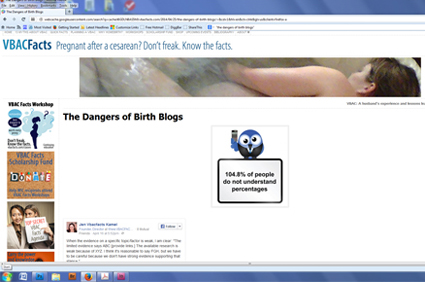
Jen titled her acid post The Dangers of Birth Blogs, and had this to say about Danielle:

Every practitioner and birth professional reading this has likely witnessed the problems that occur when lay people cross the line of giving information and feel competent to dispense actual medical advice despite the absence of any clinical training or education. (For specific examples of what this looks like, click on the third Facebook post above.) A doula is a childbirth support specialist, skilled at helping families navigate labor and birth in a way that fits each family’s needs, values and risk tolerance. A doula is not a medical expert, and medical advice is outside a doula’s area of practice.

Now I don’t name this doula or link to her blog because my objective is not to publicly shame her or to direct people to her blog. While I use my experience with this doula as a example, this is about the bigger picture.

My objective is to issue a warning: There are a lot of people out there who have no idea what they are talking about. And it is downright shocking to me how many parents and professionals are willing to just accept something as truth simply because they read about it on a blog … or writes about it on Facebook … A little bit of knowledge is not enough to understand any complex subject including post-cesarean birth options.

The irony, of course, is that Jen is describing herself. She is a lay person who “routinely crosses the live of giving information and feel competent to dispense actual medical advice despite the absence of any clinical training or education.” She has a little bit of knowledge about VBACs but “not enough to understand any complex subject including post-cesarean birth options.” And like Jen, I marvel at “how many parents and professionals are willing to just accept something as truth simply because they read about it on a blog” … like, say, VBACFacts.

Jen’s post is as clear as mud. It is extremely difficult to read and understand. But I did understand this, which Jen posted in the comments and on the associated Facebook post:

If there is something that I have said above that is inaccurate, please let me know.

So I let her know.

Jen criticized the use of the appalling MANA HBAC data to demonstrate that attempting a VBAC at home has a hideous death rate:

… You have to know that issues with the MANA mortality data. That collection of data is insufficient to accurately measure mortality. 1000 TOLACs [trial of labor after cesarean].

When Danielle points out that the data is not insufficient, Jen doubles down:

It is laughable that she makes this statement. Anyone who claims that 1000 labors is sufficient to measure maternal or neonatal mortality rates in America has no idea what they are talking about. It is simply too small of a sample size.

Jen is withering:

how much of my time should I give you to work on your piece?

2 hours?

3 hours?

7 hours?

I mean… I want to help you, but…

And I’ve already given you a line by line feedback.

And:

As someone with a website, you are under an obligation to be ethical, clear, and transparent. When you make conjectures like that, when you make leaps or tie two events together that have not been clearly connected per research, you are not being clear. It certainly makes for pretty dramatic reading but it’s not accurate.

So the question is: do you want to go for dramatic or do you want to go for factually accurate? Because sometimes factually accurate is a little bit more boring, frankly. All depends on what your objectives are. The truth? Or some other agenda?

And:

Is it good science to take an pretty solid figure (hospital mortality rates) and compare it to a figure found in a study that is not powered to measure mortality rates and then make a conclusion? Perhaps for someone reaching for an agenda, yes. But we have to be honest. And the honest answer is, the MANA data is not powered to measure mortality. They acknowledge that in the narrative. End of sentence. You cannot take this data and wave it around as a strong piece of evidence on the mortality rates of home VBAC.

Too bad Jen is completely, totally, utterly wrong.

I explained to Jen on her Facebook page why the MANA data is adequate to draw conclusions. I explained why you can’t just eyeball the data to determine if it is adequate (as she acknowledged that she did), and there is a statistical test for power. I explained that both sample size AND effect size determine power, meaning that a large effect requires a much smaller dataset to be adequately powered than a small effect and the difference between the HBAC death rate and the hospital death rate is quite large. She countered by claiming that MANA thinks the data is underpowered, as if that means anything.

But apparently, the more she thought about it, the more she realized she had made some serious errors. So she did what any natural childbirth blogger does when confronted with an error: she deleted the evidence. She deleted her blog post (the link above is the cached version) and she deleted the Facebook post where she is shown to be wrong, as well as multiple other Facebook posts that referred her withering hatchet job.

She forgot to take down one of her Facebook posts, the most ironic one of all.

image

The text on the illustration is cut off. It reads:

Science:
If you don’t make mistakes, you’re doing it wrong.
If you don’t correct those mistakes, you’re doing it really wrong.
If you can’t accept that you’re mistaken, you’re not doing it at all.

I propose that we add the following line just for Jen:

If you hide the evidence that you were mistaken, you are a very dangerous birth blogger.

And, Jen, one more thing:

If you don’t apologize publicly to Danielle for that underhanded, vicious, ignorant hatchet job, you are contemptible.

Surprise! Induction lowers the risk of C-section

Pitocin

Natural childbirth and homebirth advocates love to bemoan the “cascade of interventions.” Their theory is that every intervention leads to more interventions until finally a C-section is necessary. The implication is that if the first intervention had been withheld, the mother would have gone on to have an uncomplicated vaginal delivery of a healthy baby. But like so much of natural childbirth and homebirth advocacy, the dreaded cascade of interventions is made up crap, designed to demonize tests and procedures that the natural childbirth industry cannot provide or profit from.

In fact, in many cases, the opposite is true. Many interventions make it LESS likely that a mother will have a C-section, not more. For example, there is a growing body of evidence that induction of labor leads to a LOWER C-section rate than awaiting spontaneous labor. A large, comprehensive study just published in the Canadian Medical Association Journal provides the most compelling evidence yet that induction lowers the risk of C-section.

The study is Use of labour induction and risk of cesarean delivery: a systematic review and meta-analysis by Mishanina et al.

The authors explain:

Although induction of labour has been criticized for an associated increased risk of cesarean delivery, recent studies have shown that there are fewer cesarean deliveries with induction than without it. However, the findings have not had much impact on practice, in part because the systematic reviews investigated subsets of induction and included few randomized controlled trials (RCTs), and because observational data in a cohort study had risk of confounding. Consumer organizations, guidelines and textbooks have given contradictory information about cesarean risk, which can lead to confusion over decision-making, particularly given a desire to support normal birth in the face of increasing cesarean rates worldwide…

How did the authors investigate the issue?

We searched 6 electronic databases for relevant articles published through April 2012 to identify randomized controlled trials (RCTs) in which labour induction was compared with placebo or expectant management among women with a viable singleton pregnancy. We assessed risk of bias and obtained data on rates of cesarean delivery. We used regression analysis techniques to explore the effect of patient characteristics, induction methods and study quality on risk of cesarean delivery.

The literature review led to 157 papers encompassing 31,085 women.

What did they find?

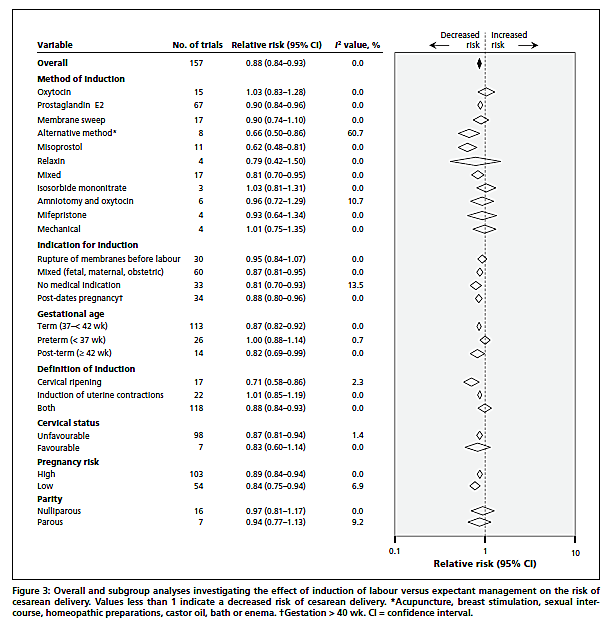
Overall, … the risk of cesarean delivery was lower with labour induction than with expectant management (pooled RR 0.88, 95% CI 0.84–0.93)…

In the subgroup analysis by method of induction, 4 methods were associated with a significant reduction in risk of cesarean delivery: prostaglandin E2 (RR 0.90, 95% CI 0.84–0.96; I2 = 0%), misoprostol (RR 0.62, 95% CI 0.48–0.81; I2 = 0%), alternative method (RR 0.66, 95% CI 0.50–0.86; I2 = 60.7%) and mixed method (RR 0.81, 95% CI 0.70–0.95; I2 = 0%).

Subgroup analysis by indication for induction showed a universal reduction in risk of cesarean delivery. Induction without a medical indication provided was associated with risk reduction of 19% (RR 0.81, 95% CI 0.70–0.93; I2 = 13.5%). When we looked at risk of cesarean delivery by gestational age, we found statistically significant reductions in risk with labour induction in term and post-term pregnancies, but not in preterm pregnancies.

In the analysis by definition of induction, risk of cesarean delivery was significantly lower when the definition included cervical ripening alone or combined with stimulation of uterine contractions than when it included uterine stimulation alone. The analysis by cervical status showed a 13% reduction in risk of cesarean delivery if the cervix was unfavourable at induction (RR 0.87, 95% CI 0.81–0.94; I2 = 1.4%) and no difference in risk if the cervix was favourable (RR 0.83, 95% CI 0.60–1.14; I2 = 0%).

The risk of cesarean delivery was reduced in both high- and low-risk pregnancies.

In other words, induction lowered C-section rates for nearly every possible indication including NO indication, using every one of the most common agents, for both term and postterm pregnancies, in both high and low risk pregnancies, and even if cervical status was unfavorable.

The authors include a forest plot that graphically illustrates the results:

Induction cesarean risk

In addition, outcomes were better with induction:

Analysis of adverse outcomes showed a lower risk of fetal death and admission to neonatal intensive care unit associated with labour induction than with expectant management. No impact on maternal death was shown.

The authors conclude:

Our meta-analysis has provided a robust answer to the disputed question of risk of cesarean delivery associated with induction of labour. Women whose labour was induced were less likely than those managed expectantly to have a cesarean delivery. In addition, the risk of fetal death and admission to neonatal intensive care unit were decreased in the induction group. Our findings have implications for guidelines and the practice of obstetrics, and are reassuring for mothers, midwifes and obstetricians.

So it seems that if you want to reduce your risk of C-section, one of the most effective things that you can do is to have an induction of labor.

Ironic, no?