Category Archives: Uncategorized

You martyred your son for your birth experience. Was it worth it?

Liberty or Death

The mind is an amazing thing. There is really no limit to the human capacity for shedding responsibility for hurting and even killing others. VBAC advocates seem to be particularly adept at this form of denial.

Consider the following story of a baby who died a preventable death at  a VBA2C. The short version:

The mother had a terrible obstetric history, 3 preterm deliveries, one vaginal, a C-section for preterm breech and a C-section for bleeding placenta previa. She was a horrible candidate for VBAC, with a low chance of success and a high chance of rupture. No hospital would accept her for VBA2C because the risk of rupture and death was too high. She decided to labor at home and show up at the hospital fully dilated. Unfortunately she did have a catastrophic uterine rupture and the baby did die EXACTLY as she was warned. Nonetheless, several months after the fact, she is still babbling that this was both unpredictable an unsurvivable. She is flat out wrong on both points.

This is the way she tells the story on a VBAC support website:

Her terrible obstetric history

My first daughter was a PPROM at 31.5wks, born natural vaginal in about 4 hrs post rupture . No augment or meds to stop labor. Was amazing and despite 24days in NICU she is amazing!

My next baby we were so freaked out about prematurity … [A]t 32.5wks .. I was having contrax, we went in for steroids and “stop meds”. During this antepartum stay I was bullied and badgered and harassed. My breech baby girl also had ‘low fluid’ … [They] told us if we didn’t surgically deliver that day my daughter would die. BIRTH TRAUMA occurred for me and major PPD 9months after due to horrible 21day NICU stay and crap bonding (despite steroids her lungs were crap for a 34week girl) …

… 3rd daughter was bound and determined to get to ten! birth vaginally! no bullying allowed! Alas, due to csection, a complete centered placenta previa. Made it to 35weeks when a bleeding placenta forced surgical delivery. Healing birth don’t get me wrong but hospital policy dictated an antepartum stay for a few days during which I was asked to “presign” consent etc and had to fight doctors … my hubby and I even had social workers sent in for us because my RN (who was 8months pregnant) couldn’t understand that a healthy baby was NOT my only goal outcome. (my emphasis)

Three times this mother was in danger of a baby dying. Once she was even in danger of dying herself. Instead of being grateful, she was angry at not having a specific birth experience. After all, a healthy baby was NOT her only goal.

Her interpretation of being told that she was not a suitable candidate for VBA2C:

We had been working with a CNM, OB, MFM doc all on the same page: the two closest hospitals WOULD NOT let me labor without being bullied and badgered for a csection. I was told to come “ready to deliver” which to me meant to labor at home for as long as possible.

Imagine that; they bullied her by telling her that the risk of her baby dying was high. So instead of giving up her “experience” for a live baby, she decided to stay home until the hospital would be forced to let her deliver vaginally.

She and her doula missed the signs of uterine rupture. After multiple hours of regular contractions she felt a “kick” and then continuous pain:

She and I couldn’t differentiate contrax as I was feeling almost tetanic but still very much cramping sensations

Her grossly irresponsible CNM let her labor at home alone and arrived to find that the baby was dead.

 [The rupture] was catastrophic. But my uterus did its job. The scar opened, birthed a baby and placenta and it shut down the bleeding. My son most likely died within the first 10 minutes though we will never know and for that I am grateful. My CNM arrived around midnight as planned and she couldn’t find baby’s heartbeat. After that I went into shock quite promptly and was eventually ambulance transferred for emergency surgery where my son was removed from my abdomen (he was up by my spleen) and 2 liters of blood was removed from my peritoneal cavity. I needed one blood transfusion but my uterus had stopped bleeding completely so the Dr stitched the now small hole and left it in my pelvis. Though he commented “Never use it again!”

Let’s recap:

A woman with a terrible obstetric history was told that she was not a candidate for a VBA2C because the risk of uterine rupture and death of her baby was too high, even for hospitals that routinely handled VBACs. So instead she decided to labor at home, where a rupture would surely be a death sentence for her baby. Just as she was warned, she ruptured and the baby died. How does she justify the entirely preventable death of her son?

Had this happened in the hospital most likely it would not have given us a healthy or alive son. It was a quick rupture per the 3 OBs that were in the OR, like a popped balloon, not a slow tear. There was no predicting it though per our perinatologist, as it is not evidence based to measure scar thickness to TOLAC. We would most likely not have been presenting to a hospital this early in labor anyway, having not lost mucus plug or water breaking etc. And after a pregnancy so unlike all my others, with everything going our way, why would I have thought about rupture?

NO PREDICTING IT? The told her repeatedly that they would not oversee a VBA2C specifically BECAUSE they thought she would rupture.

Hospital birth would not have given us a health or alive son? That’s pure bullshit. Had she had a C-section prior to labor, her baby would be alive and healthy. Had she gone to the hospital and had a C-section at the first sign of labor, her baby would be alive and healthy. And the odds are high that if she had experienced the exact same rupture in the hospital, her baby would be alive and healthy. The ONLY reason her baby is dead is because she chose to martyr him on the altar of vaginal birth. She let him die.

But, as I say, the human mind is an amazing thing. She still hasn’t accepted responsibility for her choice.

We were given the statistics respectfully and it was our choice to make. Obviously the wrong one for my son but how were we to know?

How were you to know? BECAUSE THEY TOLD YOU!!!

There is at least a glimmer of awareness:

I do have more posts coming related to the birth and VBAC, specifically one called , “I Martyred My Son” but since it is highly political I am really working it to make it right.

But only the tiniest glimmer:

My story should not be taken as a scare tactic. I would still have made the same choice but wish we had the option to attempt this in the hospital. I will never know if we could have saved my son if given the opportunity to monitor him earlier.

But what we ALL know is that if she had agreed to a C-section, he would be alive, cooing, babbling, smiling at his older sisters, and instead he is DEAD! All the potential of a life that had limitless potential was snuffed out just because his mother wanted to experience a vaginal birth.

She martyred her son for her own birth “experience.” I’d like to know if it was worth it.

Just how dangerous is childbirth?

Cancel button

Natural childbirth and homebirth advocacy are based on mistruths, half truths and outright lies.

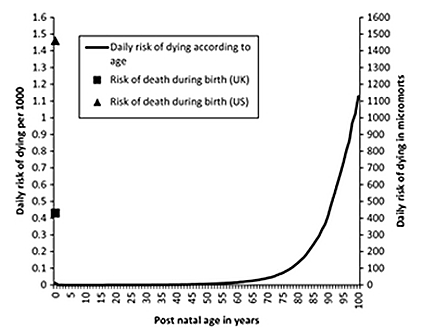
The biggest lie of all, the foundational lie of natural childbirth and homebirth, is the idea that birth is inherently safe. I’ve been writing for years that childbirth is the single most dangerous day of the 18 years of childhood. Now a new paper published in the British Journal of Obstetrics and Gynecology shows that birth isn’t simply the most dangerous day of childhood; it is the most dangerous day of a 90+ year lifespan.

The paper is The dangers of the day of birth. One of the authors wrote about it at his personal blog.

The authors point out that most people think that childbirth is safe:

… these risks are generally perceived to be low, and as a result many parents resent the intrusiveness of hospital birth, fetal monitoring, and other recommendations…

Much of the risk of childbirth remains concentrated in a relatively short period: the day of labour and delivery. In addition, when death occurs so early in life it results in more life years lost on average than when death occurs at an older age.

We speculated that expressed on a daily risk scale, instead of as per thousand births, childbirth risks would appear very different. We aimed to calculate the risk of dying on each day of your life, and compare these risks with other activities or events that an individual may encounter. This information would then be used to calculate the loss of life expectancy sustained with death occurring on the day of birth.

What did they find?

Even with modern obstetric practice the risk of a baby dying on the day of its birth in the UK is greater than the average daily risk of death until the 92nd year of life. We have shown that this risk is comparable with many other high-risk activities, and results in many life years lost.(my emphasis)

So childbirth isn’t safe for babies. It is quite dangerous, comparable to the risk of death for the average 92 year old adult and comparable to the risk of death for those facing major surgery. The graphic representation is impressive:

Risk of death on day of birth

The risk in the US is even higher as a result of a higher rate of risk factors and a lower rate of health care access than in the UK.

And that’s the risk when the baby has access to immediate life saving care. The risk at homebirth is higher still.

When natural childbirth or homebirth advocates tell you to trust birth, show them the graph, and see what they have to say then.

If they still tell you to trust birth, you have learned that you should never trust them.

Childbirth: should we err on the side of caution or err on the side of risk?

iStock_000034612480Small copy

I’m pretty confident that over the next several decades we will reduce the risk of childbirth in dramatic ways. After all, we understand the problems that we face; it’s just a matter of creating the technology that will provide the answers we need.

We know, for example, that the biggest threat to babies is lack of oxygen during labor. We don’t have a way of directly measuring the amount of oxygen that the baby is receiving so we are forced to approximate using existing technology, measuring the fetal heart rate instead. Because the fetal heart rate provides only an indirect, and often inaccurate, picture of fetal oxygenation, obstetricians end up performing unnecessary C-sections for presumed fetal distress that wasn’t distress at all. When we can accurately measure the amount of oxygen in the fetal blood stream, the only C-sections done for fetal distress will be necessary C-sections and the C-section rate will drop dramatically.

The history of obstetrics over the past 100 years is a history of identifying specific risks and then creating treatments to abate those risks or preventive strategies to remove the risks entirely. For example, pre-clampsia/eclampsia has always been a leading killer of mothers and babies. We still don’t understand the cause of the disease, but we do understand the warning signs and we have created treatments and preventive strategies that have dramatically decreased the death rate of pre-eclampsia/eclampsia for mothers and babies.

The evolution of obstetrics, and the dramatic decrease in death rates that have resulted, are a result of technology. In other words, the less we trust birth, and the more we trust technology, the fewer babies and women die. It is simply a matter of time before we have better technology that will help us achieve lower rates of death and injury by more accurately targeting treatments and preventive measures.

The real question for those who care for pregnant women is this: what do we do in the meantime?

When we have imperfect information, and when the lives of babies and mothers are on the line, should we err on the side of caution or err on the side of risk?

The answer to that question delineates the central difference between obstetricians and homebirth advocates. Obstetricians err on the side of caution. They’d rather do perform unnecessary tests, procedures and C-sections in an effort to prevent all preventable deaths. Homebirth advocates err on the side of risk, either by pretending there is no risk (“trust birth”), by ignoring risk (refusing routine tests and interventions), or by treating complications when they happen instead of preventing them (“the hospital is only 10 minutes away”). They’d rather risk preventable deaths than submit to anything that was unnecessary in retrospect.

When homebirth advocates lament obstetricians playing the “dead baby card,” they are making fun of doctors who would rather err on the side of caution. And they are implicitly advising women to err on the side of risk. They basically tell women to gamble the lives of their babies because the chances of disaster are relatively small.

Obstetricians are the equivalent of the people who tell you to board up your windows at the approach of a hurricane, reasoning that boarded up windows won’t break in the event that they are stressed to their limits by wind gusts. Homebirth advocates are the people who tell you not to board up your windows on the theory that you can save lots of time, effort and money by betting that your personal windows are not necessarily going to break in a hurricane, since the odds of a specific set of windows breaking is fairly low. Those who board up their windows are erring on the side of caution. Those who “trust hurricanes” are erring on the side of risk.

Obstetricians are the equivalent of the people who tell you to wear a helmet when riding riding a bicycle, reasoning that people who wear helmets are much less likely to suffer brain injuries if the motorcycle crashes. Natural childbirth advocates are the people who protest helmet laws on the theory that most of the time you won’t get into a crash and it’s so much more enjoyable to feel the wind rushing through your hair. Helmet laws err on the side of caution; those who protest helmet laws err on the side of risk.

So if you are thinking about homebirth, think about this: the day of birth is the single most dangerous day of the entire 18 years of childhood; the risk of death is never higher. Whether you wish to acknowledge it or not, childbirth puts your baby’s life on the line.

The question you need to ask yourself when contemplating the risk to your baby is:

Do you want to err on the side of caution and head to the hospital, or would you rather stay home and err on the side of risk?

It’s time to reject the natural childbirth paradigm as manipulative, unhealthy and deeply anti-feminist

image

Yesterday I drew an explicit parallel between the way that the fashion industry wields the body image issue to induce insecurity and thereby sell clothes, make up and diet aids and the way that the natural childbirth industry uses an idealized image of birth to induce insecurity and thereby sell midwife and doula services, homebirth and a myriad of books, tapes and DVDs.

Over the past few decades everyone from individual women, to physicians, to feminist scholars has come to grips with the fact that the fashion industry sells a view of the female body image that is unhealthy, unrealistic, and deeply toxic to women’s self-confidence. They sell the image that thin women are better, more popular, happier and an ideal to which all women should aspire.

Similarly, the natural childbirth industry sells a view that women who have an unmedicated vaginal birth are better women, better mothers, and an ideal to which all women should aspire. Now is the time for everyone from individual women, to physicians, to feminist scholars to come to grips with the fact that the natural childbirth industry sells a view of birth that is unhealthy, unrealistic and deeply toxic to women’s view of themselves and their confidence as mothers.

It has ever been thus in the natural childbirth industry. The philosophy of natural childbirth was created originally by old, white men to convince women that their primary function in life was to stay home and bear as many children as possible. It is perpetuated by women midwives, doulas, childbirth educators and lobbyists whose income depends entirely on convincing women to judge themselves by the function of their body, not the product of their minds or the content of their character.

The natural childbirth industry, like the fashion industry, situates a woman’s worth in her body. The natural childbirth industry, like the fashion industry, implies that women who meet the ideal (unmedicated vaginal birth or a size 2) are happier, better and widely admired. Women who don’t meet the ideal are unfeminine, unhappy, unadmired, and, in the case of the natural childbirth industry, bad mothers to boot.

But women who are a size 2 aren’t better, healthier or superior in any way to women who wear a different dress size. Similarly, unmedicated vaginal birth is not better, healthier or superior in any way to childbirth with pain relief, interventions and even C-sections.

The life blood of the natural childbirth industry, like the life blood of the fashion industry, is guilt and the inevitable by product of both is self-hatred. Women are convinced to buy fashionable clothing and expensive make up, to starve themselves and submit themselves to the ministrations of plastic surgeons in order to assuage the deliberately induced feelings of guilt and self-hatred.

Similarly, women are convinced to buy the services and accoutrements of natural childbirth, to endure agonizing pain, and submit themselves to the ministrations of poorly trained, deeply manipulative midwives, doulas and childbirth educators in order to assuage the deliberately induced feelings of guilt and self-hatred.

The image of the female body promoted by the fashion industry is manipulative, unhealthy and deeply anti-feminist. The image of childbirth promoted by the NCB industry is manipulative, unhealthy and deeply anti-feminist.

Women should reject both.

Sad about your birth experience? Blame the industry that set you up for disappointment.

image

What would you say if your teenaged daughter confided that she was profoundly depressed because she did not look like a fashion model? Yes, she is thin (size 4), but not size 0 like all the actresses and models she sees in People Magazine. Yes, she is tall (5’9″), but not as tall as the women she sees in Vogue who are over 6′. Yes, she has a nice figure, but nothing like those models in the magazines.

What if she told you that her inability to look like those models made her hate herself? That being unable to look like those models is the worst thing she could possibly imagine happening to her? How about if she said that she could no longer spend time with her boyfriend because he deserved a thinner girlfriend? In fact, she couldn’t enjoy and didn’t deserve to enjoy any aspect of her life unless and until she could look exactly like those models she so admires.

I’m going to guess that you might point out to her that being a healthy weight for her height and body type is far more important than wearing a specific clothing size. That the models that she aspires to emulate differ markedly from real women and it makes no sense to try to emulate them. That they don’t even really look like they appear in magazines; they are airbrushed and Photoshopped to a perfection that is impossible to attain in real life.

I’m going to guess that you would take pains to explain how women have been exploited by the fashion industry into feeling inferior so they will buy more clothing, more make up, more diet aids in a futile and psychologically harmful attempt to replicate the arbitrary standards decreed by that industry. You might even point out that it is an industry that is profoundly anti-feminist, judging women for their bodies and not their minds.

In other words, if you are sad that you aren’t the ideal weight, height and proportions decreed by the fashion industry, blame the industry that set you up for disappointment.

Now imagine that you are profoundly depressed that you did not have a homebirth. Yes, you had a healthy baby, but you did not give birth vaginally. Yes, you survived the experience, but you “gave in” and got an epidural. Sure, your baby is breastfeeding fine, but you have a lot of nipple pain, and you’re sure it is because you weren’t able to do the breast crawl in the operating room.

The loss of your homebirth is the worst thing that has ever happened to you. You can’t enjoy your baby because you didn’t really “give birth” to her; she was surgically removed like a tumor. You can no longer enjoy and don’t deserve to enjoy any aspect of your life until you achieve your healing homebirth.

Imagine, in other words, that you are like this woman featured on the blog Homebirth Cesarean:

Losing the home birth was the scariest thing I could imagine. I had been preparing for this home birth the entire pregnancy. I did my prenatal yoga where I would hold incredibly uncomfortable poses for 60 seconds, breathing through them as if they were contractions and visualizing my body opening and my baby being closer to me. Then squatting at the end of the session envisioning my baby coming out and being lifted into my arms. Every single workout I would end in happy tears becuase I was practicing giving birth to my baby and soon she would be on my chest.

But she went postdates, her labor stalled, and her baby’s heartrate began to dip. She ended up with a C-section.

And this was my fault. My body so broken labor wouldn’t start, and now it was on the verge of suffocating Geneva. I had no choice but to give up my body for my baby. It was a moment of sacrifice: sacrifice of my dreams, of my body, of my future pregnancies and births and possibly even children…

She describes her C-section:

… Everyone milled around as if I wasn’t there, pulling and sucking and cutting as if I were a dead body. No one told me what was going on, truly treating me as if I were a dead body they had to remove Geneva from. They provided fundal pressure which feels like an elephant is sitting on your chest and I literally could not breathe, but had no way to communicate this. I thought I would pass out. When they pulled out Geneva I felt nothing but despair, and cried because I could not see her and she was surrounded by strangers. She needed me and instead the first woman to hold her was that hateful OB. I knew I should be happy and felt so guilty that I couldn’t be happy…

What would you tell her? Here’s what I would tell her:

Having a healthy baby is more important than having a vaginal birth.

The experience you aspired to differs markedly from what real women experience and it makes no sense, either physically or psychologically, to try to emulate those who have an idealized experience.

That the women who do have the idealized experience are lucky, not stronger, not better made, not more deserving.

I would tell her that she has been exploited by the natural childbirth industry, a multibillion dollar industry that sells childbirth “fashion,” attempting to convince women that they need midwives, doulas, childbirth educators, hypnotherapy tapes, books and DVDs in a futile and psychologically harmful effort to replicate an arbitrary standard decreed by an industry that makes money ONLY if you accept their arbitrary standard.

And I would emphasize that the natural childbirth industry is profoundly anti-feminist, judging women for the function of their bodies and not their minds.

In other words:

If you are sad that you didn’t have a homebirth or an unmedicated vaginal birth, blame the industry that set you up for disappointment, the natural childbirth industry.

What’s the difference between homebirth and leaving your newborn home alone?

image

How would you feel if you heard that a woman left her newborn home alone for several hours to get together with friends?

Shocked? Horrified? Worried for the safety of the baby? Bewildered at the terrible risk the mother is running merely for a few hours of enjoyment? Stunned that anyone could risk the life of their precious baby for an experience?

Why are most people horrified? Because it strikes them as gambling of the most indefensible sort: gambling that the baby will not encounter a life threatening event, like a fire, or choking, or someone invading the house and kidnapping the baby, while you are enjoying yourself.

But let’s be realistic here. What are the chances that your baby will die if you leave him or her for a few hours of adult entertainment? The chances are vanishingly small. How often does the house burn down? How often does a newborn choke in the middle of a nap? How often does someone invade a home to kidnap a child? Not very often at all, yet we still consider it incomprehensibly selfish to abandon a baby just to get out for a little while.

What’s the difference between leaving a newborn home alone for a few hours and choosing homebirth?

Leaving a newborn alone for a few hours is MUCH safer than homebirth. After all, the chance of a life threatening event occurring to a newborn in an average day is tiny. In contrast, the odds of a life threatening event occurring to a newborn during childbirth is orders of magnitude higher. A woman who chooses homebirth is basically gambling that such a life threatening event will not happen to her baby, because if it does, she’s deliberately left the baby alone without the people and equipment who could save him or her. From the medical point of view, the baby is home alone.

This is not merely a theoretical argument. In the past week alone, 3 infants sustained fatal injuries at homebirths (2 I have written about, 1 that I have not yet written about). Those babies would almost certainly be alive if their mothers hadn’t gambled their lives at homebirth.

Yes, gambled is the appropriate word. Their mothers gambled that a life threatening emergency wouldn’t happen during childbirth and they were wrong. They took a chance and their babies died as a result.

So much of homebirth advocacy is devoted to convincing women that the gamble is smaller than it really is:

“Women were designed to give birth.” But that doesn’t decrease the chances that the baby will die in the process.

Birth affirmations are quoted to convince women that they can decrease the risks if they just pretend hard enough.

“The hospital is only 10 minutes away.” Maybe, but then maybe the bar down the street is 10 minutes away, but if you are there partying while your baby is home alone, your baby will still die if he or she experiences a threat to its life while you are away.

Women who choose homebirth are gambling that their babies won’t experience life threatening emergencies during childbirth. Since there is no evidence that the rate of life threatening emergencies is any lower at home than the hospital, they are simply gambling that those life threatening emergencies will occur to someone else’s babies, not theirs. If they win the gamble, it’s awesome. If they lose the gamble, the baby is dead, and they are left with crushing guilt and grief for the rest of their lives.

The bottom line is that if you wouldn’t gamble your baby’s life by leaving him or her alone for a few hours to enjoy yourself, why would you gamble your baby’s life by abandoning him or her to a undereducated, undertrained lay person masquerading as a homebirth “midwife,” and trusting that nothing bad will happen?

The only substantive difference between the two situations is that leaving your newborn home for a few hours so you can go out and party is SAFER than choosing homebirth.

Are the women who run birth blogs morally culpable for the deaths that result from their misinformation?

ethical and unethical words in wood type

There is a group of women out there who proudly and unapologetically kill and injure babies.

They are birth bloggers and they are a plague on babies who want nothing more than to live and to live uninjured by preventable birth injuries. The babies’ biggest enemy is the dozens of stupid, self important women with no obstetric education or training who dispense medical advice about childbirth.

Don’t get me wrong; they don’t mean for babies to die. But if they do, they are just unavoidable collateral damage of their favorite hobby: pretending to be experts in childbirth without any actual expert qualifications.

People like Ricki Lake and Ina May Gaskin are basically drenched in blood. One is a talk show host and the other a lay person who let her own baby die. They have lots to say about what is right with homebirth, and wrong with hospital birth, but neither of them actually has a clue. They present themselves as authority figures, but authority figures who don’t deign to take responsibility for the death and injury they leave in their wake.

Ina May is a cult leader, and probably believes every piece of nonsense that comes out of her mouth. Ricki Lake, on the other hand, knows that she isn’t a medical professional, yet she is happy to make money giving what amounts to medical advice. No matter how insulated she is from reality, Lake has got to know by this point that babies have died because their mothers watched her movies. Does it bother her? Does she lose sleep at night over those dead and injured babies? Could she care less about what happens after she takes her money and her kudos and goes home?

There seems to be an endless parade of birth clowns, who think the fact that they gave birth vaginally, or took a 16 hour doula course, or got certified as a “childbirth” educator, makes them an authority on childbirth. Everyone from the self proclaimed “public health scholar” Gina Crosley-Corcoran (I wonder what her professors would think about her “scholar” status), to uber conspiracist Jennifer Margulis (everything causes autism!!!), to the doula behind My OB Said What??!! actually have the temerity to believe that, despite an utter lack of professional qualifications, their blitherings about childbirth are wisdom to be shared with the unwary.

Consider Rebecca Dekker, blogger at Evidence Based Birth. What are her qualifications for analyzing the childbirth literature and holding forth on her conclusions? She’s a cardiac nurse.

Would you take cardiology advice from your labor and delivery nurse? You’d be a fool if you did. You’d be just as big a fool as the women who take childbirth advice from a cardiac nurse, although not as big a fool as a cardiac nurse who thinks she is qualified to analyze the obstetric literature and share her insights with the wider world.

Dekker, like all birth bloggers, is aware that her knowledge is terribly deficient. That’s why she quickly bans anyone who uses scientific evidence to contradict her. Birth bloggers are apparently “strong mamas” when it comes to vaginal birth, but pitifully fragile flowers when it comes to scientific criticism, so sensitive that they must magically make the criticism disappear.

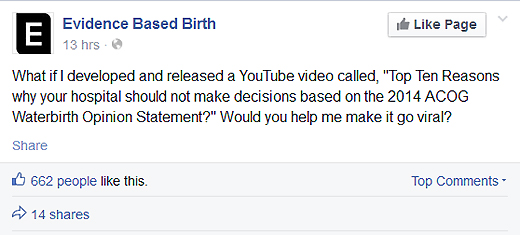
Dekker’s latest adventure is to produce a YouTube video disagreeing with the new ACOG position paper on waterbirth. What qualifications does Dekker have to disagree with the American Academy of Pediatrics Committee on the Fetus and Newborn? Does she have any neonatology training? Don’t be silly. She doesn’t need any actual training or experience in either obstetrics or neonatology to value her personal opinion above the experts in those disciplines.

Dekker waterbirth

So here’s what I want to ask Dekker:

If you make your little video and a baby dies as a result of his mother watching it, do you plan to take any responsibility for that baby’s death?

Or do you think that baby’s death has nothing to do with you?

Or, more likely, do simple fail to think at all about the outcomes that result when you share your “expertise”? I’m betting on this one.

Dekker, like most birth bloggers, is so full of herself, with outsize belief in her ability to “analyze” the obstetric literature, despite absolutely no qualifications to do so and no professional experience to draw upon, that she actually thinks she is doing a service for mothers. The reality is that she is morally culpable for spreading misinformation. She is also morally culpable for any deaths and disasters that result, whether she thinks about them or not.

Real medical professionals consider very, very carefully how they advise both patients and people who read their writings. You won’t find real medical professionals counseling people on areas outside their expertise. You won’t find them pretending that their expertise somehow magically extends beyond their actual education and training.

But then birth bloggers are not professionals. They are clowns and they would be funny except for the sad fact that babies die as a result … and birth bloggers simply go on their merry way spewing misinformation with nary a thought for the death left in their wake.

The most powerful arguments against homebirth

Grieving family with an infant's coffin

Thinking about homebirth? These mothers of these babies were, too. Their babies are dead as a result. In one case, the mother died.

James died after an abruption

Baby Girl in Portland taken home to die due to massive brain damage when she failed to breathe at birth.

“Thor” son of author Elizabeth Heineman died from lack of oxygen during labor.

Gavin Michael died of lack of oxygen when he was more than 2 weeks overdue.

Lloyd died of lack of oxygen during labor when 3 weeks overdue.

Baby girl died due to shoulder dystocia.

Baby girl died of viral infection contracted in birth pool water contaminated with diarrhea.

Baby died in Indiana when s/he failed to breathe at birth.

Mother hemorrhaged to death during transfer to the hospital after birth.

Aminah, a second twin, died after a cord prolapse.

Sam died of aspiration nearly 3 years after homebirth left him profoundly brain injured.

Utah baby died of lack of oxygen during labor while mother attempted a VBA3C.

Michigan second twin died while mother attempted a VBA2C.

Baby boy died after fetal distress during labor, hospital transfer and C-section.

Paityn died during labor.

Baby girl died of lack of oxygen during 4 day labor.

South Carolina baby died during labor at a freestanding birth center.

Natalie died of lack of oxygen while her mother pushed for 6 hours with meconium running down her leg.

Kaiya died of lack of oxygen during labor.

Michael died of meconium aspiration after his mother attempted a VBA2C.

New Jersey baby died during breech birth.

Baby girl died of Group B strep sepsis.

Aisley died of lack of oxygen during labor.

Oregon baby died of overwhelming infection.

Second twin died in Indiana after partial delivery, transfer and hospital C-section.

Baby boy died of cord prolapse.

Baby boy died of lack of oxygen during labor.

Gianni died after his mother hemorrhaged during labor.

Jude died at a freestanding birth center.

California baby boy died during prolonged labor with maternal fever.

Sunrise died after fetal distress during labor.

Baby girl died after fetal distress in labor.

Baby girl died of “complications” after homebirth.

Titus died of shoulder dystocia.

Baby girl had a cardio-respiratory arrest after birth.

Baby boy, second twin, when his head became trapped during breech delivery.

North Carolina baby died when s/he could not be resuscitated after birth.

Idaho baby girl died after fetal distress during labor.

Idaho baby boy died after fetal distress during labor.

Idaho baby died after fetal distress during labor.

These are 40 deaths that I wrote about in the past 2 years. And only the American homebirth deaths. And only the deaths that I heard about.

Homebirth represents approximately 1% of US births. When you look at term births of normal sized babies to white women, homebirth represents approximately 1.4% births. So if you are planning to tell me that “babies die in the hospital, too,” ask yourself if you’ve heard of nearly 3000 deaths of term babies in the hospital in the past 2 years.

Homebirth kills babies (and mothers) and the only people who appear to be unaware of that fact are homebirth advocates.

Thinking about homebirth? Maybe you should think about these babies (and mother) and think again.

What’s the real chance of having a C-section if you give birth in a hospital? A lot lower than you’ve been told.

Red Fall Arrow Interest Percent Symbol. Financial Business Conce

If I had a nickel for every time a homebirth advocate claimed that a “risk” of hospital birth is a 1 in 3 chance of having a C-section, I’d be a very rich woman indeed.

What’s the real risk of having a C-section? A lot lower than you’ve been told.

I’ve written in the past that homebirth midwives have a one size fits all approach to childbirth. It makes no difference who you are, what your past medical history, what your test results in this pregnancy show, or what complications you’ve experience in this and previous pregnancies, all women are treated as if they are identical, and homebirth is nearly always prescribed as the correct course of action. That refusal to personalize care (the exact opposite of obstetric care) is used to scare women into believing that because the C-section rate is 32%, the average woman’s chance of having a C-section is 32%.

To understand why that is foolish, it helps to consider other examples, like lung cancer.

The lifetime risk of developing lung cancer is slightly less than 7%. Does that mean that YOUR chance of developing lung cancer is nearly 7%. No it does not. The lifetime risk of a specific individual developing lung cancer depends greatly on whether or not you have ever smoked or still do. The risk of developing lung cancer is more than 20 times higher for smokers as for non-smokers. So if you are a smoker, your lifetime risk of developing lung cancer is much higher than 7% and if you are a non-smoker, your lifetime risk of developing lung cancer is much less than 7%.

The same principle applies to C-sections. The personal risk of ending up with a C-section in any given pregnancy is dependent on your personal situation. For example, if complete placenta previa is diagnosed at term in your current pregnancy, you chance of having a C-section if you go to the hospital is not 32%, it is 100%. A C-section is always performed because attempted vaginal delivery through a complete placenta previa invariably leads to the death of the baby and mother.

As I discussed recently, the chance of having a C-section after a previous C-section is dependent on your personal situation. For the average woman with one previous C-section, the chance of a woman attempting a VBAC ending up with another is 39%. However, the chance of ending up with a C-section falls to only 10% if you’ve had a vaginal delivery since you’ve had the C-section.

So what is the real risk that someone contemplating homebirth would actually end up having a C-section if she went to the hospital instead.

No one should be having a homebirth after a previous C-section. The risk of a severe complication is simply too high. Therefore, any one who meets the low risk criteria for homebirth has never had a C-section in the past. For them, the risk of having a C-section in the current pregnancy is NOT the same as the total C-section rate. To determine that risk, we must look at the primary C-section rate.

According to the paper Primary Cesarean Delivery in the United States, the chance of having a primary C-section is 21.9%. Does that mean that a specific individual’s chance of having a C-section is 1 in 5? No, it does not, because the risk of a primary C-section is dependent in large part on whether you have given birth in the past. The primary C-section rate for women who have never given birth in the past is 30.8%, but the primary C-section rate for women who had given birth to at least one child was only 11.5%.

The typical woman who chooses homebirth has had at least one child in the past, so her actual risk of having a C-section if she has a hospital birth is NOT 1 in 3, but slightly higher than 1 in 10. That’s a very big difference.

How does that compare with the primary C-section rate at homebirth. According to the MANA study, the overall C-section rate was 5.2% and the primary C-section rate was 4.3%. Unfortunately, MANA did not break down the primary C-section rate by parity. Of the overall group of women attempting homebirth, we do know that 77.7% had given birth to at least one child. The primary C-section rate among parous women is likely to be lower than 4.3%. Nonetheless, for women who have given birth before, the risk of having a C-section after attempted homebirth is around 4%, while the risk of having a C-section in the hospital is 11.5%. At the same time, the risk of having a baby die at homebirth is dramatically higher than the risk of perinatal death in the hospital.

Most women who choose homebirth have had a baby in the past. Therefore, they are trading a small risk of having a C-section in the hospital (11.5%) for a dramatically increased risk of having a dead baby. Is that really worth it?

What are the odds that the peer review of Texas homebirth midwife Gina Phillips will be a whitewash?

Paint Can and Paintbrush

Gina Phillips, the homebirth midwife who was supposed to be at the labor of baby James‘ mother, but was home “resting” instead, will be the subject of a homebirth midwifery peer review next week.

It’s difficult to learn the details, because this process, which is supposed to be a form of accountability and a way to improve safety, is shrouded in secrecy by Texas homebirth midwives. But I’m going to go out on a limb and make a prediction. Despite alleged grievous negligence:

  • she reportedly left a VBAC patient who had been labor more than 24 hours under the care of her student while she went home;
  • the patient’s excessive bleeding was allegedly reported to her by phone, but she told her student it was normal;
  • the patient allegedly experienced an abruption;
  • transfer was delayed so long that the baby allegedly suffered a catastrophic brain injury and subsequently died;

I predict that the peer review will be a thorough whitewash, with minimal if any consequences for Phillips, and no new standards that will bind other homebirth midwives.

What is supposed to happen during clinical peer review?

According to Wikipedia:

… The primary purpose of peer review is to improve the quality and safety of care. Secondarily, it serves to reduce the organization’s vicarious malpractice liability and meet regulatory requirements… Peer review also supports the other processes that healthcare organizations have in place to assure that physicians are competent and practice within the boundaries of professionally-accepted norms.

Peer review is not a morbidity and mortality conference where anyone present can contribute to analysis of the case. Peer review is a formal process in which reviewers are carefully selected, documents and information are introduced and the person who is the subject of the review can explain why he or she chose a specific treatment course.

I have been told that the plan for the peer review of Gina Phillips is that she will be reviewed by other midwives who are there to have their own cases reviewed. If true, that would be horrifying. As mentioned above, I would like to obtain definitive, official information about the way that this review will be conducted, but there is no official information. The process appears to be entirely informal, random, and obviously biased.

It is, of course, rather difficult to hold a homebirth midwife to specific safety standards when their national organization, the Midwives Alliance of North America (MANA), rejects ANY safety standards, preferring to leave the determination of safety up to each individual midwife. Presumably that means that if a homebirth midwife thinks abandoning a VBAC patient during a prolonged labor to go home and “rest” is safe, then it is safe.

These stories of egregious practice by homebirth midwives are replayed again and again, and babies die as a result. Homebirth advocates like to pretend that such midwives are outliers and every profession has “bad apples.” I predict that this peer review is likely to reveal that there is no such thing as a “bad apple” in homebirth midwifery, that the real purpose of homebirth midwifery peer review is to exonerate the midwife in question, and that dead babies are merely excusable collateral damage.

If a homebirth midwife faces no consequences or minimal consequences for literally abandoning a high risk patient in labor, then there are no standards in homebirth midwifery at all.

Let me speak directly to those in charge of the Texas homebirth midwifery peer review, whomever they may be:

We will be watching the outcome of this peer review. I hope that you will prove me wrong and recommend major curtailment of practice or even surrender of license in this case. We want James to be #notburiedtwice, first by his parents, and then by the homebirth community, which typically acts as if dead babies are just an unavoidable cost of doing business and require no response beyond a slap on the homebirth midwife’s wrist, leaving her to go forth and preside over other homebirth disasters and deaths.

Don’t whitewash the death of baby James.