Category Archives: Uncategorized

Why do lactivists treat women like cows?

image

A new study recently published in the Journal of Human Lactation, is making the rounds in lactivist circles. However, the study, in addition to being underpowered to reach any conclusions, treats lactating women as if they are nothing more than cows, reducing them to the characteristics of the milk they produce, without any regard to their pain, needs and desires.

The study is Relationship between Use of Labor Pain Medications and Delayed Onset of Lactation by Li et al. and the findings are:

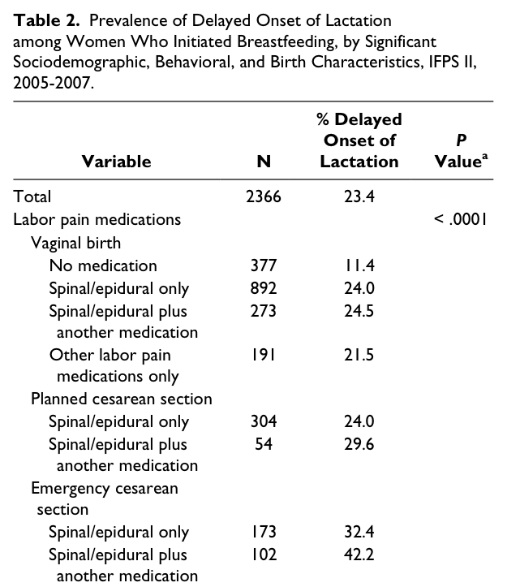
Overall, 23.4% of women in our sample experienced DOL. Compared with women who delivered vaginally and received no labor pain medication, women who received labor pain medications had a higher odds of experiencing DOL: vaginal with spinal/epidural only (aOR 2.05; 95% CI, 1.43-2.95), vaginal with spinal/epidural plus another medication (aOR 1.79; 95% CI, 1.16-2.76), vaginal with other labor pain medications only ([not spinal/epidural]; aOR 1.84; 95% CI, 1.14-2.98), planned cesarean section with spinal/epidural only (aOR 2.13; 95% CI, 1.39-3.27), planned cesarean with spinal/epidural plus another medication (aOR 2.67; 95% CI, 1.35-5.29), emergency cesarean with spinal/epidural only (aOR 2.17; 95% CI, 1.34- 3.51), and emergency cesarean with spinal/epidural plus another medication (aOR 3.03; 95% CI, 1.77-5.18).

The authors concluded:

… [M]others who received pain medications during labor and delivery were more likely to report that they experienced DOL. Because 83% of mothers in the U.S. use pain medication during labor and delivery, the implications of a link found between labor pain medications and onset of lactation, if causal, is of public health and clinical impor- tance.

How did the authors assess delayed onset of lactation? They used a notoriously unreliable method, a questionnaire, which asked mothers to recall the answer to a remarkably vague question:

“How long did it take for your milk to come in?” (1 day or less, 2 days, 3 days, 4 days, more than 4 days).

That’s only one of the six serious limitations to the study acknowledged by the authors:

This study is subject to at least 6 limitations. First … the study sample is not representative of the US population … which prevents generalization of our findings to the entire US population. Second, IFPS II [the questionnaire] did not collect information regarding dose of labor pain medication used ..; therefore a dose-response relationship between pain medication dosage and risk for DOL could not be examined. Third, while overall this was a large study, there were relatively small percentages of mothers exposed to some of the pain medications, which … limited our ability to evaluate the effects of specific medications. Fourth, because we are unable to separate cesareans from labor pain medication use, we are unable to evaluate the effects of the medications used independent of method of delivery. Similarly, we are unable to separate the pain associated with labor/delivery from the use of labor pain medications; therefore, we are unable to tease out whether it is the pain or the pain medications leading to the associations that we observed with DOL. Fifth, data regarding labor course were not collected in IFPS II; therefore we were unable to adjust for labor characteristics such as length of labor, length of second stage labor, or labor/delivery stress, all of which are known to be associated with DOL. Finally, all data were self-reported; hence outcome and exposure misclassification are potential limitations of the study.

So the design of the study itself renders the conclusions virtually useless, and that’s even before we get to the fact that the study is so underpowered that the conclusions are statistically useless.
image

The number of women in the study as a whole was small, and the number of women in each subgroup was tiny, rendering any conclusions highly suspect from a statistical point of view.

The bottom line, therefore, is that the conclusions of the study are meaningless.

Let’s leave aside for the moment the fact that the authors failed to adequately support their conclusions, and failed to demonstrate that the parameter they are measuring was even remotely clinically relevant (since they never looked at the health of the babies). The study does shed some light on another important issue: the tendency of lactivists to treat women like cows, obsessing about the quality and quantity of their milk, with no regard to the well being of the women themselves. I cannot think of any other study in the literature that rests on the presumption that treating excruciating pain is optional and possibly undesirable, but that is the foundational assumption of this paper. The implicit message of the authors is that women should forgo pain medication in order to “optimize” their breastmilk.

This is especially ironic in light of the confluence between natural childbirth advocacy and lactivism. Evidently the mother’s “birth experience” and desire to avoid lifesaving interventions and C-sections is supposed to take primacy over the baby’s interest in being born alive and neurologically intact. But the situation is magically reversed when it comes to breastfeeding. The mother’s experience is completely irrelevant and all that matters is optimizing the breastmilk that the baby receives.

How, in good conscience, can any group of investigators completely dismiss the mother’s pain in labor? How can they, in good conscience, presume to sway women against pain relief in labor in favor of a highly theoretical benefit that they are incapable of demonstrating even exists? It’s apparently very easy. In the world of lactivism, the wellbeing of the milk producer is irrelevant; only the consumer matters. Here’s what I’d like to know: how is that different from treating women like cows?


You cannot perform a C-section on a woman without her consent, PERIOD!

image

Our right to bodily autonomy is one of the most important rights that we have. Simply put, a woman (or a man) has a right to refuse medical or surgical treatment, regardless of whether or not the refusal might lead to death. In the case of a pregnant woman, that means that she has an absolute right to refuse a C-section regardless of whether the C-section is life saving for either her or her unborn baby.

If the facts of the case as outlined in The New York Times are correct, Rinat Dray has an excellent case against her doctors for performing a C-section without her consent.

After several hours of trying to deliver vaginally and arguing with the doctors, Mrs. Dray was wheeled to an operating room, where her baby was delivered surgically.

The hospital record leaves little question that the operation was conducted against her will: “I have decided to override her refusal to have a C-section,” a handwritten note signed by Dr. James J. Ducey, the director of maternal and fetal medicine, says, adding that her doctor [[Dr. Leonid Gorelik] and the hospital’s lawyer had agreed.

They should not have done that, and, given the facts that we know so far, it is difficult to imagine why the hospital’s lawyer gave them the go-ahead to do so.

Ms. Dray had had two previous C-sections:

… [T]he first doctor, at NewYork-Presbyterian/Weill Cornell hospital, began urging her to have a cesarean after her water had broken and she had labored for a few hours. Hoping for a different outcome for her second pregnancy, she went to Lenox Hill Hospital, with the same result.

Still hoping for a vaginal birth, she changed doctors again for the third pregnancy. She also hired a doula to help her with the childbirth.

In other words, Dr. Gorelik agreed to take her on as a candidate for a VBA2C. This was clearly a priority for her, and Gorelik knew it and assented to it. Presumably he had extensive discussions with her during the pregnancy about the risks and benefits of a VBAC attempt. Yet after, Ms. Dray labored for several hours, Dr. Gorelik changed his mind.

At first, she said, Dr. Gorelik appeared to relent, saying he would give her an epidural for the pain and then reconsider. “I was begging, give me another hour, give me another two hours,” Mrs. Dray said. Her mother, who was there, supported her, and the doctor said, “I’m not bargaining here,” Mrs. Dray said.

Mrs. Dray said she kept begging on the operating table. His answer, she recalled, was, “Don’t speak.”

Those exchanges, if true, are shameful. It appears that the doctor substituted his judgment for Ms. Dray’s and performed surgery against her will.

There are, of course, situations in which a doctor can perform surgery without explicit consent, but it doesn’t sound like this was one of those situations. In emergencies if a patient is incapable of giving consent for life saving treatment (e.g. if the patient is unconscious after being shot), consent for life saving treatment is assumed since the patient would consent if she or he were aware.

Yet, Ms. Dray’s situation does not sound like an emergency. No one was suggesting that her uterus had ruptured, for example, or that the baby was currently dying. Moreover, Ms. Dray hadn’t been unable to give consent; she deliberately withheld it.

An emergency C-section without explicit consent might be performed if the doctor feels that the patient is incapable of understand what is going on. There’s no evidence presented thus far that Ms. Dray did not understand exactly what was happening. Indeed, there is no evidence that any of the factors that might imply consent were occurring here. The doctor wanted to perform a C-section, the patient refused and the doctor did it anyway. That is inappropriate and inexcusable.

Dr. Howard Minkoff, chairman of obstetrics at Maimonides Medical Center in Brooklyn, whose articles on the subject of patient autonomy have been published in medical journals, said he believed that women had an absolute right to refuse treatment even if it meant the death of an unborn child. “In my worldview, the right to refuse is uncircumscribed,” Dr. Minkoff said, cautioning that he was not commenting on the particular facts of Mrs. Dray’s case. “I don’t have a right to put a knife in your belly ever.”

I heartily concur, and I suspect that the court will, too.

We are not talking about someone who is unknown to the doctor, who is in the midst of a dire emergency, who is incapable of understanding what is going on. We are talking about a competent woman who had had extensive counseling by her doctor, who strongly wished to proceed with labor, who strongly expressed that she did not give consent, and yet was operated on anyway.

Ms. Dray has the RIGHT to refuse consent for a C-section. She has the RIGHT to let her baby die if that’s what happens as a result of refusing a C-section. She has the RIGHT to sacrifice her own life, too, if she understands that she might die as a result of her refusal.

Ms. Dray’s doctors apparently trod on all those rights and substituted their judgement for hers. If that is truly the case, they can and SHOULD be held legally accountable.

What if homebirth children treat their elderly parents the way they were treated?

Old hand

For me, one of the most distressing aspects of homebirth is thinking about the experience of the babies.

Their very lives are on the line for no better reason than because their parents are seeking a specific experience. While their mothers wallow in their birth pools, and while their fathers wallow in their empowerment, the babies may be suffocating to death, struggling to extract enough oxygen across a failing placenta to feed their fragile brain cells, or gasping with heads stuck in the vagina while their bodies dangle outside because their mother attempted a breech birth at home, or drowning in a sea of bright red blood, the oxygen so close yet utterly inaccessible because their mother’s uterus has rupture during an attempted VBAC at home, extruding them into the abdomen with no way out and no way to survive.

When the survivors grow to adulthood, might they treat their elderly parents the way they were treated, as a prop in their parents stories. Might they put the lives of those elderly parents on the line to return the favor of valuing experience over their well being?

That thought came to mind reading the narcissistic drivel from M. Landers, a father whose third child was recently born in a home VBAC. Landers mused on great existential questions, like pain and death, in The Tragedy Of Childbirth: If It Hurts, Embrace It

I envision his son eventually writing a piece entitled The Tragedy of Old Age: If It Hurts, Embrace It.

The heart of Landers’ piece is his attempt to explain why he and his wife are cavalierly risking the life and health of a postdates baby in a homebirth. It purports to be deep, but is really nothing more self-indulgent, puerile rationalization:

… People can argue statistics day and night about the safety and ethics of homebirth v. hospital birth or vaginal v. C-section, but in the end I think our prefered [sic] stance really comes out of our capability to accept life-threatening and potentially tragic situations without attempting to control them. No one wants to stand by and watch tragedy befall their loved ones, but it is a constant and real possibilty [sic]. While we understand a lot about the human body and how to “successfully” modify its efforts at the birthing process, the truth is that it knows what it’s up to and often our attempts to improve upon its effects can just as easily thwart an ideal outcome.

Imagine Mr. Landers at age 80, hobbled by arthritis, nearly blind from cataracts and suffering chronic pain from who knows what. He doesn’t know, because his son, who is now his caregiver, refuses to take him to a doctor anymore, because all that doctor did was implore the son to buy expensive prescription medicines to ease his father’s arthritis, pay for expensive surgery to remove his cataracts, and subject his father to expensive tests for no better reason than to figure out cause of his chronic pain. The doctor has gone so far as to play the “dead father card,” warning that his father might die without expert care.

How would Mr. Landers feel then if his son exhorted him thus?

Dad, this is old age. If it hurts, embrace it.

If Landers wept for access to cataract surgery, desperate to be able to see, read and write again, would he be satisfied with this?

My preferred stance on this issue really comes out of my capability to accept life-threatening and potentially tragic situations without attempting to control them. I’m sorry that you’re nearly blind, Dad, but you ought to trust vision more and not attempt to control it.

And if Landers begged for access to medical care, expressing his fear that he might die as a result of whatever was causing his chronic, debilitating pain, would he be mollified by this?

Dad, no one wants to stand by and watch tragedy befall their loved ones, but it is a constant and real possibility. While we understand a lot about the human body and how to “successfully” modify its efforts at the aging process, the truth is that it knows what it’s up to and often our attempts to improve upon its effects can just as easily thwart an ideal outcome.

It sounds unspeakably harsh and cruel, doesn’t it? Yet how different is that from Landers’s own philosophy on risking the death of his son at homebirth?

Not very.

We understand how heartless and selfish the son is because we can easily envision ourselves in the position of an elderly Landers. We can imagine the grief at his loss of sight, his chronic pain and his fear of death. In contrast, it is difficult to appreciate the position of a homebirth baby, since we know that we will never again face the risk of injury and death at our own birth. But just because it is easier to put ourselves in the place of an adult instead of a baby, does not mean that the baby is suffering any less.

We quail at the thought of being treated like the elderly Landers; we ought to quail at the thought of being treated like Landers treated his son.

Landers better hope that his son give more thought to his comfort, safety, and very life, than Landers gave to him.

Get government out of birth!

hands off my birth

Over the past few days, in the wake of the UK decision to promote homebirth, I’ve looked at several reasons why the effort to promote homebirth over hospital birth is unethical.

First, in a system struggling with staff shortages, lack of supervision of midwives, poor outcomes, and exorbitant insurance expenditures, it is defies logic to promote type of birth that will only exacerbate staff shortages, further limit supervision of midwives, and increase the risk of poor outcomes and additional insurance expenditures.

Second, it is nothing short of cruel to force women to choose between personalized care and pain relief in labor.

Today, I’d like to address the third reason why promotion of homebirth is unethical: a national government has no business encouraging ANY form of birth over another. In doing so, it restricts women’s reproductive autonomy.

Imagine, if you will, that the UK government had decided to encourage “natural family planning” (NFP) over other forms of contraception, claiming that NFP is the most “natural” method and the way that women have controlled their fertility for most of human existence, and that it costs the government far less in contraceptive funds than the birth control pill or IUDs.

Women’s rights groups would, quite appropriately, decry such a plan. They would be angry because NFP is not as effective as other forms of birth control, it is far more onerous to use than other forms of birth control, and the government is overstepping its bounds by involving itself in the highly personal decision of fertility control.

They would not be mollified by government claims that the ideal effectiveness rate of NFP is high. They would likely point out that the real world effectiveness of NFP is rather low, and that is the rate that counts.

They would likely point out that women should not be “encouraged” to sacrifice convenience of a birth control method to save money for the government. The greatest portion of the burden of contraceptive failure falls on the individual woman and therefore, she is the one, and the ONLY one, who should choose among safe, effective methods of birth control.

They would almost certainly point out that choice of fertility control is a personal decision in which the government ought to have no role. Women are not truly free to control their own bodies when the government is “encouraging” a less effective, less convenient method of contraception over others.

Women’s groups would be correct on all three counts.

Let’s take another example:

How about if a government decided to promote induction of labor over conventional surgical pregnancy termination? For most first trimester and early second trimester terminations, minor surgery is used to evacuate the uterus, thereby ending the pregnancy. Surgical termination is a safe method, takes only a short time, and involves a relatively easy physical recovery.

But imagine instead that a government decided to “encourage” medical abortion, using various types of medication that induce uterine contractions to force out the products of conception, reasoning that it is the most “natural” method, one that women have used to end pregnancies for hundreds of thousands of years, and costs the government less than surgical terminations. The government might point out that pharmaceutical manufacturers have been recommending medical termination over surgical termination for years.

Women’s rights groups would, quite appropriately, decry such a plan. They would be angry because medical termination is far more painful, more onerous, and takes longer than a surgical termination. They would point out that government is overstepping its bounds by involving itself in the highly personal decision of which method of termination to use. That is both a medical decision and a personal decision and there is simply no justification for government involvement.

They would not be mollified by government claims that medical termination is cheaper and they would likely point out that women should not be “encouraged” to endure the hours of pain of a medical termination to save money for the government. The greatest portion of the burden of the procedure falls on the individual woman and therefore, she is the one, and the ONLY one, who should choose among safe, effective methods of pregnancy termination.

They would almost certainly point out that pregnancy termination is a personal decision in which the government ought to have no role. Women are not truly free to control their own bodies when the government is “encouraging” a more painful, less convenient method of pregnancy termination over others.

Women’s groups would be correct on all three counts.

The government in the UK does not privilege one form of birth control over another, and does not privilege one form pregnancy termination over another, but it has decided to encourage one form of birth over another.

The government has decided to promote homebirth reasoning that it is more “natural”: it’s the way women have given birth for millions of years; and it costs less than hospital birth. The government notes that midwives have been recommending homebirth for years.

Women’s rights group, indeed anyone concerned with medical ethics, should decry such a plan.

They should not be mollified by government claims that homebirth is relatively safe for some women under ideal conditions (i.e. The Birthplace Study). No one has bothered to look at the safety of homebirth in the UK under real world conditions, and that is the only standard of safety that counts.

They should highlight the fact that women should not be “encouraged” to sacrifice safe, effective pain relief for the agonizing pain of childbirth to save money for the government. The burden of childbirth (pain, risk of death, risk of the baby’s death) falls on the individual woman and therefore, she is the one, and the ONLY one, who should choose among safe places to give birth.

They should emphasize that place of birth is a personal decision in which the government ought to have no role. Women are not truly free to control their own bodies when the government is “encouraging” a more painful, arguably less safe place of birth over others.

The decision by the UK government to “encourage” homebirth is fundamentally unethical. It interferes with a woman’s right to control her reproductive decisions. It makes no sense from a healthcare perspective. It represents political pandering to midwives and a vain hope that reducing upfront costs for childbirth won’t be totally obliterated by massive downstream costs for care of children injured at birth and lawsuit payouts for infants who died.

It’s not healthcare; it’s politics. And, above all, it’s unethical.

The cruel choice at the heart of UK homebirth promotion: you can only get best care if you forgo pain relief

Pregnant woman detail backache

Imagine for a moment that the UK National Health Service, in an effort to save money and diminish overcrowding, offered the following service:

Patients who break a long bone, like an arm or leg bone, will be given a choice. They can receive the highest quality personalized care by orthopedic nurses in the comfort of their own home, complete with X-ray, re-alignment of bones that are out of place, and casting, but only if they forgo pain relief. Or, they could opt to wait many hours in the local emergency room for an overworked orthopedic surgeon, who also offers X-ray, re-alignment of bones, and casting, PLUS adequate pain relief.

The NHS is pleased to offer this service because it anticipates significant cost savings from limiting the use of hospital resources, paying nurses instead of doctors to provide care, and zero expenditure on either pain medications or anesthesiologist who might be needed to administer them.

That sounds to me like a choice that is both barbaric and unethical. NHS would be forcing orthopedic patients to choose between high quality care without pain relief and low quality care with pain relief.

Similarly, the latest effort to promote homebirth in the UK has the same barbaric and unethical choice at its heart. Women are forced to choose between high quality, personalized care in the comfort of their own home as long as they accept the agonizing pain of unmedicated childbirth or low quality, rushed care in exchange for access to adequate pain relief.

The orthopedic nurses who staff the new program assure us at NHS that there is really no need for pain relief in the wake of a broken arm or leg. People have been breaking long bones since the beginning of time and enduring it without pain relief. If people had needed pain relief in order to survive broken bones, the human species would no longer exist. The orthopedic nurses point to additional benefits: decreased sedation, the ability to get up and move immediately instead of waiting for anesthetics to wear off, faster healing (according to them) and fewer complications (according to them). Plus, we are designed to heal our broken long bones without any pain relief at all. It worked well for our ancestors; it can work just as well for us.

Sound familiar? It should since these are precisely the claims advanced by midwives in their efforts to promote homebirth.

But that begs the fundamental question:

Why should anyone have to choose between high quality care and pain relief?

There is really no reason why anyone should have to choose between the two, for orthopedic care or for childbirth care. So why is the choice being forced on women in the UK? The forced choice reflects the philosophical beliefs of UK midwives. They believe (without any scientific evidence) that unmedicated birth is better than birth with pain relief. They view an unmedicated birth as a success and a medicated birth as a failure. They prefer to care for women who decline pain relief and they use a variety of methods to force them to do without pain relief including delay, chivvying them into believing that they are accomplishing something by withstanding the pain, or simply refusing to provide effective pain relief altogether.

The promotion of homebirth in the UK reflects the unholy alliance of midwives who wish to increase their autonomy and bureaucrats who wish to save money. It uses an unethical, and, frankly, barbaric, bargain to promote homebirth. You can get seemingly better, more personalized care ONLY if you agree to endure childbirth in agony.

Both midwives and bureaucrats should be ashamed of themselves. This is deliberate infliction of a pernicious philosophy that treats women’s severe pain as irrelevant. Every woman deserves BOTH the highest quality childbirth care AND easy access to the most effective forms of pain relief.

Promotion of homebirth reflects political expediency and not the needs and desires of the majority of childbearing women. It’s politics, not healthcare.

When UK midwives put the lives of mothers and babies at risk, the solution is not more homebirths

iStock_000002497405Small copy

It’s enough to make a person cynical.

1. It has become startlingly, painfully clear that UK midwifery promotes vaginal birth above the well being of mothers and babies.

2. Not surprisingly, the amount of money paid for bad outcomes and the cost of insurance coverage have skyrocketed (A fifth of maternity funding spent on insurance).

3. Only 6 months ago, a UK government report delivered a scathing indictment of UK midwives, and their weak system of self-supervision that allows them to avoid accountability for multiple maternal and infant deaths.

It is unfathomable, therefore, that a government health group has just recommended more homebirths.

More women should give birth with only midwives present, including at home, because that is better for them and their babies than labour wards where doctors are in charge, the government’s health advisers say on Tuesday.

Midwives should advise mothers-to-be who already have at least one child and whose latest pregnancy appears straightforward to opt for a midwifery-led unit (MLU) or a home birth when deciding where to have their baby, the National Institute for Health and Care Excellence is urging.

The 40% of women giving birth who are first-time mothers should also be advised to choose either location, Nice is recommending in draft guidelines to the NHS in England and Wales.

Both groups of women should select either location “because the rate of interventions is lower and the outcome for the baby is no different compared with an obstetric unit”, Nice says.

Let’s me amend my previous statement:

It is unfathomable for a system that purports to care for mothers and babies to encourage UK midwives, who have caused unbelievable suffering by failing to adequately monitor and care for laboring women and their babies, who have failed spectacularly to supervise themselves and learn from their errors, to increase a practice that leaves midwives with even less supervision than before.

Of course it makes perfect sense if your objective has nothing to do with mothers and babies and, instead, is devoted to the twin aims of fulfilling the ambitions of midwives and saving money.

UK midwives have demonstrated over and over again that they value their personal autonomy over the lives of mothers and babies:

Promoting normal birth is killing babies and mothers
Midwife : UK deaths result of failing to meet the needs of … midwives?
New document on British maternity services is fundamentally unethical

They apparently believe that their autonomy resides in “normal birth,” woman’s wishes and women’s health be damned, and they have relentlessly promoted “normal birth” to catastrophic effect. Increasing the proportion of homebirths is the next logical step in increasing the autonomy of midwives, but it mind bogglingly cynical for a system that is supposed to promote the health of mothers and babies.

It is cynical on a variety of levels.

First, is a cynical misuse of the results of the Birthplace Study. I have long maintained that Birthplace Study appeared to be designed to reach the conclusion that homebirth is safe regardless of what the actual data showed. In order to achieve the desired result, the investigators created eligibility criteria that are substantially stricter than the actual eligibility criteria for homebirth in the UK. So the Birthplace Study NEVER showed that homebirth in the UK is safe. It showed that homebirth might be safe if the eligibility criteria were substantially tightened.

It is cynical because there is a growing body of evidence, particularly from The Netherlands, that midwives caring for low risk women (home or hospital) have a higher perinatal mortality rate that obstetricians caring for HIGH risk patients.

It is cynical because there is no evidence that increasing homebirths will address the known deficiencies in midwife death rates.

It is cynical because in a system already struggling with a shortage of midwives, it defies reason to promote a practice that has the impact of increasing the shortage by assigning two midwives to one patient at home, instead of centralizing the location of births so that two midwives can each care for multiple patients at a time.

But most of all, it is cynical because all the existing evidence points to a need for GREATER supervision of midwives, not greater autonomy.

NICE is promoting the interests of MIDWIVES above the very lives of newborns, its most vulnerable patients.

That’s not healthcare, that’s politics.

Rixa Freeze: Disagreeing with you online is not cyberbullying

iStock_000032271928Small copy

To a surprising degree, natural childbirth and homebirth advocates are desperate for validation. So desperate, in fact, that when they are not validated, they actually believe that they are being bullied.

Consider how Rixa Freeze explains cyber bullying to her daughter. But before we do, let’s look at the definition of cyber bullying.

According to bullying.gov:

Cyberbullying is bullying that takes place using electronic technology…

Examples of cyberbullying include mean text messages or emails, rumors sent by email or posted on social networking sites, and embarrassing pictures, videos, websites, or fake profiles. (my emphasis)

Here’s how Rixa explains it in a dialogue with her daughter:

Did you know that sometimes adults are cyberbullies?

Really?

Yes. Did you know that there is a doctor who says mean things about me online?

Really? And she’s an adult? And a doctor?

Yes.

That’s not good.

She says mean things about me because she doesn’t think anyone should have their babies at home. She says that mamas who have their babies at home do not love them and do not care about them.

But that’s silly. You love your children!

I know.

What did you say to the doctor?

I told her she was a bully and that how she was acting wasn’t right.

I’m glad that you spoke up. I think you should call the police to stop her.

No, it’s the law that people can say anything they like, even if it’s mean. I just choose not to pay attention to mean things that people say about me.

Rixa, of course, is talking about me.

Have I sent her any text messages or emails (mean or otherwise)? No.

Have I posted any rumors about her online? No.

Have I posted any embarrassing pictures or videos? Only if she think linking to a video that she posted is embarrassing.

So what did I do to Rixa that she believes is cyberbullying? I didn’t agree with her, I didn’t validate her beliefs and self-image, I failed to praise her.

Oh, the horror!

Why do natural childbirth and homebirth advocates have a dichotomous view of the world and everyone in it: if you aren’t validating them, then you must be bullying them?

Because natural childbirth and homebirth have nothing to do with childbirth, and nothing to do with babies. They all about the women who embrace them and how they would like to see themselves. They would like to see themselves as smarter, better and more loving than other mothers, and they believe that their choice of natural childbirth or homebirth is a shorthand way of broadcasting their superiority. Simply put, Rixa has made homebirth into something far more important than the way that her children were born. She has made homebirth into an integral part of her self-image. Apparently, if you believe that your choices make you superior, you also believe anyone who questions those choices is bullying you.

For Rixa, it is “bullying” to point out that she could have killed her 3rd baby who stopped breathing after an unattended homebirth. It is bullying to point out that in supporting Dr. Robert Biter, she was supporting someone who had committed negligence and malpractice. It is bullying to note that her unattended homebirths are such as large part of her identity that she manages to mention them in situations that aren’t appropriate. It is bullying to tell the truth instead of relate the sugar-coated, self-congratulatory fantasy that Rixa wishes to project.

Here’s what I’d say to Rixa’s daughter if I had the chance:

Part of being a grown up is thinking about what you do and whether it is right. There are lots of different people in the world, and lots of different ideas about what is right. Just because someone disagrees with you does not mean that they hate you, or are trying to bully you.

Most people keep their thoughts about what is right within their circle of family and friends. But some people, like your Mama, want other people to copy them. She set up a public blog to tell all the people in the world what she believes about birth, and why other people ought to believe the same things that she believes.

Your Mama thinks she knows a lot about childbirth and she is trying to teach people what she knows. Unfortunately, much of what she thinks she knows isn’t even true. Worse, much of what she tries to teach people is actually dangerous to babies; it can hurt them or even end up leading to their deaths.

I also have a blog to teach people about birth, and especially to correct the untrue things that others believe about birth. Why should anyone listen to me? Well, in addition to having given birth to four babies, just like your Mama did, I spent 8 years learning everything that I could possibly learn about women having babies, and taking care of thousands of women while they were giving birth.

It hurts my heart when I learn that babies have been injured or died because they believe the things your Mama told them. She’s not a bad person. She’s not trying to hurt babies. She’s a good person. She just doesn’t realize how much she DOESN’T know about childbirth, because she didn’t spend 8 years learning everything she could about taking care of women giving birth.

So sometimes I correct the things your Mama writes. I point out when she says things that aren’t true (she doesn’t know they aren’t true). One of the things your Mama says that isn’t true is that giving birth at home is just as safe as giving birth in the hospital. It isn’t. It’s just like saying that not wearing your seatbelt is as safe as wearing it. If your Mama said that, I would correct that, too.

As you probably know, it hurts when people disagree with us. Grown ups get hurt feelings just like children do. It would be much easier and feel much better if no one noticed when we did something wrong or said something that wasn’t true. But then we wouldn’t learn to be better people. When you get an answer wrong on a test in school, it feels bad. Sometimes you might even think that the teacher is being mean to you for marking an answer wrong; after all, you thought it was correct when you wrote it. But the teacher isn’t being mean, is she? She’s teaching. She knows more than you and she is helping you learn what she knows.

I’m sure that your Mama feels bad when I point out the things that she says that are wrong. It feels to her that I am being mean; it feels to her like I am bullying her. After all, she thinks that what she say is right, otherwise she wouldn’t be saying it. But I’m not being mean, and I’m certainly not bullying her. I’m teaching and I’m helping many people learn what they do not know.

Hopefully, when you are a grownup, you can handle feeling bad about being wrong. Hopefully, you will consider that the people who disagree with you might know more than you do and might be right. Hopefully you will learn from criticism. Children think that someone is being mean when they don’t agree with them. Grownups hopefully know better.

Love makes a mother, not birth choices

iStock_000038303210Small copy

A dear friend of mine buried her mother on Thursday. When she called to tell me about her mother’s death, after more than a decade of Alzheimer’s ravages, we reminisced about what a wonderful woman she had been.

My friend told me that she was proud that she had kept her promise to her mother to care for her at home until the very end, an extraordinarily difficult promise to keep. When I expressed my admiration, she shrugged it off, as merely giving back to her mother her due. “There was never a moment in my entire life,” she told me, “when I didn’t feel loved.”

Later today, Mother’s Day, I will pay a shiva call. Shiva is the Jewish obligation on family and friends to comfort the mourner and remember the deceased, and I anticipate hearing lots of stories about my friend’s mother and what she meant to her children and others.

I can predict with near absolute certainty a number of things that we won’t discuss. We won’t talk about whether my friend was born vaginally or by C-section. Why? Because it doesn’t matter; it had no impact on the love and attention she showered on her children.

We won’t discuss whether her mother was awake or anesthetized when my friend was born, whether she was in agony during labor or pain free courtesy of an anesthesiologist. Why? Because it makes no difference; my friend and her siblings never cared how their mother experienced childbirth, and I’d be willing to wager that her mother didn’t give it much thought, either. She loved her children simply because they were her children, not because they were birth “achievements.”

We won’t discuss whether my friend was breastfed or bottle-fed. Why? Because it is irrelevant. It tells us nothing about her love for her children, the way she protected them, nurtured them, launched them into the world and took pride in their successes.

We are unlikely to talk about whether her mother “wore” her in a sling, whether her parents had a open bed policy, whether her mother made her baby food from scratch or bought it from the grocery store. Simply put, all the appurtenances of modern “attachment parenting,” promoted as ever so necessary to ensure a strong mother infant bond, will never be mentioned. Why? Because her mother couldn’t have been more bonded to her children if she had been super-glued to them; how they were born, whether she had pain relief in labor, whether she breastfed them, wore them, invited them into her bed or made their baby food by hand had absolutely nothing to do with it.

Today is Mother’s Day, and many of us will be celebrating our own mothers. Not everyone had an idyllic childhood as my friend did. There may be anger and resentment along with love and admiration.

Consider your own relationship with your mother. Does the way you feel about her, the relationship you have with her, have anything to do with whether you were born vaginally, by C-section, or in the case of adopted mothers, whether you were even born of her body? It doesn’t, does it?

You may be emotionally close to your mother, distant from her or angry at her. Does that have anything to do with whether she was in pain or pain free when you were born? Or are your feelings about her the result of the way she treated you in the many years since then?

Is your mother your biggest cheerleader, your closest confidant, your greatest source of comfort when you are distressed? Do you think it would be any different if she had bottle-fed rather than breastfed you or vice versa? It sound foolish to even ask, doesn’t it?

So if the love you bear for your mother, the degree to which you are bonded to her, has nothing to do with how (or even if) she gave birth to you, whether she had pain relief in labor and how she fed you as an infant, why would you think that it has anything to do with how your own children bond to you? It doesn’t.

As for me, I love my four children more than life itself. I am always only as happy as my least happy child (fortunately, they are usually happy). Their successes mean more to me than mine ever did, and their disappointments hit me far harder than my own. They are in their 20’s now, and my love for them has only grown, having been enriched by my admiration for the people they have become; each remarkably different from the others. I love them more now than on the day each was born; I love them for who they are, as well as simply because they are mine.

Love makes a mother, not birth choices.

Don’t let anyone tell you otherwise.

Happy Mother’s Day to all my readers and to mothers everywhere!

What Consumer Reports does not want you to know about C-sections

Consumer Reports fail

People put a lot of trust in Consumer Reports, but reading their piece about C-section rates suggests that such trust may be misplaced.

While some C-sections may not be absolutely necessary for the health of the mother or baby, there is no scientific evidence that the C-section rate is either a safety metric, or an accurate quality metric. Indeed, ranking hospitals by C-section rate provides no  information of value. But Consumer Reports, which has fallen down the rabbit hole of natural childbirth, just like The New York Times, seems not to have noticed that the C-section rate reflects procedures, not outcomes. Most mothers are interested in the OUTCOME of childbirth, a healthy mother and a healthy baby. In a blindingly obvious misstep, Consumer Reports doesn’t even bother to mention, let alone investigate outcomes, which would be reflected in mortality and morbidity rates, NOT C-section rates.

What Consumer Reports does not want you to know about C-sections is that the C-section rate has nothing to do with either safety and little to do with quality.

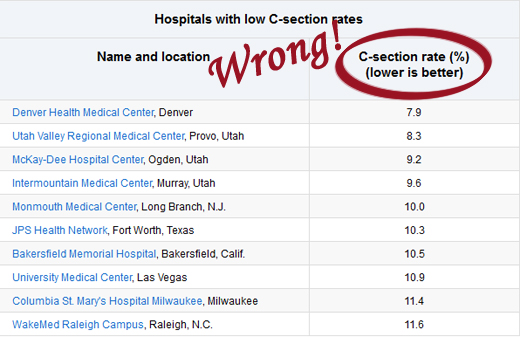
The primary problem with the Consumer Reports’ piece is reflected in their graphics:

low C-section rate

The fundamental assumption, on which the entire piece rests, is that a lower C-section rate is better. That is 100% FALSE. There is simply no scientific evidence to support the claim.

For better or for worse, there is no consistent relationship between C-section rates and outcomes. While that may mean that higher C-section rates are not better, it ALSO means that lower C-section rates aren’t better, either. Why? Because the ideal C-section rate is the one where all women and babies who NEED a C-section get one, and not too many women and babies who don’t need a C-section end up with one anyway. Notice that I did not say that there would be NO unnecessary C-sections. Given the current state of technology that can only imperfectly tell us in advance which C-sections are necessary, it is better to do many unnecessary C-sections in order not to miss any necessary ones.

How do we know that a lower C-section rate is not better? Consider international C-section rates. The countries with the lowest C-section rates in the world are those with the highest perinatal and maternal mortality. That’s because lack of access to C-sections leads to preventable perinatal and maternal deaths.

But how about countries where C-sections are easily available? As the chart below (adapted from Cesarean Section Rates and Maternal and Neonatal Mortality in Low-, Medium-, and High-Income Countries: An Ecological Study) demonstrates, there is no discernible relationship between C-section rates and safety:


C-section rates high income countries


Italy, the country with the highest C-section rates has one of the best safety profiles.

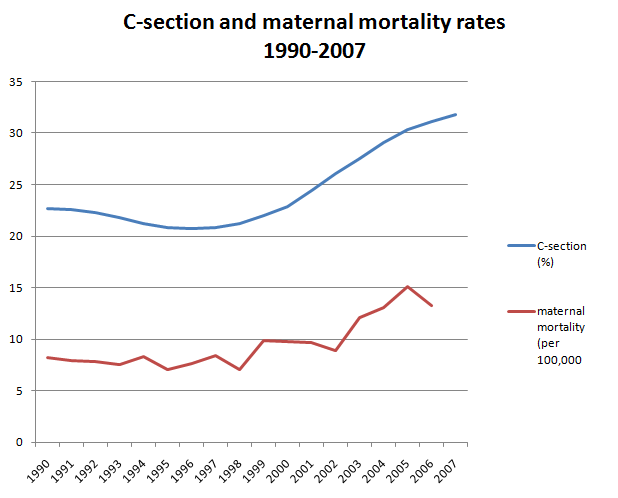
Consider the impact of C-section rates on safety over time in this country. What about an association between the rising C-section rate and rising maternal mortality? A graph comparing the maternal mortality rate and the C-section rate shows a correlation.

C-section maternal mortality 1990-2006

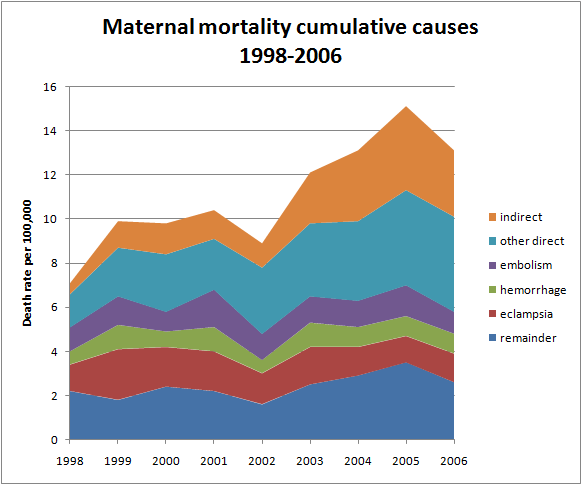
But correlation is not causation. If the rising C-section rate were leading to an increased maternal mortality rate, we would expect to see C-section complications, such as hemorrhage and embolism increasing disproportionately. But that’s not what we see. As the following graph makes clear, both hemorrhage and embolism death rates did not change their contributions to overall maternal mortality.

Maternal mortality cumulative causes 1998-2006

In addition to being based on a completely false empirical assumption, the CR piece also suffers from bias. Consider the title: What hospitals don’t want you to know about C-sections. The inescapable impression is that hospitals are hiding their C-section rates and that CR had to go to extreme lengths to obtain those rates. Yet C-section rates are widely available for free on public website. And as far as individual hospitals are concerned, Consumer Reports was easily able to obtain C-section rates for 1,500 hospitals in 22 states. That doesn’t sound like hospitals “don’t want you to know.”

Ultimately, though, the piece reflects the bias of the natural childbirth philosophy that privileges process over outcome. Consumer Reports is so sure that vaginal delivery is “better” than C-section that they never even bothered to check the outcomes at the various hospitals. But the philosophy of natural childbirth is NOT based on scientific evidence (it was dreamed up by Grantly Dick-Read, a eugenicist who was trying to convince women of the “better classes” to have more children than their “inferior” counterparts) and is both perverse and dysfunctional. It is a form of biological essentialism, judging women on the function of their reproductive organs as opposed to their intellect or character. It assumes that women are improved by agonizing pain and that they value the experience of a baby transiting the vagina more than whether the baby actually survives the transit. Natural childbirth is anti-feminist in the extreme, and is not safer, healthier, better or superior to childbirth with any and all interventions.

Consumer Reports is flat out wrong in pretending that C-section rates are a safety metric and they are wrong to encourage women to judge either hospitals or doctors based on C-section rates. They owe their readers an apology and an investigation of real safety metrics, so women can choose hospitals based on quality.

Consumer Reports tries to destroy trust in hospitals and obstetricians (not coincidentally the same objective of natural childbirth advocates and organizations) and replace it with trust in their Consumer Reports itself. Based on this irresponsible piece, they are not worthy of that trust.