Category Archives: Uncategorized

Giving birth in the hospital is an act of love; giving birth at home has become an act of selfishness.

Stop being selfish

How many babies have to die before homebirth advocates acknowledge that it has become an act of selfishness? How about two babies a day?

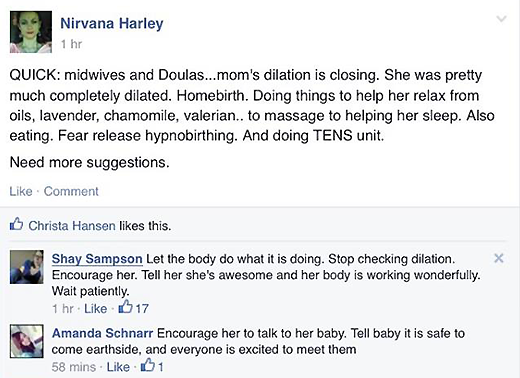
Last Sunday, the same day that doula Nirvana “Harley” Jennette was taking hideous risks with the life of a baby in Georgia, two other midwives (one in Texas, and one in Oregon) tooks hideous risks with the lives of two additional babies and both babies sustained fatal injuries as a result. It seems that “trusting birth” is just a euphemism for “letting babies die preventable deaths.”

Let’s be honest here. Homebirth midwives are under tremendous pressure to keep their clients at home. If they have to transfer to the hospital during labor, it’s because they misjudged the situation. They may be exposed to disciplinary or even legal action. And the longer they wait to transfer, the more likely it will be that the baby suffers a fatal injury, so the more likely they are to face dire consequences for themselves. Paradoxically, the more dangerous the situation becomes (and, therefore, the more likely that the homebirth midwife will face scrutiny), the more pressure she feels to stay at home and just hope against hope for a happy outcome.

That’s how babies in Portland and in Dallas-Fort Worth sustained their fatal injuries.

The mother in Portland was expecting her first baby. Membranes had been ruptured for more than 40 hours. Labor was protracted but not out of the bounds expected for a first labor and the baby was delivered and did not breathe.

The midwives waited 15 minutes to call for assistance, and the baby did not reach the hospital for over an hour after her birth.

On admission to the hospital, she was profoundly acidotic, a sign of long term lack of oxygen. Despite cooling therapy, she had suffered a catastrophic brain injury, so severe that baby has been taken home to die.

Yet again, another utterly clueless midwife is shocked to catch a nearly dead baby. The time required for transfer should give pause to any homebirth advocate who thinks they can get to the hospital fast enough in an emergency. The baby needed the immediate attention of a neonatologist when she was born. Instead, she didn’t arrive at the hospital until over an hour later. And all that time even more of her brain cells were dying. The baby did not have to sustain a catastrophic brain injury. She was not “meant” to sustain a catastrophic brain injury. It happened because her mother gambled the baby’s life in exchange for a birth “experience” and the baby lost.

Baby James sustained his fatal birth injury while his mother was attempting a home VBAC. She had had a C-section in her first pregnancy, and a successful hospital VBAC in her second. She was an excellent candidate for a hospital VBAC. No one is ever a candidate for a home VBAC.

James died of an abruption that his mother’s student midwife failed to recognize despite heavy vaginal bleeding. Where was the actual midwife? Reportedly she was home resting because the mother’s labor was so long. That, of course, was the first sign of imminent disaster. A woman who has had a successful VBAC should not be experiencing a prolonged labor subsequently. Indeed, the prolonged labor, with the accompanying possibility that the baby did not fit, dramatically raised the risk of uterine rupture. An abruption during an attempted VBAC is often the result of rupture of the uterus, but I have not been able to ascertain whether James’ mother experienced a ruptured uterus as well as an abruption.

I did receive information that was reportedly posted by the student in a student homebirth midwifery group. According to that information, the student midwife called her preceptor at home to tell her about the excessive bleeding, and was reassured that it was fine. I was told that it was ultimately the father who called 911 because the student wouldn’t. Unfortunately, it was too late. An emergency C-section was performed, but James had sustained catastrophic brain damage and was removed from life support 18 hours later. James was not “meant” to suffer a catastrophic brain injury. It happened because his mother chose homebirth.

The poor baby’s obituary is appalling. Indeed it appears as if the student midwife wrote it:

When the time came for him, his mama labored mightily to bring him into this world and his daddy was so proud of his mama. He lived for 18 wonderful hours…

Wonderful hours? I doubt those hours were wonderful for either James or his parents.

Survivors: Mama and daddy; sisters; grandparents … and midwife Kaitlyn Wages loved this boy and his family more than words can say.

A baby is dead and the obituary talks about his mother’s “performance” in labor and how much the student midwife loved him?

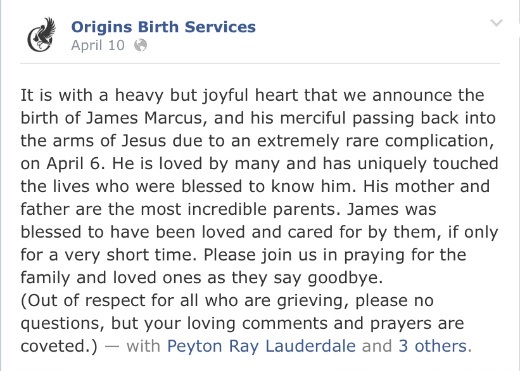
The midwives have written extensively about the baby:
image

An extremely rare complication? No, abruption is a common complication, occuring in 0.4-1% of all pregnancies.

No questions?

I asked the midwives on their Facebook page why this baby died. Their response? To delete the question and ban me. I wonder if that had anything to do with concealing potential culpability from their other clients.

Why shouldn’t ask questions of people who are grieving?

It may not be the time to ask questions of the parents, but it is most certainly the time to ask questions of the midwives. This is the time for a full investigation into a neonatal death that appears to have been entirely preventable.

The sad fact is that these deaths are not remotely surprising. Giving birth at home is equivalent to leaving your infant at home alone. In both cases, the mother is “trusting” that the chance of anything going wrong is small enough that it’s okay if she puts her own experience first. In fact, leaving your infant home alone while you got out and party is probably safer than choosing homebirth. The odds that the baby will experience a life threatening complication while sleeping (or screaming and crying) at home is vanishingly small. The odds that your infant will experience a life threatening complication at homebirth is thousands of times higher. So if going out partying and leaving your infant behind is grossly irresponsible, that makes choosing a homebirth more irresponsible still.

The bottom line is that giving birth in a hospital is an act of love. With the mounting evidence that American homebirth is far more dangerous than we ever imagined, giving birth at home has become an act of selfishness.

Have a live Tweeted, professionally photographed, video streaming, non-technological homebirth!

green natural and bio sign

Hi, folks Hypa (short for Hypatia) Crit, CPM here to introduce you to the wonders of childbirth without technology. So few people have seen a real natural childbirth that we thought it would be instructive to bring one to you on an IMAX screen so we can capture every detail

Before I introduce our birth goddess mama, and our (irrelevant now that he’s contributed his sperm) father, I want to take you through our simple preparations for technology free birth.

Let’s meet the people who will be helping us. That’s Lex over there behind our large format camera, and Steve and Mike are operating the secondary cameras that you can see in other parts of the room. Sandy is our birth photographer who will memorialize the event with 500 photos using her 42 megapixel Hasselblad camera. She’ll be arranging them into a fabulous automated slide show for your viewing pleasure.

Oops, almost tripped over the klieg lights on my way to introduce Kelly, mom’s friend from high school who will be live Tweeting the event and Margie who is live blogging for our viewers who want real time access instead of waiting for the IMAX movie or the YouTube video.

How about the preparations for birth?

The great thing about homebirth is that you don’t need any of those machines that go ping. Technology ruins the birth experience. For example, instead of the thoroughly unnatural epidural we have a plethora of options for pain relief in labor including acupuncture needles (that’s Neveah our acupuncturist), cranio-sacral therapy with our therapist Rolf, a Tens machine, and, best of all, a 5 foot diameter birth pool (filled with air by an electric pump) containing all natural water!

The mess? Don’t worry, there won’t be any mess. We have every surface covered with rubber sheets or fabric that is specially treated to be waterproof.

Let’s meet the birth team!

Childbirth is supposed to be an intimate experience, so there are only a few of us in addition to the videographers, photographer, live Tweeter and live blogger (plus the potentially 7 billion people watching around the world). Of course there’s me, Hypa Crit, the midwife and my midwife trainee Krystal. Here’s Sharon the doula and her assistant Maeve. And let’s not forget out hypnotherapist Donna who has brought her hypnotherapy tapes to help in labor. We’ll be listening to those tapes when we’re not listening to the custom designed birth mix playing on the Bluetooth enabled speakers.

What? You’re wondering who is that in the back of the room next to the high speed dehydrator. That Serena, our placenta encapsulation specialist, of course.

You have to admit: isn’t this a lot more homey than the hospital with all those machines that could save your baby’s life in the event of an emergency? Plus, there’s none of those annoying strangers like the neonatologist or the anesthesiologist who would destroy the intimacy of the birthing experience by interfering and saving someone’s life.

What’s that you say; what if there is an emergency?

First of all, in the unlikely event that we are not trusting birth enough, we have plans for unforeseen occurrances. In case of emergency I have both the hospital and the ambulance on speed dial on my iPhone. If the baby doesn’t breathe when she is born, we’ll just chant “Breathe, baby, breathe.” Babies know the sound of their mother’s voice and that usually does the trick. We’re even prepared for postpartum hemorrhage. We’ll rip off a piece of the raw placenta and force it under the unconscious mother’s tongue and that should fix everything in a jiffy!

Could someone die at a homebirth?

Duh, some babies aren’t meant to live so of course they will die. But don’t forget: there’s a silver lining to a homebirth death. No matter what happens, it is never, ever the homebirth midwife’s fault. Sure the baby died just like the obstetrician, in-laws and friends warned, but that was just an amazing coincidence.

Would technology have saved the baby’s life? Give me a break. Everyone knows that technology never works, and it just ruins the birth experience.

Children at homebirth; just whose needs are being met?

woman screaming

There is a disturbing homebirth photograph that is now circulating on the web.

You can find the photograph here.

Those posting and sharing the photo find it charming. I find it emblematic of so much that is wrong with homebirth.

What does the photo depict? It’s a picture of a young girl about four years old trying to provide counter pressure on her mother’s lower back during a contraction.

Why is it disturbing to me? Because it captures the overweening narcissism of homebirth, where the mother is the star of her little piece of performance art, everyone else (including the baby) is just a prop, and the mother is elevating her need for attention and validation above the needs of her own children (in this case the four year old).

Simply put, it is never appropriate for a small child to attend a homebirth. Childbirth belongs to the realm of experiences that are too intense and disturbing to be viewed by young children. Just as it is inappropriate for children witnessing their parents having sex, or scenes of graphic violence, and scenes of gore, it is inappropriate for a young child to witness a homebirth.

Moreover, it is never appropriate for a small child to provide care to a parent. It is not appropriate to ask a child to hold the basin when her mother vomits due to chemotherapy. It is not appropriate to ask a child to change her mother’s dressing after surgery. It is not appropriate for a child to console a mother in severe pain. It is the parent’s job to support the child, NOT vice versa.

All children, especially small children, need to feel that their parents are strong and can protect them. No child should be asked to witness a parent in severe pain or to provide the care that should be provided by another adult.

Rule of thumb: If your child will be disturbed by the movie Bambi, he or she should never be at a homebirth.

So why do women surround themselves with their older children at homebirth? Simple: to show off. This is Mom’s big moment. She’s the star and everyone should bend themselves to her need for attention, support and validation.

The truth is that it is an abrogation of parental responsibility to have a small child at a homebirth. It’s no different from asking your four year old to help you parse the details of your divorce or to confide the trauma of your sexual dysfunction to him or her.

Make no mistake: this has nothing to do with the inherent beauty of childbirth. And don’t bother to claim that small children witnessed birth in nature; they didn’t since most indigenous cultures segregate women in labor and do not allow men or children near them.

It is not charming for a little girl to support her mother through labor. It is developmentally inappropriate, and deeply, unforgivably selfish.

Vicki Markham Williams, the doula who recommends VBAC after uterine rupture

WTF. Internet Concept.

Taking obstetric advice from a doula is like taking architecture advice from a cleaning woman.

Sure, a cleaning woman cares for a home, business facility or skyscraper, but she knows nothing about how to build any of those things, and only a fool would think otherwise.

Sure, a doula knows how to care for women in labor (rub her back, get her ice chips, encourage her), but only a fool thinks she knows anything about obstetrics.

Case in point: Vicki Markam Williams, the woman who runs the Facebook group Pregnancy and Birth after Uterine Rupture with the aim of encouraging women who didn’t die at their first VBAC [vaginal birth after Cesarean) attempt (although many of their babies did die) to take on the much higher risk of killing their babies and themselves at another VBAC attempt.

Her website explains her philosophy:

Care providers are so filled with fear, and that fear is affecting the women they care for, in attitude and in denial of choice. A section rate of one in three is indefensible, and at that rate is causing MUCH more harm than good.

I think that the risks of VBAC and PAR [pregnancy after rupture] are actually MUCH lower than women are being told. If women are really re-rupturing at the rates given above then their ruptures are not being repaired properly. There is good research to say that tears heal better than cuts (http://www.ncbi.nlm.nih.gov/pubmed/10422908) and so a repaired simple rupture (no healed edges to the hole, no placenta involved) should be stronger than a second planned section scar from an incision by knife. This is clearly being taken on board, because many surgeons are now using ‘blunt extension’ techniques, which in effect means separating the uterine muscle by tearing it along its natural planes, which leads to a stronger repair and less trauma to the tissue.

Williams is referring to a 1999 paper on the Misgav-Ladach method of C-section. First, there is no evidence that the method of tearing the uterus instead of cutting leads to a stronger repair. Second, the Misgav-Ladach technique involves a one layer closure of the uterus instead of the traditional two layer closure. One layer closures have been shown to be associated with an INCREASED risk of rupture in a subsequent pregnancy, not a decreased risk. Third, very few women undergo a Misgav-Ladach C-section, so it is irrelevant to counseling most women about the risk of rupture in a future pregnancy.

Williams continues:

I’m expecting that most of the re-ruptures are women who have had windows and scars that have opened during the trauma of a repeat section. We don’t worry about any other scar or injury to the same extent. I think that the ‘dead baby card‘ is just out-and-out blackmail. So few women carry a PAR (because most get a hysterectomy and the rest are told not to try again, of which a significant majority will heed that advice) that we will never have big enough studies to know what the numbers really look like.

I have been told repeatedly that no one has a baby after a rupture, well clearly I did, and I know others who have.

Markham had a spontaneous uterine rupture at 33 weeks* (fortunately the baby survived) and her response was to attempt a VBAC? Even though she knew that a future uterine rupture could kill her baby??!!

Her musing on the risk of future rupture is probably less valuable than the cleaning lady’s musing on what holds up a building. The cleaning lady’s architecture advice is more likely to be correct since she is living in the real world while Williams is clearly just making stuff up to support her ignorance and wishful thinking.

The idea that she was told that no one has a baby after a rupture is bizarre. The issue has been studied. Indeed there is a paper in this month’s edition of Obstetrics and Gynecology on this exact topic, Pregnancy Outcomes in Patients With Prior Uterine Rupture or Dehiscence.

I know you will be shocked, shocked to learn that Williams is spectacularly wrong.

What did the authors find?

Fourteen women (20 pregnancies) had prior uterine rupture and 30 women (40 pregnancies) had prior uterine dehiscence. In these 60 pregnancies, there was 0% severe morbidity noted (95% confidence interval [CI] 0.0–6.0%). Overall, 6.7% of patients had a uterine dehiscence seen at the time of delivery (95% CI 2.6–15.9%). Among women with prior uterine rupture, the rate was 5.0% (95% CI 0.9–23.6%), whereas among women with prior uterine dehiscence, the rate was 7.5% (95% CI 2.6–19.9%).

So, in contrast to the typical risk of rupture at VBAC of less than 1%, these women had a dramatically increased risk of rupture. And that was in patients who were NOT allowed to labor! I shudder to think what the risk is in women who actually attempt VBAC.

Williams, of course, believes that the fact that she didn’t kill her baby and herself in a subsequent pregnancy indicates that VBAC after rupture is safe. Of course, if your definition of safe is that you are not 100% guaranteed to die, even Russian roulette is “safe.”

Williams concludes her piece with this:

It is so wrong to tell women that if their babies die it will be their fault and that surgery will save everyone, because it doesn’t and it won’t

Kind of like your cleaning lady telling you that is “wrong” to tell people that violating building codes leads to unsafe buildings. The claim is untrue, and there’s no reason why anyone should listen to her in any case.

Williams is criminally ignorant. She shouldn’t be allowed to care for a houseplant, let alone a pregnant woman.


*Williams’ rupture was not associated with an induction for stillbirth as originally reported.

All VBACs are not created equal

iStock_000025428692Small copy

Several weeks ago I wrote about the one size fits all approach of homebirth midwives. No matter the question, the answer is always homebirth.

Natural childbirth advocates have a one size fits all approach, too:

Personal characteristics are irrelevant. Advanced maternal age, maternal obesity, pre-existing maternal disease? It doesn’t matter because the counseling and treatment plan are always the same: you can and should have an unmedicated vaginal birth.

Medical history is irrelevant. Had a previous shoulder dystocia, C-section, postpartum hemorrhage? Who care? You can and should have an unmedicated vaginal birth.

Complications are irrelevant. Baby is breech, have gestational diabetes, colonized by group B strep? Who cares? You can and should have an unmedicated vaginal birth.

Labor complications are irrelevant. Dysfunctional labor, prolonged rupture of membranes, pushing for 4 hours? Who cares? You should still stay home because you can and should have an unmedicated vaginal birth.

In my piece about homebirth midwives, I ascribed this one size fits all approach to ignorance and dogma, and that goes for natural childbirth advocates as well. Ignorance refers not only to obstetrics, but also to basic statistics. One facet of this ignorance is the mistaken belief that statistics for a group as a whole apply equally to each individual.

Take the case of VBAC (vaginal birth after Cesarean). The overall success rate for attempted VBAC is nearly 76%. Natural childbirth advocates think that means that each individual woman’s chance of a successful VBAC is also nearly 76%. Nothing could be further from the truth. Both the chance of having a successful VBAC and the chance of a uterine rupture are modified by past medical history and factors in the current pregnancy. That was the take home message of the lecture on VBAC that I attended at the recent Harvard Medical School Review of Obstetrics .

For example:

History of a previous vaginal birth impacts the chances of successful VBAC Women who have had a previous vaginal delivery (VD) have an 86% chance of successful VBAC, and women who have had a successful VBAC in a previous pregnancy have a nearly 90% chance of having another. But for women who have never had a VD, the chance of successful VBAC is only 61%.

The reason for a previous C-section also impacts the success rate of attempted VBAC If the previous C-section was done for a non-recurring condition like breech, the chances of successful VBAC are higher than for women whose previous C-section was performed for dystocia.

The larger the baby, the lower the chance of successful VBAC Although macrosomia (baby larger than 4000 gm) in the absence of other risk factors is not an indication for repeat C-section, the size of the baby definitely affects the chance of success. For example, while a woman who had a previous C-section and no vaginal deliveries has an overall chance of successful VBAC in the range of 60+%, the chance of success drops to 38% if the baby is over 4500 gm. And if the previous C-section was done because the baby didn’t fit, the chance of a successful VBAC with a baby over 4500 gm is only 29%.

Other factors also have a large impact on success For example, if the baby’s head has not descended into the pelvis at the start of labor, the chance of successful VBAC drops to only 10%.

Maternal factors affect success The chance of successful VBAC drops as maternal age increases, and as maternal BMI (body mass index) increases. Women over age 35 and women with a BMI greater than 30 have a lower chance of successful VBAC.

The most dreaded complication of attempting a VBAC is rupture of the uterus, leading to massive hemorrhage, death of the baby and possible death of the mother. The risk of rupture also depends on the circumstances surrounding the previous C-section and characteristics of mother and baby in the current pregnancy.

Overall, elective repeat C-section is safer for the baby, and vaginal delivery is safer for the mother But those risks are not equal. The risk of death of the baby in attempted VBAC is 10X than the risk of death of the mother from a repeat C-section.

The worst situation for both mother and baby is a failed attempt at VBAC. While the overall risk of uterine rupture is 7/1000, that jumps to 23/1000 in a failed attempt. Therefore, the risk of rupture is directly dependent on the chance of success.

Other factors also affect the risk of rupture These include the type of incision on the uterus (transverse is safer than vertical), the length of time since the last pregnancy (an inter-pregnancy interval of less than 6 months triples the risk of rupture), and the timing of the previous C-section (a preterm C-section has a higher risk of rupture in a subsequent pregnancy than a term C-section).

The bottom line is that an individual woman’s chance for a successful VBAC and risk of a uterine rupture depend on her specific circumstances.

Should a woman try for a VBAC?

Natural childbirth advocates, who take a one size fits all approach to everything, will counsel every woman to attempt a VBAC and quote an overall risk of success that may not actually apply to that woman.

In contrast, obstetricians, who provide care customized to the individual woman, can offer her a realistic assessment of her chances of a successful VBAC, and a realistic assessment of the risk of a uterine rupture. Ultimately, of course, each woman has to decide for herself which risks she is willing to take, but she can only make an informed decision if she has all the information. The one size fits all approach does not allow her to make an informed decision.

Only a personalized risk assessment, based on HER history, HER medical conditions, and the size and position of HER baby will allow her to make an informed choice for VBAC or elective repeat C-section.

Photo contains graphic violence? Really?

Marybeth

After that title, you’re undoubtedly looking for the photo containing graphic violence. Would you believe that it’s the picture at the top of the post?

Yes, that picture of the beautiful baby Mary Beth in her coffin after her death at homebirth.

That picture was reported as containing graphic violence. Twice! Once when the picture was posted on one of my Facebook groups and once when Bambi, Mary Beth’s mother, posted it.

image

Who would report a beautiful, heart breaking photo as containing graphic violence and why? I have some ideas.

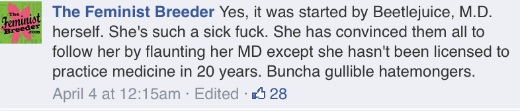
Gina Crosley-Corcoran, the Feminist Breeder, finds pictures of babies who died at homebirth to be profoundly frightening and has encouraged her readers to view them the same way.

image

In other words, Gina, like most homebirth advocates, desperately wants to bury babies who die at homebirth twice. First in a tiny coffin in the ground; a second time by erasing their existence from public view.

Gina, like most homebirth advocates, can’t handle the truth about homebirth: it kills babies who didn’t have to die.

And the claim about graphic violence? The extraordinary picture of Mary Beth does violence to the idea that homebirth is a safe, beautiful experience. If women understand that homebirth leads to preventable deaths, most of them are going to stop choosing homebirth. Rather than looking at women who choose homebirth as brave and empowered, they will start viewing such women with contempt, in the exact same way as parents who refuse to vaccinate are now viewed.

That fear is compounded by her rabid hatred of me. Referring to the Facebook group Fed up with natural childbirth where the photo was posted:

image

She can hate me all she wants. I’ve proven that I can defend myself quite well.

At this point, I view Gina as a bug on the windshield of my life: annoying, occasionally in my line of sight, but thoroughly squashed long ago.

Rail against me all you want Gina, but when it comes to women who read my blog and participate in my Facebook groups, have a little human decency. If a mother wants to post a beautiful picture of her baby who died at homebirth to prevent another mother from experiencing the never ending pain, don’t deride it as a scare tactic and don’t inspire others (or was it you?) to report those photos to Facebook for containing “graphic violence.” It makes you look like a heartless, hateful fool.

Attendant crowd sourcing another homebirth disaster in progress

Untitled-1

When will these midwives and doulas learn that the response to a stalled labor is NOT to ask your Facebook friends? The correct response is to TAKE THE PATIENT TO THE HOSPITAL!

I’ve been alerted to another potential homebirth disaster in progress posted on the Birth Professionals International Facebook page.

homebirth in progress 4-6-14 1

Apparently this mother has been in labor for FOUR DAYS!

The suggestions range from the moronic to the criminally stupid, including:

homebirth in progress 4-6-14 2

This:

homebirth in progress 4-6-14 3

And this:

homebirth in progress 4-6-14 4

Even with such shamefully negligent care, it is still possible this will work out okay, but the chances will be dramatically increased if they go to the hospital now. Let’s hope someone alerts them to this and that they do the right thing.

How babies’ brains get injured during childbirth

19378572_s

Childbirth is inherently dangerous for babies.

Why? During labor contractions, blood flow to the uterus (and therefore the placenta and baby) is cut off. During each contraction, the baby is, in essence, holding its breath. Most babies tolerate this pretty well, because between contractions the placenta is providing so much oxygen that the baby has a reserve to draw upon during the contractions.

But what happens if the placenta is not functioning optimally? In that case, the baby develops fetal distress. Otherwise healthy babies can tolerate a fair amount of fetal distress. That’s why C-sections done in the early phases of fetal distress produce very healthy, apparently undistressed babies.

It can take a long time for a baby to die of oxygen deprivation in labor, because the baby is usually getting some oxygen, albeit not enough. During that time, if the oxygen deprivation is severe enough, the baby’s brain cells will begin to die because brain cells are extremely sensitive to injury from lack of oxygen. Babies who survive may bear permanent brain injuries. The technical term for this type of brain injury is hypoxic ischemic encephalopathy (HIE).

HIE is often preventable. A new paper by American College of Obstetricians and Gynecologists’ Task Force on Neonatal Encephalopathy, published in this month’s edition of Obstetrics and Gynecology, describes the causes of and treatments for HIE. The paper, Executive Summary: Neonatal Encephalopathy and Neurologic Outcome, Second Edition, is available for free.

This paper should be of particular interest to anyone contemplating homebirth, because the existing scientific evidence shows that in addition to a 3-9X higher increased risk of death at homebirth, there is also an increased risk of injury to the baby during labor (Homebirth increases the risk of a 5 minute Apgar score of zero by nearly 1000%) and an increased risk of HIE (Risk of anoxic brain injury is more than 18 times higher at homebirth).

The paper starts by defining the problem:

Neonatal encephalopathy is a clinically defined syndrome of disturbed neurologic function in the earliest days of life in an infant born at or beyond 35 weeks of gestation, manifested by a subnormal level of consciousness or seizures, and often accompanied by difficulty with initiating and maintaining respiration and depression of tone and reflexes…

How do we know if a specific case of encephalopathy is caused by and event that occurred during labor?

Neonatal Signs Consistent With an Acute Peripartum or Intrapartum Event

A. Apgar Score of Less Than 5 at 5 Minutes and 10 Minutes

1. Low Apgar scores at 5 minutes and 10 minutes clearly confer an increased relative risk of cerebral palsy. The degree of Apgar abnormality at 5 minutes and 10 minutes correlates with the risk of cerebral palsy. However, most infants with low Apgar scores will not develop cerebral palsy.

2. There are many potential causes for low Apgar scores. If the Apgar score at 5 minutes is greater than or equal to 7, it is unlikely that peripartum hypoxia–ischemia played a major role in causing neonatal encephalopathy.

In other words, HIE is often first manifested by a low Apgar score a 5 minutes. Oxygen deprivation can be confirmed by a low pH of blood taken from the umblical cord, and brain injury can be confirmed by damage seen on MRI scans. Oxygen deprivation often causes damages to other organs, too, and these babies can suffer from kidney, liver, heart and intestinal problems due to lack of oxygen during labor.

Sometimes there is an obvious and dramatic cause for fetal oxygen deprivation during labor:

1. A ruptured uterus

2. Severe abruptio placentae

3. Umbilical cord prolapse

4. Amniotic fluid embolus with coincident severe and prolonged maternal hypotension and hypoxemia

5. Maternal cardiovascular collapse

6. Fetal exsanguination from either vasa previa or massive fetomaternal hemorrhage

Anyone planning a homebirth needs to take these possibilities into account. If one of these events occurs, the baby may likely die or be profoundly brain damaged if the event takes place in a hospital. If it happens at homebirth, the risk of brain injury and/or death rises dramatically.

In the absence of a dramatic event, how can we tell that a baby is suffering from oxygen deprivation during labor? Electronic fetal heart rate monitoring.

The patient who presents with a Category I fetal heart rate pattern that converts to Category III as defined by the Eunice Kennedy Shriver National Institute of Child Health and Human Development guidelines is suggestive of a hypoxic–ischemic event.

… Additional fetal heart rate patterns that develop after a Category I fetal heart rate pattern on presentation, which may suggest intrapartum timing of a hypoxic–ischemic event, include tachycardia with recurrent decelerations and persistent minimal variability with recurrent decelerations.

This is critically important. Contrary to the belief of many homebirth advocates, a baby does not need to have a period of prolonged slow heart rate (bradycardia) in order for profound oxygen deprivation to be happening. A bradycardia is often a terminal event; it doesn’t happen until the baby is nearly dead. This is almost certainly what has happened when a mother reports that her baby fell into the homebirth midwife’s hands dead or nearly so even though the heart rate was “normal” throughout labor. Just because the baby’s heart rate is not abnormally slow does not mean that the baby is fine. The signs of fetal distress are often too subtle to be detected by simply listening to the heart rate though it would be glaringly obvious on an electronic fetal monitoring tracing.

Is fetal heart rate monitoring perfect? Hardly, but the problem with monitoring is that it may indicate fetal distress when the baby is not distressed. In contrast, it is extremely reliable when a baby is experiencing oxygen deprivation. In other words, electronic fetal monitoring may lead to unnecessary C-sections, but if your baby is really in distress, it won’t miss it. So when a woman chooses homebirth “to avoid a C-section,” she is making a tradeoff. By avoiding electronic fetal monitoring, she is reducing the chance that she will will have an unnecessary C-section, but she is increasing the chance that her baby will suffocate to death without her midwife having any idea it is happening.

Moreover, the damage to the baby’s brain does not end when the baby is born, even if the baby is then getting enough oxygen, but with head cooling therapy, some of that additional damage can be prevented:

The implementation of hypothermia for the treatment of neonatal encephalopathy is a milestone in neonatal medicine and represents the culmination of research spanning decades that has proved the potential for neural rescue after “perinatal asphyxia.” The recognition that this therapy improves early childhood outcomes has accelerated the pace of investigations to find other brain-oriented treatments. The fact that greater than 40% of neonates undergoing hypothermia treatment still develop adverse neurologic outcomes underscores the need to further understand the underlying processes in neonatal encephalopathy…

Lately, there’s been a lot of discussion in the mainstream media about the increased risk of death at American homebirth. Unfortunately, there has been little or no research on brain injuries resulting from homebirth because, amazingly enough, homebirth midwives don’t bother to track brain injuries. They boast about breastfeeding rates, and ignore brain damage, which gives insight to their priorities.

Brain damage to your baby is a very real consequence of homebirth, and American homebirth midwives can’t be bothered to assess the scale of the problem, let alone prevent or treat it.

Women who choose homebirth are putting their babies brains at risk. How does the baby experience this? Elizabeth Heineman provides a vivid description of what she believes her baby suffered before dying during homebirth:

[The] brain, deprived of oxygen, each cell suffocating, withering into itself, crumpling, collapsing, but still struggling, alerting the nerves that something was terribly wrong. The nerves suddenly plunged into burning acid, receiving the frantic message, send­ing that information in a useless loop back to the very brain that was under siege. The brain screaming in increasing des­peration to the lungs that they should try something, anything. The lungs naively expanding, opening, to pull in relief, to pull in the cool air whose oxygen molecules it will quickly trans­mit to the bluish blood, re-reddening it, re-energizing it, so the blood can rush to the brain, restore it. The lungs instead getting meconium-filled amniotic fluid, choking the blood by transmitting precisely nothing, the blood by now dead but still pumped by the heart that hasn’t yet learned that it is all over, the heart sending the useless blood to the brain cells now wrung dry as they complete the act of withering, crumpling, collaps­ing …

Thinking about homebirth? Think again.

The anthem of homebirth midwives

We love homebirth

With apologies to Rodgers and Hammerstein. Sung to the tune of the South Pacific classic “You’ve Got to Be Taught”:

You’ve got to be taught
To hate and fear,
You’ve got to be taught
From year to year,
It’s got to be drummed
In your dear little ear
You’ve got to be carefully taught.

You’ve got to be taught to be afraid
Modern obstetrics is just a charade,
Your quest for experience will be betrayed,
You’ve got to be carefully taught.

You’ve got to be taught to be dismayed
Of the dread intervention cascade,
started by Doc so his golf game gets played,
You’ve got to be carefully taught.

You’ve got to be taught to be portrayed
As a woman whose placenta will never degrade,
Breech, twins or VBAC, be never afraid,
You’ve got to be carefully taught.

You’ve got to be taught to always downgrade
Tests, EFM, heplocks, technology arrayed,
flat on your back you will always be laid,
You’ve got to be carefully taught.

You’ve got to be taught to be afraid
That’s deep at the heart of our clever crusade,
Doctors as evil are often portrayed,
You’ve got to be carefully taught.

You’ve got to be taught our masquerade
As folks for whom blame we will always evade
That’s why our service is always prepaid,
You’ve got to be carefully taught.

You’ve got to be taught before it’s too late,
Before you are term or week thirty eight,
To hate all the people your Facebook friends hate,
You’ve got to be carefully taught!

A tale of two midwives

It was the best of times

A new guest post from the “Medwife“:

The case

A 42 year old mother of one presents in the first trimester of her pregnancy to begin prenatal care. Her first pregnancy was uncomplicated at 26 years old with a spontaneous vaginal delivery of a 7ib 4 oz infant in a rural community hospital at 41.6 weeks after three days of prodromal labor. The mother presents for current pregnancy feeling overwhelmed, but excited. She expresses her desire for low intervention care because she ‘trusts birth.’

Homebirth midwife

The mother begins prenatal care with midwife, advised against dating ultrasound after being informed of risks of autism. Trust birth philosophy reinforced, Advanced maternal age is just a variation of normal. Prior postdates pregnancy discussed; midwife concurs ‘babies know when to be born’ and mother is excited to avoid pressure to deliver prior to 42 weeks. Extensive discussion of kale diet, yoga and pelvic rocks. The midwife does not accept Medicaid and an out of pocket cost negotiated and contract signed.

An intimate relationship develops over the course of hour long prenatal appointments at which plans for her doula, birthing pool and birth kit are discussed. Fundal heights are measured as normal, however blood pressures tend to trend up at the end of the 3rd trimester. She is reassured it’s just a little elevated and the mother is thrilled her midwife doesn’t use fear mongering or scare tactics like she reads about on BabyCenter. In the meantime, her midwife crowd sources Facebook and receives recommendations to ‘trust birth’, ‘babies don’t have expiration dates’, ‘Epsom salt baths’, ‘kale smoothies’ and to ‘explore her emotional acceptance of pregnancy’ as measures to respond to increasing blood pressure.

At 38 weeks, contractions begin and labor progresses rapidly as the mother is surrounded by family and birth team. A limp apneic infant is brought to the surface of the water and the mother is encouraged to speak to her baby to ‘bring her earthside’. After several minutes, resuscitative efforts are initiated and eventually EMS is notified. Efforts to resuscitate the infant fail and as the mother is consoled by the midwife she is reminded ‘some babies just aren’t meant to live.’

For an additional fee the placenta is encapsulated.

A year later, a mother sits alone in her living room where her birthing pool had been. Empty arms and a heavy heart, wondering if she just didn’t ‘trust birth’ enough.

Medwife

At the first prenatal appointment, a thorough history and physical exam is completed. Dating u/s confirms the estimated due date. The medwife counseled the patient on folic acid, diet and exercise, weight gain and initial prenatal labs. The risks of advanced maternal age were discussed including increased risk premature birth, preeclampsia, diabetes, intrauterine fetal demise (stillbirth) and chromosome disorders. The medwife offered amniocentesis to the mother and explained the planned increased antepartum surveillance at 36 weeks with recommended delivery at 39 weeks in light of advanced maternal age.

Amniocentesis reveals an unusual chromosome disorder (mosaic) with elevated risk of stillbirth, intrauterine growth restriction and cardiac defects. After counseling provided, the patient desires to continue pregnancy. Medwife arranges maternal-fetal medicine consult, genetic counseling consult, Level II ultrasound and fetal cardiac ultrasound. Antepartum surveillance plan developed between MFM, OB and Medwife. Patient agrees to the plan, but expresses a desire to avoid induction of labor. Medwife acknowledges and discusses concerns at length while balancing risk status and emotional needs of the mother.

At 36.6 weeks, EFW (estimate fetal weight) percentile decreased from 36% to 5% with normal amniotic fluid, BPP 6/8 (absent fetal breathing movements) mildly elevated systolic/diastolic umbilical artery waveforms (an possible indication of decreased placental blood flow) and reactive NST (non-stress test) after prolonged monitoring. Blood pressure elevated at 140’s/80-90’s. Medwife consults OB and maternal-fetal medicine specialist, and the decision is made to proceed with delivery. Labor & Delivery is notified and the neonatologist is aware of genetic diagnosis. Extensive discussion regarding risks and benefits of induction, concerns regarding genetic diagnosis, onset growth restriction and elevated blood pressures. She initially declines with concerns regarding the danger of delivering prior to 39weeks according to the March of Dimes. Risk factors and concerns are discussed at length; patient agrees to proceed with cervical ripening, heplock and continuous electronic fetal monitoring. Pain management options discussed. Mother is disappointed she is no longer a candidate for labor tub and expresses concerns regarding ‘cascade of interventions.

She presents to Labor & Delivery for cervical ripening with onset of uterine contractions 6 hours after dinoprostone placed and nonrecurrent variable decelerations responding to position changes. Over course of several hours she progresses to 5cm, SROM (spontaneous rupture of membranes) and variable decelerations becoming recurrent. OB and neonatologist remain on the unit, anesthesia is in house and aware of patient status.

She rapidly progresses to fully dilated/+1 with urge to push. Minimal descent is noted with pushing efforts accompanied by prolonged decelerations, intrauterine resuscitation initiated with position changes, intravenous fluids, oxygen and terbutaline. OB present in room, Medwife and OB discuss vacuum assisted delivery with plan to proceed to the OR if not immediately successful. Patient agrees. Shortly thereafter, bradycardia ensues and OB applies vacuum and a 2300 gm female infant is delivered with Apgars 8-9. A small, thin placenta is delivered with velamentous insertion and sent to pathology. Pathology report reveals a 284 gm placenta (50% for 25-26wk gestation) with variable thickness of 0.5cm-1.25cm, maximum width 7cm and multiple succenturiate lobes.

After an uneventful 24 hour course, mother and baby are discharge to home. A year later, a developmentally appropriate and stubborn little girl toddles into the clinic with her mother, a pink tiara in one hand and a sucker in the other.

The Medwife reports:

Lost many nights of sleep during this woman’s pregnancy and barely made it to my call room to vomit after a thorough evaluation of the placenta and days away from stillbirth. I’m still not sure how that placenta managed to sustain a fetus as long as it did. I keep a copy of the placental report with the end of the EFM tracing and a first birthday photo stapled to it on a corner of my desk. Reminds me just how much birth can’t be trusted, risk factors can’t be ignored and safe midwifery care cannot be practiced in isolation.

The Medwife counsels other midwives:

This is the essence of evidence-based medicine, availability of resources and collaborative care. This is NOT ignorance of risk factors in favor of touchy feely goodness, birth teams and spectator stunt birthing and this most certainly WAS NOT a baby who wasn’t meant to live.

To homebirth midwives: this isn’t about politics. If you cannot find OB backup or have a rapport with your local hospital … perhaps you need to reevaluate why that is. You have found a way to manipulate mothers, ignore risks, bury your heads in the sand, get paid for it and walk away without remorse or liability … only to do it again. If your philosophy involves taking risks, avoiding interventions at all costs and vilifying the obstetrics community, perhaps the only politics at stake here are those you have created for yourselves. To waive the ‘politics’ card is insulting to the midwives who work endlessly to support pregnancy and birth, maintain a high level of professional collaboration within the medical community and are at all times aware of their resources. Why? Because that is the true value of Midwifery.

So the next time you leave a mother with empty arms and a broken heart, don’t you dare whisper “some babies aren’t meant to live” or “she would have died in the hospital too”. It’s not true and I’ve got the tiara to prove it!