Category Archives: Uncategorized

Surprise! Reducing doctors’ work hours doesn’t reduce mistakes

pn[C6G59AA]

In 1984, the year I graduated from medical school, Libby Zion died.

According to the Washington Post:

After his 18-year-old daughter Libby died within 24 hours of an emergency hospital admission in 1984, Zion learned that her chief doctors had been medical residents covering dozens of patients and receiving relatively little supervision. His anger set in motion a series of reforms, most notably a series of work hour limitations instituted by the Accreditation Council on Graduate Medical Education (ACGME), that have revolutionized modern medical education.

Now, nearly 3 decades later, the results of those changes are in and they are an utter failure. In fact, reduced resident hours actually result in MORE mistakes, not fewer!

As a piece in The New Yorker by Dr. Lisa Rosenbaum, entitled Why Doesn’t Medical Care Get Better When Doctors Rest More?, explains:

… [T]wo recently published studies suggest that, right now, both quality of care and quality of education are suffering.

One study, led by Sanjay Desai at Johns Hopkins, randomly assigned first-year residents to either a 2003- or 2011-compliant schedule. While those in the 2011 group slept more, they experienced a marked increase in handoffs, and were less satisfied with their education. Equally worrisome, both trainees and nurses perceived a decrease in the quality of care—to such an extent that one of the 2011-compliant schedules was terminated early because of concerns that patient safety was compromised. And another study, comparing first-year residents before and after the 2011 changes, found a statistically significant increase in self-reported medical error.

Why have the reforms produced the opposite result from what was intended? There are two reasons for the failure:

1. The proximate reason for the failure is that Libby Zion didn’t die because the residents who cared for her were overworked. She died because they were grossly incompetent.

Libby was a college freshman with an ongoing history of depression who came to New York Hospital in Manhattan on the evening of Oct. 4, 1984, with a fever, agitation and strange jerking motions of her body. She also seemed disoriented at times…

[Later] Libby became more agitated. The nurses contacted Weinstein at least twice. Weinstein ordered physical restraints to hold the patient down and prevent her from hurting herself. She also prescribed an injection of haloperidol, another medication aimed at calming her down. Busy with other patients, Weinstein did not reevaluate Libby.

And that is malpractice. The woman had a fever. In no medical universe is it ever appropriate to ignore fever and neurologic symptoms in favor of restraining the patient and dosing her with powerful psychoactive medications. It had nothing to do with being tired; it reflected the doctors’ incompetence.

2. The larger reason, one we would do well to take to heart, is that the single most important thing patients need from doctors is their time.

The calculus is brutally simple. Reducing working hours without reducing patients numbers of increasing the number of doctors means less doctor time/patient and an increase in mistakes is an inevitable result.

Because, and this is the dirty little secret in medicine, being exhausted, overworked and irritated does not cause medical mistakes. Lack of time to talk with patients, both to listen and to explain, and lack of time to obsess about the details is what causes medical mistakes.

I will freely admit that the brutality of internship and residency did not make me a nicer doctor. When you are working 105 hours a week (staying up all night, every third night) you have little energy for being nice. But it did make me a better doctor.

I can hear younger doctors out there groaning about antiquated older doctors celebrating the hazing process, but the reality is that it made for better, safer patient care. As one of my chief surgical residents told me (actually he yelled it in my face) early in my career: “In medicine there are no excuses. YOU don’t matter; all that matters is what is good for the patients. I don’t care if you are hungry, tired or depressed. The only excuse for knowing less than everything about your patients is that you are currently treating a cardiac arrest or having one yourself.”

Rosenbaum relates the story of her own mother, also a cardiologist, who has the same work ethic that was beaten into me:

“Mom,” I said. “It’s 8 P.M. Why on earth are you going to the hospital?”

“I’m going to see my patient,” she said.

“But you have been working nonstop for five days,” I protested…

“Her boyfriend’s driving in,” my mom explained. “He really wants to talk to me.”

And then, without thinking, the words popped right out of my mouth: “But isn’t there someone covering you?”

“I’m her doctor,” my mom said. “I’ve been with her since the beginning. Don’t you think this is important?”

And it is only by providing long brutal hours of care and caring like these that doctors avoid mistakes.

It wasn’t the young doctors’ lack of sleep that killed Libby Zion; it was their lack of competence. It will only compound the tragedy if the legacy of her preventable death were more medical mistakes, not fewer.

Pumping isn’t good enough; lactivists demand the right to breastfeed during work

iStock_000002039450XSmall

In their solipsism and self-righteousness, lactivists are now threatening workplace equality.

That’s likely to be the ultimate effect of a poorly conceived, basically  frivolous complaint being brought by a New Hampshire mother in the federal Equal Employment Opportunity Commission.

According to the astoundingly credulous reporter at The Boston Globe:

The 42-year-old New Hampshire woman, who was terminated from her job last August for not returning to work after her maternity leave, says she stayed home because her employers would not agree to what she calls a reasonable request to accommodate her desire to breast-feed her child during the workday.

Imagine that. She was fired simply because she refused to come to work.

I know you’ll be shocked to find that the mother feels terribly sorry for herself.

“I felt like a volcano was erupting and heading straight for me and I was locked in,” she said of the drawn-out communications she had with her employer over her breast-feeding rights. Frederick had worked as a child support officer with the New Hampshire Department of Health and Human Services in Conway. “If I went back to work and did what I needed to do for my health and [my son]’s health, I would have been insubordinating.”

I know what you’re thinking, because I thought the same thing. Why doesn’t she pump breastmilk for her son? Alas, her special snowflake won’t take a bottle.

The Affordable Care Act and state laws require most employers to accommodate women who wish to breast-feed by allowing them to pump milk during the workday to later bottle-feed their children. But Frederick’s son Devon, like many babies, would not take a bottle at first; to breast-feed him, she would have to physically be with him.

That means she fell into a legal black hole in terms of protection: Employers aren’t required to let their employees breast-feed children during work hours — they just have to make it possible for mothers to pump their milk.

She hasn’t been to work for the past year? How old is this baby anyway? Actually, he’s not a baby. He’s a 14 month old toddler.

Legal eagle Jake Marcus (a woman, and Gina Crossly-Corcoran’s former lawyer in our ongoing court case) offered this bit of brilliance:

Jake Marcus, a Philadelphia lawyer and national breast-feeding advocate, calls that legal distinction between pumping and feeding “absurd.”

“Just the specter of having children in the workplace scares people,” she said.

No, Jake, that doesn’t scare people. It’s interferes with the purpose of the workplace … work.

Dr. Melissa Bartick weighs in. You may remember Dr. Bartick as the researcher who published thoroughly fanciful and fabricated claims about breastfeeding saving hundreds of lives and billions of dollars … as long as we ASSUME (!!) a causal relationship between breastfeeding and health benefits.

Dr. Bartick, vying for the role of lactivist bully-in-chief, has this to say:

“There are enormous risks from not breast-feeding,” said Dr. Melissa Bartick, chair of the Massachusetts Breastfeeding Coalition. Stopping breast-feeding earlier puts children at risk for many chronic diseases such as diabetes, obesity, and even leukemia, she said.

That, of course, is a bald faced lie, but when you are bullying, the truth apparently doesn’t matter very much.

But let’s leave aside the extraordinary factual problems with this case, including the absurd claims about the benefits of breastfeeding. This case strikes at the heart of workplace equality for women because it is predicated on a radical demand: employers ought to be forced to accommodate whatever a mother deems “best” for her child.

Women have spent decades convincing employers that they can be equal to men in all parameters of work. Now this woman is claiming that children have a need for their mothers that trumps the employer’s needs. Why stop at breastfeeding?

Why wouldn’t women argue that children have a need for their mother’s physical presence for 3 years and that they should be allowed to have 3 year maternity leaves? Why couldn’t women argue that children have a need for mothers to be home at night and therefore, women should not be asked to travel for business? What if the baby has terrible stranger anxiety? Does that mean that the baby should be allowed to come to work with the mother?

Kate Frederick may believe that her baby’s needs come before her employer’s needs. If so, she can act accordingly by putting her baby’s needs ahead of her employer’s needs and resign her job. But Kate seems to think that HER EMPLOYER should put Devon’s needs ahead of his own needs and that’s where she crossed the line.

Are women equal in the workplace, capable of performing at the same level as men? Or does being a mother mean that women can longer be a professional at work, but a mother first?

My generation of women, and the generation that came before me, struggled mightily to convince professional schools, employers and colleagues that women are every bit as capable and every bit as responsible as male employees. We managed to do so AND successfully mother our children.

Now a new generation of women is declaring that, no, women cannot be expected to be every bit as capable and professional as men. Once they have a baby, the baby trumps all and they must be allowed to do whatever they want, whenever they want, by saying the magic words, “it’s good for my baby.”

Lactivists need to grow up and own their own choices. Women can continue a successful breastfeeding relationship by pumping during working hours while still being stellar employees. If Kate Frederick and other lactivists think that’s not good enough for their special snowflakes, they can quit their jobs, do without the income, and accept the fact that their babies are not their employers’ responsibility.

What do homebirth advocates and toddlers have in common?

iStock_000019735774XSmall

Homebirth advocates are lamenting the court defeat of Aja Teehan. Teehan petitioned to Irish courts to force the health service (HSE) to PAY FOR a homebirth VBAC, against medical advice, attended by a non-HSE provider. Not surprisingly, she lost, in large part because her toddler level claims.

The arguments of homebirth advocates bear a remarkable similarity to toddler tantrums. Indeed, the language is the same.

Consider:

1. I want

Homebirth advocates, like toddlers, appears to believe that because they want something, they deserve to have it. It doesn’t matter that it isn’t safe. It doesn’t matter that others (the baby) may be hurt or die because of their choice; it doesn’t matter that other people (health professionals) must be forced to do things they don’t want; it doesn’t matter what it costs. They want it, and like toddlers, they appear to think that this is their most compelling argument.

2. Gimme

Homebirth advocates, like toddlers, appear to think that because they want something, everyone else has an obligation to provide it for them. Regulatory boards should violate their standards to admit uneducated, unqualified midwives; the most basic principles of safety should be ignored, and somebody else, be it an insurance company, the government or donors on crowd sourcing website. should pay for it.

3. Mine

In the world of homebirth advocates, everything is “mine.” My homebirth, my rights, my desires. No one else counts, not even the baby. Everyone else is just a prop in their little piece of performance art.

4. How do you know?

Homebirth advocates, like toddlers and even older children, have zero respect for the education and experience of those who are older, better educated and better trained. Like the second grader who asks for help with math homework and then whines that the parent is doing addition wrong, homebirth advocates insist that they know more about childbirth, medicine and science then people who have spent decades studying and practicing obstetrics. In exactly the same way as the second grader who needs help with his math homebirth believes that his mother doesn’t understand addition, homebirth advocates who transfer to the hospital in obstetric emergencies believe that doctors and nurses don’t understand childbirth. Such astounding naivete may be understandable in a second grader, but it truly defies comprehension in an adult.

5. You can’t make me!

The battle cry of toddlers and homebirth advocates everywhere.

That’s because defiance is the hallmark  of homebirth advocates as well as of toddlers. It’s true that we can’t force women to give birth in hospitals or hire real midwives instead of birth junkie self-proclaimed midwives, nor should we be able to force women to do so. Nonetheless, choosing to risk your baby’s life because you enjoy defying authority isn’t any more mature than the toddler who lies thrashing on the floor, whining “you can’t make me.”

6. It’s not fair!

Homebirth advocates, like children of all ages, have acute appreciation for fairness BUT ONLY as it applies to them. They are constantly wailing about injustice without giving a moment’s consideration to their fairness to others. Homebirth advocates, like small children, insist that their “rights” are being violated as if there is a right to homebirth. They simply made it up; there is no right to homebirth, just as there is no right to stay up past your bedtime.

Ultimately, homebirth advocates are going to find it impossible to achieve their desires as long as they continue to resort to toddler-speak. “I want” a homebirth does not incur any obligation on the rest of us. “Gimme” does not mean we need to pay for it. Insisting that the birth is “mine” and ignoring the baby’s well being just makes most people think less of you. “How do you know?” and “You can’t make me!” are cries of the immature. And “It’s not fair!” begs the question of fair to whom; the baby? the health care providers? the government?

Fortunately for babies, I don’t foresee homebirth advocates improving their reasoning skills. In the books they read, and the echo chamber websites they frequent, toddler reasoning carries the day. They can’t seem to figure out that what works for toddlers isn’t going to work in the world of adults and professionals. And so they are left to wail, yet again, “it’s not fair!”

August 16, 2013: This week in homebirth idiocy

iStock_000000385785XSmall

The end of summer is a slow time in the blogosphere, but in the world of homebirth, the crazy never stops.

Gems from this week include:

1.Women petitions for health service coverage of an HBAC (homebirth after cesarean) against medical advice

According to the Irish Times:

University lecturer Aja Teehan, whose second child is due on October 13th, applied to have the baby born at home in Thomastown, Co Kilkenny, assisted by a midwife.

She alleged the HSE is operating a “blanket policy” of refusing to cover home births for women who previously had Caesarean section births which means she cannot have her baby at home as a midwife will not get indemnity cover to attend. Ms Teehan has a six-year-old daughter born after a Caesarean section.

Considering that the Irish court has already ruled that there is no right to a homebirth at all, there was zero chance of Teehan prevailing. This was just a publicity stunt and the judge slapped her down pretty hard:

Ms Justice Iseult O’Malley today rejected her application and said it would be “manifest irrationality” for the courts to change the criteria for home births as set out by the HSE.

The judge will now determine whether Teehan must pay court costs.

2. Unassisted birth; unlimited stupidity

Whenever I bring up the topic of having an unassisted birth (a home birth without the presence of a midwife, or medical professional, sometimes called ‘freebirth’), people look at me like I’m crazy.

Really? Do tell.

What if something goes wrong?

Personally, education is my relief when it comes to this. I’ve read countless birth stories, researched every possible complication, and how to handle it, and also educated Arick on all of the issues as well. I know what warrants an emergency enough to head to the hospital, or even more to call an ambulance. But the thing is, a lot of the complications that are common in hospital childbirth are due to the interventions that are used. Complications in a drug and intervention free birth are very rare.

Who is stupid enough to actually believe this crap?

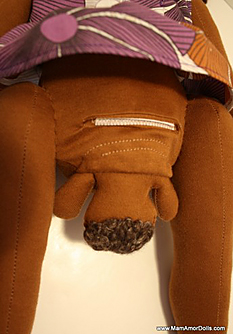
3. Introducing the VBAC doll.

Only a picture could do it justice.

VBAC doll

Apparently the “attagirls” from the other members of your ICAN group are not enough. Now impresses your toddler and her friends, too … as if your toddler cares how her younger sibling exited her body and why you needed a healing VBAC to get over her (or his) C-section birth.

And it only costs $200!

Why are birth junkies so pathetically desperate for adulation?

4. Yet another homebirth advocate claiming that a numbingly typical homebirth is “unusual.”

This homebirth story could have been written by The Onion, it is so filled with cliches. Of course you wouldn’t expect anything else from a filmaker who created …

the FOOD MATTERS film, which helped heal my father from chronic fatigue syndrome, depression and anxiety plus free him from the pharmaceutical drug bandwagon.

It’s worth reading in full. You’ll howl with laughter. It includes the usual cast of thousands such as the midwives, the doula, the chiropractor, the lactation consultant, and the cranio-sacral therapist.

Just like in nature!

No, natural is not better

iStock_000025207191XSmall copy

There is an overarching belief in contemporary society that natural is “better.”

Advertisers key into into it. Organic food purveyors rely on it. And it is obviously at the heart of natural childbirth advocacy, lactivism and attachment parenting.

Ironically, the belief that natural is better has arisen amidst a society that proves in every possible way that natural is NOT better. The average human life expectancy in nature is approximately 35 years. The average human life expectancy in first world countries approaches 80. What has been responsible for the doubling of life expectancy? It is technology, not nature.

Consider the greatest public health advancements of all time:

Creating a clean environment

  • Clean water is not natural.
  • Food free of harmful micro-organisms is not natural.
  • Sewer systems are not natural.

Expanding the food supply

  • Hunting with even the simplest weapons like spears and clubs is not natural
  • Agriculture is not natural.
  • Crop rotation, weeding and fertilizing with manure are not natural.
  • Domesticated animals are not natural.

Protection from the environment

  • Houses are not natural.
  • Central heating is not natural.
  • Clothes are not natural.

Protection from disease

  • Treatment of disease is not natural.
  • Soap is not natural.
  • Antibiotics are not natural.
  • Sunscreen is not natural.

Simply put, just about everything that makes our lives cleaner, safer, more comfortable and longer is not natural.

So why is contemporary society biased toward the natural?

Why is the mainstream media eager to report that technology (vaccines, bottle feeding, Cesareans, and pitocin, among other bugaboos) causes cancer, autism or any other currently poorly understood disease? The reasons have nothing to do with medicine or technology and everything to do with disappointments, distrust and marketing.

There is no group more disappointed with the fact that vaccines can cause serious side effects than vaccine rejectionists. Even though scientists have been thoroughly above board about the real dangers of vaccine, the anti-vax folks have transmuted their intolerance for anything less than perfection into wildly irresponsible claims about fabricated “risks” of vaccines.

There is no group more disappointed with the fact that hospital aren’t perfect than natural childbirth advocates. They wield the phrase “babies die in hospital, too” like a cudgel, transforming their profound disappointment in the fact that hospitals can’t yet save all babies into a bizarre conspiracy that hospitals are actually killing babies with “interventions.” Between them, Cesareans and pitocin save hundreds of thousands of lives each year in the US alone, yet NCB advocates live in a bizarre mirror world in which life saving treatments are dangerous and dangerous stunts like unassisted homebirth are without risk.

Americans in general are profoundly disappointed that modern business is concerned with making money, and not just with improving lives. They’ve turned that disappointment into reflexive distrust of “corporations” and bizarre conspiracy theories about manufactured products like medications.

But there’s more at work here than disappointment and distrust. Marketing has played an enormous, but largely unappreciated role in promoting “natural” in order to distinguish products in the marketplace. Marketers have woven a fantasy of benevolent “nature” that invariably costs more. From organic produce to supplements to “natural” treatments like chiropractic and reiki, Americans are urged to spend more on products that don’t do more or don’t do anything at all.

Not surprisingly, Americans with the most disposable income have the means to follow these trends. The fact that rich people choose to spend their money on a product makes it that much more desirable to everyone else. Organic food is a status symbol, wasting money on quack “treatments” is a status symbol, membership in a gym is a status symbol, having an unmedicated birth is a status symbol, and breastfeeding is a status symbol.

Breastfeeding is a particularly interesting status symbol. Infant formula became popular in a milieu where technology itself was a status symbol. The rich could afford the “superior” technological wonder of infant formula while the poor had to make do with breastfeeding. Now that most Americans can afford formula, it has become declasse. “Natural” is now the status symbol and that’s why breastfeeding is far more popular among white, well off women than among the rest of society.

From an objective point of view, there is no evidence that “natural” is better. Indeed, just about everything that has improved our comfort, health and life expectancy is not natural. Nonetheless, the bias persists that if it is “natural” it must be good even when there is a massive amount of evidence to the contrary. That accounts for the irony that vaccine rejectionists, natural childbirth advocates and lactivists use every technological method at their disposal (the Internet, advertising, and lobbying) to in an effort to argue that technology is bad and natural is good.

Why you’re choosing homebirth

Pink Argyle Baby Girl Bib

Ever notice how women who are planning to have a homebirth feel the need to justify it to the entire world?

There are literally hundreds of blog posts and web articles entitled “Why I’m having a homebirth” or some variation thereof. I’m not really sure why homebirth advocates think the rest of us care why they are having a homebirth, and for the life of me, I don’t understand why on earth they think their reasons are original. The posts and articles are always the same; indeed, I could write it for them.

Why you are having a homebirth:

1. For bragging rights.

You are inordinately proud of yourself as if you are planning to something that more than 90% of women who have ever existed haven’t already done, and are doing around the world every single day or dying in the attempt. Nonetheless, you feel the need to share this with the entire world as if you think we are going to be impressed.

You can save it for your crunchy friends who are competing with you for most risk-filled outlandish homebirth. To the extent that the rest of us care, it’s only to note that you are a fool.

2. To proclaim that you are “educated.”

This may come as a surprise to homebirth advocates, but most people who have real education do not refer to themselves as “educated.” In the world of the internet, that adjective is reserved for the ignorant who think they can actually do “research” online. Anyone with real education knows that it cannot be acquired by reading books and blogs written by lay people for other lay people.

3. You are ignorant of history.

Only a fool looks at the modern world and believes that childbirth is inherently safe. It’s like looking at the modern world and believing that highways are “natural” because you can’t remember a time when highways didn’t exist. Anyone with a modicum of historical knowledge knows that childbirth is and has always been, in every time, place and culture, one of the leading causes of death of young women and the leading cause of death of babies.

4. You are gullible.

You believe the racist, sexist claptrap made up by Grantly Dick-Read that “primitive” women don’t have pain in childbirth because they don’t have fear. In the first place, it’s not true; secondly, you seem to have confused correlation for causation. Fear doesn’t cause childbirth pain; the agonizing pain of childbirth causes fear.

5. You are selfish.

You seem to think that birth is about your experience instead of about your baby’s safety. You are dead wrong about that.

So the next time you are tempted to justify to the rest of the world your decision to have a homebirth, don’t bother. We already know why and we don’t care.

Scientists find maternity clothes cause pregnancy

image

Startling finding announced in prestigious journal
by Gull E. Bull

Scientists have made an astonishing discovery about the cause of pregnancy. According to the study, published in the widely read journal JCS (Journal of Crap Science), researchers have discovered a remarkable and powerful association between maternity clothes and pregnancy raising the possibility that maternity clothes cause pregnancy. Lead author Publish R. Parrish explains that this remarkable association was found in a variety of different investigations.

1. Nearly all women wearing maternity clothes are pregnant (correlation coefficient 0.95) indicating a near perfect relationship between maternity clothes and pregnancy.

2. There is a startling association between the number of stores selling maternity clothes and the overall fertility rate (p<0.01). 3. The odds ratio for pregnancy for a woman wearing maternity clothes as opposed to non-maternity clothes, is very high (RR 35.7). For non-pregnant women, the number wearing maternity clothes drops off in a linear fashion from the day after delivery to approximately 6 weeks postpartum. According to Dr. Parrish: "The findings in this study are even stronger than the new study touting an association between induction and autism. We believe that our study deserves far more attention because the association is much clearer and even more robust." Asked if it were possible that the investigators had misinterpreted their findings, confusing the fact that pregnancy causes women to wear maternity clothes and not the other way around, Dr. Parrish acknowledged the need for further research. He admitted that correlation is not causation but pointed out that if the mainstream media could make such a fuss about crap research showing an association between induction and autism, his work should be able to get even more attention. As Dr. Parrish noted: "We aren't really concerned with what is true, but rather what can be published and publicized. The more sensational the results, the better. Why wait to reproduce results when you can submit crap to any journal, get it published and get it publicized in the newspapers? It's not like anyone is really checking the accuracy of our findings or the plausibility of our conclusions, right?" Indeed, Dr. Parrish admits that he has no intention of further research in this area. He is eager to move on to his next project: C-sections for macrosomia cause babies to grow larger.

I mother with my entire body

image

To hear natural childbirth advocates and lactivists tell it, the entire story of mothering can be reduced to 3 body parts: uterus, vagina and breasts.

Alisa Quart points out in today’s piece in Salon that she mothers her young daughter with her brain as well.

That got me thinking about how I have mothered my four children over the past 26 years, and seems like I have used just about every part of my body.

Arms: I used my arms a lot, not merely to carry my children, although I carried them quite a bit when they were small. I used my arms primarily to embrace them. Hugs are the appropriate response in times of both happiness and sadness, or for no better reason that to be close. I cannot count the times I hugged my children, and even now, when they are adults, I still do.

Hands: I think I spent 10 solid years holding hands. Holding toddlers’hands when they learned to walk. Holding hands crossing the street and in the parking lot. Holding hands just because it is fun to hold hands.

I also used my hands to sew clothes for my children, to fill out a million permission sheets for field trips, to feel foreheads for temperatures, and to help with a billion school projects (if anyone needs pipe cleaners, I still have hundreds.)

Lips: I kissed my children over and over and over again. I kissed to heal boo-boos. I kissed to check for fevers. I kissed for no better reason than I loved to kiss them. Of course there were years I had to lay off the kissing because public kissing was just too embarrassing for teenagers, but those years are over now, and I can kiss again, at least for greeting.

Legs: I walked miles holding fretful infants in the middle of the night, shopping for clothes and shoes and toys, tramping out to baseball fields, football fields, soccer fields and basketball courts to watch countless youth sports games.

Mouth: I used it to tell my children that I loved them, but I also used to advocate for them, to seek out appropriate evaluation and therapy for learning disabilities, to explain them to teachers and to explain life’s leassons to them.

My entire body: Is there anything that gives comfort like a mother’s body? It provides comfort when you are awake sitting near your children, and even when you are asleep lying in bed next to them in bed after a nightmare.

Brain: I thought about my children constantly, when I was with them and when I was not. I taught them facts and I taught them morals. I worried when they were little; I worried when they were teenagers; and I still worry now. I shared my views on how they should treat others and how they should be proud of themselves (or not, as the case warranted). I conveyed my religious beliefs and my political views. I planned for them; I brainstormed with them; and I hoped desperately that I could give them what they needed to be happy, healthy and to reach their full potential.

Last, but not least, my heart:

Not my physical heart, although it sometimes felt like it when they were hurt or disappointed. I am referring to my metaphorical heart. I loved and I still love my children more than life itself and I have tried to convey that to them. They and their father are the most important people in the universe as far as I am concerned, and it is my deepest wish that they know it and feel it.

Yes, my children grew in my uterus. Yes, they transited my vagina when they were born. Yes, I nourished them with my breasts, but I don’t think that made much difference to who they are and to how I love them. I would gladly have had C-sections if there had been even the slightest chance that they were at risk during birth. I would have happily supplemented with formula if I hadn’t been lucky to produce enough milk. My children don’t remember those days, and frankly, they couldn’t care less.

That’s fine with me. Those body parts are not the ones that I want my children to think of when they think of me. I want them to remember holding hands when they were little, countless hugs and endless kisses. I hope they remember my physical presence beside them when they were sick, next to them in bed when they had bad dreams and in the bleachers or the audience for sports and plays and graduations.

Motherhood is so much more than whether or not your newborn passed through your vagina or whether or not you fed your infant with your breasts. In the grand scheme of motherhood, those body parts are trivial, eclipsed by the rest.

I mother with my entire body. Isn’t that what good mothers do?

Am I a Sanctimommy?

iStock_000016864858XSmall

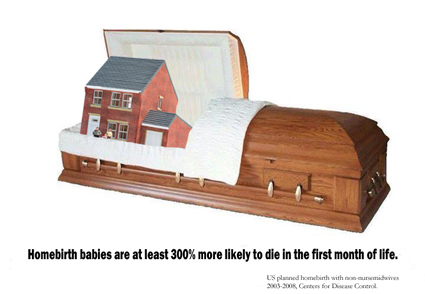
Last week I posted this image:

house casket

It got picked up by Sanctimommy on Facebook who asked:

What do you think, does the fear mongering go both ways?

In this case it does because I created the image as a riff off of a similar image created by a lactivist organization featuring a bottle of formula in a coffin and declaring that “formula fed babies are 26.5% more likely to die in the first year of life.”

I contemplated responding to the bottle in the casket image with facts: a 26.5% increase is trivial; the increased infant mortality rate reflects the difference between babies who are formula fed (race, economic status, health care) from those that are breastfed, not the difference between formula and breastfeeding. I ultimately decided that a punch in the gut image like the bottle in the coffin would be countered most effectively by a punch in the gut image of the house in the coffin, which has the added virtue of causation, not merely correlation.

In other words, I created the image specifically to “go the other way” on fear mongering.

But the Sanctimommy had this to say:

I think Dr Amy and the Alpha Parent are on equal ends of the shock and awe parenting campaign. I don’t understand how you can love one and hate the other. The argument is different but the end result is the same.

I beg to differ. There are real differences that mean that Alison Dixley, The Alpha Parent, is a sanctimommy and I am not.

Do I judge? You bet I do. I judge mothers who can’t tell the difference between the internet and a medical textbook. I judge self-proclaimed midwives who couldn’t care less if babies die at homebirth as long as they get their birth junkie high and some money to go with it. I judge women whose babies died at homebirth and refuse to take responsibility for their own decisions.

Yes, judging is the sine qua non of being a sanctimommy. It’s necessary, but it’s not sufficient.

First, for a sanctimommy, there is only one right way: her way. My primary message about parenting is that there are MANY right ways to parent children and what works for one mother and her family may not work for another.

Second, being a sanctimommy is about denigrating other mothers in order to boost your own fragile self-esteem. But I don’t write about my children and my parenting decisions. I write about the central empirical claims of natural childbirth advocacy, lactivism and attachment parenting. Specifically, I write about the fact that they aren’t based on scientific evidence, but rather made up to suit the needs of activists.

Third, and most importantly, a sanctimommy wants the majority of women to feel bad about themselves and to feel guilty. My goal is the opposite. I try to reassure the majority of women that they shouldn’t feel guilty because they aren’t doing anything wrong.

Superficially it may seem that The Alpha Parent and I have a lot in common. We are both very aggressive. But she is aggressive in promoting her view that SHE is a better mother than you. I am aggressive in promoting the view that YOU are a great parent if your decisions are made with love and concern for your child, regardless of whether I might have made the same decisions. I have no skin in the game of mommy one-upsmanship, because my children are all young adults and the decisions that obsess sanctimommies are all in my rearview mirror.

Moreover, sanctimommy bloggers are writing as themselves. I am writing as an on line persona, chosen deliberately because it seems to work the best in combating the pseudoscience rampant in homebirth advocacy, lactivism and attachment parenting. As you might imagine, I’m not shy and retiring in real life, but I’m not this persona, either.

Do I judge? You bet I judge. I judge women who put their desire for bragging rights ahead of whether their baby lives or dies. I judge individuals and organizations that profit from spreading misinformation about childbirth and breastfeeding. I judge women who can only feel good about their mothering by tearing other mothers down.

But judging is not wrong. I also judge racists, homophobes and misogynists. I judge murders, abusers and child pornographers. I judge political parties that use hate to win votes and I judge countries that use violence against their citizens.

Judging alone does not make one a sanctimommy. Who you judge and why you judge matters, too.

I’m loud, I’m aggressive and I don’t hesitate to tell unpleasant truths, but that doesn’t make me a sanctimommy.

It makes me The Skeptical OB.

Lactivism and viciousness

iStock_000010367892XSmall

The dirty little secret about lactivism is that it has nothing to do with babies or even with breastfeeding. It’s all about lactivists and their desperate need to feel better than other mothers.
Lactivism is about hating and hurting. How else to explain the breathtaking viciousness of contemporary lactivists?

When it comes to viciousness, the Alpha Parent has no equal. Her recent endorsement of a guest post by James Akre on analogizing breastfeeding is a tour de force of the genre.

I like using the ordinary to approach what is commonplace for some but still unfamiliar for others. The purpose is twofold: to show how everyday analogies, images, metaphors, similes and symbols can be used to see breast milk and breastfeeding from a fresh perspective; and to suggest how this approach in turn can help others see breast milk and breastfeeding in ways they would surely never have imagined…

English to English translation: I’d like to beat you about the head with all the ways that I am better than you.

You must, must, must read the entire post. There is so much delicious venom that it would be a shame to miss a drop. However, in the interests of brevity, I will summarize:

Analogy # 1 Of pleasure and pain

You are so selfish that you willingly take on the pain of wearing high heels, but you can’t be bothered to endure the pain of breastfeeding?

Analogy #2 Flying civilly

Formula is like those oxygen masks that drop from the ceiling when an airplane cabin depressurizes in flight; useful in emergencies but inappropriate at any other time.

Analogy #3 Break glass only in case of emergency

The accompanying image says it all:

break glass formula

Analogy #4 The sky’s the limit

If we were to decline to provide our children with the nutritional equivalent of a plush suite in a five-star hotel by feeding them artificially, we would do well not to kid ourselves into believing that, by giving formula, we’re somehow at least replacing the suite with adequate three- or four-star accommodation. In fact, our children still end up eating in the basement.

My breastfed baby gets The Ritz. Your bottlefed baby gets the pits.

Analogy #5 Holding hands with history

When a mother who, herself, has been breastfed breastfeeds her child, she at once completes and forges historical links of great consequence.

Historical significance? Really?

Analogy #6 Row, row your fashion boat

We can easily afford to provide our children with the finest in tailor-made nourishment, and this for a fraction of the price of even vulgar mass-produced synthetic nutritional frippery.

Analogy #7 Just do your best, Dear

It’s true, some parents deliberately opt to provide their children with nutritional mediocrity; but rich or poor, top-of-the-line elite nutrition is accessible to all.

Analogy #8 Kinky accoutrements

A bottle of formula is just a kinky accountrement. What does that even mean?

Analogy #9 Before you buy shoes, measure your feet

In a critical piece of ground-based navigation software one development team had used Imperial units, i.e. inches, feet and pounds, while another had used metric units. Since the software hadn’t been told to do any conversions, it appeared that the Orbiter got its trajectory wrong and crashed into the Martian surface. Meanwhile, the Mars Polar Lander reached its target at the beginning of December 1999. After 11 months of traveling some 35 million miles (more than 56 million kilometers) in space, the $165 million craft was a mere 130 feet (40 meters) from landing when disaster struck, or rather both the Lander and its piggybacking Deep Space-2 probes were likewise destroyed when they struck the surface…

Formula, rat poison, it’s all the same. If you feed your baby formula, he or she will be destroyed in a spectacular flame out.

I could go on, but I think you get the idea. This sewage spewed forth by Akre and Dixley has nothing to do with what’s good for babies. It has nothing to do with babies at all. It’s self-serving viciousness for those who love to hate.

Here’s my analogy:

These people are vipers in the grass: all natural, and deadly. Their goal is to bite you and eat you alive, for the fragile self-esteem of lactivists is not supported by breastmilk; it is nourished by venom.