Category Archives: Uncategorized

Acceptance speeches you will never hear

1. At the Academy Awards

I’d like to thank the director for creating such a wonderful film, the producer for offering me the greatest part of my career, my agent who never stopped believing in me and my mom for refusing to have an epidural during my birth.


2. At a high school graduation:

I am proud and honored to be your valedictorian. Of course, no one achieves this alone. I’d like to thank my teachers, my friends and most of all, my mother who never let a bottle of formula touch my lips.


3. At the Nobel Awards ceremony

I owe my career to my father who encouraged me to pursue my obsessive interest in dinosaurs up to and through a degree in paleontology and to my mother who trusted birth.


4. At the Superbowl

I’m proud to be named MVP, but I owe it all to God, my teammates, my coach and my mother who “wore” me on her chest until I was 3 years old.


5. At the Olympics.

I dedicate my gold medal to my mom, who had painful sex for the rest of her life because of the 4th degree vaginal tear she sustained at my birth after refusing a C-section and pushing for 5 hours.


Why won’t you ever hear them? Because the “achievements” that loom so large in the minds of mothers of newborns are entirely irrelevant to children. They don’t have any meaningful impact on children’s lives and children don’t care about them.

In contrast, when the pursuit of those “achievements” goes wrong, the results can be devastating. Here are a few more statements that will never be made, at an awards ceremony or anywhere else.


6. From an adult who sustained an Erb’s palsy.

I really don’t mind that my right arm is partially paralyzed and that I have struggled my whole life to use my left arm instead, all because my mother insisted on a homebirth midwife who had never handled a shoulder dystocia.


7. From a woman who lost her identical second twin to an abruption at birth.

Thanks, mom, for refusing to listen to the doctor who played the “dead baby card” and for insisting on giving birth to twins at home.


8. From a wheelchair bound man with severe cerebral palsy.

It’s okay that you insisted on a vaginal breech birth instead of a C-section and my head got stuck and I was deprived of oxygen. After all, it was far more important for you to have a vaginal birth than for me to be able to walk.


9. From a woman profoundly brain injured when her mother’s uterus ruptured during an attempted VBAC.

You don’t hear anything intelligible because she cannot speak.


10. From someone who contracted group B strep sepsis because her mother put garlic in her vagina to “treat it” instead of taking antibiotics.

Silence, because she’s dead.

Robbed of my perfect parenting experience

If women can be traumatized by not having their perfect birth experience, how much more traumatized could they be by not having the perfect parenting experience. Consider the following.

Grieving My Son

When I was pregnant, I had my perfect parenting experience all laid out. I wanted the experience of parenting a daughter. My mom and my sister had daughters and I knew that my body was meant to produce daughters.

Then, to my shock and dismay, I had a son.

My recovery from the shock brought its own set of complications. In the hospital I had no desire to nurse. I wasn’t consciously trying to starve him (my milk hadn’t even come in yet) but I didn’t feel any desire to nurse. It was difficult because I could never really find a comfortable way of feeding him unless I was at home with my stack of pillows. Not being able to feed him comfortably in public made me feel like such an outcast. When Boy was about 2 weeks old we were at my sister-in-laws for a family gathering I was having so much trouble feeding him under a blanket that I gave up and went to her bedroom to feed. I felt like I was banished to the naughty corner when what I needed most was other human interaction. I cried that night (I’m crying while typing this too). I stopped nursing when Boy was about 3 weeks old and switched to formula. I had to. I resented him more and more with each feeding and I knew that would not help me heal emotionally. In most regards I am glad that I switched but I still feel a bit of mommy guilt for not trying to stick with nursing longer.

Another complication was bonding with Boy. There are days where I don’t feel any connection with him. They happen less frequently than they used to but they still happen. The biggest thing I am trying to come to terms with is having a child of the wrong sex. I know he is my son. I know that he loves me. I know that the days will get better. I know that I need to find ways to move past this.

I was REALLY looking forward to parenting a daughter. I was looking forward to the frilly dresses, the rhumba tights, the tiny patent leather Mary-janes. I was looking forward to the thrill of achieving my desire, her first ballet lessons, her first prom, crying tears of joy and feeling the thrill of planning her wedding. I didn’t get any of this.

I was robbed.

I was robbed of shopping for girl clothes.

I was robbed of dressing her the way my mother dressed me.

I was robbed of seeing the look on my husbands face when he took her trick or treating as a princess.

I was robbed of my perfect family.

I was robbed of the experience of bonding with a daughter.

I was robbed of the experience of nursing a daughter.

I was robbed of my hopes and dreams.

Most of people that I talk to about this say “at least you have a healthy boy”. Yes, I am grateful to have a healthy son but I feel that my grieving is valid and it almost seems that by saying that to me it makes my feelings invalid.

I was robbed of my perfect parenting experience and I am traumatized as a result.*

*****

How sympathetic would we be to a woman who thought she was entitled to a parenting experience of her dreams? How sympathetic would we be to someone who staked her happiness on having a specific type of child rather than preparing to parent whichever gender child she had? How sympathetic would we be to a mother whose relationship with her child depending on the ability of the child to fulfill the mother’s needs and desires?

I suspect not very. Then why should we be sympathetic to someone who is “traumatized” by not having the birth experience of her dreams?

Modified from an actual post that appeared on the Web. Modified by substituting “Boy” for “C-section.”

5 babies are dead, but Lisa Barrett thinks she’s the martyr

The beauty of narcissism is that no matter what happens, it’s all about the narcissist. That’s why, in the wake of 5 babies who died completely preventable deaths at homebirth, Lisa Barrett thinks it’s all about her.

Tate Spencer-Koch, Jahli Jean Hobbs, Sam, Tully Kavanaugh and Ian are dead because Lisa Barrett minimized the risks of homebirth when counseling their mothers, all of whom were at high risk for complications. They died because Lisa Barrett could not handle the complications that were predicted. They died because their mothers did not have the Cesareans that would have saved the babies lives.

The Coroner who reviewed 4 of the 5 deaths was scathing in his point by point assessment of Barrett:

  • idiosyncratic views as to risk.
  • the seemingly unshakeable dogma that an adverse outcome in the homebirth setting would inevitably have occurred in a hospital setting in any event and that the professional services that are available within a hospital would not have altered the outcome.
  • Ms Barrett’s tendency to contradict or deny established evidence-based opinion.
  • Ms Barrett’s general position [on macrosomia] is at odds with the written material that Ms Barrett herself produced in evidence.
  • Much of Ms Barrett’s evidence about the desirability or otherwise of a vaginal delivery of a breech birth in the home setting was premised on a number of questionable views that she steadfastly appears to hold.
  • Neither this article [the PREMODA breech study cited by Barrett] nor any other literature that has been tendered suggests that planned vaginal delivery for a singleton foetus in the breech presentation at term ought appropriately be undertaken in the home. On the contrary, the conclusion reached in the article to which I have referred suggests that in vaginal deliveries, rigorous compliance with conditions before enduring labour is a prerequisite.
  • Ms Hughes asserts that Ms Barrett told her that breech was ‘just a variation of normal.’
  • Ms Barrett holds the view that ‘there’s just as much risk surrounding an elective caesarean for a breech as there is surrounding a vaginal birth for a breech’.
  • Ms Barrett went so far as to say that it would be impossible to tell whether a planned caesarean section would have resulted in the child being born alive. She goes so far as to suggest that the risks associated with caesarean section are higher than the risks of vaginal birth and that the risk associated with caesarean section and the morbidity and mortality of breech is the same in vaginal birth and caesarean section … This opinion is simply manifestly incorrect. It causes me to doubt the genuineness of other assertions made by Ms Barrett …

Now, in an interviewed with the Australian publication InDaily, Barrett breaks her silence.

She would not directly talk about the cases involved in the Coroner’s Court, instead revealing how it has affected her.

… I didn’t want people to think I was dangerous, or a maverick or whatever they think that I am, but it was thrust on me because I really believe in a woman’s right to choose.”

The quote is reminiscent of a line from Shakespeare’s Twelfth Night:

[B]e not afraid of greatness: some are born great, some achieve greatness, and some have greatness thrust upon them.

Any reference to the Shakespeare quote is more apt that Barrett realizes. The quote leads an arrogant character to take on a series of bizarre tasks in an effort to prove his own greatness. Similarly, Barrett, an arrogant midwife took on a series of high risk homebirths in an effort to demonstrate her own greatness as a defender of women’s “autonomy.” But how, exactly, does a woman exercise her autonomy if she is counseled by an arrogant midwife spewing the nonsense that the coroner noted?

So far Barrett has paid dearly for her choices. She has suffered financially and almost faced jail for contempt of court after refusing to speak on a case and break her client’s trust.

But Barrett said she is now “taking a rest” and that she would do it all again.

“It’s hard because I don’t want to make excuses for myself and I don’t want people to feel sorry for me, because I don’t feel sorry for me.

“I did everything with my eyes open, unfortunately, and I really believe that if no one is fighting for bodily autonomy than we are not going to have any left.”

Don’t worry, Lisa, I don’t feel sorry for you. I feel sorry for the babies who died unnecessarily and the women who lost their children because they believed the garbage you fed them.

You are a contemptible human being who doesn’t express even a scintilla of remorse or regret for 5 dead babies who didn’t have to die. That’s not surprising since you got what you wanted: attention, and an opportunity to portray yourself as a martyr. The mothers ended up with a grief that will never leave them and the babies end up robbed of life itself.

You’re not a martyr or a hero or a defender of women’s autonomy. You’re just another pathetic narcissist who doesn’t care who gets hurt as long as your voracious need for attention and validation is met.

Risk factors for severe maternal morbidity

A new study shines light on the risk factors for severe maternal morbidity and the reason why morbidity is rising. Population-Based Study of Risk Factors for Severe Maternal Morbidity by Gray et al. appears in the current issue of Pediatric and Perinatal Epidemiology.

The authors begin by explaining the rationale for looking beyond maternal deaths to severe maternal complications:

The overall quality of maternal health care has traditionally been measured by maternal mortality. However, in the US and other industrialised countries where maternal death is rare, severe maternal morbidity (SMM), or ‘near miss’, has been utilised as a new indicator of the quality of maternal health…

And they note that SMM is rising.

Severe maternal morbidity during delivery hospitalisation was estimated to occur in 5.1 of every 1000 US deliveries from 1991 to 1993, affecting approximately 20 000 women annually. Rates of SMM are increasing, with 4.5 per 1000 deliveries in 1991–1994 and 5.9 per 1000 deliveries in 1999–2003…

The authors sought to investigate risk factors for SMM and why it might be rising.

We conducted a population-based case–control study linking birth certificate records to hospital discharge data from the Comprehensive Hospital Abstract Reporting System (CHARS) for all Washington State singleton and multiple births from 1987 to 2008…

The distribution of maternal demographic and obstetric characteristics among cases and controls was examined. Maternal characteristics included age, race, level of education, marital status, maternal smoking during pregnancy, payer source, parity and preexisting conditions. Adequacy of prenatal care as measured by the Kotelchuck index, delivery method, having a multiple birth, delivering a low birthweight infant.

What did they find?

… Receipt of a blood transfusion was the most common qualifying SMM and occurred in nearly half of all cases, followed by hysterectomy (11.2%), and respiratory failure (10.9%)… Our study did not assess severe haemorrhage and uterine rupture as unique SMM categories, although transfusion is a surrogate for severe haemorrhage and uterine rupture commonly is associated with hysterectomy.

Which risk factors increased the likelihood of SSM?

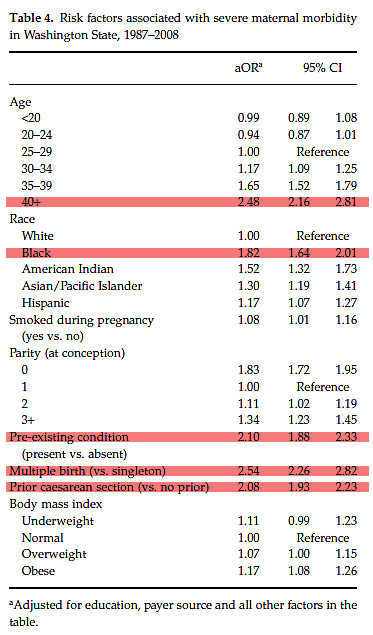
Between 1987 and 2008, 9485 women had one or more SMM in Washington State. Women with SMM were more likely to be older, non-White race/ethnicity, unmarried, to have a lower level of education, to be at the extremes of parity, to have a pre-existing medical condition and to receive Medicaid/Medicare compared with controls. Women with SMM were more likely to have a multiple birth, to deliver by caesarean, to deliver a low birthweight or preterm infant and to have received intensive prenatal care as compared with controls.

In the chart below, I’ve highlighted the risk factors that are most strongly associated with severe maternal morbidity.


What can we say about these findings?

1. None of the 5 most important risk factors modifiable, either by the patient or her provider. These are advanced maternal age, race, pre-existing medical condition, twins or higher order multiples and previous C-section.

2. Homebirth advocates like to pretend that these are not risk factors, but they are and all women who face them should be counseled that they are not safe candidates for homebirth. Natural childbirth advocates also like to pretend that these are not risk factors but, as usual, they are wrong. Women who face these risk factors may need additional monitoring and interventions in order to have a safe birth.

3. The increase in severe maternal morbidity can be explained by the rise in prevalence of the risk factors. Maternal age has increased, and therefore the incidence of pre-existing medical conditions have also increased. The incidence of twins and higher order multiples has also increased.

4. Previous C-section is a major risk factor. Unfortunately, the study did not distinguish between women who attempted a VBAC and women who scheduled a C-section, so we cannot determine if it the previous C-section that is the risk factor or whether the complications are a result of attempted VBAC.

5. Contrary to the insinuations of NCB advocates, it is not the overuse of technology that leads to poor maternal outcomes, it is the underuse of technology. The authors note:

Although this study investigated risk factors at the level of the patient, both provider and health care system factors may also play a critical role in the development of SMM. In a study investigating the preventability of maternal mortality and severe morbidity, 45% of near-miss morbidities were deemed preventable; provider factors were identified as the source of preventability in approximately 93% of these instances, including failure to identify high-risk status, lack of referral to a tertiary care centre, and in the greatest proportion incomplete or inappropriate management…

The bottom line is that the increase in severe maternal morbidity reflects the changing demographics of the childbearing population, not the quality of obstetric care. And when it comes to the quality of obstetric care, the main problem is underuse of technology, not overuse. Therefore, increased reliance on midwives has little to no place in any efforts to reduced severe maternal morbidity and homebirth has no role at all.

Let’s review: Twelve things you shouldn’t say to Dr. Amy … unless you want to appear very foolish

This piece has received more comments than any other I have written, 1000+ and counting. It first appeared 2 years ago, but rarely a week goes by without someone asserting one or more of the following in the comments sections. Clearly, some people need a review.

It seems like every day a new visitor parachutes in to this blog and attempts to “educate” me. Inevitably, the visitor finds that almost everything she says is false. Indeed, almost everything she thinks she “knows” is false. So to spare these visitors embarrassment, and to reach those who are attempting to “educate” me on other blogs, I have compiled the following list. Here’s what you should not say to me, and why you should not say it.

1. The US does very poorly on infant mortality.

Infant mortality is the WRONG statistic. It is a measure of pediatric care. That’s because infant mortality is deaths from birth to one year of age. It includes accidents, sudden infant death syndrome, and childhood diseases.

The correct statistic for measuring obstetric care (according to the World Health Organization) is perinatal mortality. Perinatal mortality is death from 28 weeks of pregnancy to 28 days of life. Therefore it includes late stillbirths and deaths during labor.

The US has one of the lowest rates of perinatal mortality in the world.

2. The Netherlands, which places the greatest reliance on midwives, has low mortality rates.

No, the Netherlands has, and has had for some years, one of the HIGHEST perinatal mortality rate in Western Europe. It also has a high and rising rate of maternal mortality. The Dutch government is deeply concerned about these high mortality rates and a variety of studies are underway to investigate.

A study published in the BMJ is early November 2010 revealed and astounding finding. The perinatal mortality rate for low risk women cared for by midwives is higher than the perinatal mortality rate for high risk women care for by obstetricians!

3. Obstetricians are surgeons.

I never understand how anyone has the nerve to say this to me. I AM an obstetrician. No one knows better than I what obstetricians are or are not. I went to college. I went to medical school. I spent four years in obstetric training. I delivered thousands of babies. I have cared for thousands of gyn patients. That some doula who is a high school graduate thinks that she can possibly know more than I about the nature of obstetricians defies belief.

Obstetricians do surgery as part of their practice. That does not make them surgeons. If it did, ophthalmologists and dermatologists would be surgeons too, since they do surgery as a routine part of caring for their patients. Is anyone seriously suggesting that you cannot go to an ophthalmologist for an eye exam because he or she will recommend unnecessary surgery?

4. Homebirth is safe.

No, all the existing scientific evidence and all national statistics indicate that homebirth triples the rate of neonatal death. Even studies that claim to show that homebirth is as safe as hospital birth, like the Johnson and Daviss BMJ 2005 study, ACTUALLY show that homebirth with a CPM has triple the rate of neonatal mortality of comparable risk women who delivered in the hospital in the same year.

The Midwives Alliance of North America (MANA) is well aware that homebirth is dangerous. That’s why they are hiding their own mortality rates. They spent almost a decade collecting information on more than 18,000 CPM attended homebirths, announcing at intervals that they would use the data to show that homebirth is safe. So why haven’t any of us seen it?

The data is publicly available, but ONLY to those who can prove they will use the data for the “advancement” of midwifery. MANA is quite up front about the fact that they will not let anyone else know what they have learned. Obviously, if homebirth had been anywhere near as safe as hospital birth, they would be trumpeting it from the mountain top. It does not take a rocket scientist to suspect that their data shows that homebirth dramatically increases the risk of neonatal death.

5. Homebirth midwives are experts in normal birth.

This one always makes me laugh. Experts in normal birth? That’s like a meteorologist who claims to be an expert in good weather.

I guess they’re trying to make a virtue of necessity. Homebirth midwives know virtually nothing about the prevention, diagnosis and management of pregnancy complications. That’s a problem when you consider that the only reason you need a birth attendant is to prevent, diagnose and manage complications. You don’t need any expertise to catch the baby and make sure it doesn’t hit the floor. Ask any taxi drive; he’ll tell you.

6. Childbirth is safe.

No, childbirth is INHERENTLY dangerous. In every time, place and culture, it is one of the leading causes of death of young women. And the day of birth is the most dangerous day in the entire 18 years of childhood.

Why does childbirth seem so safe? Because of modern obstetrics. Modern obstetrics has lowered the neonatal mortality rate 90% and the maternal mortality rate 99% over the past 100 years. What has the contribution of midwifery been to lowering those mortality rates? Zero? They’ve invented nothing, discovered nothing and tested nothing that has had any impact on perinatal or maternal mortality.

7. Childbirth used to be dangerous but that is only because sanitation was poor and women were poorly nourished.

No, the great advances of sanitation occurred in the 1800’s and the early years of the 1900’s. Not surprisingly, this had a big impact on deaths from infectious causes. However, rates of perinatal and maternal mortality did not begin to drop appreciably since the late 1930’s and the discovery of antibiotics. In the intervening years, easier access to C-sections, epidural anesthesia, newer and better antibiotics, blood banking, and neonatology led to dramatically lower mortality rates.

8. C-section increases the risk of maternal and neonatal death.

No, women who die in pregnancy are most commonly women with serious pre-existing medical illness (heart disease, kidney disease) or serious pregnancy complications (pre-eclampsia). C-sections are often done in an effort to save the lives of these women. Sometimes it is not enough. The C-section is what is known as a “confounding factor.” Both the C-section and the death can be traced back to the mother’s health status; the C-section did not cause the death.

MacDorman and colleagues have attempted to show that C-sections for “no indicated risk” increase the neonatal death rate. Their papers have been roundly criticized because they used birth certificates, not hospital record. Unrelated investigations of birth certificates have shown that, while they are highly reliable for data like weight and Apgar scores, they are highly unreliable for risk factors. Indeed, unrelated studies have shown that up to 50% of women who have serious medical illnesses like heart disease, have those risk factors missing from the birth certificate.

9. Induction harms babies.

No, induction lowers perinatal mortality. The yearly CDC data on births shows that as the induction rate has risen, the rate of late stillbirth has dropped by 29% and the neonatal death rate has not increased.

10. If childbirth were dangerous, we wouldn’t be here.

This represents a profound lack of knowledge about evolution as well as a profound lack of knowledge about childbirth. Evolution does not lead to perfection. Evolution is the result of the survival of the fittest, not the survival of everyone. Human reproduction, like all animal reproduction, has a massive amount of wastage. Every woman was born with millions of ova that will never be used. Every man produces billions of sperm that will never fertilize an ovum. Even when a pregnancy is established, the miscarriage rate is 20%. That’s right. One in five pregnancies dies and is expelled and yet we are still here. Human reproduction is perfectly compatible with a natural neonatal death rate of approximately 7% and a natural maternal death rate of approximately 1%.

11. US maternal mortality is rising.

Despite a rather histrionic political report from Amnesty International making that claim, US maternal mortality is not rising and has even dropped in both of the past two years. Why does it look like it has risen? Because the standard death certificate has been revised twice in the past two decades in order to more accurately capture maternal deaths. The new death certificate has revealed maternal deaths which otherwise would not have been counted. It is not clear that maternal deaths have increased; it’s merely that reporting of those deaths has improved.

12. Women are designed to give birth.

Women are not “designed”: they have evolved and evolution involves trade offs. Babies with big heads tend to be more neurologically mature, so having a big neonatal head has evolutionary advantages. A small maternal pelvis makes it easier for a woman to walk and run, providing her with an evolutionary advantage. Those two advantages are often incompatible. The woman with a small pelvis may have been able to survive by outrunning wild animals, but when it came time to give birth, she was more likely to die because that small pelvis could not accommodate a large neonatal head.

***

The above statements have two things in common. First, they are wrong. Second, they are passed back and forth between natural childbirth advocates who “teach” each other they are true. That’s why it is impossible to become “educated” by reading natural childbirth books and websites. Most of their information is flat out false, and they are entirely insulated from scientific evidence. Natural childbirth advocates make up their “facts” as they go along. They don’t read the scientific literature. They don’t interact with science professionals. Indeed, professional natural childbirth advocates take special care to never appear in any venue whether they might be questioned by doctors or scientists. They know they’d be laughed out of the room. That’s okay with them as long as there is a large pool of gullible women out there who will believe them and buy their products.

It is important that those who are parachuting in to “educate” me understand that they literally have no idea what they are talking about. Most of what they think they “know” is factually false. And they demonstrate that every time they write one or more of those twelve statements.

Henci Goer rejects the nonsense of Gaskin, Harper and other birth advocates

Although Henci Goer’s new book, Optimal Care in Childbirth, suffers from serious deficiencies, it does have one important virtue.

I’ve often written that Henci Goer is one of the few (perhaps the only) professional childbirth advocates who actually reads and understands the scientific literature. She may cherry pick the evidence and she may try to justify ignoring scientific evidence that does not support her worldview, but she does not make up evidence nor does she make up theories that have no scientific evidence to support them.

That’s why the book implicitly rejects the nonsense spouted by Ina May Gaskin, Barbara Harper (waterbirth), Debra Pascali-Bonnaro (orgasmic birth) and other NCB and homebirth celebrities, by ignoring it altogether. Gaskin, Harper, Pascali-Bonnaro don’t even make it into the book. The only professional natural childbirth advocates who are mentioned are those with advanced degrees in midwifery, science or statistics (with the exception of Goer herself, who lacks such a degree).

It’s pretty remarkable. Ina May Gaskin, lauded within the NCB community, doesn’t even rate a mention in Goer’s book. That’s because almost everything that comes from Ina May’s mouth or pen is nonsense, unsupported by scientific evidence of any kind.

Goer doesn’t discuss the “Sphincter Law” because she knows that Ina May simply made it up and it has no basis in scientific evidence. She doesn’t talk about birth among animals, the fear-pain-tension cycle, the belief that postdates does not increase risk, etc., because none of it is true. Goer does not mention The Farm, let alone Ina May’s unsubstantiated claims about its low mortality rate. In fact, Goer doesn’t even mention the Gaskin maneuver for shoulder dystocia, which Ina May expropriated from South American lay midwives and named after herself in a striking display of cultural imperialism.

There’s nothing about waterbirth in Goer’s book. Goer doesn’t say that babies can’t inhale the water of the birth pool because they can. All those claims from Barbara Harper about the dive reflex, prostaglandins and hypotonic solutions aren’t in Goer’s book because they aren’t true; Harper just made them up.

Orgasmic birth? You’ve got to be kidding! It’s not in the book because it doesn’t exist.

Breech is a variation of normal? Not according to Goer.

Spinning babies, moxibustion and other techniques to encourage a breech baby to turn? Not in the book because none of them have any scientific support.

Postdates inductions? Goer says that inductions are indicated at 42 weeks and beyond.

Certified professional midwives? Their existence is mentioned but Goer makes no claims about the adequacy of their training or the safety of their practice.

I could go on and on, but I think you get the idea. Just about everything out of the mouths or pens of CPMs and other lay advocates of NCB and homebirth is nothing but fabrications and lies, and therefore is not included in the book.

This is not surprising when you consider that Goer, although a biological essentialist, is not an anti-rationalist. If written about this before (Who hijacked childbirth?):

… The difference between biological essentialists and feminist anti-rationalists is primarily in their view of rationalism. Among the true biological essentialists are Henci Goer and Amy Romano. The biolgical essentialists are represented by organizations like Lamaze and the American College of Nurse Midwives (ACNM). They worship the “natural” on the assumption that biology determines what is best for all women. Nonetheless, they believe that science is non-gendered, valuable and the standard by which claims about childbirth should be judged. They freely quote scientific papers and insist that their views of childbirth are “evidence based” even when they are not. They value empirical knowledge and advanced education.

The non-rationalists reject science as male, and unfairly regarded as authoritative merely because it is male. To the extent that science supports their beliefs, they are willing to brandish scientific papers as “proof,” but explicitly reject rationalism when it does not comport with their personal beliefs, feelings and opinions. They do not value empirical knowledge and reject rigorous education.

So I have a question of NCB and homebirth advocates:

If Henci Goer implicitly rejects the nonsense of Ina May Gaskin, waterbirth and orgasmic birth, why do any of you believe it?

In the face of staggering death toll head midwife relentlessly promotes normal birth

I first wrote about the problem last year. Promoting normal birth is killing mothers and babies:

Gill Edwards, a leading clinical negligence solicitor with the firm Pannone, is in no doubt why these fatal mistakes continue.

‘Too often, we see a desire for autonomy, sometimes verging on arrogance, on the part of some midwives,’ she says.

‘It leads them to ignore National Midwifery Council rules that require them to call on the skills of other health professionals whenever something happens which is outside their sphere of practice…’

‘Some of our worst cases occur because the drive to achieve a “normal” delivery clouds the judgment of midwives about when to call in specialist help from an obstetrician, or for a paediatrician to be present at the birth to assist with resuscitation when there are signs of foetal distress during labour,’ says Ms Edwards.

The result is an unimaginable toll in deaths and injuries of mothers and babies. A new report from the NHS Litigation Authority makes it clear that there is a massive financial toll as well.

Senior staff and consultants must be available on the labour wards 24 hours a day in order to supervise junior doctors and midwives and reduce mistakes, said the report from the NHS Litgiation Authority…

The 5.5 million babies born in England between 1 April 2000 to 31 March 2010, resulted in 5,087 maternity claims, involving payouts of £3.1bn, including legal fees…

The most frequent mistakes cited in claims involved management of labour including failure to recognise the baby was in distress from fetal heart monitoring equipment or delay in acting; caesarean section including mistakes and delays and cerebral palsy, where the baby is starved of oxygen at birth and sustains brain damage, often requiring life-long care.

Other claims related to missing abnormalities on antenatal scans, drug errors, maternal deaths, damage to the mother, shoulder injuries to the baby, womb rupture and stillbirth.

The report said: “Unfortunately, many of the same errors are still being repeated.”

Confronted with the fact that midwives’ relentless promotion of “normal birth” is injuring and killing babies and costing the National Health Service billions of pounds in medical negligence claims each year, Royal College of Midwives head Cathy Warwick responds by … promoting “normal birth.”

Warwick’s response is bizarre, as the video below demonstrates. It’s like a Monty Python sketch and if it weren’t so serious, it would be quite amusing.

[youtube=http://youtu.be/BWASqt94V2w&w=400&h=300]


It is precisely the attitude expressed by Warwick in the video that is responsible for the staggering toll in preventable deaths, injuries and financial compensation.

The most important thing anyone needs to know about promoting normal birth is this:

Promoting normal birth is always and only about promoting midwives.

“Normal birth” is a way to sanitize what is really nothing more than midwifery marketing. Insisting that women hire midwives because midwives want employment isn’t particularly persuasive. Insisting that women hire midwives because only they can provide them with a “normal” birth (who wants an abnormal birth?) sounds a lot better.

It’s time to put an end to this lunacy. Women and babies are dying preventable deaths because midwives are more concerned with market share than with patient safety. Promoting “normal birth” is fundamentally unethical.  An ethical medical professional recommends whatever is safest for the patient, not whatever is most beneficial for the provider.


No, Ina May, the cervix is not a sphincter

It must be awesome to have followers so gullible that you can make up whatever you want, no matter how idiotic, and your supporters will believe you. Ina May Gaskin, the ultimate fraud, should know. She makes it up as she goes along and homebirth advocates, among the least knowledgeable people alive on the subject of childbirth, promptly accept it.

Gaskin has made up “facts” about post dates pregnancy, maternal mortality, and animal reproduction.

Gaskin’s biggest lie? It’s hard to choose since there are so many and they are so stupid, but any top ten list of Ina May Gaskin’s biggest lies would have to include her “Sphincter Law.” Let’s let her explain it:

… I will start with the observation that the vagina and the cervix—not just the anus and the urethra—are sphincters, that is, the circular muscles surrounding the opening of organs which are called upon to empty themselves at appropriate times.

There’s just one teensy, weensy problem. Neither the vagina, nor the cervix are sphincters.

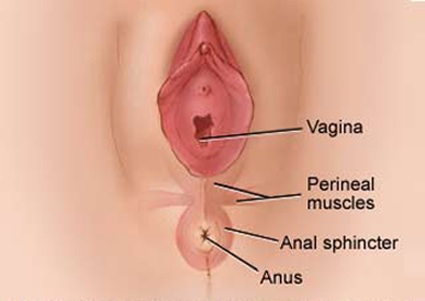
What is a sphincter? A sphincter is circular muscle that surrounds the opening of an organ, as the illustration below demonstrates.

The vagina does have some muscular fibers, but most its muscular strength is longitudinal and the cervix is not made of muscle or encircled by muscle at all. But Ina May is not worried about that since her followers don’t know any anatomy or physiology and are unlikely to check.

What is the anatomy of the vagina?

The vagina consists of an internal mucous lining and a muscular coat …

The muscular coat (tunica muscularis) consists of two layers: an external longitudinal, which is by far the stronger, and an internal circular layer…

So there is muscle in the vagina but the strongest fibers run longitudinally. In other words, it is not a sphincter.

How about the the cervix? According to Hassan et al.:

The uterine cervix is essentially a connective tissue organ. Smooth muscle accounts for less than 8% of the distal part of the cervix. Cervical competency, defined as the ability of the cervix to retain the conceptus during pregnancy, is unlikely to depend upon a traditional muscular sphincteric mechanism… It is now well-established that the normal function of the cervix during pregnancy depends upon extracellular matrix.

No, the cervix is not a sphincter, either.

The human body does have quite a few sphincter muscles including the anal sphincter and two urethral sphincters (internal and external). There are others: the upper esophageal sphincter, which opens as food passes into the stomach, the sphincter of Oddi, which controls the release of bile and pancreatic enzymes into the duodenum, and the iris, which controls the size of the pupil to regulate the amount of light entering the eye.

According to Ina May:

For anyone dealing with or organizing maternity care, probably the most important feature of sphincters to understand is that they function according to several factors:

  • Sphincters open best in conditions of privacy and intimacy
  • Sphincters open best without time limits
  • Sphincters are not under the voluntary control of their owner. They do not obey orders, such as ‘urinate now!’, ‘push!’, or ‘poop!’
  • Sphincters, however, do respond well to praise if there happens to be another person in the proximity of the sphincter’s owner. This other person might be the mother of toddler or a midwife assisting a woman giving birth
  • The opening of sphincters can be facilitated by laughter (the owner’s)
  • When a person’s sphincter is in the process of opening, it may suddenly close if that person becomes frightened, upset, embarrassed, or self-conscious. This is because high levels of adrenaline in the bloodstream do not favor (sometimes they actually prevent) the opening of the sphincters
  • The state of relaxation of the mouth and jaw is directly correlated to the ability of the cervix, the vagina, and the anus to open to full capacity. A relaxed and open mouth favours a more open vagina and cervix.

Really? Let’s test these claims.

The iris opens best in conditions of privacy and intimacy? No. The iris opens and closes in response to the amount of ambient light and privacy and intimacy have no effect.

Sphincters are not under the voluntary control of their owners? Wrong. Whether or not a sphincter is under voluntary control depends of whether it is made of smooth muscle or skeletal muscle. Both the external urethral sphincter and the anal sphincter are under voluntary control. Indeed the entire point of toilet training is to teach children to control these sphincters?

High levels of adrenaline do not favor (sometimes they actually prevent) the opening of sphincters? That’s why when people are very frightened they do not pee in their pants or defecate. Oops! That’s obviously a lie.

In fact, every one of these “rules” is nothing more than a complete fabrication, as even the most cursory knowledge of human anatomy demonstrates.

Gaskin professes surprise that no one has mentioned the Sphincter Law before.

I would argue that Sphincter Law may apply in both the first and second stages of labour. In the first stage, most of us who have been midwives for several years have noticed that, once in labour, a woman’s cervix will occasionally close. I described the first such case (Gaskin, 1978), but I have found no other documentation in the 20th and 21st century medical literature of this rather common phenomenon…

That’s hardly surprising, Ina May, since you made the whole thing up.

There is a saying in science that extraordinary claims require extraordinary proof. In the world of homebirth, extraordinary claims require no proof at all, just a self-proclaimed “midwife” willing to lie and a bunch of ignorant followers willing to believe.

Optimal care in childbirth for whom?

Earlier this month I wrote about Henci Goer’s problem with scientific evidence on display in her latest book Optimal Care in Childbirth. Her problem is that the scientific evidence does not support her preferred methods of care. No problem! She simply created excuses as to why she and her supporters can blithely ignore the scientific evidence.

Does it really make sense to ignore scientific evidence when writing about a book about optimal care in childbirth? Not if you foolishly think that optimal care refers to care that is optimal for patients. What a silly mistake! Optimal care in childbirth is care that is optimal for the midwives, childbirth educators and doulas, not for women.

Indeed, the book essentially ignores the large proportion of women who don’t qualify for midwifery care and it ignores a large proportion of essential labor and delivery care. Optimal Care is Childbirth concerns itself with Western women from first world countries who are middle or upper middle class receiving care from (almost exclusively) white, Western middle and upper middle class midwives. And not just any well Western women are worthy of attention, either. Only those who don’t have pre-existing medical conditions, those who don’t have complications of pregnancy, and those who don’t want pharmacological pain relief are worthy of consideration. In other words, if a midwife, childbirth educator or doula can’t make money from you, you are on your own.

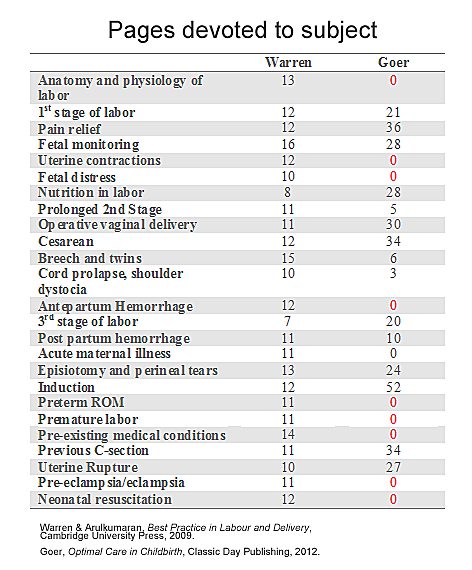
Don’t believe me? Try this exercise. Compare Goer’s book with any standard book about care of women in labor. As an example, I chose the textbook Best Practices in Labor and Delivery by Warren and Alkumaran, which concerns the same subject purportedly covered by Goer’s book. Let’s compare the number of pages devoted to various aspects of childbirth care.

A few characteristics of Goer’s book jump out immediately:

  • Anatomy and physiology are ignored
  • Women who have medical problems are ignored
  • Women giving birth before term are ignored
  • Fetal distress is ignored
  • Pre-eclampsia is ignored
  • Neonatal resuscitation is ignored

What are we too make of this? Are women who have complications of pregnancy unworthy of optimal care? I doubt that is what Goer intends. Are doctors always providing optimal care for women who have complications in pregnancy? Perhaps Goer believes this, but I don’t.

No, I believe that the message that Goer is transmitting is she is only interested in what is optimal for midwives, childbirth educators and doulas. Patients who cannot be cared for by midwives are irrelevant.

Another major omission also jumps out. Henci Goer, like most contemporary natural childbirth advocates, has piously expressed dismay over maternal mortality rates. Curiously, she devotes no attention to any of the 5 leading causes of maternal mortality: maternal cardiac disease, hemorrhage, pre-eclampsia/eclampsia, infection and embolism. She only addresses maternal mortality briefly and then only in relation to interventions. In contrast, there are literally dozens of pages devoted to maternal morbidity. That only makes sense if your motivation is tout midwives who boast about reducing morbidity, but often in exchange for increasing mortality.

What jumps out when you consider what is included? The topics that receive the most attention are childbirth interventions. Although the chart doesn’t show it, reading the book demonstrates that the bulk of the material on each intervention is devoted to vilifying it. When scientific evidence exists to minimize the use of a specific intervention, Goer presents it. When scientific evidence supports the use of a specific intervention, Goer presents that, too, and then proceeds to declare that the evidence can be ignored.

For example, the chapter on pain relief includes precious little information on the benefits and effectiveness of epidurals and a lot of material on rare complications. One of the very few mentions of maternal mortality in the entire book is the exceedingly rare incidence of maternal mortality in association with epidurals, though the actual risk of maternal mortality from a labor epidural is less than the chance of being struck by lightning.

Indeed, Goer’s discussion of maternal mortality from epidurals is a paradigmatic example of her entire approach to the issue of childbirth. There is no discussion of the leading causes of maternal mortality because the book is not about saving women’s lives or what is beneficial for them. The book is about lining the pockets of midwives, childbirth educators and doulas, and that’s why it is important to evoke the specter of maternal death only in association with epidurals.

Equally enlightening is the inclusion of homebirth. Goer’s book contains 25 pages on homebirth, a practice that accounts for less than 1% of American births. It makes no sense to devote so much space to a fringe practice unless you focus on who attends homebirths. More than 90% of American homebirths are attended by midwives and most are attended by doulas. No book about what is optimal for midwives and doulas would be complete without it.

Obviously, Goer is entitled to write whatever she wants, but no one should be fooled into thinking that Optimal Care in Childbirth has anything to do with the well being of women or babies. Optimal Care in Childbirth is about what is optimal for midwives, childbirth educators and doulas. What is optimal for mothers and babies is apparently irrelevant.

Perineal tears, midwifery care and the gap between rhetoric and reality

The Motherlode column in The New York Times has performed a public service by highlighting a relatively common problem that receives little attention: severe perineal tears, a known complication of vaginal birth.

Ashley Nelson describes her experience:

… In addition to the tear, doctors would later find a rectovaginal fistula, wherein a passage forms between the rectum and vagina. Symptoms of this are nightmarish: fecal matter through the vagina, flatus incontinence, pain. The condition is often attributed to prolonged labors, forceps and previously unrecognized tears.

As if this weren’t bad enough, Nelson has had to endure the misinformed advice and speculation of women who insist that her injuries could have easily been prevented:

… Coverage of birth injuries are often buried under studies about the escalating rates of C-sections and the “too posh to push” women fueling them, as well as more “progressive” reports suggesting that if only women relaxed better, oiled better, breathed better, all births would be just grand…

The topic is also too politicized. Like arguments against birth control and abortion, discussions of childbirth frequently sideline any real medical issues in favor of portraying women as too busy, selfish and privileged to “choose” the “right” path, in this case a vaginal birth…

As if to prove her point, midwifery supporters rushed in with the exact misinformation that Nelson decried.

A large number of commenters insisted that midwives have a lower incidence of severe tears (there is little to no high quality scientific evidence to support this claim), that upright position prevents tears (false; it actually increases the risk of tears) and that “stress” causes tears (false).

There are studies that show that midwives have lower rates of severe perineal tears often include confounders. Operative vaginal delivery is a major confounder and only obstetricians perform operative vaginal deliveries. Median episiotomy is also a confounder and in older studies obstetricians have higher rates of median episiotomies. This difference has almost entirely disappeared. Interestingly, one factor that has been shown to dramatically reduce the risk of severe perineal tears is mediolateral episiotomy (episiotomy extending to the side, not up and down). Mediolateral episiotomies tend to be more painful when healing so there has been a reduction in their use, but they are extremely effective in preventing severe perineal tears.

I explained the nature of perineal tears in a post that appeared earlier this year entitled Vaginal tears and emphasized the need for prompt, skilled repair of 3rd and 4 degree tears in order to prevent long term serious complications like urinary and bowel incontinence.

According to the scientific literature, the risk of severe perineal tears is associated with characteristics of the baby, the mother, and the delivery method. These factors are just what common sense would suggest:

There is a GREATER risk of severe perineal tears with:

1. bigger babies
2. OP (occiput posterior) position of the baby’s head, which leads to a bigger presenting diameter
3. shoulder dystocia.
4. operative vaginal delivery (particularly forceps).
5. among certain ethnic groups.
6. median episiotomy, BUT a reduced risk of tears with mediolateral episiotomy.
7. first vaginal deliveries.

There are factors that may reduce the risk of severe perineal tears including epidural anesthesia, which leads to a more controlled delivery. There are studies that suggest that perineal support and warm compresses reduce the risk of severe perineal tears but the evidence is not high quality (Cochrane Review: Perineal techniques during the second stage of labour for reducing perineal trauma.)

Upright position in labor INCREASES the risk of severe perineal tears and blood loss.

It is important that we bring this serious complication of vaginal delivery to public attention, but it is equally important that women receive ACCURATE information about the risk factors, not wishful thinking on the part of midwifery supporters.

As Nelson herself indicated, the misinformation that “if only women relaxed better, oiled better, breathed better, all births would be just grand” contributed to her sense of isolation. Nonetheless midwifery proponents rushed in to tell her that if she had just relaxed better, oiled better, breathed better, etc. her birth would have been just grand. That’s one way to validate Nelson’s story, but I daresay not the one she was hoping for.