A cardiologist’s experience with a “baby friendly” hospital

A guest post from a practicing cardiologist:

Before getting pregnant, I had never set foot in our L&D ward. My only interaction with OB’s was when they needed ICU beds for their sickest patients (severe preeclampsia, catastrophic bleeding, amniotic fluid embolism, you catch my drift). From treating these patients, I have no illusions whatsoever about the potentially lethal consequences of childbearing. I had never spoken to the midwives at all.

My first glimpse of the ‘natural childbirth culture’ came from a nocturnal cardiology consult. I was called by a young OB resident for a postpartum patient with shortness of breath and low oxygen saturation. I requested a chest CT with intravenous contrast, suspecting pulmonary embolism. I was baffled when the resident refused to do this. When asked to explain, she said the patient should not be given intravenous contrast under any circumstances. This wasn’t for a severe allergy. It was because the patient’s breastfeeding would be disturbed by the IV contrast. Just to be clear, at this point the patient’s opinion in the matter had not yet been asked. And even if it had, I’m very doubtful that the decision-making capacity of a severely hypoxic patient would hold up in court if things didn’t end well.

I was, again, baffled for a few seconds. I had never before heard of a patient’s treatment being determined by any other motive than that patient’s best interest. I replied that this was a critically ill patient being denied the care she obviously needed, and that the resident would have a very hard time getting a dead woman to breastfeed her baby. This dose of reality did the trick, and the patient got the chest CT, heparin drip and ICU admission she needed. I must say I don’t really know how things ended with her breastfeeding, but she left the hospital alive.

Fast forward to my own pregnancy. I’d had a first trimester miscarriage before. When I went in for my 12 week ultrasound, I was pretty nervous about seeing that heartbeat. When the midwife-US tech called us in, I was very anxious to get on that table and see what was going on. First, however, she insisted on giving me an educational lecture about…. breastfeeding. That’s right, before establishing the presence of a live fetus! I politely sat through it, but I still don’t know what I’d have said if it had turned out to be another miscarriage!

My pregnancy was uneventful except for the breech position. My OB is very skilled and experienced in external version, but for various technical reasons I wasn’t a candidate. So an elective CS at 39 weeks was agreed upon. However, just like in critical care, there is no planning in obstetrics.

At 36 weeks, I came to work feeling well, and started my rounds. After the second patient, I had to sit down. I had a headache, a stomachache and was seeing flickering stars. Also, incidentally, I had gained ten pounds in the past 2 weeks. People all around were commenting on how swollen I looked. I myself was firmly in denial of the glaringly obvious diagnosis, and tried to sneak home muttering something about a stomach bug. A collegue with more common sense simply grabbed my sleeve and dragged me to L&D. My OB lost no time in diagnosing pre-ecclampsia and admitting me. Overnight I deteriorated and the next morning I had my c-section. Which was the start of an extreme culture shock…

I had been planning to breastfeed my baby, to the extent that I hadn’t even listed for any bottles or feeding accessories. As the baby was 3 weeks early and I literally hadn’t had a single day of maternity leave before I delivered, I hadn’t read up on breastfeeding practicalities yet. However, the baby-friendly hospital protocol sprung into action, and my little girl was put to my breast before I had been wheeled out of the OR. As I lifted my hospital gown to latch her on, the midwive tsk’ed: “you have extremely flat nipples”.
Never before had my nipples been called deficient in any way, but as soon as my baby tried to latch, I saw the problem. She was slightly premature with a small mouth and a weak suck, and there just wasn’t enough for her to grab. Moreover, for all her enthousiastic attempts, absolutely nothing came out of said nipple.

The following 72 hours we continued in that way, being encouraged and aided by a variety of midwives and lactation consultants. I’ve had at least 10 different perfect strangers manhandling my lady parts. All commented on my apparently severely deficient nipples, as if there was something I could do about them. Silicone prosthetics were called in, but that didn’t get us any milk. For our efforts, I got cracked and blistering nipples and extreme sleep deprivation, and baby got absolutely nothing. She made her displeasure known at ever increasing volumes, until she got so exhausted she stopped trying and slept continuously. I was in the middle of my ‘baby blues’ period and literally hadn’t slept since the c-section as I was told to latch and pump every 3 hours day and night to get my milk in. I cried continuously, and looking back I believe I have never felt so desperate and miserable in my life. I felt like a total failure. I’m an alpha type personality, one of my core beliefs being that hard work can achieve almost anything. Breastfeeding, however, doesn’t work that way.

The pediatrician saw baby’s weight loss and stepped in: she needed formula. Another defeat, and even less sleep as my 8 shifts a day now consisted of a/ latching baby on, b/ giving her bottle and c/pumping (which yielded next to nothing). As befits a baby friendly hospital, mom and baby couldn’t be separated under any circumstances ever, so the midwives stepping in for any of the night feeds was out of the question. There I was, 4 days post laparotomy, not allowed any pain medication to speak of for my grotesquely swollen and extremely painful breasts, and unable to get any REM sleep for over 96 hours. Miserable doesn’t begin to describe it.

In the ICU literature there is a massive load of evidence that sleep deprivation produces undesirable outcomes. Sleep deprived patients have more deliria, worse wound healing, more infections and about any other complication you’d care to name. ICU staff try their very best to get patients to sleep at night. Apparently, none of this is valid or applicable to obstetrics. When I begged the midwives to help me get at least some sleep, they flatly refused. I had to keep on trying breastfeeding, under no circumstances would they consider taking the baby for part of the night or letting me skip the fruitless pumping. Didn’t I want what was best for my baby? And, driven by guilt, I soldiered on.

My husband and family got very worried: I looked terrible. When I look at pictures from those days, I barely recognise that pale, distraught woman with the dark circles under her eyes. My husband begged me to stop the breastfeeding attempts, but I would not take it from him. I was determined to be a good mother. When my husband tried to share his worries with the midwives, they reacted very passive-aggressively: they were not making me do anything, the decision to breastfeed was entirely mine, they only pointed out the best interests of our child. It sounded as if I was considering taking up smoking.

In the end, rescue came from a friend of mine who is a private CNM. She came to visit me in the hospital, saw what was going on and told me to just stop it. Running myself into the ground would not help my baby, she said. It was time for me to start to heal. Coming from her, I could accept this as the truth. I told the hospital midwives that I would stop my attempts at breastfeeding, as my baby was almost entirely formula-fed anyway.

The midwife didn’t say anything, she just removed the pump and all accessories from my room without comment or explanation. 6 hours later, I thought my breasts would explode. I was in terrible pain. No-one had said anything about the need to gradually diminish pumping in order to avoid mastitis. It was as if they had simply dropped me as a patient. I called my CNM friend for advice, and she advised me to ask for the pump back so I could gradually decrease my pumping frequency. The pump was put back grudgingly, without comment or advice. I pumped 2 more times and then went home with a rented pump and the help of my CNM friend.

I handed the baby to my husband, took a good painkiller and slept for 24 hours while he took care of her. I was a different person afterwards.

Looking back, I don’t feel guilty anymore. Just angry. What were they thinking, treating me like that? Did they really believe that by keeping me awake, in physical pain and psychological distress endlessly, somehow the breastfeeding would magically work out? Or were they dumbly following a cookie-cutter protocol, waiting for me to buckle and give up so the responsibility would be mine and not theirs?

And what objective was really being served throughout my hospital stay? It certainly wasn’t my or my baby’s best interest! Shouldn’t ‘first do no harm’ be the first rule of any patient-provider relationship? I feel like they did us a lot of harm. At the very least, they turned the first week with my baby into a purposeless bootcamp. I went through internship, residency and 2 fellowships without ever getting as miserably sleep deprived as I was in that maternity ward. And none of it brought me or my baby any advantage.

It seems like “baby friendly hospital” is really code for “breastfeeding before patients’ interests hospital”.

How did this crooked situation come into being? Whose interests are served by all this? I really don’t know. You tell me!

Will I ever try to breastfeed my next child? Right now I don’t think so. My daughter is a happy, thriving baby and her father and I are equal partners in her care. I don’t see any reason to put myself through all that misery again. My nipples haven’t gotten any less flat, so a repeat of this scenario is very likely. Now that I’m a rational human being again, I don’t see any reason to feel guilty anymore. I’m just happy with what I’ve got, bottles and all.


Pounding the table


Lawyers say:

If you have the facts, pound the facts. If you have the law, pound the law. If you have neither the facts nor the law, pound the table.

I guess the obstetrical equivalent would be:

If you have the experience, pound the experience. If you have the scientific evidence, pound the evidence. If you have neither the experience nor the scientific evidence, pound the table.

Here’s an outstanding example of table pounding:

This One’s For You, “Dr.” Amy

I guess she was hoping that no one would notice that she was afraid to answer the questions.

Thinking about homebirth? You must watch this video.

Over the years, I’ve talked with many people about homebirth and there is one thing that really stands out. The vast majority of people, whether laypeople, journalists or even homebirth advocates themselves, don’t realize that homebirth midwives aren’t real midwives.

They don’t know that homebirth midwives (certified professional midwives or CPMs) are a second, inferior class of midwife that exists in no other country than the US. CPMs lack the education and training required of ALL other midwives in the industrialized world.

Regular readers know that I have written about this over and over again, but I’ve always wished I had the opportunity to explain it face to face. That’s why I made this video. It gives me the opportunity to discuss this issue in a conversational way, raising and addressing the questions that people typically ask.

The video is long, and I’m planning on creating multiple shorter videos to address each of the covered issues separately.

Feel free to share the video, email it or embed it in your own website; and of course, any feedback of suggestions are appreciated.

Addendum:

Here’s the first excerpt. It clocks in a 2:33.

Claiming that epidurals harm babies is like claiming that abortions cause cancer

Earlier this year New Hampshire’s Tea Party controlled House of Representatives passed a bill mandating that doctors inform women that abortion increases the risk of breast cancer.

There’s just one problem: there’s no scientific evidence that this claim is true, and copious evidence that it is not.

According to the Huffington Post:

The bill, sponsored by Rep. Jeanine Notter (R-Merrimack), was immediately condemned by Democratic leaders, who it would require false information to be spread by doctors to patients. There is no proven breast cancer link to abortion, according to the World Health Organization and the American Cancer Society.

The language of the bill is Orwellian in the extreme:

Materials that inform the pregnant woman that there is a direct link between abortion and breast cancer. It is scientifically undisputed that full-term pregnancy reduces a woman’s lifetime risk of breast cancer. It is also undisputed that the earlier a woman has a first full-term pregnancy, the lower her risk of breast cancer becomes, because following a full-term pregnancy the breast tissue exposed to estrogen through the menstrual cycle is more mature and cancer resistant. In fact, for each year that a woman’s first full-term pregnancy is delayed, her risk of breast cancer rises 3.5 percent. The theory that there is a direct link between abortion and breast cancer builds upon this undisputed foundation. During the first and second trimesters of pregnancy the breasts develop merely by duplicating immature tissues. Once a woman passes the thirty-second week of pregnancy (third trimester), the immature cells develop into mature cancer resistant cells. When an abortion ends a normal pregnancy, the woman is left with more immature breast tissue than she had before she was pregnant. In short, the amount of immature breast tissue is increased and this tissue is exposed to significantly greater amounts of estrogen—a known cause of breast cancer. Women facing an abortion decision have a right to know that such medical data exists. At the very least, women must be informed that it is undisputed that pregnancy provides a protective effect against the later development of breast cancer.

The bill essentially acknowledges that there is no direct link between abortion, while simultaneously mandating that doctors tell women there is a link. The bill also acknowledges that there is no scientific evidence to support the claim of a link, merely a theory premised on related information.

It’s easy to recognize what is going on here. In an effort to convince women not to have abortions, anti-choice activists are lying about the risks of abortion.

Natural childbirth advocates practice the same reprehensible technique. In an effort to convince women not to have epidurals for pain relief in labor, natural childbirth advocates claim that epidurals harm babies. Just as in the case of abortion and breast cancer, there is no scientific evidence to support a link and copious scientific evidence that babies experience no harm from epidurals. Indeed, in the past 3 decades literally tens of millions of babies have been born after their mothers received epidurals, but activists cannot point to even a single individual who has been harmed.

Nonetheless, just like the Tea Party in New Hampshire, they continue to push scurrilous theories about the “risks” of epidurals.

Consider this mass of lies from Childbirth Solutions:

Undesired effects on the fetus:

Abnormal heart rate patterns, requiring oxygen to the mother, position changes and possible cesarean delivery.
Increased likelihood of newborn septic workup, IV antibiotics and isolation in the nursery if the mother develops an “epidural fever” that causes fetal tachycardia or newborn fever.
If the fetus is already stressed greater amounts of the medication are “trapped” in the fetal circulation, leading to more pronounced newborn effects (see below).

Undesired effects on the newborn:

Short-term (six weeks or less) subtle neurobehavioral effects, such as irritability and inconsolability and decreased ability to track an object visually or to shut out noise, bright light.4 There are no data on potential long-term effects.
Possible less efficient or less organized initial rooting and suckling behavior. Nurses have reported more difficulties in feeding babies whose mothers had an epidural when compared to unmedicated babies.
Decreased infant responsiveness may lead to long-term consequences for the parent-infant relationship. Parents should be counseled to give their babies time to recover from the birth and medication and should avoid a label of “difficult child” or “incompetent mother.”

Epidurals do NOT cause abnormal heart rate patterns. Decreased blood pressure in the mother might cause a temporary change in fetal heart rate, but that is easily treated by giving the mother additional fluid.
Epidurals are less likely to lead to a newborn septic workup than prolonged rupture of membranes, but natural childbirth advocates think prolonged rupture of membranes is not a reason for concern.
There is no evidence that medication is “trapped” in the fetal circulation leading to newborn effects.
In fact, despite the above lies, there is no evidence that epidurals have any harmful effects on breastfeeding or other newborn behavior.

No matter, in the world of natural childbirth advocacy, as in the world of anti-choice advocacy, the truth is irrelevant.

What’s an expectant mother to think?

If you want to have an epidural, have an epidural. If you don’t want to have an epidural, don’t have an epidural. Just keep in mind that the claim that epidurals harm babies is a bald faced lie on par with the claim that abortions cause breast cancer. It is meant to take away YOUR choice to control your own pain or your own body, and substitute the choice of advocates who have an agenda very different from helping you to make an informed decision.

Are we supposed to be impressed you risked your baby’s life at homebirth?

Homebirth advocates are braggarts.

Perhaps there’s a homebirth advocate who has treated homebirth as an intimate family event, but I haven’t heard of it. The mode of birth is part of the birth announcement, no opportunity to boast about it goes unfulfilled, and, most importantly, video is posted on line so that all 7 billion people in the world can applaud what is apparently the greatest achievement some women will even attain: a baby passed through their vagina.

And of course, the greater the risk they took (risk to the baby, not to themselves), the greater the glory.

Ironically, only a small community of like minded believers is impressed. The vast majority of people recognize these women for what they are, selfish narcissists, recklessly willing to let their own babies die to impress their peeps.

Here’s a perfect example. Are we supposed to be impressed that a woman who had two previous C-sections, a homebirth stillbirth, and 6 miscarriages chose to risk the death of her son by having a homebirth at 44 weeks?

Color me unimpressed, just disgusted.

Waterbirth: do the benefits outweigh the harms?

A review of waterbirth in the Journal of Pediatrics and Child Health succinctly summarizes the current state of knowledge about waterbirth.

Water births and the research required to assess the benefits versus the harms by Mark W. Davies starts by making it clear that there is a big difference between laboring in water and giving birth in water:

There are two separate and distinct aspects to the use of water immersion in labour:

1 the use of immersion for women in labour (without birth into the water); and
2 immersion for women in the second stage of labour with birth into the water – water birth.

This separation must be re-emphasised whenever discussing the use of water immersion in labour.

Davies points out the polarized nature of the discussion on waterbirth:

On the one hand, there are those who cannot imagine why you would want to deliver a baby into water and put them in harm’s way; on the other hand, there are those who believe that immersion in the second stage of labour offers significant benefits to the mother and is safe. However, the questions that must be asked about any health-care intervention are: first, is it useful?; second, does it do any harm?; and third, do any benefits outweigh any harms?…

The threshold question is whether waterbirth has any benefits.

There is some level 2 evidence available. However, there is only one randomised controlled trial (RCT) that has studied women who were randomised to either no immersion (n = 60)
or immersion in the second stage of labour with birth into the water (n = 60). The results … have been included in the Cochrane systematic review by Cluett et al.: It has not been published in full in the peer reviewed literature… The only outcome that showed a statistically significant difference was the subjective outcome of whether the women were satisfied with pushing efforts: There were no significant differences in any objective assessments of benefit.

The other two RCTs allocated women to either no immersion or immersion:Women in the immersion group were able to use immersion in the first or second stage of labour, or both, with or without birth into the water. The study by Woodward and Kelly was undertaken as a feasibility exercise, and was too small and greatly underpowered to assess efficacy… The most recent RCT8 also used either no immersion (n = 53) or immersion in both the first and second stages of labour (n = 53). The results are difficult to interpret as many of the basic CONSORT reporting requirements are missing… [T]he authors report that second-stage duration was the same in both groups, but there was a significant difference in rates of ‘gave birth naturally’ (outcome not defined). All those in the immersion group ‘gave birth naturally’ compared with 79% in the no immersion group. More information than is currently available would be required to assess the validity of this trial…

How about the harms?

The only RCTs available were greatly underpowered to detect any significant differences for any harmful effects to the mother or infant, especially the uncommon outcomes such as
perinatal death…

What is the evidence from case reports?

There are deaths reported directly attributed to water birth and significant morbidity directly attributed to water birth. Morbidity includes near drowning and other respiratory
difficulties including stridor, hyponatraemia and seizures secondary to hyponatraemia, infection such as Legionella pneumonia, hypoxic-ischaemic encephalopathy and avulsion of the umbilical cord.

That’s not surprising given what we know about fetal and newborn physiology.

It should be remembered that unrecognised asphyxia can occur during any delivery, that asphyxiated babies gasp (pre-, intra- and postpartum), and that if gasping occurs in infants born into the water, they will gasp under water and aspirate bath water, further compromising gas exchange and delaying resuscitation. This mechanism is almost certainly the cause for many of the morbidities described above.

Do the benefits outweigh the harms. There’s no evidence that they do.

First, there’s no evidence that there is a benefit to delivering under water (as opposed to laboring in water). Second, although the existing RCTs are underpowered to detect difference in perinatal death rates, there is a large and growing body of case studies of waterbirths that results in deaths and serious injuries to babies. That’s not surprising since, contrary to the claims of waterbirth advocates, it is incontrovertible that born and partially born infants gasp and can and do aspirate the fecally contaminated bath water.

Davies recommends that there should be no waterbirths except as part of randomized controlled trials with informed consent. What would such trials involve?

• Treatment allocation should be randomised – to reduce selection bias
• Treatment allocation should be concealed by a central mechanism such as a central telephone/Internet-based service – to reduce selection bias
• Treatment allocation should occur at the start of second stage – to reduce selection bias and performance bias (especially co-intervention)
• No crossover should be allowed – to reduce performance bias (especially contamination)
• Outcome assessment should be complete – to prevent attrition bias
• Outcome assessors should be blinded to treatment allocation – to prevent detection bias
• Adequate numbers should be enrolled to give the study adequate power to detect important differences in neonatal mortality and morbidity (such a RCT will require at least 3500 women in each group to detect a 100% increase in perinatal death rate (i.e. from 2 to 4 per 1000) with 80% power and an a of 0.05)
• Long-term follow-up of infants to assess long-term neurodevelopmental outcome.

To be adequately generalisable, the trial should only recruit women who are of low risk for complications related to labour and birth, and only recruit women who want a water birth.

As is typical in natural childbirth and homebirth advocacy, a procedure has been put into practice with no evidence that it is either safe or effective and a growing body of evidence that it is neither. That’s not surprising since there is nothing natural about waterbirth.

Questions for The Feminist Breeder

Gina Crosley-Corcoran, The Feminist Breeder, has reached a milestone of sorts. After 2 ½ years working as a doula, she has now attended 20 births.

I’ve had the opportunity to watch nearly two dozen women become mothers, either for the first or the fifth time, and it is always a transformative experience. I’m not only honored to be there for them, but I’m also very good at it. I’m never happier than when I’m with my clients.

But attending these births has certainly changed my perspective on maternity care, providers, settings, and safety.

What has changed? Among other things:

A few years ago, I honestly felt that obstetricians couldn’t be trusted, that midwives were always practicing evidence-based medicine, and that all doulas were 100% supportive of a mother’s choices. Well, color me corrected. My assumptions here have been challenged enough to say that I was wrong…

And:

I do not recommend or advocate for Free Birth… The scariest scenarios I’ve seen involved a severe postpartum hemorrhage. I held these new mothers’ hands while blood poured out of their birth canal like spicket [sic]. All cases were after a completely natural birth and could not have been predicted…

As well as:

Inductions are sometimes necessary, and can be quite beautiful …

In only 20 births some of Gina’s most cherished assumptions about obstetricians, about complications and about inductions have been changed. Why? She gained what she did not have before: experience.

She’s hardly the first to find that when it comes to caring for patients, there is no substitute for experience. More than four years ago, I quoted Barbara Herrera, Navelgazing Midwife, on this topic.

It always annoyed me when I, as a doula or childbirth educator, would be told, “You just haven’t seen enough” when I believed complications were more created than something random. And yet, here I am, many years and many birth experiences later, saying that very thing to women-midwives and natural birth advocates alike who insist it is the provider that creates the difficulties and if left alone, birth would be perfect.

It’s not true.

You know how sometimes you hear your mother’s voice coming out of your mouth? Saying those phrases you swore you’d never say? It is like that.

“You just haven’t seen enough.” “The odds aren’t great, but when you are that 1% it is 100% to you.” “The important thing is a healthy mother, a healthy baby.” I don’t always say such phrases, at least that callously and angrily, but I sure do believe them.

Now that Gina has learned from experience, I have some questions for her, and anyone else who considers herself a “birth activist.”

1. I, too, learned from the first 20 births that I saw, although they occurred during the first week of my obstetric training, not over 2 ½ years. I learned more from the second 20 births, and the third, and the fourth, adding up to hundreds over the course of my training. So Gina, since you’ve already learned so much from 20 births, how much do you think I learned from nearly 50 times as many?

2. You acknowledge that before your experience, you didn’t know that many things that you believed were wrong. Since your experience is still miniscule, has it occurred to you that a lot of what you STILL believe is wrong?

3. You write:

I haven’t yet seen a complication in a hospital that could not have been either avoided or handled by a skilled, trained, and equipped homebirth attendant.

Isn’t the reason for that more likely to be that you have only seen a miniscule number of births, not that serious complications are exceedingly rare?

4. You were impressed at what seemed to you to be a severe postpartum hemorrhage and deeply impressed at how the CNM handled it. It seems not to have occurred to you that the fact that it stopped after only Pitocin or Methergine or Cytotec was not inevitable. A severe postpartum hemorrhage is when it WON’T stop with the use of medications. In severe postpartum hemorrhage the provider has to resort to surgery or interventional radiology or even hysterectomy to stop the bleeding and save the mother’s life.

Keeping that in mind, isn’t it rather foolish to assume that because medication stopped a moderate hemorrhage with medication, a midwife could easily manage a severe postpartum hemorrhage at home?

5. If you’ve already learned that inductions can be necessary, isn’t it possible that other interventions that you have scorned in the past might also be necessary, too?

6. If an induction can lead to a beautiful birth, why can’t a C-section lead to a beautiful birth?

7. Having acquired a tiny amount of experience do you now have greater respect for those who have more experience than you?

And finally:

Gina, has it occurred to you that the main difference between you and me in our approach to birth is NOT our philosophies, but rather our experiences? I have a very different approach to birth because I have a massively greater amount of experience than you. You speak of your own small amount of experience with respect; how about showing a commensurate amount of respect for my and my colleagues vastly more extensive experience?

Midwife says she had a good reason to lie

My post about the midwifery legal guide that recommends lying to your patients was picked up by Lindsay Beyerstein at In These Times, who pointed out:.

No witnesses” is a motto for a hitman, not a health care provider.

Elizabeth Camp the midwife who recommended lying responded, explaining that she had a good reason to lie: she was protecting herself!

She was charged for using medications that she was not licensed to use and which she had obtained illegally.

[T]he witnesses against me were the mothers who’s baby or life I had saved AND my own apprentice who was also my best friend at the time… Through my experience of facing up to 20 years in prison for hurting no one, I learned that a midwife can trust no one to protect her…

After my prosecution, I often told clients, up front, that if I had to do anything illegal to save them or their babies, that I would hide it from them. That way they could honestly say to the investigator, “I saw nothing.”

Imagine that! You can’t trust your clients or friends to protect you from prosecution for breaking the law. I wonder if other criminals know this and are equally outraged.

And, anyway, Elizabeth wasn’t recommending really lying to her patients:

Don’t you think they would know, when I asked them to turn off their cameras and turn their backs, what I was doing? Of course they would know that you don’t inject “minerals” to stop a hemorrhage, they aren’t stupid, but they can’t testify of something that they “assume.” How sad it was then, that I felt I had to play the same game that Doctors do in order to avoid prosecution.

How about really lying to everyone else and falsifying medical charts? Apparently she still recommends that.

But, hey, everyone else does it.

Yes, Doctor Amy, this is the same game YOU and your colleagues play, I know, because I sat right next to some of you in nursing and medical classes in college. I was taught, right along side nursing and medical students, how to avoid lawsuits, how to hide things from patients that they could later use against you.

Ummm, Elizabeth, there are no medical classes in college and I doubt you sat in on medical school, so clearly you are lying about that, too.

I’m not aware of any medical school, hospital or malpractice insurer that advises lying to patients. In fact, they advise exactly the opposite: Never lie to patients. Apologize for errors, Never, ever, ever falsify charts.

Elizabeth claims:

I have never lied to my clients but instead they helped ME play the game in their behalf, because they were also victims …

Isn’t that what the trainers and coaches and nutritionists do when they give athletes steroid injections and tell that that they are “supplements”?

Elizabeth is glad that the laws in her state have changed.

The “lying game” is no longer necessary and for that, I am grateful, for I detest it! That is precisely the reason I became a midwife instead of a doctor.

Please, Elizabeth, you didn’t even have the intellectual chops and wouldn’t do the work to become a real midwife, let alone a doctor.

Here’s newsflash for you Elizabeth:

No one forced you to do anything. No one forced you to become a poorly educated, poorly trained pretend “midwife.” No one forced you to attend homebirths where you KNEW emergencies might occur (that’s why you carried the drugs in the first place). No one forced you to obtain medications illegally. You, like anyone else who breaks the law is not forced to break the law; you CHOSE to break the law and then you CHOSE to counsel other self-proclaimed “midwives” to do the same thing AND lie about it, too.

Oh, and Elizabeth, we had already figured out that lied only to protect yourself. You didn’t need to explain that. That’s the most common reason why people lie, to benefit themselves. And you know what? It doesn’t justify lying or excuse it and it certainly doesn’t justify recommending that others lie just like you.

Why are you arguing with me about obstetrics?

I’ve been running message boards and blogs on the internet for 18 years, and it never ceases to amaze me that lay people, childbirth educators, doulas and homebirth midwives parachute in to “enlighten” me about modern obstetrics. I spent 4 years in college, 4 years in medical school, and 4 years in internship and residency. During that time, and the subsequent years I was in practice, I delivered more than a thousand babies and cared for thousands more women in labor. Not to mention, I have given birth to 4 children of my own.

They “inform” me about national and international mortality rates, modern obstetric practice, the risks of C-sections, the “risks” of epidurals, the list is endless. I still can’t figure out why they think they know something that I don’t. I suppose they believe they have a Bachelor’s in Cut and Paste from Google U, but it’s mind boggling to realize that they think surfing the Web is a substitute for years of education and training.

I’d like to ask natural childbirth and homebirth advocates directly:

Why do you think you know more about childbirth, obstetrics, science and statistics than me? Why are you arguing with me?

Hasn’t it ever occurred to you that I know a very great deal more than you do about these subjects and that if we are disagreeing it is because YOUR knowledge is deficient, that YOU have been tricked into believing something that is not true?

There is one group you will never see arguing with me on my blog or just about anywhere else: professional natural childbirth and homebirth advocates. Sure, they take all kinds of pot shots on websites and message boards, but they are nothing more than vague, kindergarten level insults. No one dares to confront the substance of my arguments. Why? Because they know that they would be publicly eviscerated.

You don’t see Judy Slome Cohain try to convince me that putting garlic in a woman’s vagina is adequate protection against neonatal group B strep sepsis. She knows that after I recovered from laughing, I’d demolish that claim and demonstrate that she simply made it up without any support in the scientific literature.

You don’t see Barbara Harper arguing with me about the fact that babies can and do aspirate fecally contaminated bath water during waterbirths. Sure, she’s happy to offer her fanciful “theories” to lay people who don’t know any better, but she realizes she is no match for someone who comes to an argument armed with facts instead of fantasies.

You don’t see Henci Goer arguing with me about anything. She knows it will only damage her credibility and enhance mine. Her most valuable weapon is bibliography salad and that works only when people don’t read or don’t understand the articles in the bibliography. She will simply end up looking foolish when I point out that most of what she cites doesn’t say what she says or implies it does.

Jennifer Block won’t come within a mile of me in print because she’s actually met me, and she knows that I have a far greater command of the childbirth literature than she does.

I could go on and on, but I think you get the idea. The people who parachute in to “educate” me are people who have no idea how little they know. Those who make their living from promoting natural childbirth and homebirth wouldn’t dare become involved in a debate with me because they are uncomfortably aware of how little they know, and how much they have made up. They will engage only with the gullible and the uneducated, and I am neither.

Help end incompetent midwifery care in Oregon

Obama care is coming to Oregon and it’s bad news for homebirth midwives.

Big changes are coming with the implementation of President Obama’s Affordable Care Act, and some local midwives are worried that low-income clients from the Oregon Health Plan (OHP) will be lost in the shuffle. OHP services in Lane County have historically been provided through Lane Independent Practice Association and LaneCare, but beginning Nov. 1, those services will be provided by Trillium, Lane County’s new coordinated care organization (CCO).

“We have been covered by the OHP open card, historically, and the open card is going to be going away,” Erin Lusk of Sacred Waters Birthing Center says. “As of now, we’re not included as providers with the new coordinated care organization in the area.”

Since most insurance companies do not pay for undereducated, undertrained homebirth midwives (as opposed to certified nurse midwives), Oregon homebirth midwives have been encouraging their clients to file (fraudulent?) claims in order that to get reimbursement for themselves.

Here’s how it works:

Oregon Health plan essentially has two types of care plans.

Managed Care and Open Card. Managed care contracts with health care agencies to provide members with care in a specified manner. Licensed Midwives in Oregon are not contracted on Managed care contracts and thus are not able to bill for services for clients with this type of insurance.

Open Card is an option primarily created for a)those areas in Oregon (certain counties) that do not have access to Managed Care providers b) Native Americans, and can also be accessed to all people desiring birth with a Licensed Midwife regardless of location in the state of Oregon. Open card is the one way a Licensed Midwife can bill for homebirth costs.

As a Client desiring to obtain Open Card you must wait to apply after 29 weeks of pregnancy. Applying for Oregon Health Plan before 29 weeks will result in denial of Open Card care and often result in being placed on a Managed Care program, which will make it even more difficult if not impossible to change to an Open Card

It is very important when applying for Open Card at 29 weeks or after that you have the appropriate pregnancy verification from a Licensed Midwife stating you are receiving your care from them and plan to birth with them. This will help tremendously in being placed on Open Card. (emphasis in original)

If I understand the Oregon regulations correctly, Open Card is reserved for women who cannot or do not start prenatal care at the beginning of pregnancy. Since it is often extremely difficult to find a provider in the second of third trimester, homebirth midwives were allowed as a last ditch option. Therefore, Oregon homebirth midwives advised their clients NOT to register for insurance at the beginning of pregnancy, but specifically to wait until it was too late to find a real provider.

With the advent of the new health care legislation, Oregon, like all states, has reorganized its public healthcare system to create a CCO (Coordinated Care Organization). Now all providers (even those who provide care as a last resort) must meet the same standards to qualify as providers in the CCO.

The option to trick the State of Oregon into paying homebirth midwives is about to disappear, because all Oregon healthcare providers, including homebirth midwives, will be required to meet the same standards, and one of those standards is having malpractice insurance. Malpractice insurance primarily benefits patients by giving them legal recourse to economic compensation in the event of malpractice. Homebirth midwives don’t carry malpractice insurance because it is expensive.

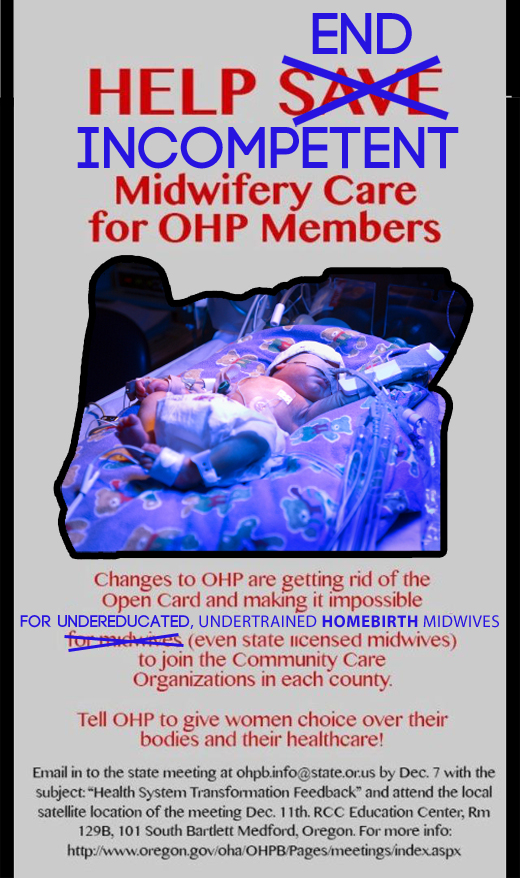
Oregon homebirth midwives are desperate to retain the ability to get reimbursed for providing care, but they have no intention of meeting the same standards as every other provider. They are fighting back with a marketing campaign, that, as usual, highlights their mendacity.

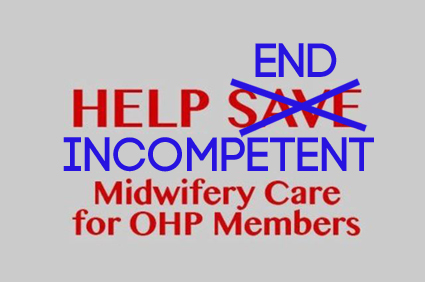
I have taken the liberty of amending one of their posters to more accurately reflect what is happening.

The first thing to not is that midwifery care in Oregon is NOT in danger. Women will have the same access to certified nurse midwives as they have always had. The only people affected are homebirth midwives who, in many cases, have no formal training in midwifery, and have appallingly high rates of perinatal mortality.

Second, the changes do NOT make it impossible for homebirth midwives to join CCO’s; they are NOT excluding homebirth midwives from CCO’s. Homebirth midwives simply have to follow the SAME rules as all other providers. Homebirth midwives don’t want to follow these rules because it will cut into their profits. Of course malpractice cuts in to the profits of any provider so many would be tempted to go without it. Oregon mandates malpractice insurance as a protection for patients.

Third, homebirth midwives think they can get around the requirements by getting their clients to protest on their behalf. As far as I can determine, they have no intention of ever complying with the same requirements that apply to everyone else.

Oregon homebirth midwives are caught in a bind. They want to be reimbursed like professionals, but they don’t want to meet the standards of professionals. In other words, they want the benefits without any of the burdens.

This may be how Oregon solves the problem of grossly incompetent homebirth midwives who have astronomically high mortality rates: stop paying them until they meet the same standards required of everyone else.

Dr. Amy