Lie to your patient and other homebirth midwifery wisdom

Want to know what homebirth midwives really think?

Read From Calling to Courtroom, A Survival Guide for Midwives. I should warn you in advance, though, that it may turn your stomach.

It may surprise you to find that midwives are every bit as concerned about legal action as the obstetricians they deride. They’re not worried about malpractice since by refusing to carry insurance they have rendered themselves judgment proof. No, homebirth midwives are worried about legal prosecution for practicing in violation of state laws. The book is a compendendium of strategies designed to prevent prosecution, or deal with it once it has occurred. It can be summed up very briefly: to protect yourself, a homebirth midwife should do anything, say anything (true or not), betray anyone and (most important) hire a licensed lawyer.

1. In order to prevent prosecution, homebirth midwives should lie to their patients.

Apparently informed consent, which homebirth midwives harp on endlessly in their criticism of obstetricians, is only for doctors, not for midwives. According to midwife Elizabeth Camp:

In the future my motto is, “No witnesses”. If I ever have to cut an episiotomy to save a baby’s life, I would ask everyone to turn their backs and turn off all video cameras. I would say to the mother, “I’m sorry, I had to TEAR you to deliver your baby quickly” (ok, so you tore her with scissors). I do not carry Pitocin anymore. For those midwives who do carry Pitocin, I would advise them to never admit it to anyone who has the ability to testify (that is, anyone except your husband). If a midwife ever feels the need to inject Pitocin or administer any kind of drug, such as Methergine, she should refer to such substances as “minerals.”

Be careful how you talk to your apprentices. You may think, “Not her, she would never betray me.” In my experience, there were only a few out of hundreds of midwives in my state who stood by me and defended me.

Be careful how you talk to your clients. Always use terms such as “If I were you, I would…” instead of diagnosing and recommending. Always have them initial on their charts when they refuse to get lab work or choose not to see a doctor.

Be careful where you keep your medical supplies. A search warrant can be issued without warning to you at any time. Do not chart emergency medical procedures. Use a “made up” code that only YOU understand. Don’t ever think it can’t happen to you. I believe I was careful BEFORE I was prosecuted. I am even more careful now.

In other words, lie to your patients, lie to your assistants, lie in your charting. Be sure to set things up so that if anything goes wrong the patient will be blamed.

2. Hire a licensed lawyer.

No self-proclaimed lay lawyers for these women. Evidently no concept of irony, either.

Want another reason that a midwife needs a lawyer? Look at the previous section of this book, describing the legal system. Lawyers go to school for at least seven years, take a grueling bar exam (which not everybody passes), then go out into the “real world” to learn how to research, argue without ticking off a judge, and apply classroom knowledge to courtroom situations. This book helps the midwife understand the system and not be shocked the first time she gets a search warrant or cease and desist order. It will not leave the midwife knowledgeable enough to represent herself. A midwife should feel no more comfortable representing herself than a lawyer would feel doing a midwife’s job (besides, most of them hate the sight of blood). The rule of thumb is this: if they have a lawyer, so should you. After all, it’s your freedom and your professional life that is at stake.

3. Don’t worry about dead babies; some babies just die.

This horrific passage comes from Geradine Simkins, former President of the Midwives Alliance of North America (MANA):

In the mid-1990’s, a well-known midwife was involved with a couple of baby deaths in out-of-hospital settings in Michigan. During one of the investigations the story became a media circus—as many of the midwife and homebirth stories do. The American public loves drama, and live-versions of drama are relished even more than fiction… This is the kind of situation that should not be made into a mini-drama. You know, babies die; it’s part of life. And only those entrenched in the bio-technical model think that that it doesn’t, or shouldn’t happen. I have traveled extensively in other countries, mostly developing nations, and people understand this reality elsewhere. I once arrived at the house of a midwife in another country the morning a baby had died in a homebirth. I found that the family had embraced the midwife and was so grateful to her—because the mother did not die. They were understandably sad about the baby, but families expect that a baby might die. A mother dying is considered beyond tragic. It’s a matter of perspective.

I’ve never seen a clearer expression of homebirth midwives’ the bone chilling lack of concern for dead babies.

When you tell women that they should accept their babies deaths and just be grateful that they didn’t die, too, you’ve forfeited any claim to being considered a professional of any kind.

When you insist that women should just get over the death of their baby because African women have it worse, you have demonstrated utter contempt both for women (generally women of color) around the world who suffer repeated heartbreak, and contempt for the emotional pain of your own patients.

There’s more, much more, along these lines in From Calling to Courtroom. I suggest this document be invoked at any legislative hearing on licensing homebirth midwives or expanding their scope of practice. Nothing can more clearly illustrate the fact that homebirth midwives are not professionals, and are unworthy of licensing, than their own words.

Are the folks at MANA’s Division of Research liars or fools?

Never say that I don’t give credit where credit is due: When it comes to sheer unadulterated brazenness, the folks at the Midwives Alliance of North America’s (MANA) Division of Research have no equal. The only question that remains unanswered is whether they are liars or fools.

Case in point, Thursday’s post on the Lamaze blog Science and Sensibility entitled Obstetricians Claim Homebirth is Unsafe…Again. Where’s The Evidence? by by Wendy Gordon, LM, CPM, MPH, Midwives Alliance Division of Research.

The post is about the recent AJOG opinion piece condemning homebirth. I am already on record excoriating that opinion piece. So why is Gordon’s piece an example of breathtaking audacity?

Because Wendy knows exactly where the evidence is: she’s hiding it!

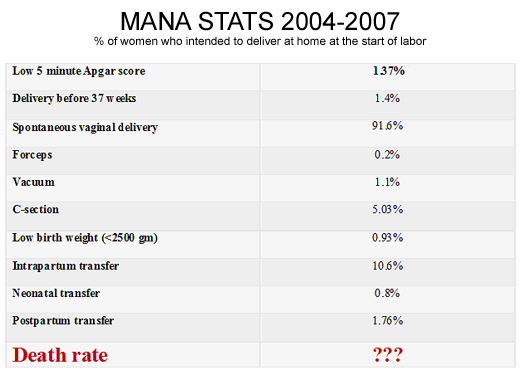
As I’ve written about many times, MANA has collected extensive safety statistics on nearly 27,000 homebirths presided over by their members.

MANA has released copious data on many of those births. You can find out:

  • the prematurity rate
  • the spontaneous vaginal vertex birth rate
  • the forceps rate
  • the vacuum extraction rate
  • the C-section rate

How about safety data? You can also find out:

  • the rate of low 5 minute Apgar scores
  • low birth weight infants
  • intrapartum transports
  • neonatal transports
  • postpartum transports


Wendy Gordon and MANA released every bit of data they had on these homebirths EXCEPT THE DEATH RATE. They’re hiding that.

Why?

Because MANA’s own death rates show that homebirth with an American homebirth midwife has a death rate so appallingly high (particularly in regard to postdates pregnancies) that they don’t dare release it!

So the only question remains: are Wendy Gordon, Melissa Cheyney and others at MANA’s Division of Research liars or fools when they publicly ask where the data is that shows homebirth is dangerous?

They KNOW where the data is. They own it and they are doing everything humanly possible to make sure that no one finds out just how many babies died at the hands of homebirth  midwives.

Prevent birth trauma: get an epidural

In natural childbirth circles there are endless tales of birth trauma that occur in hospitals. Indeed, there are cases where women claim they are suffering from PTSD and even women who really are suffering from PTSD. Natural childbirth advocates like to claim that birth trauma is the result of a lack of supportive, respectful care and lack of feeling in control, but I suspect that there is something else entirely that is to blame: PAIN.

There is one thing that I have noticed in all these stories; none of the women had epidurals except as a last resort or for C-sections. Moreover, I’ve never read or heard of a story of birth trauma or PTSD (real or otherwise) that involved a woman who planned on getting and got an epidural in a timely fashion.

It’s not surprising when you think about it. Let’s look at post traumatic stress disorder (PTSD), the most severe form of birth trauma. What is the cause of PTSD? According to pyschiatrist Roxanne Dryden-Edwards, MD:

Posttraumatic stress disorder (PTSD) is an emotional illness that that is classified as an anxiety disorder and usually develops as a result of a terribly frightening, life-threatening, or otherwise highly unsafe experience. PTSD sufferers re-experience the traumatic event or events in some way, tend to avoid places, people, or other things that remind them of the event (avoidance), and are exquisitely sensitive to normal life experiences (hyperarousal)…

Virtually any trauma, defined as an event that is life-threatening or that severely compromises the physical or emotional well-being of an individual or causes intense fear, may cause PTSD. Such events often include either experiencing or witnessing a severe accident or physical injury, receiving a life-threatening medical diagnosis, being the victim of kidnapping or torture, exposure to war combat or to a natural disaster, exposure to other disaster (for example, plane crash) or terrorist attack, being the victim of rape, mugging, robbery, or assault, enduring physical, sexual, emotional, or other forms of abuse, as well as involvement in civil conflict.

A lack of respectful care or even a lack of feeling in control does not fit that those criteria, but severe pain and overwhelming fear certainly do.

Dr JaneMaree Maher of the Centre for Women’s Studies & Gender Research at Monash University in Australia explains the effect of labor pain in her article The painful truth about childbirth: contemporary discourses of Caesareans, risk and the realities of pain:

… Pain will potentially push birthing women into a non-rational space where we become other; ‘screaming, yelling, self-centered and demanding drugs’. The fear being articulated is two-fold; that birth will hurt a lot and that birth will somehow undo us as subjects. I consider this fear of pain and loss of subjectivity are vitally important factors in the discussions about risks, choices and decisions that subtend … reproductive debates, but they are little acknowledged. This is due, in part, to our inability to understand and talk about pain.

As she explains:

… [W]hen we are in pain, we are not selves who can approximate rationality and control; we are other and untidy and fragmented. When women give birth, they are physically distant from the sense of control over the body that Western discourses of selfhood make central …

So epidurals, as the most effective form of pain relief, give women control over their own bodies and control over the way in which they behave. This allows women to represent themselves to others in the ways in which they wish to be seen, instead of pushing them into a “non-rational” space.

In other words, it is the excruciating pain that is traumatic, not simply because of the agony, but because being in agony makes it almost impossible to advocate for oneself, to make important decisions, and to exert control over your care.

Imagine if labor were painless, or nearly so. Would it be as traumatic? Would it render women unable to advocate for themselves or exert control over their care? Of course not. A woman who is not in excruciating pain can have reasoned discussions with her providers about her preferences, which is particularly if  an unanticipated complication arises.

Natural childbirth advocates are not entirely wrong in pointing out that a lack of supportive care and a lack of feeling in control contribute to birth trauma and PTSD, but they are looking at downstream effects of the real problem, pain. The support is needed to cope with the pain; the feeling of not being in control is because of the pain.

Ironically, natural childbirth advocates are actually promoting the very complication that they claim to prevent. By insisting that relieving labor pain is a moral weakness and a danger to the baby (both of which are completely untrue), they encourage women to forgo relief of the excruciating pain and increase the risk that women will develop birth trauma and PTSD.

These are just my observations, but I’d be curious to hear of the experiences of others, both personally and of people you have known and read about. Has anyone ever heard of a case of PTSD after childbirth that occurred in a woman who planned to get and did get a timely epidural in labor?

The morally grotesque campaign for human rights in childbirth

Suppose you read about an upcoming conference on human rights in childbirth. Since you are interested in making sure that all women have access to competent medical care, without regard for ability to pay, that incarcerated women not be forced to labor in chains, and that women have access to birth control, you decide to attend.

When you get there you find, to your surprise and dismay, that the conference has nothing to do with providing access to medical care for women and their babies who are suffering and dying without it. Instead, you learn that the organizers of the conference believe the “human rights” problem in contemporary childbirth care is that women who have excellent access to healthcare have no access to manicurists during labor. The organizers of the conference, most of whom are manicurists, believe that manicures enhance the hospital experience, empower women who are feeling disempowered, and, most importantly, lead to better patient outcomes.

Regardless of how sincerely manicurists might believe that manicures help women in labor, claiming that manicures are a “human right” is morally grotesque. A manicure is an extravagance, appealing only to women who have no concern about accessing safe, effective healthcare and there is no evidence that it improves care or leads to better outcomes in childbirth.

We would recognize this for what it was; a cynical effort by manicurists to line their own pockets by increasing demand (and payment) for their services by appropriating the language of human rights.

A conference on human rights in childbirth that concentrates on providing homebirth is every bit as morally grotesque as a campaign for human rights in childbirth that demands manicures during labor.

Indeed, framing homebirth as a human rights issue betrays the real focus of the homebirth movement: white, Western, well-off women who can pay homebirth midwives, doulas and childbirth educators.

Homebirth is an extravagance on par with manicures with an important difference: manicures don’t increase the risk of perinatal death, but homebirth does.

The website One World Birth and it’s film Freedom For Birth makes the same morally grotesque claim.

What’s the film about?

In 2010, Hungarian obstetrician and midwife Dr Agnes Gereb was arrested and imprisoned for supporting women in homebirth.

Although it is legal for mothers to give birth at home in Hungary, any medical professional (without a special license) who helps those women can be criminally charged…

The price Agnes paid for going against the system was to be found guilty of “endangering life in the conduct of her professional work”. She was sentenced to two years in prison. Earlier this year, the court of appeal doubled the suspension period of her medical and midwifery licenses to 10 years..

The criminalisation of midwifery isn’t just confined to Hungary. In the US, Australia and other countries around the world, many midwives have been arrested and charged. Many leading experts claim there’s an international witch-hunt against midwives.

But this is just the tip of the iceberg when it comes to injustice and denial of women’s human and civil rights.

As birth increasingly becomes seen as a “medical event”, so women have frequently been denied the right to decide the circumstances and location of where and how they give birth.

Now it’s time women took back those rights.

Who is behind the website and film?

I know you will be shocked, shocked to find that it is a white, Western, well off woman who had [cue the violins] an emergency C-section which resulted in nothing more than a healthy baby.

ONE WORLD BIRTH was co-founded by two filmmakers, myself (Toni Harman) and my partner (Alex Wakeford).

We were inspired to create ONE WORLD BIRTH after the difficult birth of our daughter four years ago, an all too familiar story of a cascade of interventions that led to an emergency c-section.

And how does Toni Harman would know whether or not her C-section was necessary and whether it was the result of a cascade of interventions? No doubt her “research” at Google University made her eminently qualified to make that determination..

We thought we could use our skills as filmmakers to make birth better around the world.

So over the past 18 months, we have self-funded our filming (helped by some wonderful contributions from previous Indiegogo campaigns) and travelled from the UK, to France, Canada, the USA and most recently to Hungary. We have filmed interviews with over 100 of the world’s leading birth experts (Sheila Kitzinger, Ina May Gaskin, Michel Odent, plus dozens of academics, OB/GYN’s, midwives, doulas, campaigners).

Strange that the only people who consider those frauds “experts” is themselves. And what has their contribution been to improving access to maternal and perinatal health care world wide? Oops, they haven’t made any contributions of the kind. To the extent that homebirth proponents have affected the death rates, it is only to increase them.

How will the film make make birth better around the world?.

Will it save the lives of any of the hundreds of thousands of women and babies who die EACH YEAR for lack of lifesaving obstetric care? No, of course not.

When One World Birth talks about making the “world” better for birth they mean making the white, Western, wealthy, technologically developed “world” better for birth.

Will it improve safety for those white, Western, wealthy women who already have easy access to obstetric interventions? No, of course not.

When One World Birth talks about making the world “better” for birth, they  mean improving the birth experience for those white, Western, wealthy women.

Who will gain the most from making birth better around the world?

Funny, you should ask. The people who would experience the biggest improvement are white, Western, wealthy midwives, doulas and childbirth educators.

Proving, as if more proof were needed, that framing homebirth as a human rights issue is every bit as morally grotesque as framing manicures in labor as a human rights issue.

Don’t get me wrong: I’m happy that we live in a world where childbirth is so safe, and access to life-saving care is so easy, that women like Toni are free to pretend that a birth experience is a human right and that a C-section that yields nothing more than a healthy baby is a tragedy. But that pretending turns very ugly indeed when extremely privileged women like are so cut off from the ugly reality of childbirth in the developing world that they think they are making the world “better for birth” by prioritizing the needs of extremely privileged white women over those of anyone else.

We should recognize the claim of homebirth as a human right for what it is: a cynical attempt by homebirth midwives, doulas and childbirth educators to line their own pockets,  increasing demand (and payment) for their services by appropriating the language of human rights. It is morally grotesque and they should be ashamed of themselves.

Natural childbirth advocates would rather be validated than be correct

In the wake of the presidential election, I wrote about the echo chamber that characterizes both Republican conservatism and natural childbirth advocacy.

Conservatives were utterly shocked by the 2012 election results. It wasn’t just that their candidates and issues lost, but that they didn’t anticipate that they would lose. It is a wake up call for conservatives who live in their own insular online, television and print world, where conservative bloggers affirm their conservative beliefs, where Fox News tells them what they want to hear and where conservative publishing houses produce an unending stream of vitriolic conservative books. It is also a wake up call for others who live in their own insular online communities, like NCB and homebirth advocates.

But no one forced the conservatives to deprive themselves of accurate information by watching Fox News and no one forces natural childbirth advocates to deprive themselves of accurate information by reading books and websites written by other natural childbirth advocates. Why do they do it? It’s because they’d rather be validated than be correct.

In the world of natural childbirth advocacy, they don’t call it validation, though; that’s too clinical. They call it “support.”

Hart et al. explore this phenomenon in their paper Feeling Validated Versus Being Correct: A Meta-Analysis of Selective Exposure to Information. The authors explain:

… Receiving information that supports one’s position on an issue allows people to conclude that their views are correct but may often obscure reality. In contrast, receiving information that contradicts one’s view on an issue can cause people to feel misled or ignorant but may allow access to a valid representation of reality. Therefore, understanding how people strive to feel validated versus to be correct is critical to explicating how they select information about an issue when several alternatives are present. (my emphasis)

Avoiding cognitive dissonance is central to the search for validation:

… According to dissonance theory, after people commit to an attitude, belief, or decision, they gather supportive information and neglect unsupportive information to avoid or eliminate the unpleasant state of postdecisional conflict known as cognitive dissonance.

Minimizing cognitive dissonance requires selective exposure, seeking out information sources that confirm existing beliefs and avoiding sources that undermine those beliefs. For example:

In one of the initial studies testing selective exposure, mothers reported their belief that child development was predominantly influenced by genetic or environmental factors and then could choose to hear a speech that advocated either position. … [M]others overwhelmingly chose the speech that favored their view on the issue.

There is an exception, however. People were happy to view uncongenial information if they felt it was easy to refute.

Books, websites and Internet communities that promote pseudoscience are quite overt in their preference for validation over accuracy. Consider this reminder that appeared at the top of the Mothering Unassisted Childbirth Forum:

… This is a forum for support, respectful requests for information, and sharing of ideas and experiences. While we will not restrict discussions only to those who birth without professional attendants, proselytizing against UC will not be permitted…

Mothering has been even more overt in its insistence on selective exposure to information about vaccination:

… Though Mothering does not take a pro or anti stand on vaccinations, we will not host threads on the merits of mandatory vaccine, or a purely pro vaccination view point as this is not conducive to the learning process.

They’re not anti-vaccine but they refuse to print a pro-vaccine point of view? Whom do they think they are kidding? Of course, it’s hardly surprising if the primary purpose of the forum is to provide readers with validation, rather than to transmit accurate information.

Those who run natural childbirth blogs, websites and Facebook pages are quite upfront about their determination to minimize cognitive dissonance by restricting the free flow of information. Only information that supports a predetermined point of view is allowed. Anything else must be deleted. That’s why they ban commentors who dare to dissent. To the extent that any real scientific papers are discussed, they are limited only to those that can be easily refuted or those papers (usually poor) that confirmed the approved point of view. The rest of the vast scientific literature is ignored.

That’s why it is impossible to become “educated” when reading pseudoscience websites. In fact, claiming to be “educated” about childbirth by doing “research” on the Web is the surest sound of profound ignorance.

Adapted from a piece that first appeared in November 2010.

No, Gisele, natural childbirth promotes violence

Giselle Bundchen, sanctimommy extraordinaire, has stepped into it again.

You may recall that after her first child’s birth, she graced us with her thoughts on breastfeeding.

“… Some people here think they don’t have to breastfeed, and I think, ‘Are you going to give chemical food to your child, when they are so little?’” she tells Harper’s Bazaar UK, The Daily Mail reports.

“There should be a worldwide law, in my opinion, that mothers should breastfeed their babies for six months,” she adds.

Now, Giselle graces us with her thoughts on hospital birth. In a typically humble gesture, Giselle has included a section on her website on the Meaning of Life. Giselle allowed a member of  Birth Around the World (not One World Birth as I originally mentioned) to post about “birth without violence.” (cached here)

Frederick Leboyer, a French physician, described the birth under the baby’s perspective, in his book “Birth without violence” published in 1975 was revolutionary for its time. In his book he describes the feelings and perceptions of the baby during the birth process, showing how birth can be traumatic for the newborn and how we can help make this transition happen in a more loving and gentle way…

The lights with a brigth focus upon over the baby that cannot even open his eyes so with such clarity. Leaves a tight place and now feel unprotected with all the space. The umbilical cord is cut immediately, the baby is suddenly forced to breathe and the baby cries.

Everyone is happy with that shrill cry, but it’s a cry of pain. Where is my mommy? Where are they taking me? The baby is taken to be assessed and often go for hours until he can get to snuggle his mother, but what they need at this moment is each other.

The feeling raised: Fear. Fear of suffering, fear of the unknown, fear of pain, fear of abandonment, fear of childbirth. The society is surrounded by this fear that is evident by the high cesarean rates in Brazil and in most countries.

But at Gisele’s homebirth:

As Gisele described in an interview : “I wanted to be very aware and present during childbirth. I prepared a lot, doing yoga, meditation. I had a very gentle birth at home, he was born and spent the whole time on my lap, never went away from me (…) With each contraction he was closer to me, I transformed that intense feeling into a hope see him closer to me. “

And how is that different from hospital birth? Surprise! It isn’t!

Moreover, my research shows that natural childbirth and attachment parenting promote tyranny, mass murder and a variety of other ills. In fact, natural childbirth causes violence.

Consider:

Of history’s greatest tyrants, men such as Hitler, Torquemada, Henry VIII, Attila the Hun, etc., nearly all were born vaginally. The only potential exception is Julius Caesar, reputedly born by way of the eponymous Caesarean section.

Almost all of history’s greatest tyrants were breastfed … exclusively.

The long term effect of giving birth without pain medication is dreadful. 100% of the children born to women who gave birth before the advent of anesthesia in the mid-nineteenth century are now dead.

Vaginal birth is a risk factor for Communism: Marx, Engels, Lenin, and Stalin were all born vaginally.

Breastfeeding is a risk factor for plague. Nearly 100% of people who died of the Black Death were breastfed.

Attachment parenting played a major role in imperialist expansion in the US. Fully 100% of the invaders who displaced the Native American population of this continent were born vaginally. Moreover, fully 100% of the Native Americans who were unable to resist the advent of the invaders were breastfed.

Breastfeeding is a risk factor for violent behavior. Almost all Viking marauders were breastfed.

Nearly all slave-holding Americans, plantation owners and the entire Confederate army were born vaginally.

Not a single Crusader was born to a woman who had an epidural in labor.

Vaginal birth is a risk factor for anti-social behavior. Roman emperors Caligula and Nero, as well as Jack the Ripper and Lizzie Borden (who committed patricide AND matricide) were born vaginally.

Breastfeeding leads to transmission of disease. Typhoid Mary was breastfed.

Hospital birth promotes technological progress. Desk top computers, iPhones, Skype and Twitter did not exist until the proportion of US births occurring in hospitals rose above 90%.

What is the cause behind these incontrovertible facts?

First, we’ve known for centuries that deep seated prejudice is “imbibed with mother’s milk.” I’ve never heard of anyone imbibing hatred with Similac, so the obvious solution is to promote formula feeding.

Second, as Dr. Michel Odent has insisted, oxytocin is the love hormone and some women clearly don’t have enough love. The solution is oxytocin supplements. Fortunately, pitocin has the exact same chemical composition of oxytocin, so it seems clear that, to be on the safe side, all labors should be induced or augmented with pitocin.

Finally, epidurals ought to be mandatory in labor. The mothers of the greatest tyrants in history gave birth without pain relief and look what happened as a result.

No, Gisele, hospital birth is not violent; it actually prevents violence!

Gisele and I do agree on her final quote:

Wilhelm Reich, said: “The Civilization begin on the day that the welfare of newborns prevail over any other consideration.”

That, of course, would mandate hospital birth, where, in the last 100 years, the neonatal mortality rate has dropped 90% and the maternal mortality rate has dropped 99%.

What’s truly uncivilized is when women like Gisele, who have no knowledge of science, statistics or obstetrics, who actually think they are doing “research” when they read the blatherings of nitwits like Fredrick LeBoyer, put their birth “experience” (and bragging rights) ahead of the lifesaving interventions of modern obstetrics … and pretend they are doing it to prevent violence.

Tell me, Gisele, how peaceful is the birth if the baby is born dead?

If we manipulate the data enough, we can make it look like homebirth has a lower risk of postpartum hemorrhage.

Does homebirth decrease the risk of postpartum hemorrhage?

Now, a group of statisticians, Andrea Nove, Ann Berrington and Zoë Matthews, has published a paper in BMC Open (Comparing the odds of postpartum haemorrhage in planned home birth against planned hospital birth: results of an observational study of over 500,000 maternities in the UK) purporting to show that homebirth decreases the risk of postpartum hemorrhage. Too bad the paper violates many standards of statistical analysis in an effort to reach a desired conclusion.

Before looking at the paper, let’s consider what you would need to investigate if you wanted to find out whether homebirth has a lower risk of postpartum hemorrhage.

The first rule of statistical analysis is that you must compare like with like. So in comparing women who gave birth at home to those who gave birth in the hospital, you MUST:

  • Use contemporary data. Out of date data leads to out of date conclusions.
  • Use a standard definition of postpartum hemorrhage.
  • Use intention to treat at the start of prenatal care. Otherwise, homebirth mothers who become high risk during pregnancy will end up in the hospital group and lower the risk of homebirth group.
  • Include a comparison of the characteristics in both groups to make sure they are as similar as possible. For example, if you find out that women who choose homebirth have fewer pre-existing medical conditions, or are less likely to smoke, you must correct for those difference in the final analysis.
  • Assure that there is no difference in the way that postpartum hemorrhage is measured in the different settings.

The authors violated every one of these requirements.

The authors used data that was 12-24 years old.

Instead of looking at postpartum hemorrhage (defined as blood loss greater than 500cc) the authors chose to look at severe postpartum hemorrhage (blood loss greater than 1000cc).

According to the Royal College of Obstetricians and Gynaecologists (RCOG), although an estimated blood loss of at least 500ml counts as a PPH, in the UK a case should be considered an “emergency” only when the blood loss exceeds 1000ml. For this reason, the definition of PPH adopted for this analysis was the loss of at least 1000ml of blood.

The authors used intention to treat at the start of labor. Therefore, any women who developed high risk conditions during pregnancy were excluded from the homebirth group and added to the hospital group.

Women were classed as having intended a hospital birth if: (a) a hospital birth was intended at booking and the baby was delivered in hospital, or (b) a home
birth was intended at booking but the baby was delivered in hospital, and SMMIS recorded the change in intention as having taken place before labour commenced.

The authors assumed that midwives working alone at home accurately recorded blood loss. Although clinicians often try to downplay complications, in the hospital setting there are additional observers, raising the possibility that the blood loss estimates at homebirth were minimized compared to blood loss estimates at hospital birth.

It is notoriously difficult to estimate accurately the amount of blood lost during labour and delivery, and the normal method used (visual estimation) has been found to be inaccurate. However, there is no reason to suppose that the estimates in hospital were systematically higher than the estimates at home, so this inherent inaccuracy is unlikely to have biased the relative risk estimates when comparing home and hospital births.

Finally, the authors did not know which women had a history of postpartum hemorrhage. One of the biggest risk factors for postpartum hemorrhage is previous postpartum hemorrhage. A history postpartum hemorrhage is a contraindication to homebirth. Therefore, women with a history of postpartum hemorrhage would deliver in the hospital and thereby increase risk level of the hospital group.

So the authors did not compare the incidence of postpartum hemorrhage in women who intended to deliver at home with women who intended to deliver in the hospital. They compared the risk of severe postpartum hemorrhage in women who intended to deliver at home AND developed no complications in pregnancy (and probably had no history of PPH) with women who intended to deliver in the hospital, had a variety of complications PLUS women who intended to deliver at home but developed complications during pregnancy. That is NOT comparing like with like.

The authors claim to have corrected for some of these problems in their analysis. A characteristic of any good scientific paper is that it includes enough data so that the reader could perform the same analysis if desired. This paper does not include the most critical data: the incidence of risk factors in each group. For example, although women having a first baby have a much higher risk of postpartum hemorrhage than women having a second or subsequent baby, the authors fail to tell us just how many primips and multips are in each group.

The authors conclude:

This study aimed to compare the risk of PPH between those who intended a home birth at the end of pregnancy (whether or not they went on to experience a home birth) and those who had a planned hospital birth. It found significantly higher odds of PPH among those who had a planned hospital birth than among those who intended a home birth. This raises questions about the safety of hospital birth from the perspective of the mother‟s wellbeing.

Really?

Let’s look at some other variables that were highly statistically significant in this analysis. According to Table 3, other variables that resulted in highly statistically significant differences (P< .001) in the risk of PPH include giving birth to a girl, having more than one ultrasound in pregnancy and giving birth in 1999 or 2000. Moreover, giving birth between 4-8 PM was also a risk factor for PPH (P< .01).

Though the study demonstrated statistically significant differences in these factors, no one, least of all the authors, believes that means that gender, ultrasound or giving birth in the late afternoon causes PPH or that women should be counseled about the purportedly increased risk of PPH in association with these factors.

Why did the authors fail to use standard definitions, fail to use intention to treat at the start of prenatal care, fail to provide standard data on the risk profile of each group and conclude that place of birth was a risk factor while ignoring other variables that were also statistically significant? I suspect that it was because doing the correct analysis, using the correct data would not have shown homebirth to have an advantage. In addition, pointing out that their analysis also led to the conclusion that gender, ultrasound, and late afternoon birth increased the risk of PPH would have undermined the validity of the analysis.

The authors claim:

The results will provide further evidence to help pregnant women, their partners and maternity care providers to make a more informed choice about place of birth than has been possible with previously available evidence.

But that is completely untrue for four important reasons.

First, the authors never compared the risk of postpartum hemorrhage between women intending home birth vs. those intending hospital birth. They compared the risk of severe postpartum hemorrhage in low risk women attempting homebirth, with higher risk women intending hospital birth.

Second, the history of previous postpartum hemorrhage was not known and this almost certainly affected the difference in postpartum hemorrhage between the two groups.

Third,the fact that gender, ultrasounds and late afternoon birth appeared to increase the risk of PPH suggests that the analysis is not particularly useful.

Fourth, the authors did not demonstrate causation, as the authors themselves have acknowledged.

This result highlights a statistical association between intended place of birth and PPH; it does not prove a causal relationship, nor does it explain why the association exists.

Therefore, this paper is interesting as an observation, but tells us NOTHING about whether homebirth decreases the risk of postpartum hemorrhage. It will not help providers make a more informed decision about place of birth because it does NOT tell us whether place of birth affects the risk of postpartum hemorrhage.

She found us wallowing in our stupidity; quick let’s hide and wallow some more.

Small children struggle with a conflict. They want approval from parents and other authority figures, but they want to misbehave, too. Solution? Misbehave but hide the evidence.

The folks at the Coalition for Breech Birth seem to have the same problem. They want approval and respect from authority figures (A doctor is one of our members! Sure he was convicted for sexual exploitation of a patient and disciplined TWICE by the Board of Medicine, but he’s a doctor and he agrees with us!). Yet they also want to be free to share their stupidity as “information” and get lots of “attagirls” when they display their ignorance. Solution? Continue to wallow in stupidity, but hide the evidence.

The napalm grade stupidity of the Coalition for Breech Birth was on flagrant display in their thread about single footling breech. From the original poster, a midwife who asks why single footling breech is dangerous AFTER she has attended two (how are patients supposed to give informed consent when their provider is not informed?); to the blathering of attention whore Nancy Salgueiro (hey, Nancy, how does a dead baby have a “life experience”?); to the hilarious discussion (directly under the label “Open Group”) of how I managed to read their exchange, their ignorance — and their ignorance of their own ignorance —  was on display for everyone to see.

Solution? Anyone with any maturity might cringe at being revealed as stupid, but they would almost certainly investigate how they could be so wrong and modify their opinions and advice based on what they learned. But like small children, the folks at the Coalition for Breech Birth want to continue to wallow in ignorance. They simply made their group private (after finally noticing that they were posting under the label “Open Group”)

That demonstrates two things.

First, they recognized that their own words made them look like fools. If they were proud of what they wrote; if they believed it to be true, they would have kept the group open.

Second, contemplating learning from their mistakes vs. being free to continue making absurdly stupid proclamations, they chose to continue making absurdly stupid proclamations.

I consider this a win-win-win.

Using their own words, I was able to illustrate the profound ignorance of natural childbirth and homebirth advocates.

By hiding their words, they basically acknowledged that I was right and they were profoundly wrong.

Forcing them to hide their own words by making their group private dramatically limits their ability to influence other women or to be taken seriously by anyone else.

I can’t explain why anyone would take advice about childbirth from clowns like these, but at least I can expose them for the fools they are.

Napalm grade stupidity on footling breech

How on earth can anyone trust clowns like these from the Coalition for Breech Birth with the lives of their precious babies?

Heather Shelley: Why is there such a fear of footling breech? Everything I read says don’t do it, but I have done two with primips and they have both been fine.
November 11 at 11:54am via mobile

Rhonda Tombros: I’ve also wondered this Heather Shelley. I think partly it is that they are the most rare and therefore attendants have least experience delivering them but I’ve heard a number of successful VBB footling stories. I think there is concern that the baby may descend before the mother is fully dilated. I don’t know what the real risks are of this though. I do know that even “breech-friendly” obs can put their feet down at the footling …

Heather Shelley: I have someone hold the feet in until we can’t hold them anymore, then let baby come. This helps with full dilation.

Wendy Jolliffe: Prolapsed cord is the fear, I believe. With a head, or a bum, it pretty much blocks the vagina. Not so much with feet.

Heather Shelley: That makes sense Wendy

Marieke De Haas-van Bommel: I’ve had a footling breech at home in bath without any real problems. After the first foot/leg it stagnated and after I started pushing along, the rest came out fine, until his head. He was jumping up and down the bottom of the birthing pool and hurted me badly so my contractions stopped. My midwives helped me deliver his head. But here in Holland they are overall scared for breech delivery and I don’t think that footling breeches come vaginally.

Amy Mokady: I know that even breech experienced practitioners do say that a footling breech is more likely to need a c-section even if you try for a natural birth. My understanding was that there is more risk of the baby getting into a position that will not deliver, and also in a footling position, the baby’s lower half is narrower than the head. I am not sure if the cervix sometimes does not dilate properly since there is not much pressure against it? In a complete or frank breech, the rounded part of the buttocks present, and in a full-term baby they are pretty much the same size as the head. Of course some footlings can birth completely hands-off, but they are more likely to need some kind of assistance/manoeuvres from the attending midwife or doctor.

Robin Guy: the SOGC guidelines say “there is consensus that footling breeches should be delivered by caesarean section.” In other words, there isn’t actually any evidence, just a widely held opinion.

Ghada Shereif: My last baby was a footling (was a frank until birth). Birthed beautifully on all fours. Left foot, right foot, left arm, right arm, and last but not least after I thought I was done :)… The midwives told me to push the head out. Ina May Gaskin and Carol caught my baby.

Lorraine Rigby-Larocque: What about footling with one leg still frank, from the baby’s point of view? When I think of being in that position myself, I cringe, but is it more dangerous for the baby?

Robin Guy: it’s not a footling if the bum is also down

Robin Guy: a presenting foot first doesn’t define it – if the bum is down WITH the feet it’s a complete, regardless of whether the bum or the foot actually appears first

Kavita Rosepetal: a footling breech could have also shortly before been a complete breech so it is hard to really say the presentation.

Maya Midwives: I have supported two footling breeches to birth naturally. I have supported a primip to give birth withl one led extended and one leg footling with no problems. Babies are flexible and designed to be born vaginally. There is no similarity to an adult adopting the same position. If the labour is progressing spontanously and without interventon then the baby will be born.

Rixa Freeze: (late to the conversation…) Cord prolapse (10% in footling breeches) is probably the biggest reason for the nearly universal contraindication for footlings, followed by the concern that extended hips won’t make as a big a diameter as flexed hips…make as a big a diameter as flexed hips…making the head possibly more difficult to birth. Not saying I necessarily agree with a universal CI for footlings, but there are definitely more risks involved because of cord prolapse.

Jan Tritten: Do them in water. You lots more time and prolapsed cord is not necessarily a problem. Ask Midwife Carol Gautschi and Cornelia Enning. Cornelia only does waterbirths for the past 30 years and has done many breeches in water. She is in Germany.

Rixa Freeze: There’s so much we still don’t know about breech…Jane Evans expressed reservations about doing breeches in water because the buoyancy interferes with gravity and changes the normal mechanisms of breech. We should see if Cornelia could come to the next breech conference and talk about her experiences!

Christie Craigie-Carter: My understanding is that although cord prolapse is a greater risk with a footling breech, it is also much less likely to be compressed for the same reason that you mention Rixa Freeze (the decreased diameter as compared to flexed hips). As a related aside, I still don’t know for certain whether my breechling was footling or complete and his foot popped out first (that part I know).

Christie Craigie-Carter: Another related aside–informed consent. First, let me make it clear that I have absolutely no qualms with how my midwives operated during our birth. But, honestly, 6 years ago, had I known he was footling, I *might* have made the choice to transfer for a cesarean because of the very fear that we are discussing. One of my midwives made a comment a couple of years after R was born that “most midwives would have called 911 when they saw the foot (emerging)”, which tells me that they didn’t know that he was presenting footling (I had several vaginal exams which I feel were prudent given an un-related issue).

Rixa Freeze: Yes, there is more room for cushioning with breech vs cephalic prolapses, and with footling vs. other types of breeches specifically. I remember that Andrew Bisits does not rule out VBB for a footling presentation before labor, because they can convert from footling to complete, etc. So they do an in-labor scan to verify position before making a final decision. Jane Evans doesn’t exclude footlings as a rule.

Christie Craigie-Carter: Sorry, hit return prematurely. There is a lot of talk about women taking risks in birth because of “the experience”. First, I always submit that mothers are not going to do something that they feel is blatantly more dangerous for their child than another option simply for an “experience” (considering that we are comparing two choices, each with risk). But secondly, why is the experience not only dismissed but disdained? I was a better mother for not having had PTSD/PPD after his birth (which I experienced after my 1st). In the end, it is a very personal decision between the parents and their care providers.

Nancy Salgueiro: One of the big keys is defining a footling. As Jane and Andrew mentioned just because feet come out first doesn’t necessarily make it a footling. If bum has passed through the cervix into the birth canal and then feet fall through, that is not a footling. Jane would tickle the feet so the baby curls them back in to stay warm. It is only a footling if the feet have come through the cervix before the bum. As mentioned above that would then present the risk for head entrapment. If the body falls through (possibly with the cord) before the cervix is fully dilated then the head may be trapped within the uterus for too long. Any delay in dilation at this point could be a problem which means it is extra important not to frighten mom or sphincter law could close up the cervix or delay opening. A bum won’t fall through a partially opened cervix so a complete or frank breech wouldn’t be cause for the same concern.

Nancy Salgueiro: My opinion of water birth for breech is that is would work with the buoyancy if the mother is in more of a squat or leaning back position, then it is like the maneuver used for a supine breech delivery. If on all fours the buoyancy works against gravity. So its just a matter of moms positioning.

Rixa Freeze: Great points Nancy & Christie.

Nancy Salgueiro: Christie Craigie-Carter I agree with you. This idea that mothers don’t matter in birth is my biggest pet peeve. Birth is not ONLY about the baby. It is the birth of a mother, the birth of a father, and the birth of a family. All of those considerations should come into play. Mothers are going to choose what they feel is best for their baby which also means having the best possible birth experience so they can have optimal bonding and physical recovery which directly impacts the long term outcome for that child. Even without the pyschosocial element of birth just breaking it down to physiology a natural birth is better for that baby. The exposure to oxytocin after and unmedicated vaginal birth physically changes the brain so the mother baby dyad bond and breastfeeding can get off to the best start. How do we not, at minimal, recognize that the “experience” of birth isn’t about having a life experience like going SkyDiving or on an amazing vacation, it is a process/experience that physiologically programs that family for life.
Then add in the sense of accomplishment, strength, and empowerment and the effects on that baby from having a mother who feels powerful instead of traumatized.

It is crazy to me that we are so dismissive of mothers when they are the key to that baby’s life experience.

With a death rate of 10% or more, footling breech birth is just as dangerous as holding a loaded gun to your baby’s head and playing Russian Roulette. But, hey, Heather Shelley delivered two and neither died, so that proves … NOTHING.

The stupid, it burns.

Baby slaughterers unite and throw off your chains!

WARNING: This is not a satire, but it is so horrifying you will wish that it were.

Everyone is the hero of their own story. Even women who commit manslaughter.

Of course it takes a fair amount of mental gymnastics pretend that you are hero when a baby (or two, or three, or more) dies a preventable death at your hands, but homebirth midwives are equal to the task. How else can you explain the existence of a website that so perfectly allies the outsize self-absorption of homebirth midwives with the utter contempt they have for babies who die?

I’m talking about the Facebook page Sisters in Chains.

You must visit this website. Nothing I can write about it can fully convey the horror of it. It is being maintained by Katie McCall, one of the “sisters”:

I keep getting asked for a list of persecuted out of hospital birth attendants and homebirthing mothers. So, here it is. Please let me know if you have anything to contribute as I realize my research may be faulty, incomplete or inaccurate. Bolded names are those still going through prosecution or persecution.

The Facebook page documents the “persecution” of NINETY (90!) American homebirth midwives and 1 doctor for no better reason than a pile of dead babies and a few injured mothers.

It does not mention a single dead baby by name; in fact, in the case of many of the deaths, neither the babies, not the fact of their deaths are mentioned at all.

How dare they hold homebirth practitioners accountable over something as trivial as a dead baby, or a mother who was injured … or for anything at all??!!

Consider:

Robert Biter (ObGyn), 2012

License suspended after a medical board witch hunt that ensued in relation to his bold and outspoken support of out of hospital birth and mothers’ rights.

That would be Robert Biter, whose license was suspended in the wake of 7 separate incidents of gross malpractice PLUS the death of a baby.

Or:

Kristina Zittle, LM (midwife), 2008

Investigated on charges of malpractice – gave up her license in order to avoid having to appear before the Board of Medicine.

That would be Kristina Zittle who managed the impressive feat of presiding of two perinatal deaths less than 6 weeks apart.

And let us not forget:

Colleen Goodwin, LM, CPM (midwife) 2012

Lost her license after investigation by the medical board and later sued for malpractice. Settled at $5million dollars with the family to avoid jury trial.

Jerusha Goodwin, LM, CPM: (midwife and Colleen Goodwin’s daughter), 2012

Lost her license after investigation by the medical board and later sued for malpractice. Settled at $5million dollars with the family to avoid jury trial.

What did they do? Nothing more than preside over 3 neonatal deaths and a case of profound brain impairment.

So let’s see if I get this straight. Anyone who tries to hold homebirth providers accountable is persecuting them. But what if they are guilty of malpractice? So what, it’s still persecution. What if they plead guilty to the crime for which they were charged? So what, it’s still persecution. What if their malpractice has nothing to do with homebirth? So what, the real reason for their persecution must be their support of homebirth.

But wait! There’s more.

According to Katie McCall:

We have a strange way of looking at the world in our culture. So much blame and so little acceptance and love.

How mean of us. Confronted with the preventable death of a baby, we should be offering acceptance and love to those who are responsible for their deaths. Just like Sheila Tobey does:

I also lost a full term healthy baby due to midwifery negligence, HOWEVER, I still totally support home birth because what happened to me was rare, and for every negligent midwife/doctor there are thousands of responsible, capable ones. It’s horrible our babies are not with us, but it doesn’t help to blame the whole concept of midwifery, rather than the exact practitioner who was at fault. I’m sorry for your loss and I pray for your healing.

Um, Sheila, perhaps you didn’t notice, but this web page is devoted to lauding “the exact practitioners” who are at fault, not blaming them.

But when it comes to ugly self-absorption, nothing beats this:

I half wonder if God blames himself for a blighted harvest? Or does He blame the sun? Or the farmer? Or does He see the beauty of a unique year?

God? Now they are comparing themselves to God? What is wrong with these people.

Any woman who is contemplating homebirth must visit Sisters in Chains. Before choosing homebirth, every mother needs to understand that MANY babies die at homebirth, that if your baby dies NO ONE will hold your midwife accountable, and YOU will be vilified by the homebirth community if you seek justice for your dead child.

Thank you, Katie McCall, for a stunning illustration of the hideous reality that homebirth practitioners believe themselves to be heroes when a baby dies a preventable death at their hands, that they will resist any attempt at accountability, and that the growing pile of tiny dead bodies should simply be ignored.

You made these points better than I could make them myself.

Dr. Amy