Fight climate change: get an epidural instead of gas and air

Global warming and climate change concept.

Below are the characteristics of two types of pain relief in labor. Guess which one is favored by midwives.

A8C8208E-35DE-4DF9-873D-BD43F4DEFC9A

If you guessed “B,” you’d be wrong.

True, it is easily adjustable, non sedating, has no impact on memory or oxygen levels and crosses the placenta in miniscule amounts if at all. But it’s the dreaded epidural and it’s bad, bad, bad.

[perfectpullquote align=”right” bordertop=”false” cite=”” link=”” color=”” class=”” size=””]Nitrous oxide, released into the environment, contributes to climate change.[/perfectpullquote]

“A” is, in fact, favored by midwives and used extensively by midwives around the world at home and in the hospital. Indeed, many midwives believe it is perfectly compatible with natural childbirth despite the fact that it is most certainly a drug, marketed by a pharmaceutical company, is difficult to dose effectively, causes sedation and impaired memory, and readily crosses the placenta in large amounts where it sedates the baby.

What accounts for this paradox?

It’s simple: midwives can administer nitrous, but lack the skills and training to administer epidurals.

All the pious wailing about the effects of epidurals is nothing more than hypocrisy. It really makes no difference to midwives whether women use “drugs” in labor to relieve pain, even if those drugs limit ability to move in labor, alter consciousness, impair memory, decrease oxygen levels, readily cross the placenta and sedate the fetus … just so long as they can administer the drugs.

Now comes word of a new risk of nitrous. It contributes to climate change!

According to the Royal College of Nurses article Combating climate change – the view from maternity:

Certain parts of the health care system contribute disproportionately large amounts to the NHS carbon footprint. In particular, anaesthetic gases such as nitrous oxide and Desflurane used in surgery make a notable contribution to climate change. In 2017 this was estimated as equivalent to 470,000 tonnes of carbon dioxide per year – about the same as the annual commuting of all 1.3 million NHS staff…

In maternity settings, the main use of anaesthetic gases is through Entonox (nitrous oxide and oxygen) as pain relief in labour. Around three quarters of women use gas and air in labour, with maternity making up around a third of all NHS nitrous oxide emissions in England. The challenge is how to reduce the amount of nitrous oxide used in labour, without adversely impacting on childbearing women and their choices.

How to reduce the amount of nitrous used in labor? Isn’t it obvious? Offer women epidurals instead of nitrous!

It’s not obvious to the folks at RCN who are ruminating on ways to deprive women of nitrous.

There may be appropriate options to improve access to non-pharmacological pain relief, such as use of water in labour. Greater awareness of the impact of nitrous oxide could increase the popularity of these options.

Sadly, they are thinking inside the midwifery box, where all power is arrogated to midwives and aid offered by other medical specialists is demonized.

But apparently epidurals are safer for the environment than nitrous and therefore, all women should have easy access to epidurals in labor.

After all:

With a need to address our carbon emissions more pressing than ever, there is a unique and previously under-reported opportunity for midwifery and other professionals working in the maternity setting to engage with this as part of clinical practice.

Prevent climate change! Get an epidural instead of gas and air!!

We could dramatically reduce postpartum stress with one bold move

Web

A new paper from Birth: Issues in Perinatal Care, What are women stressed about after birth? provides insights that could be valuable in stemming an epidemic of postpartum depression.

Pregnancy, birth, and becoming a parent is a time of physical, psychological, and social changes which require ongoing adjustment. Many stressors can arise during this time which may affect women, their infant, and their relationships…

[R]esearch suggests women experience a variety of worries which may contribute to the development of psychological problems.

If we can identify these worries and ameliorate them, we may be able to reduce the impact of postpartum distress and the incidence of postpartum depression. Of course a substantial proportion of maternal stressors can not be eliminated because they are intrinsic to the birth of a new baby.

[perfectpullquote align=”right” bordertop=”false” cite=”” link=”” color=”” class=”” size=””]Kick the Baby Friendly Hospital Initiative out of hospitals![/perfectpullquote]

These include:

worry about how they will cope as new parents, the impact on their relationship, childbirth, the baby’s health, and the impact of their own health and behavior on the baby.

These stressors have existed since the beginning of time, across all cultures, and will never disappear.

There is, however, one major modifiable stressor that is specific to our society: the pressure to breastfeed.

Postpartum, women report worries about breastfeeding. Research suggests women feel a lot of pressure to breastfeed, that they expect it to be easy and natural, and feel guilty if they stop breastfeeding. Women also report worrying about their infant getting enough milk.

The authors found:

Thirty‐five women (23.7%) reported breastfeeding stress- ors of feeling pressured by others to breastfeed, feeling like a “bad mum” for not wanting to breastfeed, or wanting to breastfeed and not being able to. Pressure to breastfeed was reported by 15.5% of women who wrote of finding breast- feeding “agony,” and being in “constant pain.” Women reported feeling anxious, guilty, and desperate to give up breastfeeding but feeling like they had to continue…

Another 5.4% of women wrote about feeling like a bad mum for not wanting to breastfeed, that they were letting their baby down and other people would think they were a bad mother…

Similarly, 2.7% of women reported wanting to breastfeed but not being able to and feeling upset and/or that they had failed.

The quotes from mothers reveal their anguish:

…There are so many breastfeeding Nazis out there who want to make you feel bad for bottle feeding, or even thinking about it, that no wonder many women, me included, feel anxious and guilty about how we feed our children.

And from another:

I gave up at 6 weeks and started bottle feeding whilst expressing milk until my supply dwindled at 11 weeks. At the time I felt so guilty to have let [my baby] down… I still feel I have to justify bottle feeding. Everyone has to hear my ‘whole story’ as to why I’m a terrible mother who bottle feeds.

And a third:

The breastfeeding really wasn’t working… I had no choice but to give up on breastfeeding and combination feed with breast milk and formula. I was extremely upset about this… felt disappointed that my baby wasn’t getting fed natu- rally… felt embarrassed telling my friends that breastfeeding had failed.

This type of pressure is both new and artificially generated. Mothers of my generation didn’t experience it; they were encouraged to breastfeed but the Baby Friendly Hospital Initiative did not yet exist and breastfeeding had not been moralized. My mother’s generation and my grandmothers’ generation didn’t experience it, either. No one worried about succeeding at breastfeeding; no one thought that success or failure at breastfeeding had anything to do with being a good mother.

Since breastfeeding pressure is both new and artificially generated, it could be ameliorated to a large degree by being honest about breastfeeding. The benefits have been grossly exaggerated; the risks have been ignored; as a results exclusive breastfeeding has become the LEADING risk factor for newborn re-hospitalization leading to tens of thousands of re-hospitalizations each year.

And for what? Breastfeeding initiation rates have quadrupled in the past 45 years and we have seen NO decrease in term infant mortality, NO decrease in term infant severe morbidity, NO healthcare savings of any kind.

The primary observable benefit of pressuring women to breastfeed has accrued — NOT to babies and mothers — but to lactation professionals in the form of increased employment opportunities and money in their pockets.

Nearly a quarter of women in the study reported breastfeeding as a significant concern and we could reduce their distress with one simple step: kick the Baby Friendly Hospital Initiative out of hospitals and end the practice of lactation consultants emotionally manipulating new mothers.

There is no reason to make increased breastfeeding rates a goal of any public health program since the benefits are so small as to be unmeasurable. Breastfeeding, and in particular breastfeeding exclusively, was not previously moralized and we should stop moralizing it now. Infant formula is an EXCELLENT method for nourishing babies and worked exceedingly well for generations.

There will be considerable resistance to this plan from lactation professionals since they will suffer economically from any attempt to ratchet down the pressure to breastfeed. But mothers and babies will benefit dramatically.

The bottom line is this:

Efforts to increase breastfeeding rates benefit the breastfeeding industry at the EXPENSE of mothers and babies. If we want to reduce the incidence of postpartum distress and depression, we should start by reducing the pressure to breastfeed.

Should hospital lactation support be prescription-only, restricted to those who have specific medical need?

Money Bag with money on background.

It is deeply unfortunate that many lactation professionals care more about the process of breastfeeding than the health of babies and mothers.

That’s why they come up with punitive schemes like infant formula by prescription and justify it with the belief that it is necessary to force poor women to pay for their “irresponsibility” in being poor.

[perfectpullquote align=”right” bordertop=”false” cite=”” link=”” color=”” class=”” size=””]The best way to highlight the viciousness of many lactivists is to flip their script.[/perfectpullquote]

Consider this bit of foulness from FABIE, the no-holds barred critic of the Fed Is Best Foundation, widely believed to be started by Australian Lisa Bridger.

Discussion question:

Is it OK to choose not to breastfeed but rely on formula through government welfare programs, or should free formula be available only for those who medically need it?

In my experience, the best way to highlight the viciousness of many lactivists and lactation professionals is to flip the script. When you turn their proposals back on them, it is easy to see the cruelty that motivated them.

So here’s my “discussion question”:

Should in-hospital lactation support be available only to those who have a specific medical need, documented by individual prescription?

Given that breastfeeding is natural, all other women who want hospital based lactation support would pay the going rate ($50-$100) out of pocket at the time of service. Only those women with premature babies — for whom breastmilk can improve mortality rates — would be able to access free in-hospital lactation support and only by individual prescription.

How loud and how long do you think lactivists and lactation professionals would howl about that proposal?

That makes it clear such questions are really about pressuring women to behave in ways that benefit lactivists and lactation professionals.

FABIE’s discussion question is meant to shame women who formula feed.

How dare a woman — especially a poor woman — imagine that she is entitled to determine how her own breasts are used? She should be required to justify herself to her doctor or midwife and receive the appropriate scolding for failing to adhere to her gender mandated role. And if she is poor, we can ratchet up the pressure by threatening to starve her baby unless she accedes to her own humiliation.

Don’t bother insisting that breastfeeding is what’s good for babies. There’s simply no evidence that breastfeeding has any impact on the mortality rates of term infants in industrialized countries. Lactation professionals can’t point to any real world evidence that a change in breastfeeding rates has led to change in the health of any but the most premature babies.

Who benefits by refusing to provide formula to babies on public assistance? It is certainly not those babies since pressuring women to breastfeed won’t change the fact that many women can’t physically nourish an infant fully, and many women must return to work and therefore can’t continue breastfeeding even if they start.

First, lactation consultants benefit by increased employment and income. If every women is shamed into attempting breastfeeding, and shamed if she attempts to stop, and shamed if she combo-feeds with formula, and shamed when she is seen bottle feeding, there will be greater need for lactation consultants. They would not benefit from a comparable scheme to restrict lactation support to those who have individual prescriptions for it and would oppose it with every fiber of their being.

Second, lactivists like FABIE benefit in the same way that those humiliating others always benefit, by enhanced self-esteem through feeling superior to the shamed.

Finally, FABIE and other lactivists benefit by reveling in ugly shaming behavior that is usually forbidden in polite society.

There is simply no limit to the cruelty of lactivists toward women who don’t or don’t want to breastfeed, and no limit to the delight that lactivists experience in sanctioned cruelty to other mothers.

FABIE proves it!

Birth trauma and the elephant in the room: PAIN!

E238DA41-1717-49C2-AC2B-8D04DE43EE0B

Midwives like Hannah Dahlen spend a lot of time discussing birth trauma, but remarkably never mention the elephant in the room: PAIN.

Pain is a known trigger for PTSD. Indeed, uncontrolled pain can be a core trauma.

Research shows that the prevalence of PTSD among injured survivors of stressful events is higher than that of survivors without physical injury, thus suggesting that secondary Stressors (e.g., severe uncontrolled pain, a prolonged state of acute anxiety, uncertainty regarding the immediate future, loss of control, and inability to monitor contact with the environment) may play an important role in the formation of PTSD.

Dr JaneMaree Maher explains the traumatizing effect of labor pain in her paper The painful truth about childbirth: contemporary discourses of Caesareans, risk and the realities of pain:

[perfectpullquote align=”right” bordertop=”false” cite=”” link=”” color=”” class=”” size=””]By demonizing epidurals, midwives may be causing the birth trauma they are bemoaning.[/perfectpullquote]

… Pain will potentially push birthing women into a non-rational space where we become other; ‘screaming, yelling, self-centered and demanding drugs’. The fear being articulated is two-fold; that birth will hurt a lot and that birth will somehow undo us as subjects. I consider this fear of pain and loss of subjectivity are vitally important factors in the discussions about risks, choices and decisions that subtend … reproductive debates, but they are little acknowledged. This is due, in part, to our inability to understand and talk about pain.

Furthermore:

… [W]hen we are in pain, we are not selves who can approximate rationality and control; we are other and untidy and fragmented. When women give birth, they are physically distant from the sense of control over the body that Western discourses of selfhood make central …

Can you imagine discussing the the trauma of a limb amputation without mentioning the pain? How about discussing the trauma of severe burns without mentioning the pain? Ridiculous, right? So why are midwives bewailing birth trauma but refusing to discuss pain, the elephant in the room? Because midwives want to maintain and claw back turf lost to obstetricians and other providers and therefore demonize epidurals, the most effective form of relief for childbirth pain.

Epidurals give women control over their own bodies and control over the way in which they behave. This allows women to represent themselves to others as they wish to be seen, instead of pushing them into a “non-rational” space. Excruciating pain is traumatic, not simply because of the agony, but because being in agony makes it almost impossible to advocate for oneself, to make important decisions, and to exert control over your care.

Coincidentally, another mainstream media article was published recently and may shed additional light on the apparently rising incidence of birth trauma: Almost 70,000 fewer women are given pain relief during childbirth compared to a decade ago, NHS figures show.

The number of women not given pain relief during childbirth has plummeted by 70,000 in a decade, figures show.

Mothers-to-be are often offered anaesthetic, pain-killing injections or gas and air to ease the agony of giving birth.

But a NHS Digital report revealed there was a six per cent drop in women who went into labour without these drugs between 2008/08 and 2018/19.

Here’s the part that had me rolling on the floor laughing so hard I could barely catch my breath:

Experts told MailOnline they were baffled as to why the change had occured …

It was suggested that it could be down to an increase in midwives providing care for women throughout their pregnancy, meaning their birth goes more smoothly.

Seriously? Have these “experts” forgotten the ill fated Royal College of Midwives “Campaign for Normal Birth”?, the Campaign that was abruptly shuttered in 2017. UK midwives relentlessly demonized epidurals, and — worse — interfered with women getting them, telling women they didn’t “need” them.

The Campaign for Normal Birth deliberately subjected women to agonizing pain, compounding that pain by refusing to give women control over how and if they experienced it.

And as for births going “more smoothly” with midwifery care, the Campaign for Normal Birth was ended because it led to a rash of preventable DEATHS. That’s hardly smooth care.

There’s one thing that I have noticed as common to stories of birth trauma; few of the women had epidurals except as a last resort or for C-sections. Moreover, I’ve never read or heard of a story of birth trauma or PTSD that involved a woman who planned on getting and got an epidural in a timely fashion. It must happen, but it’s not common.

Imagine if labor were painless, or nearly so. Would it be as traumatic? Would it render women unable to advocate for themselves or exert control over their care? Of course not. A woman who is not in excruciating pain can have reasoned discussions with her providers about her preferences, particularly important if an unanticipated complication arises.

The decrease in epidural use in labor suggests that midwives — in a bitter irony —may be causing the very complication that they are bemoaning. By insisting that relieving labor pain is a moral weakness and a danger to the baby (both of which are completely untrue), they deprive women of relief and increase the risk that women will develop birth trauma. Pain is the elephant in the room and midwives need to face up to it.

Australia’s maternity system, led by midwives, faces a birth trauma crisis

26551346 - ptsd signs

I wrote only two weeks ago about the abuse of obstetric patients in the midwife led systems of four countries, Ghana, Guinea, Myanmar, and Nigeria. A study in The Lancet raised the alarm.

The abuse was tied to patient age and social standing suggesting that it was a reflection of power relationships. These are all midwife led systems with very few doctors. The authors postulate that gender discrimination within these countries means that women who finally have some power over others may take advantage of that power.

[perfectpullquote align=”right” bordertop=”false” cite=”” link=”” color=”” class=”” size=””]Why do midwives cause so much birth trauma and what are they going to do about it?[/perfectpullquote]

Now comes word that women in Australia, another country with midwife led maternity care is facing a birth trauma crisis.

According to Australia’s maternity care at ‘crisis point’ with birth trauma rates increasing in today’s news.

Up to one in three Australian women have experienced birth trauma and one in 10 women emerge from childbirth with post-traumatic stress disorder (PTSD) and according to researchers, the problem is getting worse.

Toowoomba mother Jessica Linwood clutched her husband Daniel’s hand as she described the birth of their first child — when she experienced a postpartum haemorrhage — as “terrifying”…

“[A] midwife was pushing on my stomach to contract my uterus back down.

“I had said it hurt and [that] she was hurting me and she told me that I [would] die if she didn’t do it.

The midwives and doulas of Australia, though their lobbying group, blame the problem on medicalization.

The Maternity Consumer Network (MCN) has blamed the problem on overmedicalisation during childbirth, and said the national caesarean rate of 34 per cent was three times the rate recommended by the World Health Organisation.

But C-section rates have been rising for at least two generations and have held steady for the past decade; birth trauma, in contrast, has only become a problem relatively recently, as midwives have gained more power within maternity systems. The dirty secret about birth trauma is that midwives are responsible for a lot of it.

Why? Because they promote their OWN interests over the interests and needs of patients. Indeed, the Australian midwifery group behind the MCN has as its motto: “Midwifery Continuity of Care for Every Woman.”

Not, ‘Safe Care,” not ‘Respectful Care,” but ‘Midwifery Care.’

At the heart of midwifery abuse of patients is the fact that midwives, while claiming to be with women, promote “normal birth,” a midwife-centered, one size fits all model of care. It’s hard to imagine anything more disrespectful  and traumatizing than telling women how they ought to give birth and ignoring what they might want (pain relief, interventions, maternal request C-section), yet this is precisely what campaigns for normal birth do.

The article itself is a form of astroturfing.

According to Merriam Webster, astro-turfing is:

organized activity that is intended to create a false impression of a widespread, spontaneously arising, grassroots movement in support of or in opposition to something (such as a political policy) but that is in reality initiated and controlled by a concealed group or organization (such as a corporation).

This article and others like it are intended to hijack the serious problem of birth trauma for the benefit of midwives, the very people causing the problem.

Don’t believe me? Look who is quoted in the article, a midwifery leader, an executive at a midwifery group, a pro-midwifery lawyer.

The Australian midwifery leader Hannah Dahlen wants more midwives:

Professor Dahlen said women who had continuity of midwifery care — the same midwife through pregnancy, labour, birth and six weeks post-partum — had less medical interventions and were more satisfied with their births.

The midwifery executive wants more money:

“If we actually started to move some money into that bucket we would see benefits in spades.”

And the pro-midwifery lawyer, Bashi Hazard, refuses to acknowledge that midwives are responsible for a great deal of birth trauma. Several weeks ago I asked her publicly on Twitter to explain the difference between a doctor who performs a painful exam over a woman’s protests and a midwife who denies an epidural over a woman’s protests. She mounted an extended tantrum in an effort to deflect attention from the fact that she couldn’t supply an answer.

What would it look like if midwives actually cared about birth trauma instead of merely weaponizing it to increase midwifery funding and employment?

The first thing they would do is admit their own complicity and set up training programs FOR MIDWIVES to address THEIR ROLE in causing birth trauma. They would stop promoting normal birth, which reflects THEIR preferences and start respecting patient preferences.

But that’s not going to happen since this isn’t about preventing birth trauma; it’s about promoting midwives.

Lucy Lactivist explains: Big Eyewear has convinced people they are nearsighted

many fingers seen on single hand isolated on white

Hi, folks! It’s Lucy Lactivist here. I’m a certified lactation consultant, though I prefer to think of myself as “The Breast Whisperer.” I am so skilled I can help any woman breastfeed … or at least make her feel like its her fault if she can’t. That’s why I created the FFFL Facebook page — Formula Feeding’s For Losers.

I’m branching out these days, and adding certified vision consultant to my list of skills. After all, vision is every bit as natural as breastfeeding, and works right nearly all the time.

[perfectpullquote align=”right” bordertop=”false” cite=”” link=”” color=”” class=”” size=””]Just like every woman could breastfeed, every woman could have perfect vision if she only had more support.[/perfectpullquote]

Here’s a scary statistic for you: Approximately 30% of Americans are diagnosed as nearsighted and end up wearing glasses or contacts!

Are we really supposed to believe that 1/3 of all people can’t adequately see without vision correction? No animals wear artificial vision substitutes (aka glasses), do they? They didn’t have glasses in nature, folks, and we’re still here. The human race would have died out long ago if that many people really needed glasses.

What happened? In order to sell more artificial vision substitutes (aka glasses), the eyeware industry basically invented nearsightedness. Big Eyeware undermined trust in natural vision and convinced people they couldn’t see. Like formula companies, corporations put profits ahead of respecting nature.

Think about it: the human eye is perfectly designed to see, in the same way the human breast is perfectly designed to feed babies. Just as breastmilk is always available in the perfect amount, always at the perfect temperature and always really easy for the baby to get out of the breast, human vision is always available in just the right amount, is always focused in the perfect direction, and never requires squinting.

Some people say that vision corrected by glasses or contacts is just as good as natural vision, but that is absolutely, positively not true. Natural vision contains components that can’t be duplicated in glasses or contacts, which are only artificial attempts to mimic nature.

And glasses and contacts are made of chemicals!!! Not just chemicals, but toxic chemicals. Did you know that glasses cause obesity, diabetes and cancer? Yes, they do.

For example, the graph below covers the years 1500-2000.

Blue business graph with blue arrow up, three-dimensional rendering

You can see that as the rate of glasses wearing increased dramatically (blue bars), the rate of obesity (blue line) increased dramatically, too. You could draw similar graphs for the relationship between glasses and diabetes and glasses and cancer (except you’d have to make them difference colors). What more proof do you need?

If only people got more support with their vision they wouldn’t need to give up and resort to glasses. Sigh, I wish optometrists were more educated about vision. No sooner does a woman complain that she is having difficulty seeing, then the optometrist immediately gives her a vision test and recommends glasses if the test is abnormal … as if that’s the answer to her problem. Even worse, the optometrist makes no effort to help the woman reach her exclusive natural vision goals.

A certified vision consultant such as myself would initially ignore anything a woman has to say about her vision. I never believe women when they report on the functions of their own bodies. Everyone knows that they cannot be trusted to tell the truth; they’re just lazy and prefer to take the easy way out. They don’t realize the extent to which they have been brainwashed by Big Eyeware.

I’m not a radical. I recognize that some women truly have vision problems. For example, if a woman pokes her eye out with a stick I immediately refer her to a hospital that is usually less than 10 minutes a way.

Here’s how vision complaints should be handled:

1. Providers should deny that the woman has any problems with vision. You should encourage her to believe that she could see perfectly if she just had more support.

2. If a woman insists on an eye chart test and can’t see even the big “E” at the top, you should tell her it’s just a variation of normal.

3. Encourage the woman to work harder at seeing.

4. Before even mentioning the option of vision correction, you should have the woman read and sign a statement acknowledging that natural vision is the gold standard and that glasses or contacts are an inferior method of seeing. In addition, imply that glasses will make her look terrible, too.

5. Under no circumstances should you ever give a woman glasses or contacts to take home. If they’re in the house, they’ll destroy a woman’s resolve to rely exclusively on natural vision.

6. When women are admitted to the hospital, you should hide their glasses or contacts and make them beg for them before you give them back. Sometimes women just need tough love to rely on natural vision.

7. It’s okay to sell reading glasses in drugstores, but they should be locked up behind the counter and women who want them should be stigmatized by being forced to wait in a separate check-out line.

Let’s face it. Just like every woman could breastfeed if she tried hard enough, every woman could have perfect vision if she only had more support. That’s why we must spend millions of dollars to put multiple vision consultants in every hospital and doctor’s office. Think of the money the healthcare system will save if it doesn’t have to pay for artificial visions substitutes (aka glasses)!

Oh, and everyone should wear T-shirts like the one I’m wearing today. Look, it says, “My eyes can see; what’s your superpower?”

What do you mean you can’t see the writing? You could if you had paid me to support you.

Unethical Swedish researchers shocked that deadly research led to dead babies

Grunge Textured UNETHICAL Stamp Seal with Ribbon

According to The Guardian:

Sweden has cancelled a major study of women whose pregnancy continued beyond 40 weeks after six babies died.

The research was halted a year ago after five stillbirths and one early death in the babies of women allowed to continue their pregnancies into week 43.

“Our belief is that it would not have been ethically correct to proceed” with the study, the researchers concluded.

Not only would it have been unethical to proceed, it was unethical to undertake the study in the first place. The death of babies was not merely preventable; it was inevitable.

[perfectpullquote align=”right” bordertop=”false” cite=”” link=”” color=”” class=”” size=””]Swedish researchers withheld the known preventive treatment for postdates pregnancy deaths to see what would happen.[/perfectpullquote]

Why is the study itself fundamentally unethical?

Swedish researchers withheld the established preventive intervention for postdates pregnancy deaths to see what would happen and — not surprisingly — babies died postdates pregnancy deaths. That type of study is never ethical and no informed consent procedures can ever make exposing patients to preventable deadly risks ethical.

Their excuse?

There is no international consensus on how to manage healthy pregnancies lasting more than 40 weeks, although it is generally accepted that there is an increased risk of adverse effects for mother and baby beyond 41 weeks.

But there is complete international consensus on how to manage pregnancies beyond 42 weeks; induction is the established treatment and has been for decades.

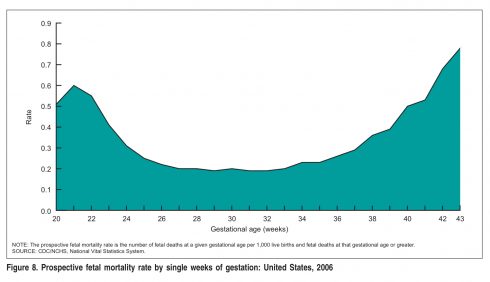
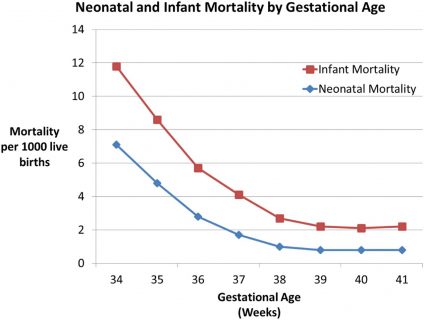
These two charts demonstrates why.

This is a chart of stillbirth rates by gestational age.

1C6C2938-3581-4861-8A7F-E4FA81DC1465

You can see that stillbirth rates begins to rise from about 36 weeks of pregnancy onward and rise steeply after 41 weeks.

Why don’t we deliver every baby at 36 weeks? Because it makes no sense to deliver a baby early to prevent stillbirth if that increases the chance that the baby will die in the days and weeks after birth.

This chart shows neonatal and infant mortality by gestational age:

0FC46B51-B668-4207-AB76-0D371D9DBA64

Mortality reaches the lowest rates at 39 weeks. If we want to minimize both the risk of stillbirth and the risk of neonatal death, the optimal time for delivery is 39 weeks.

There is as yet no consensus on whether routine induction should be offered at 39 weeks, 40 weeks or 41 weeks. But there is complete consensus that all women should be induced by 42 weeks. The stillbirth rate jumps precipitously from 0.5/1000 at 41 weeks to 0.75/1000 at 43 weeks. The stillbirth rate at 39 weeks, in contrast, is 0.3/1000.

…[T]he Swedish post-term induction study (Swepis) set out to survey 10,000 women at 14 hospitals.

Women in their 40th week of pregnancy were invited to join the study and divided randomly into two groups, with labour induced at the beginning of either week 42 or week 43, unless it occurred spontaneously.

Given what we know, what should researchers have expected to happen?

If 10,000 women reached 42 weeks, we would expect 5 stillbirths and if they reached 43 weeks we would expect 7-8 stillbirths.

That was an unacceptable, unethical risk. But the Swedish researchers managed to exceed the worst expectations:

When abruptly halted in October 2018, the study had involved only a quarter of the target number of expectant mothers. But the six deaths were already judged to indicate a significantly increased risk for women induced at the start of week 43. No infants died in the group whose pregnancies were ended a week earlier.

The researchers represent their findings as a new discovery:

The immediate consequences of the study “may be a change of the clinical guidelines to recommend induction of labour no later than at 41+0 gestational weeks”, its author concludes.

Sahlgrenska hospital announced on Thursday that it would change its pregnancy management policies based on the results of Swepis trial.

“We have awaited the scientific analysis showing that it is really true that there is a greater risk of waiting two weeks beyond term,” the head of childbirth operations at the hospital told Swedish television.

But there was NEVER any question that it was true. So why did the researchers, most of whom appear to be midwives, embark on this fundamentally unethical study? Because they can’t handle the truth that interventions often produce better outcomes than “unhindered” natural childbirth.

Contemporary midwifery is at a crossroads.

The foundation of contemporary midwifery is:

1. The belief that childbirth interventions inevitably lead to more interventions, often culminating in a C-section and therefore a bad ‘experience.’

2. The quest for a better childbirth experience is justified by the fact that “scientific evidence shows” that it is also a safer experience.

Hence the crossroads. One direction would confirm the claim that midwifery is about adherence to scientific evidence; the other would represent a rejection of scientific evidence in favor of doctrine. Sadly, it looks like midwives are searching desperately for any fig leaf that would cover a naked rejection of high quality science in favor of doctrine.

To cater to their own prejudices, they embarked upon a study that — predictably — killed babies. They should be held to account for letting babies die because of their irresponsible, unethical denial of established obstetrical care.

Anti-vax — like the Salem Witch Trials — is a form of mass hysteria

0DF4F675-B95A-41BD-AEFD-3BB20A206284

Vaccination is one the greatest public health advances of all time.

It has saved, and continues to save, literally millions of lives each year, yet many well meaning parents have become convinced that vaccines are harmful and there is no amount of scientific evidence that can convince them otherwise.

As Rachel Burke reports in The Olympian, We’re hard-wired not to change our minds:

[perfectpullquote align=”right” cite=”” link=”” color=”” class=”” size=””]Vaccine injuries are the demonic possession of our time.[/perfectpullquote]

The clearest example may be [the] work around the popularly held belief that the measles-mumps-rubella (MMR) vaccine is linked to autism, a claim made by a single, long-discredited study. Nyhan, Riefler, and their research partners surveyed over 2,000 parents; most received one of the following: (1) materials from the Centers for Disease Control (CDC) correcting the falsehood; (2) a pamphlet describing the dangers of measles, mumps, and rubella; (3) pictures of children who have these illnesses; or (4) a mother’s firsthand story about how her baby almost died from measles. A control group received no materials.

The results: None of these approaches made parents who were opposed to vaccines more likely to vaccinate their kids… (my emphasis)

Why are anti-vax parents evidence resistant?

Nyhan and Riefler speculate that “we’re even more inclined to hold on to a false belief if it threatens our sense of self.”

There’s no doubt that ego is a large part of anti-vax belief. As I’ve written before, anti-vaccine parents view themselves as smarter than others. They see their combination of self-education and defiance of authority as an empowering form of rugged individualism. Anti-vax supposedly marks out their superiority from those pathetic “sheeple” who aren’t self-educated and who follow authority. Psychologically, they cannot tolerate the reality that they are both ignorant and gullible.

But fear of vaccines is hardly new. It’s been around for 200 years, nearly as long as vaccines themselves. And Anti-vax advocates have a perfect record! They’ve never been right even once!!

Why, in the face of the scientific evidence of vaccines’ safety and efficacy and the historical evidence that anti-vaxxers have never been right about anything, do they cling so desperately to their beliefs?

It could be a form of mass hysteria.

According to Wikipedia:

… [M]ass hysteria … is a phenomenon that transmits collective delusions of threats, whether real or imaginary, through a population in society as a result of rumors and fear…

A common type of mass hysteria occurs when a group of people believe they are suffering from a similar disease or ailment, sometimes referred to as mass psychogenic illness or epidemic hysteria.

Fear of vaccines is a collective delusion transmitted through a population as a result of rumor and fear. Yet there’s no doubt that those in the grip of anti-vax hysteria  are completely convinced that children, including their children, have been harmed by vaccines.

But there was no doubt in the minds of the citizens of 1690’s Salem, Massachusetts that members of their communities were being harmed by demonic possession. Just like contemporary anti-vax parents who fervently believe in vaccine injuries, not merely in theory, but in practice in their own children, Salem resident believed passionately in demonic possession, not merely in theory, but in practice in their own neighbors.

Adolescent girls … began to have fits that were described by a minister as “beyond the power of Epileptic Fits or natural disease to effect.” The events resulted in the Salem witch trials, a series of hearings and executions of 25 citizens of Salem and nearby towns accused of witchcraft. The episode is one of America’s most notorious cases of mass hysteria, and has been used in political rhetoric and popular literature as a vivid cautionary tale about the dangers of isolationism, religious extremism, false accusations and lapses in due process.

There’s no such thing as demonic possession and there never was, so why were Salem residents so sure they were witnessing it?

  1. Someone had a “fit.” That really happened.
  2. It was interpreted in light of religious beliefs and irrational fears.
  3. Other people also had “fits.” They and those around them were not making it up; they were certain it had happened.
  4. The population was gripped by the collective delusion of a threat and transmitted that fear through rumor, aided and abetted by those who stood to benefit from convincing others that demonic possession was real.

Sound familiar? It should. It bears a striking resemblance to anti-vaccine advocacy.

  1. Someone had a bad reaction after vaccination. That really happened.
  2. It was interpreted in light of scientific ignorance and irrational fears about vaccines.
  3. Other people also had “bad reactions.” They and those around them were not making it up; they are certain it happened.
  4. The population was gripped by the collective delusion of a threat and transmitted that fear through rumor, aided and abetted by those who stand to benefit from convincing others that vaccines injuries are real.

The key point, which cannot be overemphasized, is that many anti-vaxxers honestly believe that they have witnessed the evidence with their own eyes and they’re not lying. They’re like the Salem residents who also believed they had witnessed the demonic possession with their own eyes and they weren’t lying, either.

That’s why anti-vaxxers are evidence resistant. It’s not merely that they can’t understand the evidence because they lack scientific knowledge; it’s not merely that view themselves as “educated,” “empowered” and transgressive. It’s that they are in the grip of mass hysteria.

Vaccine injuries are the demonic possession of our time. They are a collective delusion, fueled by fear and rumor, and fanned by those who stand to benefit from the fear.

Just trust breasts!

White bra details

Hi. It’s Ima Frawde, CPM. The initials after my name stand for “certified professional mammarist.” I am an expert in normal breasts.

I don’t know about you, but I am sick and tired of the hegemonic, patriarchal, male medical system constantly telling women that their breasts are “broken” and don’t make enough breastmilk. They try to undermine breastfeeding by destroying women’s trust in their own breasts.

[perfectpullquote align=”right” bordertop=”false” cite=”” link=”” color=”” class=”” size=””]First trust breasts to make adequate milk and they will. Then trust them not to get cancer and they won’t.[/perfectpullquote]

Are we suppose to believe we’re inferior to squirrels, cows, rabbits and elephants? There are about 5000 species of mammals and we’re supposed to believe that we’re the only one that ever needs to supplement our young to ensure their survival. How did survive for thousands of years before formula? If insufficient breastmilk were really that dangerous, our species wouldn’t be here.

It’s not different from the hegemonic, patriarchal male medical system that insists that women of a certain age should have regular mammograms to detect breast cancer. Out of those 5000 species of mammals, we’re the only one that supposedly need routine scans. How did we managed to survive for thousands of years before mammography? If breast cancer were really that dangerous, our species wouldn’t be here.

It’s not a coincidence that my comments sound similar to those made by Ina May Gaskin on Feministing. Ina May is my hero. Everything she says goes double for me (heh, heh, heh, just a little breast humor).

Why should you listen to me? As a CPM (certified professional mammarist), I am an expert in normal breasts. In fact, certified professional mammarists are trained specifically to manage breast health. In order to obtain my certification, I had to meet rigorous standards; I was required to submit a portfolio of 20 breasts examined within the home (right and left breasts are each counted separately). Plus I had to observe examination of an additional 20 breasts done by my preceptor. That means I had contact with 20 separate women before I began practicing on my own!

That’s how I know that you should trust your breasts throughout your life. First trust them to make adequate breastmilk and they will. Then trust them not to get cancer and they won’t.

Insufficient breastmilk doesn’t exist. It’s fear that makes women “misperceive” adequate supply as insufficient. Baby screaming from hunger, losing weight and failing to thrive? It’s not insufficient breastmilk. It must be a defective baby tongue; cut it immediately. Trust breasts, but never trust baby tongues!

What? You don’t believe that lack of trust causes “perceived” insufficient milk supply? You mean you deny that there is a mind-body connection?

Once you understand that fear causes “perceived” insufficient supply, you can see why trusting breasts is the best way to ensure adequate breastmilk. Routinely weighing babies in unnecessary when you trust breasts. Weighing babies might reveal that the baby is losing weight and that lead to a cascade of unnecessary interventions like formula supplementation, not to mention undermining women’s faith in their own bodies.

But you shouldn’t think that certified professional mammarists reject technology. Far from it. We routinely recommend electronic and battery powered breast pumps. We routinely recommend off label use of dangerous medications to boost milk supply. And don’t forget our frequent recommendation to laser your baby’s tongue.

Are we always correct? Unfortunately, no, but some babies are just meant to die. They probably would have died eventually even if they were supplemented with formula anyway (it might have been 10 or 20 years later, but the principle holds true).

We’re also working on developing better methods for boosting milk supply. We are creating a new generation of breast pumps. Even as we speak, several groups of women are currently fabricating pumps to our own specifications, using no plastic of any kind; they are knitting them from steel wool! As soon as our breast pumps are fully knitted, we plan large qualitative studies comparing the experience of pumping with a knitted pump vs. a conventional machine.

You might be wondering why we are bothering with breast pumps at all. In answer, I will paraphrase anthropologist and midwife Melissa Cheyney:

The rituals of trusting breasts are not simply about assuring personal transformation via the transmission of counter hegemonic–empowering value —although many women certainly described their experiences this way. Breastfeeding rituals, are also self-consciously political in their intent. As the popular bumper sticker “Mammarists: Changing the World One Breast at a Time” suggests, trusting breasts is a performative medium for the promotion of social change.

That’s just a longer way of saying “trust breasts!”

Babies bleed into brains: the result of refusing newborn vitamin K

F0E96AC5-C586-4DD2-9F7D-43405C6CD7E3

Bitter grief is often an unselfish motivator:

Consider organizations like Mothers Against Drunk Driving, started by parents who suffered the ultimate loss, to ensure that other parents would not have to endure the death of a child. Consider the various laws named after children who were abducted and murdered, championed by parents who wanted to make sure that no other family’s life would be shattered by crushing grief…

Where is the organization to ensure that no other mother has to endure the preventable death of a child at homebirth or because the mother refused recommended obstetric or newborn care guidelines?

[perfectpullquote align=”right” bordertop=”false” cite=”” link=”” color=”” class=”” size=””]The risk is not merely double or triple, but 81x higher for babies who don’t receive the vitamin K injection.[/perfectpullquote]

There is no such organization.

Why? Because the mothers who have a child who was injured or died as a result of homebirth or of refusal of routine interventions often collude with the providers who encouraged them.

Thankfully, that is not the case for Stefani Leavitt. She has unselfishly shared the story of the terrifying result of failing to give the recommended Vitamin K injection to her newborn daughter.

You can read the entire story across three blog posts:

The First 24 Hours
Getting Out of the Woods
Why It Happened: The Truth About Vitamin K Deficiency Bleeding

Leavitt has the inner strength to be brutally honest, even with herself:

This may be the hardest part of Olive’s story that I will write. The part where I admit that what happened to her was nearly 100% preventable. And yet it happened.

It happened because she didn’t receive her dose of Vitamin K when she was born.

I spent the first few days that she was in the hospital blaming myself. I ran through the situation in my mind, trying to understand why I would say “No” to something that would keep my daughter from being in this much pain. In Olive’s situation, unfortunately, it was largely accidental. That didn’t stop me from feeling guilty, however, and only recently did I accept that although this happened to Olive, it doesn’t have to happen to another person’s baby.

What happened to Olive?

It all started on Valentine’s Day.

Olive had struggled to eat the night before, so she and I had been up all night…

When we woke up [from a nap], Olive could barely open her eyes – the only word I could think of was “lethargic,” and since that never coincides with anything good, I immediately called the doctor… The doctor told us to go to the ER immediately …

At the hospital:

By this point, Olive was breathing and her heart was beating, but she was otherwise non-responsive…

The pediatric intensivist, Dr. M., came and asked me if we had given our daughter a Vitamin K shot at birth, and I just stared at him and said I had no idea. He said they needed to bring her in for a CT scan, but every time they tried to place an IV (which she needed before she went for the scan), the vein would blow. She was bleeding from every spot that she had gotten poked that night, including the LP point on her spine.

Finally they were able to perform the head CT.

The next thing I knew I was sitting in a room with Eric and our Bishop from church, and seeing the doctor wheel in a computer with pictures on the screen… Just by looking, you could tell it wasn’t good. Where the left side of her brain was supposed to be, there was a huge (16 mm, to be exact) mass of blood, pushing her entire brain off center.

Dr. M. explain that a clot had developed which was placing immense pressure on Olive’s brain. Not only that, but there was bleeding on the back of the right side of her brain as well. The water pockets that are within the brain were completely destroyed, and the tissue on the left side of the brain looked mostly damaged. He said that the lack of Vitamin K in Olive’s system resulted in her body’s inability to clot. Anything as small as putting her down in her bed could have caused this bleed. Since she couldn’t clot, the bleeding didn’t stop. There had been one other case of this that the doctor had seen – I asked what had happened then, and was told that the baby hadn’t lived.

The treatment? Correcting her clotting deficiency with Vitamin K and brain surgery to remove the blood clot.

After the brain surgery:

I walked into the hospital room to find Olive hooked up to a plethora of machines, with even more wires running from her. She had a gauze turban around her swollen head, and a breathing tube running from her throat. As hard as it was to see her like that, I was full of so much gratitude that she was alive and I was comforted by the sudden knowledge I had that she was going to be okay – I just didn’t know how.

The surgery had been successful:

Where there was once a huge mass of blood, her brain had moved back into place. The neurologist who spoke with us, Dr. R., explained that there had been a significant stroke on the left side of her brain, but it was on the surface, rather than in the central gray matter. On the right side, there was a pocket of blood in the cerebellum, but this was expected to absorb into the brain. Overall, Dr. R. said that he felt “cautiously optimistic.” ..

The next days were marked by milestones, which all seemed like little miracles.

Towards the end of the third day, Olive was taken off of sedation and opened her eyes for the first time in days.

From the blog C'est Si Bon
From the blog C’est Si Bon

Olive continued to improve.

From the blog C'est Si Bon.
From the blog C’est Si Bon.

Overall, Olive’s progress has been remarkable.

Olive is nothing short of a miracle. After seeing her condition the first night and seeing her now, only two weeks later, I am still in a state of disbelief. Countless doctors and nurses told me what amazing progress she was making. She took to nursing again like a champ. She is moving both sides of her body, with very little difference in strength. And since her surgery, we have all been able to see her beautiful smile.

There will still be struggles from here, I’m sure. We are uncertain of what Olive’s future will bring, or what challenges this brain injury will cause. But despite all of that, I am so grateful for the blessing that she has been to our life thus far …

But none of this had to happen at all. Stefani writes:

… [T]he Vitamin K shot should not be optional.

When a baby is born, they have a limited amount of Vitamin K in their system, and while some begin to produce it on their own, others struggle with a severe Vitamin K deficiency. If these babies receive a shot of Vitamin K at birth, this isn’t a problem and they will eventually begin to produce the Vitamin K on their own in order to avoid any deficiency bleeding. In a case like Olive’s, however, the severe lack of Vitamin K results in an inability to clot, which can cause deadly bleeds in a baby’s brain and gastrointestinal system.

In children that receive the Vitamin K shot at birth, the chance of developing this disease is relatively nonexistent. When the shot is not given, however, the risk of having late stage (from 2 weeks to 2 months old) deficiency bleeding is 81 times greater.

The sad thing is that while it is extremely rare, recent years have seen children suffering from VKBD more and more often. Four cases were reported at a hospital in Tennessee in 2013 – one resulted in severe gastrointestinal bleeding and the other three in severe intracranial bleeding. In the hospital where Olive was treated, there was one other recent, which resulted in the child’s death.

Stefani speaks from experience:

I can’t change what happened to Olive, but I can try to prevent it from happening to another baby.

Please share Olive’s story. Please tell the mothers you know about the importance of Vitamin K. Please let them know that the risks of rejecting the shot may not be as rare as they think.

Kudos to Stefani for turning her family’s pain into vital advice for other families. She will never know how many lives she may have saved.

Dr. Amy