Birth warriors or just beneficiaries of white privilege?

60487050 - privilege, 3d rendering, blue street sign

There’s a story currently making the Internet rounds that purports to be a tale of heroic anti-vaxxing birth warrior parents who are being harassed by child protection authorities for their unconventional choices.

Hermine Hayes-Klein, of Human Rights in Childbirth, was appalled at the way a young couple, Rachel and Dustin, was treated. Rachel had an unanticipated breech birth in a hospital; refused all testing and refused vaccines. The hospital called child protection authorities who determined that the baby should be put in foster care until a court hearing. Hayes-Klein was so appalled that she represented Rachel and Dustin pro bono in a court hearing on parental competence.

[pullquote align=”right” cite=”” link=”” color=”” class=”” size=””]Is a hospital is being vilified for daring to hold white parents to the same standards they would have held parents of color?[/pullquote]

…[M]y phone started blowing up about a young man’s social media post that his wife had just given birth at a Portland hospital, and after refusing vaccines and arguing with hospital staff, their newborn was being taken by DHS (Oregon’s department for child protective services)…

Ms. Hayes-Klein chose to portray Rachel and Dustin as persecuted because of their birth choices, but I can’t help wondering if this has nothing to do with birth and everything to do with white privilege. Situations like these arise with families of color each and every day but the folks from Human Rights in Childbirth aren’t rushing to represent them.

Why might DHS have been called?

1. The family was homeless, living in a van and wandering the country.

… They drove to Costa Rica, but didn’t find their home there. They sold the car and flew to Sacramento, where they began a journey by hippie van, greyhound bus etc. up through places in Northern California and Oregon. Rachel saw midwives along the route, was having a healthy pregnancy, and hoped to give birth in her new home with a midwife when the baby came. It was due on September 22 based on her LMP. By early September, they were in Oregon and their housing situation had not resolved itself. Rachel flew back to Florida where she could stay with her mother when she gave birth. But then she decided that she really wanted to be with Dustin when this baby came.

On September 19, Rachel flew from Florida to Portland, from which she intended to travel south to where Dustin was working and living on a farm in Southern Oregon. She went into labor on the plane. By the time they landed at PDX, the flight attendants were aware that she was in labor and had an ambulance waiting at the airport. They took her to the hospital…

2. They had no visible means of support.

3. The mother had no prenatal records of any kind and could not prove she had received care.

4. The father had an arrest record, which Hayes-Klein dismisses out of hand.

This couple are dreadlocked vegans in their 20s, who used to have a shop in Florida where they sold hemp clothing and products among other things, we all know this kind of semi-psychedelic shop. Hemp is associated with cannabis, which is still illegal in Florida, and the police came into this shop many times and harassed them. They had confrontations with police several times and even arrests for “disorderly conduct.”

5. The parents refused drug testing.

In contrast, Hayes-Klein implies (though does not state) that DHS got involved because of the parents’ alternative choices. When the baby was found to be breech, she had breech vaginal birth.

… The doctor rubbed the ultrasound wand over her belly, and said, “The baby’s breech! Prep her for c-section.” Rachel was asking what that meant, and the doctor was answering “You’re going to be numb from your chest down.” Rachel asked, “Have any of you ever delivered a breech baby naturally?” They all indicated, no. Before they could wheel her to surgery, the baby’s body came out of her vagina. She was pinned back by her arms and her legs pulled up and back. The doctor put her hands on the baby and started “delivering” it. There was a loud snap. The baby’s arm was broken at a right angle. Her apgars was 4 and 8…

And:

Later that morning, the pediatrician came in and wanted to give the baby vaccines and do blood work on “mom.” Rachel said she would prefer to wait till the next day to discuss any more injections on the baby or herself… The doctor said that they were leaving him with no choice but to call DHS.

Then:

A little later, Dustin and Rachel were cuddling with the baby. The door opened, and a social worker entered with 4 fully-armed police in bullet-proof vests. Rachel remembers a nurse with them saying, “Why didn’t you get an ultrasound?” Dustin angrily objected that this was an intrusion and a violation of their rights. They told him to go get his ID from the hippie bus, and then he was blocked from re-entering the hospital. The baby was taken to a different floor from Rachel, and she would only be allowed to see it for feedings…

Hayes-Klein rode to the rescue:

There in the quiet hospital hallway were two fully-armed policemen in bullet-proof vests. I looked in the door beside them, and there was this weeping young mother, hunching her bare shoulders toward the door and holding her precious baby to her breasts. The baby had just fallen asleep nursing in her arms. I started crying immediately; maybe it’s unprofessional, but what can I say; this is who I am. I walked in and said, “I’m on your side.”

Who was on the baby’s side? Hayes-Klein doesn’t say.

The next day I went with them to the DHS meeting to form a safety plan …

On Monday we went to the hearing. Suffice to say that the judge did not want to discuss the merits of the DHS action itself, but tabled those until a trial of the case on October 28. She agreed that the baby could be returned to Rachel under a safety plan that included following all doctors’ orders.

Hayes-Klein presents a touching photo of the reunion. I’ve blurred the faces; the impact of the picture for me is how white and blonde everyone is.

image

… The reunion that followed was healing balm to the wounds on my heart from seeing their separation on Thursday. Little baby was asleep and looked sort of closed in. Her parents fell on her, weeping and cooing. Her mama untied her from the car seat, and baby started to cry. Rachel lifted her up to her heart and she stopped crying. I helped them into an enclave with benches where they could cuddle together as a family. Baby snuggled to mama’s breast and started to relax. Then she opened her eyes. And as her father wept and said, “Daddy’s here baby; I’ll protect you; everything’s all right,” she started to smile.

I don’t doubt for a moment that these parents love their baby, but that was not the issue. DHS requested a safety plan because they were concerned for the baby’s SAFETY, fearing that the parents did not have the knowledge or the means to properly care for her.

Hayes-Klein recognizes that the hospital professionals were trying to do what they thought was right (and, although she doesn’t mention it, what they were almost certainly legally REQUIRED to do), but:

The problem is the power imbalance, and the destructive momentum of child-protective cases if their merit is not scrutinized closely at their outset. Judges rely on hospital workers as the front line that see many cases of genuine neglect and abuse that need state intervention. Cases like these raise the need for judges to be aware of how triggers and power can work together to lead to child-neglect complaints that are really about doctor-patient conflict. One place to start is by making clear for everybody that the parents had the right to informed consent and refusal on all the interventions they are charged with medical neglect refusing…

Yet Hayes-Klein fails to present any evidence that breech birth and refusal of vaccines had anything to do with calling DHS.

Hayes-Klein tells a story of heroic lawyer representing heroic parents who became a target of a punitive DHS investigation in retaliation for unconventional birth choices.

I can’t help wondering if we are looking at a situation where a hospital is being vilified simply for daring to hold white parents to the same standards they would have held parents of color.
When your baby has a homebirth complication, I don’t win but you lose

54953528 - you lose: yellow road sign with a blue sky and white clouds

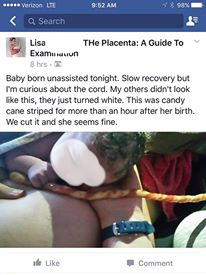
Several weeks ago someone forwarded a picture posted in an unassisted birth group.

The mother noted that the baby’s umbilical cord was unusual; it looked like a candy cane or barber pole.

[pullquote align=”right” cite=”” link=”” color=”” class=”” size=””]The mother could have killed her baby, but her chief concern is her image.[/pullquote]

image

As the mother recognized, this is abnormal; it’s often associated with a serious infection of the placenta, the baby or both.

I publicly urged the mother to take the baby to the hospital. A newborn can have a serious infection without showing any signs of illness. The baby could collapse and die before the mother ever realizes that the baby is ill.

Not surprisingly, the mother ignored me. If you don’t give enough of a damn to have a medical professional present at birth, you don’t give enough of a damn to investigate even serious problems. Unassisted birth is medical neglect; bringing in a baby with a complication after unassisted birth will raise all sorts of red flags with medical professionals and child protection authorities.

Not surprisingly, the baby did have an infection. Ultimately a pathology report showed acute chorionitis and acute funisitis as well as meconium staining. In other words the membranes were infected and the baby was mounting an inflammatory response.

Fortunately, it was mild enough that the baby was able to fight it off, though there was no way the mother could know that at the time.

Does she feel bad that she risked her daughter’s life? Of course not. She feels bad that I might think that I “won.”

image

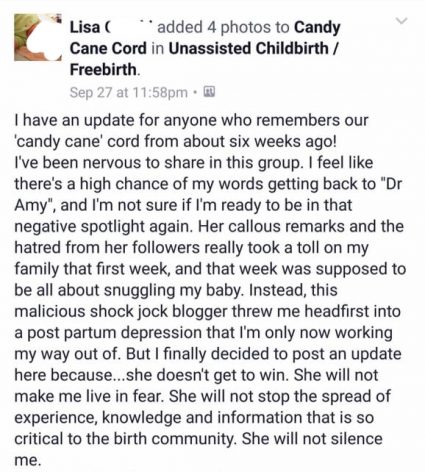
… I fell like there’s a high chance of my words getting back to “Dr Amy” and I’m not sure if I’m ready to be in that negative spotlight again. Her callous remarks and the hatred from her followers really took a toll on my family that first week … But I finally decided to post an update here because … she doesn’t get to win. She will not make me live in fear. She will not stop the spread of experience, knowledge and information that is so critical to the birth community. She will not silence me.

I, I, my, my, me, me. It just reinforces my contention that unassisted birth groups are cesspits of stupidity, ignorance, and, above all, narcissism.

There is nothing natural about unassisted birth. It is an affectation of privileged, primarily white women who confuse defiance of authority with intelligence.

The mother could have killed her baby, but her chief concern is image. Therefore, let me explain something:

When your baby has a homebirth complication, I don’t win … but your baby loses. My self image is not on the line when YOU do something irresponsible and narcissistic. Don’t flatter yourself by imagining that I care what you think about me.

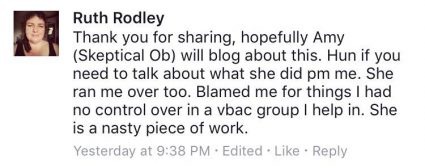
Unassisted birth advocate Ruth Rodley “dead babies are hickups [sic]” had this to say:

image

Thank you for sharing, hopefully Amy (Skeptical OB) will blog about this… She ran over me too. Blamed me for things I had no control over in a VBAC group I help in. She is a nasty piece of work.

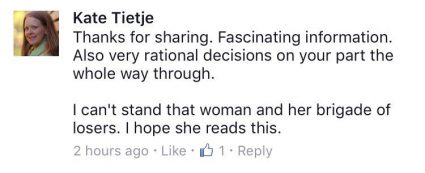
`And the inimitable Modern Alternative Mama Kate Tietje weighed in:

image

I can’t stand that woman and her brigade of losers.

Says the woman desperately trying to monetize her ignorance.

I comment about homebirth complications and deaths because I want to PREVENT them. I get no joy from the thought than an innocent baby faces injury, brain damage or death because her clown of a mother wants to impress her equally ignorant friends.

I don’t need validation of my education, training and experience. If I needed that I would look to my professional colleagues whose own education, training and experience I hold in esteem, not to women who are breathtakingly arrogant in their ignorance.

When you risk your baby’s brain function and life in choosing homebirth, unassisted or otherwise, please don’t imagine that I “win” when your baby is harmed. But make no mistake … YOU lose.

More passive-aggressive crap from lactivists

54515666 - who cares concept

Galina Nemirovsky, in Who Cares How She Feeds Her Baby?, is so not judging you.

See?

I don’t care how you breastfeed your baby or don’t breastfeed your baby, yet our whole country has been engaged in a dialog about if it’s OK to see photographs of women fulfilling biology’s mission.

Galina is so not judging you. It’s entirely up to you whether you want to fulfill biology’s mission for women.

[pullquote align=”right” cite=”” link=”” color=”” class=”” size=””]Who cares if you’re a lazy slob who feeds her baby formula?[/pullquote]

The fact that we entertain a choice as to how we feed our babies is by the grace of modern science and it’s not natural – but it is sufficient and it keeps children alive, just like dialysis is not natural but keeps people with kidney failure alive.

Bottle feeding is fine! Of course, it’s not natural, but that doesn’t mean Galina is judging you for giving your precious baby second best.

What I find most absurd is the dichotomy of how people have an uproar of judgments about how parents feed babies, yet by the time the children have reached three and the mothers are feeding their children processed chicken fingers at McDonald’s, no one is pointing fingers or sharing Instagram posts.

Just because you’re a lazy slob who feeds her child Chicken McNuggets (processed food — oh, the horror) doesn’t mean Galina is judging you for being a lazy slob who feeds her baby processed infant formula.

Why might other women criticize your decision to bottle feed?

It’s a psychologically established fact that our criticism of others comes from our insecurities.

Really, Galina?

I’m not saying we all shut up and nod along; I suggest asking two extra questions before you attack, “How does it really affect you?” and “Is it really your business?”

Galina, when it comes to other women’s infant feeding decisions I’m happy to to tell YOU to shut up and nod along.

How does another woman’s decision to bottle feed her baby affect you? It doesn’t, so why are you blithering passive-aggressive viciousness about it?

Is it really your business how another woman feeds her infant, Galina? No, it isn’t … but, as you helpfully remind us, your criticism of other women comes from your own insecurities.

Oh, and thanks for the helpful lesson on how to be thoroughly unsupportive while pretending that you’re providing support.

How betrayal aversion makes anti-vaxxers more afraid of vaccine complications than of disease

51924249 - betrayed word on keyboard button

How do people analyze risks to determine the best course of action?

Imagine that you were given a choice of two different rental apartments, and you were planning to make your decision based on which offered the most protection from death in a fire. The first apartment had an older smoke alarm and a 2% risk of fire related death; the second apartment had a newer smoke alarm with a 1.01% chance of fire related death. All other factors being equal, those who are fire averse will choose the apartment with the newer technology and the lower risk of death, right? Not necessarily and the reason is a widespread but seldom noted phenomenon, betrayal aversion.

The apartment example is taken from a paper by Gershoff and Koehler, Safety First? The Role of Emotion in Safety Product Betrayal Aversion. The authors note that some risks are apparently more frightening than others.

Consumers often face decisions about whether to purchase products that are intended to protect them from possible harm. However, safety products rarely provide perfect protection and sometimes “betray” consumers by causing the very harm they are intended to prevent. Examples include vaccines that may cause disease and air bags that may explode with such force that they cause death. … [T]his study examines the role of emotions in consumers’ tendency to choose safety options that provide less overall protection in order to eliminate a very small probability of harm due to safety product betrayal…

Gershoff and Koehler’s asked study participants which apartment they preferred, having explained that smoke alarms differ in risk of death, but also in the risk of malfunction:

Some participants were told that in the event of a nighttime fire due to the usual causes, occupants in the apartment equipped with Alarm One had a 2% chance of dying while occupants in the apartment equipped with Alarm Two had only a 1% chance of dying. However, they were also told that the wiring of Alarm Two was such that it sometimes causes electrical fires that increase the risk of dying in a nighttime fire by an additional 0.01%. In other words, Alarm One was associated with a 2% risk of death and Alarm Two was associated with a 1% + 0.01% (betrayal) risk of death.

Most participants of the study chose the apartment with Alarm One even though it had double the increased risk of fire death. That’s because most participants the tiny risk of “betrayal” (product malfunction) much more frightening that the much larger risk of actually dying.

Why did the risk of product betrayal loom so large in the minds of study participants?

It is not surprising that consumers consider the risk of betrayal when choosing among safety devices. The mere possibility of betrayal threatens the social order that enables us to trust the safety infrastructure of our society, causing intense visceral reactions and negative emotions toward the betrayer. Unfortunately, these strong negative emotions toward a potential betrayer may also lead people to take unwise risks…

It is this visceral reaction that causes people to make irrational decisions about vaccinating their children. When parents balance the much larger risk of a child dying from a vaccine preventable disease against the tiny chance of a child being injured by the vaccine, they regard the possibility of product betrayal with out-sized horror. And because they are horrified by the tiny risk, they paradoxically choose the much larger risk. Ironically, they actually think that they are “protecting” their children by embracing the much higher risk of death from disease.

That’s because reaction to risk depends on emotion as well as rational analysis:

Research on how people evaluate risky options points to the importance of … the emotional system. Studies show that people commonly make judgments and decisions under uncertainty based on nonprobabilistic rules, visceral urges … and gut feelings. [The] risk-as feelings hypothesis … argues that feelings such as worry, dread, and fear drive decisions in ways that cannot be reconciled with an analytical assessment of the underlying risks…

Gershoff and Koehler note that betrayal aversion has important implications for public health policy:

… Various government agencies are charged with protecting public safety and general welfare. These agencies frequently issue safety standards on such important matters as seat belt usage in cars, helmet usage on bicycles, and vaccinations for public school children. Policy makers, who generally prefer alternatives that maximize overall safety, need to be sensitive to the possibility that members of the public will find some of those alternatives emotionally repugnant. Indeed, large portions of the public may act in ways that put them at increased risk…

Interestingly, the authors do not suggest that people should be encouraged to dismiss betrayal aversion:

… If the negative consequences of safety product betrayals reach beyond the immediate harm .., then one cannot say that consumers’ safety product preferences should rely on probability of death comparisons alone. A rational person may justly believe that eliminating the collateral damage that betrayals may cause, including the emotional toll and damage to the social order, is worth trading for a small increased risk of death.

That may be true, but many people do not realize that their judgment is shaped by betrayal aversion. If, after careful consideration of the actual risks, some people elect to accept the higher risk of harm from vaccine preventable illness over the much smaller risk of harm from vaccines, they have every right to do so. But in order to carefully consider the risks, people need to realize that their emotional reaction to product betrayal may be clouding their assessment of the magnitude of the risks.


This piece first appeared in March 2011.

The rise in US maternal mortality: the cause will surprise you

Mother Headstone

Recently, two important papers were published that shed a great deal of light on a previously murky topic, the US maternal mortality rate.

Up to this point the observed increase in maternal mortality has been difficult to parse because the new US death certificate, redesigned to capture more instances of maternal death, was only gradually adopted by the states. Is the observed incidence real or simply the result of better record keeping? A superb analysis by MacDorman et al. makes it clear that the increase is real,  albeit only a fraction of the apparent rise.

[pullquote align=”right” cite=”” link=”” color=”” class=”” size=””]The women most in need of highly technological medical care are failing to get it.[/pullquote]

But, as another study makes clear, the rise in US maternal mortality is NOT the result of poor medical practice or overuse of medical technology. Maternal mortality is closely tied to race and socio-economic status. Often the women most in need of highly technological medical care are failing to get it.

The MacDorman study is entitled Is the United States Maternal Mortality Rate Increasing? Disentangling trends from measurement issues.

Studies based on data from the 1980s and 1990s identified significant underreporting of maternal deaths… To improve ascertainment, a pregnancy question was added to the 2003 revision of the U.S. standard death certificate…

However, there were delays in states’ adoption of the revised death certificate … This created a situation where, in any given data year, some states were using the U.S. standard question, others were using questions incompatible with the U.S. standard, and still others had no pregnancy question on their death certificates.

Due in part to the difficulties in disentangling these effects, the United States has not published an official maternal mortality rate since 2007…

Now that the standard has been adopted in all states, the authors were able to correct the data to take into account previous underreporting during the years before an individual state adopted the revised death certificate standard.

What did they find?

Most of the observed increase in US maternal mortality can be ascribed to changes in the death certificate, but not all.

…[C]ombined data for 48 states and DC showed an increase in the estimated maternal mortality rate from 18.8 in 2000 to 23.8 in 2014 – a 26.6% increase.

The authors conclude:

Clearly at a time when WHO reports that 157 of 183 countries studied had decreases in maternal mortality between 2000 and 2013 (21), the U.S. maternal mortality rate is moving in the wrong direction. Among 31 Organization for Economic Cooperation and Development (OECD) countries reporting maternal mortality data, the U.S. would rank 30th, ahead of only Mexico.

Curiously the authors did not address perhaps the most pressing question about US rank. They’ve just shown that prior to the changes in the death certificate, the US failed to capture a substantial portion of maternal deaths. We were ranked higher internationally then because we weren’t providing accurate statistics. Yet the authors assume that maternal mortality rates in all other countries are accurate. Is that assumption justified? Have we fallen in international rankings simply because our maternal mortality statistic are more accurate than other countries? I’m not familiar enough with the individual maternal mortality assessments in other countries to answer that question, but perhaps they are.

The increase, however, is real and that is deeply troubling. What’s going on?

To answer that question, Amirhossein et al. compared maternal mortality rates by state in a just published study, Health Care Disparity and State-Specific Pregnancy-Related Mortality in the United States, 2005–2014.

They found tremendous variation in mortality rates between states.

…There was a significant correlation between state mortality ranking and the percentage of non-Hispanic black women in the delivery population. Cesarean deliveries, unintended births, unmarried status, percentage of non-Hispanic black deliveries, and four or less prenatal visits were significantly (P<.05) associated with increased maternal mortality ratio.

As the authors explain:

Although the United States has a higher rural population than many European nations, such factors are present to an even greater degree in Canada, which is even more rural, yet has a maternal mortality ratio of 10 per 100,000 live births.Furthermore, our data failed to identify a statistical correlation between statewide maternal mortality and either rural status or poverty.

Immigration has also been cited as a factor in this trend. However we found lower mortality for Hispanic women who make up the majority of recent immigrants…

The high U.S. cesarean delivery rate has also been invoked as an explanation for increased mortality, yet our data demonstrate only a weak correlation of mortality with cesarean delivery. Furthermore, previous work has demonstrated that this correlation does not reflect causation—the overwhelming majority of maternal deaths associated with cesarean delivery is a consequence of the indication for the cesarean delivery, not the operation itself.

Although medical factors such as hypertensive disease, diabetes, tobacco use, and obesity have been shown to be correlated with increased maternal morbidity, statewide population differences in rates of these conditions were not significantly correlated with mortality ratios.

Not surprisingly, the authors conclude:

First, states that may pride themselves on the intrinsic quality, leadership, organization, and funding of obstetric health care in their state based on national maternal mortality ratio rankings must realize that in many instances, such favorable rank simply reflects a different proportion of non-Hispanic black patients in the population rather than intrinsically superior medical care

Second, health care statistics that do not adjust for these important demographic factors are of little significance in judging the intrinsic quality of available health care in an individual state. Most importantly, these data strongly suggest that racial disparities in health care availability, access, or utilization by underserved populations are important issues faced by states in seeking to decrease maternal mortality. Ethnic genetic differences may also be involved. In addition, the potential role of unconscious (implicit) bias in this significant racial disparity must be considered. (my emphasis)

A startling example:

We note that although Washington, DC, has the highest maternal mortality ratio in the nation, non-Hispanic white patients in this district have the lowest mortality ratio in the United States. Excellent care is apparently available but is not reaching all the people.

These findings have important implications for international rankings that don’t adjust for demographic factors. The US has the highest proportion of non-Hispanic black women of any industrialized country. Our relatively poor ranking on maternal mortality may have little to do with the quality of US obstetric care and depend largely on access to it.

The rise in US maternal mortality may be much smaller than it originally appeared, but it is rising nonetheless and that calls for a vigorous response. We need to ensure that the women most likely to die from pregnancy related causes have access to the care that prevents maternal deaths.

Another benefit of vaccines: reducing antibiotic resistance

image

Anti-vax advocacy is unethical. Most of us are familiar with the reason: Withholding vaccines from your children doesn’t merely deprive them of protection and put them at risk for life threatening diseases. It deprives other people’s children of protection from those same diseases.

Vaccines work by making it impossible for pathogens to jump from person to person. Even the best vaccines are not 100% effective, and we can’t vaccinate 100% of the population. For example, babies can’t be vaccinated for specific diseases until they can mount the appropriate antibody response. Immuno-compromised people may not be able to mount an immune response at all.

[pullquote align=”right” cite=”” link=”” color=”” class=”” size=””]Vaccines prevent the rise of superbugs.[/pullquote]

If vaccines needed to be 100% effective to work, they wouldn’t work in the real world.

Instead, vaccines work by dramatically reducing the chance that an infected person will encounter an unprotected person. When parents withhold vaccines from their their children, herd immunity is disrupted and deadly diseases can spread. So when you refuse to vaccinate your own children, you aren’t just hurting them; you’re hurting many other.

Some of you are probably thinking “Big Deal! It’s my responsibility to protect my children from vaccine side effects and I have no responsibility to anyone else.” But you hurt everyone in another way that affects your children as well:

Vaccines prevent antibiotic resistance and the rise of superbugs.

Epidemiology Professor Marc Lipsitch explains in How Can Vaccines Contribute to Solving the Antimicrobial Resistance Problem?:

…Vaccines can reduce the prevalence of resistance by reducing the need for antimicrobial use and can reduce its impact by reducing the total number of cases… These effects may be amplified by herd immunity, extending protection to unvaccinated persons in the population. Because much selection for resistance is due to selection on bystander members of the normal flora, vaccination can reduce pressure for resistance even in pathogens not included in the vaccine…

Most anti-vax parents assume that if their unvaccinated child becomes ill with a vaccine preventable disease, they can take that child to the doctor’s office or hospital for antibiotics to cure the disease. Unfortunately, every time antibiotics are used, the risk of resistant superbugs grows. As Prof. Lipsitch points out, the microbes that become superbugs aren’t necessarily even the microbes that are causing the disease; they may be otherwise harmless bacteria in the normal microbiome.

For example:

Existing vaccines already help to reduce the burden of antimicrobial resistance. Notably, resistance is not a significant clinical problem for either of the transmissible bacterial infections against which we have routinely vaccinated for decades—diphtheria and pertussis, most likely because they are rarely seen and thus rarely treated…

But as parents continue to withhold vaccines from their children, the rate of rare diseases will inevitably rise and antibiotic resistance will rise along with it. And as Dr. Lipsitch notes, the new superbugs will not necessarily be those that cause diphtheria and pertussis; they might be staph bacteria that are normally present on the skin. Those staph bacteria commonly cause minor skin infections in cuts and scrapes but can quickly become lethal if they are resistant to antibiotics.

Lipsitch concludes:

Vaccines and antibiotics are widely hailed as the two greatest accomplishments of modern medicine. In fact, vaccines are the medical intervention that has saved the most lives globally. As evolution begins to erode the value of antibiotics, a multipronged approach to preserving and restoring this value is needed. Vaccines have an important role to play in doing so.

Both vaccines and antibiotics have saved millions of lives, but by overusing antibiotics we are destroying their usefulness and putting everyone at risk. Vaccines can reduce antibiotic resistance by preventing the need for antibiotics in the first place.

When parents withhold vaccines from their children under the assumption that they can be treated with antibiotics if they get sick, they don’t just hurt their children; they hurt everyone including themselves.

Fed is best? Intolerable!

image

How dare The Leaky Boob advocate tolerance!

Jessica Martin-Weber of The Leaky Boob wrote an ode to tolerance of infant feeding choices Why I’ll stick to saying “Fed IS Best”. In it, she chides lactivists for their intolerance of tolerance, lactivists who say things like “…[I]t is scientifically proven that breast is better. This is not a shaming statement, it is factual.”

[pullquote align=”right” cite=”” link=”” color=”” class=”” size=””]For lactivists, the question is not what is best, but who is best.[/pullquote]

came across an image boldly making this statement recently and I’ve seen others like it and in the infant feeding support group I run on Facebook I was accused of not really supporting breastfeeding because we don’t permit formula bashing or shaming and discourage the use of the phrase “breast is best” (a marketing tool developed by formula manufacturers, no less).

Reading that phrase above it strikes me that it sounds a lot like when kids are trying to one-up each other with “well, blank is better!” …

“Fed is best” is a big thing here in this space… “Fed is best” isn’t a perfect phrase but then there is no such thing as a perfect phrase. Words are limited, expressions are clumsy, one-liners are inept. But as far as words and phrases go, this one leaves room… for the personal story. The narrative, the humanity, the journey.

It leaves room for tolerance. For lactivists that is intolerable.

Witness the comments on TLB Facebook page:

of course babies need to be fed, however promoting fed is best undermines breastfeeding. fed is not best, fed is the minimum…

Or:

Saying fed is best really undermines breastfeeding. Saying fed is best makes people feel that the other option is starvation. People shouldn’t be having babies if they can’t feed their children…

Or:

This is (the now classic) “cover off every angle so you don’t upset anyone” social media post when we all just need to be real and understand what we put into our bodies matters and especially from birth… [W]hy is it that we can’t focus on the wonders of breastmilk??????? It’s also free!!! Let’s not undermine breastfeeding!

And my favorite:

Oh whatever. Sell out.

It’s instructive watching Sanctimommies strenuously defending their sanctimony.

Why do they find tolerance intolerable? For a very simple reason: ego. For lactivists, the question is not what is best, but who is best. If “fed is best,” they’re not best.”

I’ve quoted sociologist Stephanie Knaak (Contextualising risk, constructing choice: Breastfeeding and good mothering in risk society) on this topic in the past:

…[T]his discourse is not a benign communique about the relative benefits of breastfeeding, but an ideologically infused, moral discourse about what it means to be a ‘good mother’ in an advanced capitalist society.

When lactivists say “breast is best,” they mean “I am best.”

…[T]his association of breastfeeding with ‘good mothering’ and formula feeding with ‘not so good mothering’ has been argued to be a key characteristic of today’s dominant infant feeding discourse. In large part, this can be attributed to the fact that pro-breastfeeding discourse is organised and mediated by: (a) a moralising public health ideology; and (b) the ‘ideology of intensive mothering’, today’s dominant parenting ideology.

Militant lactivism shares some ugly traits with racism. Racism is fundamentally about boosting one’s self-esteem by declaring the inferiority of another group. Racists use all sorts of empirical claims about the supposed deficiencies of non-white people (they’re criminals; they’re terrorists; they’re stealing our jobs) but those are just dog whistles to other racists. Lactivists make all sorts of empirical claims about the supposed deficiencies of formula, but those are based on weak or non-existent science, and primarily serve as dog whistles for other lactivists.

Both militant lactivists and racists feel themselves under siege even when they’re not. They always portray themselves as long suffering victims who will suffer further if anyone dares acknowledge the humanity of those who are different.

Militant lactivism is also ableist.

According to Stop Ableism.org:

Ableism – a set of practices and beliefs that assign inferior value (worth) to people who have developmental, emotional, physical or psychiatric disabilities…

An ableist society is said to be one that treats non-disabled individuals as the standard of ‘normal living’…

Militant lactivism is a set of practices and beliefs that assigns inferior value to women who do not use their breasts to feed their babies. Despite the stark scientific reality of lactational insufficiency affecting up to 15% of women or more, lactivists aggressively insist that it is so rare as to be unworthy of consideration. And as we can see from the comments above, it treats breastfeeding as the standard of “normal living.”

Which leads to an important question: how could another woman’s choice to breastfeed hurt the children of lactivists? It’s not like vaccination where individual decisions can harm the entire community.

It couldn’t. But it hurts the egos of lactivists and that’s more important.

I pull back the curtain and show the often ugly reality of homebirth

Close up of hand in white glove open the curtain. Place for text

In the world of homebirth, I am known as “Satan,” or “she who must not be named,” or worse.

Why? Because I pull back the curtain on the often ugly reality of homebirth.

Promoting homebirth (or natural childbirth, breastfeeding or attachment parenting) depends on commodifying a romanticized ideal. The clearest expression is the hiring of a birth photographer, a previously undreamed of manifestation of privilege.

[pullquote align=”right” cite=”” link=”” color=”” class=”” size=””]I rip away the gauzy trappings and expose the ugly reality: an injured, dying or dead baby.[/pullquote]

It isn’t enough to remember the event; it isn’t enough to have a partner or friend take pictures. A professional is required:

…[Her] role is critical … because she is fluent in the alternative symbolic orientations to and understandings of natural birth … [She] also provides her association and emotional support either by sharing beliefs about the experience or by affirming the woman’s right to assign her own unique beliefs to birthing. This seemingly simple service of association and presence is a critical social need in the context of extraordinary experiences and rites of passage that depend a shared cultural consensus for their significance.

The above quote comes from Great Expectations: Emotion as Central to the Experiential Consumption of Birth by Markella Rutherford and Selina Gallo-Cruz. They are referring to midwives, but the point also applies to doulas and birth photographers. It’s all about creating a carefully curated view of birth (or breastfeeding, etc.)

One of the reasons I inspire such a visceral reaction from homebirth advocates it that I pull back the curtain on such carefully curated set-pieces and expose the ugly reality behind them. And I never lack for opportunities.

It’s not simply that there are so many homebirth deaths and disasters that I can pick and choose. It’s that even mothers who have let their babies be profoundly injured or even die in the quest for the idealized birth experience try to make sense of that experience by romanticizing it (“born sleeping”) and boasting about it.

I pull back the curtain on that fantasy and expose the ugly reality:

  • A baby has been profoundly injured or died
  • The mother is romanticizing a catastrophic injury or death
  • The mother is still boasting about HER achievement
  • The incident is a cautionary tale for anyone else contemplating homebirth

Not surprisingly, that results in considerable backlash. Women have created manicured tableaux to absolve themselves of responsibility and I tear that away. They post tasteful, artistic, carefully curated photographs to convey their understanding with the symbolic orientations of the natural birth community and I rip away the gauzy trappings and expose the ugly reality: an injured, dying or dead baby and a mother who bears responsibility for that outcome.

Consider the most recent case where, fortunately, no one was injured. A birth photographer posted a dramatic photo of a baby falling into the midwife’s hands — literally. The baby fell a distance of several feet, the umbilicus experienced tremendous traction and the cord tore open, artfully spraying the field with the baby’s blood.

I reposted the picture on my Facebook page with a question. How do the same people who insist that delayed cord clamping is critical to ensuring the baby get it’s “full blood supply” suddenly find it completely acceptable to spray the baby’s blood everywhere?

Here’s typical response:

image

Gabrielle Hyde (I have no idea of her connection to the photo) writes:

Why post things you don’t understand. Were you there? You do know what happened? It was made aware it was perfect birth. Obviously you have no idea what professionalism is. And I will through my professionalism out there and call you a cunt. Please do not shame mothers, midwives or any other woman who knows how to make big girl decisions. You, in your old age, need to grow the fuck up.

And when I ignored it, she followed with this:

No response? It’s okay to tear people down and break someone’s soul? Yeah, okay. It’s time for you to retire. Birth is the most amazing experience a woman can go through and you tore it down like wallpaper. Get off the internet, because you have no couth.

Gabrielle wanted a response, so here it is.

The wording is remarkably revealing.

The birth was “perfect” even though the clown of a midwife let the baby dangle by its umbilical cord, tearing it open and spraying the baby’s blood everywhere. How can it still be “perfect” even though the baby was harmed? Because the baby is simply a prop in the mother’s piece of performance art.

The choice of words — “tear people down,” “break someone’s soul” — illuminates how homebirth is about building the mother’s self esteem; what happens to the baby is irrelevant.

Thank you Gabrielle for illustrating the ugly reality behind the carefully curated images of homebirth. I pulled back the curtain and you helpfully provided the commentary:

A perfect birth is one that soothes the mother’s soul, baby be damned.

Japan has high rates of co-sleeping AND high rates of teen suicide. Coincidence?

The child who plays by a PC

An opinion piece in the LA Times promoting co-sleeping between infants and mothers is generating a lot of discussion in the mommy blogosphere.

Entitled It’s OK to sleep next to your infant child. In fact, it’s beneficial was written by Robert and Sarah LeVine, scholars in education and human development. It’s meant to counter the empirical scientific evidence that co-sleeping increases the risk of sudden infant death syndrome (SIDS). The LeVines don’t dispute the scientific evidence; they offer what they consider conflicting evidence.

[pullquote align=”right” cite=”” link=”” color=”” class=”” size=””]Asian babies have the lowest risk of SIDS; that’s why Japan’s low rate of SIDS tells us nothing about co-sleeping.[/pullquote]

Specifically:

…In Japan — a large, rich, modern country — parents universally sleep with their infants, yet their infant mortality rate is one of the lowest in the world — 2.8 deaths per 1,000 live births versus 6.2 in the United States — and their rate of sudden infant death syndrome, or SIDS, is roughly half the U.S. rate.

The claim is injudicious at best and deeply disingenuous at worst.

First, the risks of co-sleeping are known to be increased with soft bedding, and parents who are impaired by alcohol or drugs. It’s entirely possible that decreased death rate of co-sleeping in Japan is the result of different bedding or lower incidence of alcohol or drug use among Japanese parents.

Even more important, SIDS has a different incidence among different ethnic groups.

image

CDC data from the US show that Asian babies have the lowest rate of SIDS in the US, approximately 1/3 the rate of African-American babies and nearly 1/2 the rate of non-Hispanic white babies. Considering that Asian babies have the lowest risk of SIDS; the fact that Japan, which is almost exclusively Asian, has a very low rate of SIDS is only to be expected. Therefore, the low SIDS rate in Japan tells us NOTHING about the risks of co-sleeping.

Why do the LeVines believe it is important to promote co-sleeping — so important that it’s worth misleading mothers with claims about Japan? They think that co-sleeping promotes children’s emotional health:

Christine Gross-Loh writes in her 2013 book, “Parenting Without Borders”: “After years of living [in Japan] on and off, my husband and I (and even our kids) have noticed that most children — the same children who sleep with their par­ents every night — take care of themselves and their belongings, work out peer conflicts, and show mature social behavior and self-regulation at a young age. Japanese parents expect their kids to be independent by taking care of themselves and be­ing socially responsible. They expect them to help contribute to the household or school community by being capable and self-reliant.”

Their conclusion?

…[T]he proven benefits of mother-infant co-sleeping far outweigh the largely imaginary risks. Putting a baby in a separate room at night encumbers parents and leads to their exhaustion without guaranteeing the safety or future char­acter development of their children.

Really? Japan has an extraordinarily high rate of teen suicide, among the highest in the industrialized world. It’s hard to imagine a more chilling indicator of poor child emotional health than that.

So Japan has high rates of co-sleeping and high rates of teen suicide. Coincidence?

Almost certainly. And that illustrates how drawing conclusions from correlations can be terribly misleading.

Co-sleeping increases the risk of sudden infant death; there’s no question about it and therefore mothers need to know. The increase is not dramatic and some mothers may decide that it is worth the risk for them.

It doesn’t matter what ancient peoples supposedly did in pre-history or what the Japanese do today. To imply otherwise is terribly misleading and chillingly irresponsible.

Anti-vax mud wrestling

Danger Sinking Mud (left of frame)

Some people clearly enjoy mud wrestling with anti-vaxxers. I’m not sure why since it only encourages them and since they don’t have enough basic science knowledge to understand what people are telling them. If you feel you must engage with prolific anti-vax commentors, please do so here. I’m closing several other comment threads because they are about to crash the site.

Dr. Amy