Category Archives: Uncategorized

Dr. Amy’s 6 steps to a joyful birth

iStock_000002119649XSmall

It seems like every natural childbirth blog or book has a list of “Steps to a Joyful Birth.” I find this surprising since I never considered that there was anything necessary for a joyful birth besides a desired baby.

But since everyone else is doing it, and since I’ve witnessed thousands of joyful births, as well as had four exceedingly joyous births of my own children, I thought I’d offer my set of steps.

1. Don’t read the NCB literature

One of the most striking things about women who are disappointed in the birth of a healthy, wanted baby is their disappointment is usually connected to the fact that their birth did not meet the arbitrary “standards” set by natural childbirth advocates.

I’ve read a lot of the natural childbirth literature and I can tell you that most of it is guilt-inducing lies. In the first place, NCB has no basis in either science or reality; its fundamental claims are nothing more than stuff that advocates made up to valorize their own personal choices. Moreover, NCB was fabricated by Grantly Dick-Read, a white, male eugenicist whose goal was to trick women of the “better” classes into having more children by telling them that the pain of labor was all in their heads.

Reading the NCB literature to find out what your birth ought to be like is the equivalent of reading Vogue Magazine to determine what your body ought to look like. It’s almost guaranteed to end in disappointment.

2. Don’t make a birth plan

Birth plans are worse than useless. They’re useless because they are as effective as making a “weather plan” and for the exact same reason. You have no control over how your labor will progress (or not progress) and you certainly have no control over how well your baby will tolerate that labor.

As I’ve noted in the past, birth plans engender hostility from the staff, are usually filled with outdated and irrelevant preferences, and create unrealistic expectations among expectant mothers. But the worst thing about birth plans is they don’t work. They don’t accomplish their purported purpose, make no difference in birth outcomes, and, ironically, predispose women to be less happy with the birth than women who didn’t have birth plans.

3. Don’t make any plans about pain medication until you feel the pain

Sounds obvious, right? You wouldn’t make demands about how much pain medication you will or will not take after your root canal; you’d wait until you experienced the pain and then tailor the amount of pain medication, if any, to whether you felt you needed it. Why on earth would you decide to refuse pain medication for labor until you’ve felt the pain? I know why; because once you feel the pain you’ll want the medication and the only way that NCB advocates can get you to mirror their choices is to convince you to refuse pain medication before you have any idea what the pain will be like.

Making an important decision like this, before you have accurate information is a set up for disappointment.

4. Don’t hire anyone, midwife, doula or childbirth educator, who values process over outcome

They will try to convince you that there is one BEST way to give birth and that you should feel disappointed if you don’t meet their arbitrary goal. Who needs that?

5. Don’t expect to be immediately smitten by overwhelming love for your baby

Let’s see. You’ve just spent the past 40 hours suffering an agony that you never even dreamt was possible. You haven’t slept. You haven’t eaten. You’ve thrown up repeatedly. Your nether regions (or your abdomen) feel like they are on fire. You are so tired you can barely lift your head off the pillow. And now you’re supposed to feel overwhelming love for someone you’ve never met before? It might happen, but don’t count on it.

It doesn’t matter whether you feel overwhelming love for your baby immediately after birth. That’s just another one of those NCB fantasies. You might feel that way, or it might take days or weeks to develop. That’s okay. It doesn’t need to happen immediately for you to form an ironclad bond with your baby.

6. Don’t take a good outcome for granted

This is by far and away the most important step. Any baby, especially a healthy baby, is a miracle. When you are counseled to assume that there will be no complications, and your baby will be healthy (“trust birth”) your joy, wonder and gratitude are inevitably diminished.

Homebirth, lactivism and hypocrisy

Hypocrite

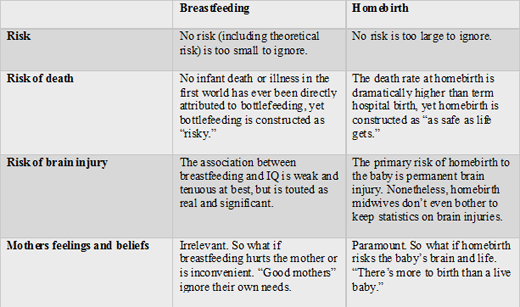
Homebirth advocates are hypocrites. They tout two diametrically opposed views of risk in an effort to justify their personal preferences.

Homebirth advocates are invariably lactivists. Lactivism is based on the belief, central to attachment parenting, that mothering is about doing whatever it takes to reduce risks to babies to the lowest possible level and doing whatever it takes to promote brain development (real or imagined). Homebirth is about ignoring risks to babies, either by pretending those risks do not exist, or by insisting that there is more to birth than whether a baby is healthy.

Consider:

Homebirth lactivism hypocrisy

There is not a single infant death in the first world that has ever been attributed to infant formula properly prepared (by both factory and parent), yet homebirth advocates insist that formula is “risky,” should be locked up in hospitals, and, if lactivists had their way, should be available by prescription only. There are dozens of preventable homebirth deaths each year, yet homebirth is constructed as “safe as houses” or “as safe as life gets.”

We live in a society obsessed with “intelligence.” According to homebirth advocates, mothers should breastfeed in order to obtain every last IQ point possible. What about the risk of brain damage at homebirth? It’s never even mentioned. Homebirth midwives don’t bother to keep any statistics on brain injuries that occur at homebirth.

Indeed the entire approach to risk is inverted 180 degrees when comparing breastfeeding and homebirth. In regard to breastfeeding there is literally no “risk” of bottlefeeding too small to be taken into account. Yet when it comes to homebirth, there appears to be no risk too large to be ignored. Breech? VBAC? Twins? Triplets? More risk leads to more kudos.

When it comes to breastfeeding, homebirth advocates consider mothers’ feelings to be irrelevant. There is simply no amount of maternal pain, difficulty or inconvenience that can justify bottle feeding in their minds. Yet the same people see no problem with a mother risking her baby’s death at homebirth because she’s afraid of the hospital, or doesn’t want the discomfort of a heplock.

If it could be shown that a baby died specifically because of bottlefeeding, homebirth advocates would be up in arms. When a baby dies at homebirth, advocates tell each other that the baby was “meant” to die. Formula manufacturers are evil; homebirth midwives who preside over preventable perinatal deaths, even multiple perinatal deaths, are “persecuted.”

There is one area that homebirth advocacy and lactivism share in common, though. Both are the personal preferences of privileged white women who have elevated their preferences to an ideal that should be emulated by everyone else.

That’s not surprising. Homebirth and lactivism aren’t about babies; they’re both about mothers and their own self image. Babies are just props in the display of their own imagined superiority.

Why do lactivists value ideological purity above the wellbeing of babies?

way

My latest piece on Time.com, The Breastfeeding Police Are Wrong About Formula, addresses new research that shows that early supplementation with formula actually improves rates of extended breastfeeding. Contrary to the dire predictions of lactivists, giving hungry babies formula until their mothers’ milk comes in does not sabotage breastfeeding.

It’s not surprising when you consider anthropological research that shows that early supplementation is common in a wide variety of cultures from the Indian subcontinent, to Southeast Asia to Africa. Mothers around the world, who fully intend to breastfeed for years, and do breastfeed for years, see nothing wrong with giving a baby supplements in the first few days after birth. So why have lactivists insisted that supplements sabotage breastfeeding and advocate letting babies scream for hours in hunger until a woman’s milk comes in?

It’s very simple; they value ideological purity over the wellbeing of babies.

Consider the Baby-Friendly Hospital Initiative, bizarrely named since it is not friendly to babies or to mothers. It is being implemented in hospitals around the country despite the fact that there is no evidence that it works and quite a bit of evidence that it does not. Indeed a paper published in the April 2013 issue of the journal Pediatrics found the opposite. According to the authors of Baby-Friendly Hospital Accreditation, In-Hospital Care Practices, and Breastfeeding:

…After adjustment for significant maternal, infant, clinical, and hospital variables, women who birthed in BFHI-accredited hospitals had significantly lower odds of breastfeeding at 1 month (adjusted odds ratio 0.72, 95% confidence interval 0.58–0.90) than those who birthed in non–BFHI-accredited hospitals. BFHI accreditation did not affect the odds of breastfeeding at 4 months or exclusive breastfeeding at 1 or 4 months…

When you consider the 10 steps of the Baby-Friendly Hospital Initiative, it’s hardly surprising that they don’t increase breastfeeding rates. Instead of addressing the problems that mothers identify — pain, difficulty, low milk supply, inconvenience — the 10 steps identify the problem that lactivists insist, without evidence, is responsible for low breastfeeding rates — cultural pressure.

Having misidentified the problem as a lack of ideological commitment, lactivists have misidentified the solution as greater enforcement of ideological purity.

Why is there such a massive disconnect between what works to improve breastfeeding rates and what lactivists recommend? Because lactivists aren’t really interested in the wellbeing of babies. They’re invested in boosting their own self-esteem by having their personal choices mirrored back to them … and punishing those who refuse to copy them by making them feel like bad mothers.

CDC statistics show that rates of combo-feeding (breastfeeding plus supplementation) exceeds rates of exclusive breastfeeding by 30 percentage points, demonstrating that large numbers of women are already successfully combining breastfeeding and supplementation. Anthropological studies show that women from many different cultures do the same. It’s time to re-orient our breastfeeding recommendations toward what actually works for babies and mothers, and away from the ideological purity demanded by lactivists.

It’s time for breastfeeding without guilt.

Homebirth kills mothers, too

iStock_000009061164XSmall

Not one, but two maternal deaths at homebirth have occurred in the past several months.

Yesterday, Mother’s Day, from Baby Center:

My husbands cousin passed away today while giving birth. She was 24, beautiful, had just graduated with her masters in engineering, and was getting married. She was due may 15th. She went into labor today. She had a home birth and midwife. She bled to death on the way to the hospital that was 8 minutes away. Her daughter is alive…

But wait! That’s not all.

A St. Louis area doula reports on the death last fall of both mother AND baby. The piece originally appeared in the Fall 2012 issue of the Missouri Friends of Midwives newsletter. Although the doula does not specifically mention that this was a homebirth transfer, she does say that it caused her to question her own decision to have a homebirth (which, having learned nothing, she ultimately did anyway).

Addendum 5-16-13: The doula added the following to her post, “this was a PLANNED HOSPITAL BIRTH. It was not a homebirth or a homebirth transfer. This mother was attended by an obstetrician, not a midwife. This update isn’t meant to invite further dialogue …” Surprising, considering that the doula is an aspiring homebirth midwife, treasurer of her local chapter of Missouri Friends of Midwives, and wrote about it in the Missouri Friends of Midwives. I apologize for the error.

Why do mothers die at homebirth? Because homebirth midwives and doulas replace knowledge of childbirth with “faith” in birth:

… I have been “brought up” in the midwifery and homebirth community. As a result, my heart and mind have been continually washed with faith in the birthing woman’s abilities and the newborn babe’s resilience. Trust birth. Birth works. I’ve heard it all many times over. I believed it like a religion…

Why do mothers die at homebirth? Because homebirth midwives don’t understand that low risk does not mean no risk.

I recently attended a birth as a doula in which the mother died. And making things even more horrific, the baby died as well. They had both been perfectly healthy the entire pregnancy and labor…until they weren’t…

Why do mothers die at homebirth? Because the hospital is never “close enough.”

… When my client and her baby died, I was in the room. I was tapping her arm and feeling for her pulse and calling out her name…and then I looked in her eyes and knew she was no longer inside looking back at me. I was a foot away when the doctor caught her baby girl, as purple as an eggplant in the face and white everywhere else. I was clutching the father’s arm when he was told the impossible news some 45 minutes later that neither mother nor baby could be saved.

Why do mothers die at homebirth? Because homebirth midwives obsesses about the process and take the outcome for granted:

I have not been able to talk to this beautiful mother – who I came to care about deeply –about the amazing job she did in labor and birth, and I will never be able to have that conversation with her…

Did the doula learned anything from this hideous tragedy? Of course not.

… Got mad at God. Felt helpless. Questioned whether or not I still wanted to have a homebirth. Wondered about everything over and over again – if my client had been sufficiently informed of the risks vs. benefits of various interventions, if the presumed cause of death was accurate, if I was a horrible doula/if I would be a horrible midwife, if I could regain trust in my baby and my body, and if that would be enough …

What is the matter with homebirth midwives are homebirth advocates. A mother and baby are dead. They are DEAD!! You can’t get a better, more brutal confirmation of the fact that trusting birth is NEVER enough, yet these fools prattle on about regaining her trust in a process that has just been shown to be entirely untrustworthy.

The doula titled the post, When Birth and Death Meet. A more appropriate titled might be When Ignorant Homebirth Midwives Meet Birth, Mothers and Babies Die. Trust that, not birth.

Lawsuit update #6: Let’s take a look at the documents

image

Techdirt’s article on my lawsuit mentions a key issue:

…. [Gina’s brief] then says that the move away from the second host, DaringHost, was because the site was getting too much traffic, and the owner of DaringHost, supplied a deposition stating that he had explained this to Tuteur.

Gina seems to go to great lengths to make this point. The only problem is, it’s not true. This is the email that Nick Esposito, the owner of Daringhost, sent to me on 1-25-13:

Amy,

I spoke with the lawyer I’ve used with my businesses earlier today about the situation with your website and it being targeted. He informed me that hosting your website is a liability on a few different levels which is a risk to my business. While I support your cause and understand the situation you are in, I will no longer be able to host your website due to the risk and liability it poses to my business.

I do not want to leave you and your website out in the cold because I can understand that fighting against the people who are targeting you is not an easy task. I have done some research for you and found a couple of different businesses that should be able to host your website better in terms of dealing with it being targeted.

The first host I’ve found is called Alibabahost.com. On their website they state “AlibabaHost provides freedom of content and speech. Regarding the DMCA complains, we forward them to you and you decide how to proceed next.” …

The second host I’ve found is called safeandsoundhost.com. They have servers located in the Ukraine which has been known to host freedom of speech web sites before…

The third host I found is called urpad.net. They offer VPS plans in Iceland. Iceland has recently passed a law that allows for freedom of information, speech, and expression…

I sincerely apologize that I have to turn you away. I value your business however I’d like to keep the risk and liability as low as possible for myself and the business. I hope you understand where I’m coming from.

__
Regards,
Nick Esposito
Daring Host Owner

The email makes it absolutely clear that I was forced to leave Daringhost because of Esposito’s concerns of legal liability related to the DMCA notices.

****

Yesterday I posted a screenshot of Gina exulting that Bluehost (my original host) had taken down my website for copyright violation. That wasn’t just wishful thinking on her part. That’s what actually happened.

Here’s the email I received from Bluehost on 12-21-13 at the same time as the shutdown:

Your web hosting account for skepticalob.com has been deactivated, as of 12/21/2012. (reason: terms of service violation – copyright violation)

This deactivation was due to a Terms of Service violation associated with your account. At sign-up, all users state that they have read through, understand, and agree to our terms. These terms are legal and binding.

Although your web site has been suspended, your data may still be available for up to 15 days from the date of deactivation; if you do not contact us during that 15 day period, your account and all of its files, databases, and emails may be deleted…

Thank you,
Bluehost Terms of Service Compliance

This email makes it clear that I my website was taken down specifically because of the original DMCA notice filed by Gina.

****

The Motion Picture Association of America has also entered the case (https://dl.dropboxusercontent.com/u/27713670/MPAA%20brief.pdf). They have offered support of Gina’s interpretation of the DMCA. This is not a surprise, merely additional confirmation that the issues raised by my lawsuit are of weighty public importance.

In my view it helps everyone understand what is at stake here. Gina’s position is supported by an organization whose members send a lot of DMCA notices and who would find it harder to do so if they had to determine whether copyright had ACTUALLY been violated before they sent the notices.

My position is being supported by two organizations that champion the right of free expression on the internet.

I’m good with that.


Addendum 5-14-13: I’ve filed a motion with a brief attached, responding to Gina’s claims, presenting the actual correspondence with my webhosts.

“Defendant Crosley-Corcoran’s Response to Plaintiff’s Memorandum of Law To ShowCause purports to feature a compelling story about how Dr.Tuteur’s webhosts (Bluehost.com and DaringHost) never actually removed or disabled anyaccess to materials on her website (The Skeptical OB) – and “certainly” did not do so “inresponse to Crosley-Corcoran’s DMCA takedown notices . . . .”
Needless to say, all of these allegations – falling, as they do, outside the pleadings – are out of bounds at the motion to dismiss stage, and Defendant knows it. But worse still, like many of the most compelling stories, Defendant’s tale is simply a work of fiction.”

You can read the rest here:

https://dl.dropboxusercontent.com/u/27713670/Tuteur-20130514_Reply_iso_show_cause_brief_%26_request_for_leave_to_file_-_as_filed.pdf

Lawsuit update #5: Really?

iStock_000009143046XSmall

Yesterday Gina’s lawyer filed a brief in response to my Memorandum to show cause. You can read the full brief below. In it Gina asserts that my original host, Bluehost, never took down my blog:

Tuteur’s failure to allege that BlueHost took down her site is not inadvertent. As Tuteur is well aware, once she sent BlueHost her counter-notice, BlueHost told both parties that it would take no action. See Exhibit 1 (“The copyright claim regarding this domain has a counter claim issued. If a counter claim is submitted, it will be up to the two parties to pursue legal action.”)

…Because neither BlueHost nor Daring Host removed or disabled access to any materials on the Plaintiff’s site at all (and certainly not in response to Crosley-Corcoran’s DMCA takedown notices), Count I of her Complaint must be dismissed as a matter of law.

Really? Really??!!

What about this?

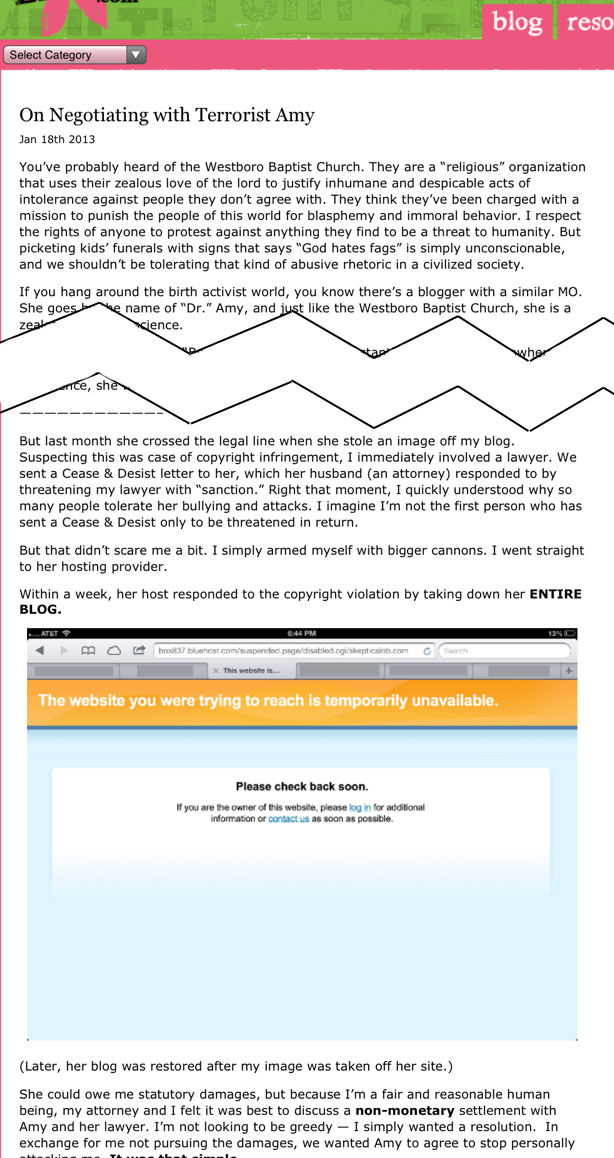
Feminist Breeder 1-18-13

Let me quote in case it isn’t clear enough to read:

… I simply armed myself with bigger cannons. I went straight to her hosting provider.

Within a week, her host responded to the copyright violation by taking down her ENTIRE BLOG.

(Later, her blog was restored after my image was taken off her site.)

So not only did Bluehost take my site down for copyright violation, Gina BOASTED that it took my site down for copyright violation.

Oops!

Stay tuned for more developments.

Gina’s brief:

https://dl.dropboxusercontent.com/u/27713670/CC_Brief_re_Order_to_Show_Cause.pdf

Australian homebirth death shows it’s time to reform midwifery

Time For Change

Joseph Thurgood didn’t have to die.

Tate-Spencer Koch didn’t have to die.

Jahli Jean Hobbs didn’t have to die.

Charlotte Rodman didn’t have to die.

All four died preventable deaths at homebirth.

Joshua Titcombe didn’t have to die.

Nittaya Hendrickson and her unborn son Chester didn’t have to die.

Sareena Ali and her daughter Zainab didn’t have to die.

All 5 died preventable deaths in the hospital.

These 9 deaths, and dozens of similar deaths that I have written about over the years are distinguished by one common factor: all involved arrogant midwives; midwives who thought that they knew more about childbirth safety than doctors; midwives who were utterly, tragically, negligently wrong.

Let Joseph Thurgood’s death be a clarion call for an all out effort to reform midwifery. First world midwives, regardless of educational background, regardless of international location, regardless of the location at which care is provided, are desperately in need of better education about childbirth, greater understanding of their own limitations, and above all, administrators and thought leaders who understand that midwifery is about saving babies and mothers and not about extending the employment opportunities of midwives.

What happened to Joseph Thurgood? According to The Age:

A coroner has found a baby’s death after a home birth went wrong could have been prevented if the labour and delivery had been carried out in a hospital…

[The Coroner] said midwife Fiona Hallinan had indirectly contributed to the baby’s death by failing to tell the mother of the risks of home birth which had “sustained the misguided views of the mother, contributed to her disregarding the advice provided by obstetric medical clinicians and facilitated in her a level of confidence that she may safely proceed to home birth”.

The Coroner correctly identified that Joseph’s mother naively and erroneously thought that she was educated about homebirth because she had done “research” on the internet:

…Ms Thurgood’s use of the internet to research home birth was “sadly an example of the danger of untrained users utilising raw data or statistical information to support a premise as to risk, without knowledge and understanding of the complex myriad of factors relevant to the risk”.

“To disregard the obstetrician’s advice on the basis of a mantra founded in … data obtained from the internet is a dangerous course to follow,” the coroner said.

The coroner recommended the Health Minister consider regulating the practice of providing home birth services and develop a source of information to help prospective parents be fully informed of the issues associated with various birthing options.

That’s good as far as it goes; homebirth advocates pride themselves on what they know, but most of what they know is factually false.

But that only protects women who choose to deliver at home. How about women who choose to deliver at the hospital and then lose their babies or their lives because midwives deny them access to obstetricians and pediatricians? It doesn’t do anything for them. These same midwives are desperately in need of comprehensive education reform.

Unfortunately, obstetricians in first world countries have left midwives to their own devices, reasoning that they ought to be able to handle uncomplicated childbirth and call for help when complications occur. I suspect that most obstetricians have no idea that contemporary midwifery has been highjacked by a bunch of post modernists who appear to think that midwifery autonomy is ever so much more important than whether babies and mothers live or die.

I’m not talking about the clowns of the Midwives Alliance of North America (MANA) who aren’t really midwives at all, just lay people with a pretend “credential” that they awarded to themselves. I’m talking about supposedly adequately trained midwives who spew nonsense, like:

Australian midwifery professors Jenny Parratt and Kathleen Fahy, responsible for the criminally inane “paper,” Including the nonrational is sensible midwifery.

British midwifery professor Soo Downe who invokes quantum mechanics, which she does not understand, to explain why midwives can ignore scientific evidence.

Cathy Warwick, head of the Royal College of Midwives, who thinks the solution to every problem, including the problem of preventable deaths at the hands of midwives, is to give midwives more autonomy.

Hannah Dahlen, spokesperson for the Australian College of Midwives, who has callously asserted that perinatal mortality is a “kindergarten” view of birth.

Dutch midwifery leaders who have yet to take any responsibility for the appalling fact (which they acknowledge to be true) that Dutch midwives attending low risk births, home or hospital, have higher death rates than Dutch obstetricians attending high risk births.

These women, and many of those that they teach and represent, have become infected by a toxic mix of ignorance, arrogance and obsession with autonomy at the expense of the lives of mothers and babies.

The Coroner is correct that women can benefit from greater and more accurate information about the risks of childbirth and homebirth, but even more women will benefit by overhauling midwifery education to reflect scientific evidence, as opposed to the midwifery fantasies that are currently killing women and babies.

Homebirth is just the tip of the iceberg. International midwifery has become infected by the rot of midwifery arrogance and self-interest. It’s time to start improving the education and accountability of midwives. Mothers and babies deserve no less.

Hands off my breasts!

Well, not my breasts; my breastfeeding days are over.

Hands off the breasts of all women of breastfeeding age!

It’s time wake up to the obvious fact that women have the right to control their own bodies. That includes EVERY body part. That includes breasts. It is amazing to me that in 2013 anyone could believe that they have the right,or even the obligation, to tell women when, how and for how long they should use their breasts.

Yesterday, KJ Dell’Antonia of the NYTimes Motherlode blog published the post Similac’s Dubious ‘No Judgment’ Marketing:

Similac, maker of infant formula, sponsored a “StrongMoms Empowerment Summit” on Tuesday as part of the introduction of its StrongMoms campaign, which the brand describes as a “Call-to-Action to Stop ‘Mom-Judging.’” …

Mothers … find the public-service message “Don’t judge one another for feeding a baby formula” a little laughable when “brought to you by Similac.” We get it. We may not want to judge one another. The very-lovely-I’m-sure marketing people at Similac may hope to help mothers bypass that judgment stage. But Similac itself, in whatever corporate form it has, wants people to buy more baby formula. When the message is from a marketer, it’s never just about the message.

That’s why Ms. Allers is right to encourage us to look harder at what it means when a company with a financial interest in our infant-feeding choices tells us not to “judge” them. That there is a line between judging and talking is something Similac has no interest in our thinking too hard about.

My comment:

You are absolutely correct to point out that Similac has an ulterior motive, but you are remiss in failing to point out that lactivists have an ulterior motive, too.

The truth is that while breastfeeding has real benefits, they are quite small. Why, then, have lactivists become obsessed with pushing women to breastfeed and engaging in ever more ludicrous practices (locking up formula in hospitals) in an effort to enforce the orthodoxy?

Lactivists have a very specific view of women and their bodes. Instead of respecting a woman’s right to control her own body, they insist that mothering be defined by how women use that body. It is no one’s business how a woman uses her breasts, just like it is no one’s business whether she uses contraception, chooses to carry a pregnancy to term, or chooses to terminate it.

Lactivism is not about benefiting babies. In the first place, the benefits are trivial. In the second place, most lactivist efforts are utter failures because they fail to take into account the real reasons why women choose not to breastfeed: the pain, the difficulty, inadequate milk supply, and the inconvenience.

Lactivism is about promoting the parenting standards of privileged white women to an ideal that all women are supposed to follow. It is about deliberately making some women feel guilty so other women can feel superior to them. It is about defining women by their body parts and how they use them, not by their needs, beliefs and desires.

There followed the typical judgmental comments, but my comment is the most popular comment, suggesting that while they may not be vocal, a large proportion of women feel as I do.

And that includes Salon writer Mary Elizabeth Williams. In a post entitled Is Breastfeeding “Gross”?, Williams reports on the views of Playboy Playmate Shanna Moakler. In an articulate response to criticism  of her desire to bottlefeed, Moakler explained:

“I understand this debate,” she said. “I’m highly educated on it….  I celebrate breastfeeding. I think women should be able to do it in public. I will stand arm in arm for women’s rights to do it. When I personally tried to do it. It felt wrong. It felt immoral and it felt incestual and it wasn’t a good fit for me. I’m so sick and tired of women who are pro-breastfeeding – which is awesome – putting down other women who either don’t want to do it, don’t like it, have bad feelings about it, or physically can’t do it…. When I tried to do it, it didn’t feel like a wonderful bonding experience. It felt immoral to me and so I chose not to and I chose formula…. You can’t tell me that feelings are wrong.”

Williams sums up her personal view about other women’s choices:

Their breasts are their business.

The sooner we realize that, and stop pandering to the desire of lactivists to shame any women who doesn’t mirror their own choices, the better.

Achievement parenting

iStock_000016596076XSmall

I just finished reading a raw, brutally honest account of parenting a disabled child. The piece, Waiting to love my child, by Heather Kirn Lanier, is about being afraid to love a subsequent unborn child, but has startling insights into how we approach parenting of all children in the US.

Lanier’s daughter Fiona has Wolf-Hirschhorn syndrome:

I learned what that missing bit of her fourth chromosome could mean. Developmental delays and cognitive disabilities, yes. But also life-threatening seizures. Potential kidney failure. And a 1-in-3 chance of dying before age 2.

She gains a great deal of comfort and insight by reading Emily Rapp’s book, The Still Point of the Turning World, about parenting her son Ronan, afflicted with Tay-Sachs disease and fated to die in early childhood.

the experience of loving Ronan teaches Rapp lessons, many of which I’m slowly learning myself. For example: “It took this experience to help me see clearly, to understand that the bulk of the popular parenting advice champions an approach to living that completely complies with achieving bogus standards of success.”…

Rapp mentions the mothers who make “products” of their kids, the moms for whom parenting becomes yet another venture at which to succeed. In such a case, the child is not a person but a measurement of one’s success. But the limits of Ronan’s body refuse to offer Rapp the back-patting moments of typical modern parenting. Walked before age 1! Started signing at 9 months! Breast-fed immediately after delivery, that’s how smart he is!

The most startling insight is this:

And the only way to survive this, at least with any joy, was to see what Rapp also had to see: that the desire to approach parenting as a race, as a series of achievements measured by the output of one’s kid, is a cultural sickness…

It’s easy to see how this “cultural sickness” has overtaken parenting of the older child: the endless “enrichment” activities, the travel sports teams, the desperation to have one’s child accepted to an elite college. It’s far harder to recognize that this cultural sickness is the basis of contemporary natural childbirth philosophy, lactivism and attachment parenting.

All are embodiments of the cultural sickness of viewing parenting as a series of achievements to be met, instead of an experience to be had, and a child to be loved for who he or she is.

Childbirth has been transmuted from the emergence of the child from the womb to a race. Did you have an epidural? Did you have a C-section? Did your baby breastfeed immediately after birth? If not, you are a loser.

Why endure excruciating pain without pain relief? Why risk your child’s life in an effort to avoid a C-section? Why shove your breast into the face of a newborn still gasping to fully expand his or her lungs, before the baby could possibly be interested in nursing? Because parenting is a race and if you haven’t done those things, you’ve already been left in the dust before your baby is an hour old.

Advocates of natural childbirth, lactivism and attachment parenting insist that they are “better for the baby.” Leaving aside for the moment that there is no evidence to support those claims, let’s ask a more basic question: What do advocates mean by “better for the baby”? The ugly truth is that they believe the prescriptions and proscriptions to be a wind at the child’s back in the ongoing race in which the mother is competing against her peers.

Why are women “traumatized” after “giving in” and accepting an epidural in labor? Why are they devastated by a C-section? In what way are they “healed” by having a subsequent vaginal birth? Because they have imbibed the cultural sickness that views mothering as a competition, with signal moments that seem to exhaust the story of mothering.

Why are many women wracked with guilt about being unable to breastfeed? Because they believe that they have failed to give their children the edge in the competition.

Why did a woman pose for a Time Magazine cover photo breastfeeding her 3 year old, violating his privacy and exposing him to ridicule among his peers? Because she wanted to show the whole world that she is winning the race of contemporary parenting!

This obsession with competition forms an interesting subtext to Nicholas Day’s delightful series on Slate, How Babies Work. As Day explains in No Big Deal, but This Researcher’s Theory Explains Everything About How Americans Parent:

Every society has what it intuitively believes to be the right way to raise a child, what Harkness calls parental ethnotheories. (It is your mother-in-law, enlarged to the size of a country.) These are the choices we make without realizing that we’re making choices. Not surprisingly, it is almost impossible to see your own parental ethnotheory: As I write in Baby Meets World, when you’re under water, you can’t tell that you’re wet.

What is the “right way” in the US in 2013? American parents believe that maximizing opportunities for achievement.

… Interestingly, even the attachment parents, who were very adamant about being different in a lot of ways—they still gave the same answer.” And all the parents meant a very particular sort of stimulation. The parents talked about themselves in almost curatorial terms: They’d create a setting for intellectual growth…

Unlike Day, I’m not surprised that attachment parents felt the same way. Attachment parenting, and the related philosophies of natural childbirth and lactivism, are really about achievement and not about parenting.

As Kirn Lanier points out in her Salon piece, “there is a deeper, more transformative way to parent.”

I think it’s to be brought to our knees with a love we have no choice over. To surrender to that love. To say, Yes, yes, yes, I will love whomever we find ourselves holding…

Simply put: love a child for who he or she is, not for how many achievements he or she can garner in your competition with other parents.

Oops! Save the Children illustrates US neonatal death by using a CPM attended homebirth

Angela Rodman

Save the Children has issued a report on the State of the World’s Mother’ 2013, entitled Surviving the First Day. This report concentrates on death on the day of birth.

Unfortunately, the analysis of developed countries used deeply flawed data to reach an erroneous conclusion about the first day death rate in the US. What shocked me most, however, is that to illustrate first day death in the US, the organization (?unwittingly) used a photo that I recognized as a CPM attended homebirth death that was almost certainly preventable.

In other words, the face of first day death in the US is preventable death at homebirth.

Why did Charlotte die shortly after birth? Her mother, Angela Rodman, tells the story on her blog.

Charlotte was born at the Bella Vie Birth Center, owned by Desiree LeFave, CPM. It’s not an accredited birth center. Indeed that appellation “birth center” is a misnomer. It is homebirth at a rented house.

In the typically clueless way of American homebirth midwives, Charlotte, unexpectedly dropped nearly dead into the midwives’ hands. And, unbeknownst to the midwives, Charlotte was suffering from intrauterine growth restriction.

When they placed her in my arms, this bloody tiny bundle they kept calling my baby, I knew something was wrong. I felt, with that bone deep Mama knowledge only mothers posses, that my baby was not long for this earth. I could feel her soul struggling to depart even as I held her close for those few precious seconds.

Then my primary midwife took her from me, I heard someone say I need resuscitation now and everything went crazy…

I sat on the birthing stool, rubbed her foot and talked to her. She opened her eyes and looked at me. Jonathan moved next to me and started talking to her. She opened her eyes and looked at him. There was blood being pulled out of her stomach. They were trying to resuscitate her. Everything was very chaotic…

A midwife I had never met was crouched next to me, rubbing my leg, checking my bleeding, and I asked her over and over: “Will she be okay? She’s too small. Is she too small? Will she be okay? What’s wrong?” She rubbed my leg and told me they were doing everything they could.

I was losing a lot of blood. I watched the blood spill onto the floor and roll underneath the board Charlotte was laying on. I don’t do well with the sight of blood; I thought I was going to faint. I kept thinking I should point out the blood loss, but I couldn’t form my thoughts into words.

Someone said, “Hey, where is that blood from?” and Jonathan said, “She needs Pitocin, give her a shot of Pitocin!” I had a midwife crouched on either side of me and I received two shots of Pitocin in each thigh.

… Charlotte struggled to breathe. Her color was terrible, grey and pale. It was obvious her connection to me was helping her stay alive and allowing her to be resuscitated.

Charlotte was transferred by helicopter to the NICU at Salem Hospital. Unfortunately, they could not save her life.

Charlotte’s mother had difficulty getting to her daughter’s side. Because of her hemorrhage, she could barely stand, but eventually, she made it to the hospital.

I don’t remember when a nurse came in with the baby, but I remember her being placed in my arms. I was absolutely freaked out by her weight, the blood around her mouth and nose, the tube that was still in her mouth. I didn’t understand why she had tubes in her when she was dead.

When I next looked up everyone was gone, it was only Jonathan, Charlotte and me. We sat in those awful plastic chairs, he wrapped his arms around us and for a moment we were three, just like we had planned.

Fortunately, for her next pregnancy Angela Rodman was followed by an obstetrician, delivered in a hospital and has a healthy baby to show for it.

Why did Charlotte die? Obviously no one can know for sure, but it couldn’t have helped that Charlotte’s mother gave birth at home (not a real birth center), that her midwives, self-proclaimed “experts in normal birth” didn’t pick up on Charlotte’s probable distress during labor and were incapable of performing the expert resuscitation that may have saved Charlotte’s life. They were in such a panic that they didn’t even notice that Angela was hemorrhaging on the floor.

And now, in a report that will be widely read and make its way around the world, the face of neonatal death in the US is a CPM attended homebirth.