Category Archives: Uncategorized

Ina May, what’s the perinatal mortality rate for aardvarks?

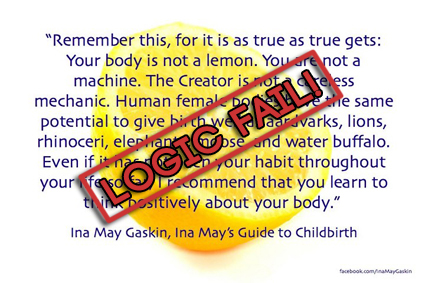
Gaskin lemon logic fail

I can’t decide.

Does Ina May Gaskin really believe the crap that she spews?

Or does she simply have contempt for the intelligence of her followers?

Consider one of the the quotes for which she is best known:

Remember this, for it is as true and true gets: Your body is not a lemon. You are not a machine. The Creator is not a careless mechanic. Human female bodies have the same potential to give birth well as aardvarks, lions, rhinoceri, elephants, moose, and water buffalo. Even if it has not been your habit throughout your life so far, I recommend that you learn to think positively about your body.

What’s the purpose of this quote? Its purpose is to convince women to pay uneducated, untrained birth junkies (lay midwives, DEMs, CPMs) to attend them at birth on the theory that nothing is going to go wrong.

Does Ina May actually believe that nothing is going to go wrong? Or is she simply trying to dupe potential customers into believing it?

Let’s parse the quote:

1. Your body is not a lemon?

Ever notice that it is only natural childbirth advocates who insist that anything less than an idealized birth is a sign that a woman is defective?

I’ve read a great deal of the obstetric literature and I haven’t come across any obstetricians who even tangentially imply that a variation from ideal is a sign of a defect in the individual women. Obstetricians don’t tell women who have miscarriages that they are “lemons.” Indeed, they reassure women that miscarriages are a normal part of human reproduction and they should never blame themselves for miscarriages. They would no more think of a woman who needed a C-section as “broken” than they would think of a woman who needed an appendectomy as broken. It is only NCB advocates who try to convince women that they should be ashamed of complications and avoid that shame by pretending those complications don’t exist.

2. You are not a machine?

In find this particularly ironic since Gaskin’s implication that everyone can have an unmedicated vaginal delivery without complications suggests that she thinks that woman ARE machines that can faithfully churn out perfect children in an endless stream of perfect births. It is she who can’t acknowledge that many variations of pregnancy experiences, complications and outcomes, not medical professionals.

3. The Creator is not a careless mechanic?

So that would explain why no one ever has a miscarriage; there are no birth defects and there is no disease, right? Oops, that can’t be it.

Or maybe it is simple blasphemy, implying as it does that pregnancy complications are something that “the Creator” never intended but was too sloppy to prevent.

Or maybe it simply means that Ina May is a creationist.

4. Human female bodies have the same potential to give birth well as aardvarks, lions, rhinoceri, elephants, moose, and water buffalo?

That’s funny. Why didn’t Ina May invoke animals with which we are familiar like cows, horses, sheep, dogs and cats?

Perhaps it is because she knows that anyone with experience caring for farm animals and domestic pets knows that birth complications, dead offspring and dead mothers are quite common (horse intrapartum mortality is 13.7%; lamb neonatal mortality is 14.3%; among dogs 24.6% of litters experience at least one death), revealing her claim of perfect birth in the animal kingdom to be the lie that it is. How much better to invoke animals that are exotic so that Ina May can pretend that their births are perfect.

So what’s the perinatal mortality rate for aardvarks, Ina May? What is the complication rate for rhinocerous birth? Let me guess: you have absolutely no idea; you just figured that no one else would know, either, so they wouldn’t be able to recognize your claim for the lie that it is.

5. I recommend that you learn to think positively about your body?

Not exactly. Ina May actually recommends that you think unrealistically about your body and then pretend that the diagnosis of pregnancy complications reflects an obstetrician’s desire to insult you.

Now that we’ve parsed the quote, I have to ask:

Who believes this crap? And why?

Inquiring minds want to know.

Jennifer Margulis tries to manipulate Amazon reviews of her book

Margulis Amazon

What’s the difference between a journalist and a hack?

A journalist tries to address substantive criticism of her claims. A hack tries to silence her critics.

You see this over and over again in the world of natural childbirth advocacy. Virtually every natural childbirth website deletes posts that question the received wisdom and bans people who dare to offer scientific evidence that contradicts NCB claims. Partly it is because NCB advocates have an insatiable need for validation of both their personal choices and their preferred view of themselves as incisive thinkers who can’t be fooled by corporate conspiracies. Partly because they recognize that they aren’t equipped to address criticism; they have absolutely no idea of what the scientific evidence shows since they never read it.

Jennifer Margulis wrote an astoundingly crappy and irresponsible book, and she’s being called on it.

As Annie Murphy Paul wrote in the NYTimes:

Inaccurate or inflammatory statements are repeatedly reproduced without adequate substantiation or comment from the other side… Margulis’s treatment of scientific evidence is similarly unbalanced… [U]ltrasound exams of pregnant women may be responsible for rising rates of autism among their children, according to “a commentator in an online article.” This anonymous individual has “used ultrasonic cleaners to clean surgical instruments (and jewelry),” which apparently qualifies him or her to offer an opinion on how the vibration of ultrasound waves may be causing the developmental disorder: “Perhaps this vibration could knock little weak spots in myelin sheeting of nerves or such, I don’t know.”

Amy Wong of the Oregonian offered an equally cutting review:

…Margulis builds her argument mostly on individual parents’ anecdotes, without providing context for whether they represent common experiences. Many of the anecdotes seem to have been selected purely for their shock value. And she frequently describes in detail how mothers suffered at the hands of doctors or nurses apparently without having sought out the doctors or nurses for verification, comment or context. This is not journalism.

I wouldn’t be surprised if Margulis were stung by these reviews, but the appropriate response is to provide the scientific evidence to support her claims, something which she has not done (and possibly believes that she cannot do).

Margulis responds on her Facebook page with this bit of self-serving drivel:

Margulis Silent Spring

Comparing her book to Rachel Carson’s classic Silent Spring? Now that’s funny!

But Margulis has gone further, advising her supporters to manipulate Amazon reviews of her book as demonstrated by the Facebook post at the top of this piece. Margulis is asking her supporters to bury unfavorable reviews so that people browsing Amazon will not be able to find them. I can’t imagine that Amazon would be happy with this attempt at manipulation. Morever, I suspect that the folks at Brandeis’ Shuster Center for Investigative Journalism would take a dim view anyone on its staff responding to substantive criticism in this way.

I’m surprised. Anyone who writes a book as misleading and irresponsible as Margulis’ book isn’t likely to be able to defend her claims against those who present actual scientific evidence, but this response puts her journalistic integrity into question. I would have thought she knew better.

La Leche League is not honest about the risks of co-sleeping

image

One of the best ways to determine if a profession follows scientific evidence is to determine how it reacts to evidence that contradicts established practice.

Obstetricians were convinced that episiotomies prevented more serious tears, but when high quality evidence showed that to be wrong, the rate of episiotomy plummeted. Pediatricians routinely recommended placing infants to sleep on their stomach to reduce the risk of aspiration, but when high quality data showed that the prone position increased the risk of Sudden Infant Death Syndrome (SIDS), they changed their recommendations to placing infants on their backs and the SIDS rate dropped precipitously.

New, high quality evidence now shows that co-sleeping dramatically increases the risk of SIDS among breastfed infants under 3-4 months of age (Bed sharing when parents do not smoke: is there a risk of SIDS? An individual level analysis of five major case–control studies), and the La Leche League is in denial. They base their denial on a “white paper” that insists that the new evidence should be ignored.

The lactivists who wrote this white paper are supremely unqualified to pass judgement on scientific research: 2 are lay people who run parenting blogs, 1 is a nurse, and 2, including Darcia Narvaez, PhD, are an minor faculty in psychology departments. Not surprisingly, they have produced a piece of junk, but to understand why it is so disingenuous, we need to review the study it purports to critique.

The study in question, Bed sharing when parents do not smoke: is there a risk of SIDS? An individual level analysis of five major case–control studies, is remarkably rigorous. The authors set out to answer a very specific question: what is the risk of co-sleeping in breastfed babies whose parents do not smoke or drink?

They found:

…[T]he combined data have enabled the demonstration of increased relative risk associated with bed sharing when the baby is breastfed and neither parent smokes and no other risk factors are present (see figure 2 and table 2). The average risk is in the first 3 months and is 5.1 (2.3 to 11.4) times greater than if the baby is put to sleep supine on a cot in the parents’ room (table 3). This increased risk is unlikely to be due to chance (p=0.000059).

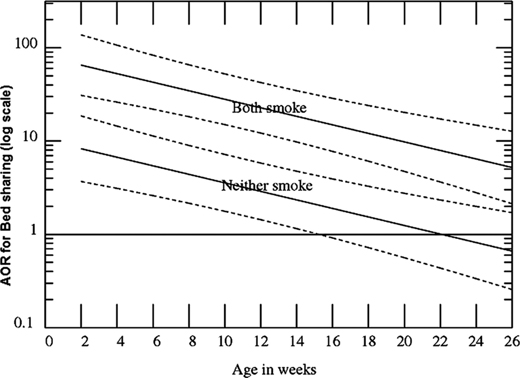
The data is quite robust as demonstrated by the following graph:

Co-sleeping risk of SIDS

The graph shows Adjusted ORs (AORs; log scale) for Sudden Infant Death Syndrome by age for bed sharing breast-fed infants, when neither parent smokes and both smoke versus comparable infants sleeping supine in the parents’ room. AORs are also adjusted for feeding, sleeping position when last left, where last slept, sex, race, and birth weight, mother’s age, parity, marital status, alcohol and drug use.

What is most remarkable is linear nature of the increased risk of SIDS with co-sleeping compared to the risk of SIDS if the baby is sleeping in the parents room, at every gestational age, and regardless of whether or not the parents smoke. Up until the age of 14-15 weeks, co-sleeping always increases the risk of SIDS death.

The authors go so far as to apply Hill’s criteria to their findings:

  • Assessment of bed sharing, in the absence of parental smoking alcohol and maternal drug use, as a causal risk for SIDS by Bradford Hill’s criteria31
  • Strength of association: Adjusted Odds Ratio (AOR) for bed sharing=2.7 (95% CI 1.4 to 5.3), p=0.0027, for breastfed infants with no other risk factors. AOR for the first 3 months of life=5.1 (2.3 to 11.4), p=0.00006. These AORs are moderately strong.
  • Consistent: Of more than 12 published studies, all but two small ones show, after multivariate adjustment, increased risk of SIDS associated with bed sharing, some combined with sofa sharing…
  • Temporally correct: Bed sharing always precedes SIDS.
  • Dose response: New Zealand study showed risk increased with duration of bed sharing. Not otherwise investigated.
  • Biologically plausible: Bed sharing risk is greatest to youngest infants who are most vulnerable.
  • Coherence: The proposition that bed sharing is causally related to SIDS is coherent with theories that respiratory obstruction, re-breathing expired gases, and thermal stress (or overheating), which may also give rise to the release of lethal toxins, are all mechanisms leading to SIDS, in the absence of smoking, alcohol or drugs. Infants placed prone are exposed to similar hazards.

The authors conclude:

… Our findings suggest that professionals and the literature should take a more definite stand against bed sharing, especially for babies under 3 months. If parents were made aware of the risks of sleeping with their baby, and room sharing were promoted, as ‘Back to Sleep’ was promoted 20 years ago, a substantial further reduction in SIDS rates could be achieved.

The white paper touted by the La Leche League condemns the findings of this study and attempts to mislead readers about what the study actually shows.

The authors share two graphs that show how various risk factors (such as infant position, parental smoking and bottle feeding) increase the risk of SIDS. That’s nice, but that’s not what the study is about. The study is specifically about the increased risk of co-sleeping in babies without any risk factors who are breastfed.

The authors insist:

Without consideration of [bedding and temperature], it is not possible to determine that one variable, such as bedsharing itself, is inherently responsible for risk remaining in this study

Really? Is there any reason to believe that the temperature of the bedroom and the blankets on the bed differ between women who breastfeed and those who don’t? Of course not.

The authors continue:

Instead of looking at how each of the variables in the dataset can contribute to risk of infants’ breathing or compromise arousal — the authors focus on whether the act of breastfeeding protects against all risk of SIDS.

Did these women even read the paper? It does not focus on whether breastfeeding prevents all cases of SIDS; it focuses SPECIFICALLY on whether co-sleeping increases the risk of SIDS in babies who are breastfed and finds that it increases the risk by a factor of 5.

The second issue pertains to the risk factors included and not included in the analysis…

Missing from the analysis are other known risk factors: specifically … environmental context (bedding) or infant vulnerability (prematurity)…

But is there any reason to believe that breastfeeding women are more likely to have inappropriate bedding? Is there any reason to believe that breastfeeding women are more likely to have babies who are premature? Of course not.

The lactivists end with this rousing call:

So, let’s stop going around in circles talking about secondary issues and focus on discussion on primary issue: decreasing the risk of SIDS events. If we want to decrease risk of SIDS events, then we must assure infants’ are in the best possible situation to support breathing and arousability.

Apparently they haven’t noticed but that’s EXACTLY what the authors of the original paper are doing. They are looking at an issue that has the potential to dramatically decrease SIDS among breastfed infants.

If trusting birth won’t prevent miscarriage, why would it prevent other life-threatening complications?

iStock_000010636965XSmall

I often write about the fact that homebirth advocates, despite their claims of being “educated” about childbirth, are generally quite ignorant. They lack the basic knowledge of science, statistics and obstetrics that would allow them to evaluate what they read on the Web (or more importantly, to recognize that you cannot become educated by reading on the Web).

Ignorance is not the only deficiency. Homebirth advocates seem to suffer from a serious problem with magical thinking.

What is magical thinking? It’s the belief that your own thoughts have power to “magically” control events. It’s difficult to imagine anything more emblematic of magical thinking than the inane mantra, “trust birth.”

Does trusting hearts prevent heart attacks? Does trusting pancreases prevent type I diabetes? Does trusting breast prevent breast cancer? Obviously not, so how can any grown woman counsel another with a straight face to “trust birth” as a method of preventing life threatening pregnancy complications? And how can any grown woman actually believe that “trusting birth” is going to have any impact on anything?

The idea that women could actually believe that “trusting birth” will have any impact is especially remarkable considering that most women already recognize that trust has absolutely no impact on miscarriage, the most common life threatening (to the embryo) complication of pregnancy. Indeed, miscarriage demonstrates that the philosophy of “trusting birth” is completely farcical.

Your body is perfectly designed to give birth?

Really? Then why do 1 out of every 5 confirmed pregnancies end in miscarriage?

Miscarriages are commonly caused by devastating genetic defects, such as the absence of a chromosome or an extra chromosome. A some point in the reproductive process, during the formation of the the ovum (or the sperm) or during fertilization, a massive genetic error occurs and that error is incompatible with life. No amount of “trust” can prevent these genetic errors and no amount of “trust” can prevent the miscarriages that result.

Let’s think about what that really means: the same body that is supposedly perfectly designed to give birth will create embryos with the wrong number of chromosomes approximately 20% of the time.

How trusting would you be of an airline if 20% of their flights crashed on takeoff and burned killing all aboard? How trusting would you be of an automobile manufacturer if 20% of their cars blew up the first time you turned the key in the ignition? How trusting would you be of a soup maker if 20% of people who consumed it got botulism and died? I suspect that you wouldn’t be very trusting at all. So how on earth can any woman trust any aspect of pregnancy when it ends in the death of the embryo fully 20% of the time?

How does trusting birth prevent a placenta that can’t transfer oxygen fast enough to a baby during labor? How does trusting birth prevent a breech baby’s head from getting stuck, killing the baby? How does trusting birth prevent the mother from having a stroke because of pre-eclampsia, killing her? Obviously it can’t prevent any of those things because “trusting birth” is nothing more than immature wishful thinking.

Why on earth would you think that a process that can’t even manage to assemble the correct number of chromosomes more than 20% of the time is going to result in a baby who fits perfectly, has a perfect placenta, and develops no life-threatening complications?

Simply put, how could any grown woman, with a modicum of intelligence “trust birth”? And how could any grown woman, with a modicum of intelligence, trust any provider who counseled her to “trust birth”?

Please, enlighten me as to why “trusting birth” isn’t among the stupidest possible prescriptions for a healthy baby and a healthy mother.

Raeanne’s stuntbirth plan

Fool Rubber Stamp

Ahh, stuntbirth, also known among aficionados as freebirth or unassisted childbirth (UC).

Stuntbirthers like to pretend to themselves and others that this is how birth happens in nature (no, across all times, places and culture, birth is assisted), that birth is so deeply personal and “sexual” that a couple must experience it alone (really, then why do stuntbirthers post videos of it on YouTube for all the world to see?) and that it is safe. The entire practice would be nothing more than a punch line were it not for the fact that it kills babies. Indeed, both the leading American and Australian advocates of UC, Laura Shanley and Janet Fraser, have ended up with dead babies as a result.

Unassisted childbirth has no benefit for the baby and poses very serious risks. It is a form of medical neglect based on appalling ignorance and extraordinary selfishness and self-absorption. Don’t believe me? Consider Raeanne’s stuntbirth plan, found (where else?) on Mothering. com. Unfortunately, I cannot share the whole inane document, and it will almost certainly be deleted by the folks at MDC when they find that it is being ridiculed, but I can share the high points, starting with the fact that Raeanne dodged a bullet with her first baby (my first was 19 days “late”) and cannot tell the difference between luck and wisdom.

Early labor:

  • Make sure everything is cleaned up and in order in the house (no clothes or toys laying around where Raeanne could trip or bleed on them)…
  • If laundry needs to be washed throw a load or two in.
  • Start dishwasher if needed.

Pretty clever getting her husband to clean the house using labor as an excuse.

Active labor:

  • Maybe recommend a shower too? Help her blow dry her hair if she wants…
  • Remember that sometimes a red/purple line will appear between a woman’s butt cheeks that can indicate how dilated she is. Check for that! If it is slightly below the tailbone she’s at 6 or 7 cm. if it’s at the top of butt crack she is probably around 10 cm! Take a picture so Raeanne can help you analyse…
  • For emergency childbirth procedures refer to Emergency Childbirth by Gregory White!

Yup! In an emergency, just refer to the book. That’ll work.

The baby:

  • Make sure baby is breathing!
  • The most important thing is skin to skin contact (with a blanket draped over mother and baby), hearing familiar voices, a relaxed atmosphere, leaving the cord attached …

It’s hard to imagine that anyone is so ignorant that they actual believe that the “most important thing” is skin to skin contact, but stuntbirth aficionados are nothing if not gullible.

How about postpartum bleeding?

  • If placenta has not been delivered give Angelica: 1 dropper full under the tongue every minute as needed and up to 3 times.
  • If placenta has been delivered give Shepherd’s Purse 1 dropper full under the tongue every minute as needed (up to 3 doses) and a dime-sized slice of the maternal side (membrane side that was attached to the uterus) of the placenta to tuck into her cheek and get baby to nurse asap!
  • Ice cubes on the bottoms of her feet. This causes strong contraction through the sympathetic nervous system, and it also slows circulation and decreases bleeding.

Really? Really??!!

Hopefully Raeanne and her baby will survive her own stupidity, but, if so, that will only be luck … which Raeanne will never realize because she is an ignorant fool.

8 stupid things crunchy expectant mothers say to each other

iStock_000022313387XSmall

Congratulations to the blogger at Hiking the Paper Trail to Parenthood. You win the prize for packing the highest volume of stupid claims into any post of its size!

The blogger, an expectant mother, is so ignorant about childbirth that she is happily transmitting mistruths, half truths and outright lies in her post 8 Things Not To Say to a Crunchy Expectant Mother : A Tirade.

Consider these whoppers:

1. “Women die in hospitals in the US during and after birth.”

Duh. That’s because childbirth is dangerous.

The issue is not whether women die in the hospital during and after childbirth, the issue is the RATE of death compared to the rate of death at homebirth.

2. A completely fabricated, bald faced lie: “The United States of America currently (as of Summer of 2012) has the highest mother and infant mortality rate of every developed country in the world.”

No, not even close. Not to mention that infant mortality is the wrong statistic and that international comparisons of mortality rates are invalid since many countries cheat by counting LIVE premature babies as stillbirths.

3. “Holland, the has some of the best infant and maternal mortality rates in the developed world, with a common 80% of births taking place at home.”

I guess if you are going to make stuff up, you might as well go all the way. The Netherlands has one of the worst perinatal mortality rates in Western Europe and a homebirth rate of 27% and falling. Dutch midwives caring for low risk women (home or hospital) have death rates HIGHER than Dutch obstetricians caring for high risk patients.

4. “My midwives’ rate of patients who end up in Cesarean is less than 4%.”

And what are the death rates of homebirth midwives? Let me guess: the blogger has no clue that LICENSED homebirth midwives attending PLANNED homebirths have death rates up to 800% higher than term hospital birth. Let me guess; the blogger has no clue that the Midwives Alliance of North America (MANA), the organization that represents homebirth midwives refuses to release the death rates of their members because those rates are so hideous.

5. “I have never heard of someone getting a “super germ” like mrsa (a potentially lethal and antibiotic-resistant infection) in their own home.”

Most cases of MRSA (methicillin resistant staph aureus) are “community acquired” not hospital acquired.

6. “Both midwives have the same neonatal resuscitation experience as L&D and NICU staff in a hospital.”

Possibly the stupidest of the many stupid claims in this piece. Most homebirth midwives have NO training in advanced resuscitation, have NO experience in advanced resuscitation, and have NEVER intubated a baby.

7. “There will be medications, IVs and oxygen available if they are needed.”

Will there be an operating room? If not, and you experience a life threatening emergency, your baby will die. Will there be someone skilled in intubation and advanced neonatal resuscitation? If not, and your baby is born needing more than a little oxygen, your baby may die or suffer permanent brain injury. Will there be blood for transfusions? If not, you can hemorrhage to death long before you get to the nearest hospital.

8. “The people who ask this question are the ones to whom information and education have no impact.”

No, honey, you are the one on whom information and education have had no impact because you are the one who hasn’t been exposed to either information or education. Reading the lies of other homebirth advocates on the internet and gullibly believing them is not “education,” it is merely a sign of lack of basic knowledge of science, statistics and childbirth.

Here’s some real information you can use:

Planned homebirth with an American homebirth midwife is the MOST dangerous form of planned birth in the US.

Take down your post, which is utter crap, stop spewing arrant nonsense, and learn some actual facts about childbirth. I guarantee you will be very, very surprised.

World Health Organization: no long term benefits to breastfeeding

Motherhood

Breastfeeding is a good thing. I heartily endorse it; I did it with four children; I really enjoyed it.

But it isn’t nearly as good as lactivists have implied. For example, all those long term health benefits of breastfeeding that you’ve heard about? None of them exist.

Don’t believe me? Perhaps you will believe the World Health Organization.

The World Health Organization recently published Long-term effects of breastfeeding; a systematic review by Horta and Victora. It is a 74 page paper, but it can be summed up in one sentence:

There is no evidence for any long term health benefits of breastfeeding.

The paper is an evaluation of the entire world literature on the long term benefits of breastfeeding and it is divided into individual sections for each purported benefit. These include overweight and obesity, blood pressure, serum cholesterol, type-2 diabetes, and intellectual performance.

In every case, the scientific literature does not support a claim of benefit.

Specifically:

1. Overweight and obesity

Our conclusion is that the meta-analysis of higher-quality studies suggests a small reduction, of about 10%, in the prevalence of overweight or obesity in children exposed to longer durations of breast-feeding. Nevertheless, it is not possible to completely rule out residual confounding because in most study settings breastfeeding duration was higher in families where the parents were more educated and had higher income levels.

In other words, the observed effect is very small and probably due entirely to confounding.

2. Blood pressure

[The] findings are consistent with a small protective effect of breastfeeding against systolic bloodpressure, but residual confounding cannot be ruled out.

Once again, the observed effect is small and probably due entirely to confounding.

3. Cholesterol

Because the confidence interval included the null effect, these results do not support a long-term programming effect of breastfeeding on blood lipids.

4. Type-2 diabetes

The evidence suggests that breastfeeding may have a protective effect against type-2 diabetes,particularly among adolescents. Obesity/overweight seems to account for part of the association. Generalization from these findings is restricted by the small number of studies and the presence of significant heterogeneity among them.

5. IQ

[A]mong those studies that adjusted for maternal intelligence, breastfeeding was associated with an additional 2.19 IQ points… [T]he practical implications of a small increase in the performance in intelligence tests may be open to debate.

Since IQ tests are generally acknowledged to have a standard error of 3 points, there is no difference.

*****

These results are not news. The new study merely confirms the results from the original WHO study of the same name published in 2007.

These results are not surprising. With the exception of IQ testing, the studied outcomes are risk factors for diseases of adulthood and old age.Throughout most of human existence, life span was approximately 35 years, and diseases of old age had little to no impact on the survival of the species. There is no reason to expect there would be much of an evolutionary advantage to avoiding the disease of old age.

In industrialized societies, the benefits of breastfeeding are small and short term. That’s why there is no reason for any mother who chooses bottlefeeding to feel guilty. Breast milk is not “liquid gold.” It’s just milk and confers a few small, short term benefits across populations compared to infant formula.

No, the details of the dispute underlying the lawsuit are not silly

iStock_000022906201XSmall

On Monday Techdirt published yet another piece on my lawsuit against Gina, MPAA Freaks Out: Insists That Having To Consider Fair Use Before Filing A DMCA Takedown Would Be Crazy:

Is it really any surprise that the MPAA suddenly took notice of the case after the EFF filed an amicus brief? The MPAA had to step in and argue why it should be allowed to continued to file millions of DMCA takedowns without having to be that careful about bogus takedowns, because actually having to make sure a work is infringing would be too much work. So, the MPAA basically says, “we should be allowed to stifle free speech with no consequence because OMG PIRACY@!@!!” Yes, that’s a paraphrase, but that’s the crux of the MPAA’s argument.

Like most everything else Techdirt has written about the lawsuit, it gets to the heart of the matter. However, like other published reports on the lawsuit, it gives short shrift to the underlying dispute, claiming that it is silly. I’d like to explain why the underlying dispute is not silly at all, but is deadly serious.

I imagine that people unfamiliar with the history of the case might have been thrown off by the fact that it was triggered by Gina’s incredibly immature posting of herself making an obscene gesture to me, but that was simply the way that she learned about the DMCA process; it has nothing to do with the underlying issue.

As I detail in the legal briefs, the underlying issue is that Gina wanted to silence my voice on the Web because she disagrees with what I have to say. She’s not alone in her feelings; I am anathema in natural childbirth circles because I aggressively challenge their attempts to deny the historical and scientific evidence that shows childbirth is and has always been inherently dangerous, modern obstetrics has dramatically reduced both maternal and neonatal mortality, and most of what NCB advocates believe is stuff that they simply made up.

In my efforts I am no different from paleontologists fighting against advocates of intelligent design; no different from climate scientists fighting against those who would deny global warming; and no different than physicians fighting against anti-choice activists claim (erroneously) that abortions cause everything from breast cancer to depression.

Perhaps at first blush the lawsuit appears to be about two women arguing over “women’s stuff.” But this “stuff” is a matter of life and death. On a regular basis I share stories of babies and mothers who have died because women rejected medical science at the behest of natural childbirth advocates. Far from being silly, the underlying dispute is deadly serious.

If someone can abuse the DMCA process to silence me, it opens the way to others using the DMCA process to silence the immunologists, pediatricians and public health professionals who promote vaccination. It opens the way for climate denialists to use the DMCA process to silence the professionals who have warned us about global warming. And it opens the way for anti-choices activists to use the DMCA process to silence the doctors who point out their lies.

This is about something far more serious than the immature gesture of one blogger now immortalized in the Federal Court Files. It’s about protecting those who convey scientific evidence from those who prefer to pretend that scientific evidence doesn’t exist.