Government report: UK midwives put the lives of mothers and babies at risk

image

I’ve been writing about this topic for years, from Promoting normal birth is killing mothers and babies to, only a few days ago, In the UK babies continue to die on the altar of vaginal birth,

Along the way I’ve written about the preventable death of baby Joshua Titcombe and his father’s heroic efforts to make sure no one else endure the grief he and his wife were forced to endure. And I’ve reported on the strenuous efforts of UK midwives to avoid accountability, In the face of staggering death toll head midwife relentlessly promotes normal birth, and the staggering increase in obstetric liability costs as a result of bad outcomes.

The government of the UK has finally taken notice, producing a report that is scathing in its assessment of midwives:

The Health Service Ombudsman examined the supervision of midwives after a series of reports into a scandal at University Hospitals of Morecambe Bay Foundation trust involving the deaths of 14 babies and two mothers.

It accuses the midwives in failing to carry out even basic monitoring and then attempting to avoid reponsibility for maternal and infant deaths:

The damning report is fiercely critical of subsequent investigations into the deaths by the trust and the local health authority – which it found guilty of “maladministration” for failing to properly probe the deaths.

Under the current NHS system of regulation, local midwives in were asked to investigate their peers following a series of deaths at Furness General Hospital.

Despite clear evidence of serious mistakes made, they found their colleagues did nothing wrong.

There were long delays investigating the deaths, and failures to highlight obvious lapses in care – such as babies not having their heart rates monitored and not being given antibiotics despite being very poorly, the report found.

The report entitled Midwifery supervision and regulation: recommendations for change is restricted to strengthening the weak oversight of UK midwives that allows them to ignore mistakes, fail to learn from them, and avoid accountability.

As if on cue, the Royal College of Midwives promptly moved to avoid accountability and maintain supervision of a system that could not prevent, and has not learned from, multiple maternal and infant death:

RCM chief executive Cathy Warwick said: “Midwifery supervision is a statutory function, is highly-valued by the midwifery profession and, indeed, has been the envy of other professional groups. It is impartial, in that it does not represent the interests of any service provider.”

“In many maternity services, the supervision of midwives can and should make a significant contribution to the protection of women and their babies,” she said. “It is very important that the long-term consequences for high-quality maternity care of further changes are very carefully considered.”

She added: “We must be extremely careful not to lose sight of the benefits of midwifery supervision; we could be in danger of throwing the baby out with the bath water.”

Bravo, Cathy Warwick! Thanks for demonstrating the point of the report: midwife regulation and supervision must be changed because midwives are interested in protecting each other and avoiding responsibility and give woefully short shrift to their legal and ethical obligations to mothers and babies. QED.

The purview of the report did not extend to investigating underlying causes that led to the mistakes themselves. I suspect that the underlying causes are an unholy marriage between the midwifery philosophy and the government’s desire to save money by hiring midwives instead of obstetricians. These midwives are well educated and well trained, but they subscribed to a thoroughly unethical (not to mention scientifically unsupported) elevation of process above outcome. No doubt they’ve decreased the rate of interventions and C-sections. As a result, they have inevitably increased the rate of senseless, easily preventable maternal and infant deaths.

The “Campaign for Normal Birth” benefits midwives, and kills innocent women and children. It must stop immediately or more lives will be lost in UK midwives’ relentless attempts to promote and protect themselves.


The hubris of homebirth midwives

image

Obstetricians are inherently humble.

You can’t attend thousands of births and fail to be impressed with the unpredictability of life threatening complications. They can come out of nowhere. Within minutes a perfectly healthy baby can die from a cord prolapse, a shoulder dystocia or a ruptured uterus. Within minutes a perfectly healthy mother can die from a postpartum hemorrhage, an amniotic fluid embolus or a ruptured uterus.

As proud as obstetricians are of their hard won knowledge and skills, all of us respect the life and death power of childbirth. We are not foolish enough to believe that we can accurately predict the future, so we plan for all possibilities. After all, the lives of our patients and their babies depend on us being prepared.

Homebirth midwives, on the other hand, are rather prideful. They actually think that they can predict unexpected complications is advance. They show precious little respect for the awesome life and death power of childbirth, reassuring women (falsely) that there will be plenty of time to transfer to a hospital in case of an emergency, even though there is no transfer fast enough to save the life of a baby in the case of cord prolapse, shoulder dystocia, or the need for an expert resuscitation with intubation.

Obstetricians are humble enough to recognize that “normal childbirth” is a retrospective diagnosis. Homebirth midwives, on the other hand, presume to make that diagnosis in advance. Indeed, they presume to make that diagnosis even when a pregnancy is known in advance to be high risk. In their ignorance and hubris, they simply reclassify high risk situations, like breech, twins and VBAC, as “variations of normal.”

Moreover, they impute bizarre, impossible skills to themselves such as preventing and curing pre-eclampsia with diet, turning breech babies by shining lights at the vagina, or stopping postpartum hemorrhage by shoving a piece of placenta under the mother’s tongue.

Is it really surprising, then, that homebirth midwives have hideous perinatal death rates, so hideous that the Midwives Alliance of North America has spent nearly 5 years trying to hide their own death rates? Hardly.

Any woman contemplating homebirth needs to understand that when homebirth midwives say “trust birth,” what they really mean is “trust me; I can predict unpredictable complications in advance, and assure you before the fact that nothing will go wrong.” What they really mean is “don’t show respect to birth; show respect to me and my awesome ability to see the future.”

There’s an old saying, “pride goeth before the fall.” The extraordinarily high rate of preventable death at homebirth reflects the outsize pride of homebirth midwives.

Unfortunately, it is babies and mothers who take the fall.

Just another variation of normal at homebirth

image

Woohoo! The Facebook page of Elder Midwives is a comedy goldmine!

Indeed, I am beginning to wonder if it is real or a parody, since it’s difficult to imagine anyone as thoroughly clueless as these supposedly experienced “midwives” are.

Consider this gem:

I want all your opinions! I have a new client who wants to birth at home so bad it breaks my heart. She may go US. She was in a car accident 2years ago and had surgery on her saccrum, where they placed a rod with screws. After the surgery she had an embolism in right lung. She was on Coumadin til she got pregnant, then was placed on Lovenox, and will be put Heparin at 36 weeks til birth. She feels none of these things put her at risk. I have not said I will attend, told her I have never faced these things, and would have to do some research before I commit. Have any of you faced either of these conditions? I’m off to look up these drugs.

Ii suppose that we should be grateful that this “midwife” hesitated, but the fact that she is even considering attending this birth is pretty horrifying. She has no idea what any of this means, but even she ought to know that this is not a low risk birth. Doesn’t that mean she is obligated to counsel that she is an inappropriate patient for homebirth under any circumstances, since homebirth midwives are only trained in “normal birth”? Apparently not.

Her colleagues are no less ignorant and irresponsible as she:

Has she done her research?

And:

I wouldn’t be overly concerned about the sacrum. Can you do a VE and see if there is any movement, but I would think even if there isn’t the pelvis and baby will adjust for it, just might mean more pushing.

And this astounding bit of blatant ignorance:

the goal of these meds is to make women who are hyperclotters into normal clotters — so theoretically — they should hve normal bleeding response if the levels are correct.

Wrong. These drugs are dosed to give the patient an abnormally prolonged clotting time.

Bur my personal favorite response comes from a patient:

i was on coumadin before my last pregnancy, then was on clexane during, due to previous postpartum cardiomyopathy and stroke at a later date. I had a moderate PPH after that pregnancy (my 4th) where as I had no previous history of bleeding… I chose to free birth again – mostly because I coudn’t get an attendant of any description. I am 25 weeks pregnant again at the moment, and this time I have decided to treat my tendency to coagulate naturally via lumbrokinase, nattokinase, and earthing…

So let’s see if I get this straight. A history of cardiomyopathy, stroke and postpartum hemorrhage. Just another variation of normal, amirite?

No artificial medications for her. She’s “treating” her increased risk of thrombo-embolism, not with evil heparin, naturally occurring in and harvested from mammals, but lumbrokinase obtained from earthworms and nattokinase from soybeans. Because, really, what could be closer to human anti-clotting compounds than those from earthworms?

I hear you asking: what’s earthing? No, silly, it’s not putting dirt on yourself. That would be ridiculous. It’s “an important health discovery!

The practice of using the earth’s energy is called “earthing” and entails “grounding” a person to the earth much as an electrical current is grounded.

See, doesn’t that make sense?

As I say, the Elder Midwives are comedy gold … unless, of course, you stop to consider that the lives of mothers and babies are routinely put at risk by these fools. But what’s more important, really? Whether midwives can find enough paying clients or whether mothers and babies live or die?

Obviously, a midwife’s opportunity to get a birth junkie high is far more important that trivial matters like life and death.

Natural childbirth advocates: it’s all in your head!

The Pot Calling The Kettle Black

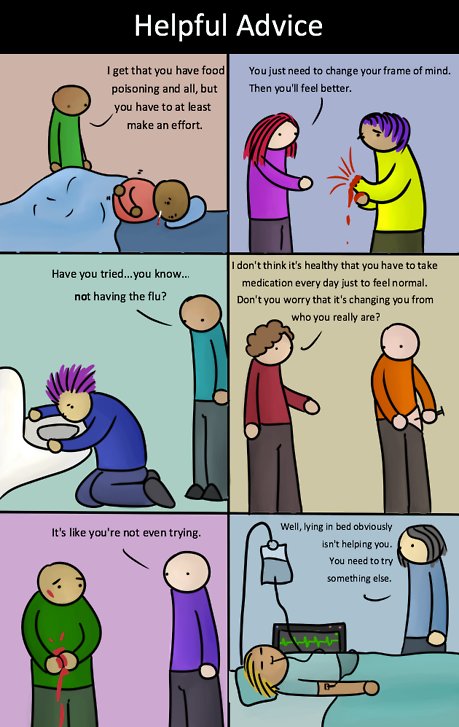
I came across this comic on Facebook. It originated with NAMI of Oregon, an organization devoted to helping people with mental illness, and it was designed to satirize the way that people often chide those with mental illness, as if the illness were a choice or as if simply changing outlook would cure it. It asks us to think about the way we would react if physical illness were brushed off the way that mental illness often is.

NAMI comic

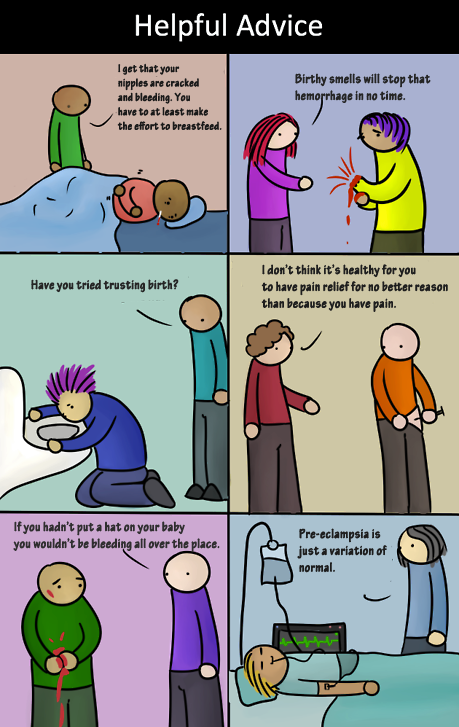
The comic was being shared because someone thought that the memes were strikingly similar to those of natural childbirth advocacy.

That got me thinking:

NCB comic

In the world of natural childbirth, women’s needs ARE brushed off as if they are irrelevant or if their pain or illness or complications were there fault and could easily be treated with a better attitude and trust in birth.

The original comic is also being shared on the Facebook page of a prominent homebirth advocate who complains that she has heard these memes used to denigrate those with psychiatric issues. She fails to see that she (and other natural childbirth advocates), use exactly the same memes — the same blame, dismissiveness and insistence that the very real pain and suffering of laboring women could be easily controlled if they simply thought the right thoughts — to belittle women who choose pain relief in labor, experience pregnancy complications, or accept (or even request!) interventions in childbirth.

Ironic, isn’t it?

Have natural health advocates ever been right about anything?

Alternatives

Anti-vaccinationists have a perfect record. In the 200+ years since vaccine rejection came into being (shortly after vaccines came into being) they have been wrong about 100% of their claims.

Pretty impressive, no? Yet, there are still vaccine rejectionists despite the fact that their all time batting average is zero.

That got me thinking. Have advocates of alternative health ever been right about anything?

I’m not referring to whether individuals believe that a particular method of alternative health, like homeopathy or chiropractic cured their cancer. I’m looking for examples where alternative health advocates proposed a new treatment for a specific disease or disability and scientific evidence ultimately vindicated their claims. Or they offered specific claims of harm for a specific vaccine or medication and scientific evidence was found that substantiates it.

I can think of one minor example. Natural childbirth advocates oppose pretty much all obstetric interventions on the grounds that they are ineffective or harmful. It turns out that they were right about episiotomies, a procedure designed to prevent vaginal tears that may actually increase them.

But there must be other examples somewhere, right?

Help me out. If you can think of any alternative health “treatment” that has ever been demonstrated to actually work, please let me know.

Oh, look, another Western, white*, well off woman using her body to feel superior to other women

Young woman isolated  - surprise

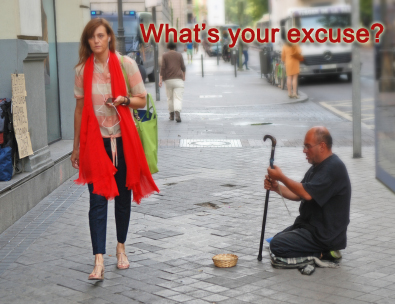
Maria Kang is shocked, shocked that anyone could have misinterpreted her “playful” suggestion as hate speech.

Kang has sparked internet discussion with this image, posted on her Facebook page:

mariakang

And like other vicious women taken to task for making women feel bad, she thinks SHE is the one who is being discriminated against:

Will a “real woman” please stand up? In the age of Photoshop, plastic surgery and celebrity idolatry, it seems women are constantly debating what is considered a “real” woman. And, as I found out recently when I posted a picture of myself looking fit and healthy in workout clothes with my three sons (playfully asking the question “What’s your excuse?”), apparently I don’t count. My voice as an apparently nonreal woman counts so little, in fact, that Facebook recently banned me temporarily from the site — shutting down my account for almost three days for supposedly violating the site’s terms of service — after a number of users flagged a post of mine venting about the damaging culture of fat acceptance. After my post had garnered thousands of likes, comments and shares, these users apparently reported what I wrote as “hate speech.”

Maria is right. Her image is not hate speech. It is hateFUL speech. And it is depressingly familiar. Yet another Western, white, relatively well off woman promotes the notion that women should be judged by the functions of her body, not the power of her mind or the accomplishments she has achieved or the people she has aided.

And like natural childbirth advocates who think women’s virtue is located in her vagina, or lactivists who believe that women’s virtue is embodied in lactating breasts, Maria thinks women’s virtue is determined by how closely they approximate the Western, white ideal of the thin and toned body.

Not suprisingly, King justifies her viciousness by appeals to “science.”

Overweight women are now standing up (often half-naked) in defiance, exclaiming: “I have a beautiful ‘curvy’ body” and “This is what a real woman looks like.” These campaigns send a message that being overweight is normal…

Constant campaigns promoting self-acceptance and embracing one’s curves are placing the psychological need for a positive body image ahead of health. When you normalize a problem you create complacency. After all, you can’t fix a problem if you don’t see a problem…

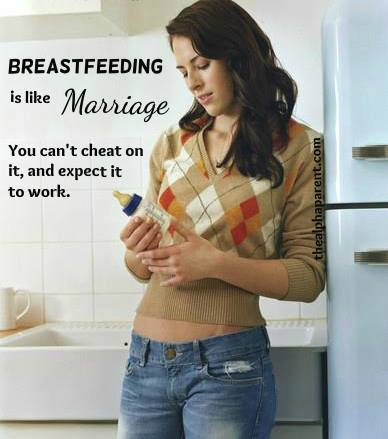
Sound familiar? It should. Consider the lactiviciousness of Allison Dixley, the self-proclaimed “Alpha Parent”. She posted this gem:

breastfeeding is like marriage

Wow, what a coincidence! This picture also depicts a Western, white woman who is thin and toned.

And she also attempts to justify a hateful meme.

Aside from the important supply-related issues, there is also the fact that combination feeding dilutes much of the protection afforded by breastfeeding the way nature intended … To use the marriage analogy: a marriage can still exist when cheating has occurred; likewise breastfeeding can still exist when supplementation has occurred, but it will not ‘work’ as nature intended. Both mother and baby will not reap the normal physiological advantages.

Yet another startling coincidence! Both women justify their viciousness by appeals to “the science”; King appeals to “the science” about obesity and Dixley to “the science” about breastfeeding.

Charlotte Faircloth, a sociologist of parenting, has written about the abuse of science by lactivists (‘What Science Says is Best’: Parenting Practices, Scientific Authority and Maternal Identity) and her words have relevance for Kang’s abuse of “the science” of obesity.

When ‘science’ says something is healthiest for infants, it has the effect, for [lactivists], of shutting down debate; that is, it dictates what parents should do…

… [U]nder the assumption that science contains ‘no emotional content’, a wealth of agencies with an interest in parenting – from policy makers and ‘experts’ to groups of parents themselves – now have a language by which to make what might better be termed moral judgements about appropriate childcare practices. [But] ‘Science’ is not a straightforward rationale in the regulation of behaviour, rather, it is one that requires rigorous sociological questioning and debate in delimiting the parameters of this ‘is’ and the ‘ought’.

Kang, who judges women by their weight, justifies it with a similar appeal: it’s okay to be vicious to overweight women because being thin is “healthier.” Leave aside for the moment the fact that the scientific evidence actually shows that being slightly overweight is healthiest. The point is that both Dixley and Kang are exponents of health moralism, the practice of moralizing personal choices by appeals to “health.”

This is just an new gloss on an old phenomenon, the locating of women’s value and worth in the function or appearance of their bodies.

It is long past time for us to take a stand against viciousness masquerading as concern about health. Do we want our daughters to believe that their worth resides exclusively between in their breasts, across their flat, toned abdomens and in their vagina? Or do we want our daughters (and our sons!) to recognize that their worth is in the content of their character, the way they use their natural gifts, and how they treat others, including others who differ from themselves?

Here’s the meme I’d like to see:

iStock_000028624238XSmall copy

I’m not holding my breath, though. Images that question privilege are not nearly as popular as those that further entrench it.


*Someone pointed out to me that Kang is Asian-American. Nonetheless, she promotes the Western, white, well off ideal of the female body.

In the UK, babies continue to die on the altar of vaginal birth

iStock_000003296116XSmall

It’s inevitable, really. When you elevate the process of birth over the outcome, you have to expect that babies are going to die preventable deaths.

That’s precisely what has been happening in the United Kingdom. Driven in part by the immoral, self-serving UK midwifery obsession with vaginal birth, babies who could have easily been saved by C-section are dying at vaginal birth. Driven by the desire to save money in the short term by reducing the C-section rate, the National Health Service has experienced an appalling explosion in liability costs for dead and brain injured babies.

I’ve written in the past about this deadly obsession with vaginal birth:

Promoting normal birth is killing babies and mothers
Midwife : UK deaths result of failing to meet the needs of … midwives?
New document on British maternity services is fundamentally unethical

Not surprisingly, the amount of money paid for bad outcomes and the cost of insurance coverage have skyrocketed (A fifth of maternity funding spent on insurance):

Public Accounts Committee chairwoman Margaret Hodge said it was “absolutely scandalous” that £482m was spent on clinical negligence cover last year.

The MP’s comments came as a National Audit Office report shows that the NHS in England forks out the equivalent of £700 per birth on such cover.

The most common reasons for maternity claims are mistakes in the management of labour or Caesarean sections and errors resulting in cerebral palsy, the NAO report states.

In other words, the obsession with vaginal birth and the concomitant obsession with lowering the C-section rate have led to an appalling number of infant injuries and deaths.

Those are the stark facts, but sometimes it takes a story to really drive the point home. Beatrix Campbell has lived such a story and today she tells it in the Mail Online, ‘I begged for a Caesarean – but the midwife refused and my baby girl died: As minister holds maternity summit, a mother’s angry open letter. The letter is published in response to a government sponsored maternity being held today.

I wish I could reprint the entire piece because it is both brilliant and appalling, but I can only offer quotes.

My daughter Alexandra suffered a barbaric death at just three days old as a result of appallingly substandard care in 2009.
So I hope today’s seminar will be a soul-searching event. Top of the agenda should be last month’s horrifying finding by the National Audit Office that the number of lawsuits involving ‘obstetric damage’ is rising – as well as ‘significant and unexplained variations in rates of obstetric complications and interventions’.

Behind the jargon there are the stories of babies left with a lifetime of brain damage or, worse, stillborn or dying soon after birth. Stories of babies like Alexandra.

Why does this happen?

What is going wrong? One of the major problems is the conveyor belt mentality that pervades some maternity units.

This is based on the extraordinary idea that there’s a right and wrong way to give birth – natural childbirth is ‘good’, while women who have problems during labour are failing or are even making trouble.

What happened to Alexandra? Her mother was admitted to the hospital for a postdates induction at 42 weeks of pregnancy:

So, 30 hours after the induction had started, with the birth canal still barely dilated, I begged the midwife to organise a Caesarean. I was shocked that the request was brusquely refused as unnecessary. From then on, I was a silly girl making a fuss.

When I requested a second opinion and asked to see the consultant obstetrician, with my husband Craig repeating the request, we were ignored.

If the team had followed national guidance, based on the evidence on what makes for safe obstetric care, I would have had surgery at that point.

Indeed, in its internal inquiry into the death of Alexandra, the hospital acknowledged that our daughter could have, and most likely would have, lived had she been delivered by Caesarean at that point.

Why was Beatrix denied the C-section that she both needed and requested?

At the time of her birth, the World Health Organisation had quotas in place to decide how babies should be born: a hospital should allow no more than 15 per cent of all births to be Caesarean – Britain’s current rate is 25 per cent. That was being ignored as unscientific in many units. After all, how could a decision on safe birth be decided by quota?

Indeed, the quota was withdrawn in 2010 amid a scientific scandal over evidence that it had been drawn up virtually at random.

So Beatrix was forced, without her consent, into a mid-forceps rotation and delivery with Kielland forceps.

Without explanation, I was transferred to an operating theatre where an untrained and unsupervised junior doctor turned Alexandra’s head without moving her body, injuring her brain and spinal cord so badly she was unable to breathe on her own. She was left so severely brain damaged she was on a ventilator for three days before she died in my arms.

What has the health service done in the wake of Alexandra’s death?

Yet four years after Alexandra died we have not received a proper apology from the hospital and we know there has been no disciplinary action against the junior doctor who effectively killed our daughter or the senior doctors who failed in their responsibility to do no harm.

Edinburgh Royal Infirmary carried out an inquiry of sorts conducted by the senior doctor and midwife most closely implicated in Alexandra’s death.

At a meeting with us, they added insult to the terrible injury we’ve suffered by informing us we were ‘just unlucky, very unlucky’.

I was told by a senior midwife that I must keep quiet about Alexandra’s death because the incident might frighten future patients…

In other words, nothing has been done.

So more babies will continue to die on the altar of vaginal birth, and the payouts for obstetric disasters will continue to rise. That’s the price for focusing on process instead of outcome.

Apparently British health authorities are willing to pay extraordinary amounts of money to increase the vaginal birth rate and decrease the C-section rate. And British babies are forced to pay the price with their lives.

I’ve found the perfect hat for the naturally born baby!!

iStock_000016964581XSmall

Thank goodness for geniuses like Carla Hartley of “trust birth” fame. She intuited that putting one of those cute knit hats on a baby to prevent heat loss after birth actually can harm the baby’s health for the rest of its life AND precipitate maternal postpartum hemorrhage.

The sheeple of the homebirth movement (get it? knitting? sheeple?) having been falling all over themselves to embrace this new form of “defiance.”

The nitwits (knitwits?) at Modern Alternative Pregnancy have this to say (Take it Off: Why You Should Drop Your Newborn’s Hat):

Mothers and babies are wired by nature to recognize each other’s smell. Your baby can recognize you on scent alone, and you can recognize your newborn on scent alone. These smells cause the two of you to bond strongly, right away…

The smell of your new baby’s head isn’t just important for bonding, it’s important for your safety and baby’s well-being. The olfactory system expects certain cues right after your baby is born – these cues are supplied by the smell of your baby’s head as you snuggle with him or her after birth (it’s an even stronger cue than breastfeeding).

This trigger to your olfactory system (and limbic system) cues a massive rush of oxytocin, the “mothering hormone.” Oxytocin causes your uterus to contract, which shears the placenta from the wall of the uterus and forces an instant constriction of the blood vessels that were running to the placenta. This means a safe, effective third stage of labor for you (Odent, 2013).

There’s really no limit to the gullibility of these fools, is there?

But wait! I have found a solution for the terrible problem of hatting! The solution is vaginal knitting.

Yes, you heard that right. Vaginal knitting as practiced by this self-styled “craftivist.”

vaginal knitting

According to the Mirror (Artist shoves ball of wool up her VAGINA to knit with it for a month):

Casey Jenkins from Melbourne, Australia, wanted to do something unusual with her knitting to make women’s private parts appear less “shocking or scary”…

She pulls the thread straight out of her vagina and knits streams of yarn in front of an audience.

This is how you can create the perfect hat for your naturally born baby. Shove a ball of yarn up your vagina immediately after birth (there should be plenty of room, enough for the economy size) and knit a hat imbued with those birth smells that are so important.

It might be a little uncomfortable, but then again, it might be arousing. According to Casey, who continues vaginal knitting during her period:

For starters, when I’m menstruating it makes knitting a hell of a lot harder because the wool is wet so you have to kind of yank at it.

“It’s sort of slightly uncomfortable sometimes, arousing sometimes.

Birth orgasms are so 2013. I predict that vaginal knitting orgasms are the wave of the future.

So there you have it, my solution to the outrageous hospital plot of hatting newborns, designed to destroy bonding and promote postpartum hemorrhage.

Vaginal knitting of newborn hats allows babies to keep their birthy smells and wear them, too.

Birth as performance art — literally

totally NSFW

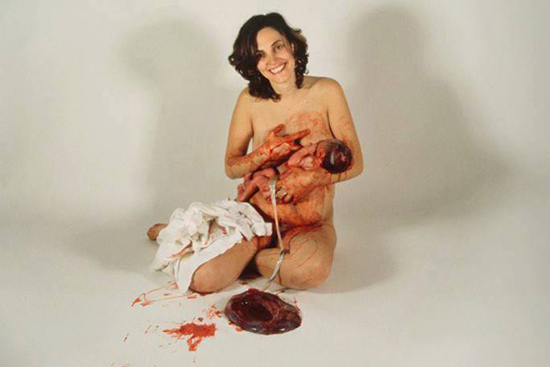
This picture has been making the rounds on Facebook.

Click here to see it if you dare. It’s very bloody, and, once seen, cannot be unseen.

The image is so obviously staged that I wondered whether it was even real. It is. And it is a piece of performance art by an actual artist.

According to the artist, Ana Alvarez-Errecalde, this is a portrait of her in the aftermath of the birth of her daughter.

With this documental self-portrait (without Photoshop or any kind of image manipulation) of myself giving birth I want to challenge most of maternities in films, advertising and all of art history.

Without image manipulation? Not exactly, since the photo is staged on a photographic background and the mother has at least washed her face and combed her hair.

Interestingly, the artist wanted to show that birth is NOT sacred:

These maternities re-enforce the stereotypes that impart from heterosexual masculine fantasies, in which exist the duality of the mother/whore, making sacred all that has to do with the “mother” (maternity with veil included).

And:

By giving birth I take off my “cultural” veil. My maternity is not virginal, not aseptic.

Well, yes, birth is not virginal.

Had she stopped there, she would have distinguished her art from the “look at me and be impressed” school of birth performance art. But she too wants you to look at her and be impressed.

I am the protagonist. I am a hero.

Umm, no. You are not a hero, any more than you are a hero when you digest your food and absorb oxygen through your lungs.

And if she’s the hero, what is the baby? Nothing apparently, just another prop in the world of birth performance art.

Henci Goer: Sure, homebirth is dangerous in reality, but what about in theory?

What if analysis

I almost feel sorry for Henci Goer. She has styled herself an advocate of evidence based obstetric practice, but the evidence continues to mount that homebirth, which she supports, increases the risk of perinatal death.

What evidence?

  1. Well, there’s the CDC data on planned homebirth, collected since 2003, that consistently shows homebirth to have a death rate 3-7X higher than comparable risk hospital birth.
  2. There’s the data from Colorado that shows that homebirth has a death rate more than 15X higher than expected.
  3. There’s the data from Oregon, probably the most definitive American dataset, that shows homebirth has a death rate 9X higher than comparable risk hospital birth.
  4. There’s the Birthplace Study from the UK, rigorously controlled for all possible risk factors, which still showed that homebirth increases the risk of adverse outcomes.
  5. There’s the Grunebaum study that shows that homebirth increases the risk of 5 minute Apgar score of 0 by nearly 1000%.
  6. There’s not a single study of homebirth with a CPM (certified professional midwife) that shows it to be safe; the Johnson and Daviss study is a bait and switch.
  7. The Midwives Alliance of North America (MANA), the organization that represents homebirth midwives, has been hiding its own death rates for nearly 5 years, while simultaneously boasting about the low rate of C-sections and interventions in the same group.

But Goer is still out there gamely trying to put on a brave front. This is especially impressive since she tries to have some integrity. Unlike MANA and its executives, who simply issue bald faced lies, and refuse to correct them even when it is pointed out they are lies, Goer tries to stick to the truth.

And now she’s been reduced to this: acknowledging that in practice homebirth increases the risk of death, but wondering what might happen theoretically.

Her latest piece of the Lamaze International blog Science and Sensibility is Safe at Home? New Home Vs. Hospital Birth Study Reviewed by Henci Goer.

The paper Goer reviews is yet another that shows that homebirth increases the risk of death. The paper is Selected perinatal outcomes associated with planned home births in the United States by Cheng, Snowden, King and Caughey. I had the pleasure of participating in a panel with Dr. Caughey at the ACOG conference in Maui and reviewing the dangers of homebirth.

The study looked at 2,081,753 births term singleton live births in 2008 in the United States. Of these, 12,039 births (0.58%) were planned home births. The authors found:

Women who were multiparous,35 years old, of non-Hispanic white ethnicity/ background, married, and college-level education or higher were more likely to have planned home births. Women who had planned home births had lower rates of obstetric intervention than those who gave birth in hospitals.However, neonates of planned home births were more likely to have critically low 5-minute Apgar scores (<4) and seizure activity, both of which are known prognosticators of neonatal death and poor neurologic outcomes such as cerebral palsy and longterm developmental impairment.

Goer doesn’t really quibble with the fact that the study shows that in practice, homebirth increases the risk of adverse outcomes. Instead, she tries to divert attention away from reality by musing about theory.

Goer claims:

To begin with, the relevant question isn’t the tradeoffs between planned home birth per se and hospital birth. It is: “What are the excess risks for healthy women at low risk of urgent complications who plan home birth with qualified home birth attendants compared with similar women planning hospital birth?”

That’s nothing more than wishful thinking. Goer’s target audience is women considering homebirth. They want to know whether choosing homebirth puts their babies at risk. In other words, they want to know what actually happens. It makes no difference to them whether homebirth might be safe in a theoretical world that doesn’t exist.

Goer is shocked, shocked that women with high risk conditions are giving birth at home:

Not all women planning home birth were low-risk. For one thing, women with prior cesareans were included. For another, the methods section states that the analysis adjusted for medical risk, and the discussion notes that women with prior children in the home birth group were more likely to have babies with low Apgar scores even after removing women with medical risk, which implies that some of them had medical problems.

Yet, I’ve never seen Goer criticize MANA or the many state groups of CPMs who consistently lobby for increasing scope of practice to embrace high risk conditions.

And Goer is shocked, shocked that not all homebirth midwives are actually qualified to represent themselves as midwives:

Not all women in the home birth group had qualified home birth attendants. Outcome data on the overall population came from women recorded as being attended by MDs, DOs, “other midwife,” “others,” and “unknown/not stated” as well as by professional midwives.

But that’s hardly the problem. “Professional” midwives, such as CPMs have hideous homebirth death rates.

Then, as homebirth advocates typically do, she cites studies from foreign countries that have higher standards for midwives, dedicated transport systems, and greater integration into the hospital system. Look, look, see the Netherlands and Canada!!! Well, in the first place, we are not talking about those countries, and in the second place, the Netherlands has nothing to boast about. Low risk births attended by midwives (home or hospital) have HIGHER death rates than high risk births attended by obstetricians.

Goer’s conclusions are rather bizarre, since they aren’t supported by anything she presented:

Women desiring home birth should have access to professional midwifery care, which argues for making CPMs legal in all 50 states.

But legal, licensed CPMs in Colorado and Oregon have extraordinarily high death rates, so that’s obviously not the answer.

Second, less than optimal candidates are birthing at home, and some women may be continuing labor at home who shouldn’t… [H]ospital-based practitioners need to address the behaviors, practices, and policies that drive women away from hospital birth.

No, Henci, that conclusion is unfair to the women choosing homebirth in high risk situations. They are not deliberately choosing unsafe birth. They’ve “educated themselves” to believe that homebirth in high risk situations IS safe, in part by reading pieces such as the one you have just written, and by listening to the counsel of CPMs.

The correct conclusion is precisely the opposite: Homebirth proponents like Goer need to address their own rhetoric to determine why women are reaching the erroneous conclusion that homebirth is a responsible choice even in high risk situations.

Personally, I would have written a shorter, crisper analysis of this study:

  1. It is yet another study that shows that planned homebirth in the US increases the risk of death.
  2. It is very valuable because it represents the real world risk that women should contemplate when choosing homebirth.
  3. It doesn’t matter whether homebirth is safe in some other country or in some theoretical world that doesn’t exist.
  4. We need to have much higher standards for midwives; the CPM is grossly inadequate.
  5. Homebirth midwives and advocates need to do a great deal of soul searching to determine where women are getting the idea that homebirth is safe in high risk conditions.

I feel for Goer. She’s staked out a position that homebirth in the US is safe, and it clearly is not. Unlike MANA and other homebirth advocates, she appears to have some integrity. Therefore, she should start telling women the truth. Homebirth in the US increases the risk of death compared to hospital birth. Unless and until she does that, Goer is part of the problem, not part of the solution.

Dr. Amy